Homes shaped around makers rarely remain static. Objects accumulate, collections expand, and daily rituals gradually inscribe themselves onto the architecture until the distinction between living and making begins to dissolve.
In a 1,200 sq. ft. apartment in Bengaluru, Jois Design House has translated that reality into a carefully composed interior. Conceived for a creative homeowner whose pursuits span painting, baking, performance, and collecting, and whose collection includes more than two hundred heirloom sarees, Rasa was envisioned as a home where a lifetime of acquisitions could coexist with the evolving rhythms of family life.. Principal architect Ananya Jois stripped the apartment back to its shell before rebuilding it entirely, crafting an Indo-modern environment that allows memory, craftsmanship, and contemporary living to occupy the same space without hierarchy.
The home’s intent becomes apparent from the outset. Walls recede into the background while joinery, texture, and collected objects assume the role of storytellers. A solitary textured wall in the living room carries visual weight precisely because restraint governs everything around it. Rather than competing for attention, the architecture acts as a quiet framework, allowing the family’s artworks, heirlooms, and personal narratives to define the character of the home.
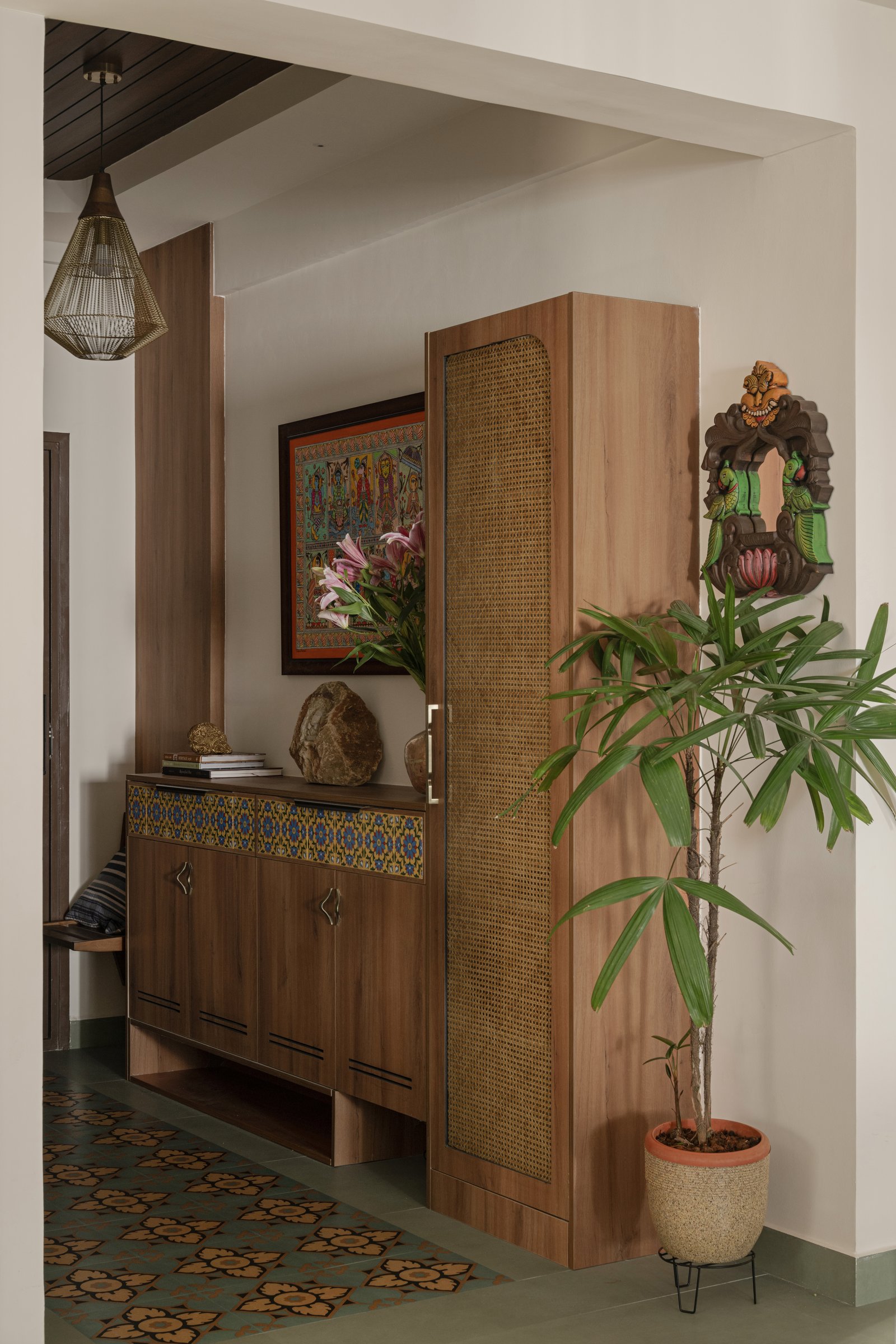
The foyer establishes the home’s design language before the apartment unfolds fully. Encaustic tiles patterned in warm shades of ochre and terracotta define the threshold, leading to a bespoke wooden console accented with handcrafted tile inlays and a tall cane-fronted cabinet that discreetly conceals utility functions behind a breathable screen. A Madhubani artwork and a carved gavaksha-inspired wooden mask lend the space a sense of cultural continuity, introducing the layered dialogue between craft, memory, and contemporary living that runs throughout the home.
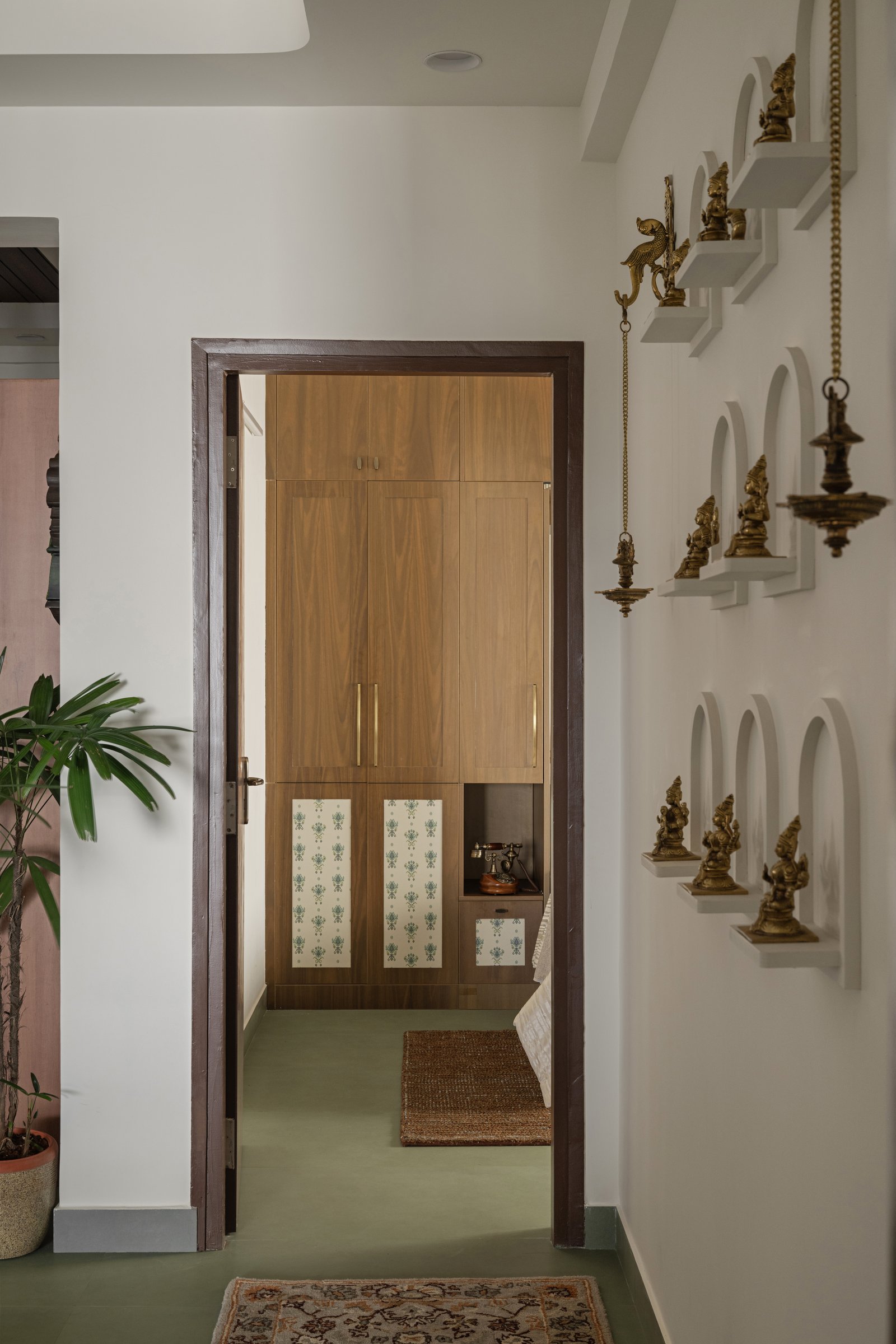
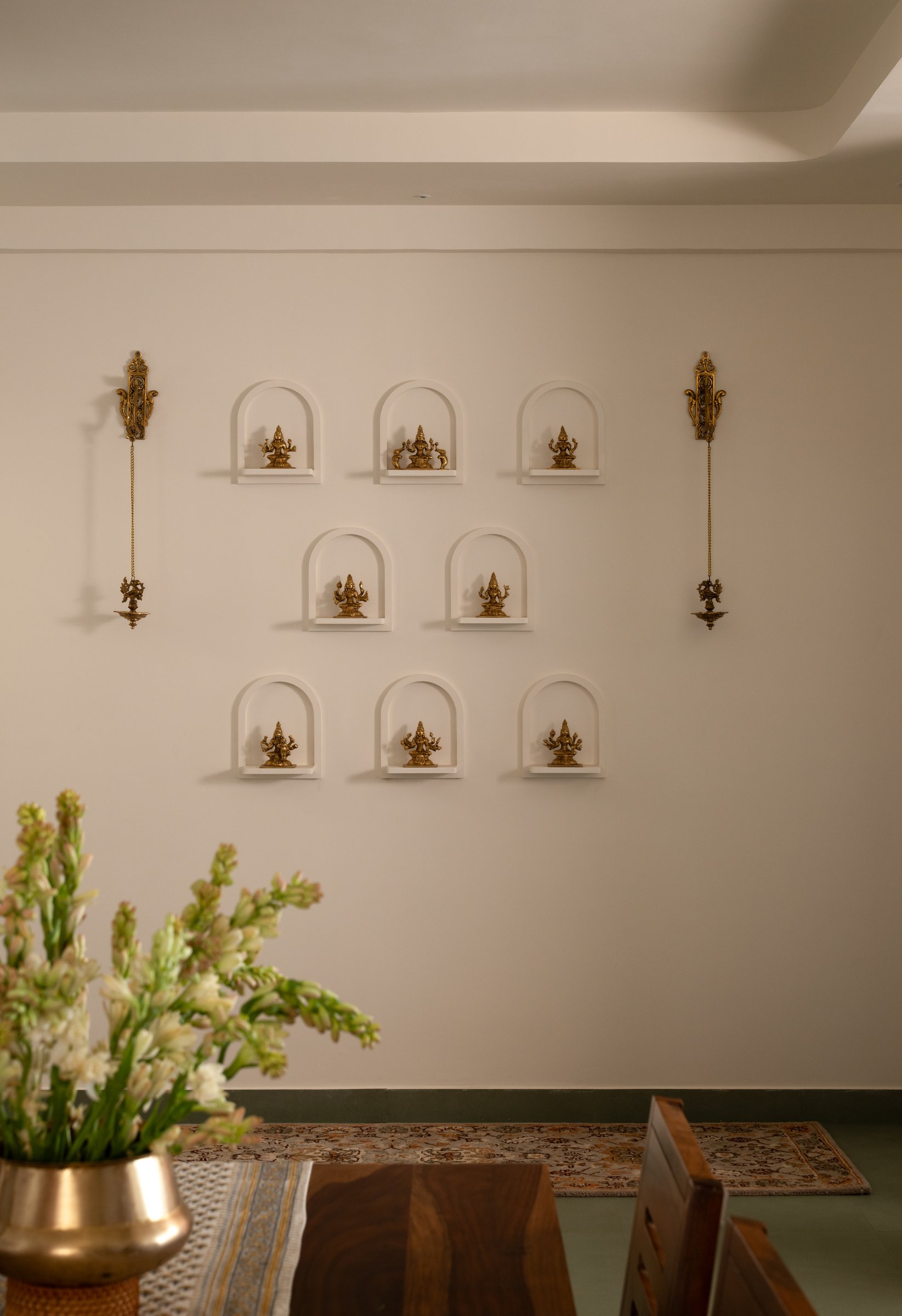
Beyond the entry, a corridor unfolds into one of the home’s most considered moments: a wall of arched plaster niches housing a curated collection of brass deities, framed by suspended diyas hanging delicately from long chains. The composition elevates an otherwise transitional space, transforming a simple passage into a place of pause and reflection. In doing so, it introduces ritual into the everyday, allowing architecture to quietly participate in the rhythms of daily life.
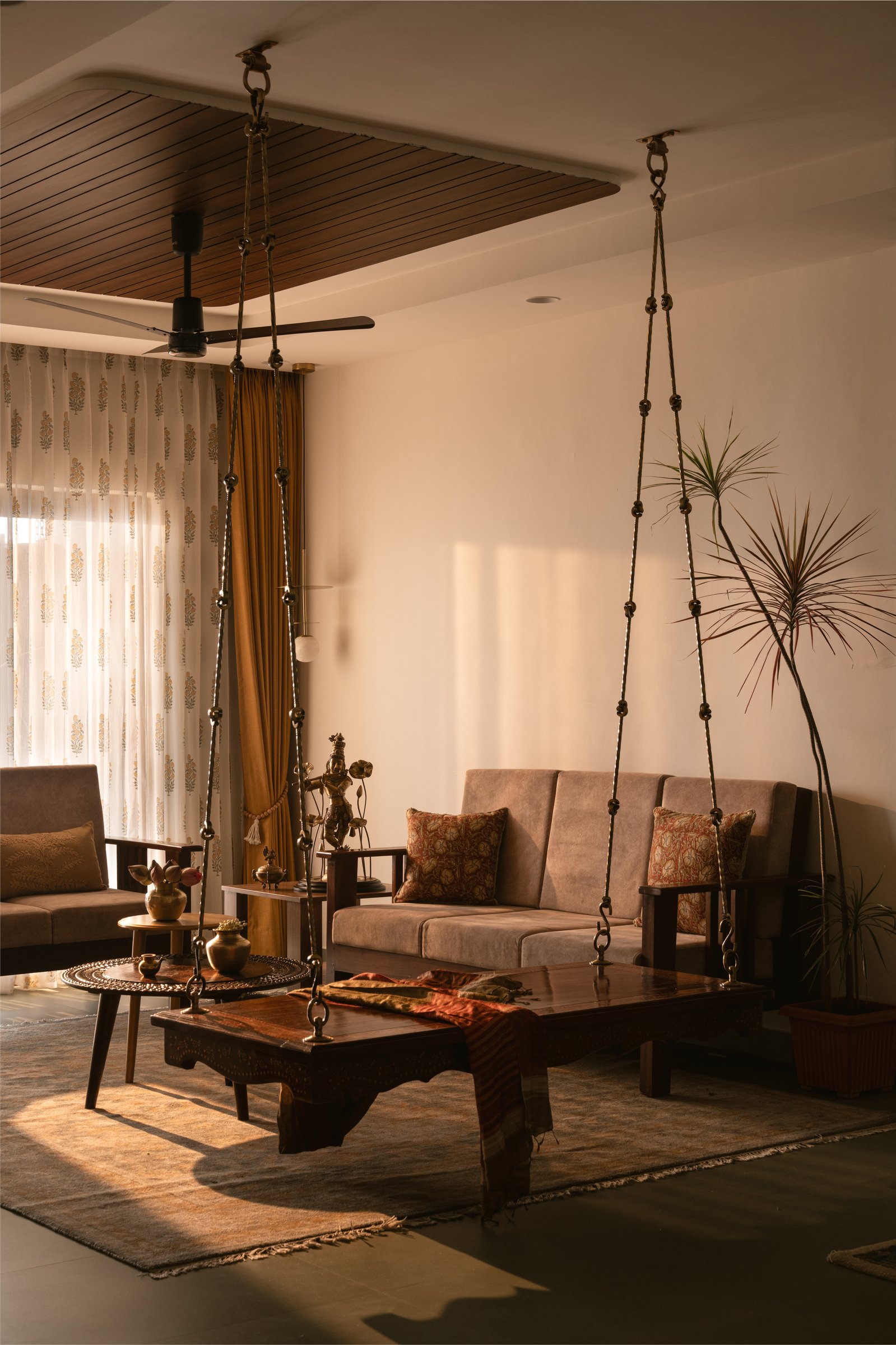
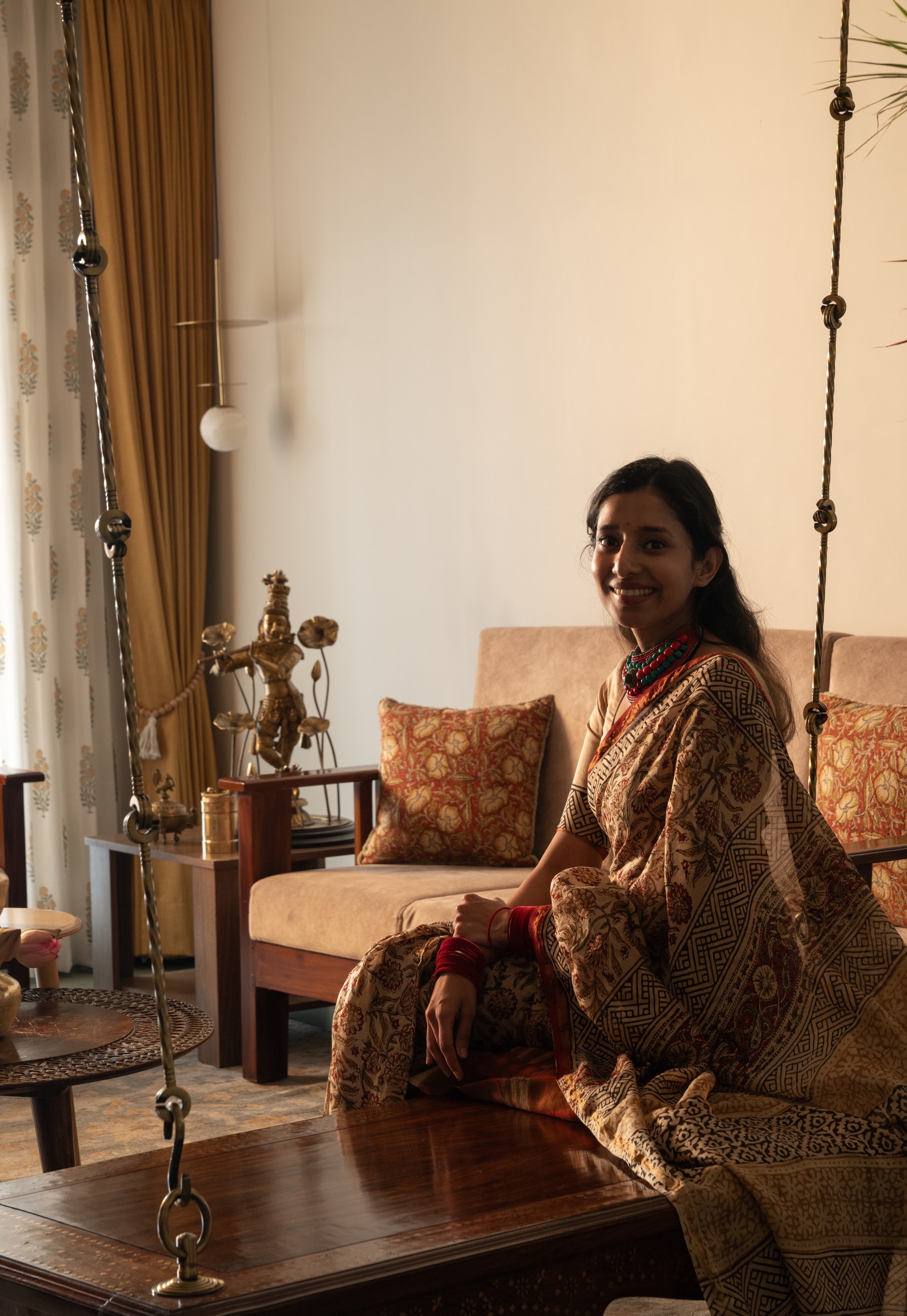
The living room unfolds in a palette of warm, honeyed tones. At its centre, an antique carved wooden jhoola suspended from brass-beaded chains serves as both a focal point and a repository of memory. It is accompanied by a refurbished sofa upholstered in muted taupe and a low coffee table layered with an heirloom textile, creating a setting where inherited objects and contemporary comforts coexist with ease.
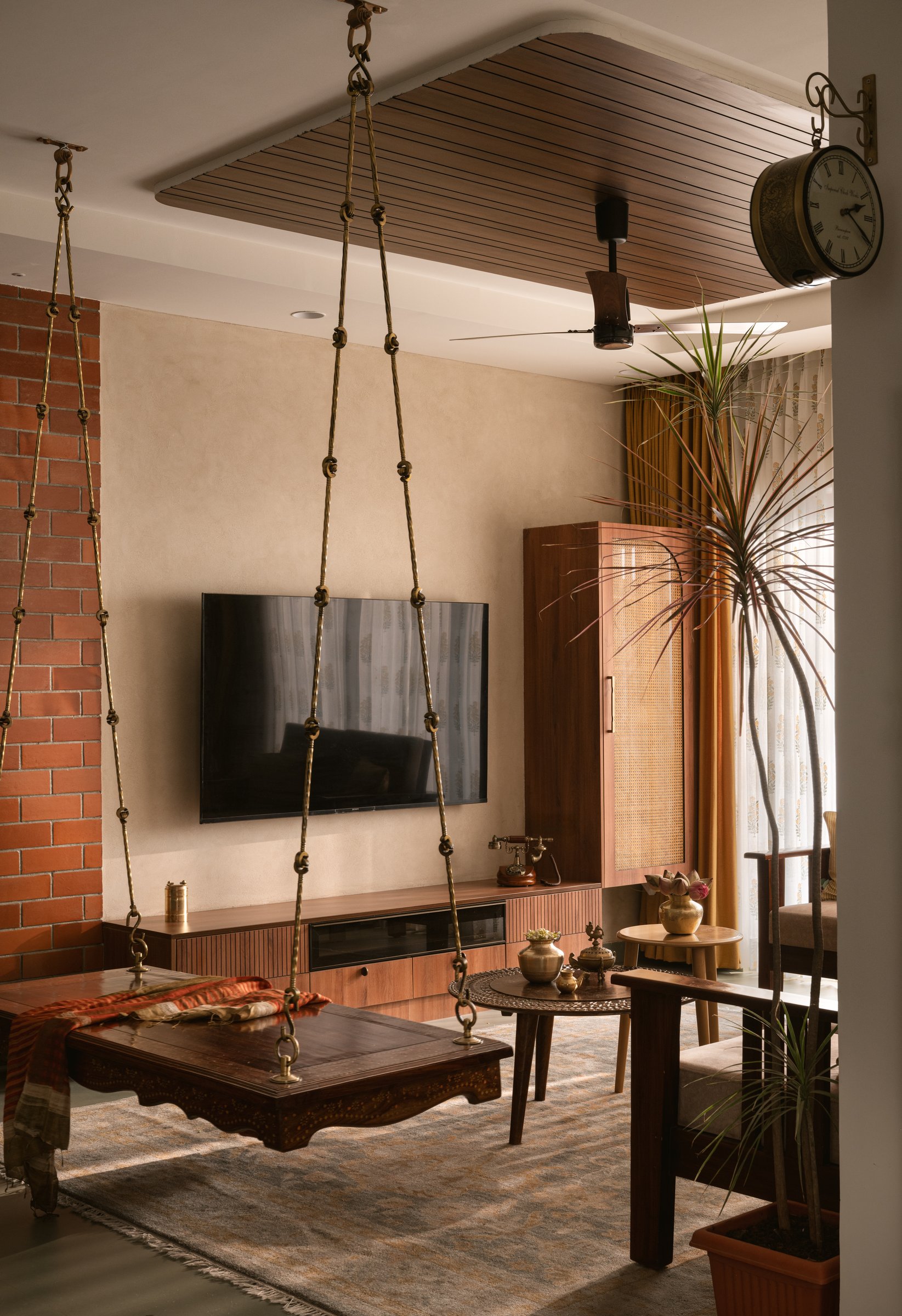
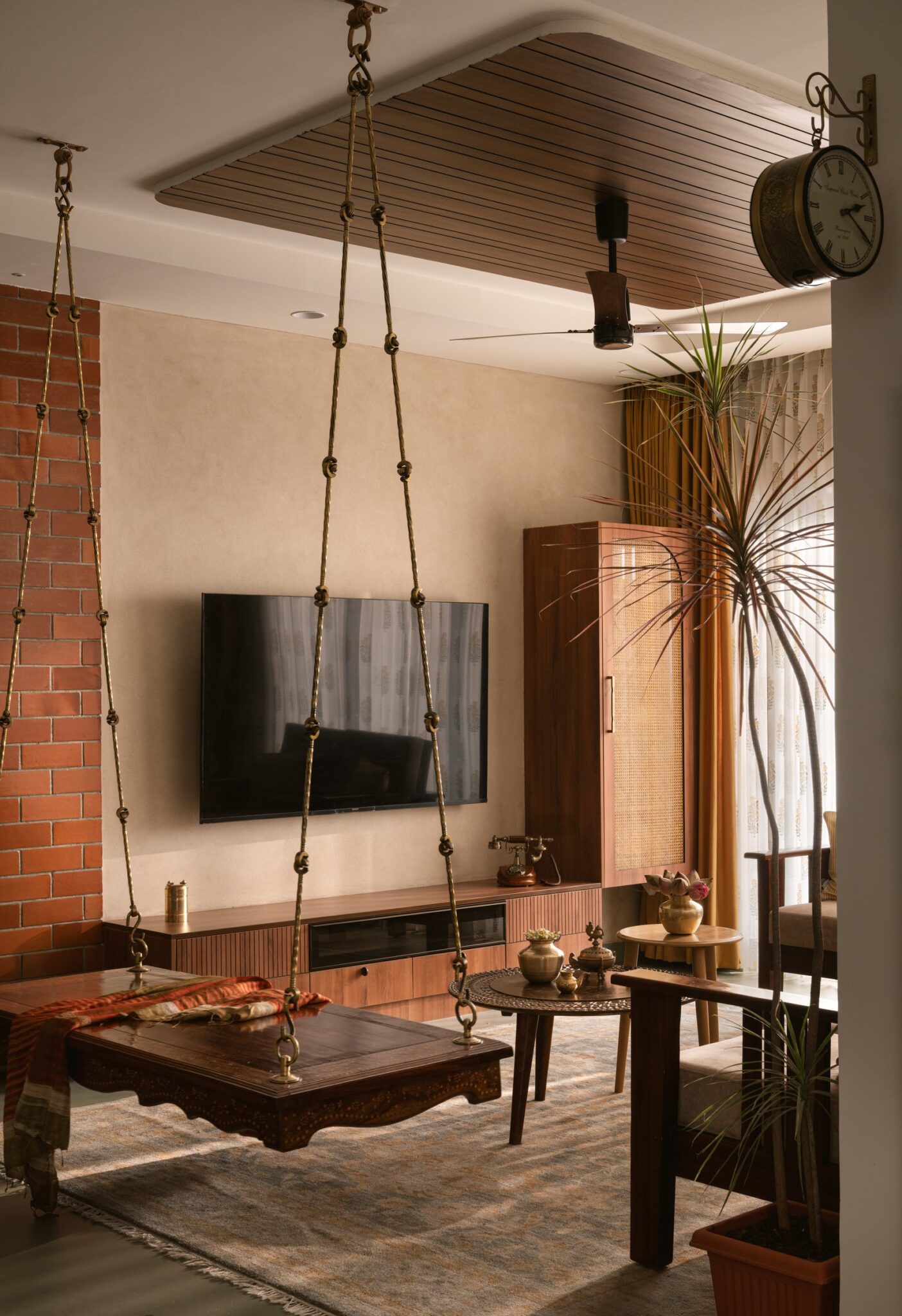
Viewed in its entirety, the living room reveals the home’s careful balance of materiality and restraint. A plane of exposed brick meets a lime-washed plaster wall, creating a subtle dialogue between texture and tone behind the wall-mounted television and custom slatted wood media unit. Above, a suspended wooden ceiling element defines the seating area while preserving a sense of openness, gently framing the antique swing without imposing on the room’s spatial flow.
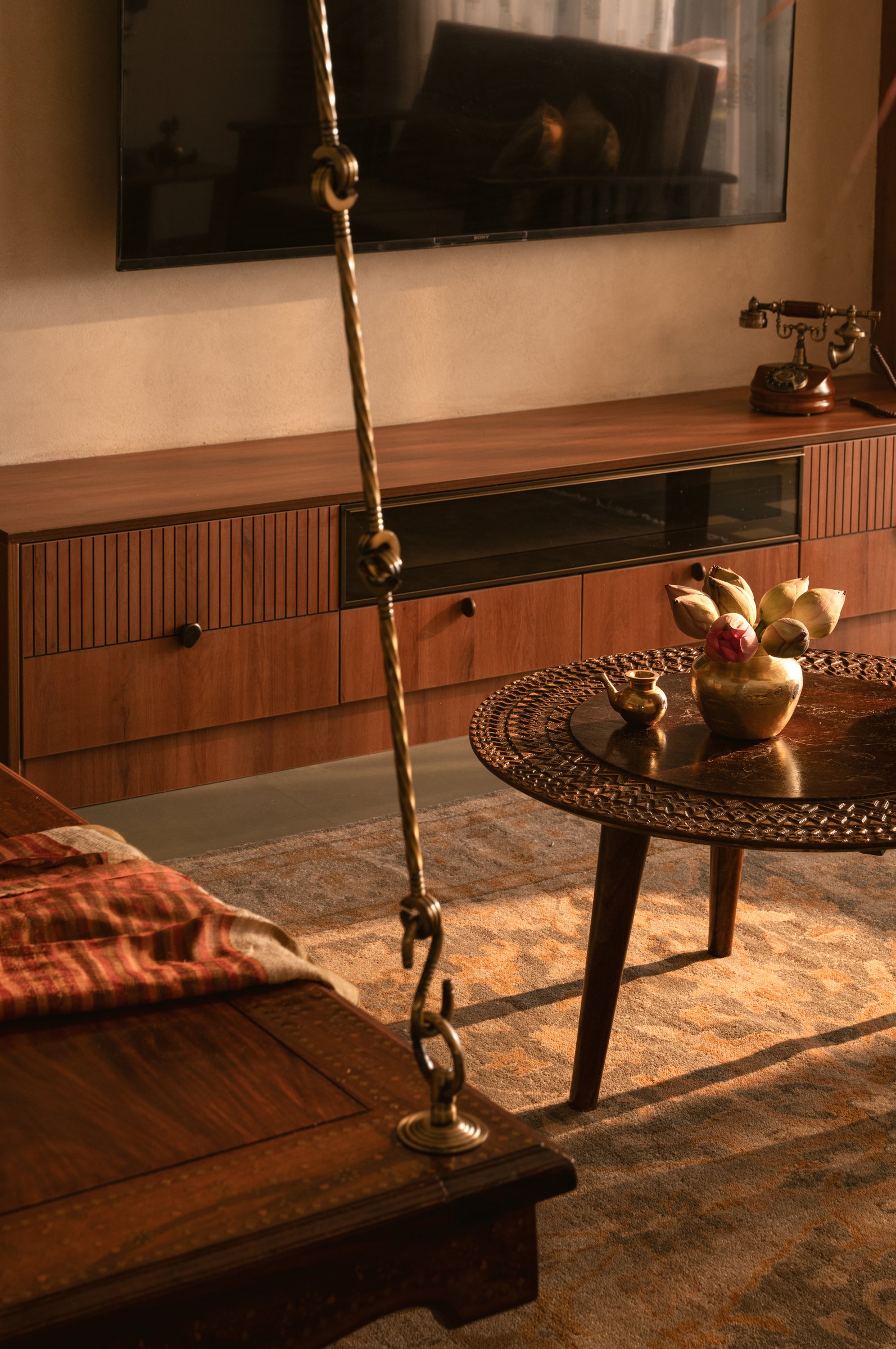
The media console embodies the home’s measured approach to detail. Reeded drawer fronts, a recessed glass-fronted niche, and a vintage rotary telephone arranged at one end lend the piece a quiet sense of character without disrupting its clean geometry.
““Tradition speaks through quieter gestures — her heirloom sarees carefully preserved in deft storage, handmade paintings resting against bare walls, coloured glass filtering daylight.””
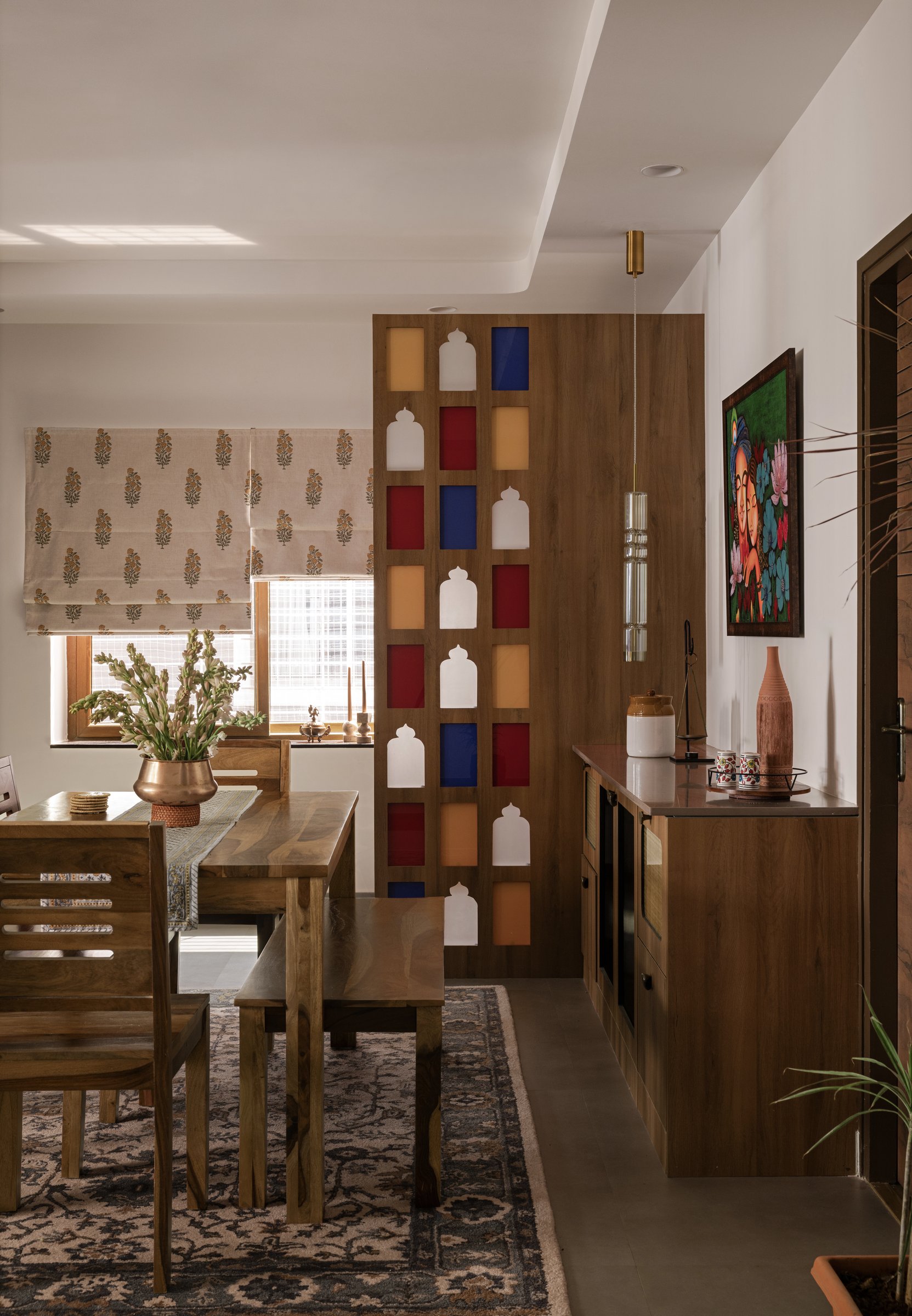
The dining area, once part of a larger uninterrupted volume, is subtly defined by a jharokha-inspired partition. Set within a timber frame, panes of red, yellow, blue, and frosted white glass reinterpret traditional Indian fenestration, filtering daylight into the space as shifting washes of colour. Anchoring the room is a solid sheesham dining table paired with a bench and matching chairs, while a block-printed Roman blind echoes the warm marigold tones woven through the partition.
Opposite the dining table, a bespoke sideboard detailed with cane and reeded panels provides both storage and display. Above it hangs a vibrant Radha-Krishna painting in layered greens, blues, and pinks, created by the homeowner herself. The artwork becomes the emotional anchor of the room, bringing a deeply personal dimension to the space, while the surrounding joinery recedes into the background, allowing memory, craft, and expression to take precedence.
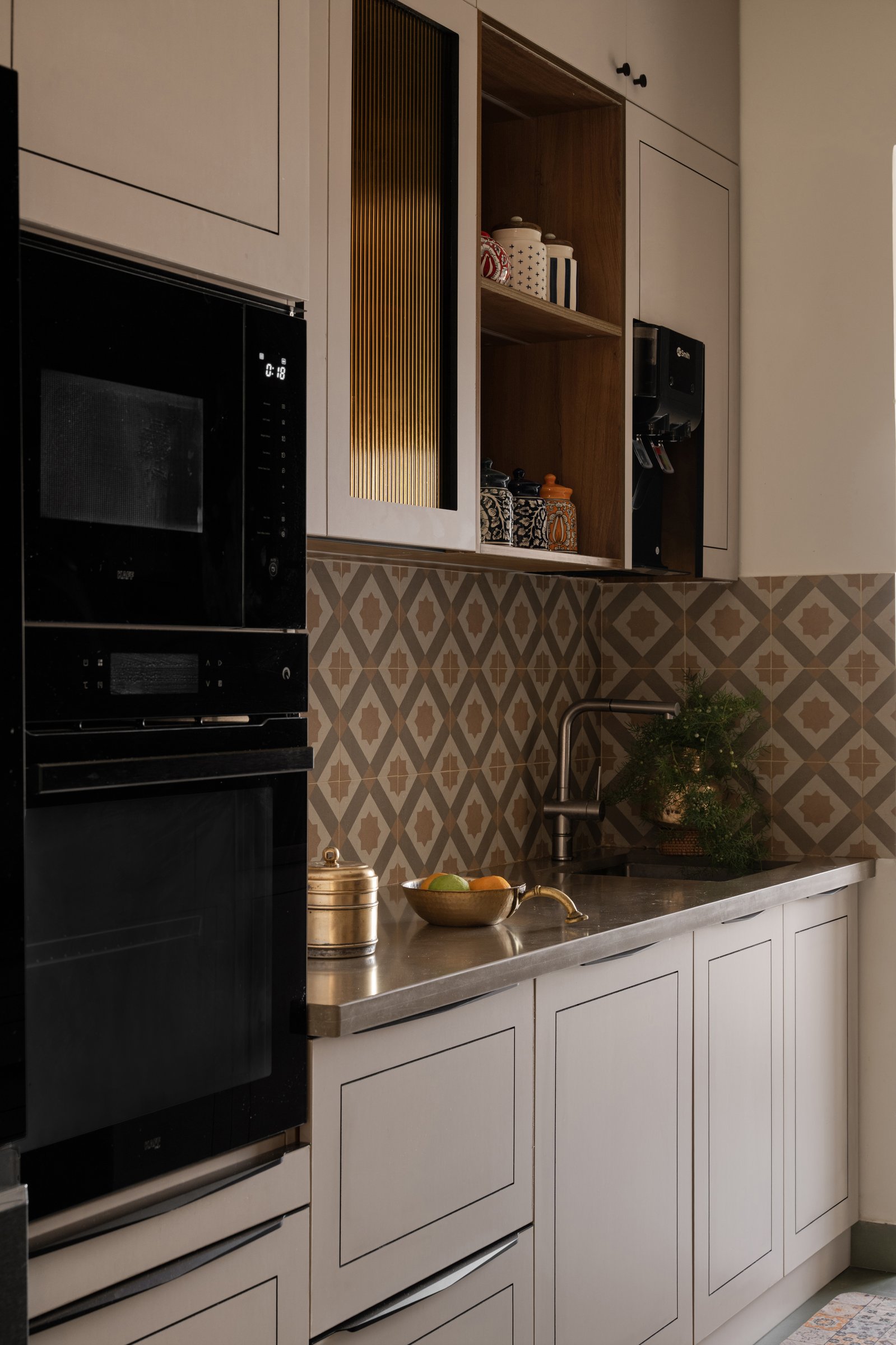
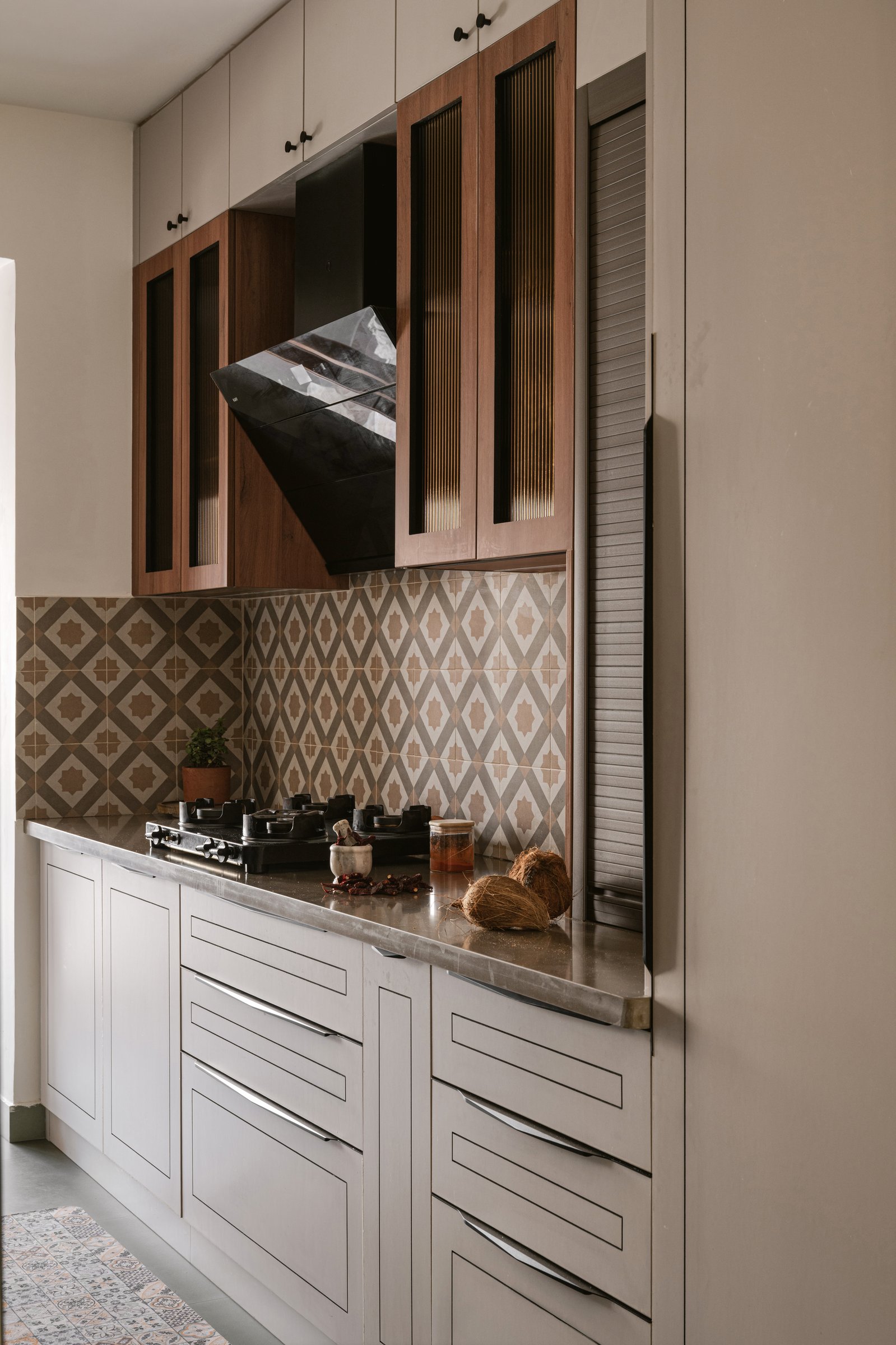
The kitchen embraces pattern with a confidence that contrasts the restraint found elsewhere in the apartment. A geometric backsplash in soft shades of beige and taupe stretches across the length of the counter, introducing rhythm and visual texture against a backdrop of pale shaker-style cabinetry and a stainless-steel work surface. The palette remains subdued, allowing the graphic quality of the tiles to take focus without overwhelming the space.
Open wooden shelves display hand-painted ceramic jars and everyday essentials, lending the kitchen a sense of warmth and familiarity. A fluted-glass cabinet door sits alongside an open display niche, creating subtle variation within the working wall and establishing a thoughtful hierarchy between concealment and display. The result is a kitchen that feels practical and lived-in, yet carefully composed in every detail.
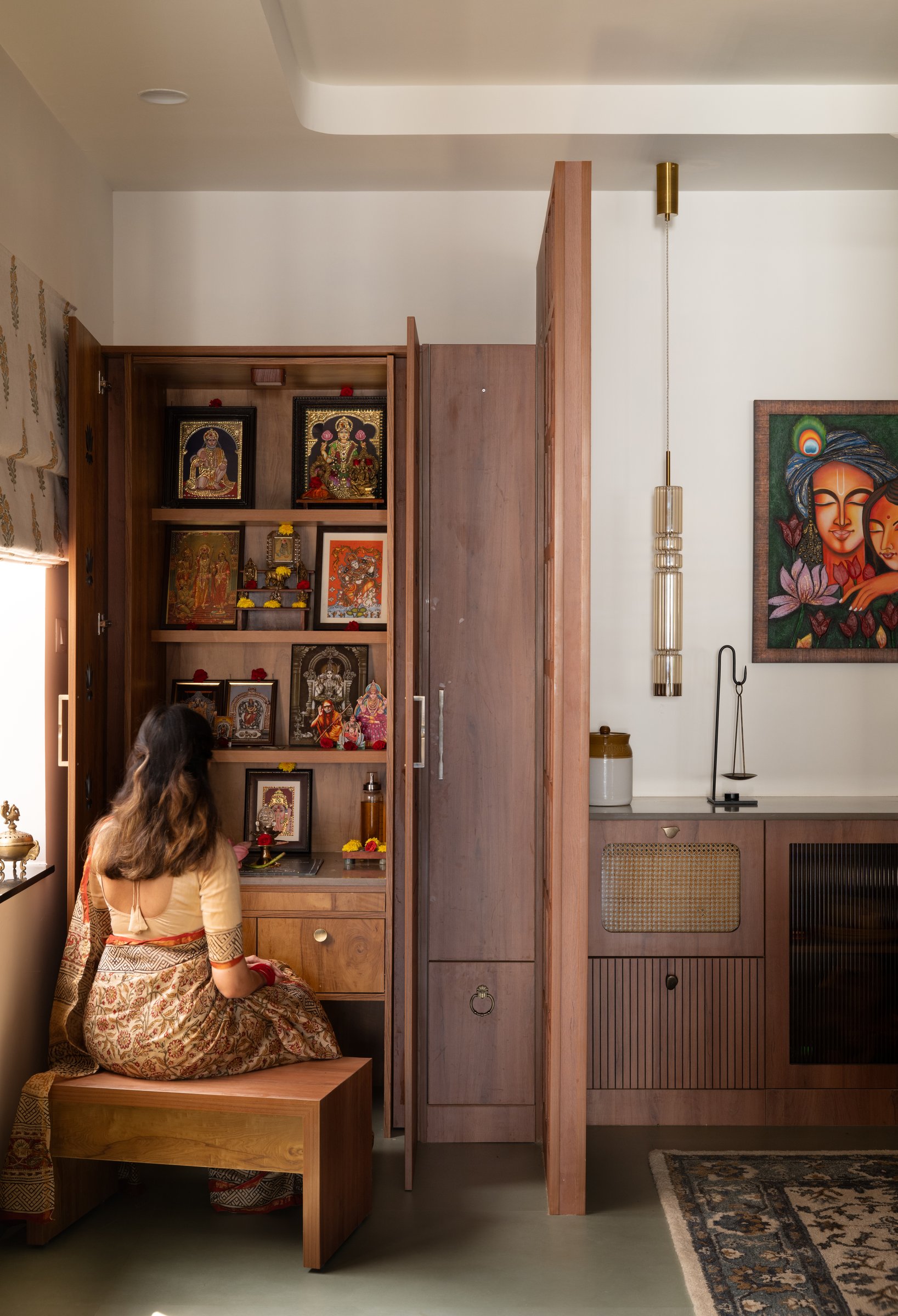
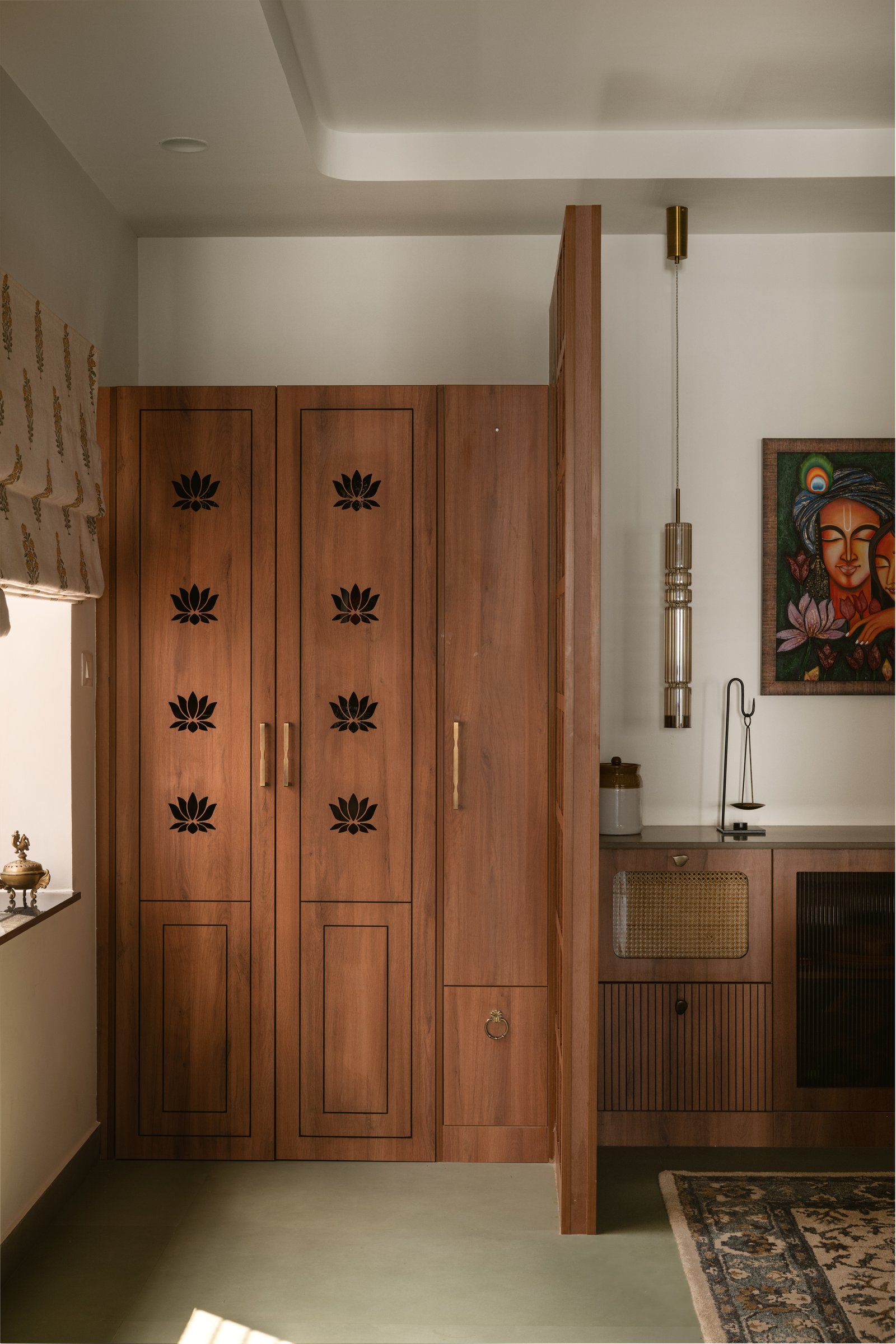
The pooja space is conceived not as a separate room but as an integrated piece of architecture and joinery. A tall wooden cabinet opens to reveal tiered shelves displaying Tanjore paintings and brass deities, creating a compact yet deeply personal setting for worship. A simple bench positioned in front allows for moments of quiet reflection, ensuring the space remains connected to the daily life of the home rather than isolated from it.
Adjacent to the shrine, a fluted-glass and brass pendant introduces a soft glow, while a cane and reeded-wood console supports another Radha-Krishna painting created by the homeowner. Together, these elements extend the home’s larger narrative, where spirituality, craftsmanship, and personal expression are woven seamlessly into the fabric of everyday living.
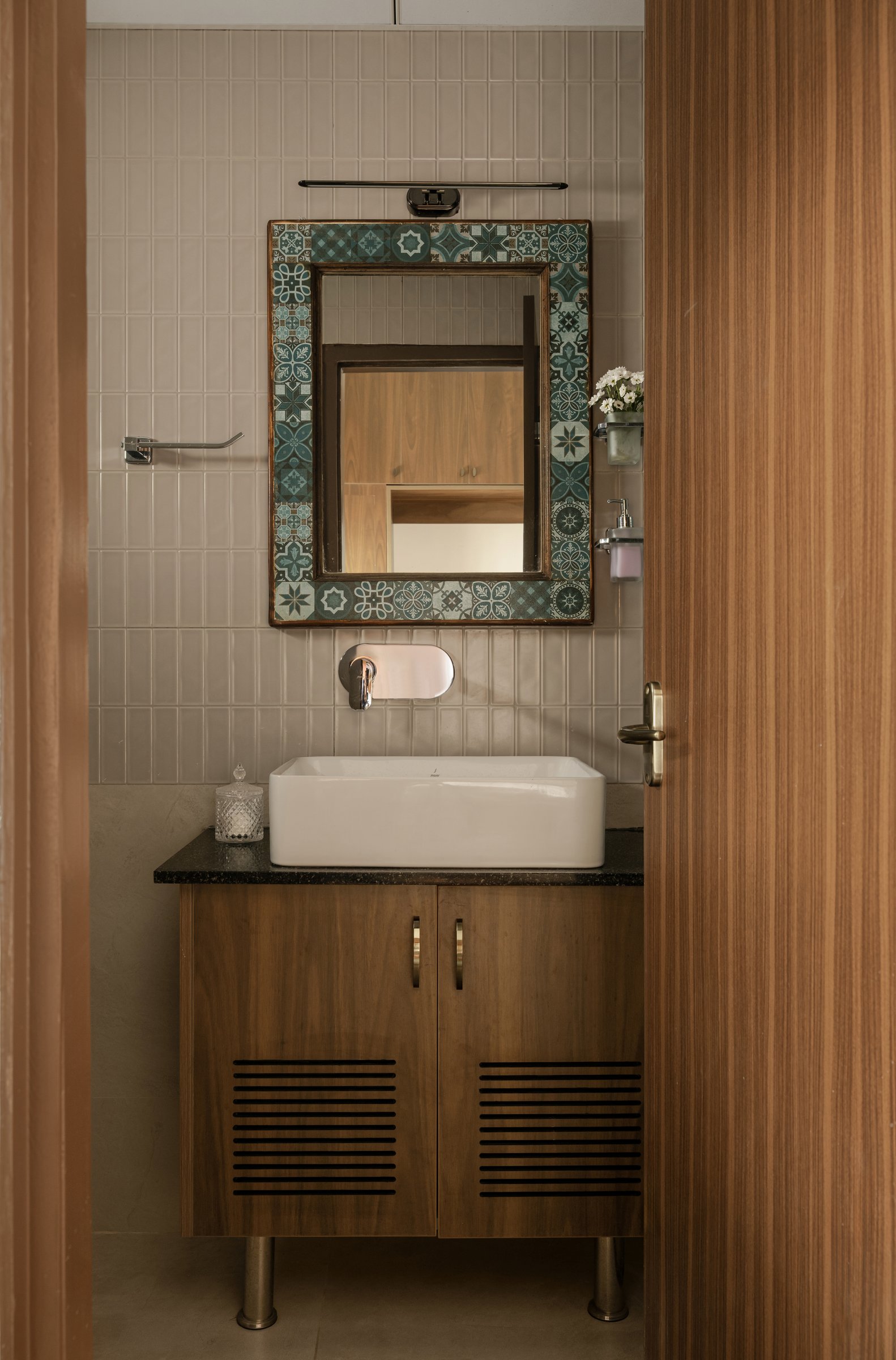
The powder room continues the home’s habit of letting craft do the framing. A mirror set in a wide tile-mosaic border in blues and creams sits above a stone-topped wooden vanity with a rectangular ceramic basin and slatted cabinet fronts. The wall behind is laid in stacked vertical tiles in a chalky neutral, and the door surround is in a richer wood-grain veneer.
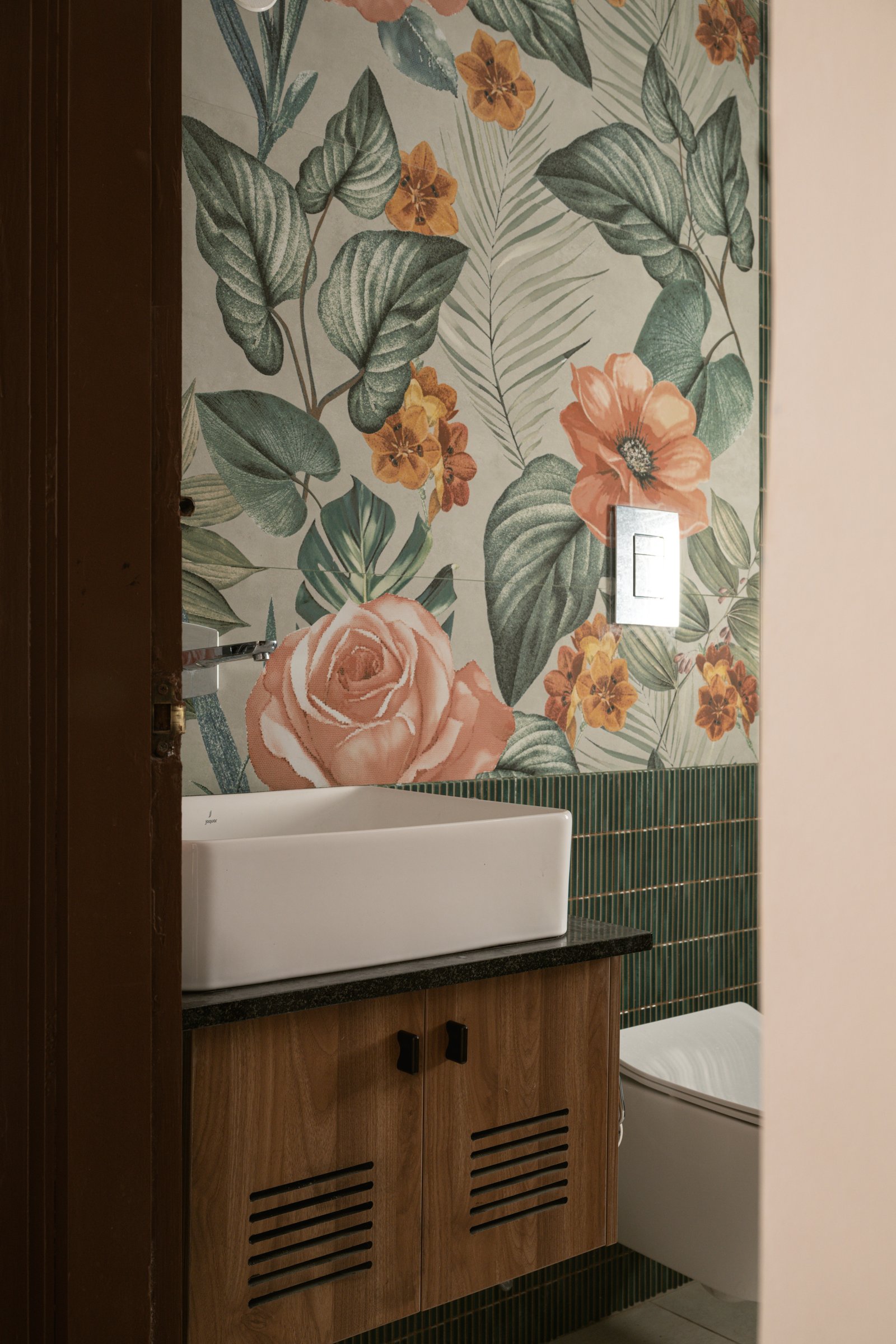
The second bathroom adopts a more expressive character than the rest of the home. A large-format mural depicting lush tropical foliage, oversized leaves, a coral-toned bloom, and scattered orange blossoms forms a striking backdrop to the wall-mounted basin, transforming the space into an immersive composition of colour and pattern. A band of vertically stacked green tiles runs along the lower portion of the wall, reinforcing the botanical narrative while adding depth and texture.
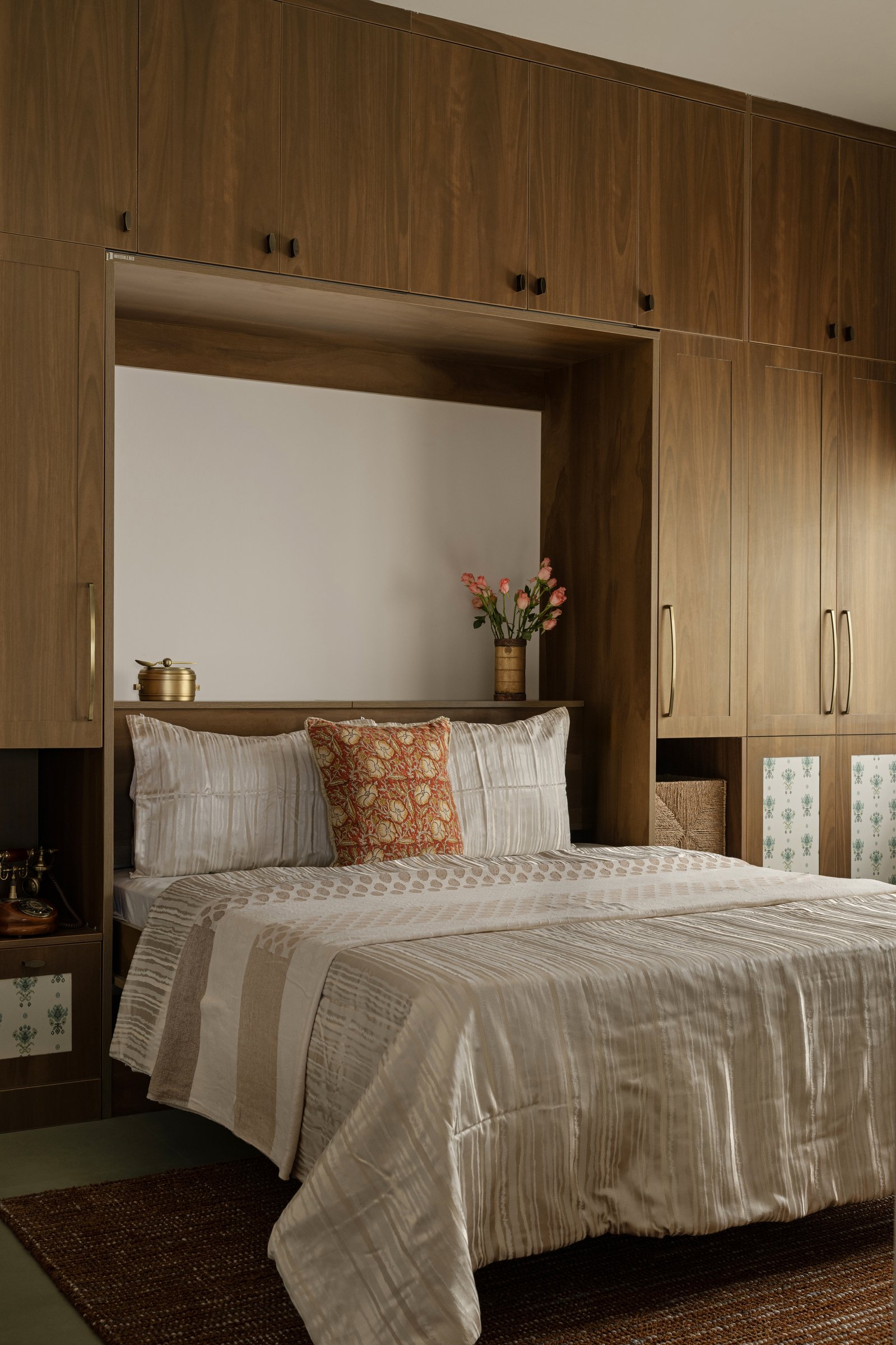
This bedroom is the most restrained expression of the home’s design language. A continuous wall of full-height timber joinery envelops the bed, its warm, even-toned wardrobes creating a sense of order and calm. Above the headboard, a recessed niche interrupts the expanse with quiet precision, displaying a brass vessel and a stem of pink roses that lend the room a subtle note of softness.
The palette remains intentionally subdued. Layers of neutral bedding reinforce the room’s tranquil atmosphere, while a single block-printed cushion in shades of coral and ochre introduces a measured touch of colour and pattern. The effect is one of quiet confidence, where material consistency and careful proportion achieve warmth without relying on ornament.
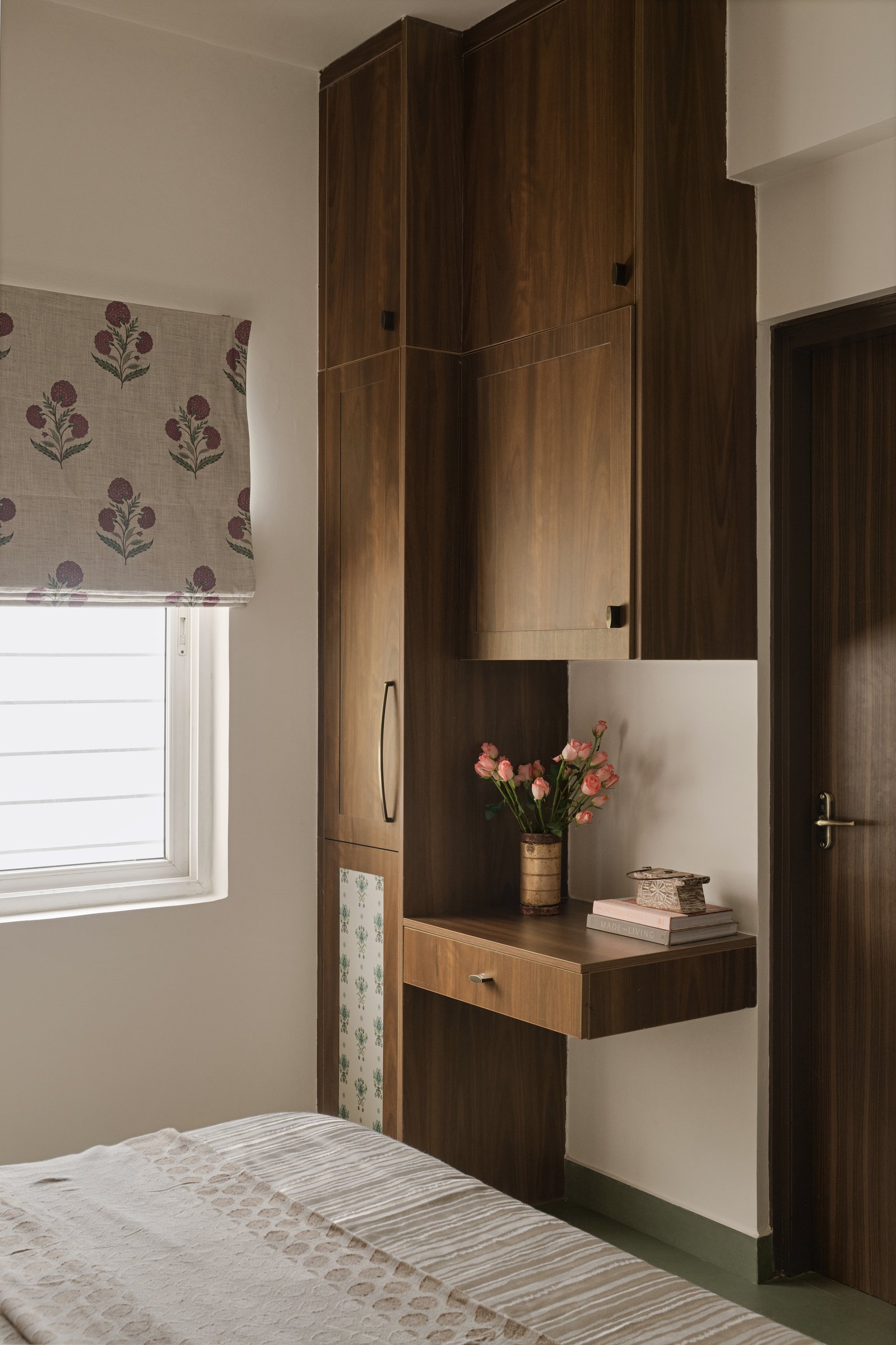
A compact floating bedside ledge is seamlessly integrated into the surrounding joinery, its single drawer and open shelf providing space for books and everyday essentials without interrupting the room’s visual continuity. At the lower level, a panel of patterned wallpaper in a delicate green-and-cream motif introduces a subtle layer of texture, gently breaking the expanse of timber.
The detail serves a purpose beyond decoration.
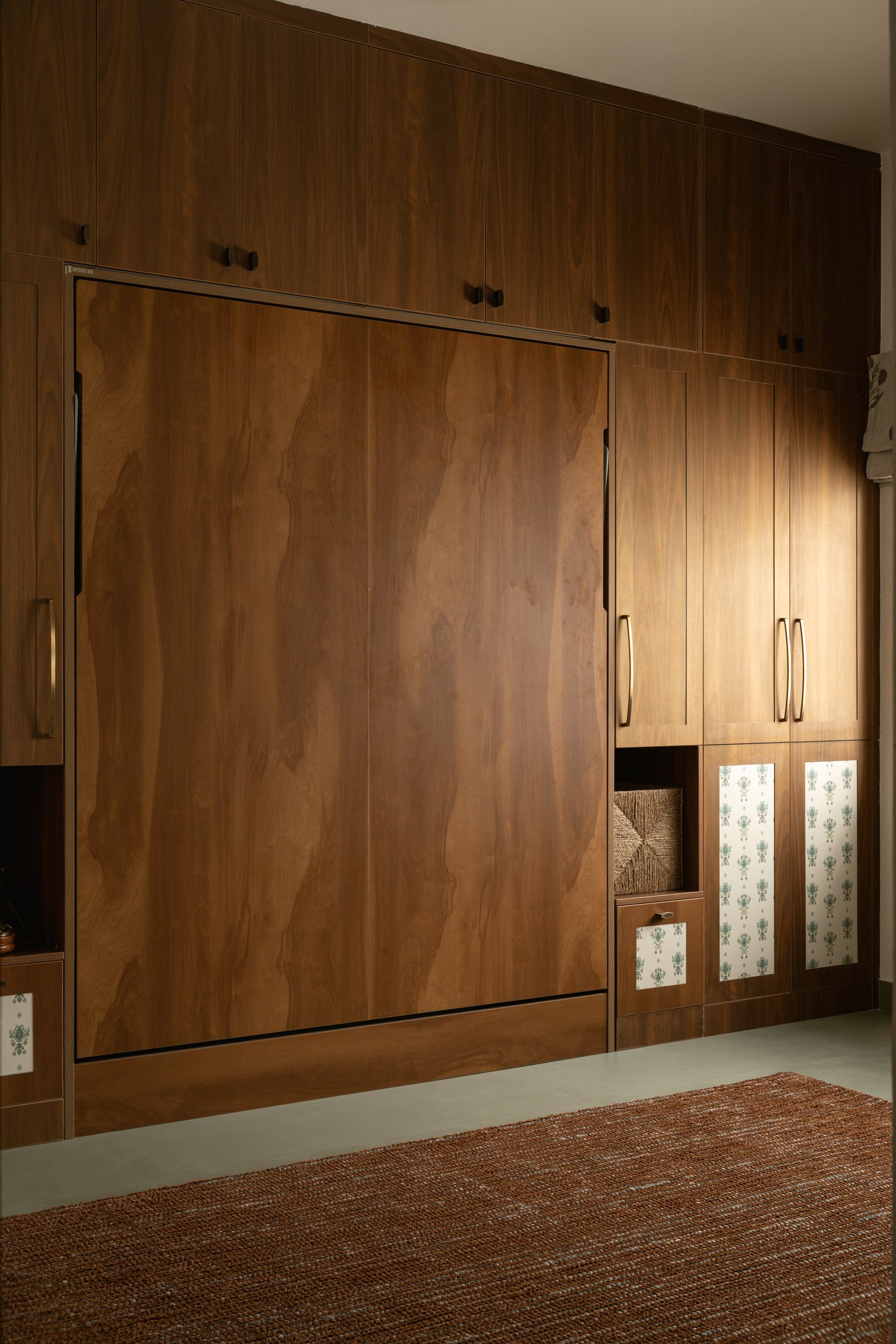
The opposite wall reveals one of the room’s most functional interventions. A continuous expanse of warm timber cabinetry stretches from floor to ceiling, incorporating flush-fronted wardrobes, slender integrated pulls, and a concealed fold-down bed at its centre. The composition demonstrates how storage has been treated not as an afterthought but as an architectural device, allowing the room to maintain its sense of calm and visual clarity.
It is a reminder that much of the room’s character lies not in what is displayed, but in how effortlessly its practical requirements have been absorbed into the architecture.
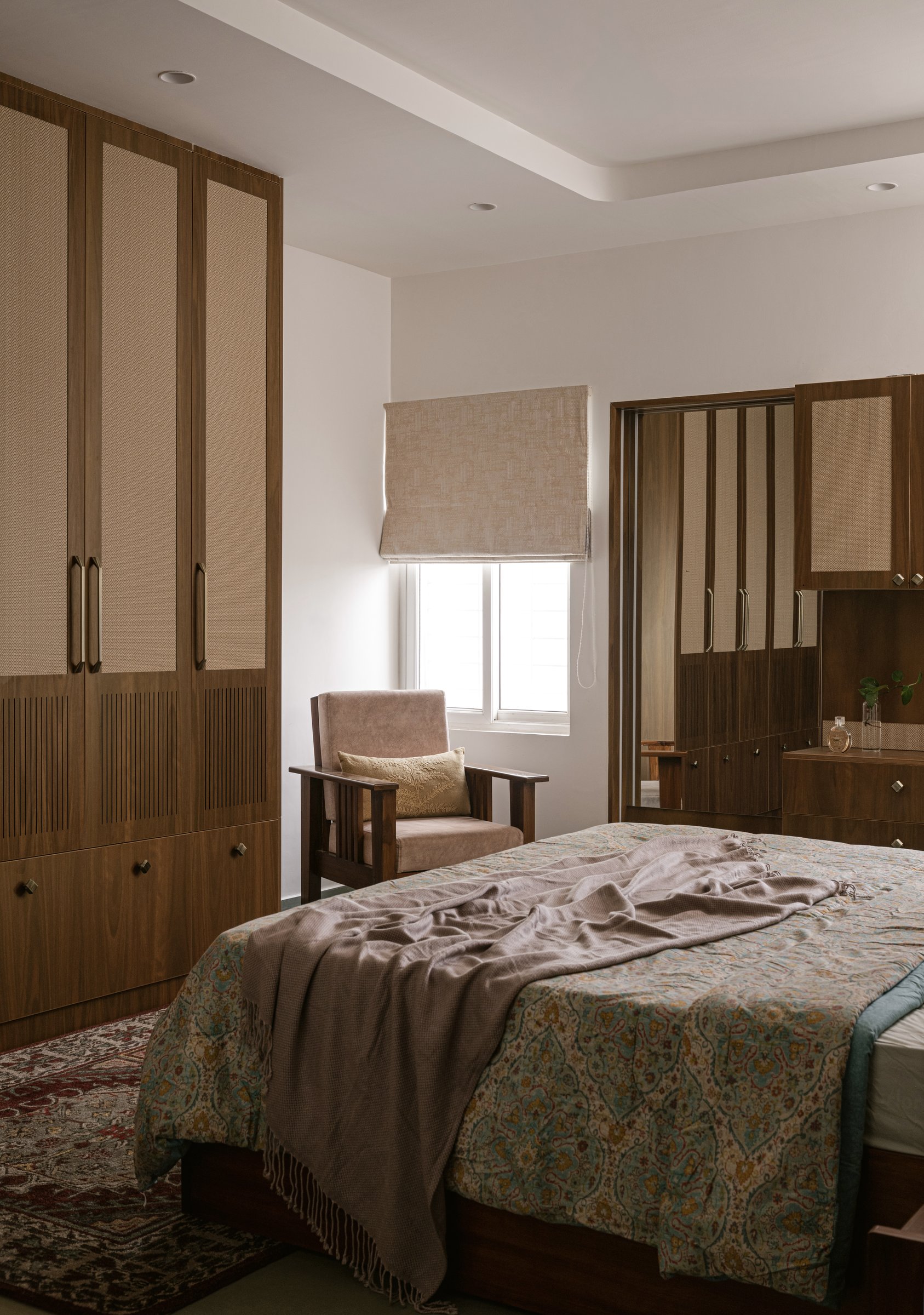
The second bedroom adopts a softer and more relaxed character. A wall of wardrobes in a light wood-grain finish combines cane-webbed panels with subtle reeded detailing at the base, bringing texture and craftsmanship to the room without overwhelming its calm atmosphere. Positioned beneath a window dressed in a flax-toned Roman blind, the bed benefits from a gentle wash of natural light that reinforces the room’s tranquil mood.
The palette remains warm and understated. A compact armchair upholstered in muted blush velvet introduces a quiet note of colour, echoed by the paisley-patterned throw layered across the bed. Together, these elements create a space that feels restful and inviting, defined by comfort, tactility, and a sense of effortless ease.
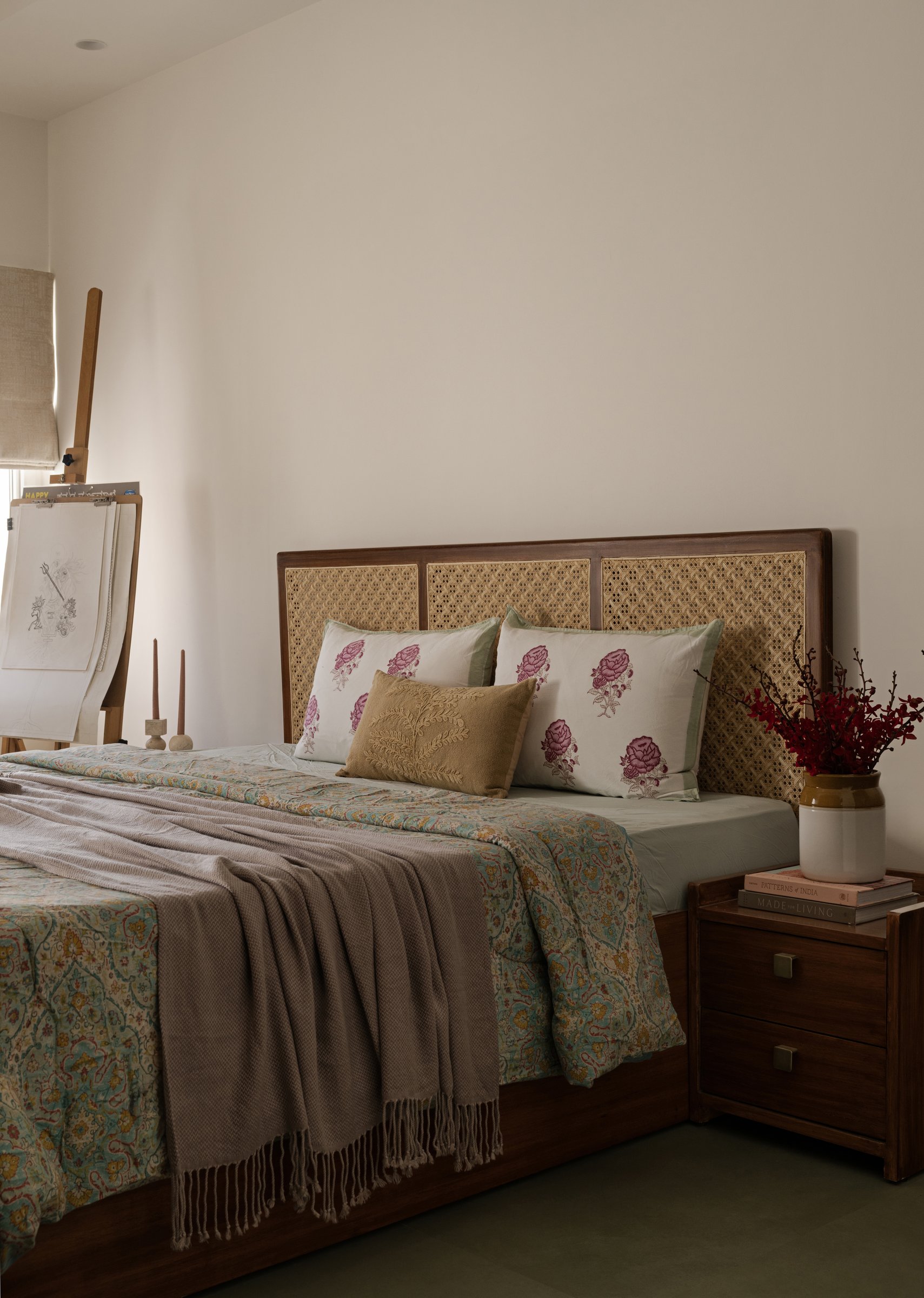
The room’s most distinctive feature is its understated headboard, a wide cane-webbed panel framed in dark timber and set against a softly textured plaster wall. The composition relies on material contrast rather than ornament, allowing the warmth of the cane and wood to bring depth and character to the space while preserving its sense of calm.
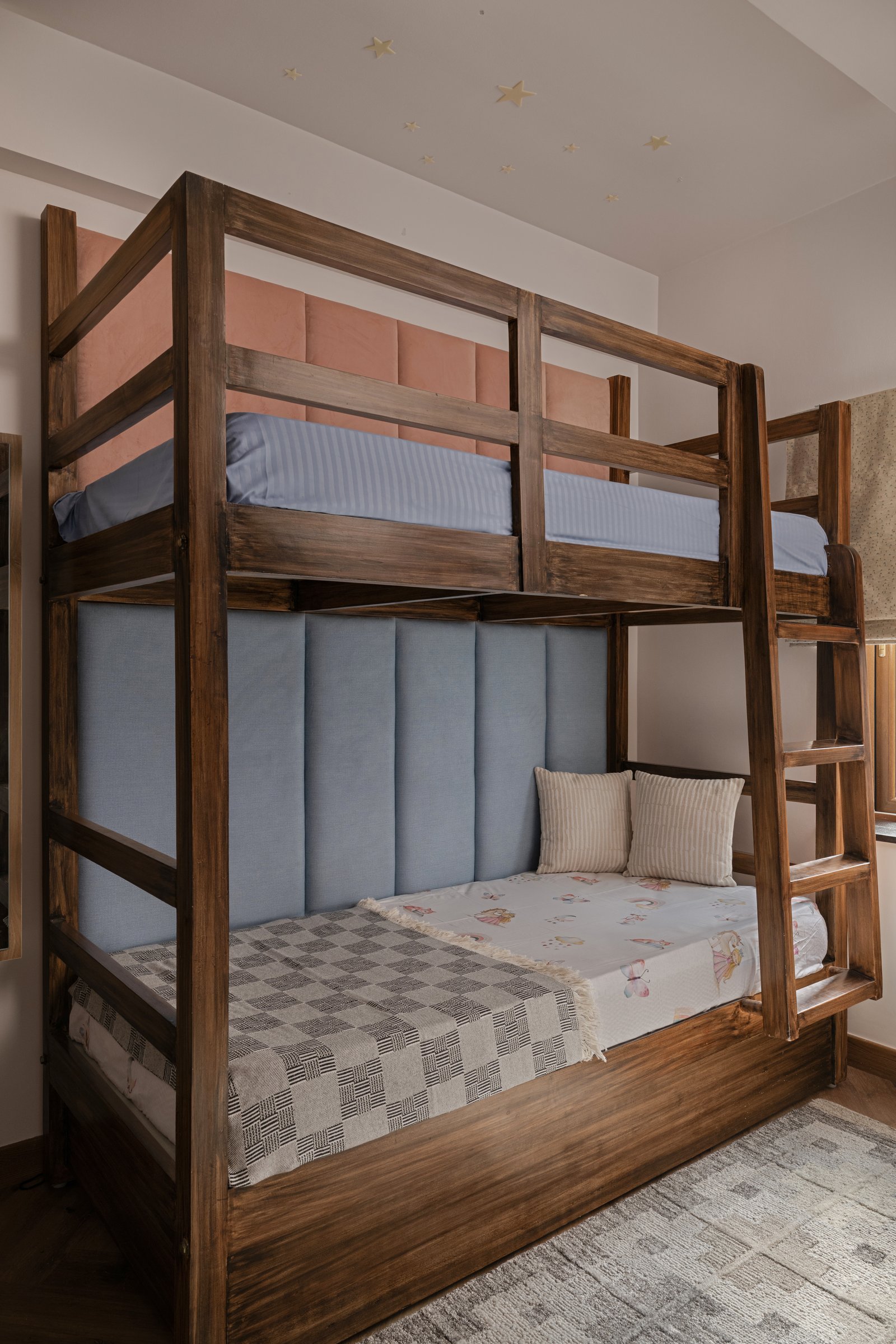
The daughters’ bedroom introduces a lighter and more playful energy to the home’s otherwise restrained palette. A custom solid wood bunk bed anchors the room, its broad-tread ladder and robust construction lending it a sense of permanence while remaining tailored to everyday use. The upper bunk is framed by a coral velvet headboard panel, while the lower berth is softened with channelled blue upholstery, creating a gentle contrast of colour and texture.
Despite its youthful character, the room remains carefully composed. A scattering of small gold stars across the ceiling provides a touch of whimsy, adding just enough visual delight without overwhelming the space. The result is a bedroom that feels imaginative yet grounded, designed to evolve gracefully alongside its occupants.
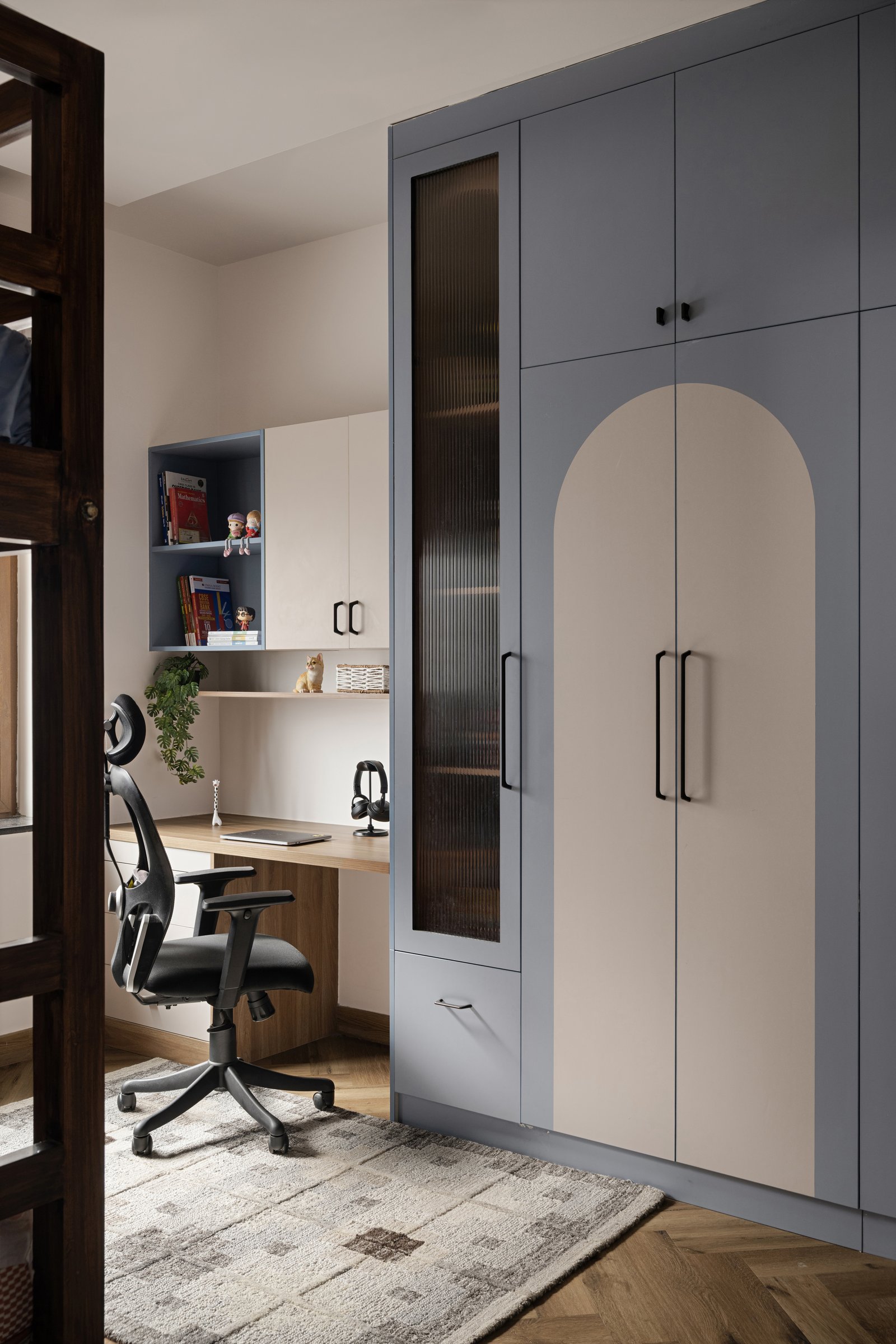
What Jois Design House has achieved at Rasa is a home where heritage is embedded into the architecture rather than displayed as an aesthetic layer. Tanjore paintings, brass idols, handwoven textiles, and personal artworks are seamlessly integrated into a framework of carefully considered joinery, storage, and spatial planning. The Indo-modern language of the home emerges not through decorative gestures, but through the way tradition is accommodated, organised, and lived with on a daily basis.
In a city like Bengaluru, where neighbourhoods such as Basavanagudi continue to hold memories of an older domestic vocabulary of swings, patterned floors, crafted timber furniture, and deeply personal rituals, Rasa offers a contemporary interpretation that feels both familiar and relevant. Rather than replicating those elements literally, architect Ananya Jois distils the qualities that made them enduring: spaces that adapt over time, storage that remains discreet, and moments of spirituality woven naturally into everyday routines.
The apartment feels less like a setting for its occupants and more like an extension of their lives and creative pursuits. Artworks take precedence, collections find purpose-built homes, and the architecture quietly supports the demands of daily living. Within a modest footprint, the design accommodates a remarkable breadth of objects, memories, and activities, demonstrating that thoughtful planning and restraint can achieve a richness that far exceeds what the apartment’s dimensions might suggest.