Renovation is rarely an act of replacement. More often, it is an act of reinterpretation, finding new spatial expression for patterns of living that have accumulated over years. When a family chooses to reinvent a home it has inhabited for two decades, the challenge is not simply to alter the structure but to preserve familiarity while creating room for change.
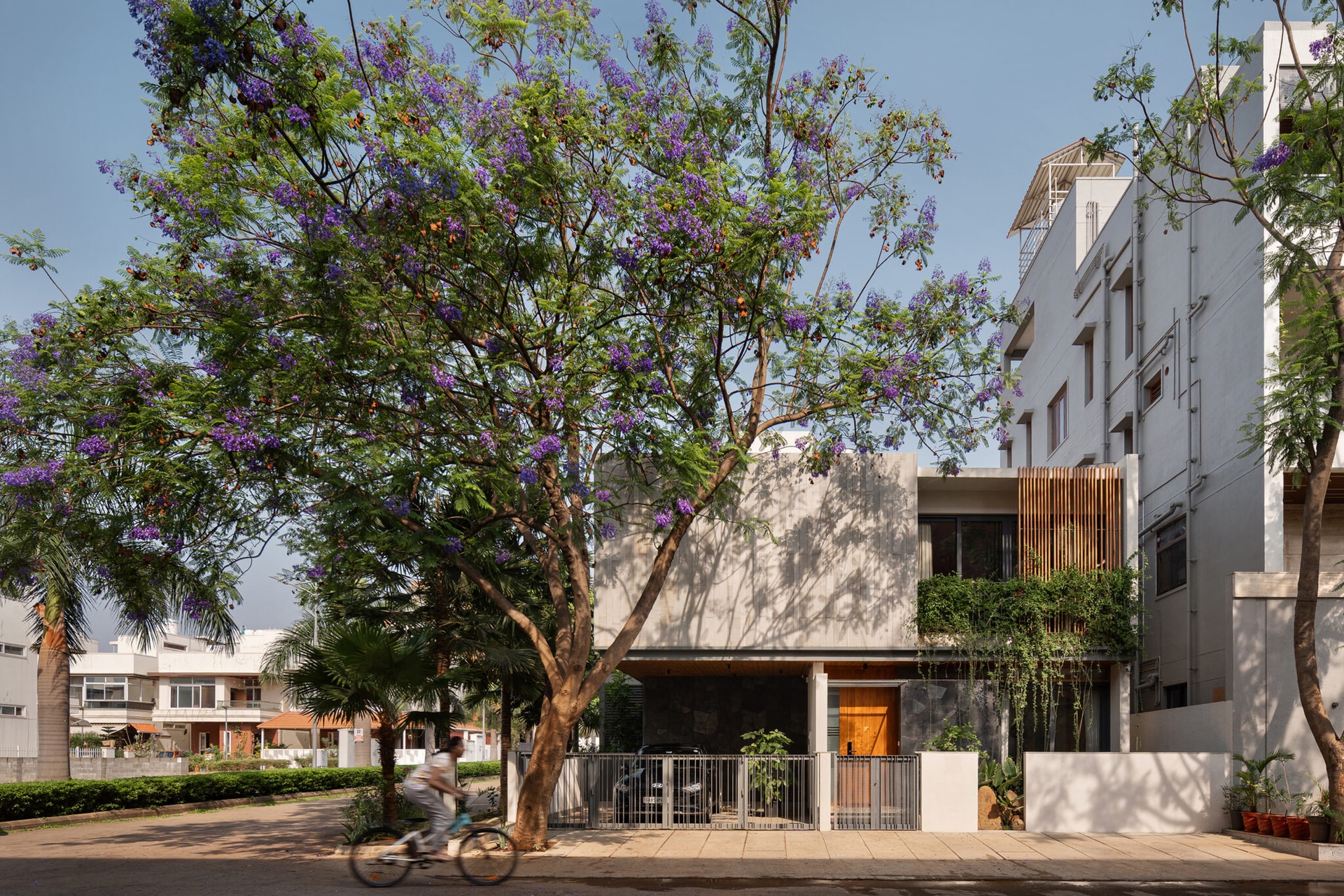
Pragati Niwasa, a 2,100 sq. ft. residence in Bengaluru’s Nagarbhavi neighbourhood, emerges from precisely this condition. Designed by AD Studio 9, the project reimagines a twenty-year-old load-bearing house for a multi-generational family comprising a couple, their parents, and young son. Rather than erase the home’s existing character, the intervention works within its original shell, opening up the interiors to create a greater sense of light, continuity, and connection between spaces.
The brief called for a home that could balance luxury with restraint, offering comfort without excess. The response is an uncluttered and highly functional environment where openness becomes the organising principle. Spaces flow naturally into one another, encouraging interaction between family members while accommodating the rhythms of everyday life, transforming an ageing structure into a residence that feels both renewed and deeply familiar.
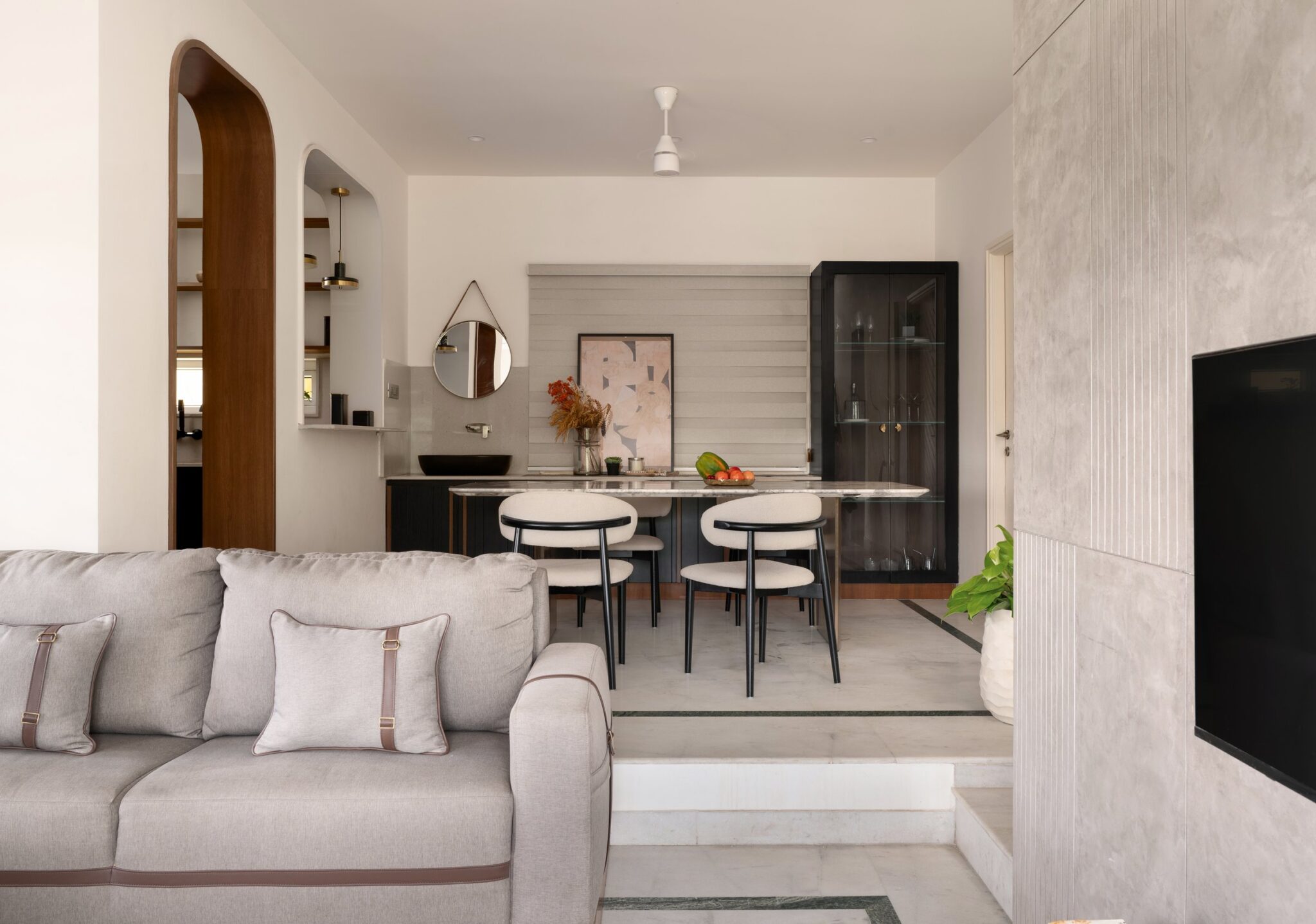
The lower floor is arranged around a clear visual axis that lends the home an immediate sense of openness. From the formal living room, the gaze moves uninterrupted across the dining space and toward the kitchen beyond, establishing a strong connection between the home’s primary gathering areas. A textured grey television wall anchors one end of this sequence, while a softly arched timber opening frames the other, introducing a curved language that reappears throughout the interior in niches, doorways, and bespoke joinery details.
Within the living room, a restrained palette of white walls and pale Indian marble creates a calm architectural backdrop. Custom-crafted oak furniture, from the sofa framework to the floating media console and coffee table, reinforces the home’s emphasis on clean lines and careful proportion. Upholstered in muted grey tones with subtle leather detailing, the seating introduces warmth and texture without disrupting the room’s quiet character.
The marble flooring is detailed with a delicate inlay border that subtly defines the space while preserving its visual lightness. Together, the materials and furnishings establish an atmosphere of understated refinement, where luxury emerges through craftsmanship, proportion, and restraint rather than ornament.
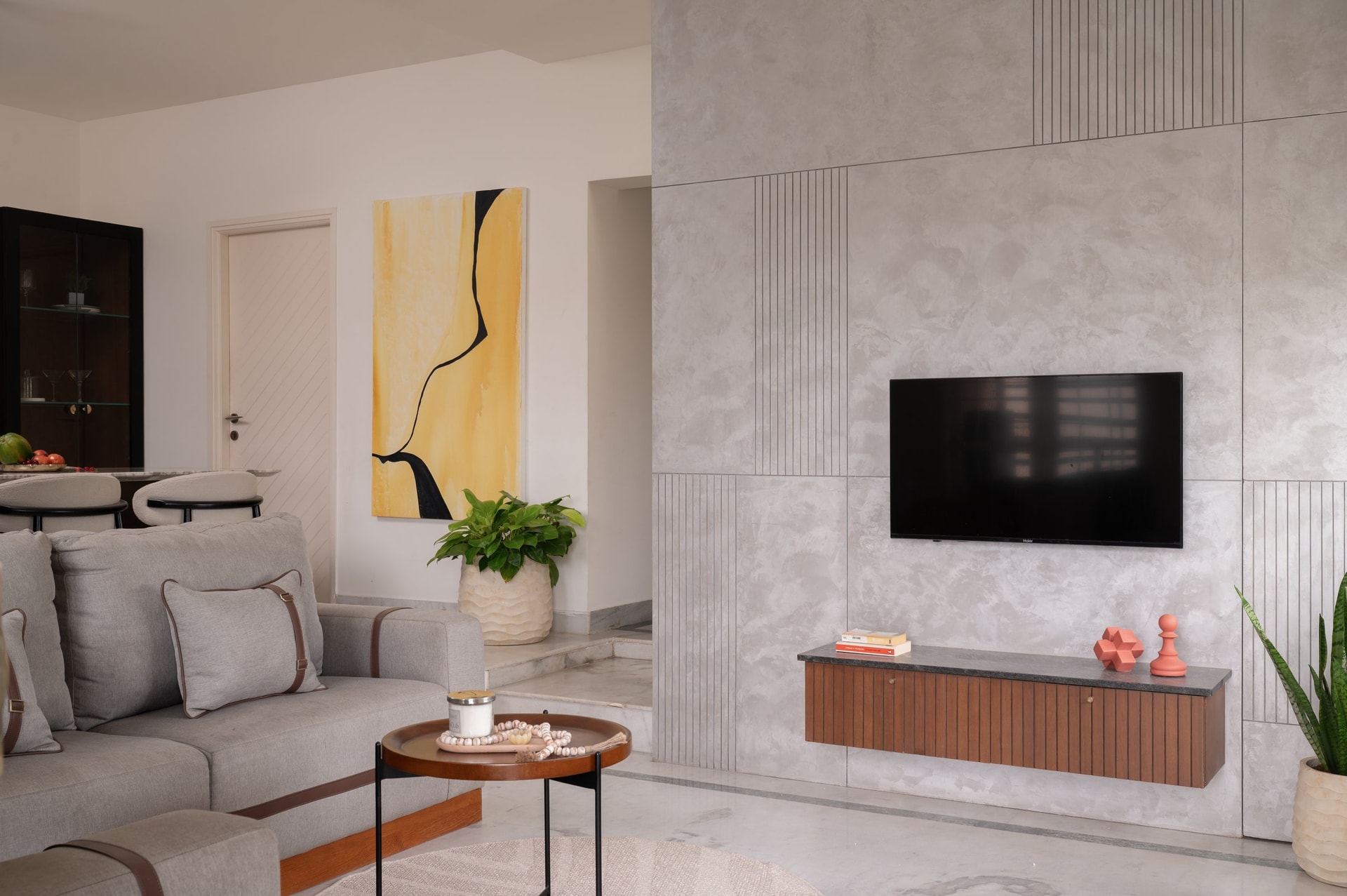
The television wall forms the living room’s primary architectural focal point. Finished in a bespoke concrete-toned surface articulated with fine vertical grooves that converge subtly towards the centre, it transforms what could have been a purely functional element into a composed architectural backdrop.
Despite its generous proportions, the room resists any sense of excess. The design is intentionally restrained, allowing everyday objects and personal belongings to contribute to the atmosphere of the space.
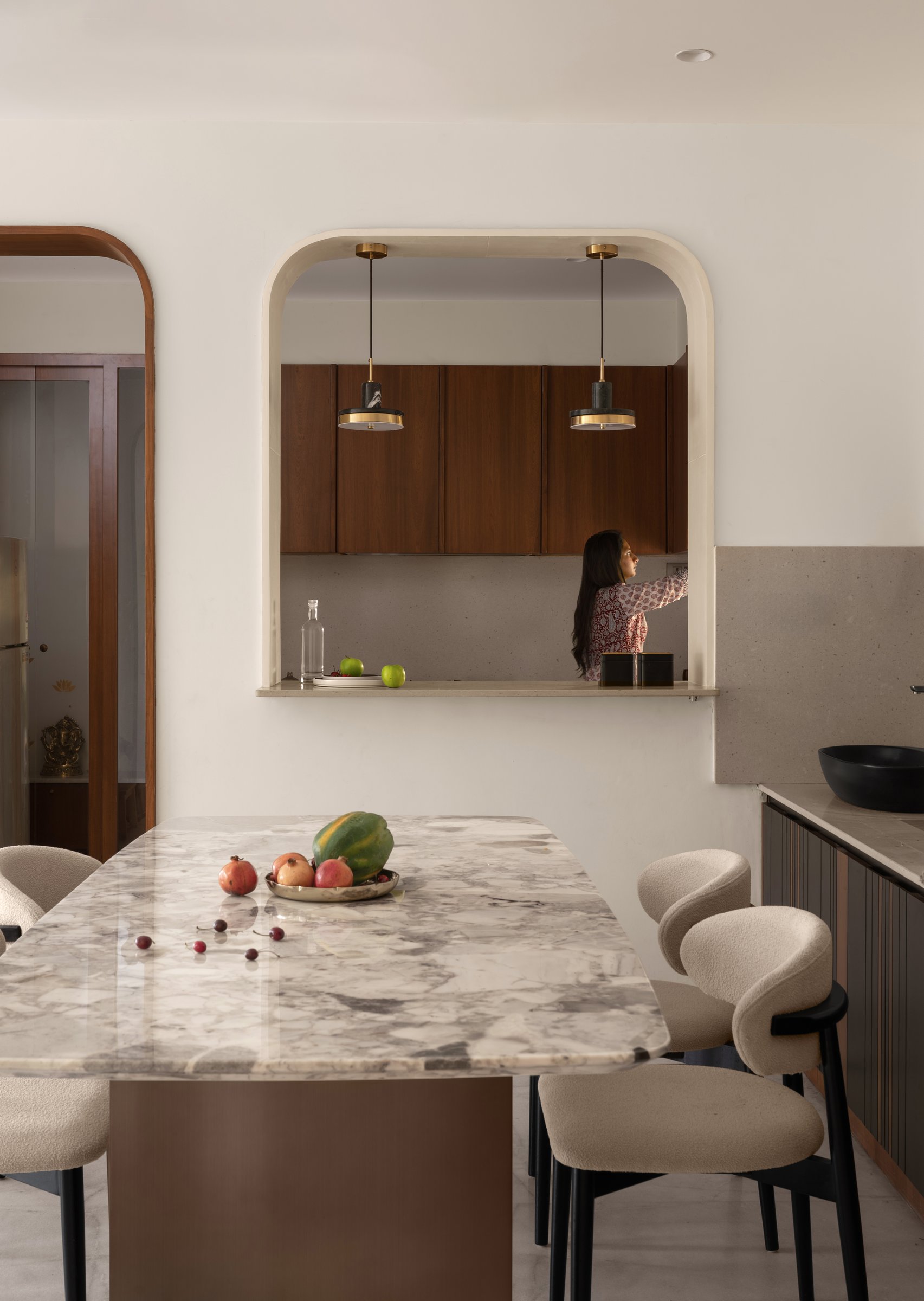
A curved opening carved into the wall between the dining area and kitchen subtly reshapes the way the home functions. More than a decorative gesture, the arch creates a visual and social connection between the two spaces, allowing conversations to flow more easily, extending sightlines across the floor, and drawing natural light from the kitchen deeper into the interior. What might otherwise have been a simple partition becomes a threshold that both separates and connects.
Suspended within this opening, a pair of pendants with blackened metal shades and brass detailing help frame the view into the kitchen beyond, where warm timber cabinetry introduces depth and texture. Their placement reinforces the arch as a focal point, turning a functional connection into a carefully composed architectural moment.
Anchoring the dining space is an oval stone table distinguished by its richly veined surface and sculptural bronze-toned base. Bouclé-upholstered dining chairs with slender black frames surround it, bringing softness to the composition while maintaining its contemporary character. Together, the elements create a dining setting that feels intimate yet connected to the larger rhythm of the home.
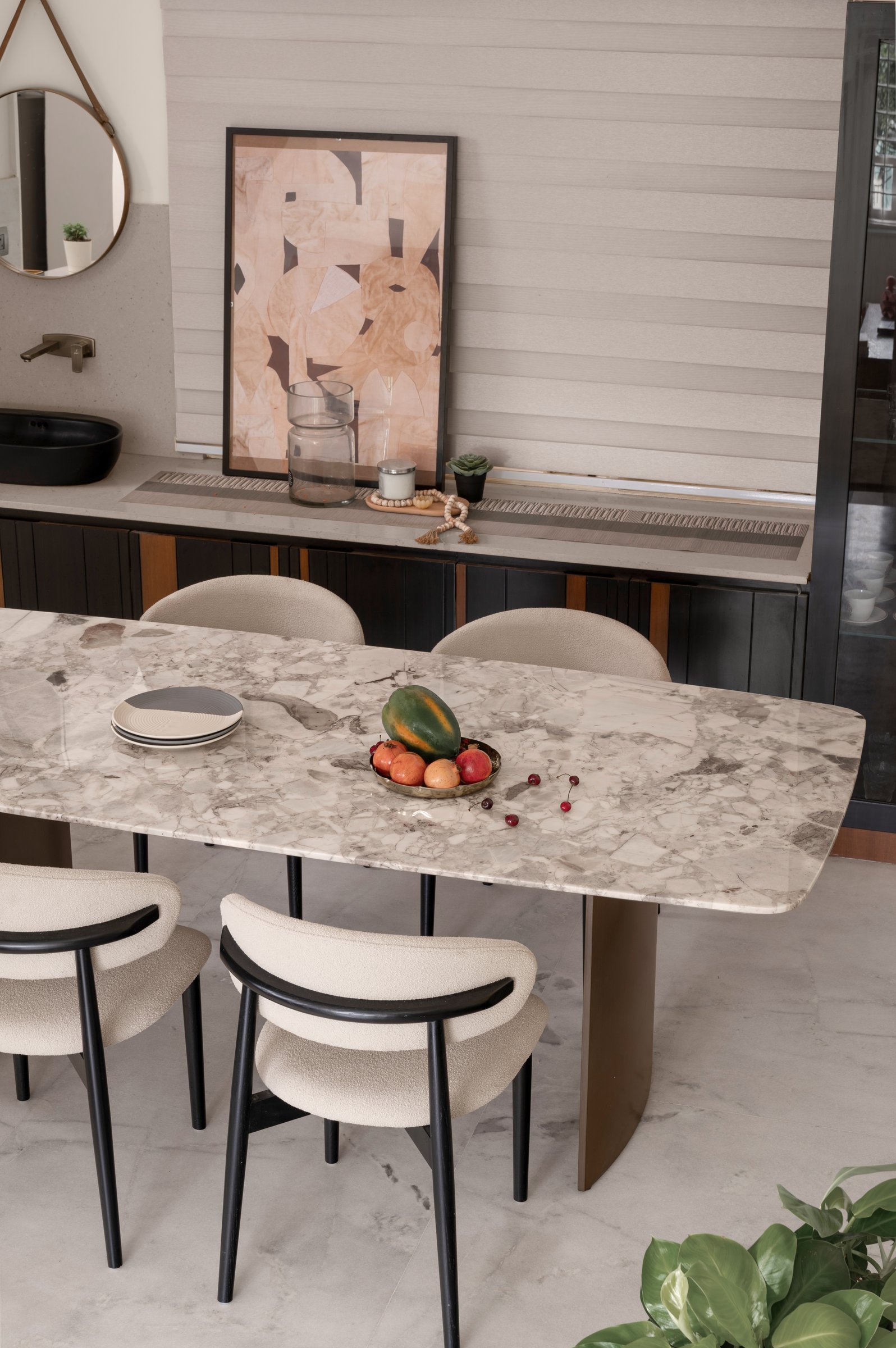
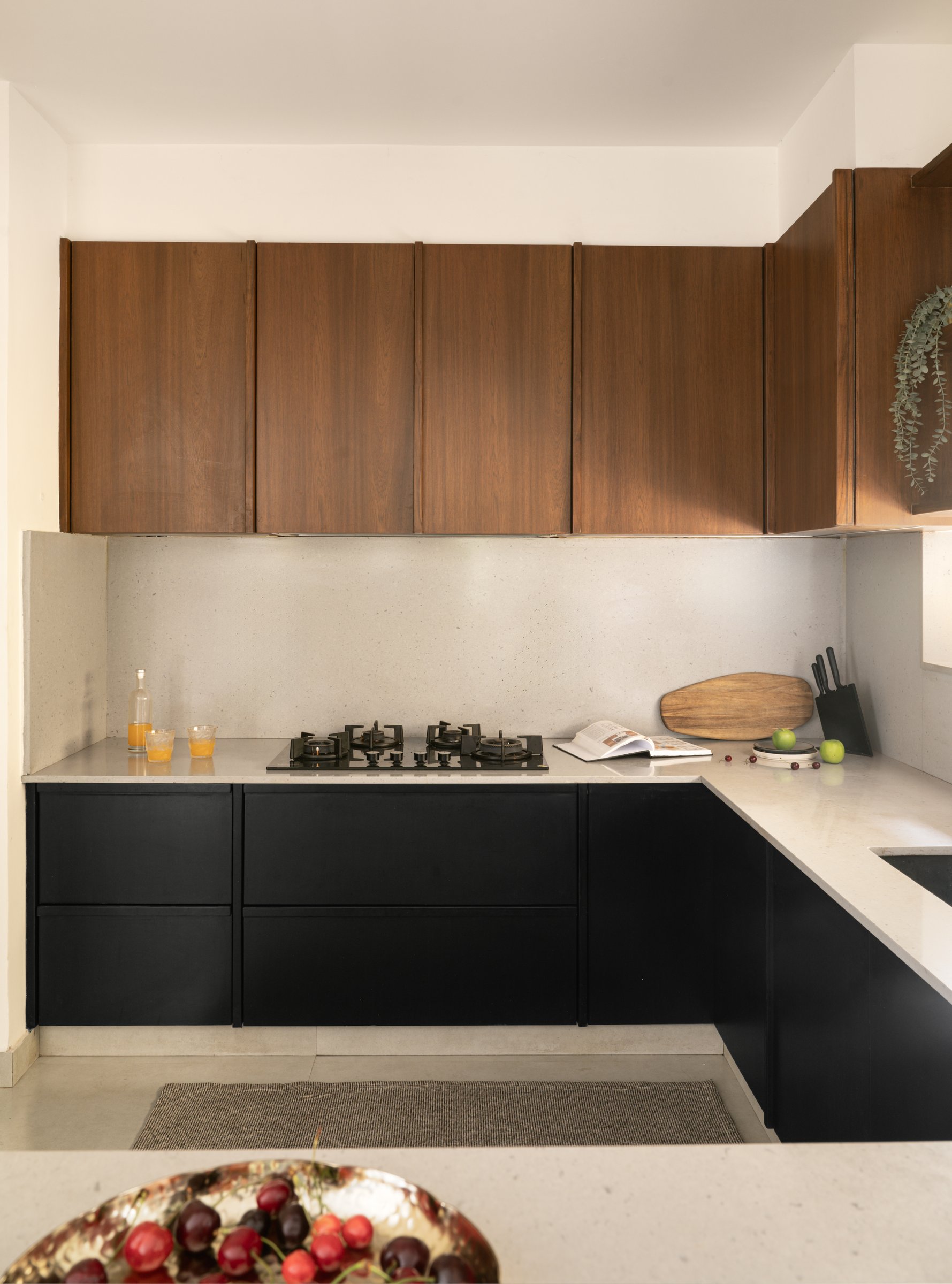
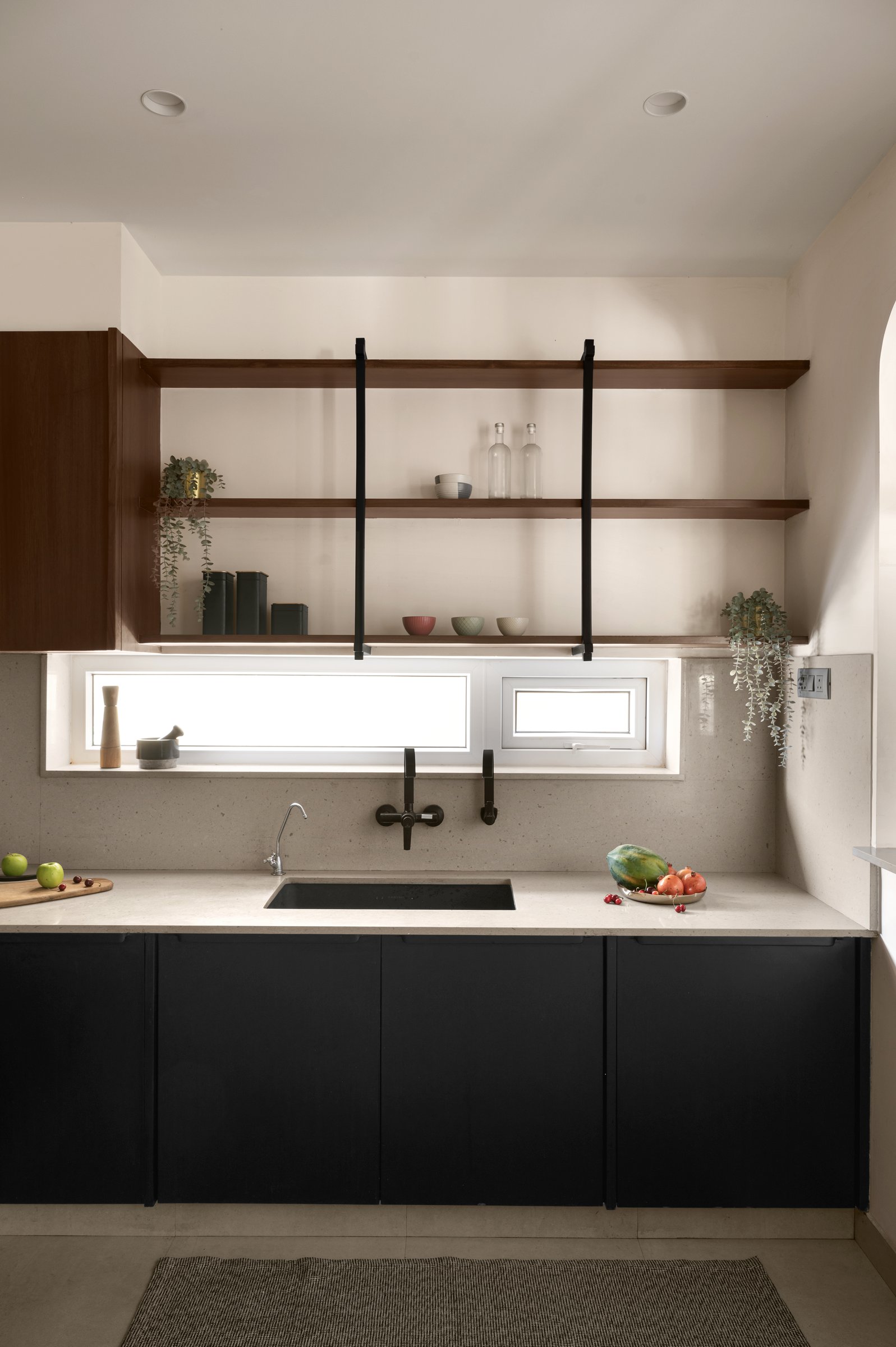
Set just beyond the arched opening, the kitchen embraces a language of restraint that feels both deliberate and practical. Handle-less matte black base cabinets anchor the space beneath a pale quartz worktop, while upper units in warm oak veneer introduce texture and warmth. The cabinetry is detailed with a continuous vertical grain, allowing the wall to read as a unified surface rather than a collection of individual cupboards.
The composition is defined by the interplay of contrasting horizontal layers. Dark cabinetry grounds the room, the pale countertop forms a crisp visual break, and the honey-toned timber above brings warmth and lightness. This simple arrangement lends the kitchen a clarity that feels architectural rather than decorative.
There is little here that seeks attention for its own sake. The materials are honest, the detailing precise, and the palette intentionally restrained. As a result, the kitchen reads first as a place of use rather than display, a working room whose appeal lies in its quiet efficiency and enduring simplicity.
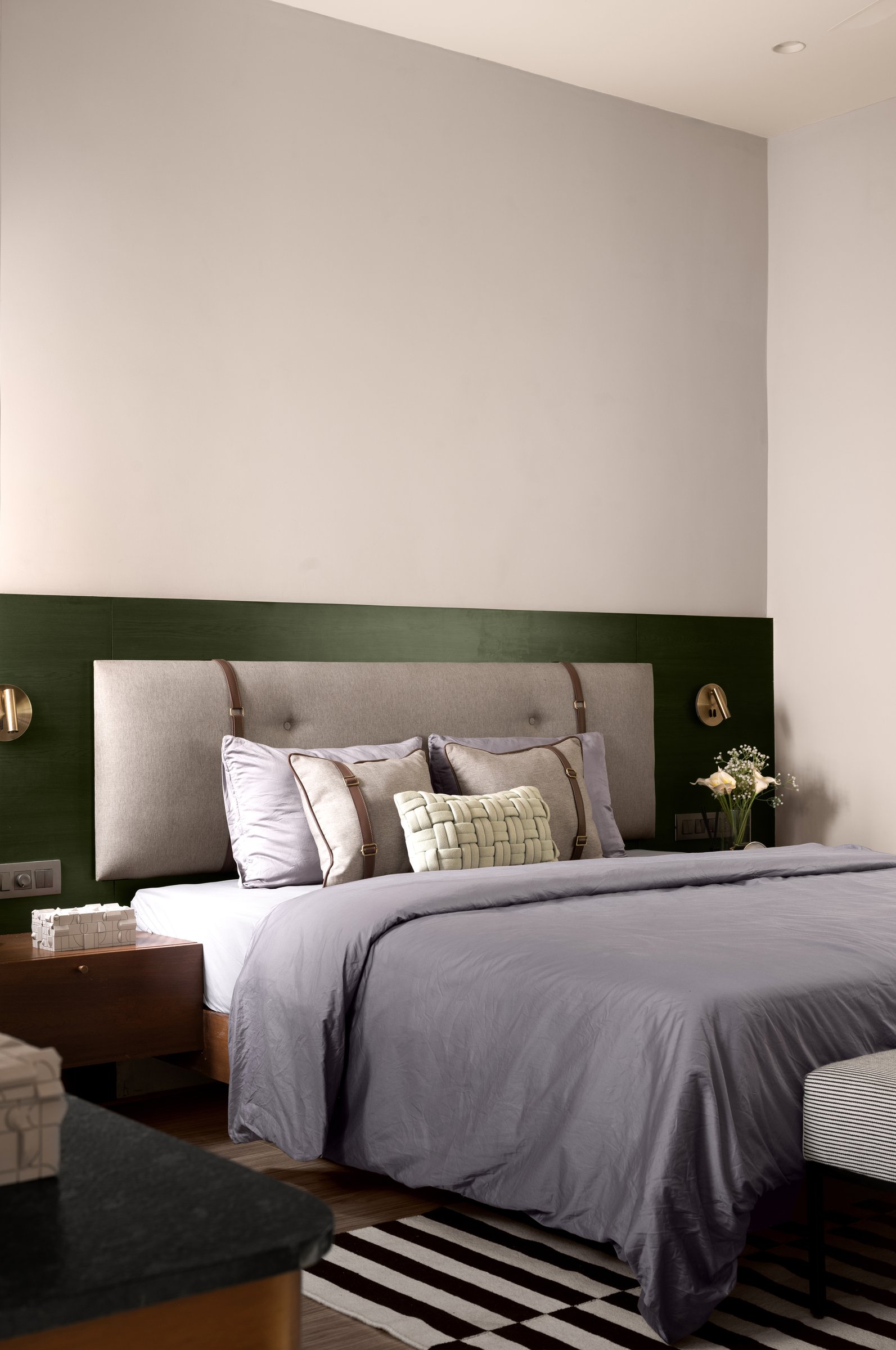
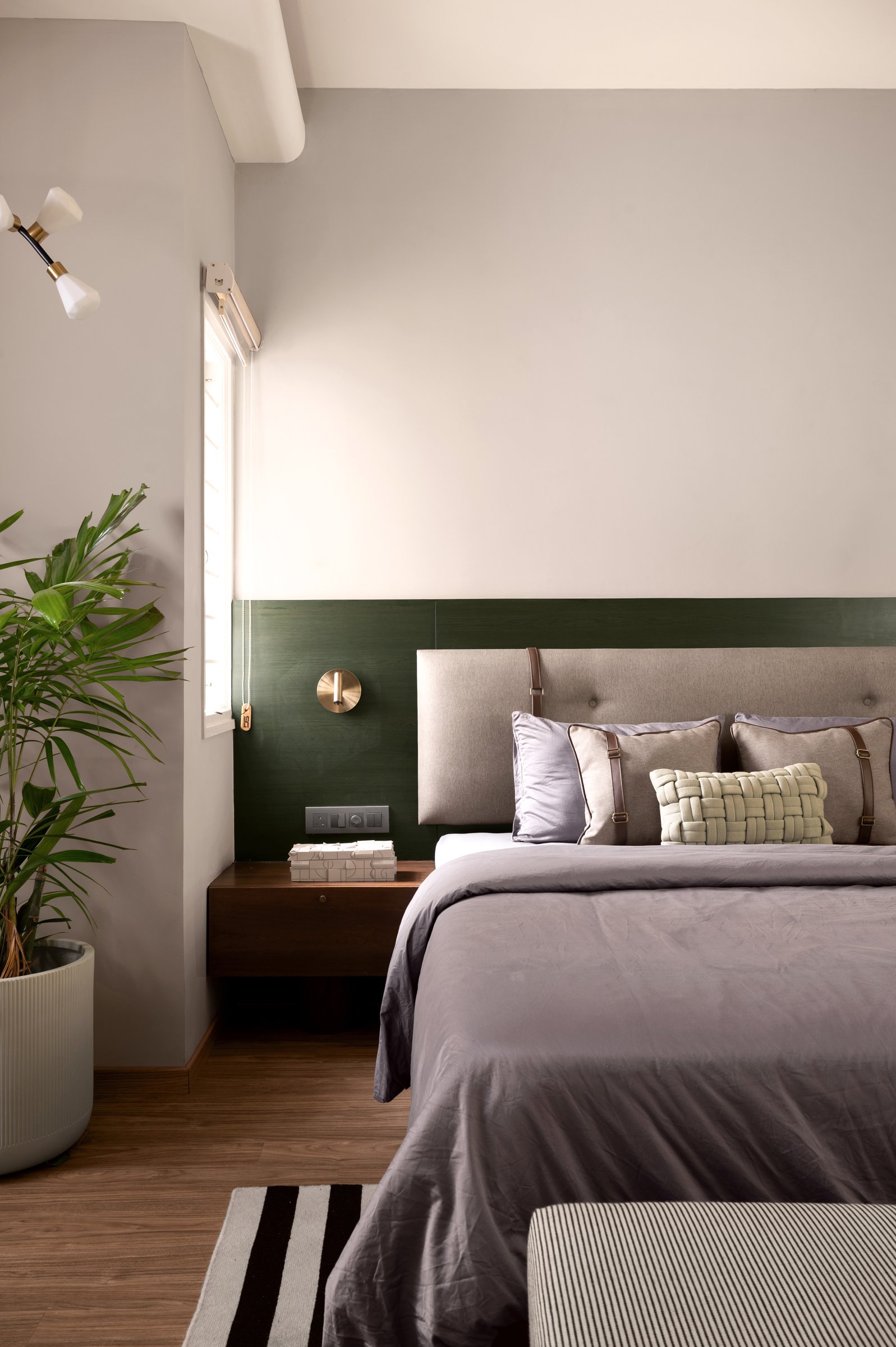
The primary bedroom on the lower floor adopts a richer and more intimate palette while remaining aligned with the home’s overall restraint. A deep green wall treatment stretches across the width of the room behind the bed, terminating at picture-rail height to create a strong horizontal datum. Rather than enveloping the space, the colour acts as a grounding element, introducing depth and character without overwhelming the room.
Set against this backdrop, a grey upholstered headboard detailed with leather straps brings texture and softness to the composition. Brass wall sconces are integrated into the arrangement, adding a subtle warmth that complements the green and timber tones elsewhere in the home. The interplay of materials feels considered and calm, with each element contributing to a layered yet restrained atmosphere.
““Common areas are swathed in a calming neutral palette of beige and white, while bedrooms burst with colours that reflect the unique personalities of their occupants.””
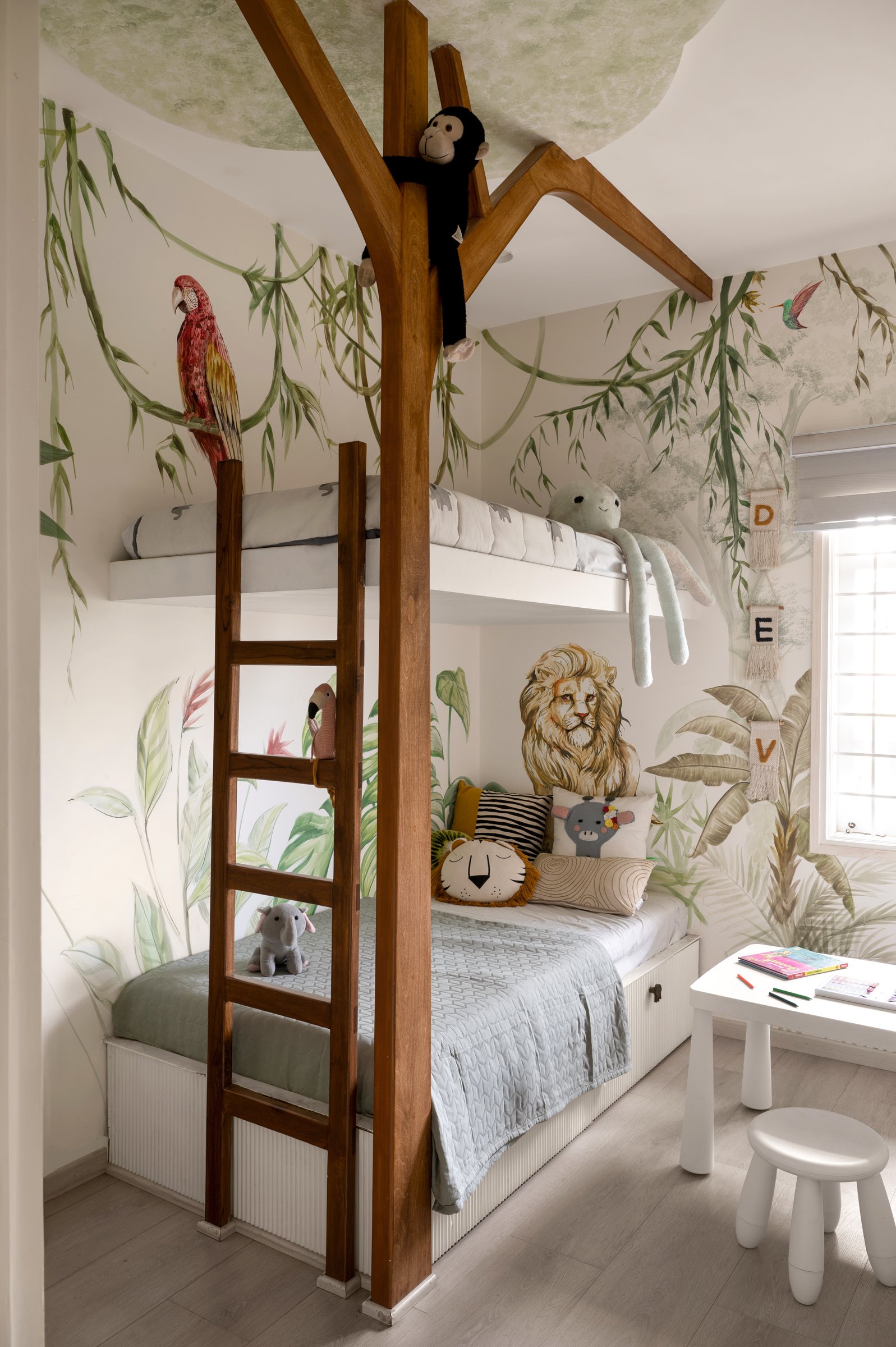
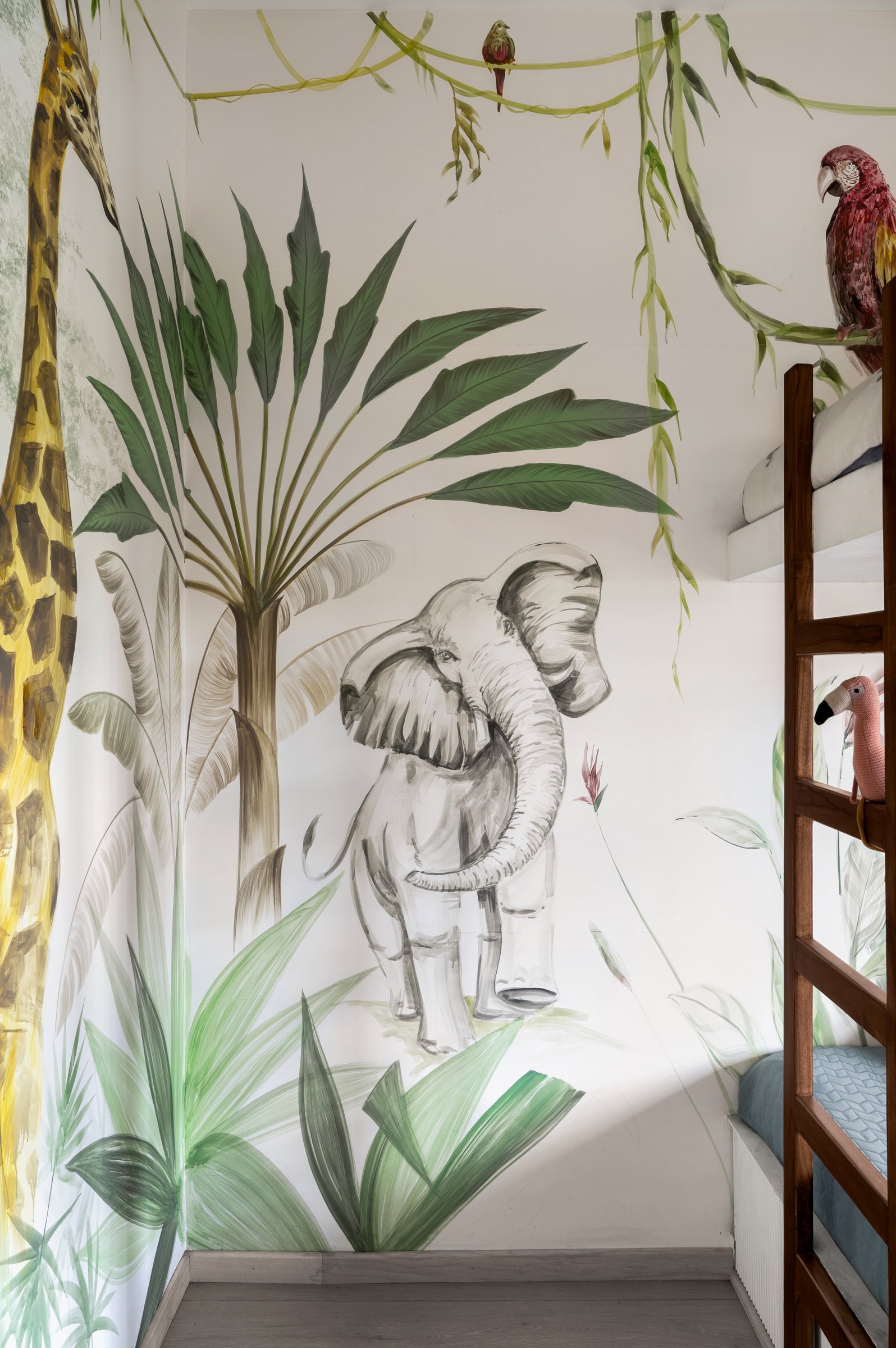
The son’s bedroom marks a deliberate shift in mood, introducing a sense of playfulness into an otherwise restrained interior. Here, the design embraces imagination without abandoning craftsmanship. A bespoke teak bunk bed, conceived as a stylised tree, rises through the room, its trunk-like form extending upwards into branching elements that spread across the ceiling plane. The piece functions as both furniture and architecture, transforming the room into a landscape for play.
Surrounding it, a hand-painted jungle mural envelops the walls with layers of foliage, trailing vines, tropical birds, and wildlife. Parrots perch among the leaves, hummingbirds dart through the composition, and a watchful lion occupies a place above the bed, lending the room a narrative quality that unfolds gradually rather than all at once. The artwork is immersive without becoming overwhelming, creating a setting that encourages curiosity and imagination.
Importantly, the palette remains measured. Muted greens, earthy taupes, and natural timber tones temper the exuberance of the theme, allowing the room to feel sophisticated as well as playful. Rather than relying on bright colours or novelty, the design creates a childhood environment that is rich in character, layered in detail, and capable of growing alongside its occupant.
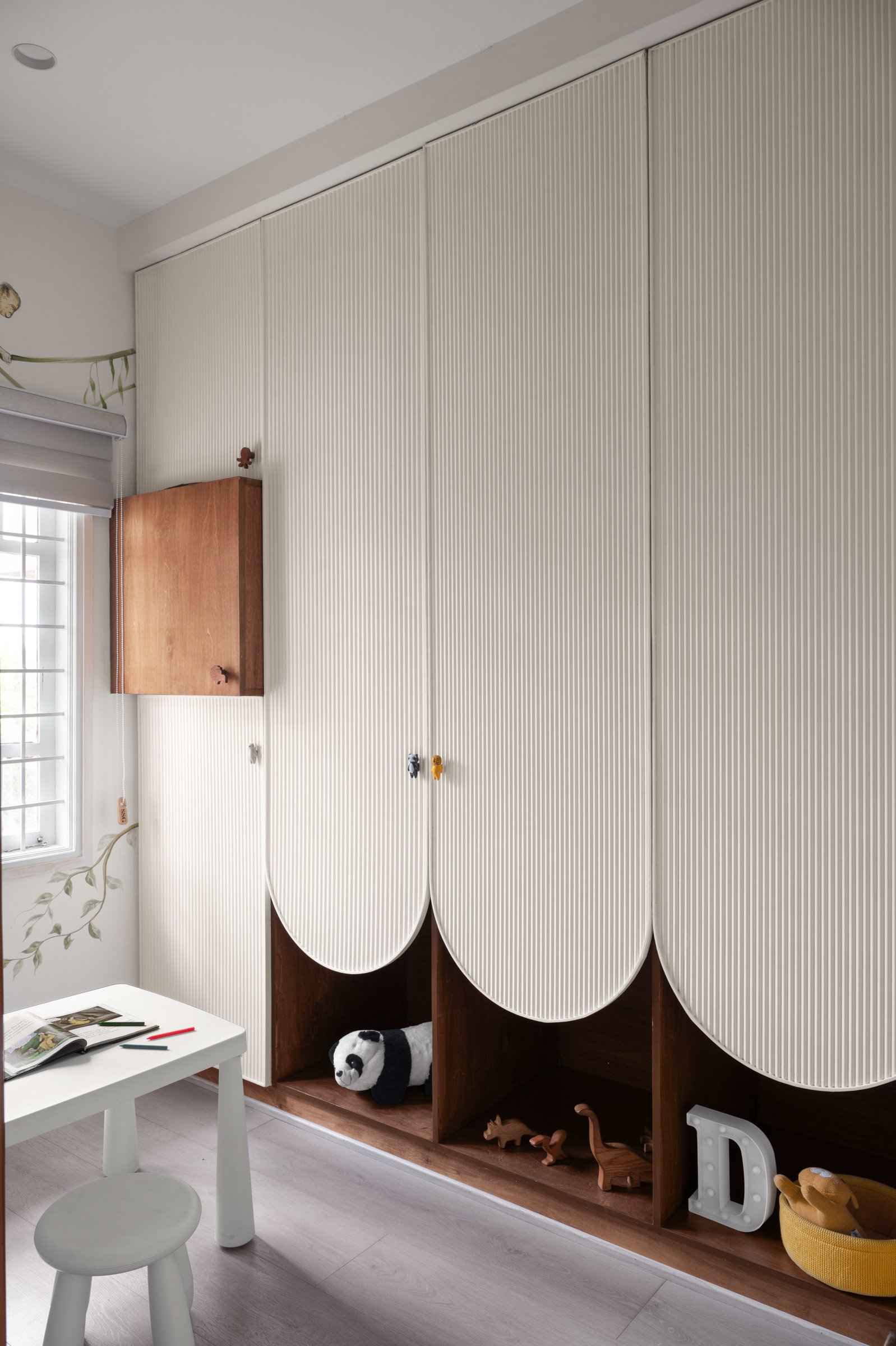
Opposite the bed, the wardrobe continues the room’s thoughtful balance between utility and imagination. Fluted cream shutters lend the piece a gentle rhythm, while their lower edges soften into scalloped curves that introduce a sense of play without resorting to overt decoration. The detailing echoes the rounded language found elsewhere in the home, adapted here to suit the scale and sensibility of a child’s room.
At the base, an open timber niche replaces what might otherwise have been a closed plinth. Designed to display soft toys, books, and treasured objects at a child’s eye level, it transforms a purely functional storage element into an active part of the room’s daily life. The wardrobe becomes more than a place to store belongings; it offers moments of engagement, discovery, and ownership.
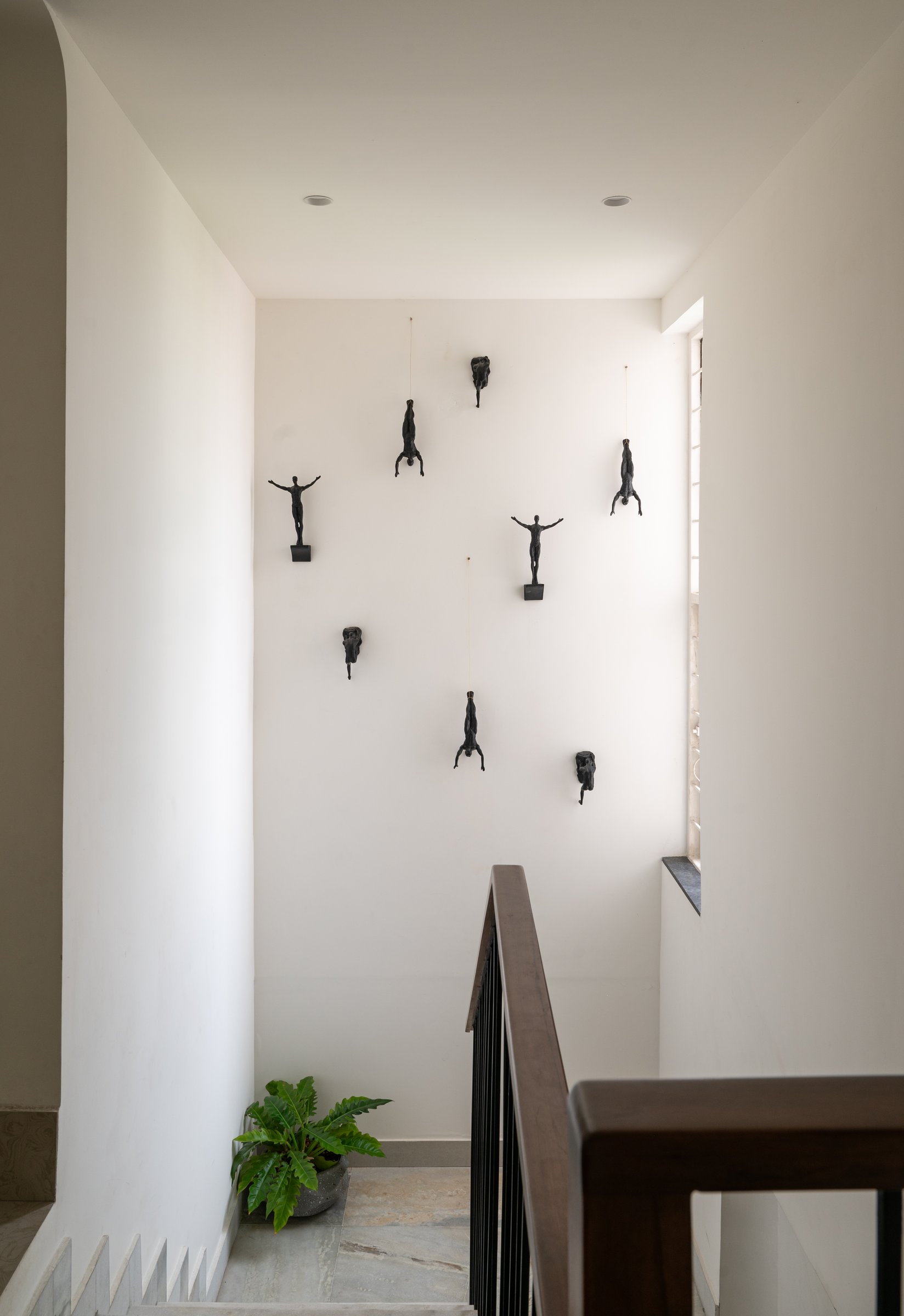
The stairwell that connects the two floors is treated as its own composition. A series of small bronze figures, climbing, suspended, leaping, scale the white wall in a loose, scattered choreography, and a single fern at the landing softens the base of the climb. The gesture turns a purely circulatory space into a moment of quiet wonder before the upper floor reveals itself.
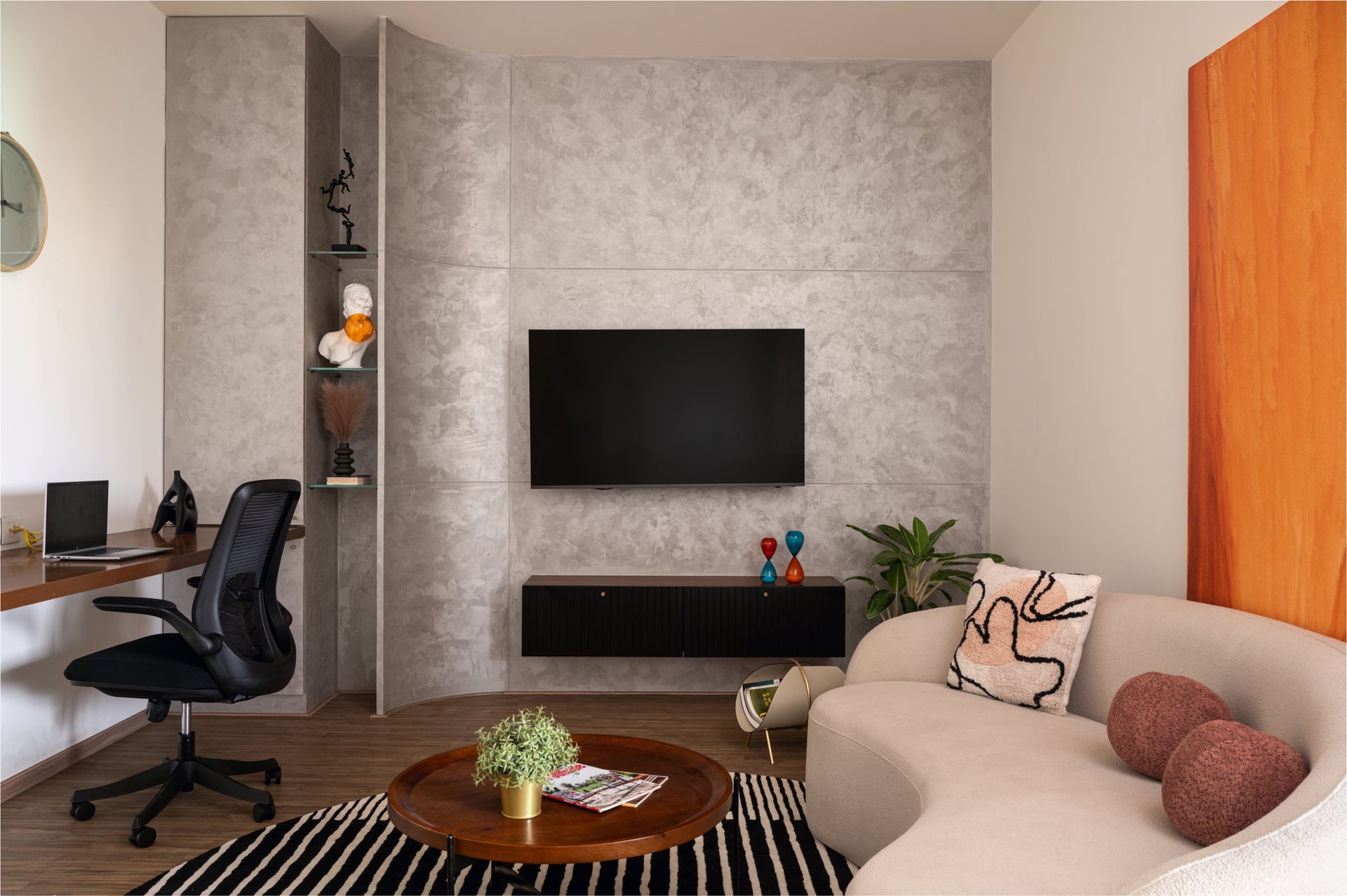
The upper-floor living room is the home’s most flexible space, conceived for owners who work from home and host often. A curved beige sofa wraps one side of the room, set against a textured concrete-toned wall that carries the TV and a fluted black console. A teak desk and ergonomic chair tuck into the adjacent wall, and a glass-shelved display niche between the two zones holds a small bust and sculptural objects, blending work, leisure and display into a single continuous room.
The curved sofa is anchored by a tall canvas in rust and ochre, its washes of pigment reading almost like weathered metal. A rounded boucle stool in the same earthen palette sits to one side, and a black-and-cream striped rug grounds the arrangement. The colour story here, warm clay, cream, soft pink, is the warmest in the home, and the room’s curves feel deliberate against the more linear vocabulary of the floor below.
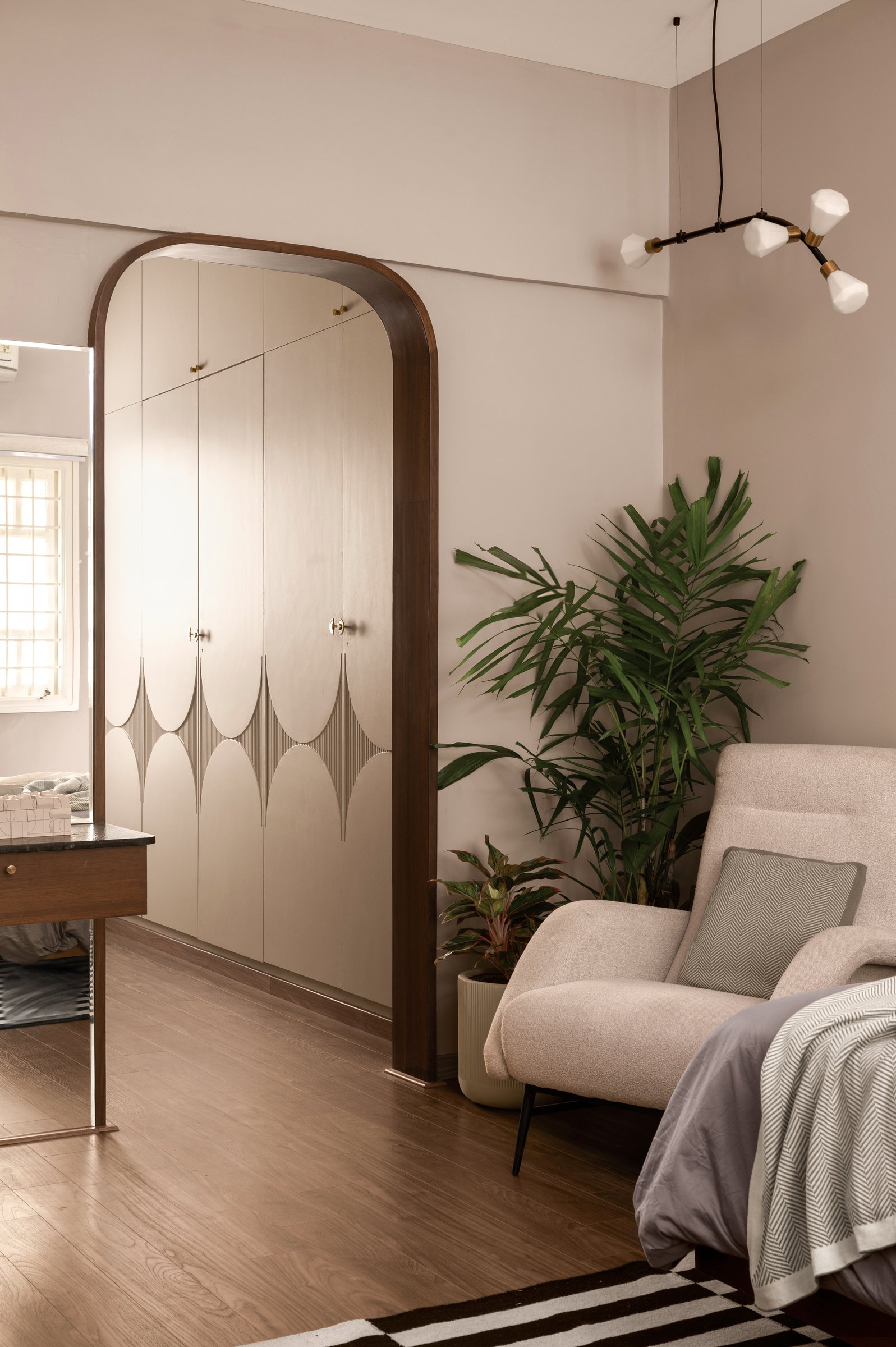
The upper-floor bedroom completes the home’s vocabulary of arches. A walnut-framed arched portal carries the eye to a wardrobe wall finished in soft cream, where a subtle inlay traces three slim arcs across the shutters, a low-key echo of the doorway. A boucle armchair and a tall palm soften the corner, and a slim brass-and-glass pendant hangs from the ceiling.
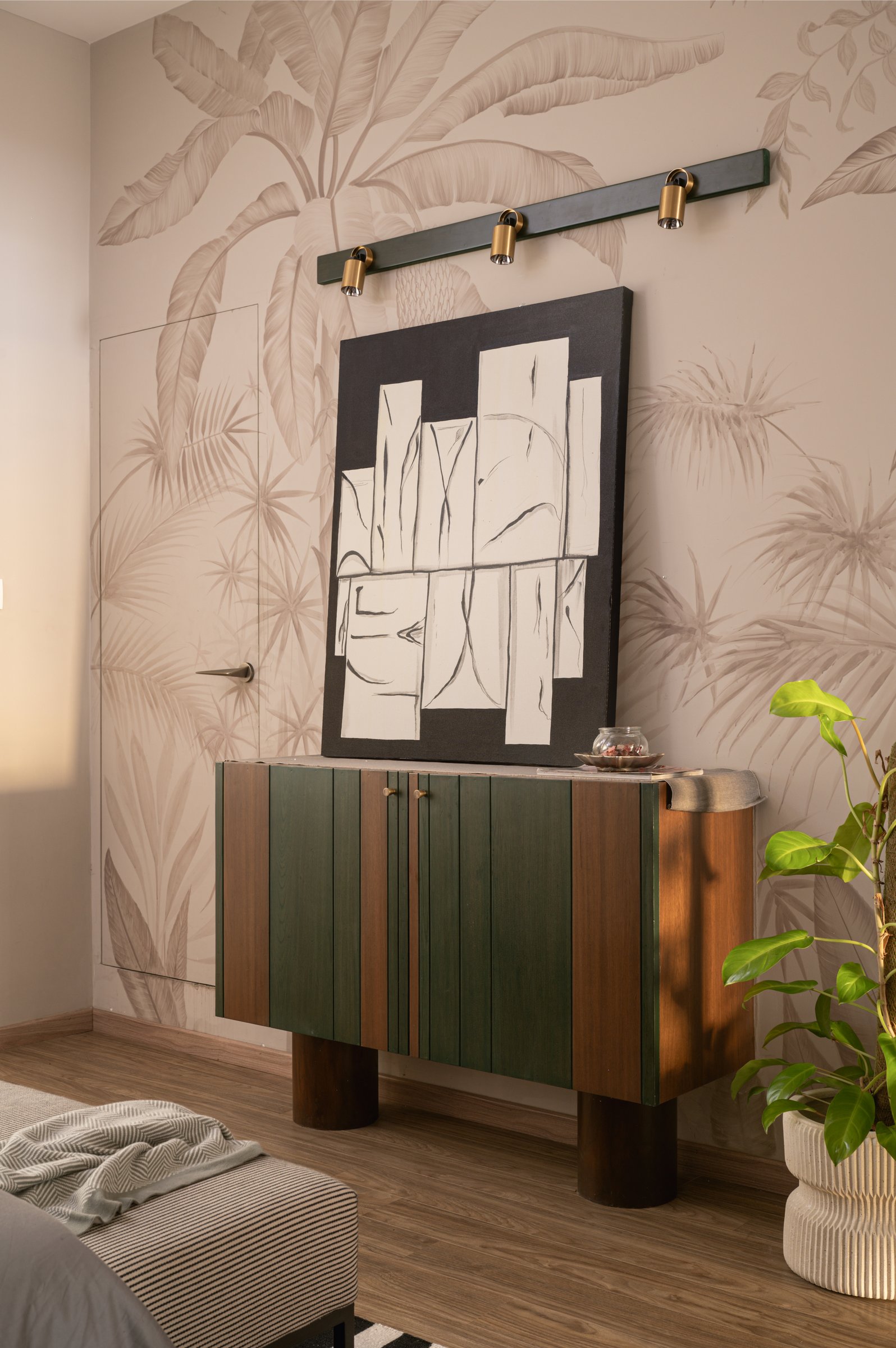
Within the same bedroom, a wallpapered wall in muted palm fronds carries a sideboard in vertically panelled green and walnut, set on stout cylindrical legs. A large monochrome canvas leans against the wall above, and a slim track of brass spotlights washes the composition. The piece is the only place in the home where green moves from architectural band to full furniture object, a small payoff for the colour discipline practiced elsewhere.
What Pragati Niwasa ultimately demonstrates is the potential of renovation as an act of refinement rather than replacement. The original load-bearing structure remains intact, carefully adapted rather than erased, allowing the house to retain its memory while accommodating a new way of living. Through a measured vocabulary of arches, softened corners, natural materials, and thoughtfully connected spaces, the design creates an environment that responds to the rhythms of three generations sharing a single home. In a city where ageing houses are often demolished in favour of entirely new constructions, the project offers a more considered alternative.
The success of the home lies not in grand gestures but in the accumulation of small, deliberate decisions. A curved opening that encourages interaction between rooms, a band of colour that grounds a bedroom, joinery shaped to a child’s scale, and materials repeated with quiet consistency across the interior all contribute to a sense of cohesion. The design never seeks attention through excess, instead allowing everyday life to become the focal point.
What emerges is a home defined by warmth, familiarity, and ease. Its luxury is found not in spectacle but in the precision with which spaces respond to their occupants. Pragati Niwasa feels less like a transformed house than a rediscovered one, a place where architecture works gently in the background, supporting family life while allowing it to unfold naturally over time.