Renovation is seldom an act of replacement. At its most thoughtful, it is an act of refinement: the careful editing of a home until its essential qualities can emerge with greater clarity. Within this process, restraint becomes the most exacting design tool, asking architecture to rely not on spectacle but on proportion, materiality, and the choreography of light.
Elara, a 1,500 sq. ft. residence in Ranchi designed by SCJ Architects & Interior Designers under the direction of Architect Shikha Choudhary, embraces this philosophy with quiet confidence. Conceived as a contemporary 3BHK apartment, the home is shaped by a restrained palette of warm timber, soft whites, muted greys, and expanses of Italian marble. Rather than seeking visual drama, the design builds atmosphere through texture, balance, and a measured layering of materials.
The experience of the home begins not with a statement but with a sense of calm. Fluted surfaces, softened edges, and sculpted curves establish a subtle rhythm that carries through the interiors, while carefully layered lighting lends depth and warmth throughout the day. Social and private spaces share a common material language, creating continuity without uniformity, and allowing each room to unfold as a distinct yet connected part of a cohesive whole.
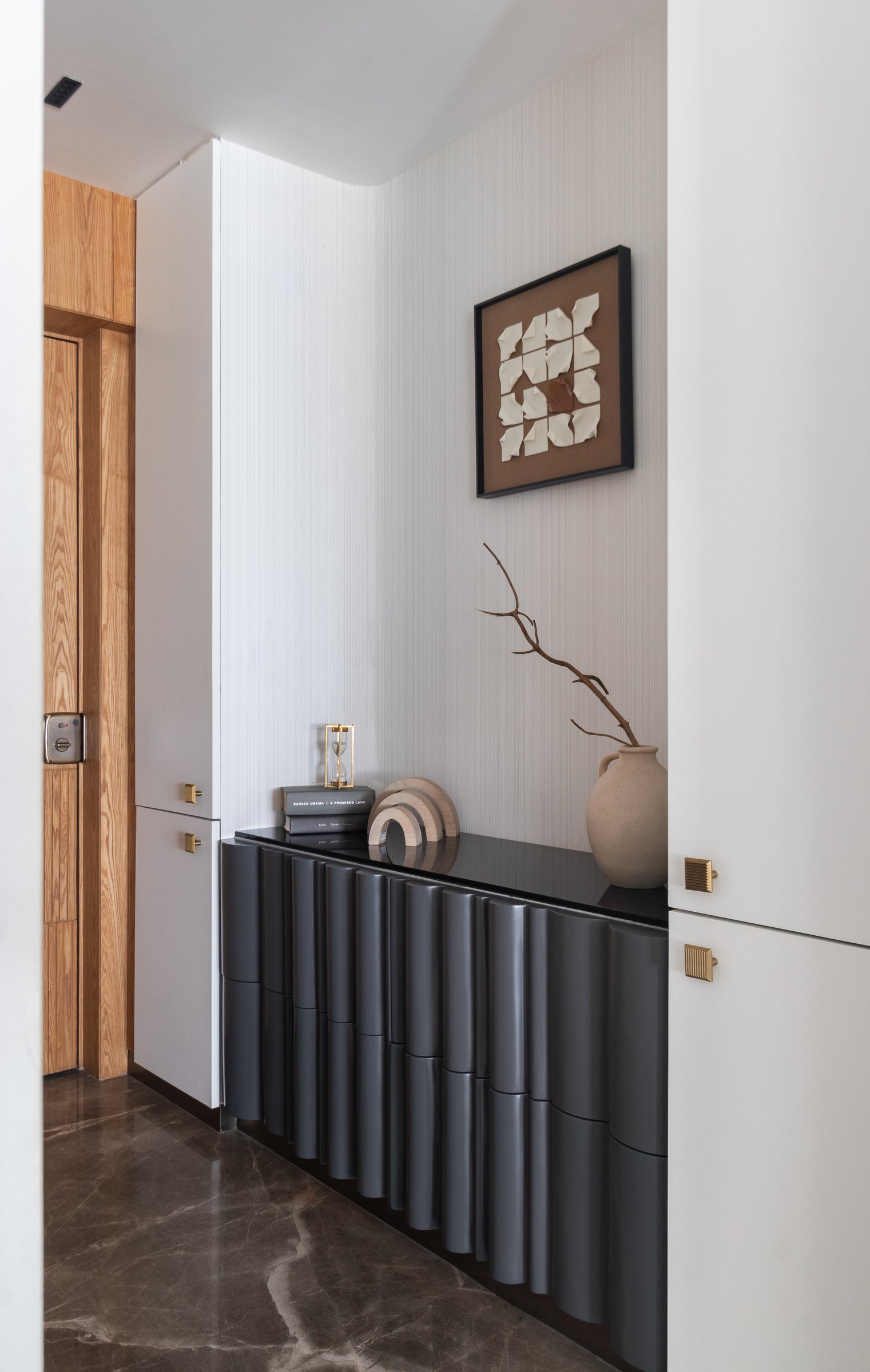
The foyer establishes the home’s design language in a single composed frame. A grey fluted console, broader in rhythm and architectural in scale, anchors the threshold against a softly textured pale wall, its surface holding a small still life of vessel, book and weathered branch. The honeyed wooden door and brass cabinet pulls introduce the warm-and-cool conversation that the rest of the apartment will continue, allowing texture rather than ornament to define the character of the space.
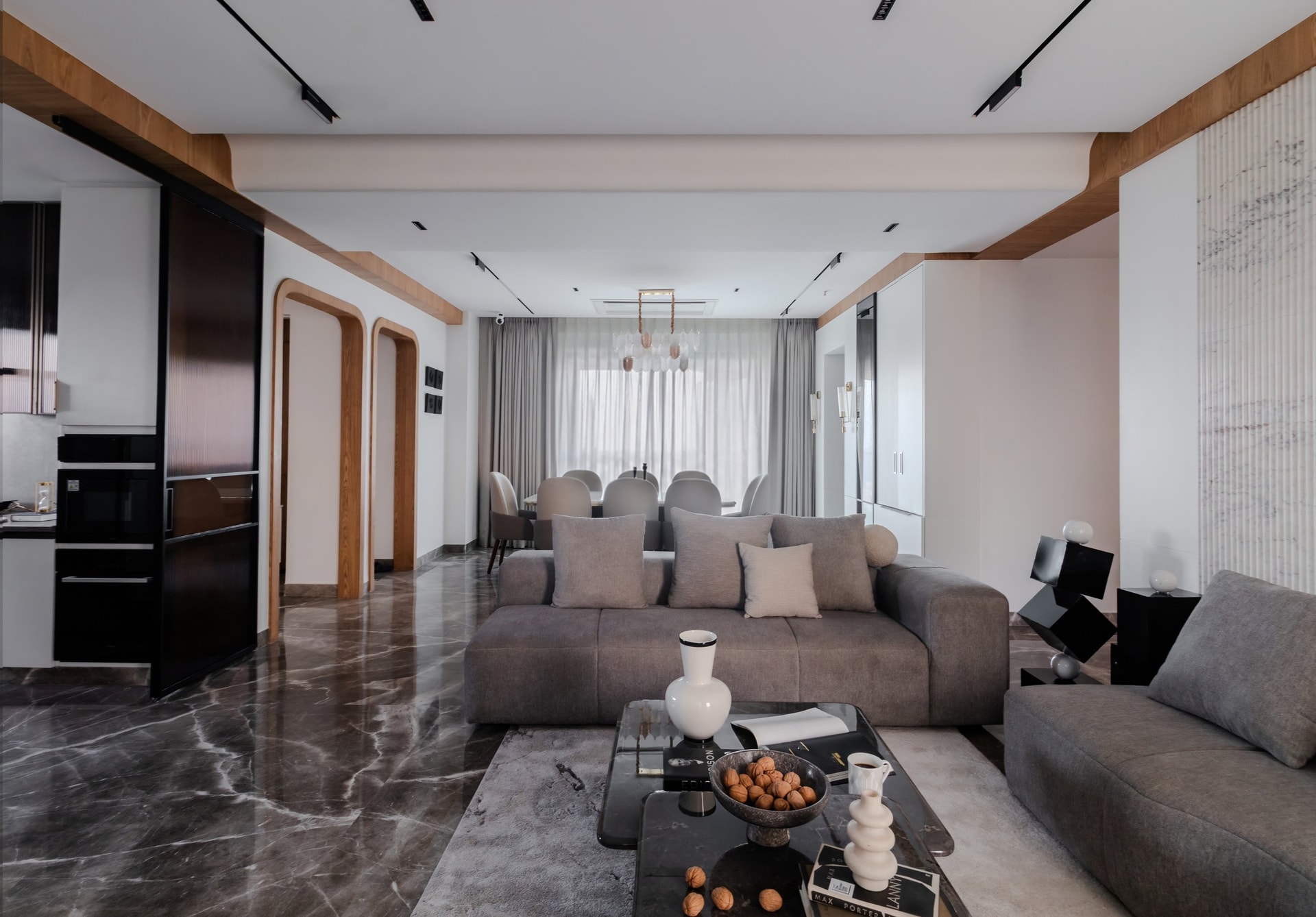
Beyond the foyer, the living room opens into the home’s principal social volume, where greyed Italian marble flooring and a long upholstered sofa in soft grey set the tonal register. A wooden beam traces the ceiling line and continues into framed doorways, lending continuity between living and dining without resorting to overt division.
The composition rewards stillness. Light pools across the marble, sheer drapes diffuse the daylight at the far end, and the eye is allowed to travel the full length of the apartment before settling on any single object. It is a room shaped by edits, not additions.
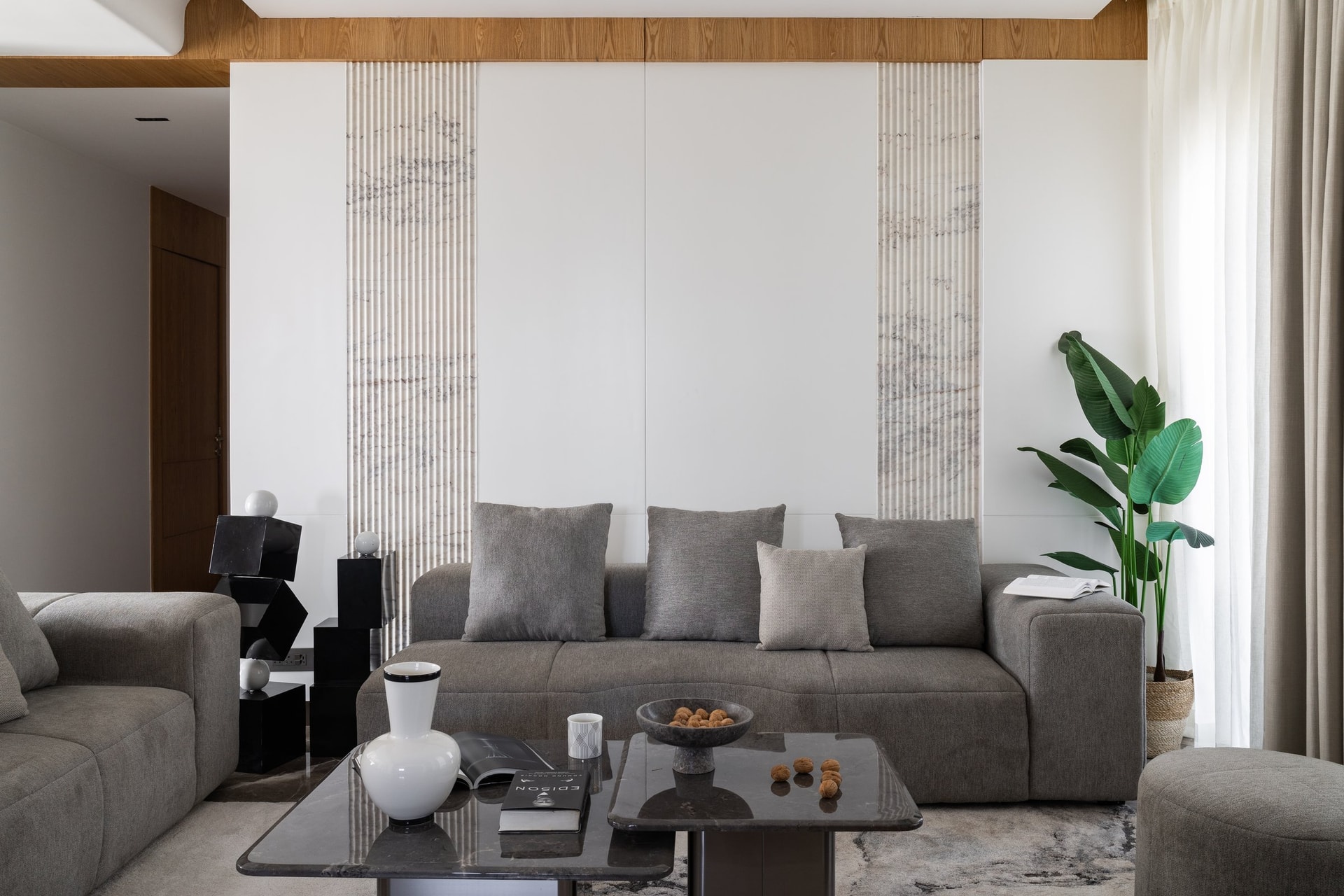
The sofa backwall is where the project’s restraint becomes most articulate. Two slender bands of fluted, veined stone rise vertically against a tall white panelled surface, their cool, painterly grain echoing the marble underfoot.
The wall does not compete with the seating; it frames it. By keeping ornament narrow and vertical, the room reads as taller and calmer, and the broad sofa in muted greige sits comfortably as the room’s softest gesture.
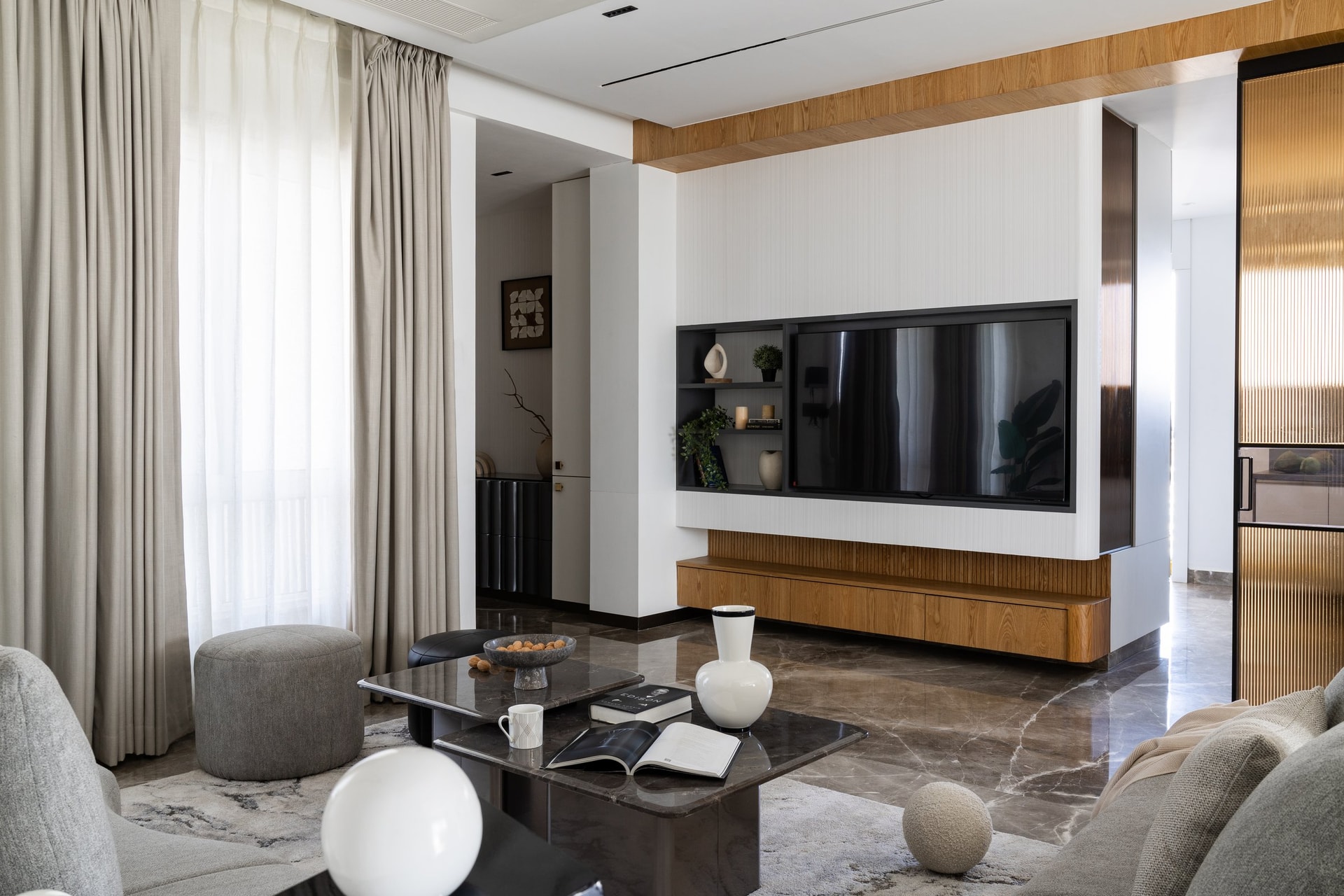
Opposite, the media wall reinterprets the familiar television niche as architecture. A recessed black frame holding the screen and a slim open shelf is set into a white textured surface, grounded by a long, slatted wooden console that runs the full width below.
““A quiet drama unfolds through sculpted lines and softened edges, where the textured backdrop whispers and the foreground speaks in a deeper, bolder tone.””
The wooden ceiling band overhead ties this wall back to the beam that traces the entire social zone, reinforcing how the apartment’s geometry is held together by a few carefully repeated horizontals.
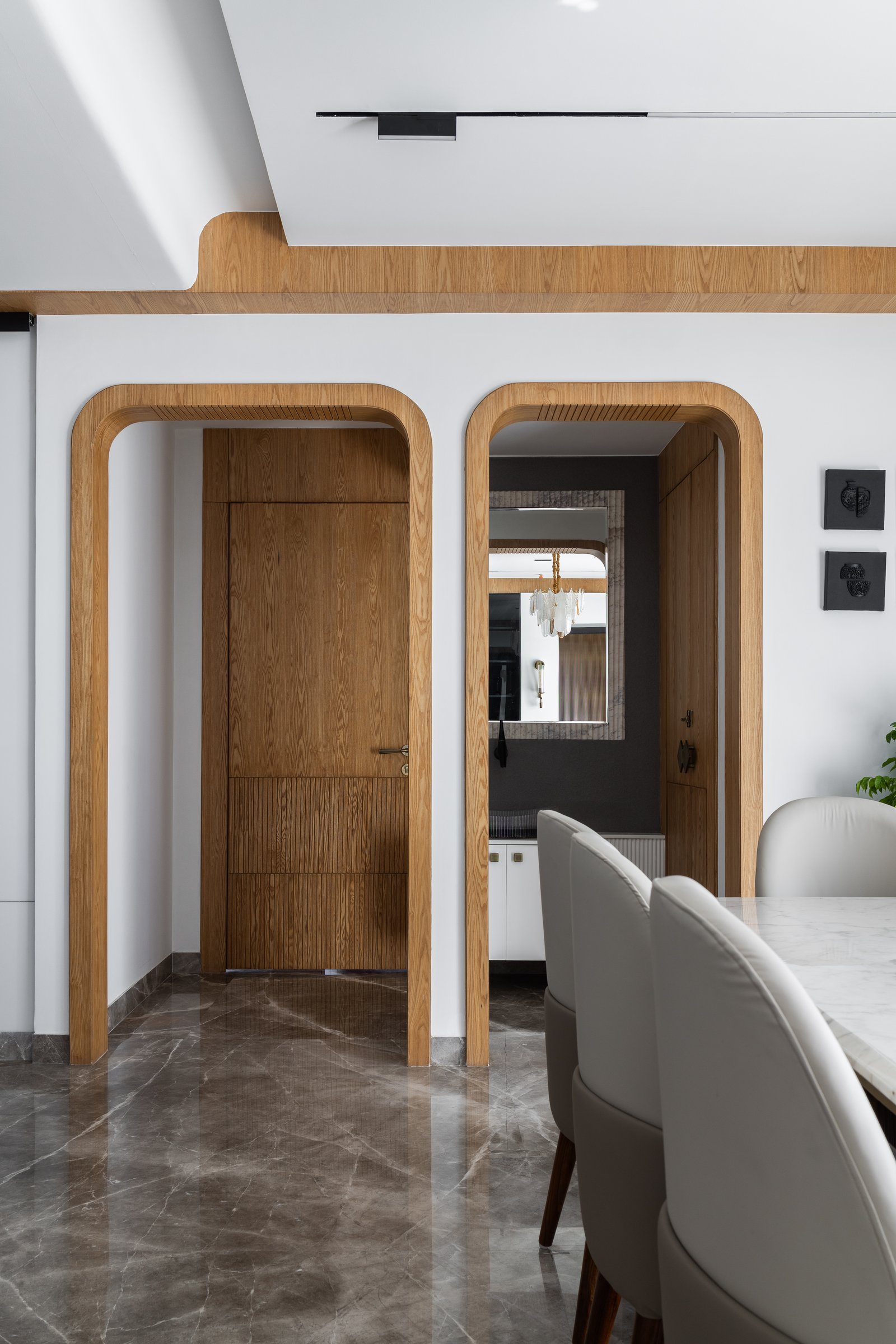
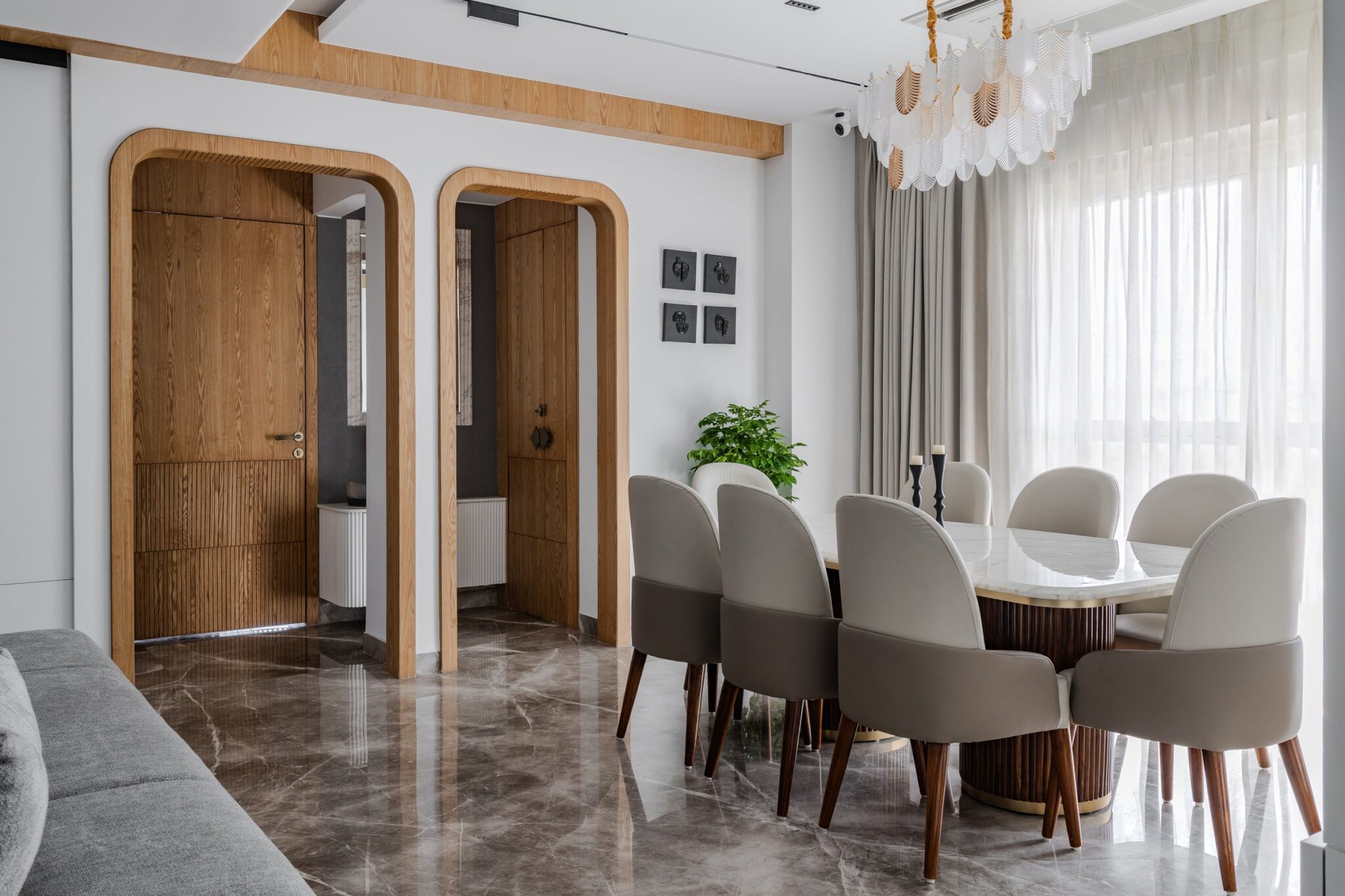
The transition between living and dining is articulated through twin arched openings framed in warm wood, their soft curves echoing the rounded ceiling detail above. These arches are the home’s gentlest spatial argument, allowing the floor plan to flow without ever feeling undivided.
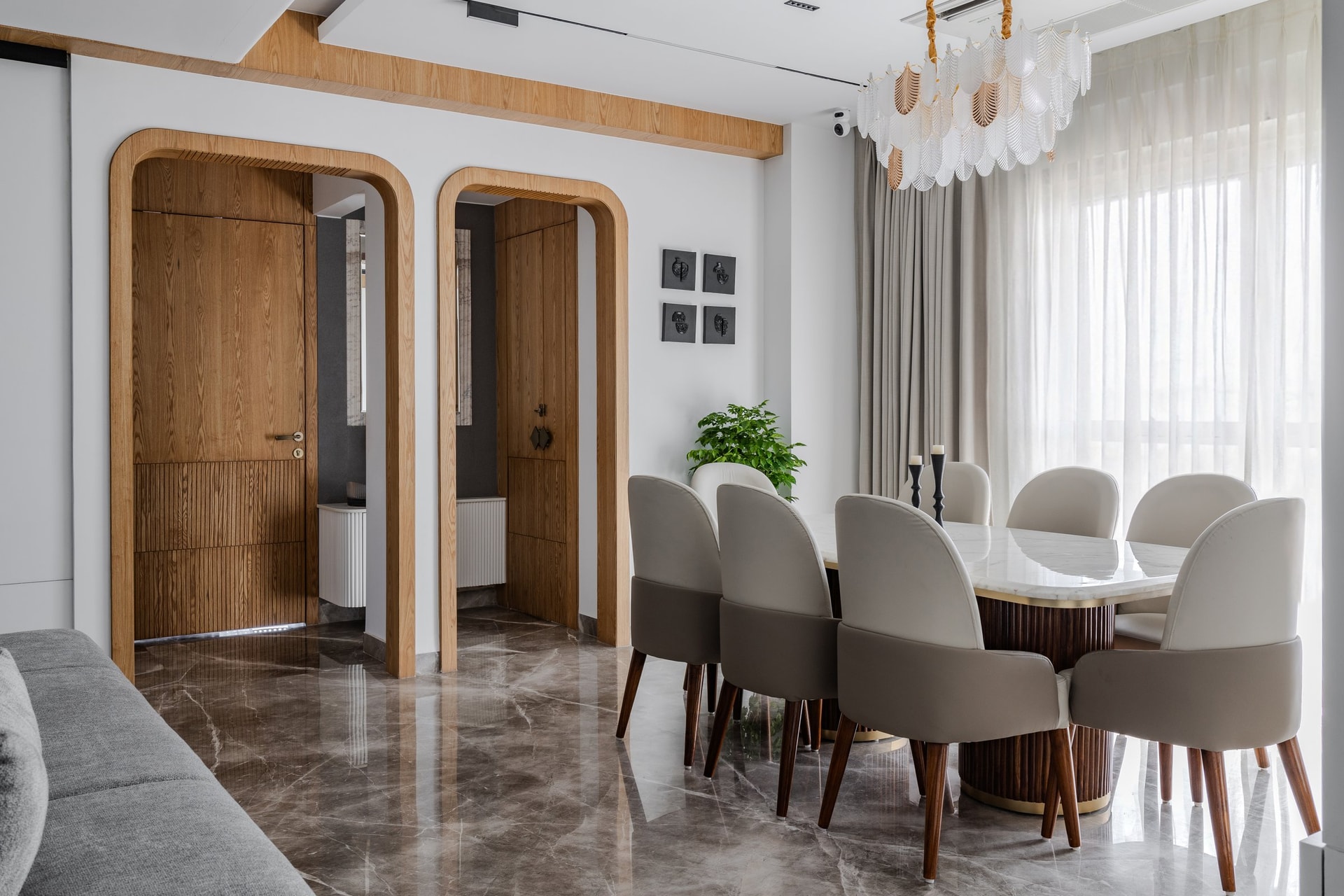
The dining area carries the home’s quiet sense of elegance forward. A marble-topped table on a fluted wooden base is surrounded by upholstered chairs in soft greige with turned wooden legs, while a layered shell-like chandelier hangs above as the room’s single sculptural gesture.
The arched portals on one side lead into private quarters, their wooden frames reading as a soft punctuation between the home’s social and intimate registers. Sheer drapes on the opposite side allow daylight to fall in long, calm planes across the marble floor.
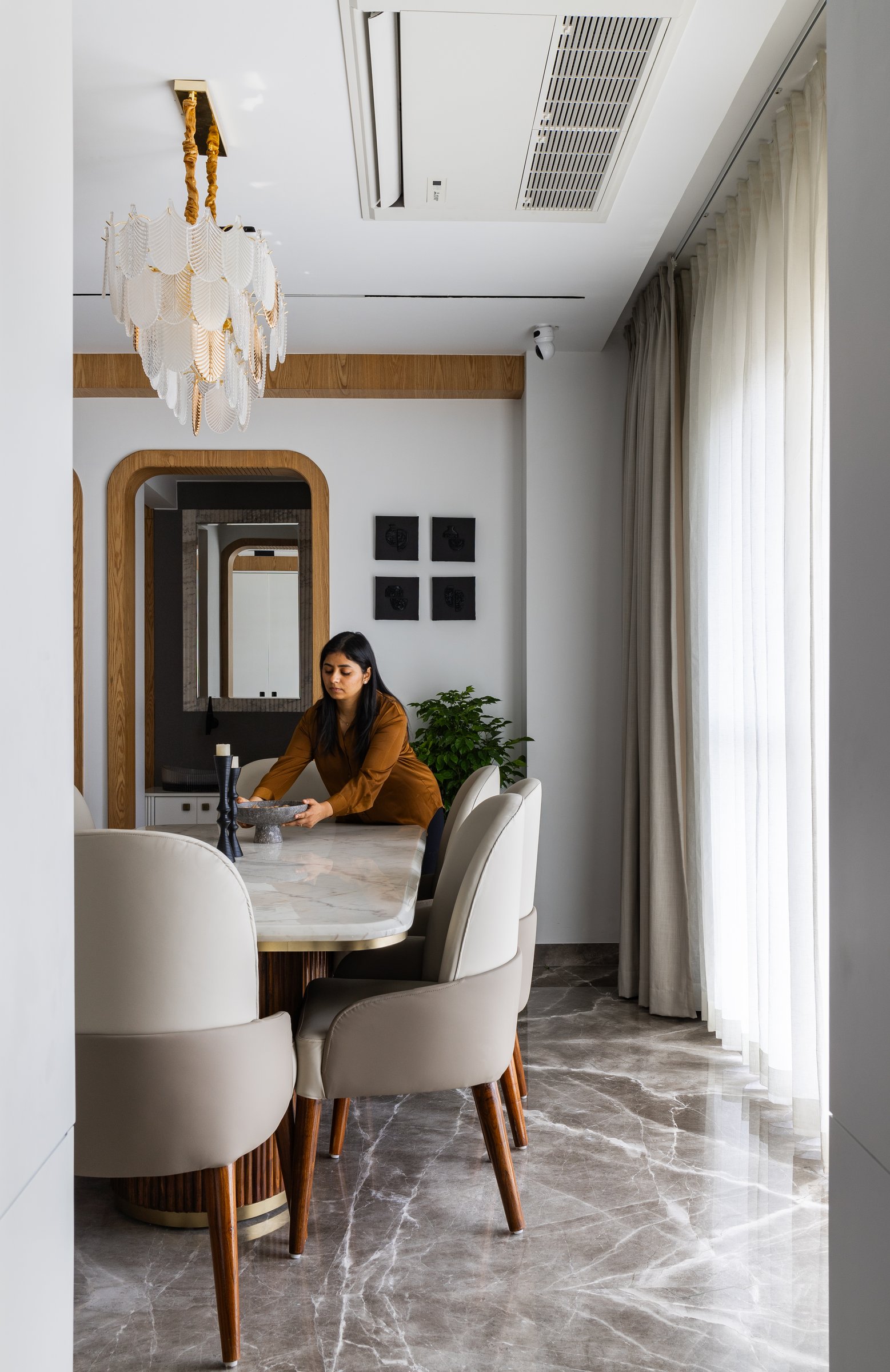
The arched mirror set into a wooden frame doubles the dining room’s depth and reflects the chandelier’s quiet shimmer, while a small grid of dark artworks anchors the wall beside it. It is a space conceived for slow, lingering meals rather than performance.
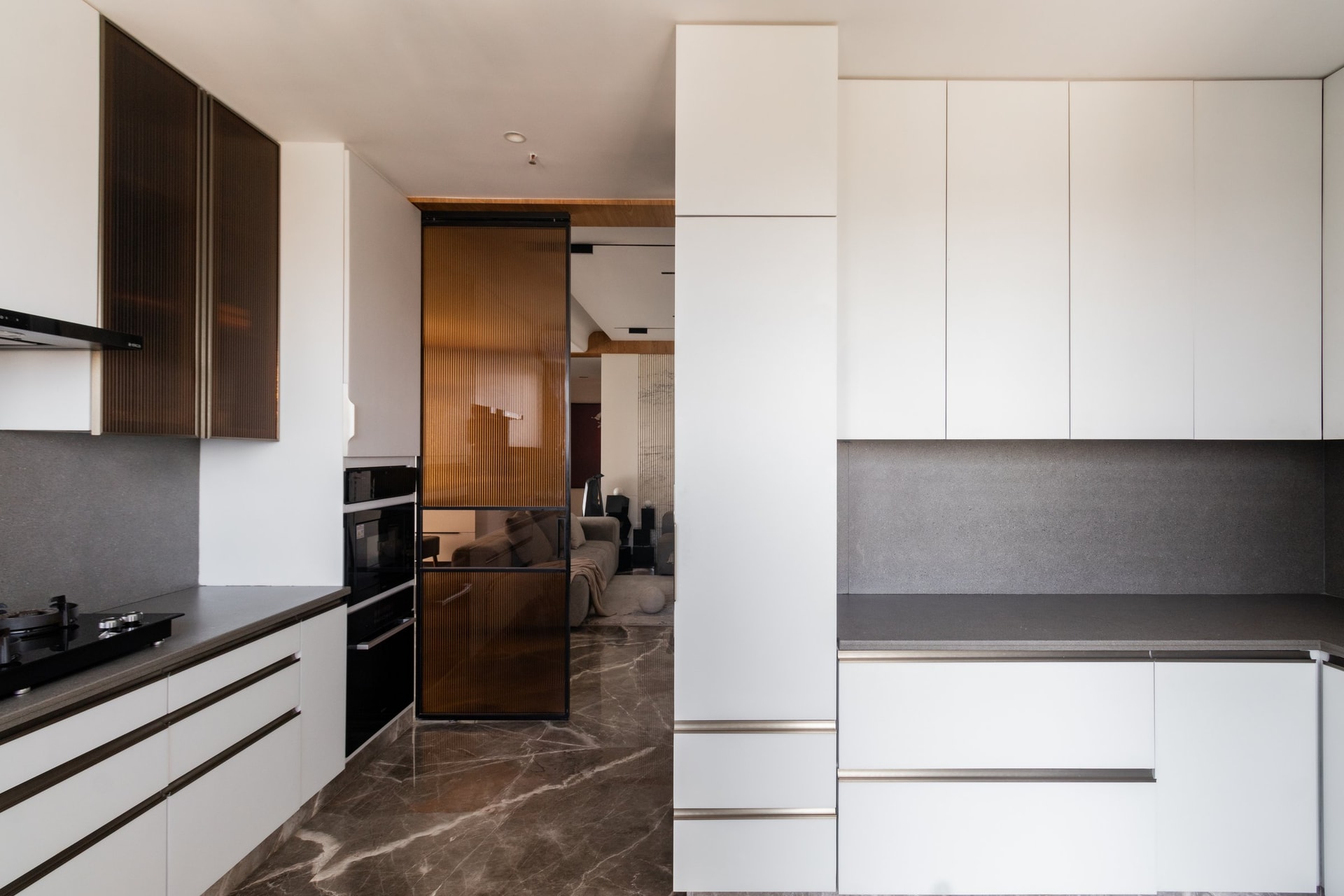
The kitchen sits behind a sliding amber-toned reeded glass door, a detail that preserves visual continuity with the social zones while allowing the working space to remain private when needed. White handle-less cabinetry, a muted grey countertop and the same marble flooring carry the home’s discipline through into the service space.
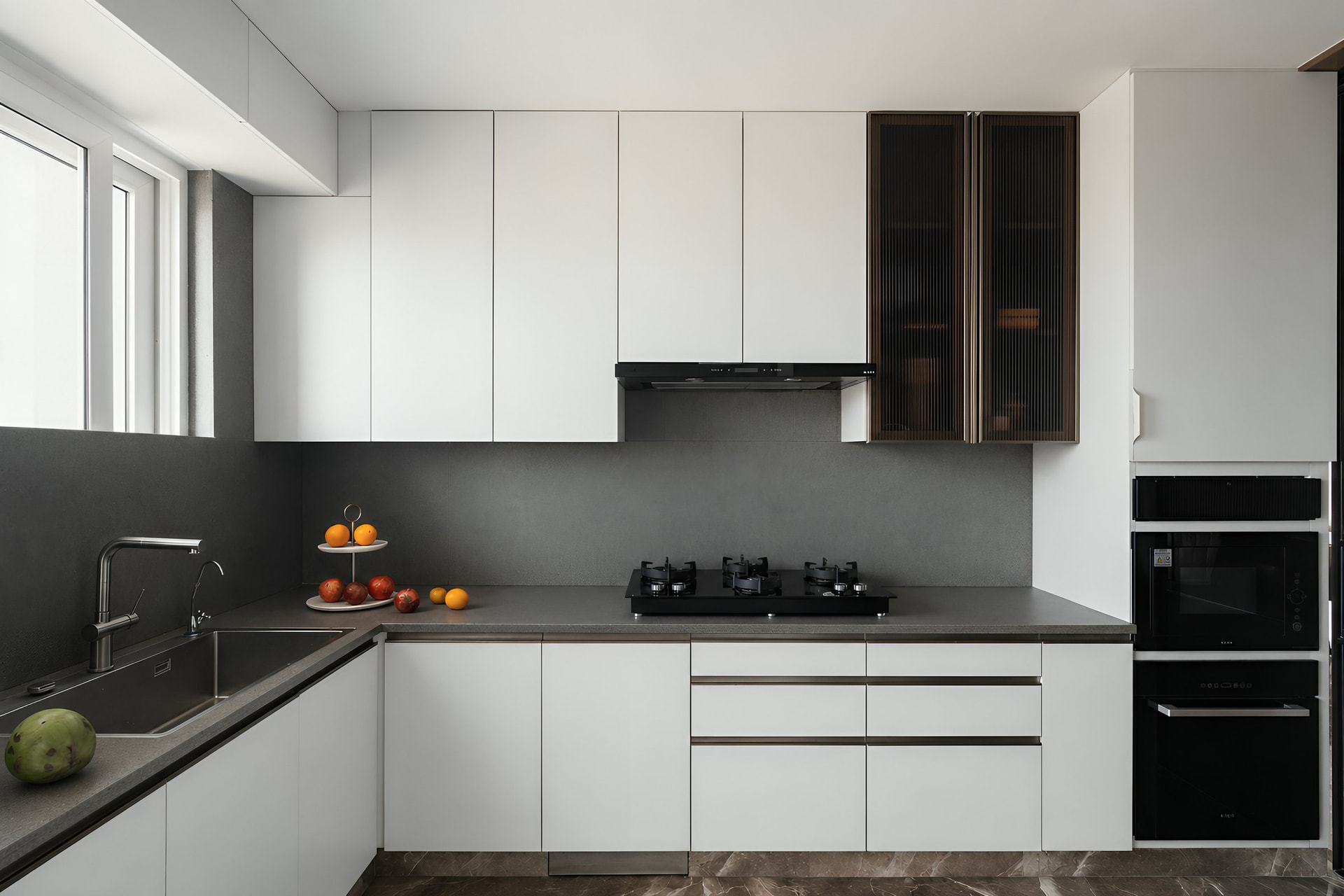
Within, the kitchen is resolved as a purely functional volume: an L-shaped run of white cabinetry, a grey stone backsplash and integrated appliances along one wall. The single decorative gesture is a pair of reeded smoked-glass upper cabinets that quote the sliding door at the threshold, tying utility to the home’s larger material vocabulary.
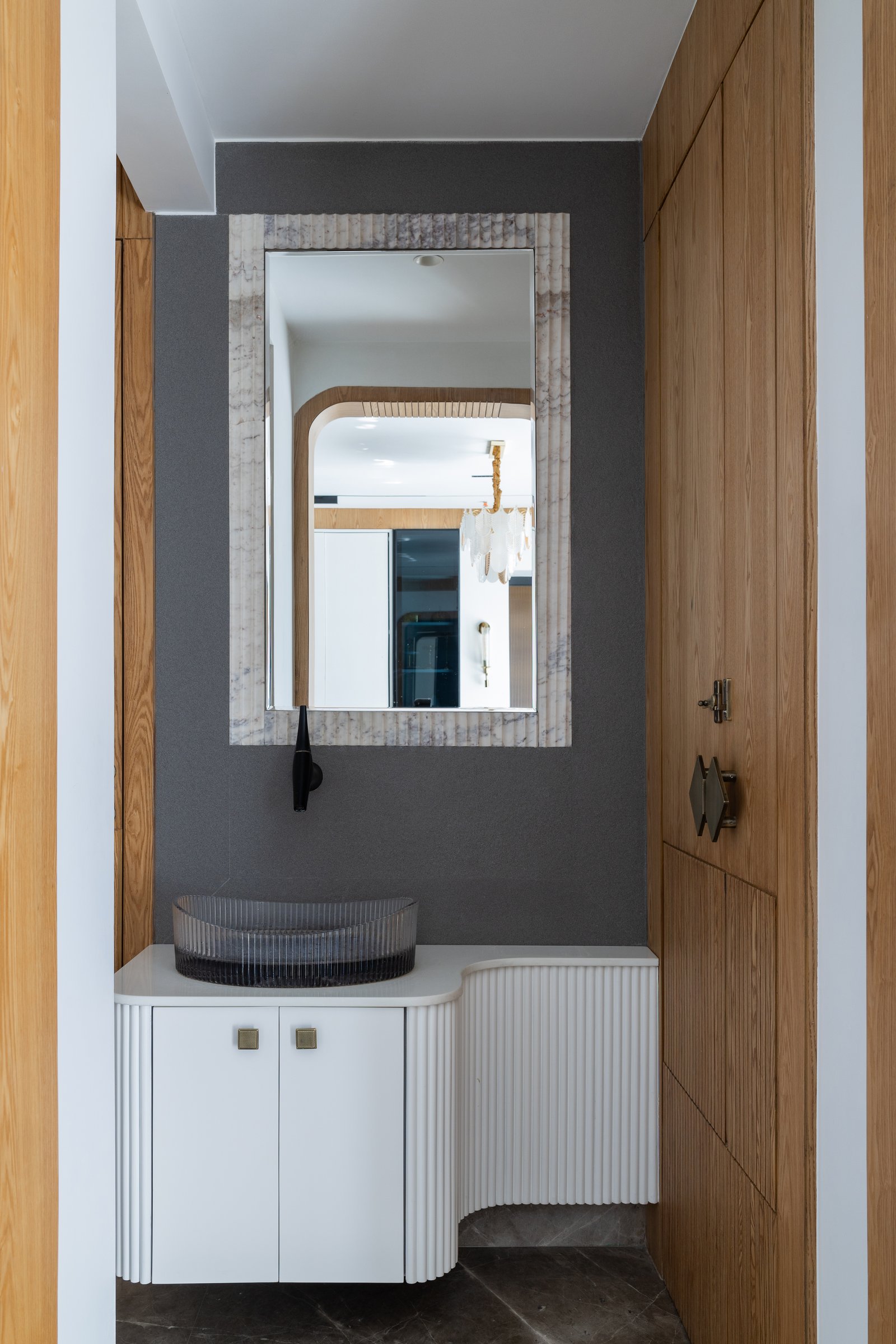
The powder area distils the home’s fluted motif into a single, sculpted moment. A curved white vanity with vertical reeding holds a smoky ribbed basin, set against a charcoal wall and crowned by a veined stone mirror frame.
Warm wooden door panels on either side reintroduce the apartment’s recurring material warmth, ensuring even the smallest service space feels considered rather than incidental.
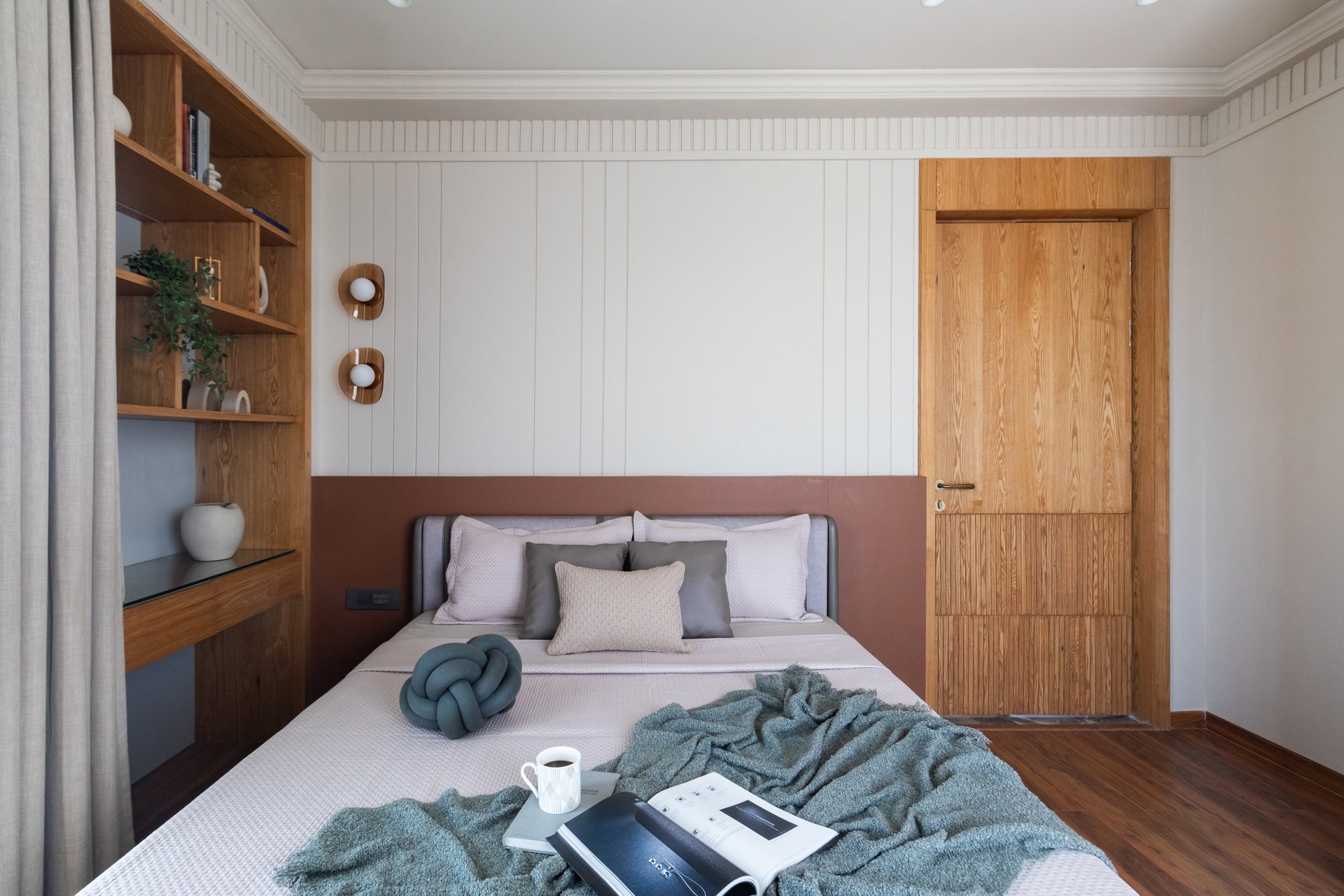
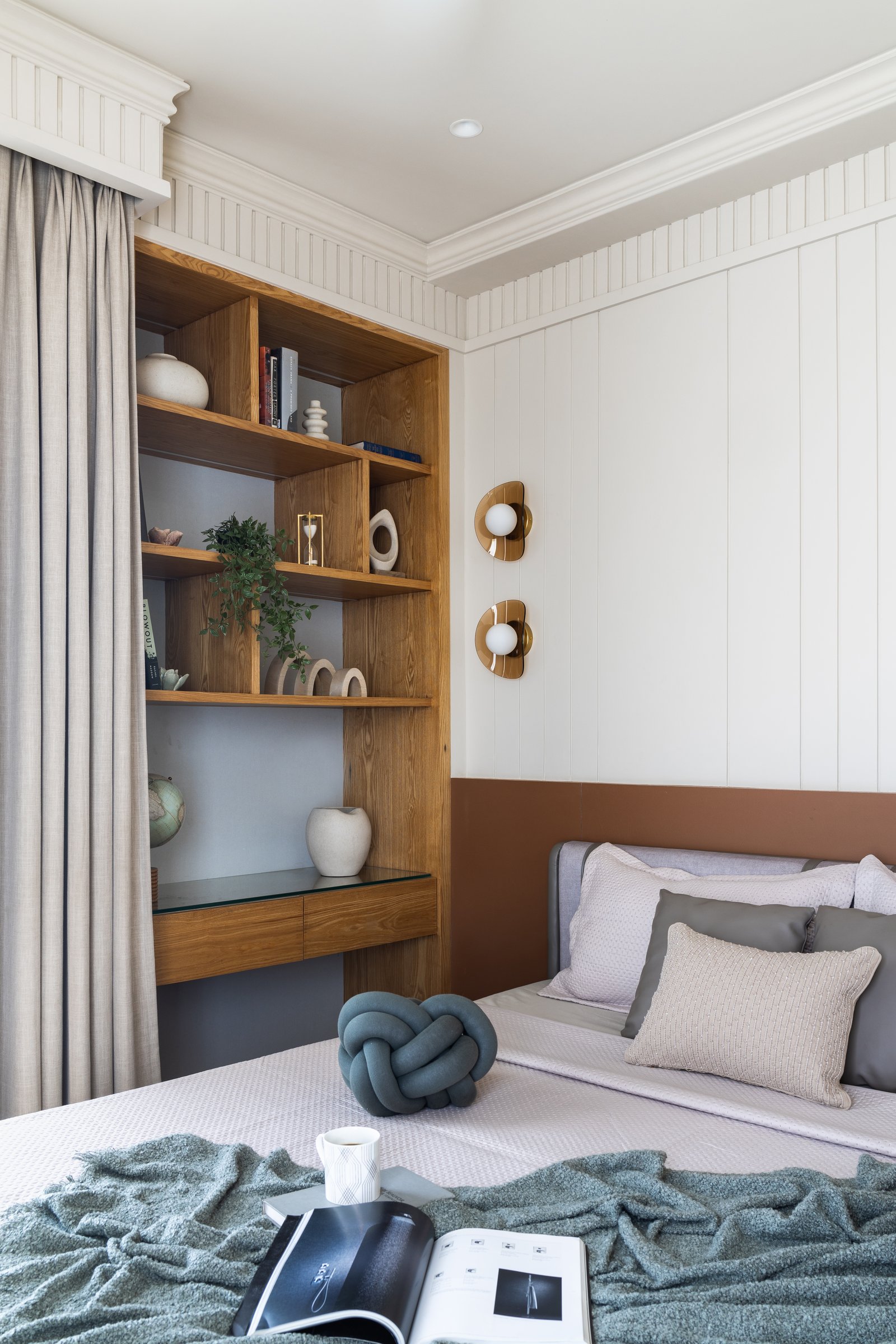
The first guest bedroom shifts the palette toward a softer register. Behind the bed, a vertically panelled white wall is anchored by a terracotta-toned band that introduces warmth without overwhelming the room, creating a backdrop that feels both composed and inviting. A timber ledge integrated into the headboard wall accommodates books and personal objects, lending the space a quiet sense of familiarity.
The room demonstrates the project’s broader approach to comfort: colour is used sparingly, materials are allowed to retain their natural character, and every element serves both a functional and atmospheric purpose. The result is a guest room that feels less like a temporary accommodation and more like an extension of the home’s lived-in calm.
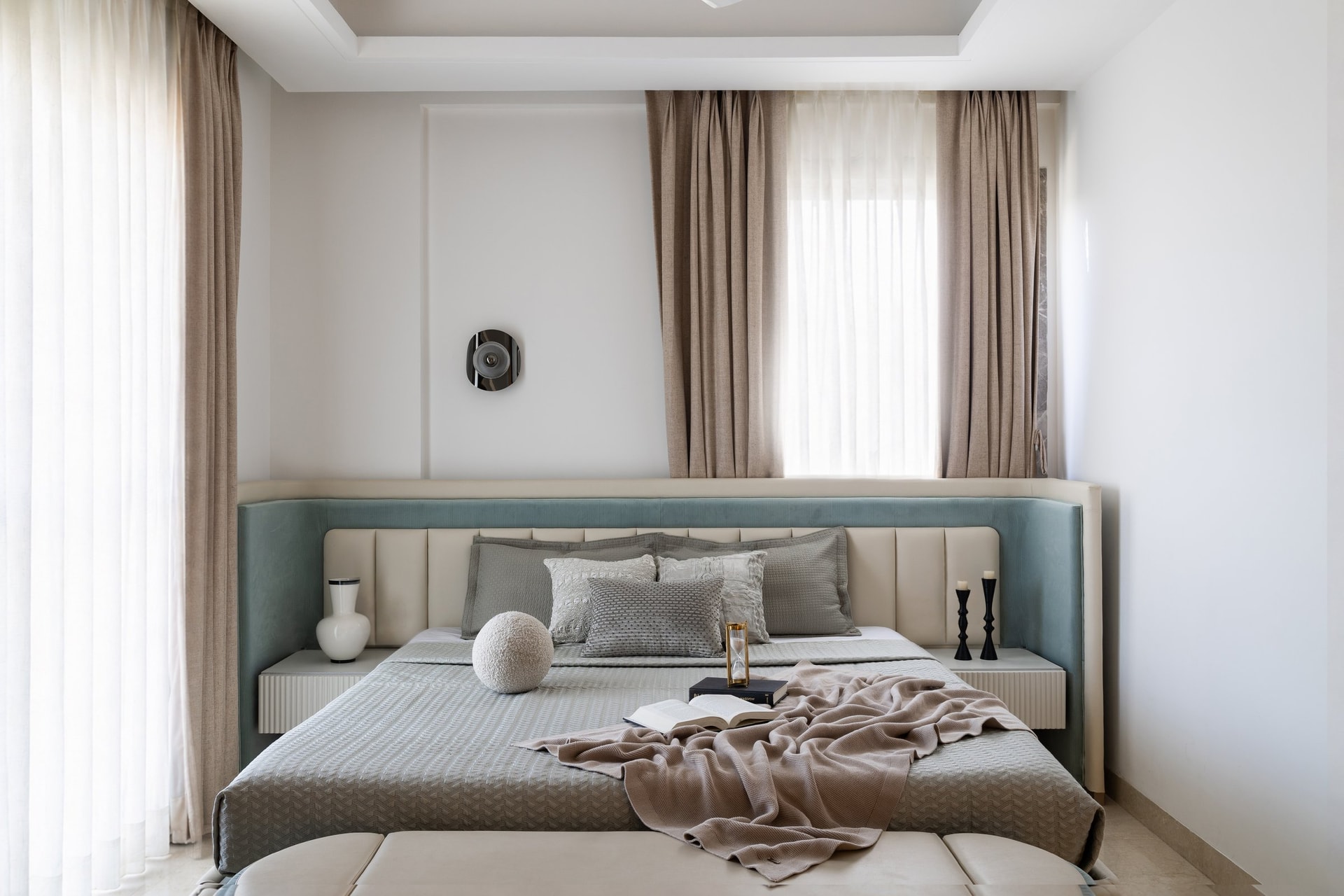
The son’s bedroom is composed as a quieter, more tonal retreat. A full-width upholstered headboard in pale ivory and dusty teal spans the bed wall, its channelled detailing introducing texture while echoing the vertical language that recurs throughout the apartment. The restrained palette allows material and proportion to take precedence, creating a room that feels calm without becoming austere.
Floating bedside tables with fluted fronts extend the vocabulary established elsewhere in the home, particularly in the foyer joinery, reinforcing a sense of continuity across spaces. Here, repetition is used not as decoration but as a means of cohesion, allowing the room to feel connected to the larger design narrative while maintaining its own distinct atmosphere.
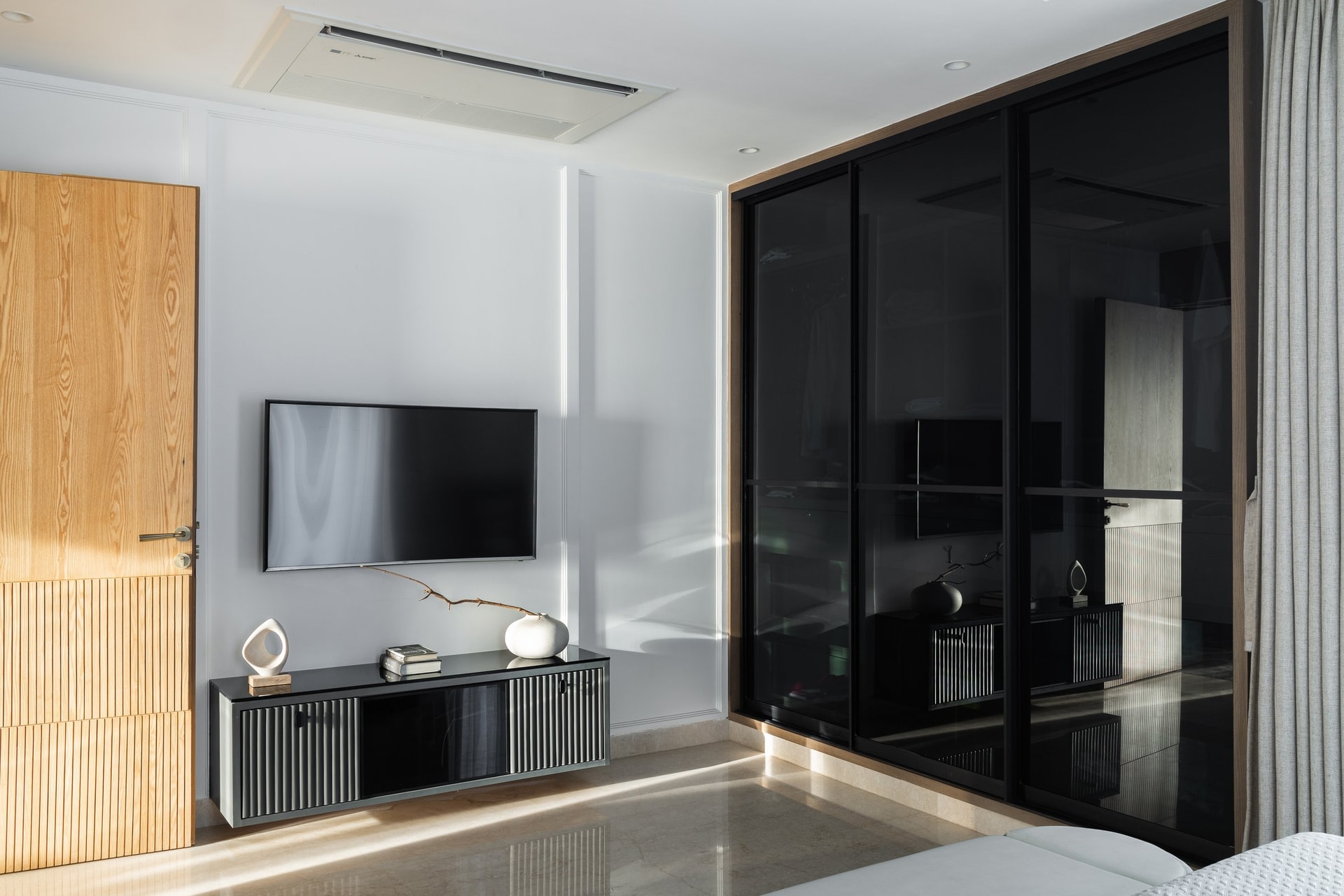
Across the room, a wall-mounted television sits above a fluted media console in deep grey, while a dark-tinted glass wardrobe runs along the adjacent wall. The reflective wardrobe surface expands the perceived volume of the room and lets the marble floor continue uninterrupted, a quiet move that keeps a compact bedroom feeling generous.
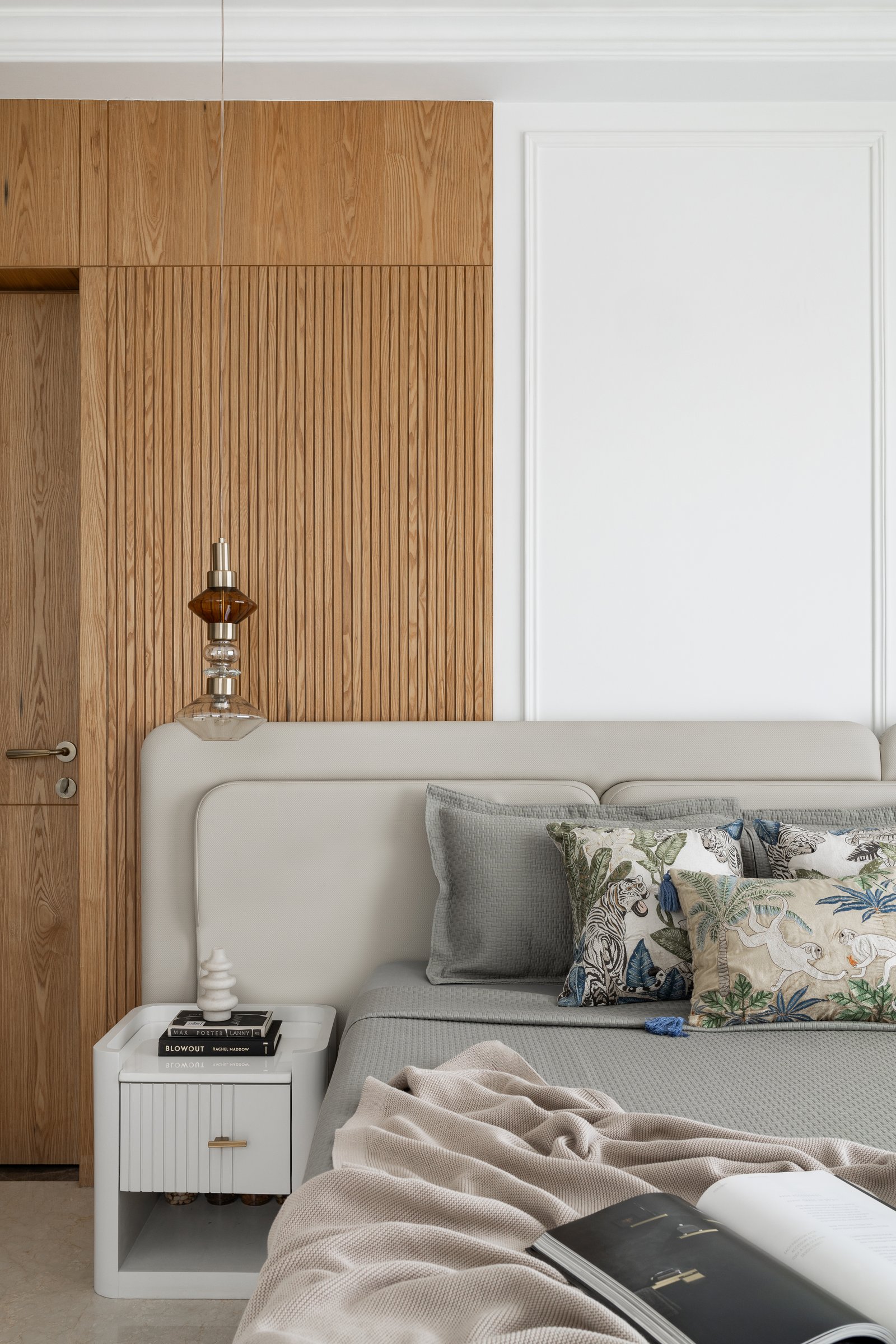
The master bedroom distils the apartment’s design language into its most restrained expression. The bed wall is anchored by a tall panel of vertically reeded timber, framed by smooth wall panelling and seamlessly integrated joinery. Against this backdrop, a low-slung upholstered bed in soft greige introduces a gentler counterpoint, its rounded edges tempering the linear precision of the architecture.
Rather than relying on decorative excess, the room builds atmosphere through carefully calibrated details. A slender amber-glass pendant descends beside the bed, replacing the conventional bedside lamp with a more sculptural gesture and casting a warm pool of light across the timber surface. Botanical embroidery on the cushions provides the room’s only patterned note, introducing a subtle layer of softness without disrupting the overall sense of calm. The result is a space that feels composed and deeply restful, where every element contributes to an atmosphere of quiet luxury.
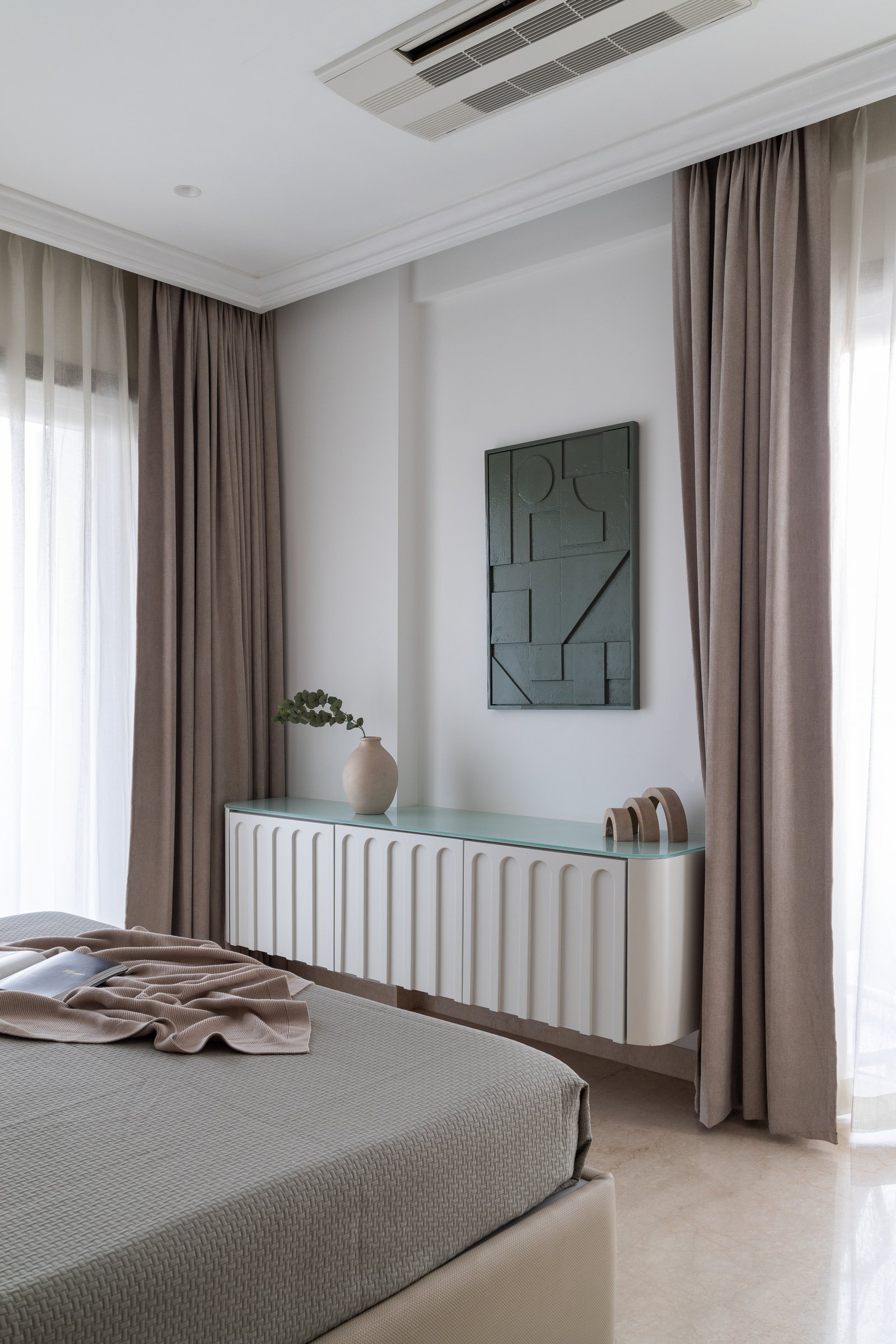
On the opposite wall, a long fluted console in soft cream sits beneath a textured artwork in deep green, framed by full-height drapes in a warm taupe. The console’s arched, columned fronts reinterpret a classical motif in a contemporary register, while the muted palette holds the room in stillness.
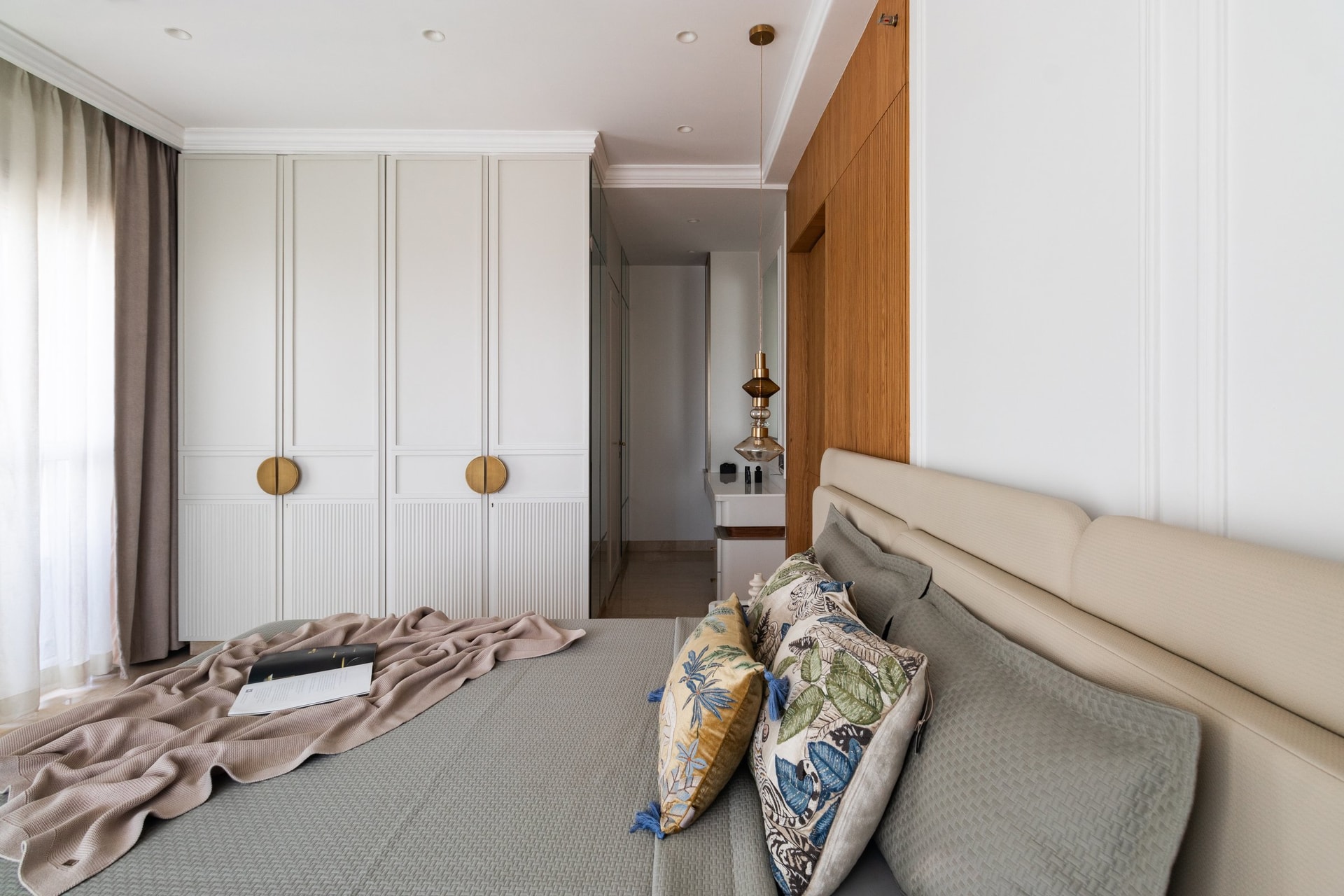
The room extends into a dressing zone defined by tall ivory wardrobes with circular brass pulls and fluted base panels. A slim pendant in amber glass marks the threshold to the vanity beyond, and the wooden headboard panel returns at the far end to anchor the sleeping zone within the larger composition.
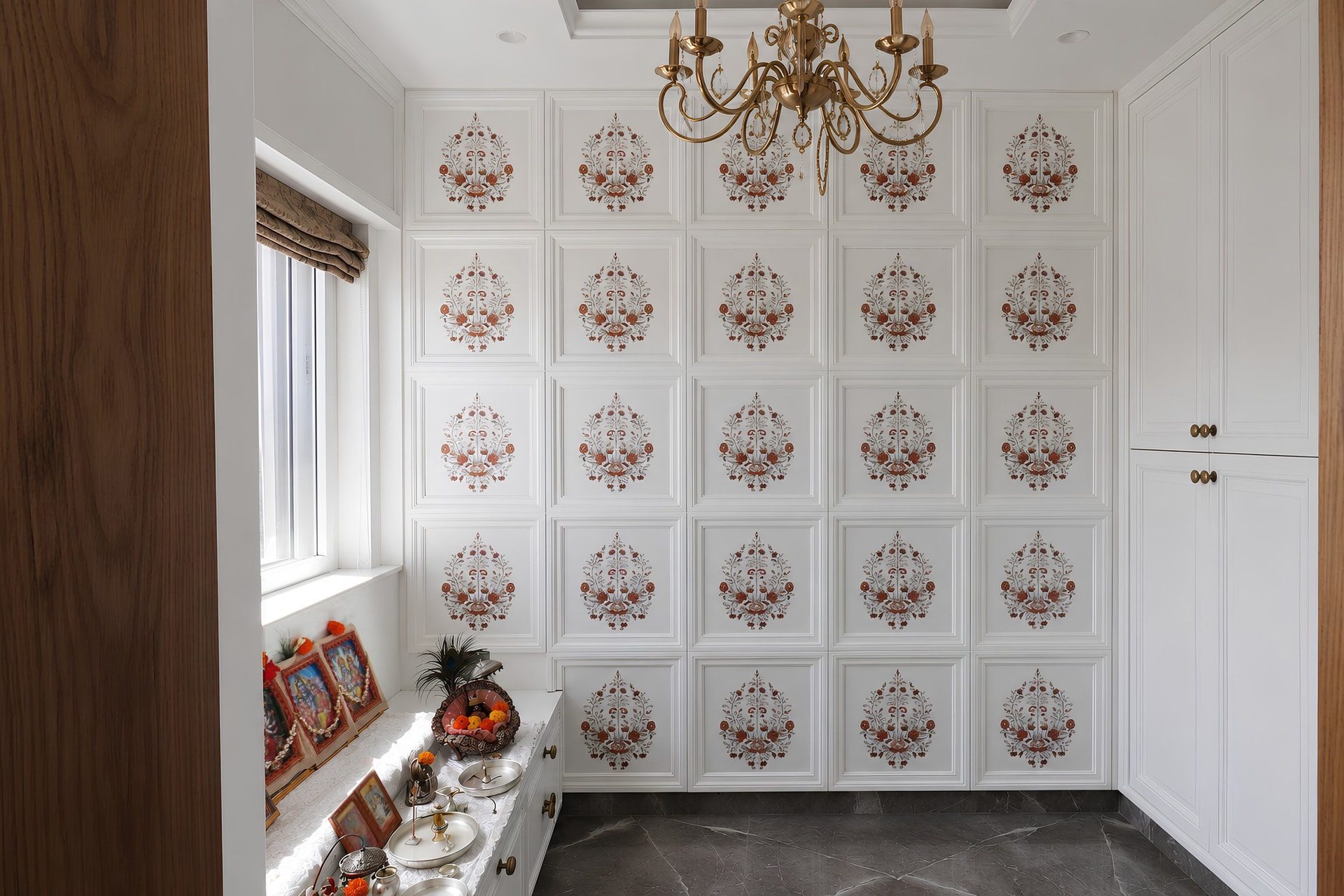
The puja room is the apartment’s most expressive space, yet it remains firmly within the home’s disciplined design language. A composition of white panels adorned with delicate floral motifs in muted coral and sage creates a backdrop that feels devotional without becoming decorative excess. Above, a brass chandelier introduces a warm glow, illuminating the prayer counter where framed deities, marigold garlands, and ritual vessels transform daily worship into a quietly ceremonial experience.
Across the apartment, Elara reflects a growing confidence within residential design in India’s emerging urban centres. Rather than borrowing from global trends, the project draws its character from material consistency, careful detailing, and an understanding of contemporary family life. In a city like Ranchi, where this level of design refinement has historically been less visible, the residence signals a broader expansion of the conversation around contemporary Indian interiors.
What ultimately defines the home is its restraint. The repeated language of fluted surfaces, the continuity of marble, the interplay of warm timber against soft greys, and the measured use of colour create a sense of cohesion that never feels forced. Elara does not rely on singular moments of spectacle; its strength lies in the accumulation of thoughtful decisions. In that quiet consistency, the project finds its authority, offering a home that is both elegant and enduring.