Some homes arrive through accumulation, layering colour and pattern until the eye has nowhere left to settle. Others arrive through editing, until what remains can finally be felt. The Soft Nest belongs firmly to the second category, a residence built around the conviction that calm is not the absence of design but the result of patient calibration.
Set on the twenty-seventh floor of a tower near Wadala East in Mumbai, the apartment was conceived by Chaukon Studio as a Jodi flat reimagined for a family returning to slower domestic rhythms after years of urban acceleration. The clients arrived with a clear instinct: nothing flashy, nothing performative, a predominantly white envelope that could hold the family’s energy without ever competing with it. The studio responded with an interior that privileges breathability, pale tonality, and a sense of dignity in everyday comfort.
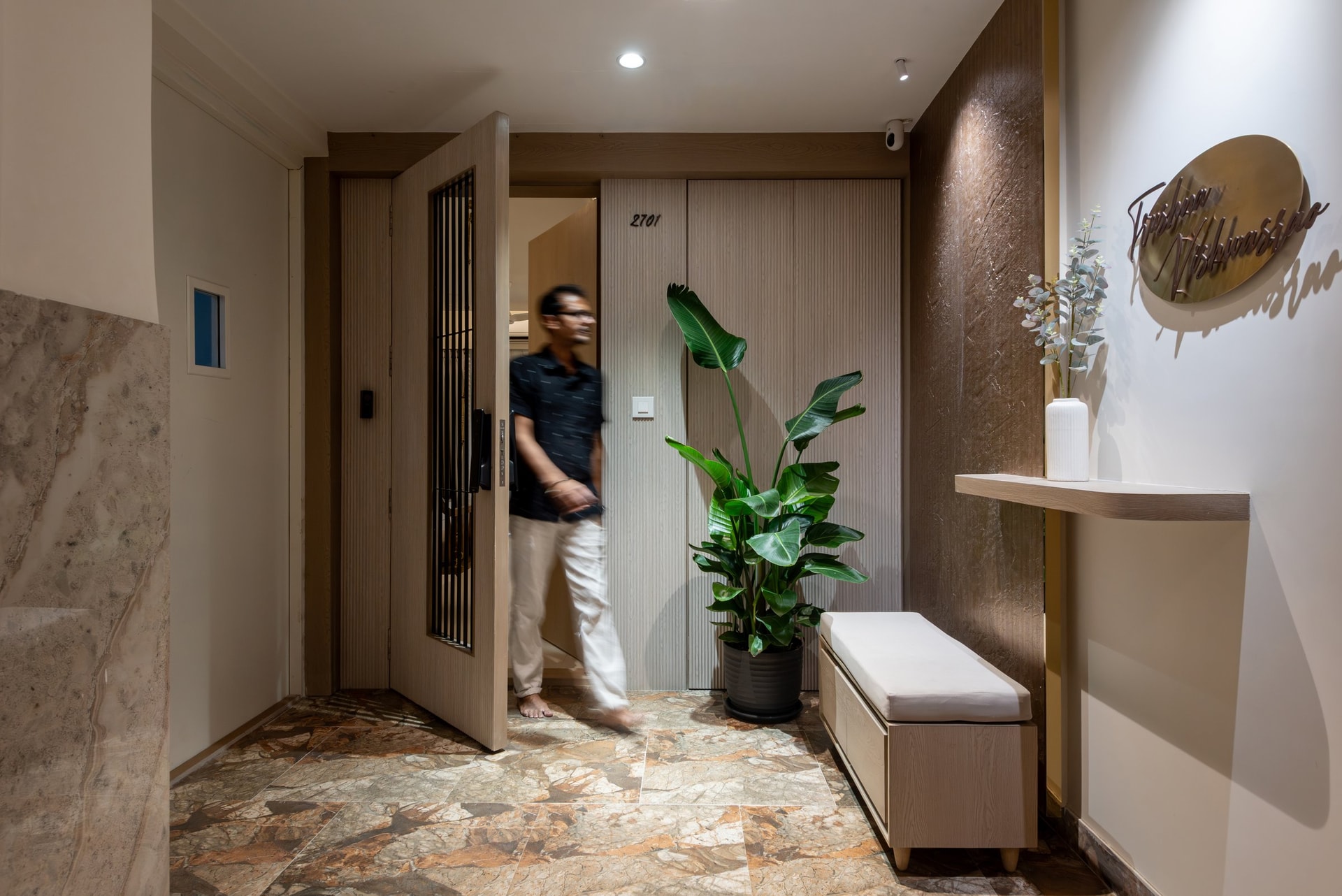
The entry establishes the home’s design language in a single, composed frame. A bench in pale ash sits beneath a brass nameplate, while a reeded wood-panelled wall in soft fawn frames the apartment number. Underfoot, a patterned stone floor in tones of amber, cream, and grey introduces the only ornamental gesture before the home’s quieter palette takes over.
The contrast is deliberate. The textured stone and reeded panelling work as a brief overture, a moment of richness that prepares the eye for the restraint to follow rather than competing with it.
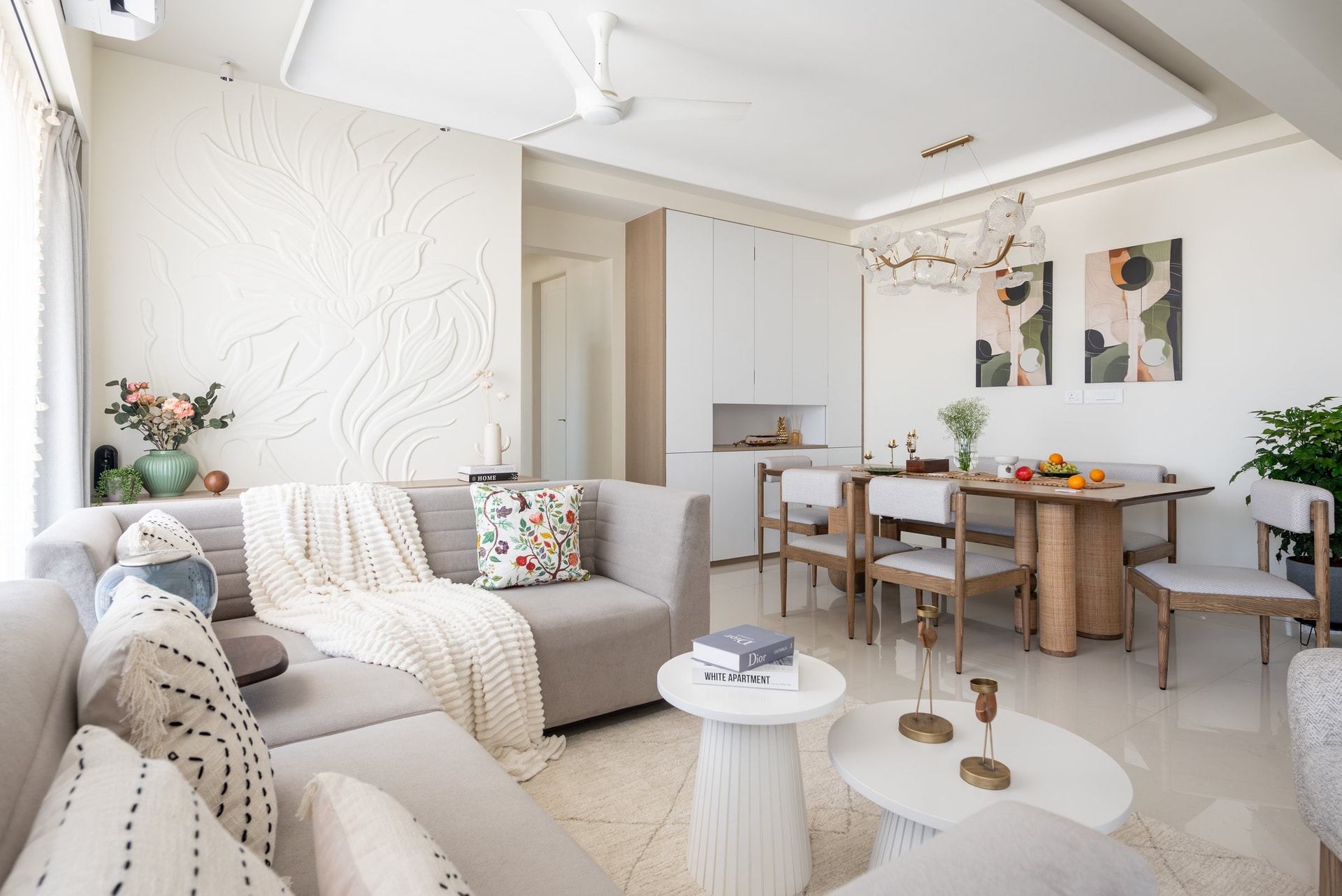
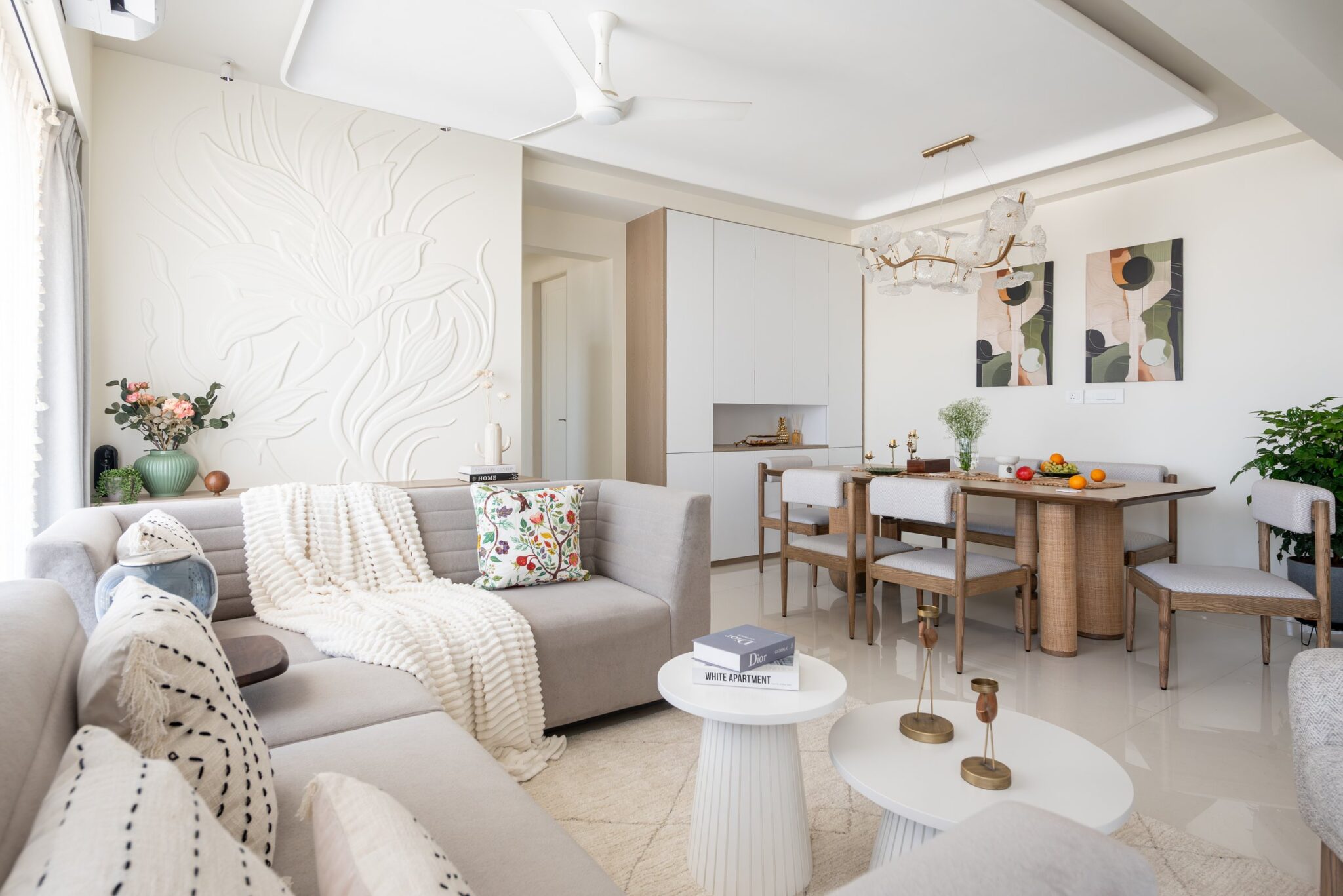
The living room unfolds with a quiet sense of restraint, organised around a sculptural plaster relief wall whose botanical motif is rendered entirely in tonal white. The grey channelled sofa, a pair of fluted white pedestal tables, and a tufted rug in cream anchor the seating without raising the visual register.
What lends the space its clarity is the discipline of the palette. By holding nearly every surface within a narrow band of warm neutrals, the studio allows the room’s quieter incidents to register fully rather than disappear into noise.
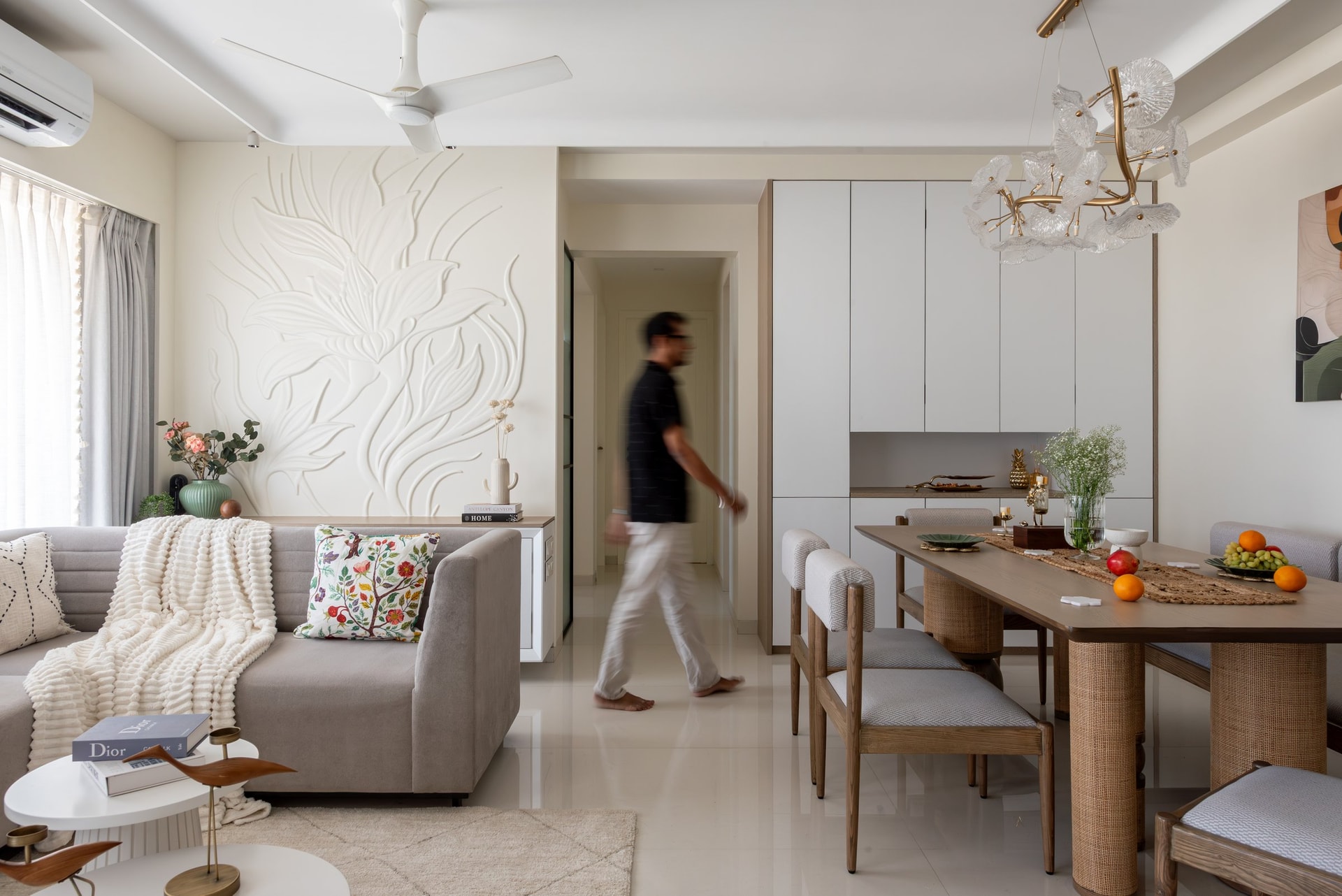
Seen from the other end, the living and dining zones read as one continuous, carefully held interior. A full-height white storage wall absorbs the kitchen pass-through and family services into a single composed plane, while the sculptural floral chandelier in clear glass and brass introduces the room’s one extravagant gesture.
The arrangement privileges sightline over compartmentalisation. Circulation moves easily between sofa, dining table, and the corridor beyond, allowing the apartment to read less as a series of enclosed rooms and more as one continuous, carefully held interior.
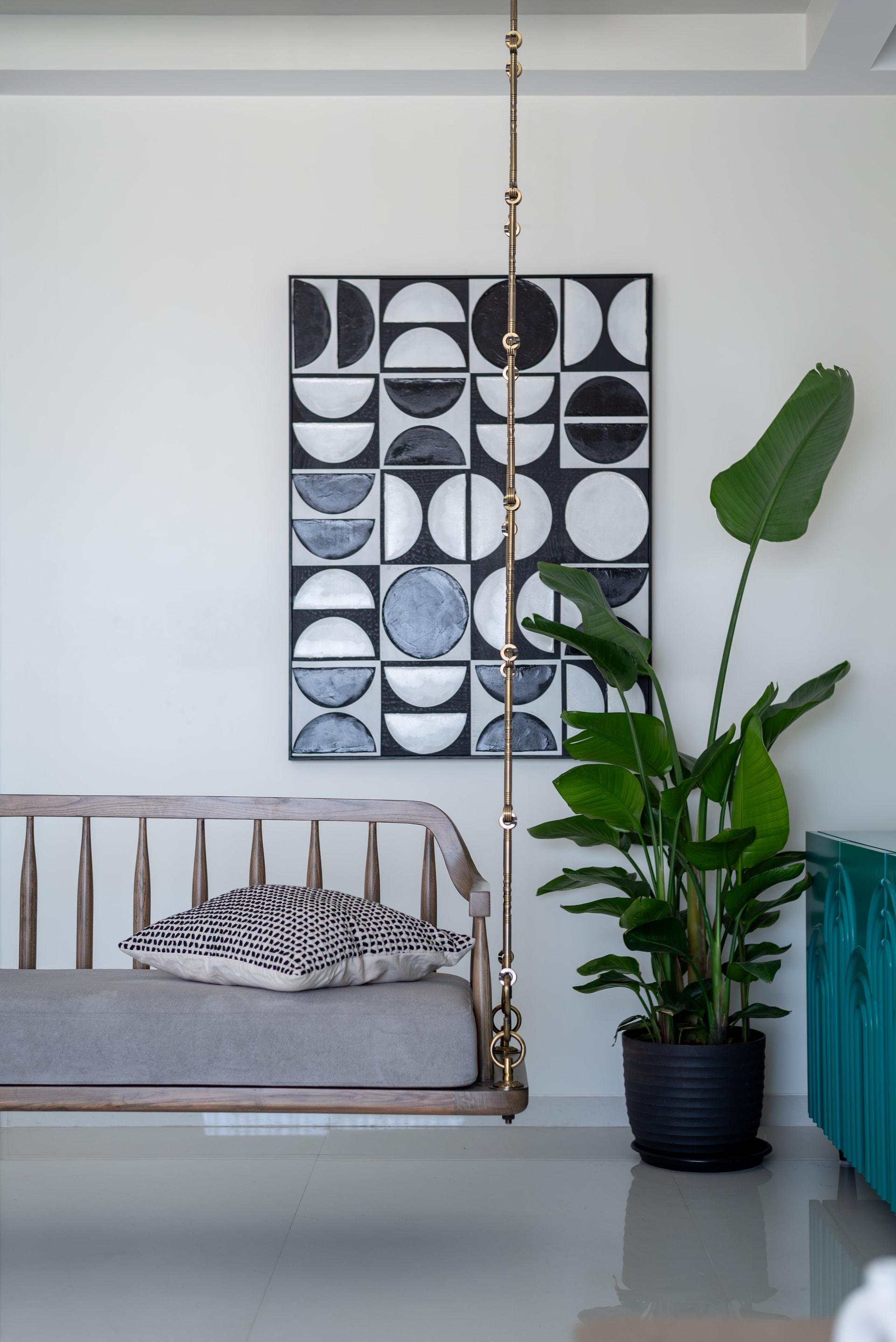
A timber jhoola suspended on brass chains anchors a quieter corner of the open plan, framed against a graphic black-and-white artwork. The swing is a familiar gesture in Indian homes, here recast in a contemporary register through its pared silhouette and the deliberate stillness of its surroundings.
The teal sideboard at the edge of the frame is the home’s one assertive colour move, allowed to sing precisely because the surrounding envelope refuses to argue with it.
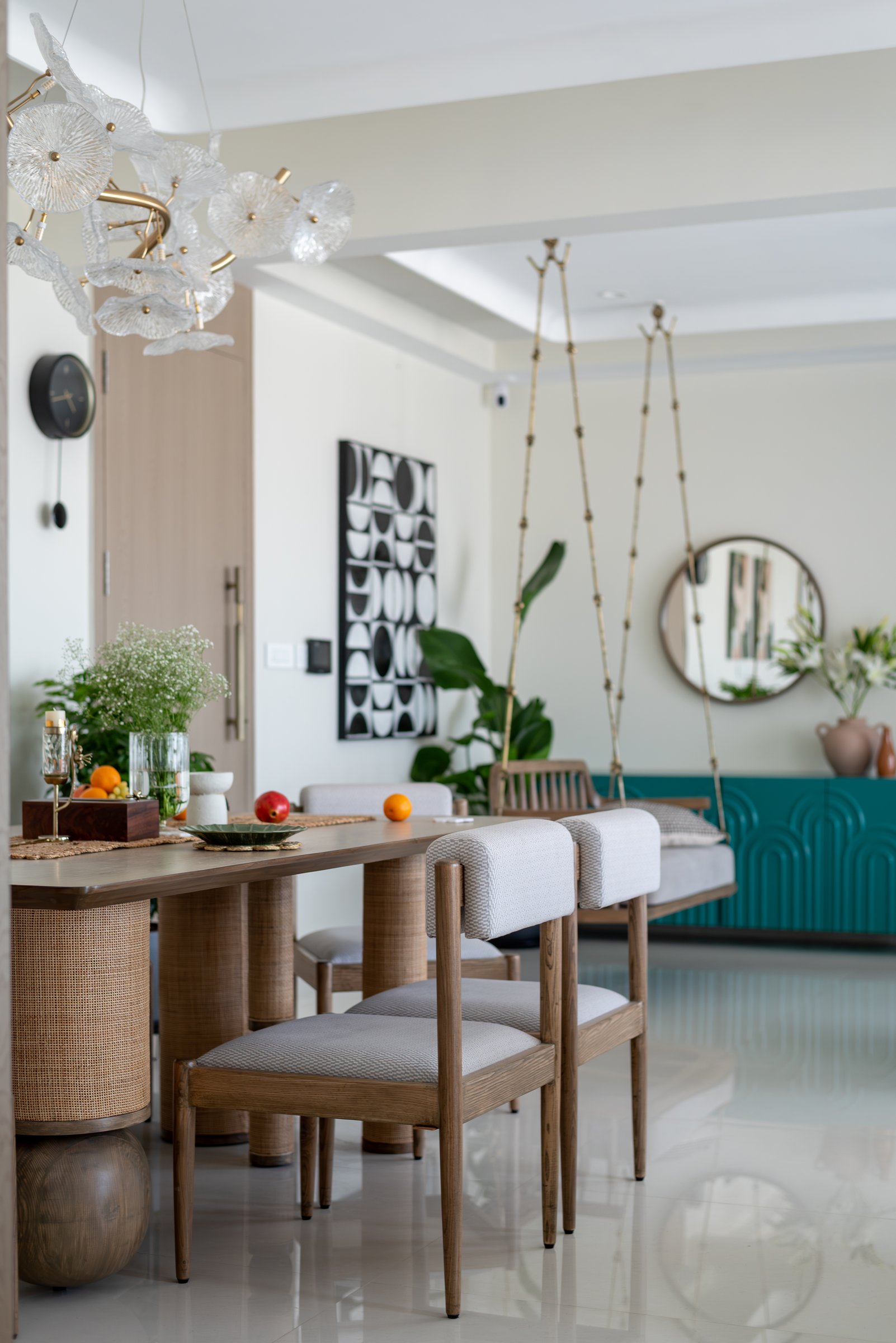
The dining area is anchored by a wooden table whose cane-wrapped cylindrical bases lend the room its tactile intimacy. The upholstered chairs in pale neutrals and the bench seating along the far edge keep the composition open and accommodating, a setting calibrated for unhurried meals rather than ceremonial display.
Above, the sculptural chandelier in clear glass petals and brass arms reads as the dining zone’s single decisive gesture. The pale storage wall behind dissolves the working kitchen into a continuous backdrop, ensuring the table itself remains the social heart of the room.
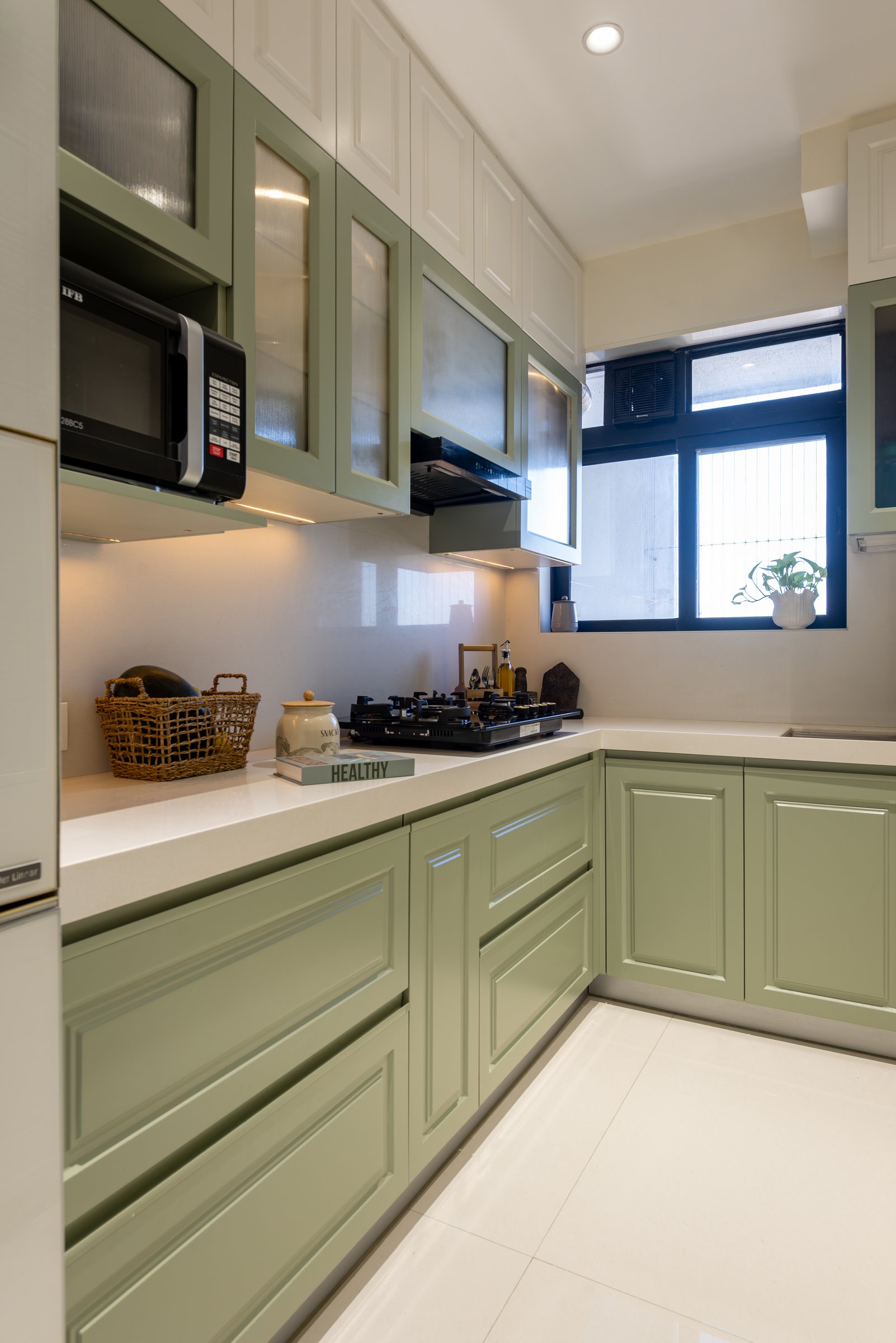
The kitchen departs from the home’s neutral envelope through cabinetry in a muted sage green, the upper units fronted with fluted glass panels that soften the storage’s visual weight. White countertops and a pale backsplash keep the workspace bright, while a small window above the cooking range admits natural light into what is otherwise a tightly organised galley.
The choice of colour here is telling. By granting one utility-driven space its own distinct character, the studio gives the kitchen functional rigour without sacrificing the home’s overall composure.
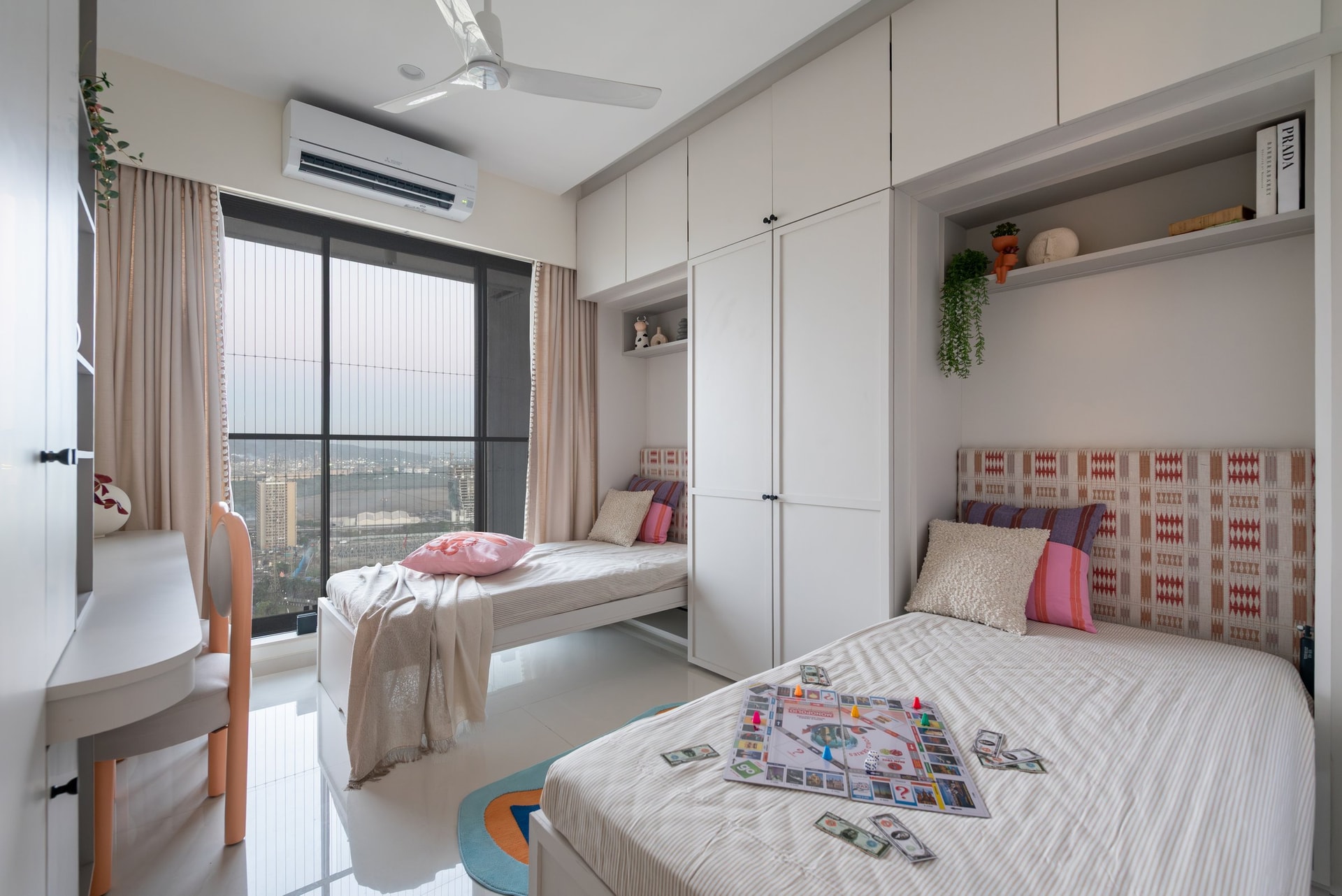
The children’s bedroom holds two single beds within a single composition, separated by integrated wardrobes and niches that absorb storage and display in one continuous joinery line. A patterned woven headboard introduces the room’s only graphic note, its earthy reds and pinks reading as warm rather than insistent.
The full-height window pulls in the city and distant hill line, giving the room a sense of openness that compensates for its modest footprint. A small dressing table with a peach-toned chair completes the room’s quiet personality.
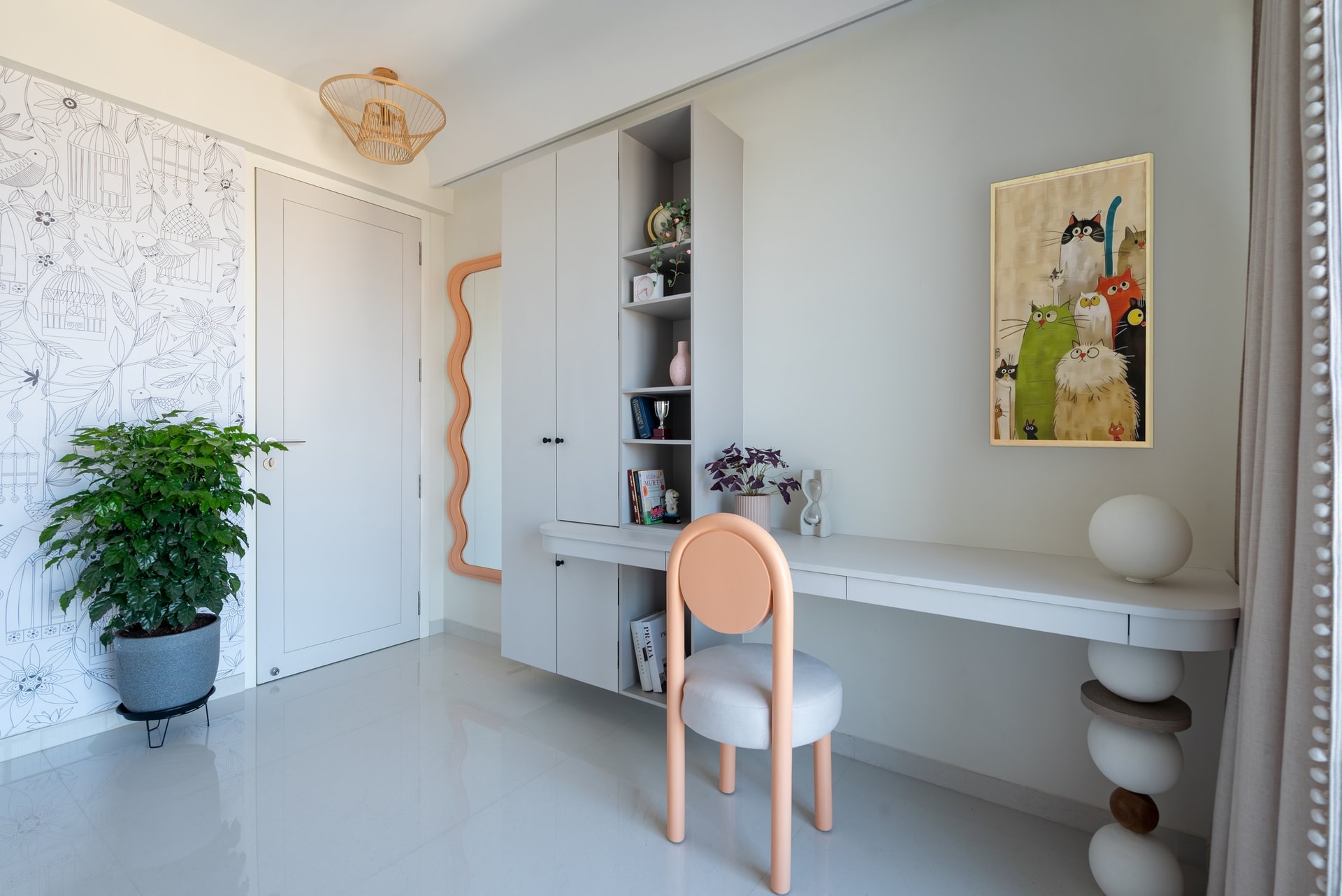
A study and dressing zone within the same bedroom continues the playful register without breaking from the home’s overall calm. A line-drawn botanical wallpaper introduces graphic interest along one wall, while a peach wavy-edged mirror and a matching peach chair give the corner its character.
The desk, with its sculptural stacked-sphere leg, reads as a piece of furniture-as-object, holding the room’s interpretive thread without insisting on it.
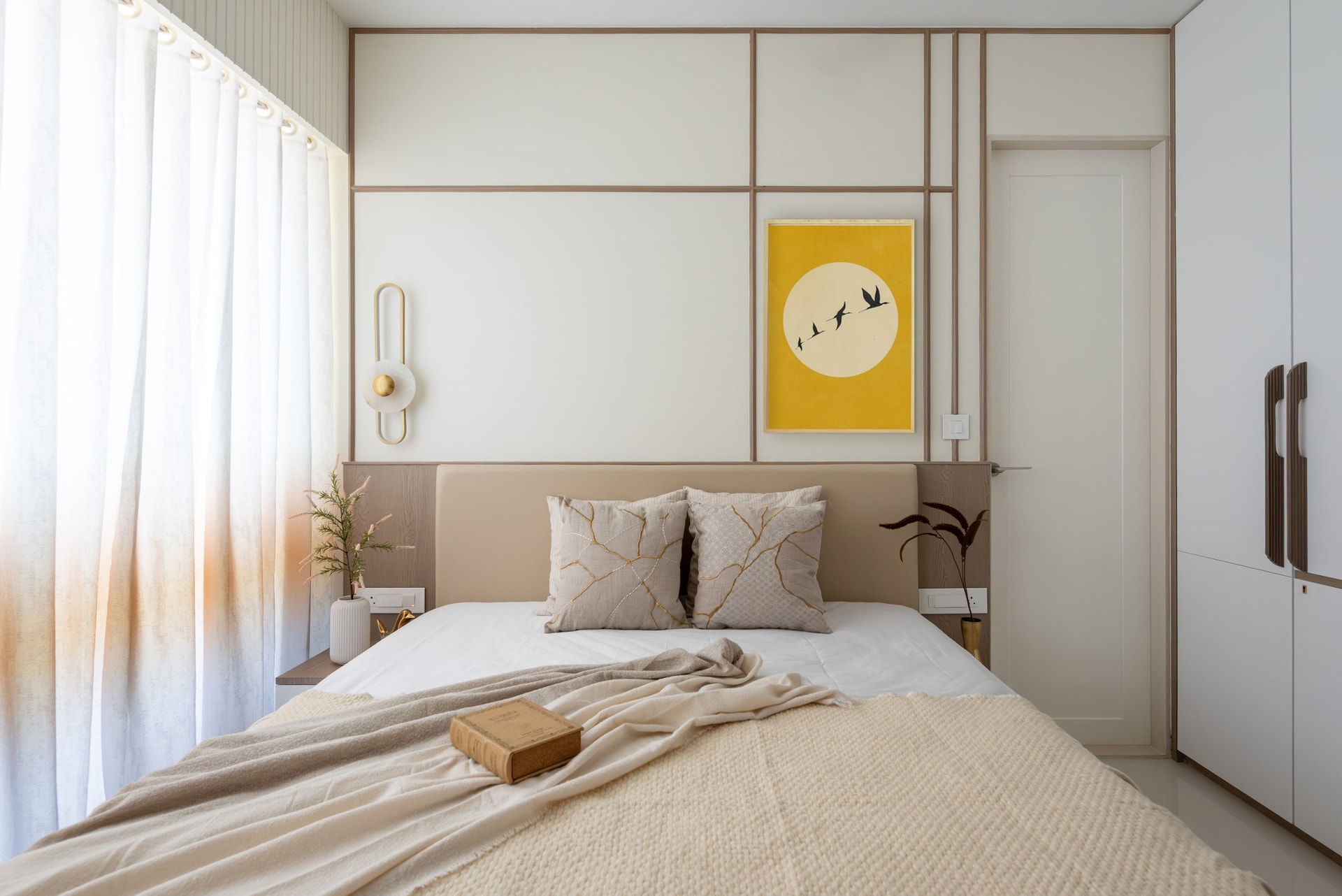
The master bedroom is composed around a grid of fine metallic mouldings that organise the wall above the upholstered headboard into a quiet architectural frame. A slender brass-and-alabaster sconce sits within one panel, providing the room’s single luminous note against an otherwise pale envelope.
The bedside sconce in brass and alabaster lends the headboard a softer rhythm, while the ombre curtains modulate the morning light into something warmer than the city outside.
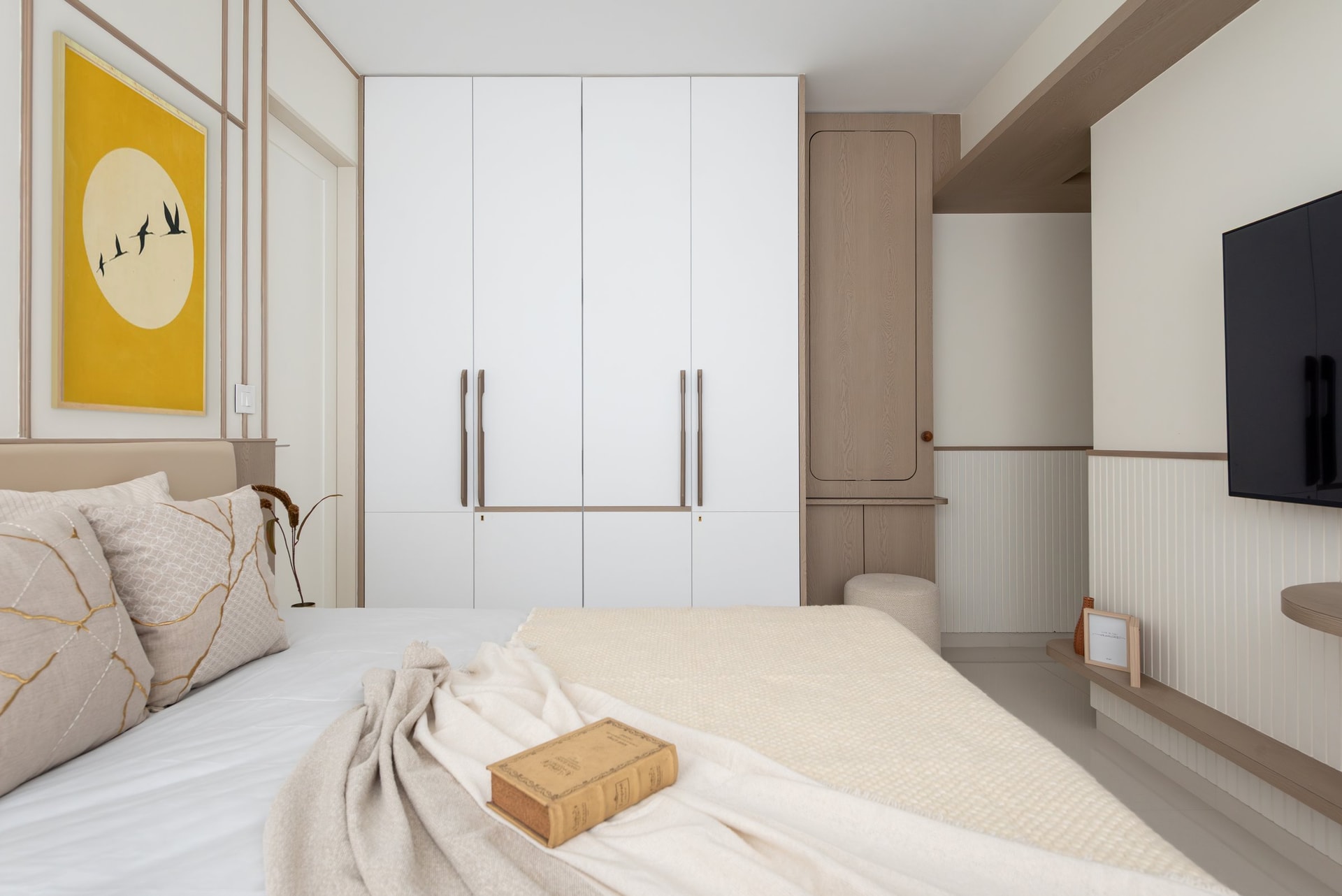
Across the room, a tall wardrobe in white with flat panelled doors aligns with a pale wood door beside it, while a wall-mounted television sits within a fluted wainscot niche edged in pale wood.
The result is a master suite that reads as composed rather than sparse, warm rather than decorative.
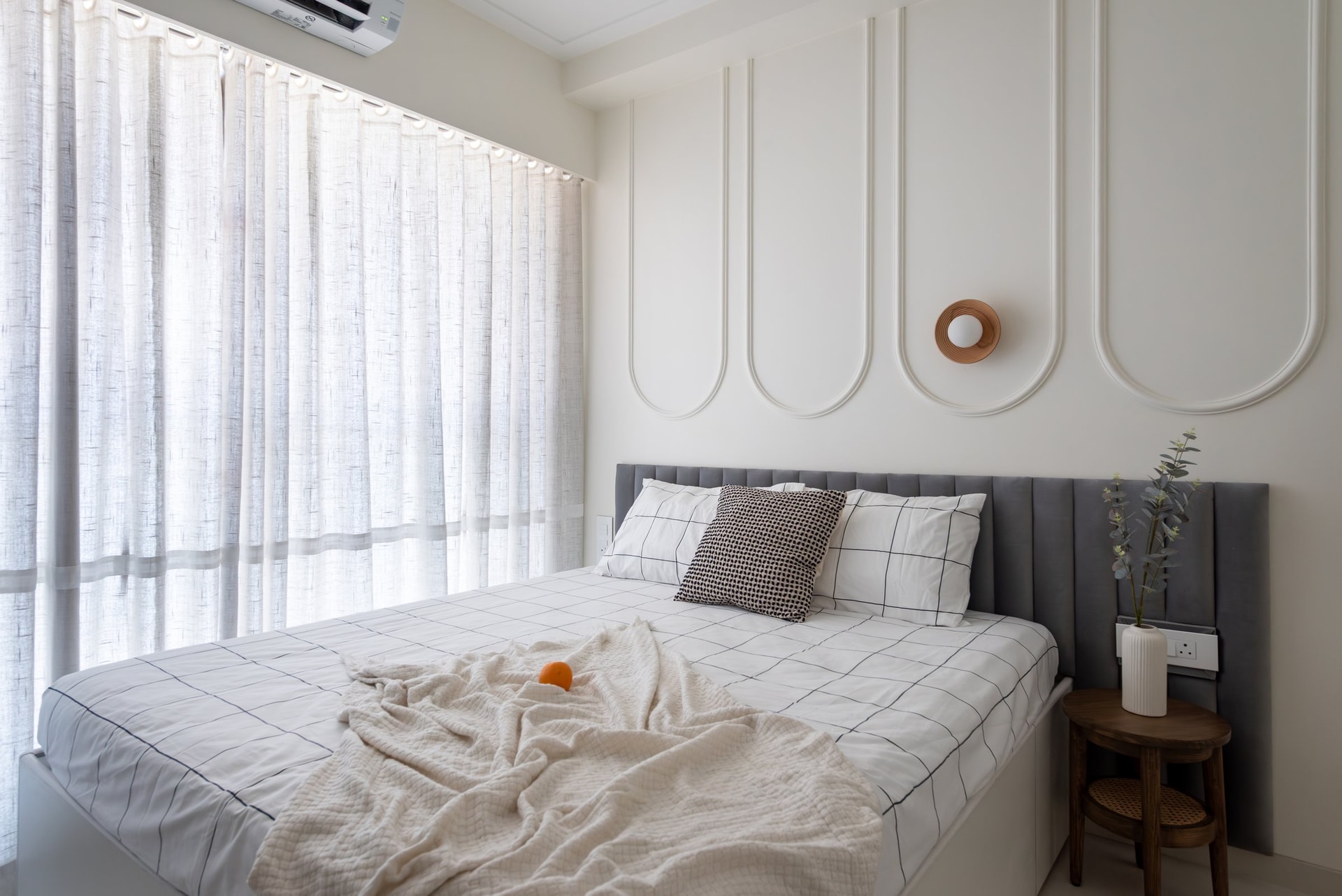
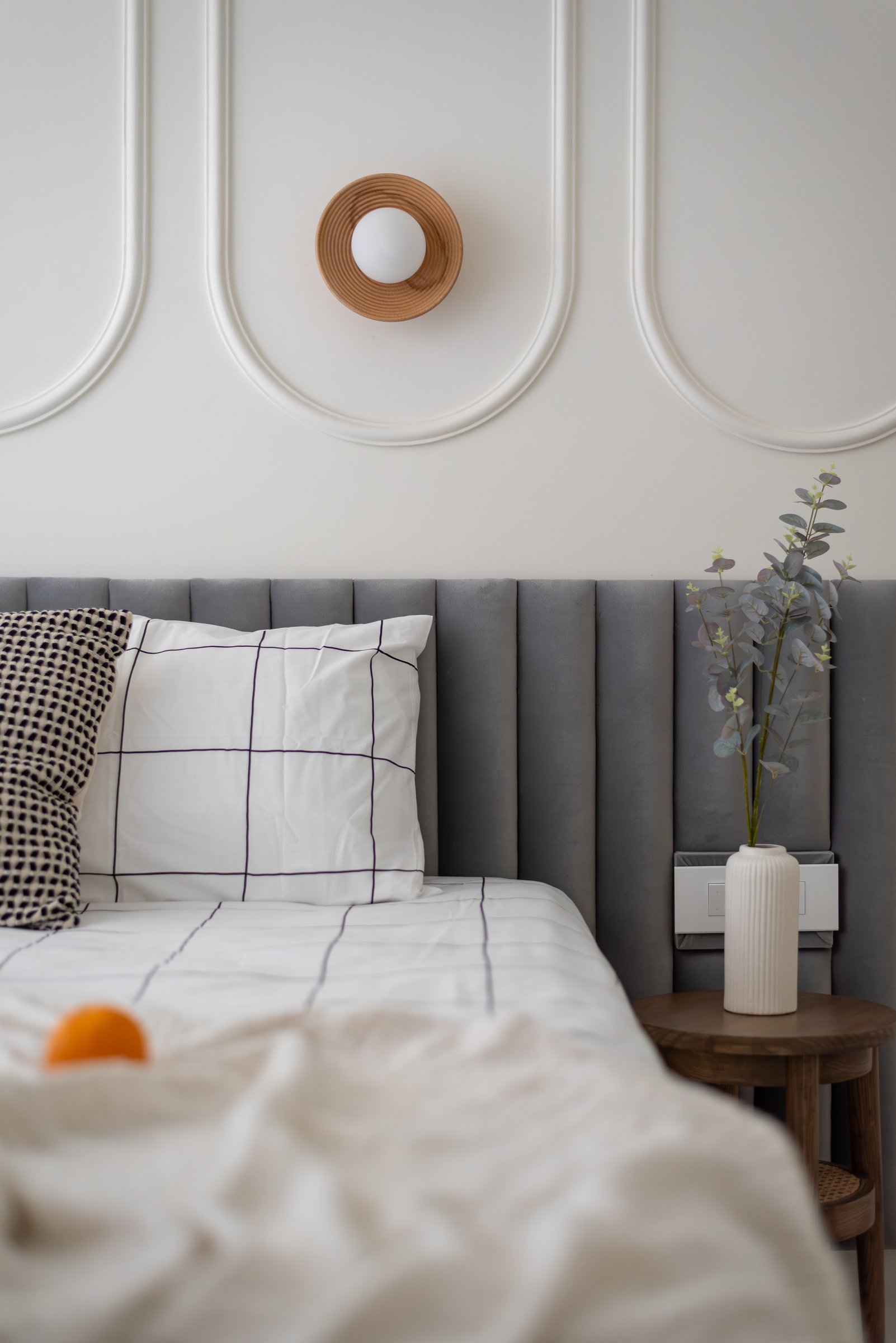
A second bedroom takes a different decorative direction, with classical wall mouldings forming a sequence of arched panels behind the bed. The grey channelled headboard sits against this backdrop, its quiet verticals echoing the panelling’s curves without imitating them.
A small wood-and-glass sconce, centred within one of the moulded arches, becomes the room’s most considered detail. The bedding in white with fine grid stripes keeps the room’s energy unhurried.
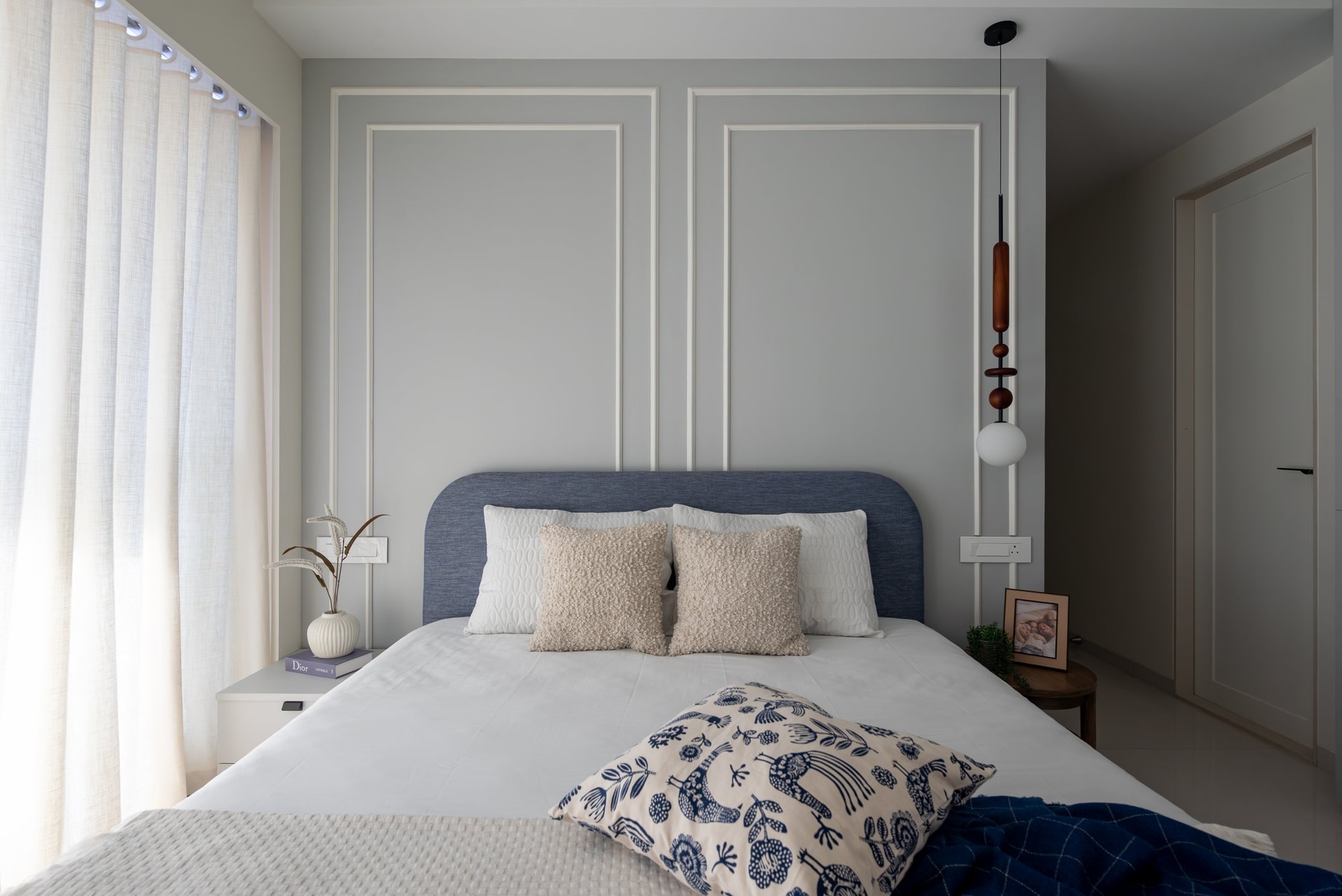
Another bedroom shifts the palette toward cool greys, with a blue upholstered headboard set against panelled mouldings in soft slate. A vertical pendant of stacked wooden beads ending in a glass globe descends beside the bed, centring the composition on the bed against a panelled wall, where a sculptural beaded pendant adds vertical rhythm.
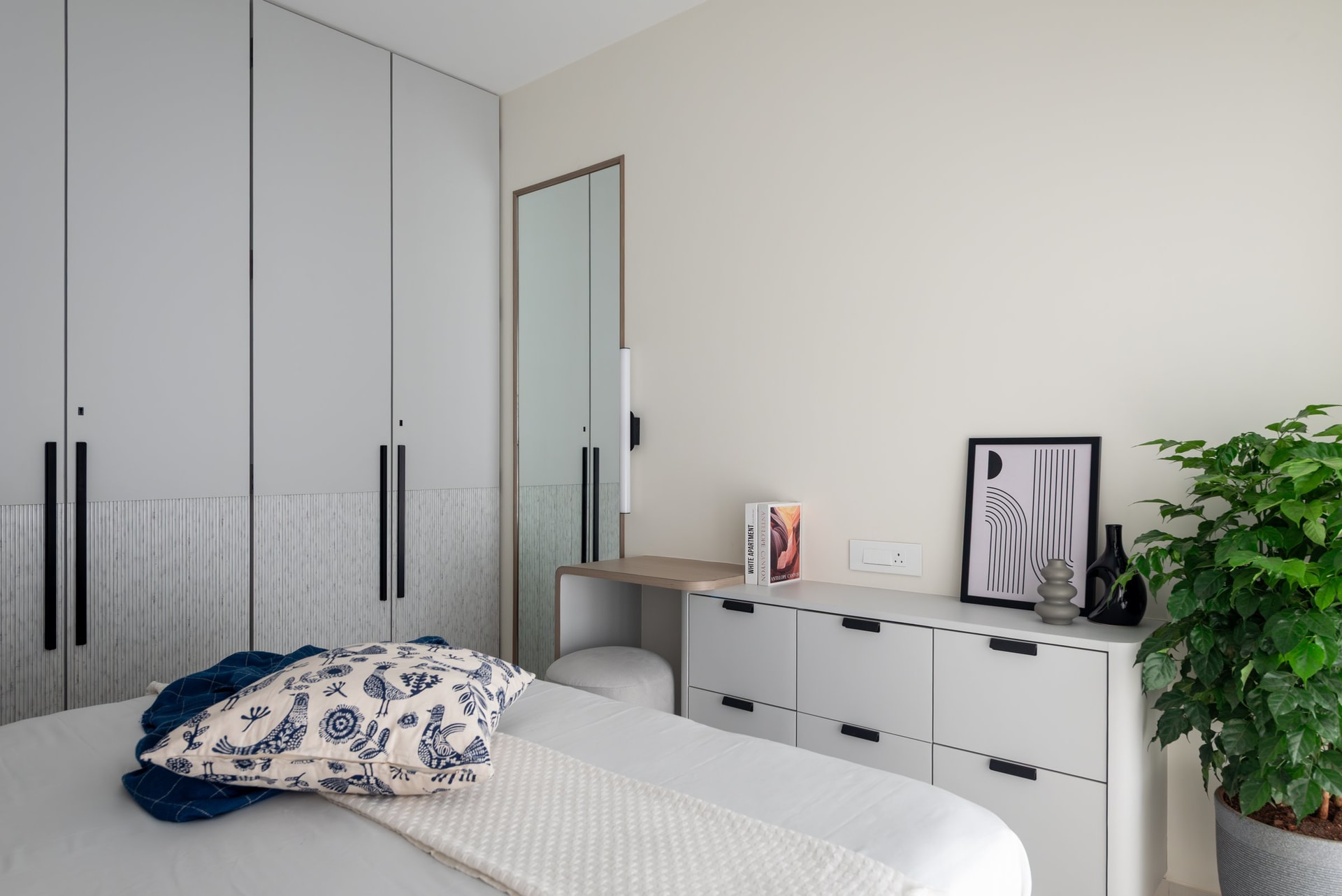
The same bedroom turns toward its storage wall, where wardrobes in pale grey with vertical reeded panels at their lower section align with a low chest of drawers along the adjacent wall.
The full-height mirror tucked into the wardrobe run resolves the room’s functional needs without interrupting its quiet visual rhythm.
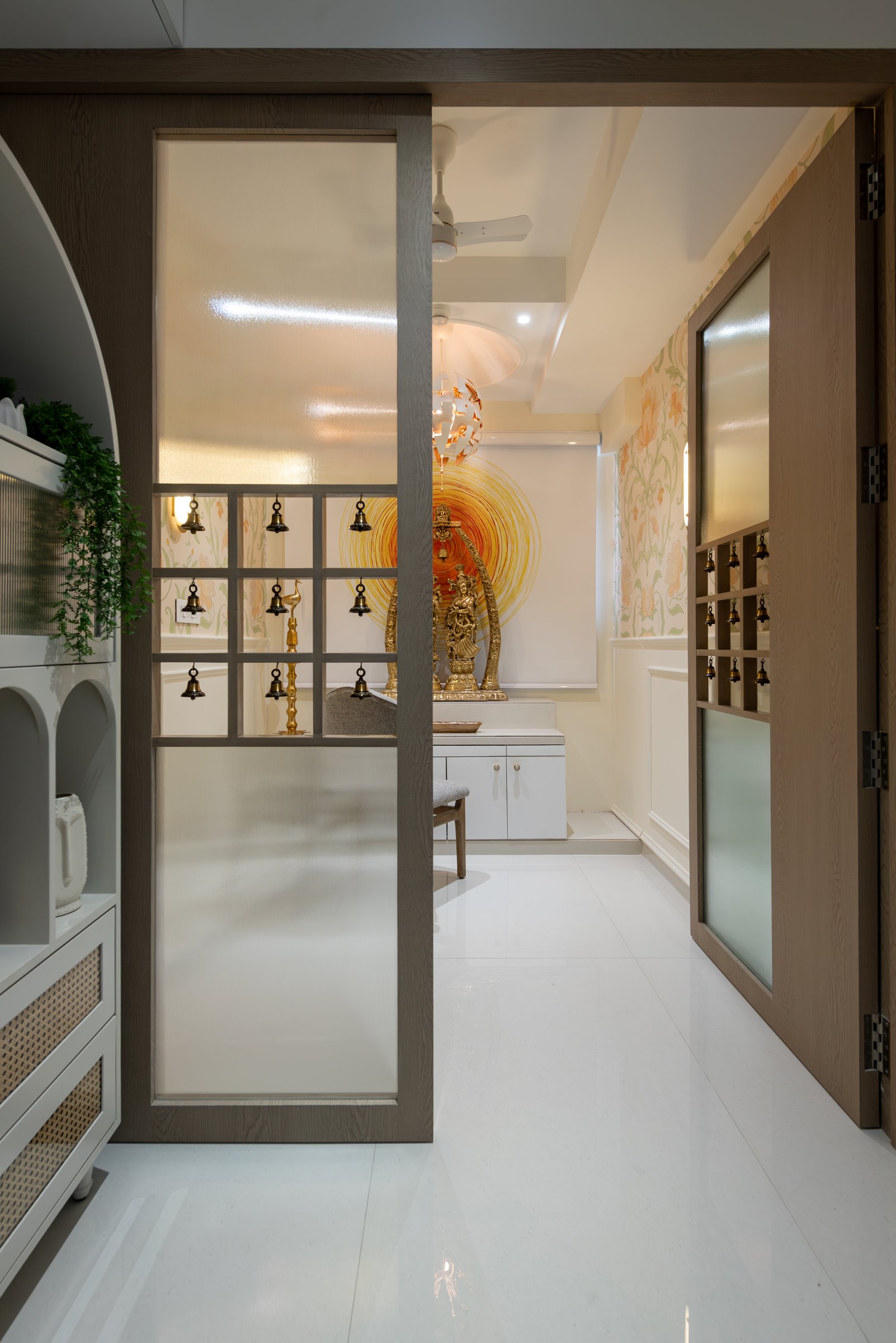
The puja room is approached through a frosted glass and wood-framed sliding partition, which preserves the ritual’s privacy while allowing soft light to pass through. The deity sits within a sculpted golden mandala against a softly patterned wallpaper, while rows of brass bells line the framed grid of the partition itself.
It is a place of pause and reflection, treated with the same compositional clarity as the rest of the home rather than as a separate cultural insertion.
What makes The Soft Nest worth pausing over is its willingness to let a contemporary Indian home be quiet without becoming impersonal. The studio resists the urge to load every wall with statement, trusting instead that texture, proportion, and a disciplined palette can carry the weight of family life on the twenty-seventh floor of a busy Mumbai tower.
The result is an interior that feels at once composed and deeply liveable, the kind of home that registers its design intelligence not in single declarations but in the steady accumulation of restrained choices. Chaukon Studio has produced a residence where calm is not a stylistic preference but a way of inhabiting the city.