AA retirement home asks something different of architecture. Rather than making statements, it must offer reassurance, holding memory without sentimentality, expressing heritage without performance, and creating the kind of quiet ease that only a life of accumulated experience can truly appreciate. The most enduring homes for this stage of life are those that balance familiarity with renewal, allowing cherished objects, rituals, and contemporary comfort to coexist with equal grace.
The Samaagam Project, designed by CUBSpaces for a Kerala-based family settling into a 3,000 sq. ft. residence in Sopanbaug, Pune, takes its name from the Sanskrit word for “confluence.” Led by principal designer Lakshmi Satish, the project interprets South Indian heritage with notable restraint, treating it not as a decorative theme but as an underlying sensibility woven through the home. Cane, teak, brass, and natural textiles recur quietly across the interiors, while a calm contemporary palette allows these materials to carry their cultural resonance without overwhelming the space.
The result is a home that feels deeply rooted yet unmistakably contemporary. Rather than relying on overt references to tradition, it builds atmosphere through material warmth, careful proportion, and a measured sense of continuity, creating a residence whose greatest luxury lies in its quietness and its ability to make the next chapter of life feel both familiar and gently renewed.
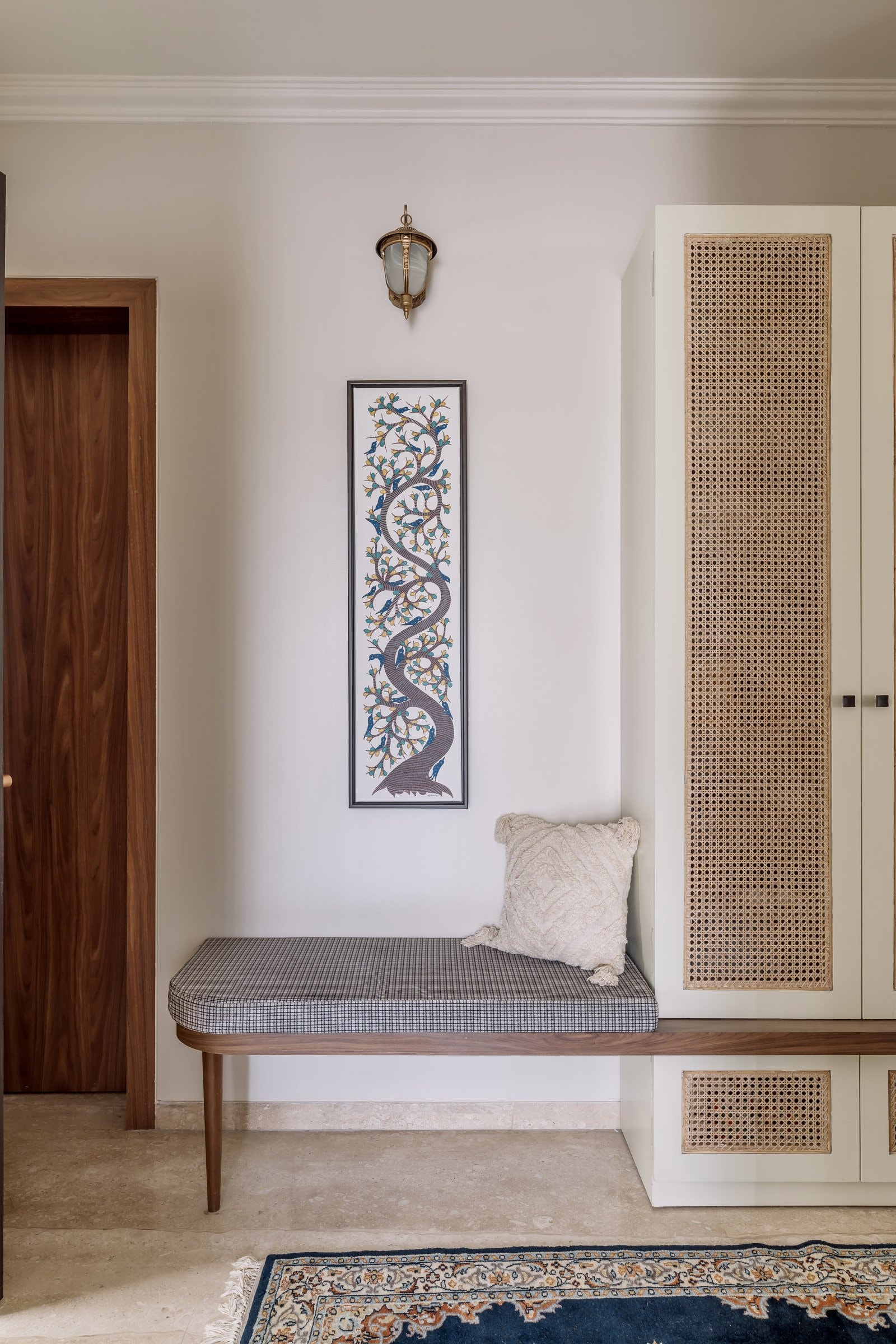
The entry establishes this sensibility in a single, composed gesture. A slender Gond-style painting in indigo and ochre anchors the wall above a walnut-legged bench upholstered in a fine checked fabric, while a tall cane-fronted cabinet alongside introduces the woven texture that quietly threads through the home. The composition is restrained yet richly tactile, setting the tone for a residence that privileges craftsmanship, material honesty, and quiet permanence over spectacle.
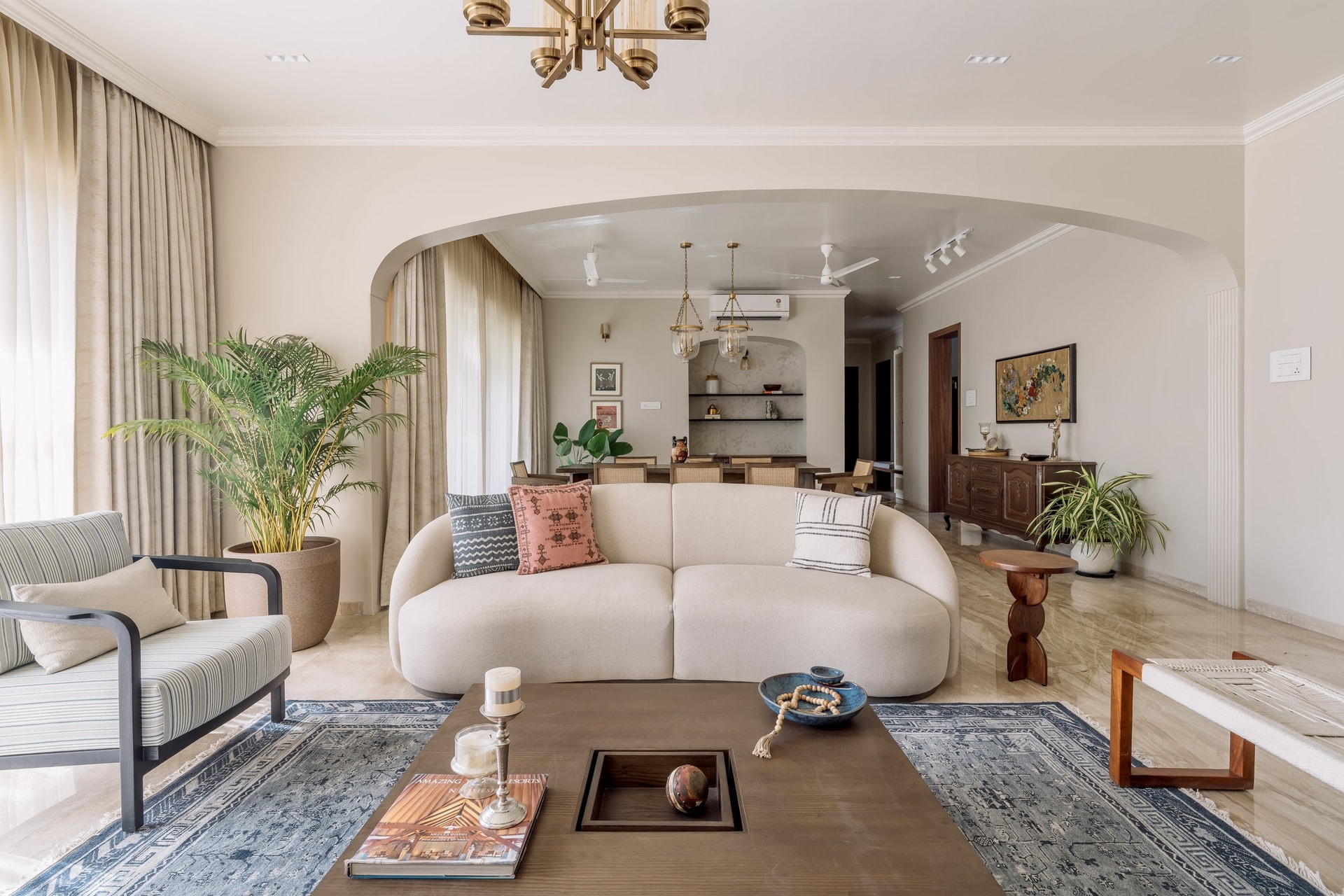
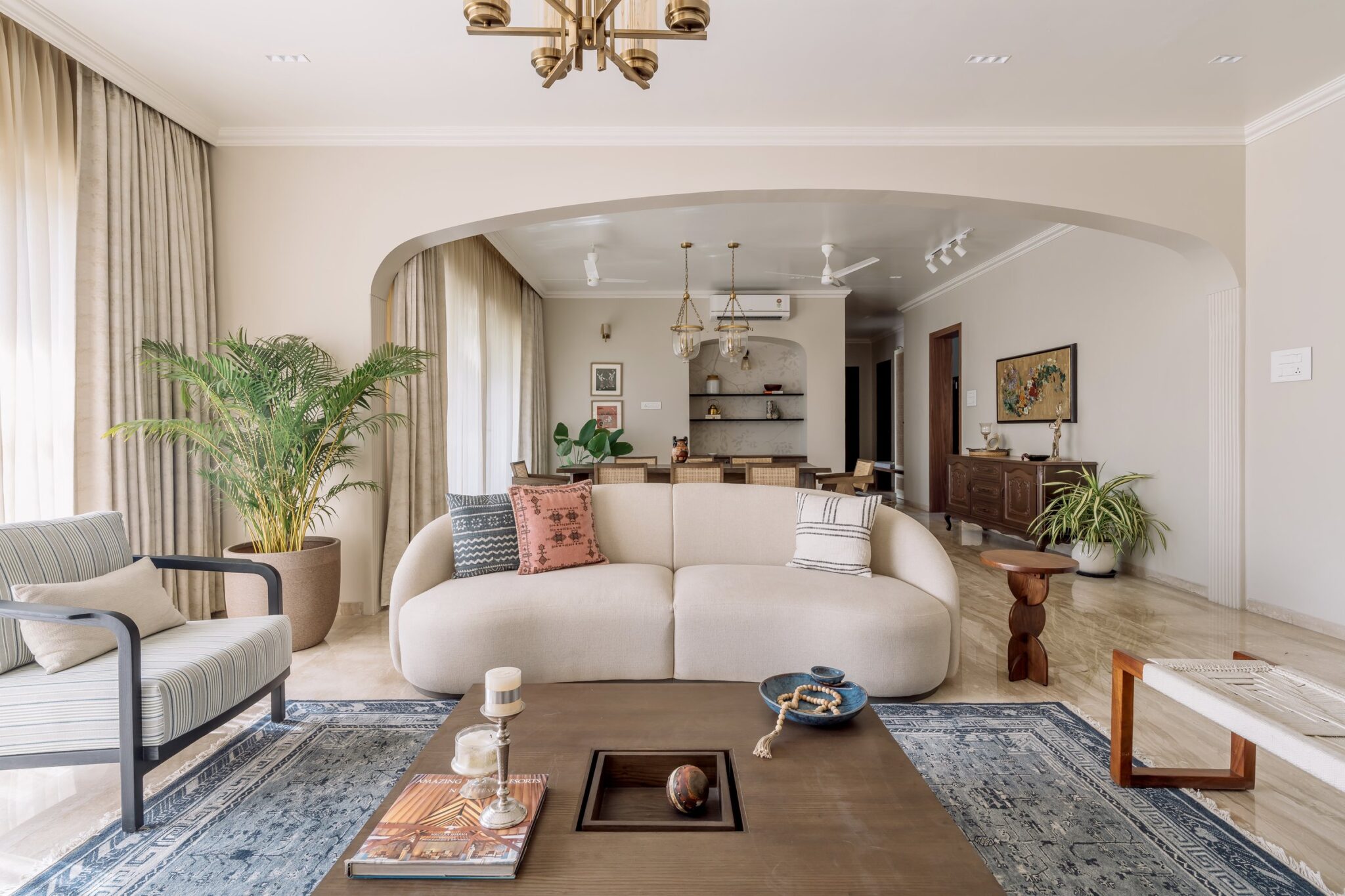
An arched opening gently frames the living room beyond, softening the transition between spaces rather than marking a defined threshold. A curved oatmeal-toned sofa anchors the seating arrangement, paired with a striped armchair and a low timber coffee table layered with books and handcrafted ceramics. The composition feels considered without appearing staged, carrying the relaxed ease of a home shaped by daily rituals rather than formal display.
Beyond, the plan unfolds as a continuous social landscape, with the living, conversation, and dining areas flowing seamlessly into one another beneath abundant natural light. Expansive drapery frames views of the surrounding greenery, while the open layout encourages movement, daylight, and conversation to travel freely through the home. Rather than dividing functions into separate rooms, the design relies on proportion, furniture placement, and subtle architectural cues to define each space without interrupting its sense of continuity.
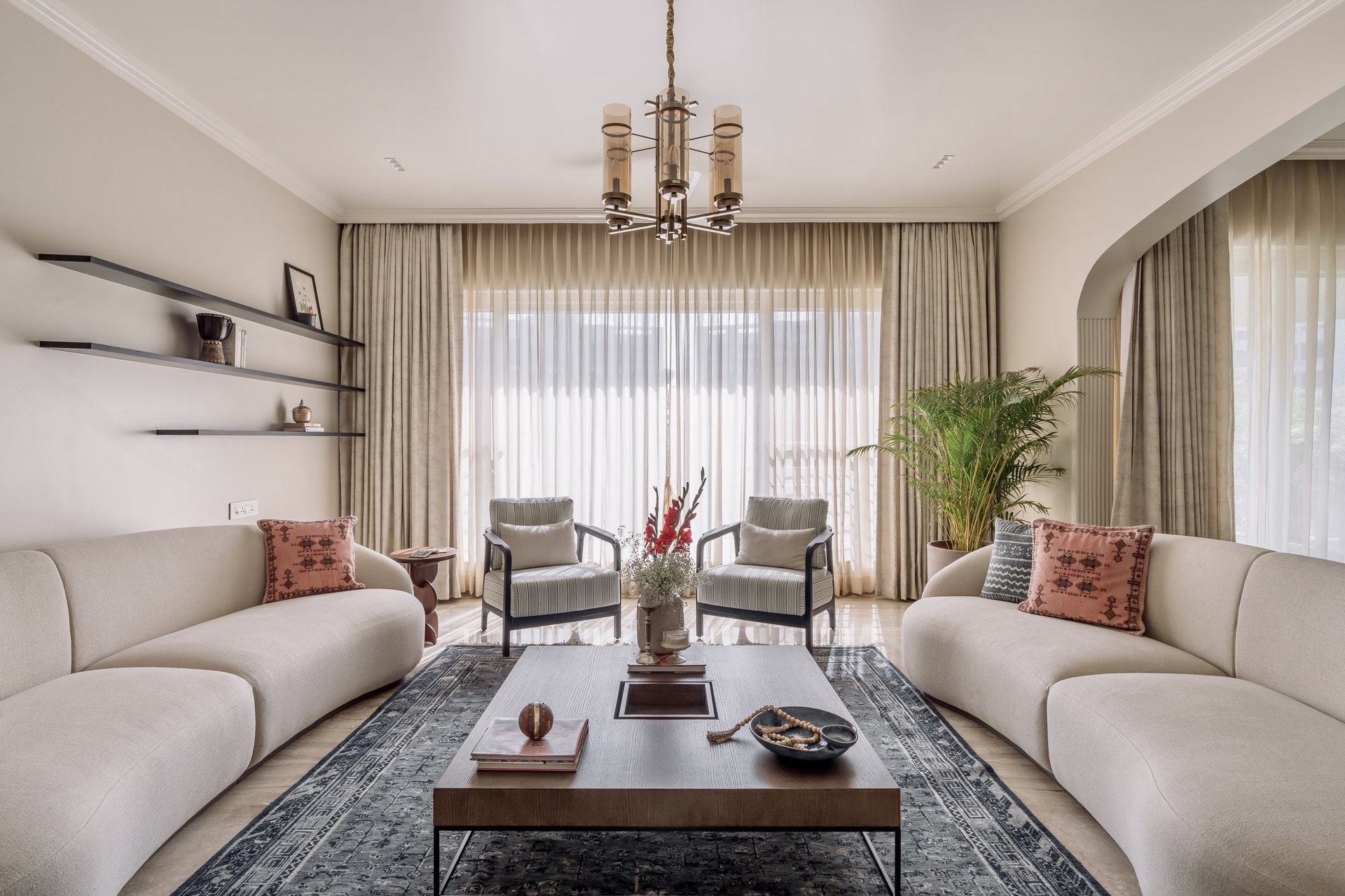
Two gently curved sofas face one another across a low timber table, while a pair of striped upholstered armchairs in dark wood complete the arrangement. Formal in composition yet relaxed in spirit, the setting encourages the kind of unhurried, multi-generational conversations around which the home has been conceived.
Floating shelves along the adjacent wall display a carefully edited collection of books, ceramics, and personal objects, while sheer drapery filters daylight into a soft, even glow. The palette remains deliberately restrained, moving through creams, taupes, and muted blues, allowing texture, woven fabrics, and the patina of natural timber to provide depth and warmth rather than relying on colour or ornament.
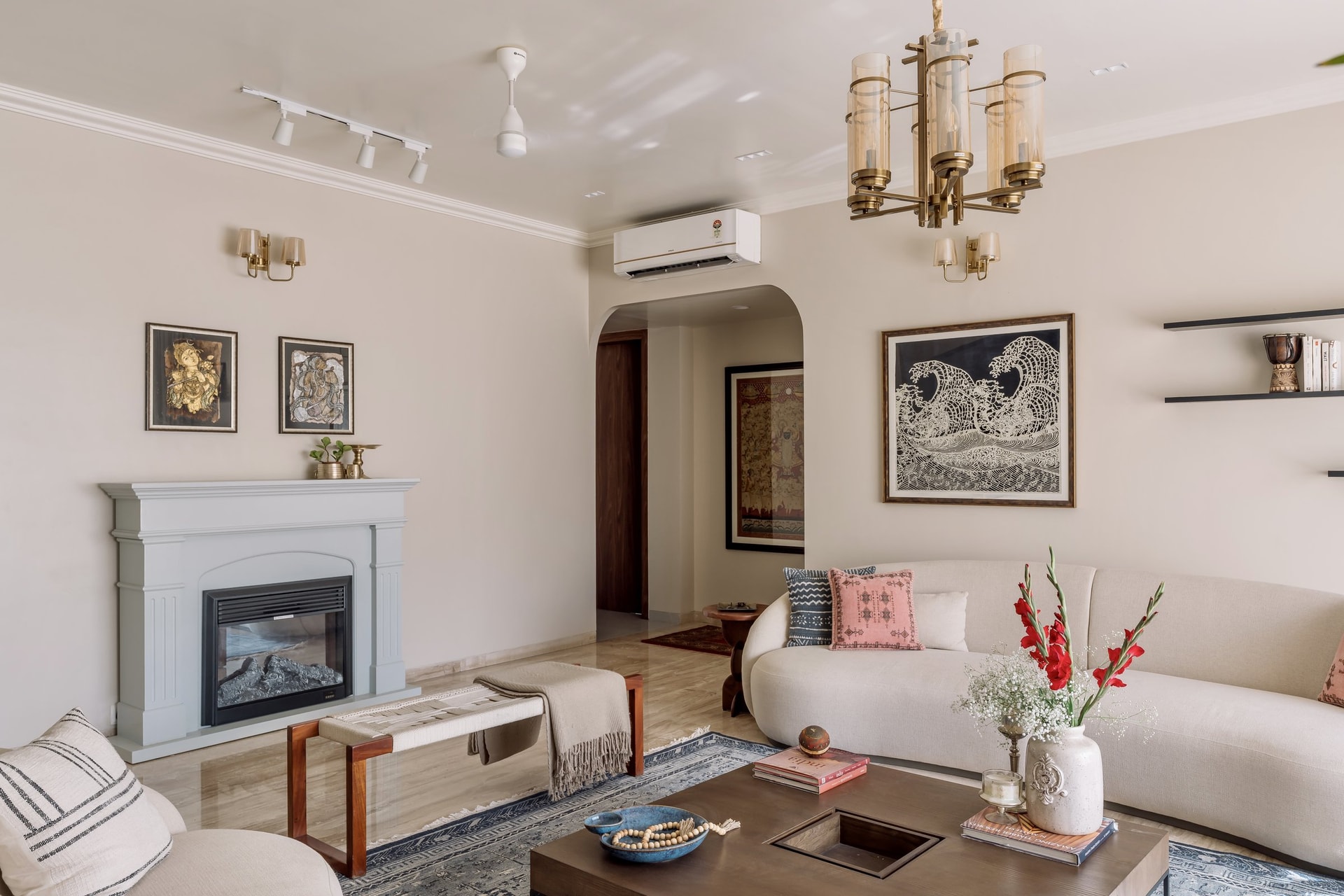
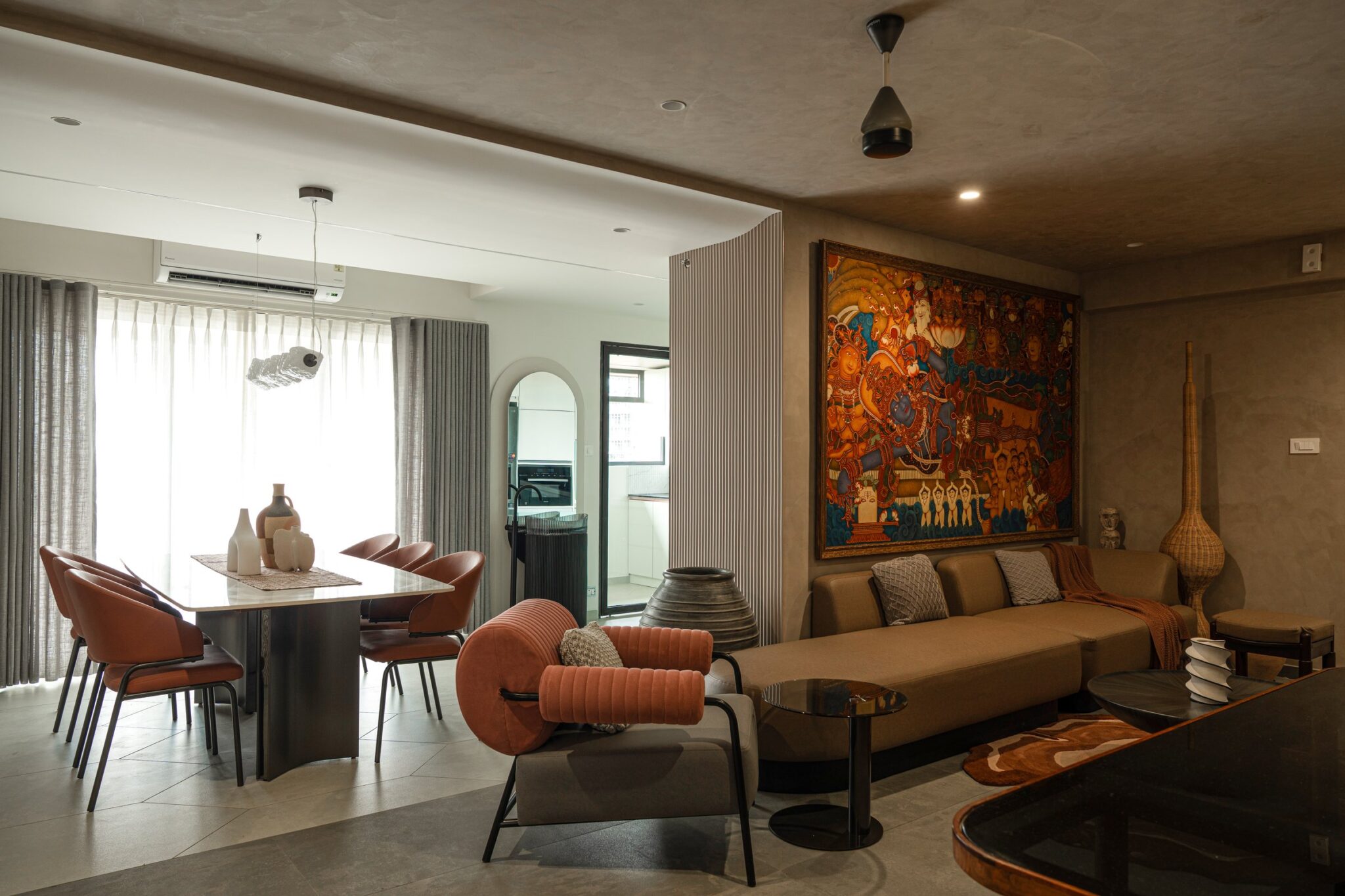
““The striking element of the living room is the Sanjhi art from Varanasi, an adaptation of Hokusai’s The Great Wave off Kanagawa. The wave motif symbolises movement, fluidity, and a confluence of cultures, much like the home, where old meets new.””
The framed Sanjhi piece anchors a quieter wall opposite a painted mantel, with a second arched opening leading into the dining beyond. The composition gathers the project’s thesis without announcing it: a Japanese print reinterpreted through an Indian paper-cut craft, displayed beside small devotional artworks and brass objects on the mantel. The cultural confluence is visible only to those who pause long enough to read it.
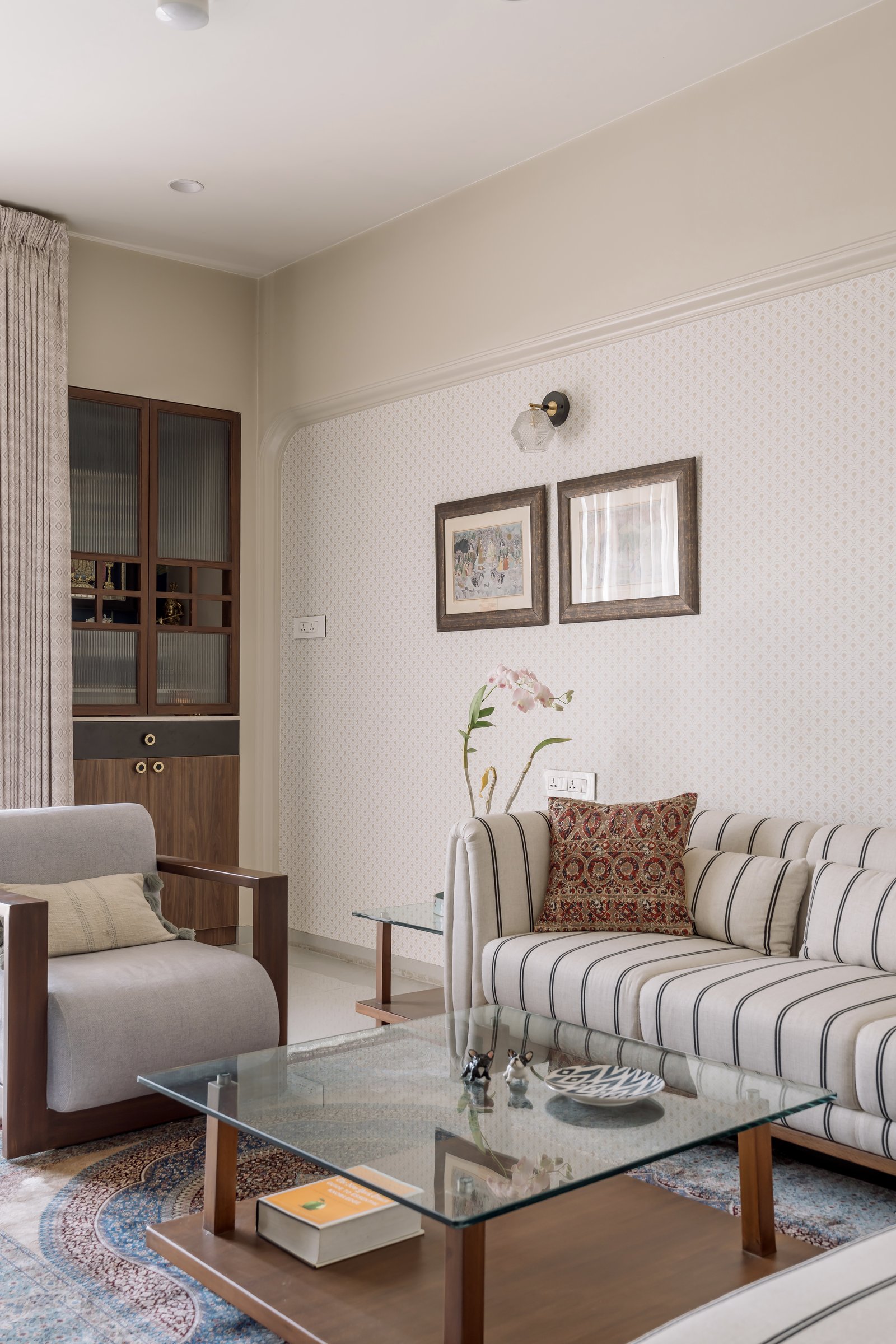
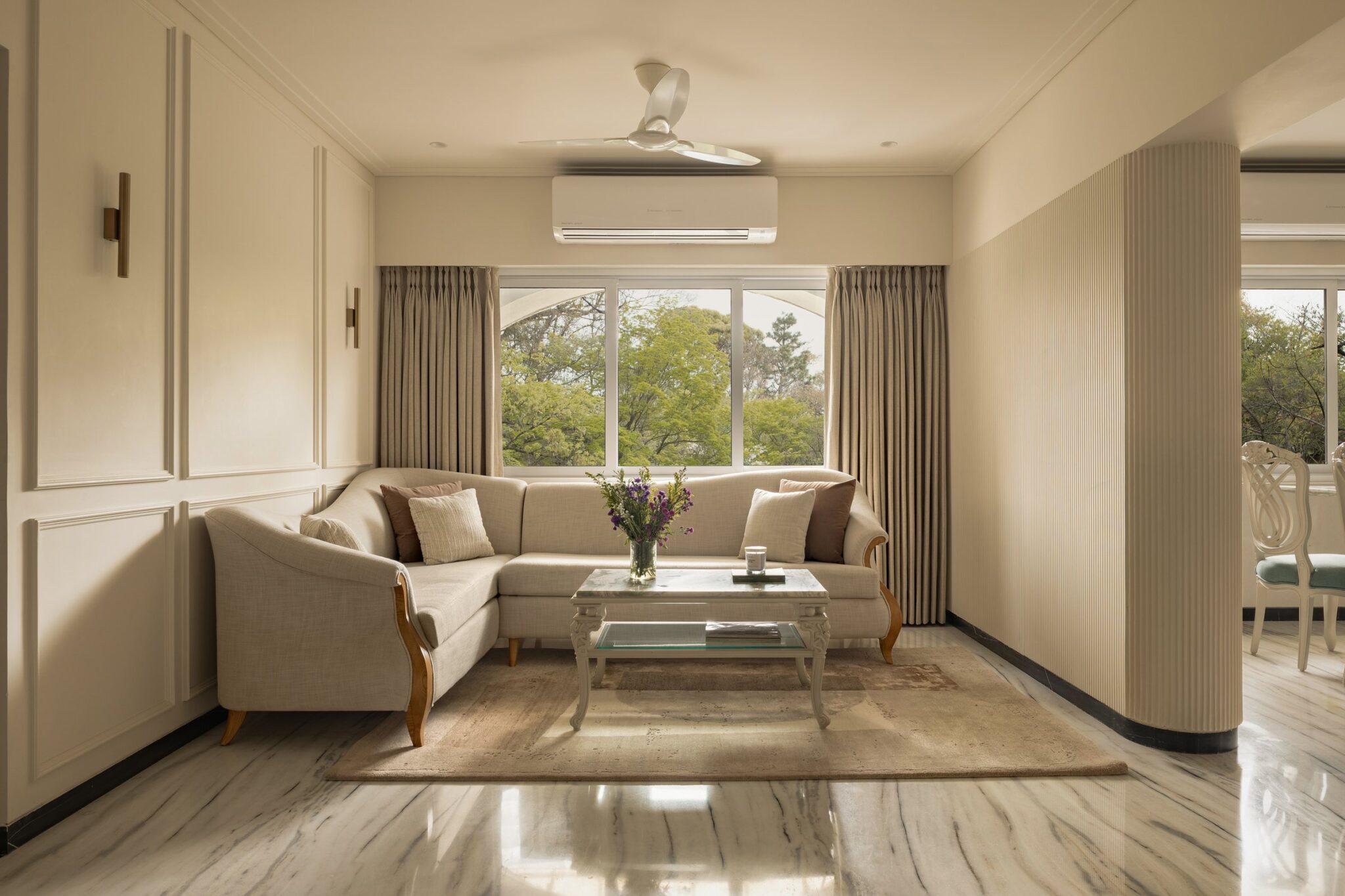
An adjoining sitting room adopts a lighter, more intimate character. A striped sofa rests against delicately patterned wallpaper whose understated motif recalls the small-scale prints once common in South Indian homes. To one side, a refurbished teak armchair introduces a sense of inheritance, its worn timber carrying a history that no newly made piece could replicate, while a glass-topped coffee table keeps the composition visually light.
Behind the seating, a fluted-glass walnut cabinet discreetly houses the family’s puja space, integrating it into the rhythm of everyday life rather than isolating it within a separate room. The gesture reflects the home’s broader design philosophy, where tradition is not treated as a ceremonial display but woven naturally into daily living, allowing ritual and routine to exist within the same architectural language.
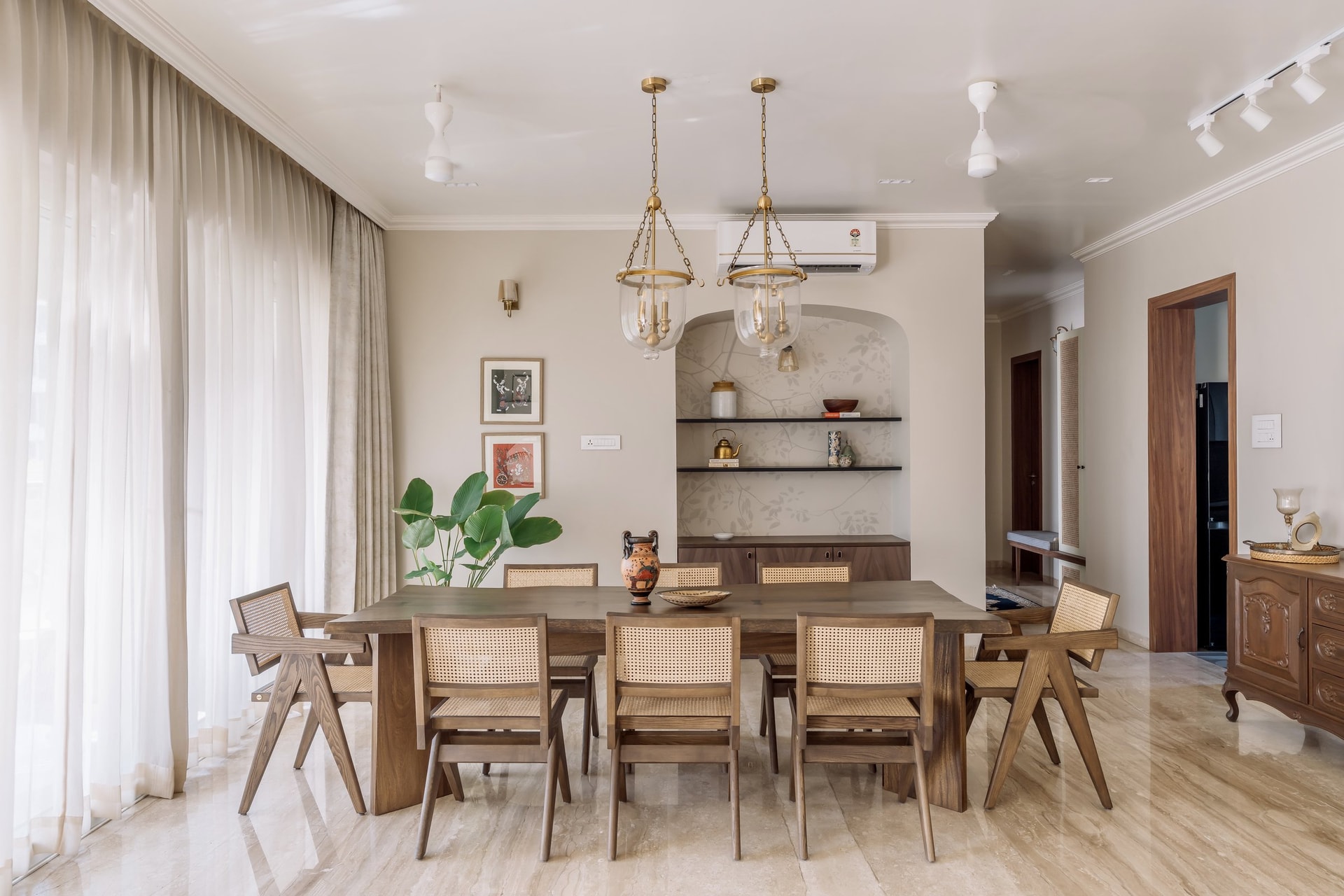
The dining area occupies one of the brightest corners of the home, centred around a long teak table accompanied by cane-and-timber chairs that draw on the restrained vocabulary of Chandigarh’s modernist furniture tradition. Suspended above, a pair of brass-and-glass bell pendants provide a gentle focal point, their timeless form lending the space a quiet sense of elegance without anchoring it to any particular era.
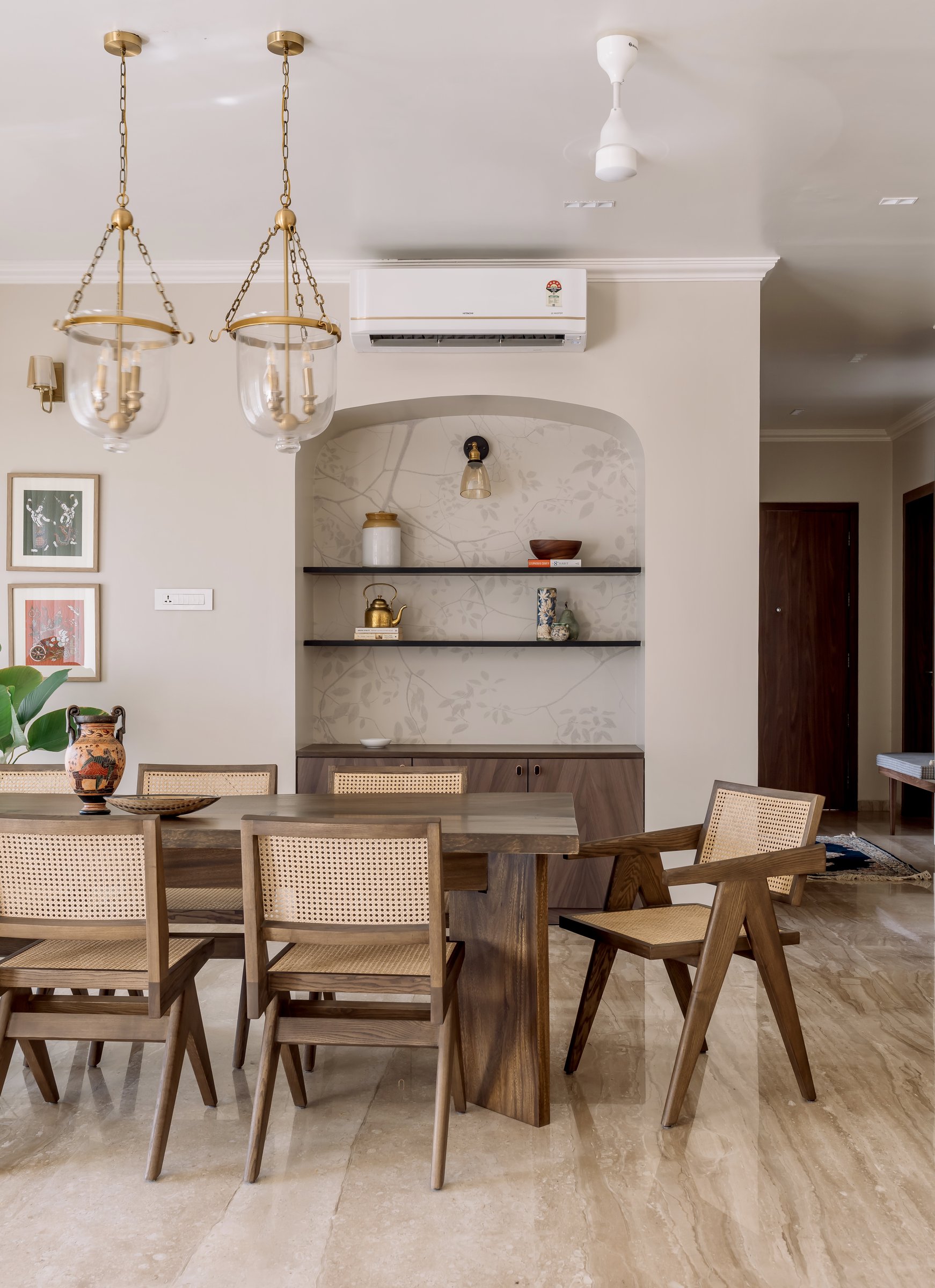
The arched display niche behind the dining table is the room’s most considered architectural gesture. A delicate botanical wallpaper lines its back, with two slim black shelves. The composition reads as a contemporary reinterpretation of the wall niches of older Kerala homes, scaled and styled for present-day use.
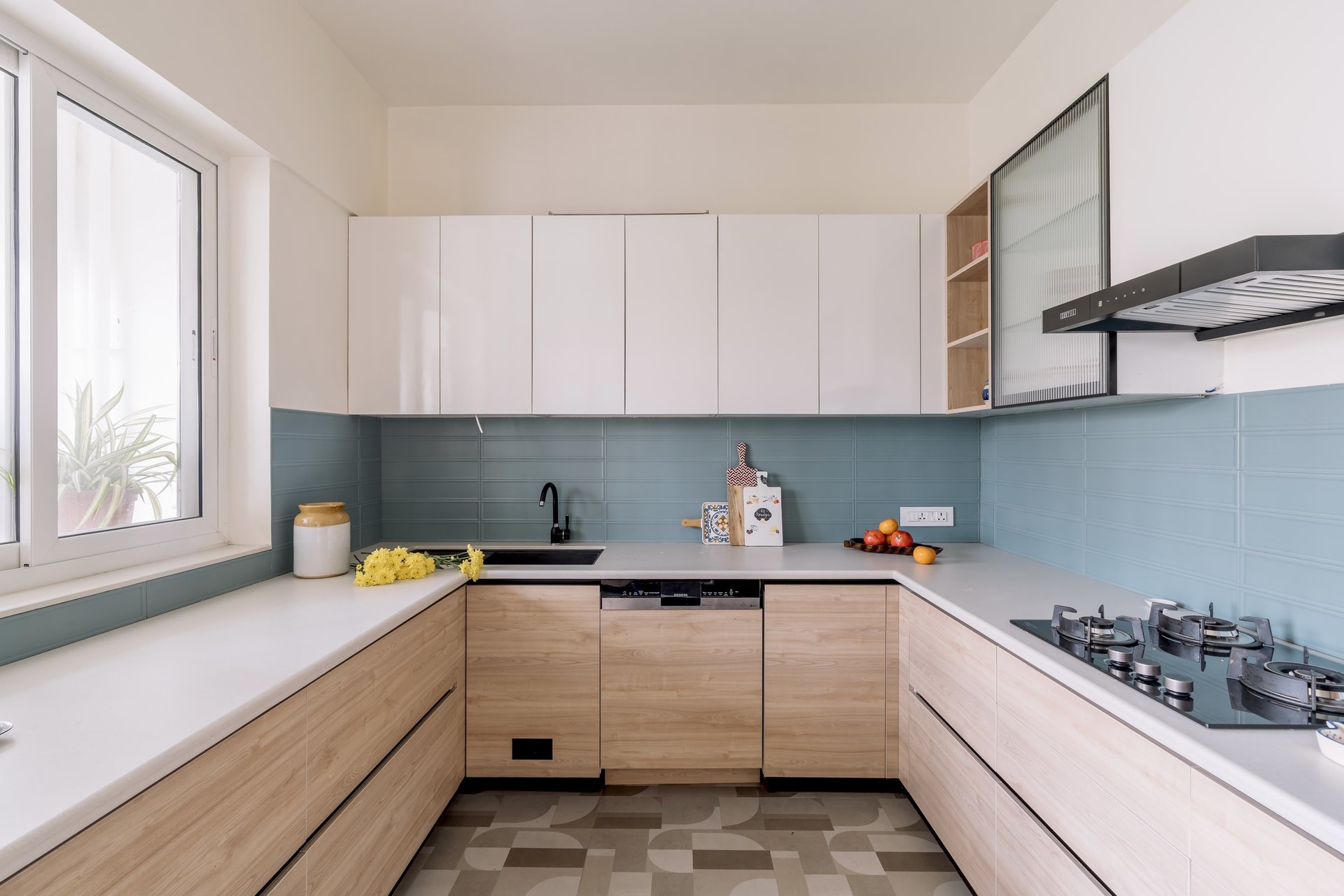
The kitchen shifts into a lighter, more utilitarian palette. Pale timber base cabinetry is paired with crisp white upper units across a stone countertop, while a muted blue tiled backsplash introduces the room’s only sustained note of colour. Underfoot, a patterned cement-tile floor lends a subtle graphic rhythm, grounding the otherwise restrained composition with quiet character.
There is little here that feels performative. Instead, the kitchen is organised with clarity and purpose, allowing its material warmth and careful detailing to speak without unnecessary embellishment.
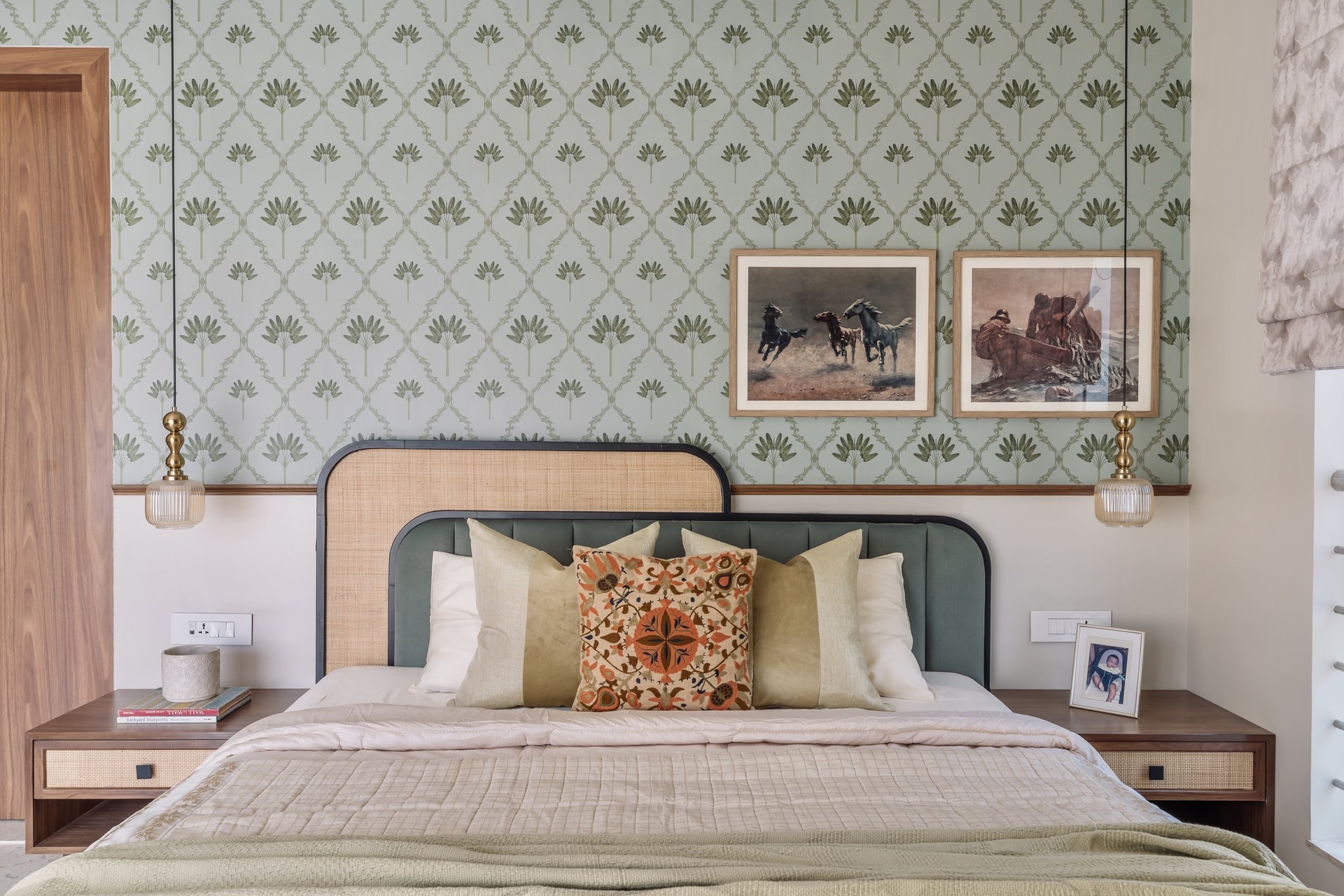
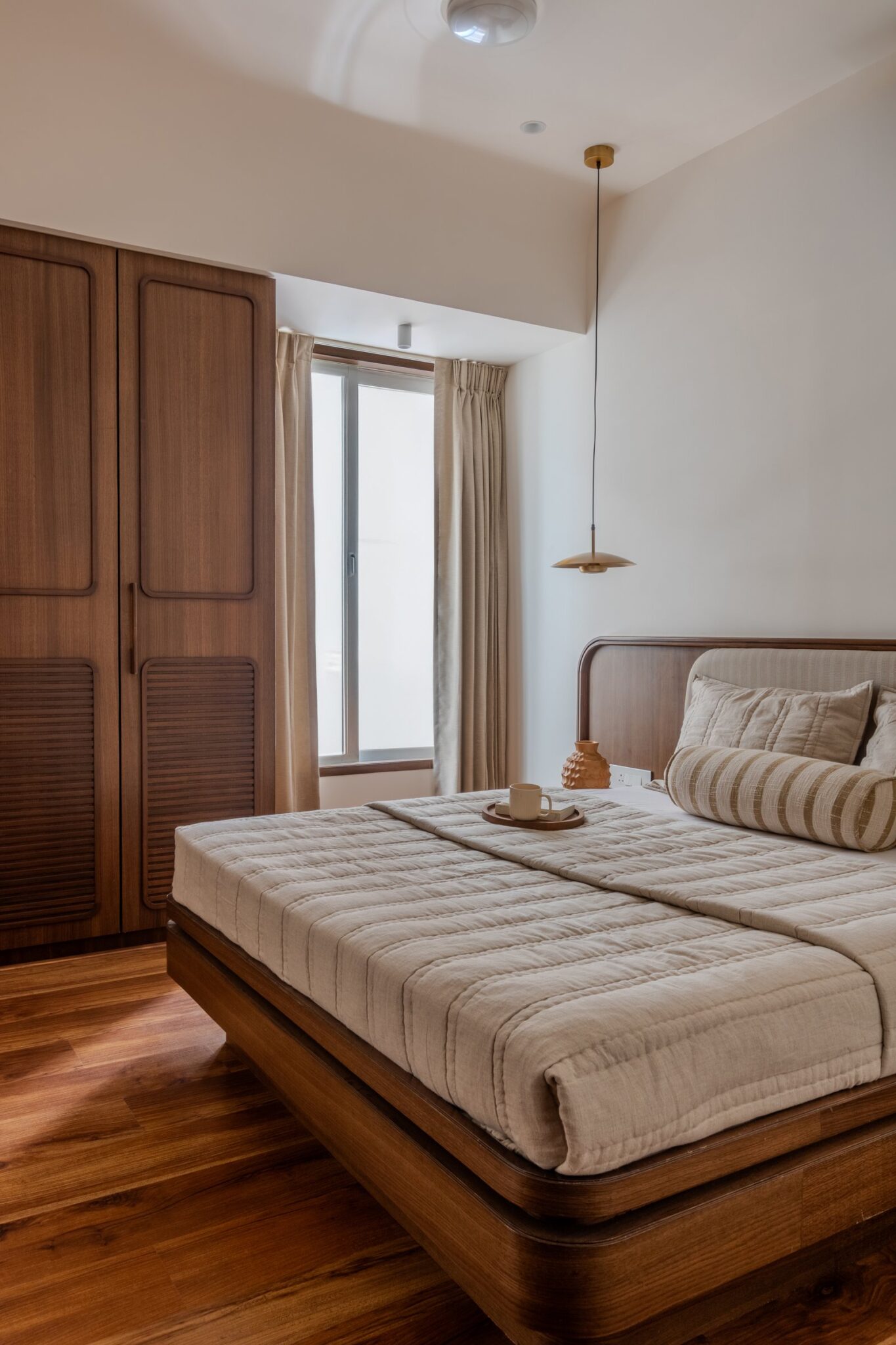
The master bedroom offers the home’s most distilled expression of its design language. A bespoke botanical palmette wallpaper by The Wall Chronicles envelops the headboard wall in soft shades of sage and olive, its diamond trellis pattern drawing from the botanical motifs of South Indian craft traditions. Interpreted through a restrained palette and refined scale, the design feels quietly architectural rather than overtly nostalgic, lending the room a sense of depth, softness, and enduring calm.
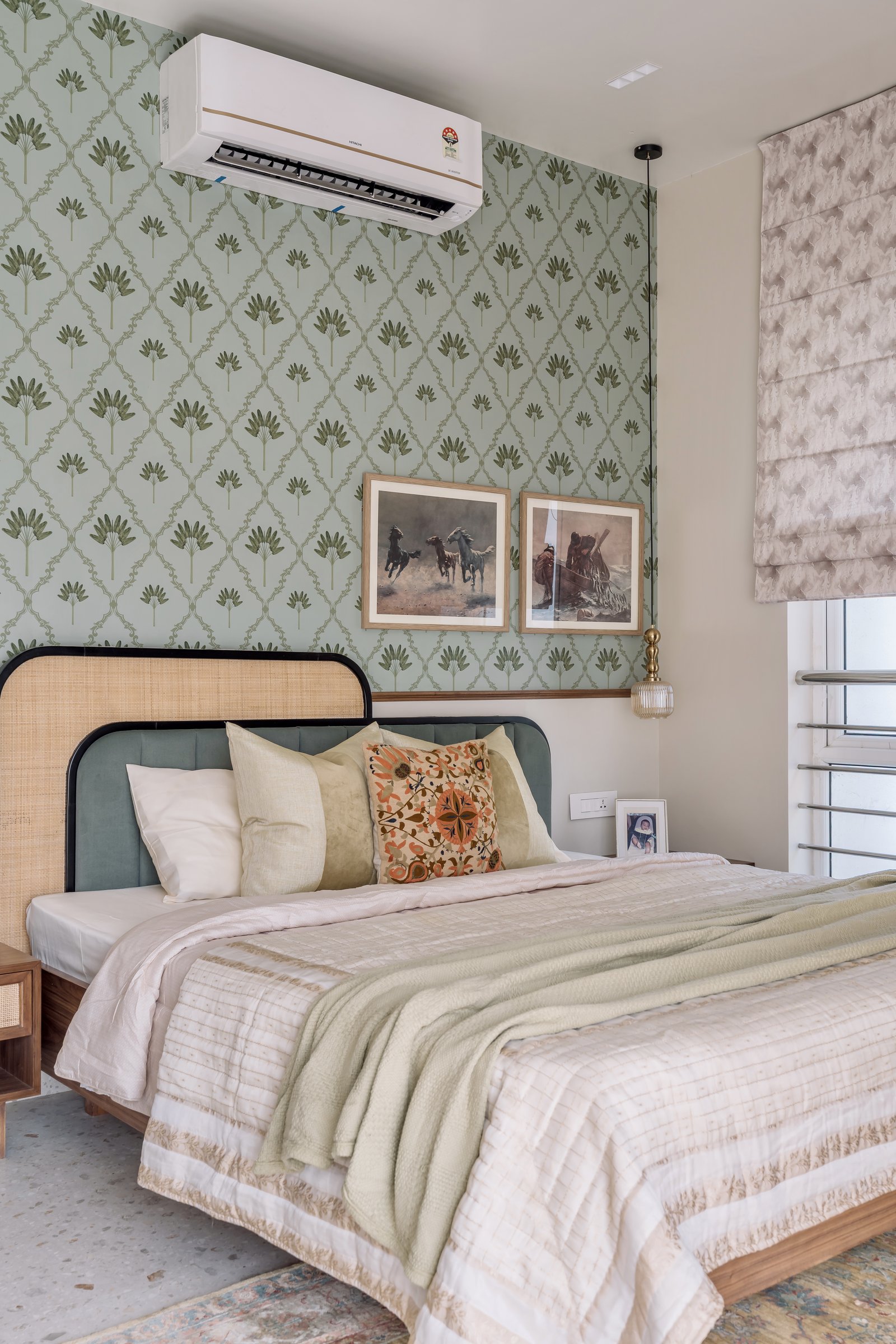
The bed itself carries the home’s material confluence in a single piece: a wooden frame with a cane-and-upholstered headboard in muted sage, framed by a slender brass-and-glass pendant light descending from the ceiling.
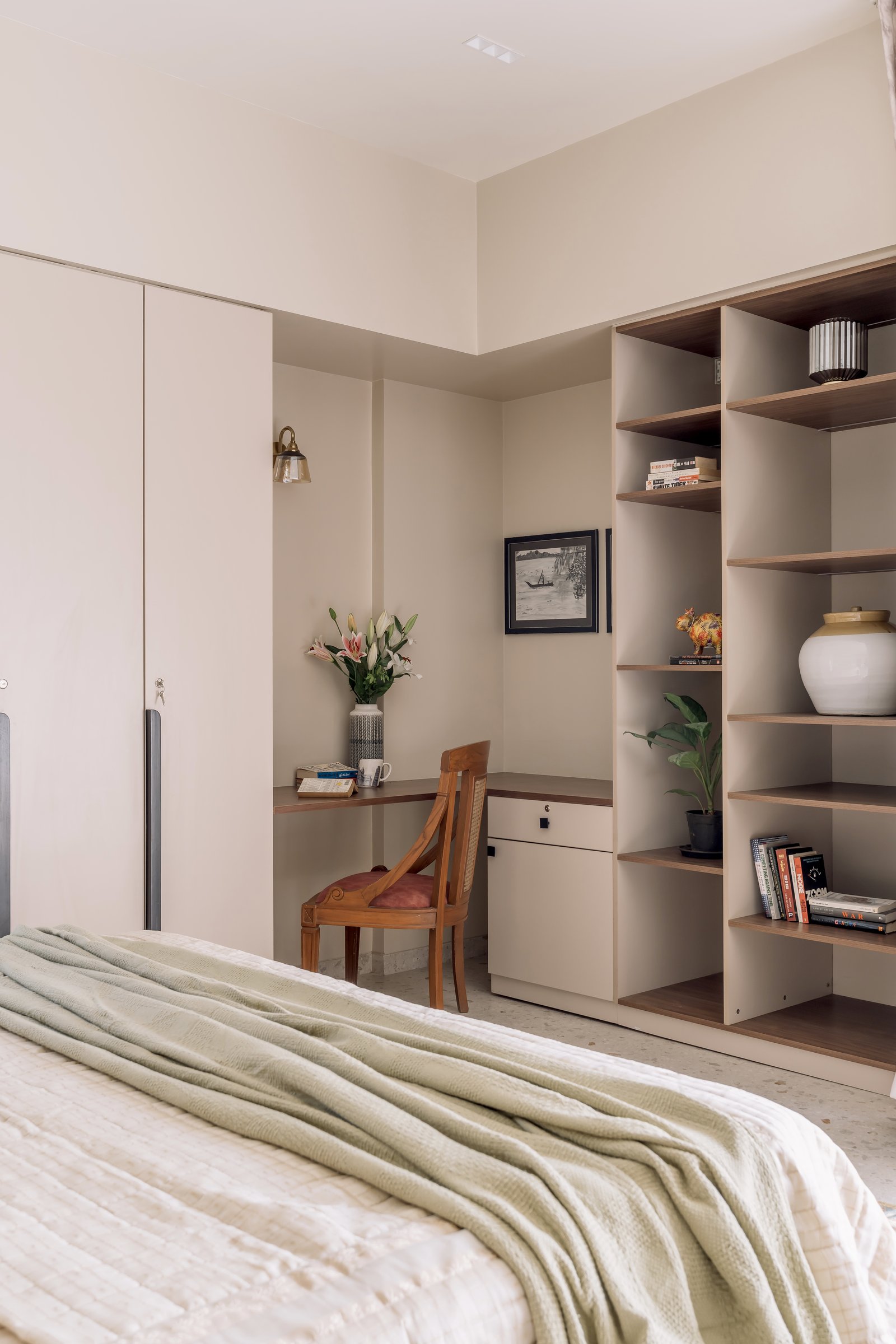
A study corner within the bedroom extends the room’s sense of quiet into a compact workspace. A simple writing desk is tucked neatly between full-height wardrobes and an open shelving unit finished in pale tones with warm timber interiors, accompanied by a vintage cane-back chair that echoes the home’s recurring material language. Every surface is used with purpose, yet the composition remains visually light, demonstrating how functionality can be integrated without disturbing the room’s calm, restorative character.
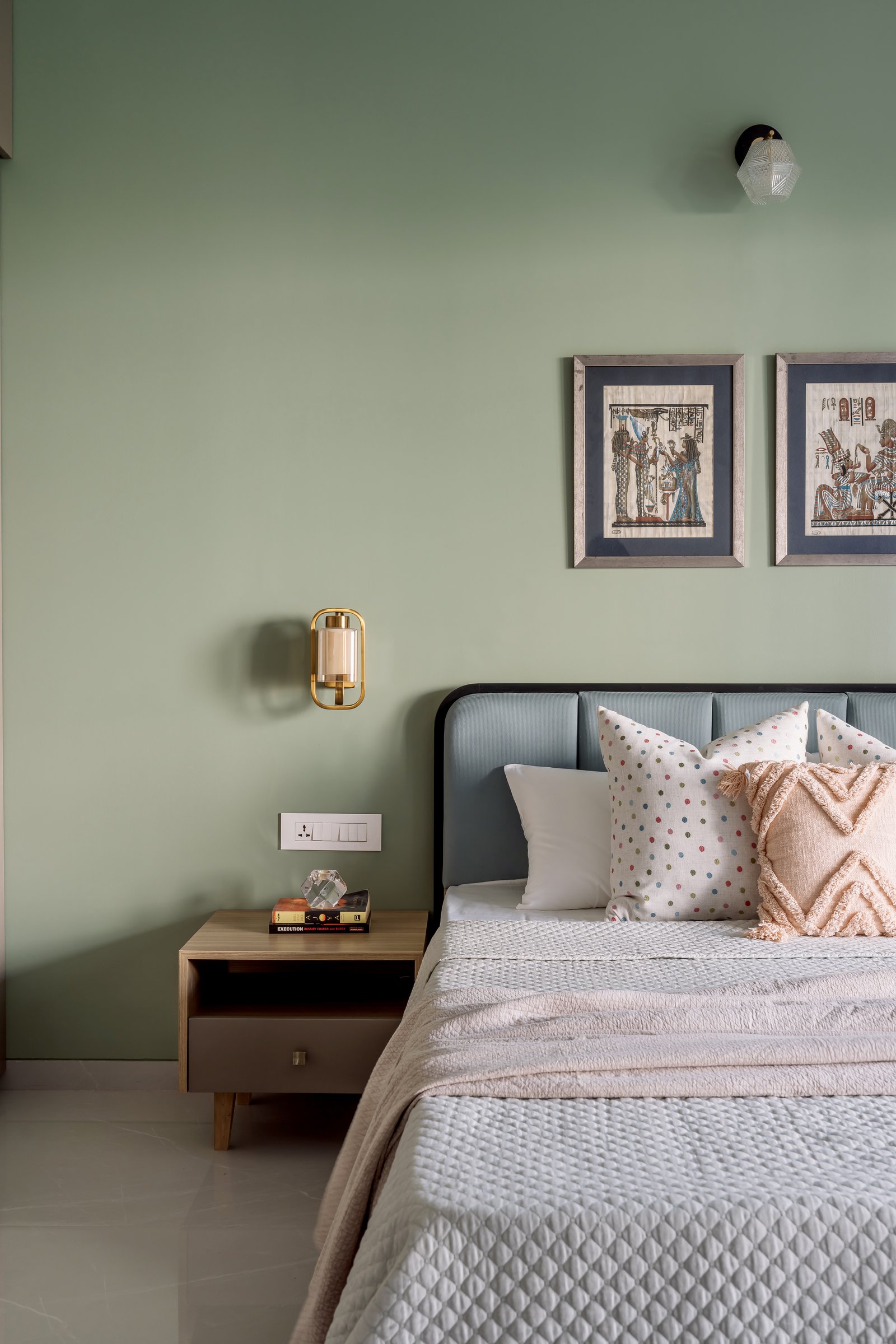
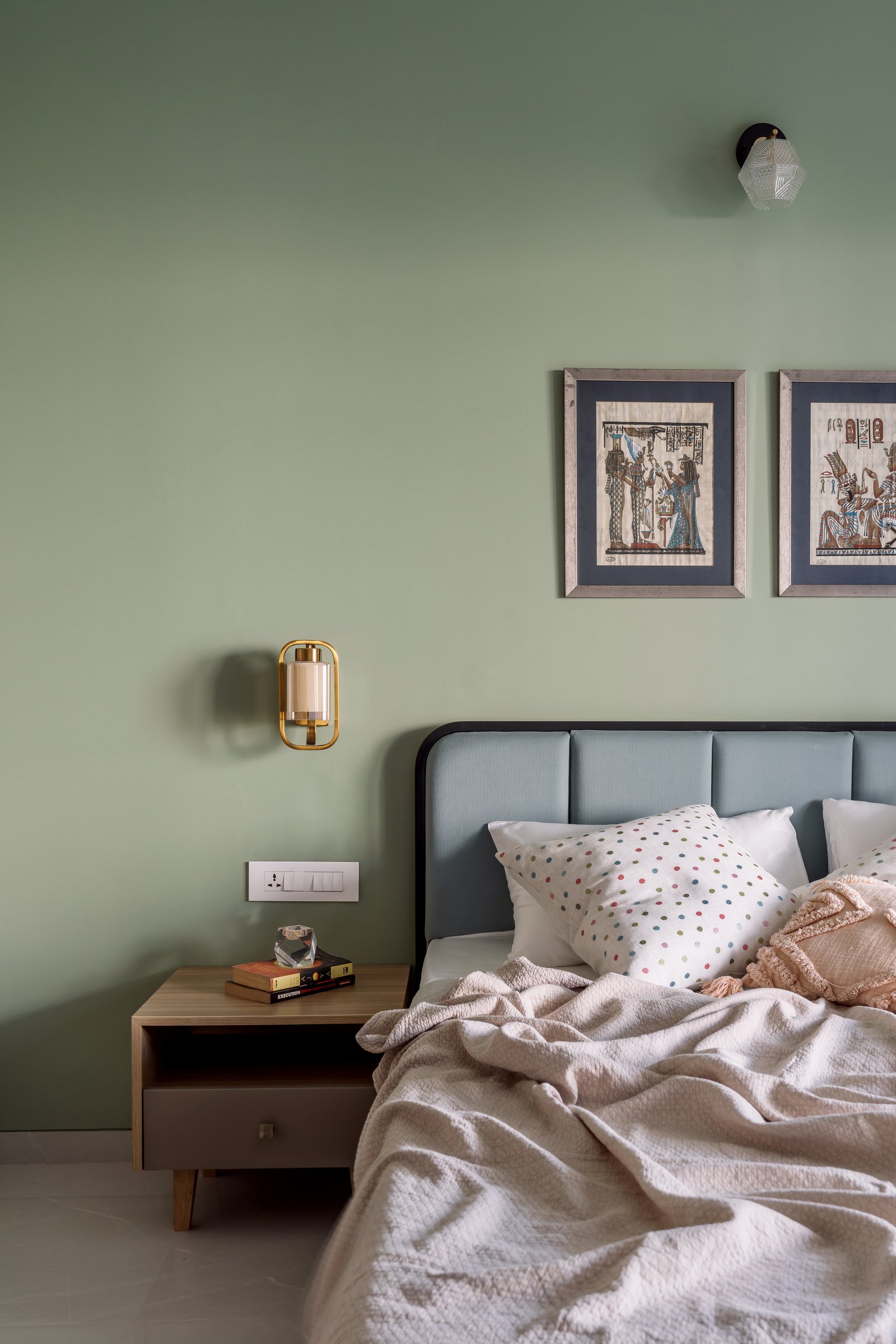
The second bedroom adopts a lighter, more contemporary expression. A muted sage wall forms a calm backdrop for two framed Egyptian-inspired prints, introducing a subtle layer of narrative without overwhelming the space. Below, a softly upholstered headboard with gentle channel detailing brings texture and comfort, while a brass-and-glass wall sconce offers a restrained note of warmth. The composition remains understated, relying on tonal harmony and carefully chosen accents rather than decorative abundance.
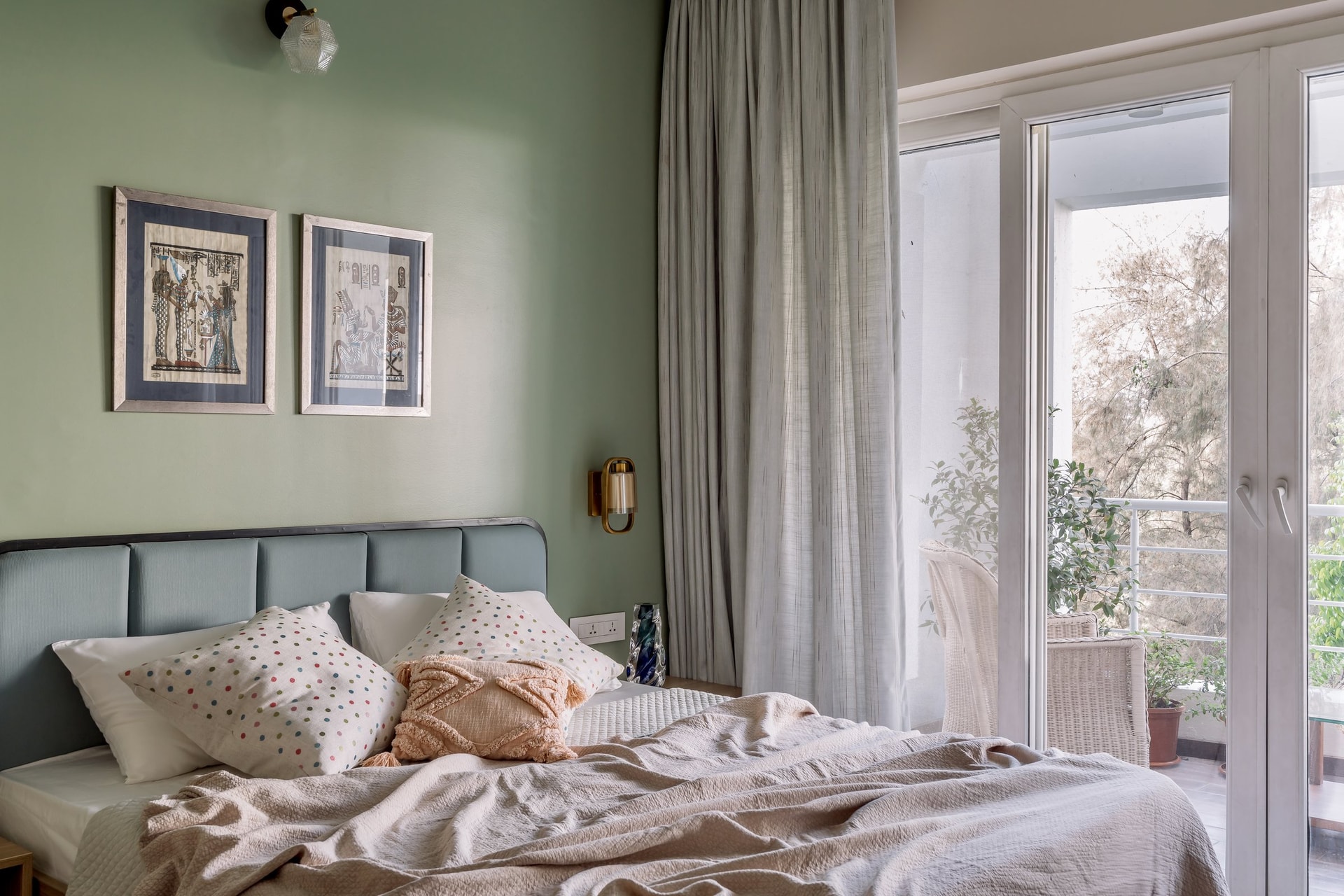
From a wider vantage, the room opens onto a compact balcony through white French doors, extending its calm beyond the interior. Sheer drapery filters views of the surrounding greenery, while a wicker chair placed outside hints at the quiet morning rituals the space has been designed to accommodate. Against the muted sage wall, the framed prints read less as decorative statements than as personal touchstones, lending the room a sense of familiarity and lived-in warmth.
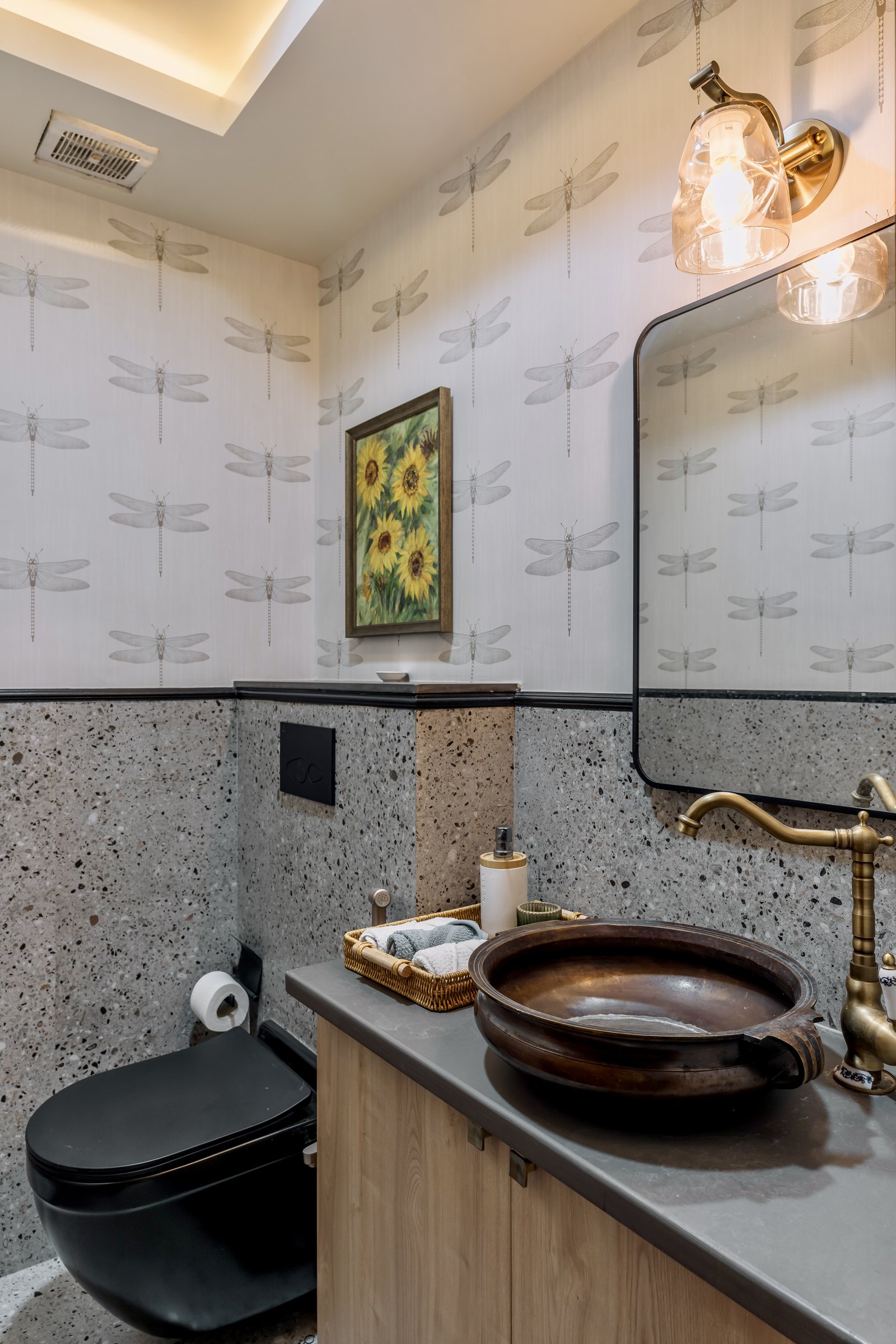
The powder room takes a more decorative turn. Dragonfly-patterned wallpaper covers the upper half of the walls while a terrazzo dado wraps the lower portion, the two meeting at a slim black band. A traditional uruli-style bronze vessel sits as the basin, paired with an aged brass tap that reads as inherited rather than sourced.
The room’s confluence of old and new is at its most literal here: a vintage vessel set into a contemporary stone counter, with patterned terrazzo recalling the flooring of older South Indian homes.
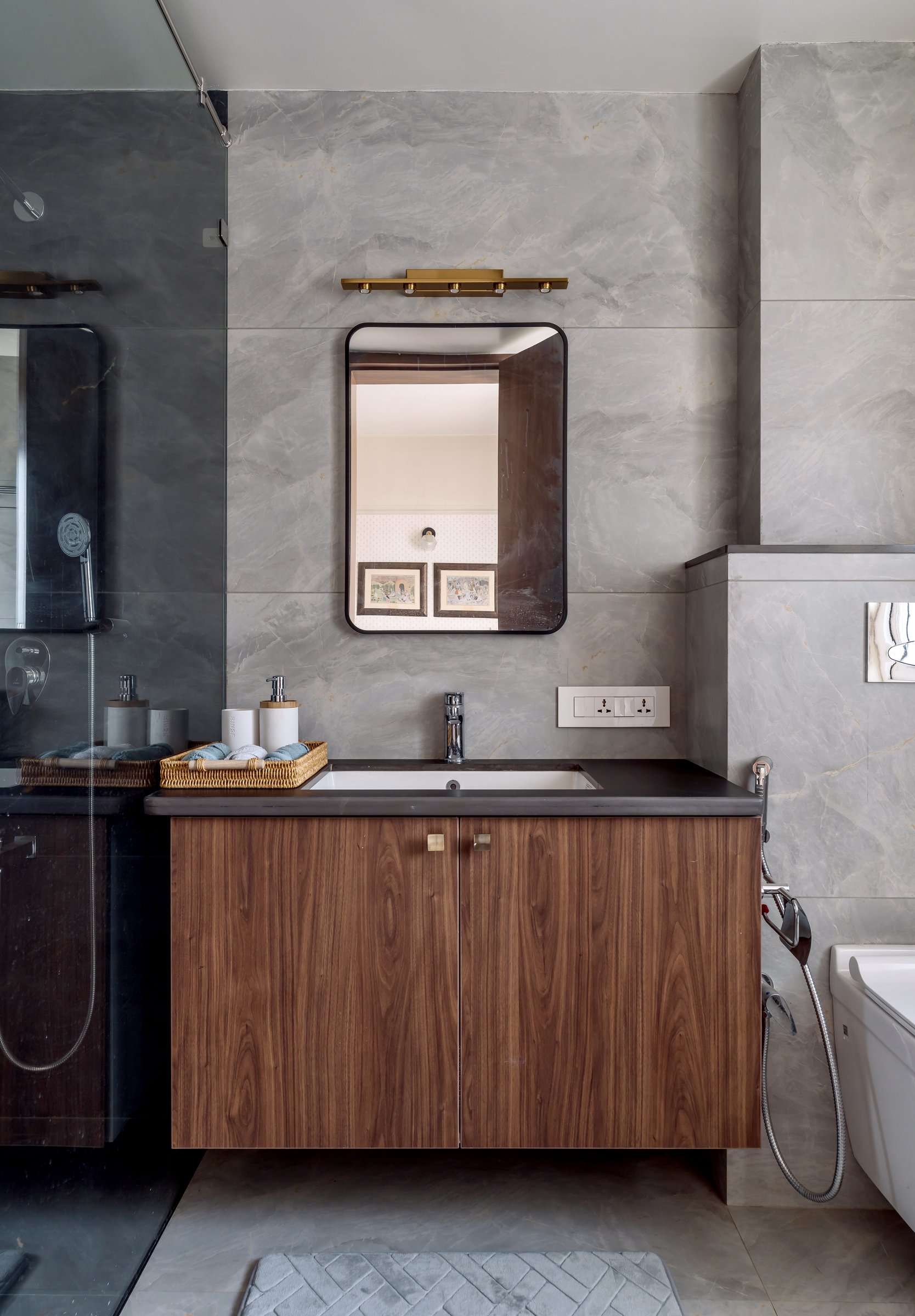
The master bathroom moves into a more restrained register. Large veined stone panels in cool grey clad the walls, with a floating walnut vanity providing the single warm note in the room.
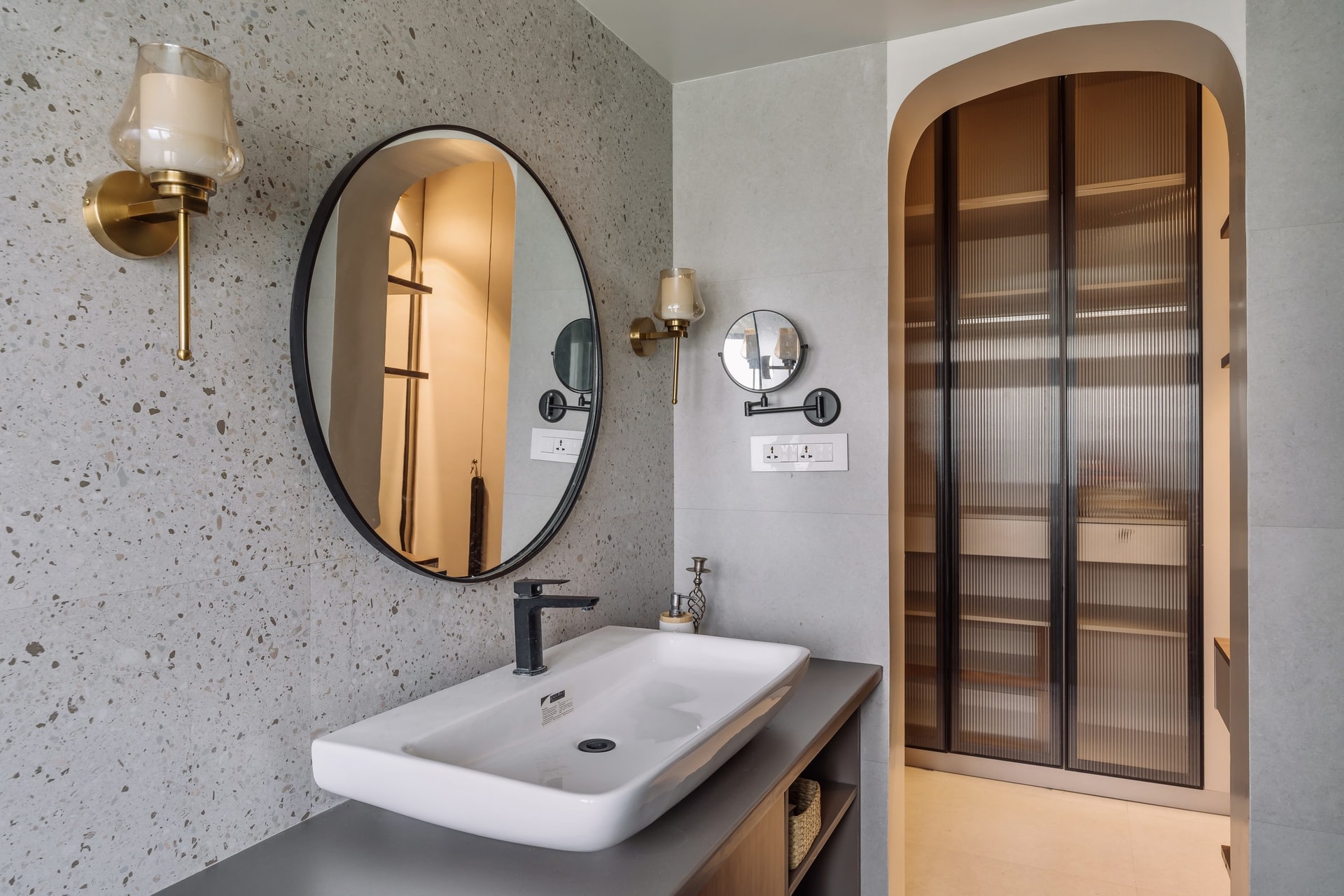
An adjoining bathroom continues the stone palette but introduces a terrazzo wall on one side, the speckled pattern reading as a contemporary translation of the same heritage flooring referenced elsewhere. An arched fluted-glass partition leads into the dressing area, the curve echoing the home’s recurring architectural motif.
What The Samaagam Project demonstrates, more than any individual material or motif, is the quiet confidence of restraint applied to a deeply rooted cultural brief. Cane, teak, brass, botanical patterns, and handcrafted textiles appear throughout the home, yet none is treated as a decorative statement. Instead, they recur as subtle threads within a contemporary architectural language, allowing heritage to be experienced rather than announced. Tradition here is neither preserved behind glass nor translated into nostalgia; it is allowed to evolve naturally within the rhythms of everyday life.
For a family entering a slower, more reflective chapter, the residence offers precisely what a retirement home should: spaces that accommodate memory without being defined by it, materials that will acquire greater character with age, and an atmosphere of quiet permanence. Rather than resolving the relationship between past and present, The Samaagam Project embraces their confluence, creating a home that feels rooted in inheritance while remaining fully attuned to the life still unfolding within it.