Minimalism is often reduced to an aesthetic of absence. Yet its more persuasive expression lies in restraint: in the careful withholding of excess so that proportion, light, and material can assume greater presence. This Vadodara residence, designed as architect Rajneesh Rami’s own home, explores that idea with quiet conviction, building a language of calm that feels considered rather than austere.
Designed by Studio 7 Design for Rami and his family, the apartment frames warm minimalism as an everyday discipline rather than a stylistic gesture. Whites, soft greys, and muted wood tones establish a palette of studied restraint, while furniture is edited with care rather than accumulated for effect. Throughout, the architecture does the heavier work: planes, volumes, and material transitions are allowed to hold attention without visual interruption.
What emerges is a home that understands minimalism not as reduction for its own sake, but as a way of heightening what remains. The spaces feel composed rather than sparse, intimate rather than ornamental, allowing warmth to arrive through texture, proportion, and light instead of decoration alone.
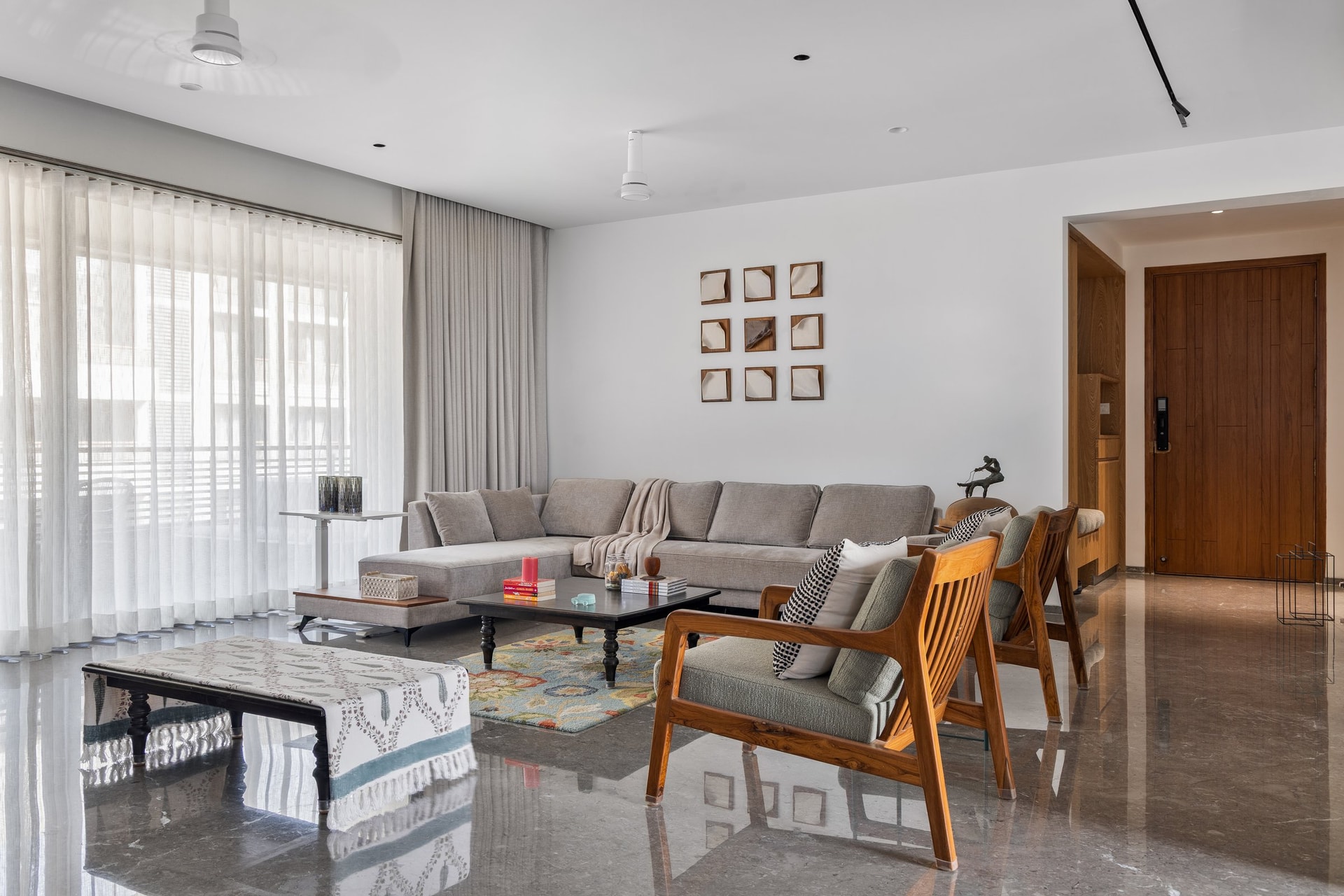
The living room establishes the home’s design language in a single, composed frame. A low grey sectional anchors the space against a wall hung with a quiet grid of nine framed works, while a pair of slatted teak armchairs introduces warmth and a sharper graphic note without disturbing the apartment’s neutral register.
Polished grey stone flooring extends light across the room, catching the soft luminosity filtered through full-height sheer drapery. Much of the space’s clarity lies in the discipline of its composition: here, proportion and spacing perform the work that a more overt feature wall might have done elsewhere, allowing the room to feel calm, resolved, and entirely unhurried.
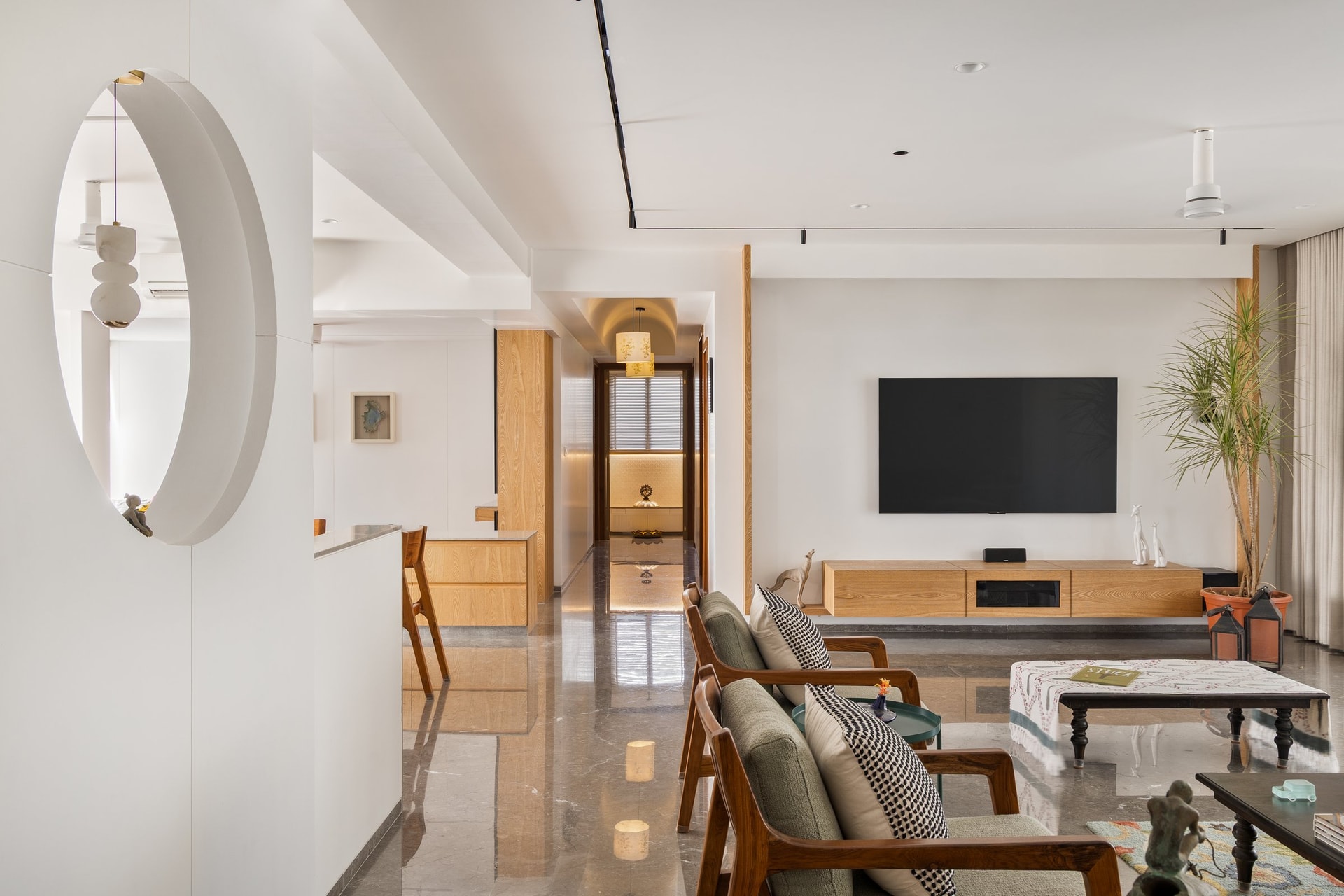
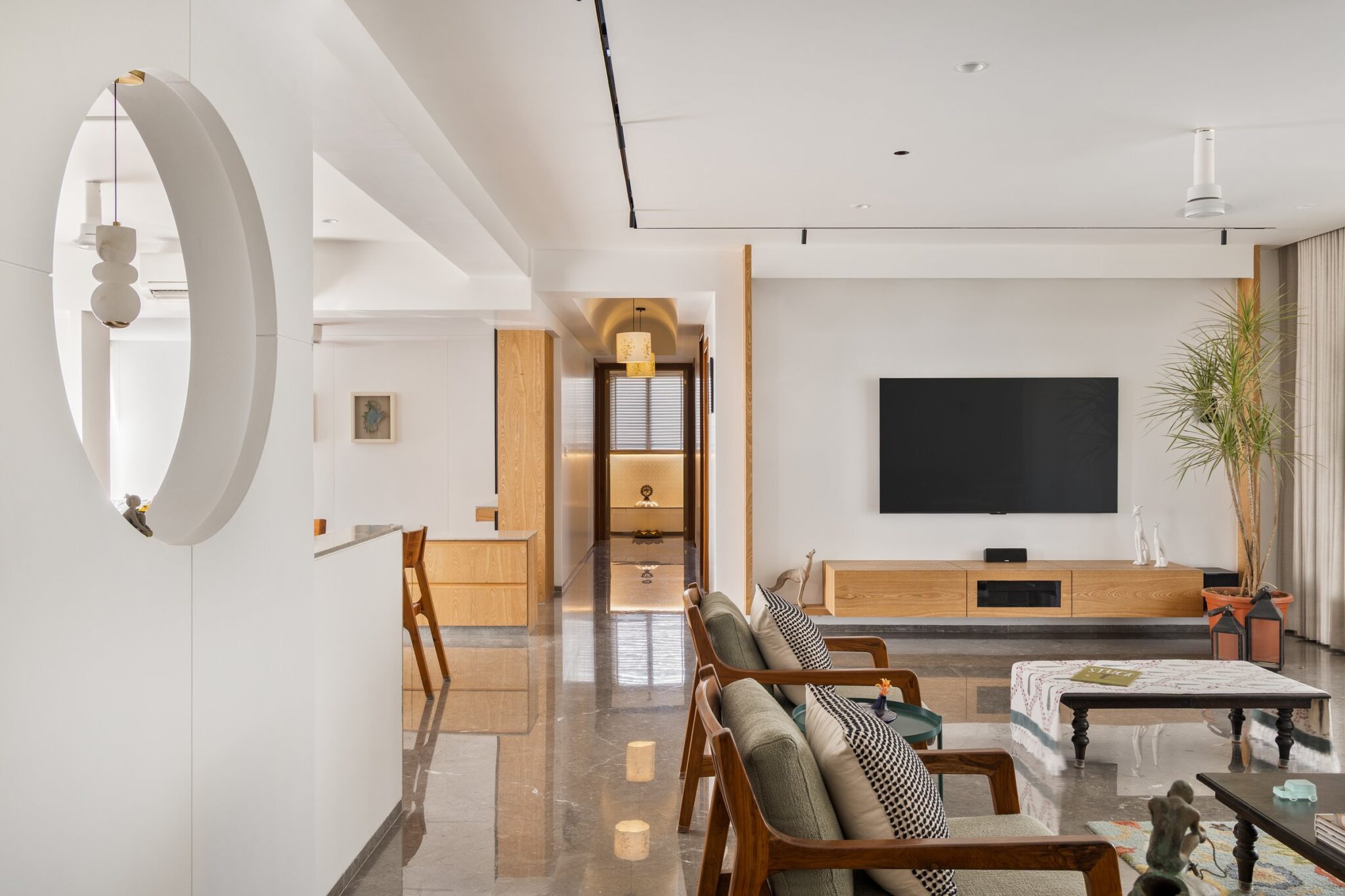
Looking back across the same volume, the home reveals its plan as a single, generous social spine. A circular cut-out in the partition wall frames a sculptural pendant beyond, introducing a softer geometric note into the otherwise rectilinear architecture and drawing the eye towards the puja room at the corridor’s end.
Below the wall-mounted television, a long wood-grain console runs the length of the room, its horizontal line lending the composition a sense of steadiness and visual continuity. Together, these gestures privilege sightline over compartmentalisation, allowing the apartment to read less as a series of enclosed rooms and more as one continuous, carefully held interior.
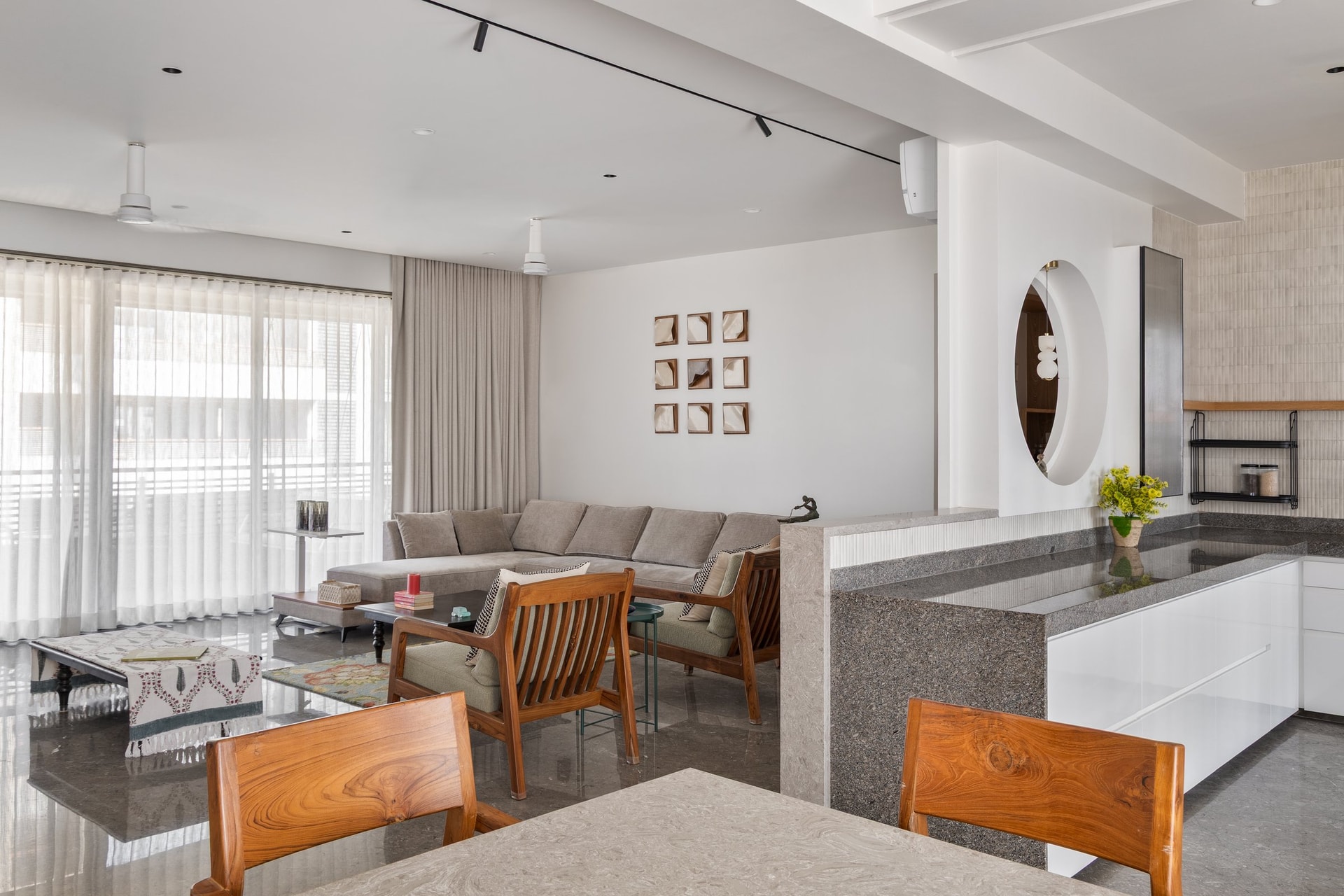
From the dining side, the relationship between zones becomes clearer: the living room, kitchen counter, and dining table occupy a single luminous volume, separated only by a stone-clad half wall. The circular cut-out reappears here as a framed aperture between kitchen and living, a small but effective architectural gesture that introduces porosity without compromising function.
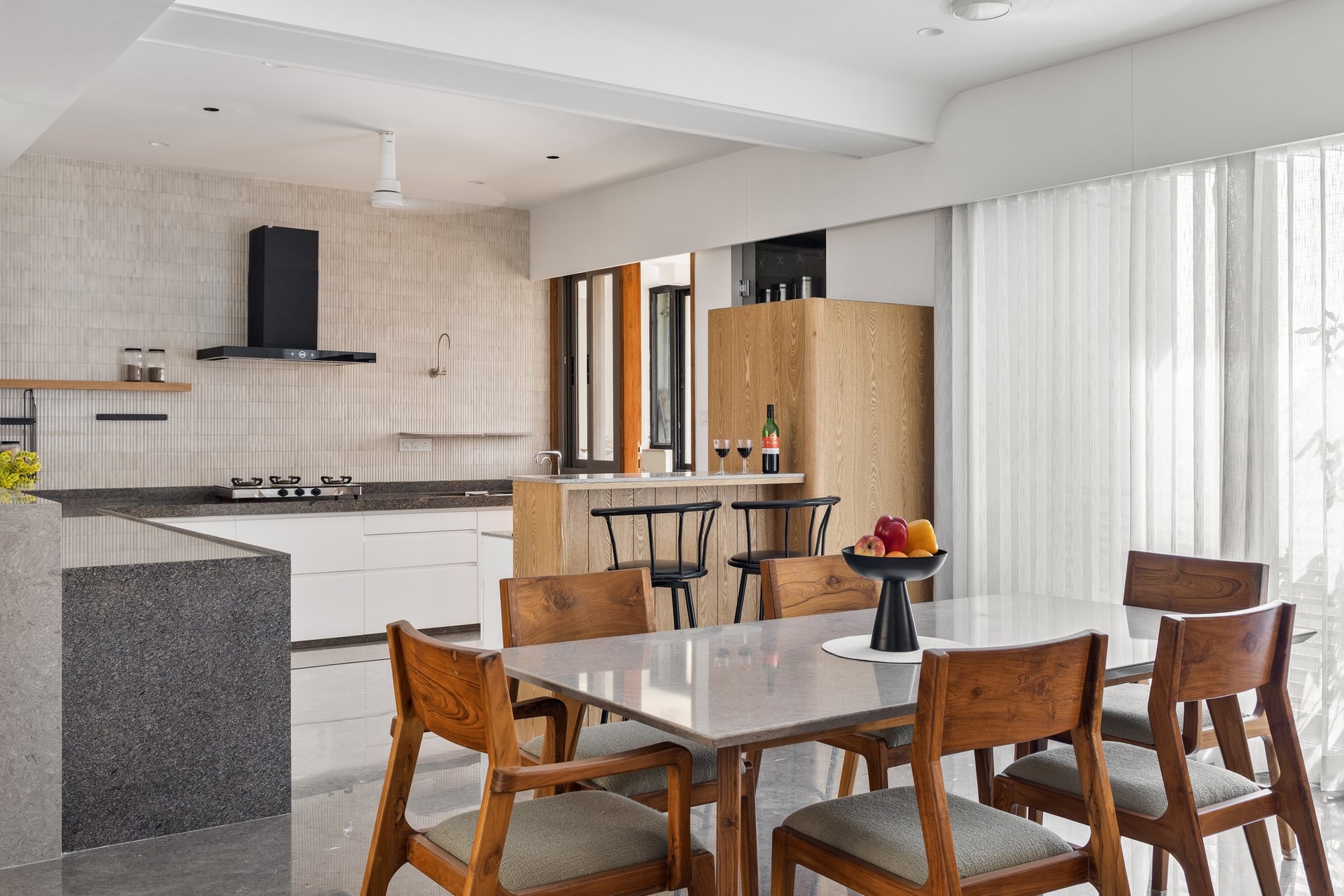
The kitchen exemplifies the home’s disciplined minimalism. Handle-less white cabinetry runs beneath a dark stone counter, while a finely ridged pale tile backsplash introduces quiet texture against otherwise pared-back surfaces. At the threshold between kitchen and dining, a wood-clad breakfast counter paired with bentwood-style bar stools in black metal brings a welcome note of warmth.
The dining table, finished in pale stone and surrounded by solid wood chairs, sits at the centre of this open arrangement, reinforcing the continuity between preparation, dining, and conversation. The result is a kitchen that feels composed, practical, and enduring, with every material and surface carefully calibrated to earn its place.
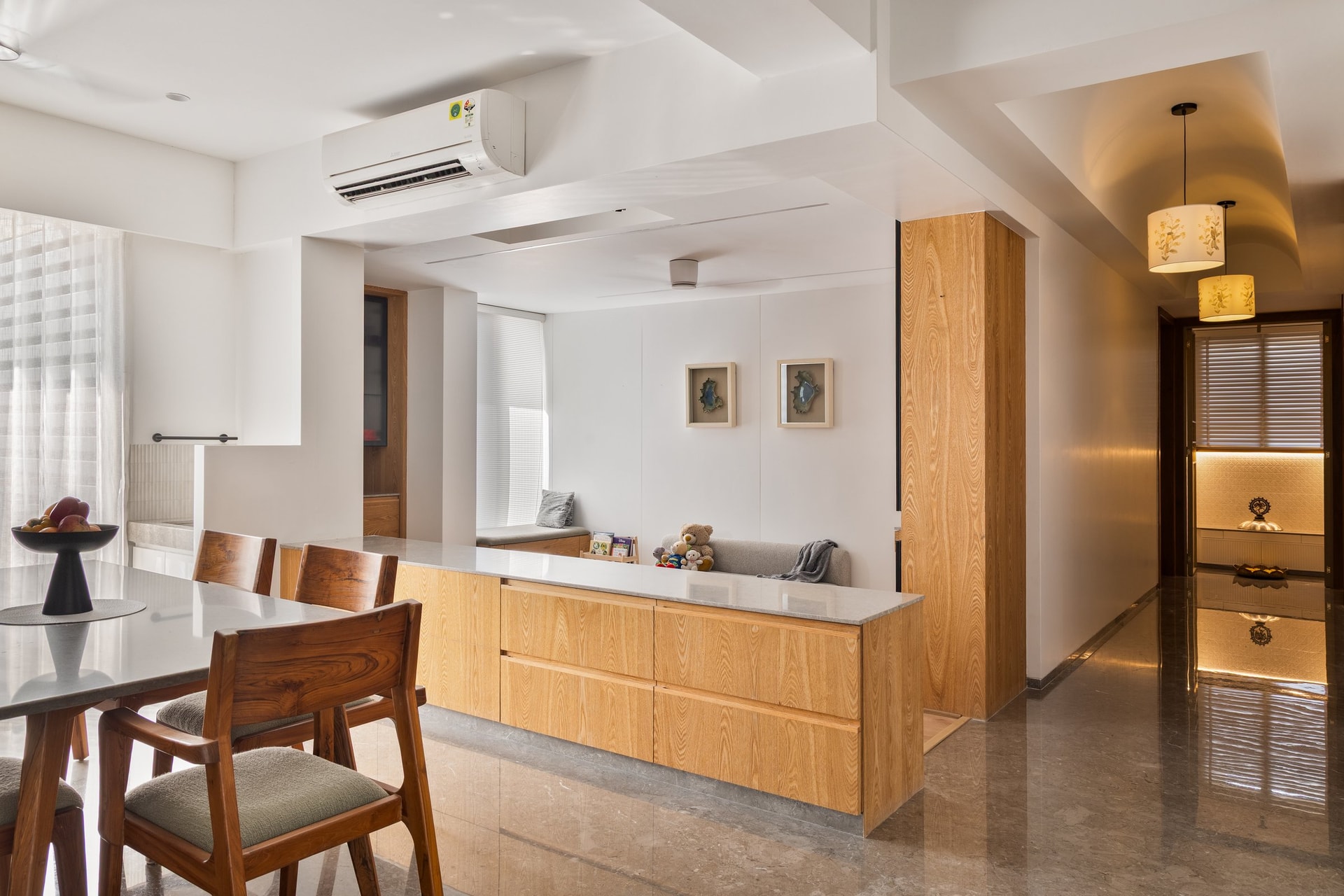
Beyond the dining area, a long wood-fronted sideboard with a stone top works both as storage and as a gentle divider for a small reading and play nook set into the window. To one side, a corridor leads towards the puja room, its warm glow visible through a fluted partition.
Here, minimalism is less about austerity than adaptability, with the same restrained palette quietly accommodating the everyday rhythms of family life.
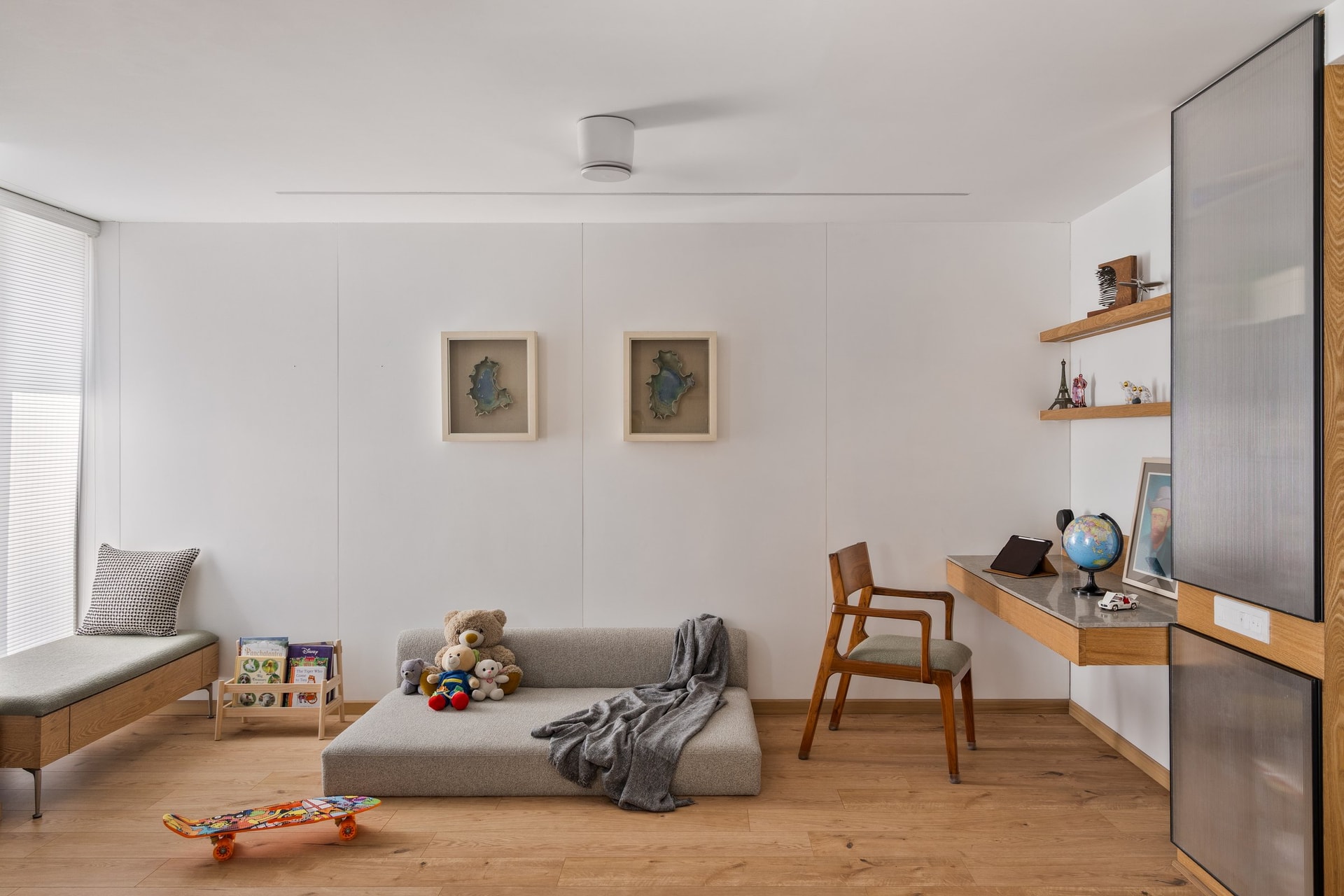
The adjoining multi-use room extends that idea of adaptability. A built-in window-side bench in pale oak, a low bouclé daybed, and a wall-mounted writing desk with floating shelves allow the space to shift between reading, study, and play without the need for rearrangement. Two small framed works punctuate the broad white wall, while the rest of the room is left deliberately open, reinforcing the home’s quiet confidence in restraint.
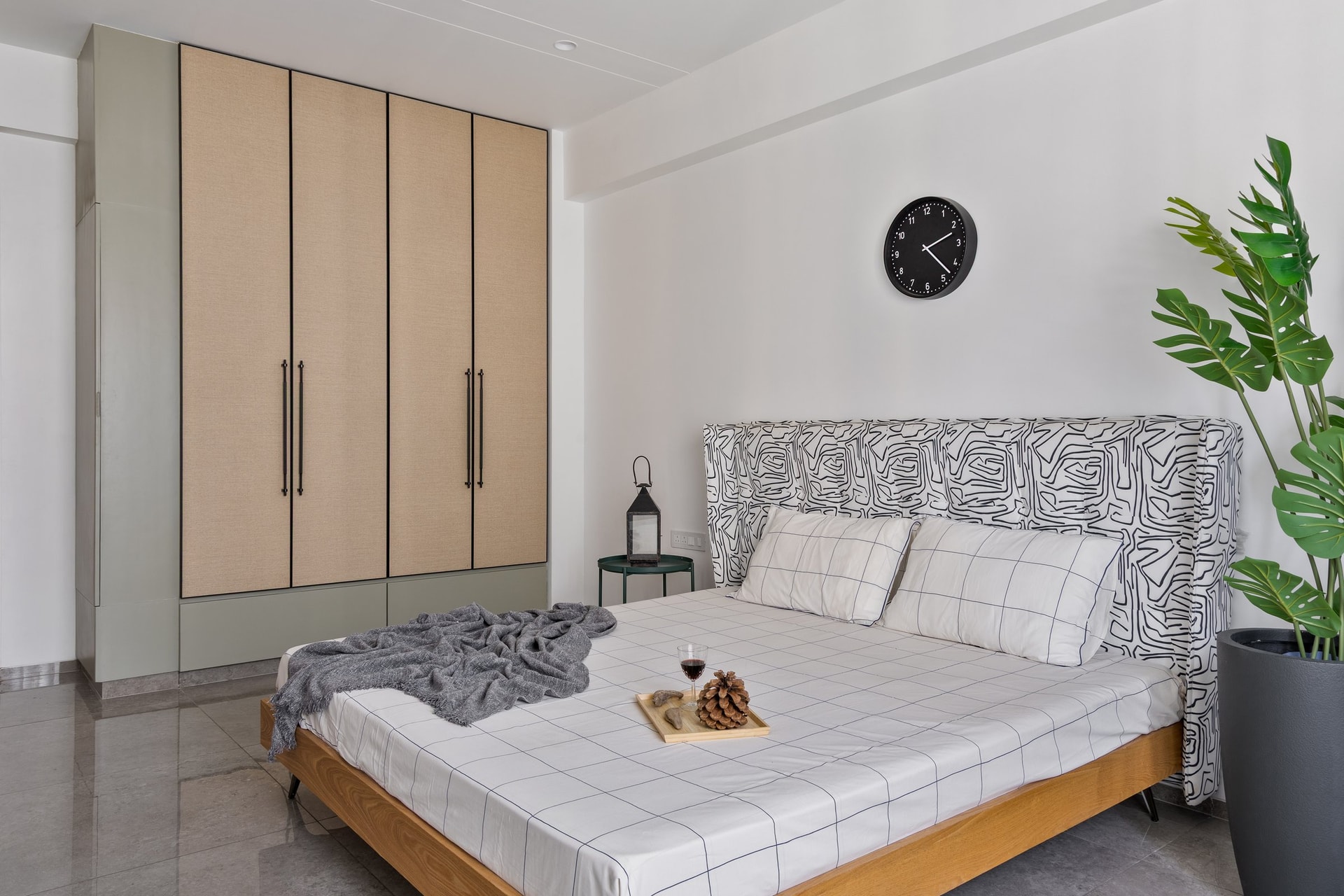
The bedroom holds the home’s most disciplined palette. A patterned upholstered headboard in black-and-white organic line work introduces a note of graphic energy into an otherwise restrained composition of soft sage and beige cabinetry, white walls, and a low timber bed frame.
The wardrobe, with its fabric-textured fronts and slim metal pulls, recedes quietly into the wall rather than asserting itself. The room reads as calm and ordered, a space shaped for genuine rest, where texture and tone do the work of ornament.
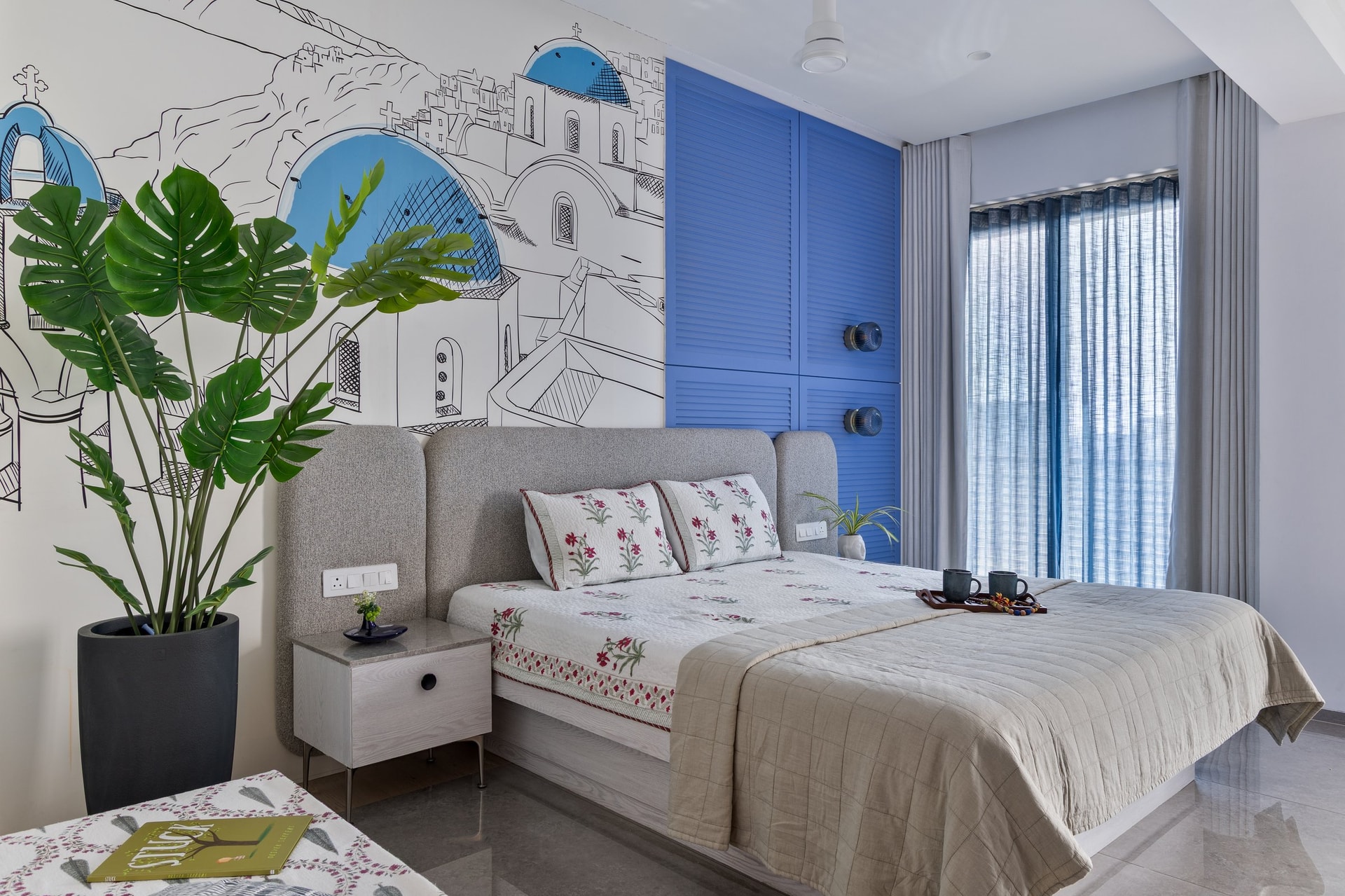
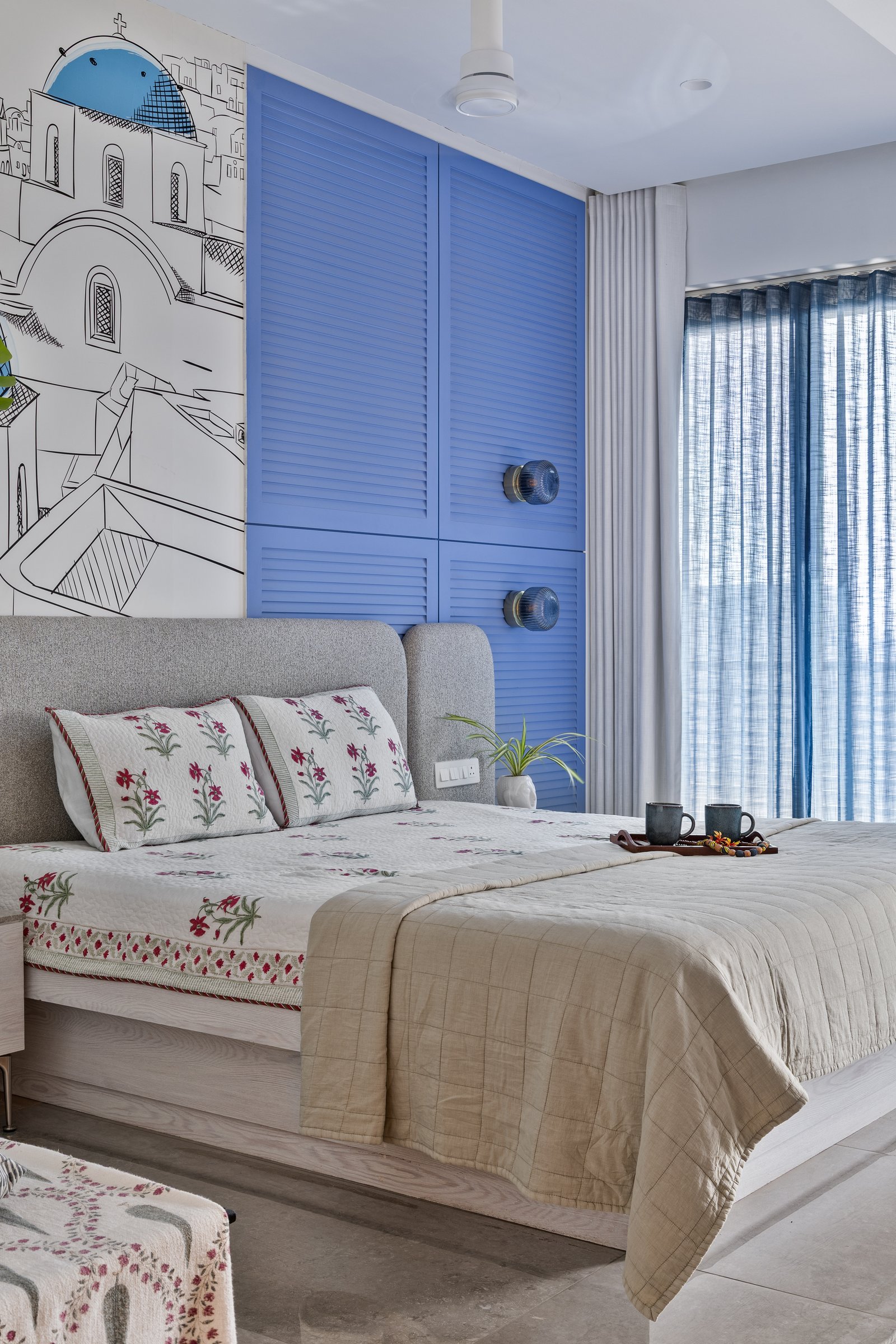
The second bedroom takes a lighter, more expressive turn without departing from the home’s overall compositional discipline. A hand-drawn mural of a coastal Mediterranean town wraps the headboard wall, its blue domes subtly echoed in the louvred cabinetry alongside.
Accent colour is introduced with care rather than emphasis, never overpowering the room’s underlying calm. The effect is playful yet measured, allowing personality to surface without disrupting the apartment’s broader language of restraint.
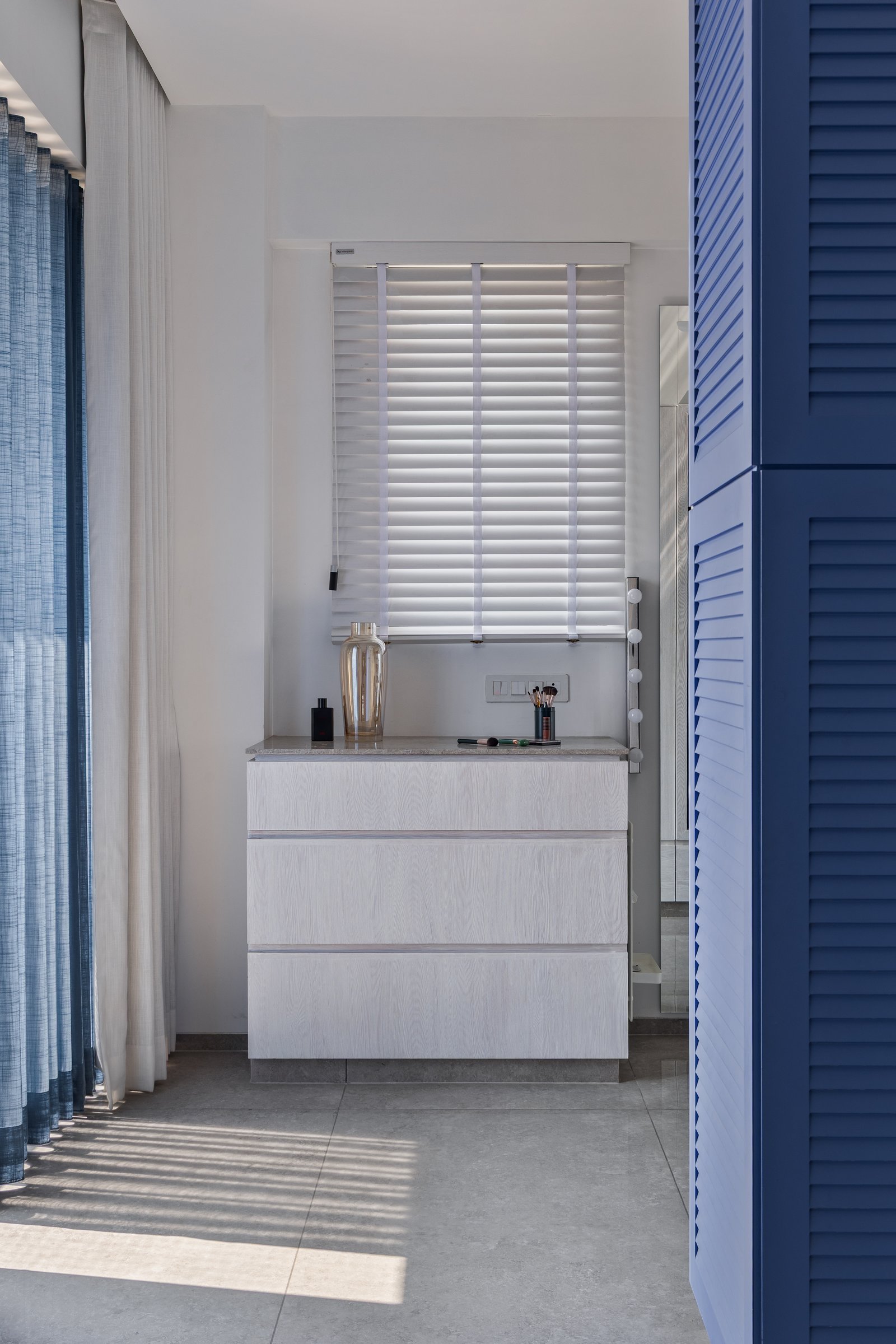
The adjoining dressing area carries the same blue louvred detail forward as a connective thread, paired with a pale timber vanity drawer and a slim mirror flanked by globe lights. Natural light filters softly through the blind and across the stone floor, turning this compact corner into a quietly composed extension of the room. It is a small but telling moment, one that demonstrates how the home’s design discipline extends even into its most utilitarian spaces.
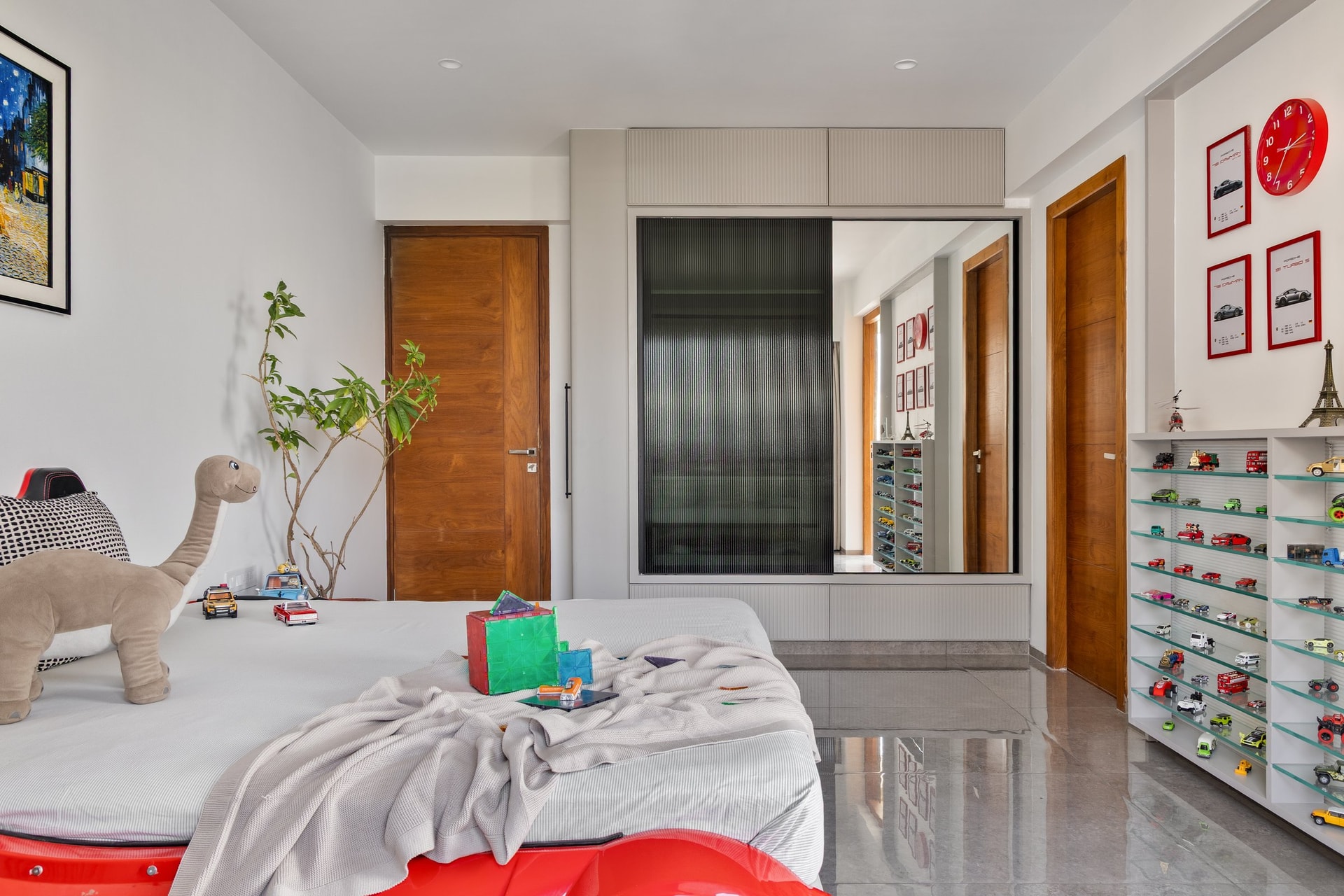
The children’s room turns the home’s restraint into a backdrop for collection and play. A glass-shelved display wall houses an extensive line-up of model cars, while a framed gallery of automotive prints anchors one corner. Nearby, a fluted-and-mirrored wardrobe panel reflects the room back into itself, adding depth without visual excess.
The architectural shell remains deliberately neutral, allowing the child’s interests to take centre stage without tipping the room into clutter. What emerges is a calibrated balance between discipline and delight, where personality is given room to surface within the home’s larger language of restraint.
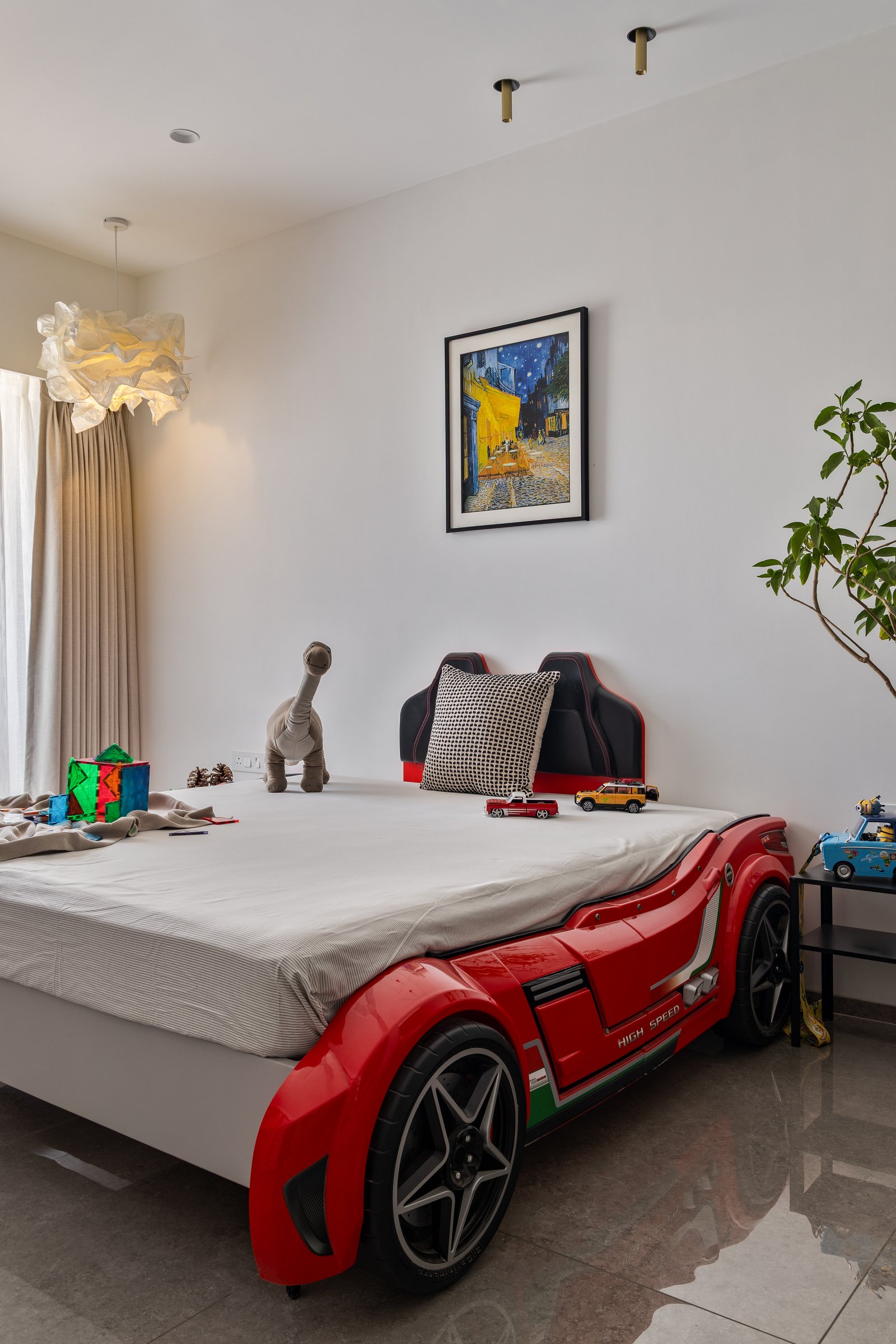
The bed itself, shaped as a red sports car with sculpted wheels, is the room’s single extravagant gesture. Overhead, a sculptural paper-form pendant introduces a softer note of volume and lightness. Together, these elements suggest that a child’s room can accommodate fantasy without surrendering compositional discipline.
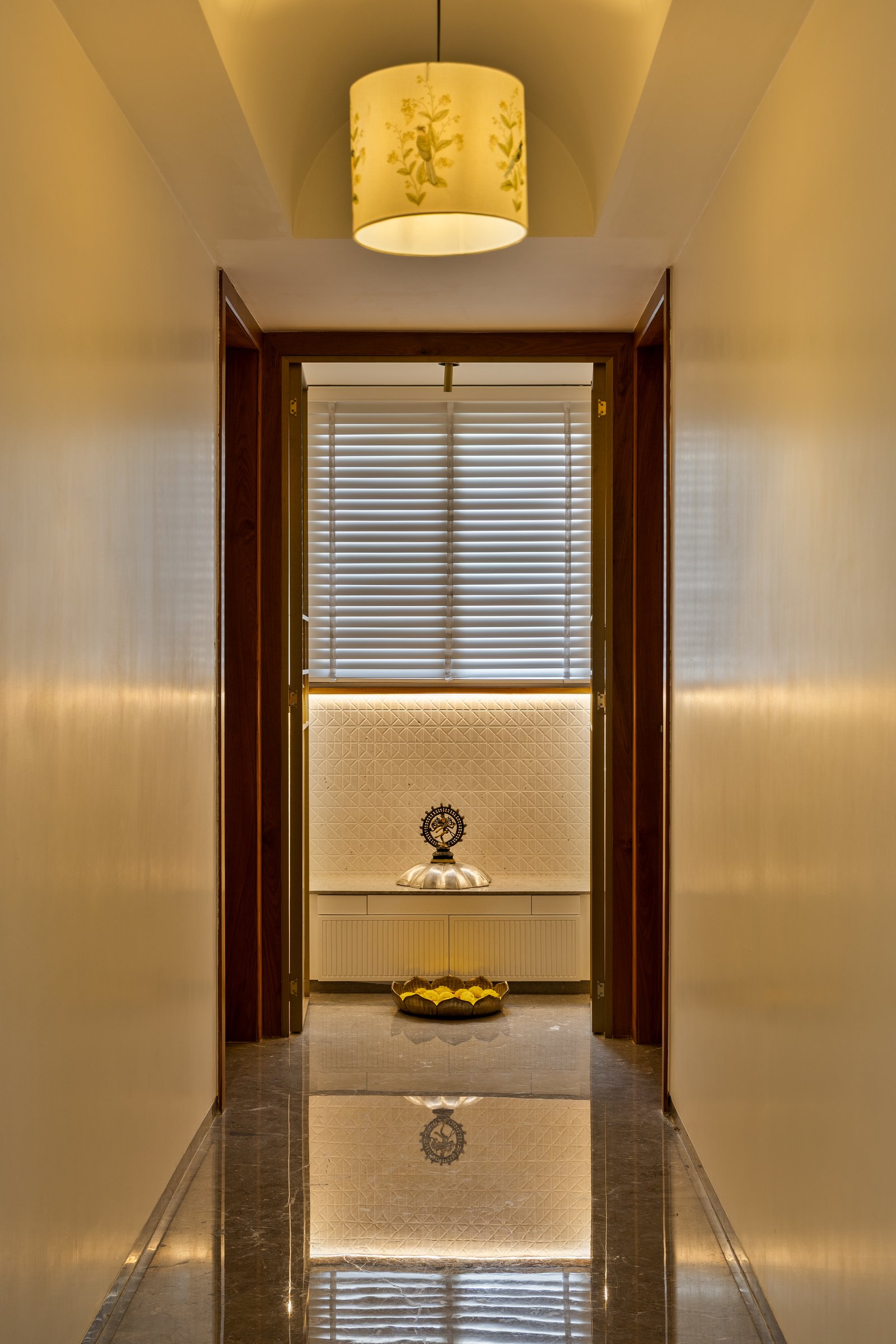
The puja room, framed at the end of a softly lit passage, offers the home its quietest moment. A patterned cream backdrop, a single bronze Nataraja figure, and a brass lotus plate set on polished stone create a compact space of pause and reflection, where ritual is folded gently into the everyday rhythm of the home.
Vadodara has long sustained a measured architectural sensibility, shaped by its institutional legacy and traditions of craft, and this apartment reads as a contemporary continuation of that lineage. The home leans on proportion, material restraint, and considered detailing rather than stylistic display, offering an interpretation of domestic minimalism that feels both current and rooted in place.
What the residence demonstrates, finally, is that minimalism need not be an act of withholding. Held with care, it becomes a frame within which warmth, family life, and personal expression can register more clearly, allowing the architecture to recede just enough for the life within it to come forward.