Renovation is rarely an act of replacement. The most considered restorations work in the opposite direction, peeling back the years to find what is worth carrying forward, then setting that inheritance against a contemporary frame so the two can speak to one another. This is the approach that defines Project Saundh, a fifty-year-old apartment in Bangalore reworked into what its designers describe as a Modern Indian home, where memory is the structural premise rather than an applied finish.
The project is the work of Nebulous Design Workshop, led by Kiran Sabnani and Prerna Sarda, for a family whose ties to classical Indian music and ancestral craft run across generations. The 2,400 square foot residence sits on the bones of an older home, and the brief was less a list of rooms than an emotional inheritance: a seventy-year-old brass collection, a heritage temple door, a veena and a mridangam, all needing a contemporary architecture that would hold them without flattening their meaning. The design responds with a measured dialogue between past and present, replacing nostalgia with continuity and ornament with intent.
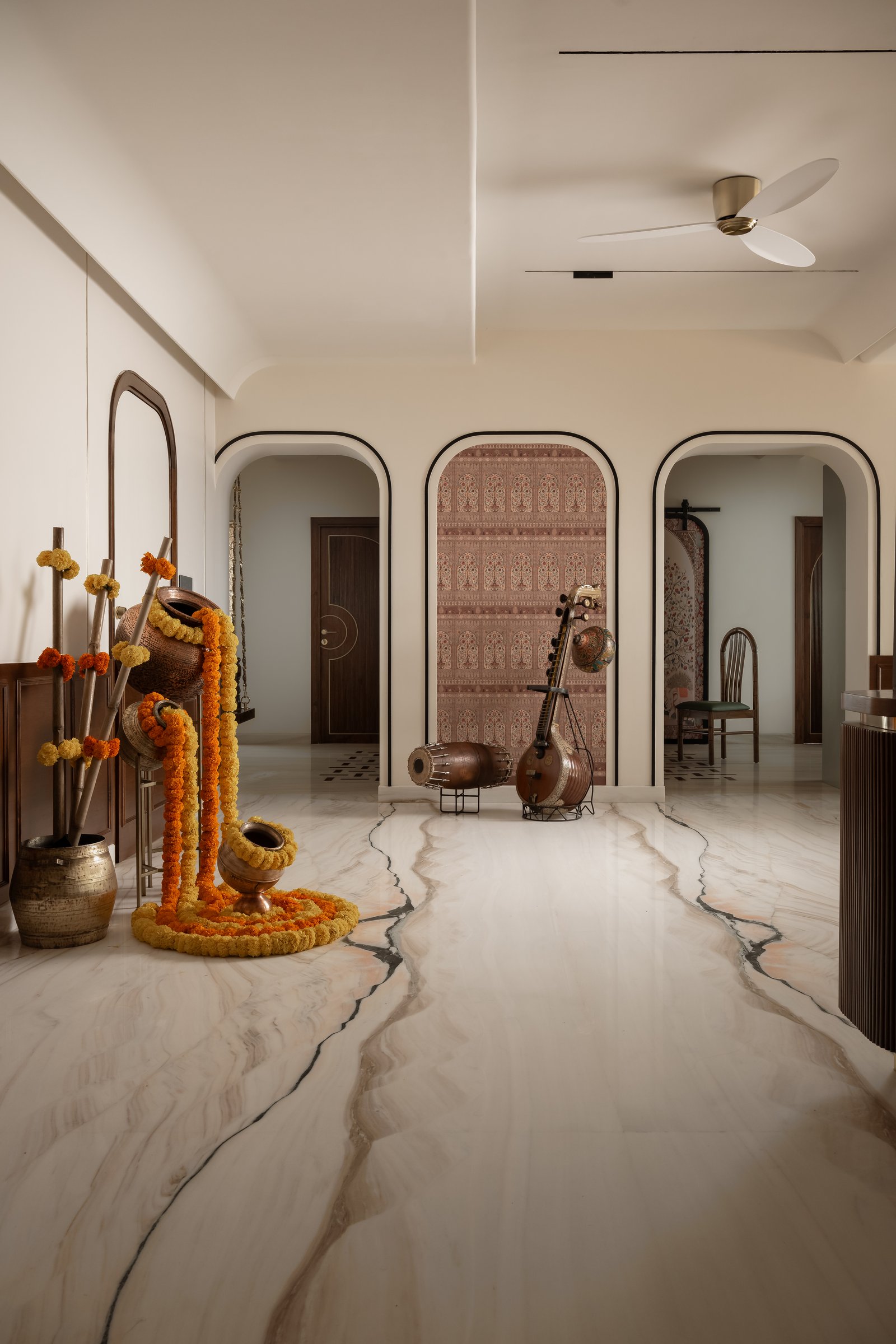
The foyer establishes the home’s design language in a single composed frame. A river of veined marble runs the length of the floor, its dark seams tracing organic lines across pale stone, while three arched openings outlined in slim black profiles frame views into the rest of the apartment.
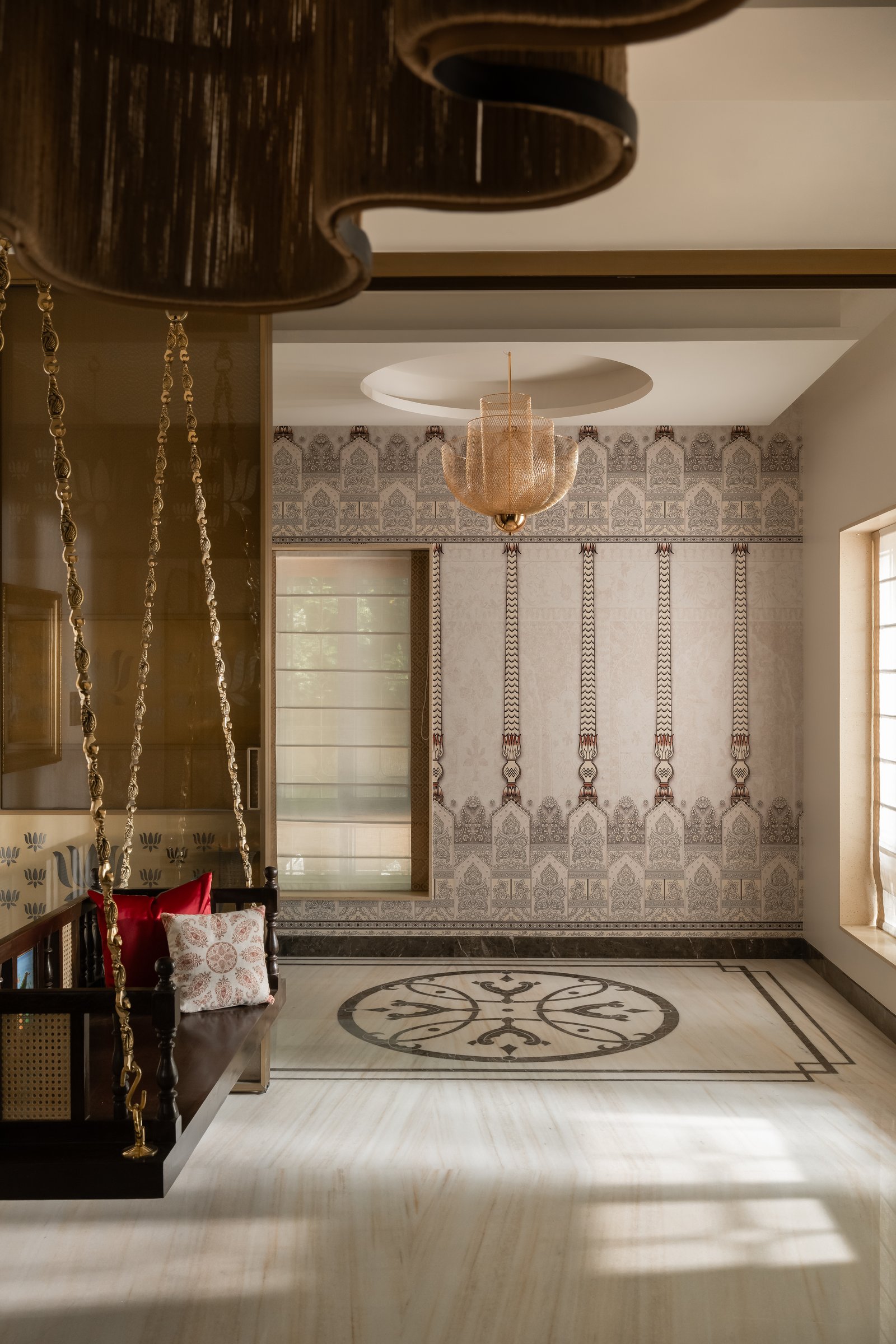
An adjacent volume houses a traditional jhoola suspended on ornate brass chains, set against a wallpapered wall whose Indian motifs reach floor to ceiling. The drop ceiling above the swing is layered with a textured ring and a sculptural pendant in woven metal mesh, while a circular inlay set into the pale stone floor anchors the seat below it. Together these elements frame the swing as a place of pause and reflection within the everyday rhythm of the home.
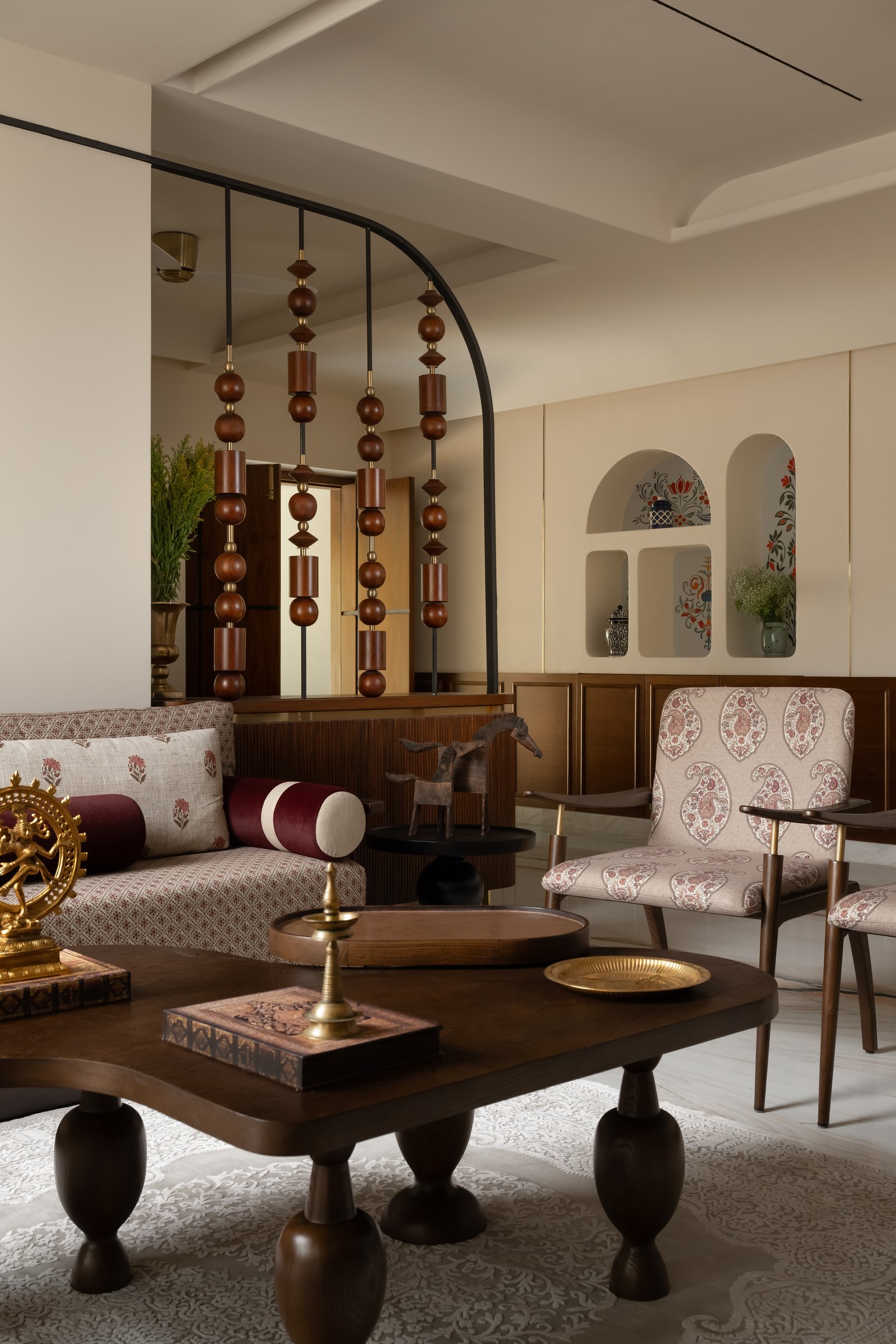
The principal living room establishes the home’s defining material language through a layered composition of craft and contemporary restraint. A block-printed sofa in muted ivory and rust is paired with paisley-upholstered armchairs around a low table with bulbous turned legs, its sculptural profile recalling the vocabulary of traditional Indian furniture. Rather than relying on decorative excess, the room allows pattern, timber, and texture to shape a quiet sense of richness.
Behind the seating, an arched metal framework supports a curtain of turned wooden beads, offering a contemporary reinterpretation of the traditional toran. The installation gently filters views between adjoining spaces, preserving openness while introducing rhythm, depth, and a subtle sense of ceremony to the transition between rooms.
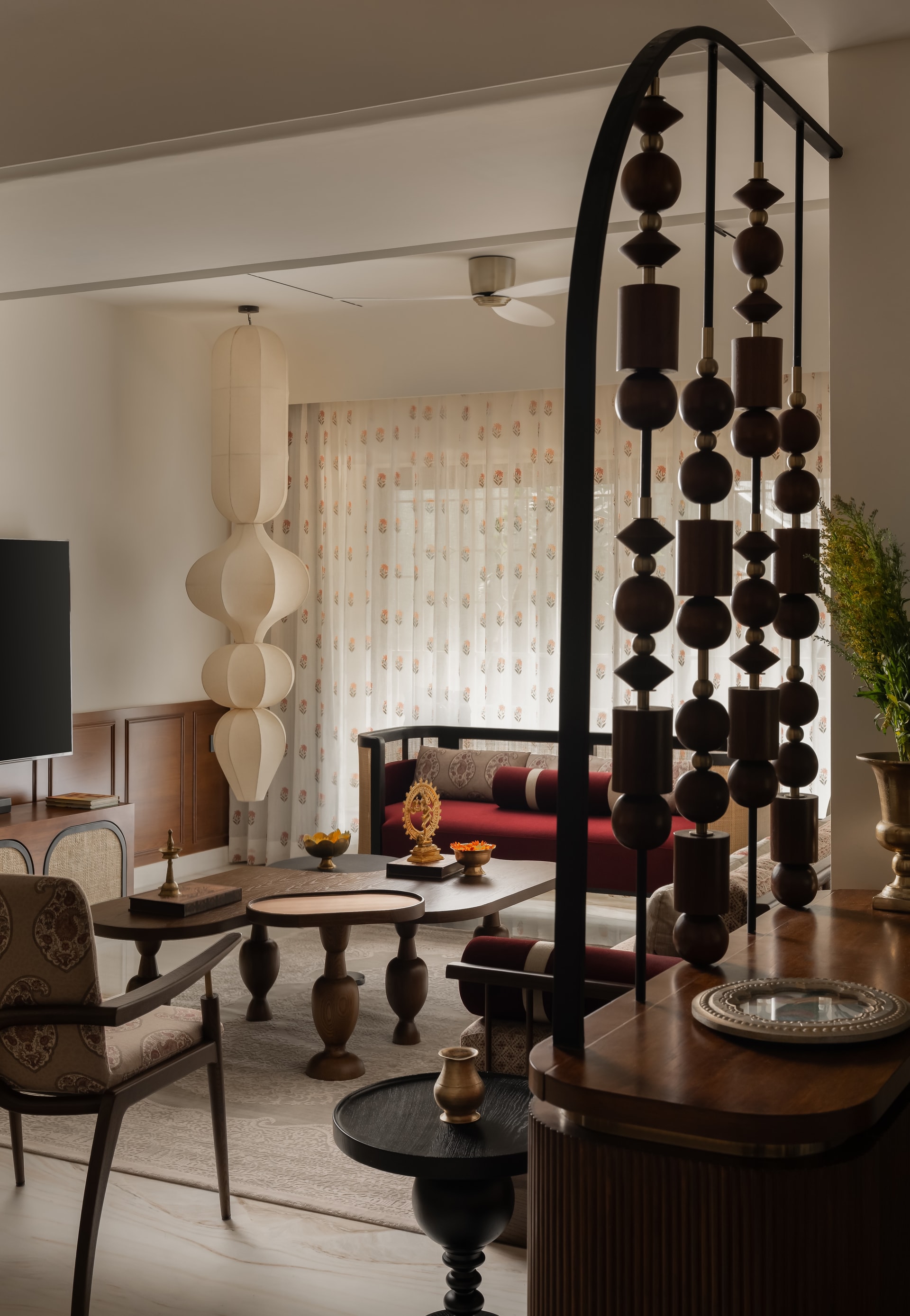
““The entire home is built around one core emotion: revival with respect.””
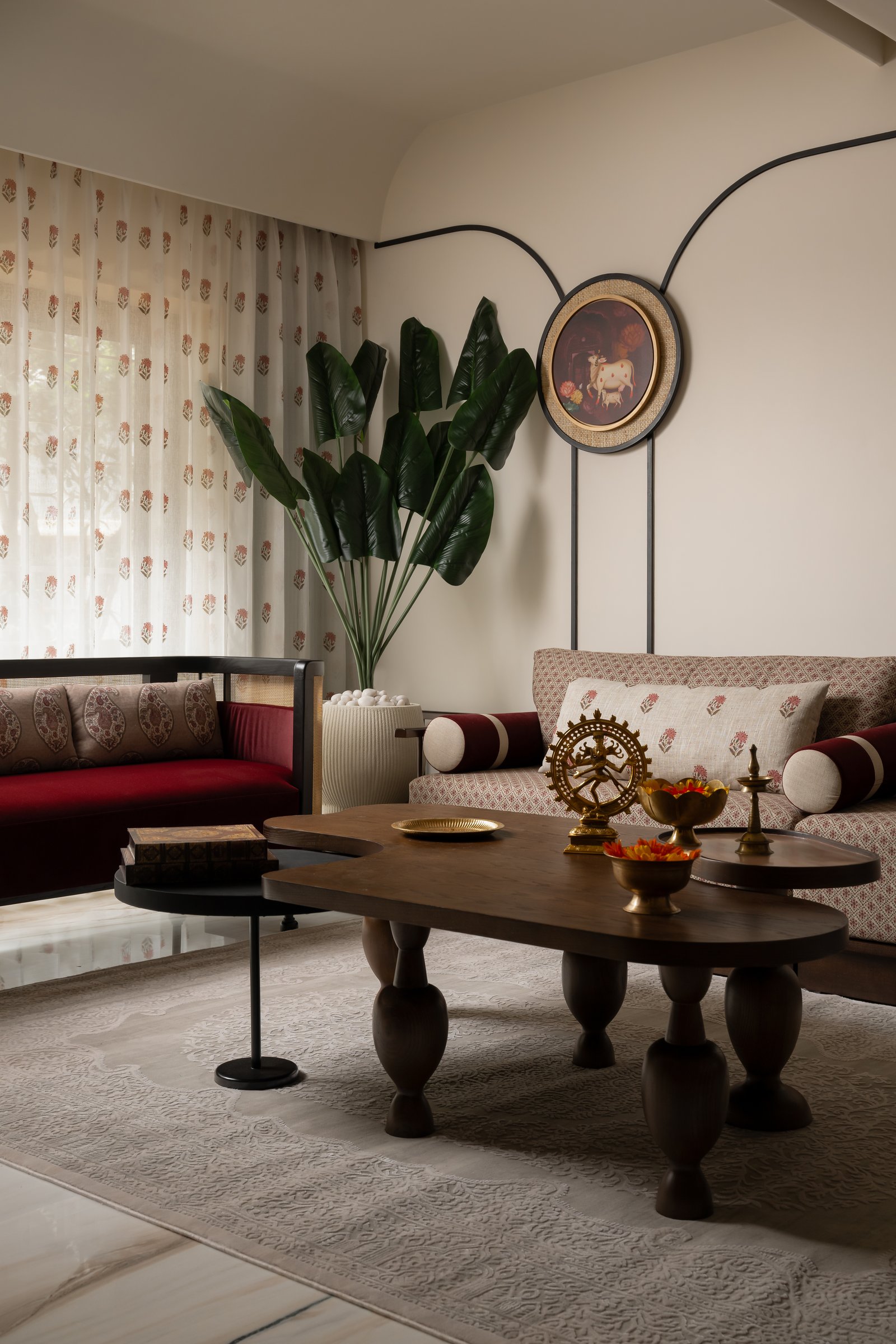
A second view of the living room reveals the studio’s careful orchestration of furniture, art, and wall. A deep oxblood settee with a woven cane back sits beneath a slender black linework installation that loops across the wall to frame a circular Pichwai-inspired artwork, transforming an otherwise plain surface into a graphic focal point. The rich upholstery, floral-patterned sheer curtains, and sculptural wooden coffee table together create an interior that feels layered without becoming ornate, warm without relying on excess.
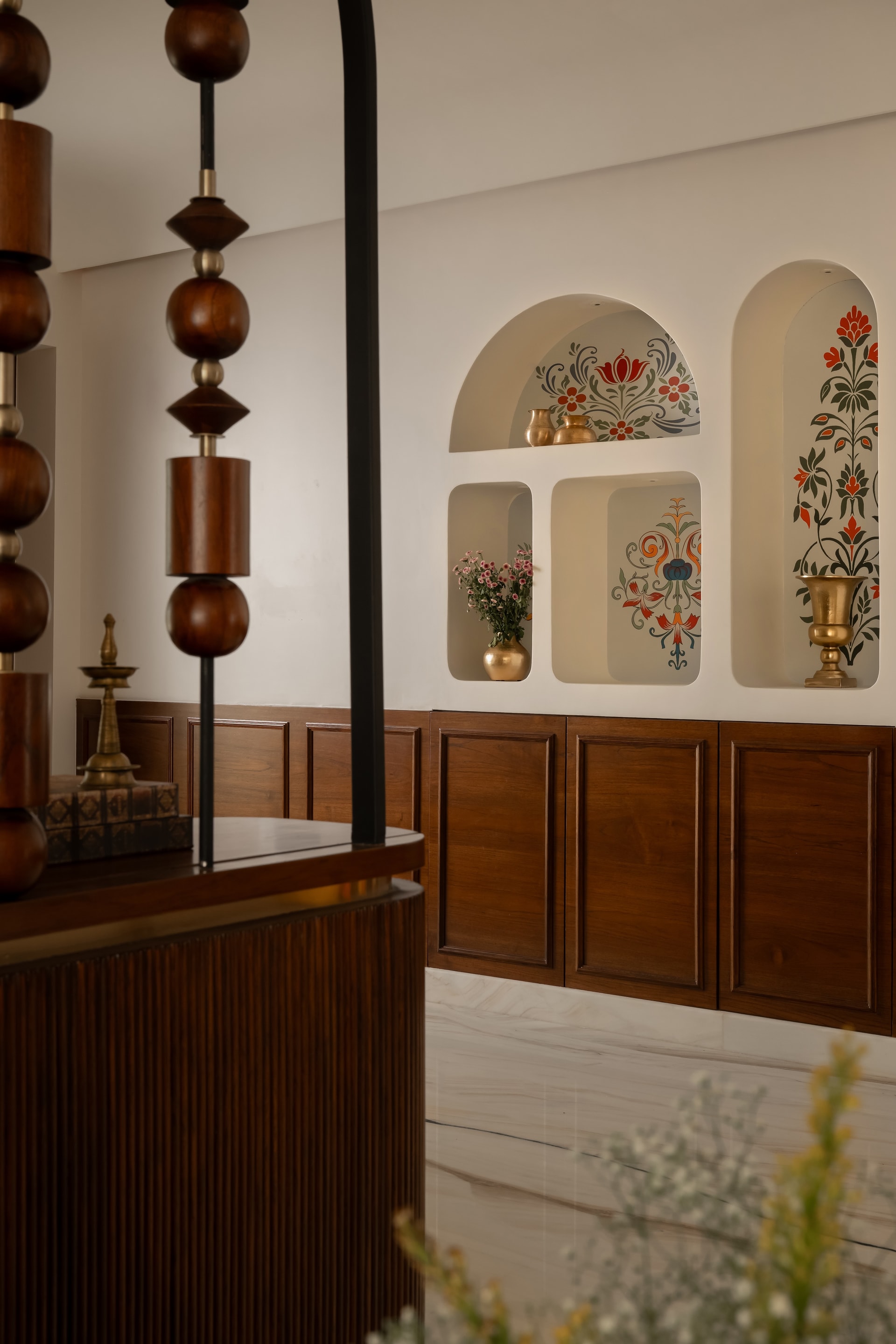
Beyond, the living room unfolds seamlessly into the dining area, where the beaded screen functions as a permeable threshold rather than a partition. A sculptural floor lamp, with its stacked ivory forms, provides a quiet counterpoint to the surrounding dark timber elements, while a wood-fronted console anchors the transition between the two spaces. The composition reflects the studio’s nuanced approach to planning, using material shifts and carefully placed objects to define spaces while preserving visual continuity and a sense of openness.
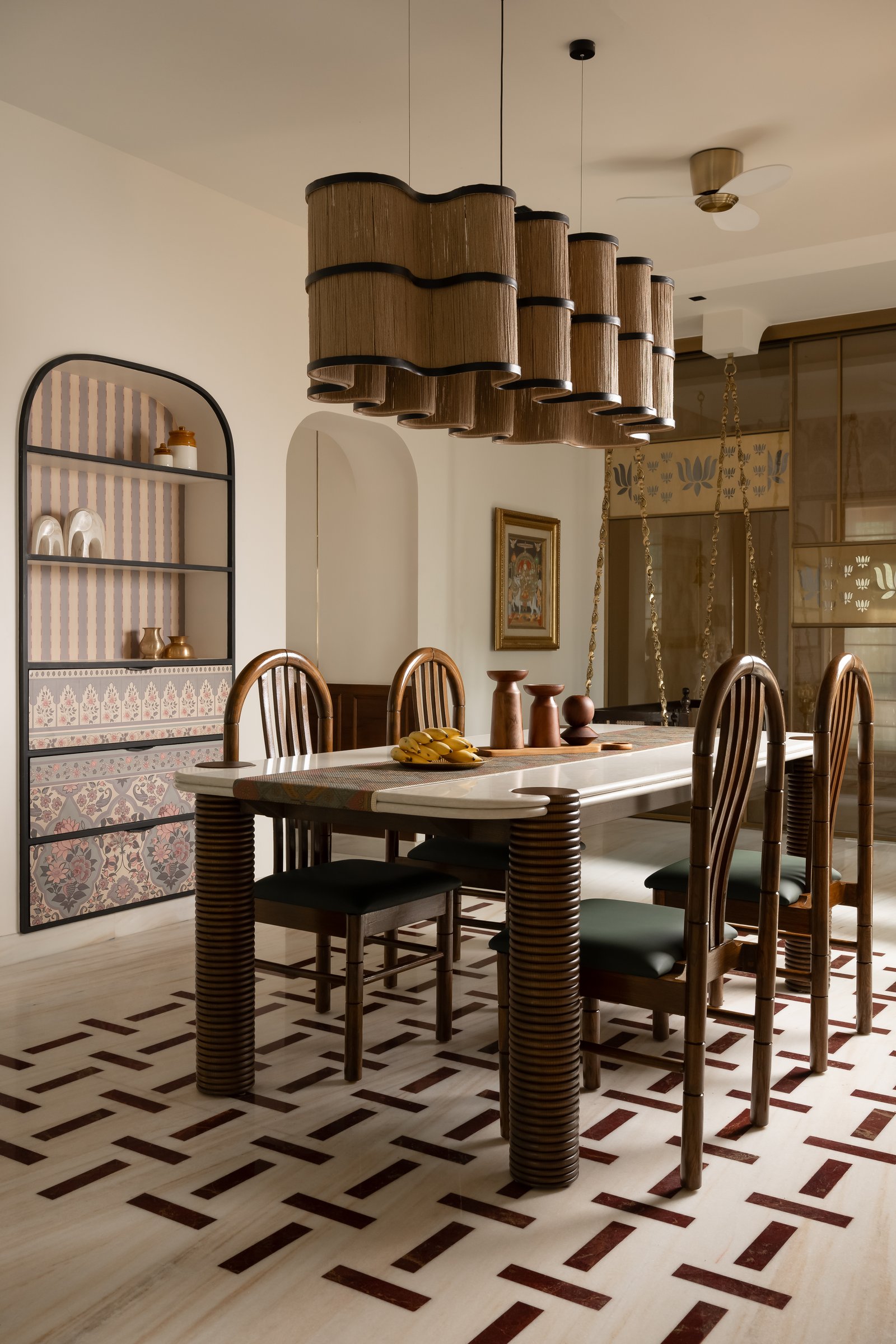
The dining area brings the home’s material vocabulary into its clearest focus. A long stone-topped dining table rests on four lathe-turned timber columns, their ribbed profiles recalling the proportions of traditional temple architecture. Dark wood spindle-back chairs with upholstered seats complete the composition, balancing craftsmanship with understated elegance. Above, a cluster of fringed pendant lights introduces a softer, tactile layer, their undulating silhouette tempering the geometry of the furniture below.
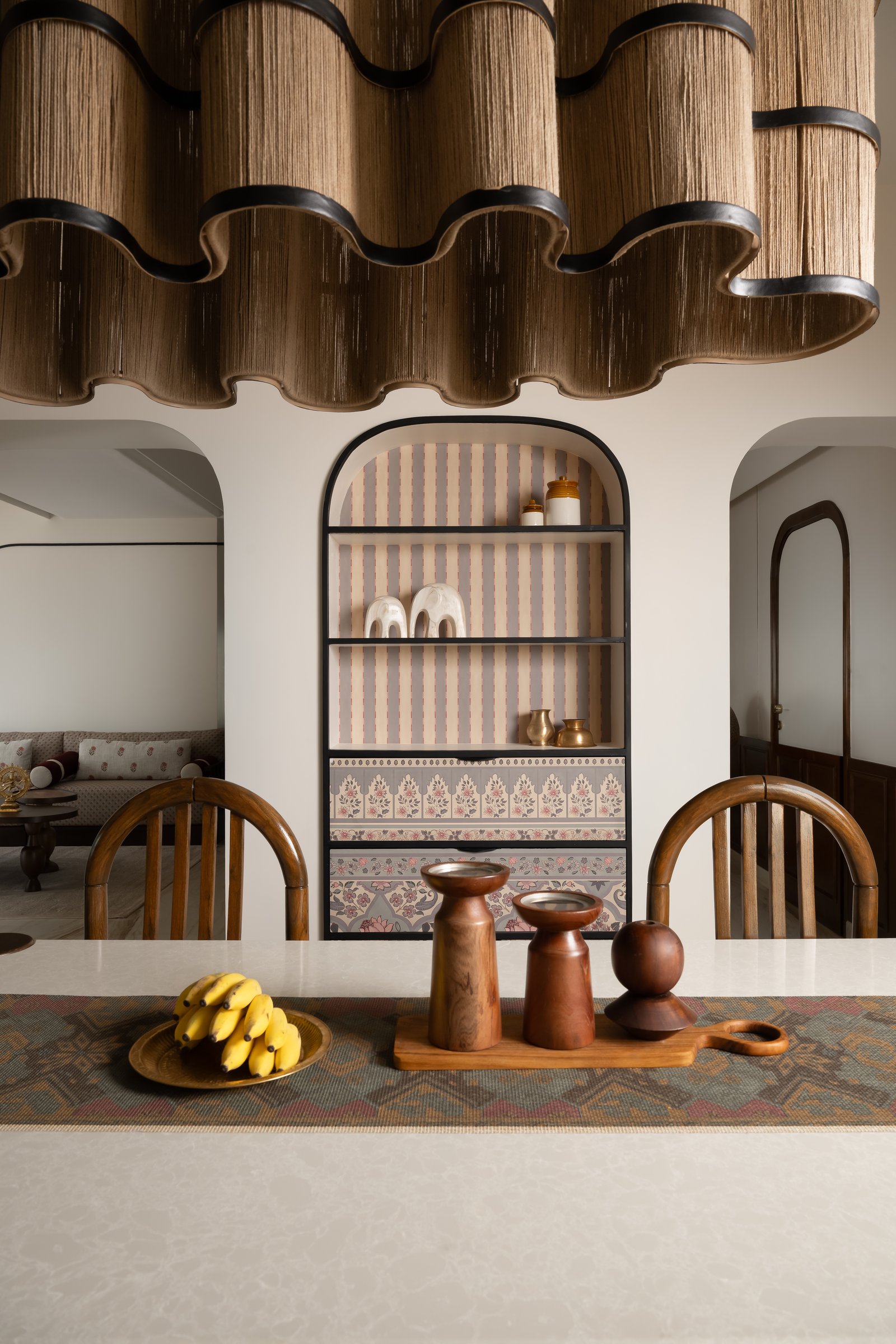
To one side, a tall arched display niche becomes both architectural feature and curated backdrop. Lined with layered striped and patterned wallpaper, it houses an arrangement of brass and ceramic vessels that reinforces the home’s dialogue between heritage and contemporary living. Rather than treating decoration as an afterthought, the studio integrates it into the architecture itself, allowing material, craft, and object to work as a single composition.
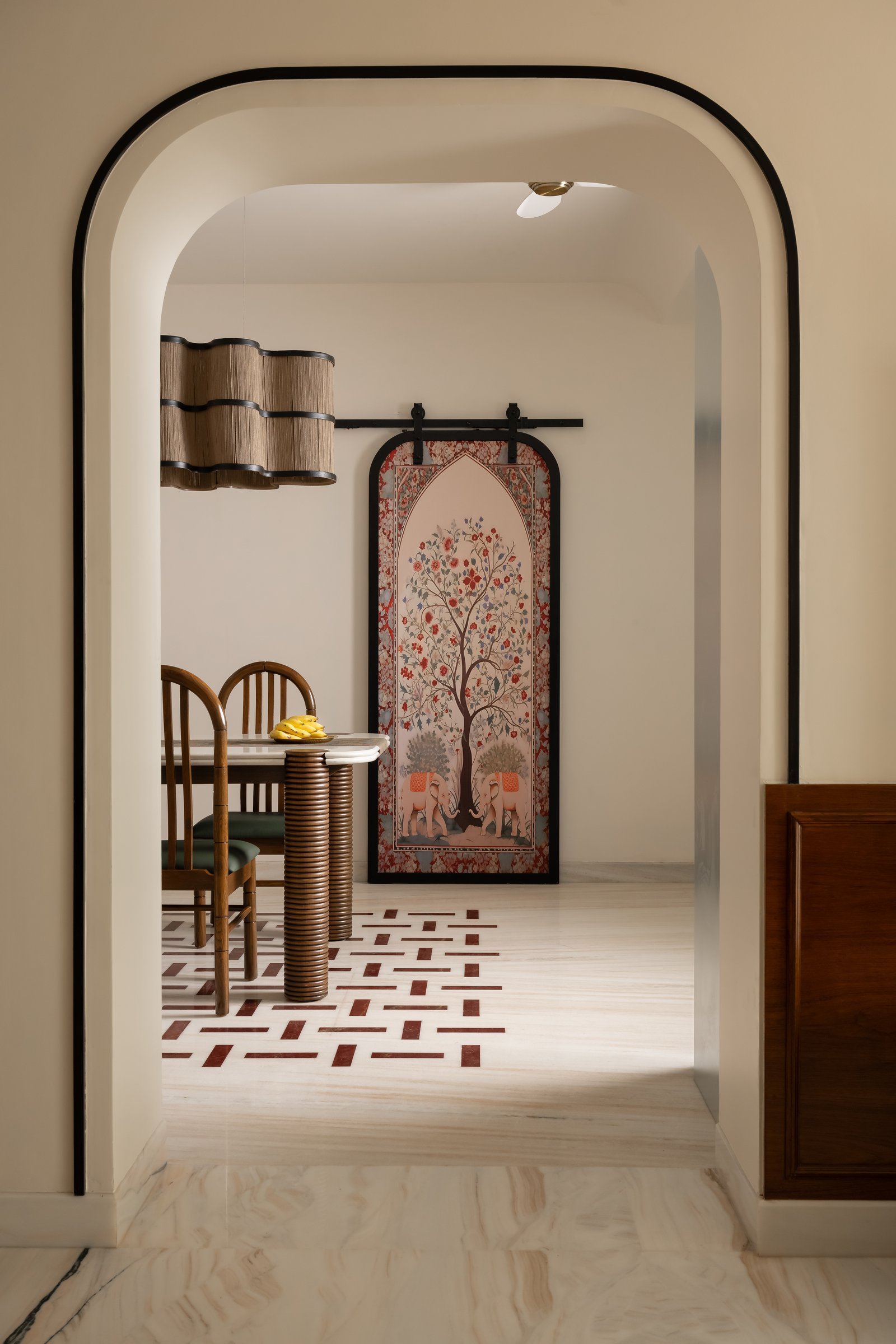
An arched threshold framed in slim black profile lines connects the dining area to a wider corridor, where a large vertical artwork depicting a tree of life with elephants at its base reads as a contemporary pichwai. The wood-and-iron mounting bracket above the painting borrows the language of barn-door hardware, a small detail that captures the studio’s broader move: traditional motifs are reframed by contemporary detailing without losing their cultural register.
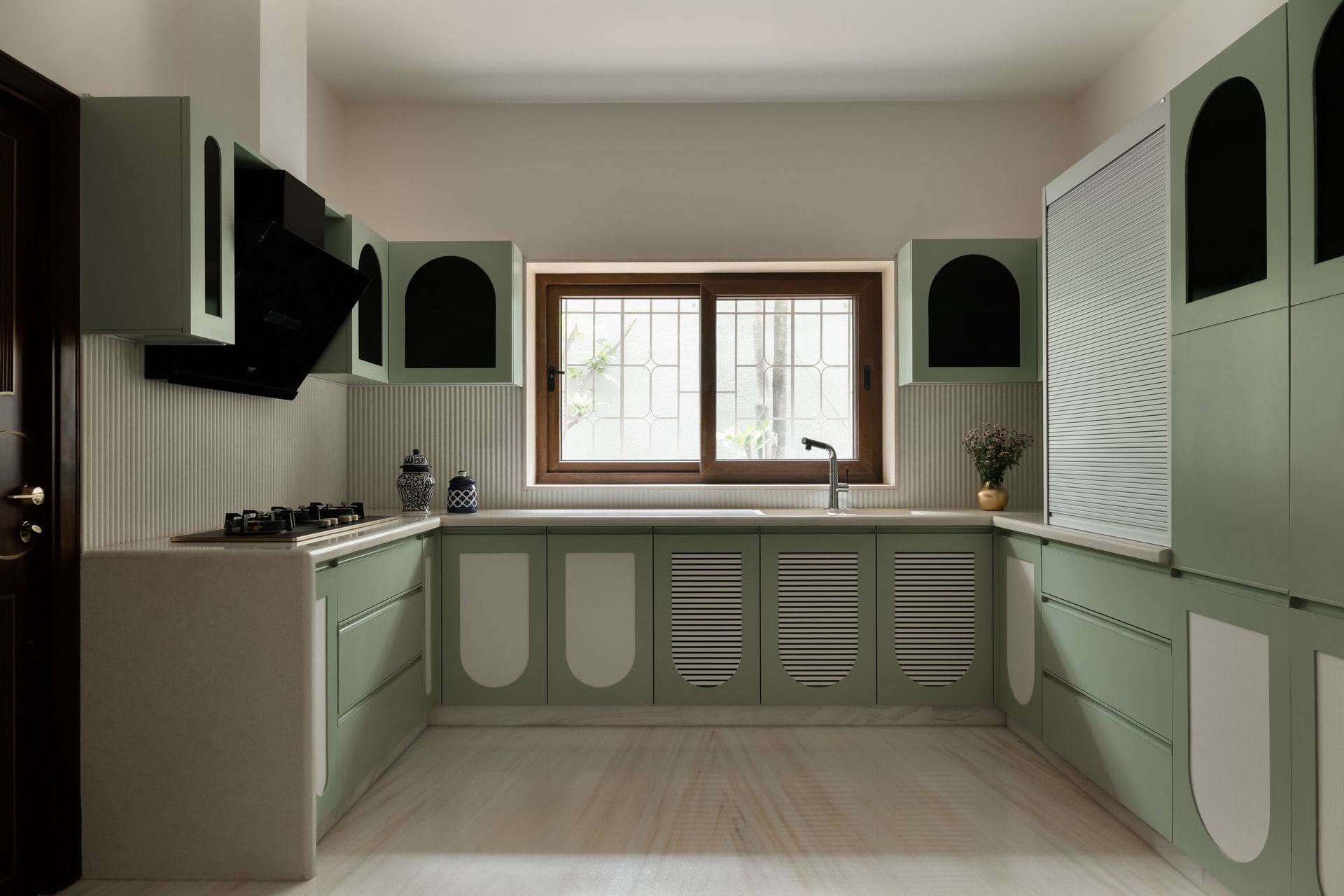
The kitchen adopts a quieter, more graphic expression while remaining firmly rooted in the home’s overarching design language. Soft sage-green cabinetry is detailed with arched insets and subtle oval inlays on the lower doors, distilling the recurring arch motif into a more abstract and refined form. The composition balances ornament with restraint, allowing the detailing to enrich rather than dominate the space.
A reeded stone backsplash introduces texture behind the worktop, while a wood-framed window with leaded glazing brings warmth and filtered light into the room. The black extractor hood provides a crisp visual counterpoint, completing a palette that is deliberately restrained and allowing the muted green cabinetry to become the kitchen’s defining element without resorting to overt statement-making.
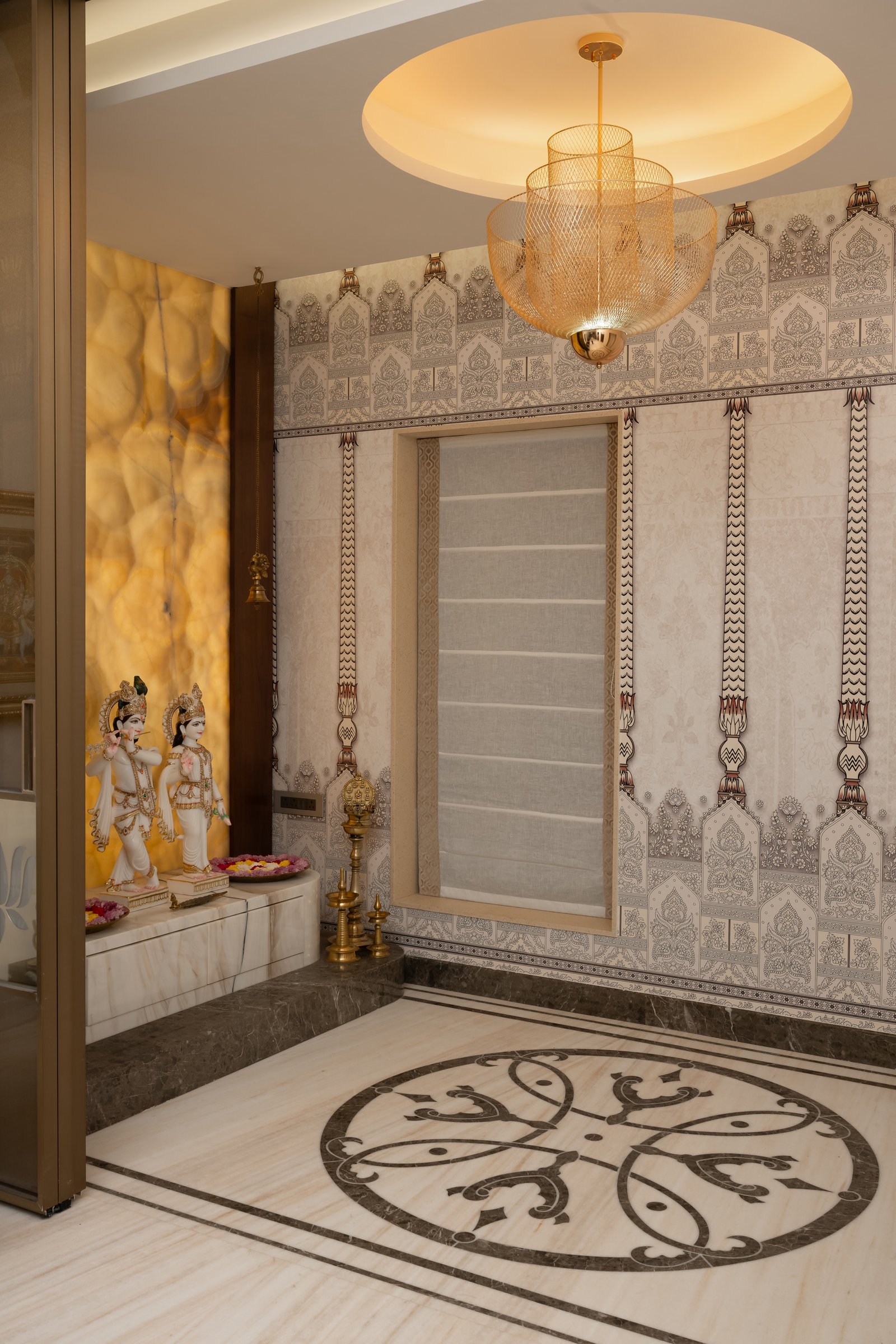
The temple room is the home’s most contemplative space, where materiality and light come together in quiet reverence. A backlit amber onyx panel forms a luminous backdrop to the marble murtis of Radha and Krishna, its translucent surface lending the shrine an almost ethereal presence. Set upon a stepped plinth, the composition is restrained yet ceremonial, allowing the natural beauty of the stone to become part of the spiritual experience.
Wallpaper patterned with a subtle palatial motif wraps the room in a gentle sense of ornament, while a woven gold pendant introduces warmth overhead without overwhelming the space. Below, a circular stone inlay references the geometry of a traditional rangoli in an abstract, architectural gesture. Rather than reproducing familiar religious motifs, the studio reinterprets them through material, proportion, and light, creating a temple that feels both rooted in tradition and distinctly contemporary.
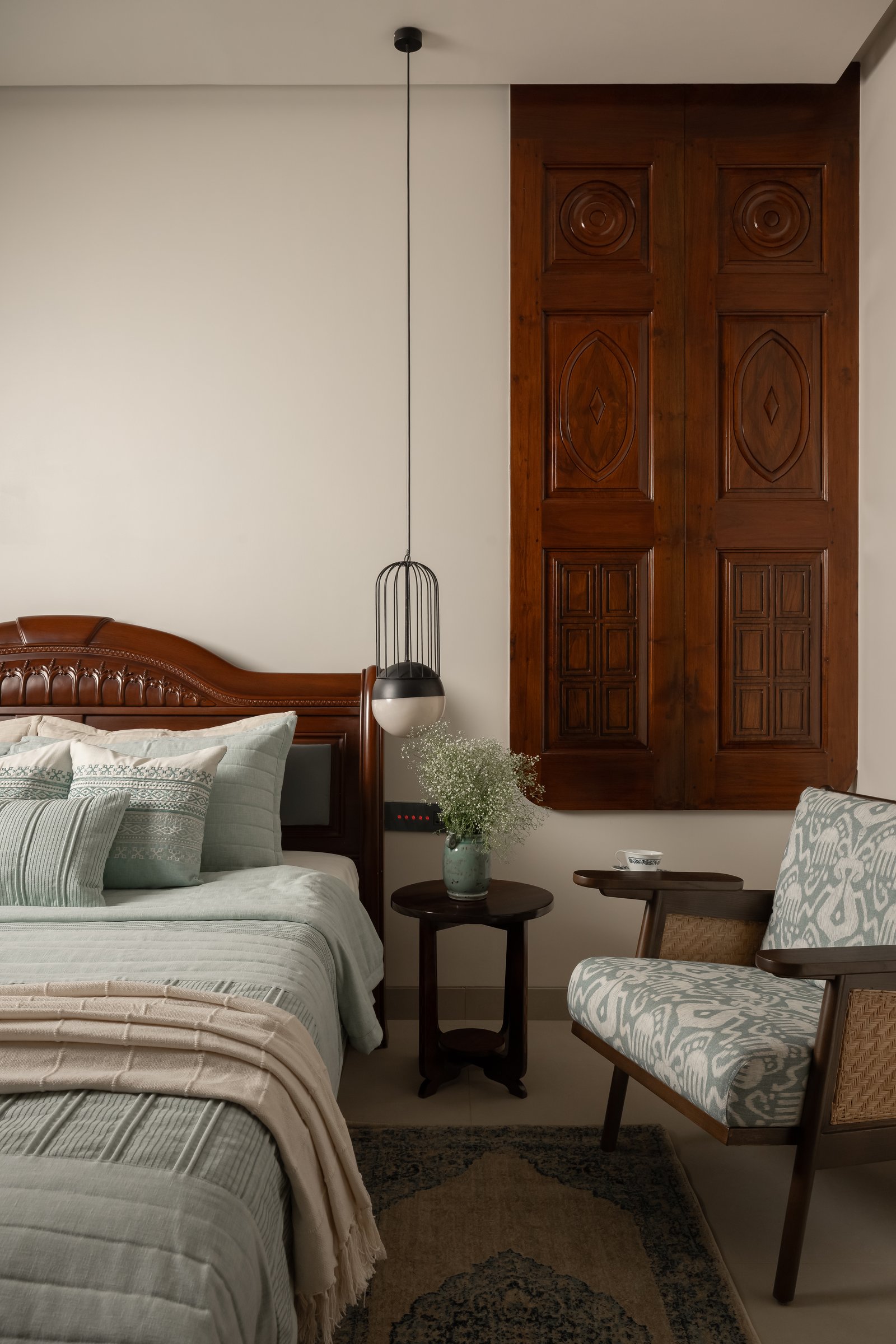
The master bedroom shifts the home’s material language towards a quieter sense of intimacy. A carved timber headboard, drawing from the vocabulary of traditional Indian joinery, anchors a bed layered in soft sage greens and warm ivory, creating a palette that feels calm and restorative. Rather than introducing new decorative gestures, the room builds its character through carefully preserved pieces and restrained detailing.
Its most evocative element is a section of the home’s original temple door, reclaimed from the existing structure and mounted as artwork above the bed. More than a decorative object, it serves as a tangible link to the house’s earlier life, bringing memory and continuity into the everyday ritual of the bedroom. A black caged pendant and a patterned upholstered armchair play supporting roles, allowing the restored heritage fragment to remain the room’s emotional and visual anchor.
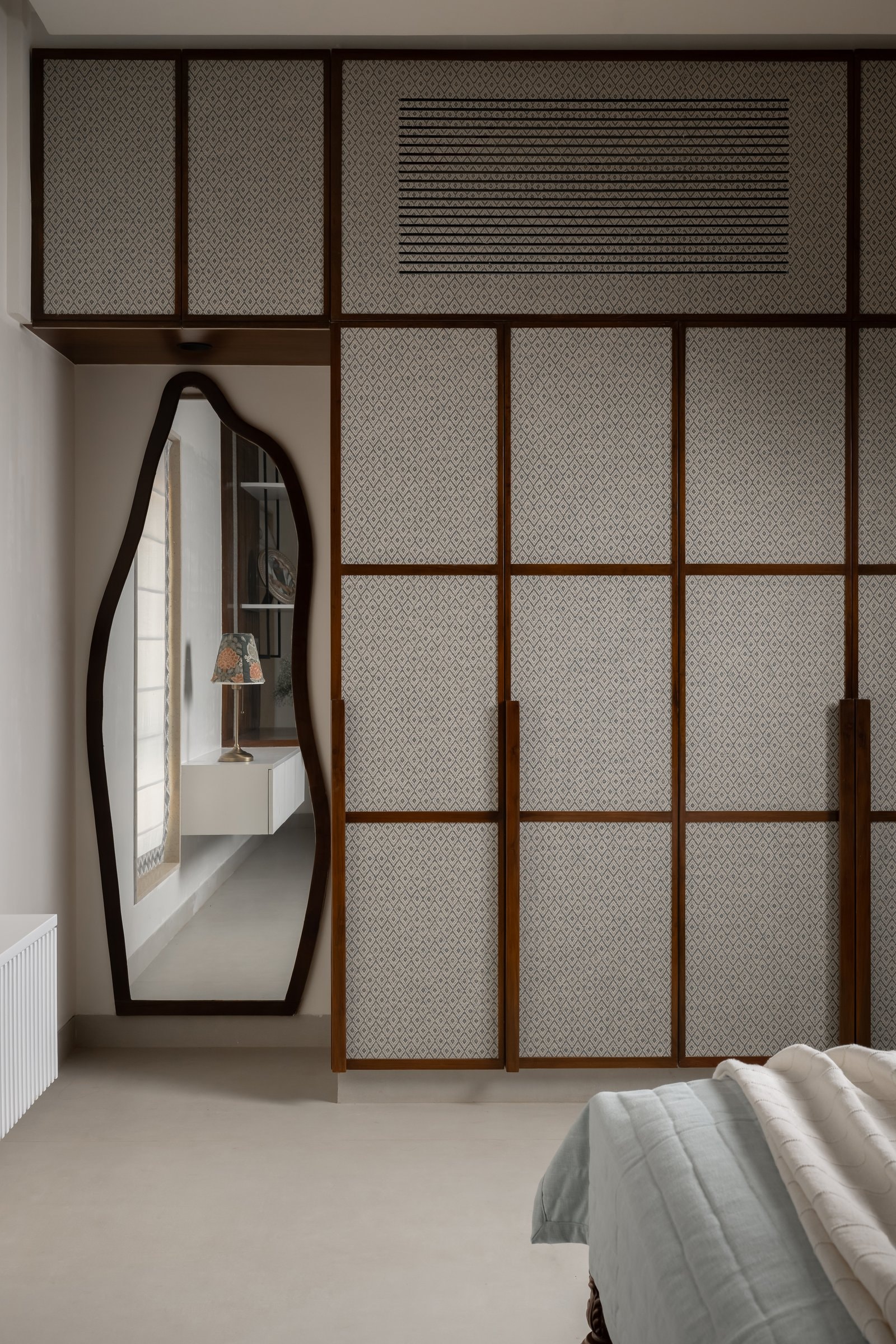
Opposite the bed, a full wall of wardrobes is faced in a small-scale diamond-patterned upholstery, framed in slim wood profiles that divide the surface into a grid. A wave-edged mirror in a dark wood frame leans against the adjacent wall, its organic silhouette providing relief against the disciplined geometry. The decision to soften storage with fabric rather than reveal it through joinery is one of the project’s quieter intelligences.
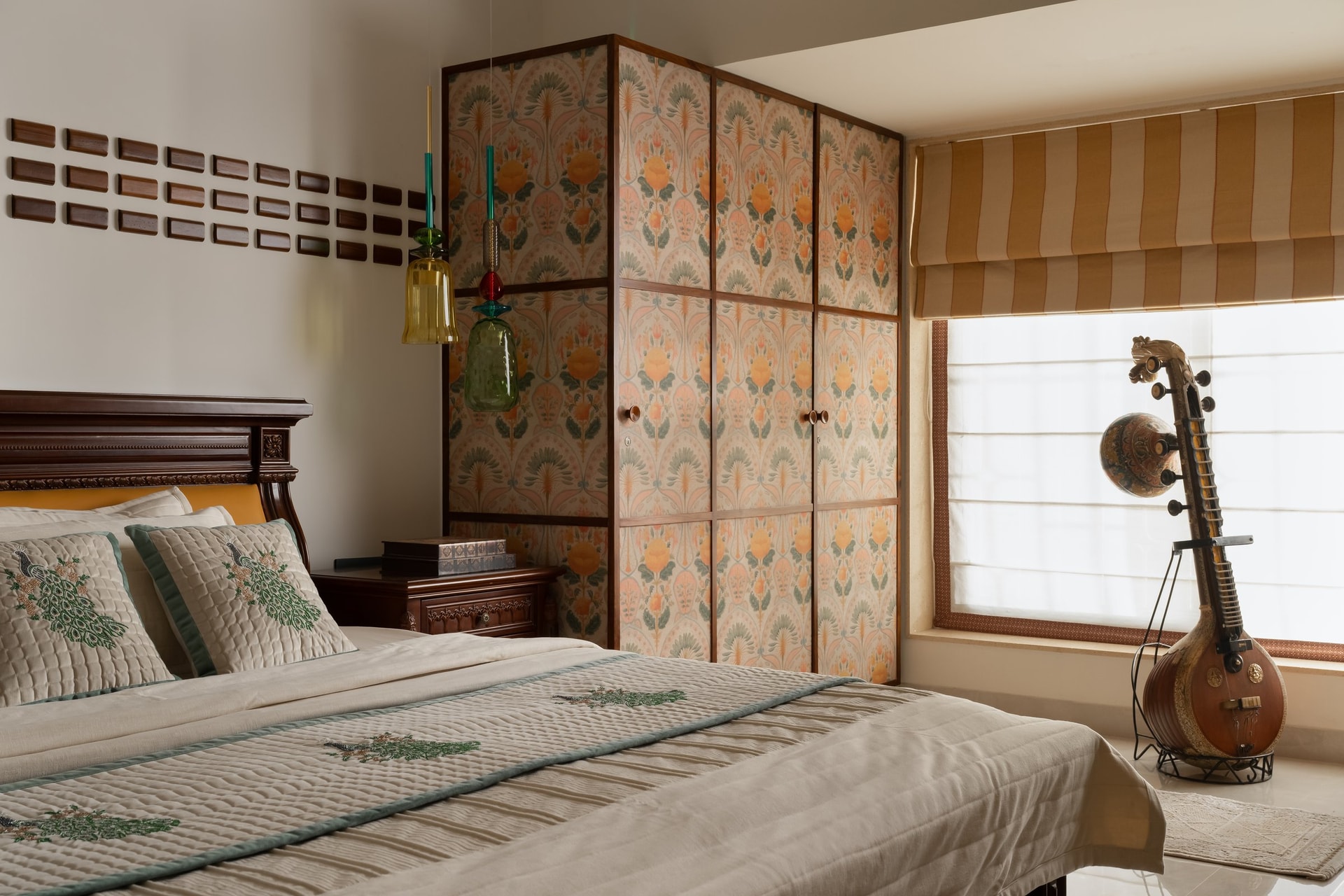
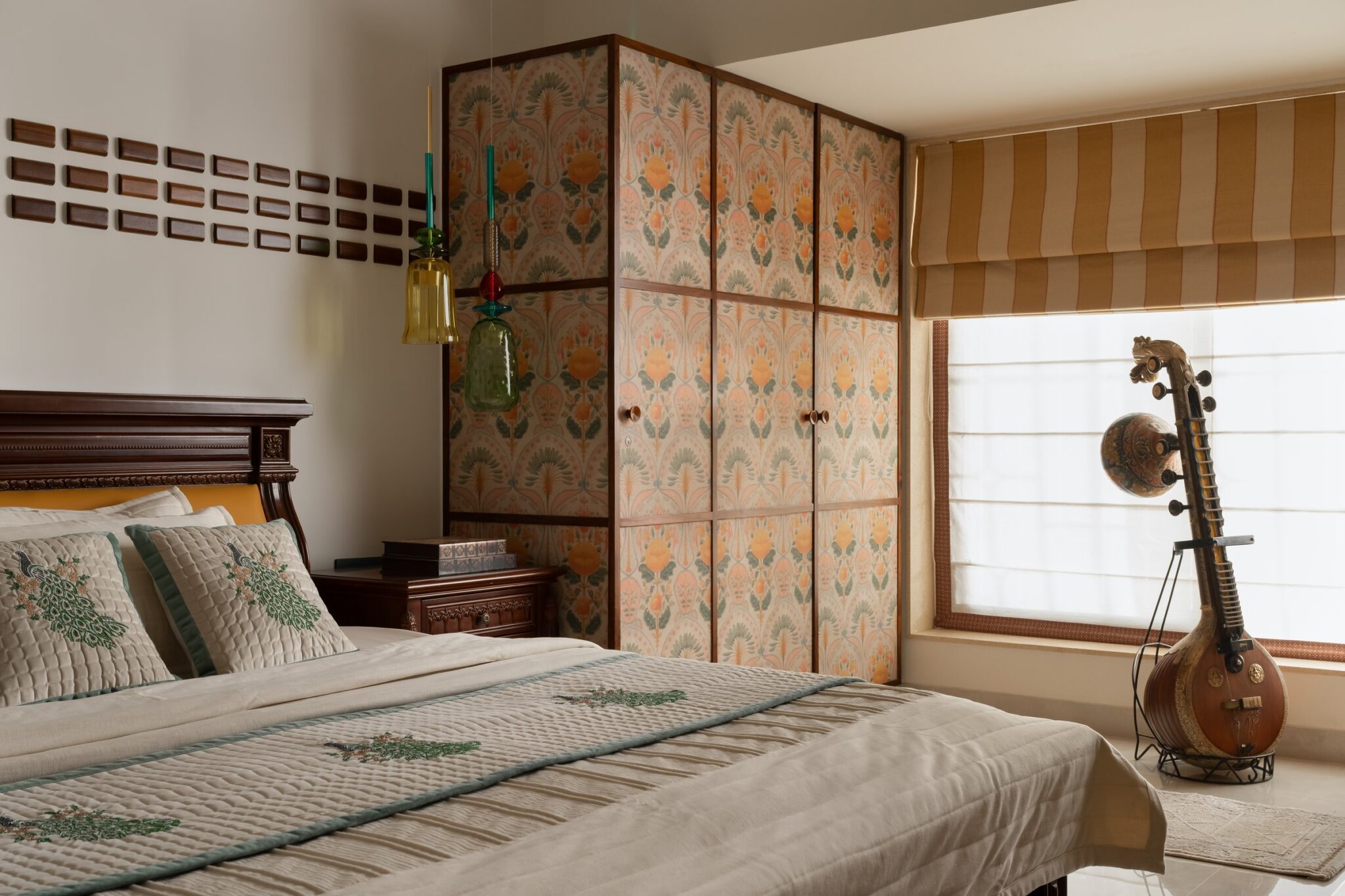
The second bedroom offers a lighter interpretation of the home’s craft-driven narrative, introducing colour and pattern with greater confidence while remaining rooted in the same design language. Wardrobes are clad in a richly patterned wallpaper of stylised florals in muted ochre and sage, framed by dark timber joinery that lends the composition both depth and structure. Beside the bed, a cluster of hand-blown glass pendants in amber, green, and ruby introduces moments of colour that animate the otherwise restrained palette.
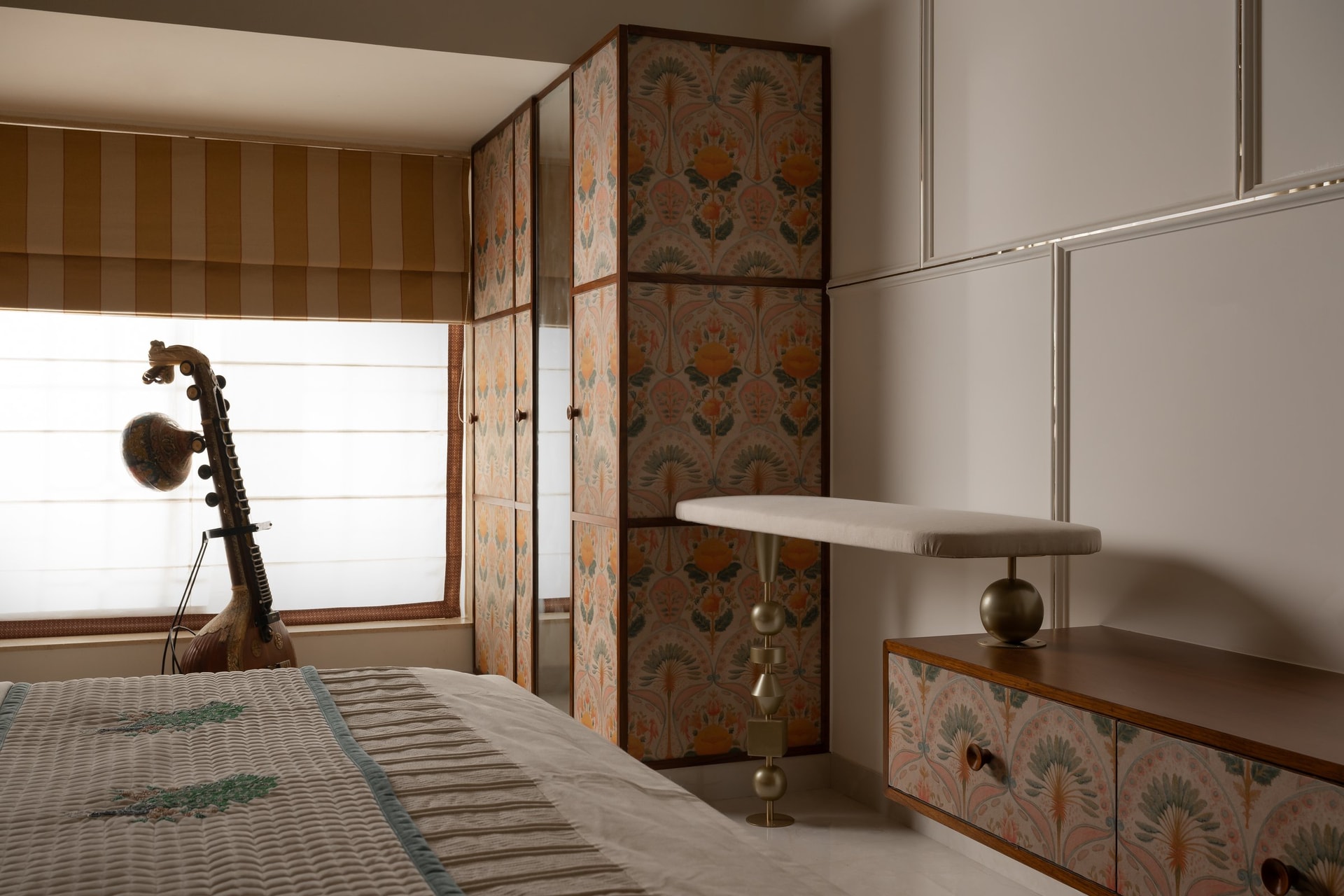
A second view of the bedroom reveals the studio’s attention to continuity and detail. A slender floating dressing console extends the wardrobe language, its drawer fronts wrapped in the same floral wallpaper so that the joinery reads as a single, cohesive composition. Rather than competing for attention, each element contributes to a carefully layered interior where pattern, timber, and texture remain in quiet dialogue.
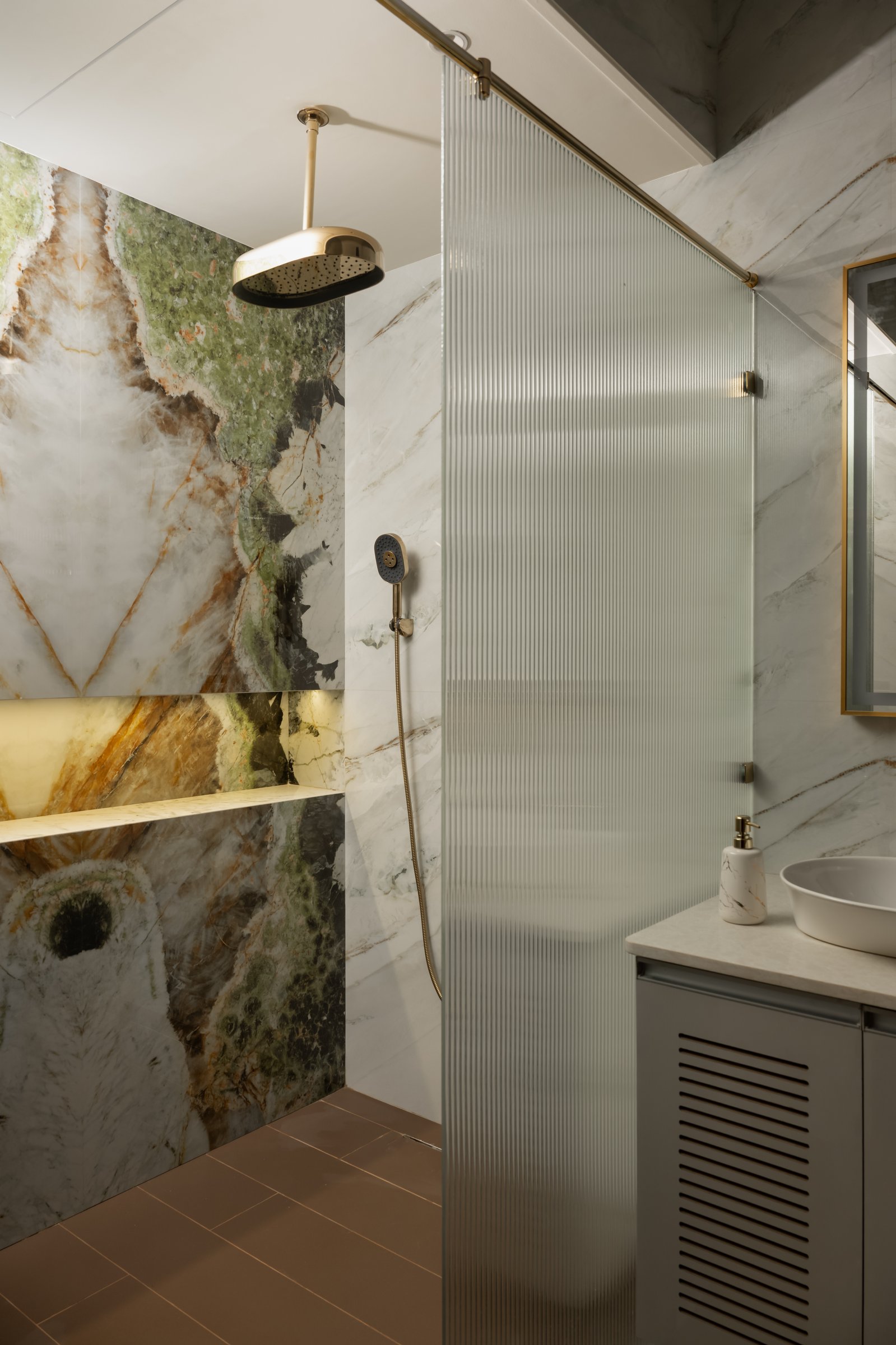
The primary bathroom is composed around a single dramatic stone wall: a slab of patterned quartzite in greens, ochres and creams that reads almost as landscape painting. A reeded glass screen separates the shower zone, its vertical ribs softening the light without obscuring the stone behind. The brass shower fittings and the recessed marble shelf are kept deliberately restrained so the stone can carry the room.
More than any singular material gesture, Project Saundh demonstrates a thoughtful approach to preserving heritage without reducing it to nostalgia. Folk art, ancestral brassware, the restored temple door, and the family’s musical instruments are not treated as curated artefacts but are seamlessly woven into the architecture, allowing memory and everyday life to coexist. Tradition is neither replicated nor romanticised; instead, it is reinterpreted through proportion, materiality, and craft, resulting in a home that feels deeply connected to its cultural inheritance while remaining distinctly contemporary.
The residence ultimately achieves a rare balance between continuity and renewal. Rooted in the character of a fifty-year-old home yet shaped for present-day living, it reflects an architecture that understands when to remain understated and when to become expressive. Rather than a conventional renovation, Project Saundh is an act of careful translation, distilling the home’s history into a refined and enduring spatial language that will continue to evolve with the family it shelters.