A home is rarely defined by what fills it. More often, it is defined by the relationships between its parts: how one volume yields to another, how a level shift becomes an invitation, how a single material is allowed to carry the weight of an entire wall without apology. This is the quieter argument of contemporary residential design, and it is the argument Jupiter House makes from the moment one steps inside.
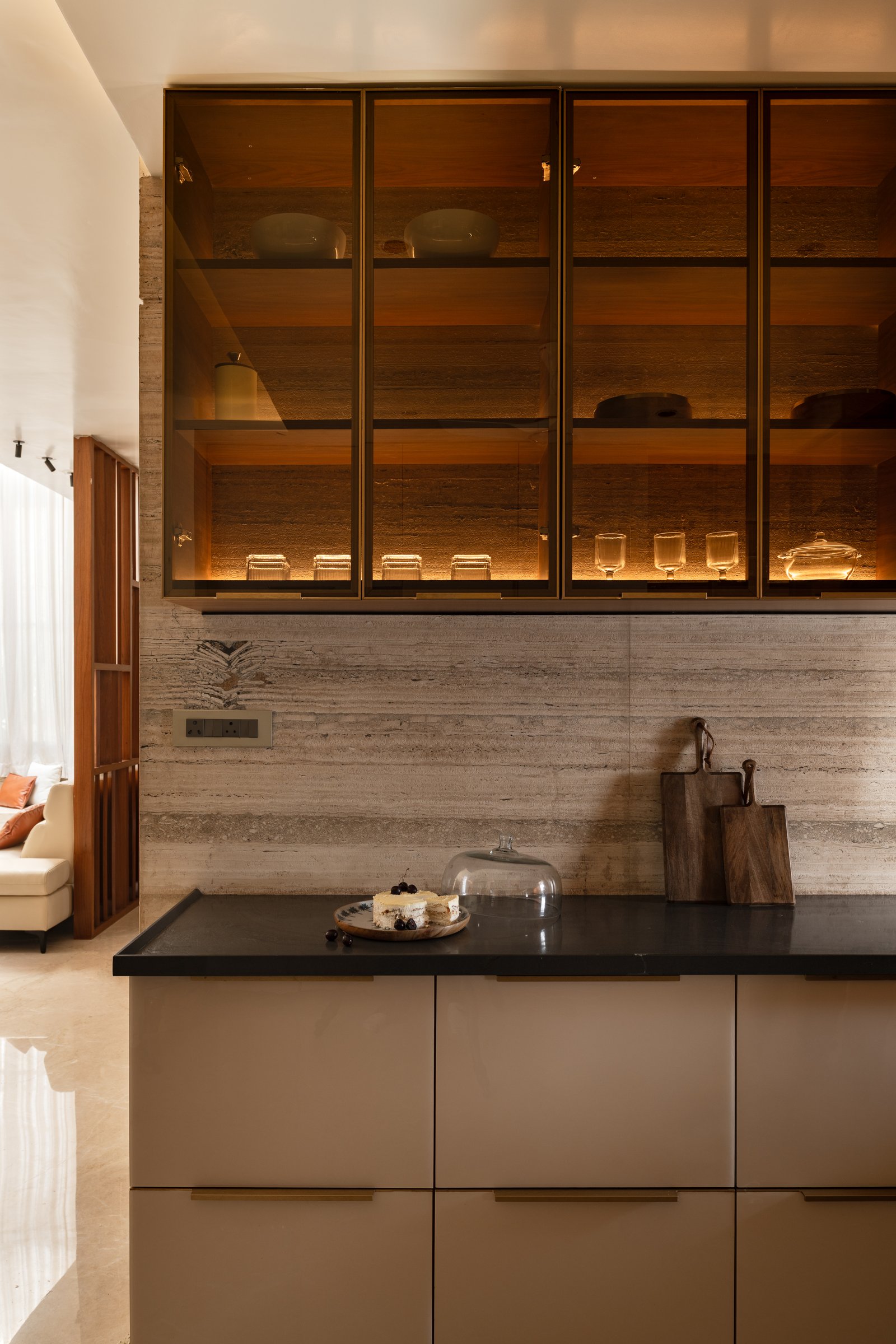
Set in Vanasthalipuram, Hyderabad, the residence was conceived by Studio Sacred Geometry for a family of four. Principal designer Anurag Reddy has approached the project as a study in order and continuity, where ornament gives way to texture and where the home reads less as a collection of rooms than as a sequence of framed volumes. A restrained palette of travertine and teak carries through every floor, allowing proportion and natural light to do the descriptive work.
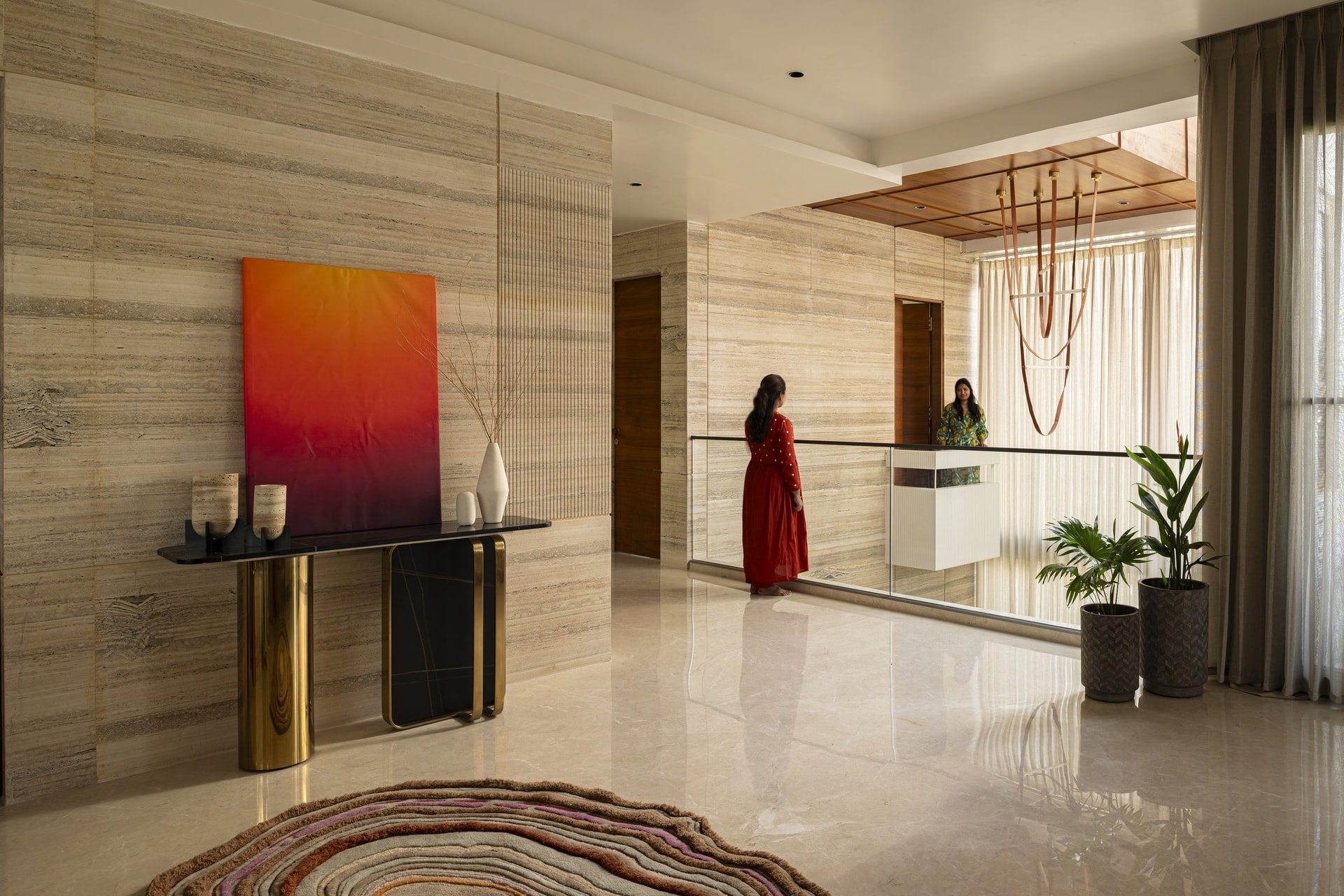
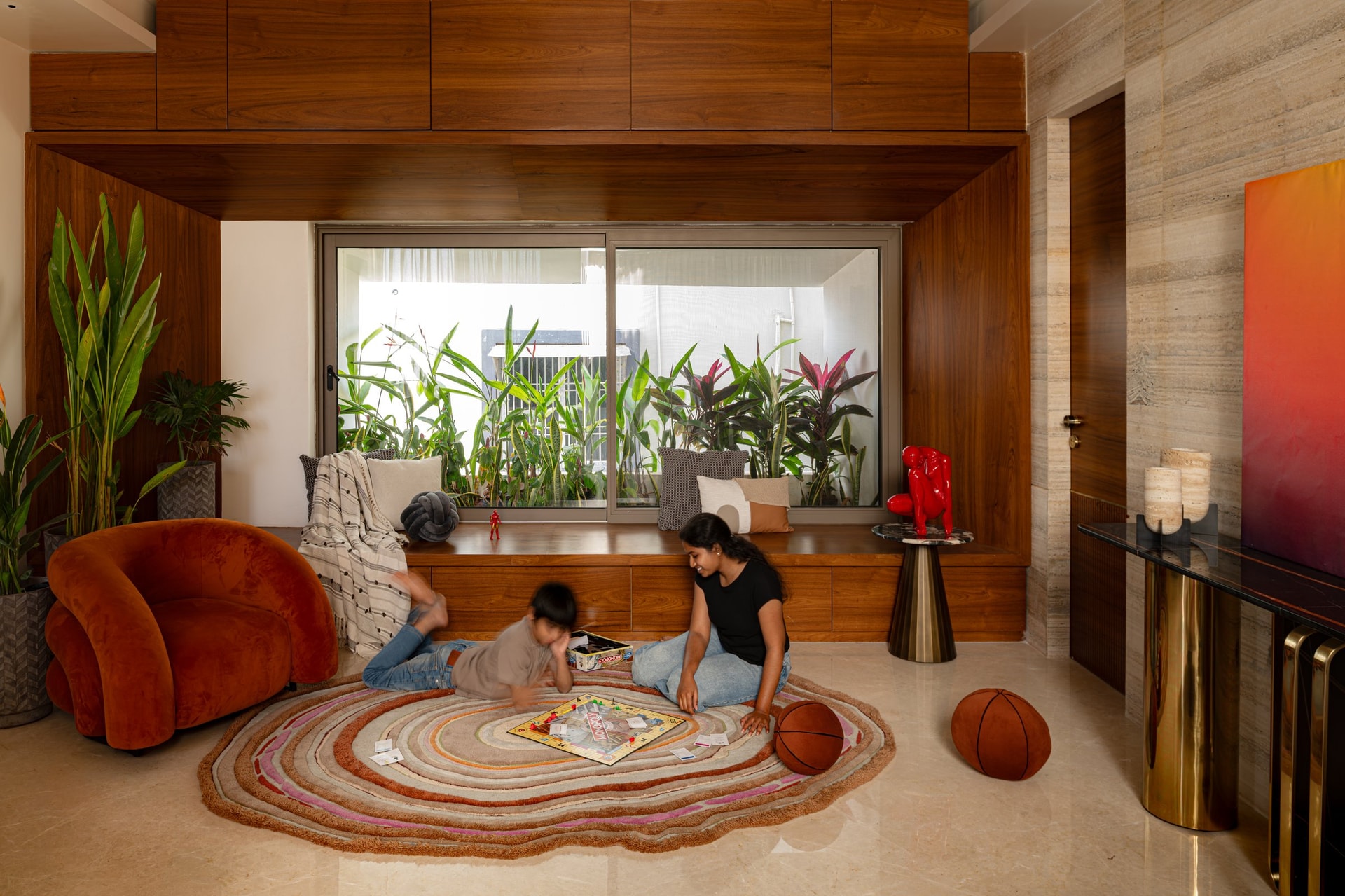
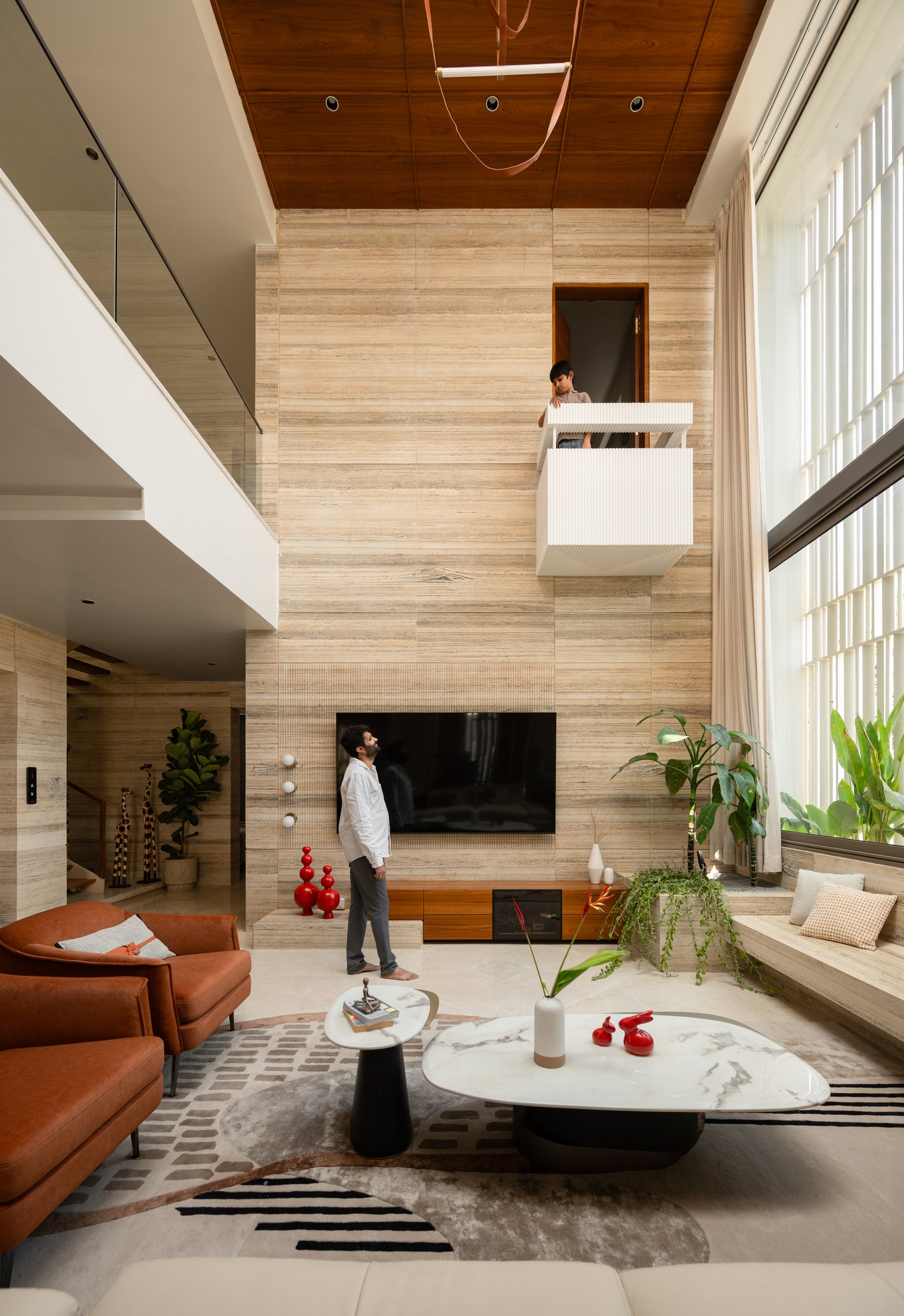
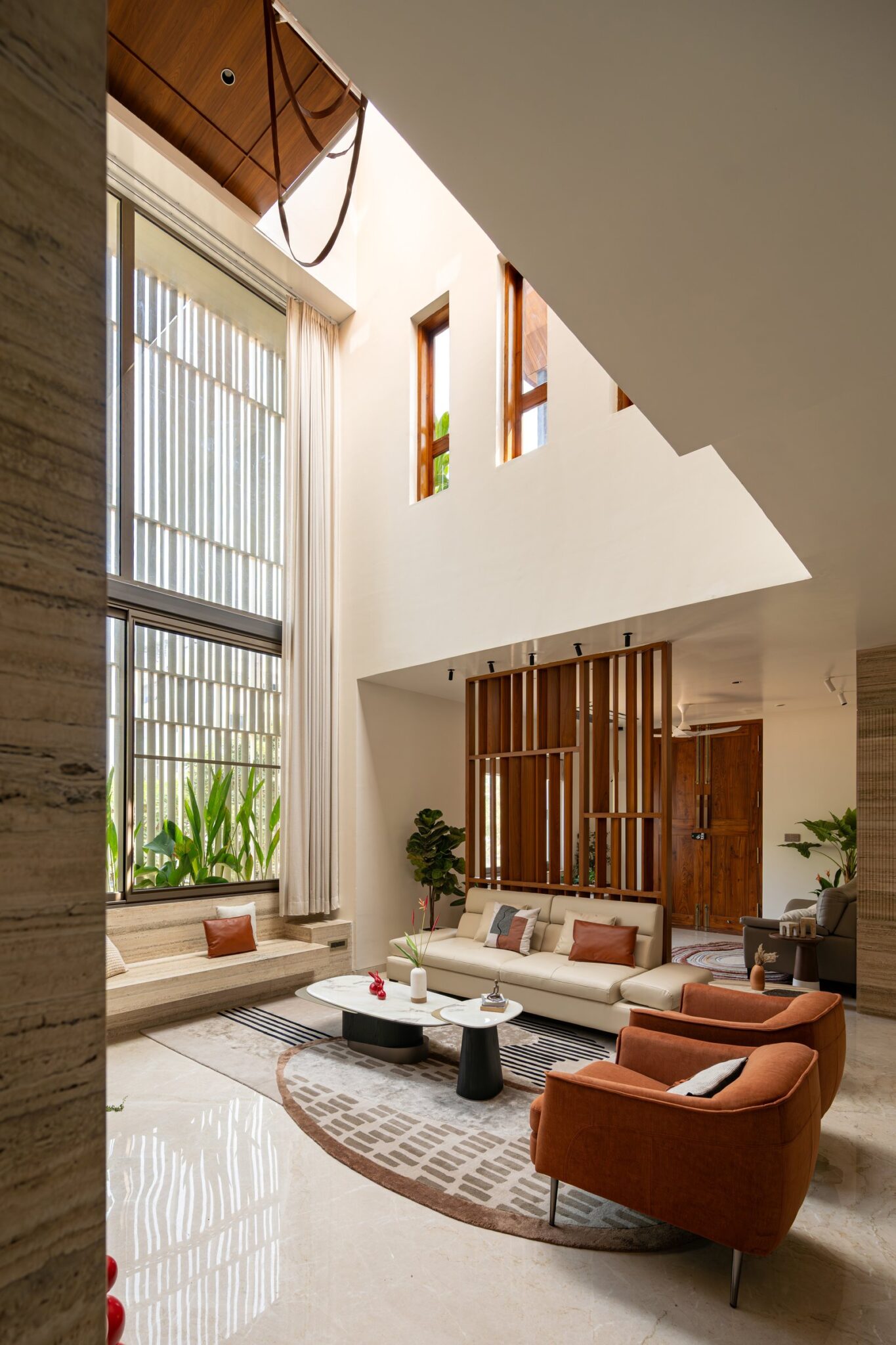
The double-height living room is the home’s spatial centrepiece. A continuous travertine wall rises the full height of the volume, broken only by a recessed media console and a small cantilevered balcony that projects from the upper floor, a deliberate architectural gesture that turns the wall itself into an event.
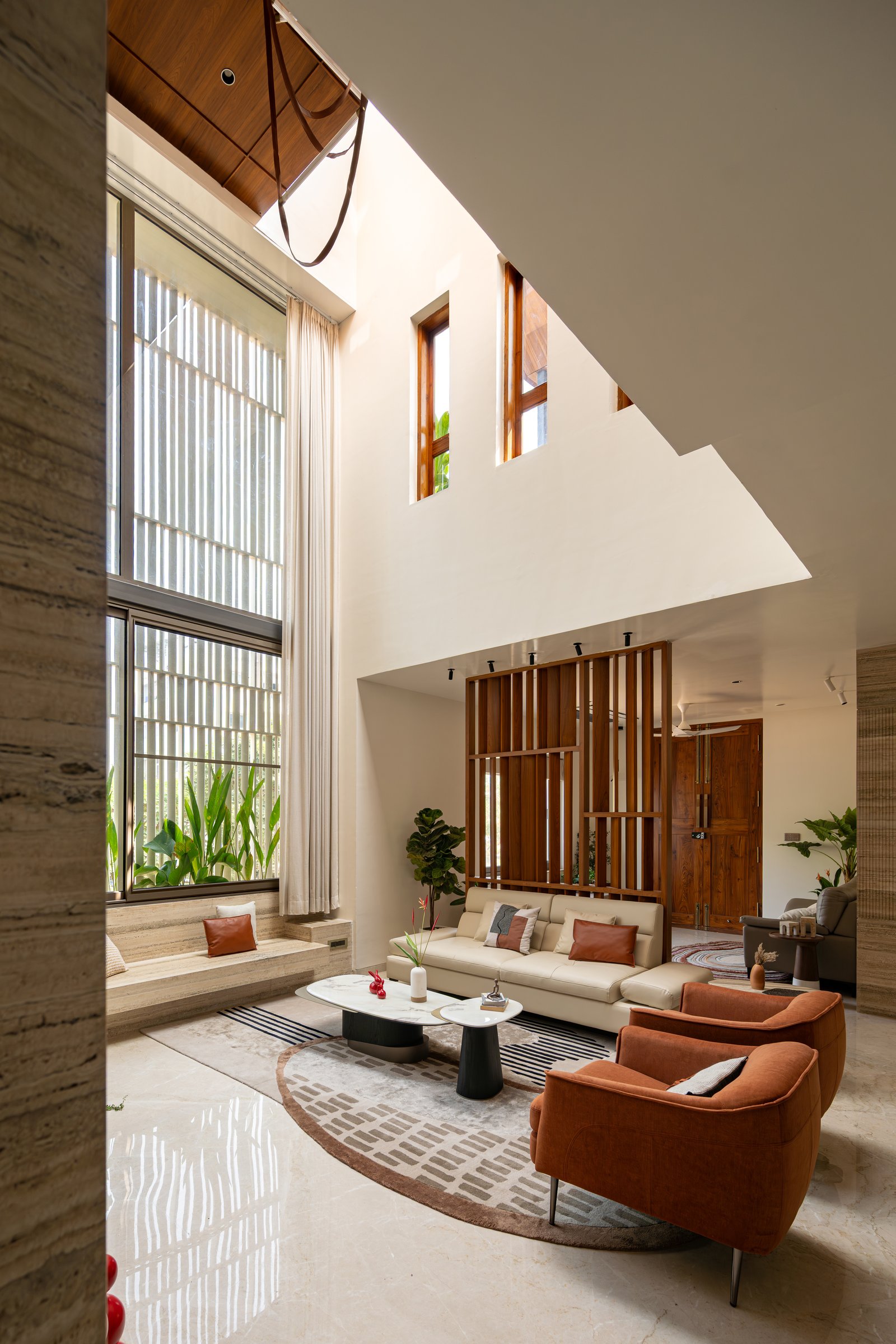
Seen from the opposite end, the same room reveals its second logic: a slatted teak screen that filters the entry zone without sealing it off. Light pours through tall fluted glazing onto a stepped travertine bench, and the upper void opens to clerestory windows that bring daylight deep into the plan.
““Spaces are not treated as isolated rooms but as a sequence of framed volumes, where transitions are shaped through light, level, and subtle material shifts.””
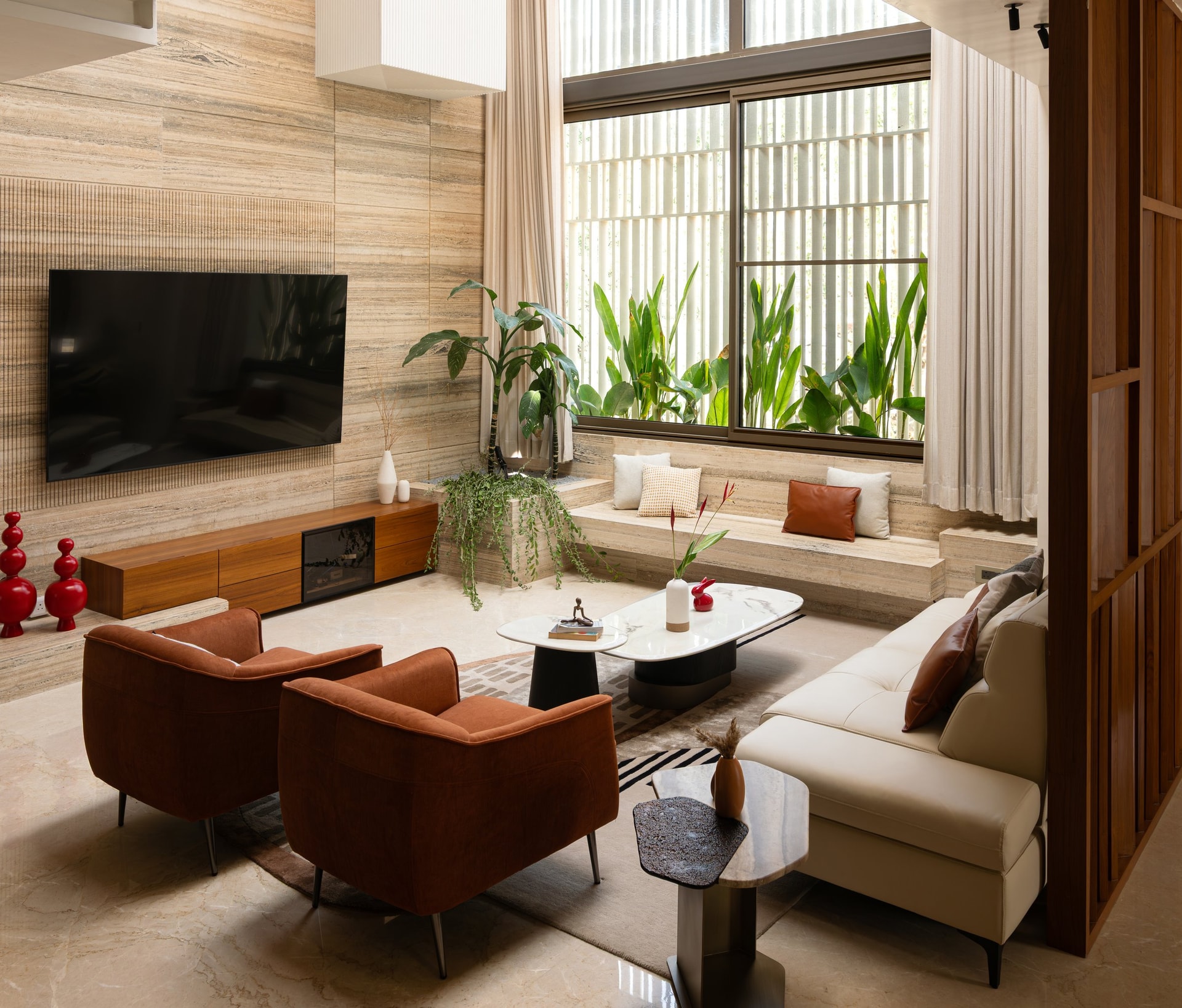
The seating gathers around a sculptural marble-topped coffee table, with rust-toned armchairs answering the warmth of the stone wall behind. The wall itself shifts subtly between smooth and finely ribbed travertine panels, a quiet textural variation that gives the long surface its rhythm without resorting to applied decoration.
The view extends through to the dining area beyond, confirming the home’s continuous-volume logic: rooms are defined, but never severed.
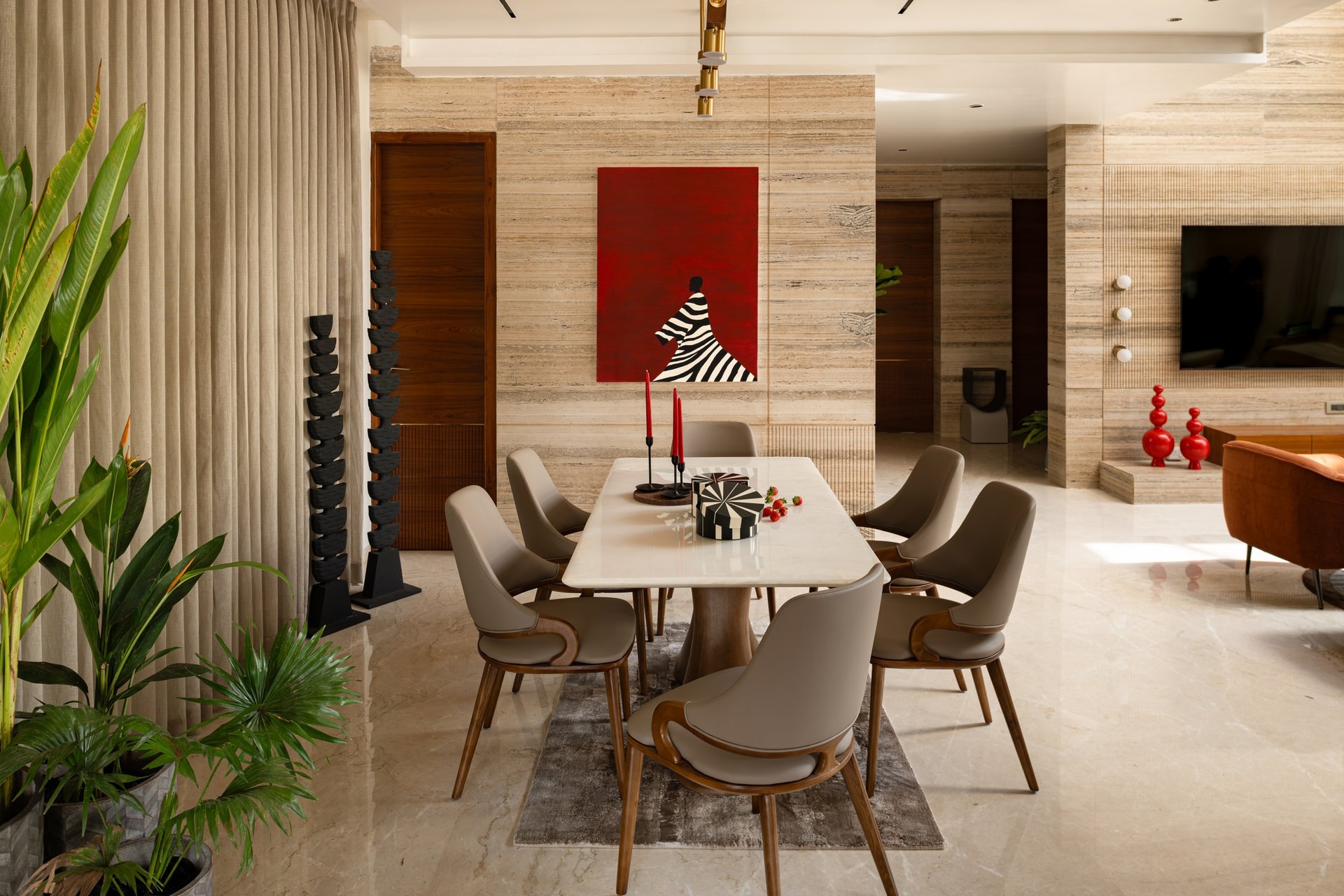
The dining room operates as the home’s punctuation mark. A red canvas with a striped figure anchors the travertine wall behind a stone-topped table, flanked by tall black sculptural totems that read almost as architectural columns in their own right.
The composition is unusually confident for a dining space. It treats the meal as one element in a curated room rather than the room’s sole reason for being, an attitude one finds more often in gallery interiors than in family homes.
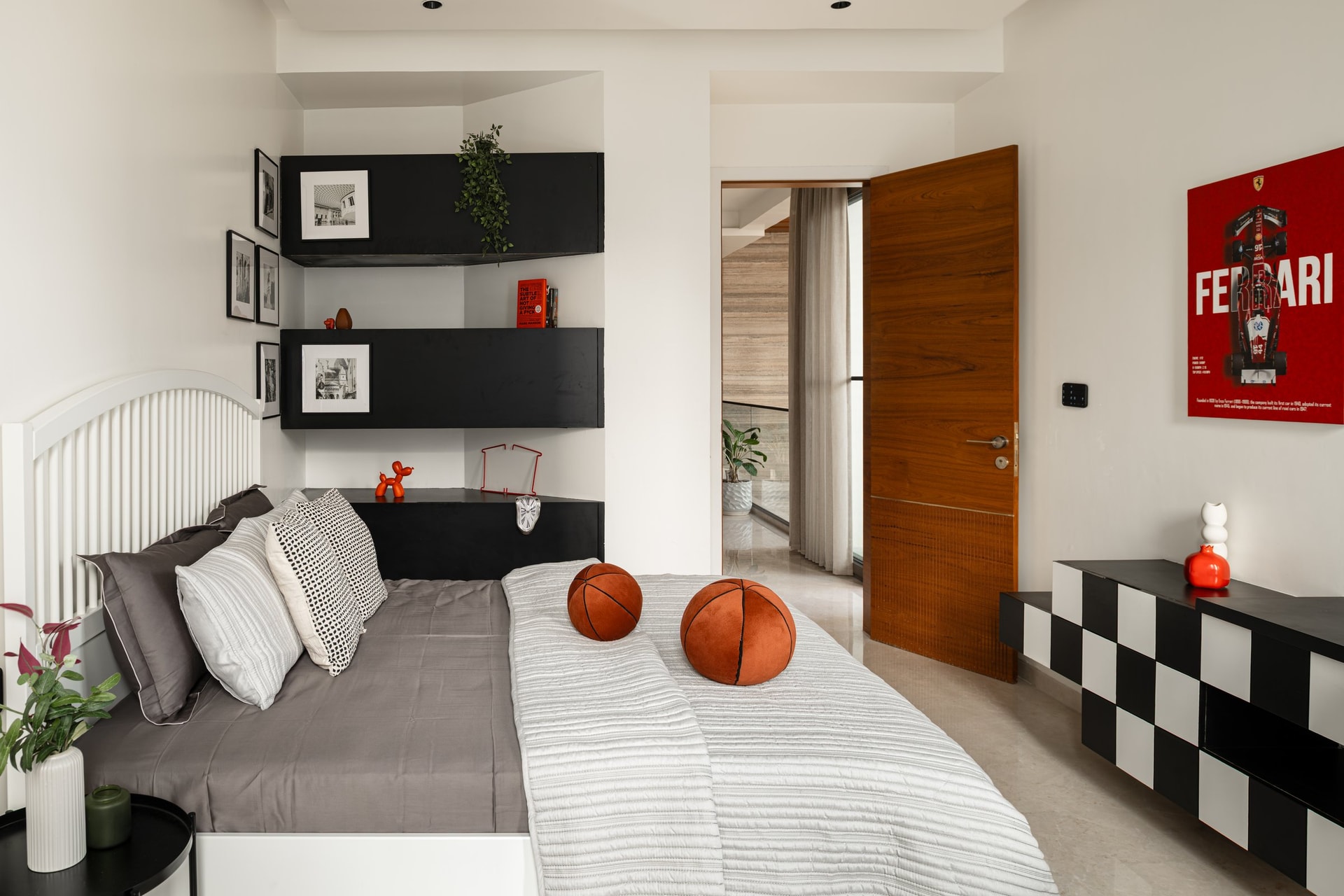
Upstairs, the younger son’s room departs sharply from the travertine-and-teak palette of the public floors. A white slatted headboard, black floating shelves stacked with framed photographs, and a checkerboard console on the opposite wall introduce a graphic energy that suits the room’s occupant. A Ferrari poster supplies the room’s chromatic anchor.
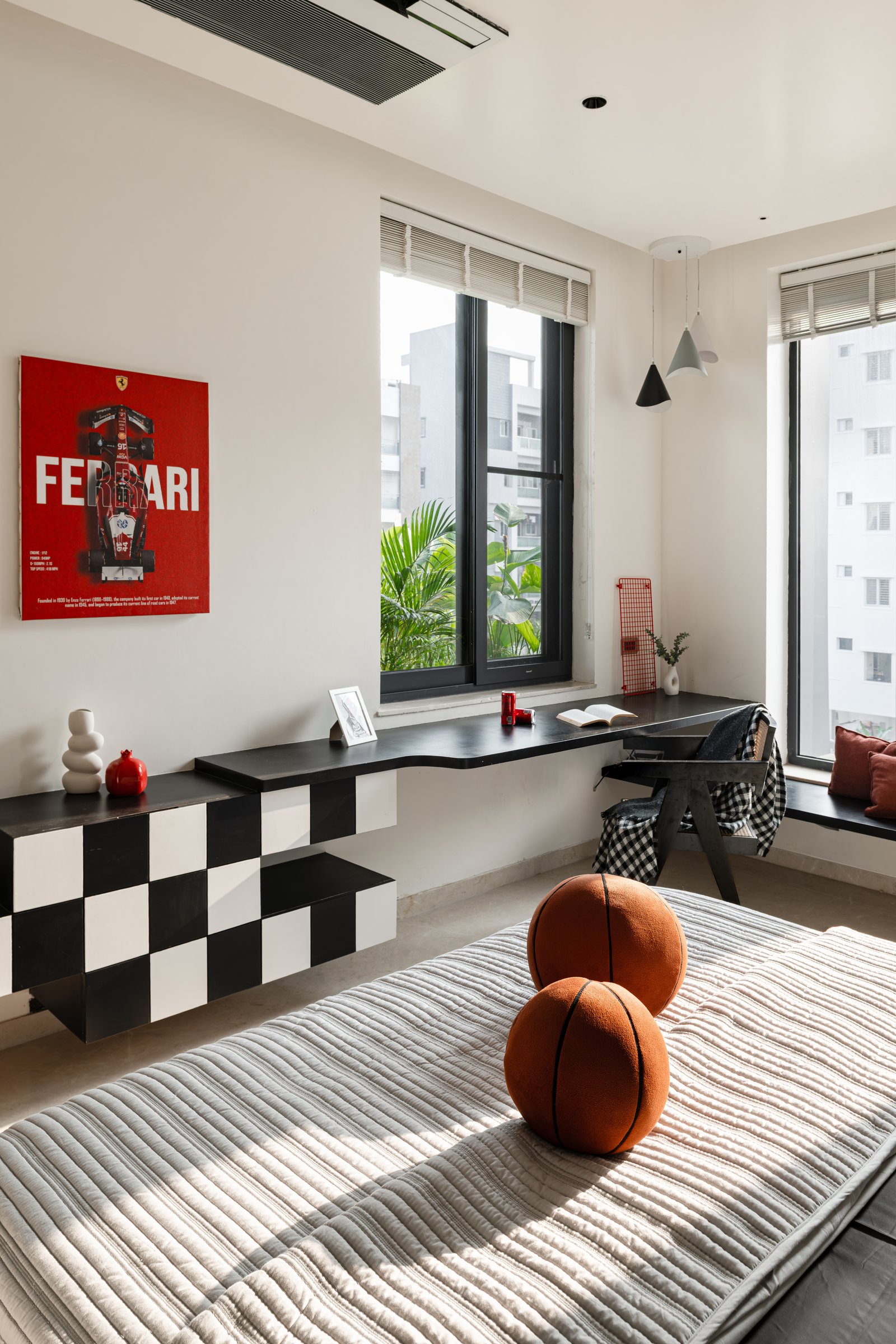
Across the same room, a long black writing counter runs beneath the windows, terminating in a cane-and-wood chair drawn from the language of Chandigarh’s institutional furniture. The checkerboard cabinet returns here as the room’s signature object, holding the design idea together across both walls.
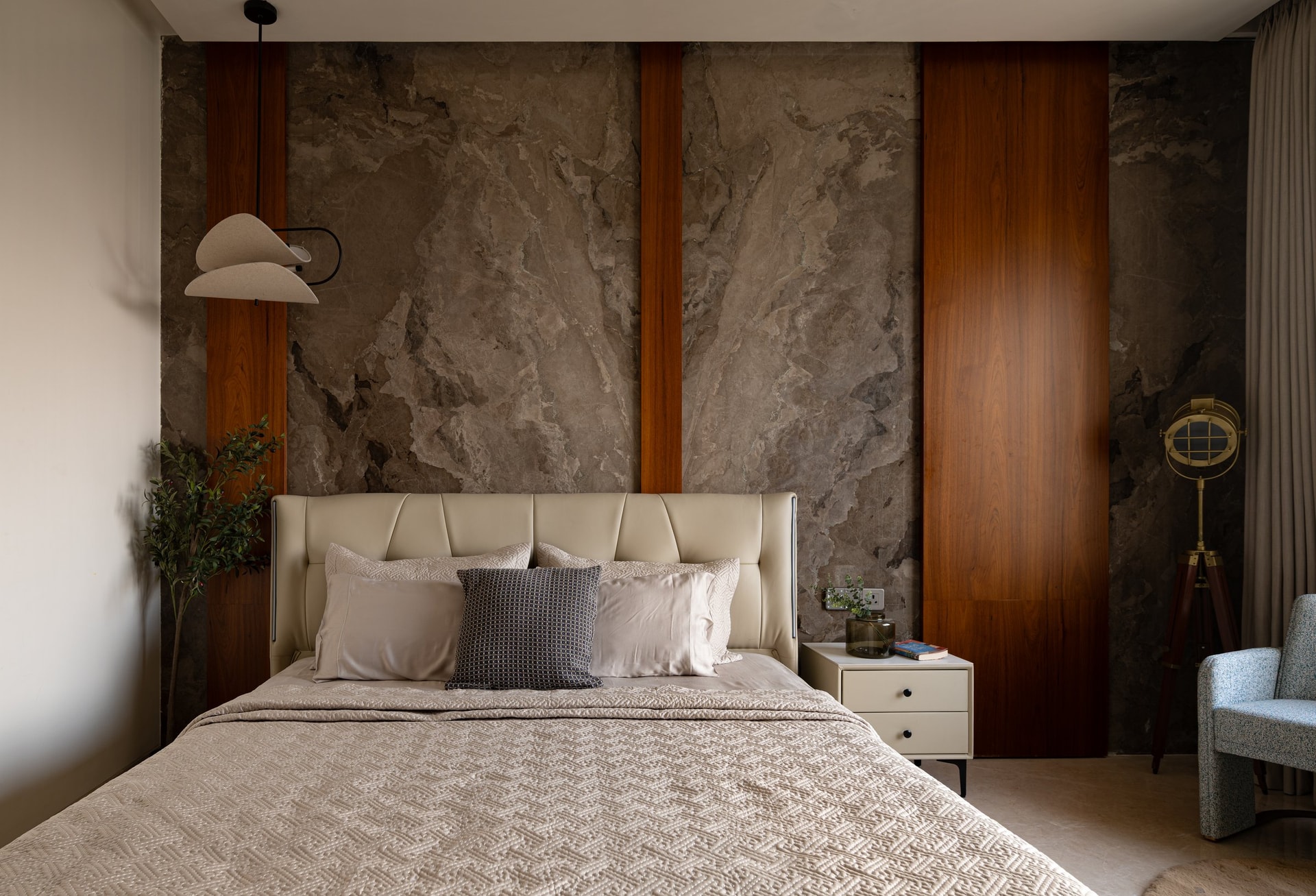
The master suite is the most materially indulgent room in the house. A brown-and-taupe veined stone headboard wall is divided by vertical teak inserts, the natural movement of the stone framed almost like a triptych. An upholstered headboard in pale cream rises tall against the composition, ceding the wall its drama.
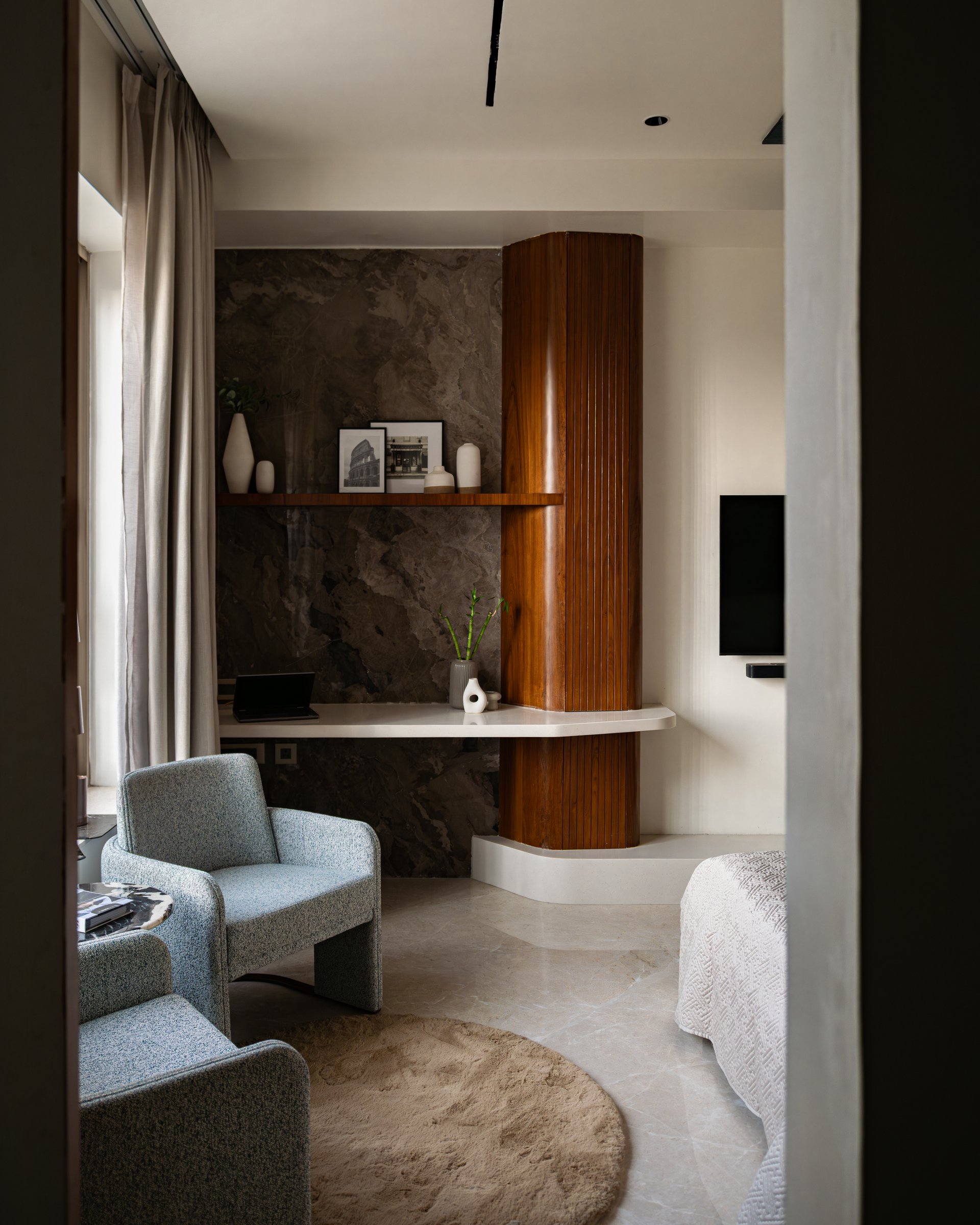
Within the same suite, a study and lounge zone extends the room’s vocabulary. A fluted teak column wraps a structural element, with a floating shelf cantilevered into the stone-clad alcove behind, doubling as both a work surface and a display ledge. Two soft grey armchairs complete the corner as a quieter retreat within the room.
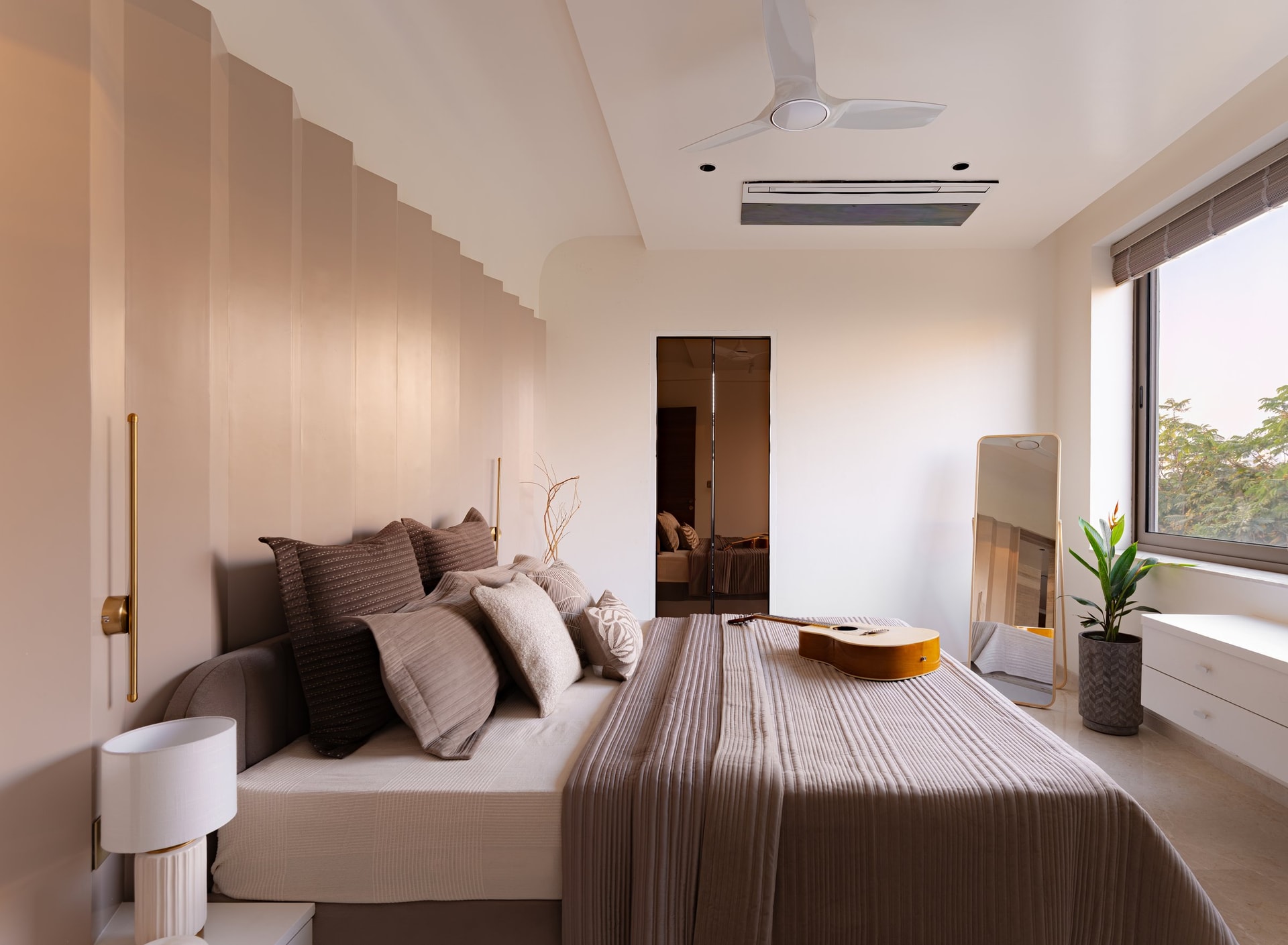
The elder son’s bedroom takes a different tonal route. A muted blush, fluted plaster wall rises behind the bed, with a soft sloping ceiling that gives the room an enveloping quality. The palette stays close to its own register: warm beiges, dusty pinks, a fluted table lamp with brass detailing.
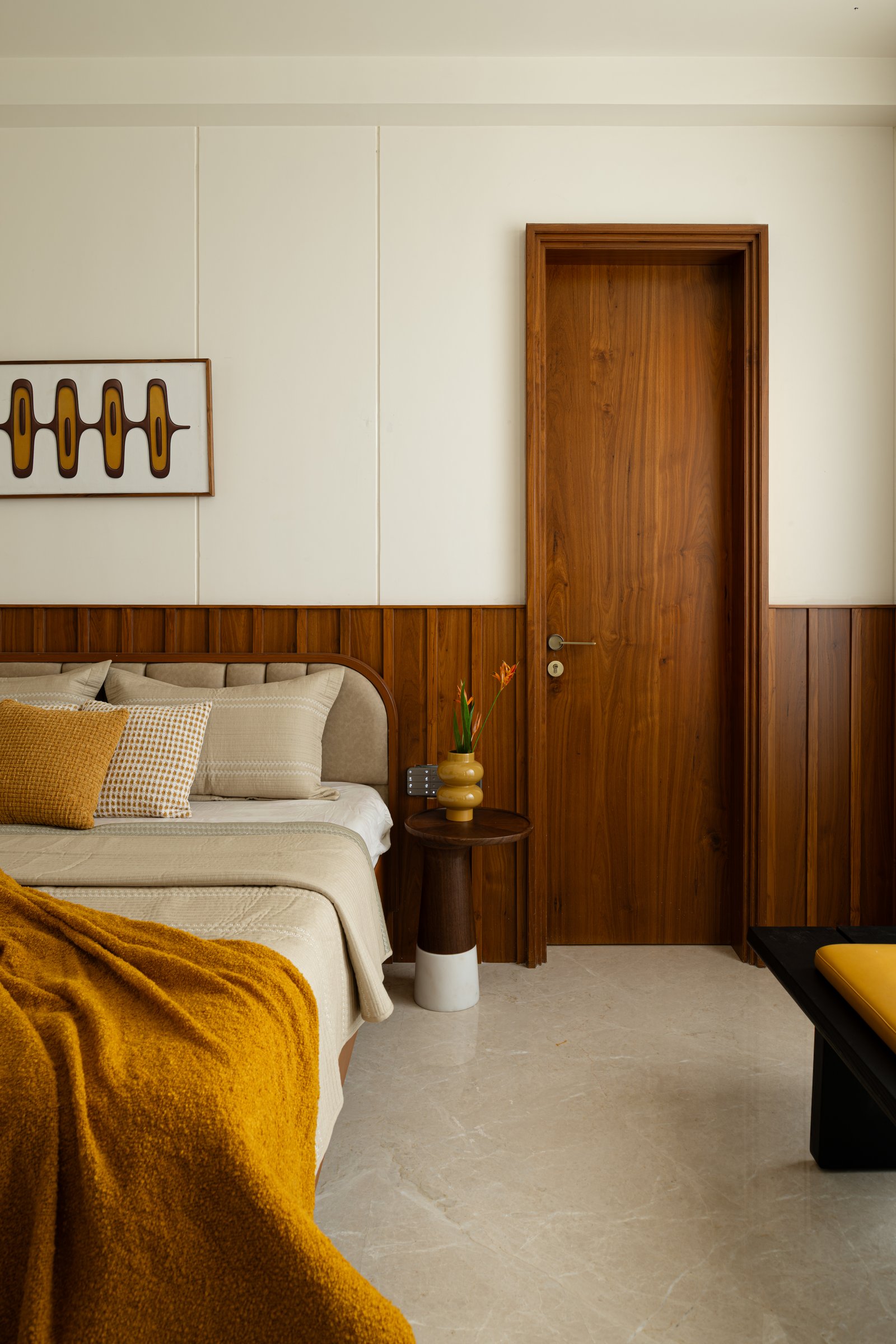
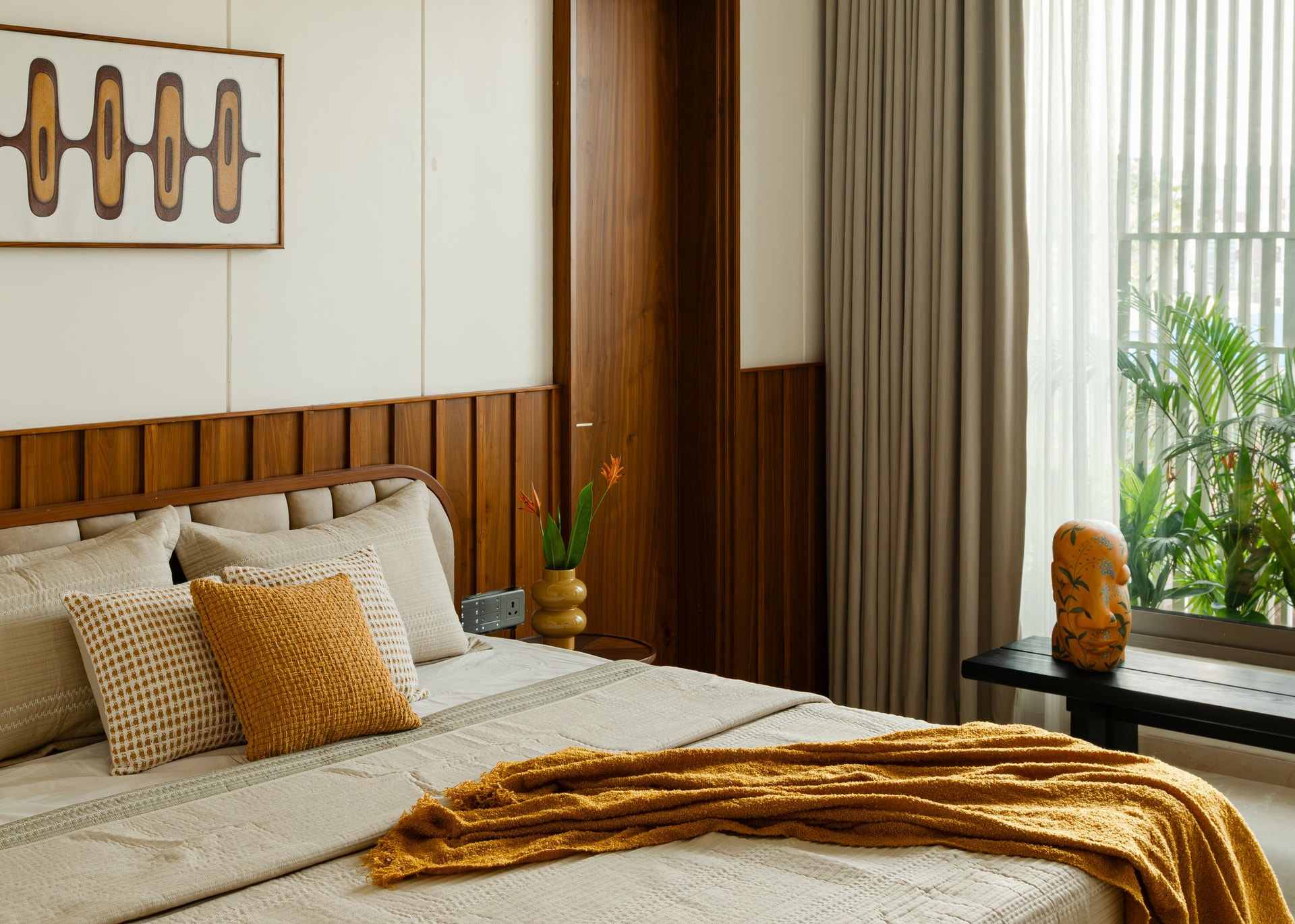
The guest bedroom adopts a warmer, more traditional register. A teak panelled dado runs around the room, meeting a teak door of generous proportion, while a graphic mid-century artwork hangs above the bed. The mustard throw and ochre cushions tie the palette to the wood.
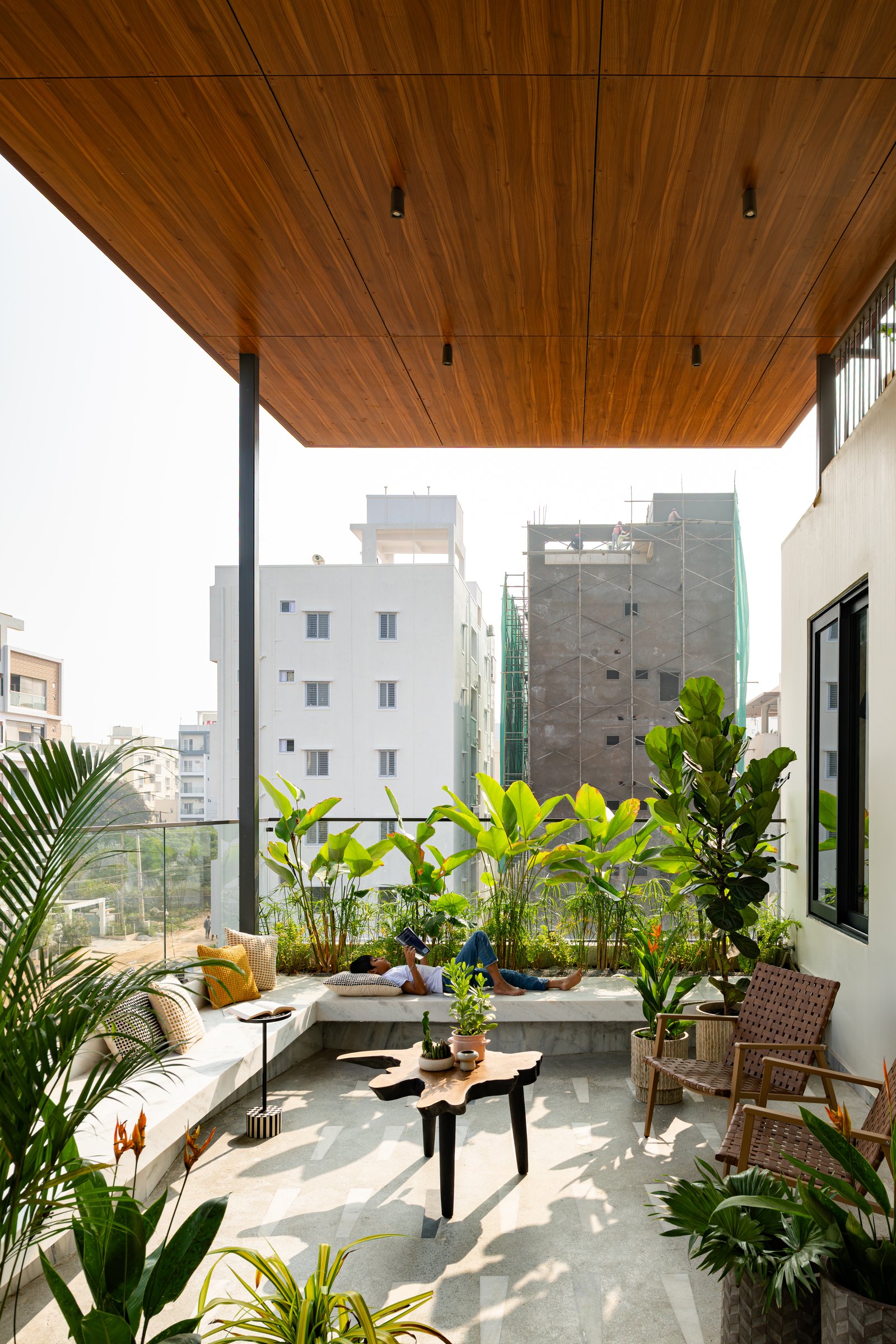
One of the home’s most quietly accomplished moments is the upper terrace. A deep teak soffit floats above the balcony, its underside warmed by the daylight bouncing off the stone floor, and a built-in bench runs along the planted edge. The planting itself, banana, fiddle-leaf, palm, turns the space into a green room open to the sky.
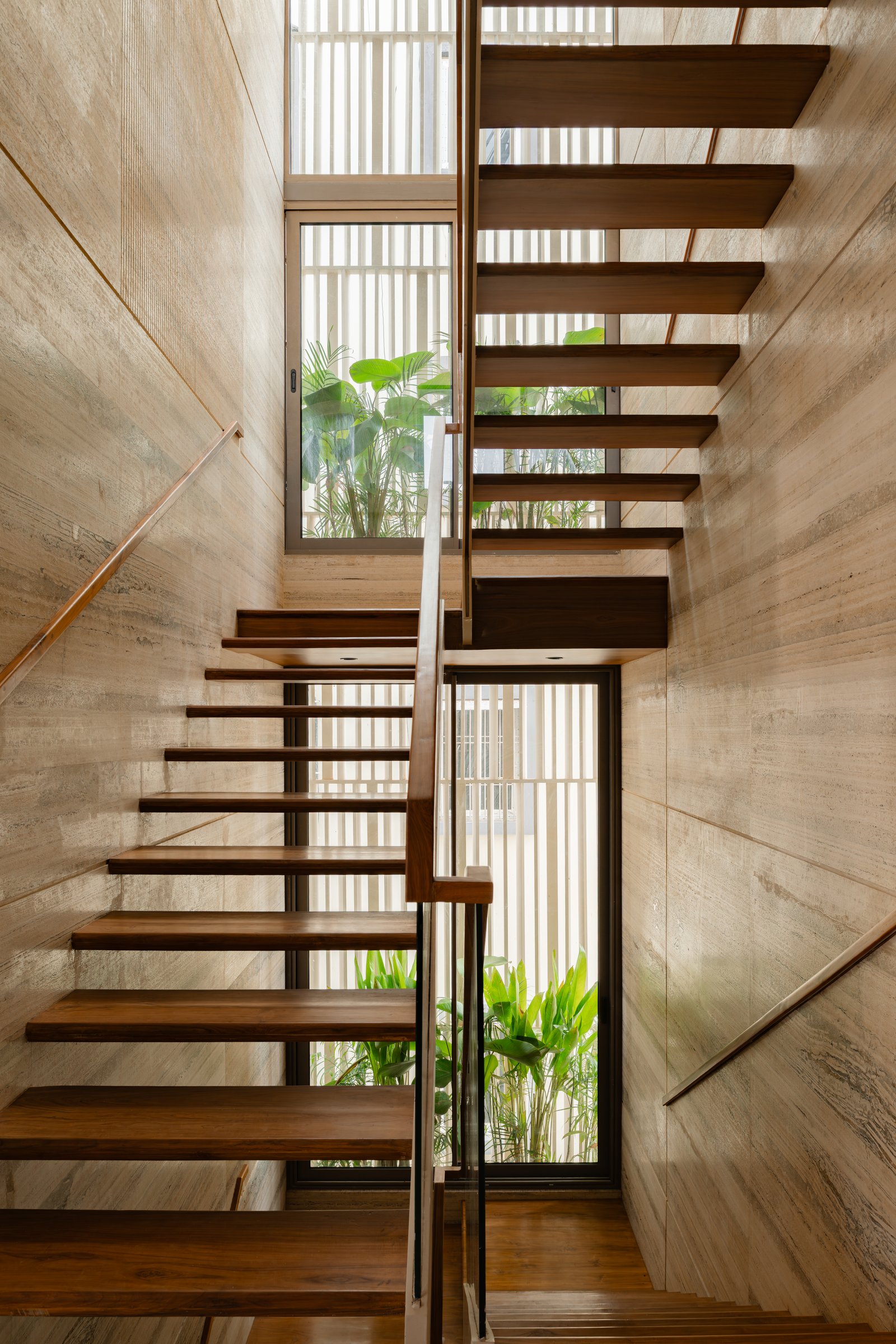
The staircase is where the home’s material logic becomes most concentrated. Cantilevered teak treads float against full-height travertine walls, with vertical glazing along one side framing a slim planted court. The whole composition reads as a single sculpted volume.
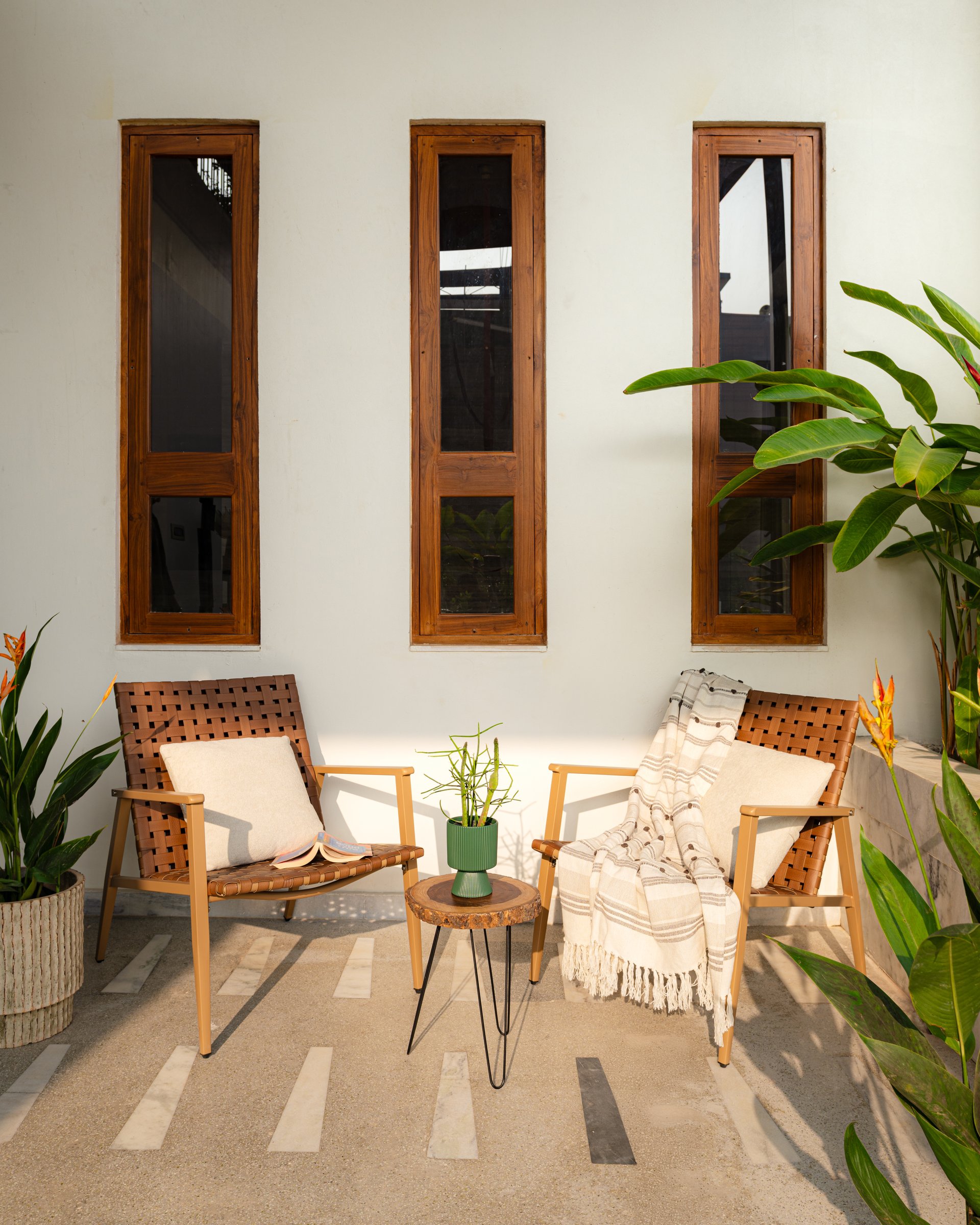
At ground level, a shaded courtyard extends the home’s relationship with greenery outward. Three tall teak-framed windows punctuate a white plastered wall, with two woven-leather lounge chairs flanking a live-edge side table on hairpin legs.
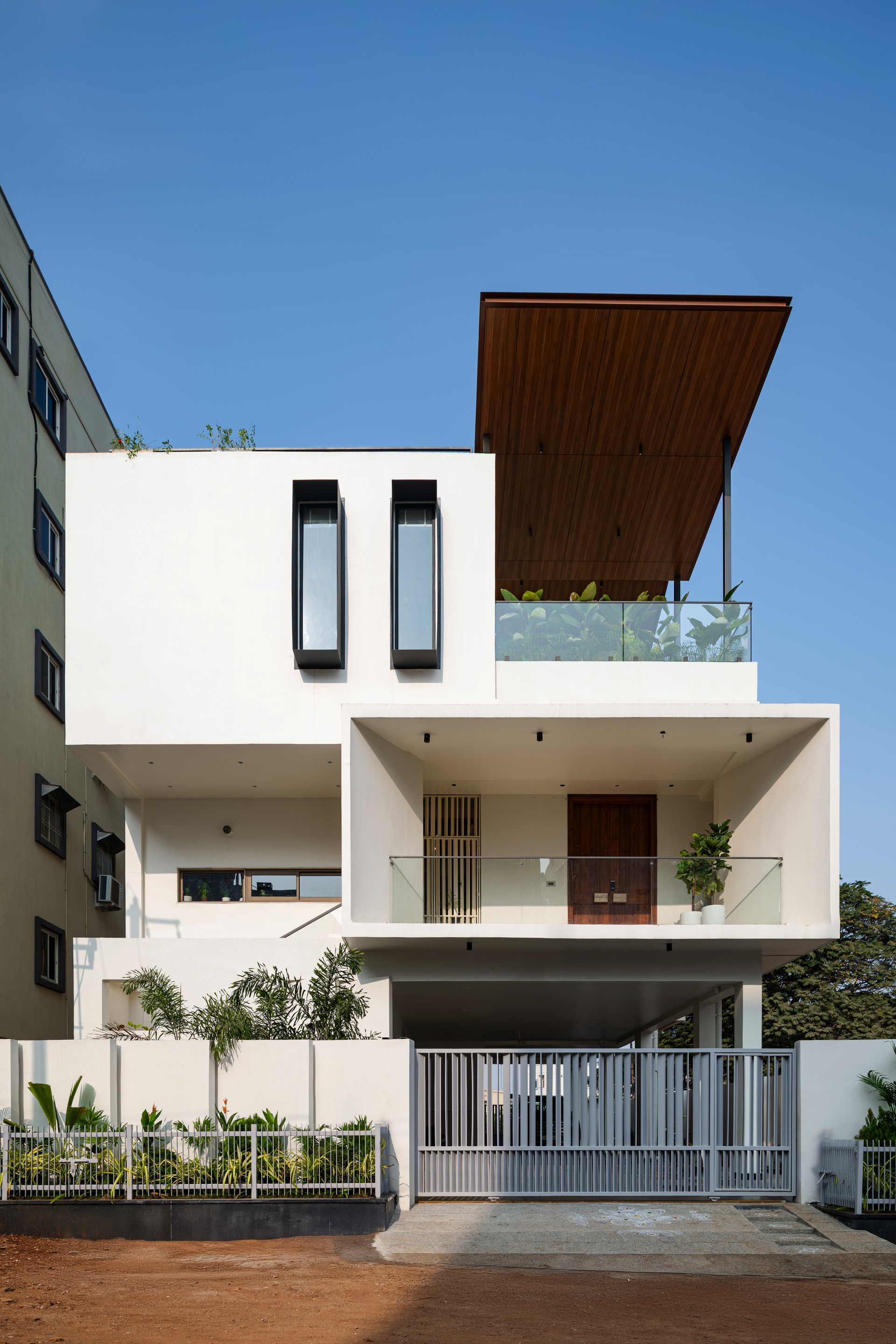
The street facade resolves the home’s interior language in massing. A cantilevered teak-clad canopy floats over the upper terrace, set against stacked white volumes punctured by tall slim windows. The composition reads as a series of confidently held boxes, with the teak underside of the roof acting as the building’s signature.
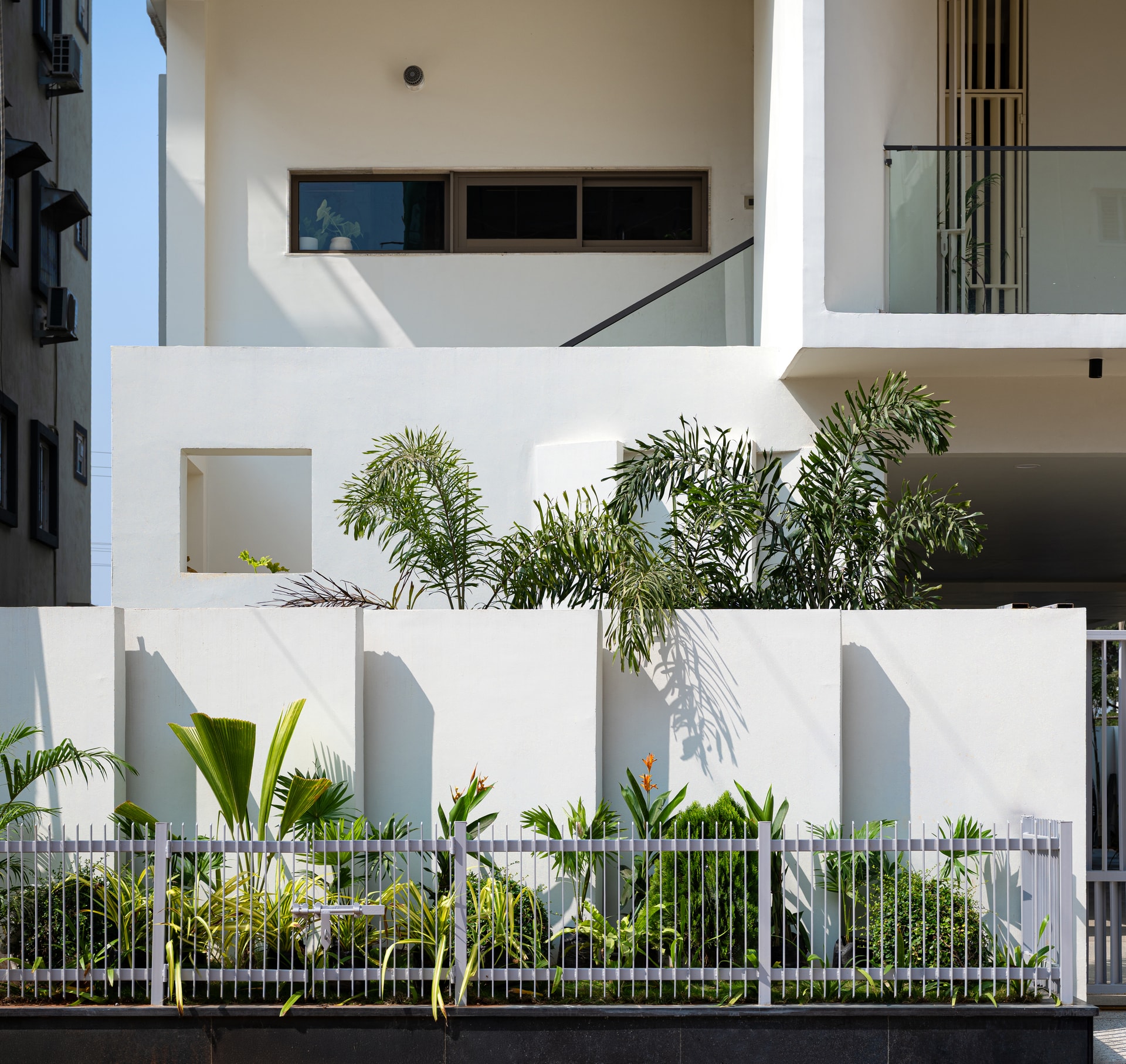
A view of the compound wall and front planting confirms how thoroughly the project integrates landscape into its architectural reading. The white perimeter wall, articulated with a single square aperture and a stepped profile, holds the planted edge like a quiet plinth for the home above.
In a city where new residential architecture often leans toward the assertive, Jupiter House makes its case through restraint. The travertine is not a luxury statement so much as a structural one, a single tonal field that allows the home’s volumes, levels, and openings to register clearly. The teak does the work of warmth without ornament.
What the project finally argues is that domestic architecture can be composed in the same way as a long piece of music: through phrasing, return, and the careful management of silence. Jupiter House is a home where the design does not announce itself in any single room, but accumulates across the whole.