A workspace is rarely asked to feel like a home, just as a home is seldom allowed to function as a workplace. The conventional office is designed for productivity; the conventional residence for retreat. Between these two conditions lies a quieter possibility, one that Studio Aatman has spent the past year exploring in a tree-lined lane off Pune’s Senapati Bapat Road.
Their own studio, Daftaar, occupies a compact 450-square-foot footprint within a dilapidated one-bedroom bungalow set on a triangular plot. Encircled by nearly 1,300 square feet of lush landscape dotted with mango, jackfruit, coconut, and a mature champa tree, the structure offered more than a site, it offered a temperament. Led by architects Prathamesh Kubal and Tanvi Dubbewar, the intervention did not seek to overwrite the bungalow’s character but to work in conversation with it.
Walls were selectively removed to establish visual continuity, the former kitchen was transformed into a quiet waiting area, and a continuous workstation volume was introduced to draw the eye from the front garden through to the rear. Rather than a conventional renovation, Daftaar emerges as an exercise in attentive adaptation, where architecture blurs the familiar boundaries between dwelling and workplace, creating an environment that feels equally suited to concentration, conversation, and pause.
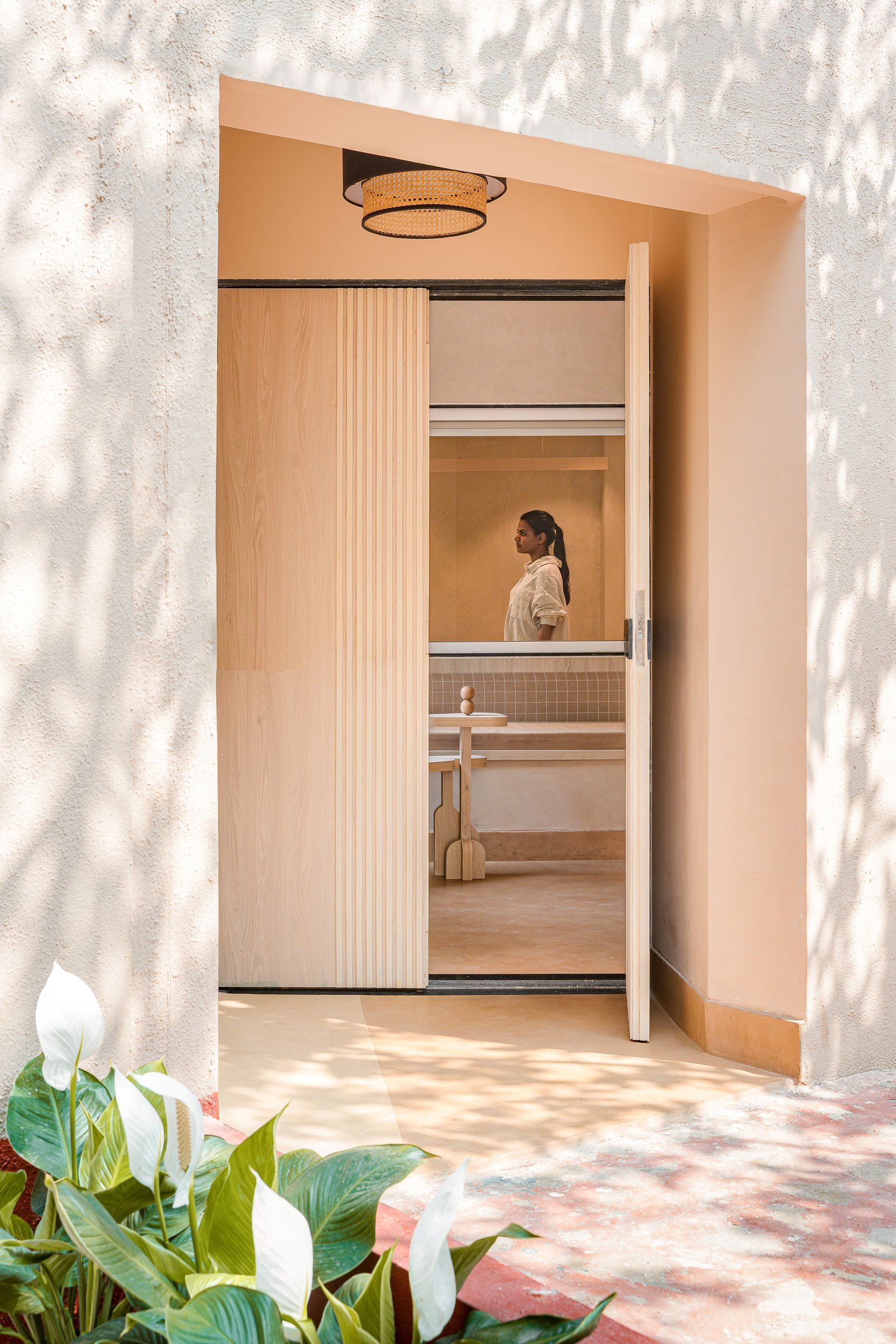
The arrival establishes the project’s intent immediately. A peach-toned porch frames a pivoting entrance door, composed of light wood panelling and fluted detailing, its surface animated by shifting shadows from the trees above. Through the opening, glimpses of plywood joinery and a woven cane pendant offer a warm, domestic welcome. The threshold deliberately resists the visual language of the conventional office, choosing familiarity and ease over corporate formality.
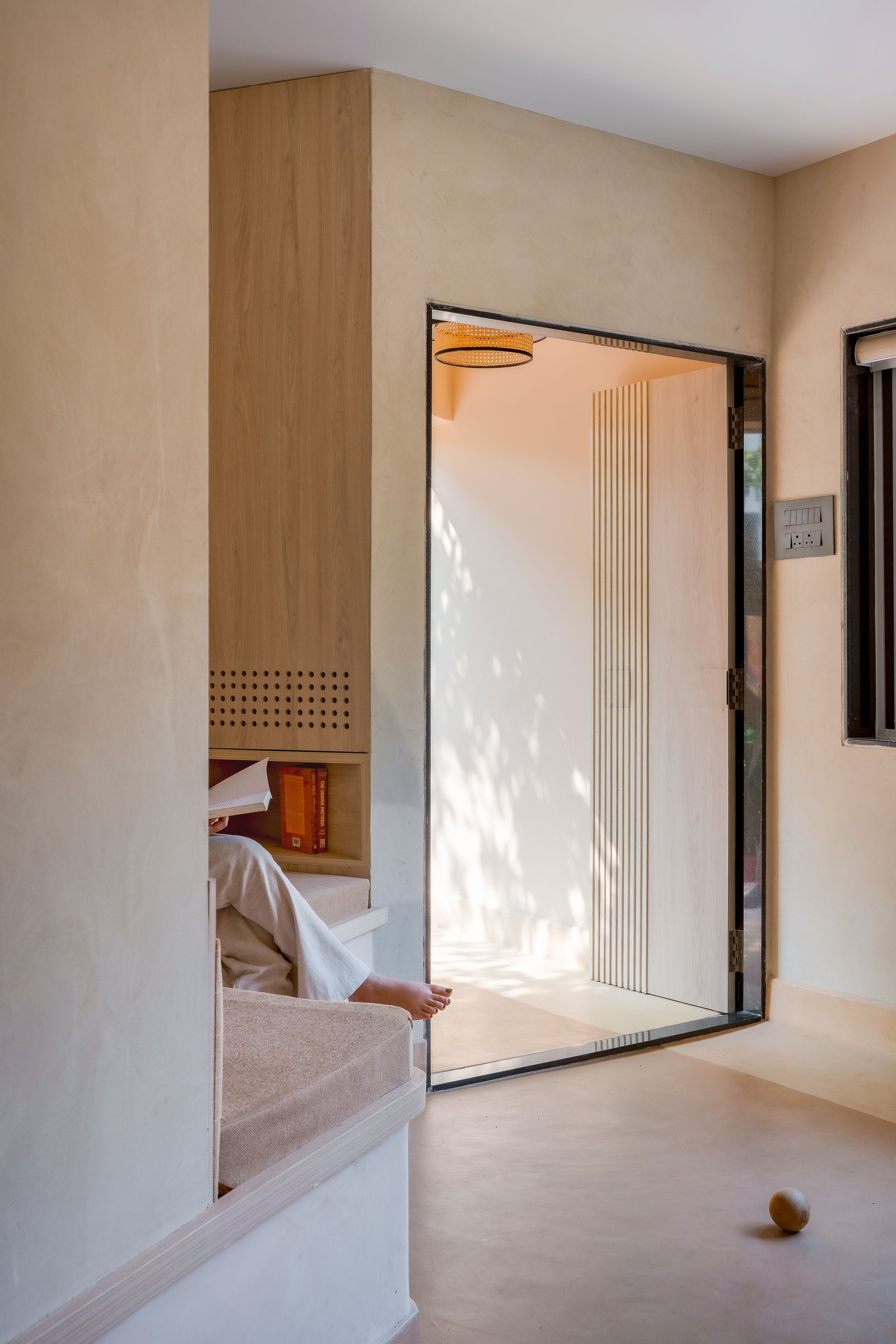
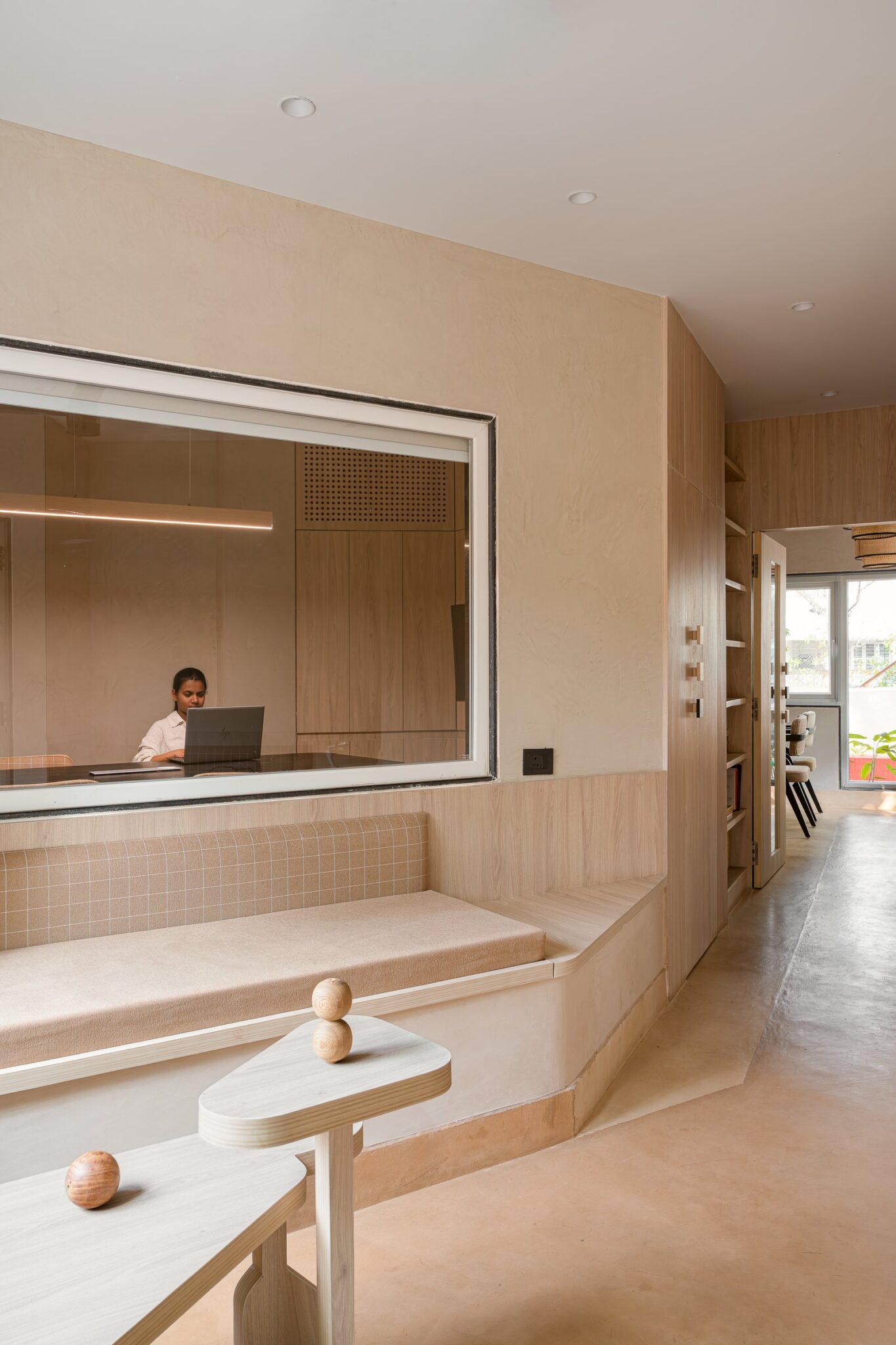
Step inside, and the vocabulary continues with quiet consistency: lime-washed walls in a soft warm beige, microcrete underfoot, and pale wood joinery that absorbs the functions of door, storage, and partition without declaring any of them. To the left, an upholstered ledge invites an easy pause, a book held just out of frame, a gesture that feels unmistakably domestic.
This waiting space, carved out of the former kitchen, becomes the project’s clearest refusal of conventional office behaviour. It does not perform arrival through reception desks or formal seating. Instead, it asks visitors to slow down, settle in, and enter the studio through a mood of ease rather than transaction.
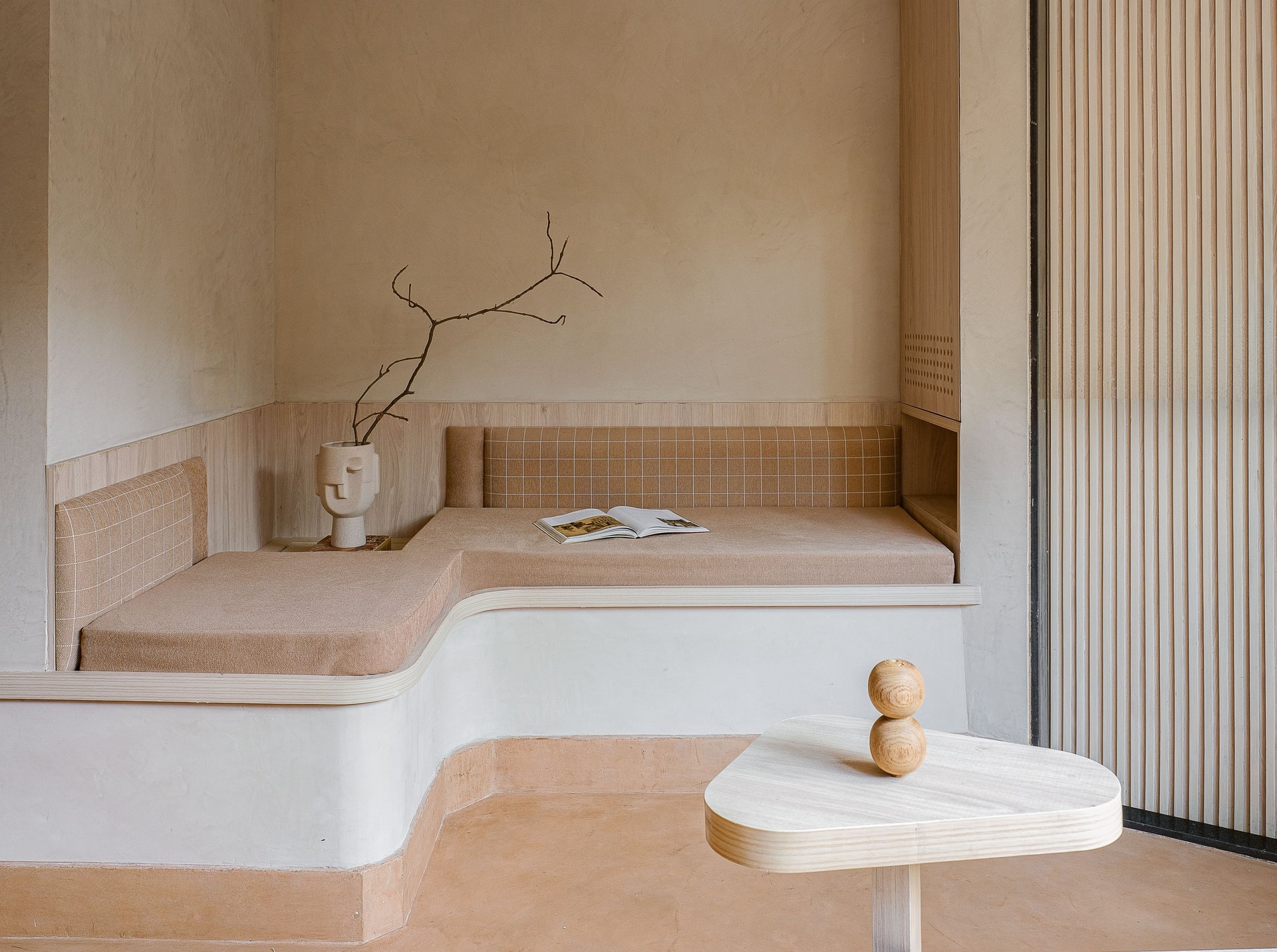
The seating forms the room’s quiet focal point: a built in L shaped bench upholstered in warm sand toned fabric, paired with a check patterned backrest and anchored by a terracotta tinted oxide plinth that lends weight to the pale plaster backdrop. E
The restraint at work here is less about minimalism than precision. The result feels composed rather than sparse, warm rather than decorative.
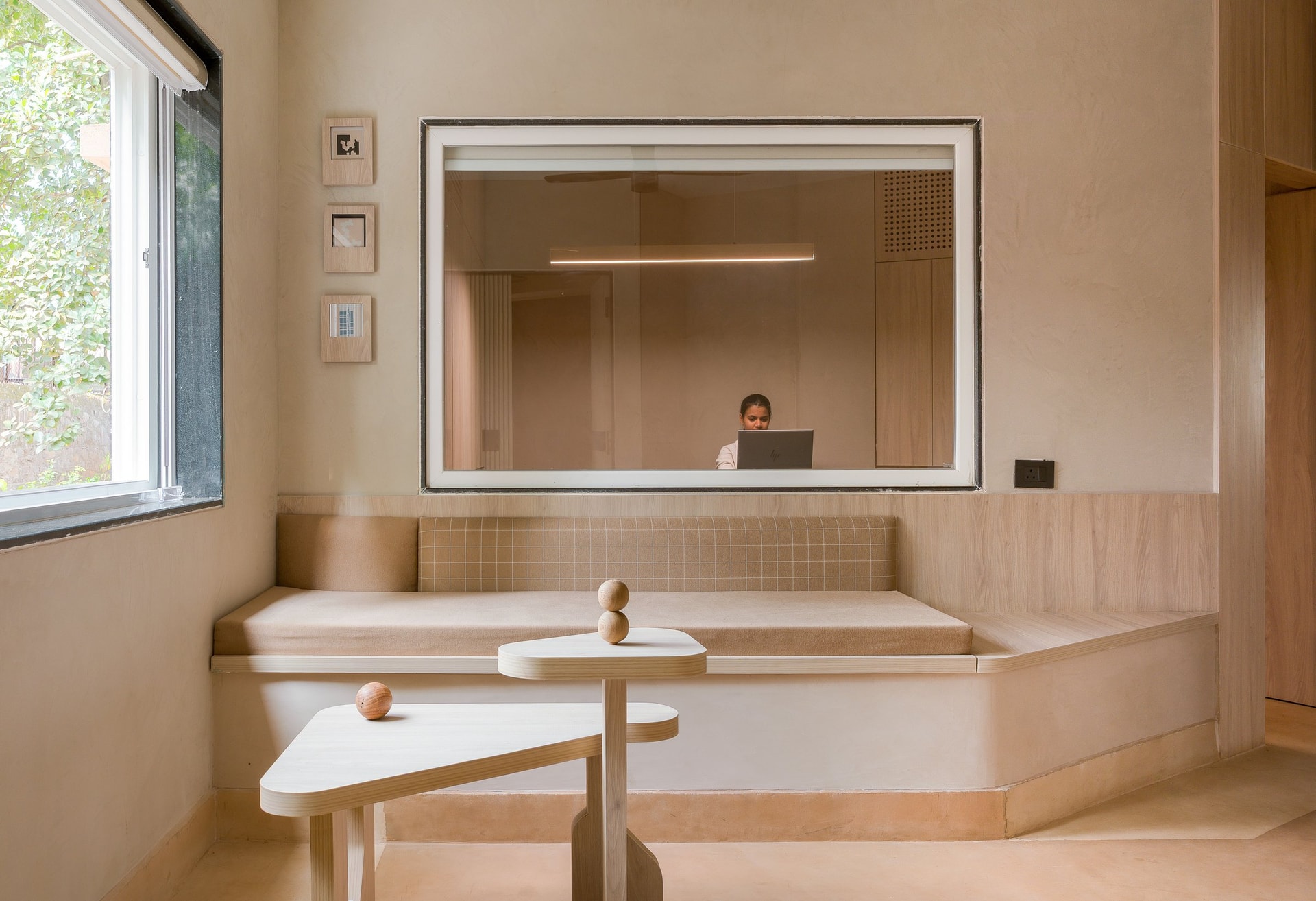
Above the bench, a horizontal window is cut cleanly into the wall, framing a carefully composed view of the workspace beyond. The opening creates a visual connection without compromising separation, allowing activity to be observed rather than imposed upon the room.
More than a functional aperture, the window acts as a curatorial device. It borrows from the language of domestic architecture, where internal openings are used to create relationships between spaces while preserving their individual character. Here, it transforms the everyday act of working into part of the studio’s visual narrative.
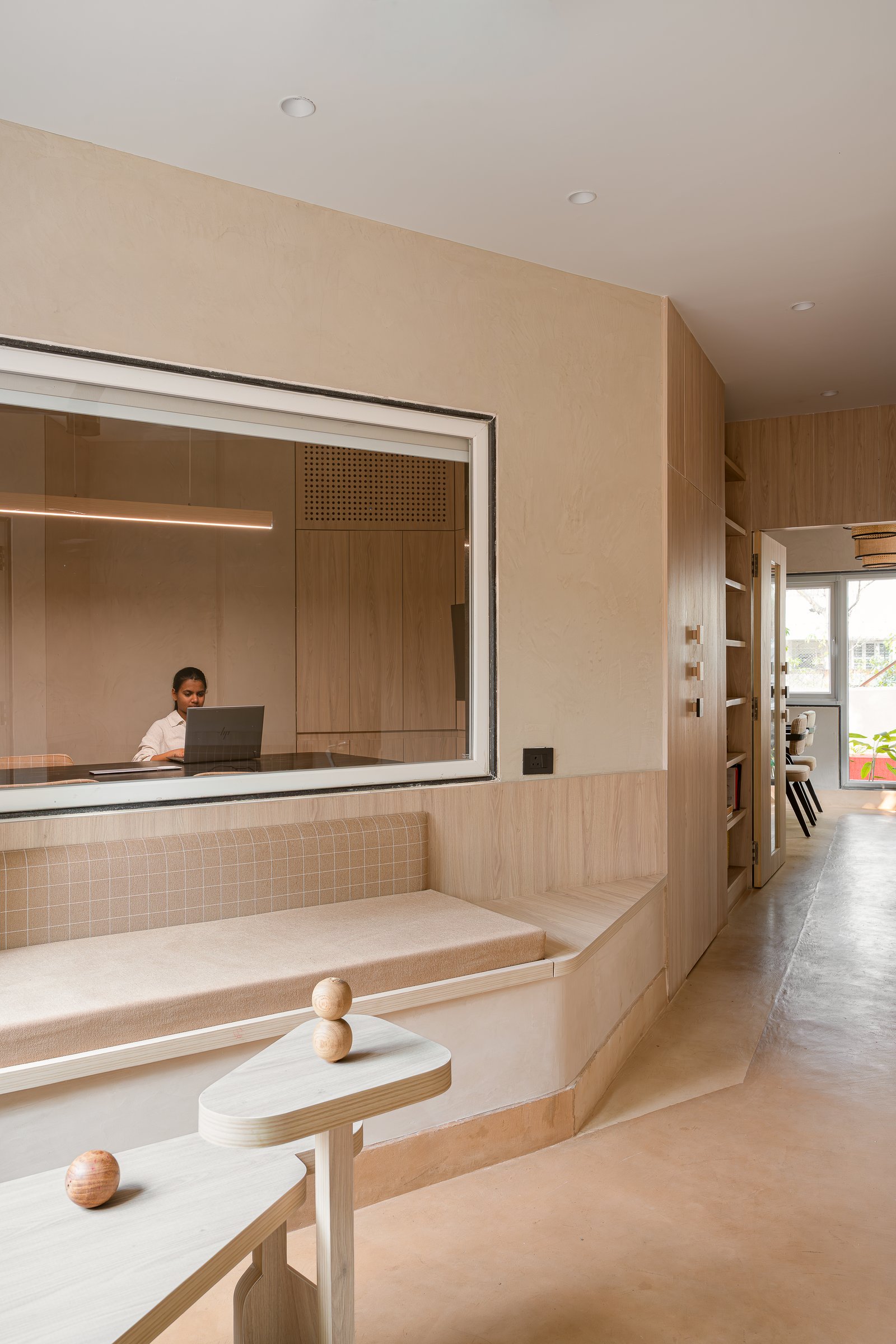
From the waiting bench, the spatial sequence begins to reveal itself. A wood panelled volume to the right accommodates open shelving and a flush door, beyond which the main workspace stretches toward the rear garden. The continuity of the microcrete flooring draws the eye forward without interruption, allowing the former rooms of the bungalow to read as a single, connected volume.
This sense of openness is achieved not through complete removal, but through careful editing. Boundaries remain present yet understated, defined by changes in function rather than physical enclosure. The result is a workspace that unfolds gradually, maintaining a sense of intimacy while extending visual depth through the length of the studio.
““The intervention focused on a compact 450 sq.ft footprint. Within this constraint, the studio found an opportunity to craft a workspace rooted in familiarity, openness, and a strong connection to the outdoors.””
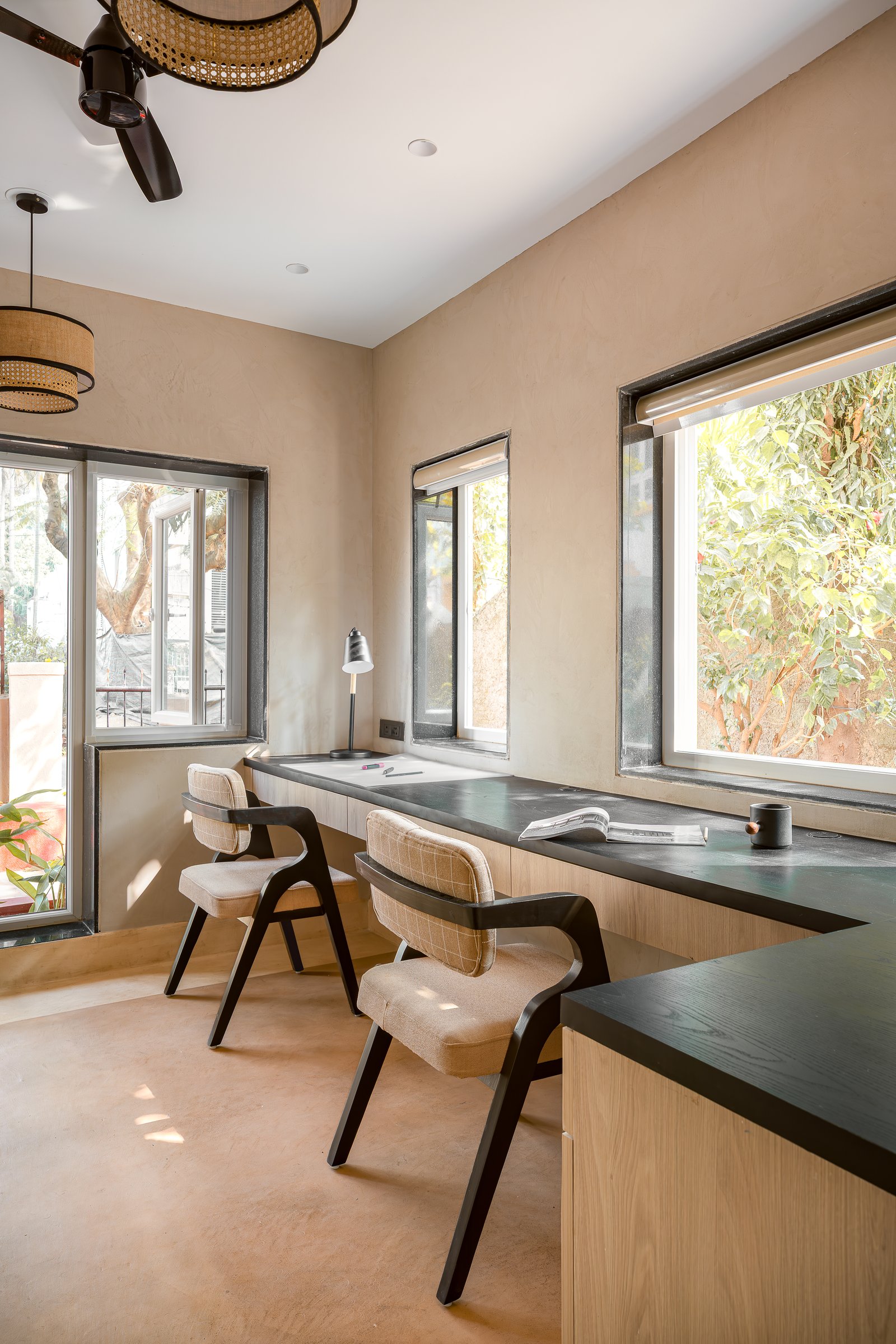
The main workspace reveals itself as a long counter running beneath a trio of windows, its dark stone surface set against pale wood cabinetry. Two chairs with sculpted dark frames and upholstered seats are positioned to face the greenery outside, while a task lamp and a ceramic mug provide small signs of occupation along the otherwise disciplined line of the desk.
What distinguishes the space is its orientation. The desk is positioned not against a wall but toward a view, allowing the surrounding landscape to become an active participant in the working day. Here, attention is directed outward to foliage, shifting light, and the rhythms of the garden beyond, reinforcing the studio’s belief that productivity need not come at the expense of calm.
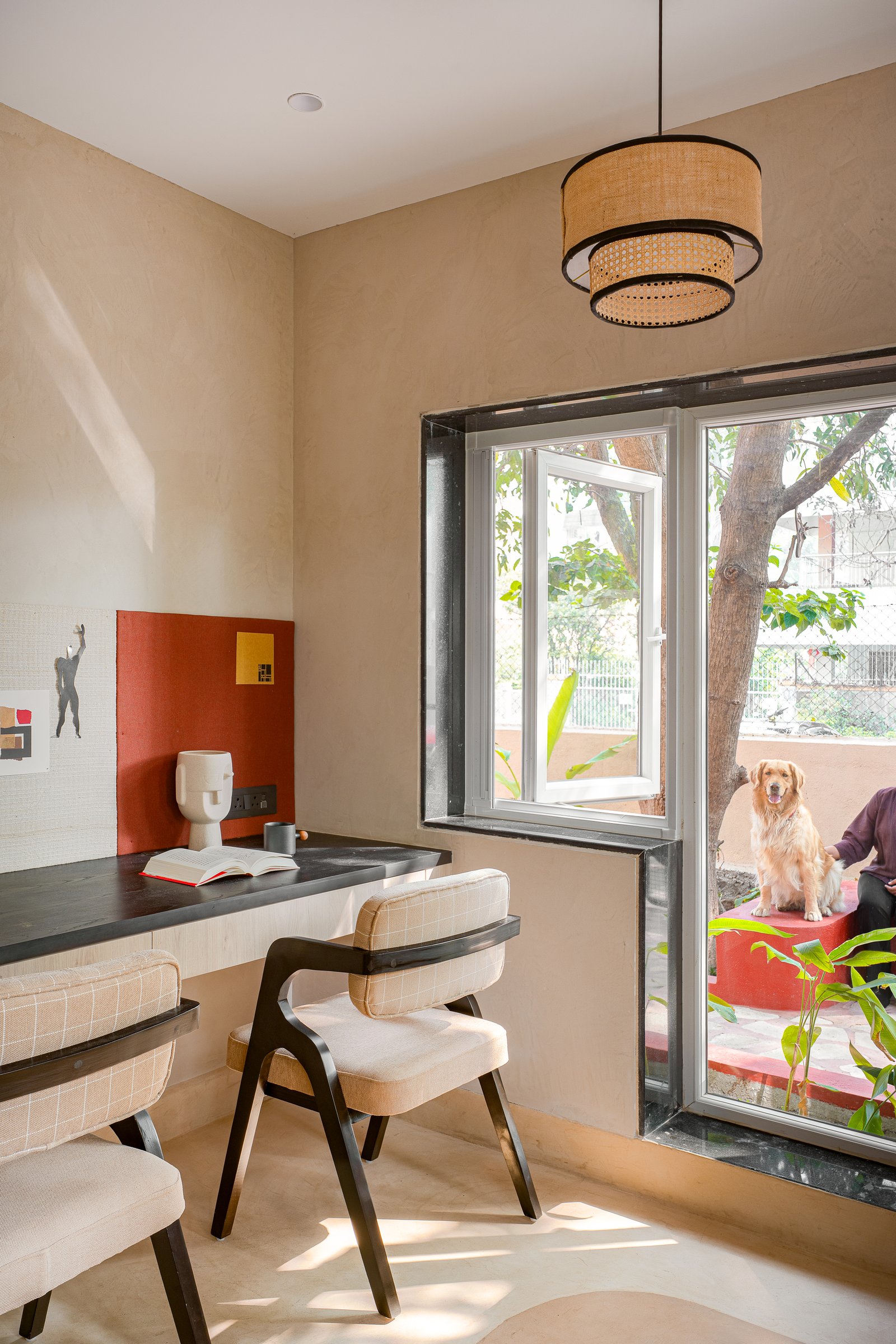
This is what a working office looks like when the architects have refused the visual conventions of one. There are no acoustic ceiling tiles, no whiteboards, no banks of monitors competing for attention.
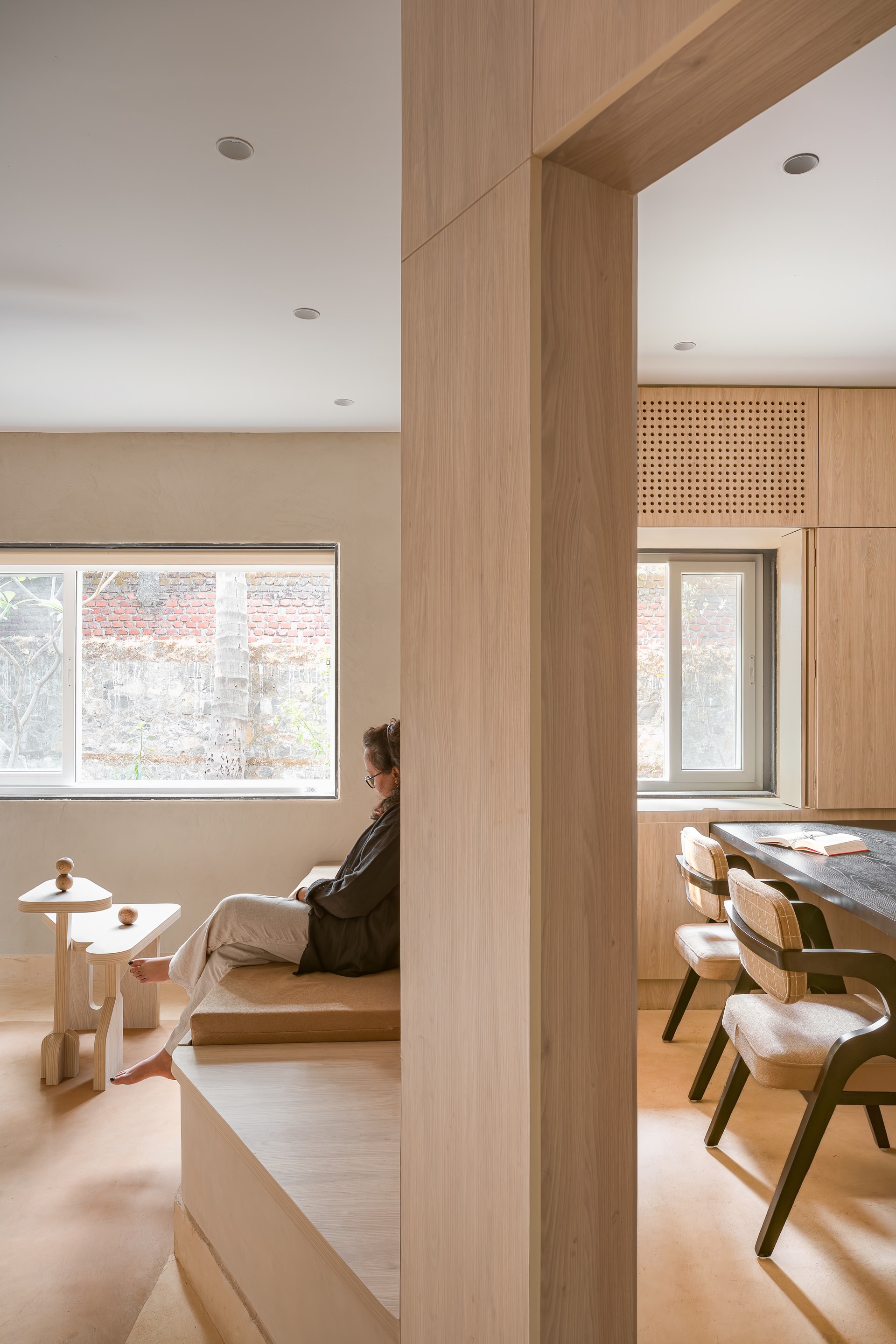
A wood clad partition marks the transition between the main workspace and the conference room beyond, yet its role is less about separation than orchestration. Through the opening, both spaces are revealed at once: to one side, an upholstered ledge sits beneath a window framing an old stone and brick boundary wall; to the other, a dark wood conference table is surrounded by the same check backed chairs that appear throughout the studio, creating a sense of continuity rather than distinction.
The partition carefully calibrates privacy and connection. It allows each zone to receive its own quality of light and occupation while maintaining a visual relationship between them. Rather than dividing the studio into discrete rooms, it choreographs a sequence of views, encouraging the eye to move fluidly from one space to the next.
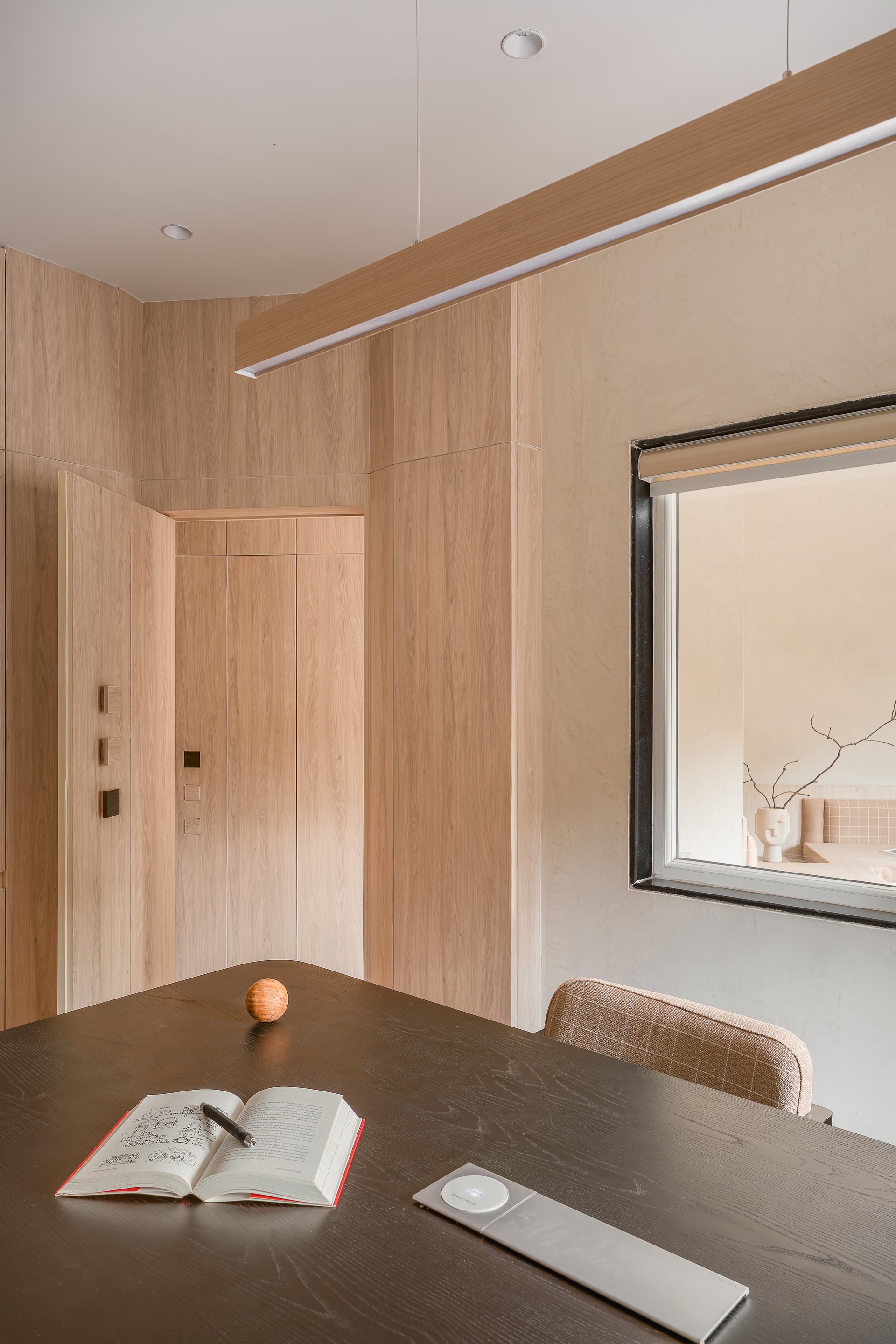
Inside the conference room, the material language shifts with subtle confidence. Pale wood panelling wraps the walls, while a perforated band above the joinery introduces texture and quietly accommodates ventilation. A slim linear pendant runs the length of the dark wood table, reinforcing the room’s measured simplicity and drawing attention to the conversations it is designed to host.
An internal window on one side looks back toward the waiting area, completing a carefully considered network of sightlines that threads through the studio. These visual connections allow each room to borrow depth from the next, making the modest 450 square foot footprint feel far more expansive than its dimensions suggest. Rather than relying on openness alone, the project creates generosity through visibility, where every space remains aware of the others.
If the interiors argue for slowness, the landscape argues for rootedness. The front yard is treated not as decorative buffer but as primary programme.
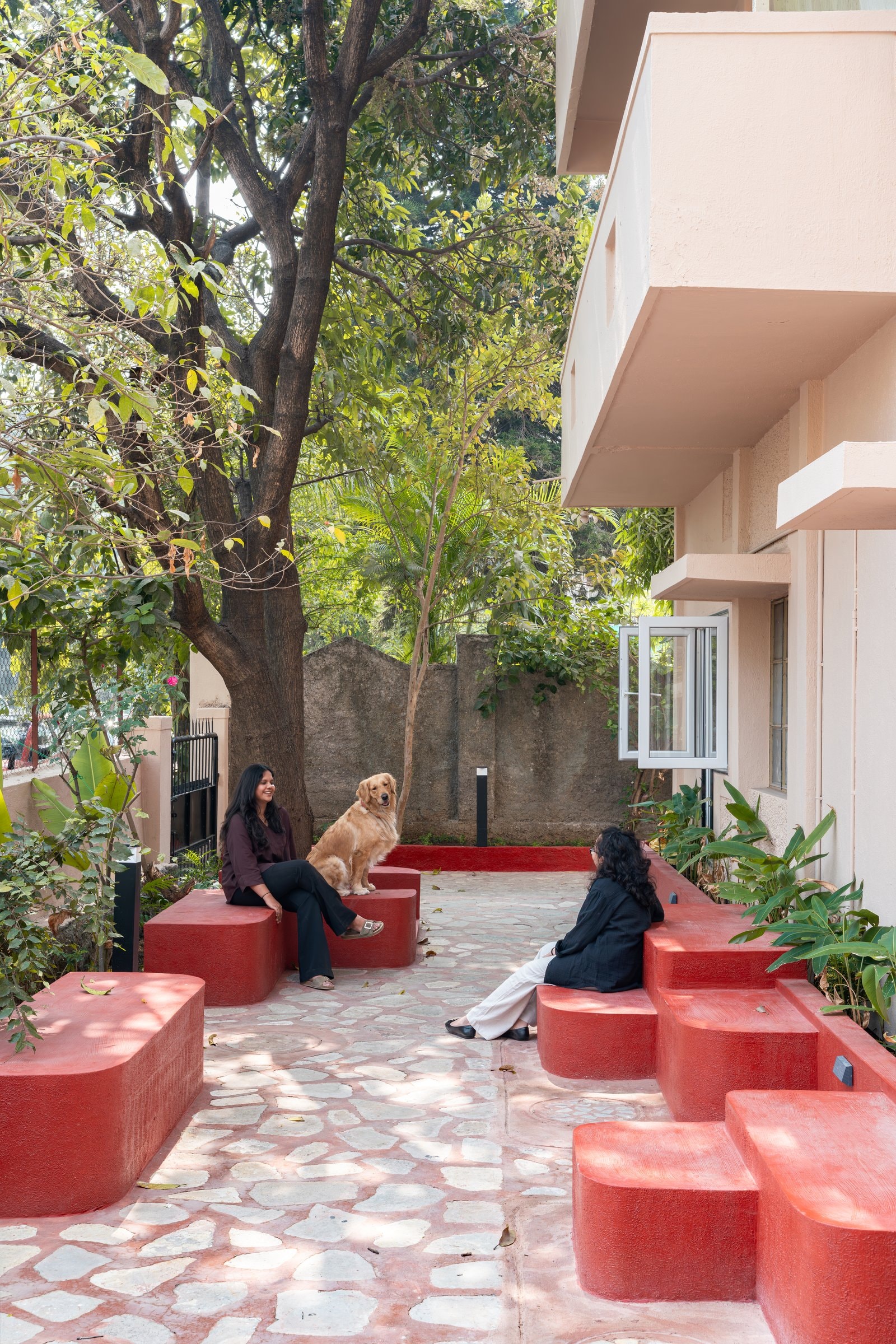
Beyond the enclosed rooms, the studio opens into a courtyard shaped as much by reuse as by landscape. Stepped seating in a rich oxide red terraces gently through the site beneath the canopy of a mature champa tree, its form cast in situ using debris salvaged from the demolition. Underfoot, reclaimed Shahabad stone has been reassembled into an irregular crazy paving pattern, its fragments stitched together with oxide grouting that echoes the warmth of the seating.
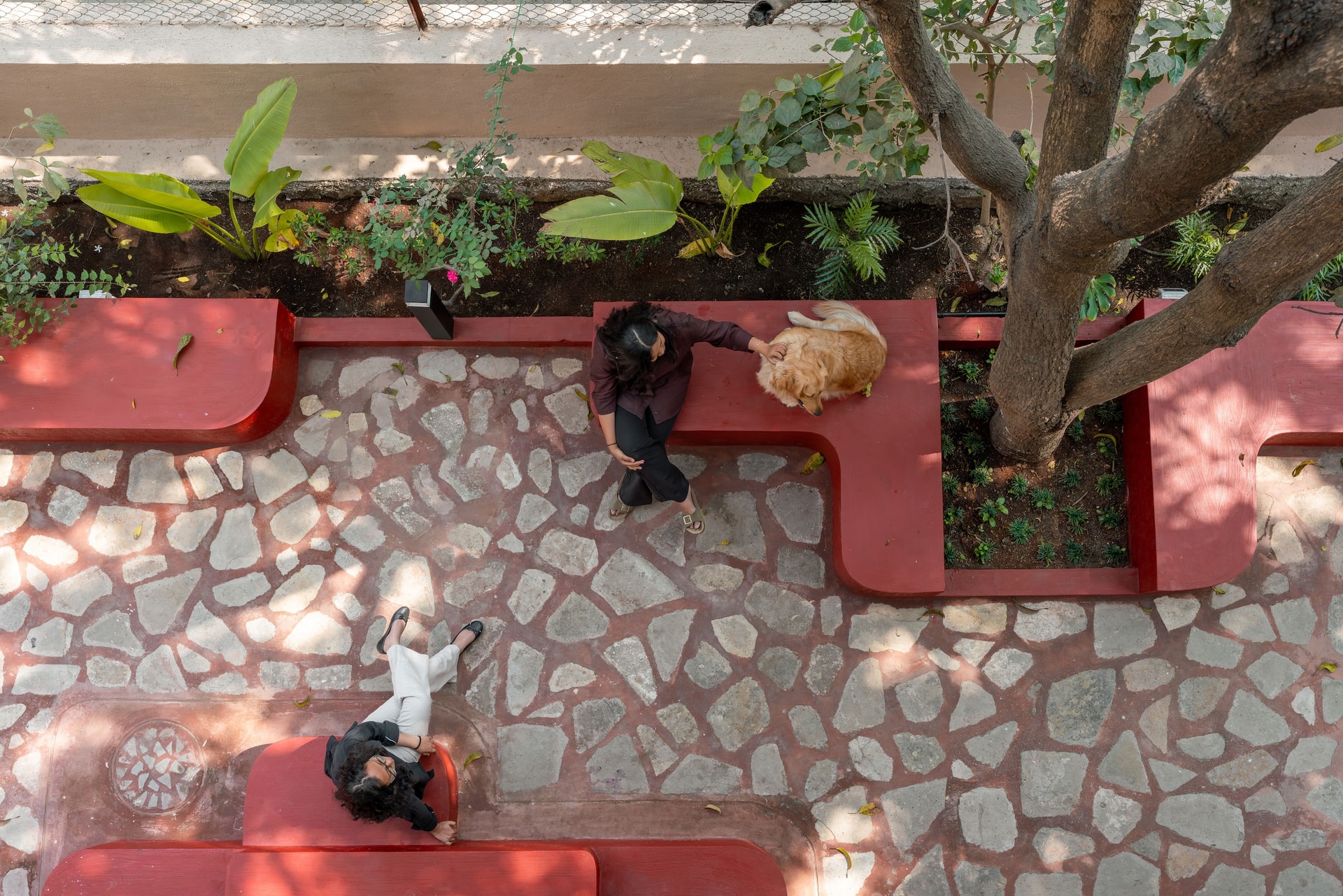
Daftaar belongs to a growing group of Indian design practices that see value in adaptation rather than replacement, and in working within modest footprints rather than pursuing constant expansion. The decision to retain the irregular shell of the former 1BHK, reuse its demolition debris, and allow a mature champa tree to shape the spatial organisation is not an exercise in nostalgia. It is a considered position on how cities such as Pune can evolve without discarding the layers of character embedded within their older neighbourhoods.
What ultimately lingers is the project’s rejection of the conventional divide between home and office. Studio Aatman has created a workplace that takes its cues from domestic life, where work unfolds at the pace of the garden, where a visiting client and a sleeping dog comfortably share the same threshold, and where architecture prioritises ease as much as efficiency. Within just 450 square feet, Daftaar offers a compelling proposition: that the quality of a practice is defined not by the size of its office, but by the generosity of the environment it creates.