In a city where rainfall dictates the rhythm of routine and the boundary between seasons grows increasingly unstable, the question of how architecture might respond to weather, rather than resist it, has become quietly urgent. The conventional answer is enclosure: tighter envelopes, drier interiors, sharper distinctions between in and out. Another answer is to give up that distinction altogether.
That second proposition is the argument made by Liminal Pavilion, a 768 sq. ft. structure designed by Rust Collective on the campus of the School of Environment and Architecture (SEA) in Mumbai. Commissioned through an open call by Invisible Dust, Raqs Media Collective, the Goethe Institute and SEA Mumbai to mark the school’s tenth anniversary, the pavilion sits in a residual zone between building and boundary wall, between trees and built form. It is conceived not as an object placed in a landscape but as a porous condition assembled within it.
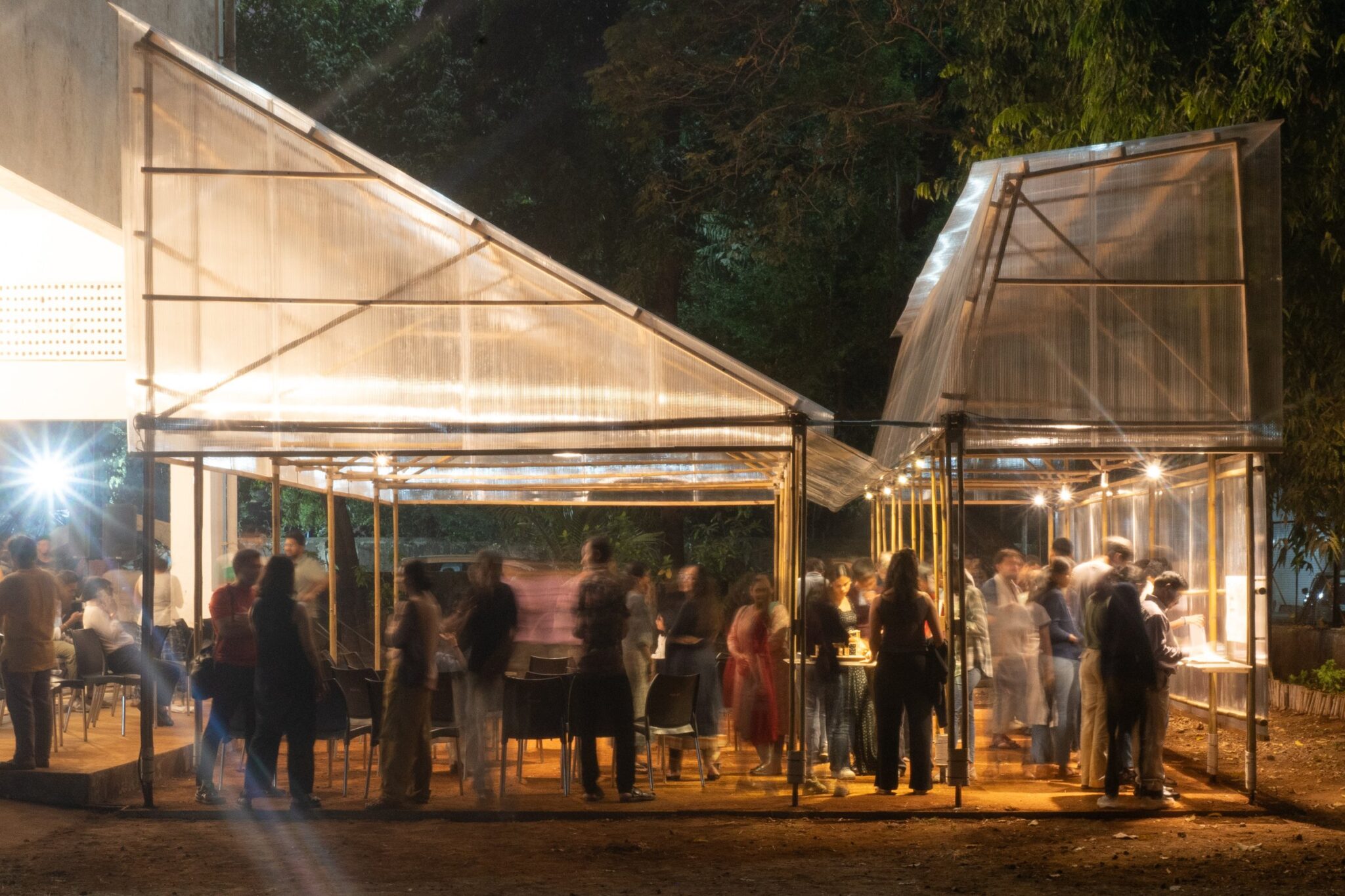
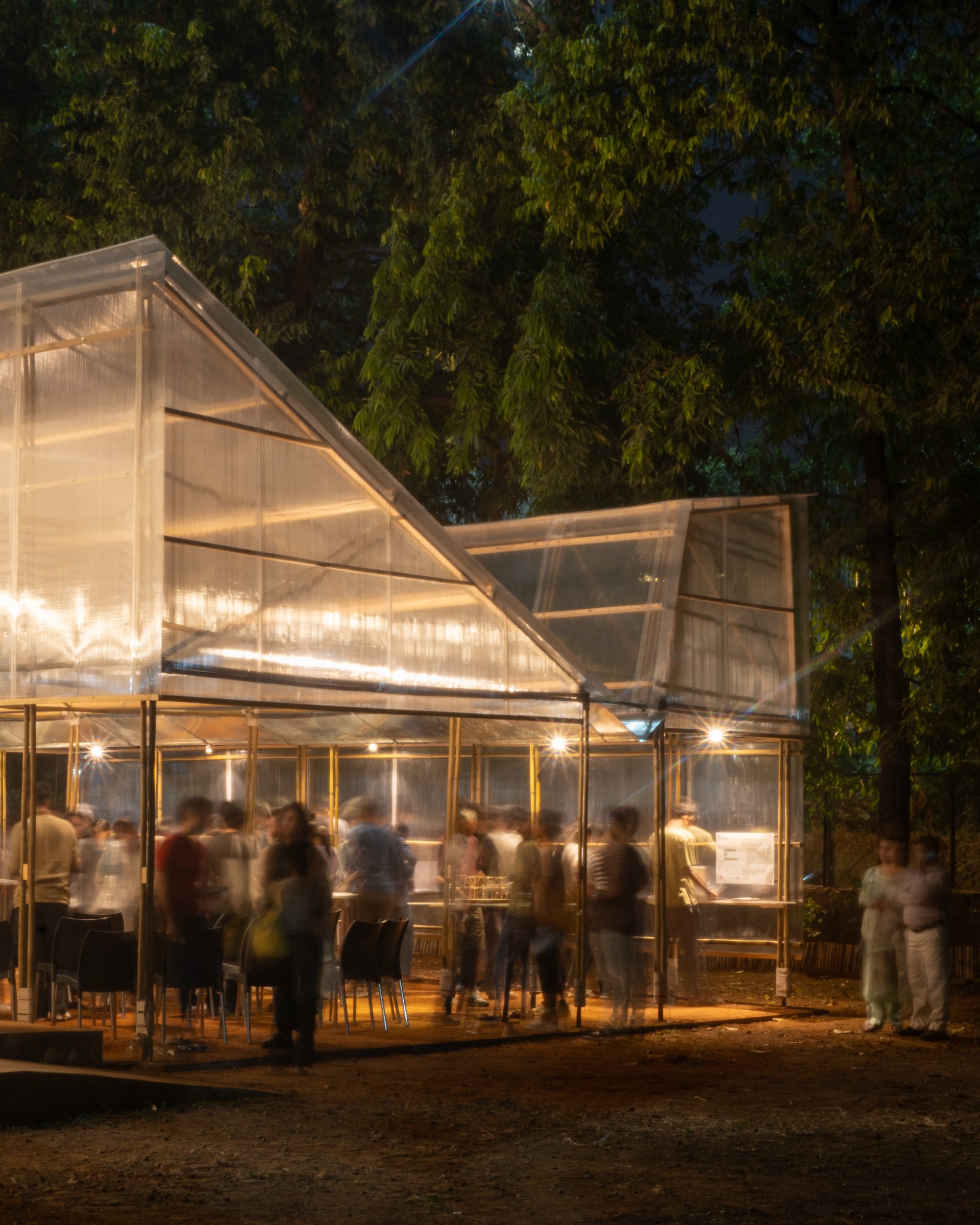
Seen at dusk, the pavilion reads as two translucent volumes joined at the centre, their inverted roof planes lifted on slender bamboo stilts. The polycarbonate envelope glows from within, gathering the warm light of a public evening and dispersing it into the surrounding trees. The people around the chairs and tables register the building’s intended life: discussion, gathering, exhibition, the slow choreography of an evening on campus.
The pavilion announces itself less through silhouette than through luminosity. Where most campus structures sit heavily against the ground, this one appears to hover, the line between interior and exterior dissolved into a continuous translucent skin.
From the longer elevation, the geometry resolves into a clearer reading. The roof folds in on itself, creating a section that admits filtered light from above while allowing the building’s edges to remain open. The pavilion’s proportions follow the golden ratio, used here not as ornament but as structural framework, lending coherence to a composition that might otherwise read as improvised.
““The pavilion rethinks shelter not as enclosure but as continuity, a spatial and material response to the extended, erratic seasons that climate change has now made inevitable.””
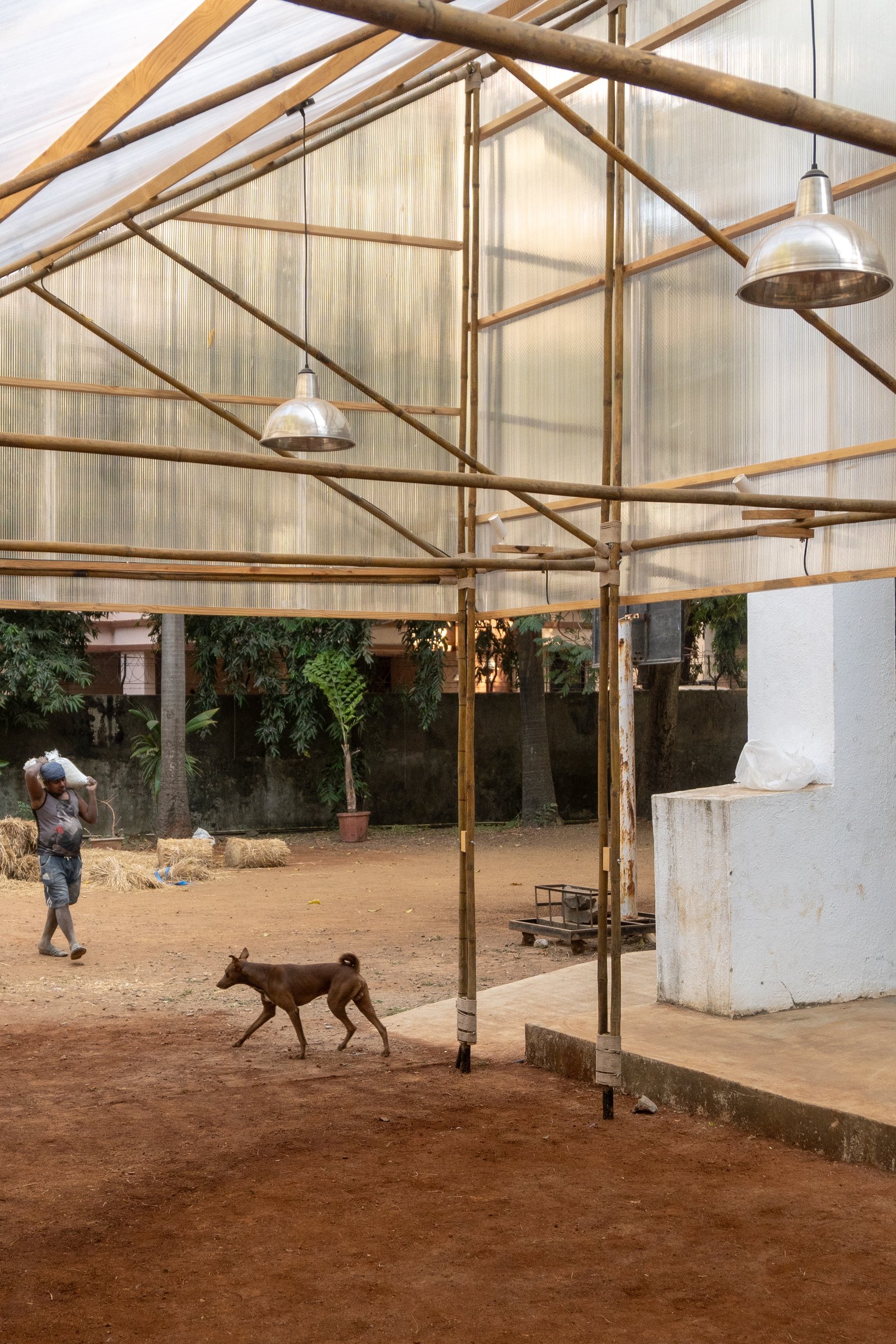
In daylight , the structure reveals its constructional logic. The bamboo frame stands as a series of slender portals braced by diagonals, the polycarbonate sheets above acting as a luminous ceiling rather than a sealed roof. The floor is the campus ground itself, packed earth that continues uninterrupted beyond the line of the columns.
The decision to leave the ground untreated is not casual. It registers the project’s argument that architecture need not insulate itself from the site it occupies; materials across the frame all belong to the same continuous space the pavilion attempts to hold.
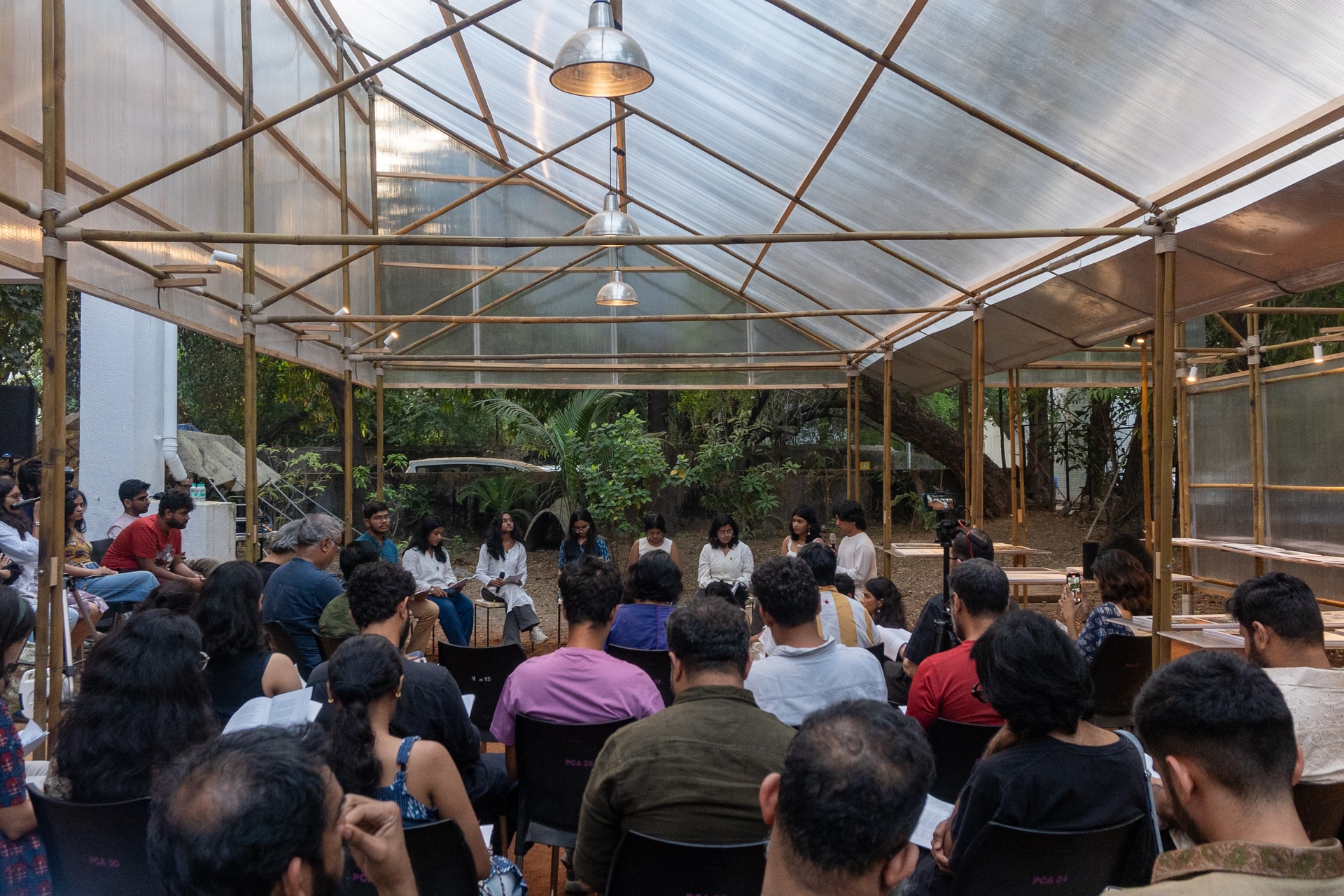
Programmatically, the pavilion is open-ended. It functions as a space for discussion, dialogue, display and performance, a neutral but charged ground that invites occupation rather than dictating it.
The filtered light from above and the constant movement of leaves visible through the translucent envelope create an atmosphere both grounded and ethereal. The pavilion holds the gathering without insisting on a hierarchy of stage and seat, lectern and audience.
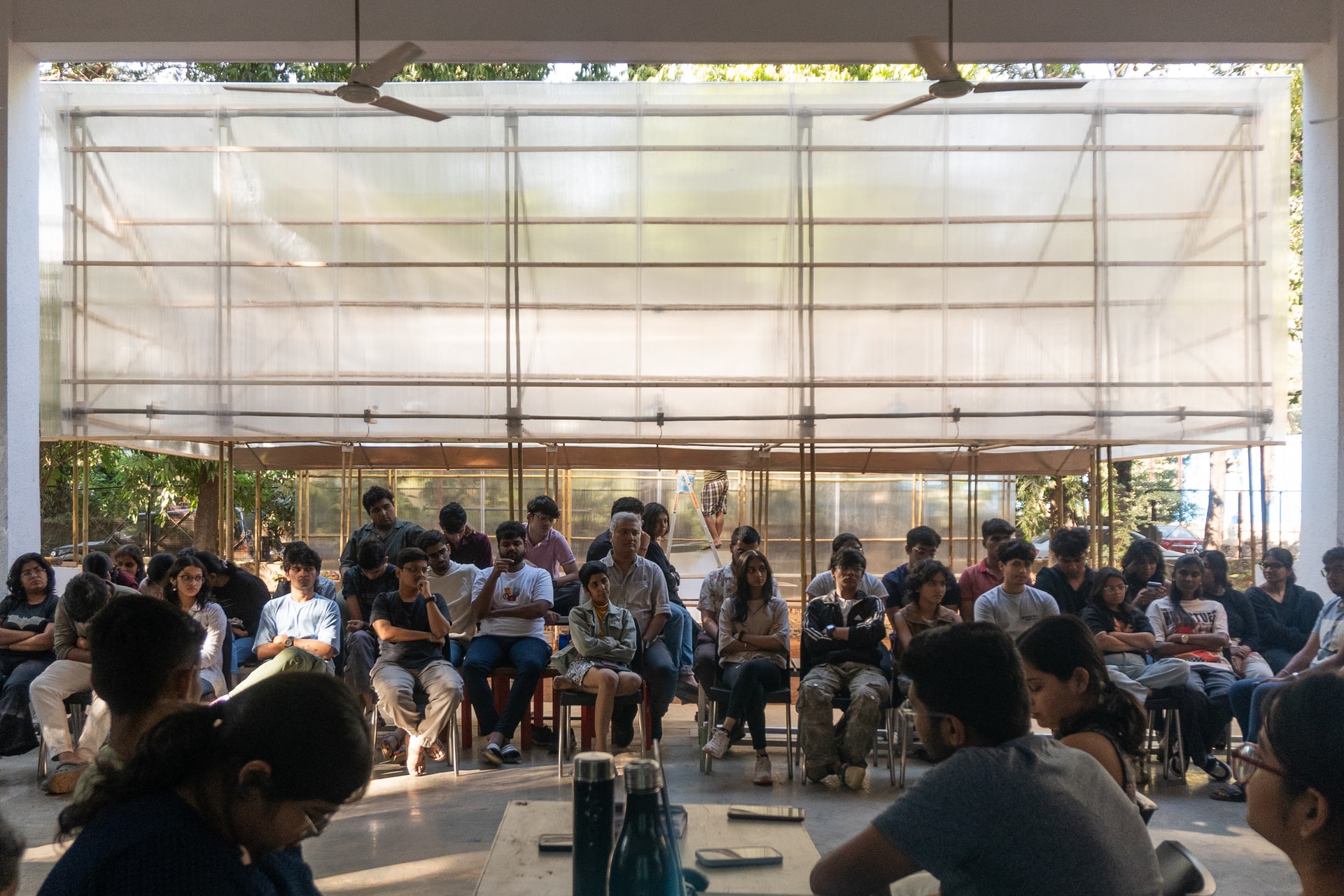
The polycarbonate skin softens the light passing through it, turning the structure into a quiet backdrop for the everyday rhythms of the school. The bamboo frame is legible behind the surface, a faint linework that registers the discipline holding the form together.
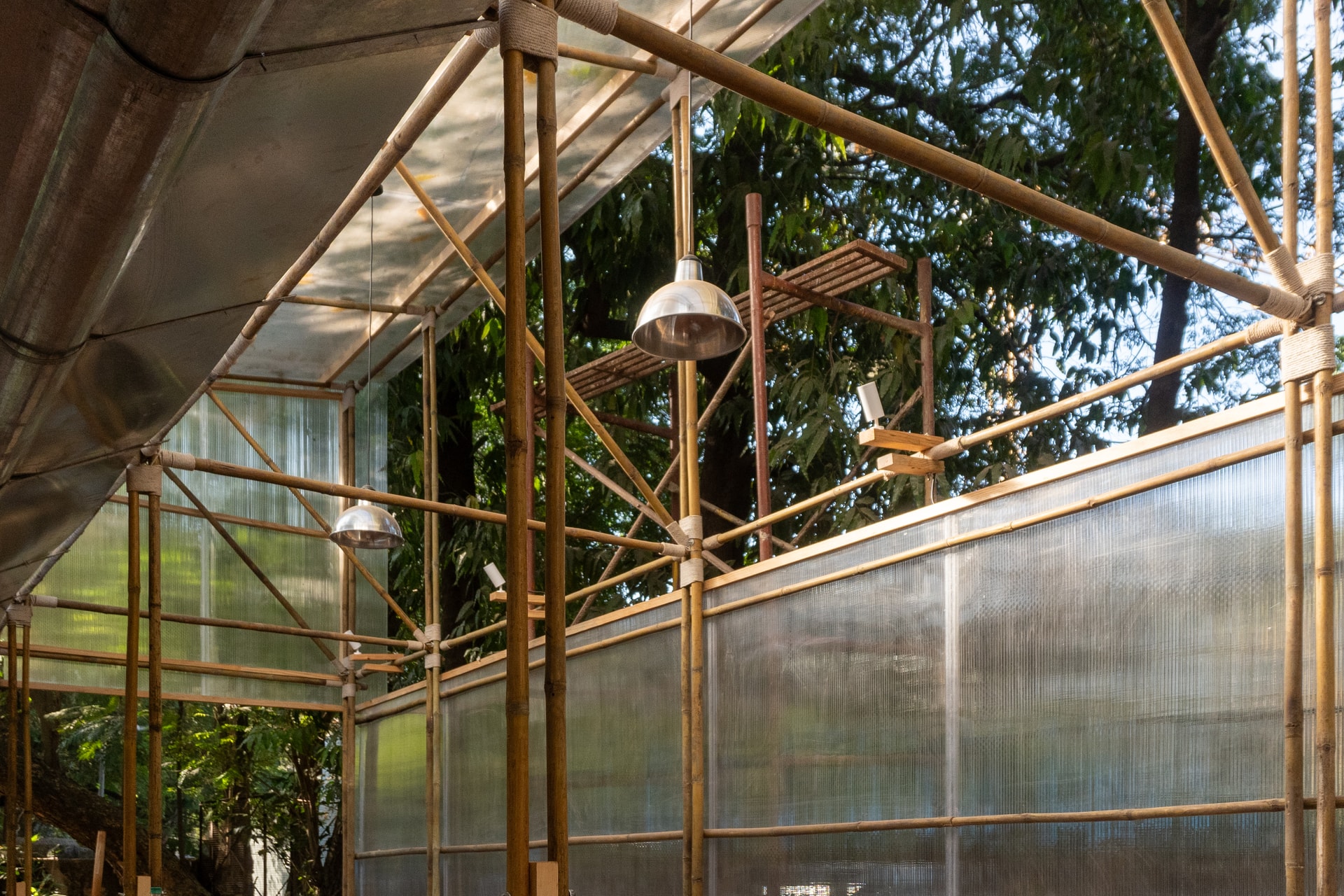
The interior frame, closer to the eye, shows how the system actually works. Bamboo members of different diameters are bound with jute at every junction, the heavier verticals carrying load while lighter members brace the geometry. Industrial pendant lamps hang from the rafters; a small bamboo gallery rail floats beside one of the columns, ready to hold drawings or printed matter.
The structure resists the impulse to close itself off, choosing instead to remain receptive to sound, breeze and movement. The trees press up against the polycarbonate and read through it as colour and shadow.
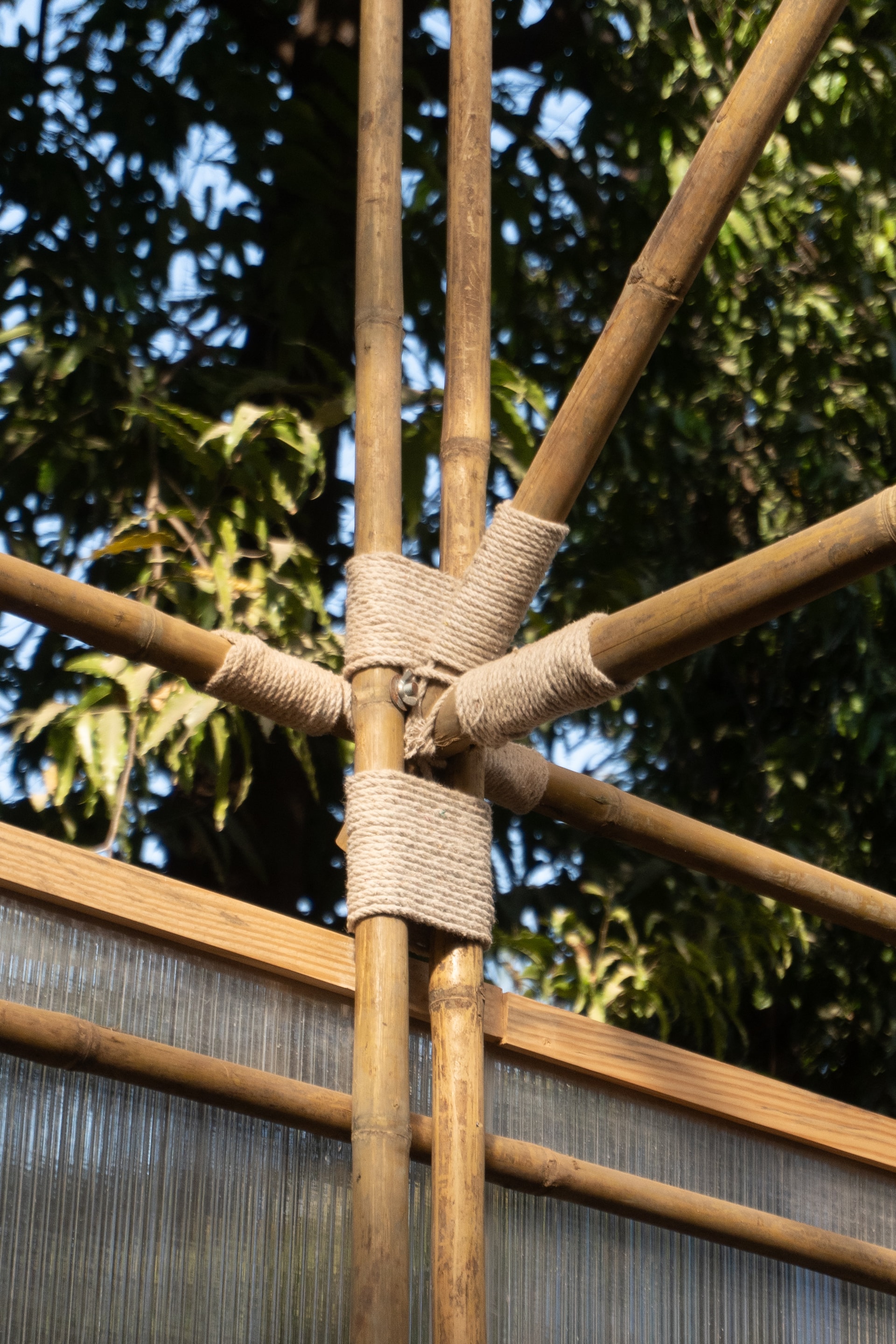
Jute rope wraps each junction in tight bands, locking the bamboo members together with a single metal bolt at the core reinforcing the binding. The detail is unembellished and exact; it carries the logic of the handmade that the studio identifies as its working method.
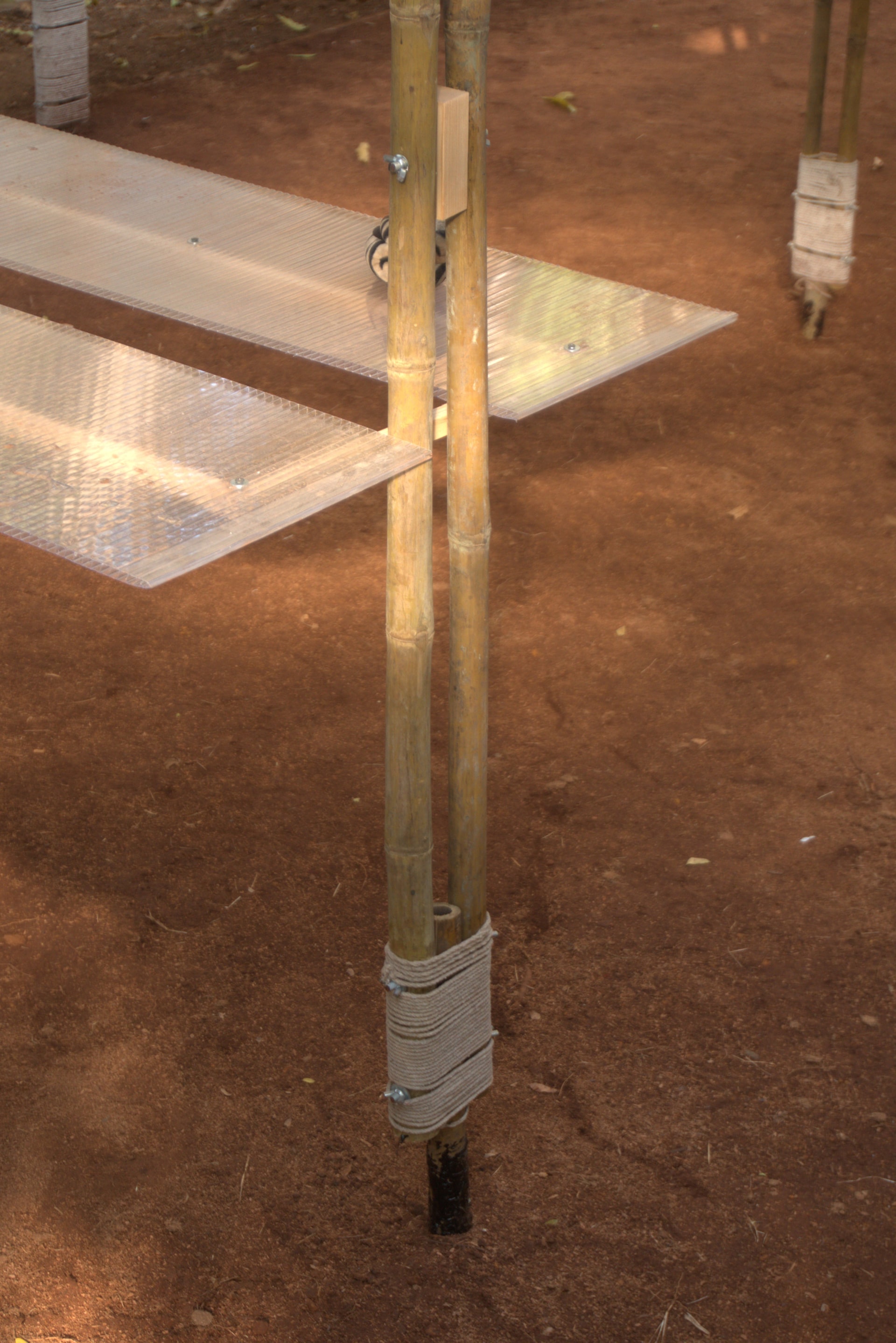
At the base, the same restraint governs the connection to the ground. The bamboo columns are sleeved over short metal stubs anchored into the earth, the join wrapped again in jute. Slim polycarbonate trays cantilever off the column as informal display surfaces. The detail acknowledges that the pavilion is temporary, that its footprint must lift away cleanly when the structure’s season ends.
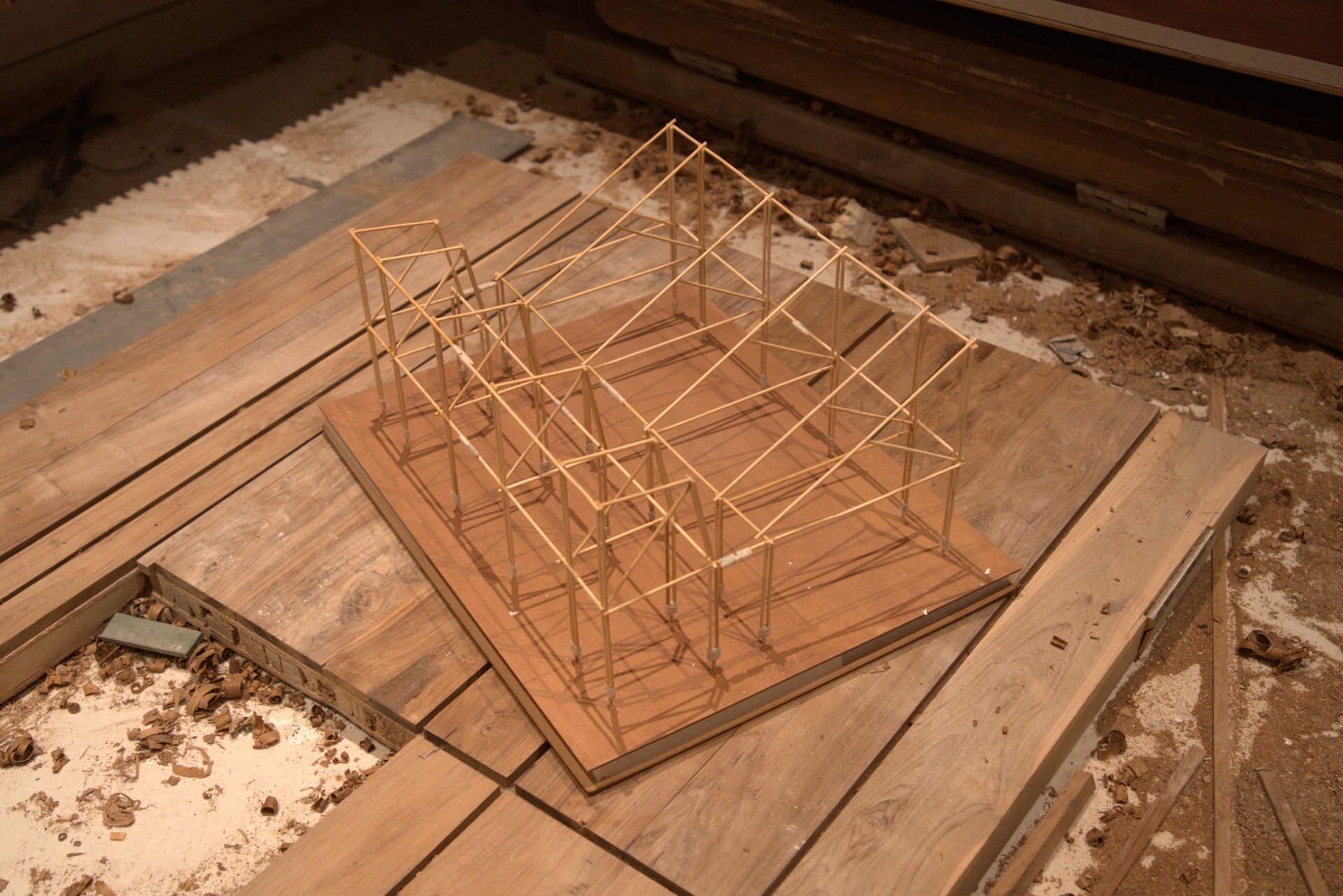
A study model shows how the geometry was tested before scale. Slender dowels stand in for the bamboo frame, the pitched roof planes already legible in miniature. The model sits among offcuts and sawdust, an honest record of a practice that works through making rather than rendering.
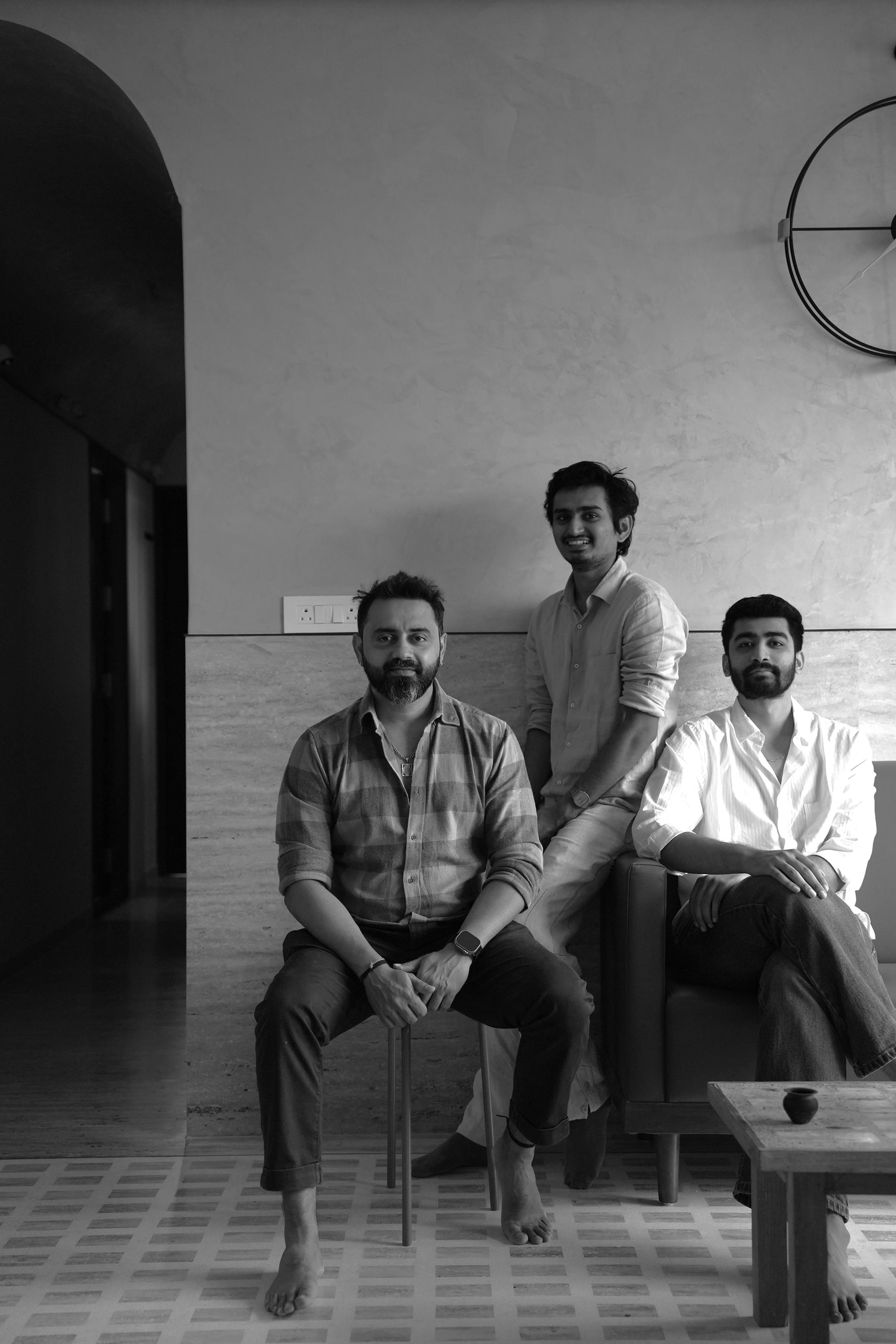
Rust Collective, founded in 2022 by Dhruv Sachala, Neel Shah and Pratik Shah, operates at the intersection of art, architecture and design. Two of the founders are SEA graduates, and the studio describes its method as that of the bricoleur, recombining materials, tools and histories to arrive at context-appropriate solutions. The Liminal Pavilion is the clearest demonstration to date of what that approach yields when given a brief that asks for argument rather than resolution.
Within Indian architectural discourse, projects of this scale rarely receive the attention given to larger residential or institutional work, yet they often carry the most direct propositions. The pavilion’s response to monsoon and to climate uncertainty places it within a broader conversation about how architecture in the subcontinent might learn from its own seasonal logic rather than insulating itself from it.
What remains, after the gatherings end and the lights are switched off, is a small architectural argument made tangible: that shelter can be continuous with landscape, that permanence is not the only measure of relevance, and that a building’s capacity to absorb and yield may matter more than its capacity to resist.