Adaptive reuse, at its most considered, is less about transformation than about listening. A godown in Chembur becomes a neighbourhood café not by erasing what was there, but by editing it with restraint, by allowing the existing structure to carry the project rather than disguise it. The result is an interior that feels familiar before it feels designed.
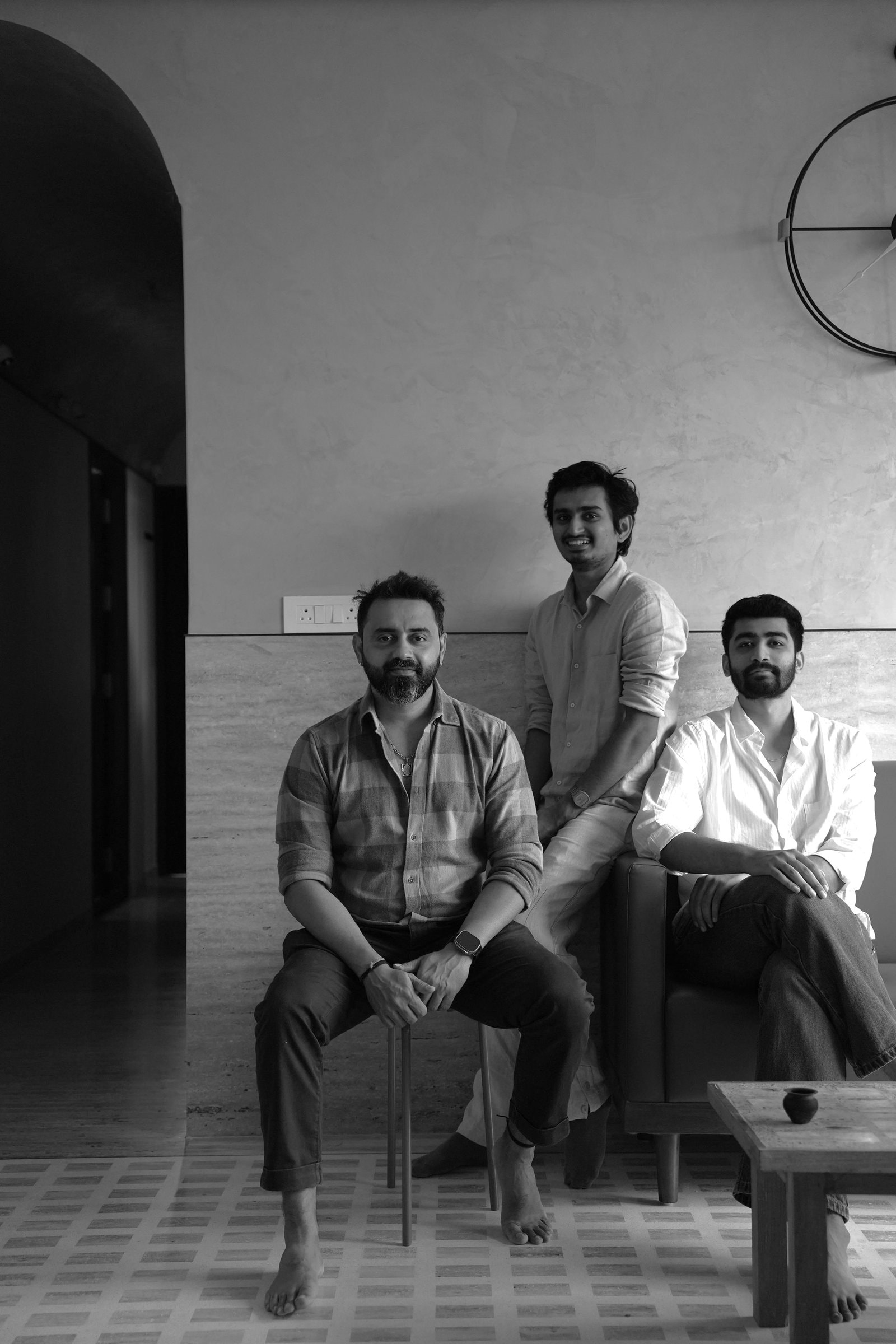
Anjaneyar, designed by Rust Collective, interprets the spatial language of traditional South Indian homes and everyday canteens through a contemporary lens. Led by Neel Shah with Dhruv Sachala and Pratik Shah, the project sits within a tight construction timeline and an even tighter set of inherited constraints, and the studio has met both with strategic, minimal intervention rather than wholesale reinvention. What emerges is a rooted, memory-driven environment shaped by light, material honesty, and everyday familiarity.
The process is the project’s quiet thesis. Rather than a singular architectural vision delivered to site, Anjaneyar evolved through continuous dialogue between architect, contractor, client, the owner of the original structure, and the café’s brand designer. Palette decisions were shared with the brand designer; the kitchen layout responded to the client’s operational non-negotiables; openings followed what the existing shell would permit. The contractor remained central to grounding intent in practicality.
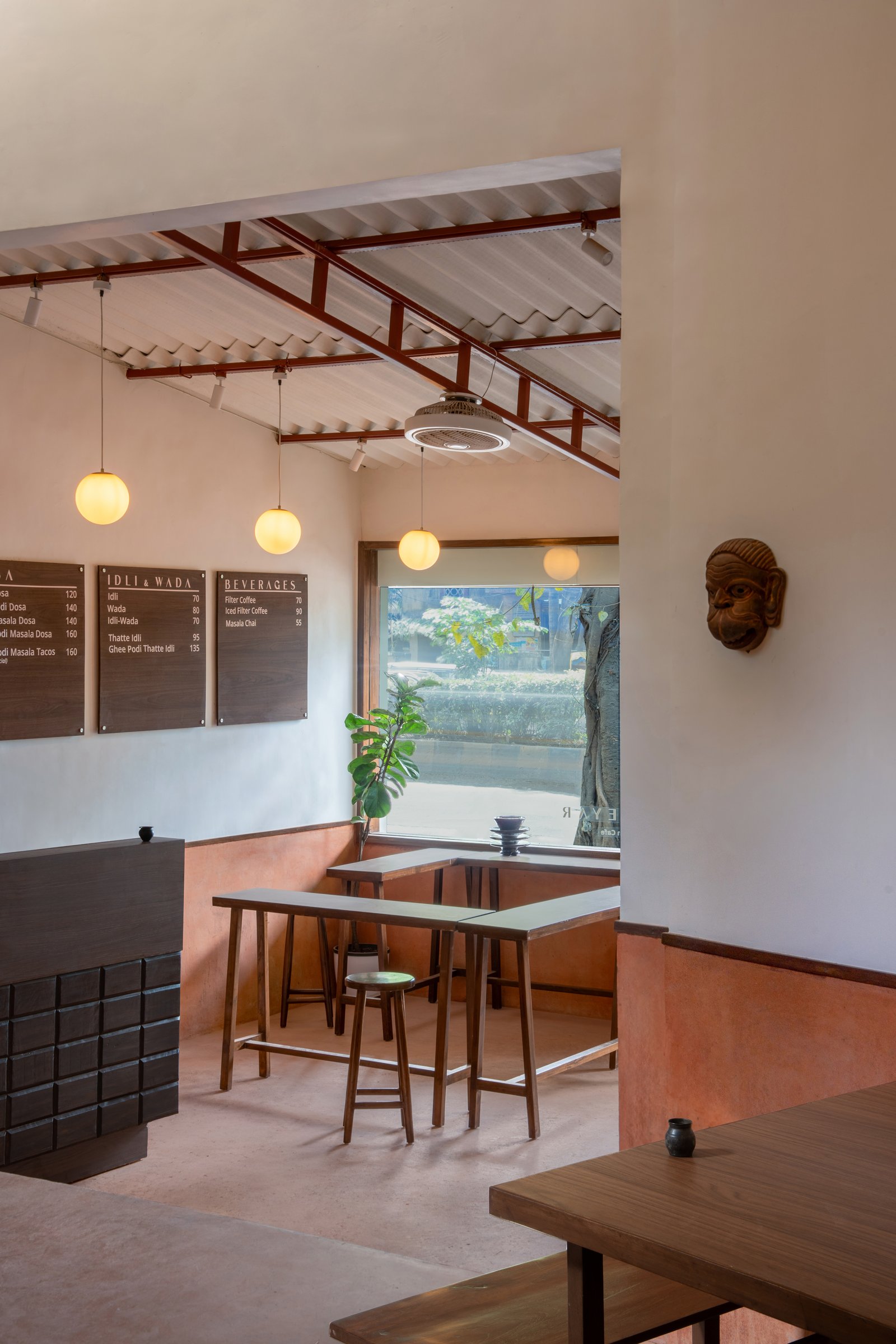
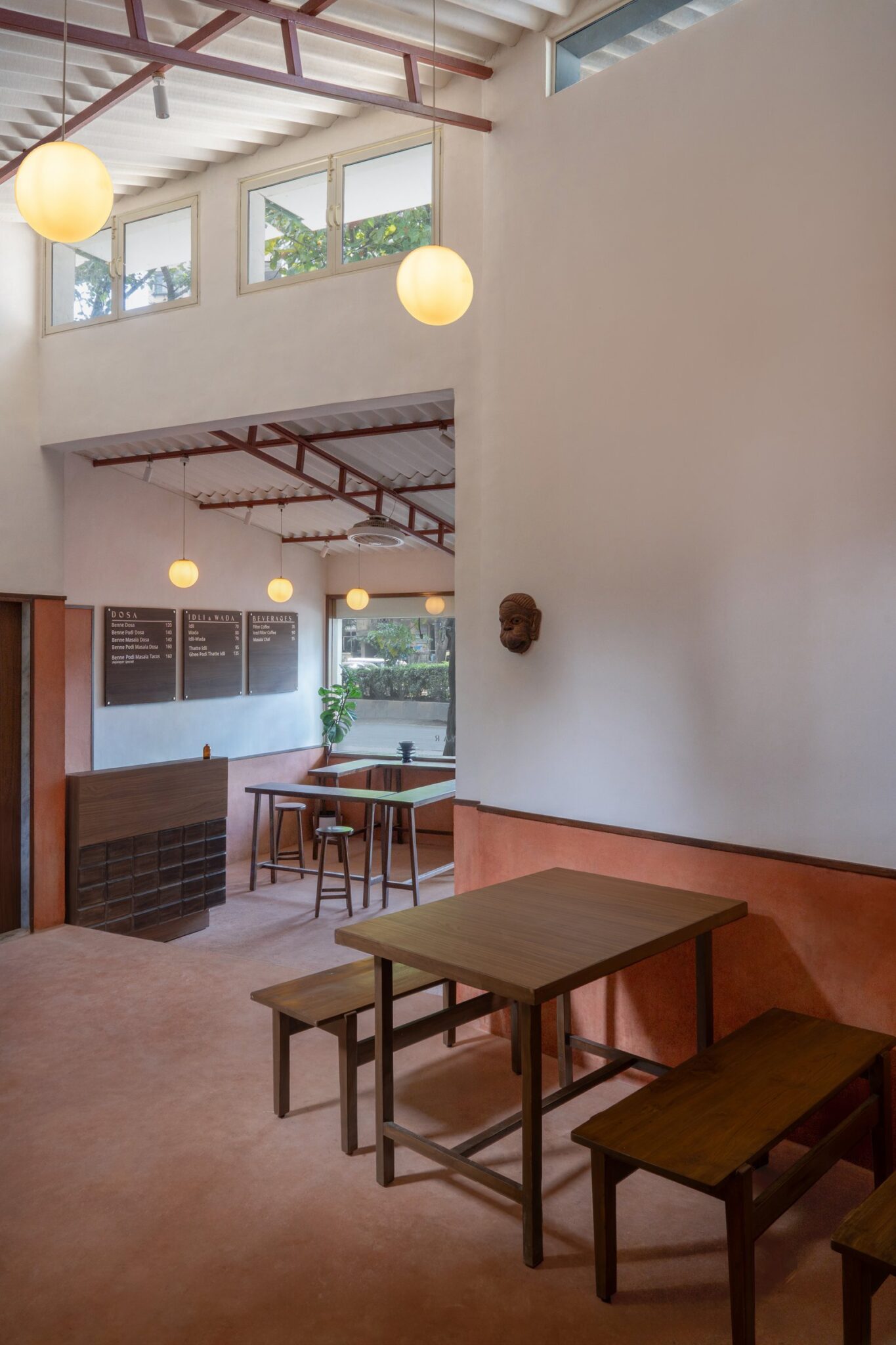
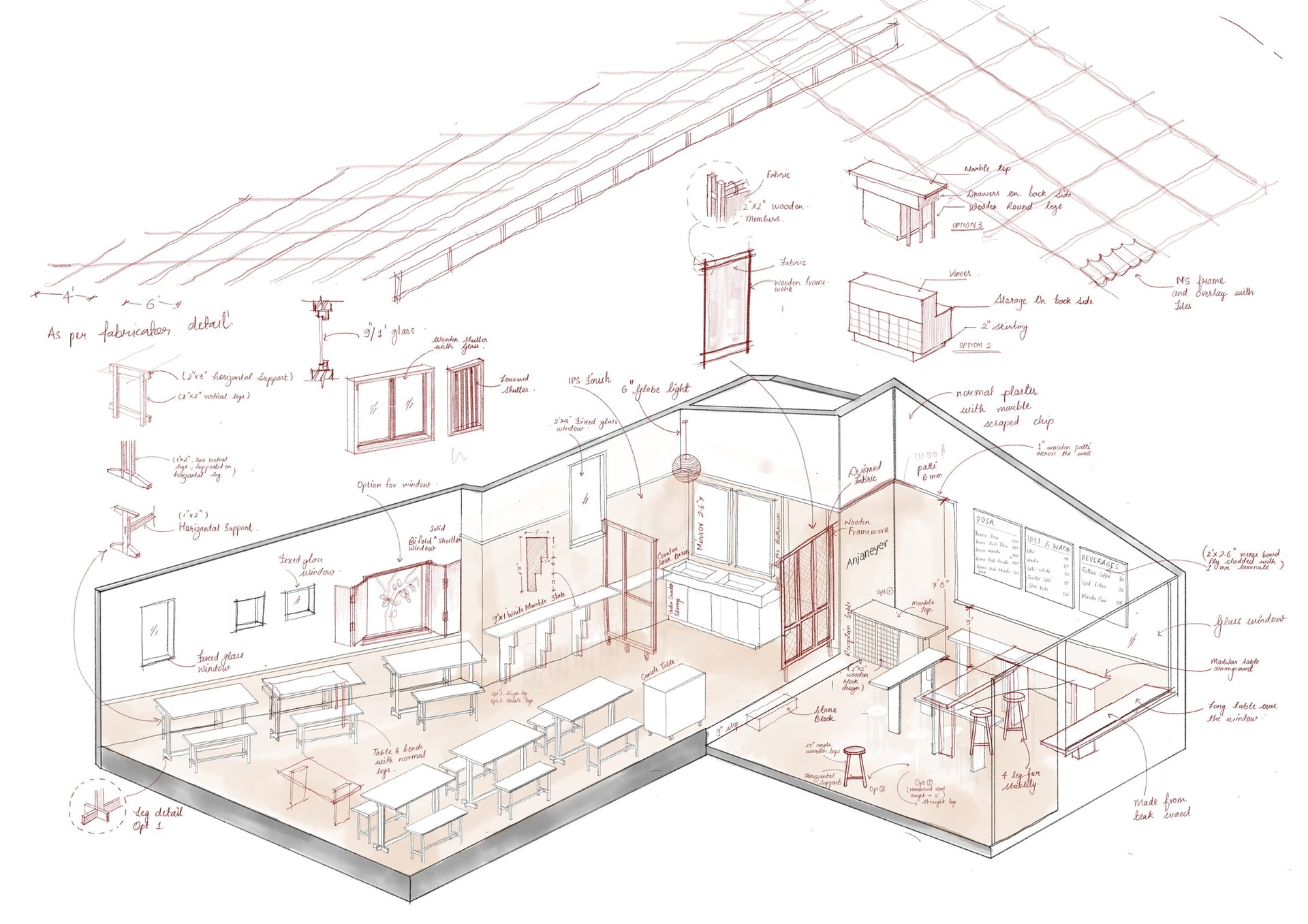
The entrance opens into a well-lit volume where a large window façade and clerestory windows pull morning sunlight deep into the interior. A row of suspended globe lights traces the line of the pitched ceiling, while the corrugated roof and exposed steel members are left expressed rather than concealed, lending vertical volume and a frank, utilitarian honesty to the room.
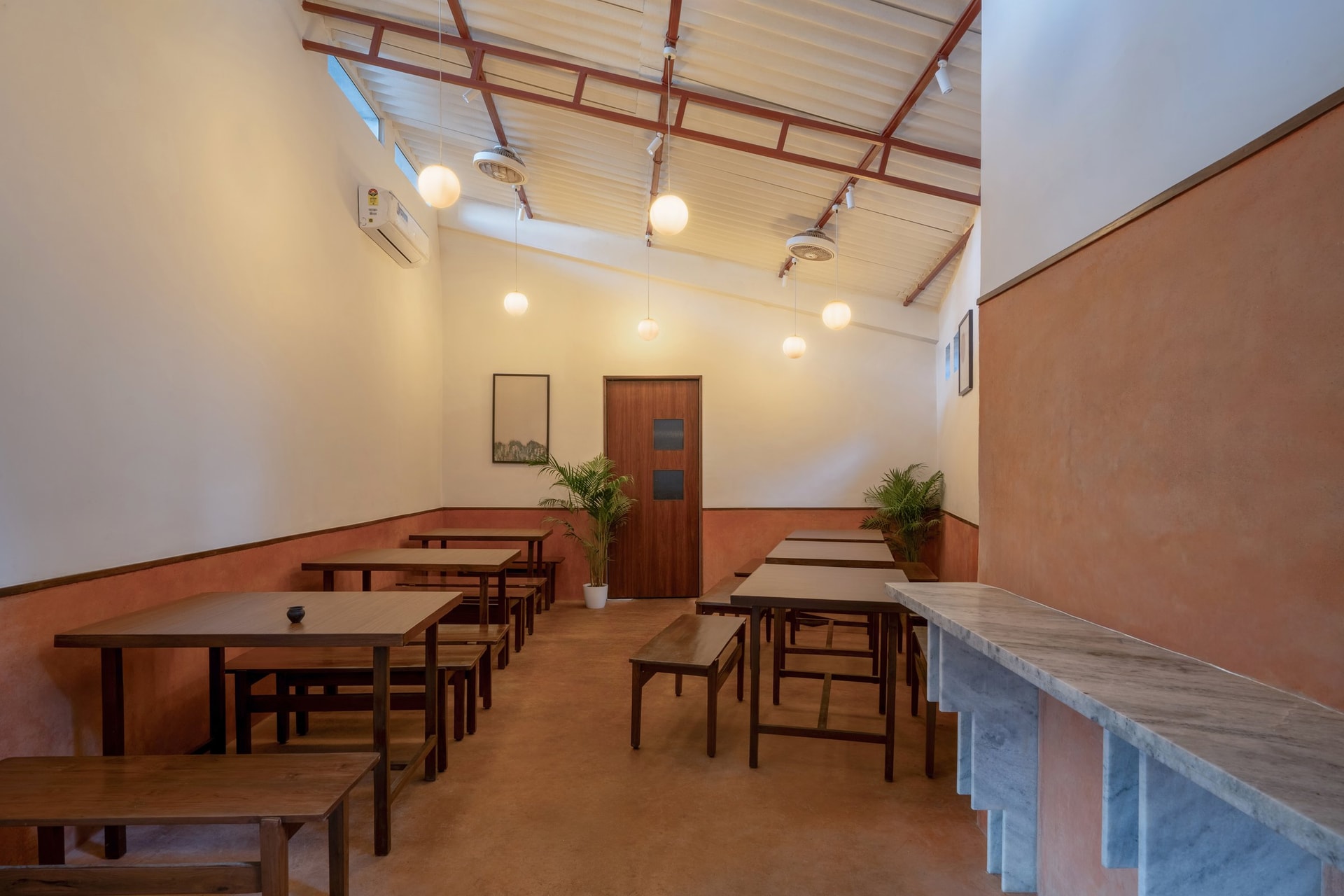
The dining hall reads as one continuous, composed interior. Walls are split horizontally, with rustic IPS in a warm terracotta tone wrapping the lower register and a pale lime-washed surface above, a device that recalls the dado lines of older South Indian eateries without quoting them literally.
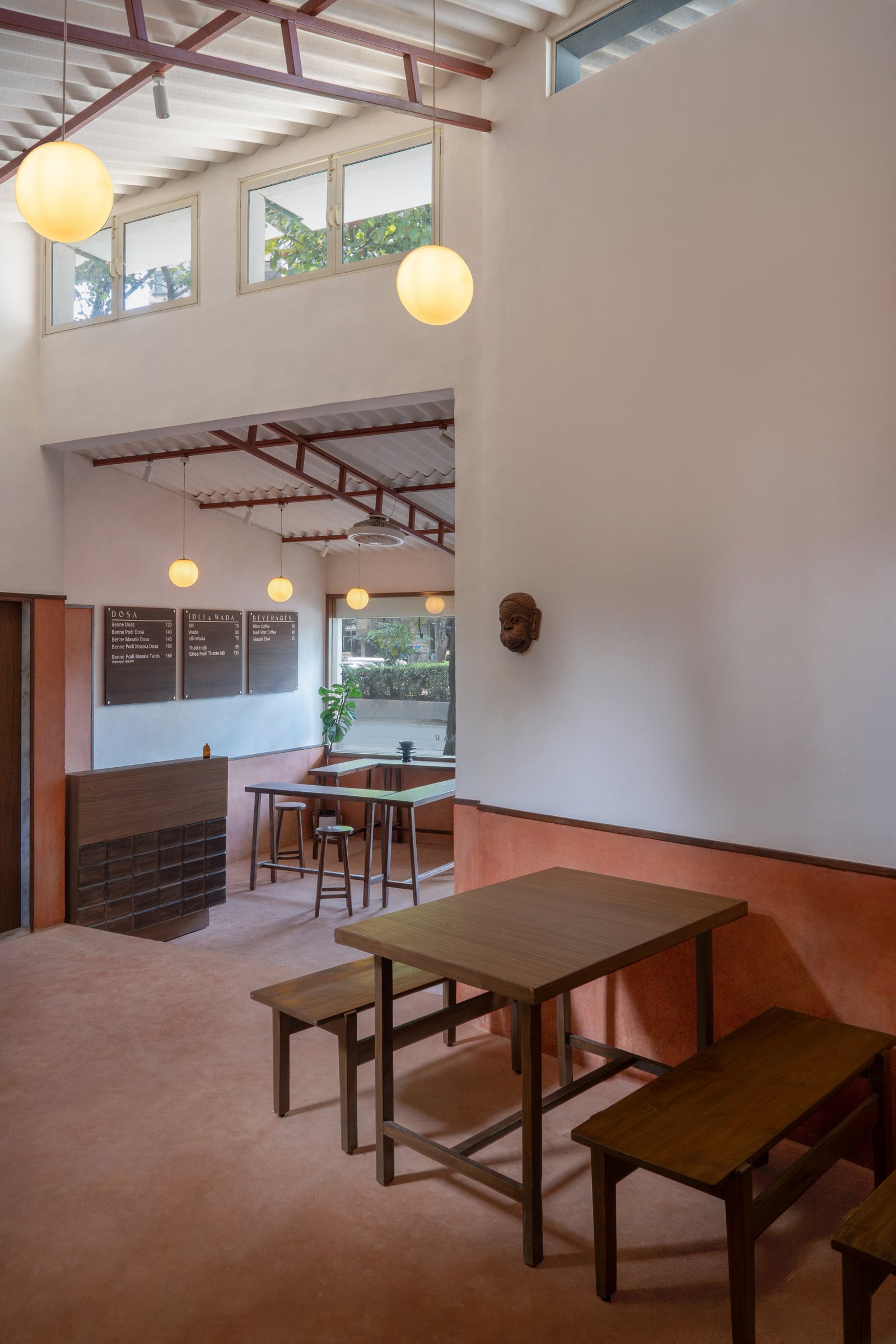
Furniture follows the logic of the canteen. Simple wooden tables, benches, and stools are arranged in linear configurations that encourage shared seating and informal exchange, the kind of arrangement that resists curation and instead invites use. Nothing here performs; everything is sized to the body and the meal.
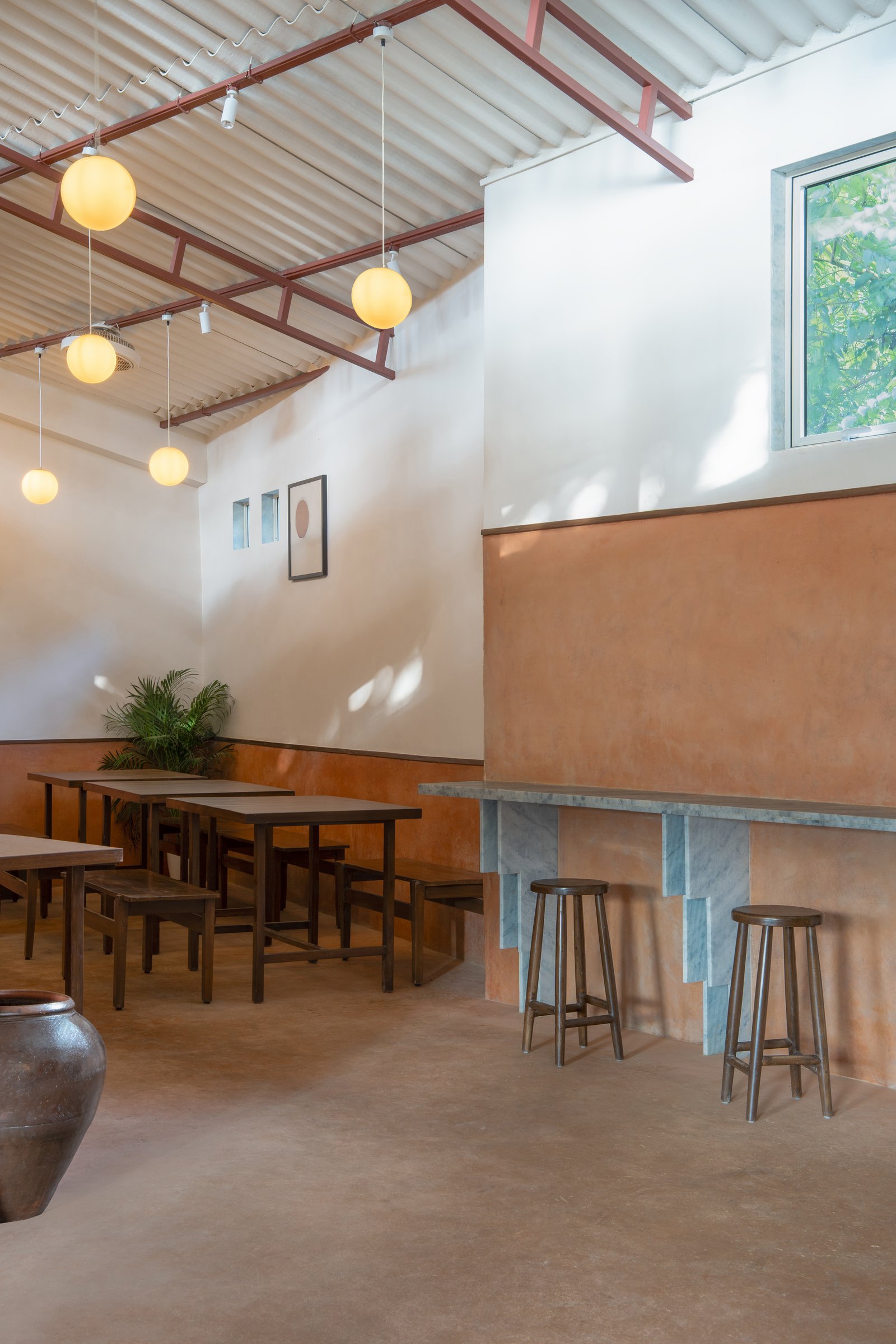
Along one side of the hall, a long marble shelf rises from a stepped IPS base, paired with tall wooden stools for solo or counter-style seating. The stepped marble forms read almost like a small architectural event in themselves, lending the side wall a sculptural rhythm against the otherwise restrained palette.
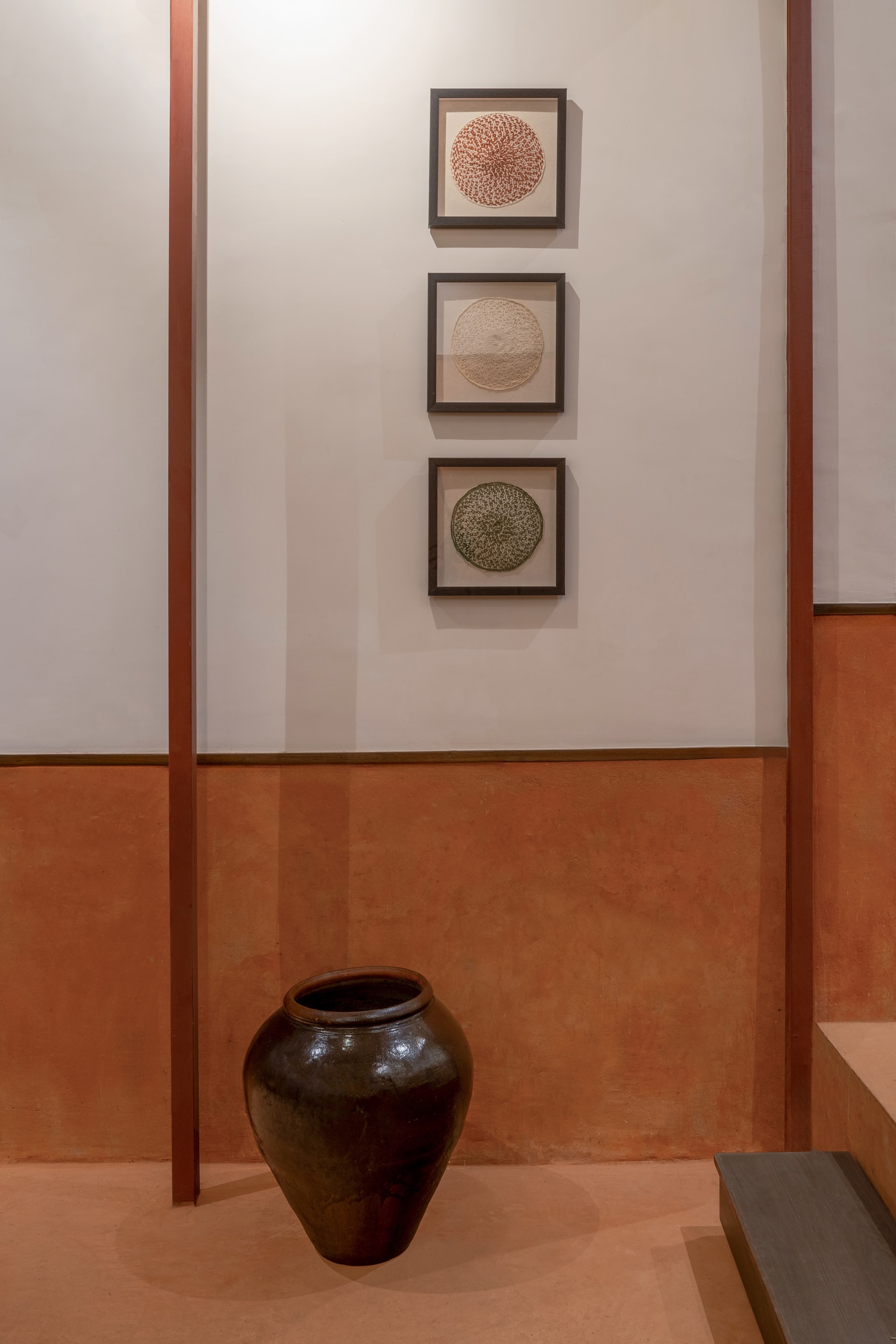
A framed textile artwork by Krupa Shah of SOAWN anchors the far wall, hung beside the service door. The hand-embroidered pieces are integrated through the interior as framed works and soft partitions, introducing texture and narrative without disrupting the architectural restraint.
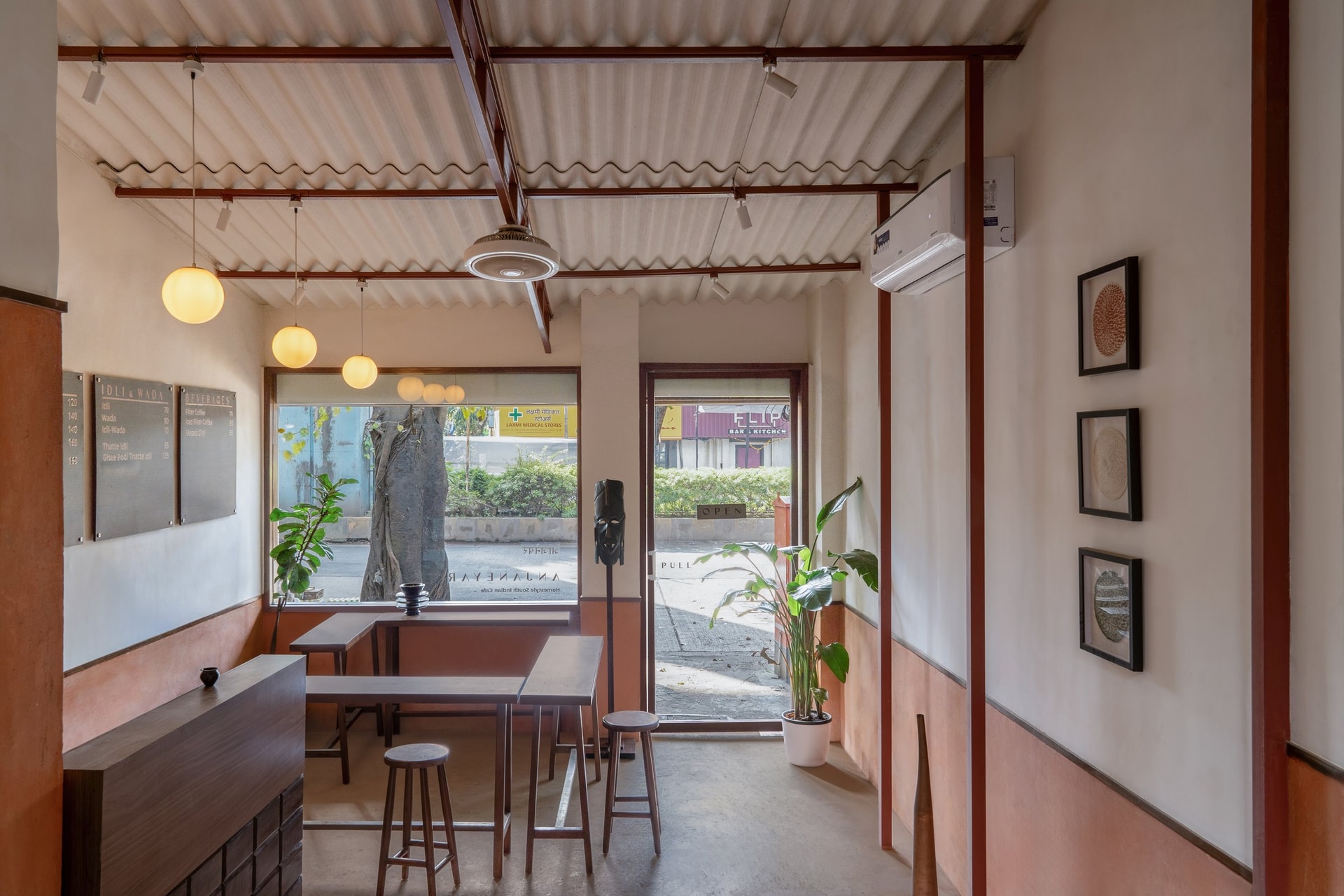
From the entrance threshold, the relationship between street and interior comes into focus. A timber-framed glass door, signage in both Devanagari and Roman scripts, and a wooden mask mounted near the doorway frame the arrival; the tree canopy outside is borrowed into the room through high-level openings positioned to catch filtered daylight.
“Together, these elements allow Anjaneyar to stand apart from Mumbai’s homogenised café interiors, offering a rooted, memory-driven environment shaped by light, material honesty, and everyday familiarity.”
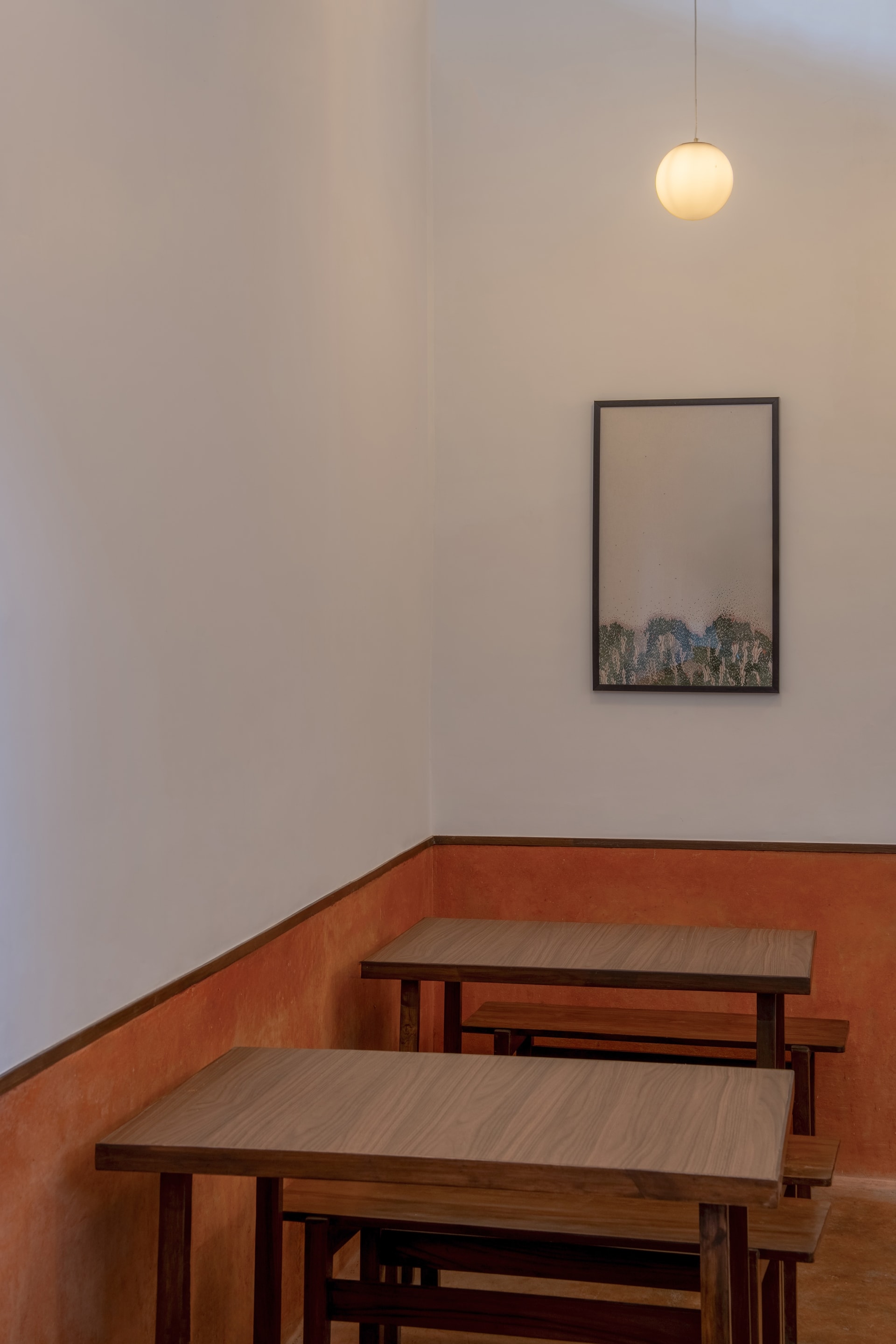
A quieter corner of the dining hall holds a framed textile artwork above a pair of canteen-style tables, the terracotta dado meeting the white plaster above in a clean horizon line. A single globe pendant lights the corner, establishing the soft, domestic rhythm the studio describes as central to the project.
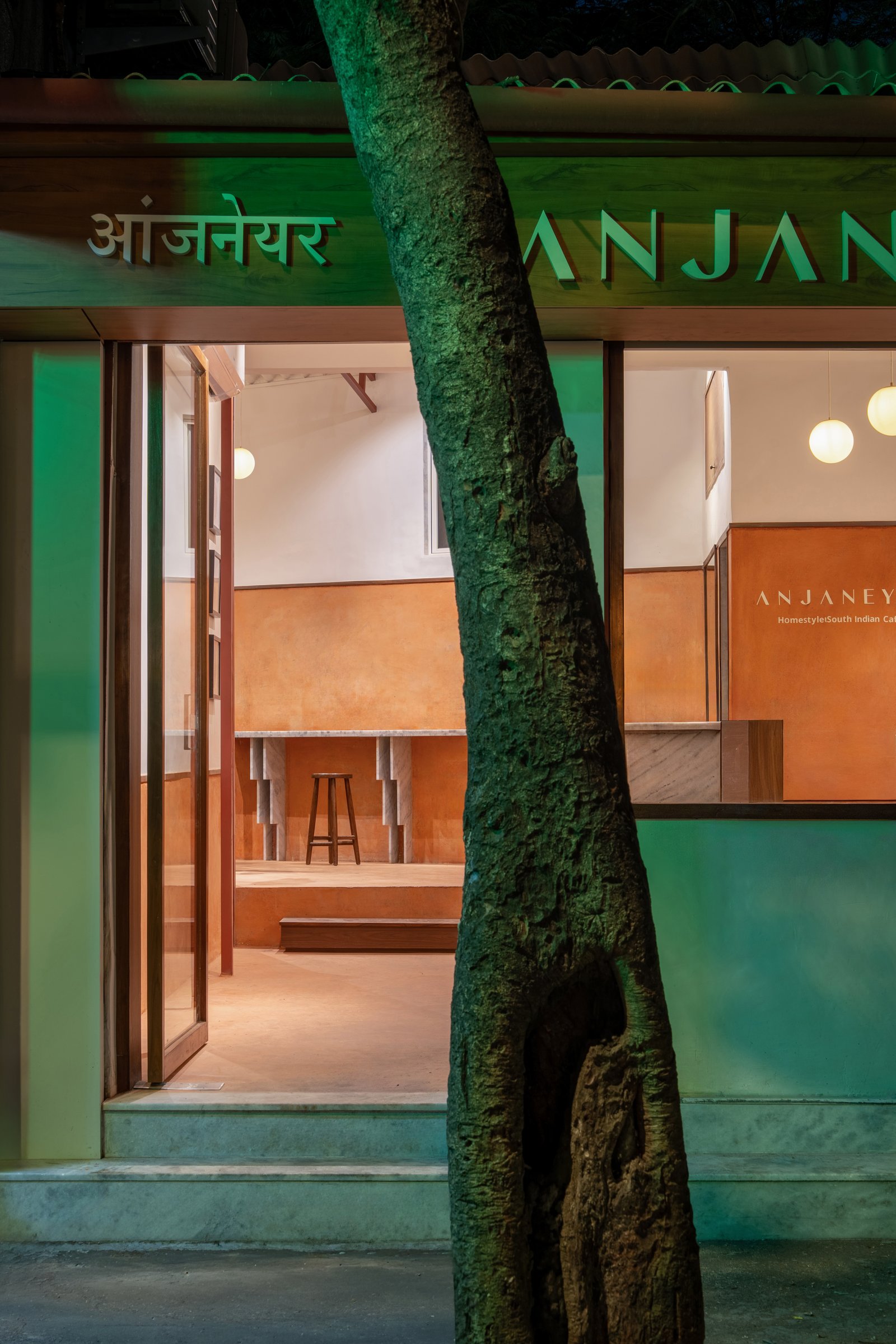
Seen at dusk through the existing tree at the threshold, the storefront glows in green-painted signage and the warm terracotta interior behind. The Devanagari and Roman scripts of the name share the façade, and the building’s relationship to the street tree, retained rather than cleared, becomes part of the café’s identity.
At a moment when Mumbai’s café interiors increasingly resemble one another, Anjaneyar offers a different proposition: that adaptive reuse, regional reference, and collaborative process can produce a space that feels specific to its city without performing nostalgia. The South Indian canteen is not quoted; it is reinterpreted through proportion, palette, and the simple act of arranging benches in a line.
What lingers is the calm of a room that knows what it is. Anjaneyar reads as composed rather than sparse, warm rather than decorative, and it suggests a quieter direction for the city’s hospitality interiors, one where light, material, and shared dialogue do most of the work.