Workplace interiors rarely begin with softness. The conventional language of the private office, particularly in mid-sized Indian cities, leans on orthogonal planning, hard edges, and the visual shorthand of corporate seriousness. FOLDS proposes a different premise: that a working environment can be sculpted rather than partitioned, and that fluidity, not rigidity, can carry the weight of professional identity.
Set atop a G+4 structure in Raipur, this 1,700 sq. ft. private office was designed by JB Designs, led by Akash Shobhwani and Riya Shobhwani. The brief asked for a workplace that felt closer to a hospitality interior than a conventional office, and the studio answered by organising the entire plan around a circular reception volume, with cabins, meeting room, and director’s office radiating outward in a continuous curved sequence.
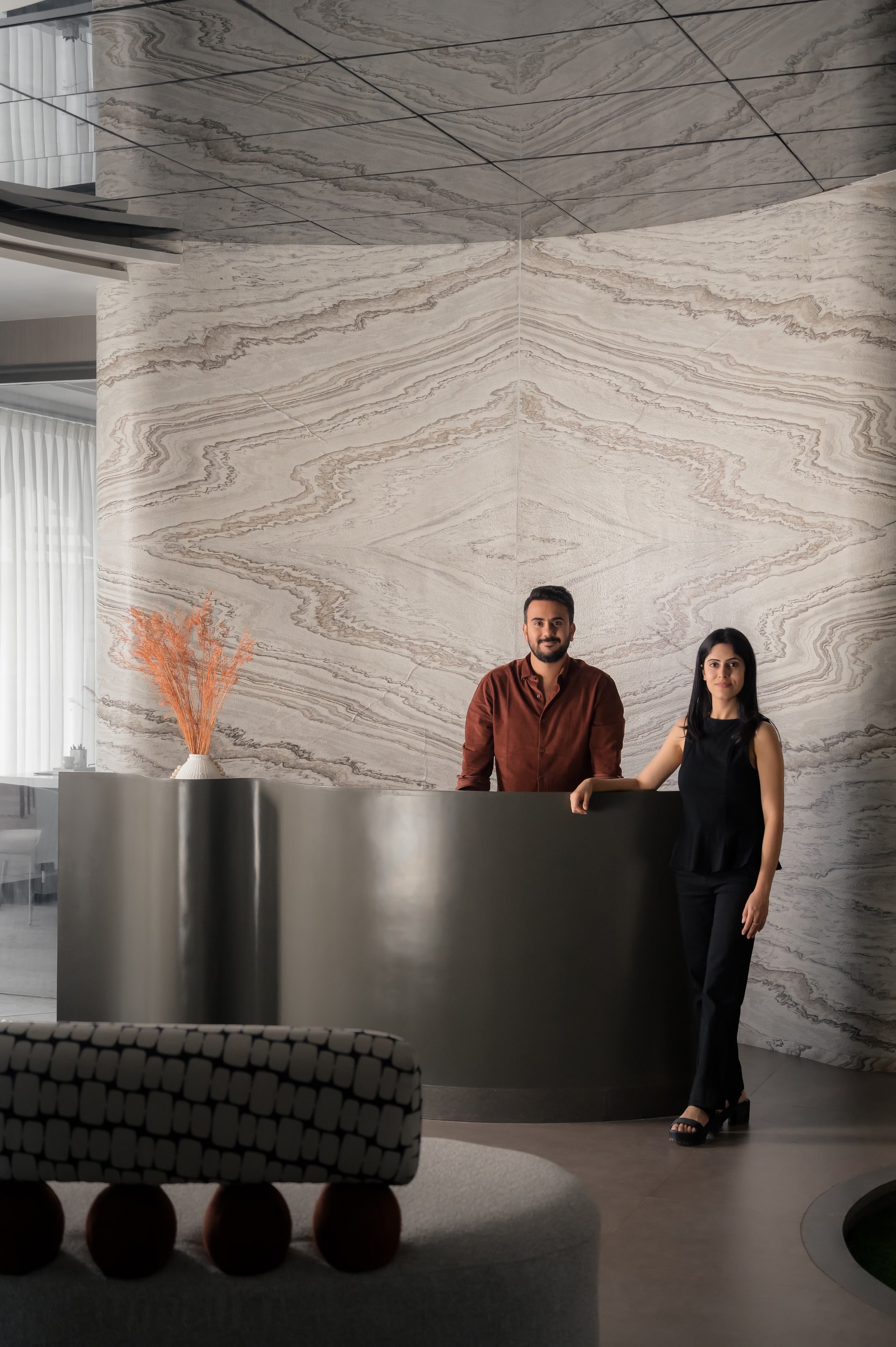
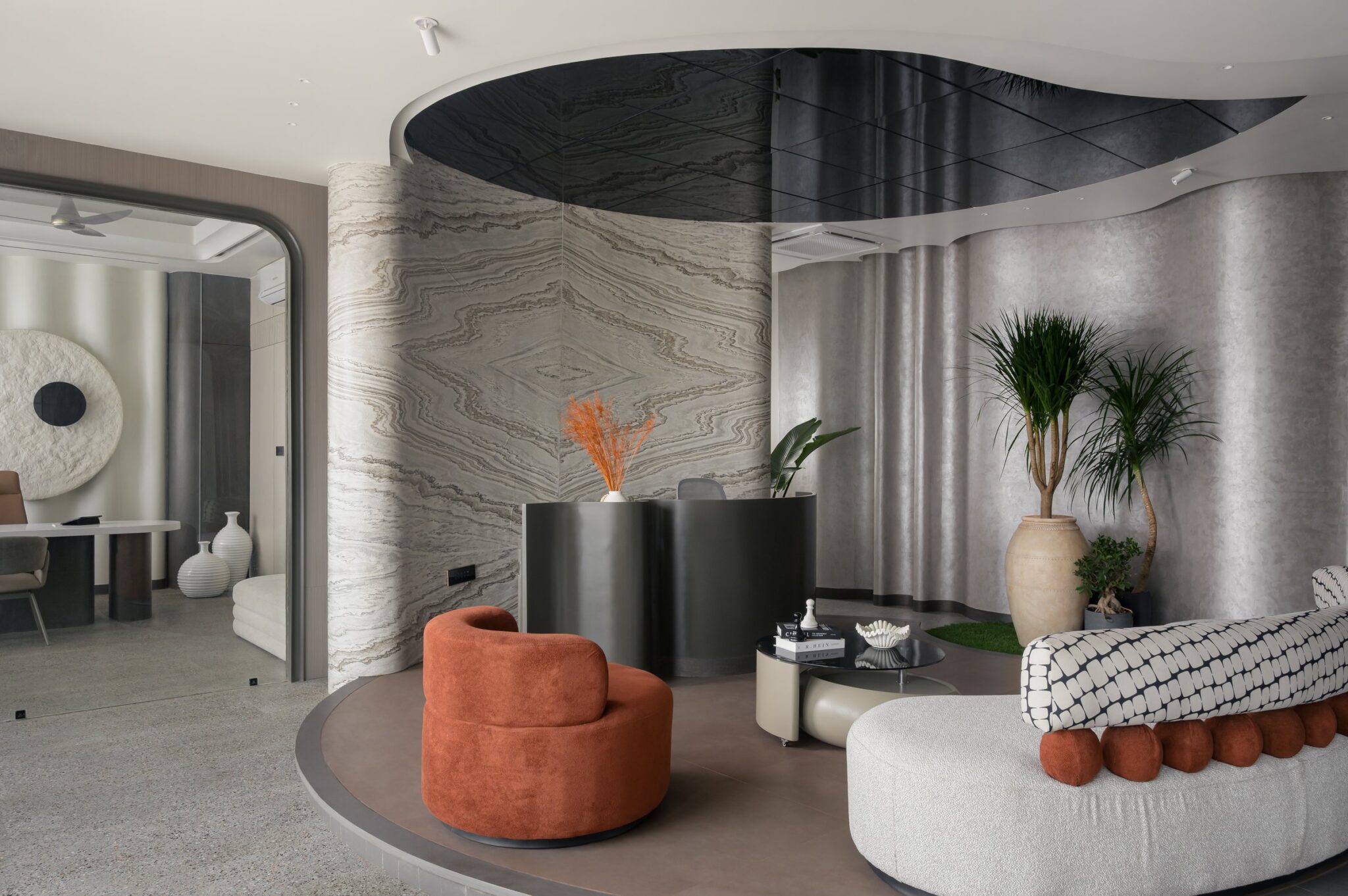
The reception establishes the project’s design language in a single composed frame. A book-matched stone wall rises behind a curved metallic desk, its natural veining converging into an almost symmetrical pattern, while a sculptural ceiling insert in dark reflective panels mirrors the curvature of the platform below. The terracotta lounge chair and patterned bench introduce warmth and rhythm against the muted palette, signalling that the office will not arrive at colour timidly.
What lends the reception its visual clarity is the dialogue between the stone, the dark ceiling plane, and the textured grey walls that wrap the volume. The mirrored ceiling pulls the room upward, while the curved platform underfoot defines a clear circular threshold without resorting to walls or partitions.
““Instead of rigid lines and orthogonal planning, the design embraces softness, sculpting space through curves, texture, and natural light.””
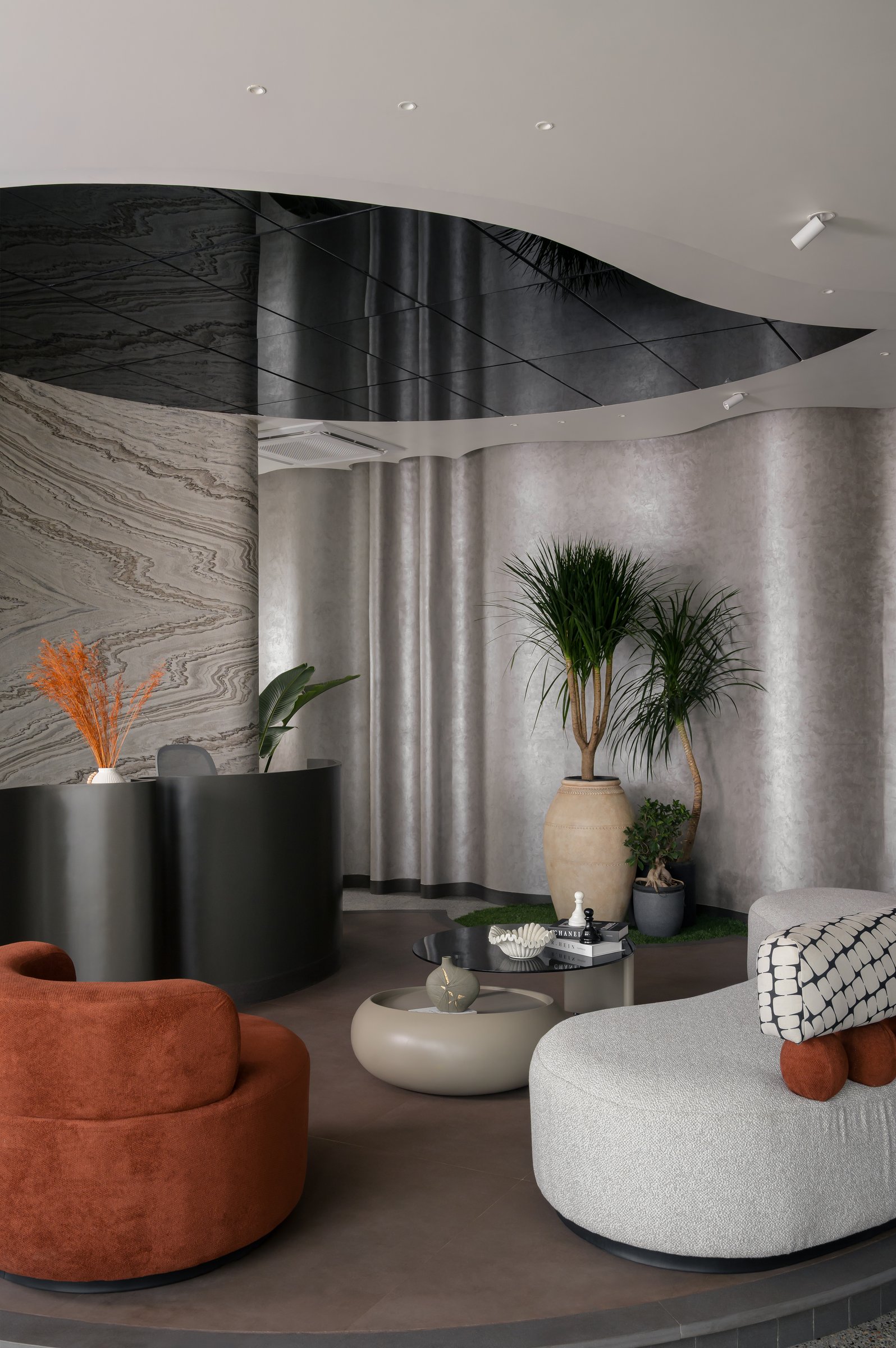
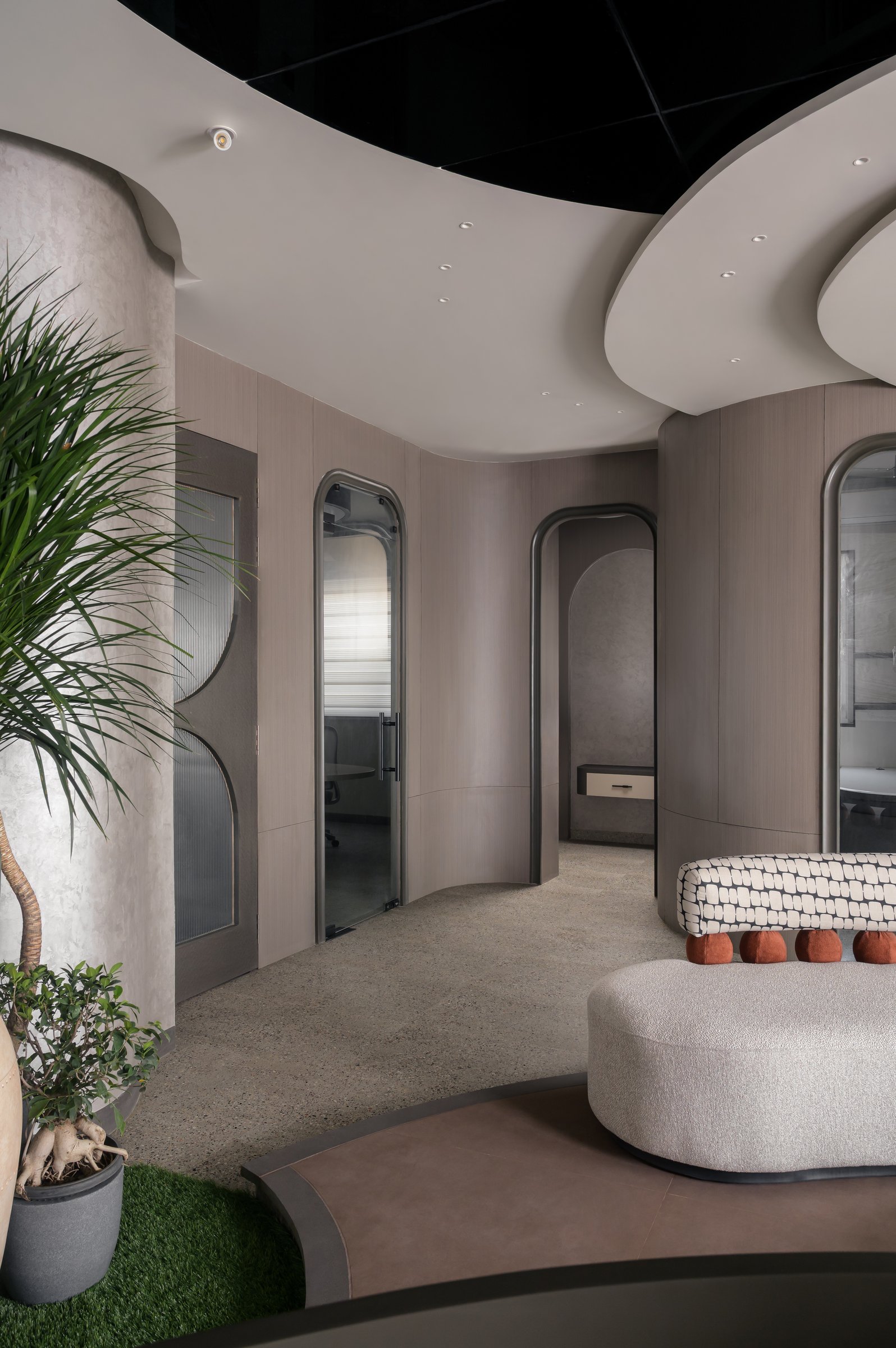
Seen from a different angle, the reception reveals the depth of its material layering. The terracotta swivel chair and the patterned bench frame a low coffee table grouping, while a tall terracotta-toned vessel holding a dracaena anchors the corner against softly textured grey walls. The composition feels closer to a boutique hotel lobby than a workplace, which is precisely the temperament the brief called for.
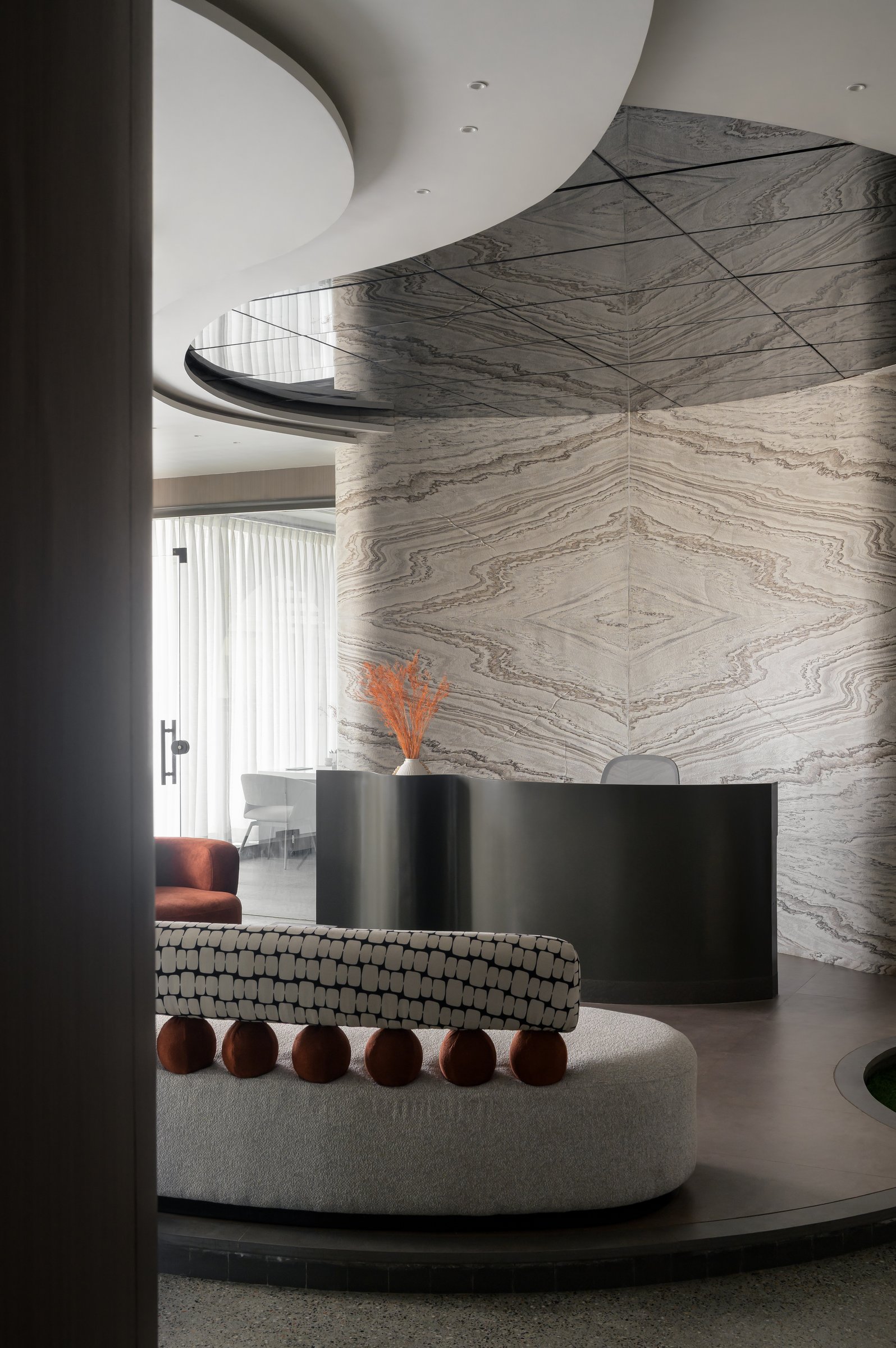
The reception’s curved metallic desk reads almost as sculpture in this view, its dark satin finish absorbing light against the dramatic veining of the stone wall behind. The book-matched panels create a quiet symmetry that does the work that artwork often has to, while the rounded bench in front continues the home’s vocabulary of soft curves and tactile contrast.
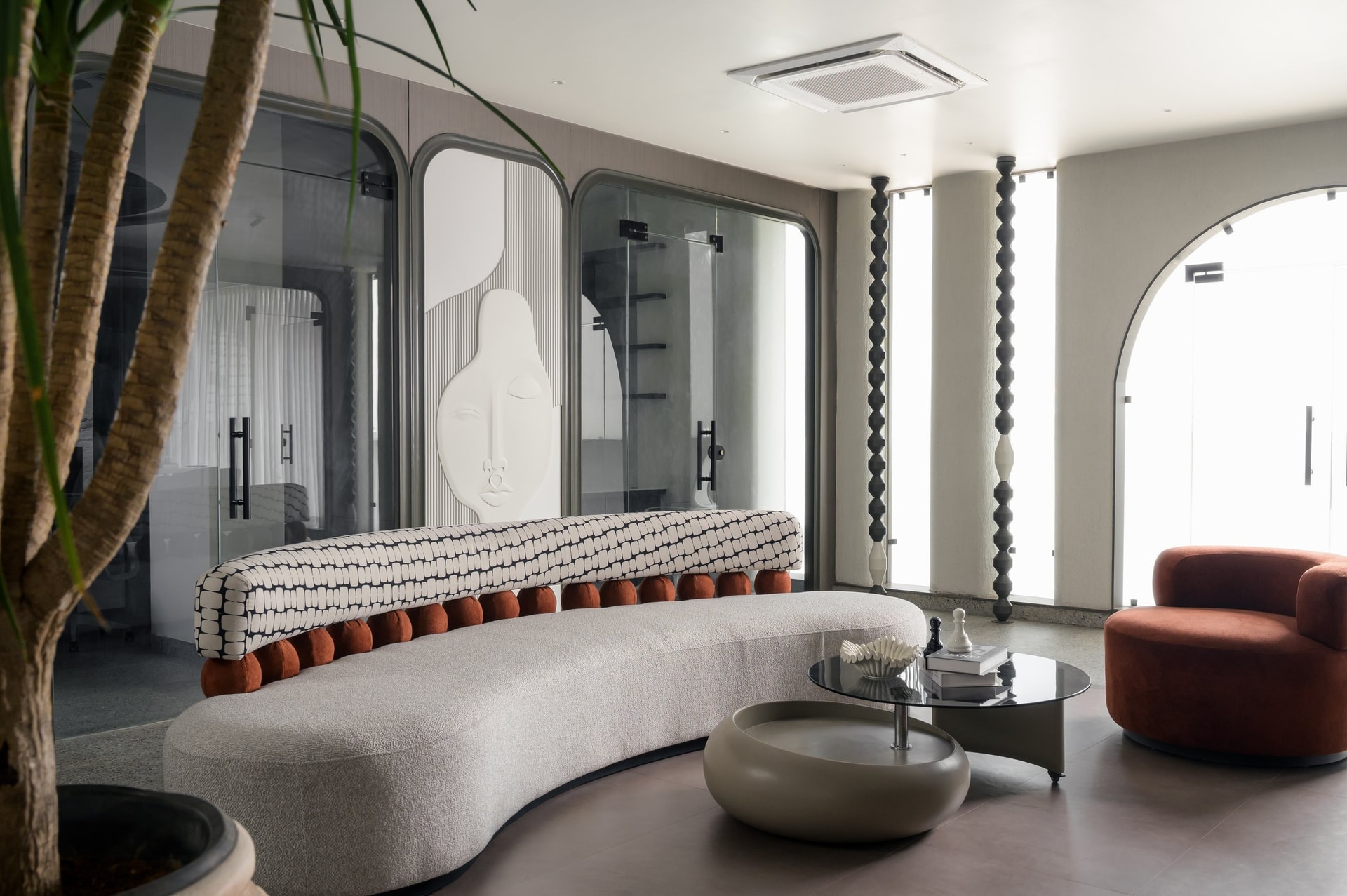
From within the lounge, the spatial choreography becomes clearer. The crescent sofa unfolds along a generous arc, set against a wall framed by curved glazed partitions and a sculptural relief of a serene low plaster. The relief, set between fluted vertical panels, operates as a quiet anchor in a room otherwise defined by movement.
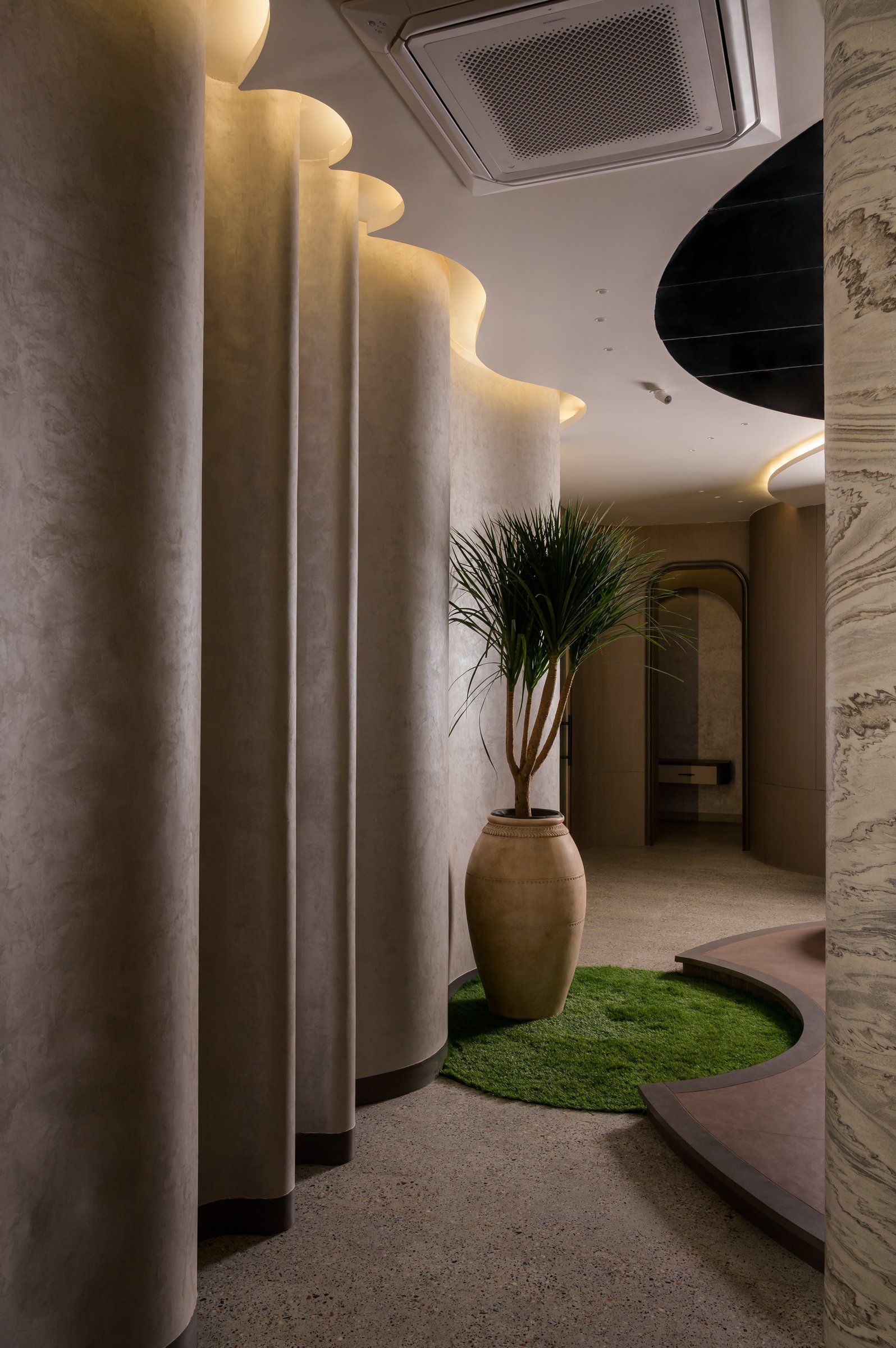
The circulation spine away from the reception is treated as a designed experience rather than residual space. A series of scalloped plaster volumes, lit from above with concealed cove lighting, rhythmically articulate the corridor wall, while a terracotta-toned vessel sits on a circular green inset, softening the transition between zones.
The dark reflective ceiling plane and the warm column of stone at the edge frame the passage with a sense of intimacy. The scalloped wall does the choreographic work that signage typically carries, guiding movement through the office without instruction.
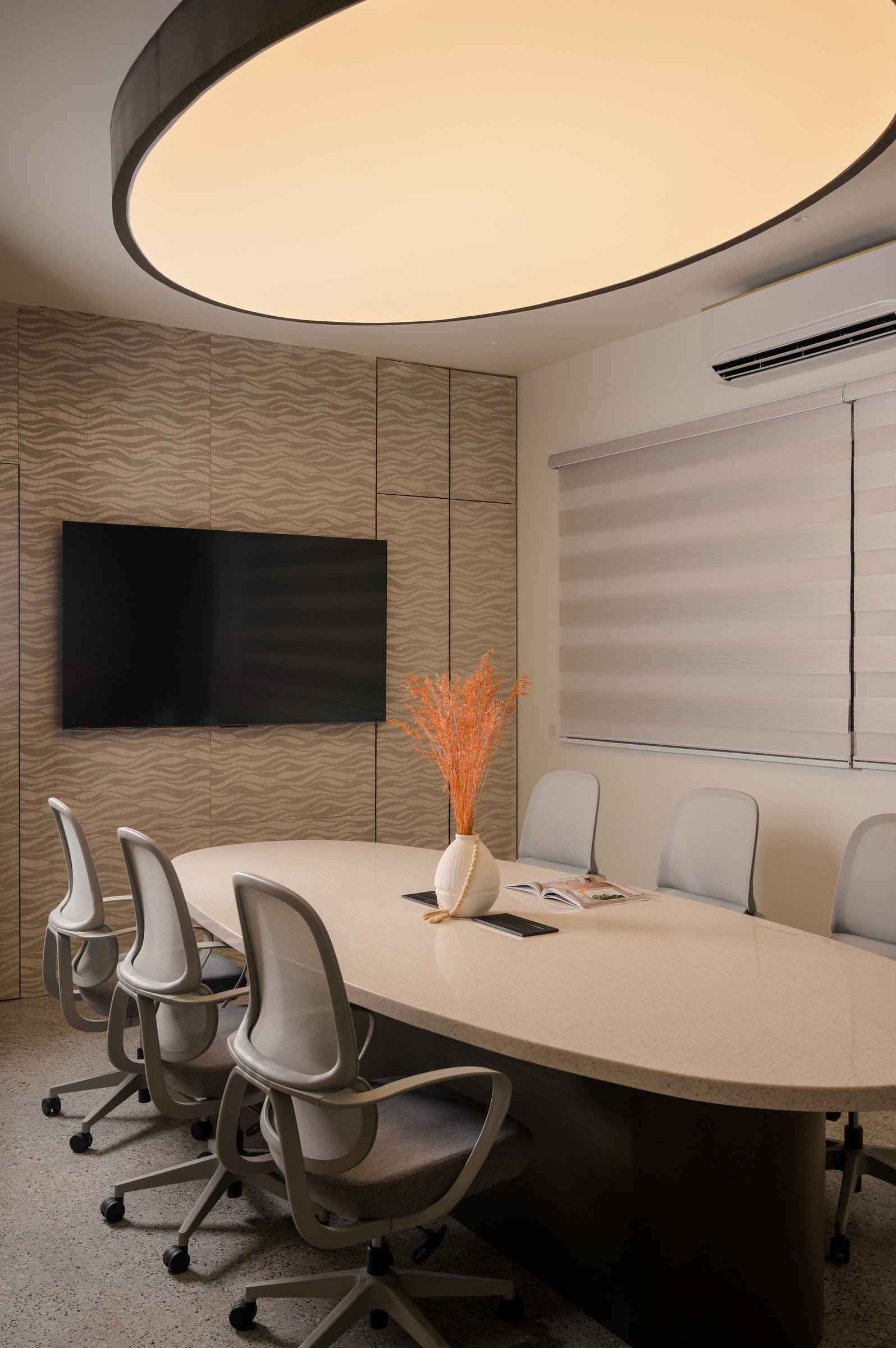
The conference room takes the curved vocabulary into a quieter, more focused register. An oval table in pale composite stone sits beneath a large oval ceiling light that washes the room in warm illumination, while a textured wall panel with a horizontal wave motif provides a calm backdrop to the wall-mounted screen. The mesh-back ergonomic chairs introduce the only utilitarian note in a room otherwise composed for slower, considered conversation.
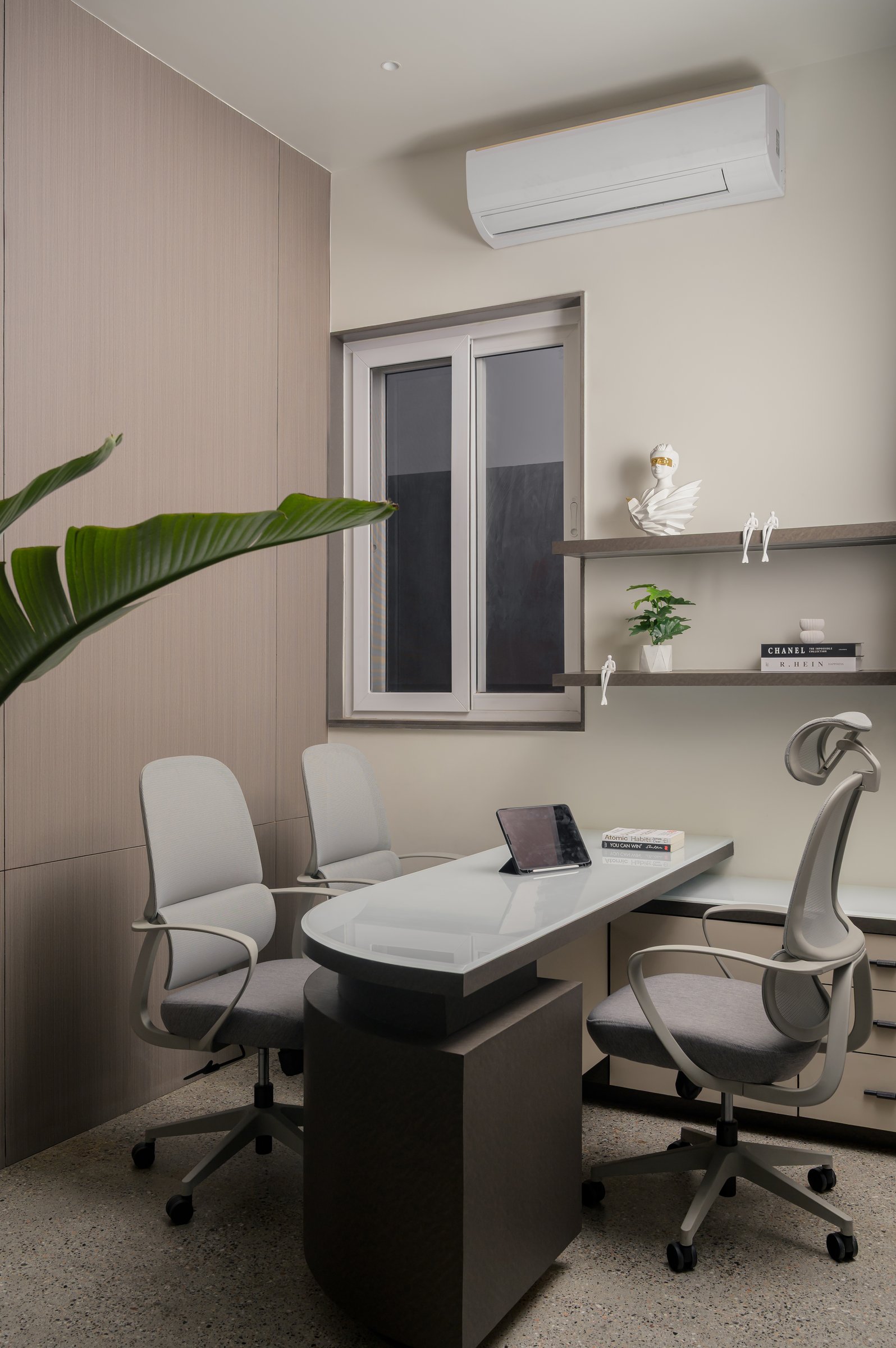
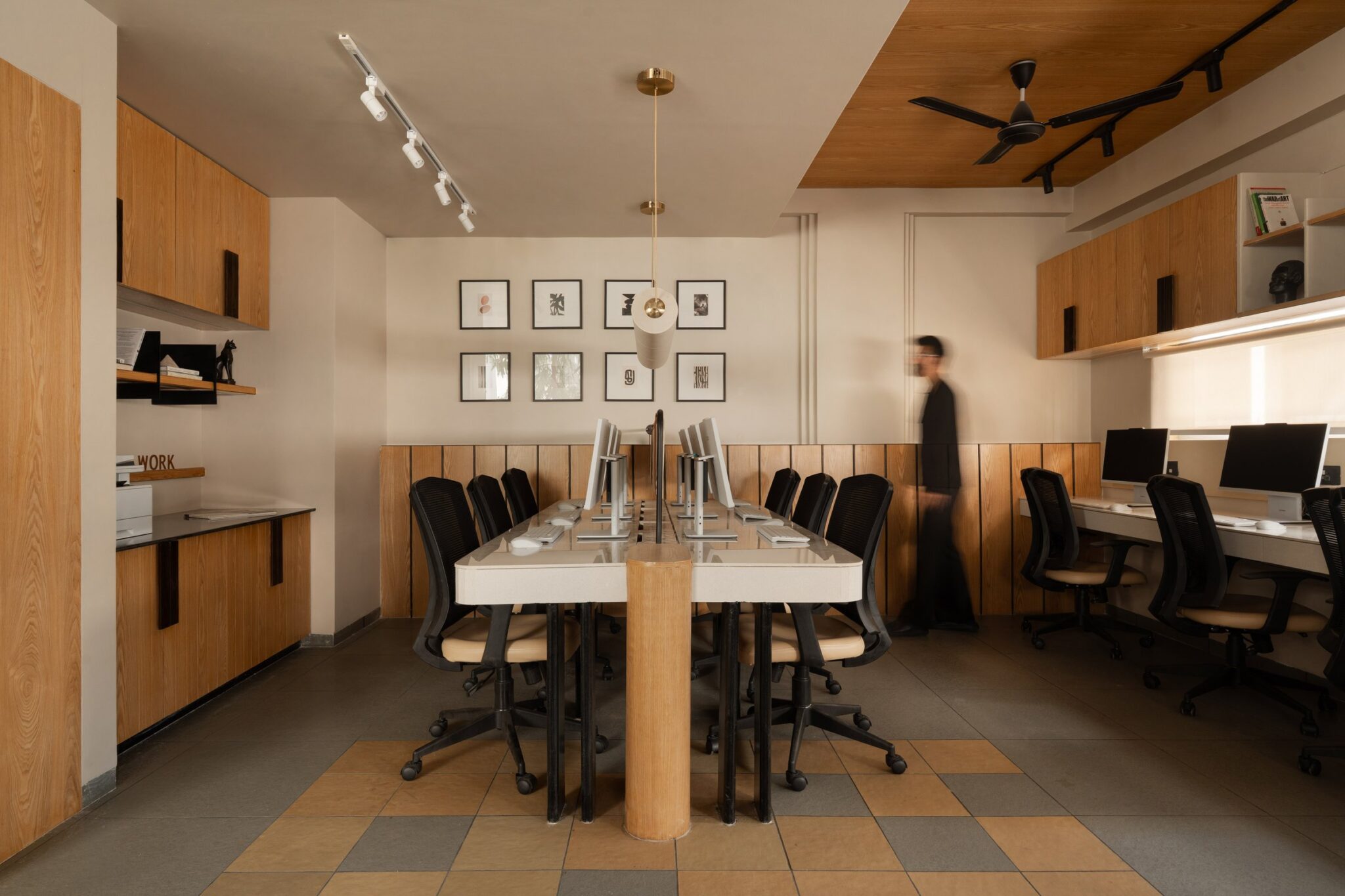
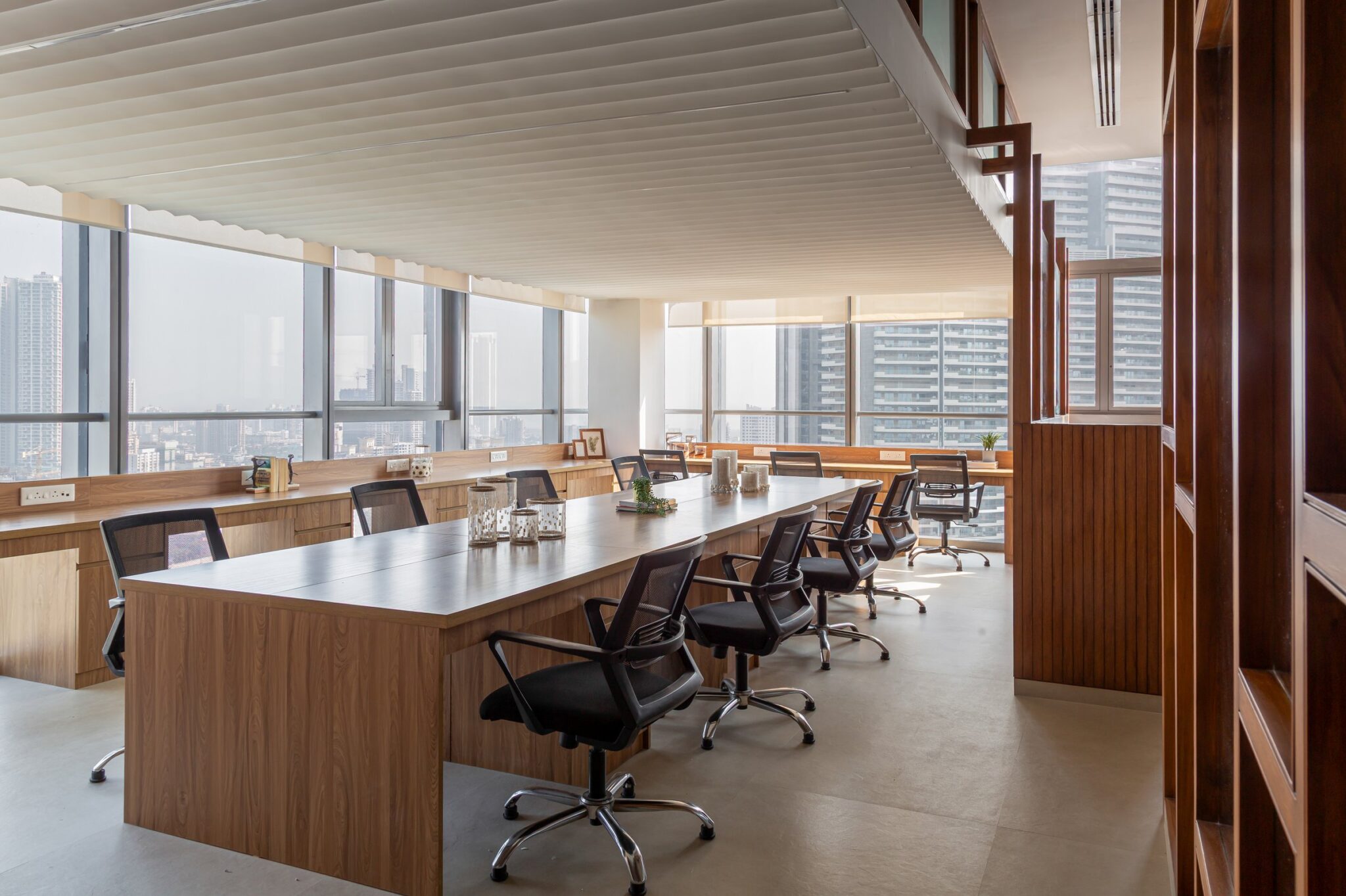
The cabins privilege restraint over expression, allowing the architectural shell to recede so that the work itself can come forward. Wood-toned wardrobes line one wall, a compact glass-topped desk sits perpendicular to a window, and a floating shelf carries small sculptural objects and books, while the ergonomic chairs maintain continuity with the larger scheme. The result is composed rather than sparse, calm rather than utilitarian.
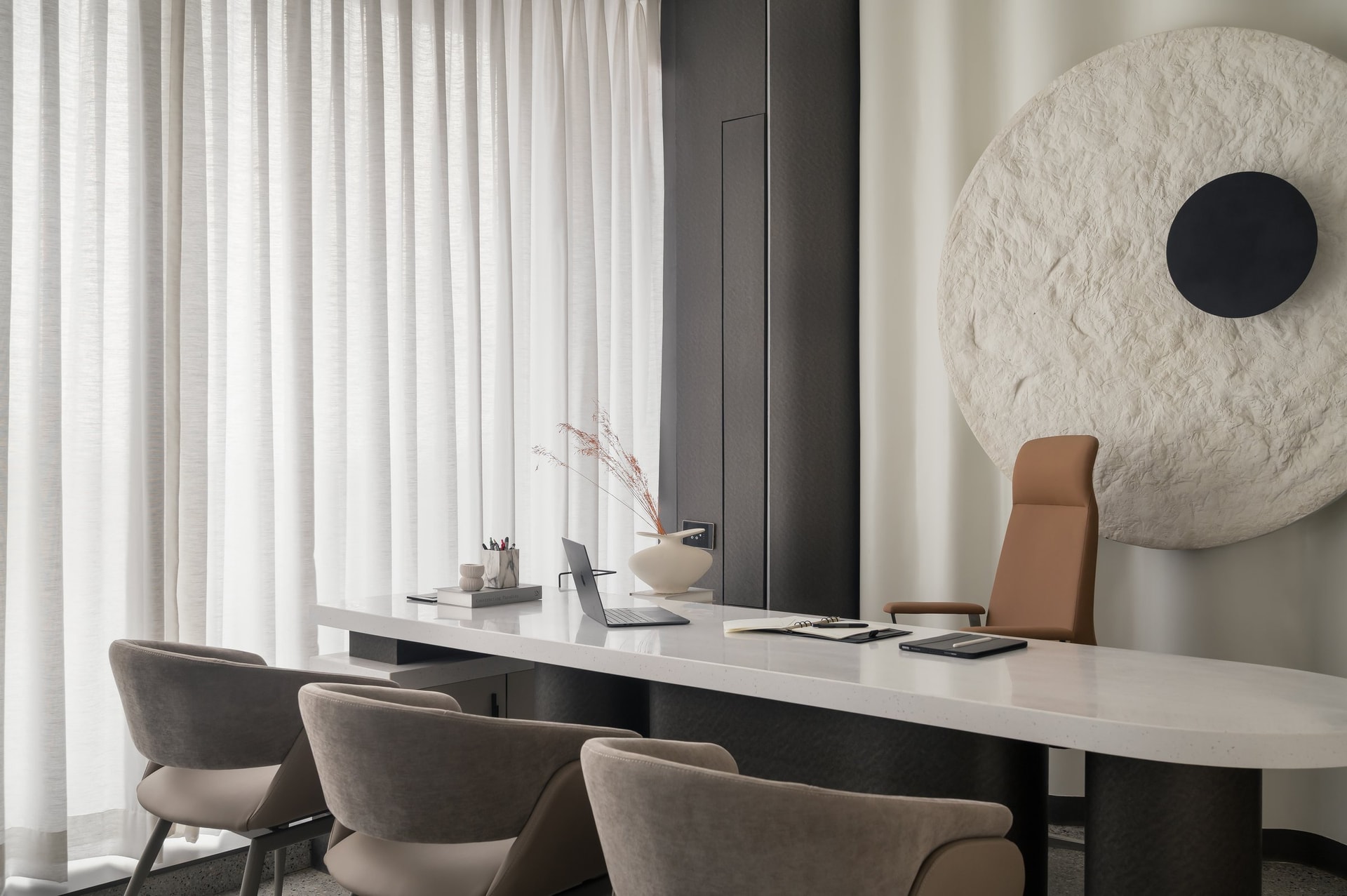
The director’s office reads as the project’s quietest room and its most considered. A long composite-stone desk runs parallel to a wall of sheer ivory drapes that filter daylight into a soft, even wash, while a tall textured circular relief, marked by a single dark disc, anchors the wall behind the principal’s chair as a sculptural focal point.
The grey upholstered visitor chairs and the tan leather principal chair establish a measured contrast in tone and material. The room demonstrates how restraint, used with precision, can carry as much authority as the more theatrical reception that announces the office at its threshold.
FOLDS sits within a broader shift in Indian commercial design, where smaller cities are increasingly producing workplaces that refuse the generic vocabulary of the corporate office. The project’s commitment to curvature, tactile materiality, and a hospitality-led temperament suggests an architectural sensibility that treats work as part of a continuous lived experience rather than its functional opposite.
What JB Designs has achieved in 1,700 sq. ft. is a workplace that argues for softness without sacrificing operational clarity. The plan is disciplined, the circulation legible, the cabins efficient, yet the overall experience is one of calm and continuity. FOLDS demonstrates that a private office can be both rigorously functional and quietly atmospheric, composed rather than corporate, and warm rather than performative.