Small offices tend to argue with themselves. They want to look serious and stay light, hold a meeting and host a guest, photograph well and still function on a Tuesday afternoon. Most resolve the tension by retreating into neutrality. The Wavy Oak takes the opposite route: it picks a single formal idea, the curve, and runs it through every surface until the room reads as one continuous gesture.
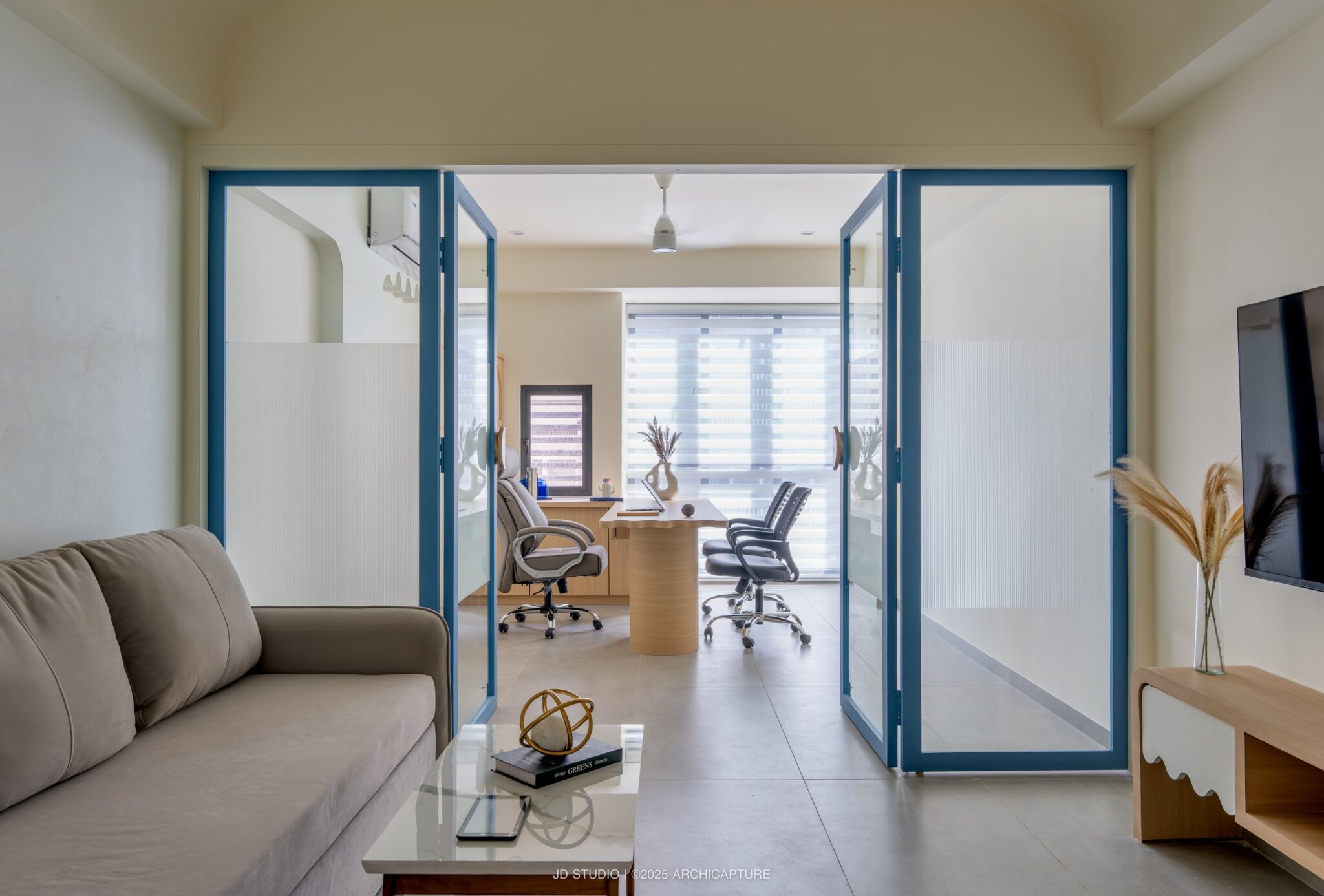
Designed by JD Studio under the direction of Jinal Desai, the 300-square-foot workspace in Rajkot is organised around a quiet but deliberate split. A pair of deep blue-framed glass partitions divide the plan into a lounge on one side and a working cabin on the other, holding the two functions in conversation without collapsing them into one room. The palette stays cream, oak, and stone-grey throughout; the blue frames are the only chromatic interruption, and they earn that role by doing real structural work.
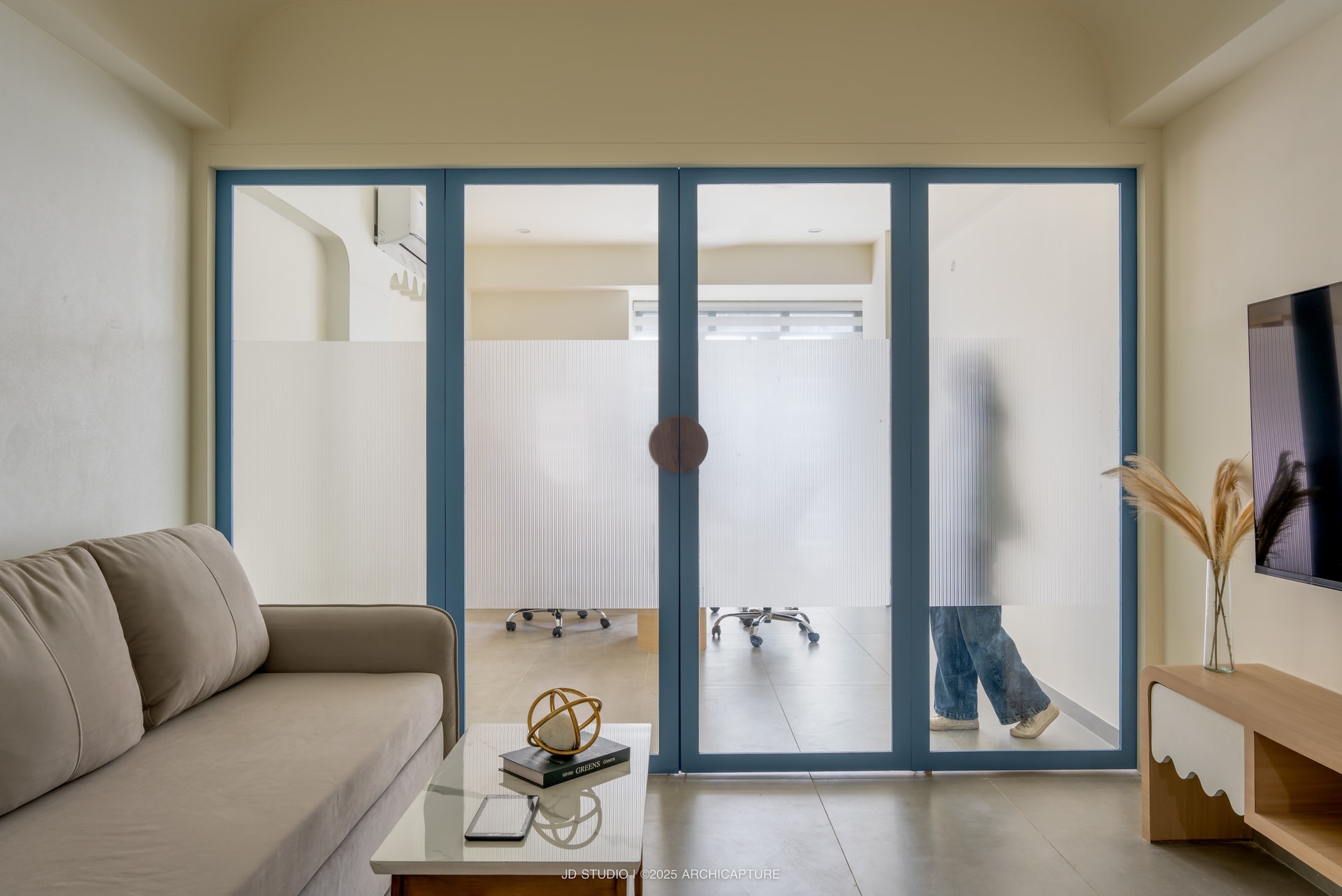
Looked at from the lounge, the office reveals its full logic in a single frame. The glass partitions slide open to reveal a scalloped-edge desk, an ergonomic chair, and a window dressed in zebra blinds, all held within a shell of soft cream. The blue framing is what makes the composition legible: it draws the eye through the threshold without ever closing it off.
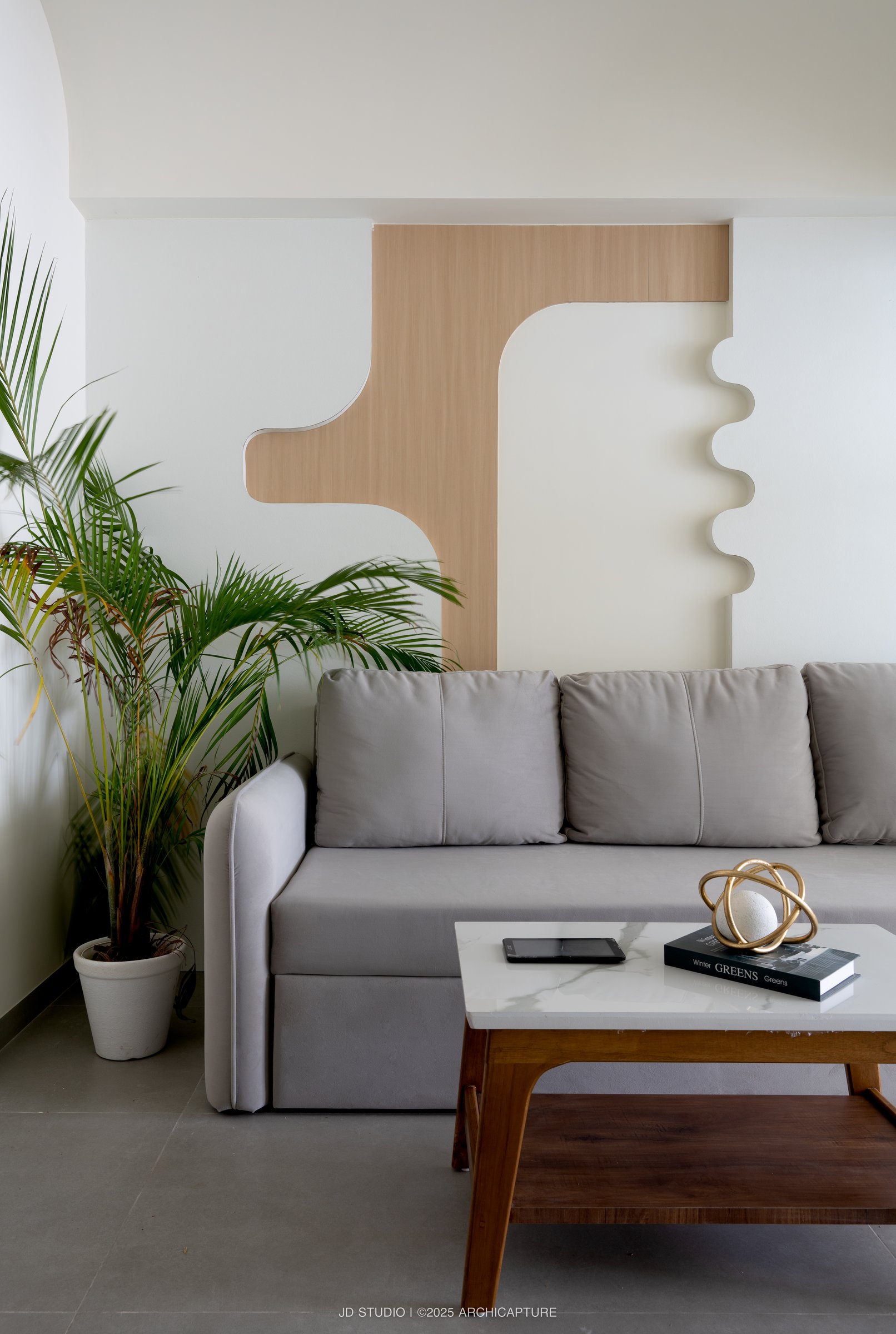
The lounge sofa sits below a wall composition that functions as the project’s signature. A wood-toned cut-out interlocks with a wavy white form, the two shapes reading like a piece of architectural marquetry rather than applied decoration. The grey upholstery and the marble-topped wooden coffee table stay deliberately quiet beneath it.
This is the room making its argument in miniature. Curvilinear geometry is not a motif here, sprinkled across cushions and lamp bases; it is the operating grammar of the wall itself, which means the furniture is free to relax into ordinary forms.
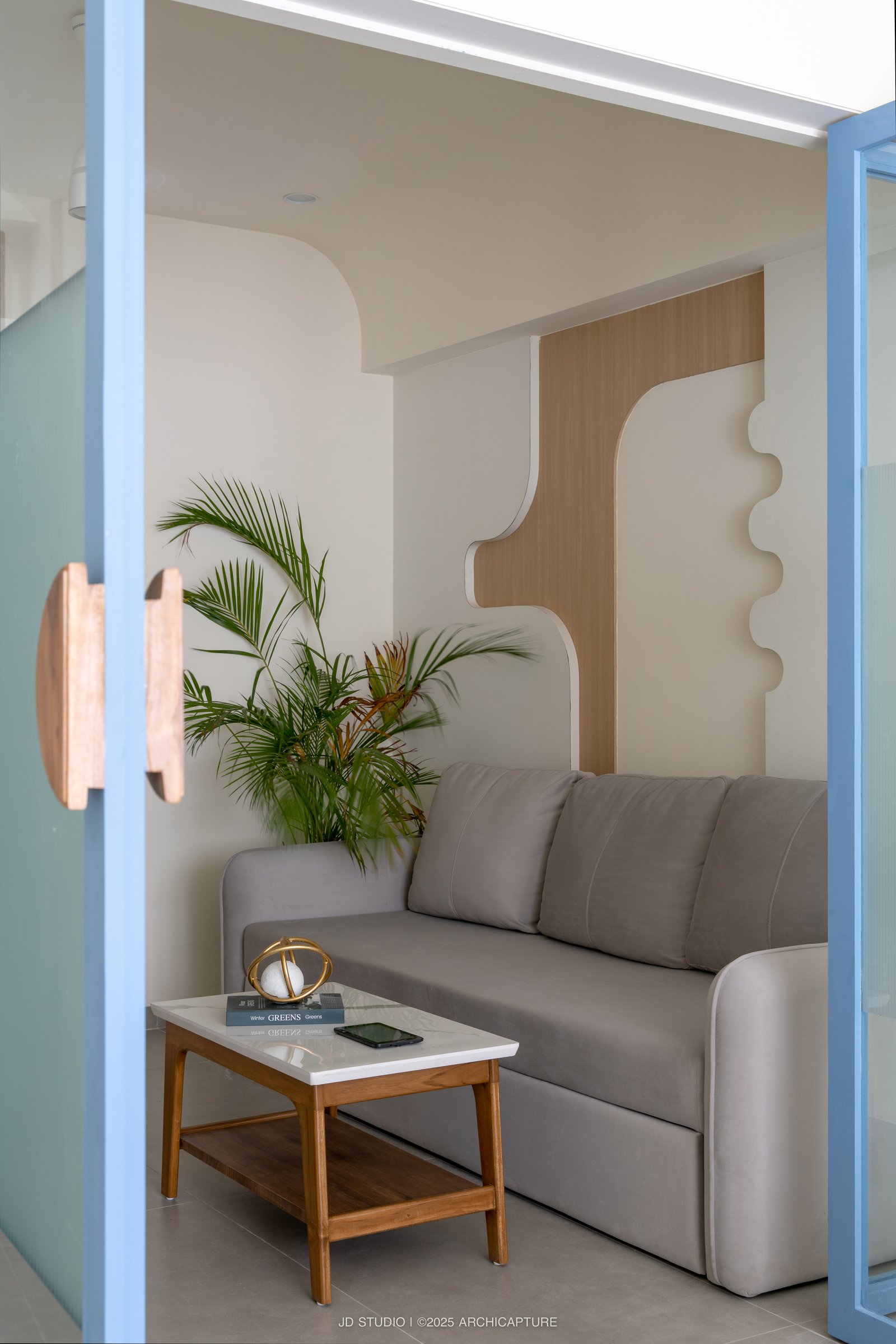
Framed through the open blue partition, the lounge takes on the quality of a vignette, the wooden door pull on the glass frame catching the light as a small sculptural detail. The composition makes clear why the partitions were drawn in blue rather than dissolved into the cream: they are the threshold event, and they need a colour that holds.
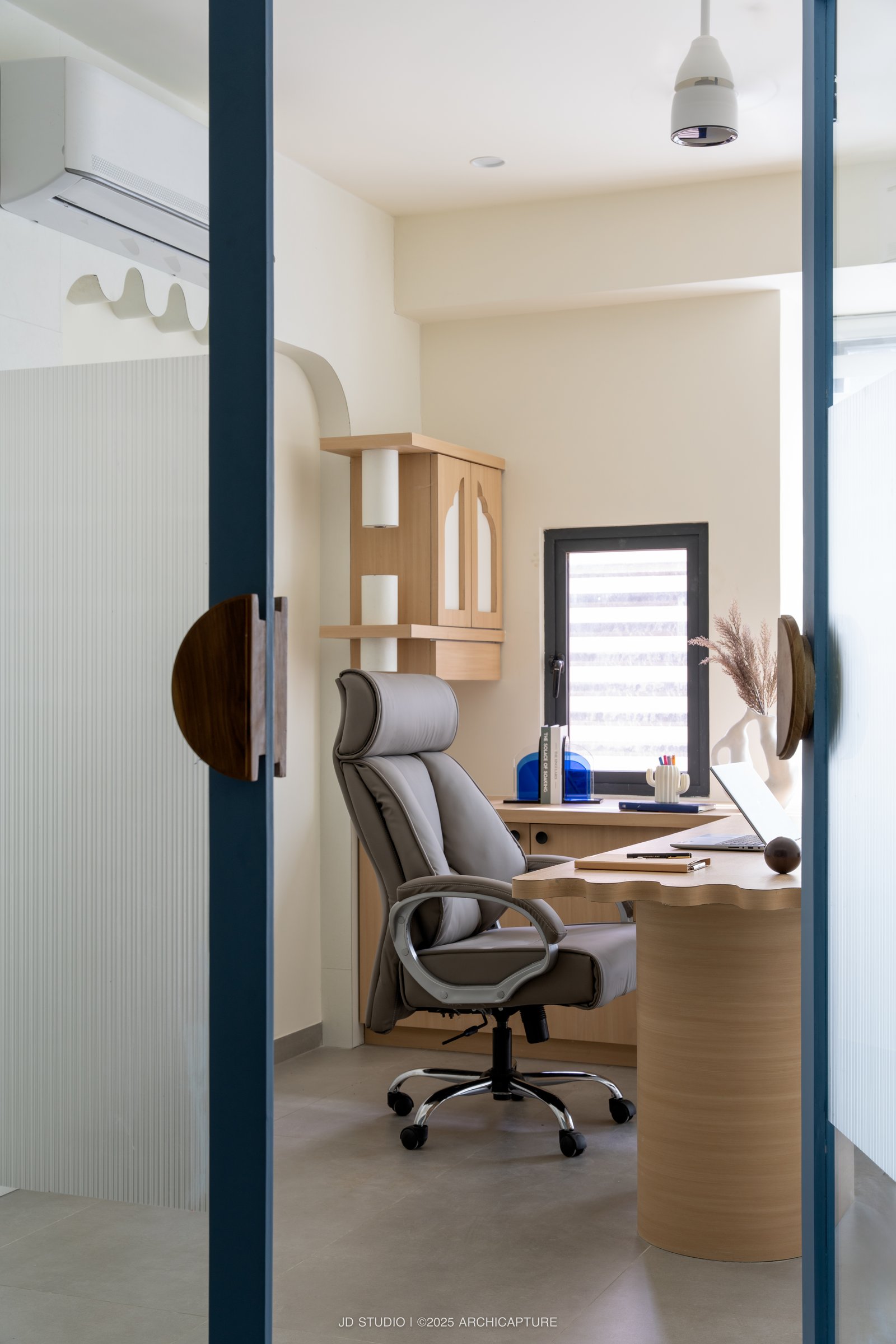
Through the same threshold, the working cabin reveals its own discipline. A wall-mounted oak cabinet with arched cut-outs sits beside a window, with a ceiling pendant above, while the desk’s scalloped front edge curves toward the chair.
The cabin’s restraint is the point. In a 300-square-foot office, the temptation is to make every surface speak; here, only the desk edge and the cabinet fronts carry the curve, and the rest of the room recedes into plain cream walls and an oak-toned floor.
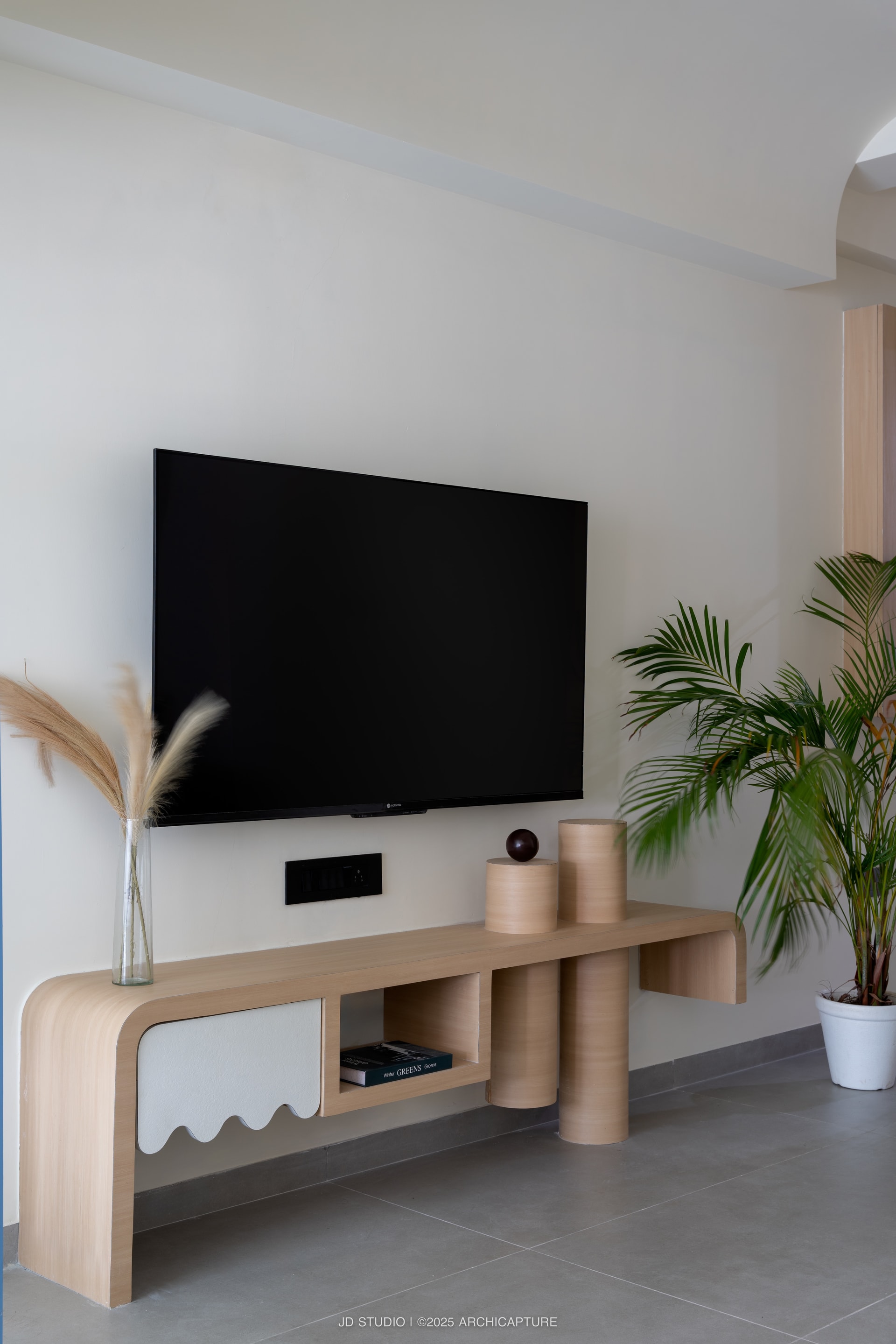
The media console on the lounge’s opposite wall is where the wavy vocabulary turns fully sculptural. The oak unit rests on curved arched side panels, a small upholstered drawer front carries a scalloped white wave, and a pair of cylindrical vessels sit beside a dark sphere as the only styling gesture.
It is the room’s most overtly designed object, and it works because nothing else competes. The television above stays flush and unframed; the console below carries all the formal weight.
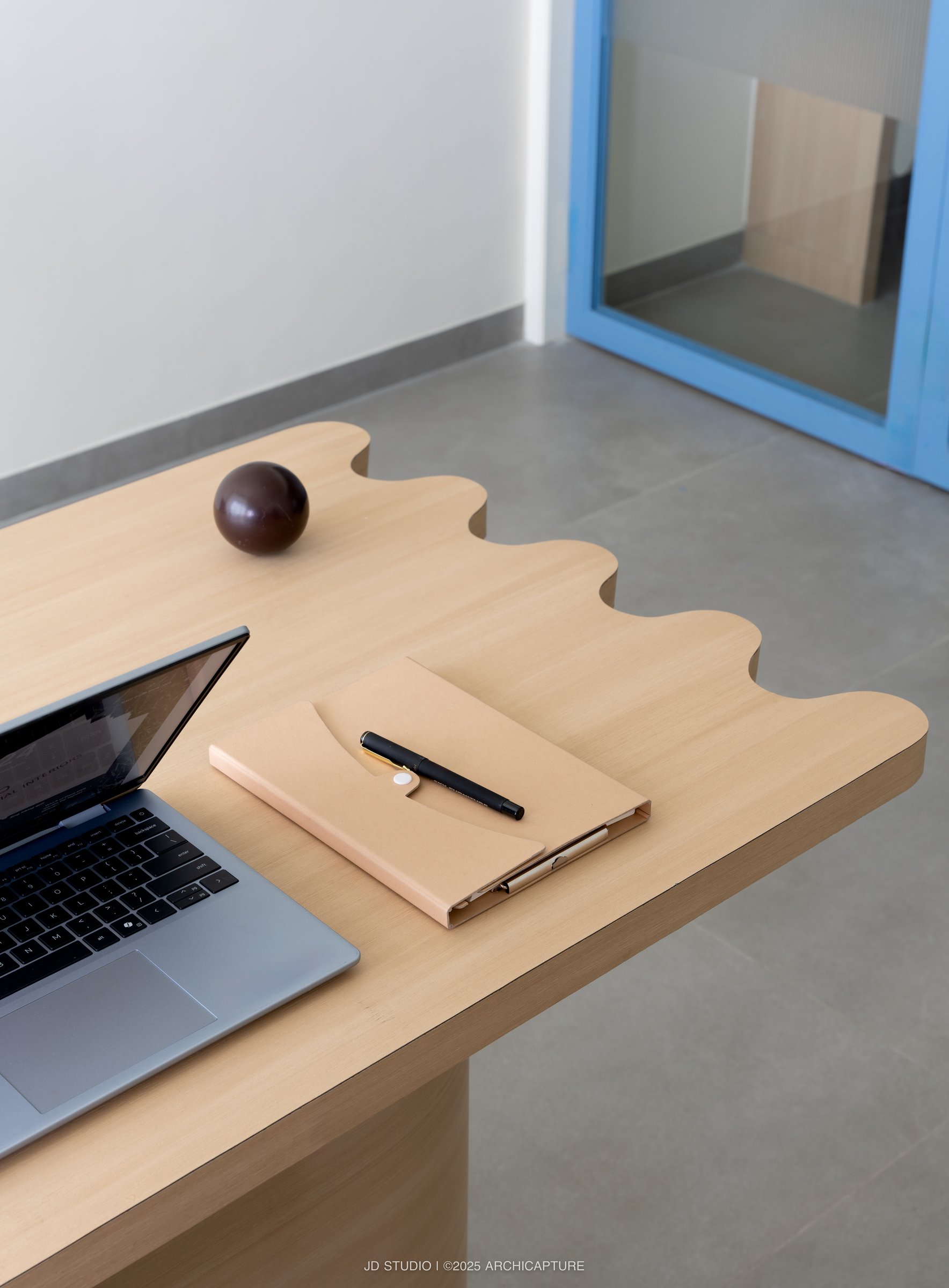
At close range, the desk’s wavy edge clarifies itself as the project’s thesis in miniature. The pale timber is cut into a continuous scalloped profile that runs the length of the work surface.
For a city like Rajkot, where commercial interiors still default to glass-and-laminate efficiency, a 300-square-foot office that commits this fully to a single formal idea is a quiet shift. The project does not import a style so much as test whether a small workplace can hold a design argument at all.
The answer, on the evidence of this room, is that it can, provided the argument is restrained enough to live inside the working day. JD Studio’s restraint is what makes the curve land.