A katte, in old Bengaluru, was the raised plinth around a banyan tree where the day’s news, gossip, and small disputes were settled over coffee. It was infrastructure for belonging, not for transaction. Nammura Katte, on a tree-lined street in the city, asks whether that civic instinct can be rebuilt indoors, in tile and pigment and arch, without slipping into pastiche.
Designed by Panchatatva Architects, the project is a multi-vendor café and snack hall that gathers Chikkamagaluru filter coffee, Karnataka bhel, and a small bakery under a single material grammar. The brief was less about styling a restaurant than about composing a small piece of public life, the kind of corner that a regular returns to without quite remembering when they started.
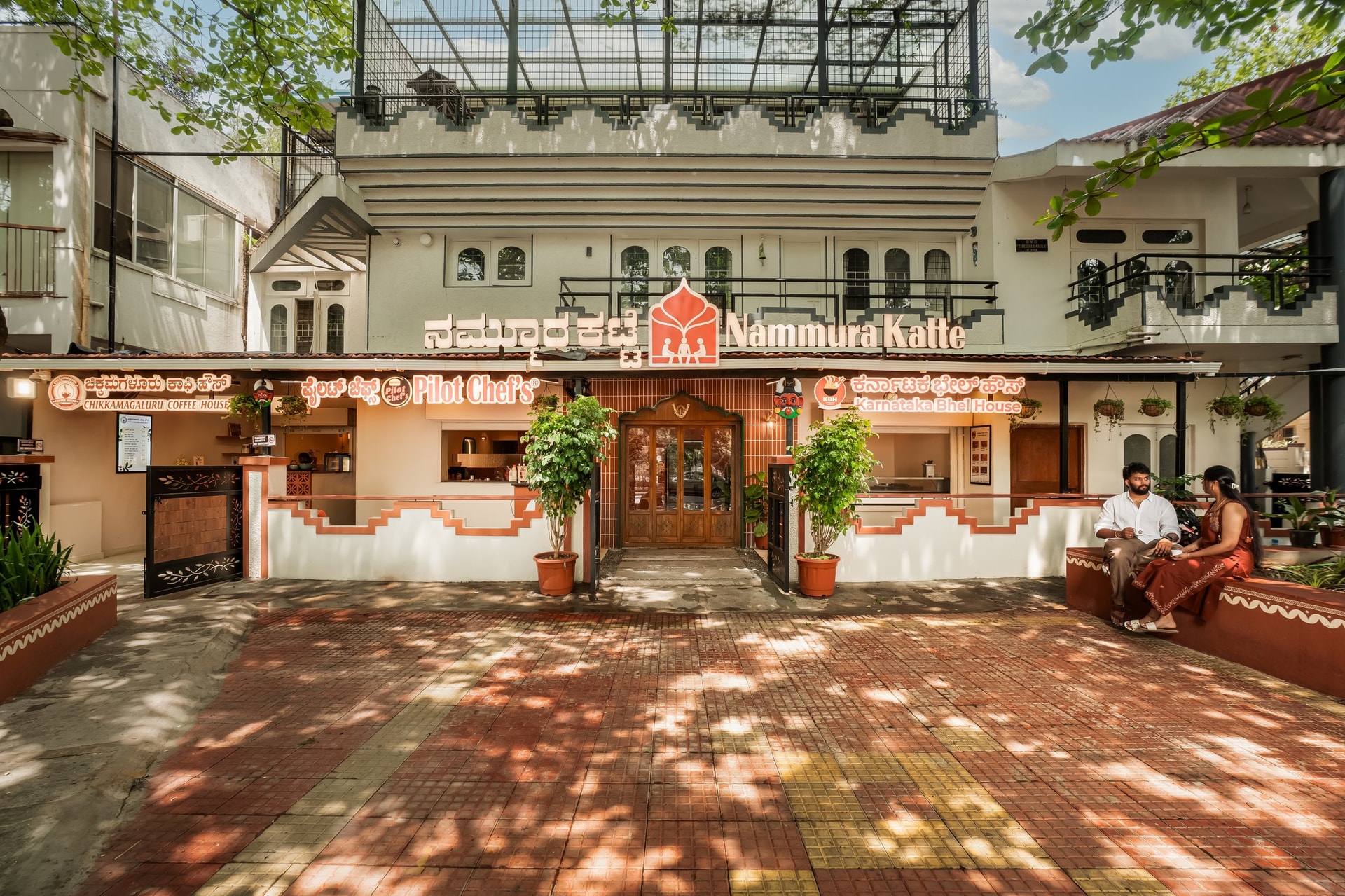
From the street, the building presents itself less as a purpose-built commercial establishment and more as a familiar neighbourhood bungalow adapted over time. A terracotta-tiled facade wall, understated bilingual signage in Kannada and English, and a modest forecourt softened by potted greenery evoke the atmosphere of a traditional katte reimagined for contemporary use.
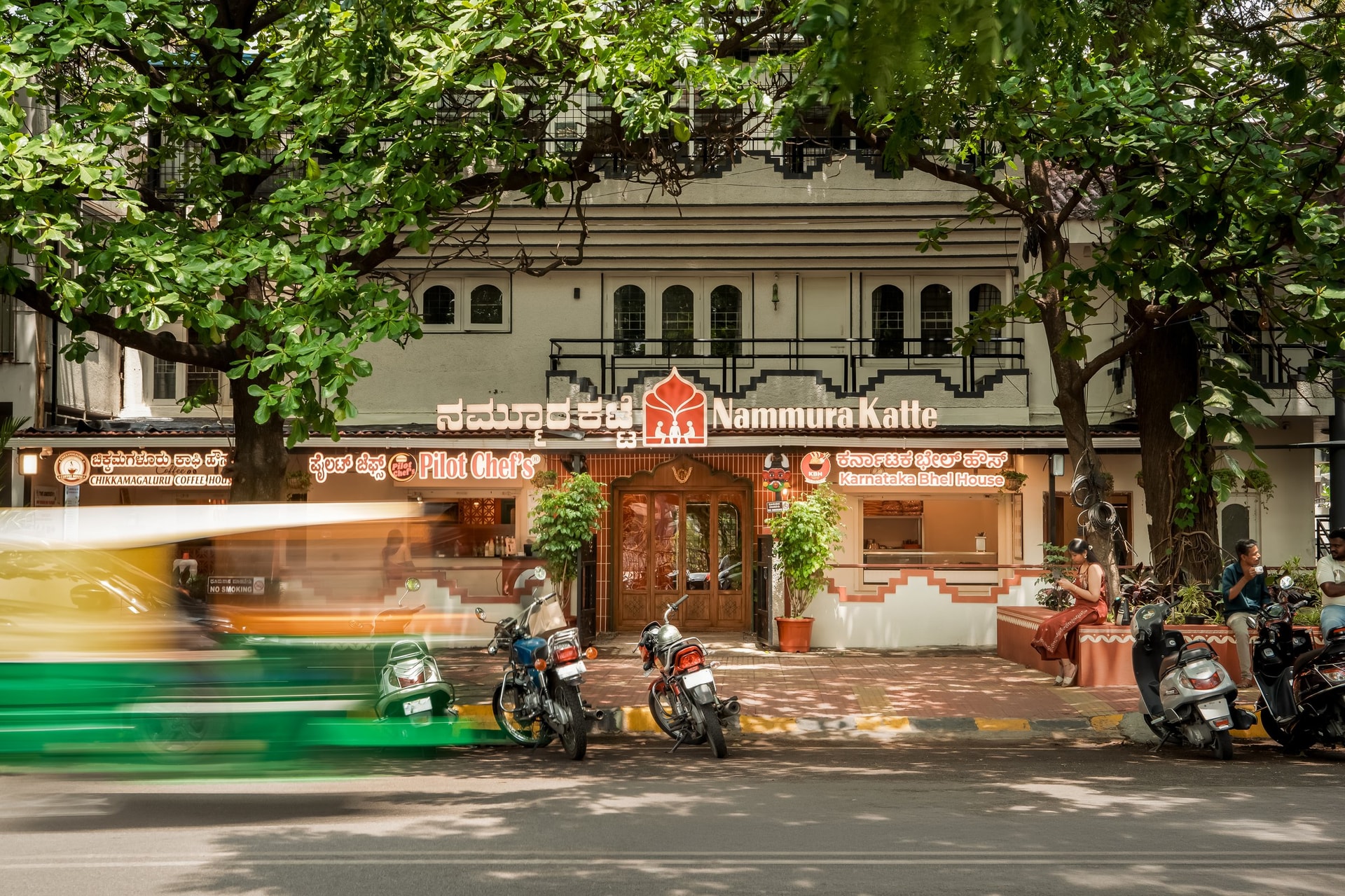
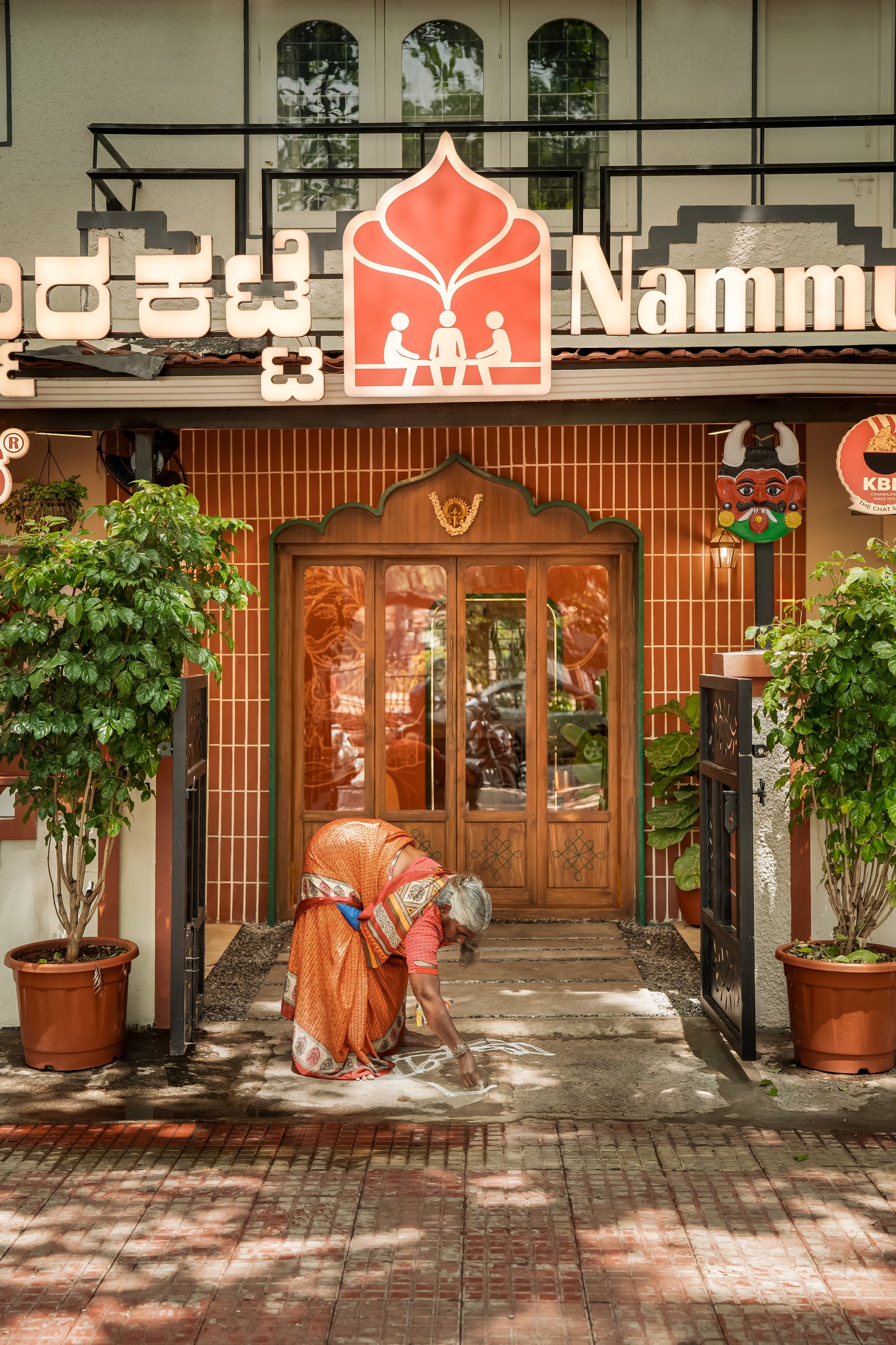
The door is teak, framed by a scalloped green-edged surround crowned with a small brass deity. The wall behind it is laid in slim terracotta tiles set in a stretcher bond with generous white grout, a finish that reads as both contemporary and traditional. Two wall lanterns flank the door, and a stepped concrete-and-gravel path completes the approach.
““Nammura Bengaluru, nimmuru yaavooru?””
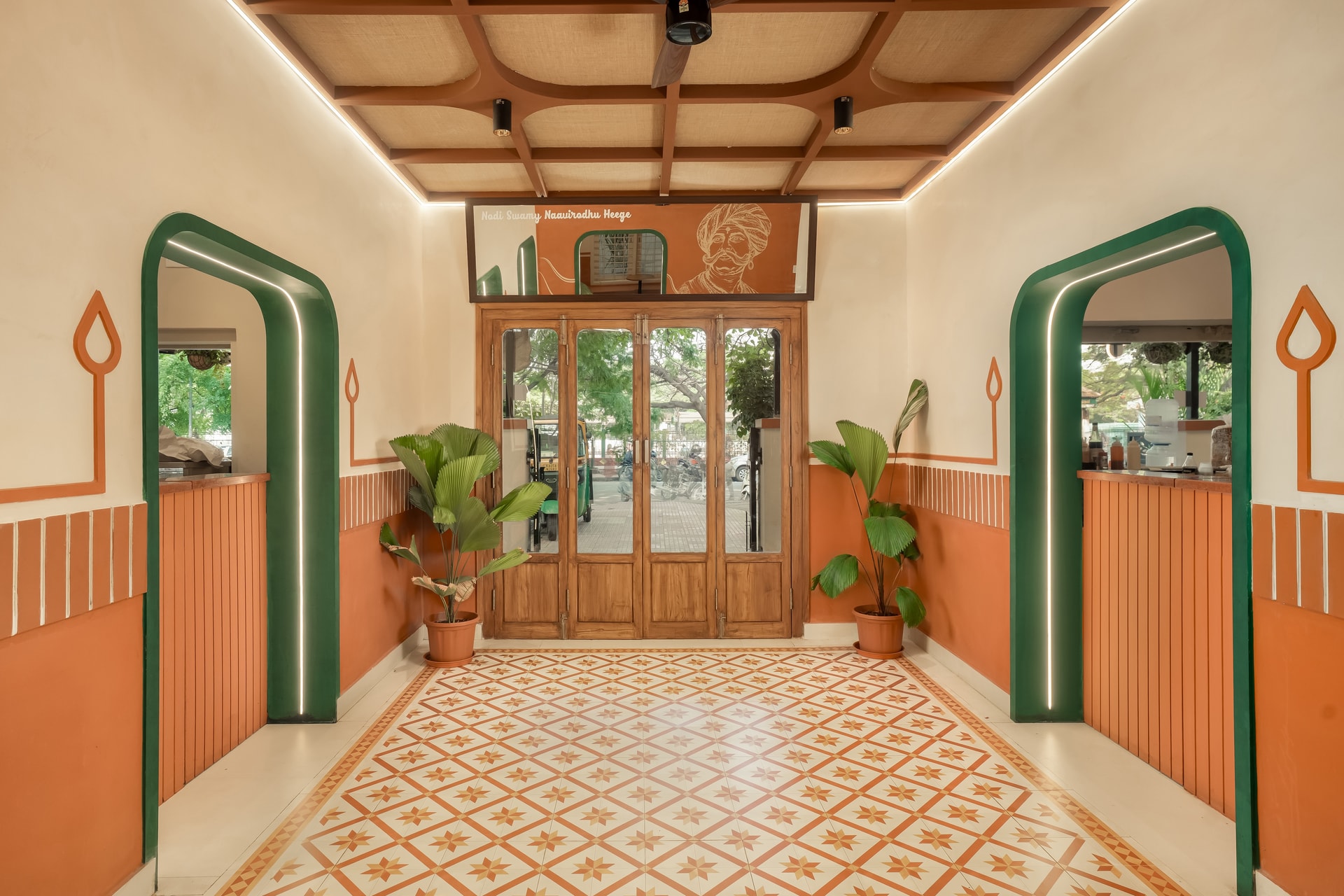
The foyer is symmetrical: green-edged arched openings cut through panelled half-walls in terracotta, and the jute-and-wood coffered ceiling continues overhead. The patterned tile carpet runs the length of the room.
The architectural restraint here is worth pausing on. The decorative load is carried almost entirely by colour, mural and floor pattern; the joinery itself is plain teak, the walls are flat plaster, the arches are simple radii. The room feels rich without feeling busy.
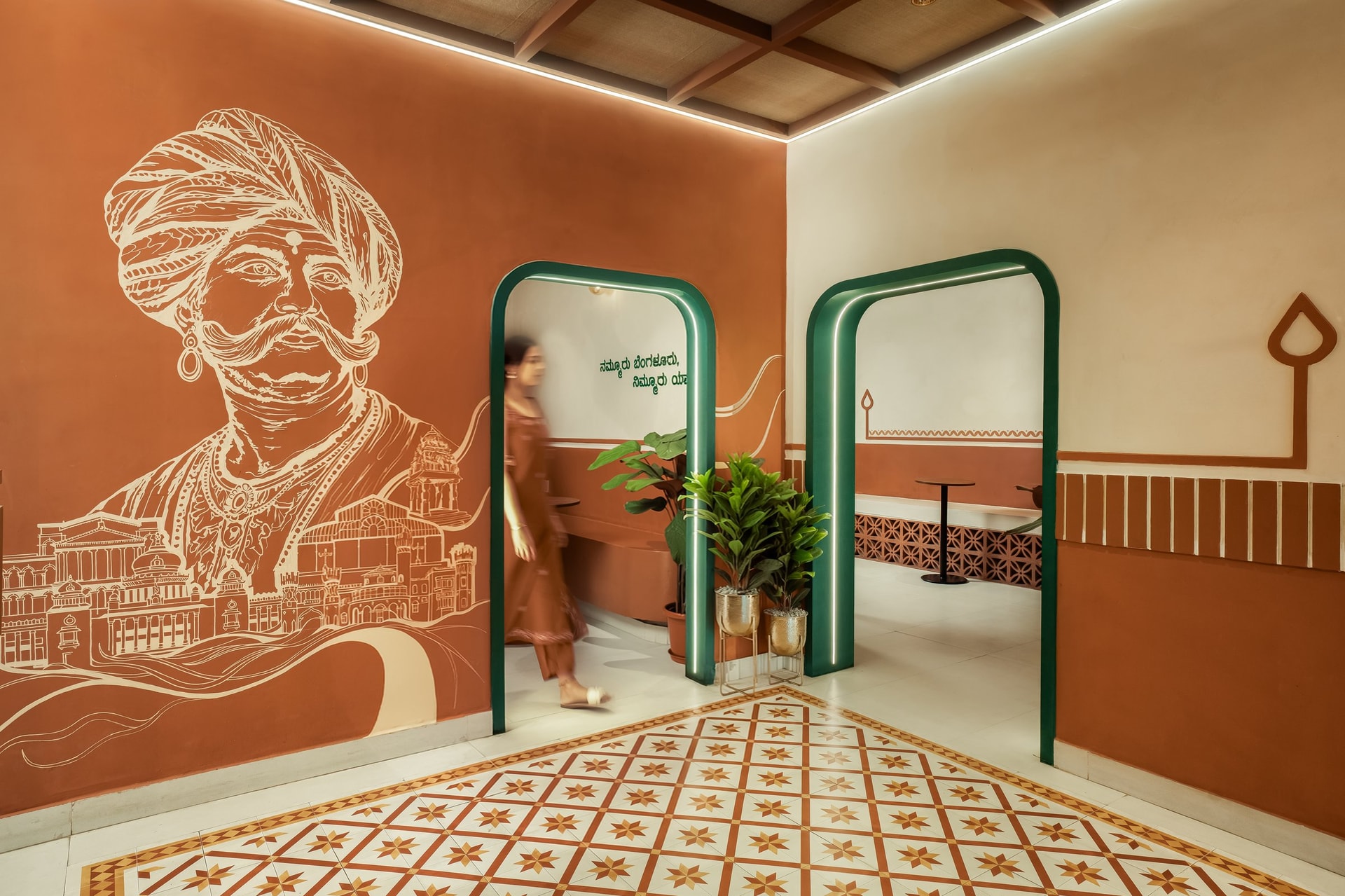
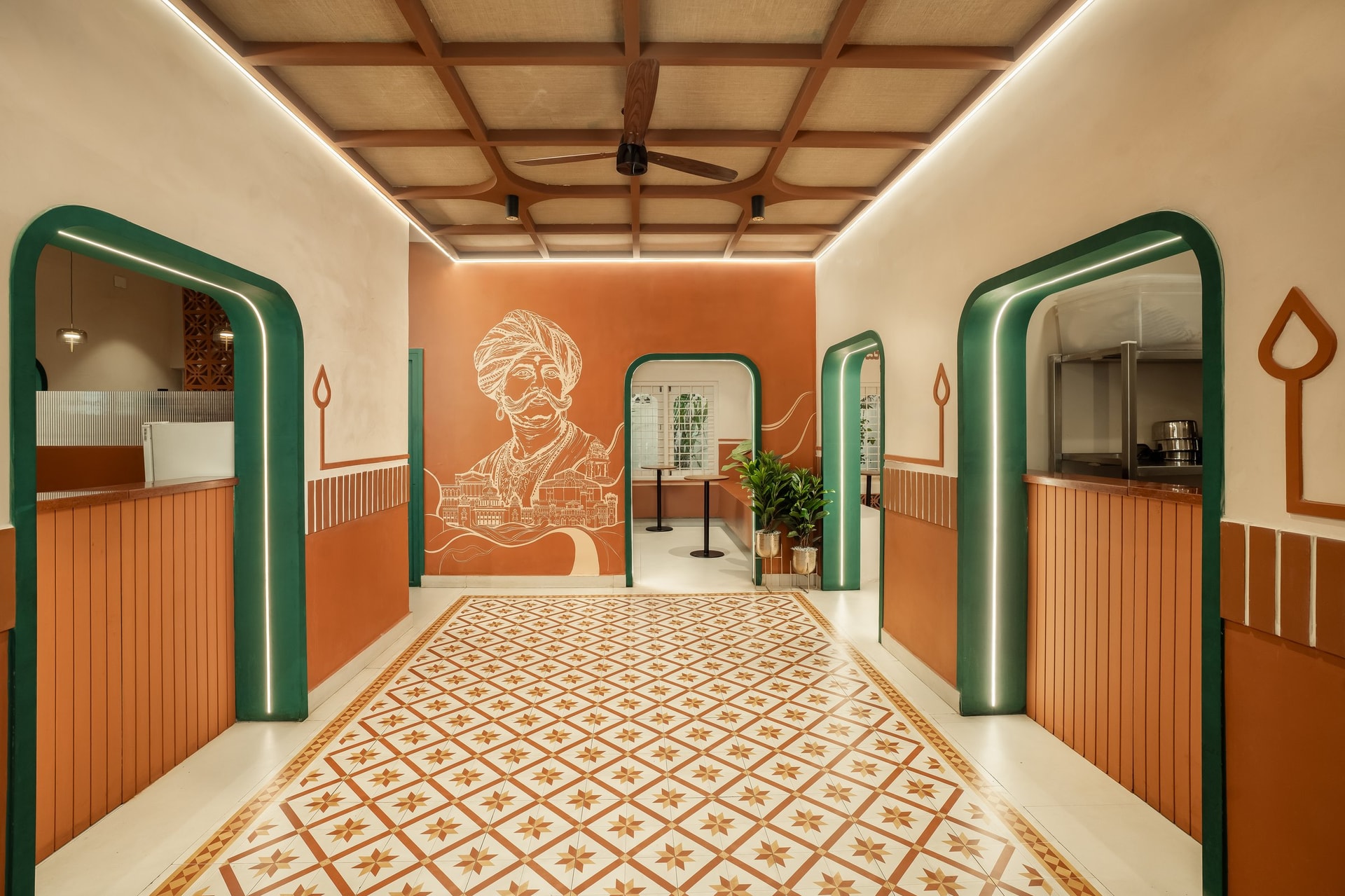
Turning into the main hall, the Kempegowda mural reappears at full scale on the central wall, flanked by two further arched portals that open into the service counters on either side. The ceiling fan, set into a wooden boss within the coffered grid, suggests an older typology of Bengaluru hall, the kind once found in Malleswaram homes and small clubs.
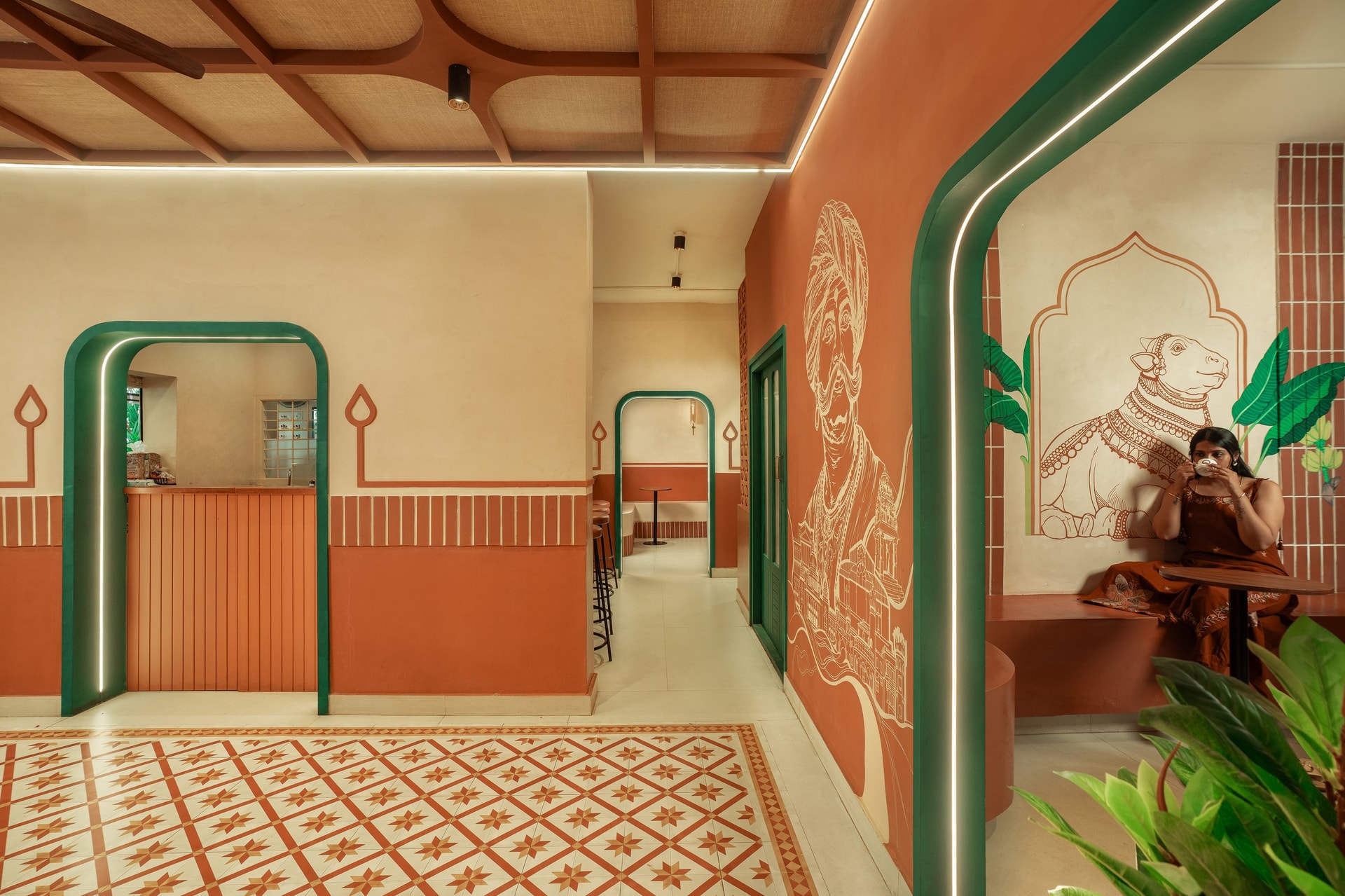
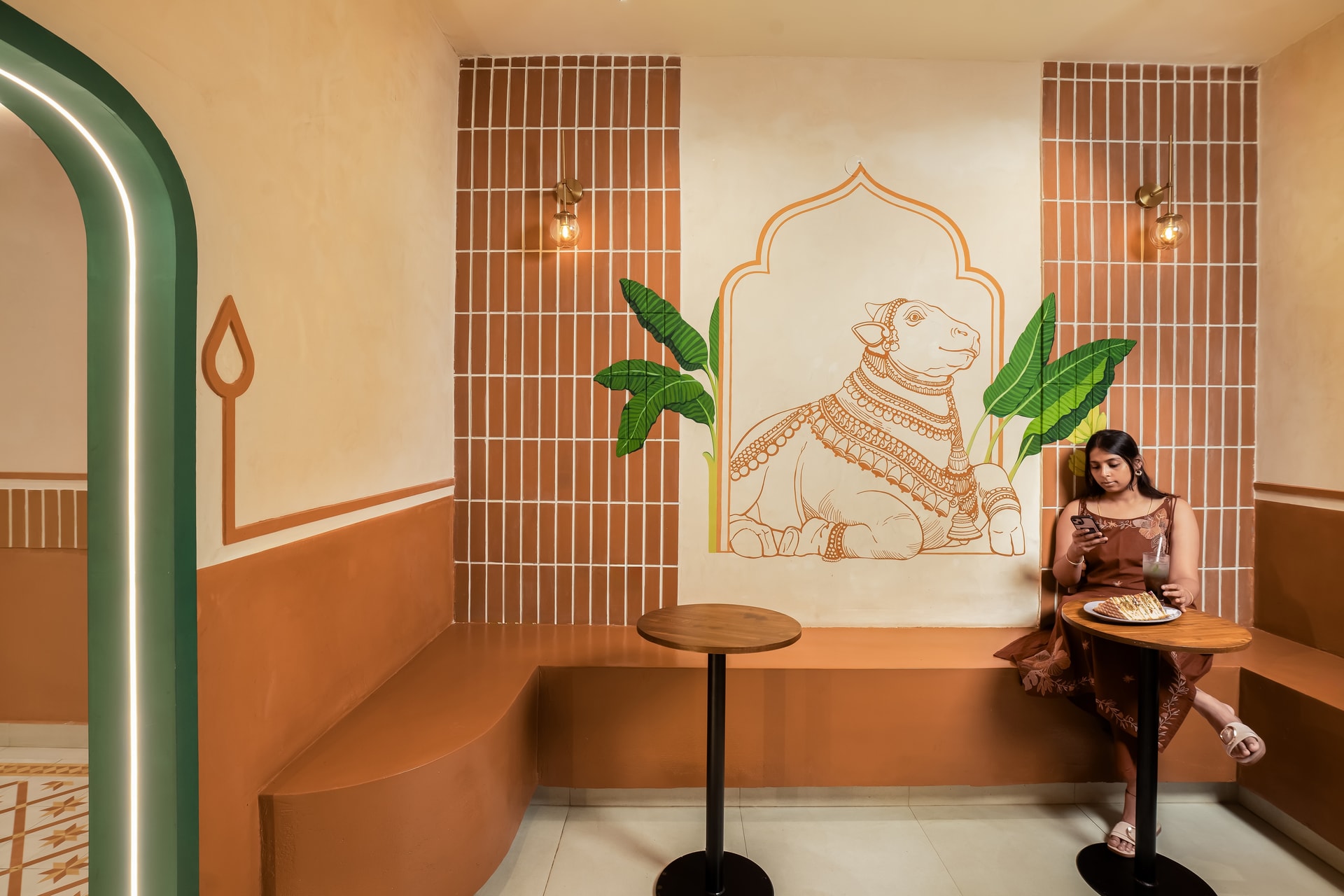
Off to one side, a second mural introduces Nandi, the seated bull, framed within a painted shrine-like arch and flanked by stylised banana leaves. The gesture turns the act of waiting for a filter coffee into something closer to a small architectural event.
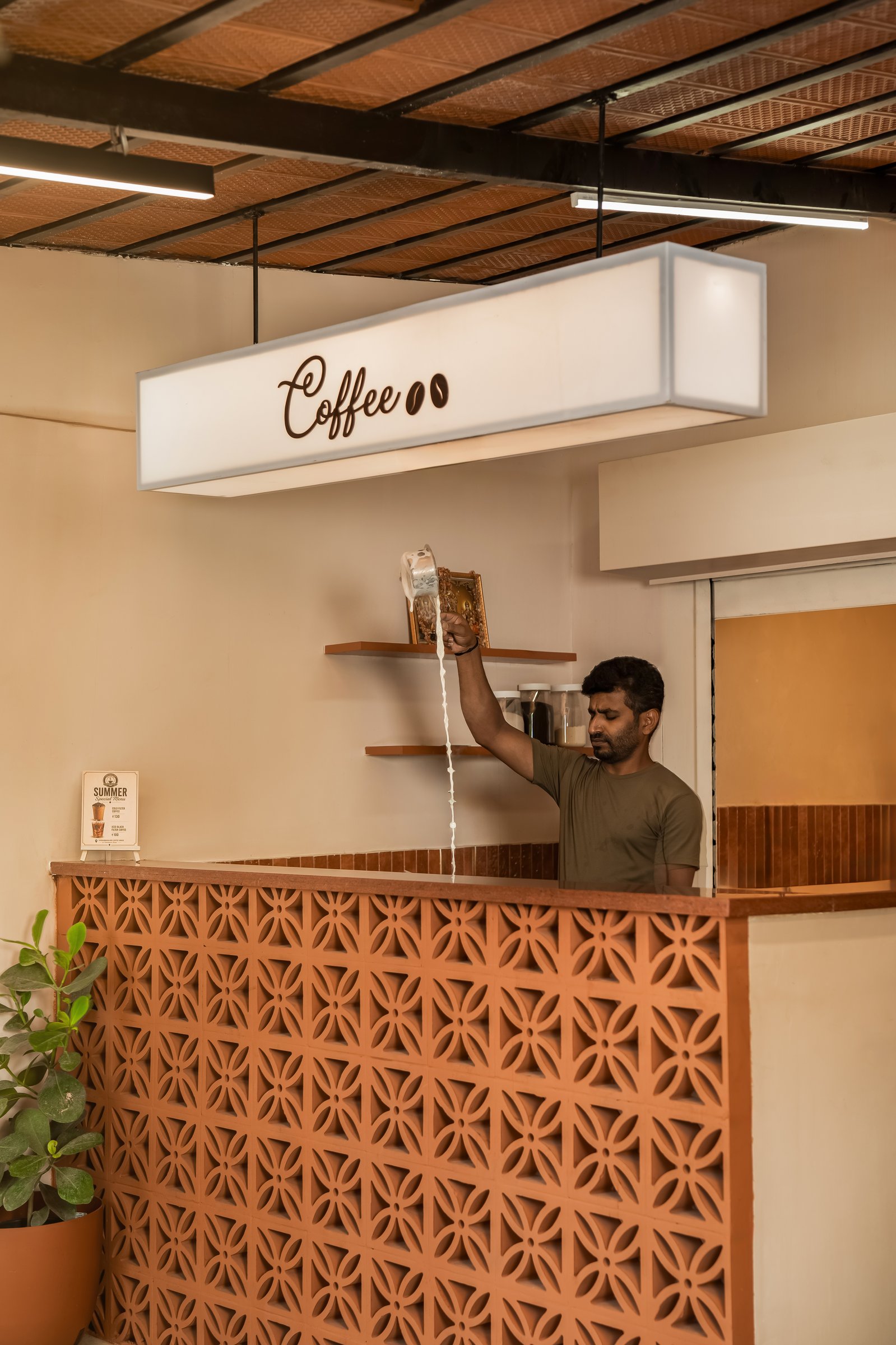
The Chikkamagaluru Coffee House counter is the project’s working heart. A perforated terracotta jali, the floral-cutout block screen familiar from south Indian houses, wraps the counter front. A back-lit acrylic light box above reads “Coffee”, and the ceiling above is a corrugated terracotta tile soffit on exposed beams.
The jali is doing more than decoration. It ventilates the equipment behind, breaks the visual mass of the counter, and quotes a material the city associates with verandas and courtyards. Used as café joinery, it shifts register without losing its origins.
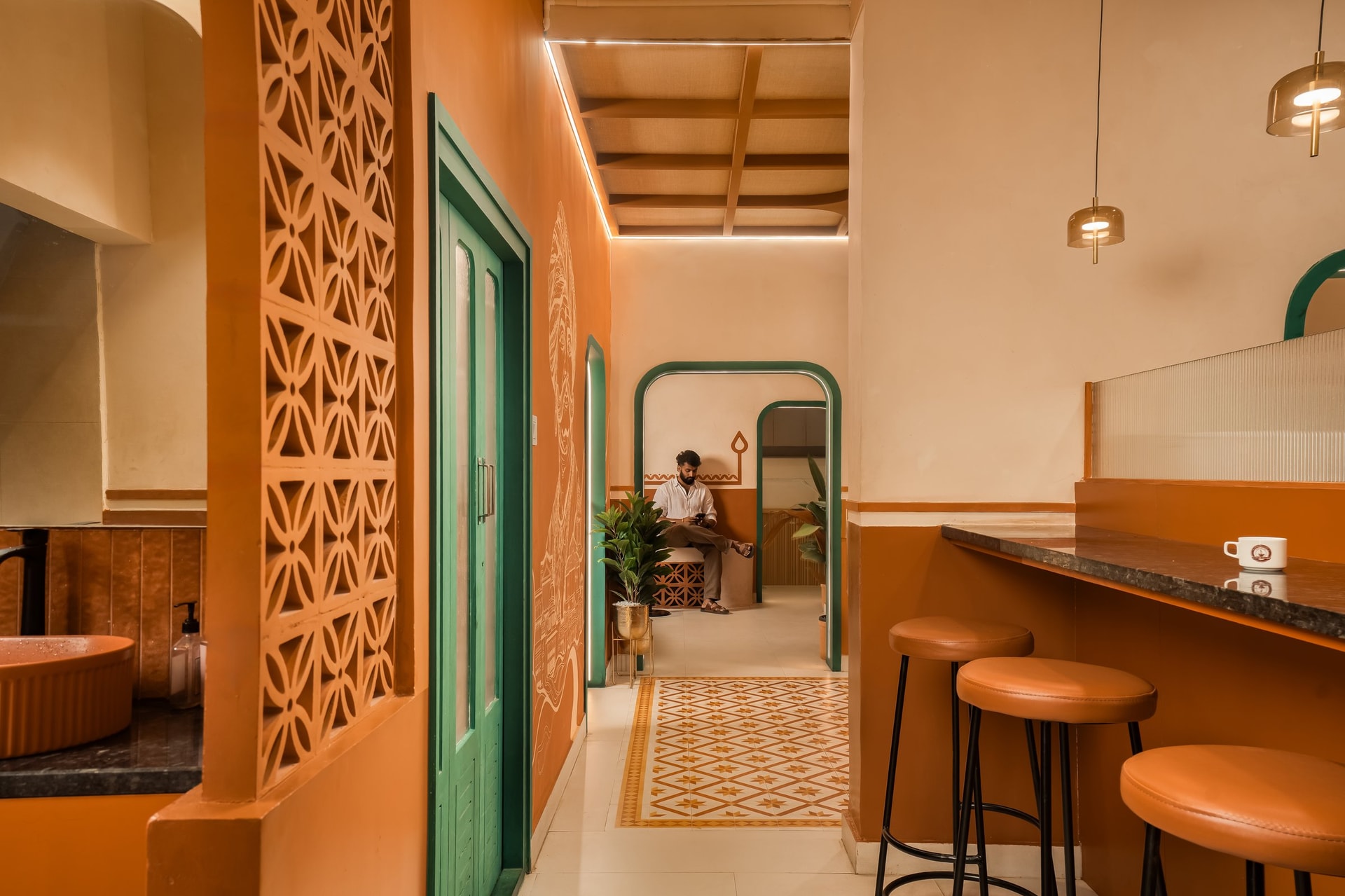
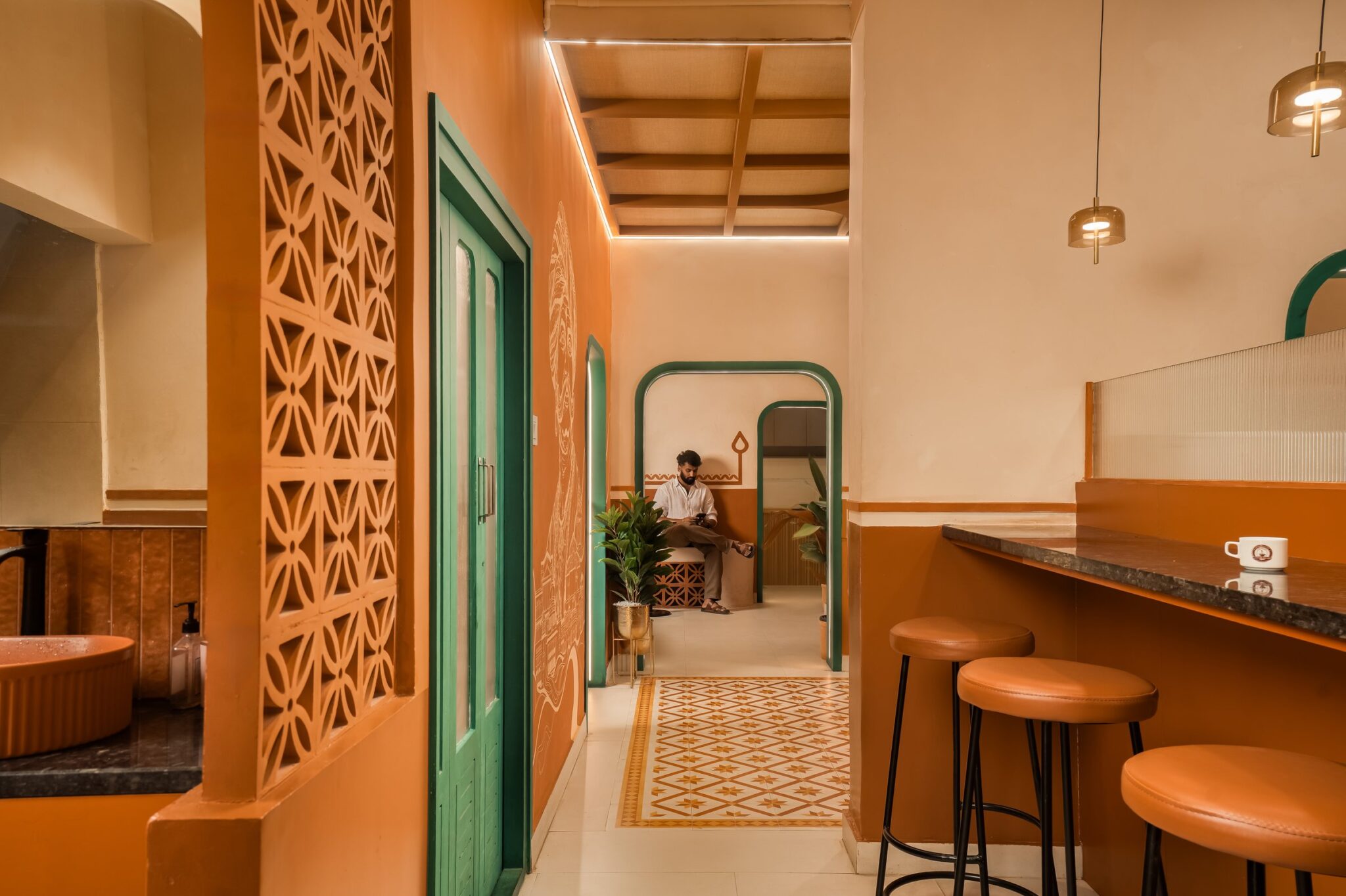
Circulation between the three vendors is treated as a sequence of arches rather than corridors. A green double door, a jali screen, a wall mural all line up along a single sightline. Three leather-topped bar stools at a terracotta-fronted counter occupy the foreground, with brass pendant lights overhead.
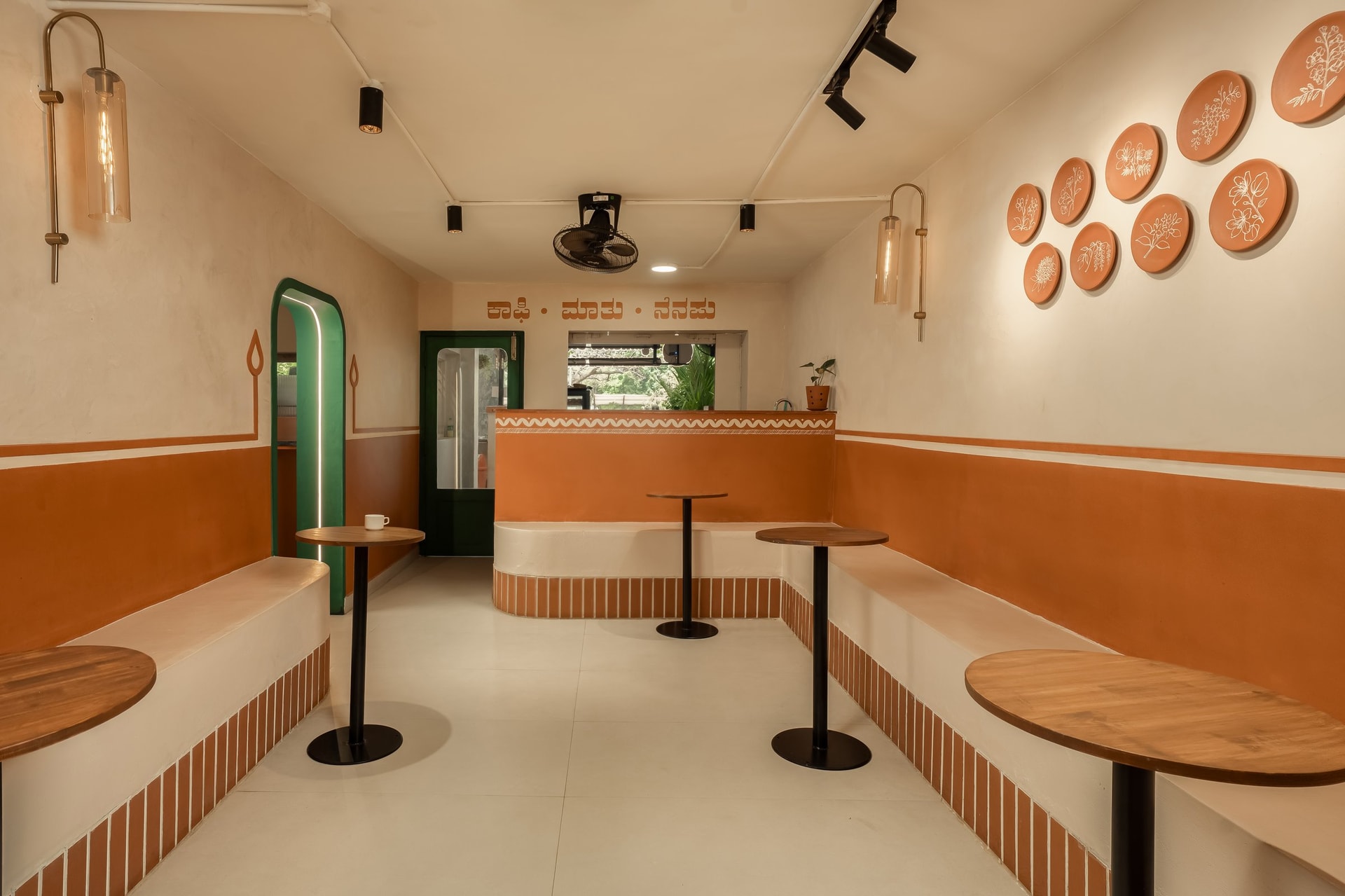
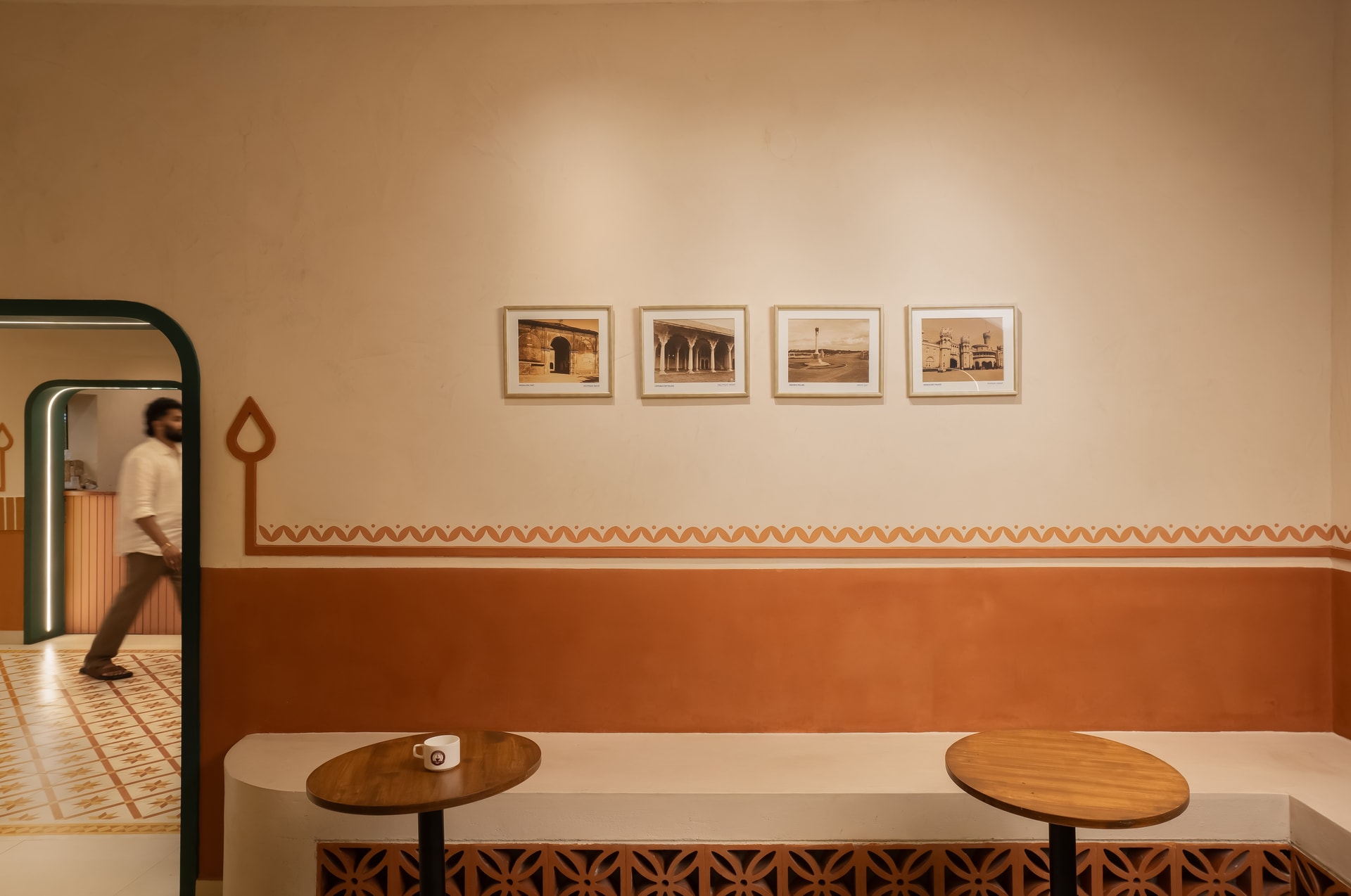
Built-in benches in white plaster run along three walls, their bases clad in the same slim terracotta tile used outside, capped with a continuous painted band in rust. A small service counter sits at the centre, its plinth painted with a folk border that echoes the kolam at the entrance. Free-standing round tables on slim black bases punctuate the space.
On the wall, a constellation of terracotta plates hand-painted with botanical motifs in white reads as both art and inventory. Two pendant sconces in brass and glass hold the wall at a domestic scale, and a single line of Kannada above the counter reads “Coffee, Conversation, Memory.”
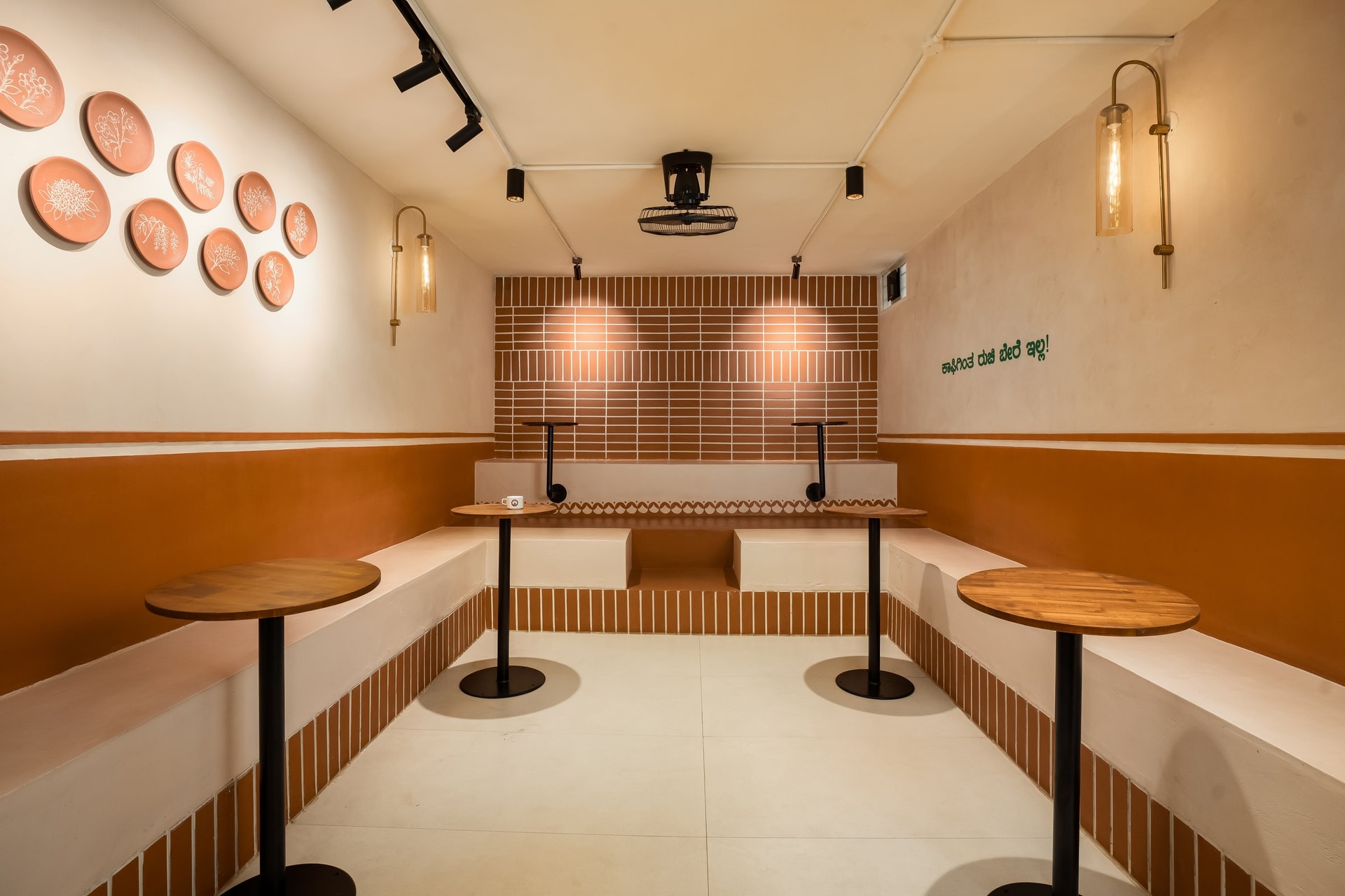
From the far end of the same hall, the geometry of the benches becomes clearer. The U-shaped seating creates a small communal pit at the centre, the kind of arrangement that makes strangers acknowledge each other.
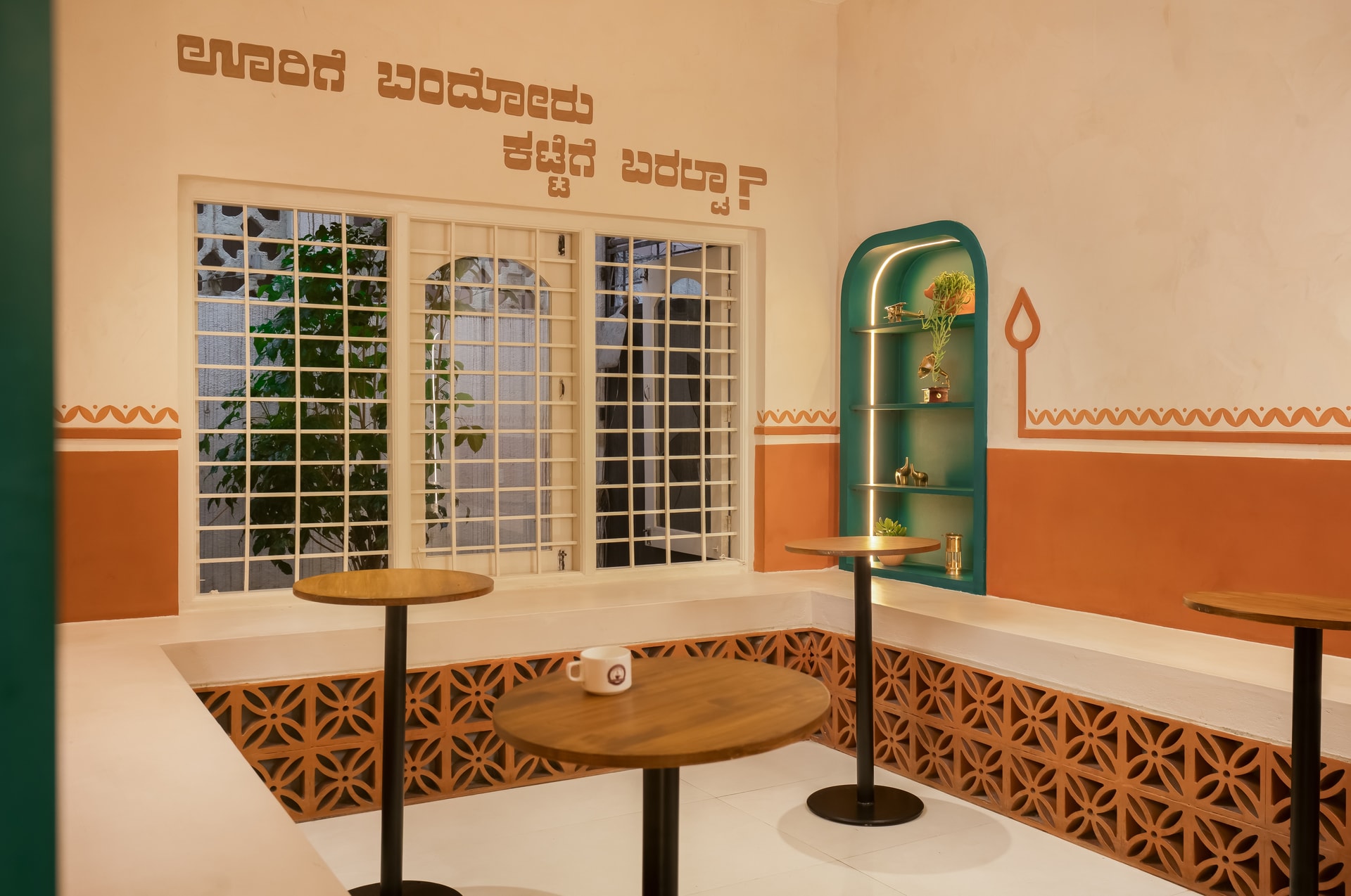
The Karnataka Bhel House room takes a softer line. A large window grilled in a fine geometric grid lets in light filtered through the foliage of the garden, and a Kannada line above it asks “When you come to the town, will you come to the katte?”
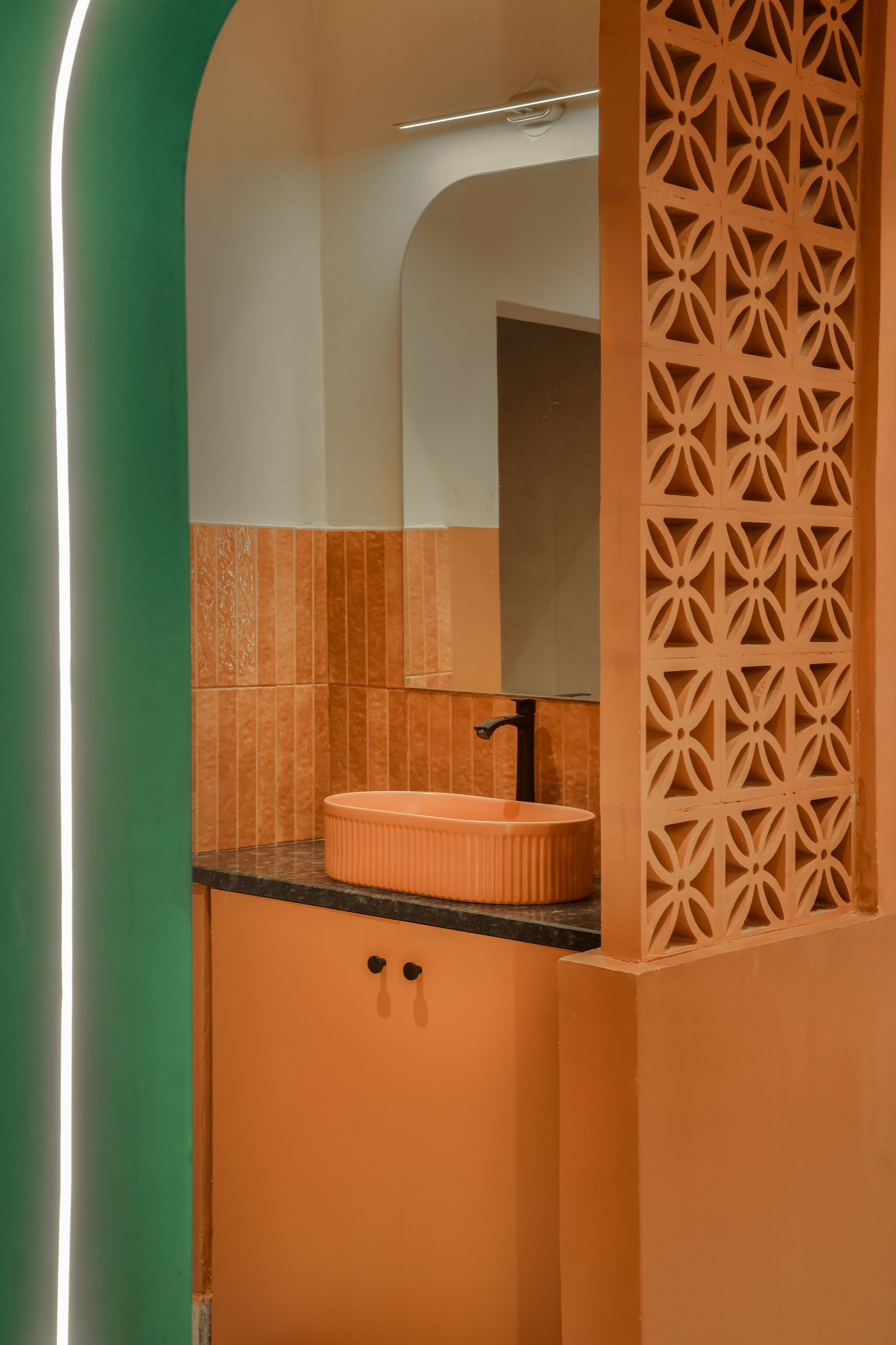
What Panchatatva have created here is less a café interior than an extension of the public life that has long animated Bengaluru’s streets and neighbourhoods. References to the katte, kolam, jali screens, coffered ceilings, and patterned cement tiles are drawn from the everyday architectural vocabulary of old Bengaluru and small-town Karnataka, yet they are interpreted with restraint rather than nostalgia. A tightly controlled palette of terracotta, cream, and muted green gives the project its identity, while the joinery remains deliberately understated, allowing colour, texture, and spatial rhythm to take precedence.
The success of Nammura Katte lies in its ability to evoke familiarity without resorting to imitation. Every design gesture feels purposeful, balancing cultural memory with contemporary sensibilities to create a space that is both rooted and relevant. Rather than reconstructing an idealised past, the project distils its essence into an environment that feels instinctively welcoming.
The result is a café that earns its warmth through careful design rather than sentiment. Nammura Katte does not ask visitors to remember a Bengaluru they may never have experienced; instead, it offers a setting where the city’s enduring culture of gathering, conversation, and coffee can find renewed expression in the present day.