Compact apartments in Mumbai rarely fail for lack of effort. They fail for lack of restraint, the instinct to compensate for square footage with visual noise, to fill every wall with a gesture, to confuse busyness with character. The more enduring approach is the opposite: edit until what remains can be felt rather than seen.
This is the proposition behind Arlo Home, a 700-square-foot residence in Mumbai designed by Eight Degree Design House under the direction of Chrisann Rodrigues. The brief favoured calm over compression, with a material register of pale neutrals, blond wood, and brushed brass arranged around a single idea: that a small home need not perform smallness.
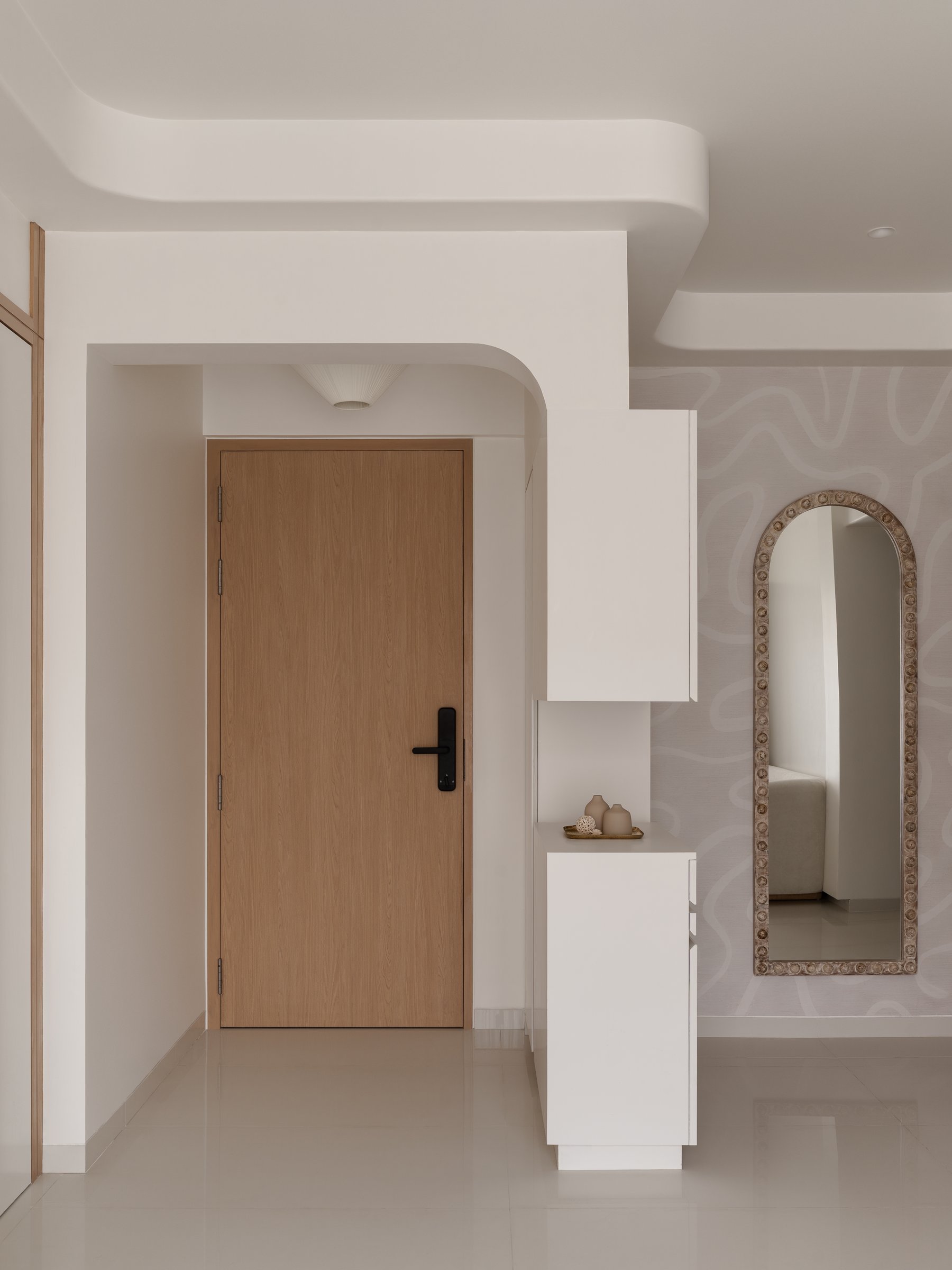
The entry establishes the home’s design language in a single, composed frame. A wood-grain door sits within a softly curved plaster archway, beside it a slim white console with two ceramic vessels on a tray, and on the adjoining wall a tall arched mirror framed in textured beaded timber against a wallpaper of pale, looping line-work.
The ceiling above the threshold drops in a sculpted curve, easing the transition from public corridor to private interior without resorting to a hard architectural break. The arch is the home’s recurring motif, and meeting it at the door rather than deeper inside is a measured opening gesture.
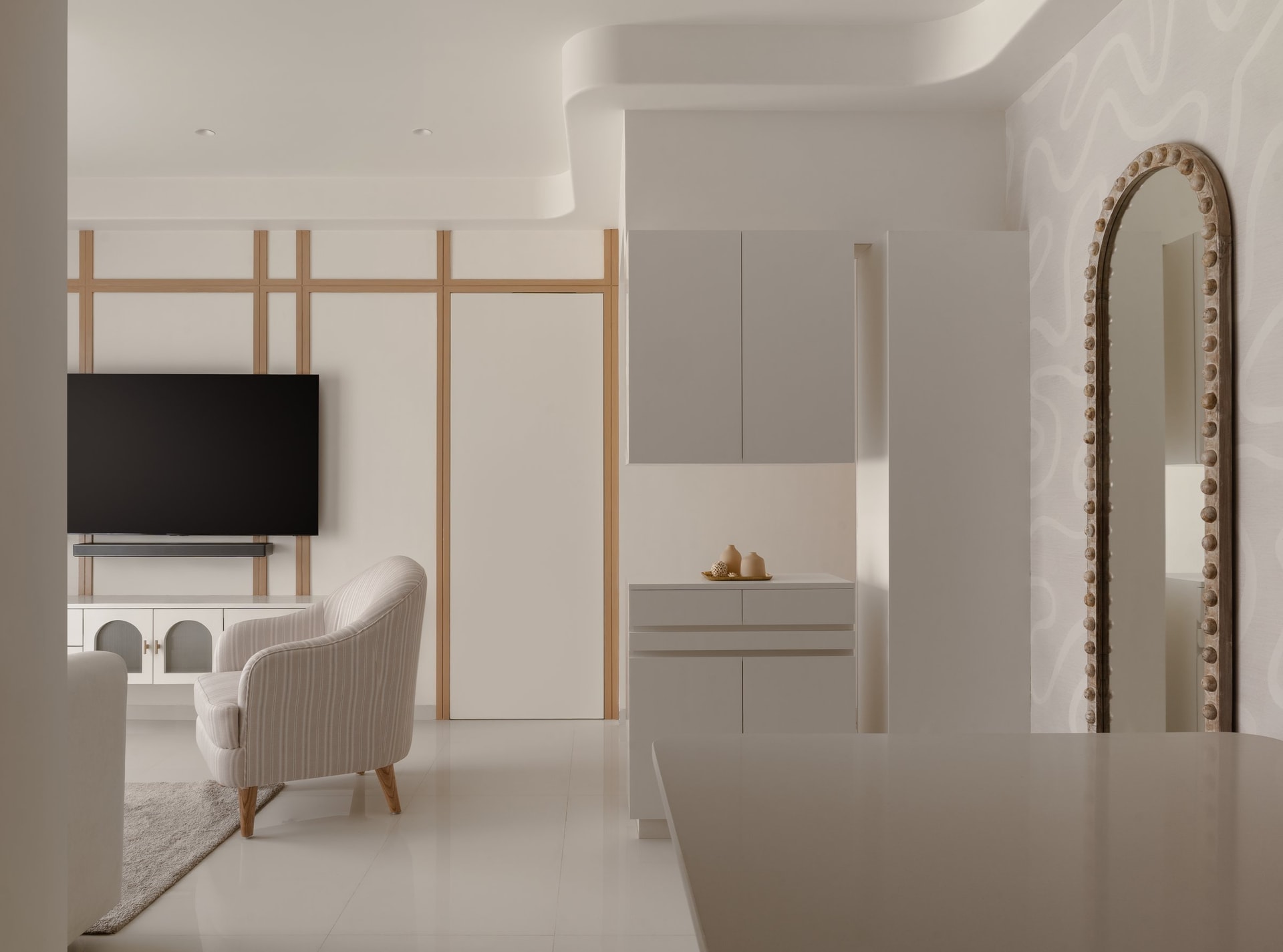
Beyond the foyer, the apartment reveals its open plan as a continuous neutral field. A striped upholstered armchair on slender wooden legs sits before a media wall articulated by a slim wooden batten grid; pale grey cabinetry runs along the adjacent wall, and the curved ceiling drop from the entry continues overhead, holding the rooms in a single composed envelope.
The choice to let one tonal field carry the living, kitchen, and dining zones is what allows the apartment to read less as a series of enclosed rooms and more as one carefully held interior.
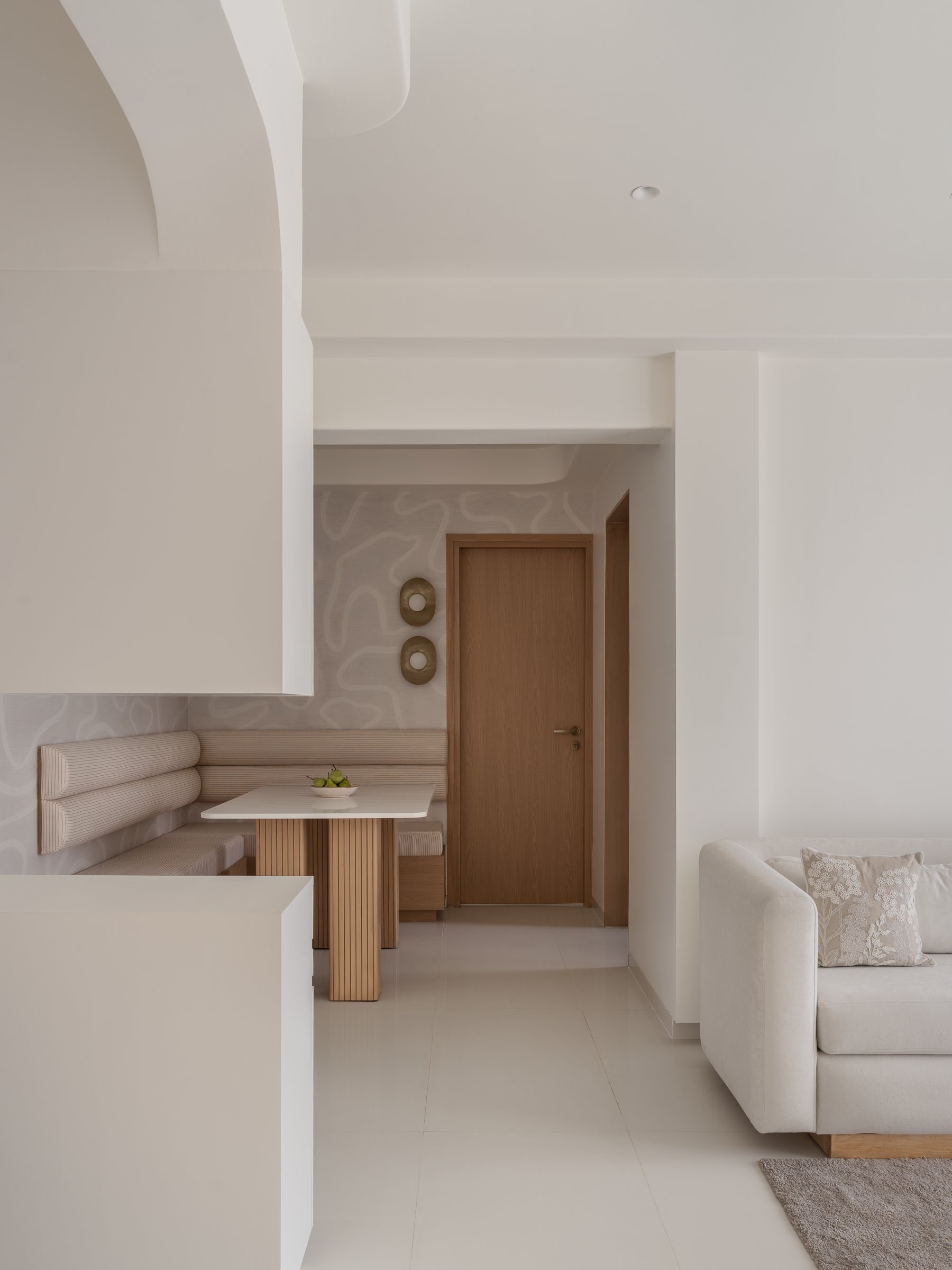
From the living edge, the home’s spatial logic becomes legible. A pale upholstered sofa with embroidered cushions anchors one side, while across the floor a banquette in softly ribbed upholstery wraps a corner around a small rounded-rectangular table on a fluted wood pedestal, with the apartment’s interior door visible in the background framed by the wavy line-work wallpaper.
Two functions, lounging and dining, occupy a single uninterrupted volume, and the home holds them together by repeating the wallpaper as a quiet connective backdrop rather than partitioning them with walls.
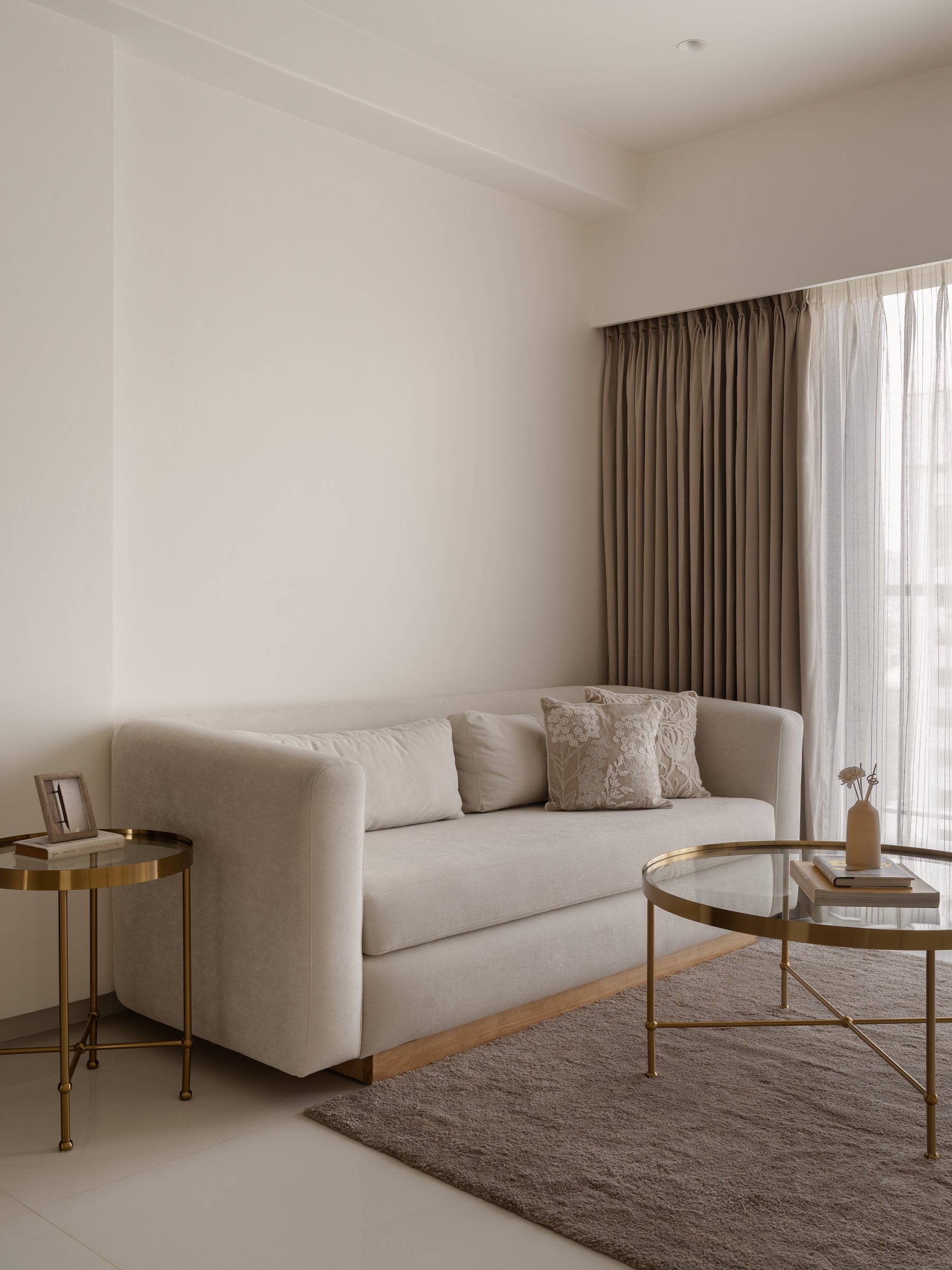
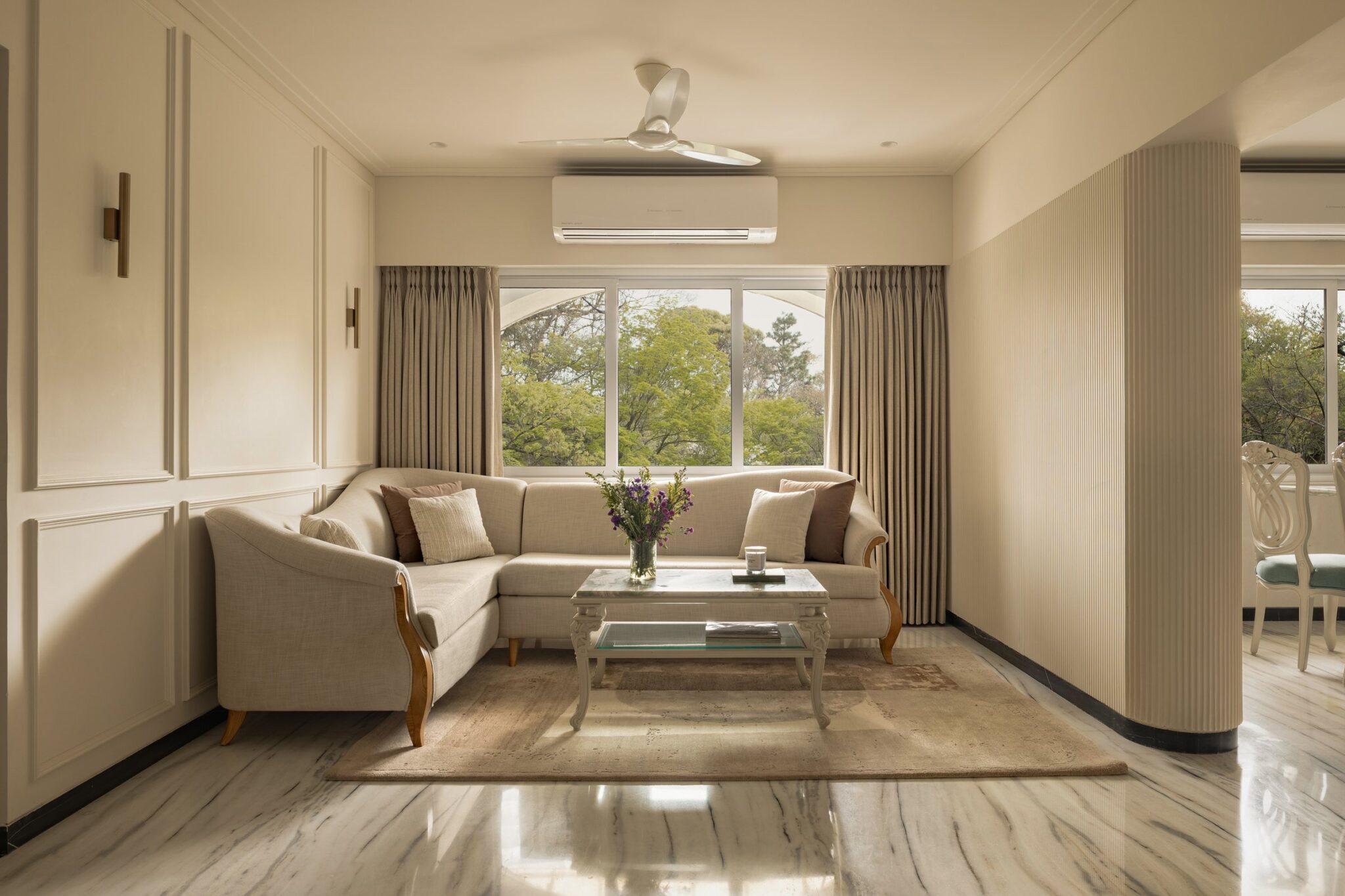
The living room itself is composed for stillness. A pale upholstered three-seater sits against a plain wall, its low silhouette grounded by a beige rug; beside it a small round side table and a larger glass-topped brass coffee table.
The room rejects the maximalist instinct of the small apartment, which is to crowd every surface in compensation for missing space. Instead the palette runs warm and edited, with the pinch-pleat curtain in a taupe tone introducing the only deeper note.
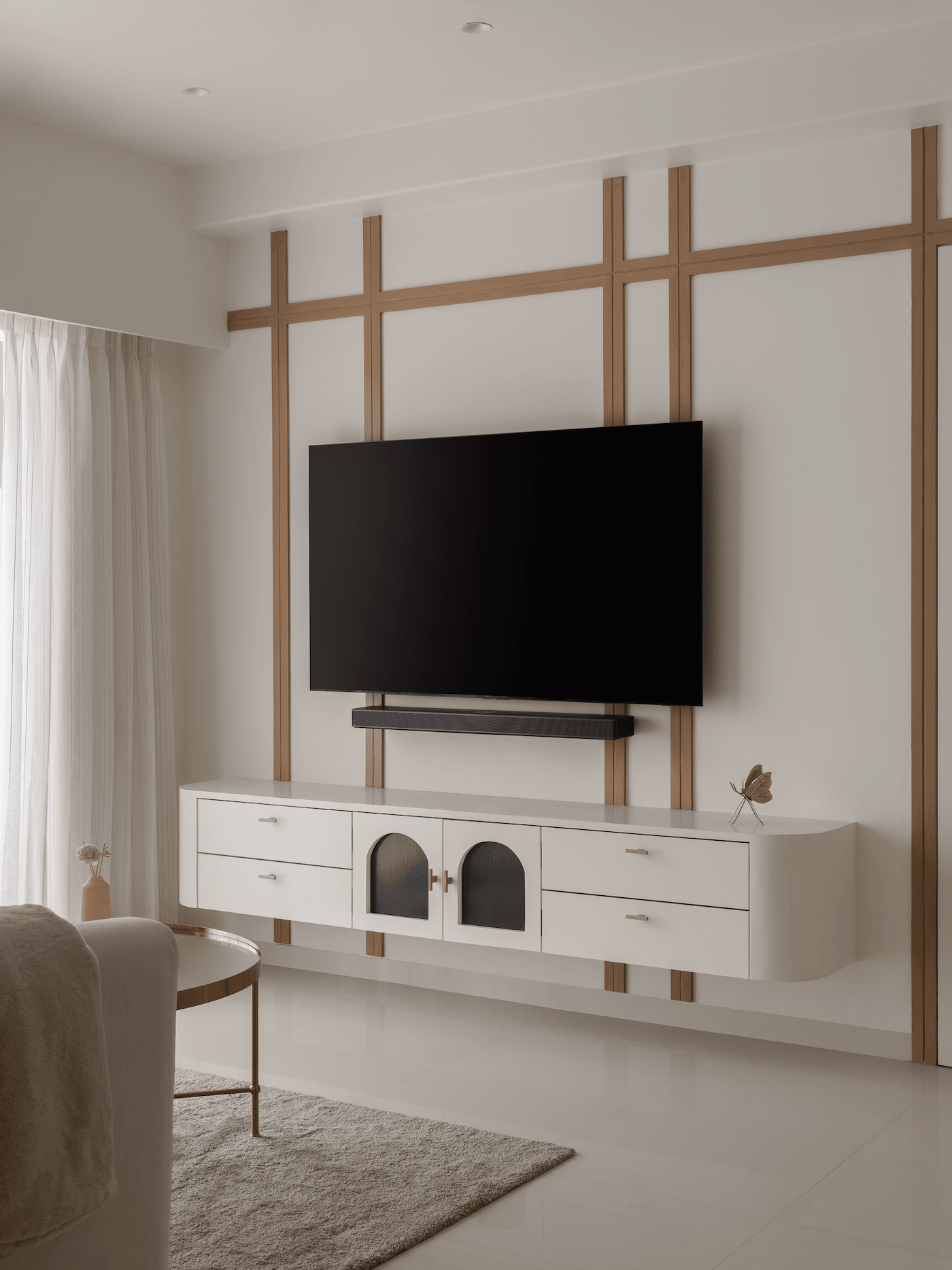
The media wall is the apartment’s most graphic move, and the only one that allows itself any geometric assertion. Slim wooden battens run floor to ceiling behind the screen, crossed by horizontal bars in a sparse window-pane pattern, while a long floating console below carries flat drawers either side of a central cabinet with two arched glass-panelled doors.
The arched cabinet inserts here repeat the foyer mirror’s silhouette, threading the home’s vocabulary across rooms without restating it.
“The studio’s intent was to design a home that feels generous within tight dimensions, where every surface is calm and every detail considered.”
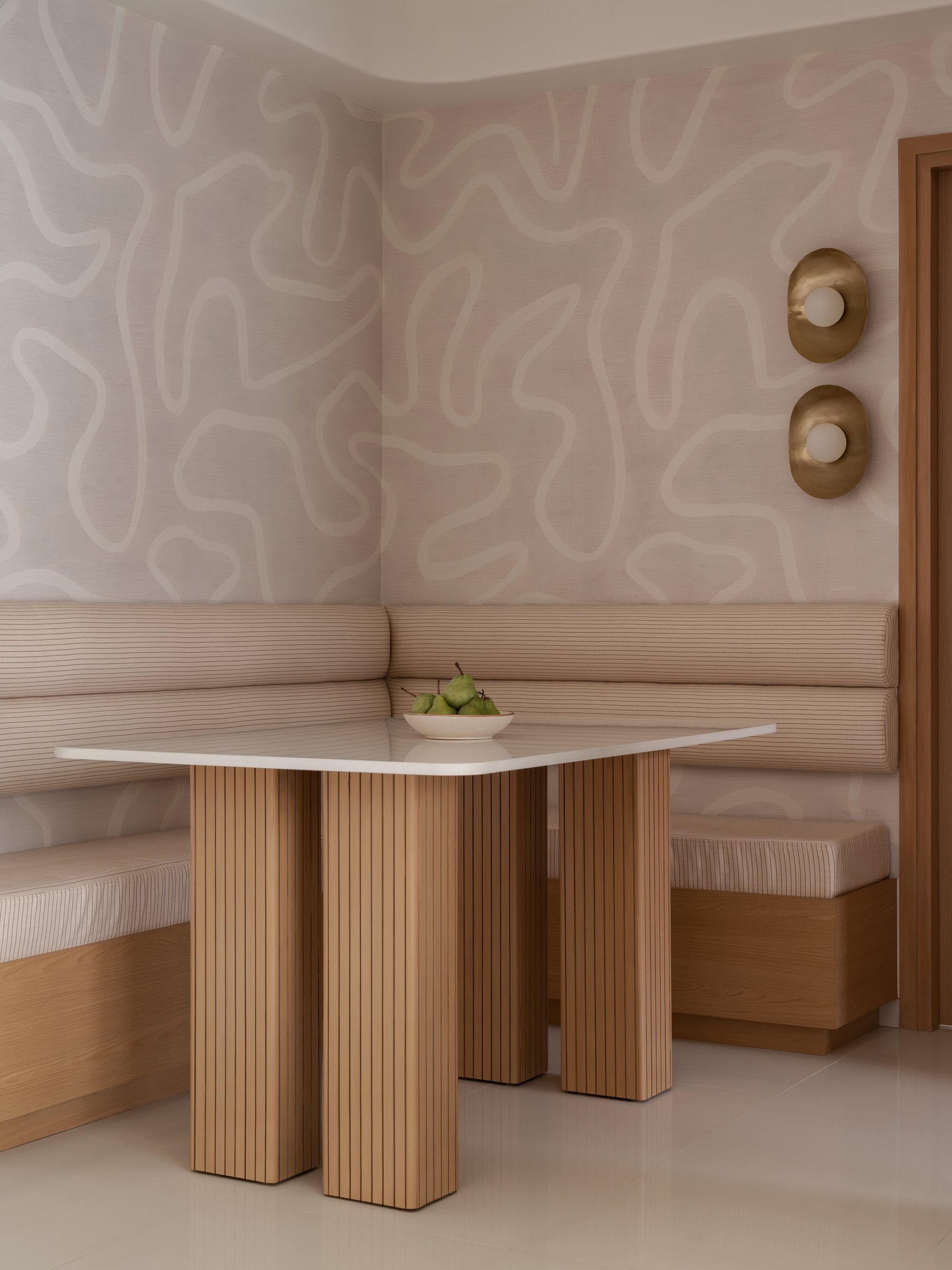
The dining nook earns its own paragraph because it carries the home’s clearest design argument. A square stone-topped table rests on four ribbed wood pedestals, framed by an L-shaped banquette in fine vertical stripes, with two brass disc sconces stacked vertically against the looping line-work wallpaper.
What in a larger apartment would be a separate dining room is here a built-in moment of intimacy, the banquette doing the work of both seating and storage, the table scaled closer to a breakfast nook than a formal setting.
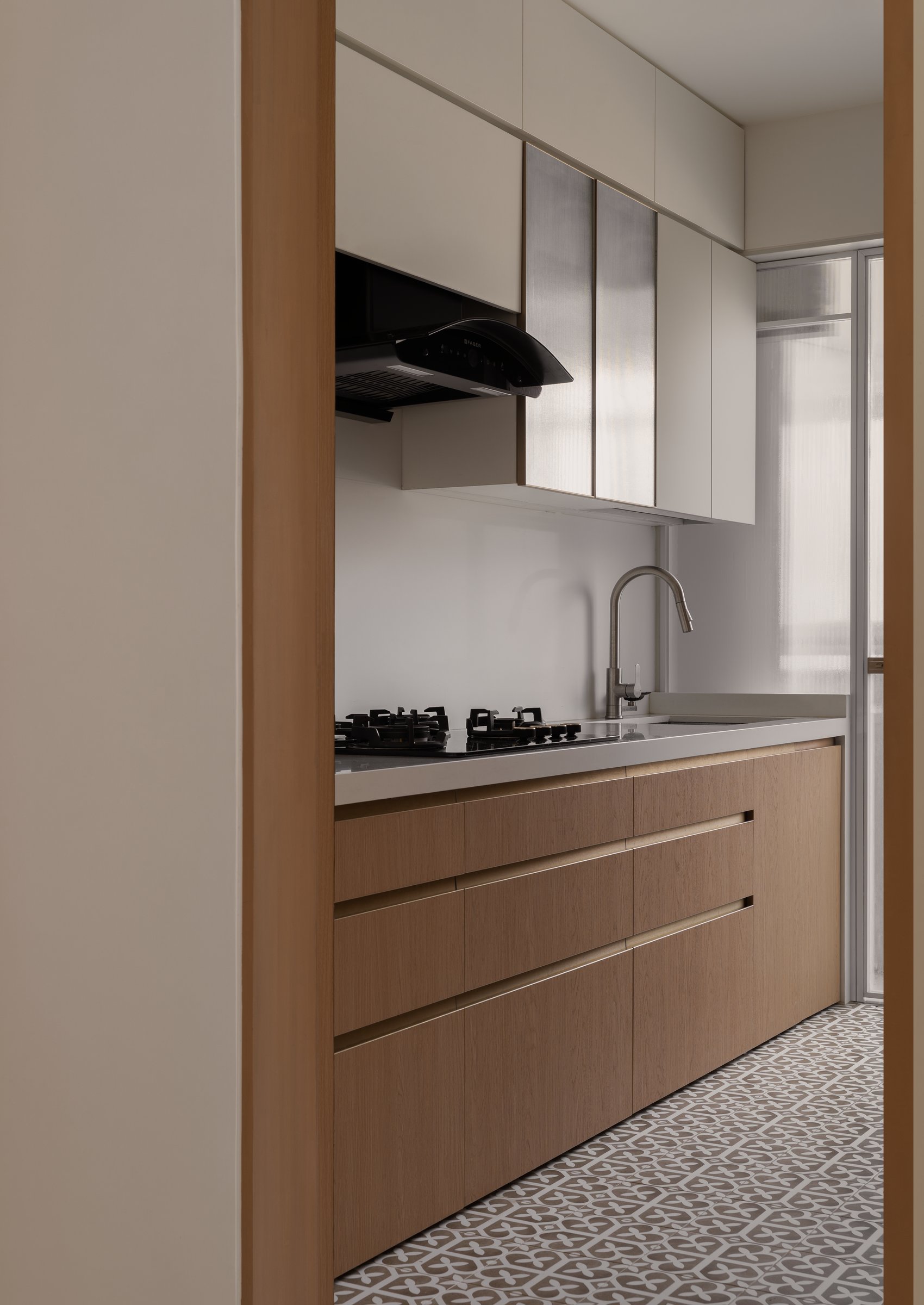
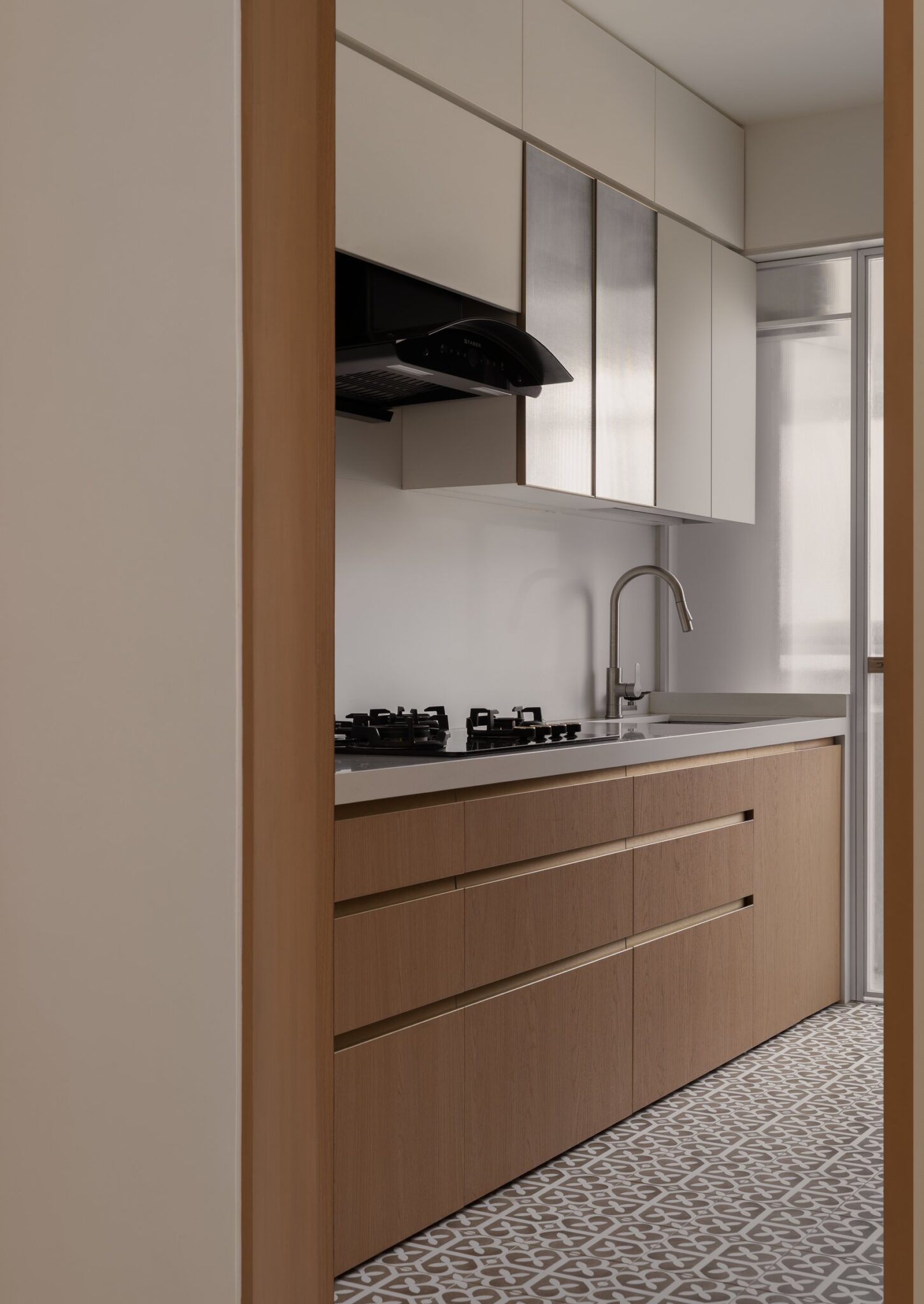
The kitchen, visible through a wood-framed pocket opening, takes a different register. Lower cabinetry in warm wood-grain laminate with recessed pulls runs along one wall beneath a stone counter, with upper units in a soft off-white, and the floor laid in a patterned cement-look tile in muted brown and cream.
The patterned floor is the apartment’s most decorative gesture, and the studio has rightly contained it to the one room where decoration earns its keep: the workspace where the household most often gathers.
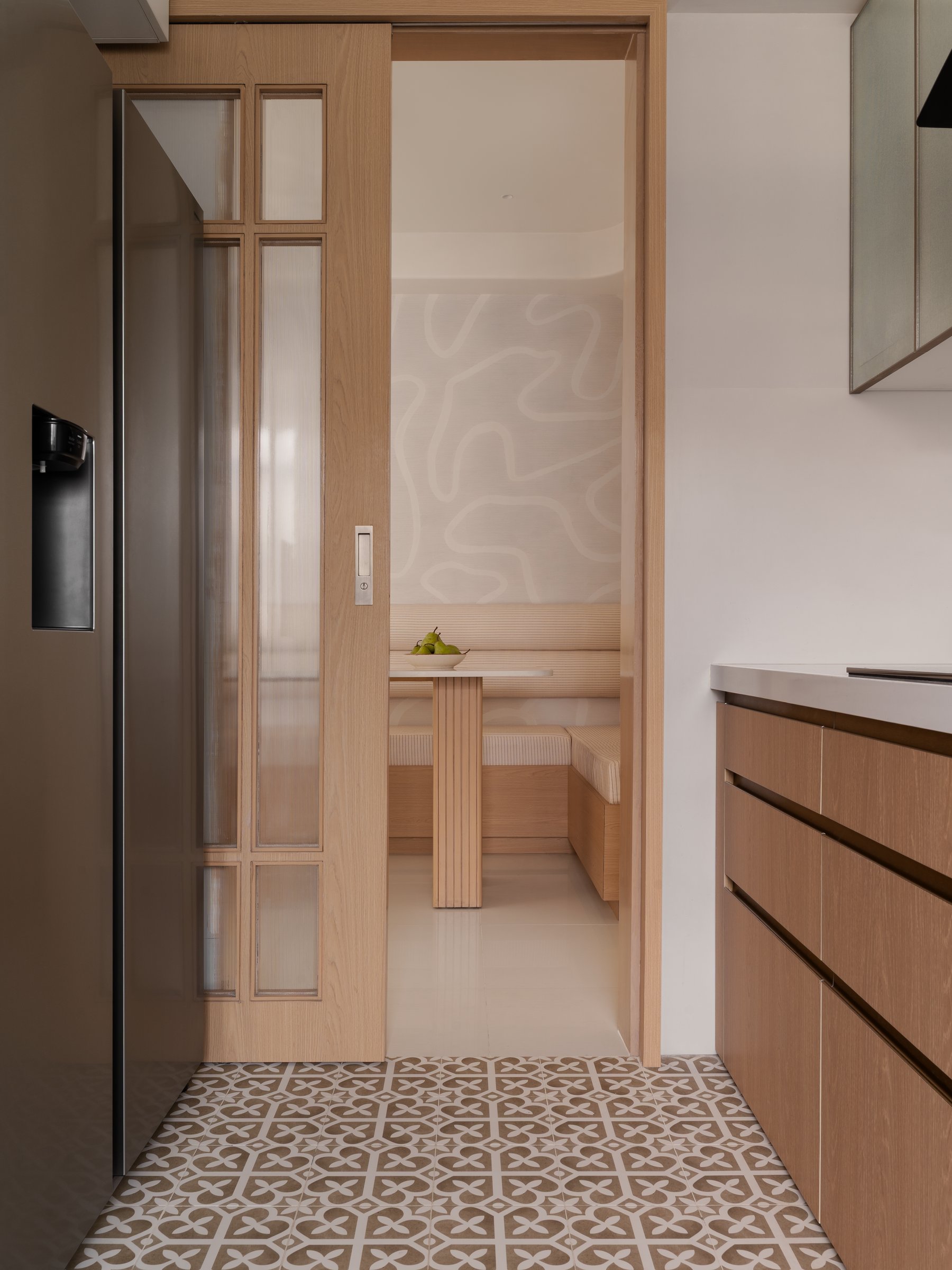
The threshold between kitchen and dining is itself worth a beat. A sliding door in wood with reeded-glass inserts retracts to reveal the dining banquette beyond, the patterned tile floor reading against the pale stone floor of the dining area, with a tall fridge in dark finish set into the kitchen wall.
The reeded glass is doing two jobs at once, screening the kitchen when closed and dissolving the wall visually when open, a small detail that earns its place in a 700-square-foot plan.
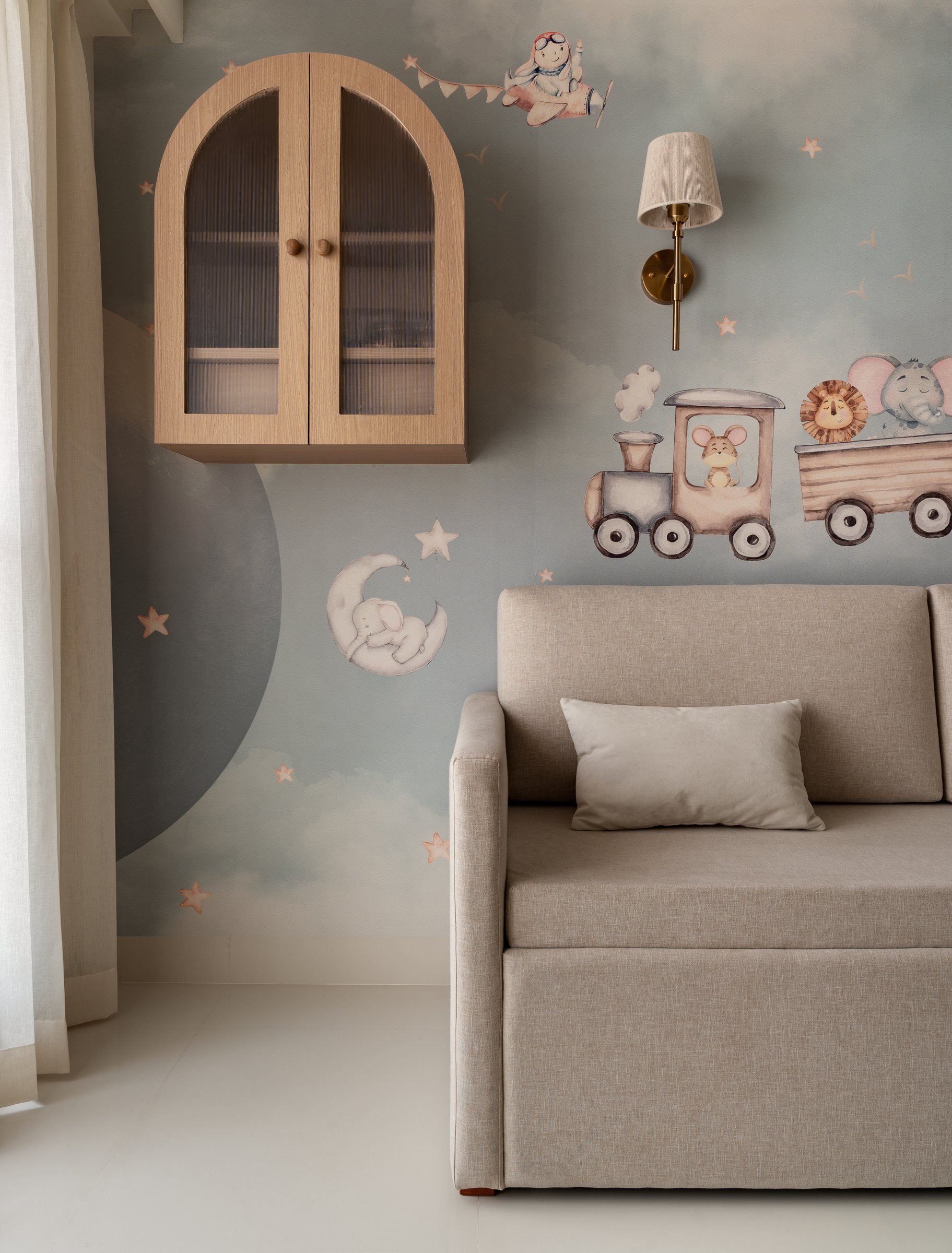
The children’s room departs from the home’s neutral palette into something softer and more illustrative. A pale fabric sofa sits against a wall covered in a watercolour mural of clouds, stars, a moon, and a small painted train, with an arched wooden wall cabinet beside it and a fabric-shaded wall sconce in brass.
The mural is whimsical without tipping into kitsch, and the muted blue-grey ground keeps it within the apartment’s quieter register rather than declaring the room a separate world.
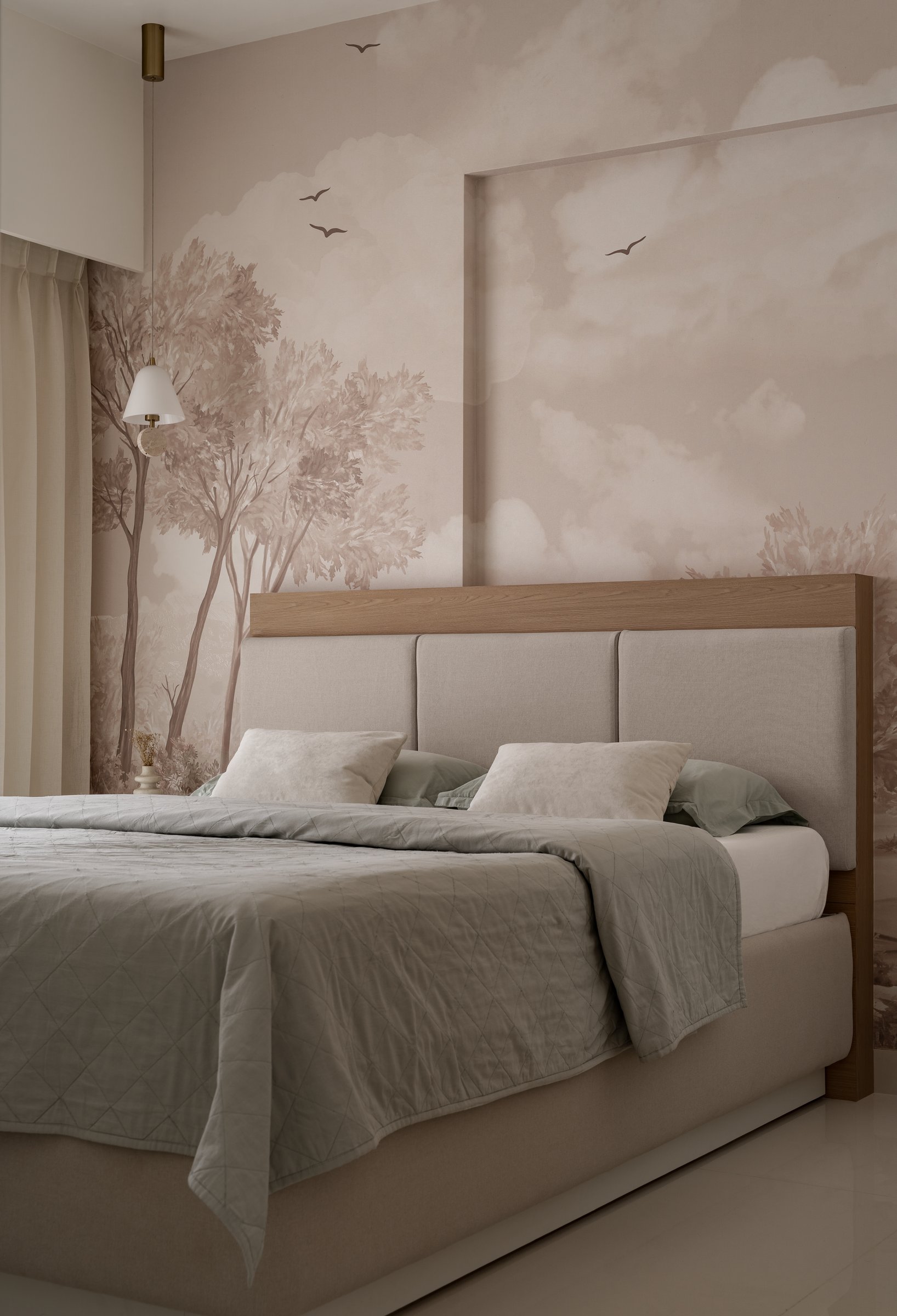
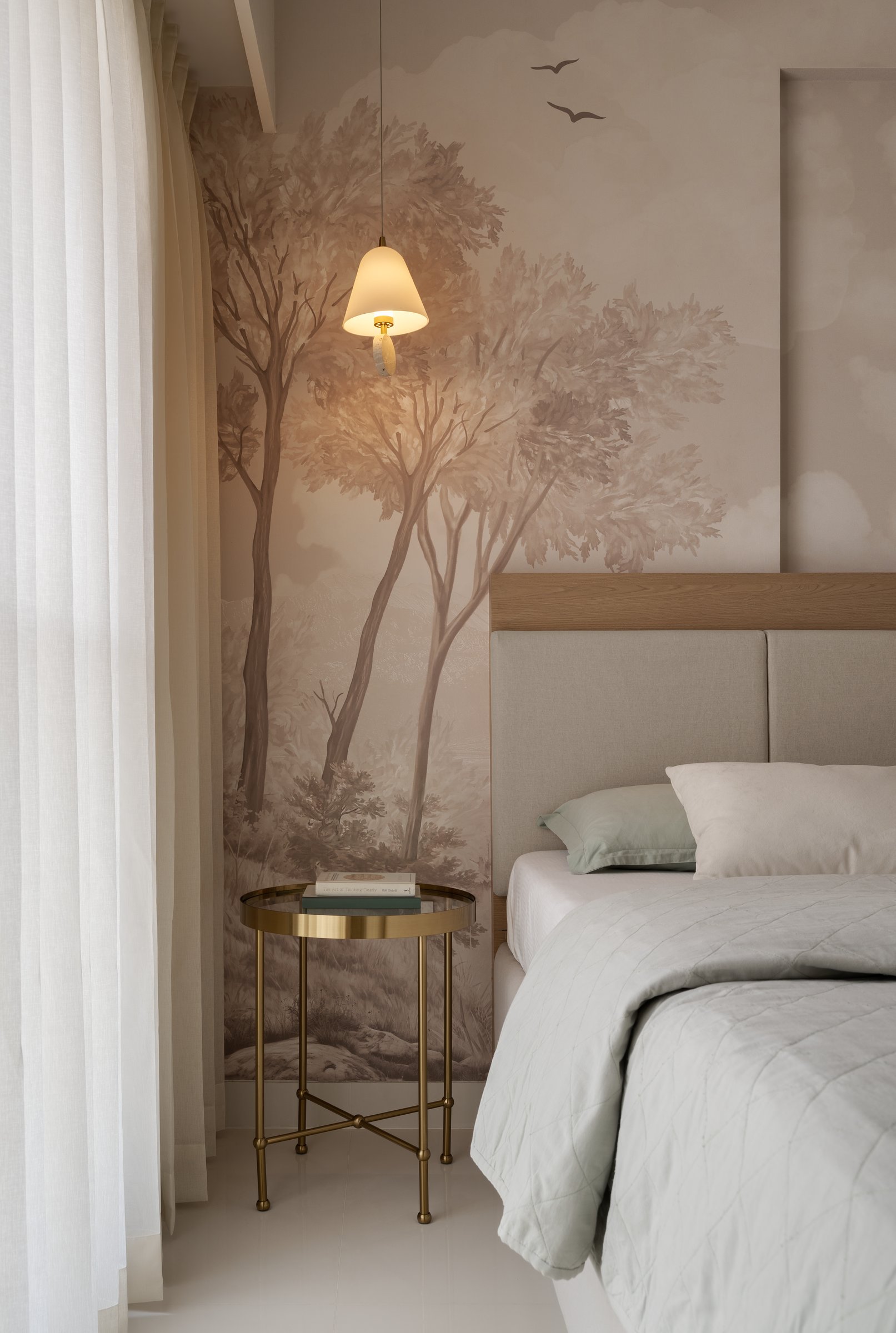
The bedroom returns to the home’s enduring palette but trades pattern for landscape. A king bed with a tall upholstered headboard in pale fabric, capped by a wood frame, sits against a wall painted in a sepia-toned forest mural, its branches and birds reading like a faded fresco; the bedding is layered in pale neutrals and soft sage, and a pendant light with a pale shade on a brass stem hangs to one side.
The mural reframes the room as a place of pause, doing what art rarely manages in small bedrooms, which is to deepen the room’s perceived horizon rather than crowd it.
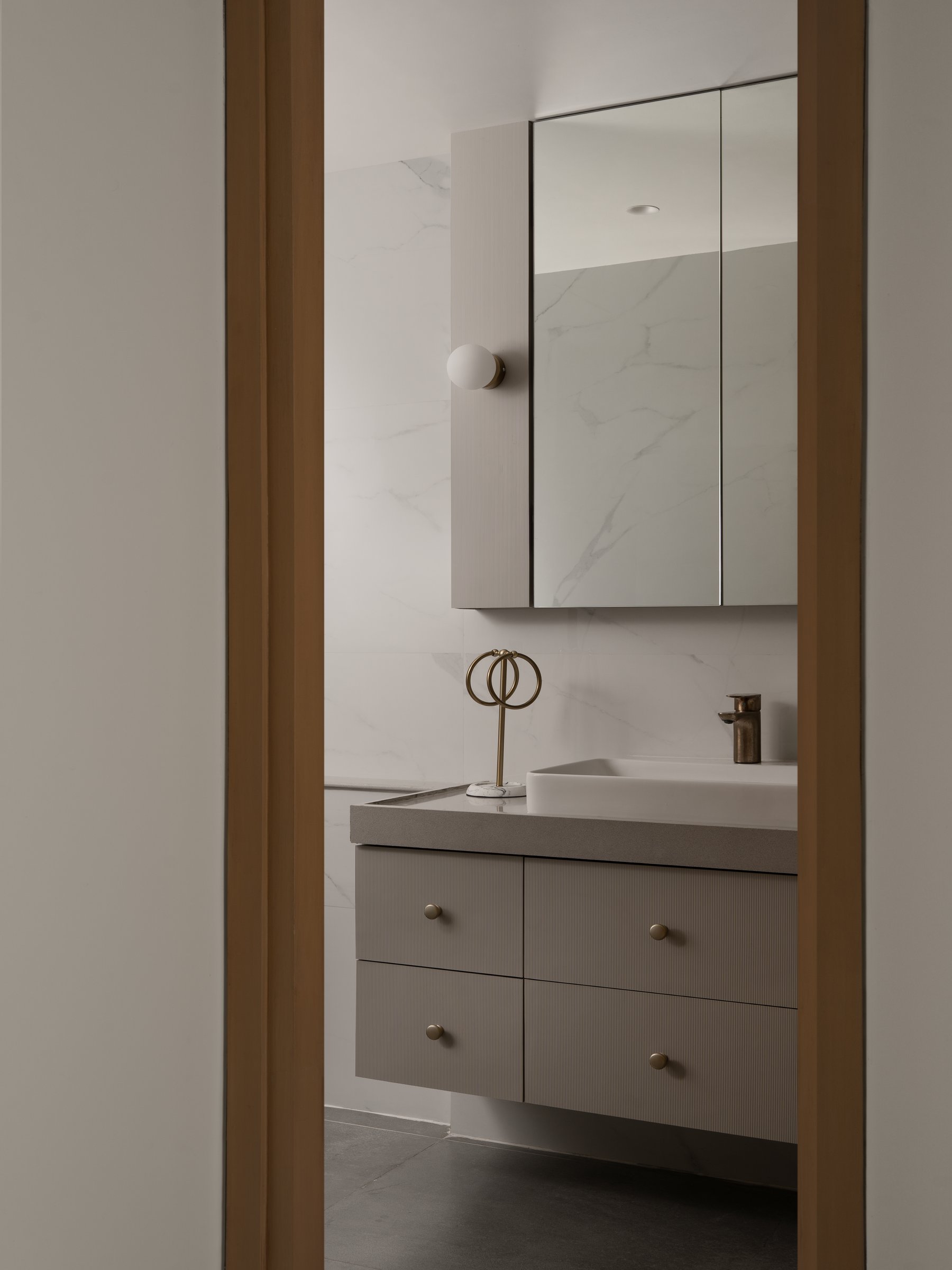
The bathroom, glimpsed through a wood-framed opening, completes the material story. A floating vanity in pale ribbed fronts with brass knobs carries a stone-grey counter and a rectangular vessel basin, the wall behind clad in veined white stone with a slim cylindrical wall light beside the mirror cabinet.
What Arlo Home represents for Mumbai is a quieter argument about how the city’s compact apartments can be lived in. The studio has avoided the now-default move of layering visual complexity to disguise tight dimensions, choosing instead a continuous neutral envelope, a recurring arched motif, and a measured palette of wood, stone, and brushed brass.
The result is an interior that feels composed rather than sparse, warm rather than decorative. In a market that often equates ambition with density, Eight Degree Design House has demonstrated that 700 square feet can read as generous when every decision is calibrated to the same enduring idea.