The conventional office floor has long been a study in neutrality, a beige proposition that confuses restraint with intelligence. Workspot Cowork begins from a different premise altogether: that a place built for thinking should look like thinking, that energy on the walls might translate into energy at the desk, and that the ducts overhead need not be apologised for in matte black but might instead be sung in mint green.
Set across four thousand square feet in Kochi, the project is the work of Behind Architecture, with Ajay Subrahmanya leading the design. Conceived as a coworking environment for a city whose creative economy is expanding faster than its workspace typologies, the floor abandons the muted vocabulary of the standard tech office in favour of something far more committed. The argument here is simple and confident: colour, used as structure rather than ornament, is enough to organise a workplace.
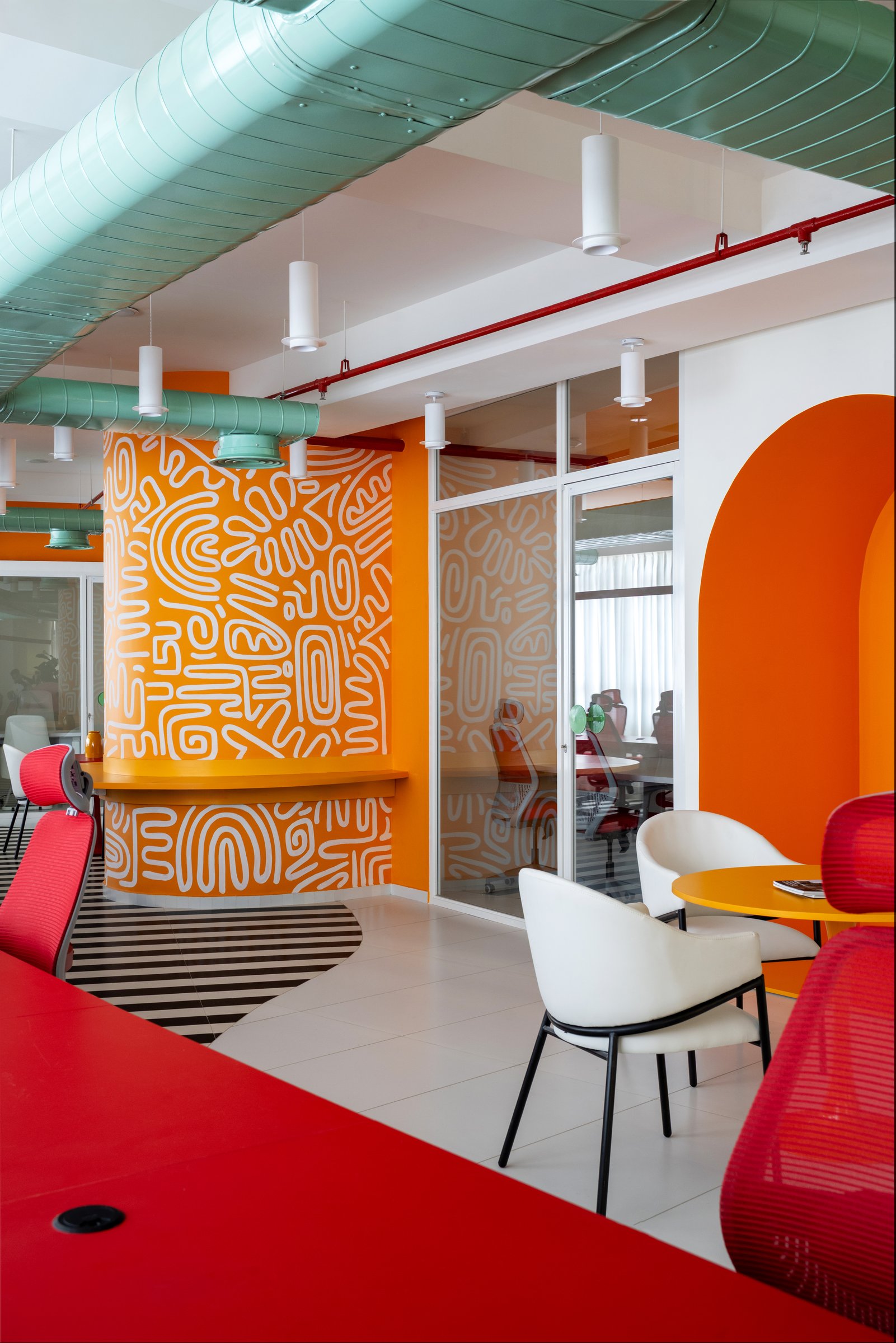
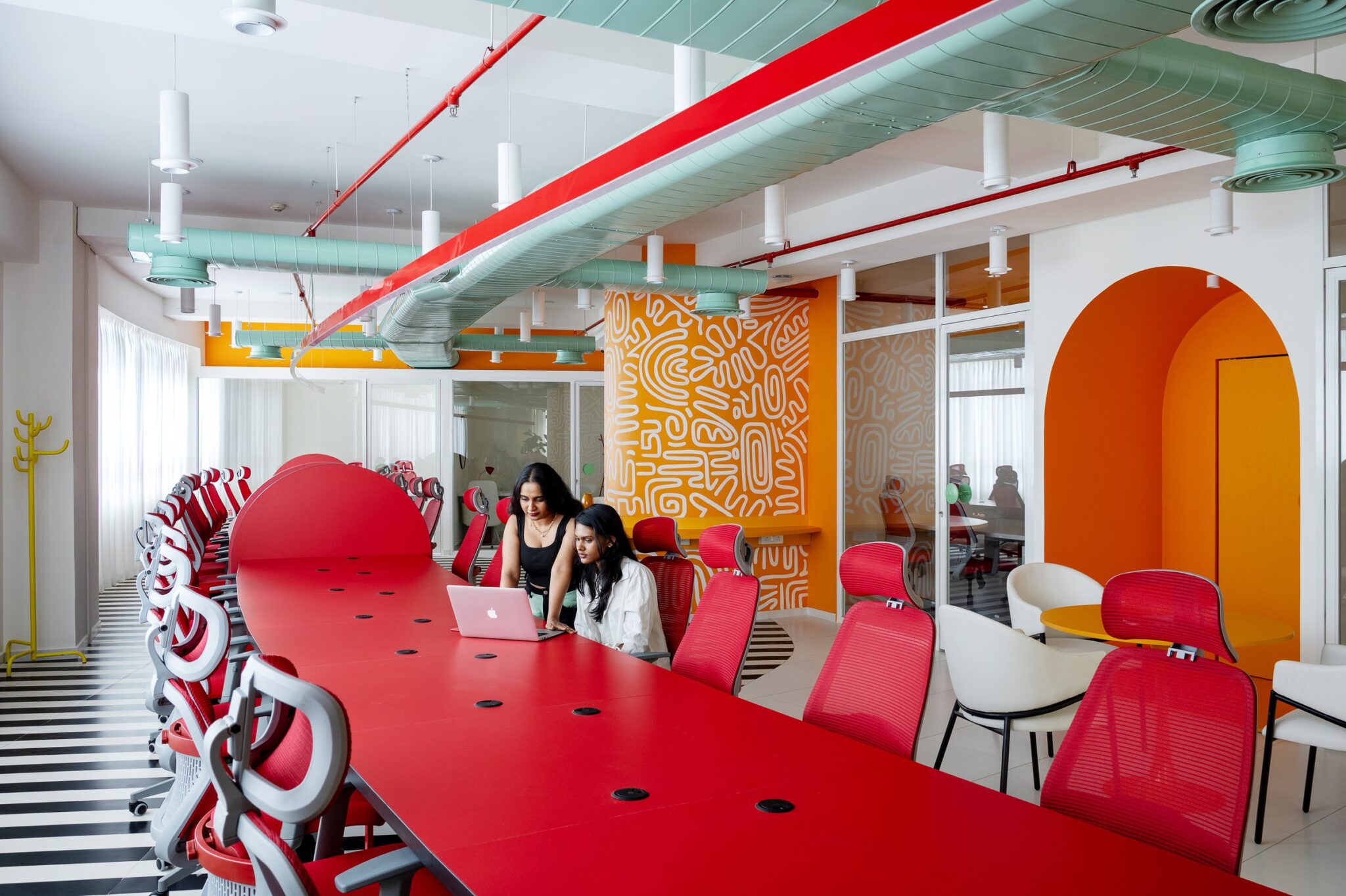
At the entry threshold, a curved counter wrapped in hand-drawn white-on-orange line work sets the tone before a single workstation comes into view. The mint-green ductwork loops overhead like an exposed circulatory system, the orange arch at the right frames a soft passage into the meeting volume, and the striped floor pulls the eye forward in a single confident gesture. Nothing about this opening is incidental.
The reception counter doubles as an informal lounge edge, where a small cluster of white tub chairs and a tangerine side table offer the first place to pause. It is the rare workplace foyer that reads as both arrival and invitation, which is the design’s quiet thesis stated in microcosm.
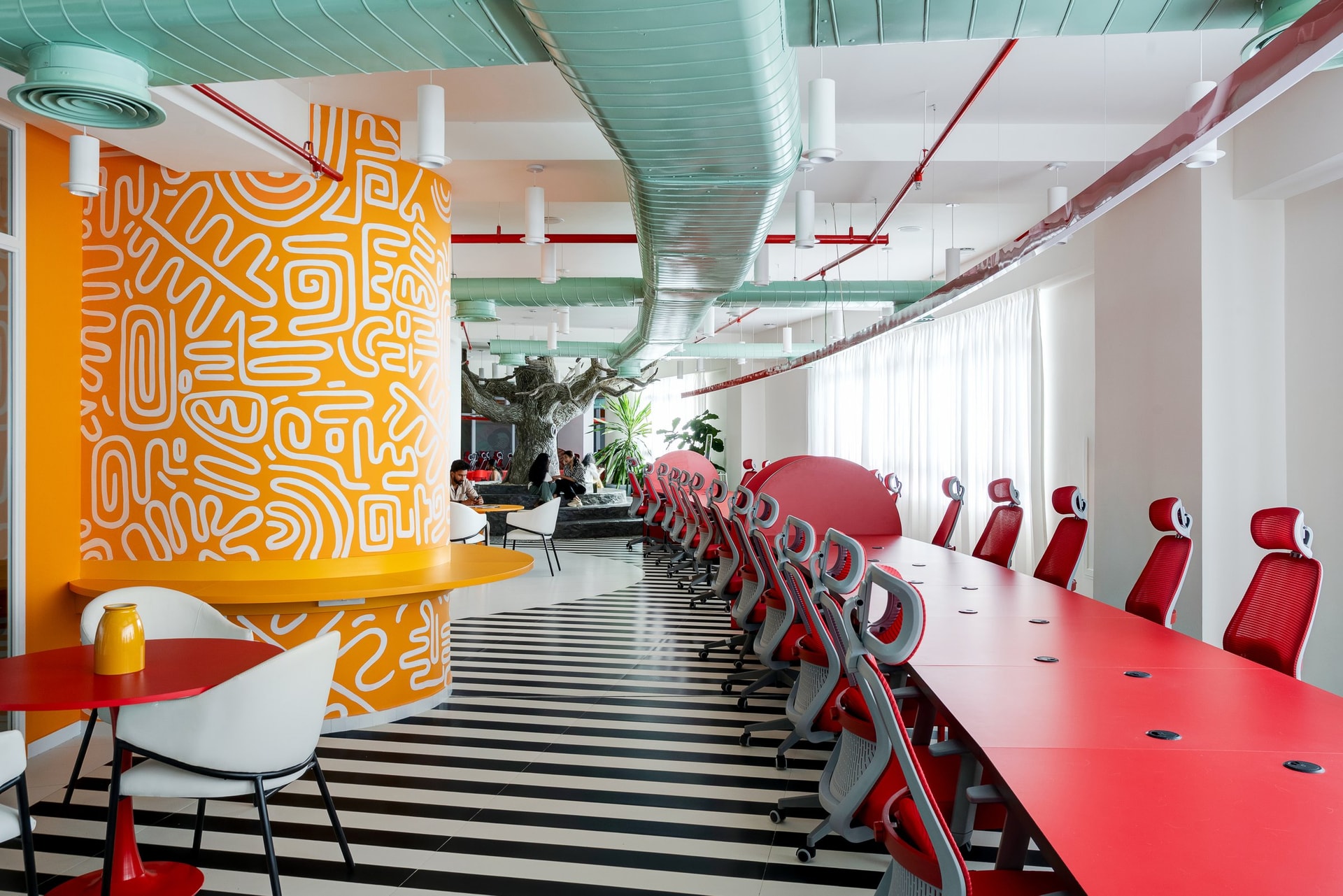
Past the entry, the floor opens into its central spine: a long collaborative table in saturated red, ringed by ergonomic task chairs in matching mesh, running the full length of the window wall behind a soft veil of white curtain. The graphic column at the left, a continuation of the reception’s line-work motif, anchors the volume while signalling that the orange language travels through the floor rather than terminating at the door.
What makes this spine work is the floor itself. The black-and-white striped runner, laid directly into the tile, choreographs movement without partitions or signage. It tells you where the working zone begins, where it bends, and where it releases into the quieter clusters at either end.
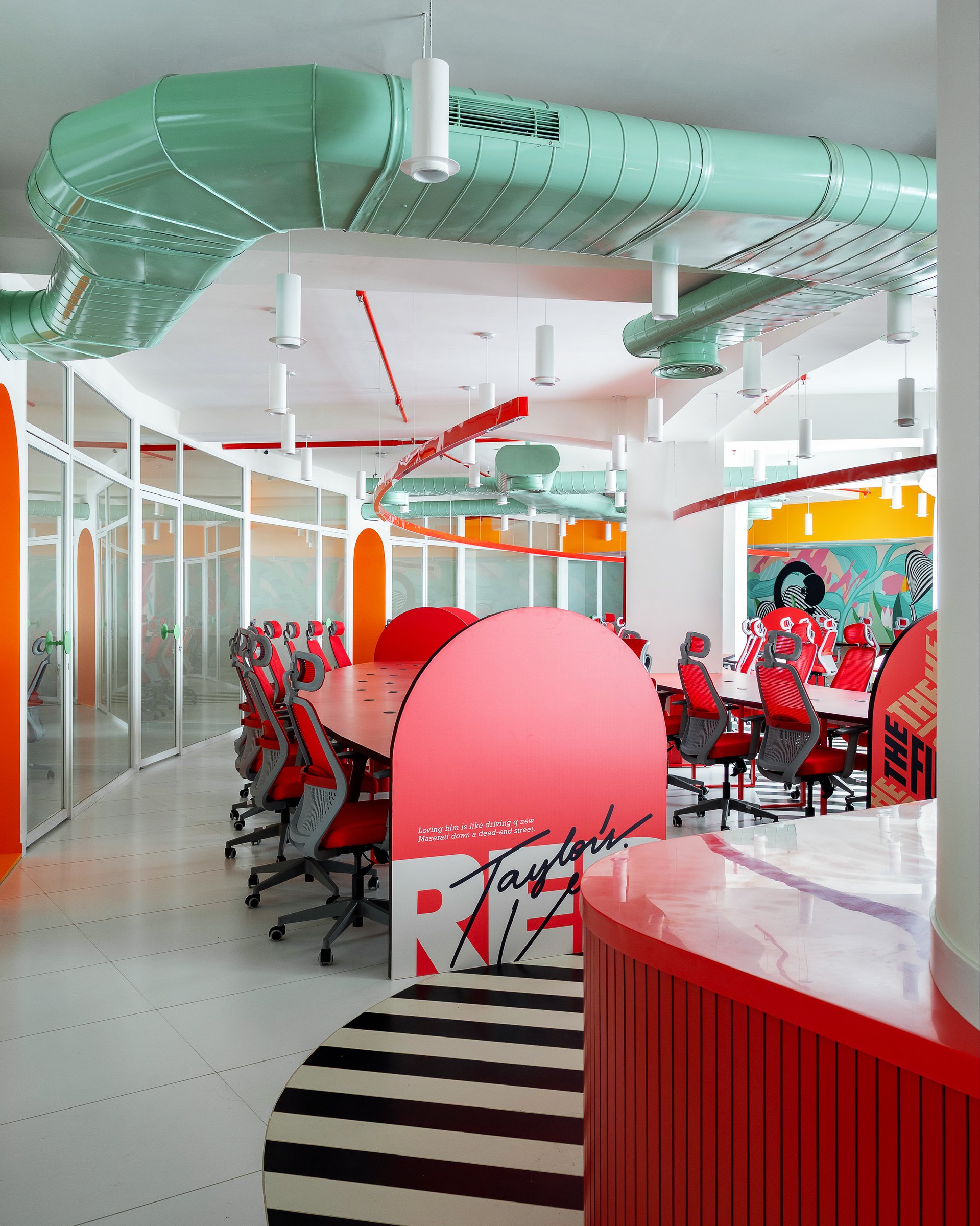
Curved arched dividers in coral and red punctuate the long workstations, carrying fragments of pop typography and lyric quotation across their faces. They function as acoustic and visual breaks, sectioning the long bench into smaller cognitive units, but they do something more interesting too: they introduce voice into the workplace, a willingness to be specific and even playful where most offices default to silence.
““The space is conceived not merely as an office, but as an energetic experience that stimulates movement, conversation, and innovation through color, form, and atmosphere.””
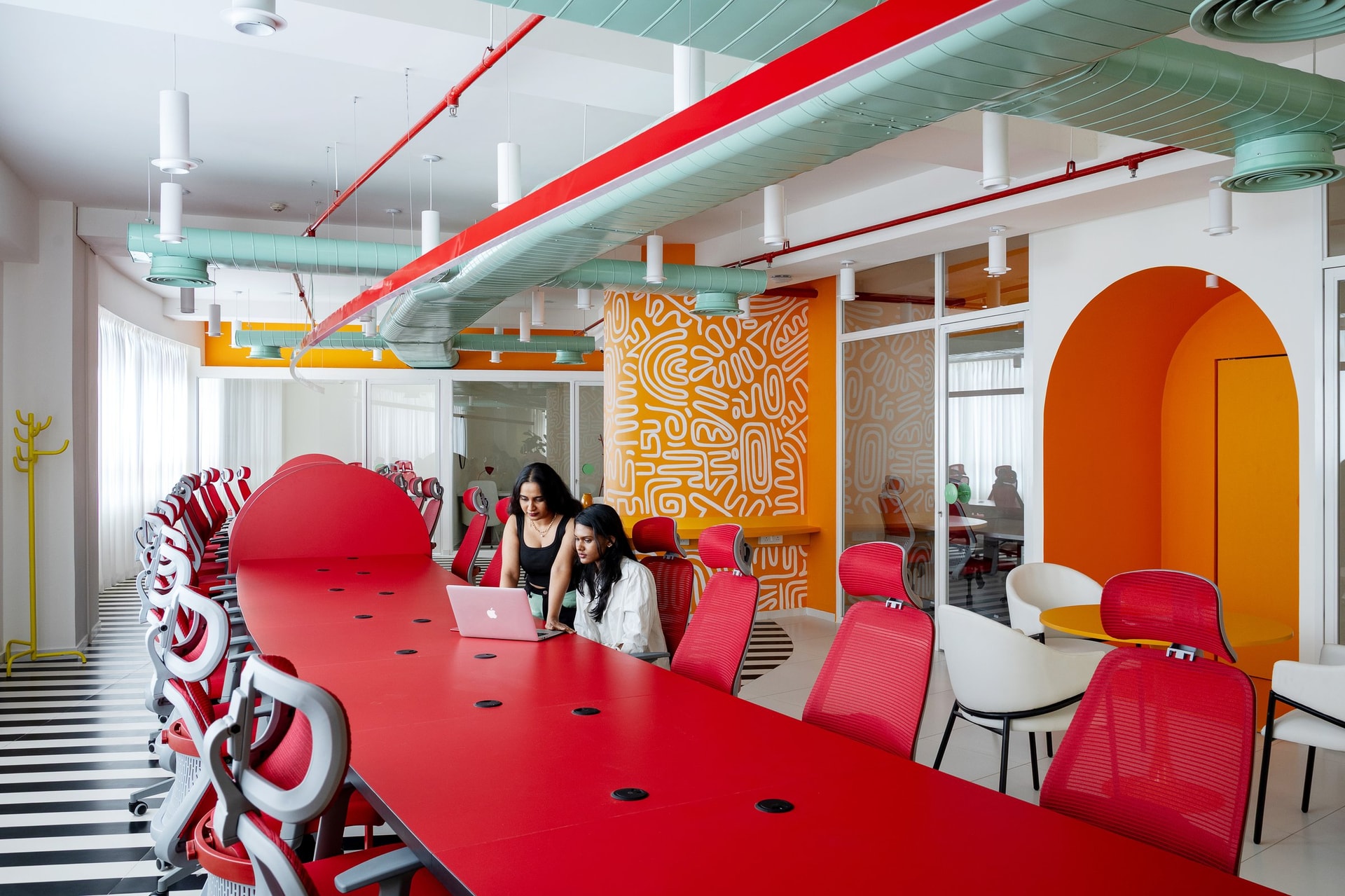
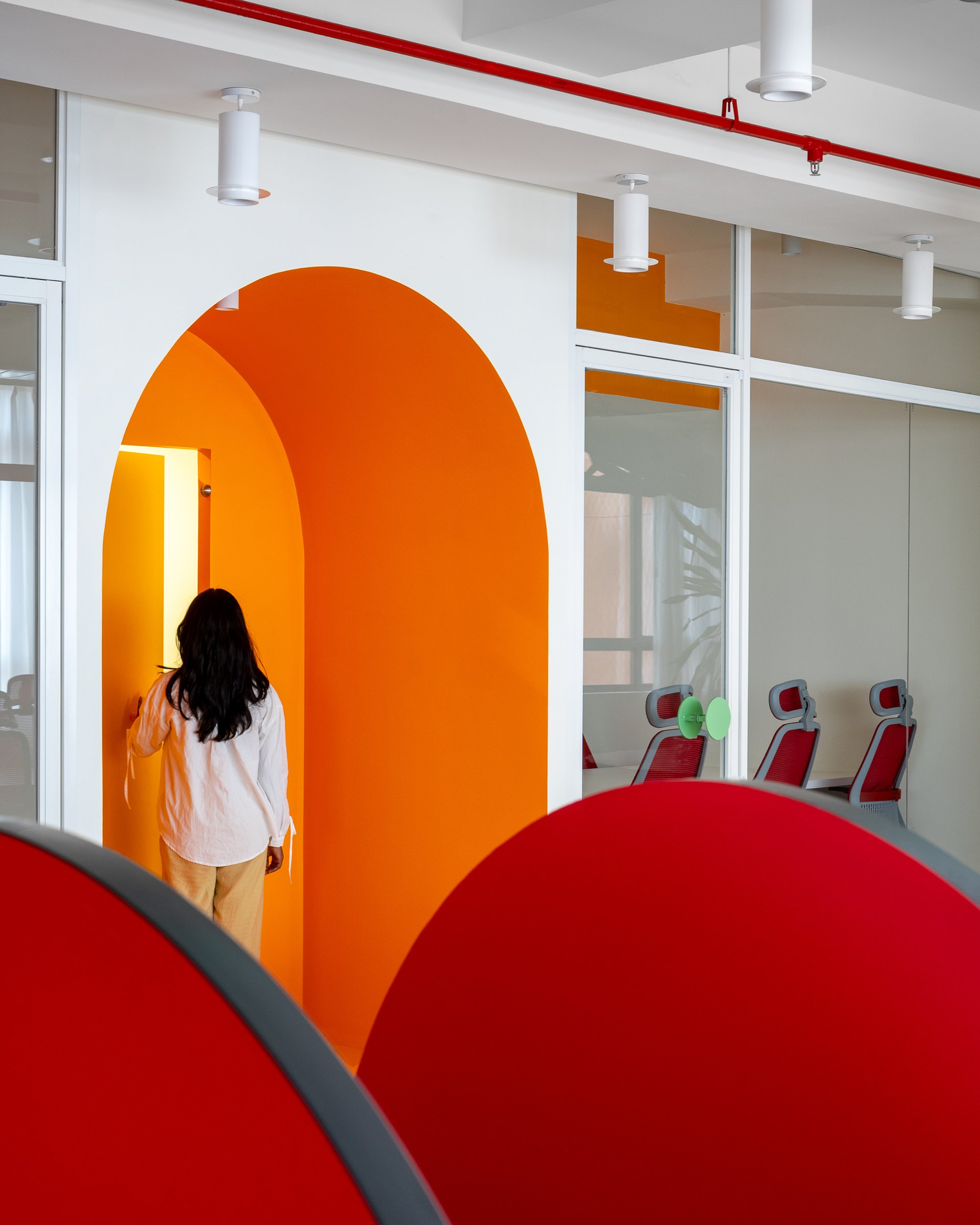
The arched orange portal on the right is the design’s sharpest move. It announces a doorway with the certainty of monument, what lies beyond is a corridor to the next pod. The architecture treats utility with the same seriousness as ceremony.
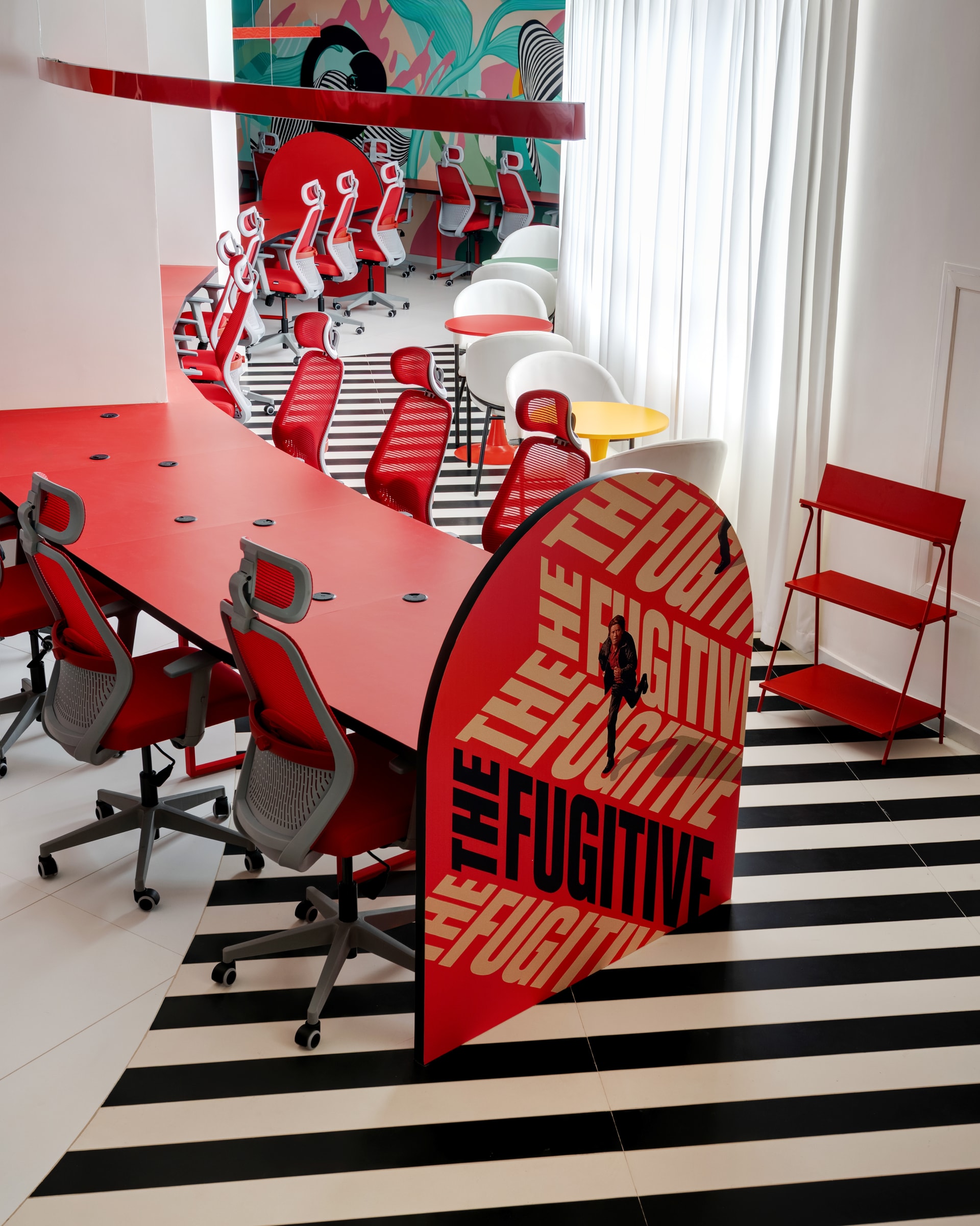
Further along, the workstation curves gently around a fixed graphic divider stamped with bold pop-art typography. The serpentine plan is not a flourish; it is what allows two long benches of high-back task chairs to share one continuous floor without the visual flatness of a parallel rank. The curve produces sightlines that change as one walks, which keeps the volume alive even when half-occupied.
At the window edge, a second seating cluster of cream tub chairs and a small yellow café table offers a softer counterpoint to the working spine. It is the spatial equivalent of a quieter register in the same conversation, and it gives the floor a place to retreat to without leaving it.
What is striking is how legible the floor remains despite its colour intensity. The white walls and ceiling do the patient work of holding everything else in tension, and the striped floor returns as a quiet rhythm beneath the louder gestures above.
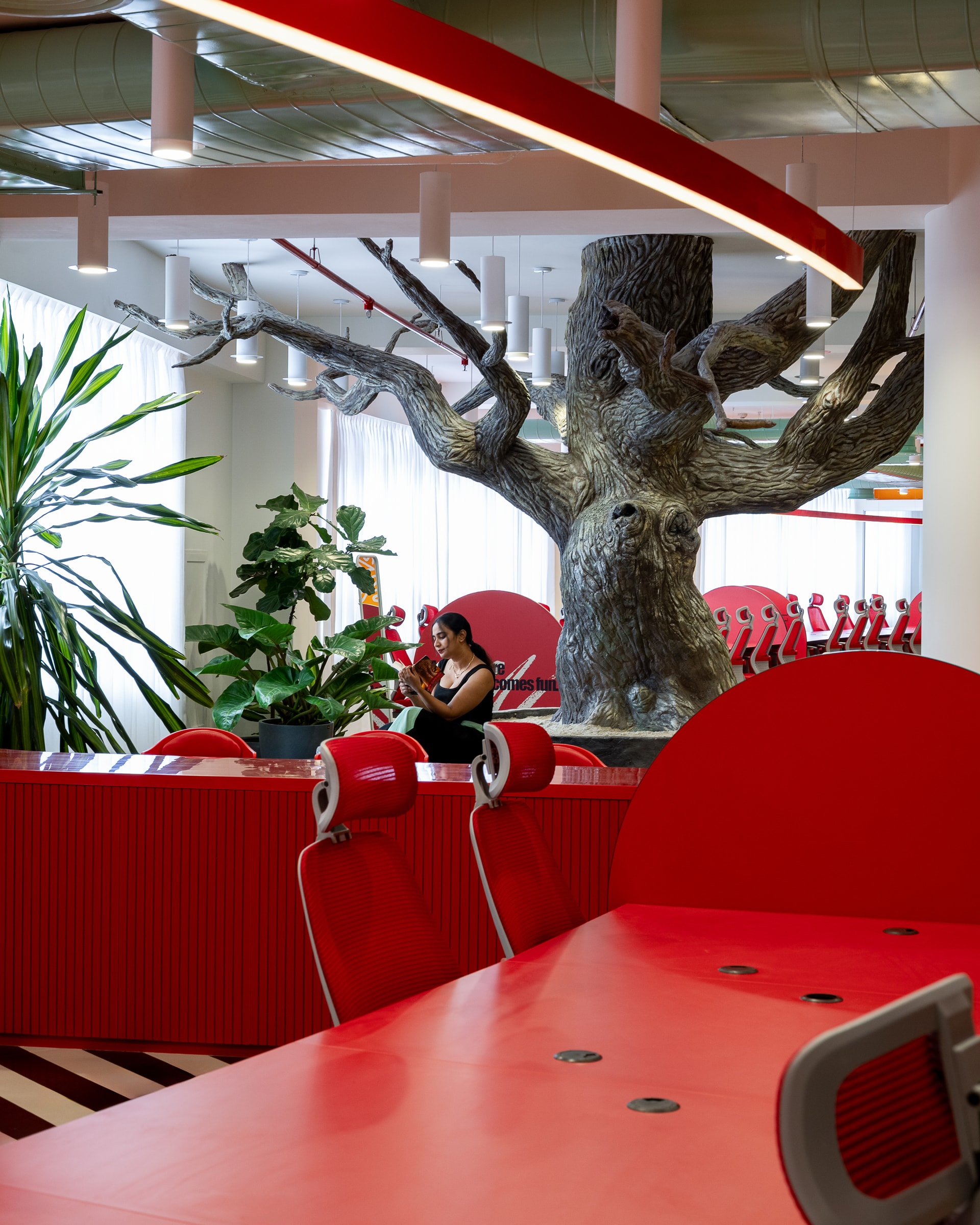
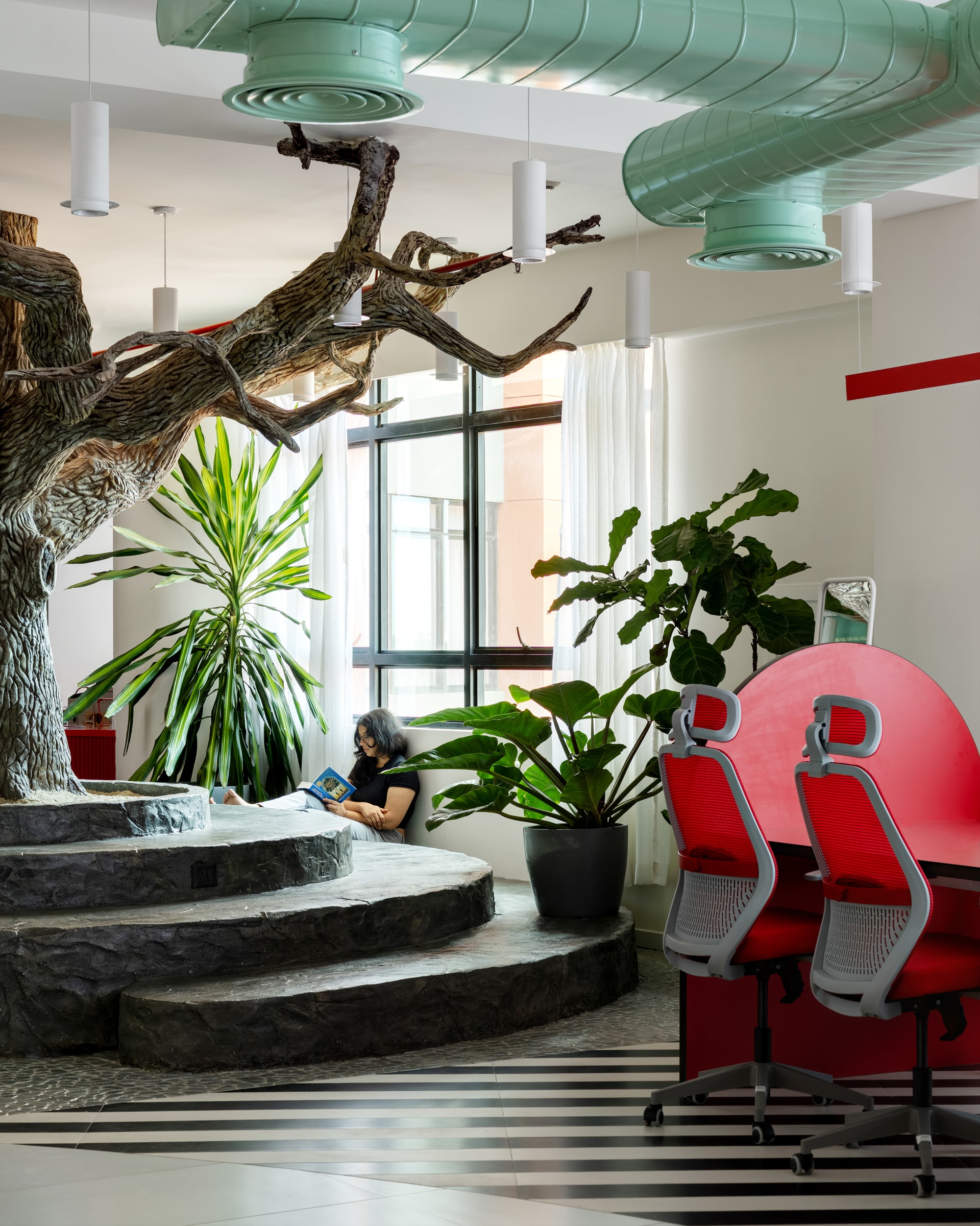
At the centre of the floor stands the project’s most unexpected element: a full sculptural tree, rendered in textured bark with branches reaching across the ceiling plane, surrounded by a tiered stone-effect platform and clusters of live planting. It is part landmark, part reading nook, part interruption to the orthogonal logic of the workstations around it.
Seen from across the red working surface, the tree reads even more sculpturally, its trunk and canopy framed against the white curtain wall and crossed by the loop of red ceiling pendant lighting overhead. The contrast between the organic mass and the engineered geometry around it is the design’s central argument compressed into one sightline.
This is where Workspot’s logic becomes legible: the colour, the typography, the curves, the ducts, the stripes all converge around a slow, weighty organic anchor. The vibrancy needed a counterweight, and the studio found it not in a quieter corner but in a single dense object placed at the geometric heart of the floor.
In a city whose contemporary commercial interiors have until recently leaned heavily on the muted palettes inherited from larger metro markets, Workspot proposes a different ambition for Kochi’s workplace typology. It is unembarrassed by colour, unembarrassed by graphic voice, and confident that a coworking floor can hold a clear design identity without sacrificing the ergonomic and acoustic discipline its users actually need.
What the project finally demonstrates is that expressive workspaces need not be juvenile. Behind Architecture has built a floor that is loud in its palette but quiet in its planning, where every saturated surface earns its presence through a structural job: defining a zone, marking a threshold, slowing a sightline. The result is a workplace that argues, persuasively, for the idea that an office can have a voice.