The dual-income household with one child has become one of urban India’s defining domestic units, and yet most apartments still address it with the same vocabulary used for joint families and weekend entertainers. The home, in this reading, is not a stage for hosting but an instrument for recovery, a place that must absorb the velocity of two careers and return its occupants softer than it received them.
This is the premise TABA Design Studio set itself in Between The Rush, a 1,240-square-foot apartment in Bangalore designed by Ar. Tantrima Basistha for a Double-Income, One-Kid family. The brief was unusually specific: a function-first home for time-poor professionals, where every square inch had to earn its place without producing the visual fatigue of a space that announces its own efficiency.
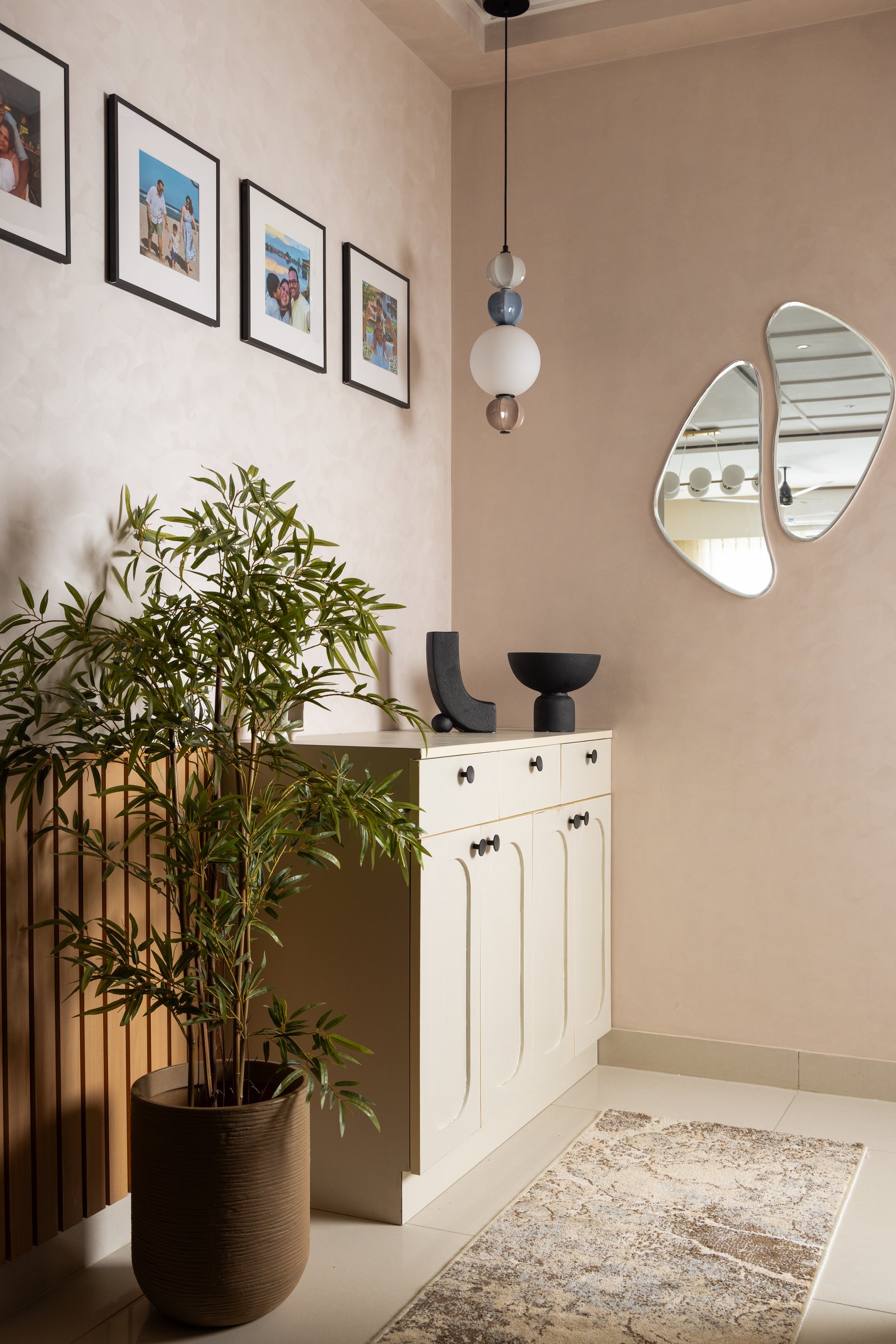
The foyer is where the home’s argument begins, quietly. A blush-toned textured wall holds a small family photo gallery above a cream cabinet whose arched panel detailing softens what would otherwise be pure utility storage.
A slatted wood screen anchors one edge, a sculptural pendant of stacked glass orbs marks the threshold, and an asymmetric mirror catches a fragment of the rooms beyond. The entry resolves a difficult equation: it does the work of a mudroom while reading as a composed vignette.
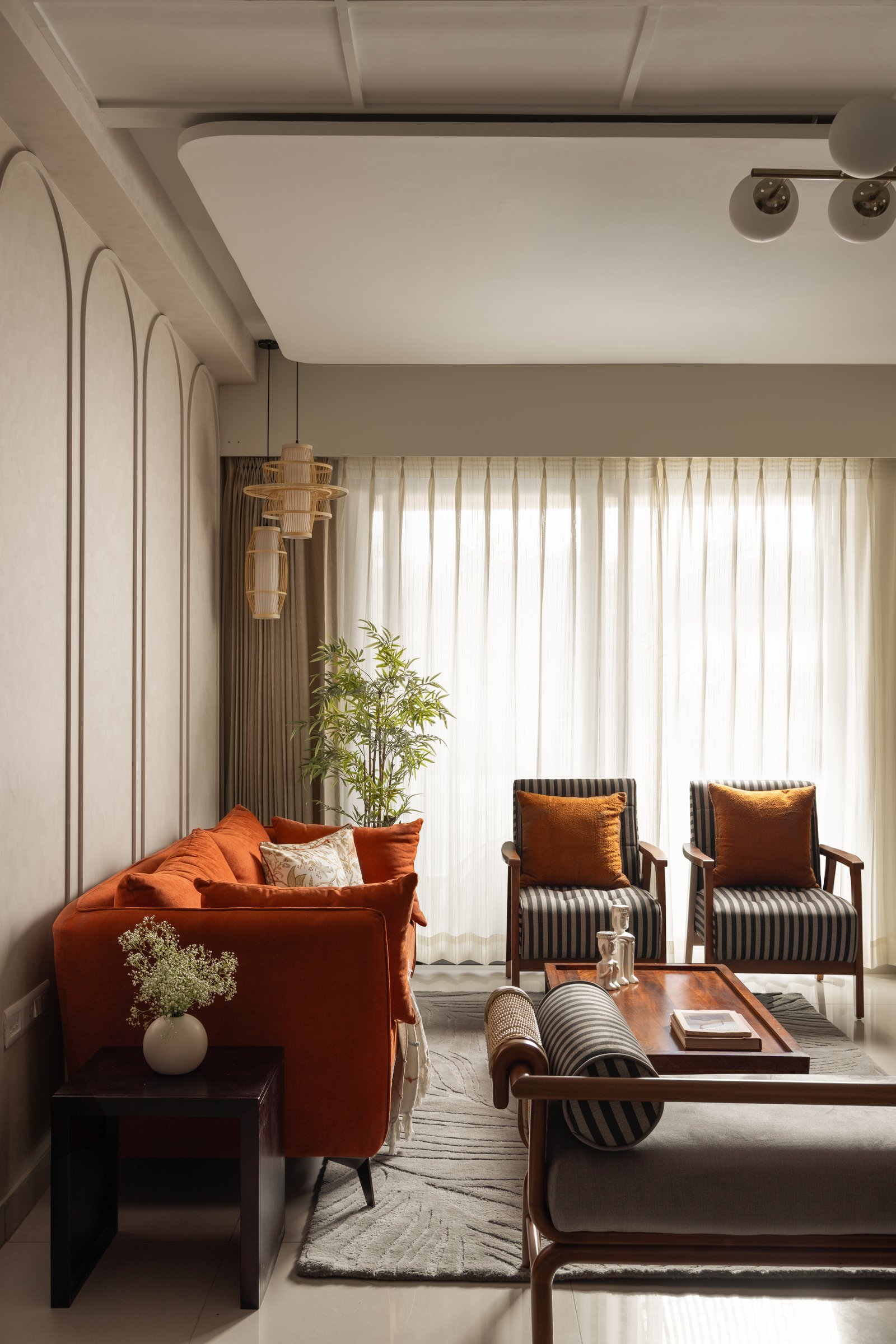
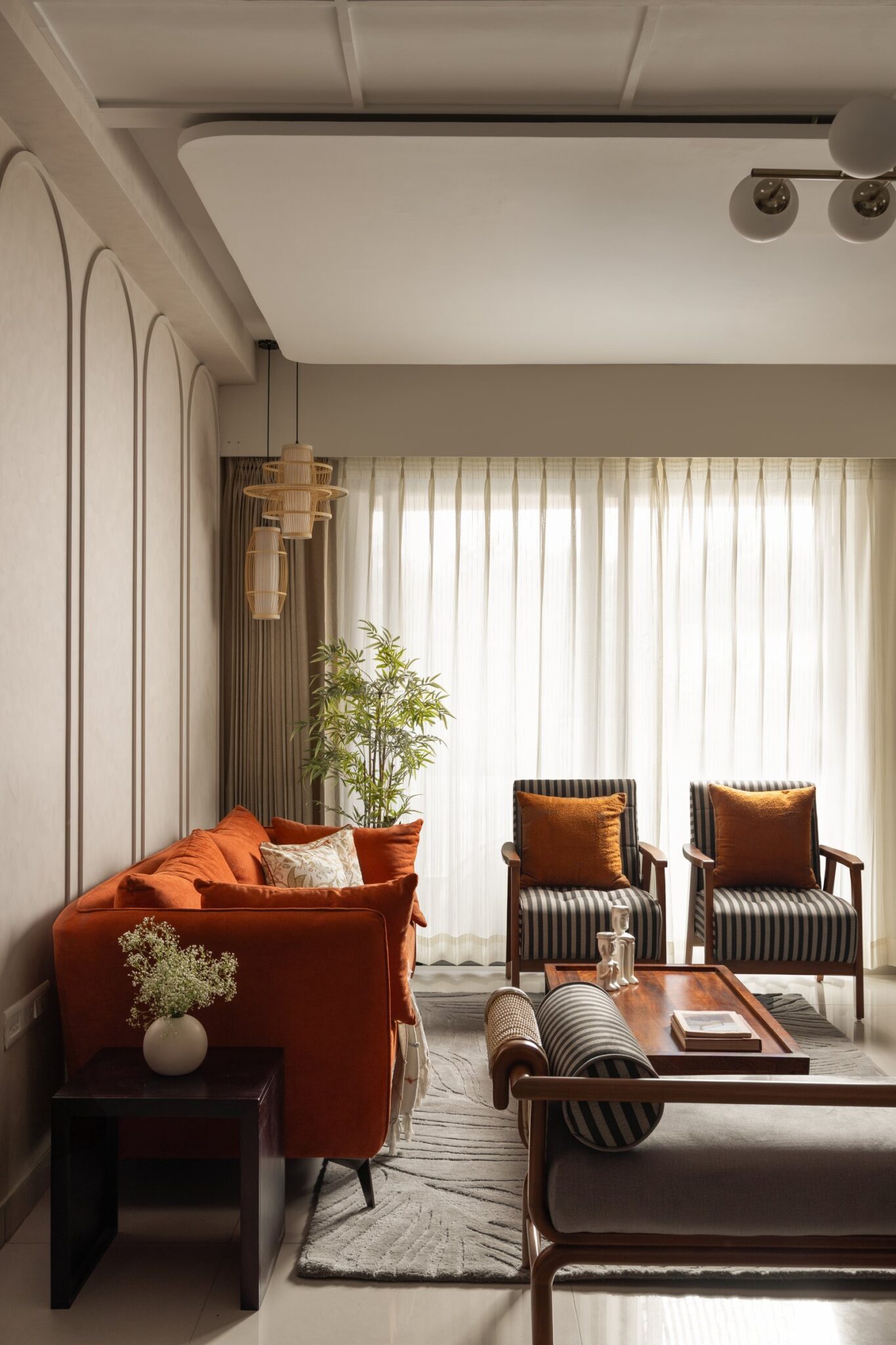
The living room enters on a deeper register. A rust-orange sofa sits against a panelled wall whose slim arched mouldings introduce a soft architectural rhythm, while a pair of striped armchairs faces it across a dark wood coffee table.
The room is not large, and the design refuses to pretend otherwise. Instead, it leans into intimacy: a cluster of woven pendants suspended above a side table, sheer curtains diffusing the afternoon light, and a palette built around a single confident colour rather than a survey of neutrals.
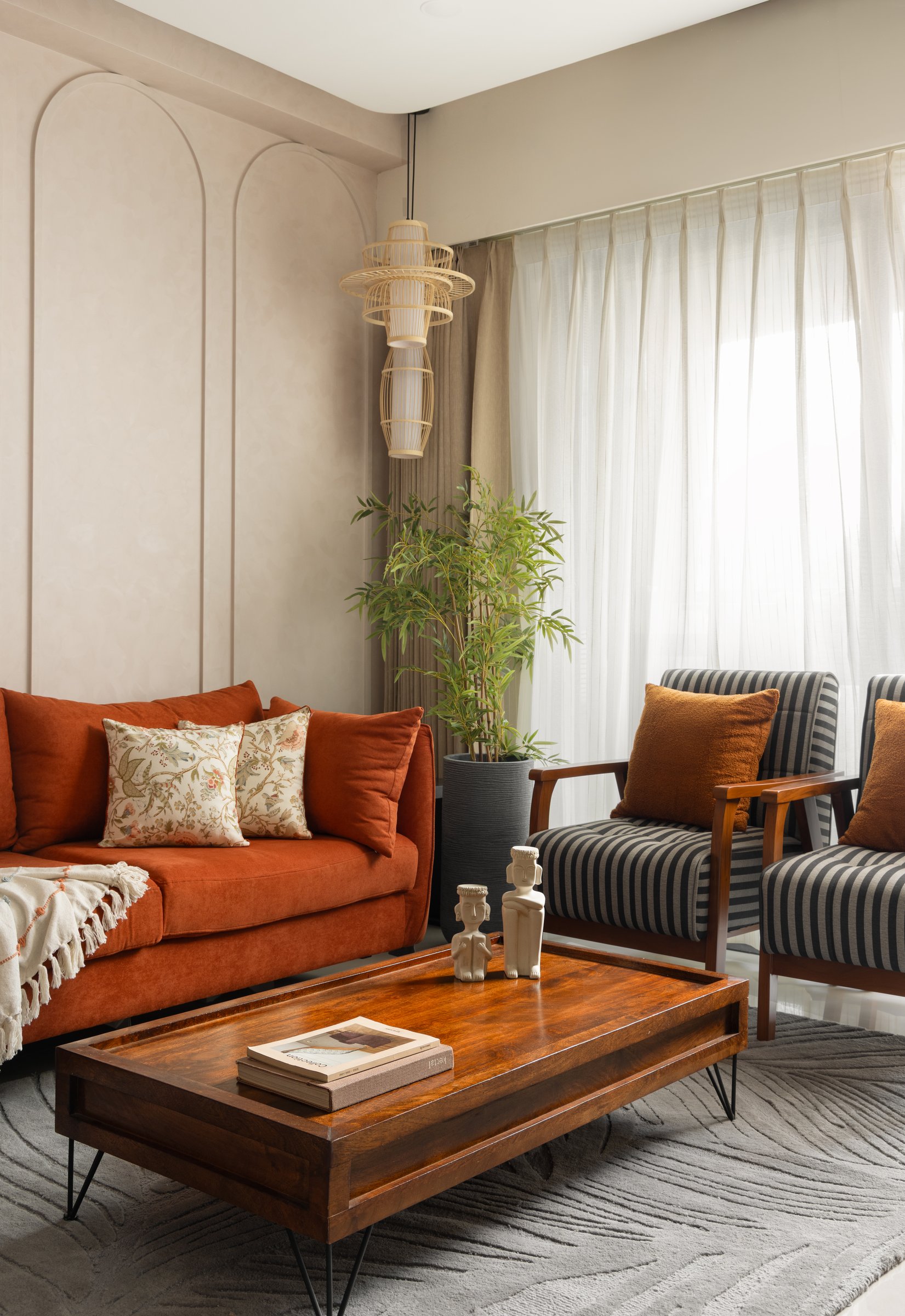
Seen from a closer angle, the seating arrangement reveals its sense of assembly. The sofa is dressed with a botanical-print cushion and a fringed throw, two small carved figurines sit on the coffee table, and a potted plant softens the corner where panelled wall meets curtain.
““In a world of high-intensity work, the home was envisioned not just as a living space, but as a recharging station where every square inch is optimized for utility without sacrificing a sophisticated, tactile aesthetic.””
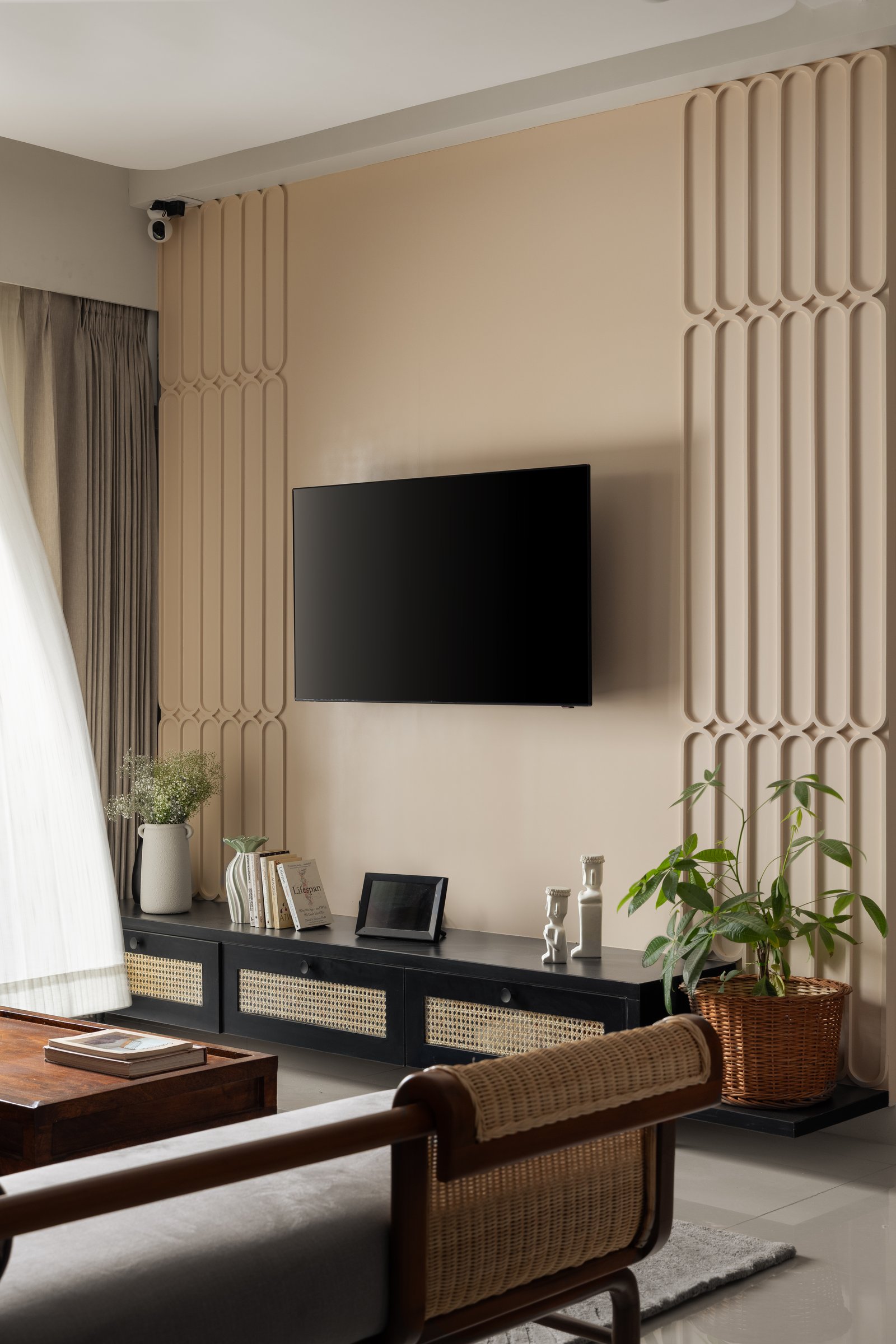
Opposite the seating, the television wall is the room’s most considered architectural gesture. A pale, putty-toned wall is overlaid with elongated arched mouldings that frame the screen without competing with it, and a low console with cane-fronted drawers grounds the composition.
What this wall does, quietly, is dignify the television. In a home built around the realities of how families actually unwind, the screen is not hidden behind cabinetry or apologised for; it is given an architecture that lets it belong.
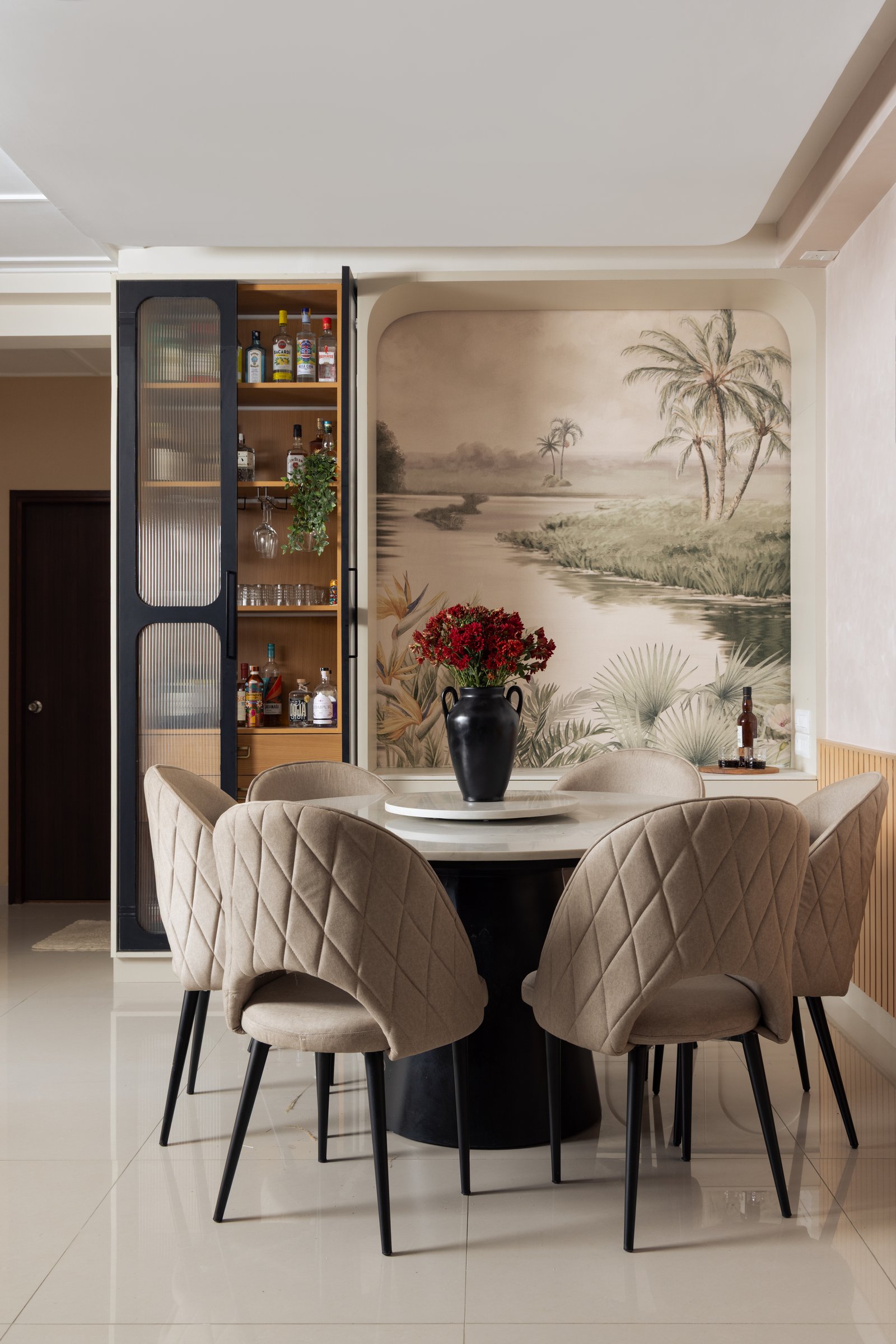
The dining area pivots the home’s mood from rust-warm to softly tropical. A round table on a black pedestal is encircled by six diamond-quilted chairs in a sandy neutral, and the wall behind carries a hand-painted-style mural of palms and waterways set within a rounded architectural niche.
To the left, a slim bar cabinet with fluted glass doors and a blackened frame opens to reveal a curated row of bottles and stemware. The dining zone reads less as a room and more as a small staged interlude, the home’s one indulgence in scenography.
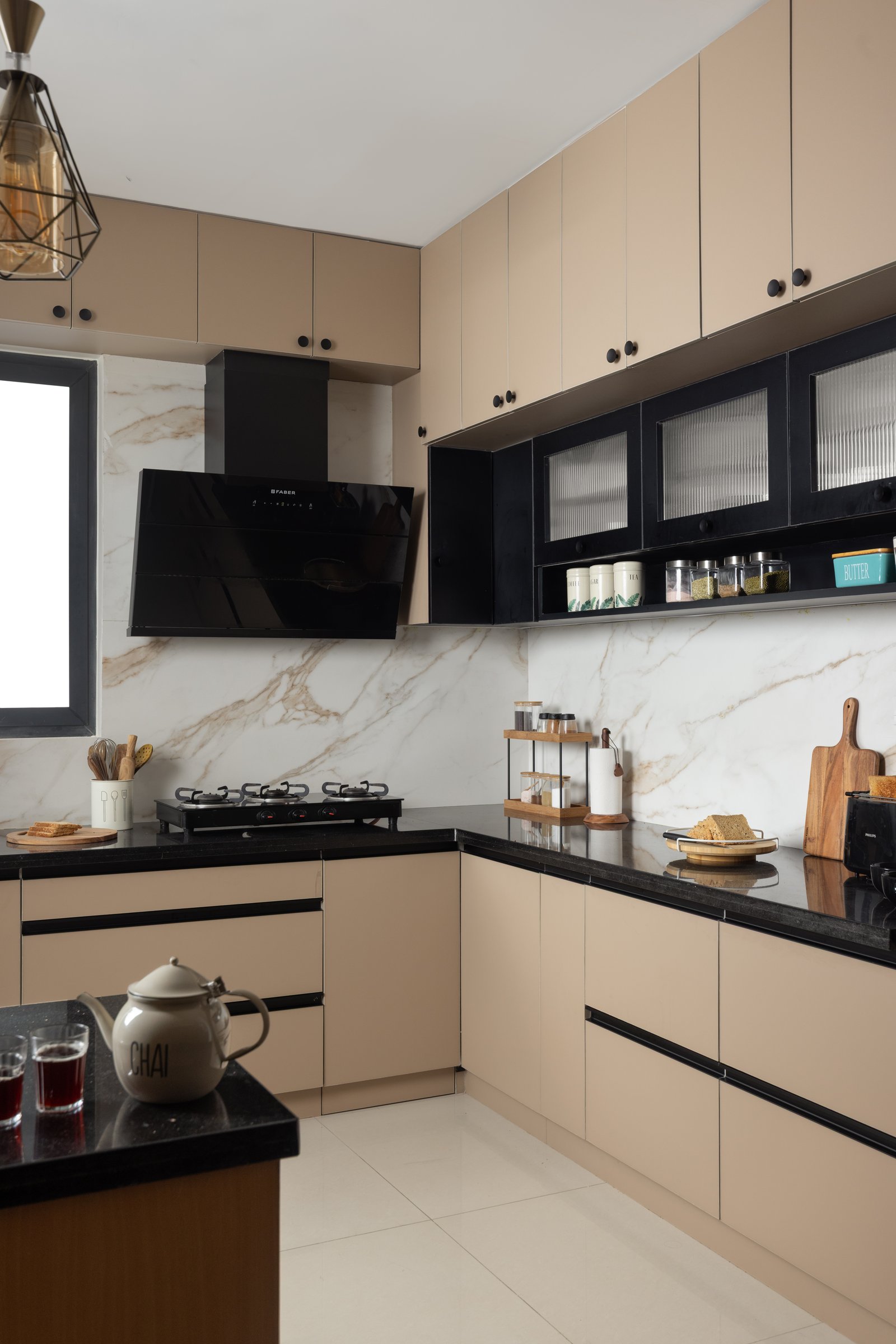
The kitchen is where the function-first philosophy is most legible. Matte latte cabinetry meets a black stone counter, and a marble-finish backsplash runs the length of the working wall, its veining the only ornament the room permits itself.
The decision to introduce fluted glass uppers framed in black is what lifts this from a competent kitchen to an editorially considered one. The fluted panels diffuse the contents within, so the shelf of canisters and jars reads as soft texture rather than visual noise.
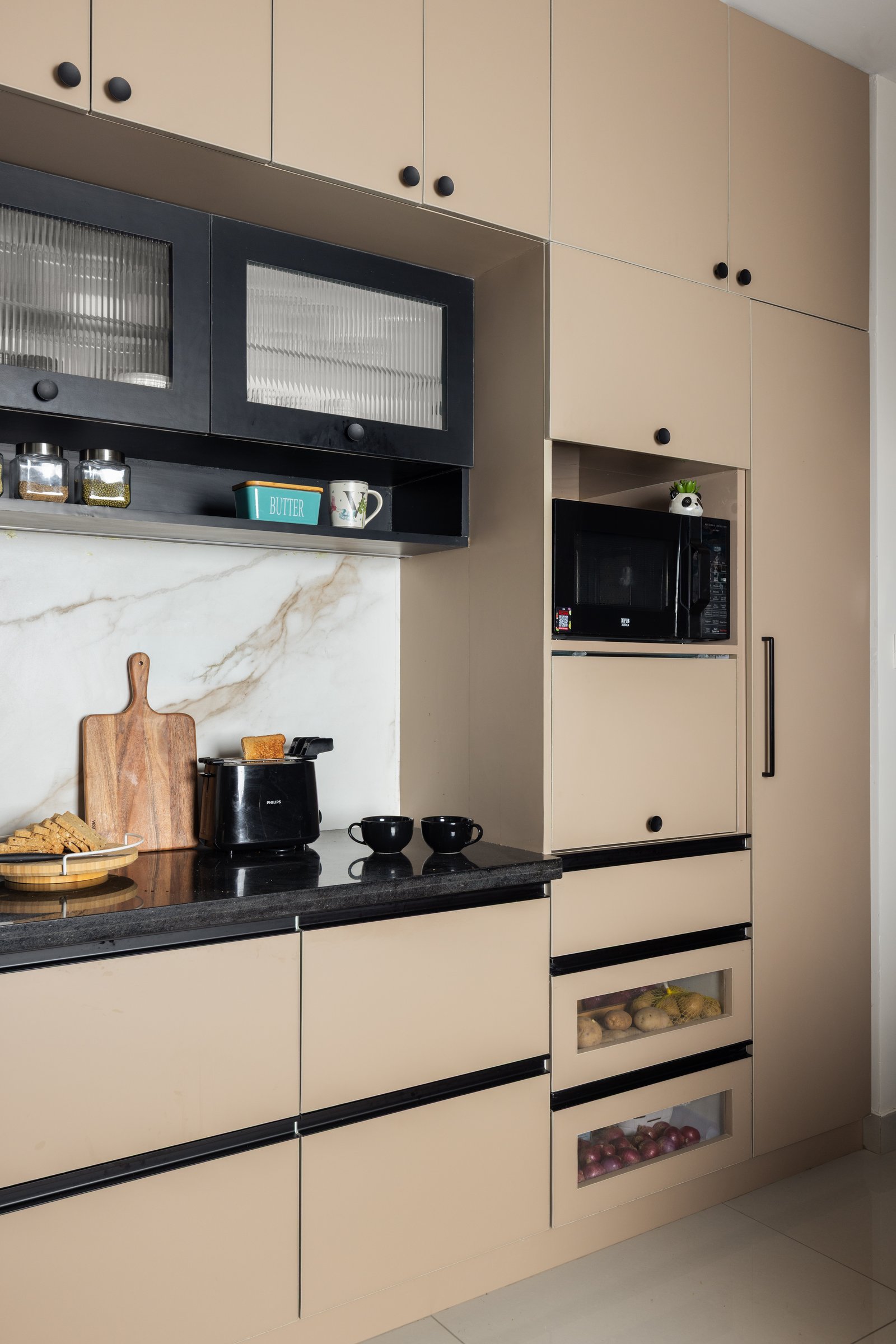
Around the corner, the kitchen tightens into a tall run of integrated appliance housing and full-height storage. A microwave niche sits flush within the cabinetry, and two clear-fronted drawers at the base hold vegetables on open display, a small piece of honesty in a room otherwise built on concealment.
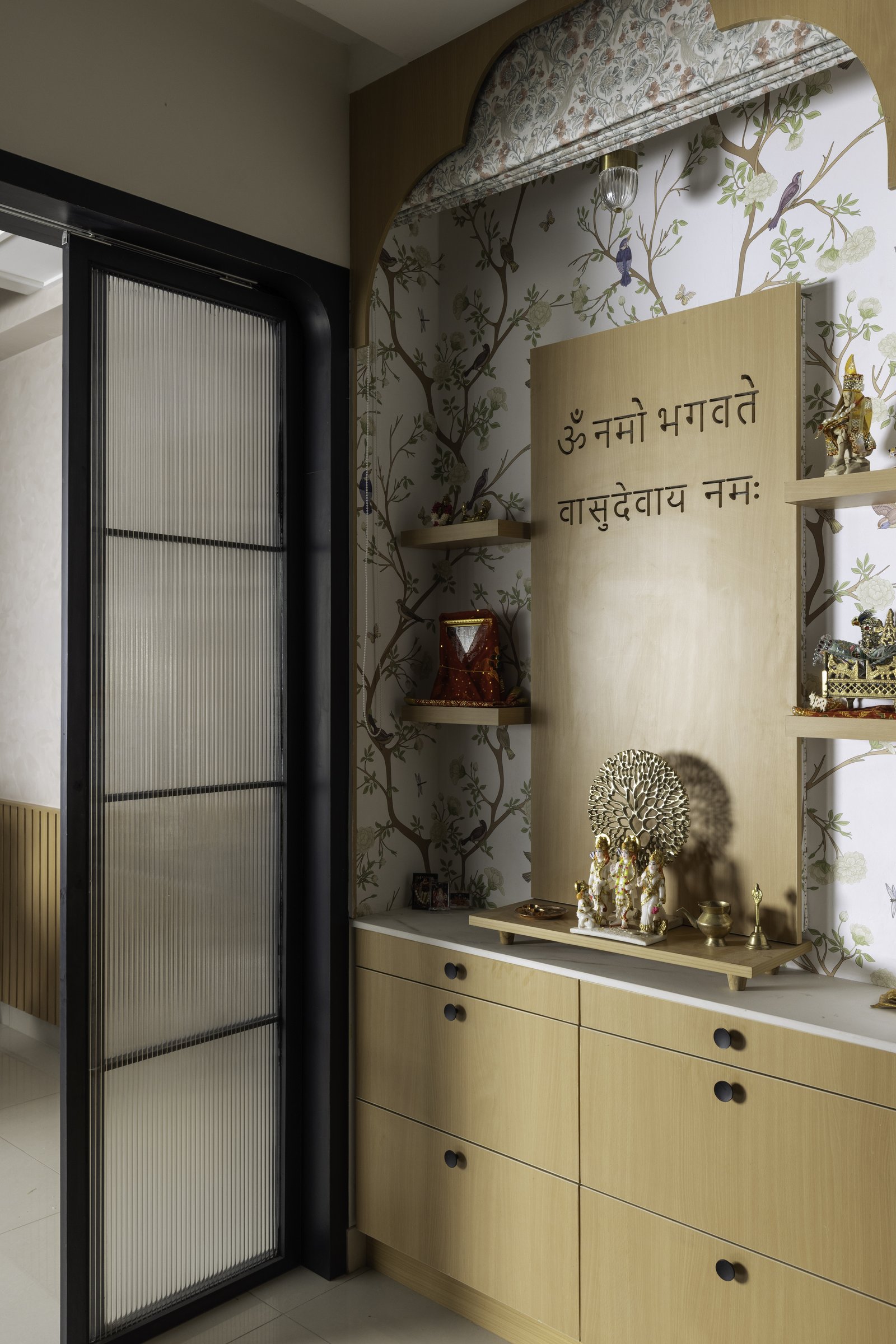
The puja room is tucked behind a fluted glass sliding door, its scale modest but its detailing generous. A floral chinoiserie wallpaper wraps the niche, a wood-clad altar carries a Sanskrit invocation, and slim brass-handled drawers below maintain the calm of the rest of the home.
It is the home’s quietest space and arguably its most necessary, a deliberate pause folded into the plan.
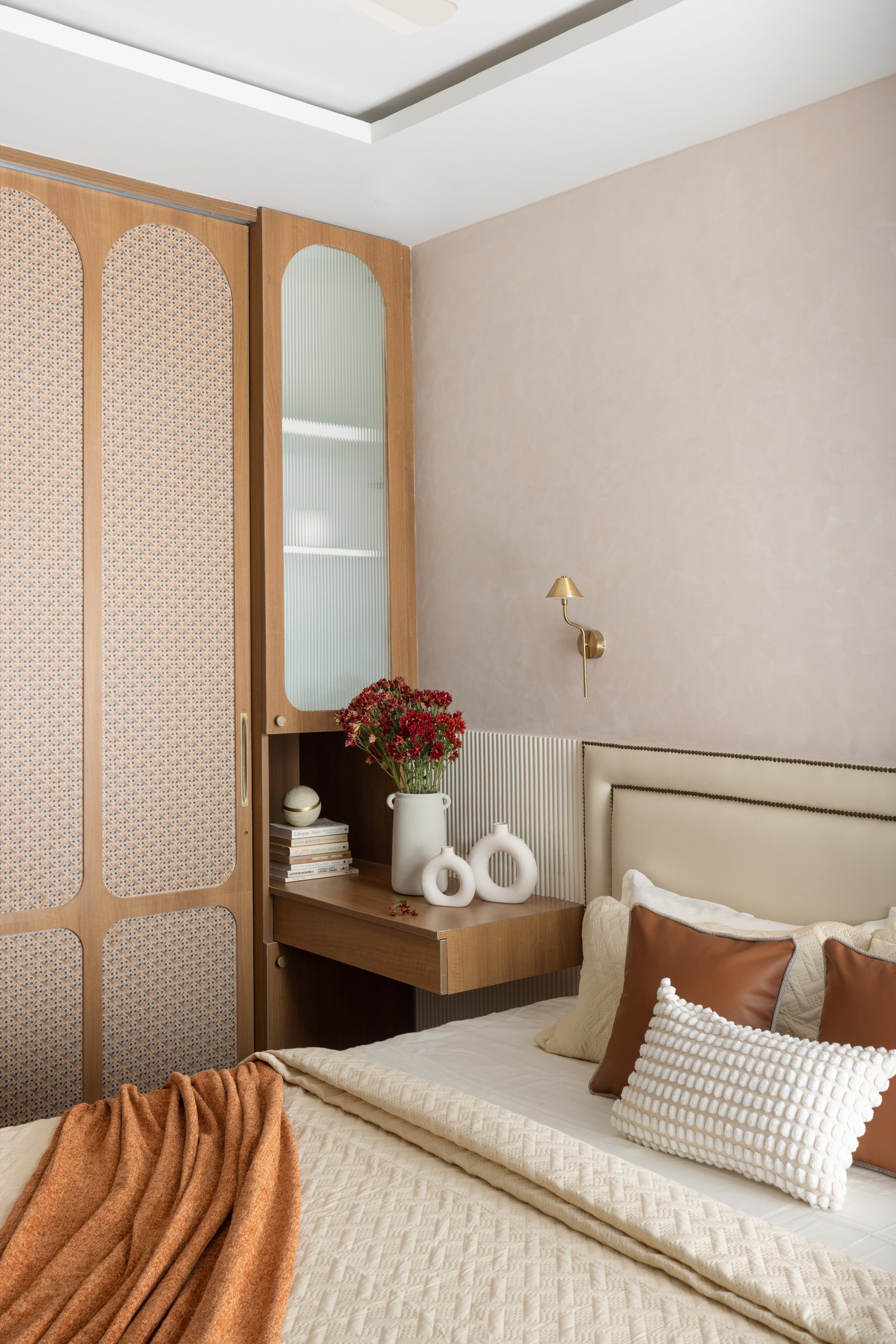
The primary bedroom opens with a studded headboard set against a blush textured wall, framed by a wardrobe whose cane-inlay shutters introduce the home’s softening material vocabulary. A small floating wooden nightstand set against a fluted panel holds a vase of carnations and a stack of books, lit by a slim brass wall sconce.
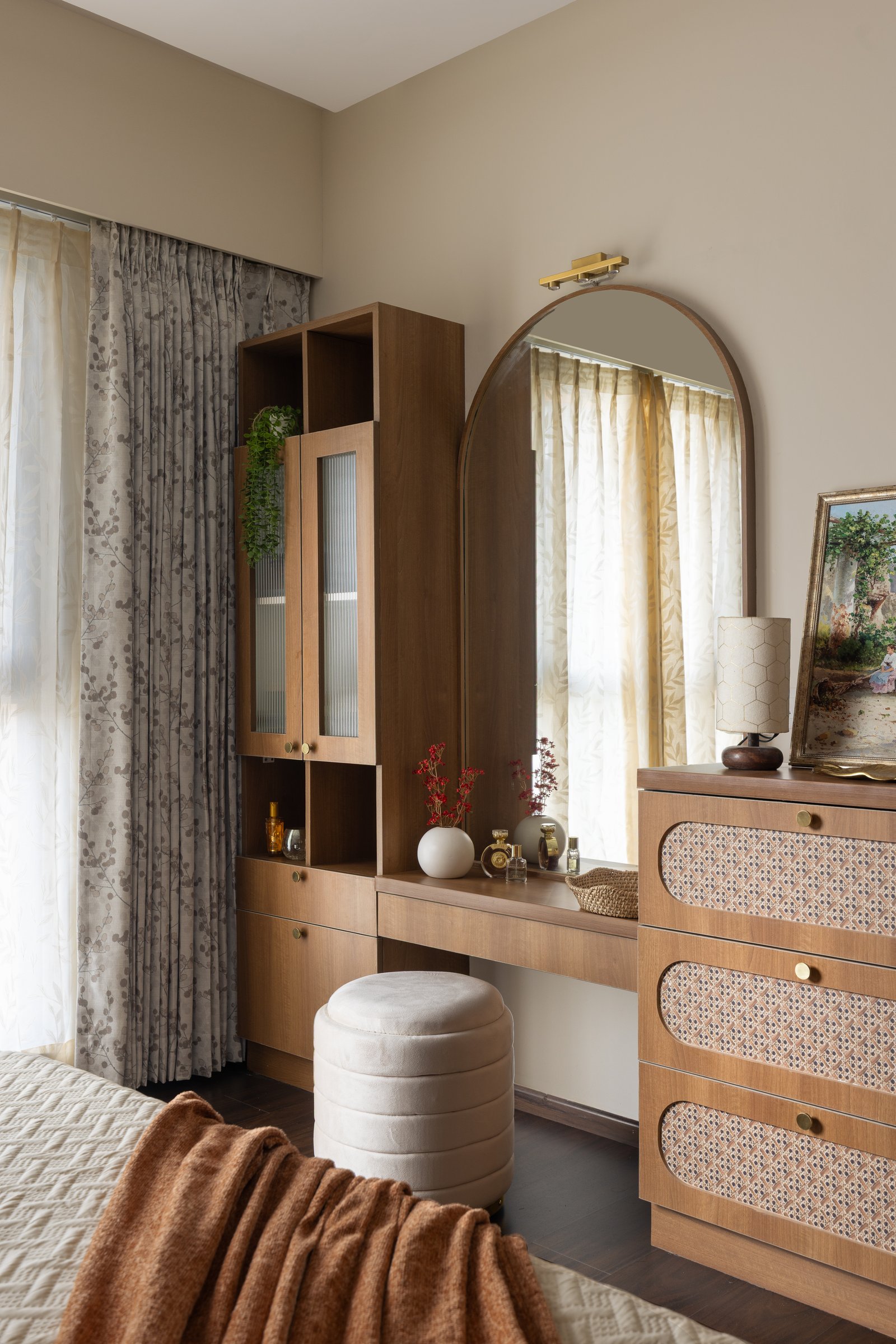
Across from the bed, a wood-toned dressing unit pairs an arched mirror with a tall display column and a chest of drawers fronted in cane panels. A small framed painting and a honeycomb-shaded lamp sit beside the mirror, and a quilted stool tucks neatly beneath the vanity counter.
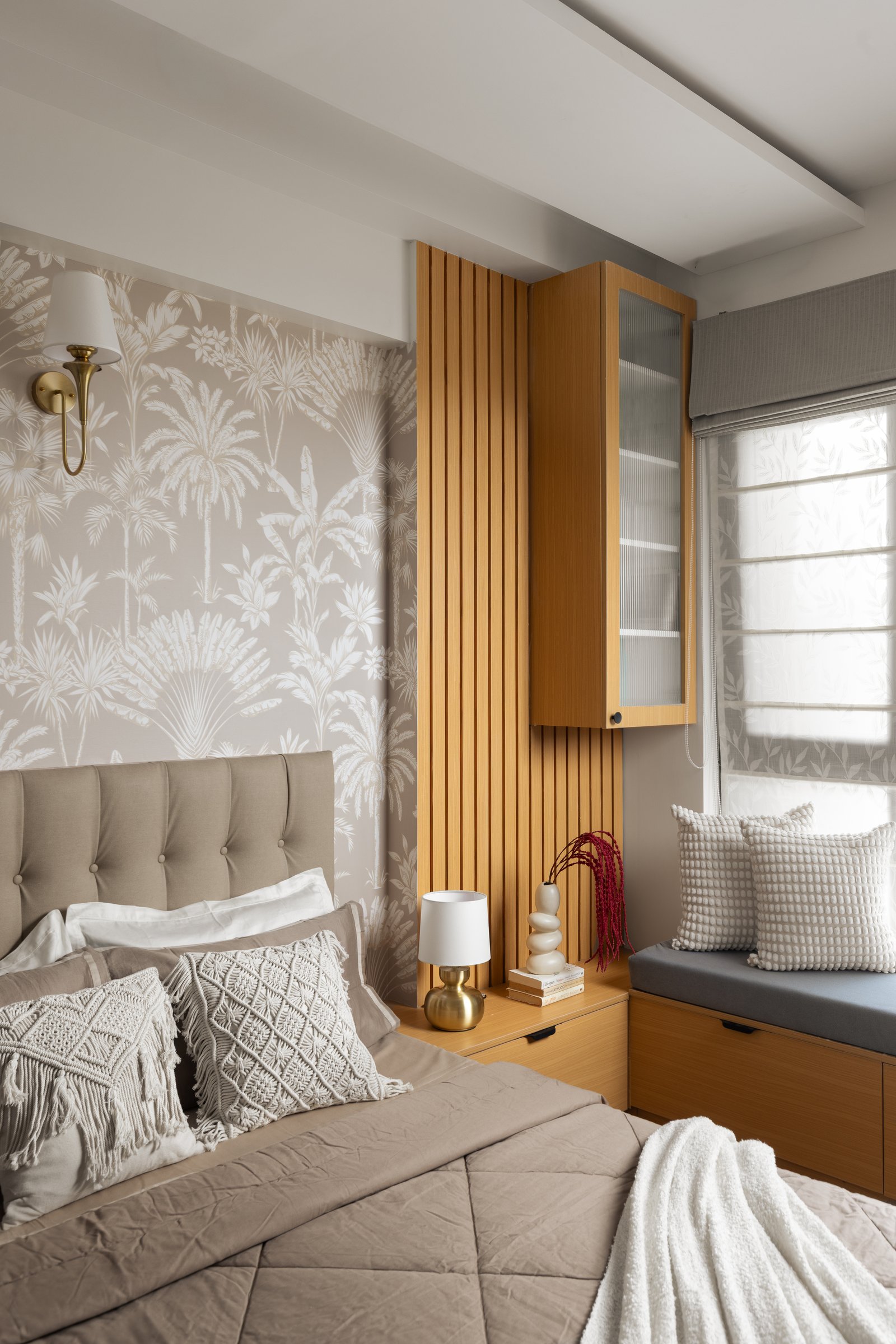
The guest bedroom opens into a different register, lighter and more pattern-led. A botanical palm-print wallpaper wraps the wall behind a tufted upholstered headboard, while a slatted wood panel rises beside it carrying a fluted-glass cabinet, and a window seat in the same wood-grain extends the room into a quiet corner for reading.
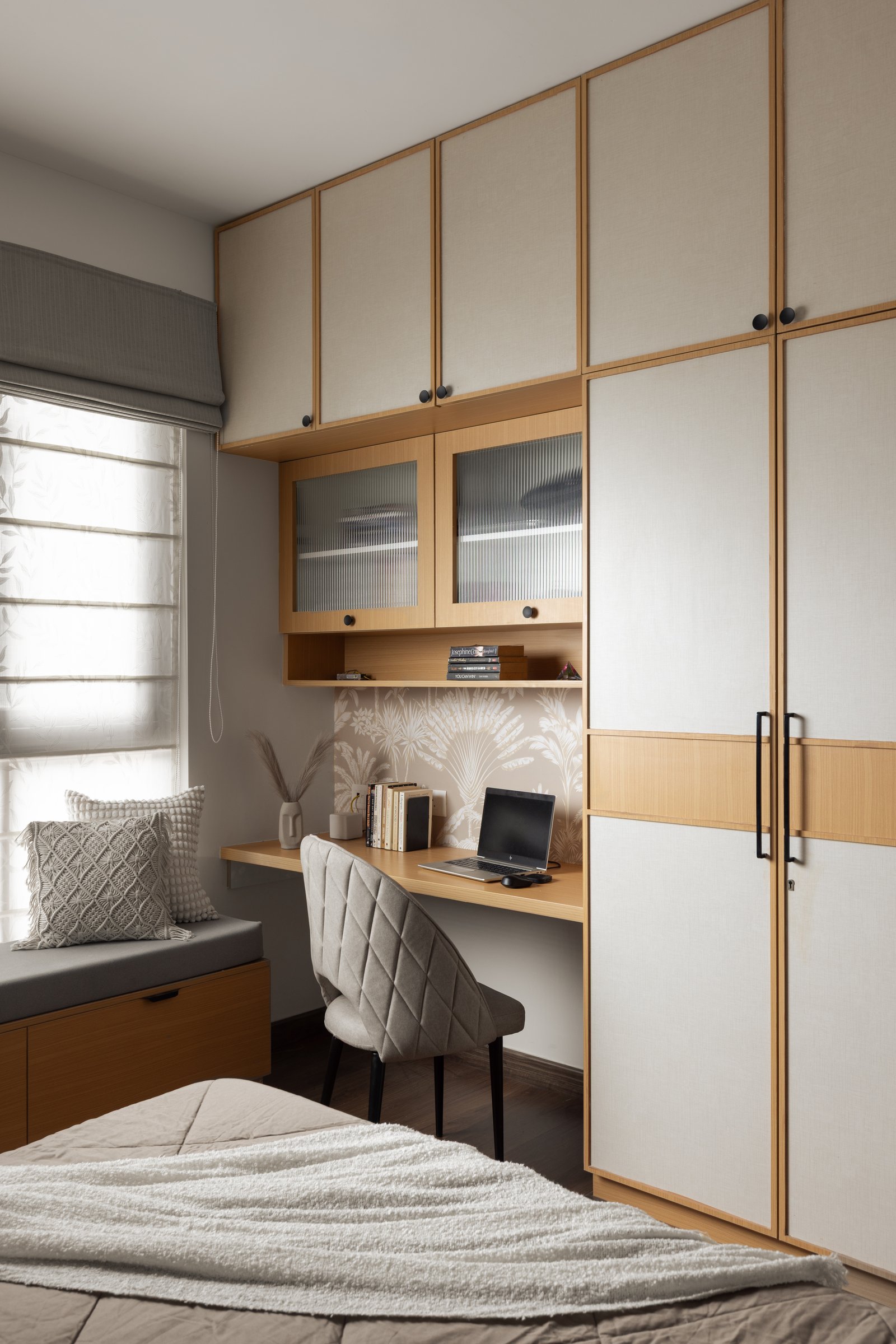
The same room reveals its second life. A built-in desk runs beneath fluted-glass uppers and a band of botanical wallpaper, with a quilted chair pulled in, the window seat continuing alongside. This is the vanishing workspace the studio describes, joinery that reads as cabinetry until a laptop opens and the room quietly reorganises itself around work.
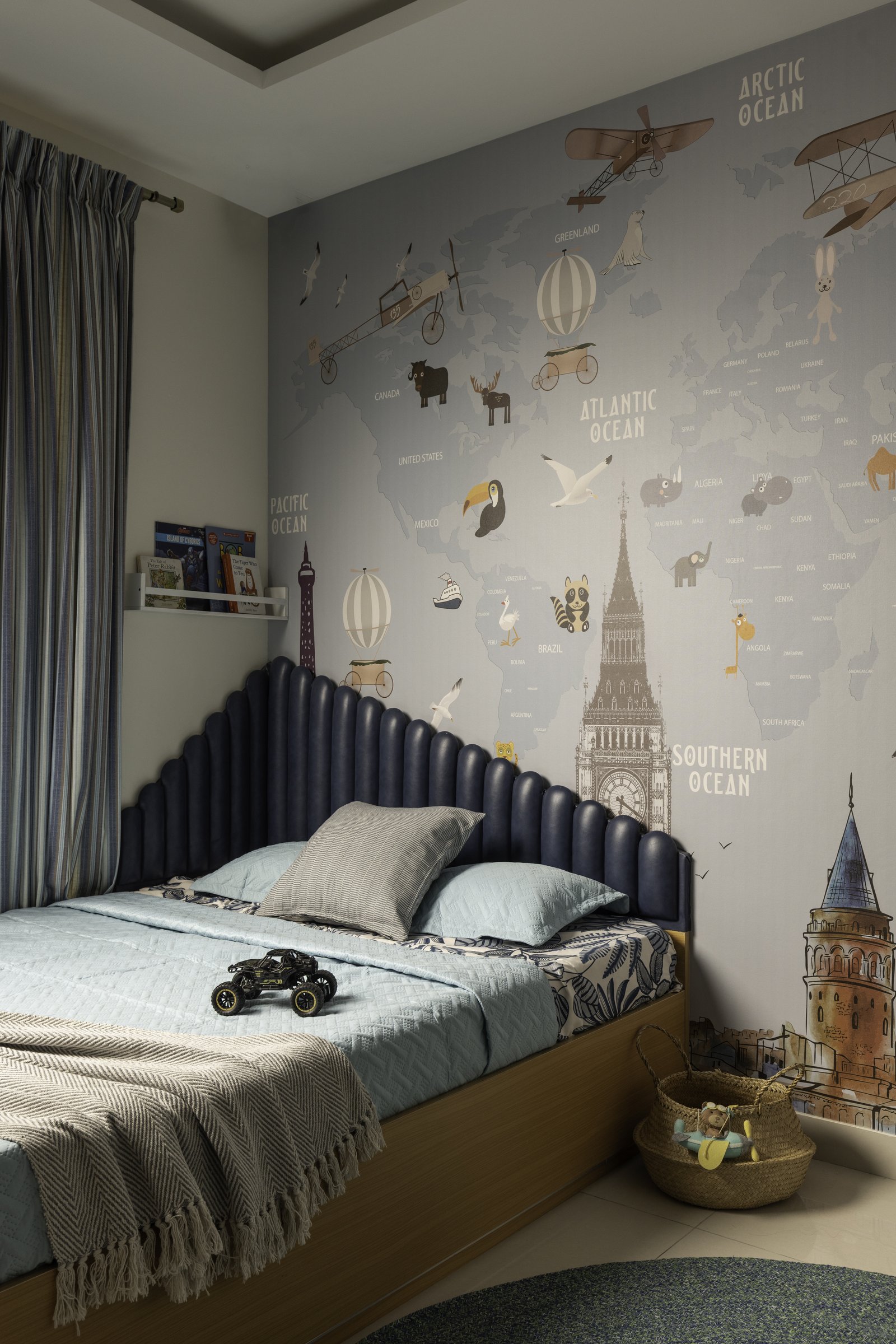
The child’s bedroom is the home’s most exuberant room, and the only one where the design lets pattern lead. A world-map mural wraps the wall behind a platform bed with a curved, channelled headboard in deep blue, animated with hot-air balloons, biplanes and miniature landmarks.
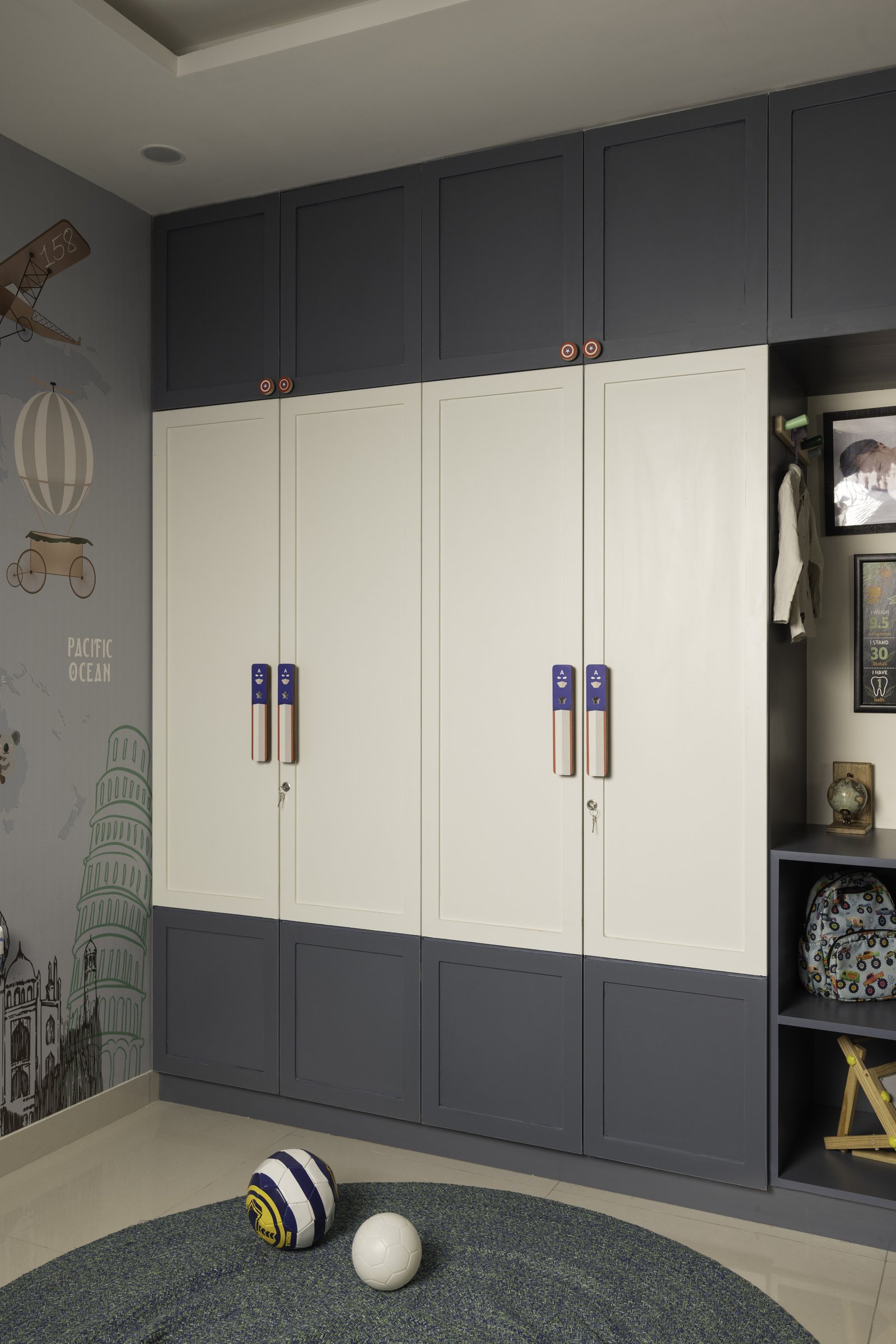
The wardrobe wall continues the same logic in calmer form: tall storage in a two-tone palette of charcoal and ivory, with custom playful handles that signal this is a child’s room without resorting to cartoonish joinery. An open shelf at the side holds a backpack and framed pictures.
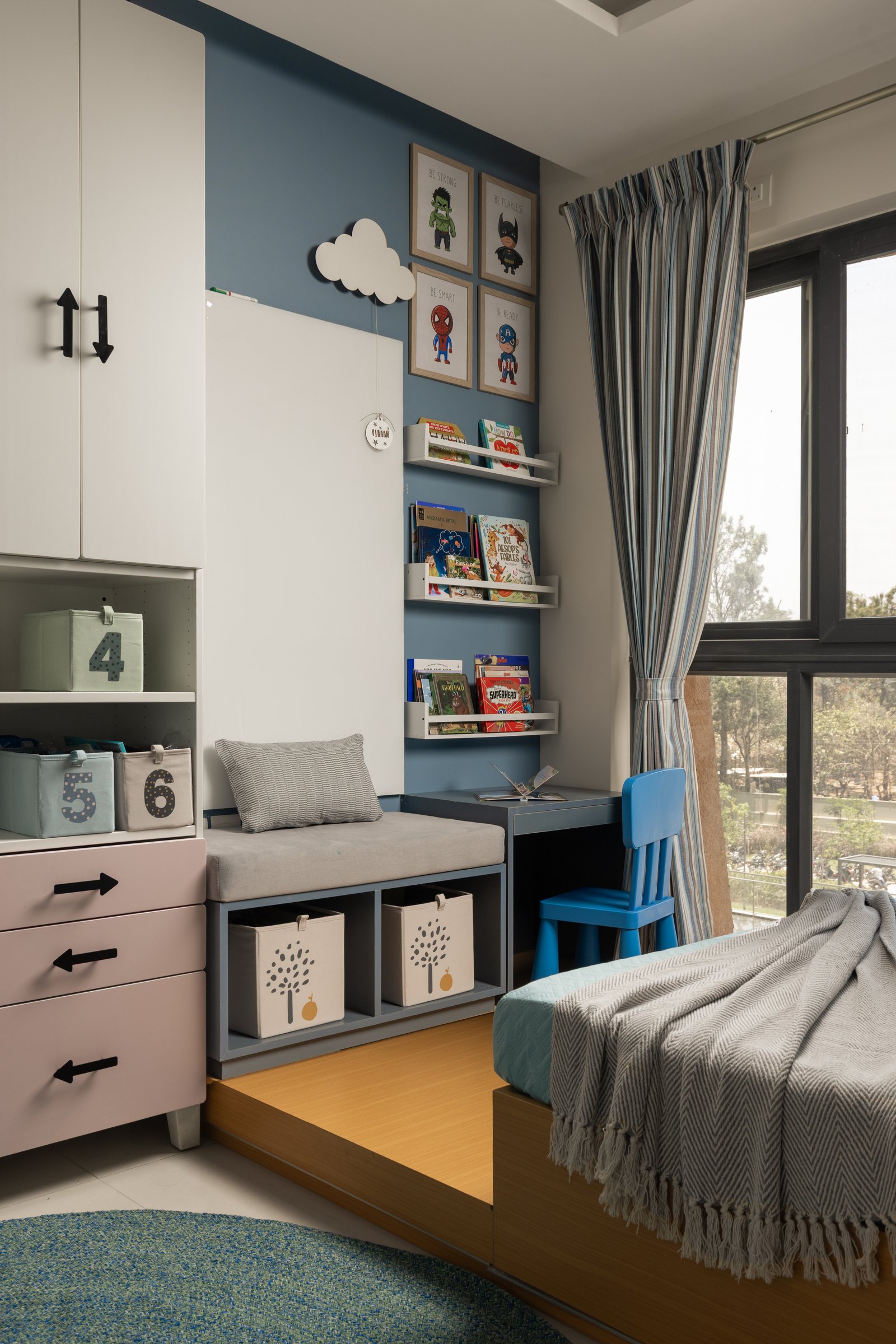
The room’s study corner sharpens the same idea. A compact desk and a low window-seat sit beneath a framed grid of superhero prints and three slim picture-ledges of storybooks, with colour-blocked drawers in blush and white anchoring the adjacent wall. The room argues, with some conviction, that disciplined storage and imaginative pattern are not opposing values.
What Between The Rush represents within Bangalore’s residential landscape is a quiet shift: away from the aspirational large-format apartment and toward the genuinely useful smaller one. The DIOK household is not a niche; it is increasingly the city’s defining demographic, and the homes designed for it have lagged behind the lives lived within them.
TABA’s work here suggests that intentional minimalism, when paired with cane, fluted glass, brass and a willingness to allow one strong colour per room, can produce something more durable than trend-driven luxury: a home that holds the day’s intensity at the door, and gives back something steadier in return.