There is a way of designing for return, of shaping a home not around the act of arriving but around the slower, more interior act of settling, that asks the architect to step back rather than forward. The most considered homes are not those that announce themselves but those that allow their occupants to grow into them, where rooms accept rather than perform, and where tradition is referenced through proportion and gesture instead of literal quotation.
This is the proposition behind Aatman, a 1,200-square-foot, three-bedroom apartment in Ranchi designed by SCJ Architects & Interior Designers under the direction of principal architect Shikha Choudhary. Conceived for a family seeking a contemporary Indian sensibility without the visual loudness that often accompanies it, the home reads as an exercise in restraint, where warm wood, soft neutrals, and the quiet recurrence of the arch carry an entire vocabulary of belonging.
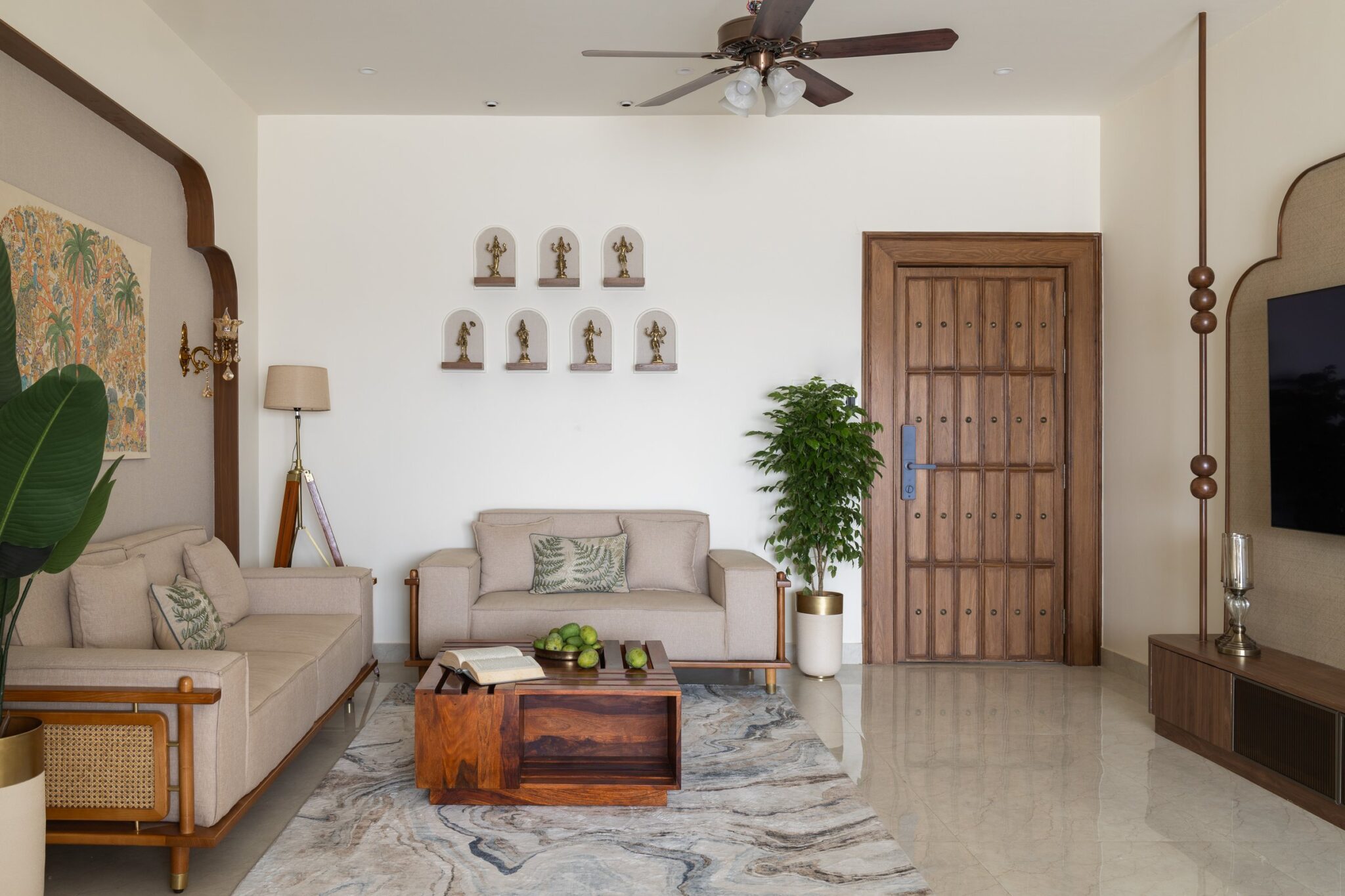
The living room opens with a clarity that feels deliberate rather than minimal. A pair of wood-framed sofas upholstered in oatmeal fabric sit perpendicular to a long, near-empty wall, where seven small arched niches hold brass figurines in a quiet, almost devotional rhythm. The arch is introduced here not as ornament but as a structural idea that will repeat through the home, framing the entry door, the artwork alcove, and the television wall in turn.
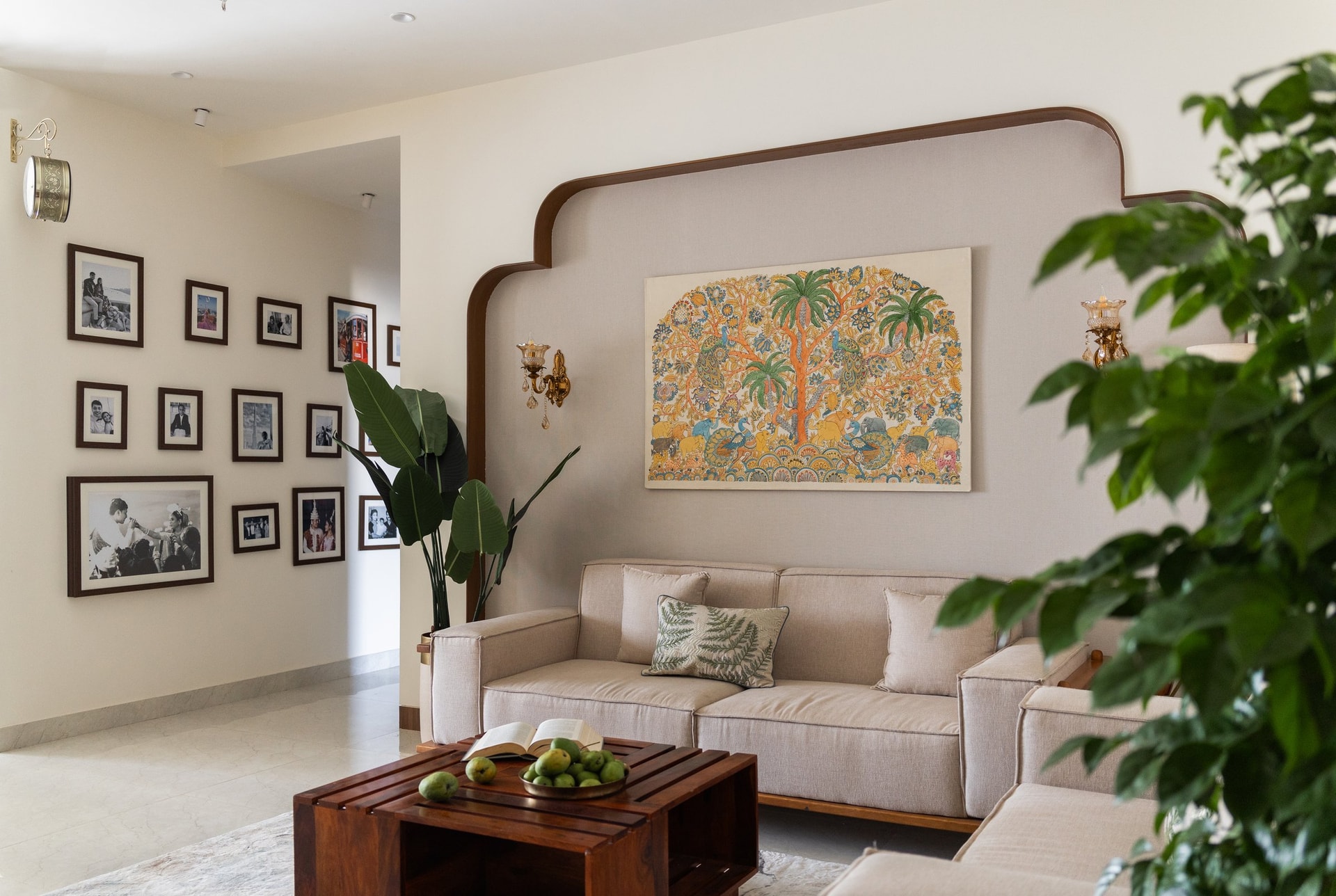
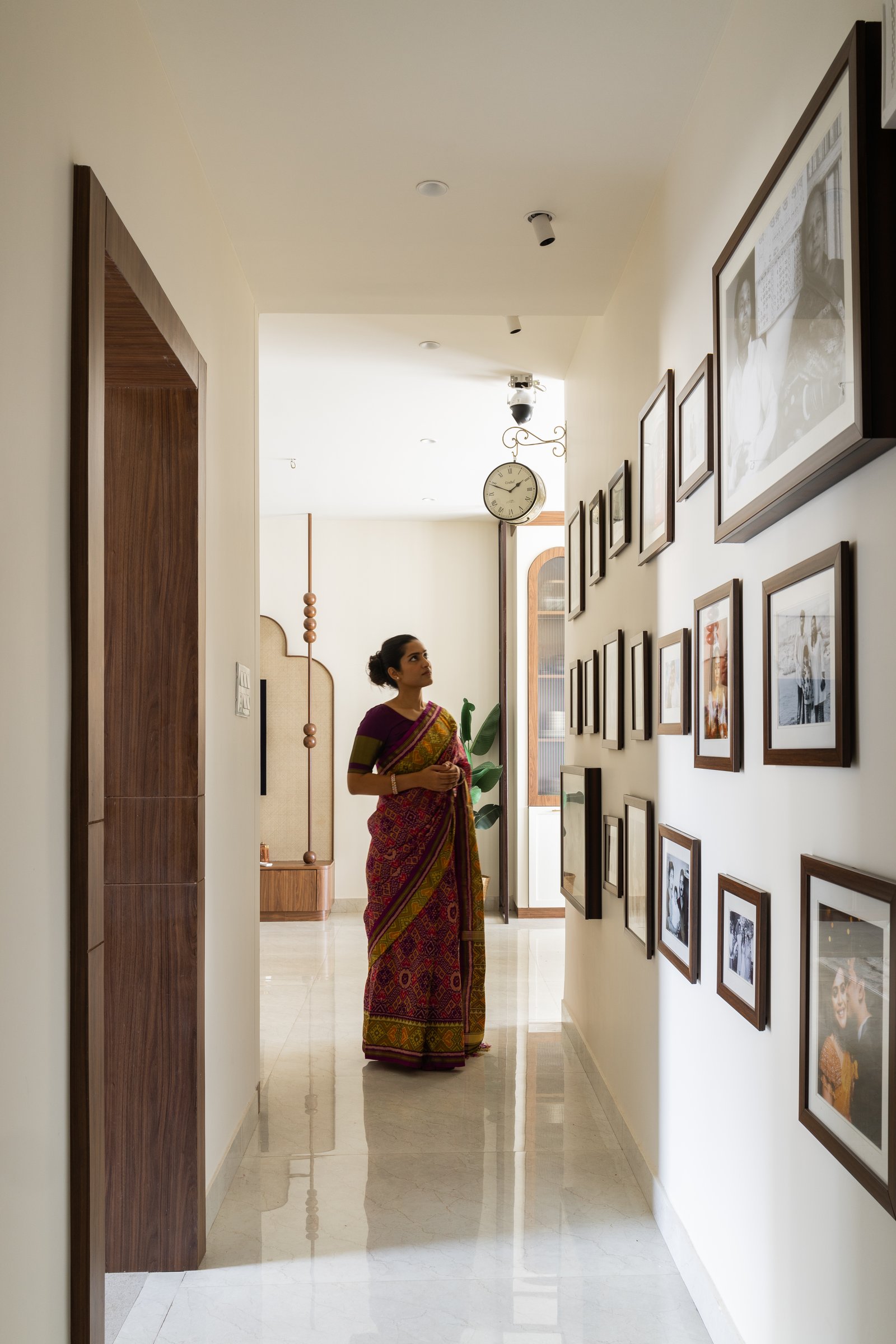
A second view of the same room reveals how the arched alcove behind the sofa was conceived: a softly profiled wooden frame holding a single piece of folk art, lit by twin sconces with amber droplets. The adjacent wall of family photographs, tightly hung in matched wood frames, anchors the room in personal history rather than decorative effect.
““Aatman becomes more than a residence; it is a place to return to, where familiarity, comfort, and a sense of belonging come together.””
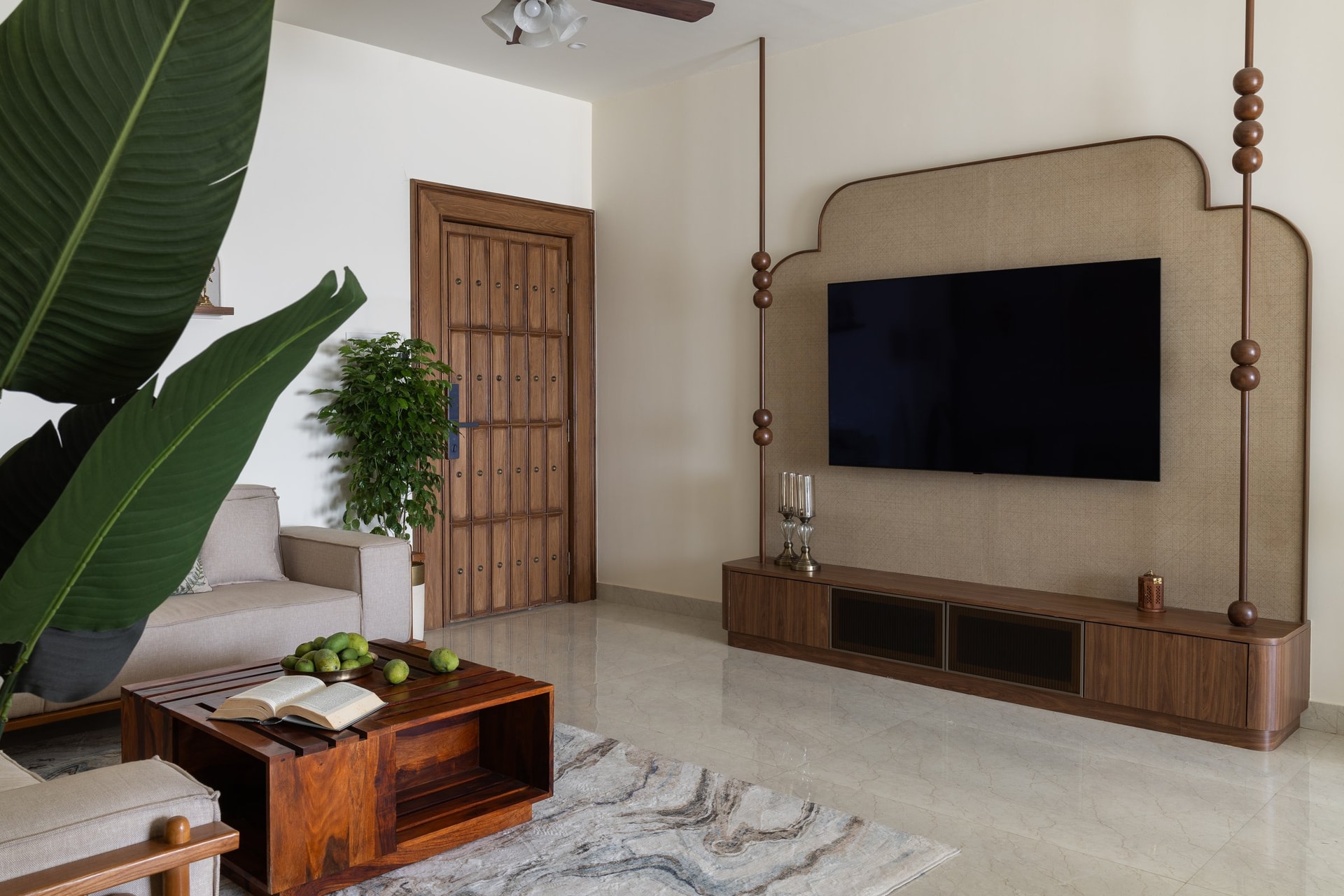
Across the room, the television wall takes the arch and stretches it into something more sculptural. A linen-clad panel rises in a stepped silhouette, flanked by slender vertical posts threaded with turned wooden beads that read almost as an abacus held against the wall. The gesture is unhurried, but it is the one piece of the living room that quietly insists on being looked at.
The transition from living to dining is handled through a single moment of detail: a scalloped doorframe that softens the geometry of the passage and signals a shift in register. To one side, a wall of ceramic discs in muted tones offers texture without colour; to the other, the gallery of photographs continues, carrying the personal narrative of the home from one room into the next.
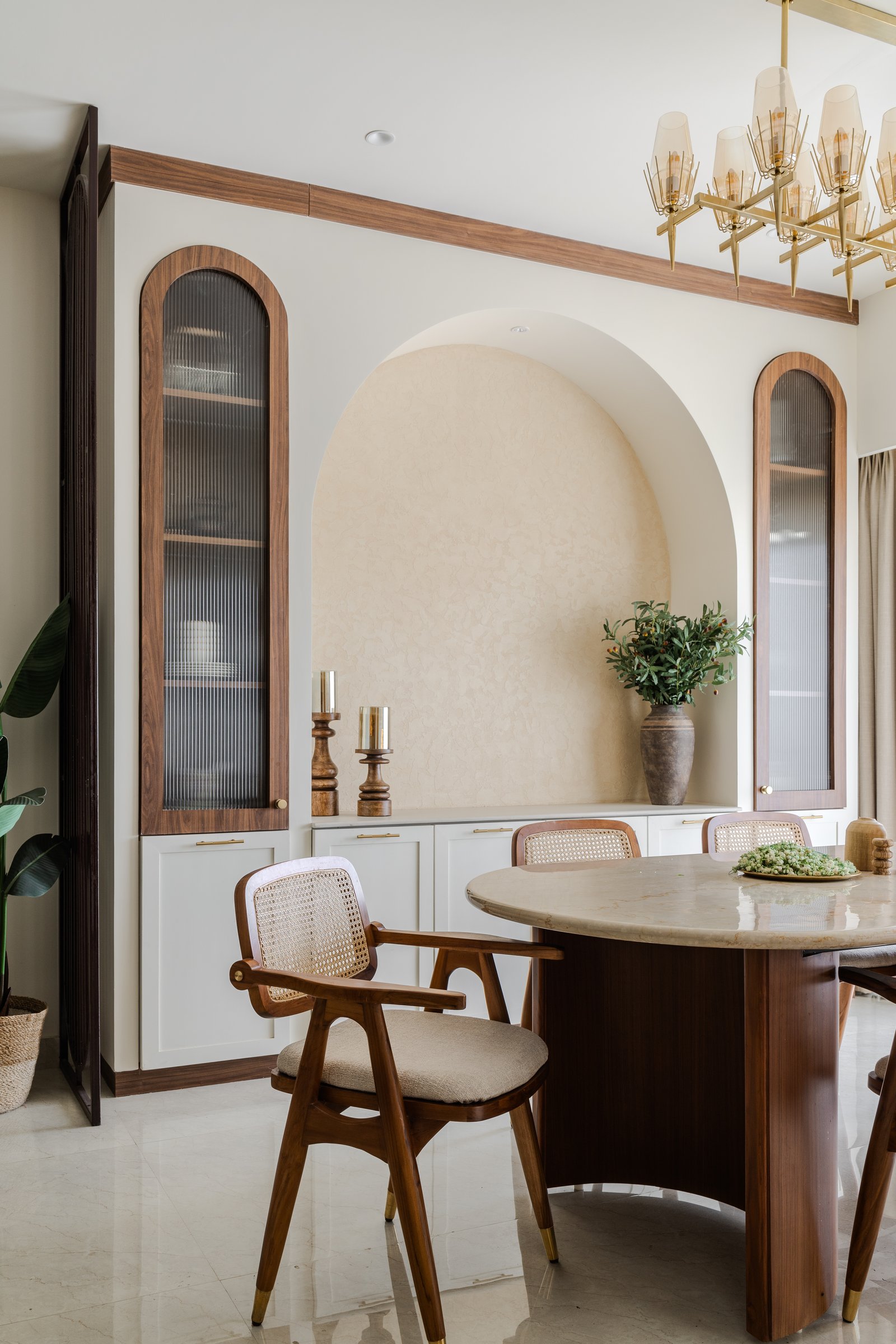
In the dining area, the central arched niche becomes the room’s quiet anchor. Rendered in a textured cream plaster and flanked by two tall, slender cabinets with fluted glass shutters in walnut-toned frames. It is a composition that understands the discipline of leaving things out.
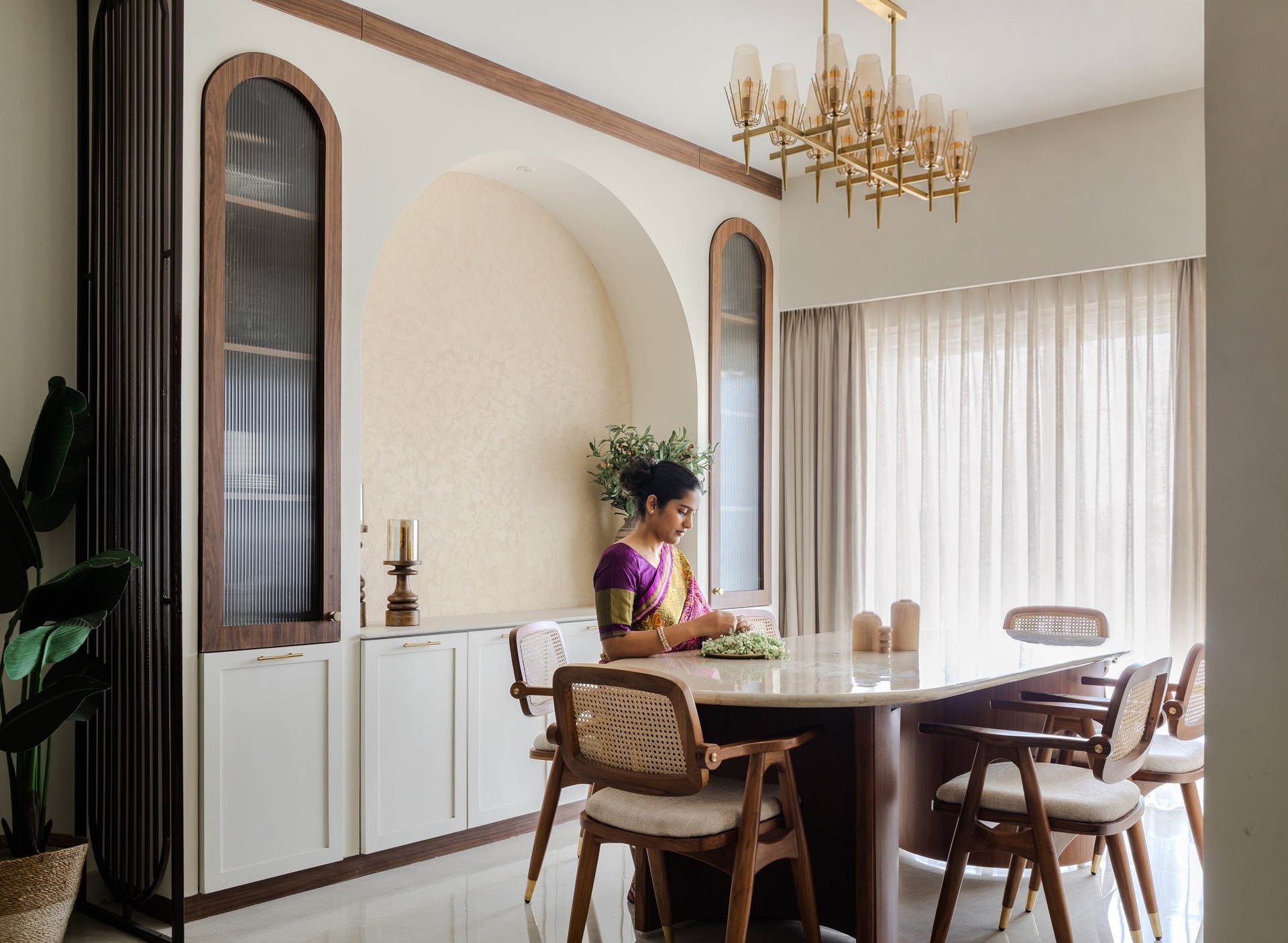
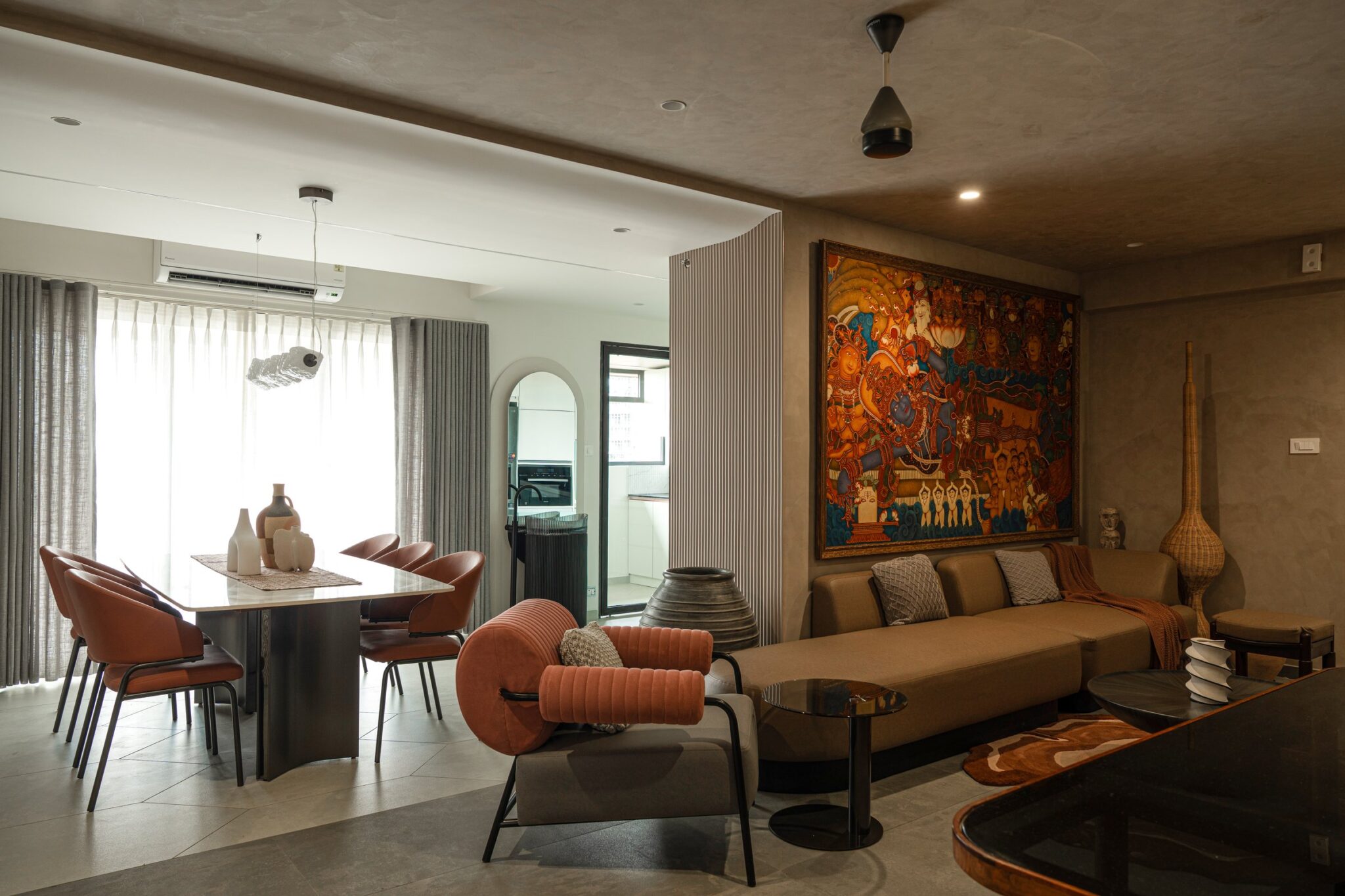
The dining table itself extends this discipline. A stone-topped oval surface sits on a sculpted wooden base, surrounded by cane-backed chairs whose silhouettes feel drawn from mid-century Indian craft rather than imported nostalgia. Sheer curtains diffuse the afternoon light into something almost powdery, and a brass chandelier with frosted glass shades holds the ceiling without weighing it down.
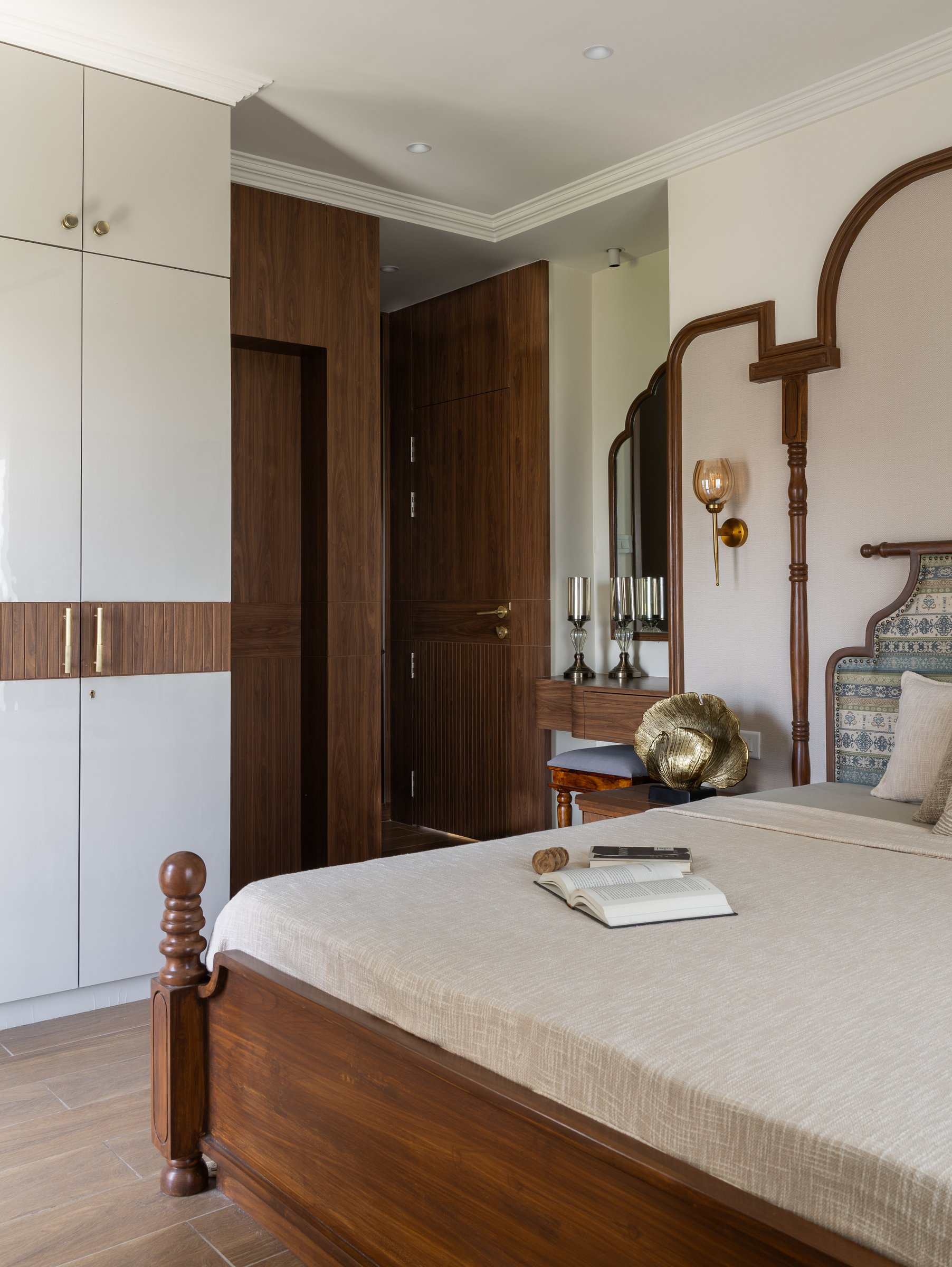
The master bedroom carries the home’s most overtly traditional language, but it does so through silhouette rather than ornament. A four-poster wooden bed with turned finials anchors the room, set against a wall panel whose stepped wooden moulding traces an arched outline around a softly upholstered headboard. The wardrobe wall opposite, finished in ivory laminate with a band of fluted wood, keeps the storage volume quiet so the bed can speak.
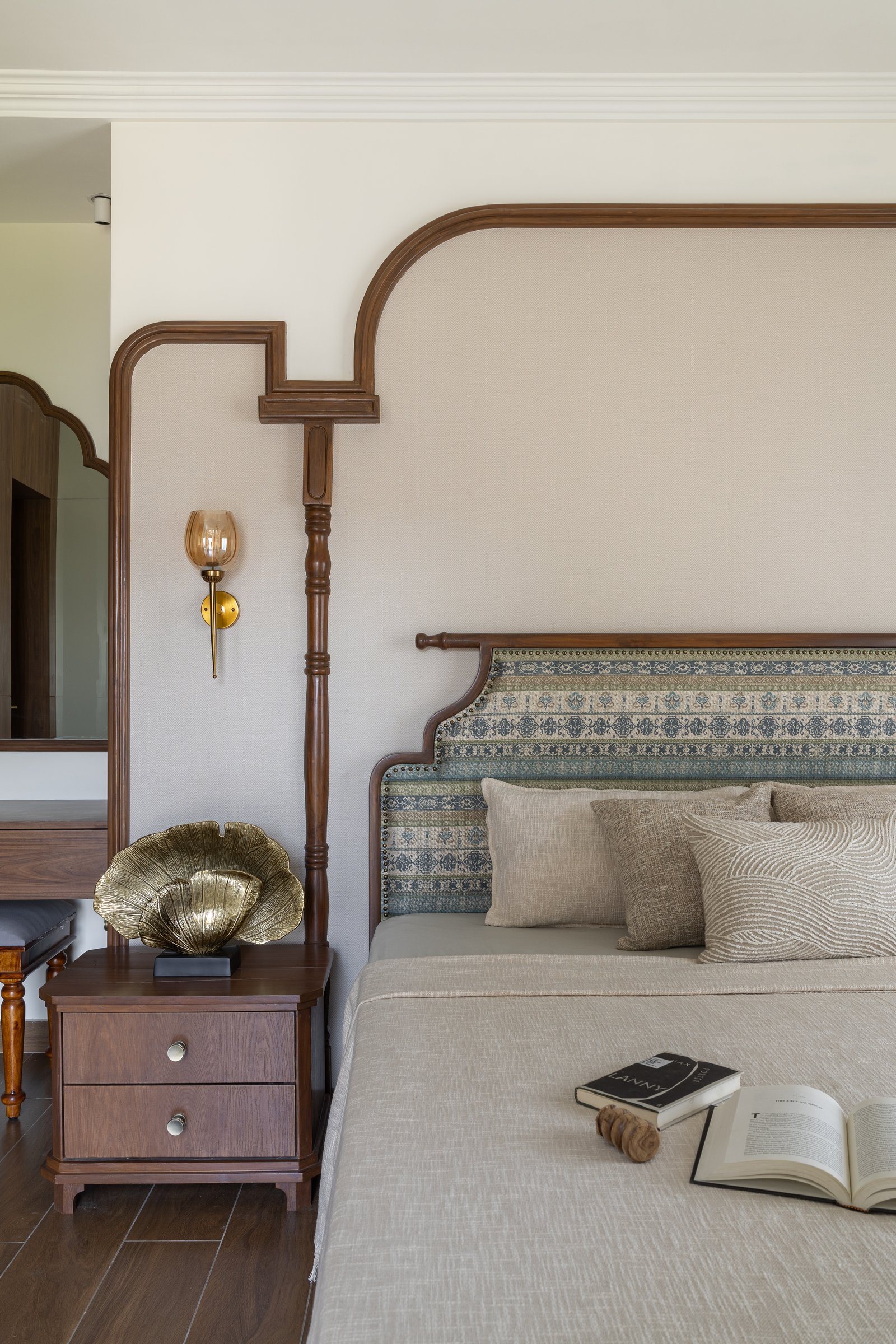
A closer view of the headboard wall reveals how carefully the room’s references have been edited. The patterned upholstery panel within the wooden frame draws on the visual language of block prints without quoting any single tradition directly, while the slender turned post and amber-glass sconce add vertical punctuation. It is the kind of detail that earns its place by not asking for attention.
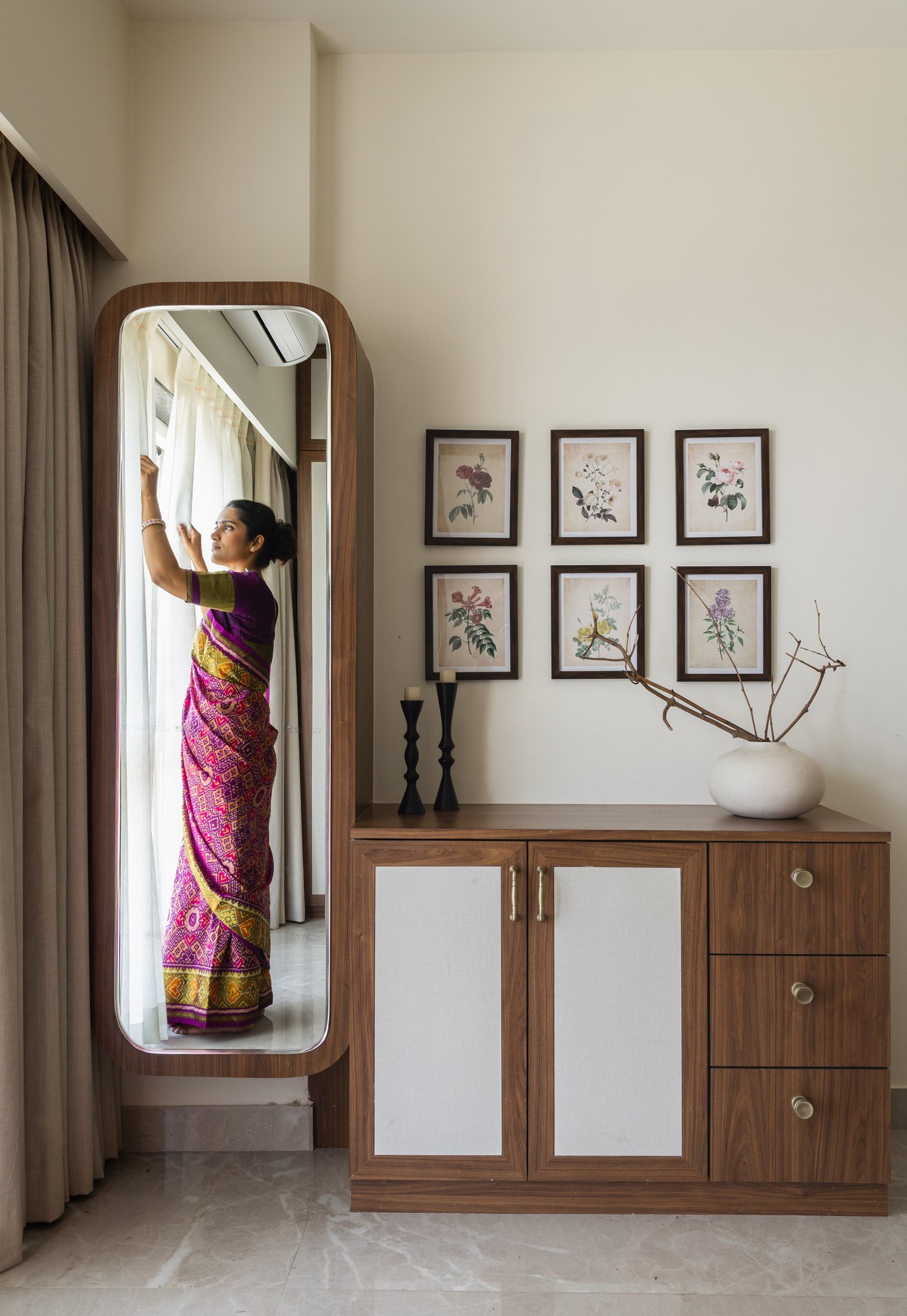
The parents’ bedroom opens with a corner that reads almost as a still life. A full-length mirror with a softly rounded wooden frame leans against the wall beside a low chest with linen-fronted doors, above which a grid of six botanical prints lends the room its gentlest gesture toward formality. The vignette captures what the brief describes as warm nostalgia made modern: familiar elements held in lighter proportion.
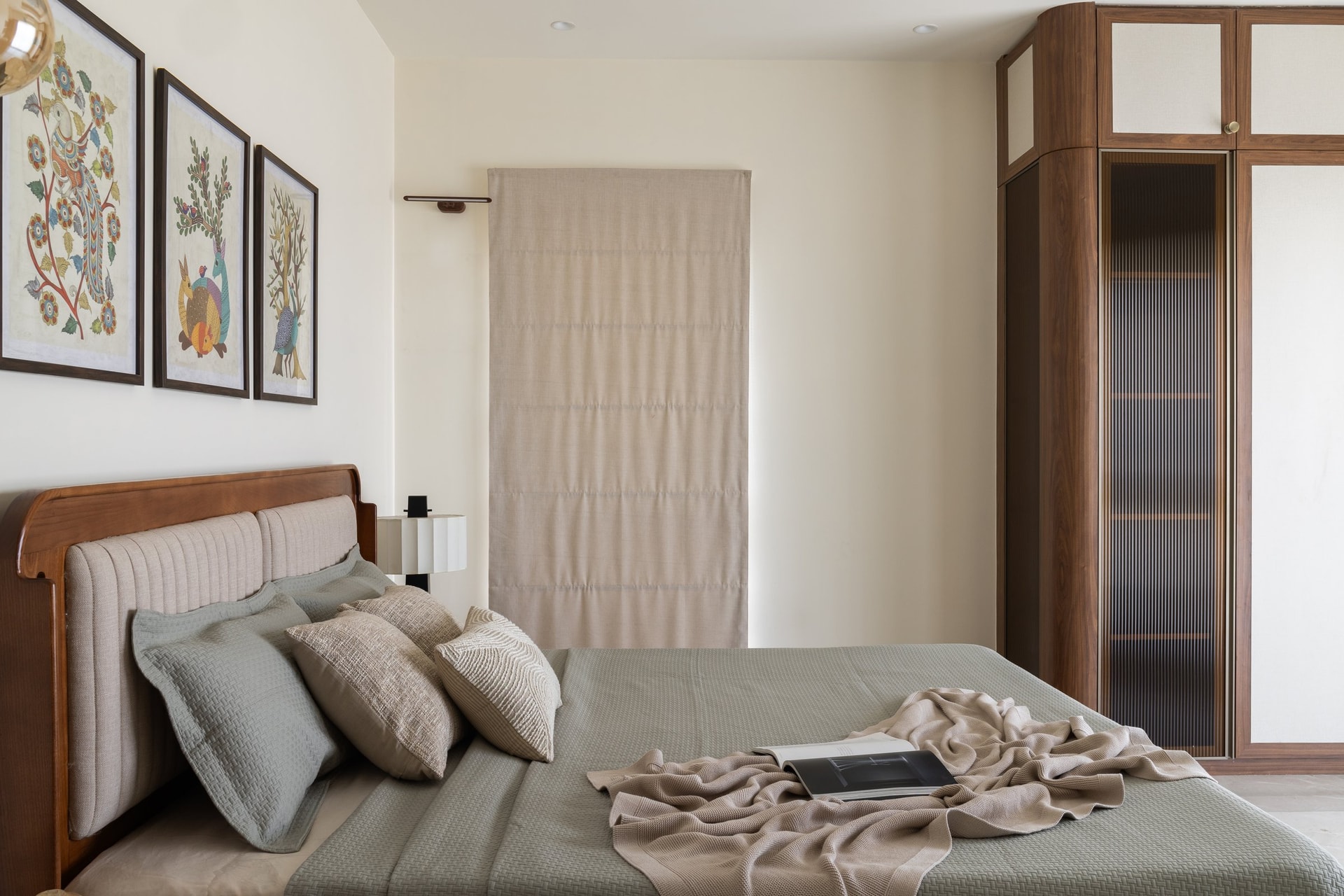
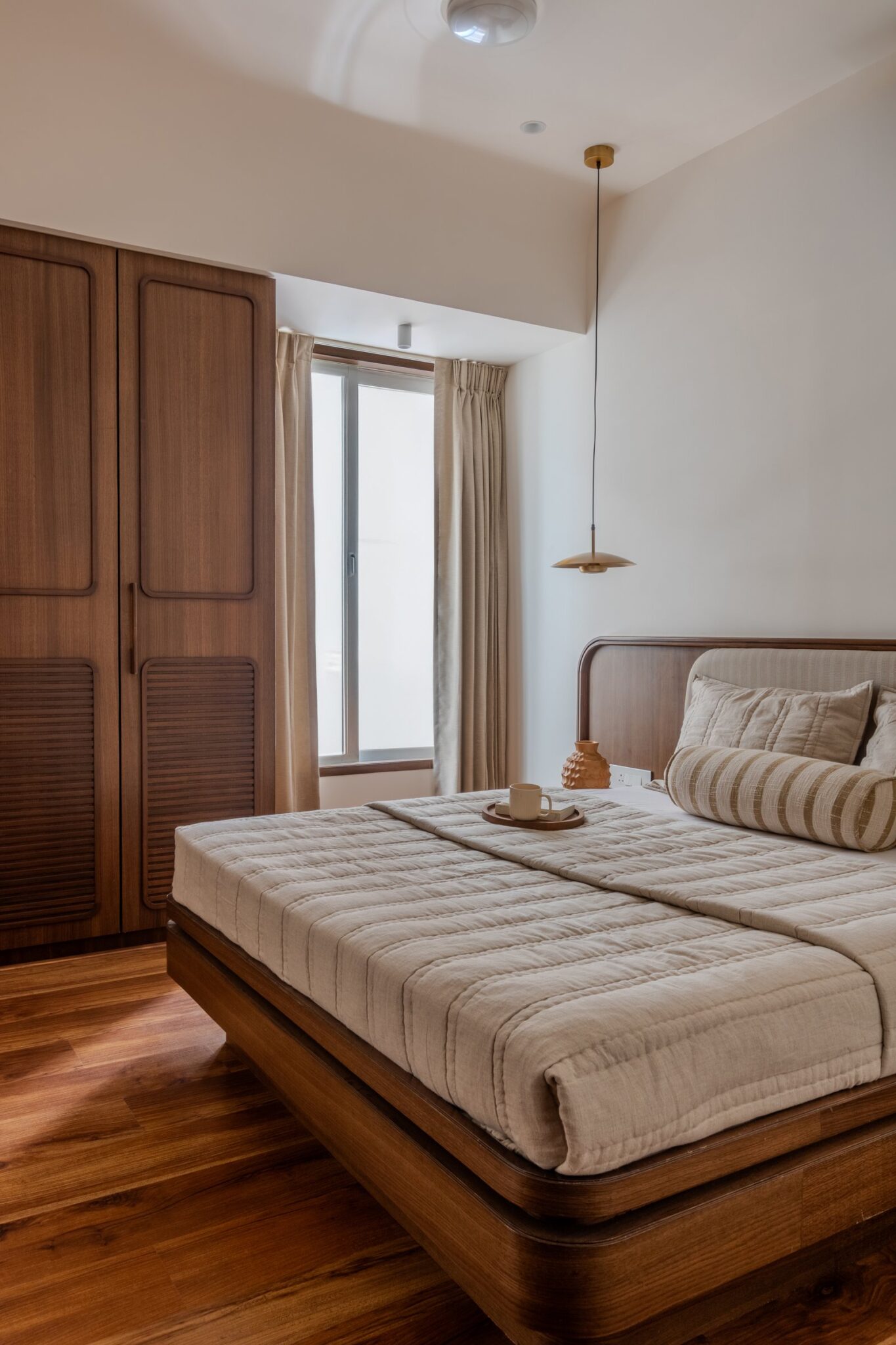
The bed itself, with its wood-framed headboard and an upholstered panel in a putty tone, is paired with a triptych of folk-art prints whose colour palette of ochre, green, and rust is the room’s only concession to brightness. A tall wardrobe in walnut and fluted glass closes the composition, and a linen Roman shade softens the window into a quiet vertical plane.
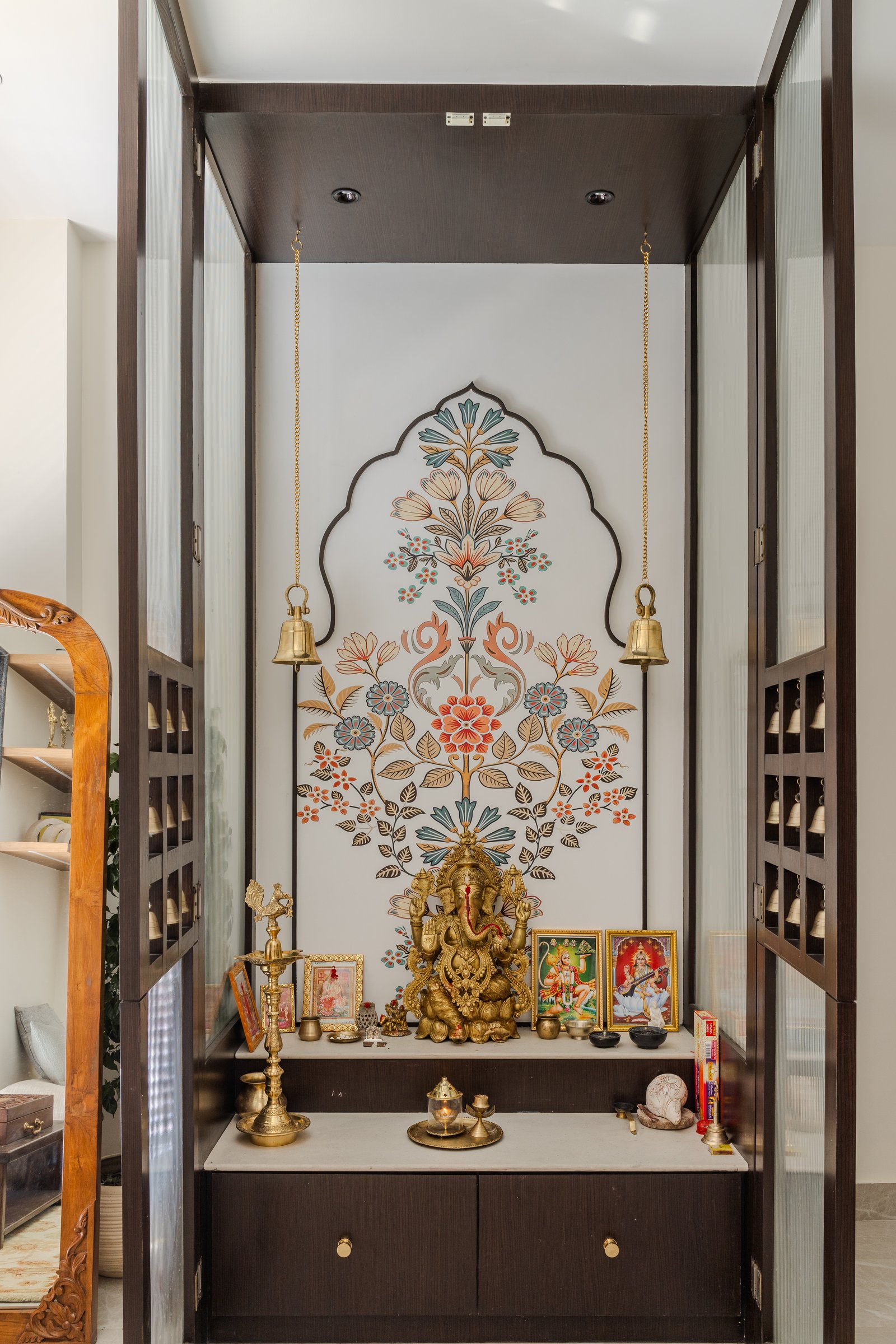
The mandir sits within its own framed enclosure of dark wood and fluted glass, treated as a small architectural room rather than a furniture insert. Behind the brass deities, a floral wallpaper in muted blues, corals, and ochres rises within an arched outline, while two brass bells hang on long chains from the ceiling, their function ritual and acoustic at once.
Within the wider conversation around contemporary Indian apartments, Aatman belongs to a quieter strand of practice, one that finds its identity in proportion and material warmth rather than in overt cultural signalling. Ranchi is not a city often featured in design press, and there is something fitting in seeing this kind of measured, interior-facing work emerge from it rather than from the metropolitan centres where such restraint is sometimes mistaken for caution.
What SCJ Architects have built here is not a statement home but a habitable one, where the arch is a recurring structural idea rather than a motif, where wood and linen carry most of the emotional register, and where every room leaves enough quiet for the family to remain its primary subject. The home holds its references lightly, and in doing so, it earns them.