A home built around spiritual practice tends to announce itself loudly, with motifs and iconography stacked one upon the other until reverence becomes décor. This Bandra apartment refuses that route entirely, proposing instead that calm is something architectural, something a palette and a proportion can hold, long before any object is asked to do the work.
Designed by Redbeam Studio under the direction of Swati B Sharma, the 780-square-foot residence sits inside a new construction in Bandra, Mumbai, and was conceived for a couple deeply connected to the Art of Living Foundation, alongside their teenage daughter. The brief was modest in size but precise in ambition: a home of minimal visual clutter, vintage in temperament, composed of materials that age slowly. Rattan, jute laminate, teakwood, and brass were chosen as the working vocabulary, and the studio committed to them with the discipline of an editor cutting adjectives.
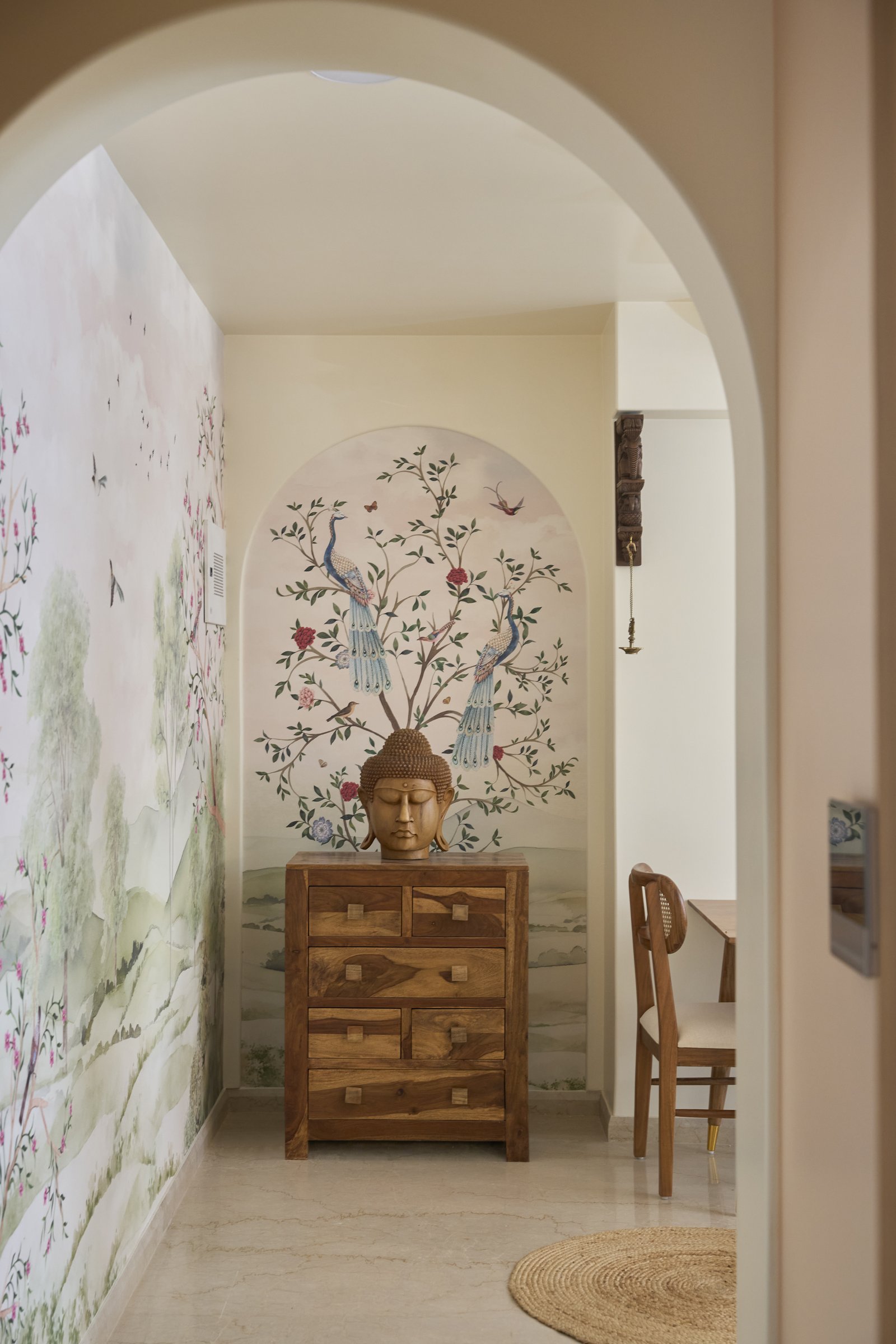
The arrival sequence sets the entire argument in a single frame. A compact lobby, just three feet square, draws the eye through an arched threshold to a wooden chest of drawers where a Buddha head sculpture sits before an arched niche painted with a tree-of-life mural featuring peacocks, birds, flowers, and butterflies. On the adjacent wall, a softer landscape of skies, hills, and birds spreads across the surface, extending the green-pink freshness into what is otherwise a wood-toned interior.
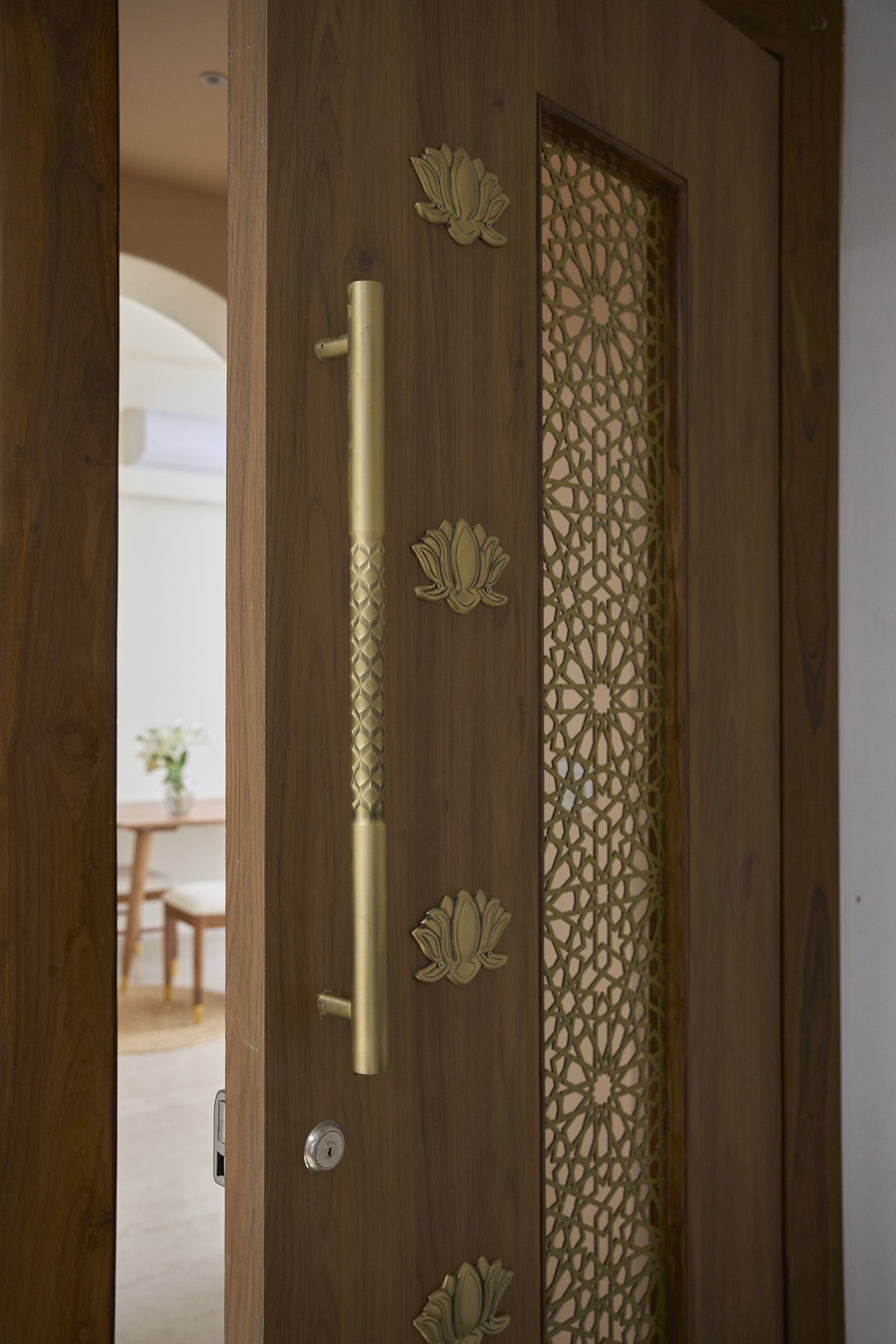
The entrance door itself carries the home’s quiet thesis before one steps inside. A brass lotus motif, a slim geometric grill, and a turned brass handle are set into a warm wood face, the ornament neither shy nor performative.
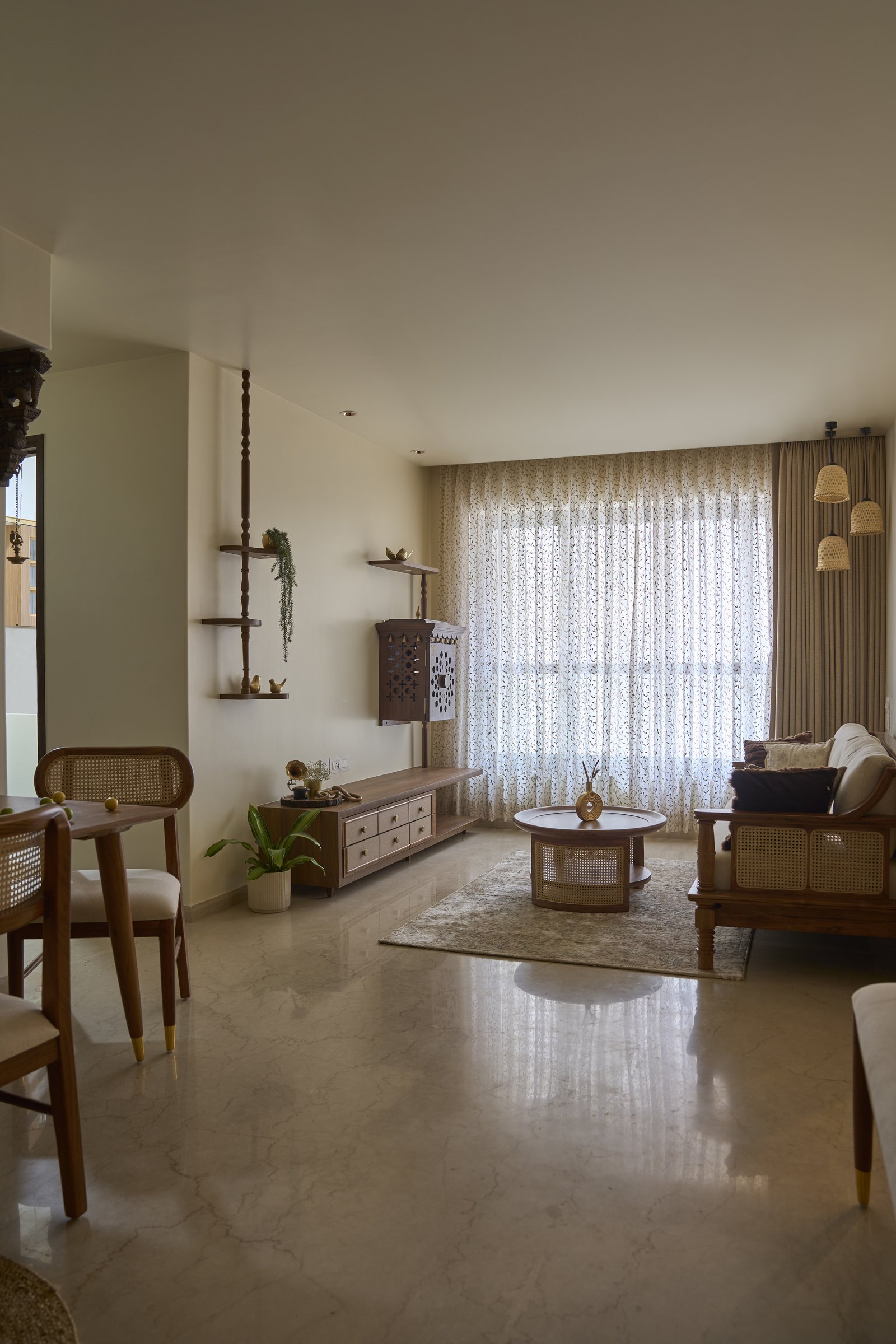
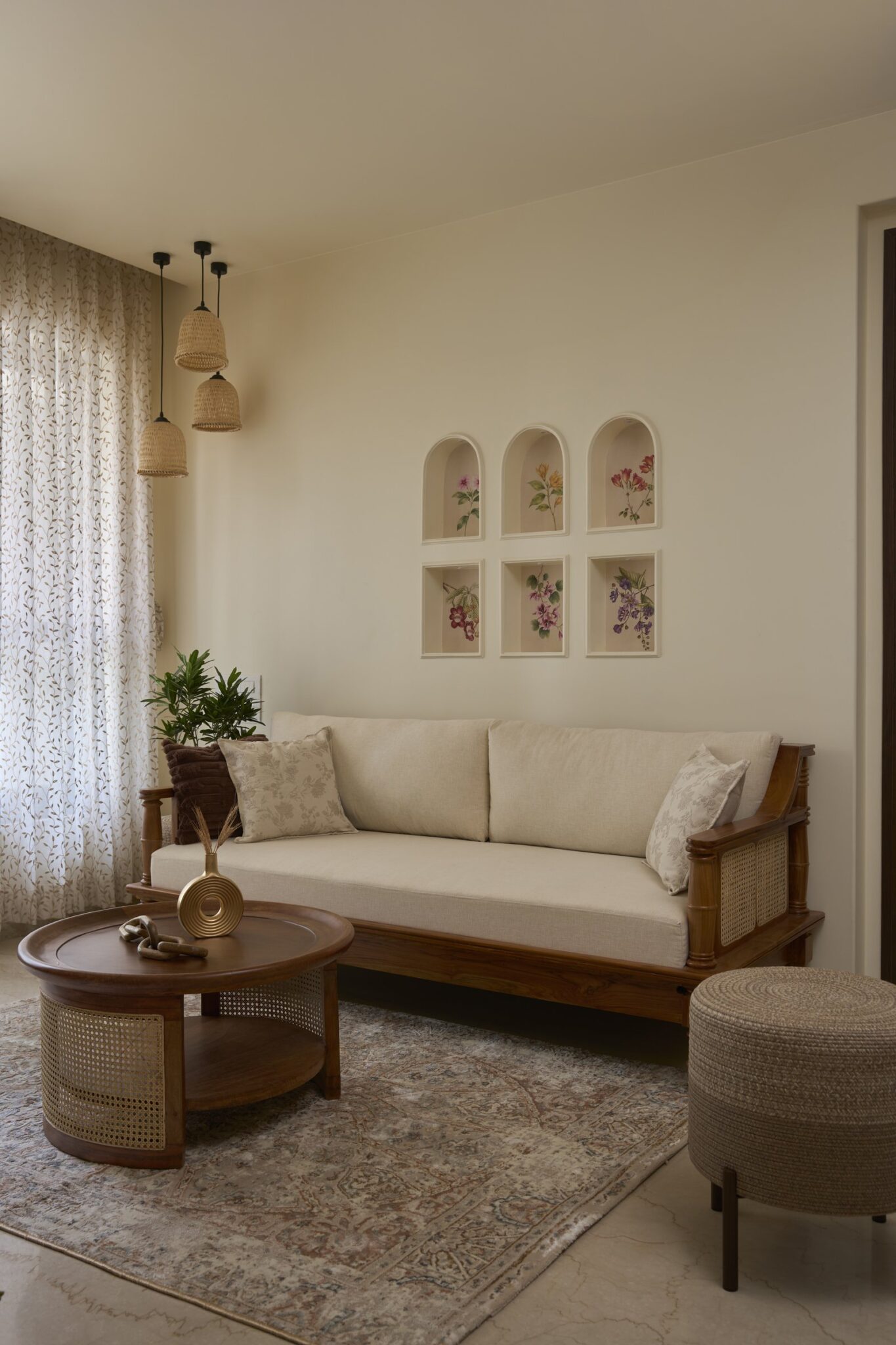
The living room reads as a single fluid volume because nothing in it is asked to dominate. A teakwood-and-cane sofa anchors one side, a round centre table in matching materials sits at its centre, and across from them a low storage console runs along the wall in place of the television the clients chose not to have. The generous floor-to-ceiling height, lengthened further by sheer patterned curtains, gives the modest footprint the feel of a much larger room.
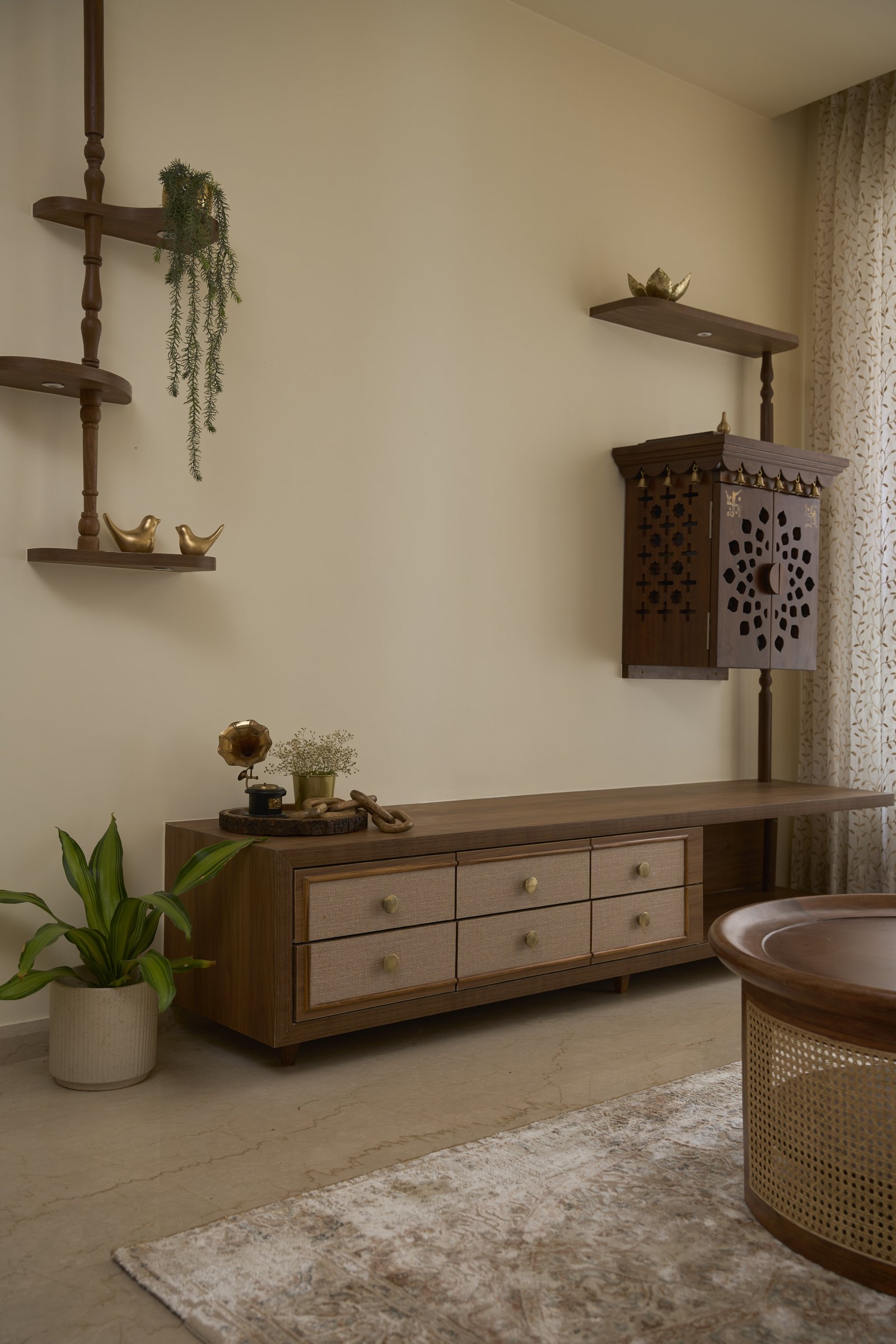
In place of a screen wall, the studio built a piece of architecture out of furniture. A long console anchors the base, flanked by two slender teakwood columns, one suspended from the ceiling, the other rising from the floor, framing a wall-mounted mandir with carved doors and brass finials. Open shelves carry brass birds, a vintage gramophone, and the slow accumulation of a life spent collecting small, considered things.
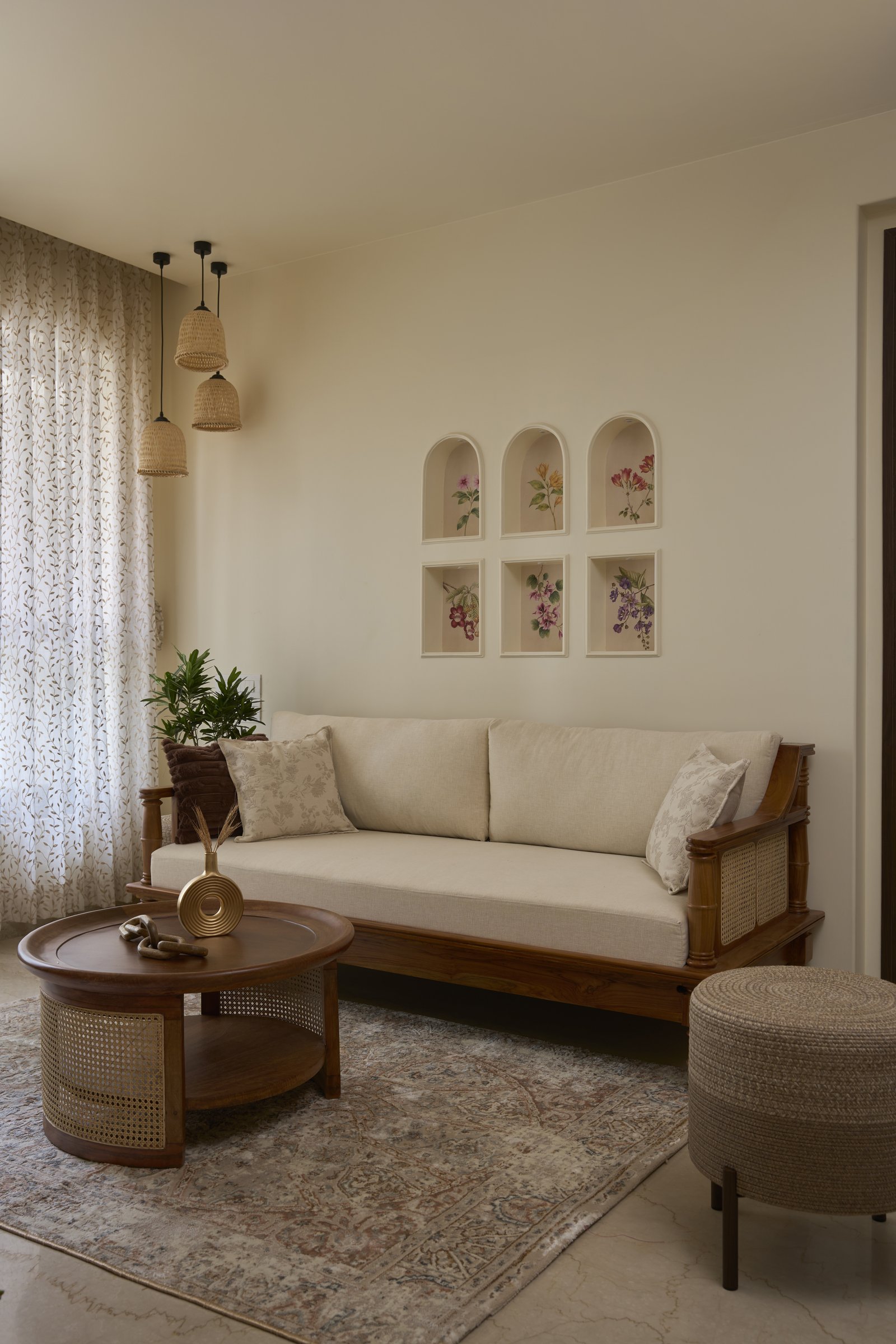
Opposite, six niches, the upper three arched, are carved into the wall above the sofa, each holding a botanical study of flowers native to Maharashtra: champa, the trumpet ful, jarul, apta leaves. The references are specific without being didactic, and the arched niches themselves echo the arch at the entry, threading the home together through a single recurring geometry.
““The house is designed with minimal yet bold interventions, such as teakwood moldings and suspended columns, with the inclusion of existing elements such as paintings and artworks.””
One full wall is given over to a panoramic mural of misty hills, flowering branches, and birds in flight, the kind of view a Mumbai apartment can rarely offer in real life. The studio uses it as a borrowed landscape, set deliberately at the end of a sightline so that the rooms in front read against an implied horizon.
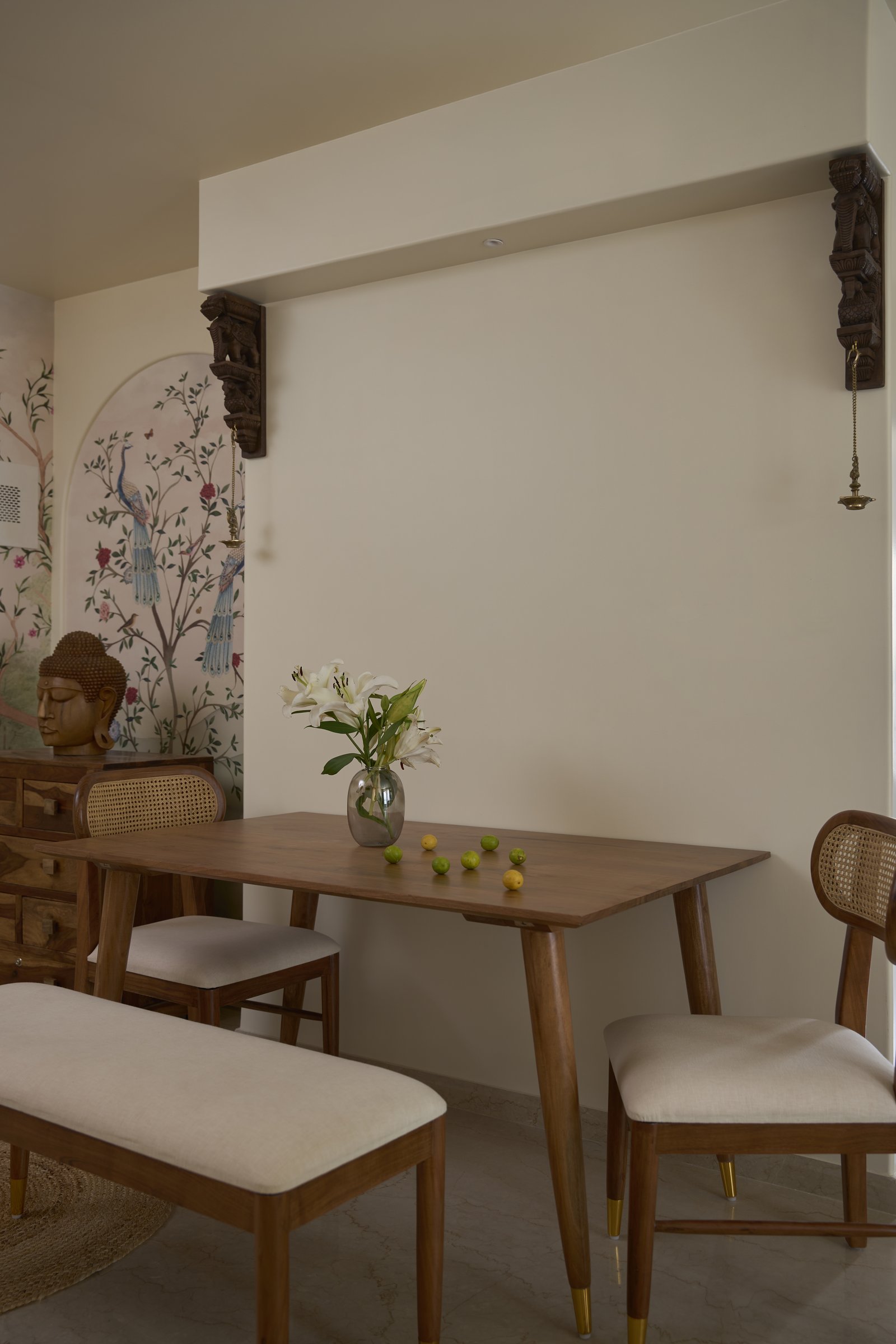
The dining area sits alongside the living room rather than apart from it, sharing the same wood-and-cane chairs, the same brass diya hanging from a carved corbel above. The table is a simple rectangle in solid wood, its brass-tipped legs the only flourish, and the wall behind it has been left almost entirely bare, an editorial choice that lets the peacock mural opposite breathe.
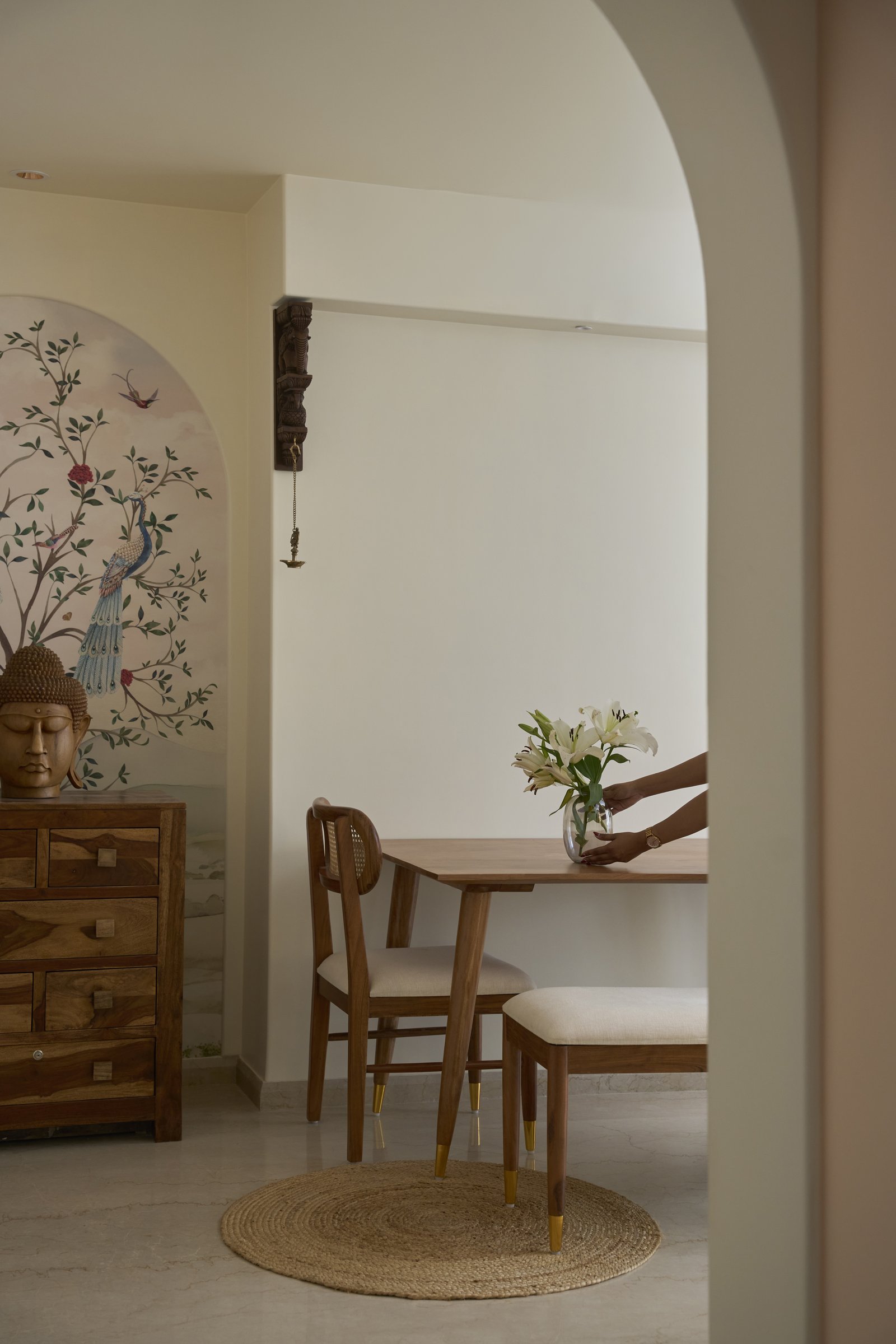
Seen through the living room’s arched opening, the dining zone reveals how carefully the home’s linear axis has been organised. The carved corbel, the jute rug, the Buddha on the chest, and the curve of the arch itself all sit on the same visual line, so that movement from one space to the next never feels like a transition between rooms so much as a slow change of register.
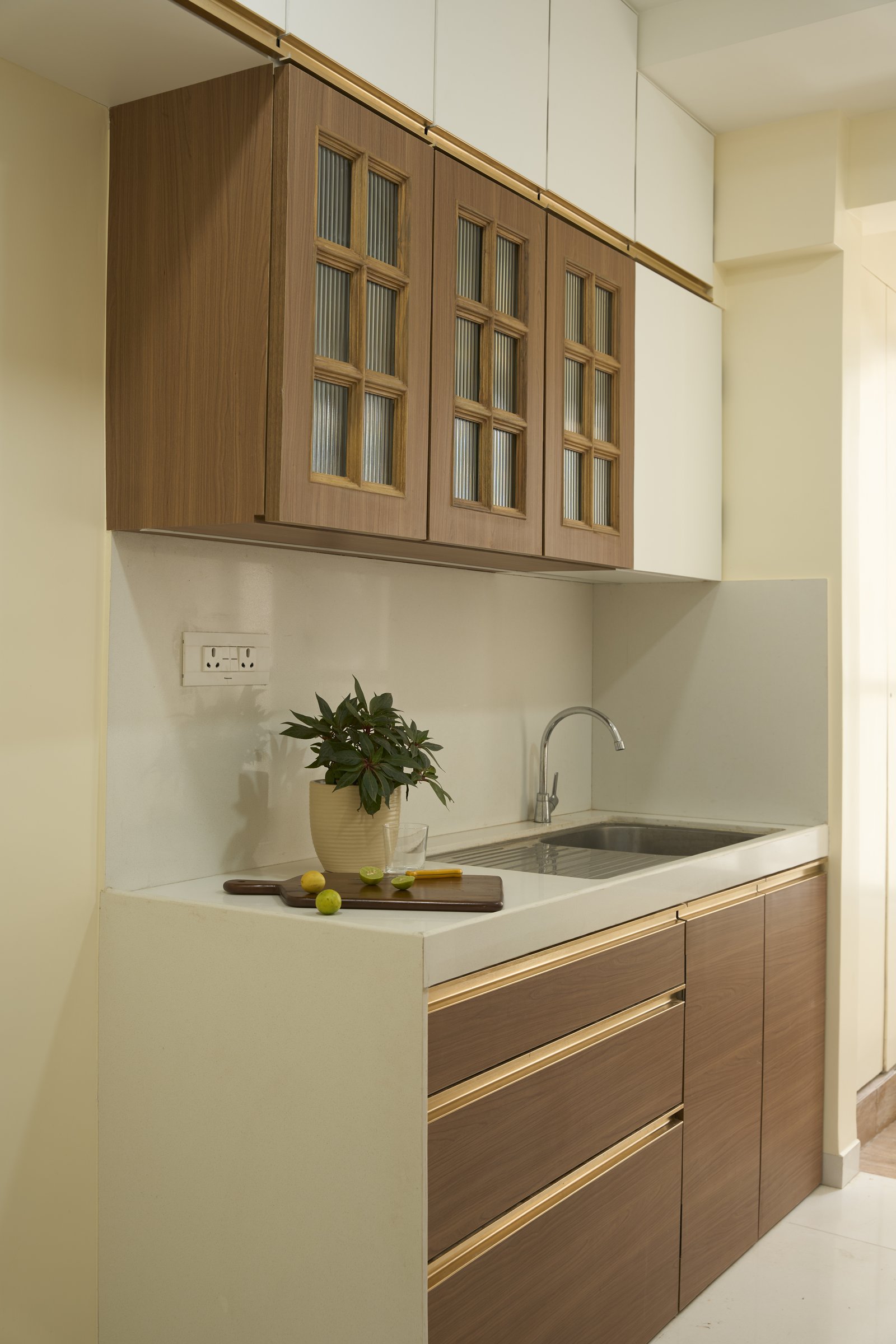
The kitchen is compact but composed in the same vintage register as the rest of the home. Fluted glass shutters set within wood-framed upper cabinets recall apothecary and pantry cabinetry of an older Bombay, while slim brass channels run along the drawer edges below.
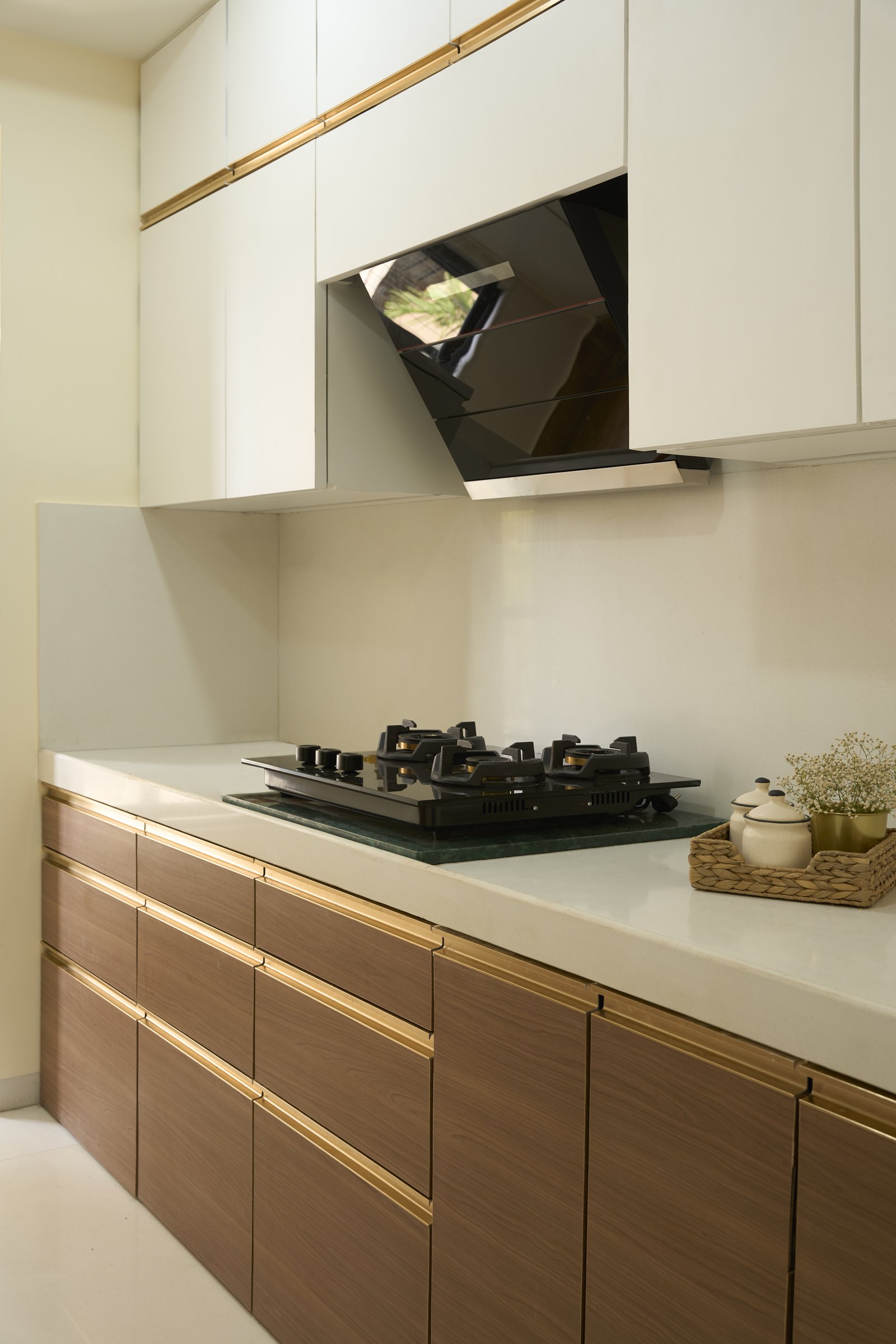
Along the cooking wall, the studio inverts its tonal logic with deliberate effect: darker wood drawers ground the lower half, while creamy upper cabinets keep the eye lifted and the small room visually light. The brass inlays act as the connective tissue, threading the kitchen back to the brass diyas and door details elsewhere in the home.
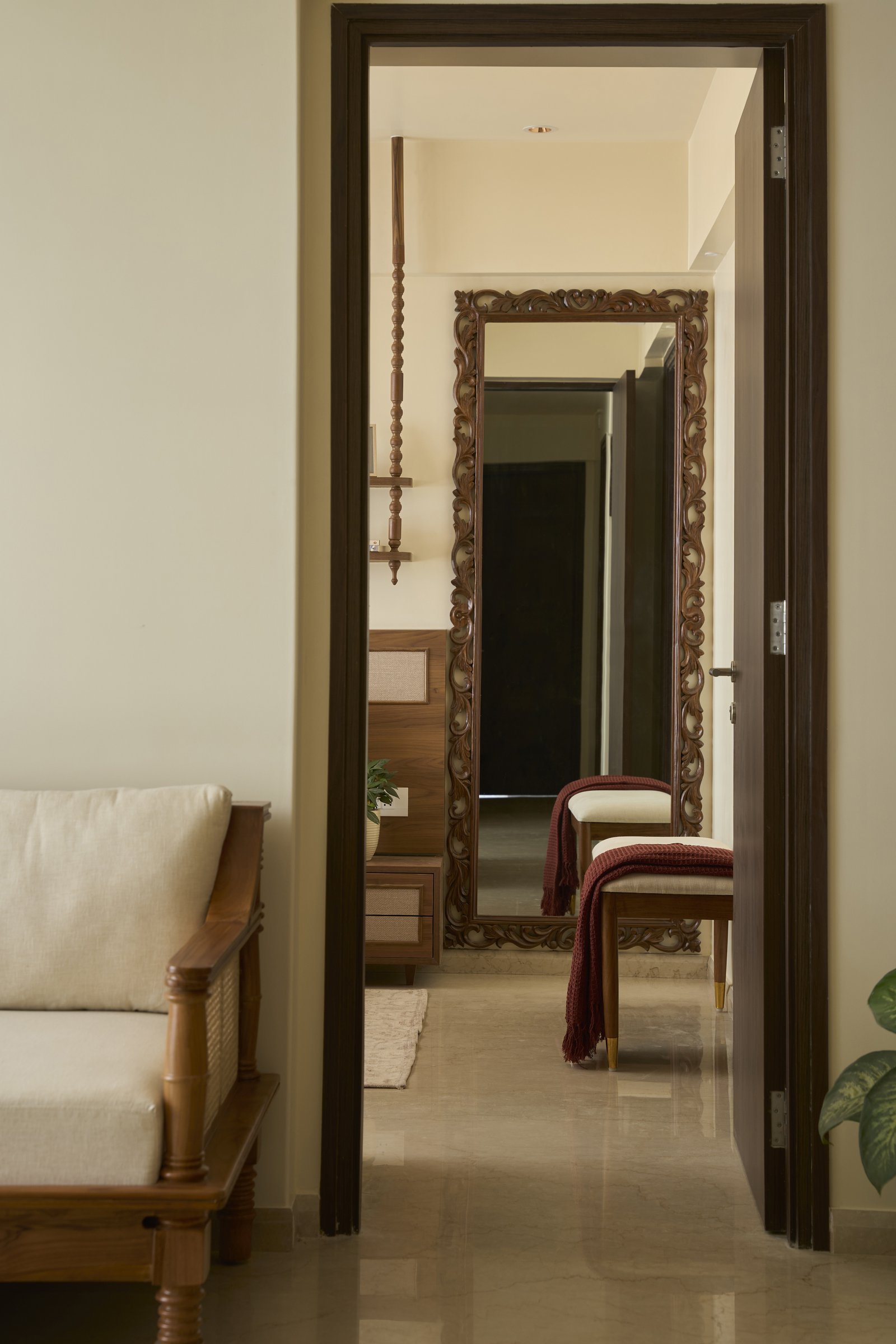
The passage to the master bedroom is treated as a room in its own right. A large carved wood mirror, framed in the kind of foliate detail one associates with older Maharashtrian craft, doubles the available light and visually extends the linear axis the apartment has been organised along.
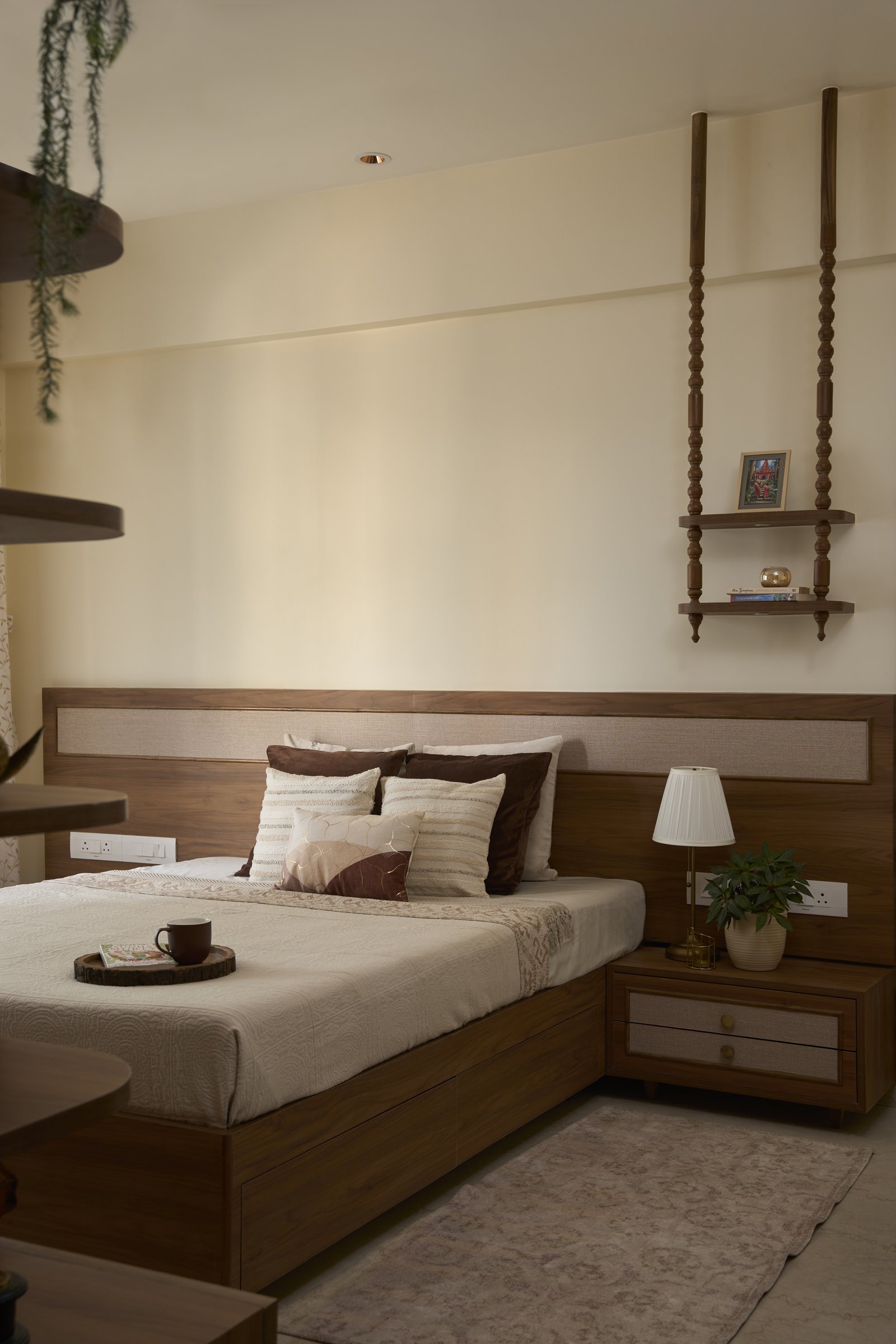
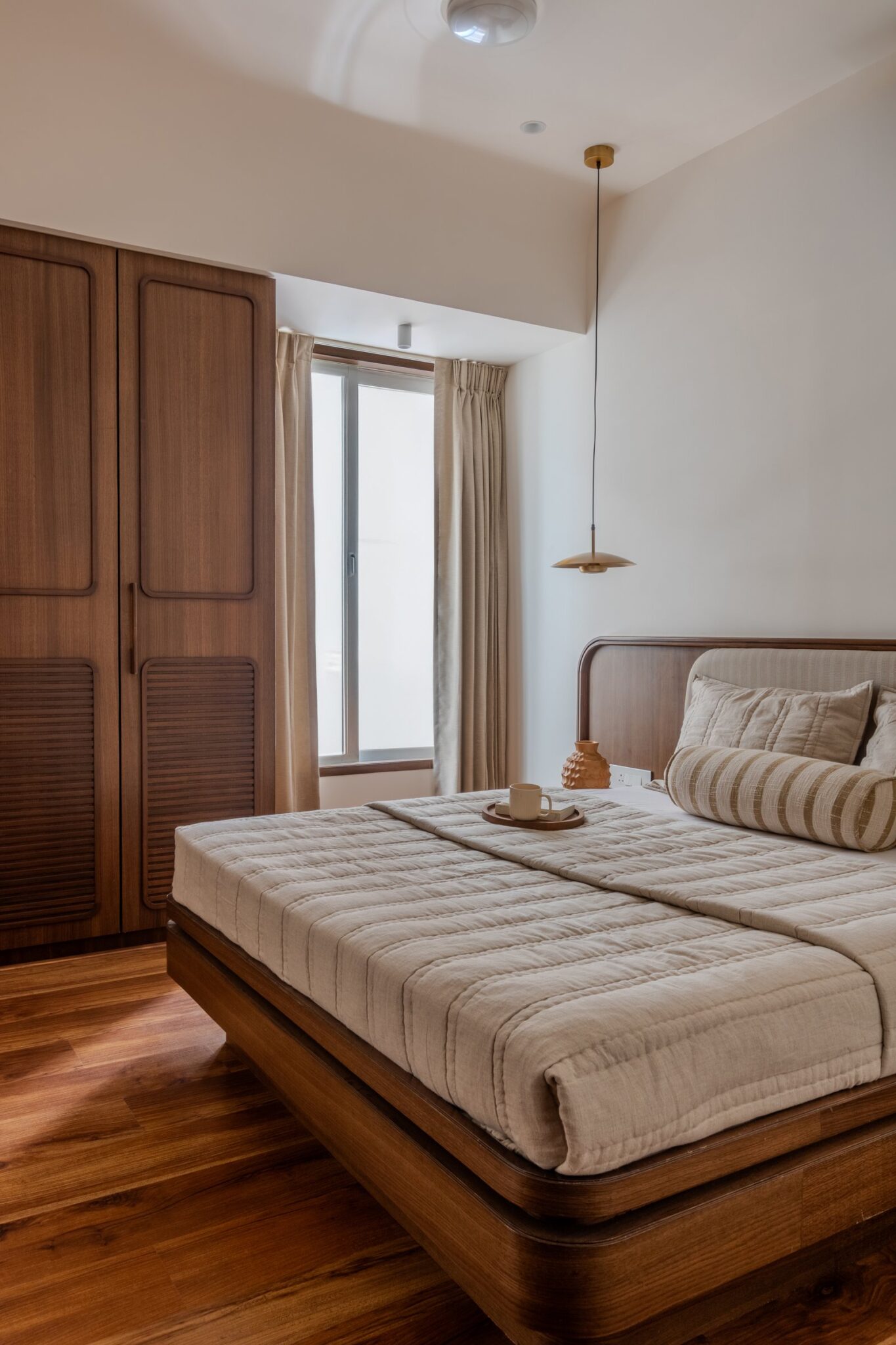
Inside the master bedroom, the material language continues without interruption. The bed is built in solid wood with an upholstered jute-panelled headboard that runs the full width of the wall, and a pair of turned wooden uprights suspend an open shelf beside it, holding a single framed photograph and a small brass object.
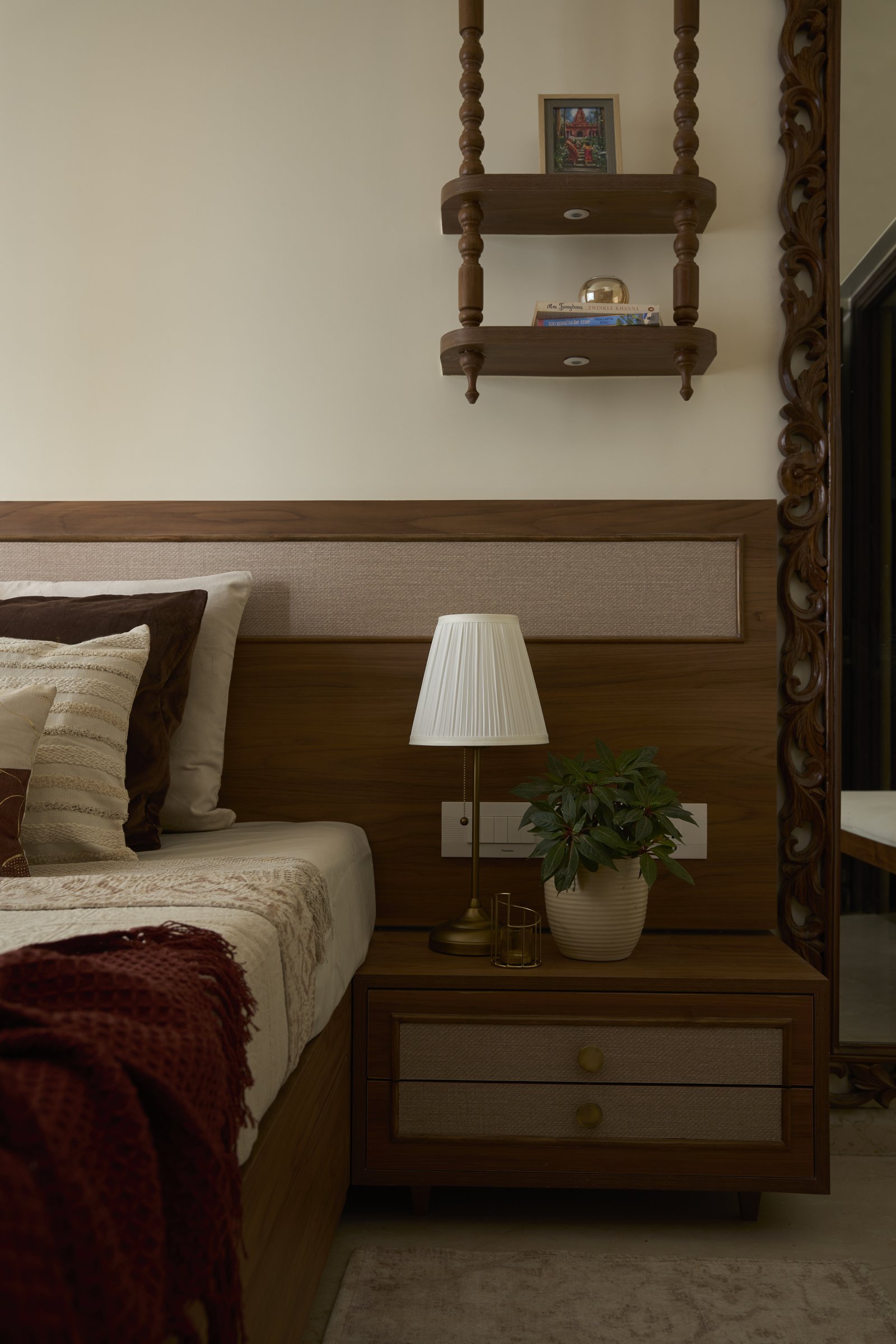
A closer view reveals how the studio treats restraint as ornament. The side table picks up the jute-and-wood vocabulary of the wardrobe, a pleated lamp casts a soft pool of light, and the edge of the carved mirror enters the frame as a deliberate counterpoint to the bedroom’s otherwise quiet geometry.
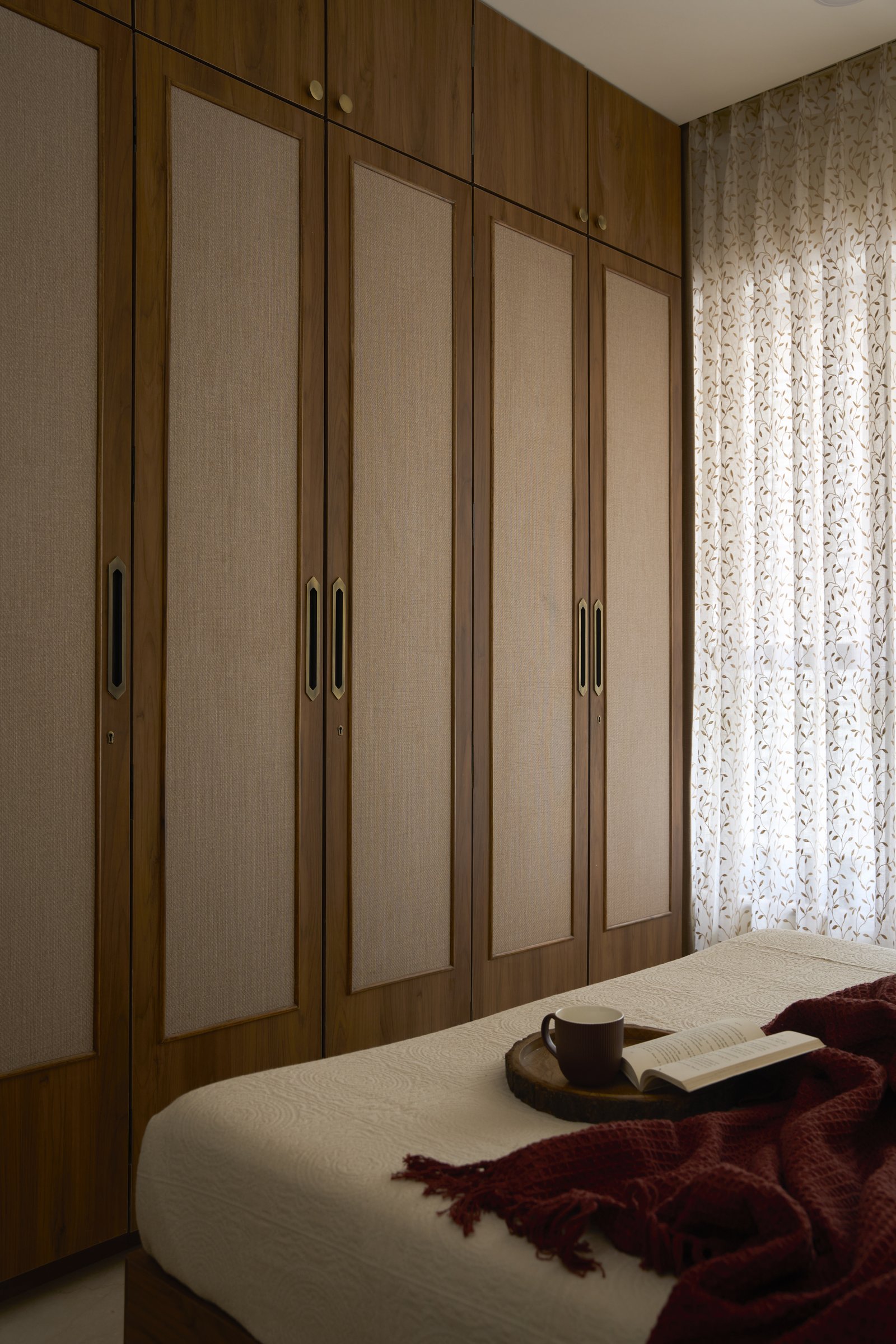
The wardrobe wall reads as a single uniform façade, broken only by the rhythm of jute panels set within wood frames. The decision to alternate veneer with woven texture is what keeps the wall from collapsing into one heavy brown plane, and the sheer leaf-patterned curtain beside it softens what could otherwise have felt monumental.
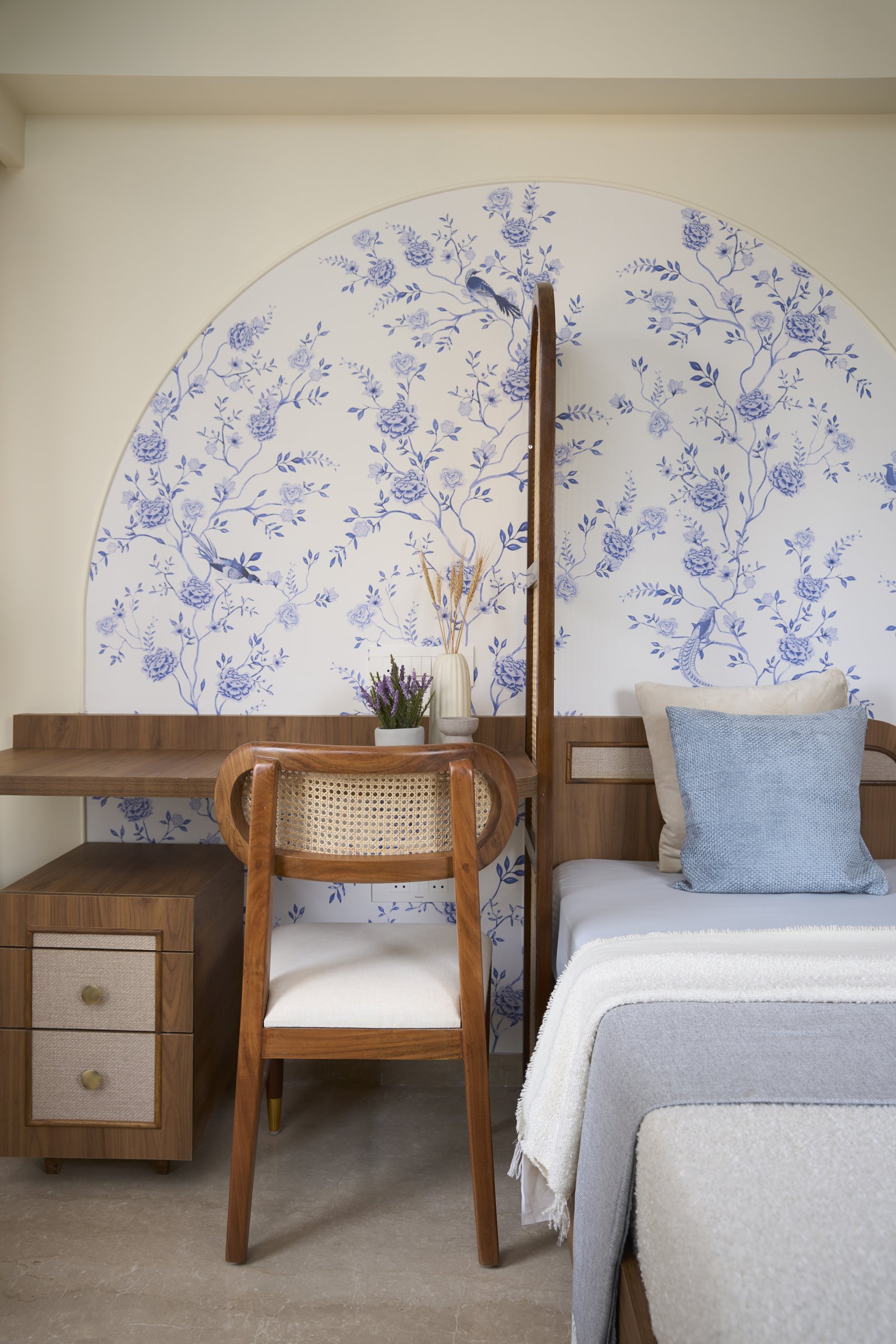
The daughter’s room takes the same palette and shifts the temperature. A blue-and-white floral wallpaper is set within an arched recess behind the bed, a clear cultural cousin to the peacock and landscape murals at the entry, but pitched to a younger, lighter register.
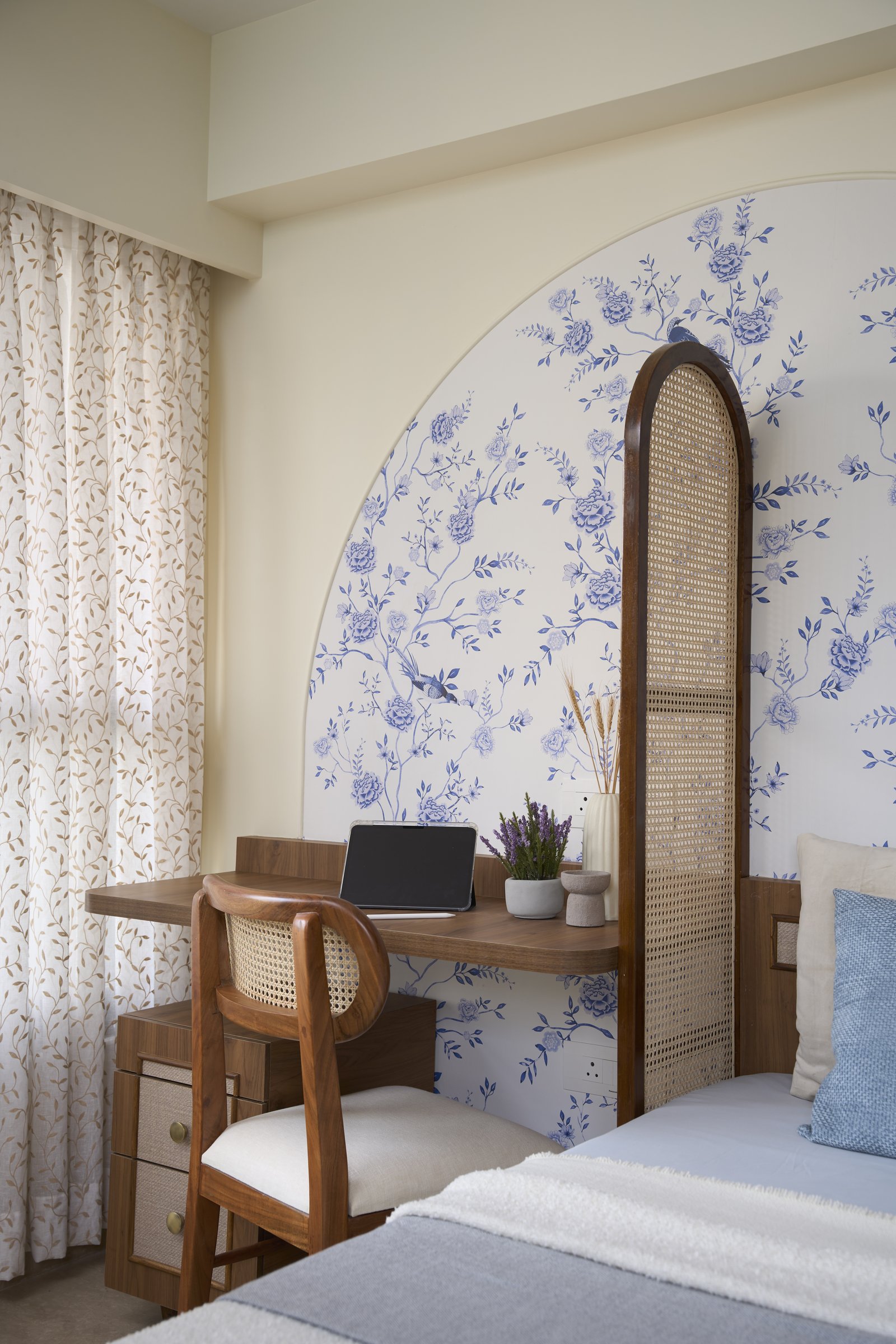
A built-in study desk extends from the bed in continuous wood, separated only by a slim arched cane screen that gestures toward privacy without ever truly enforcing it. The cane partition is one of the home’s quietest, smartest gestures: it lets a small room contain both sleep and study without partitioning either.
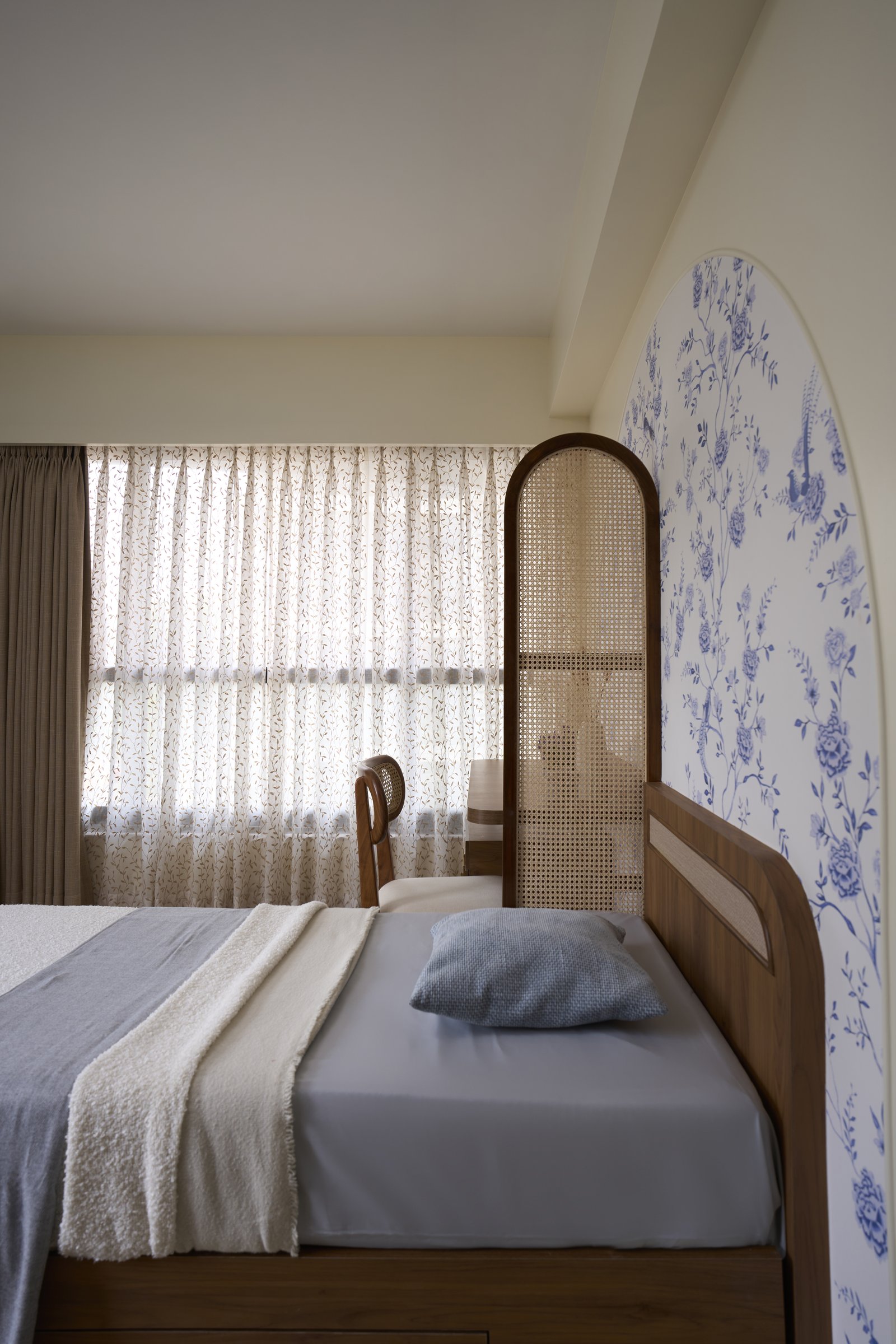
From the other side of the bed, the room’s spatial intelligence becomes clearer. The window’s full height is preserved, the sheer fabric carries the same leaf-print vocabulary used elsewhere in the home, and the arched wallpaper rises behind the headboard as a soft canopy.
What makes this apartment worth attention, in a Mumbai market saturated with both maximalist period homages and Scandinavian-adjacent restraint, is its refusal to belong to either camp. The vintage references here are regional and specific, the Maharashtrian flora, the carved Maharashtrian corbels, the brass diyas, the lotus motif on the door, but they are deployed as design grammar rather than as cultural signage. There is no theatre of heritage. There is only a steady, internally consistent way of building rooms.
In a 780-square-foot footprint, that consistency is what carries the home. The apartment offers its occupants the one thing a busy Mumbai life rarely permits: a pause, held in place by wood, brass, jute, and the patient repetition of a single arch.