The most interesting commercial interiors today are the ones that refuse to behave like commercial interiors at all. They borrow the calm of a residence, the choreography of a hotel arrival, the restraint of a gallery, and assemble these instincts into something the working day is rarely afforded: an atmosphere of considered ease.
The new Al Thuriah Group Sales Office in Sharjah, designed by AHI Interiors and led by Jessica Khouzami, takes this position seriously. Spanning a ground-floor arrival lounge and an eighth-floor open sales office, the project was developed from the shell up to translate the developer’s identity into a workspace that feels less like a transaction and more like an introduction.
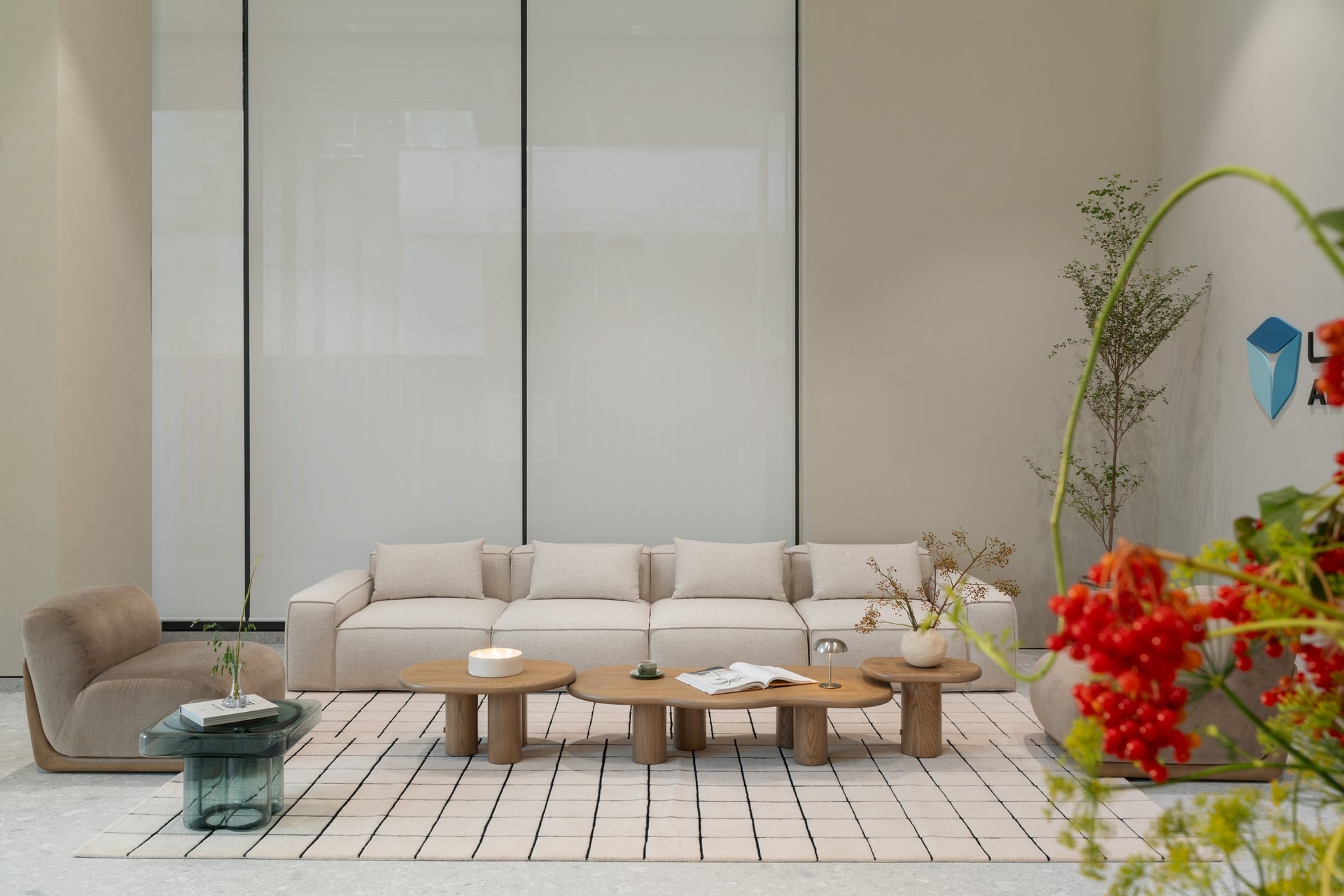
The ground-floor arrival lounge sets the entire grammar of the project in a single gesture. A long modular sofa in a soft oatmeal weave faces a constellation of organic-shaped wooden tables, their cloud-like silhouettes resting on a graphic cream rug ruled with thin dark lines.
What makes this opening succeed is its refusal to over-design. The palette is restricted, the volumes are quiet, and the only colour in the room arrives through florals and a single fruiting branch, a reminder that hospitality begins with how a space welcomes, not with how loudly it announces itself.
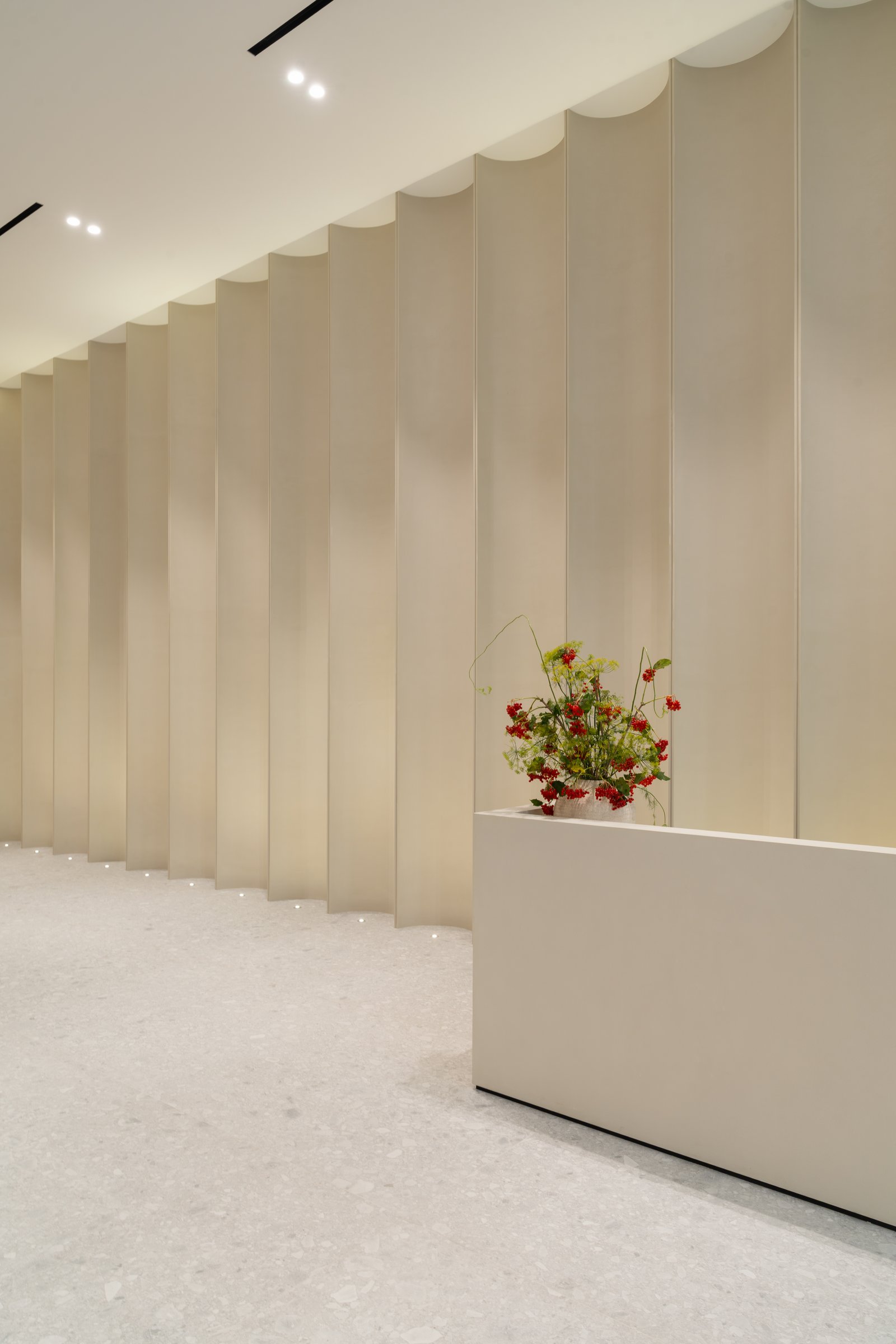
The room’s defining architectural element reveals itself along one flank: a wall of GRC convex fluted panels, vertically articulated and lit from below by recessed floor uplights. The fluting is not decorative shorthand; it gives the long entrance volume a sense of measured procession, an almost cloister-like rhythm.
The floor underfoot, in Ceppo di Gré, carries the pebbled, sedimentary quality of older Italian institutional buildings. It is a material that does not date, and that decision quietly anchors everything else.
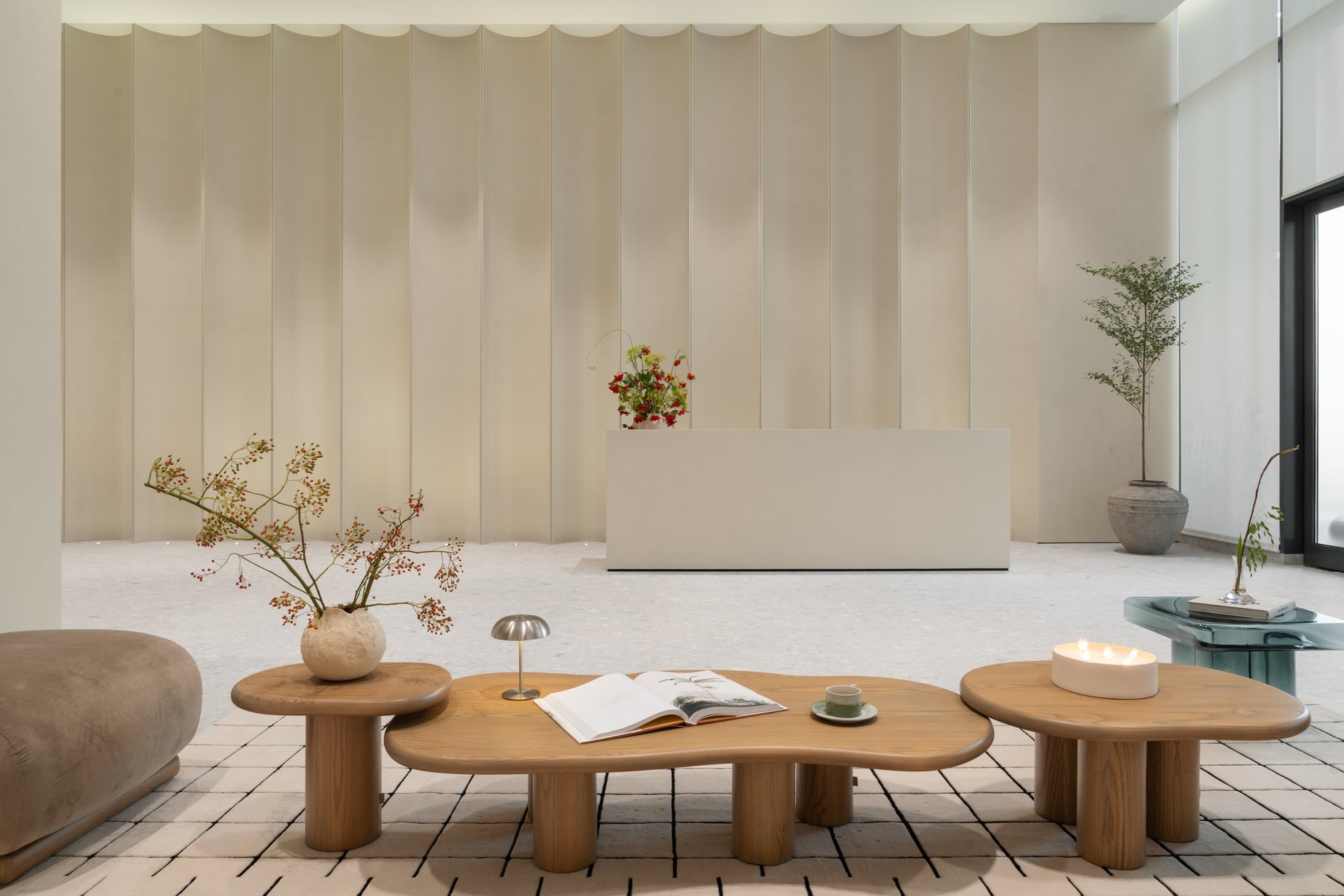
From a wider vantage, the lounge’s spatial logic becomes clearer. A minimal plinth-like reception desk floats against the pleated, fluted wall, deliberately under-scaled so as not to compete with the architecture behind it.
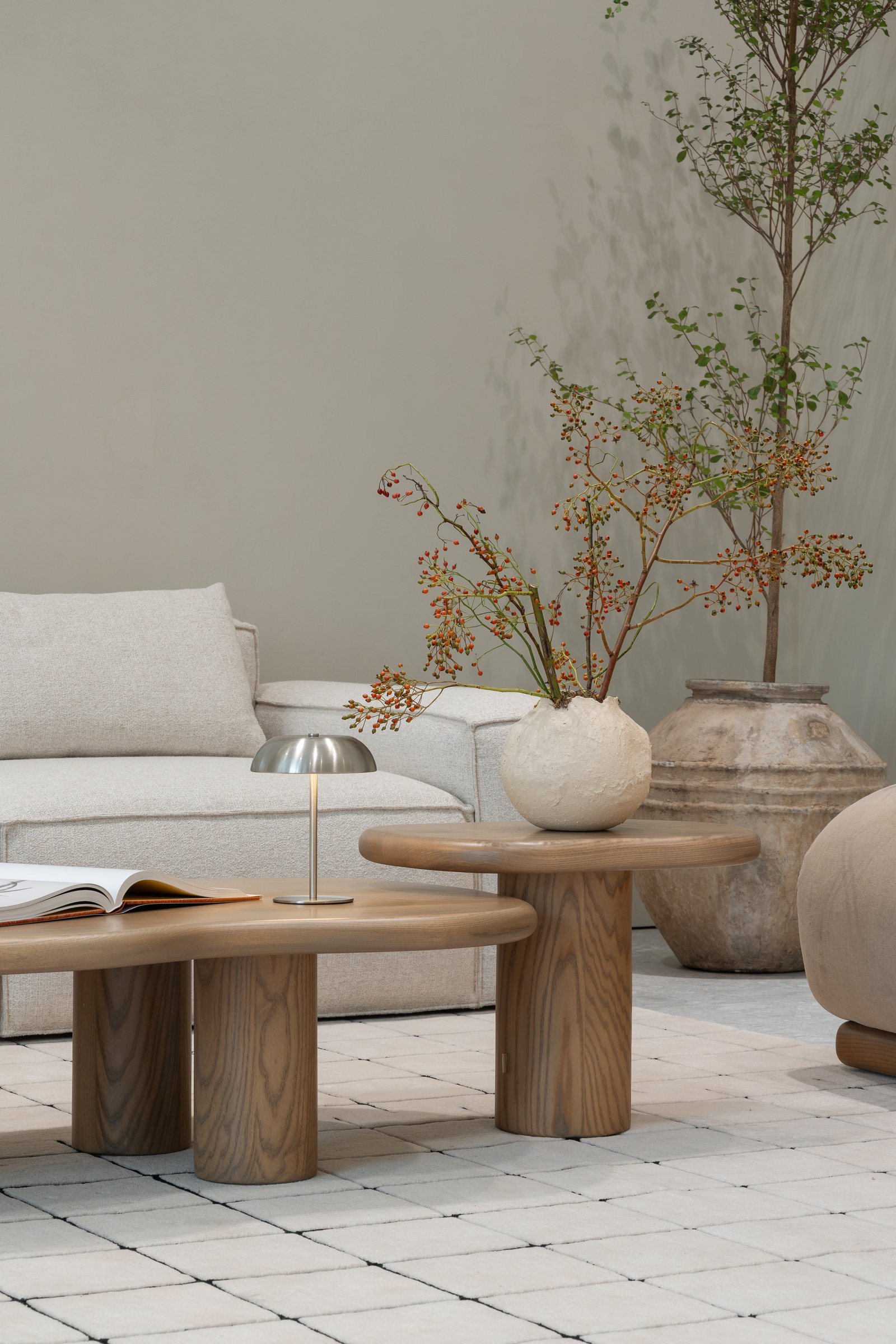
““The design balances global design icons with regional craftsmanship,” the studio notes, framing a strategy that is visible in every adjacency: a Miniforms glass side table set beside a locally thrown vessel, an imported sofa anchored by a rug whose simplicity reads as almost vernacular.”
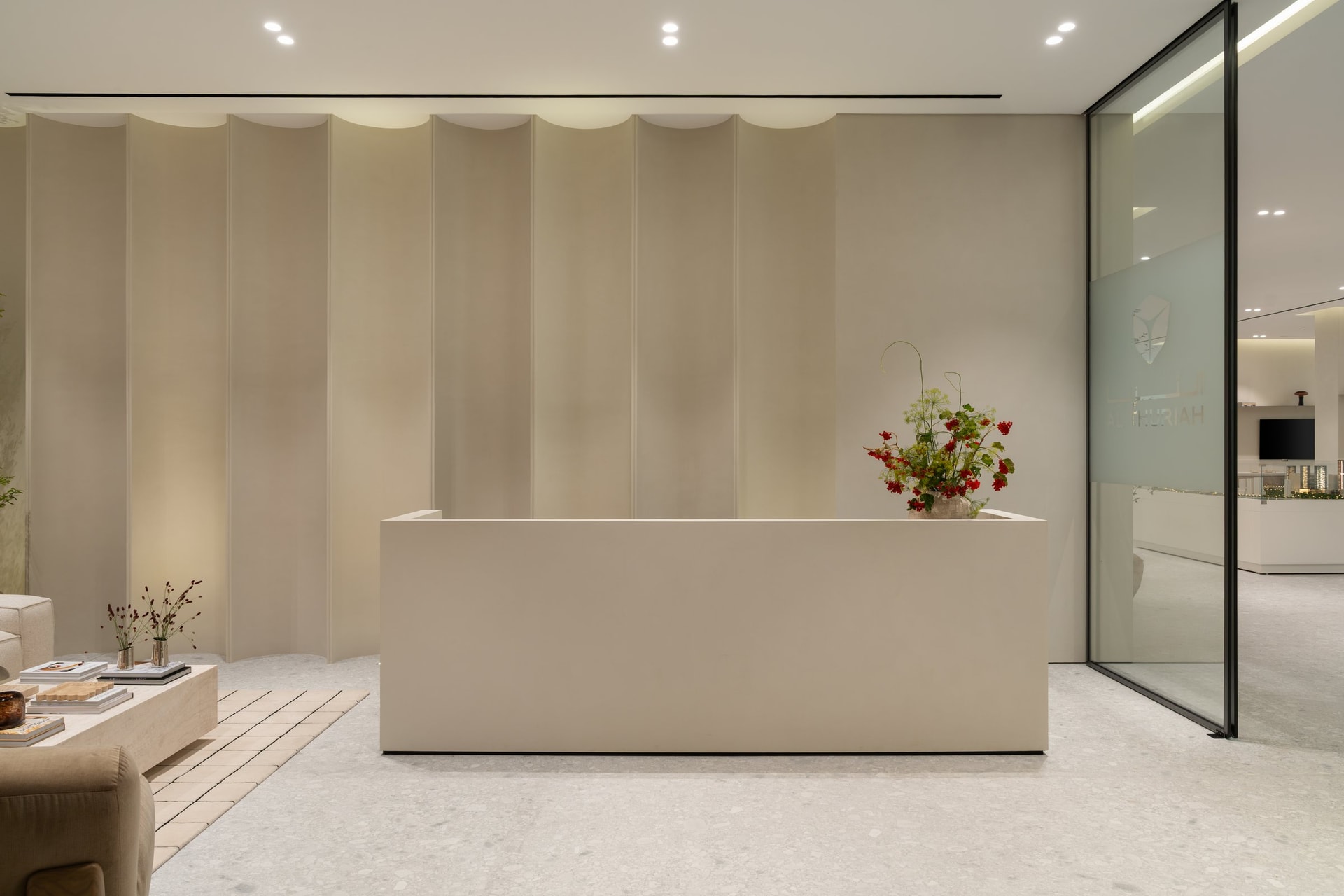
On the eighth floor, the design language travels upward intact. The same concave panels reappear behind a second reception desk, the same Ceppo di Gré underfoot, the same restraint of palette. Continuity, here, is not a decorative loop but a way of telling the visitor that the brand thinks consistently across every encounter.
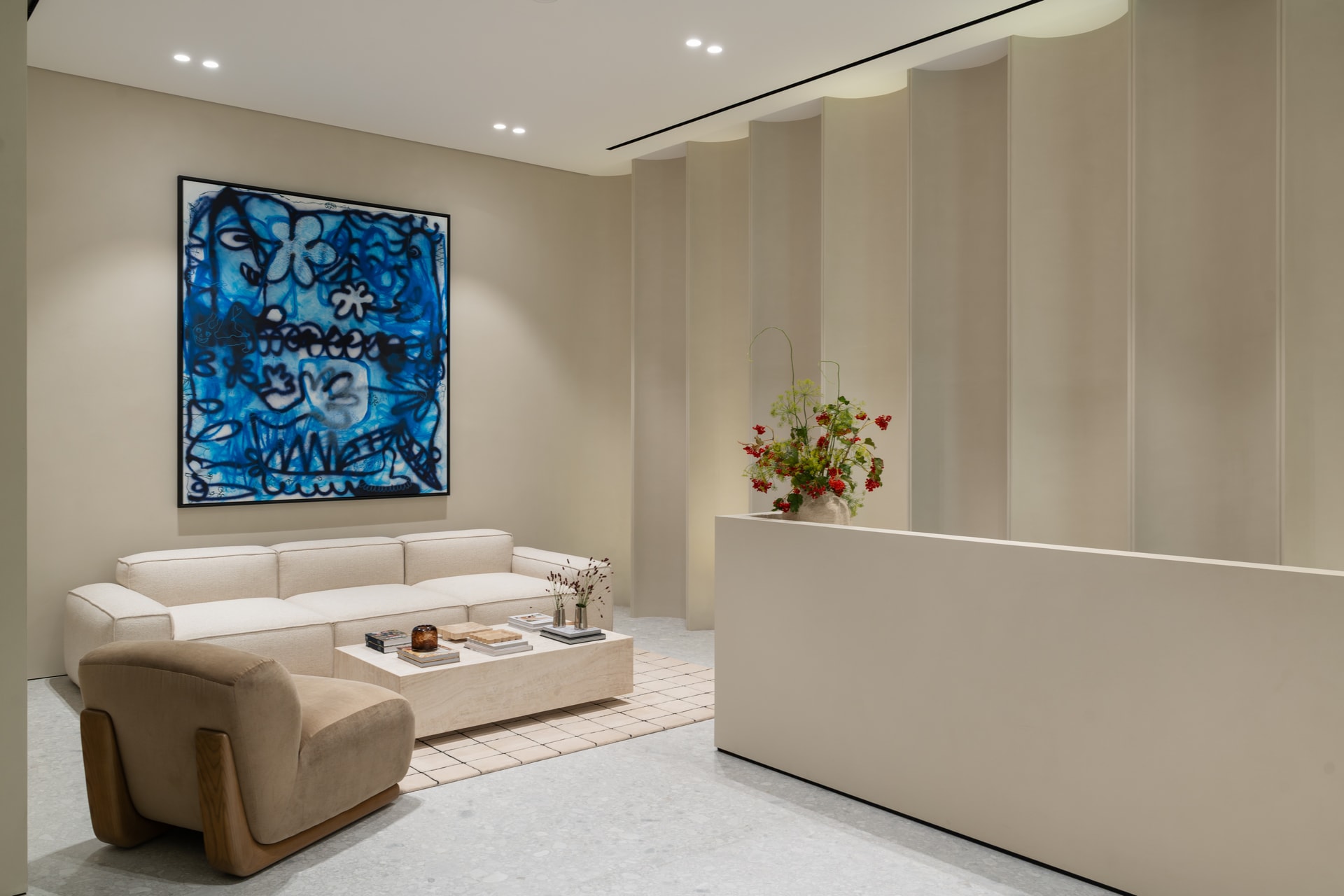
The entrance vestibule on this floor introduces the project’s one moment of chromatic risk: a large abstract canvas in cobalt and indigo, positioned above a low cream sofa and a travertine plinth-like coffee table. Against the room’s near-monastic neutrals, the painting functions as a single deliberate exhale, the gesture that proves the restraint elsewhere is a choice and not a default.
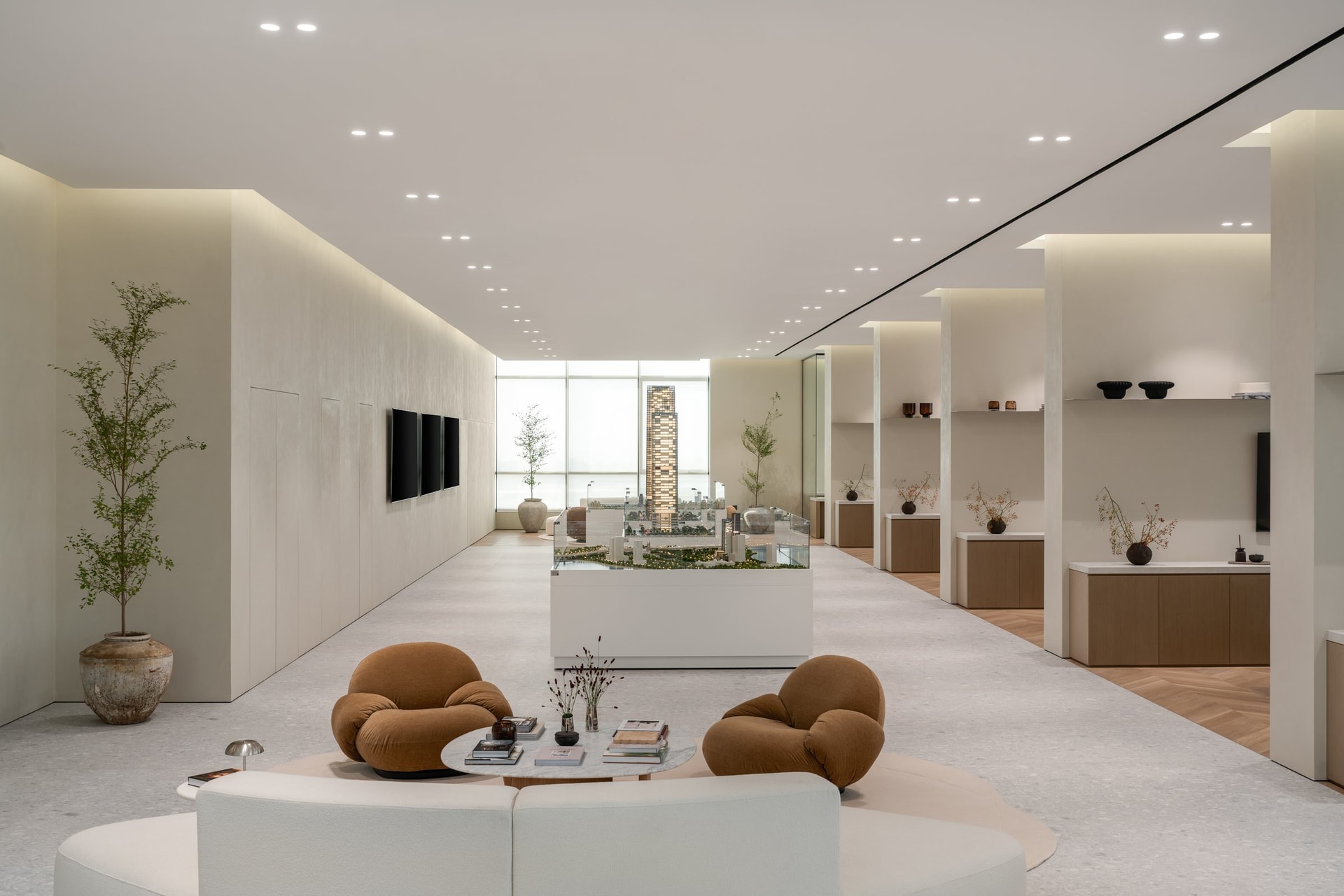
Stepping fully into the sales floor, the spatial ambition reveals itself. A long central aisle carries the eye toward a glass-enclosed model display showcasing the developer’s tower, flanked by pale oak plinths on one side and integrated screen walls on the other. The room reads as a gallery of intent rather than a corporate showroom.
What is notable is how the architecture refuses to clutter. Storage disappears into flush wall planes, the access to washrooms is concealed within a continuous surface, and the eye is left to travel uninterrupted from the seating cluster in the foreground to the model island at the centre and the city beyond.
Where Hospitality Meets the Working Day
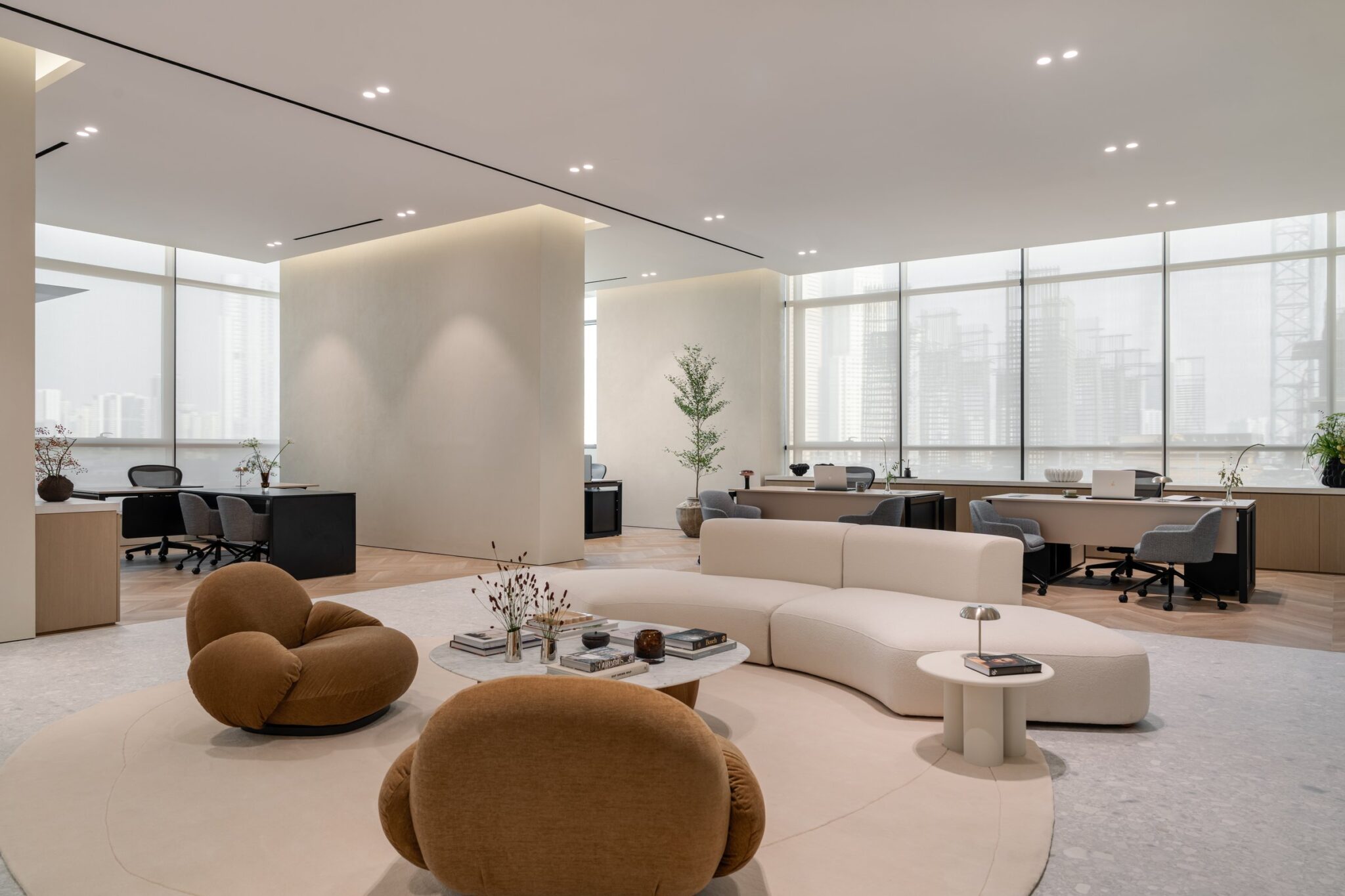
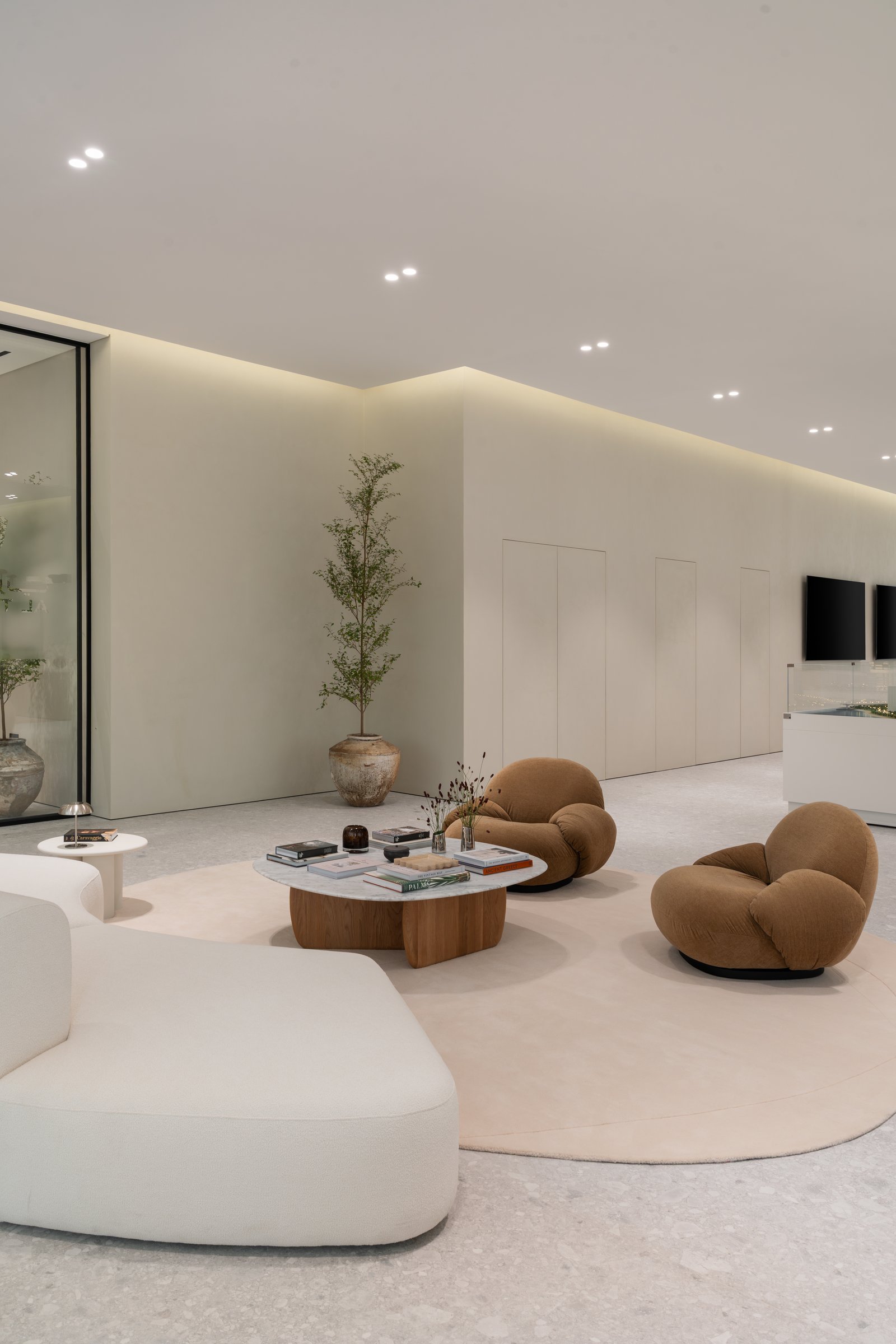
The first of two guest seating hubs is built around a pair of camel-toned Gubi Pacha lounge chairs and a curved cream sofa, gathered on a softly shaped rug whose pale silhouette echoes the curves of the furniture. A marble-and-oak coffee table grounds the composition without weight.
The geometry is doing real work here. Every piece in this grouping is curved or rounded, set against a room of straight planes and flush surfaces, and the contrast produces exactly the residential softness the brief asked for.
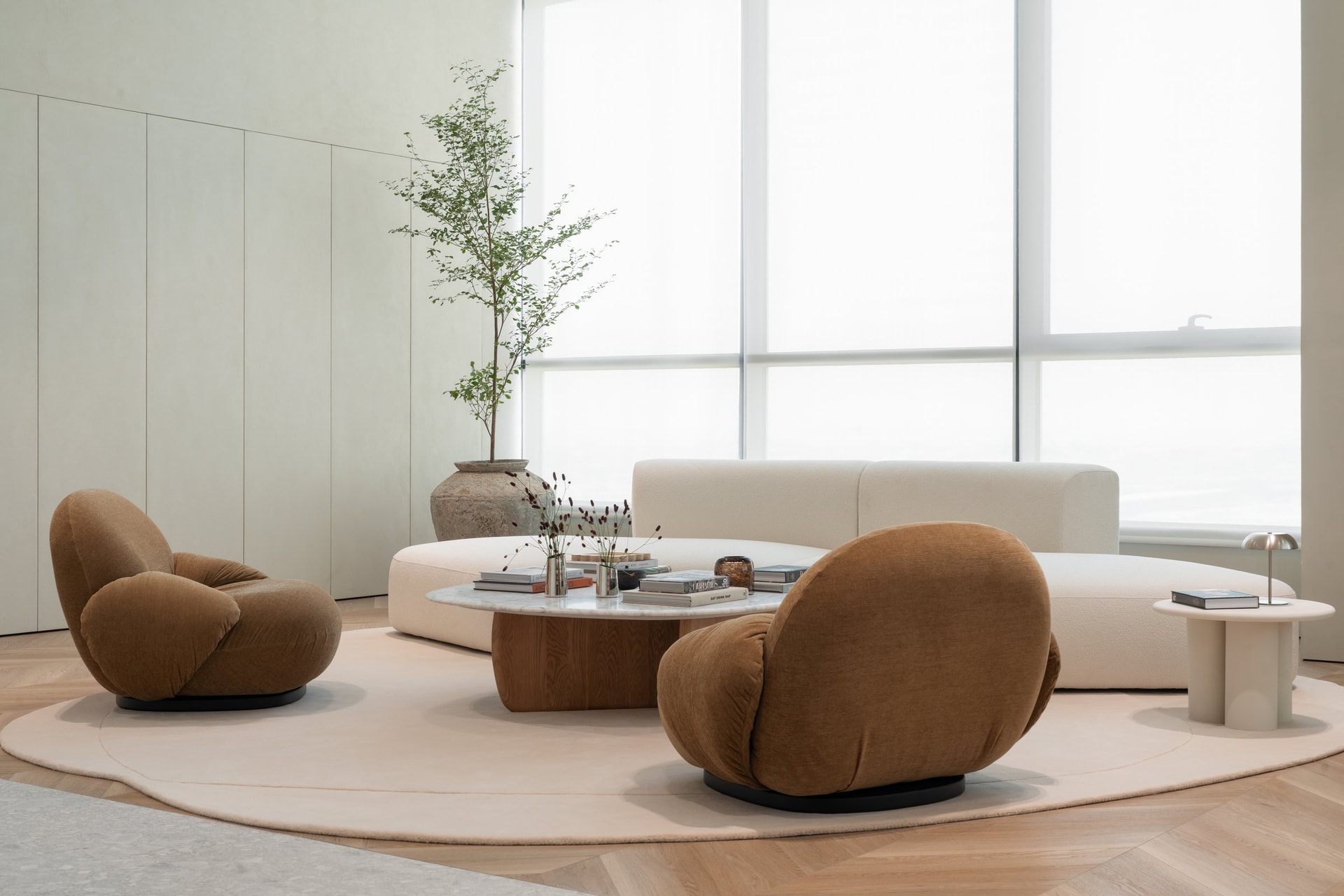
The second seating arrangement, set against a wall of light from floor-to-ceiling windows, reveals where the building’s chevron oak flooring takes over from the Ceppo di Gré. The transition is deliberate: stone for circulation and arrival, wood for the zones where people sit and stay. It is a quiet piece of choreography that the visitor reads with their feet before they notice it with their eyes.
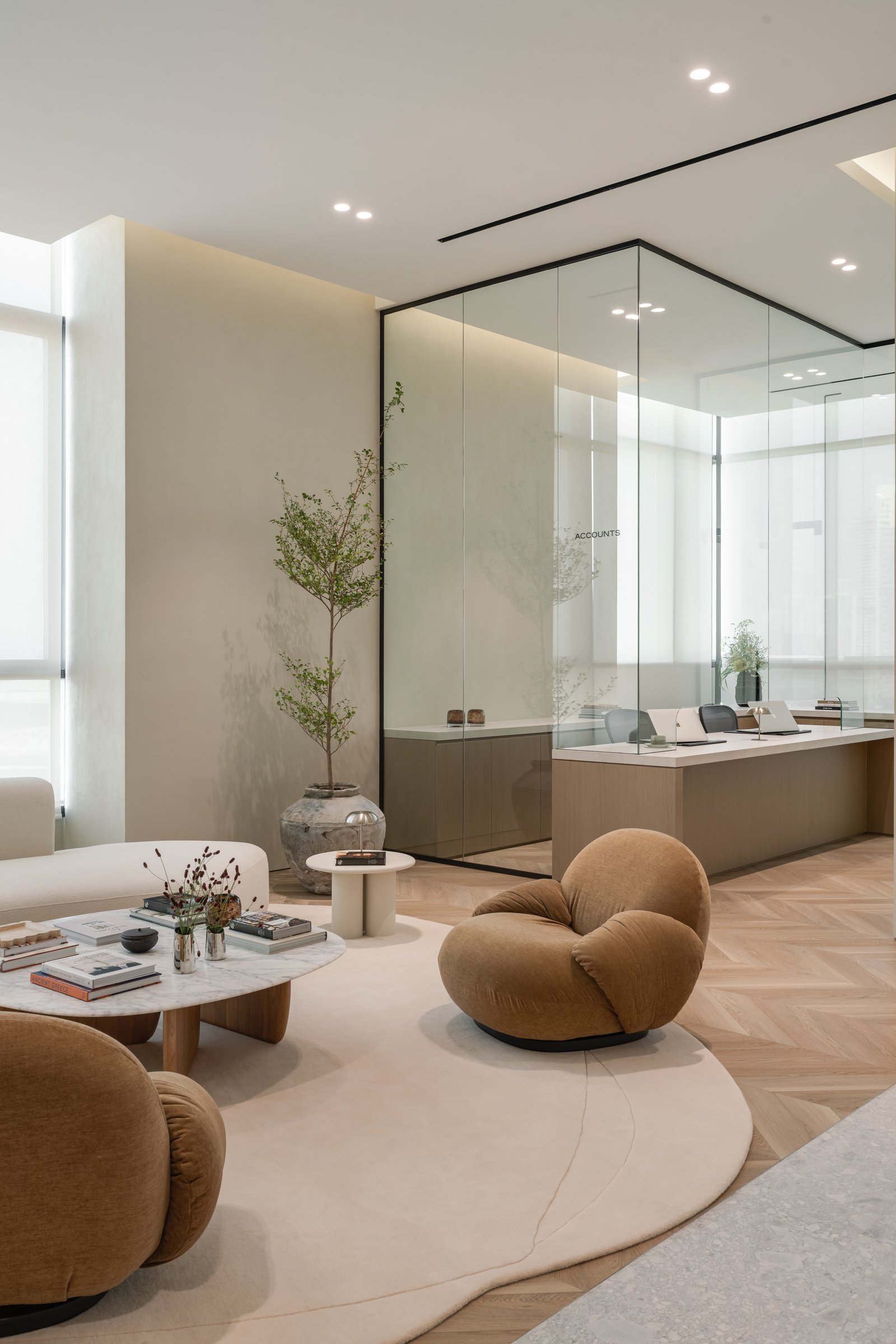
Looking past the lounge cluster, the glass-walled accounts office comes into view, its thin black-framed partitions enclosing the working zone without sealing it off. The accounts cabinetry in pale oak repeats the material vocabulary of the display plinths beyond, so that even the operational backstage of the office holds the same finish discipline as its most public moments.
From the central seating hub, the open desking zone unfolds toward the city. Slim dark desks paired with grey upholstered task chairs line the perimeter where the daylight is strongest, the chevron oak floor running beneath them with the warmth of a domestic interior rather than the neutrality of a corporate one.
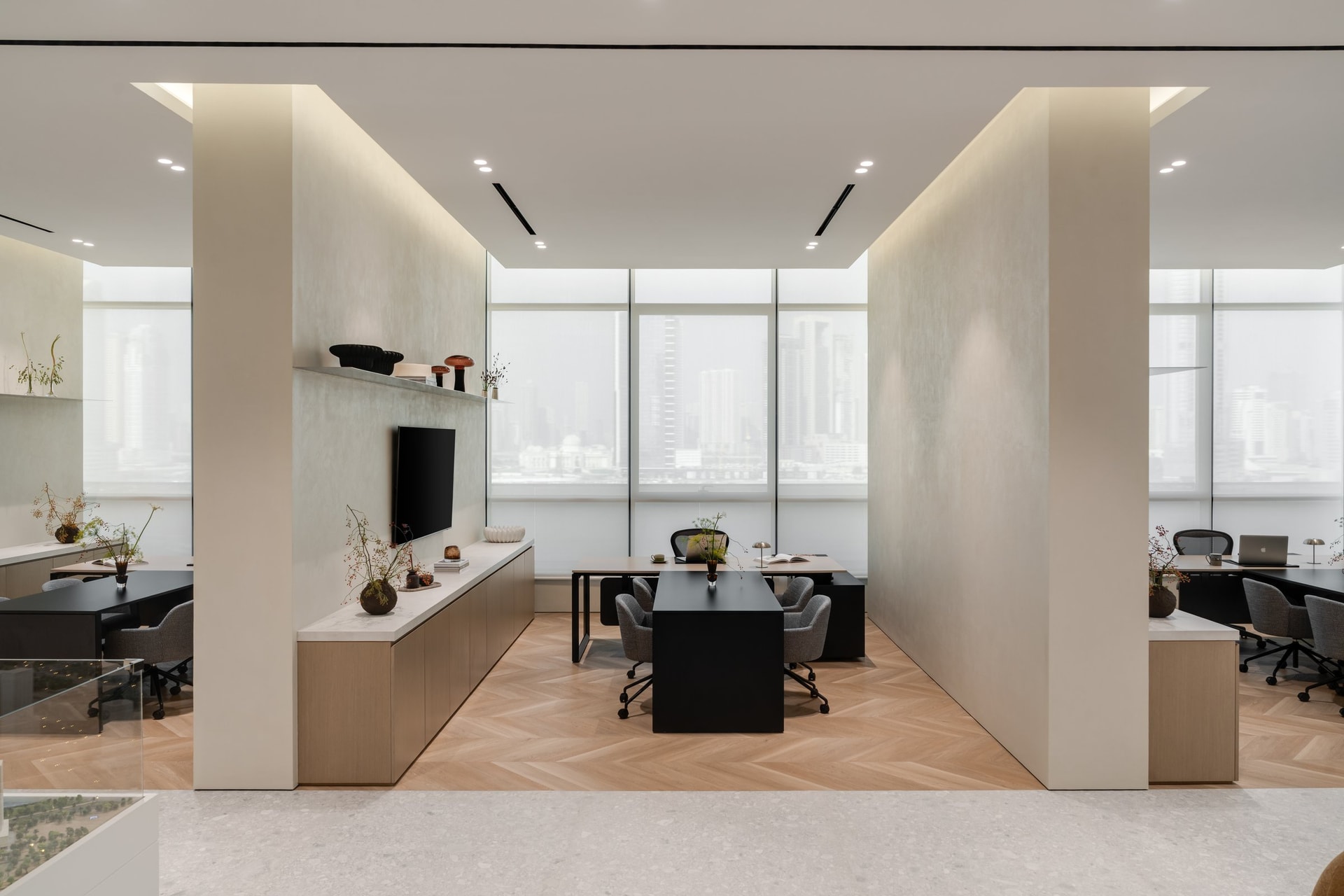
The deeper office zone, where individual workstations are organised between low oak credenzas and partial walls, is where the project’s true ambition becomes legible. Wall-mounted screens, considered shelving with a few ceramic objects, and floral arrangements bring the workspace closer to the language of a quiet residence.
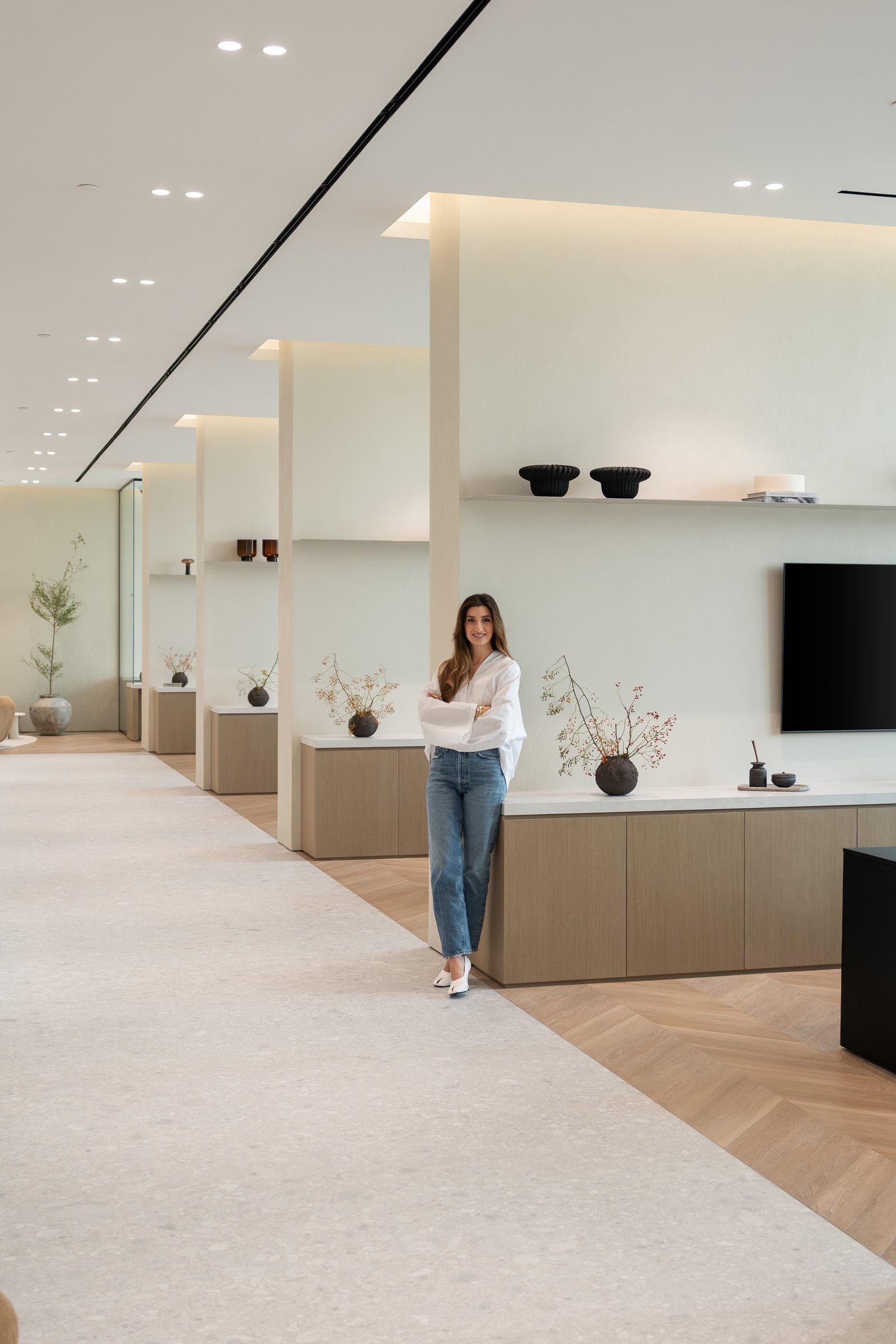
For the UAE, where commercial interiors have often defaulted to spectacle, the Al Thuriah Sales Office proposes a different register. It suggests that a developer’s most persuasive argument is not the scale of its lobby but the calm of its rooms, and that hospitality, properly understood, is a quality of attention rather than a quantity of materials.
The project’s intelligence lies in how it refuses easy categories. It is an office that behaves like a lounge, a sales floor that behaves like a gallery, a corporate space that behaves like a home. None of those translations are forced, because the design begins from the assumption that the people who use the room, whether for an hour or a working day, deserve the same considered welcome.