In a city that moves with relentless forward motion, the most radical thing a commercial space can offer is permission to slow down. Salons in particular have long been engineered for efficiency, mirrored walls multiplying productivity, harsh lighting flattening the experience into transaction. Diorette argues for the opposite proposition: that beauty rituals are, at their core, acts of pause, and the architecture around them should honour that.
Located in RT Nagar, Bengaluru, the 2,100-square-foot space is the work of Tesor Designs, who have woven together two unhurried rituals, the coffee and the appointment, into a single immersive interior. The brief was not to design a salon with a café attached, but to dissolve the line between hospitality and grooming until the visit itself becomes the offering. Diorette, the name a quiet diminutive suggesting delicacy rather than declaration, sets the tone before one even crosses the threshold.
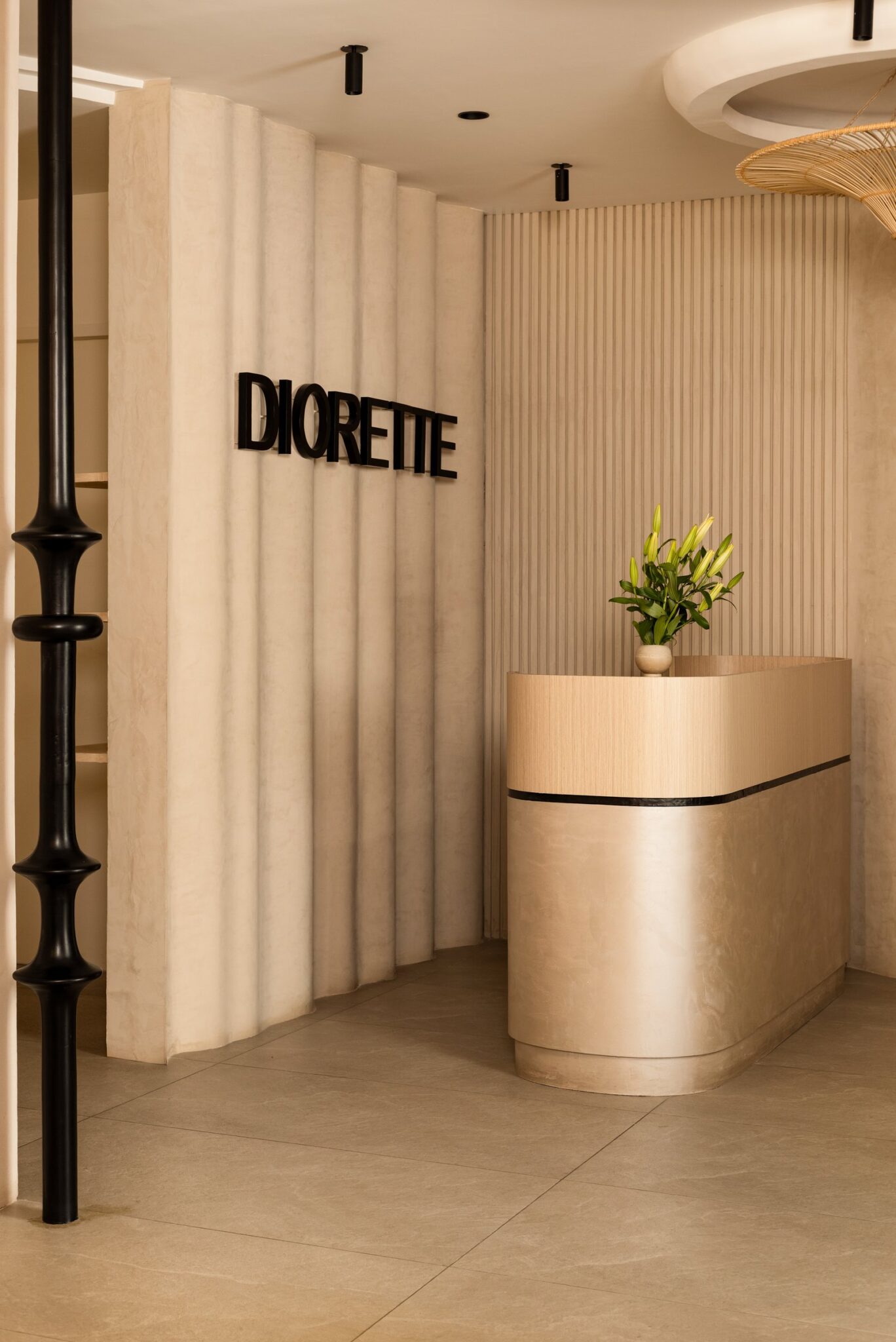
The arrival sequence is composed with restraint. A fluted plaster wall in warm beige carries the brand mark in matte black, while a softly rounded reception counter in pale wood and lime plaster sits to one side, its proportions deliberately modest. A sculptural black baluster, repeated as a recurring motif throughout the space, marks the threshold like punctuation.
There is no spectacle here, only proportion and tactility. The lime-washed surfaces catch light in shifting gradients, revealing texture that polished finishes would have suppressed. It is a reception that asks the visitor to register material before recognising function.
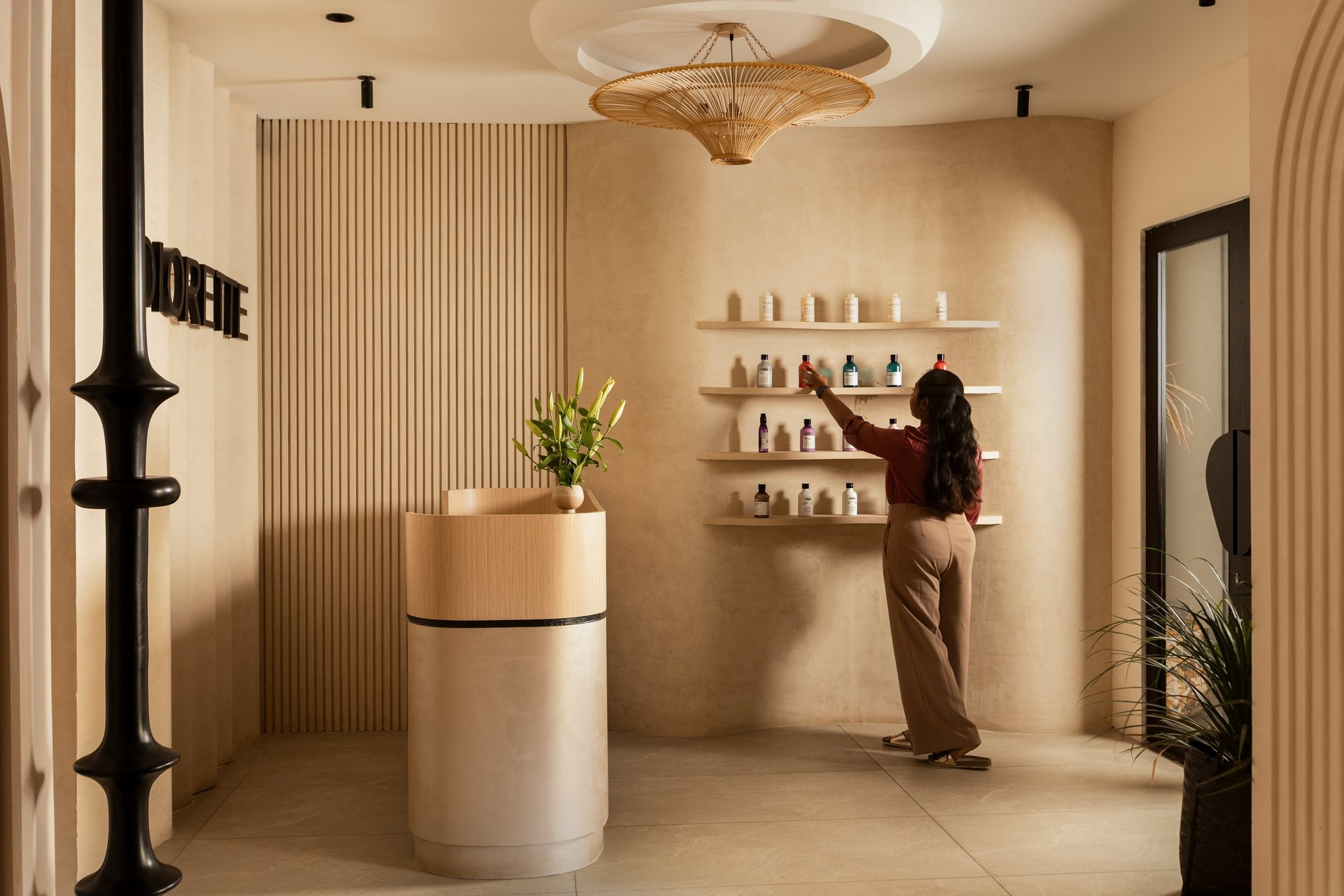
Beyond the desk, the retail wall unfolds as a quiet display: four floating shelves carrying haircare bottles against a softly textured plaster surface, lit by a wide rattan pendant that hangs like an inverted parasol. A slim cylindrical podium in pale wood and plaster anchors the centre, holding a single ceramic vessel of lilies.
The geometry of the room is gently curved rather than orthogonal, walls bowing inward to soften the circulation. Vertical fluting on the panelled wall introduces rhythm without ornament, while the black baluster column on the left repeats the entry’s sculptural note. Retail is treated here as composition, not commerce.
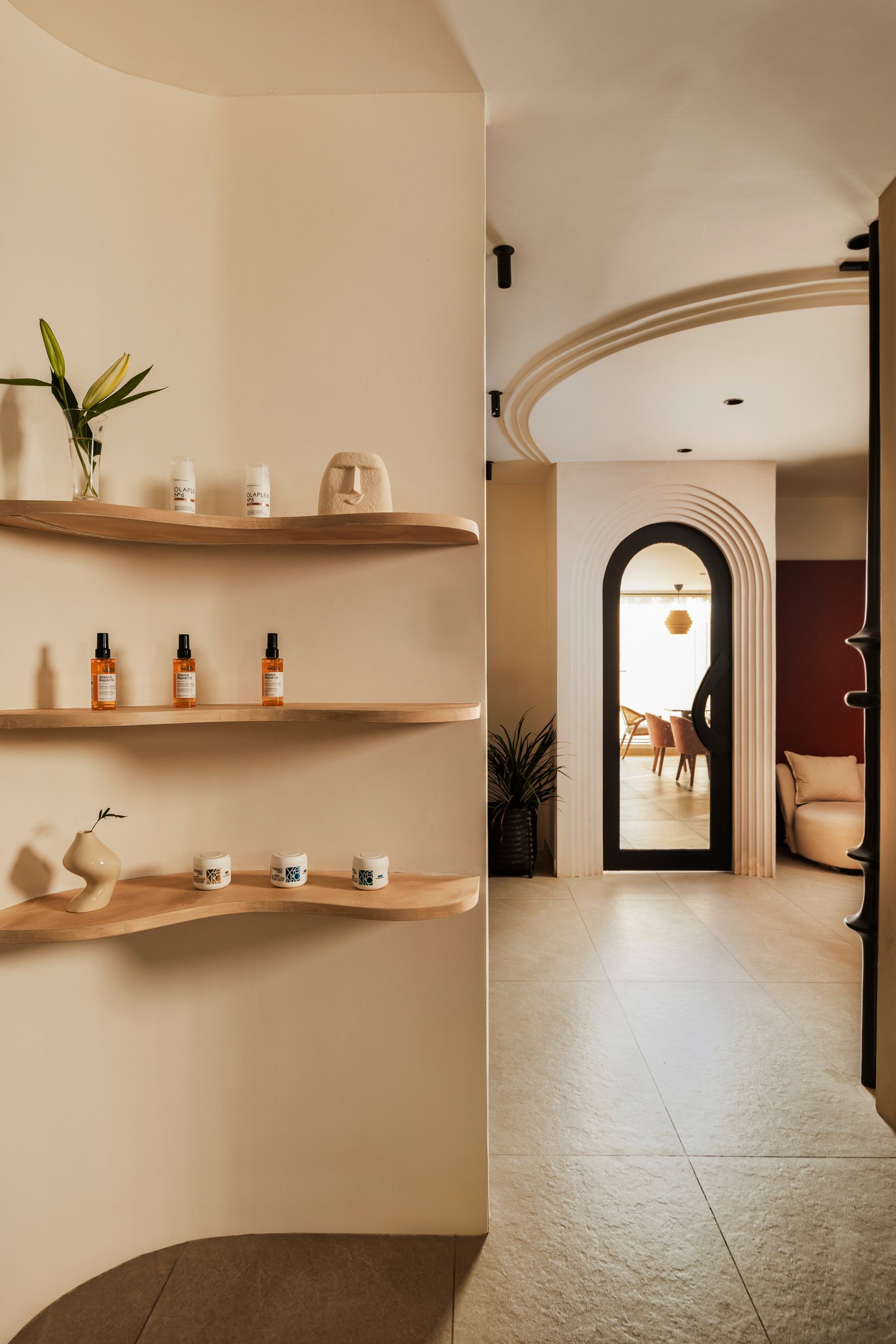
The transition from retail into the main salon is articulated through a layered arched portal, its concentric reveals stepping inward to frame a view of the café beyond. A curved plaster wall on the left carries three undulating wooden shelves holding product and small ceramics, the wave of the shelf edge echoing the curves overhead.
““Arches and organic contours are not decorative gestures but structural expressions of continuity. Each threshold becomes a gentle modulation in the atmosphere rather than a defined break.””
The detail rewards close looking. A small sculpted face sits beside the lilies on the top shelf, an intimate gesture that resists the showroom impulse. Through the arch, a glimpse of pink café chairs and warm pendant light promises something more domestic than commercial.
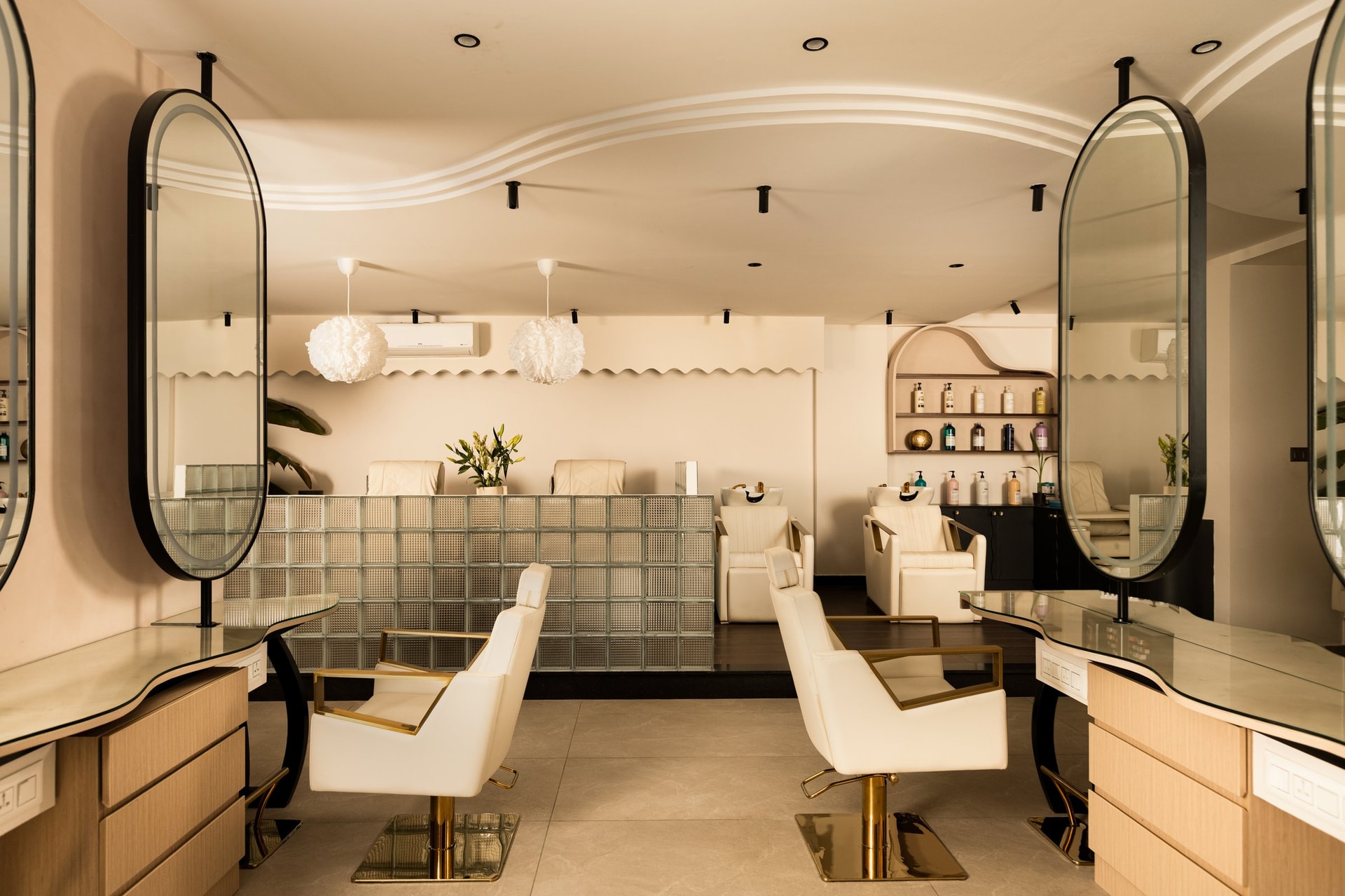
The styling floor opens into the project’s most visually composed gesture: a sculptural ribbon of plaster relief sweeps across the ceiling in undulating curves, mirroring the wave of a scalloped pelmet that runs along the rear wall. Twin oval mirrors in slim black frames hang suspended from the ceiling, flanking a glass-block partition that filters light from the wash zone behind.
Two cream styling chairs on polished gold bases anchor the foreground, paired with wood-fronted vanities whose curved glass tops repeat the room’s organic vocabulary. Two cloud-like white pendant lights hover above the partition, their soft form reading almost as confectionery against the architectural rigour of the ceiling waves.
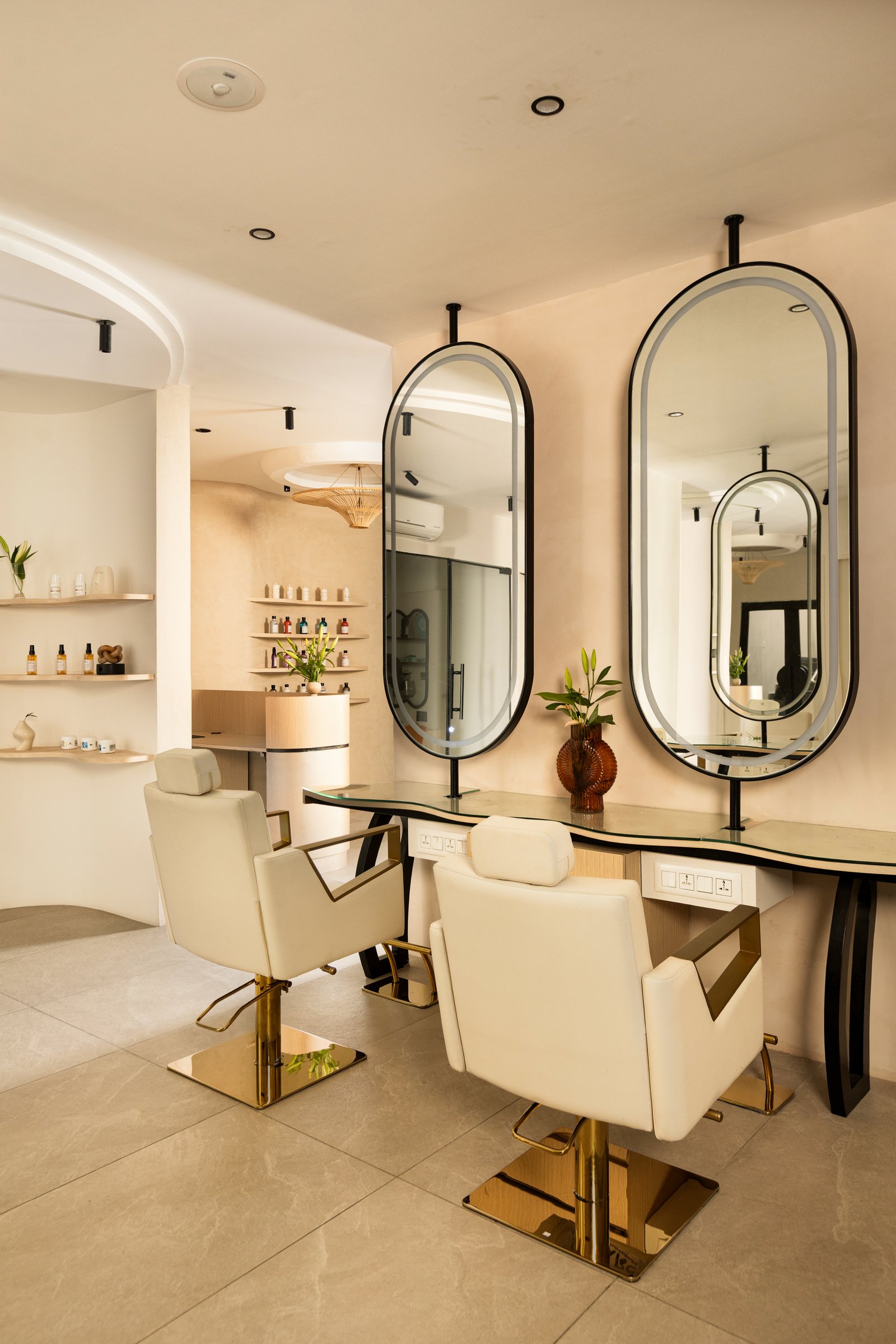
A closer view of the same zone reveals how carefully the styling stations have been calibrated. The chairs themselves are conceived as relaxation loungers rather than utilitarian seats, prioritising physical ease during the long durations a colour service demands. A small vase with a single stem sits on the vanity between the mirrors, a quiet domestic note inside what is technically a workstation.
To the left, the curved retail alcove from the entrance returns into view, knitting the spatial sequence together. Nothing in this room reads as standalone; each element references another across the volume.
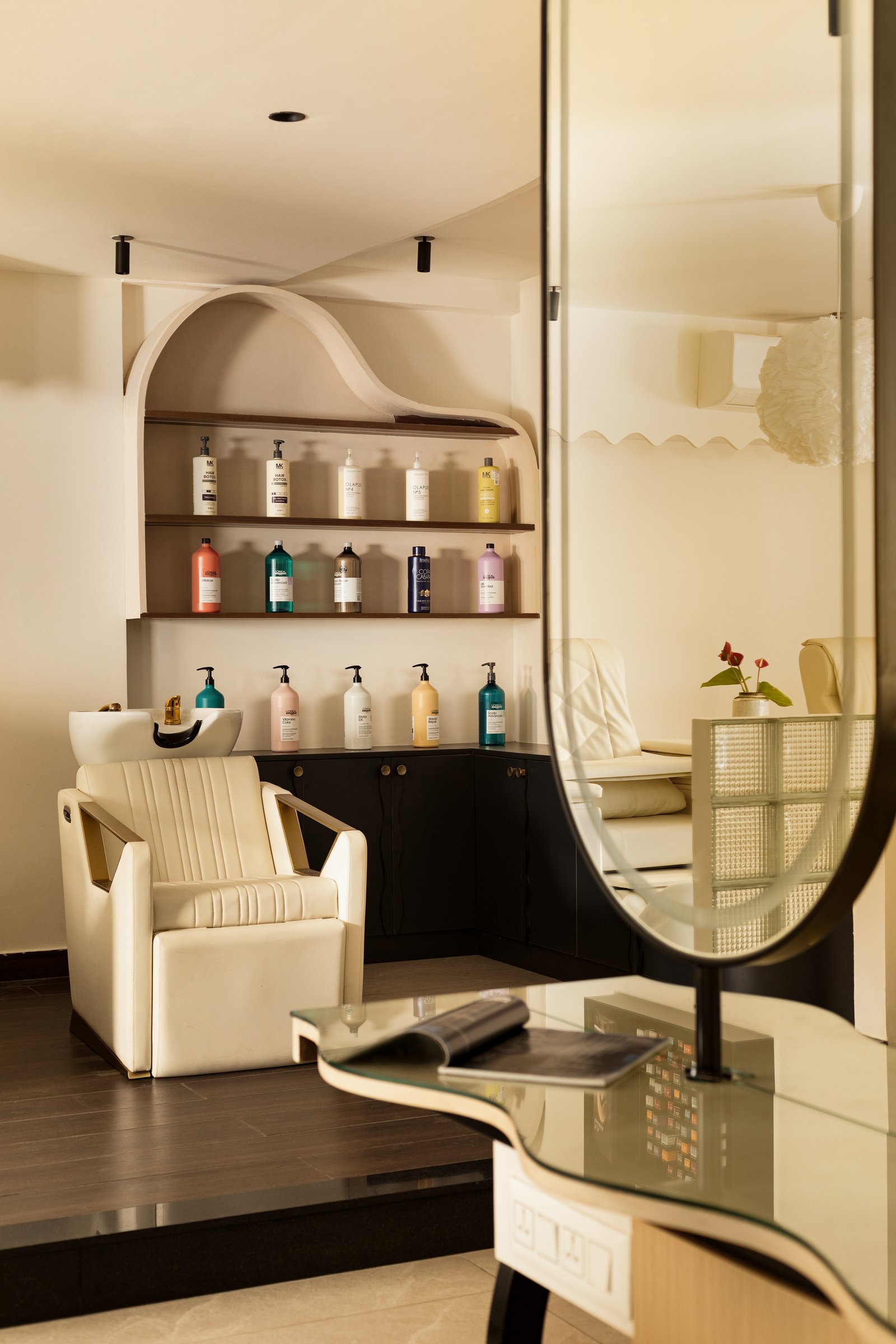
The wash zone takes the curve vocabulary into a different register. An arched niche, its profile rising and dipping like a wave, frames three shelves of product against the rear wall, while a cream wash chair with subtle channel-stitch detailing sits in the foreground. Black cabinetry below grounds the composition, providing visual weight where the rest of the room is pale.
The glass-block partition reappears on the right, partially veiling the styling floor beyond, and a softly contoured glass console with a black-edged profile completes the layering. The room reads as a series of overlapping screens rather than separate functions.
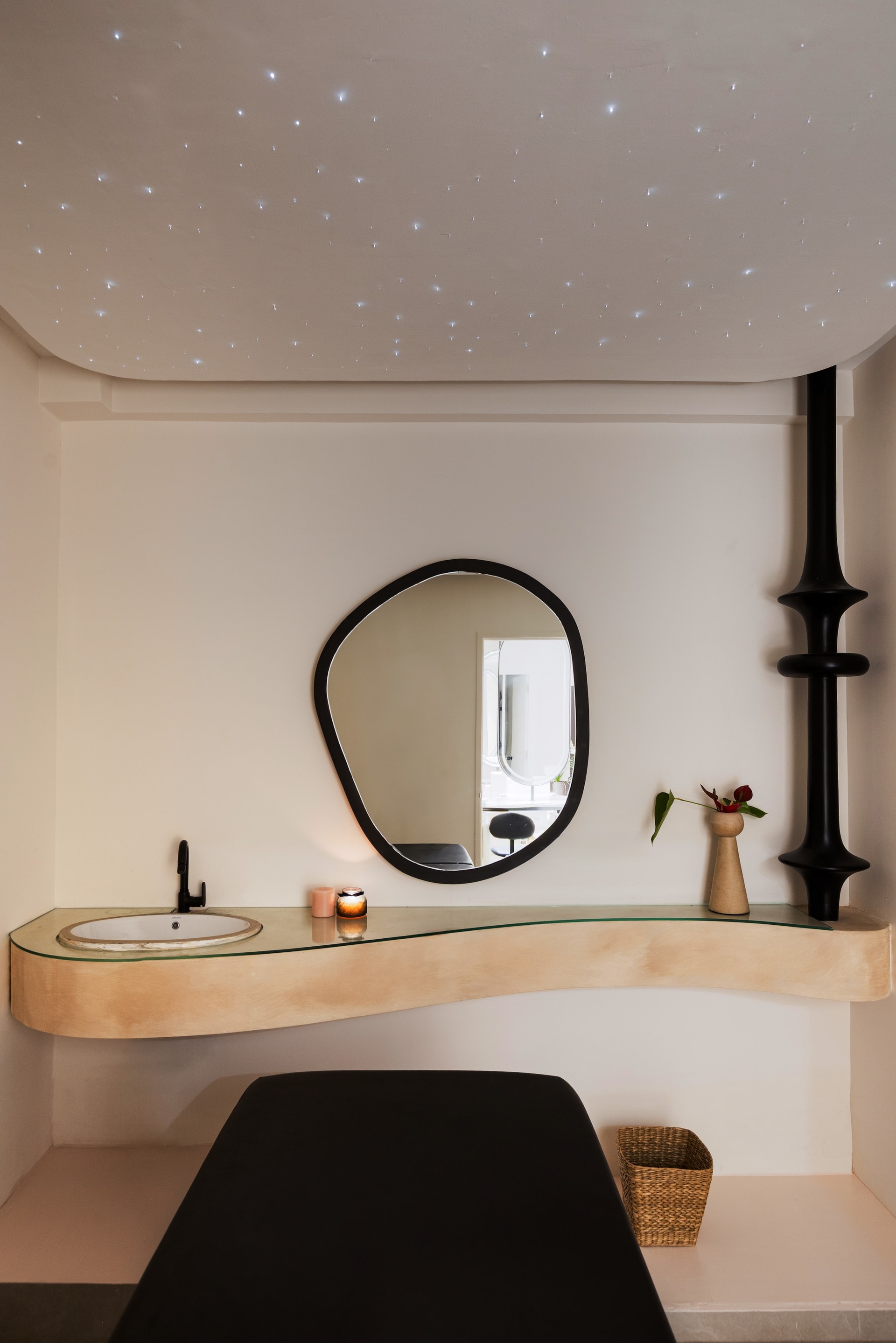
The treatment room marks the project’s deepest withdrawal from the public-facing zones. Above the massage bed, the ceiling has been fitted with optic fibre lights that scatter pinpricks of illumination across the surface, a constellation that replaces conventional ambient lighting with something genuinely atmospheric. An organically shaped mirror with a slim black frame hangs above a curved floating vanity.
The sculptural black column reappears here too, anchoring the corner like a totem. The room is small but the ceiling effect expands it vertically into something that feels closer to meditation than to clinic.
Cafe Diorette occupies the corner that completes the salon’s narrative arc. Dusty pink velvet armchairs cluster around black pedestal tables, set against a wall mural of foliage rendered in white linework. A woven pendant in stacked layers hangs above the central table, its texture catching the warm light beautifully.
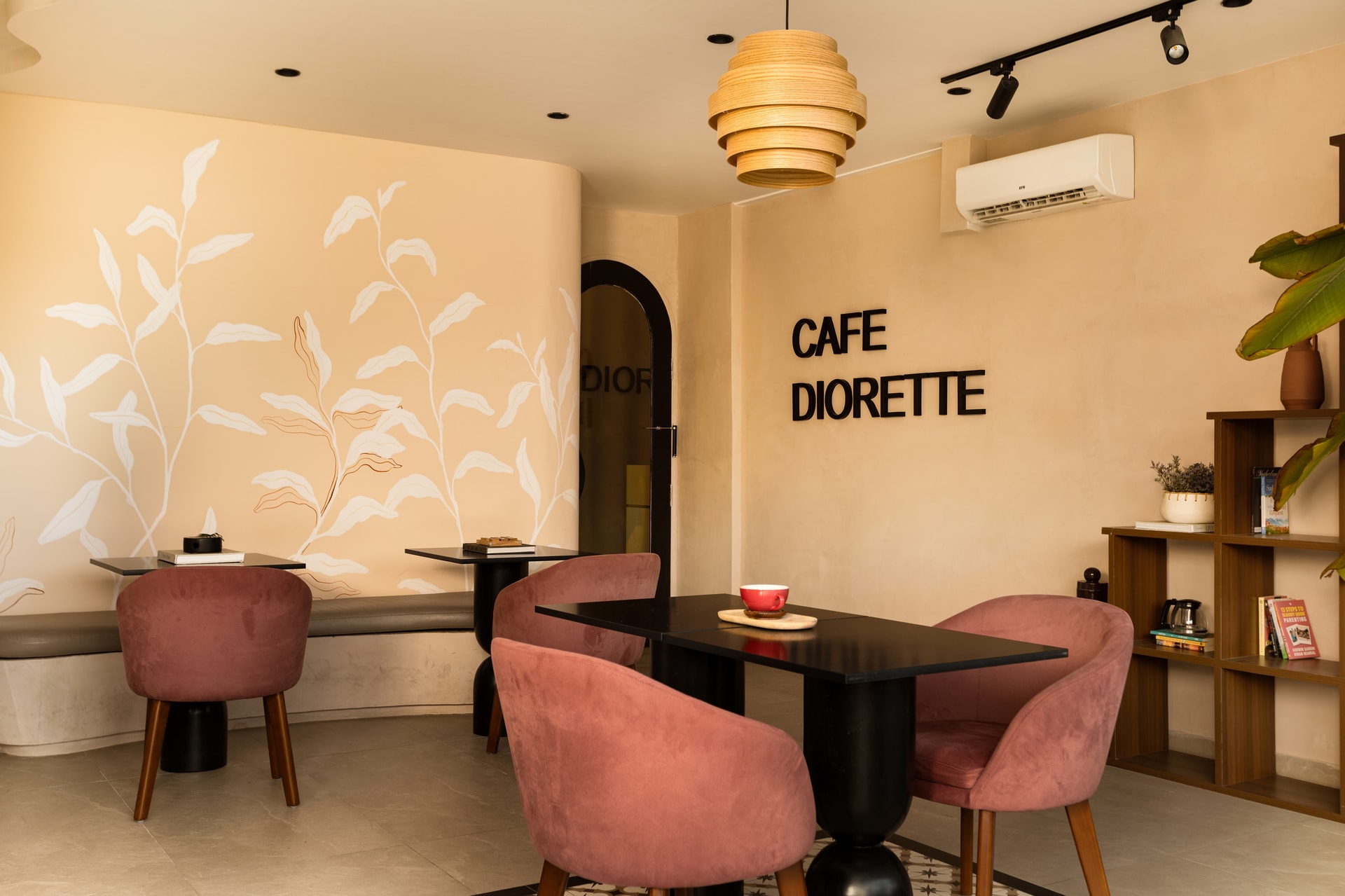
The room is unashamedly soft. A built-in plaster banquette runs along the mural wall, while a slim wooden bookshelf in the corner holds reading material and a small kettle. This is the project’s clearest argument that waiting can be reframed as inhabiting.
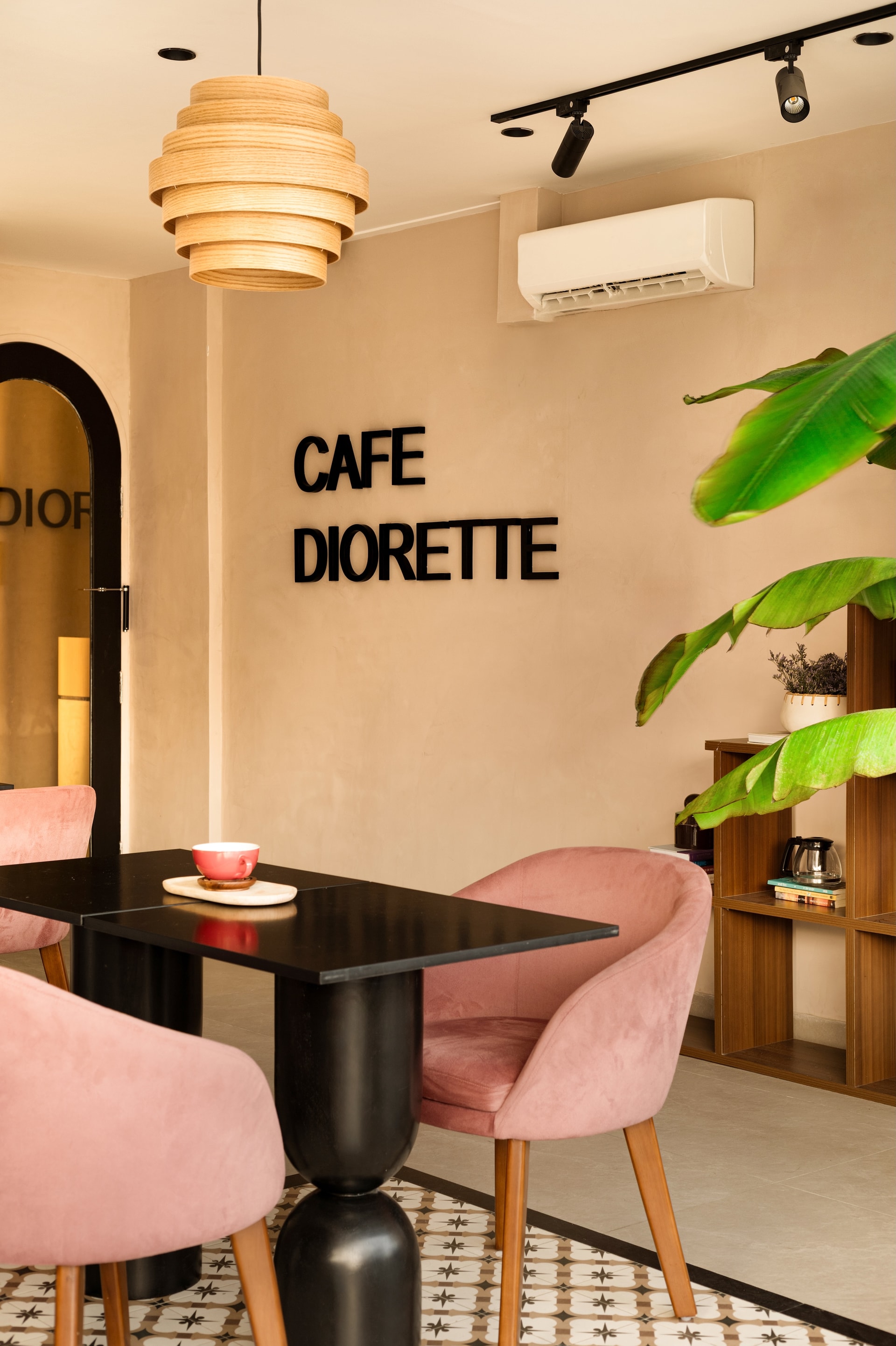
A second view into the café reveals the patterned cement-tile floor beneath the central table, its geometric motif providing a counterpoint to the otherwise tonal palette. The Cafe Diorette signage in matte black floats on the warm plastered wall, while a large-leaved plant rises from beside the bookshelf, bringing a note of unstructured green into the otherwise composed room.
The arched doorway visible on the left returns the visitor’s eye toward the salon, completing the circulation loop. Café and salon are not adjacencies here; they are continuous spatial experiences.
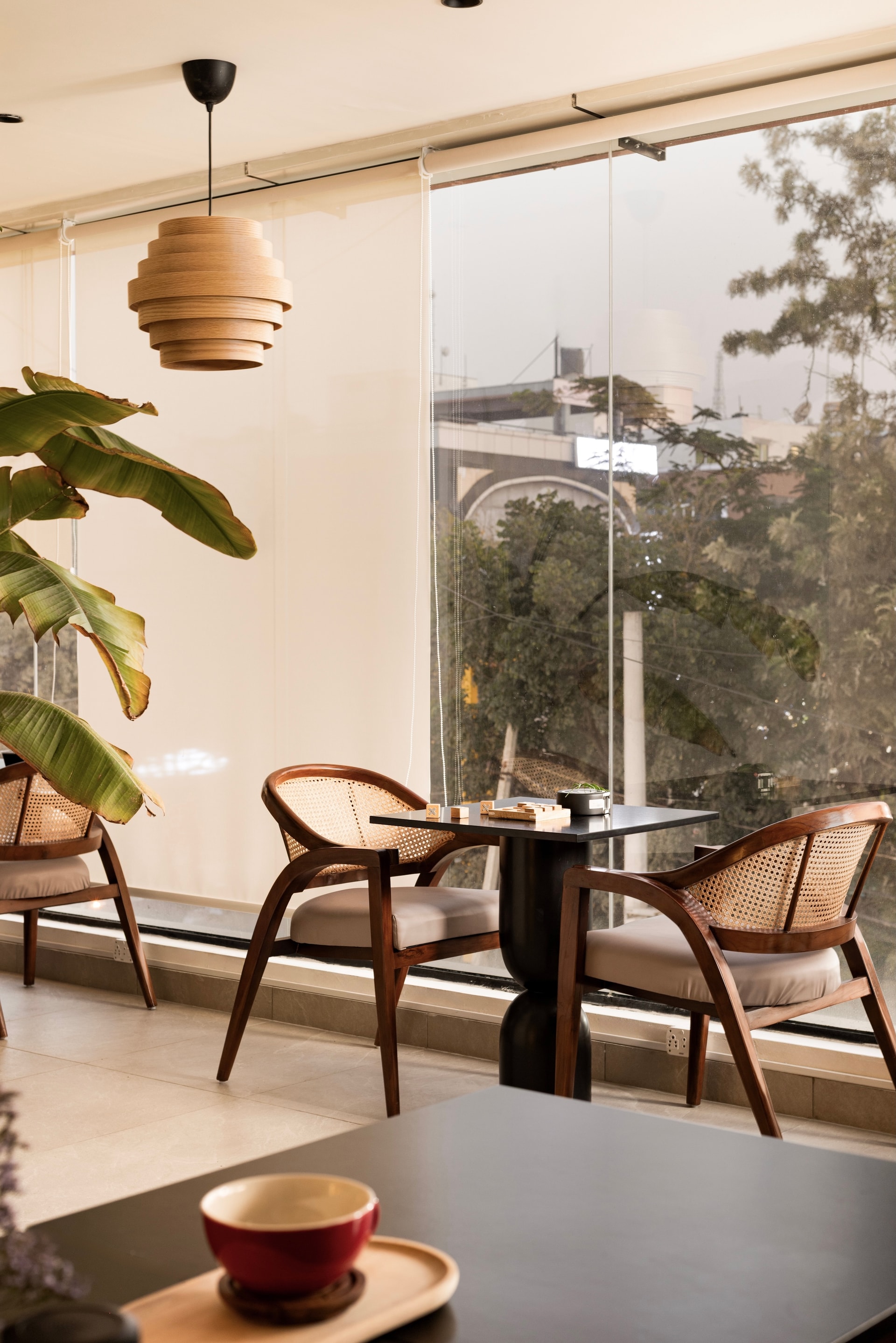
The café’s window edge offers the project’s most informal moment. Two cane-and-wood armchairs face each other across a small black-pedestal table, set against a wall of glazing that opens onto Bengaluru’s trees and rooflines. A banana plant softens the corner, and a stacked wooden pendant in pale veneer hangs overhead, echoing the wider rattan light in the retail zone.
The view itself is not curated, it is simply the city as it is, but the framing invites a longer pause than most commercial windows ever earn. Coffee here is not a service offering; it is a reason to stay.
Diorette sits within a broader shift in how Indian commercial interiors are imagining hospitality, away from the slick uniformity of chain salons and toward something more spatially generous and emotionally calibrated. Bengaluru, with its appetite for the considered and the unhurried, is a natural home for this kind of work. The project absorbs influences from contemporary spa design and café culture without imitating either.
What Tesor Designs has achieved is a commercial space that earns its restraint. Diorette does not perform luxury through finish or fixture; it proposes that luxury, in a busy city, is simply the quality of time the architecture allows you to keep.