A design practice that builds homes for others must, at some point, build one for itself. The studio it inhabits becomes the most honest brief it will ever write, an unprompted statement of how it thinks about proportion, palette, and the small ceremonies of working life. The risk is self-consciousness; the reward, when it lands, is a space that reads as argument rather than advertisement.
In Bengaluru, Design Cubes, led by Komal Kapoor and Anvitha Bhandary, has taken on that brief across roughly 1,250 square feet. The studio is conceived as a built manifesto, an immersive environment in which the firm’s design language, restrained, layered, quietly classical, is rehearsed at full scale. The project moves from a panelled entry to a central meeting volume, through a tucked pantry and twin cabins, ending in a powder room that does not let the project’s care slip at the last moment.
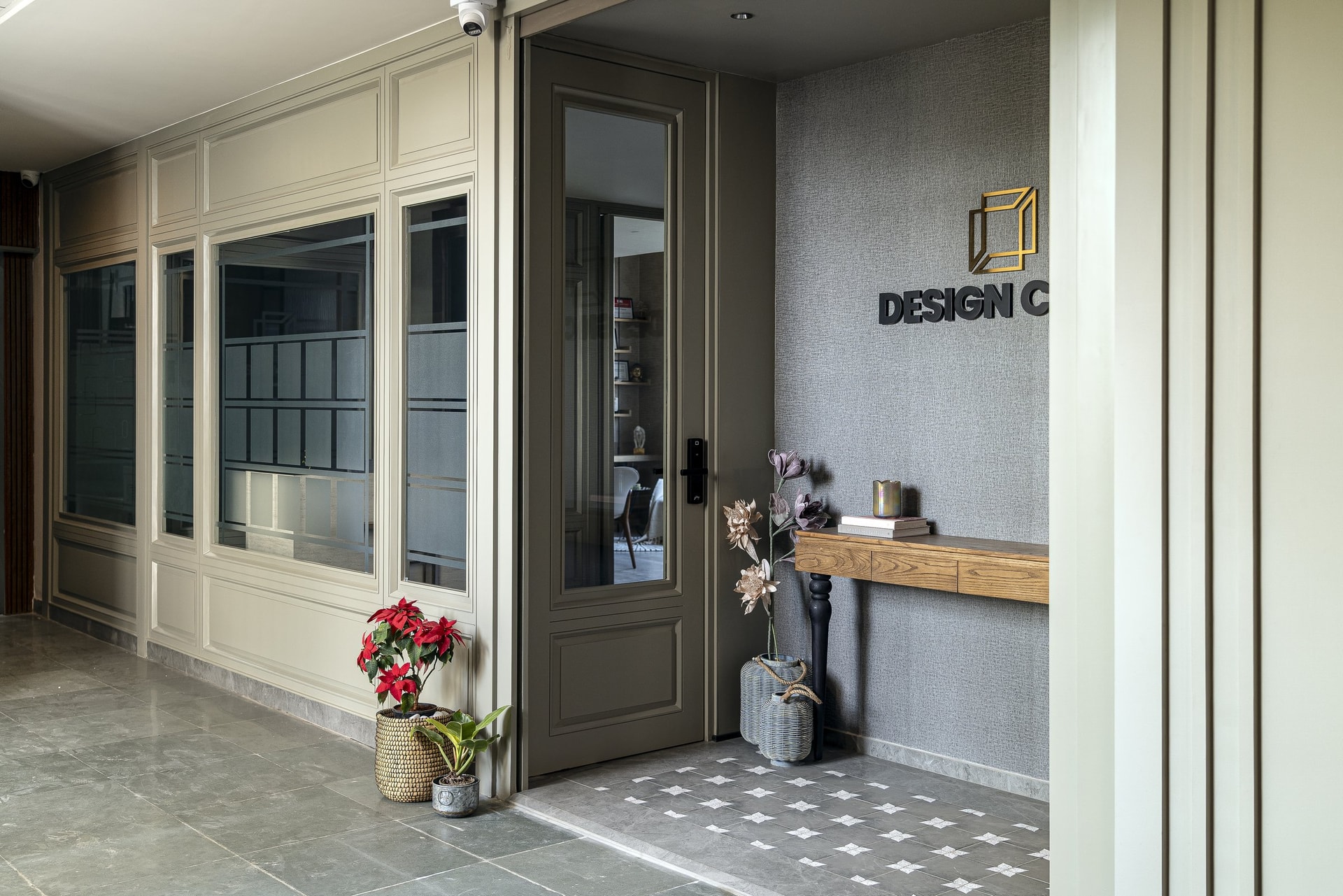
The arrival sequence is staged with deliberate calm. A wall of contemporary classic panelling in a warm putty tone, broken by glazed inserts, mediates between the lift lobby and the studio interior; a patterned stone floor, set in a small diamond motif, marks the threshold like a rug rendered in masonry. Branding is held back to a single console wall, signalling the studio without announcing it.
That console wall is the project’s first set piece. A textured grey wallcovering carries the gold-and-black studio mark above a slim wooden console on turned black legs, with a single dark pendant offset to the right rather than centred, an asymmetry that keeps the composition from settling into something too ceremonial. The detail is small, but it is the kind of decision that distinguishes a practice that thinks about how a wall is read from one that only thinks about what is on it.
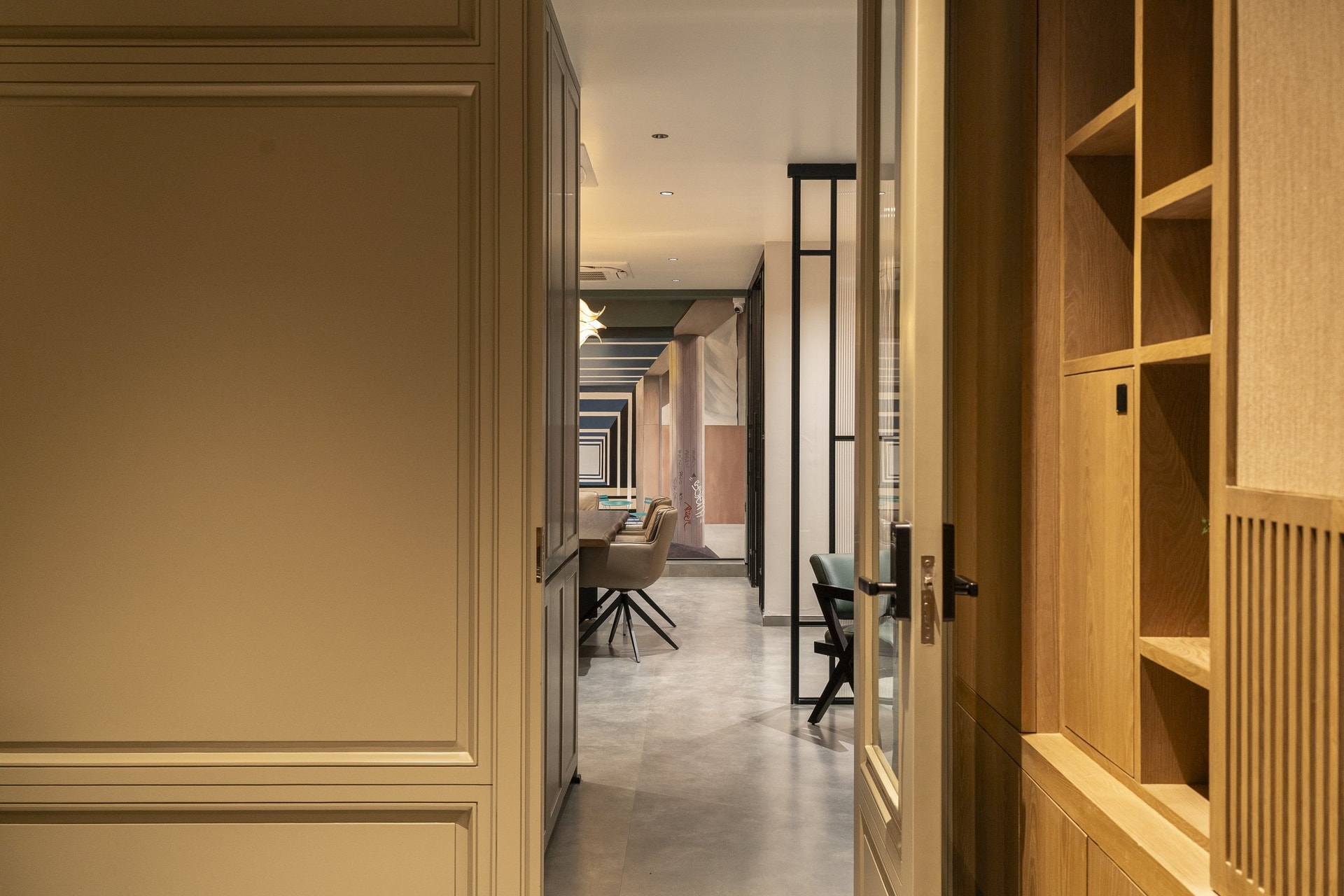
Beyond the foyer, a short passage frames the studio’s deeper geometry. Panelled cream cabinetry on one side, a slatted wooden shelving wall on the other, and a glimpse of the central meeting room with its graphic mural pulling the eye forward. The corridor is doing real work, compressing the visitor briefly before releasing them into the main volume.
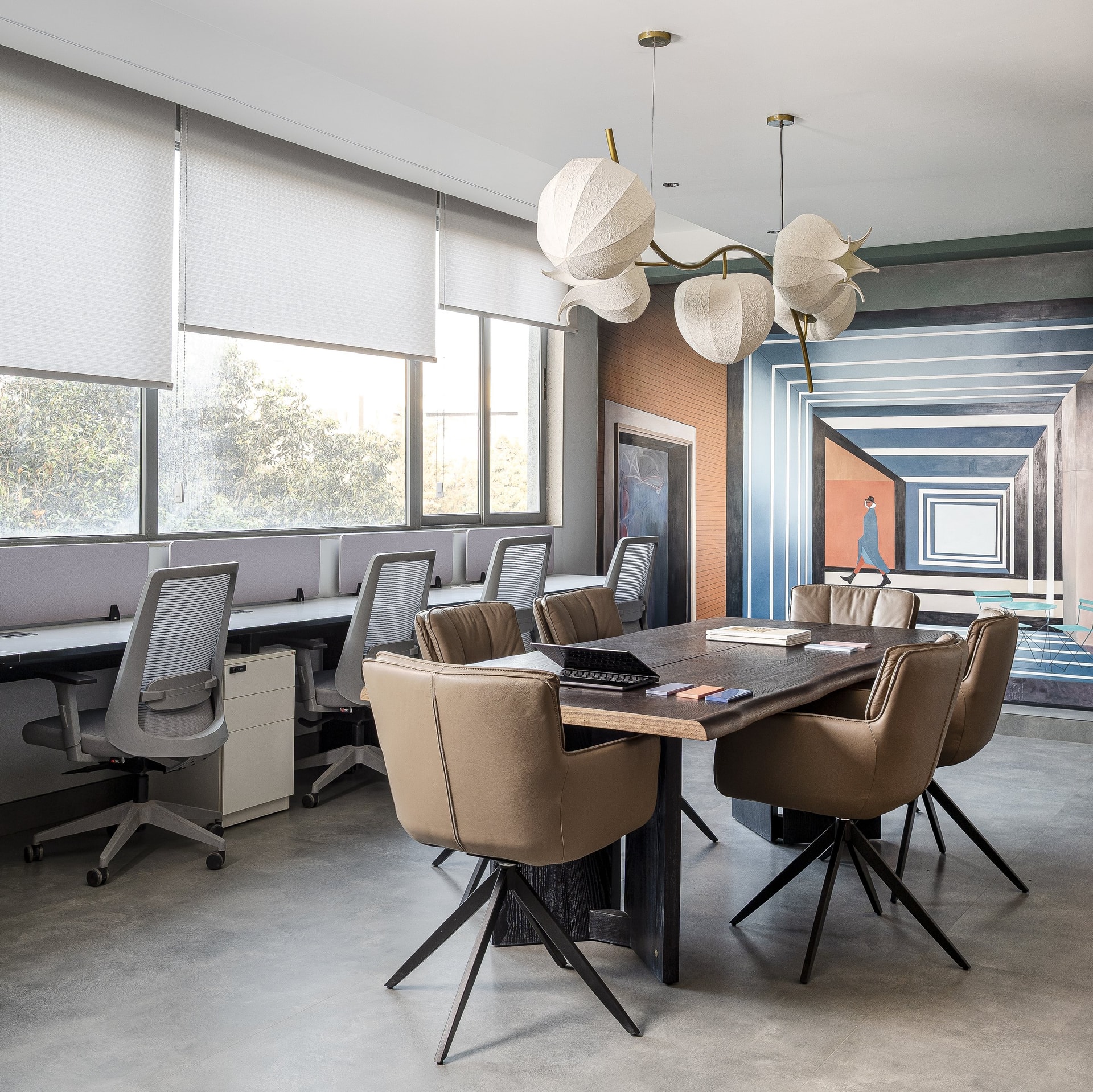
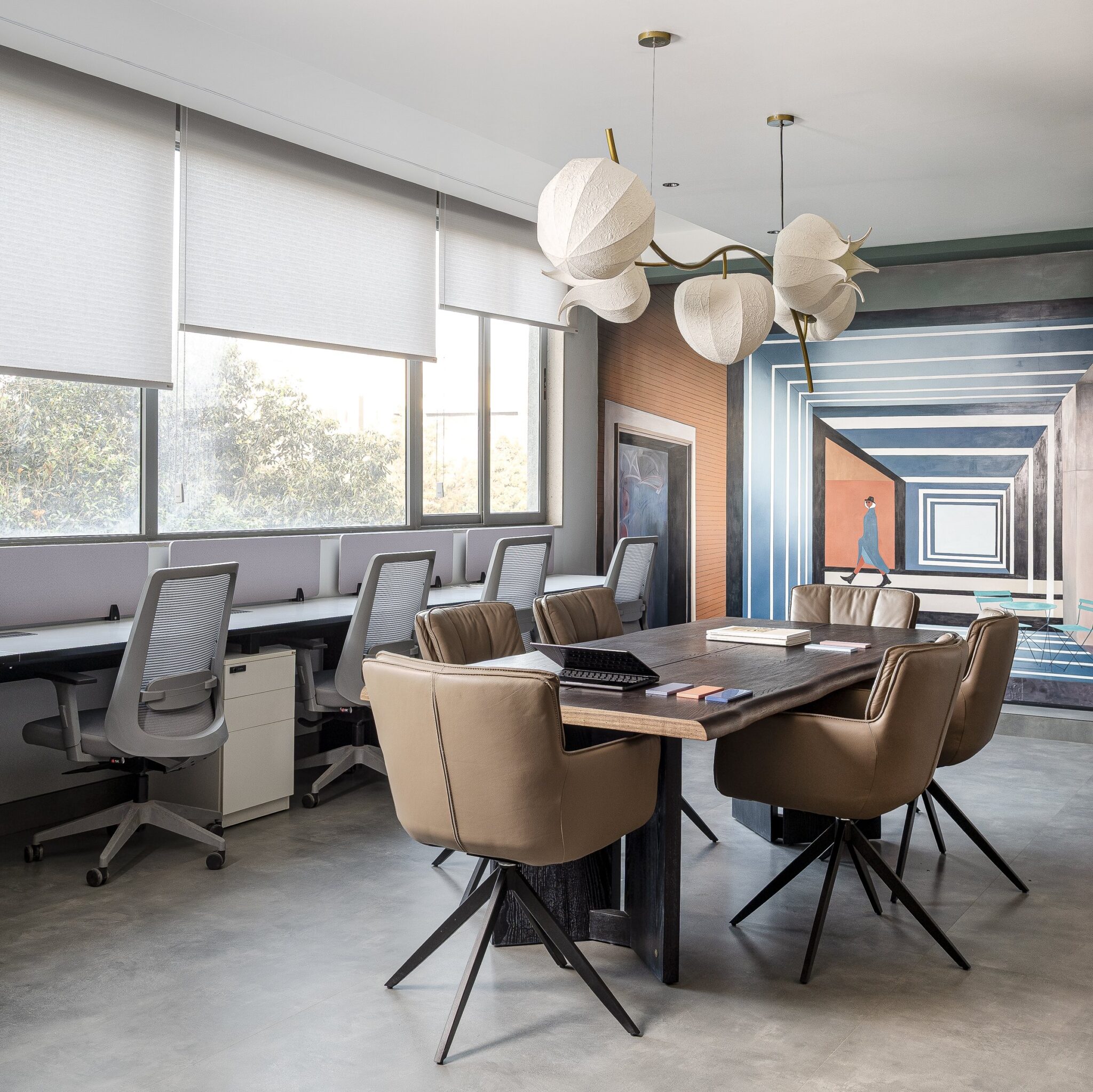
That main volume is the studio’s social and working heart, a long room in which a live-edge meeting table in dark wood and tan leather swivel chairs sits alongside a run of workstations under generous windows. The most striking move is the mural behind the table: a hand-painted, deep-perspective composition in indigo and terracotta that pulls a fictional street scene into the room. It is the studio’s argument that workspace can carry the same narrative ambition as a residential interior, without forfeiting daylight or discipline.
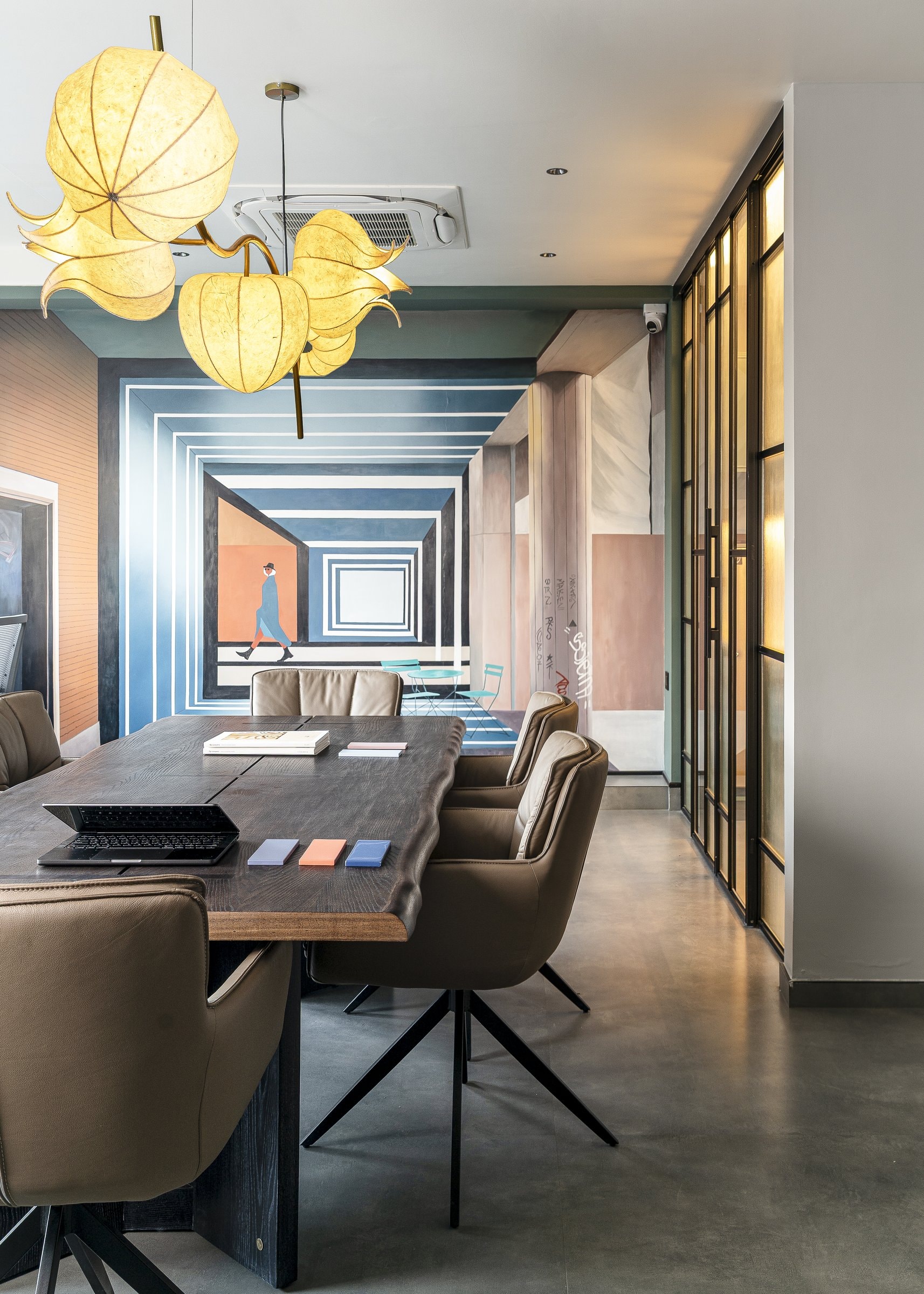
Above the table, a sculptural pendant of fabric pods on slender brass arms reads as the room’s single indulgent gesture. Earned, because the rest of the palette, polished concrete-toned flooring, dark stained meeting table, muted upholstery, holds steady around it.
““The intent was to create a workspace that is not only functional but also communicates the high quality and thoughtful approach to design undertaken with every project.””
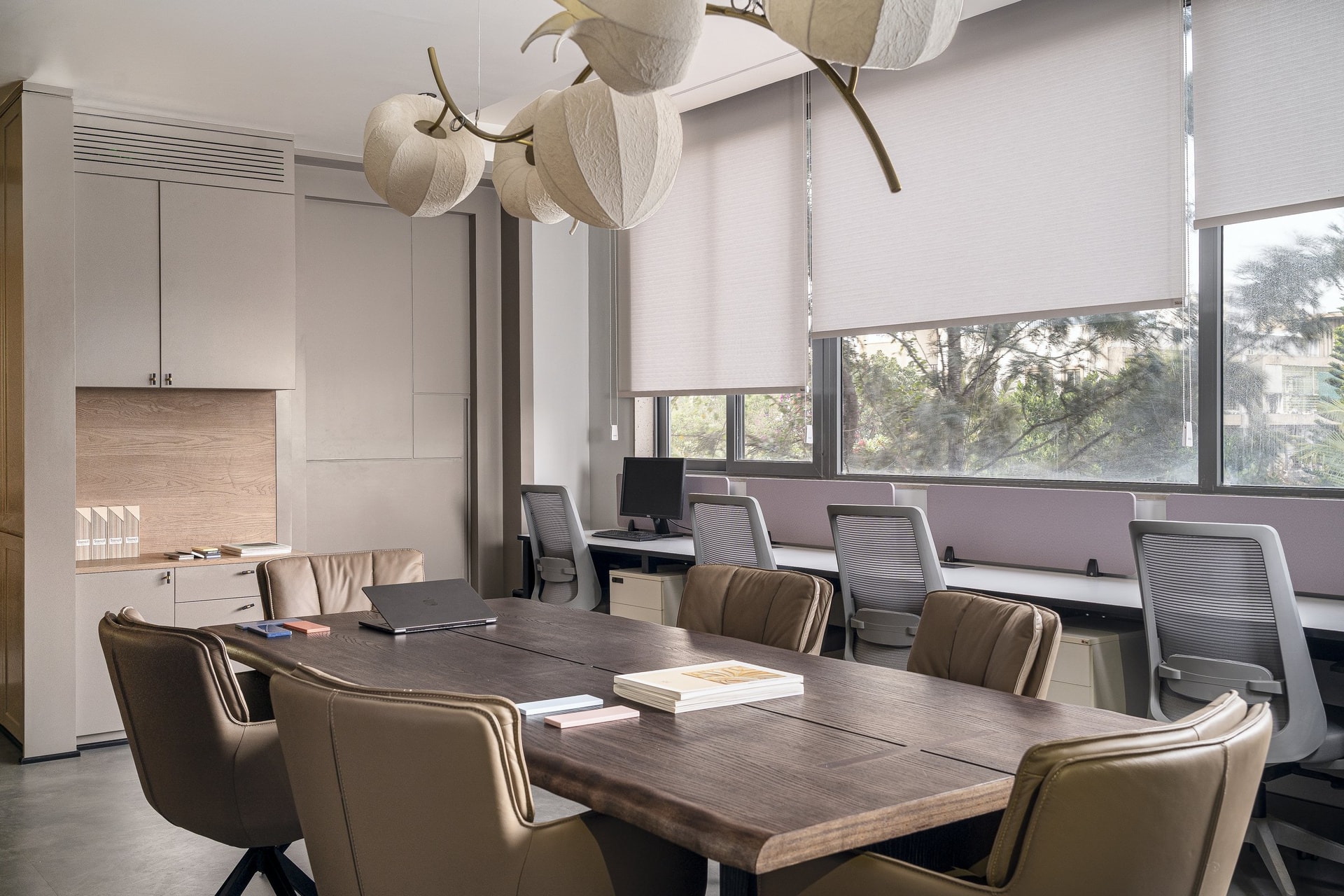
Seen from the opposite end, the same room recomposes itself around the windows. Roller blinds in a pale fabric soften the daylight onto a built-in storage wall finished in a quiet greige, with a fluted wooden inset that lifts the cabinetry out of pure utility. The workstation run, screened by lilac fabric panels, holds its line without ever competing with the meeting table for attention.
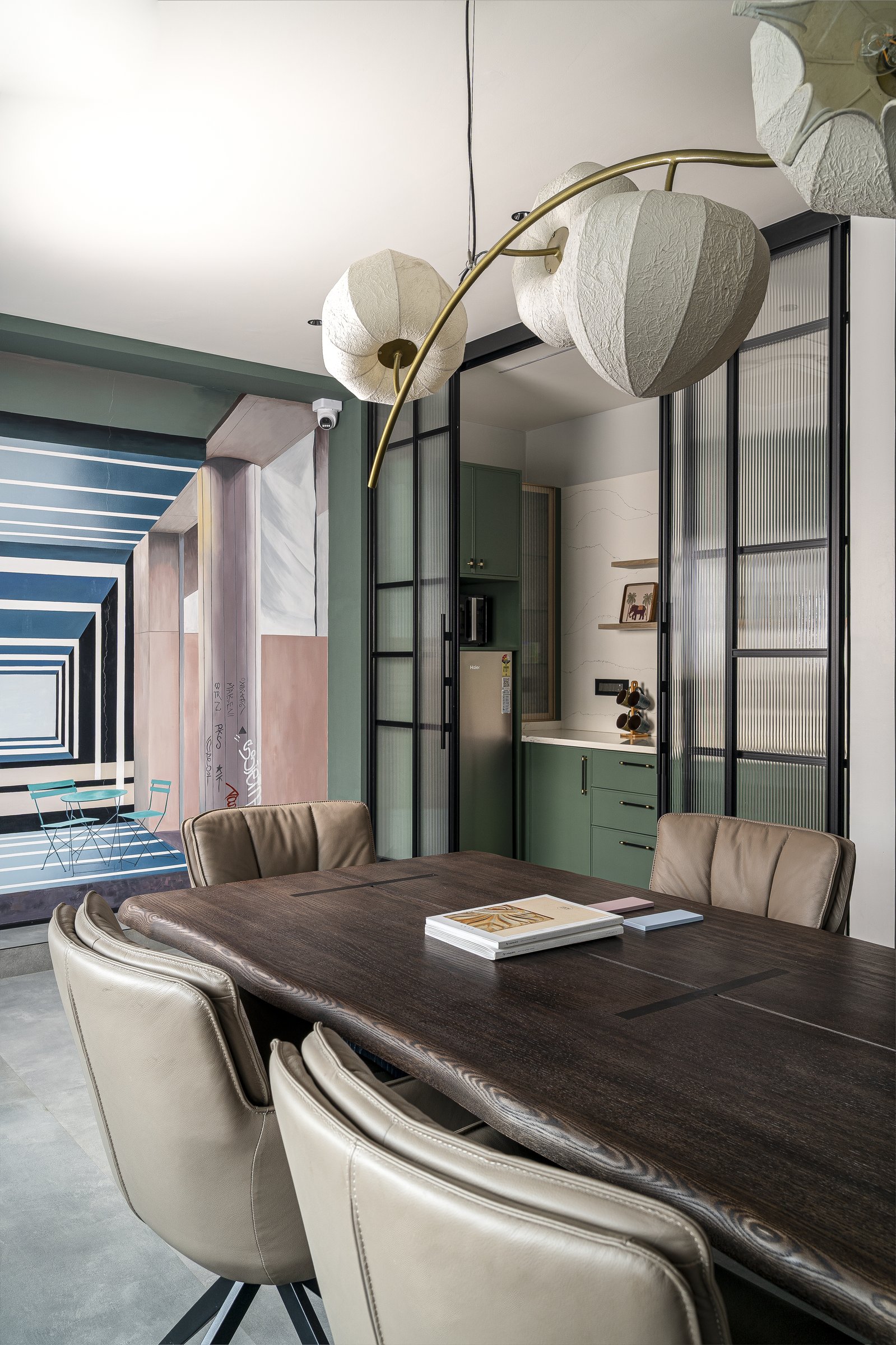
From the meeting table, the pantry reveals itself behind a screen of fluted glass set in black metal framing. The partition is the project’s clearest detail-level argument: that a small support space need not be hidden, only filtered. Through it, sage green cabinetry, a slim countertop, and a glimpse of a powder room read as a composed still life rather than a back-of-house concession.
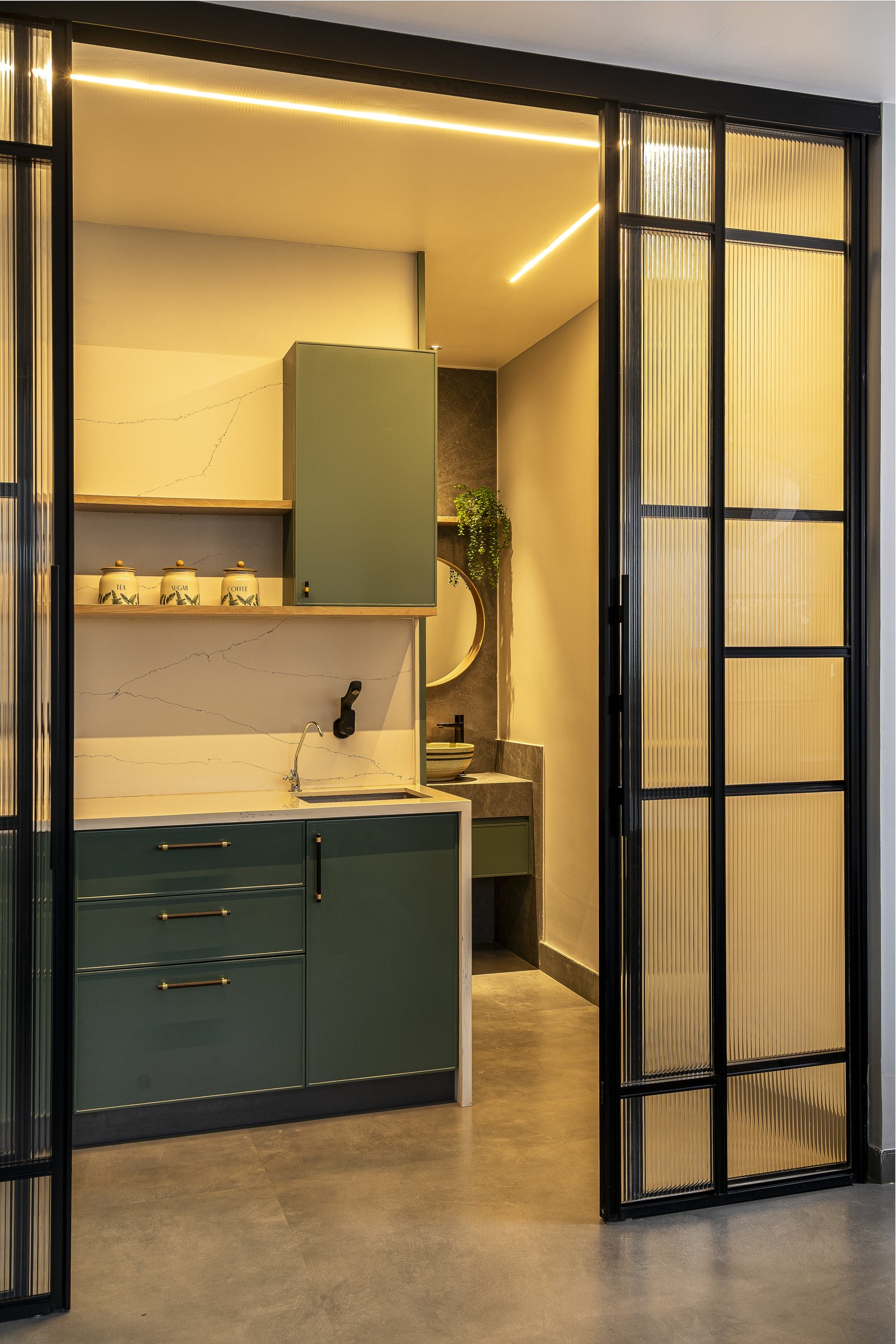
Inside the pantry, the same green carries the cabinetry from floor to upper unit, paired with a veined white stone backsplash and slim brass pulls. A linear cove light traces the ceiling, and a round mirror catches the edge of the adjacent washroom.
The principal cabin moves the studio into a warmer, more residential key. A wall of light wood panelling, ribbed and inset with linen-toned cloth panels, wraps behind a screen-and-desk configuration, while a black marble desktop on a wooden base anchors the room with weight. A large portrait painting in green and chequerboard cream, set against the wood, gives the cabin its emotional centre.
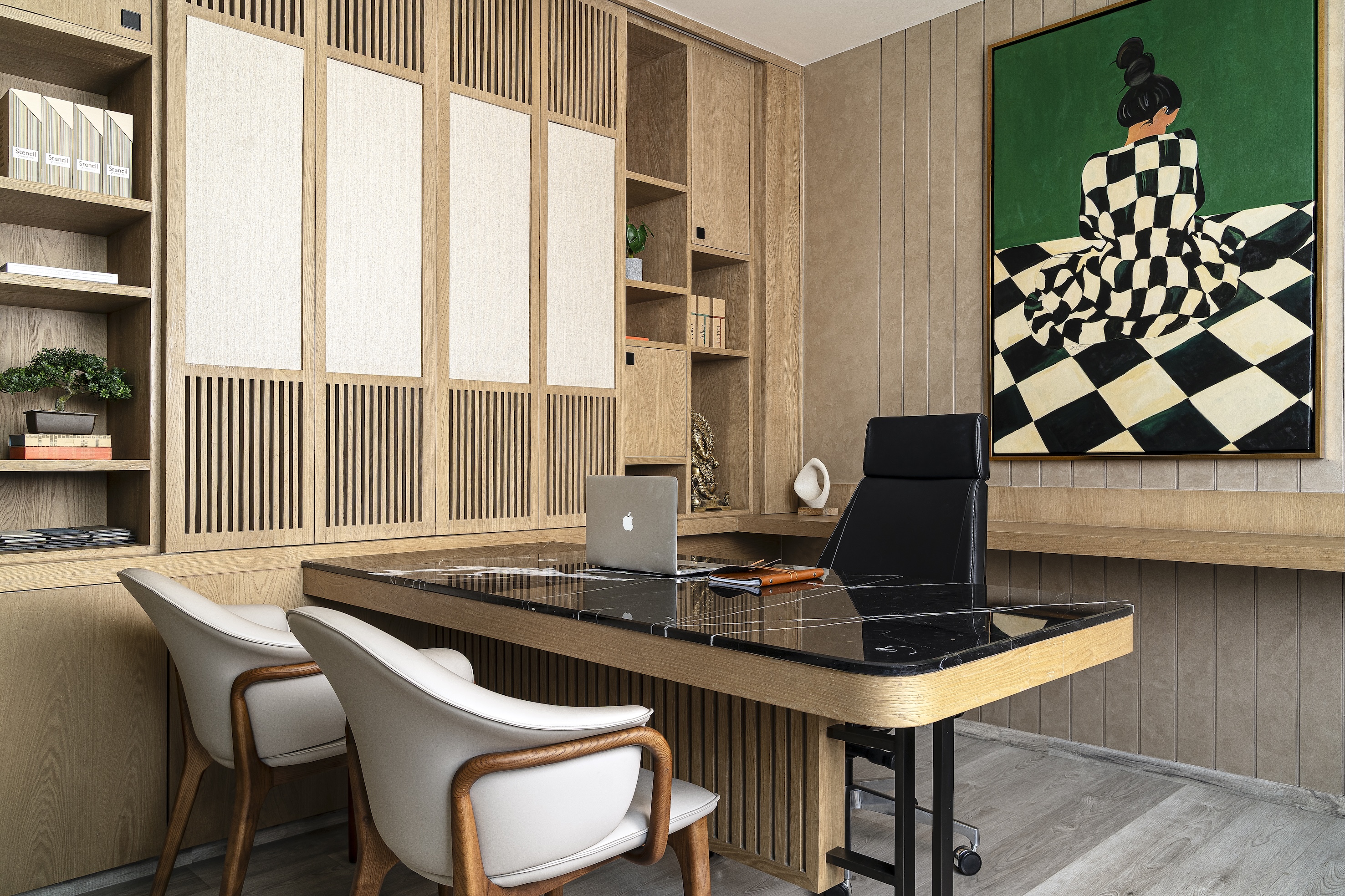
Pulled back, the same room reveals its full library wall: open shelving stacked with material samples and reference books, a slatted cabinet run, and the artwork holding the far corner. The cabin is doing the unglamorous work of any principal’s room, storage, display, focus, and resolving it through a consistent material vocabulary rather than through additional decoration.
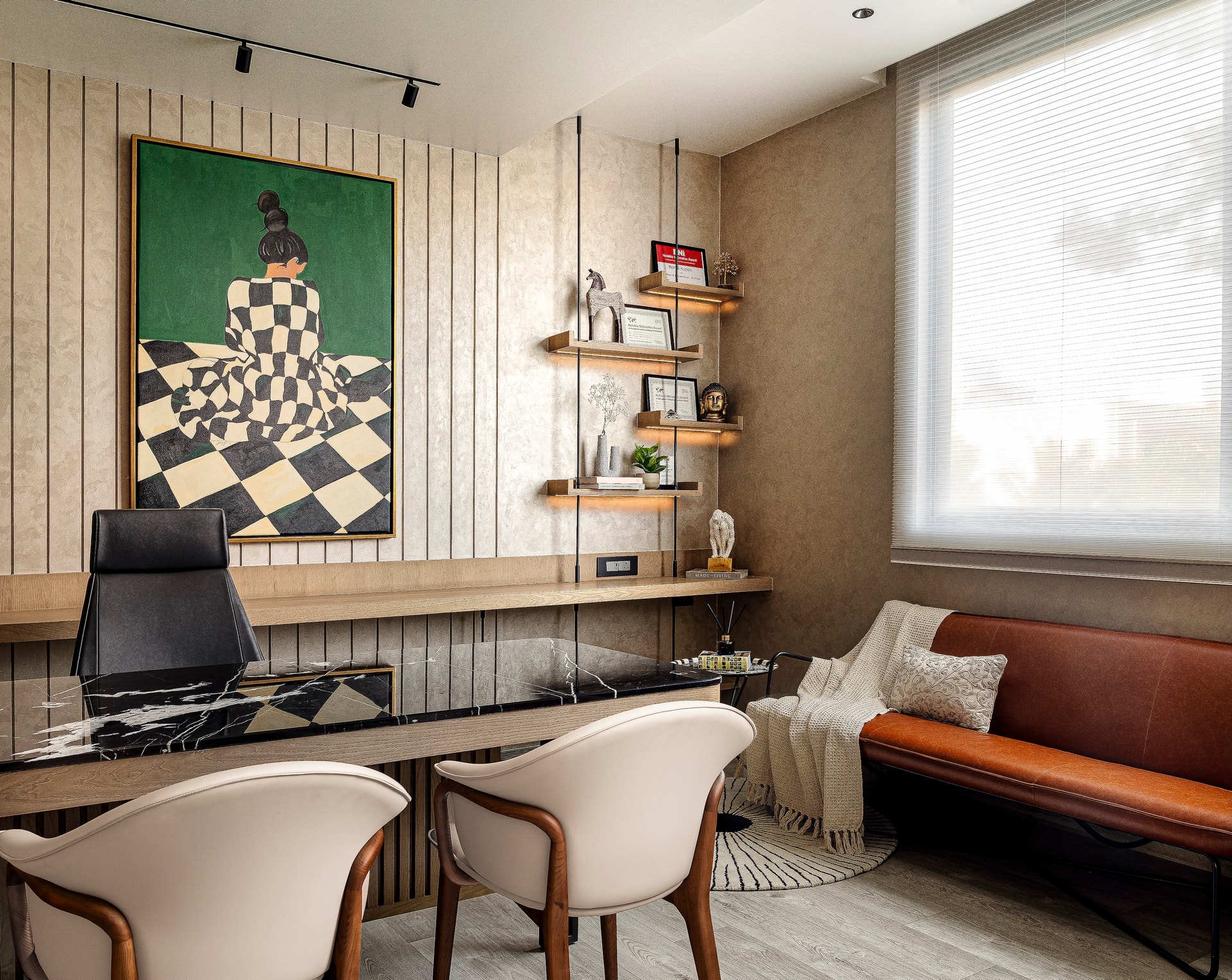
The second cabin takes a softer route. Plaster-finished walls in honeyed beige, fluted wood panelling, and a black marble desk return, but the room introduces a tan leather bench and a small woven rug to suggest a meeting space that can downshift into conversation.
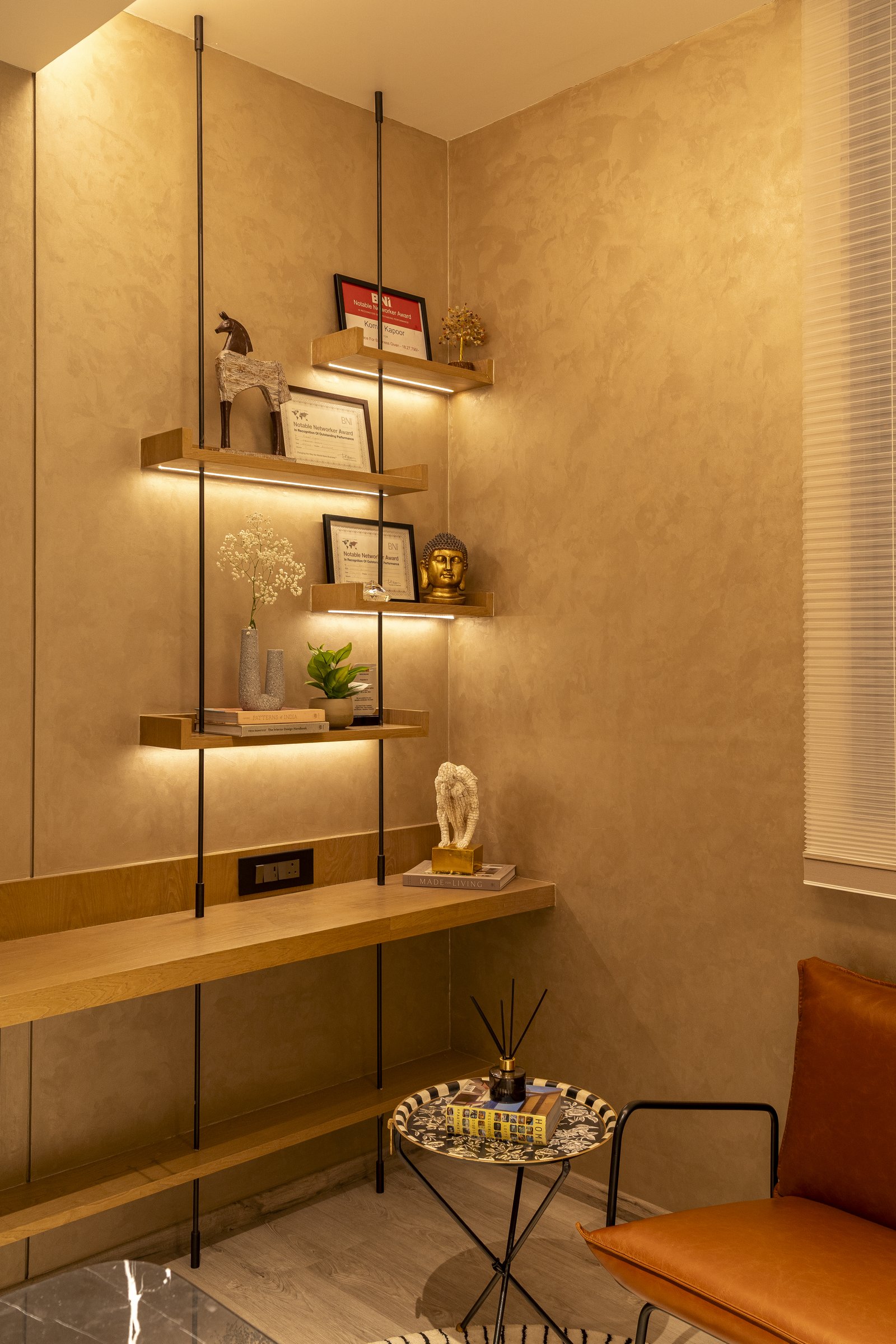
A corner of this cabin holds the studio’s quiet self-portrait: a slender shelving rig of wooden ledges suspended on black steel rods, lit from below, carrying awards, a small Buddha, framed certificates, a brass horse.
Within Bengaluru’s growing landscape of design-led workplaces, Design Cubes Studio sits in a particular register: classical detailing held in restraint, contemporary craft used without irony, and a willingness to treat a working studio as a fully resolved interior rather than a back office. It belongs to a wider shift in Indian design practice, where studios are taking their own spaces seriously as portfolios in three dimensions.
What gives the project its quiet authority is not any single feature, but the consistency of judgement from the threshold tile to the powder room shelf. The studio reads as a space that has been edited, not merely assembled, and that is, in the end, the most useful thing a design practice can say about itself.