A workplace announces its character before a single conversation begins. In offices designed for legacy organisations, that announcement tends to lean toward spectacle, marble lobbies that perform importance, lighting that strains for drama, signage scaled for effect. Project Oak-ay! argues the opposite case: that authority is most convincing when it has nothing to prove.
Set across 10,000 square feet in Okhla, New Delhi, the office was conceived by Design Ethics Studio for the Jaina Group of Companies, a client whose cultural responsibility shaped the project’s restraint. Principal designer Poulomi Dhar, working alongside Jatin Gupta and team, treated the brief less as a corporate fit-out and more as an exercise in atmosphere, where materiality, light, and bespoke detail would do the work that ornament usually does.
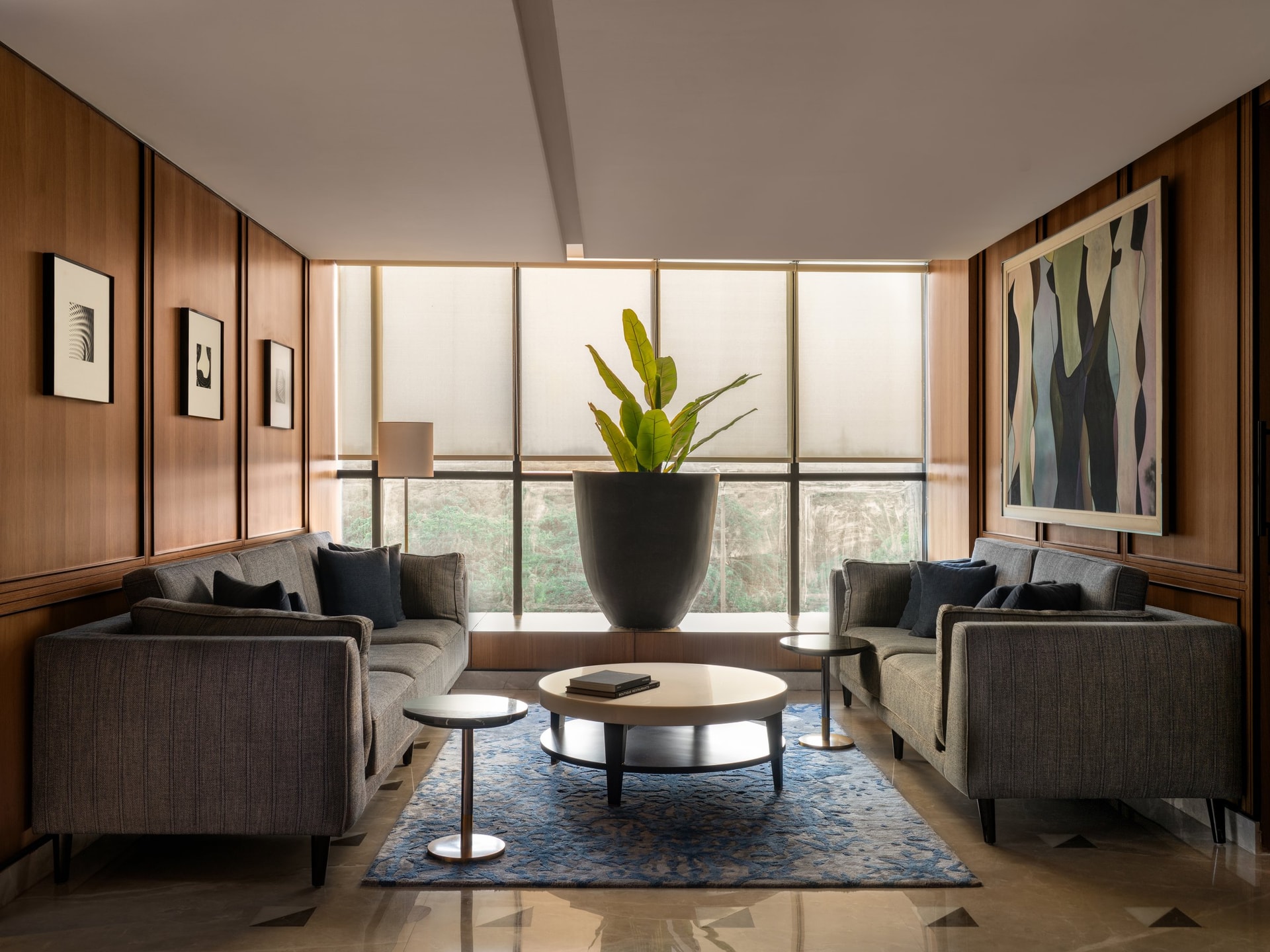
The primary lounge sets the project’s tone with unusual clarity. Two upholstered sofas in a soft, herringbone-textured grey face each other across a low circular table, anchored by a deep blue patterned rug that breaks the warmth of the wood-panelled walls.
The wood panelling here repays close attention. Vertical grooves run floor to ceiling in a steady cadence, giving the room a discreet architectural rhythm against which the abstract artworks read as pauses rather than punctuation. The geometric inlay on the stone floor, small triangles set into a creamy ground, draws the eye forward without theatre.
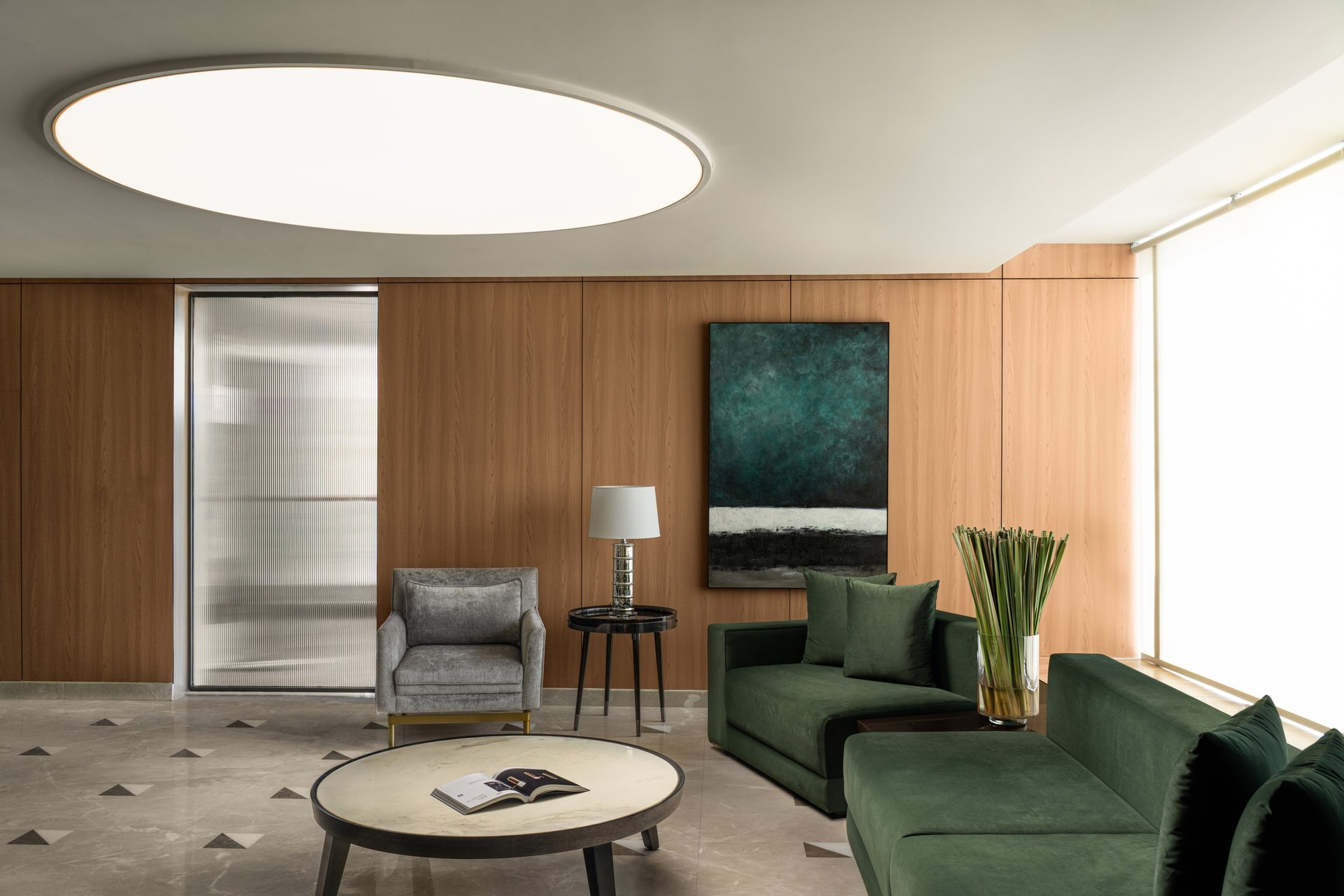
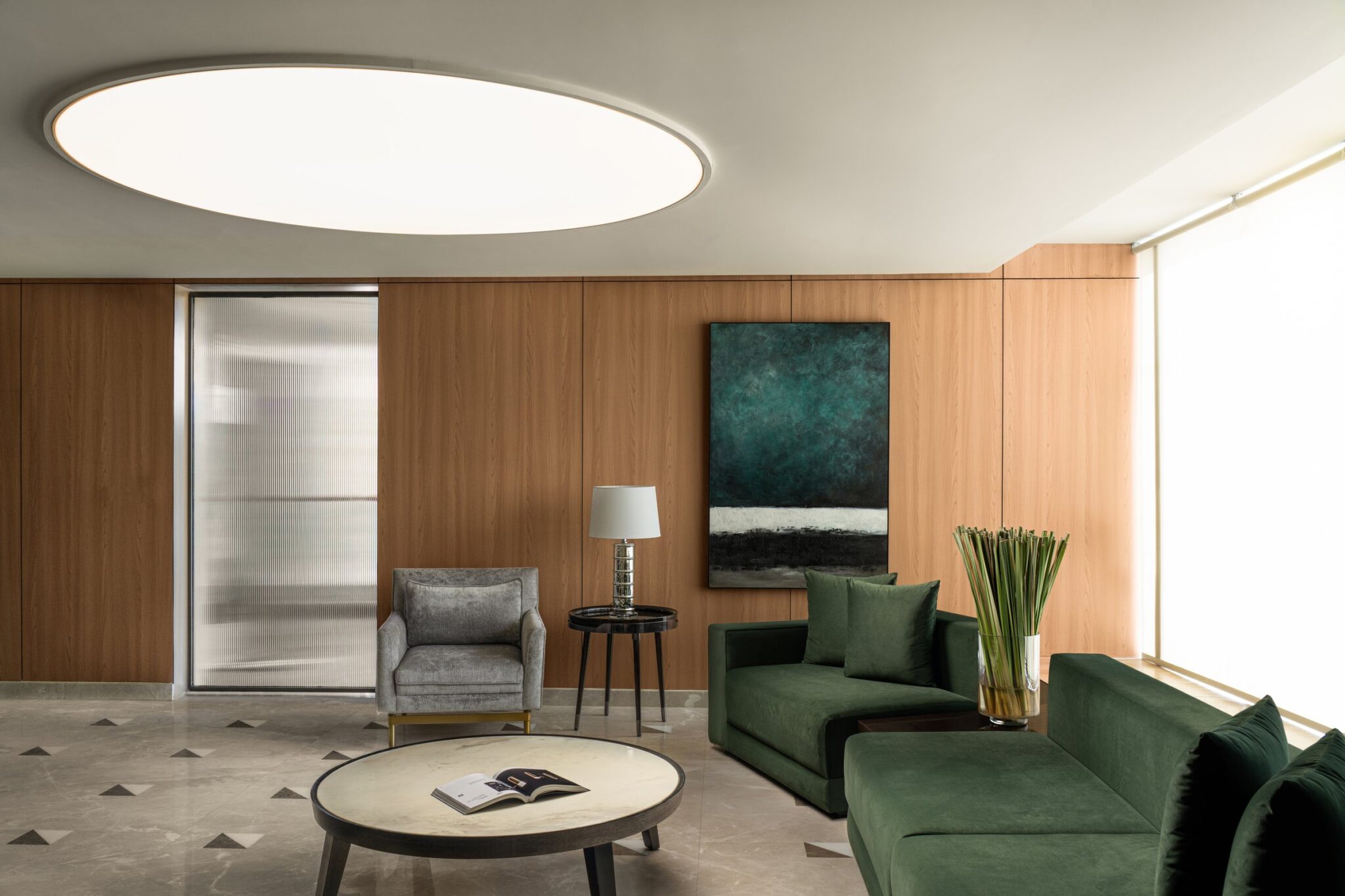
A second lounge zone reveals the project’s lighting logic in its most distilled form. A vast circular luminous plane hovers overhead, behaving less like a fixture than a piece of architecture, a sky engineered into the ceiling to compensate for the building’s limited daylight. It pools an even, hospitable glow across the room without naming its source.
““The aim was to create and compose furniture that feels indigenous to the space. Nothing should appear transplanted.””
Against the wood-panelled backdrop, deep green velvet seating introduces the project’s only fully saturated note, paired with a single grey accent chair and a moody, horizon-line canvas that holds the wall with quiet confidence. The reeded glass door to the left filters light without surrendering privacy, one of the project’s recurring strategies for permeability.
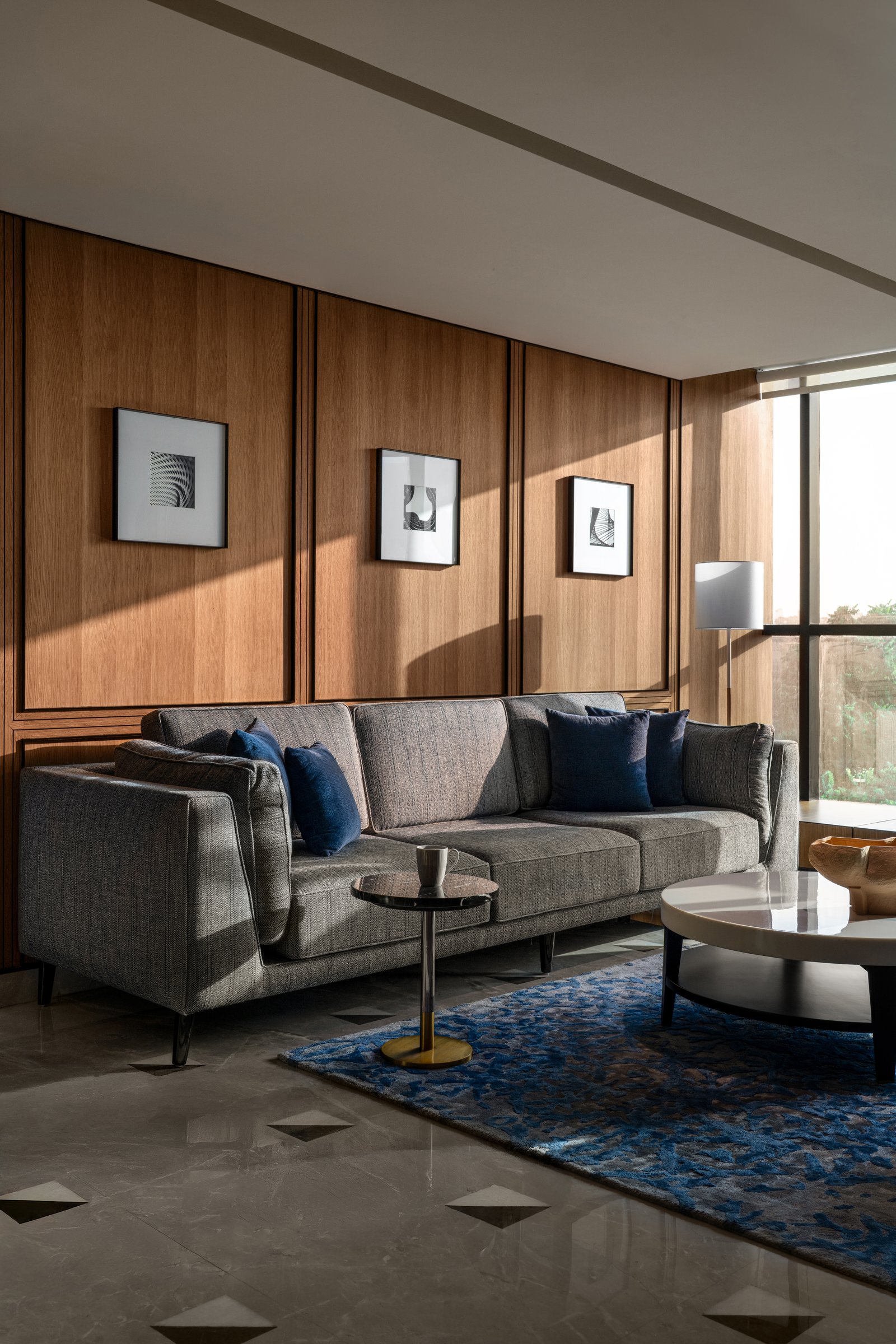
Closer in, the same lounge reveals how carefully its details have been calibrated. A long sofa in textured grey sits beneath a triptych of small framed works, the spacing precise enough to read as architectural punctuation rather than decoration. Late afternoon light falls in soft diagonals across the panelling, animating what would otherwise be a static surface.
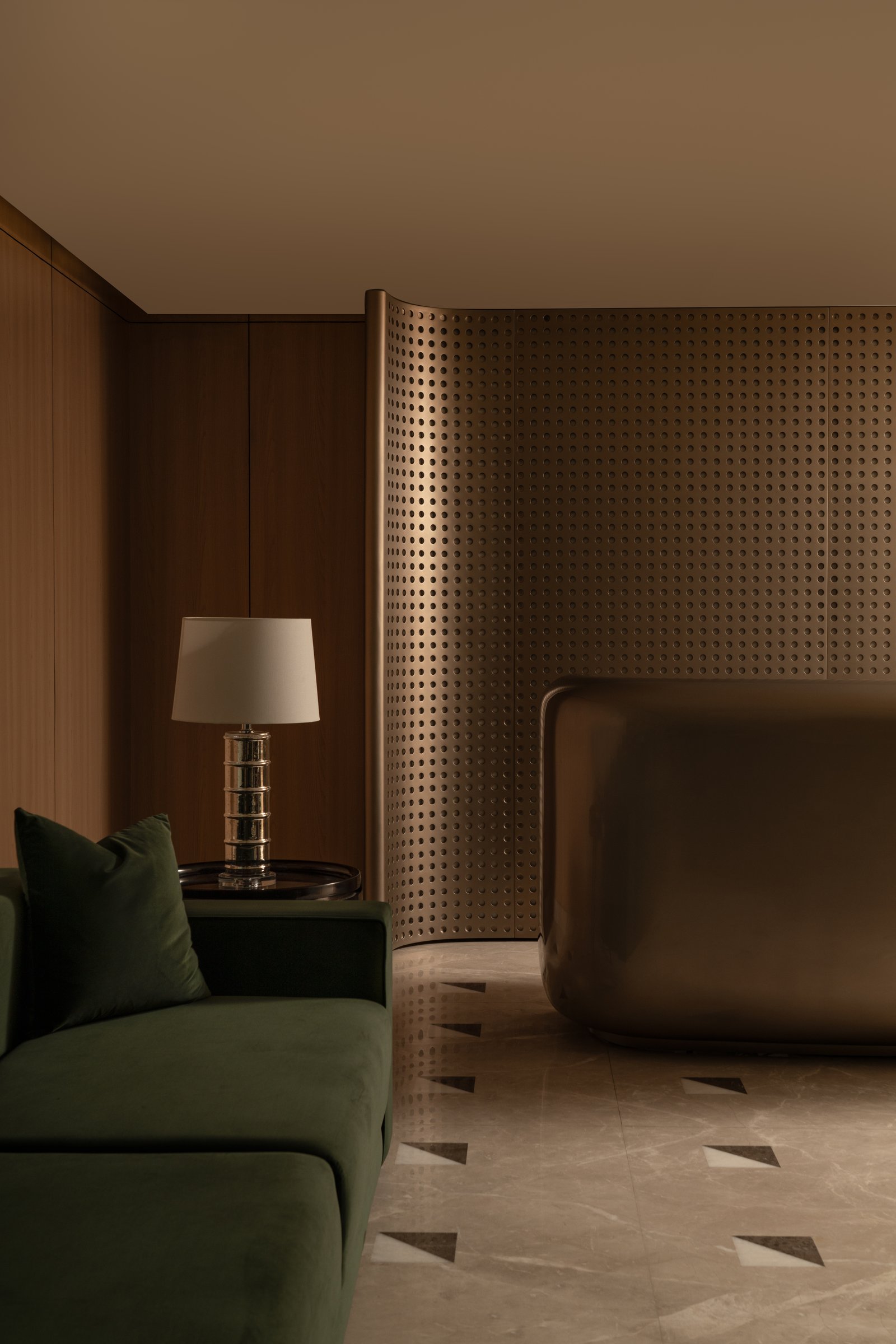
The reception desk is where the project’s material intelligence becomes most explicit. A curved bronze-toned screen, perforated in a regular grid, wraps behind a solid metal counter whose burnished surface catches the room’s low light like a held breath. The screen does the work of a partition without enclosing; it filters, suggests, withholds.
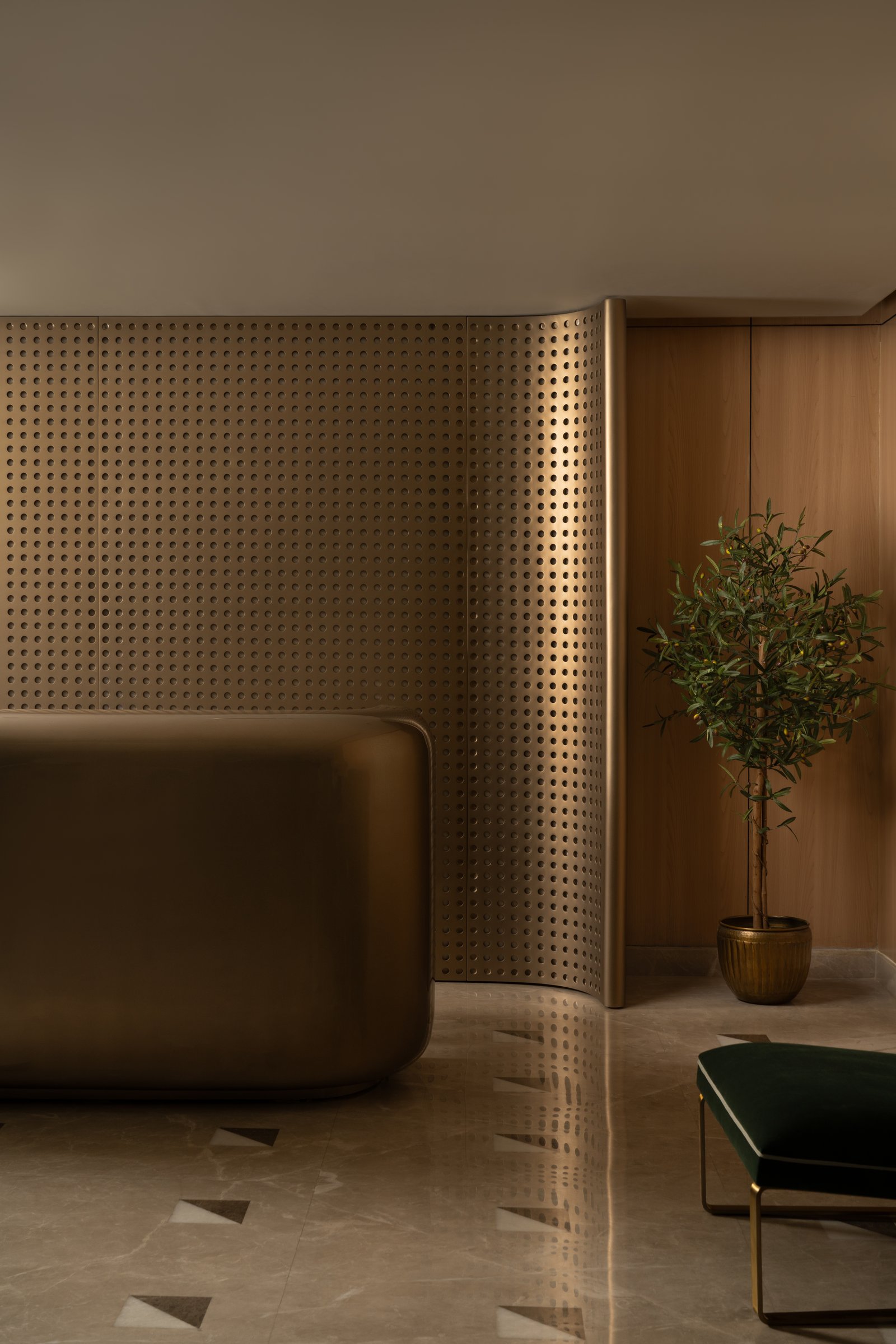
Seen alone, the perforated screen reads almost as sculpture. A small olive tree in a brass-toned planter sits beside it, the only living gesture in an otherwise wholly composed scene, and the contrast between the engineered geometry of the metal and the soft irregularity of the foliage is the room’s quiet argument: precision and life, not in tension but in deliberate company.
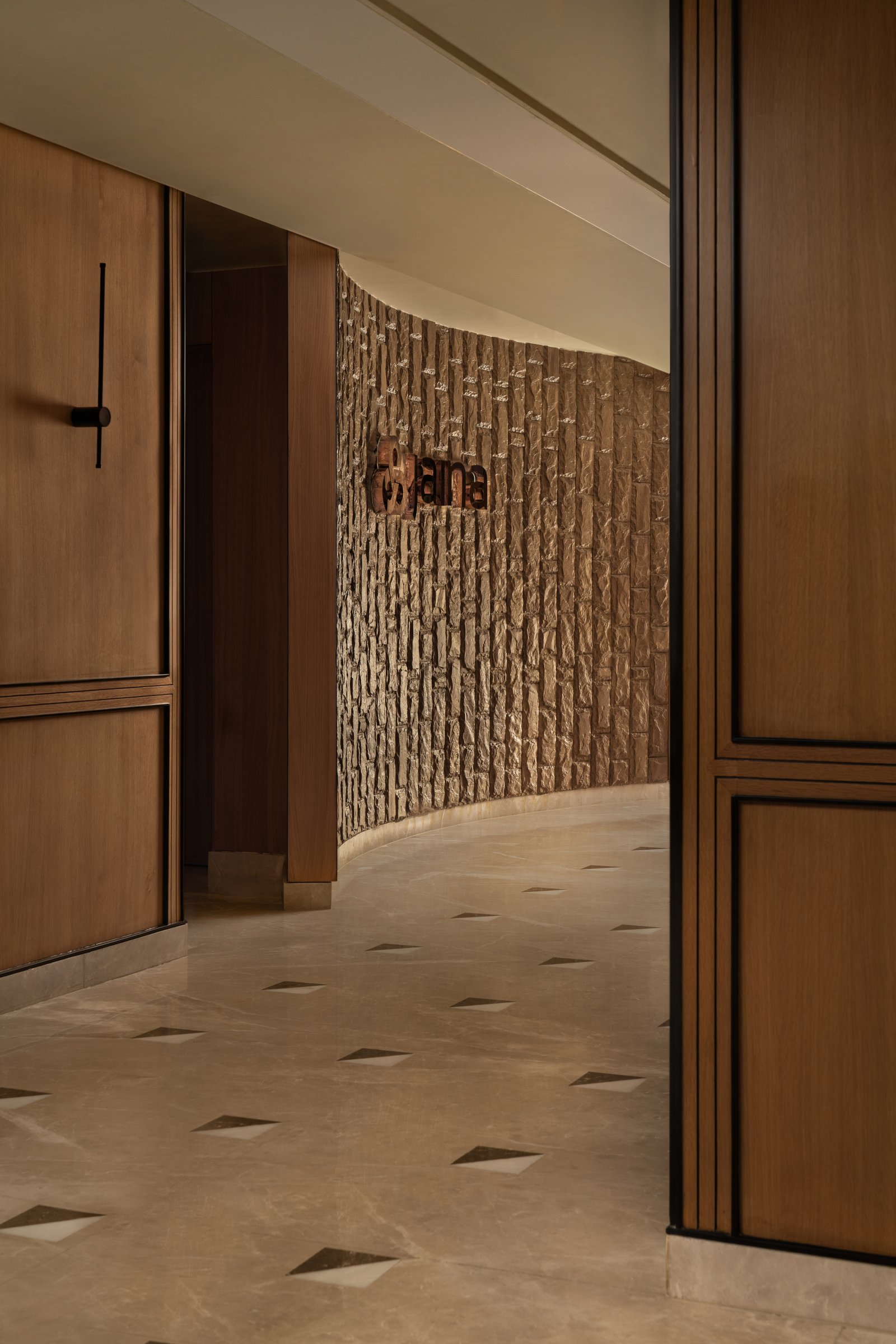
The curved stone wall behind the reception, textured in a stacked, hand-chiselled pattern, holds the organisation’s insignia in raised bronze lettering. The form eases circulation rather than blocking it, and the rough stone surface establishes a material vocabulary, crafted, tactile, unhurried, that the rest of the office will continue to translate.
The Spine
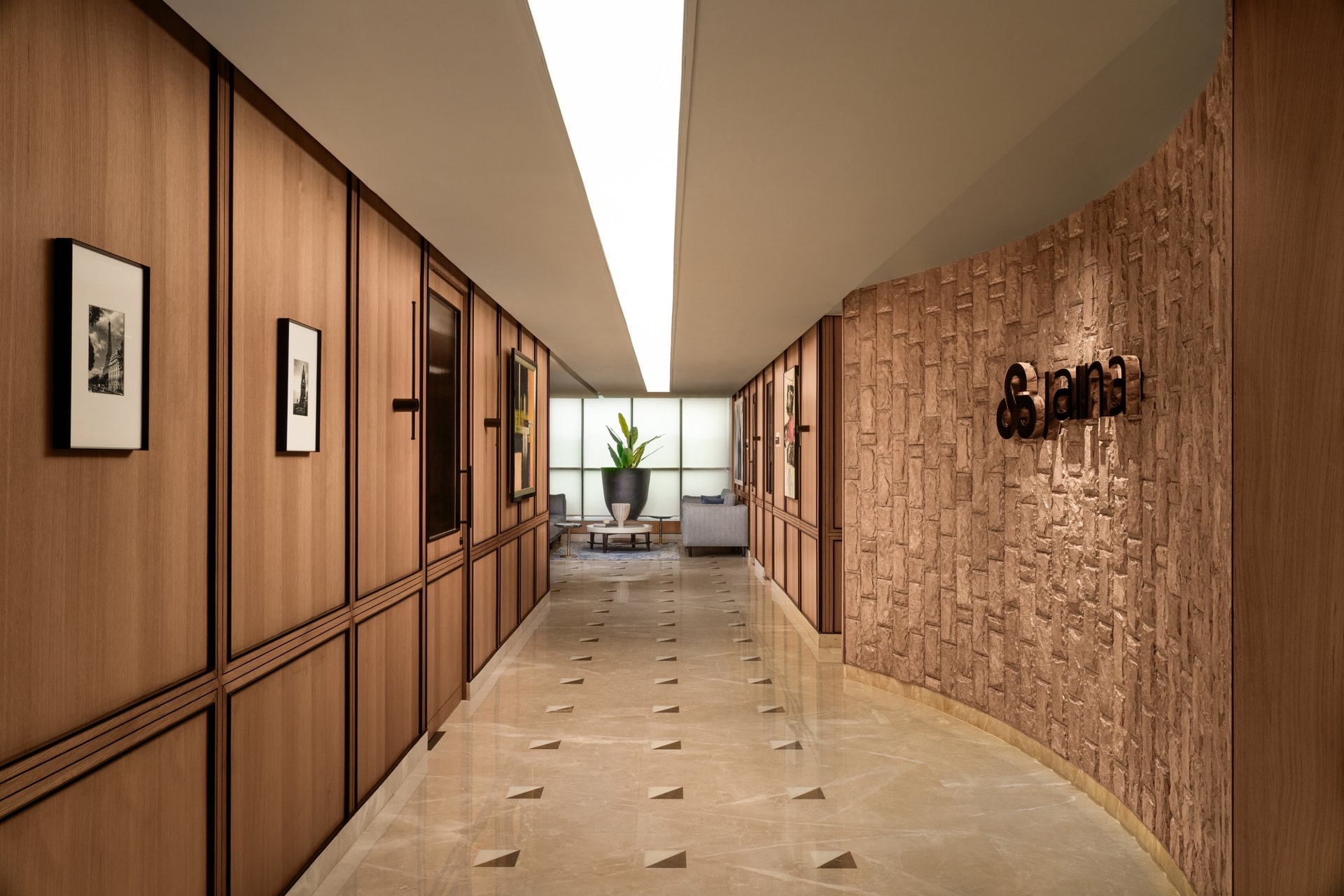
The central corridor functions as the office’s organising spine. Vertical wood panelling, framed in slim recessed reveals, runs the length of one wall, while the textured stone surface curves away to the right, drawing the eye toward the lounge visible at the corridor’s end. The floor’s geometric inlay introduces directionality without instruction.
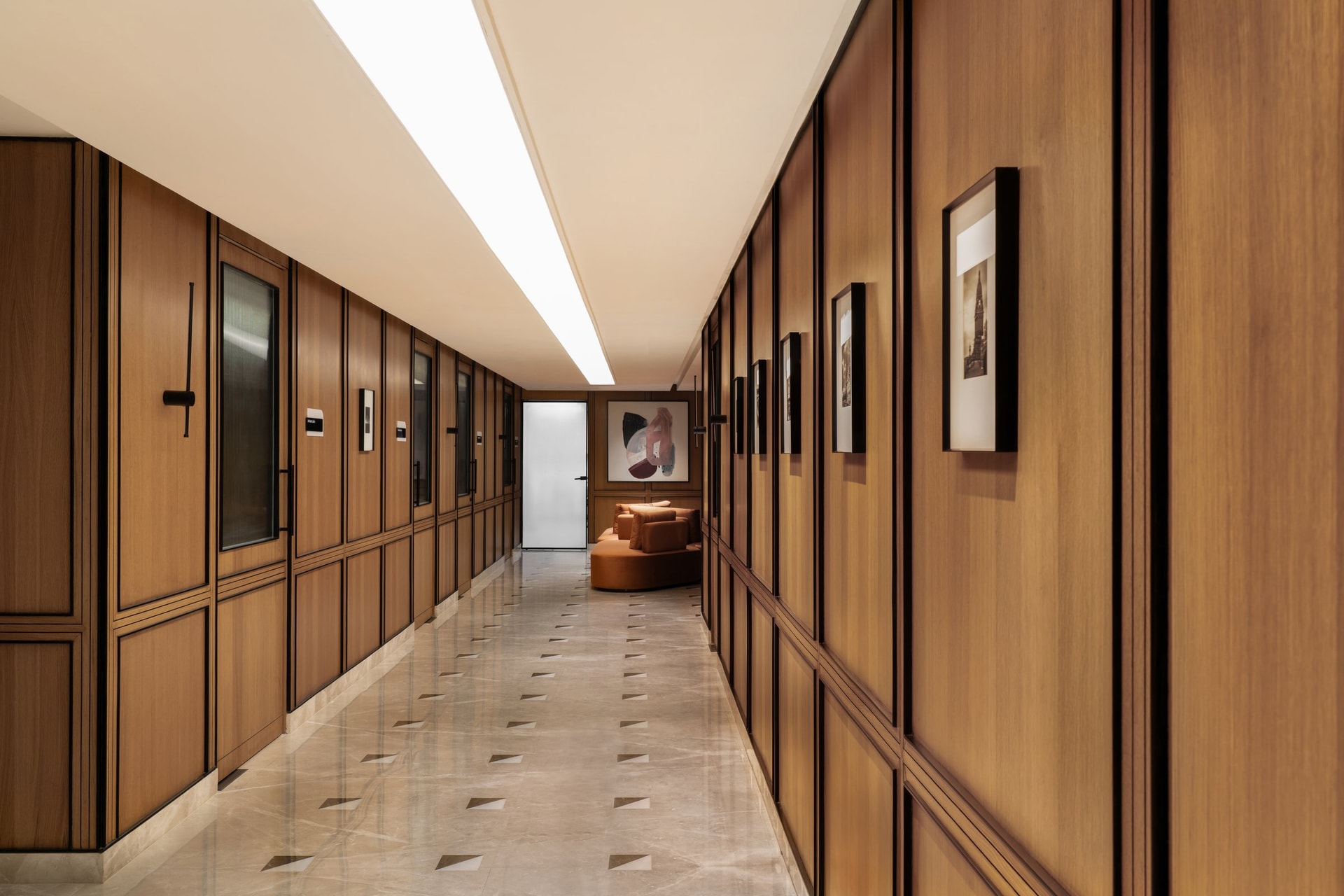
Further along, the corridor takes on the character of a private gallery. Framed photographs and artworks punctuate the wood panels at regular intervals, and a recessed luminous strip in the ceiling washes the passage in a steady, even light. A rust-orange curved sofa waits at the far end, the single warm punctuation in a long composition of browns and creams.
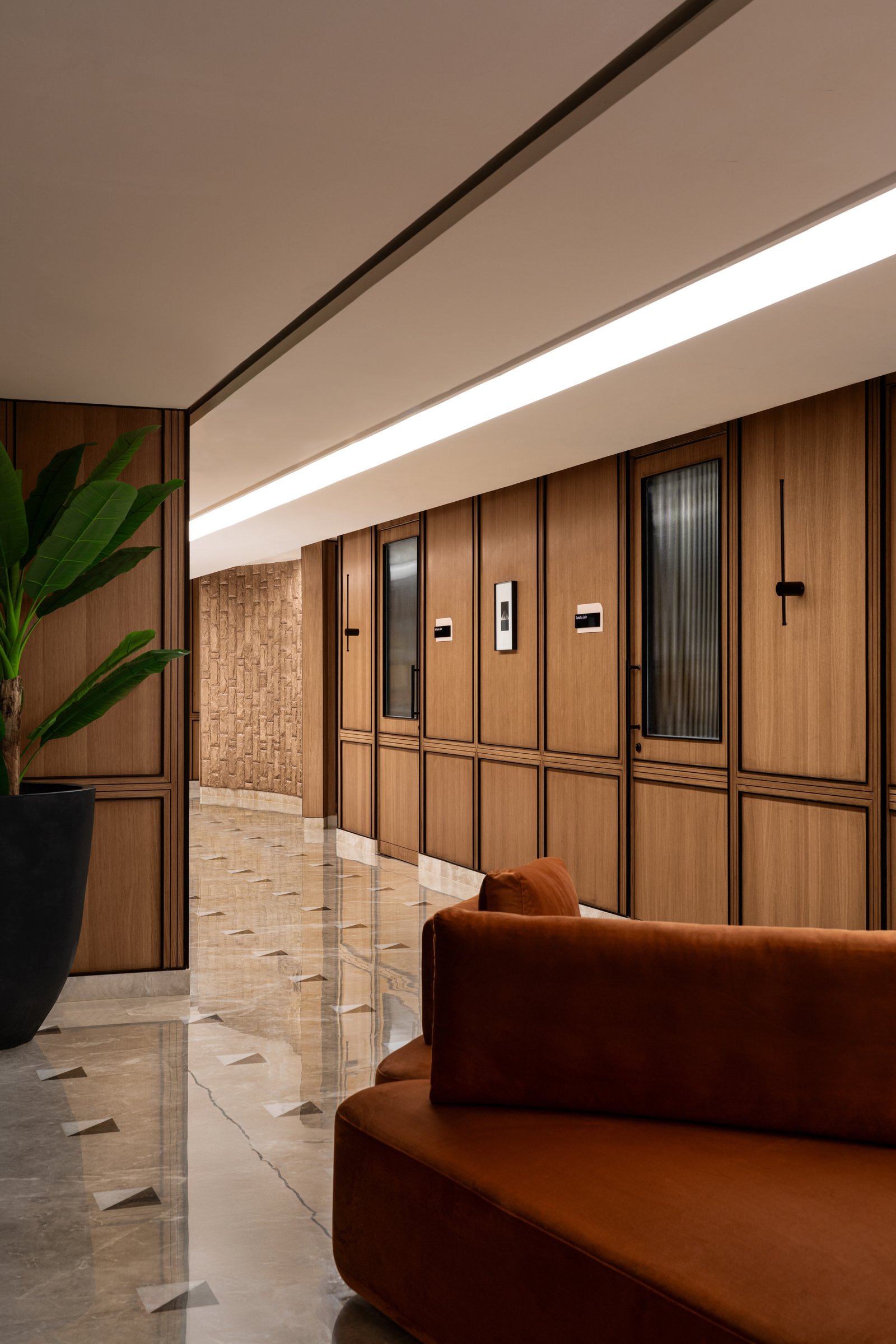
The same passage, viewed from the opposite direction, shows how the lighting strategy holds the space together. A continuous linear fixture runs overhead, eliminating the harsh contrast that fluorescent troffers would impose, while the panelled doors of the enclosed offices, set flush with the wall, dissolve into the larger surface rather than interrupting it.
Rooms of Quiet Authority
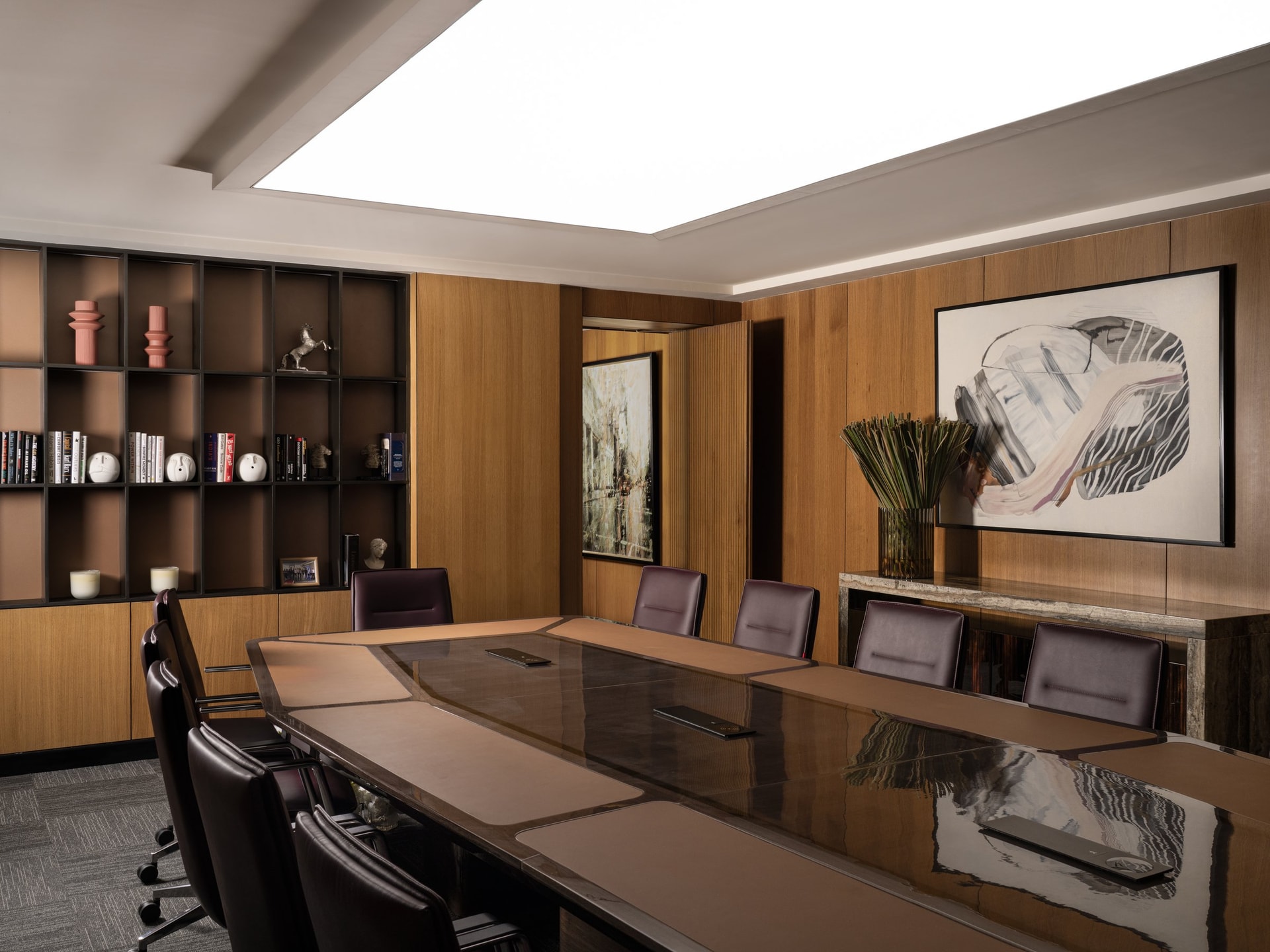
The principal boardroom resolves into a study of considered restraint. A long table with an inset leather working surface anchors the room, surrounded by tall-backed chairs in a deep aubergine that reads almost black against the wood. The luminous ceiling plane returns here, a soft rectangle of light that fills the room without naming its source.
On one wall, a deep grid of open shelving in matte black holds books and a curated set of objects with the discipline of a museum vitrine. Two large artworks frame the room’s longer axis, and a console below one of them carries a single gestural arrangement of dried stems. The room is generous without being demonstrative.
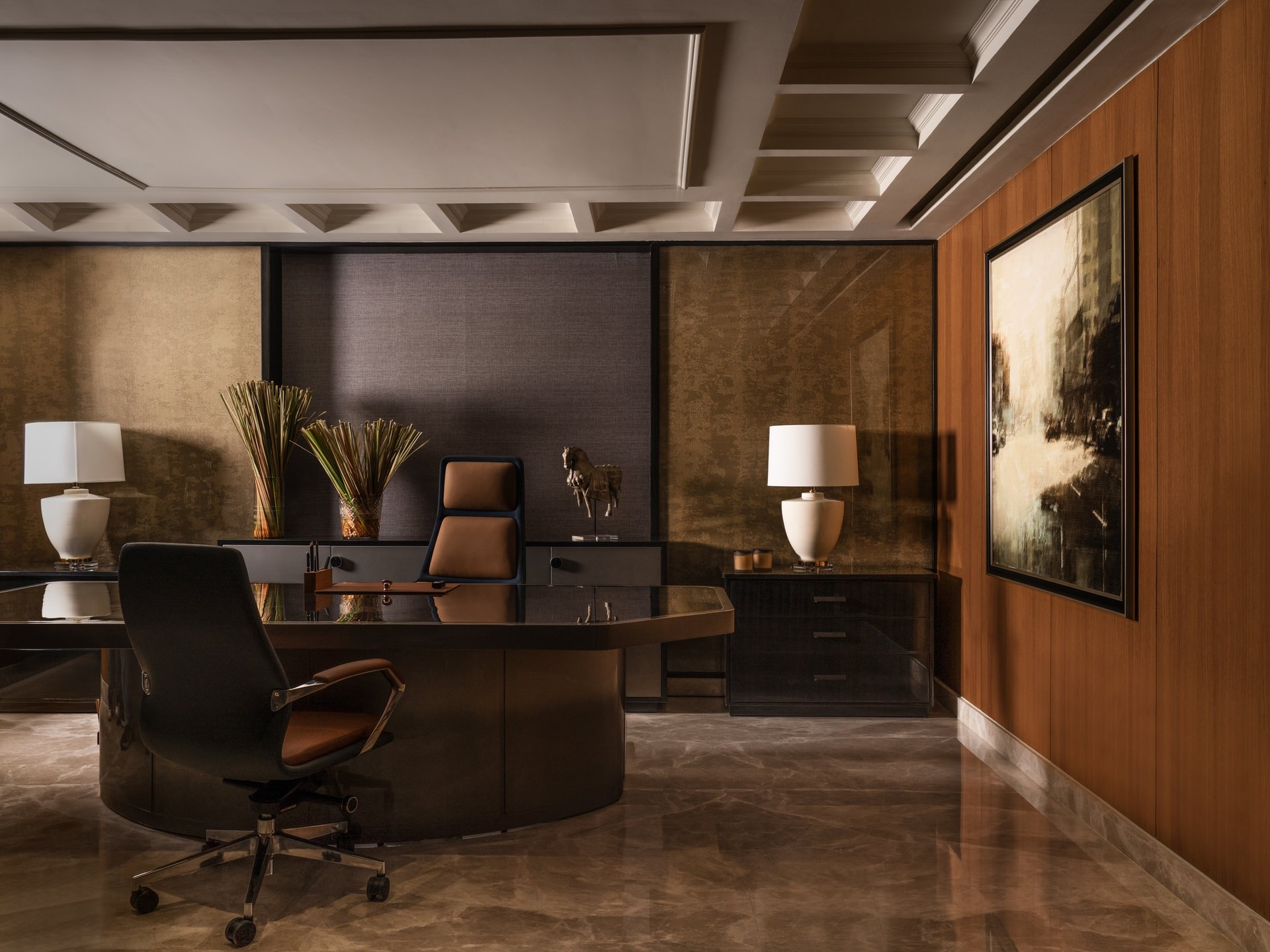
The principal’s cabin pushes the palette further toward intimacy. A coffered ceiling, layered in soft beige tones, sits above wall panels finished in an aged gold-leaf treatment, framing a central upholstered headboard wall in deep grey. The desk itself, a curved volume in dark veneer with a glass top, rounds the room rather than confronting it.
Working Surfaces
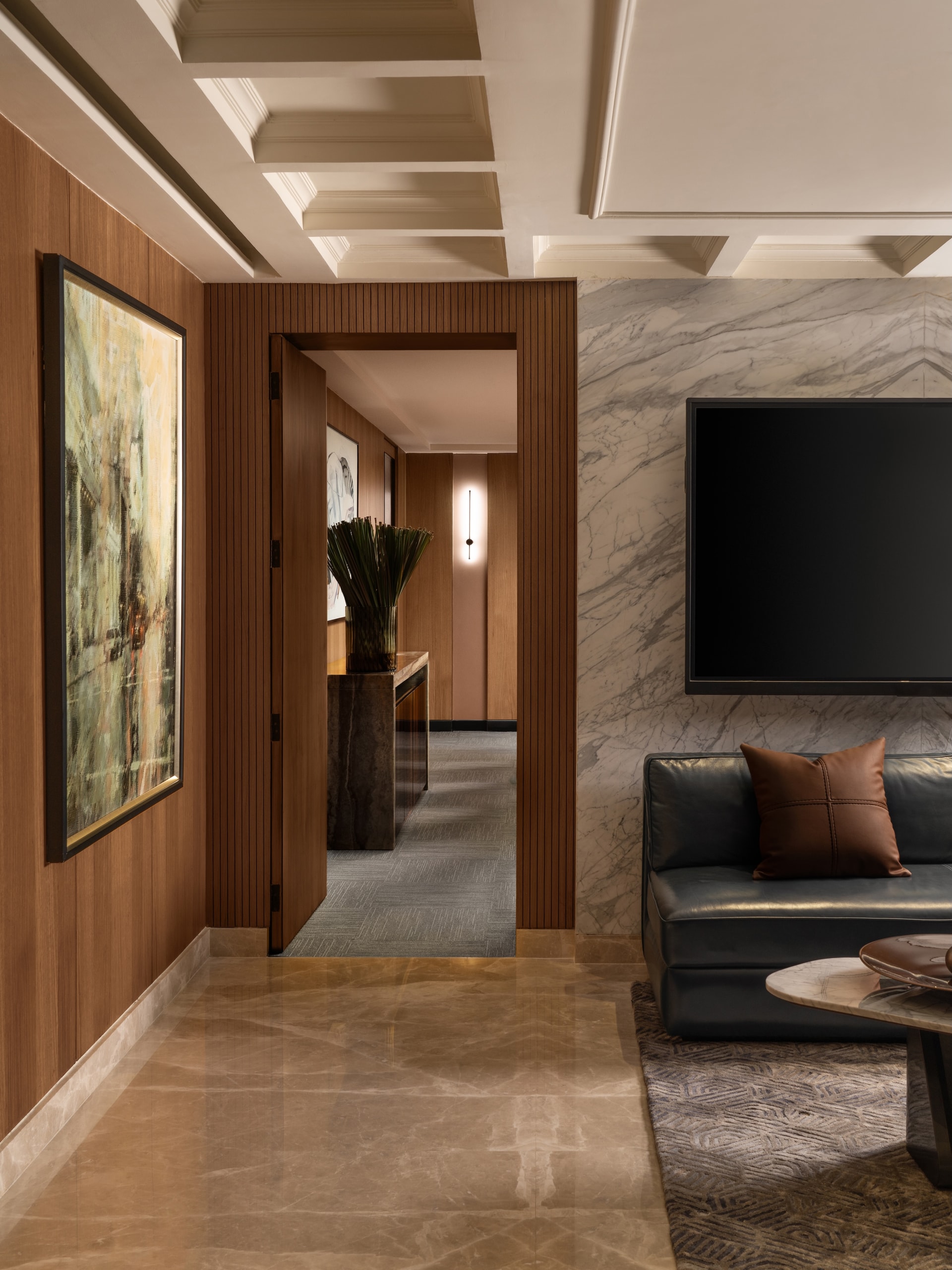
An informal meeting lounge introduces the project’s only veined-stone moment, a wall of book-matched marble framing a wall-mounted screen, paired with a low dark leather sofa. The coffered ceiling above, painted in a soft taupe that catches the cove lighting, gives the room a hospitality register that the brief had begun to seek out as the design progressed.
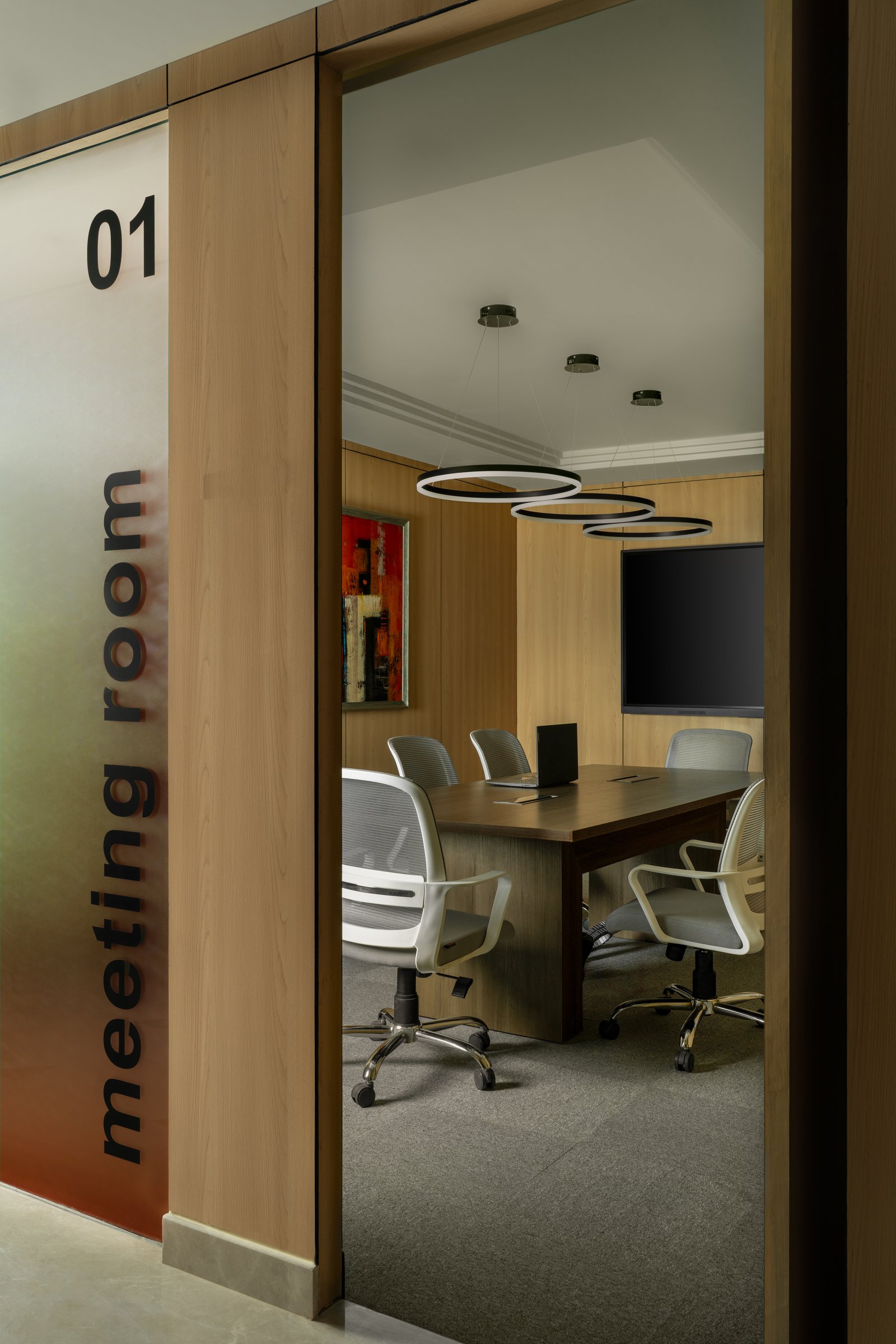
The general meeting rooms are deliberately quieter. Glass partitions etched with simple signage, 01 meeting room, in clean lowercase, mark each room’s threshold, and inside, mesh-backed task chairs gather around modest wood-veneer tables. A trio of slim ring pendants hangs overhead, the only sculptural gesture in an otherwise resolutely functional space.
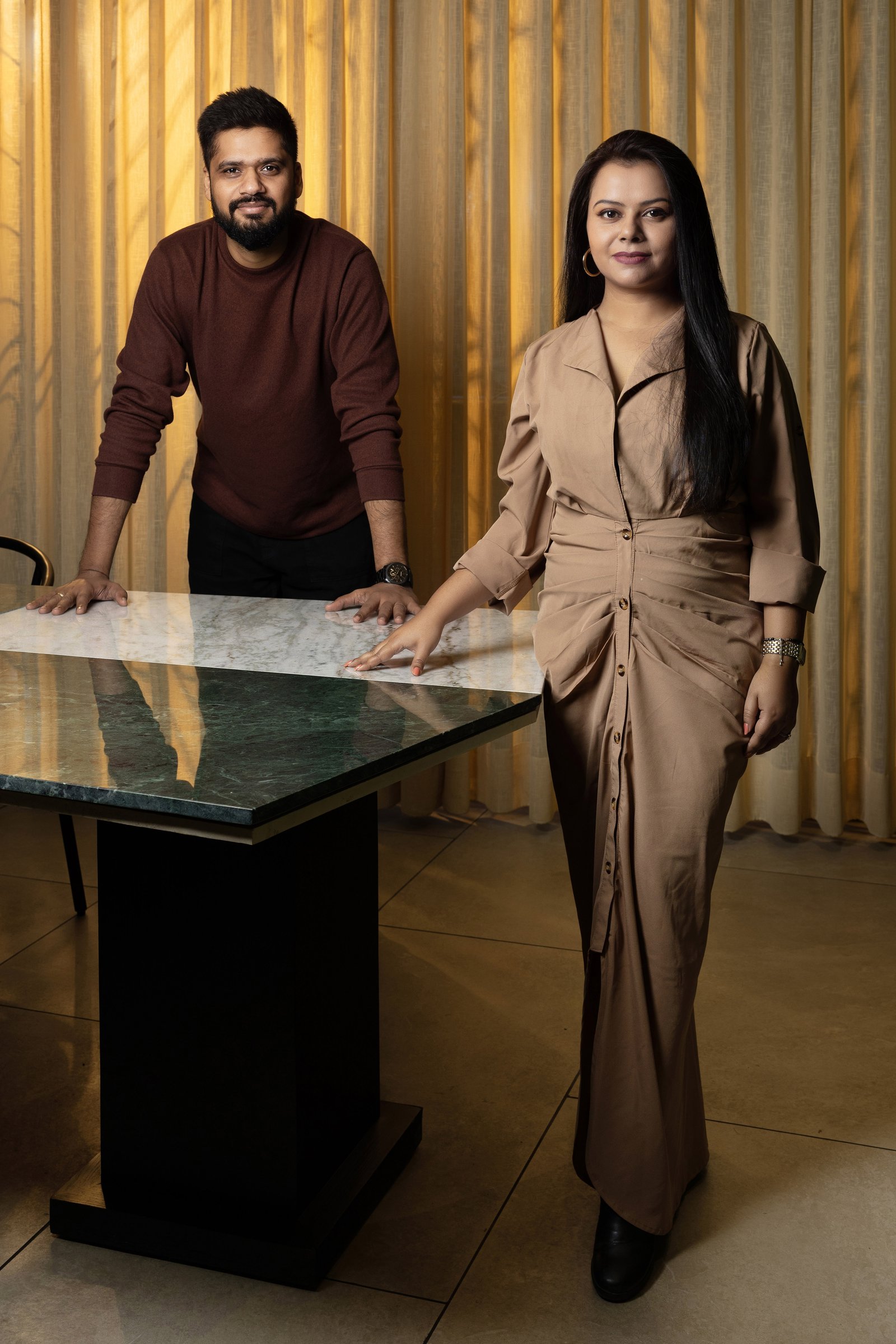
The project is the work of Poulomi Dhar and Jatin Gupta, whose studio Design Ethics has spent the last several years building a practice grounded in measured, craft-led commercial interiors. Their willingness to let a workplace feel like a place of hospitality rather than display, of slow craft rather than corporate signal, sits at the centre of this project’s success.
What Project Oak-ay! proposes, finally without grand claim, is that the contemporary Indian workplace has earned the right to a different vocabulary. The office no longer needs to announce its ambition through scale or polish; it can do so through proportion, through the calibration of light, through the discipline of a single material decision held across ten thousand square feet. The argument is quiet, and it carries.