The contemporary office has been written about so often that the brief no longer needs introduction: open, flexible, collaborative, wellbeing-oriented. What matters now is whether a workplace can actually argue for those values in material form, or whether it simply repeats them as decor. Few typologies test this more honestly than the research and development facility, where the romance of the laboratory tends to absorb all the design oxygen, leaving the people who run the experiments to inherit the leftover square footage.
Beyond the Lab, a roughly 17,000-square-foot R&D facility in Thane designed by Studio27 under principal designer Rashi Vora, refuses that hierarchy. The project splits its plan into two interconnected halves, a high-performance lab on one side and a full workplace on the other, and treats the second half with the same intent the first usually monopolises. The result is a workplace conceived as a destination, where structure is loosened by moments of ease and the scientist’s daily rhythm becomes the unit of design.
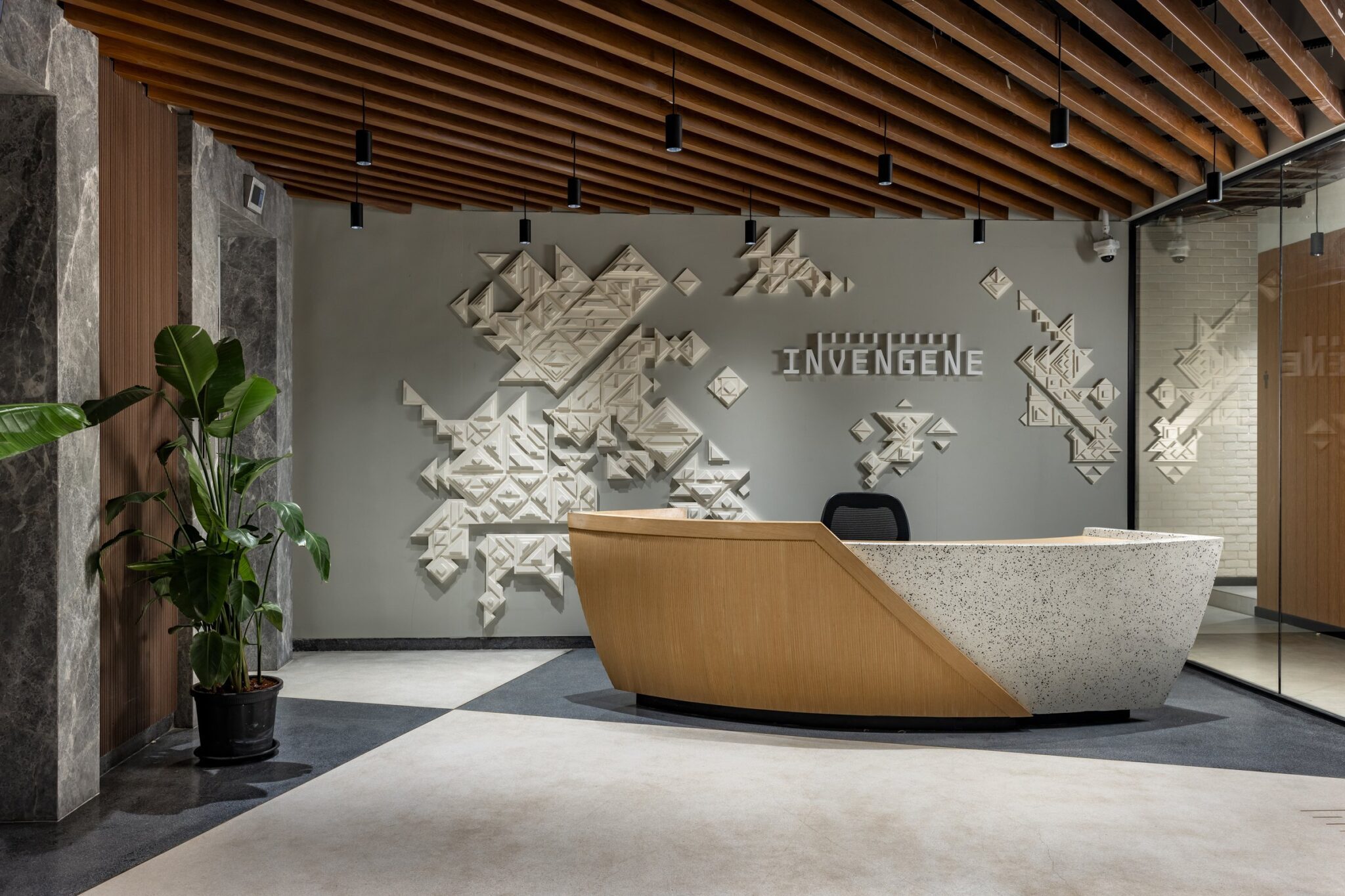
The reception sets the tone with an unexpected register of craft. A sculpted desk in pale wood and speckled terrazzo sits beneath a slatted ceiling, against a wall of pixelated geometric reliefs that read almost like a pattern language printed in three dimensions.
The geometry on the feature wall does much of the spatial argument. It signals that this is a research-led company without resorting to laboratory iconography, and it lets the lobby behave as a piece of design rather than a holding area for visitors.
The Grammar of the Threshold
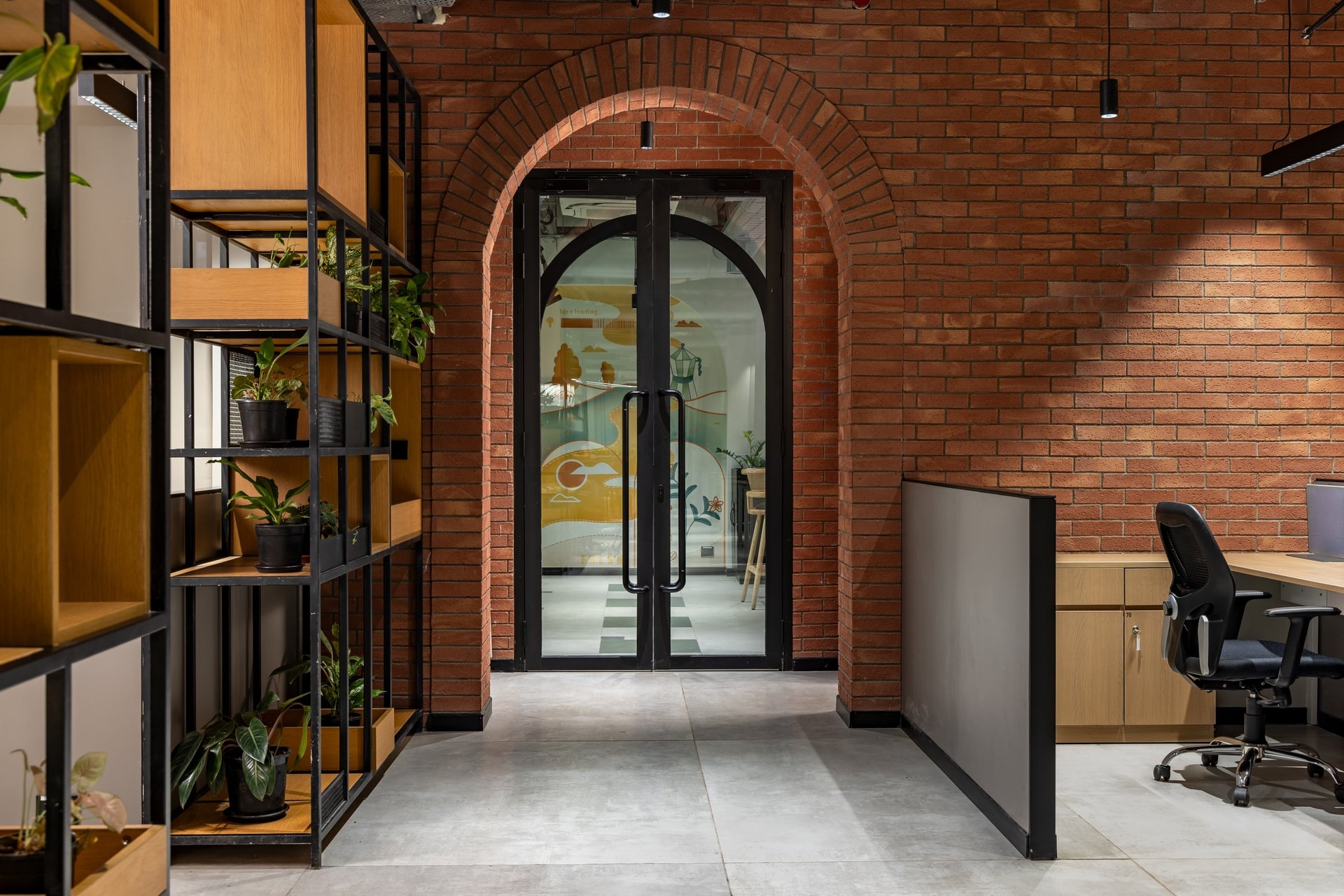
Deeper into the plan, a red-brick archway frames the passage from the open workspace toward an inner meeting room. The arch is treated as a real piece of masonry, not a stuck-on motif, and the moment of crossing through it is the building’s clearest gesture of mood-change. On one side, work; on the other, something that approaches hospitality.
A tall shelving system in blackened metal and wood, planted generously, runs alongside the arch and softens the transition. The threshold does not announce itself as a feature, it simply makes the shift in atmosphere feel earned.
Where Focus Lives
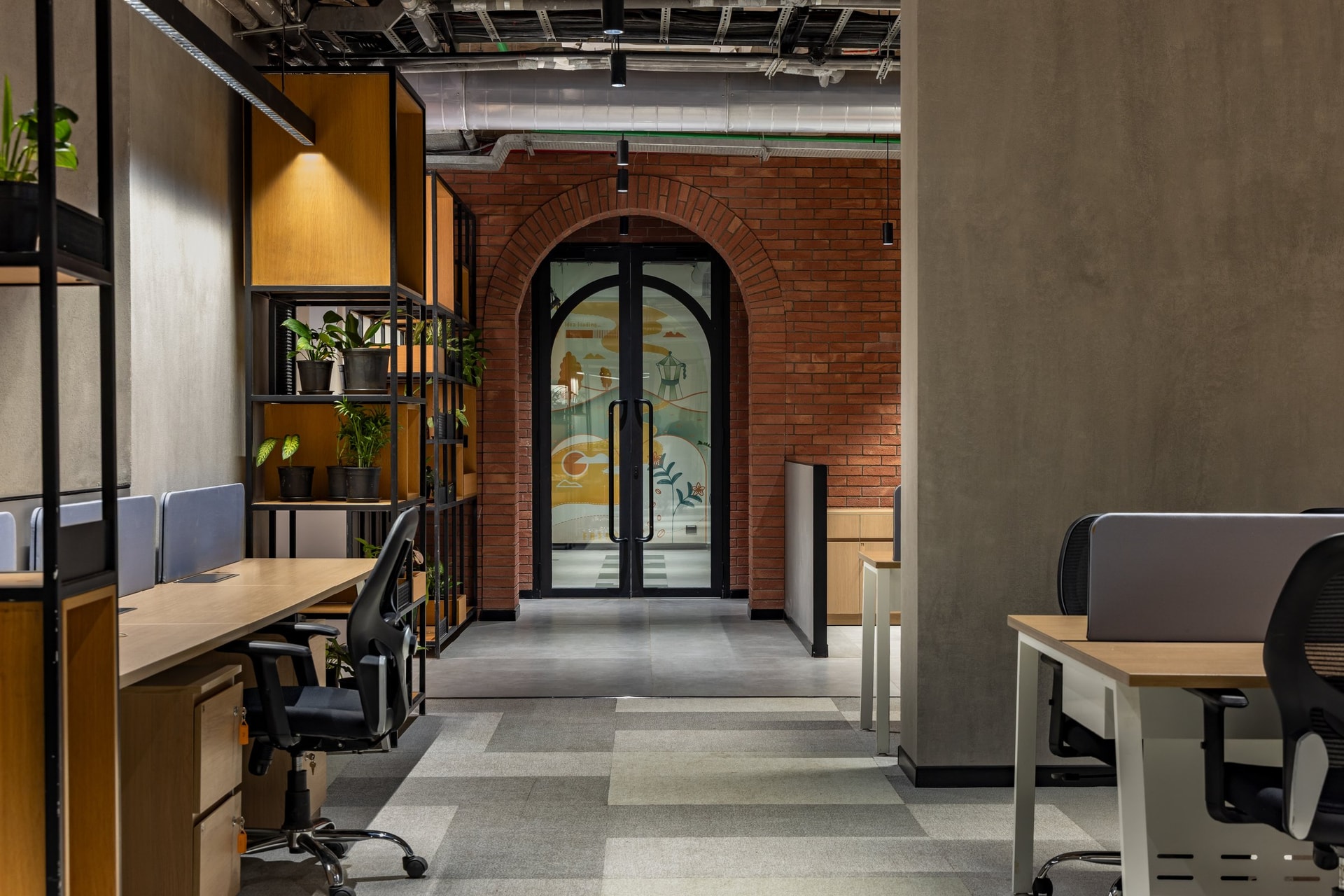
The open workspace is where the project’s human-centric language is tested most rigorously. Desks are arranged to draw in daylight, ceilings are left exposed with their services on view, and the brick arch reappears at the far end as a visual anchor that keeps the long floorplate legible.
The decision to leave ducts, trays and conduits visible is not industrial styling for its own sake. It gives the workspace honesty about what it is, a research facility, while the wooden joinery and planted shelving introduce the warmth that keeps it from feeling clinical.
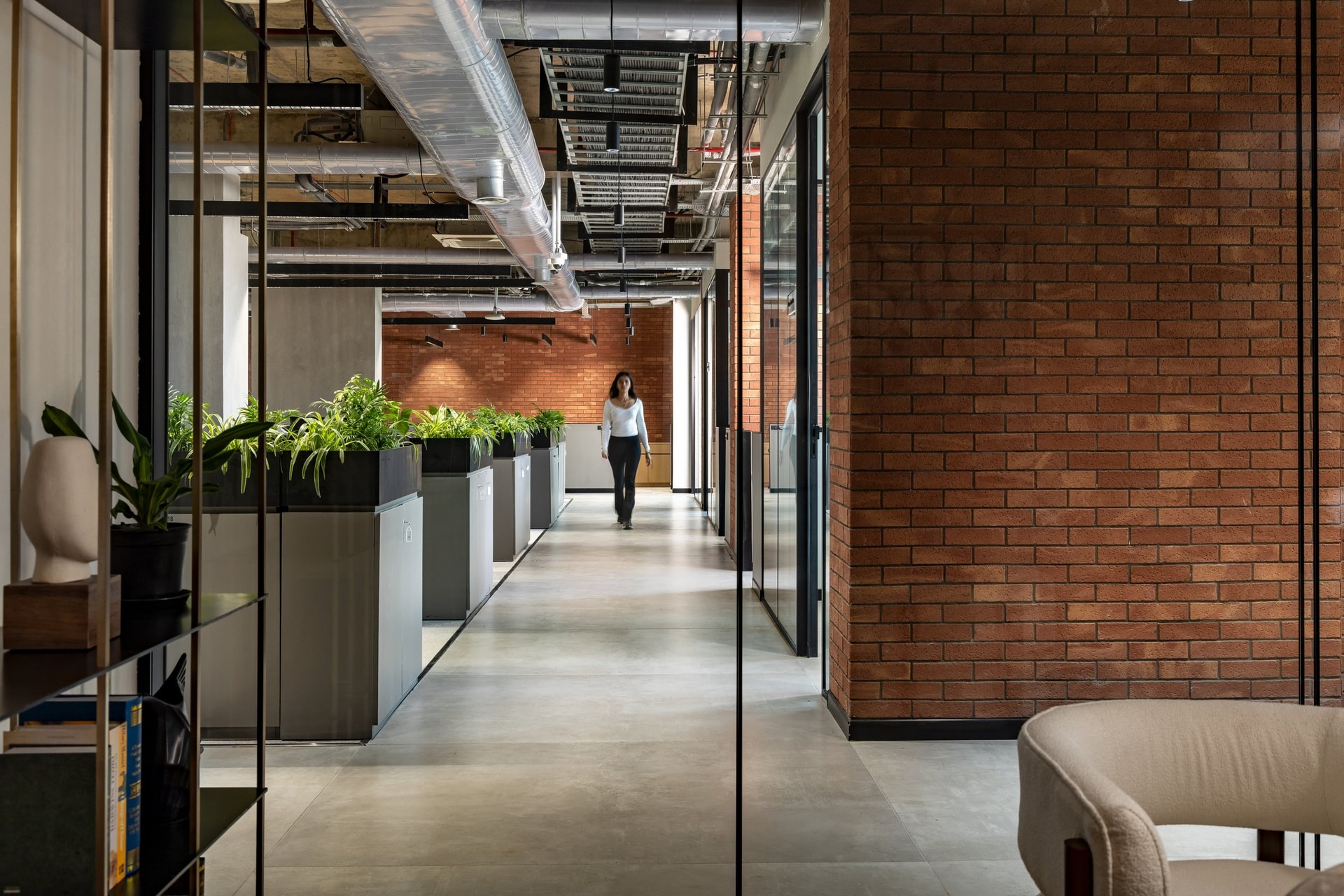
A circulation spine runs between glazed cabins and a long brick wall, with planters set on low storage units to soften the edge of the workstations. The corridor reads as a working street rather than a passage, wide enough to absorb pause and conversation without disrupting the desks beside it.
““The spatial language reflects the company’s ethos, where performance is balanced with wellbeing, and structure is softened with moments of ease.””
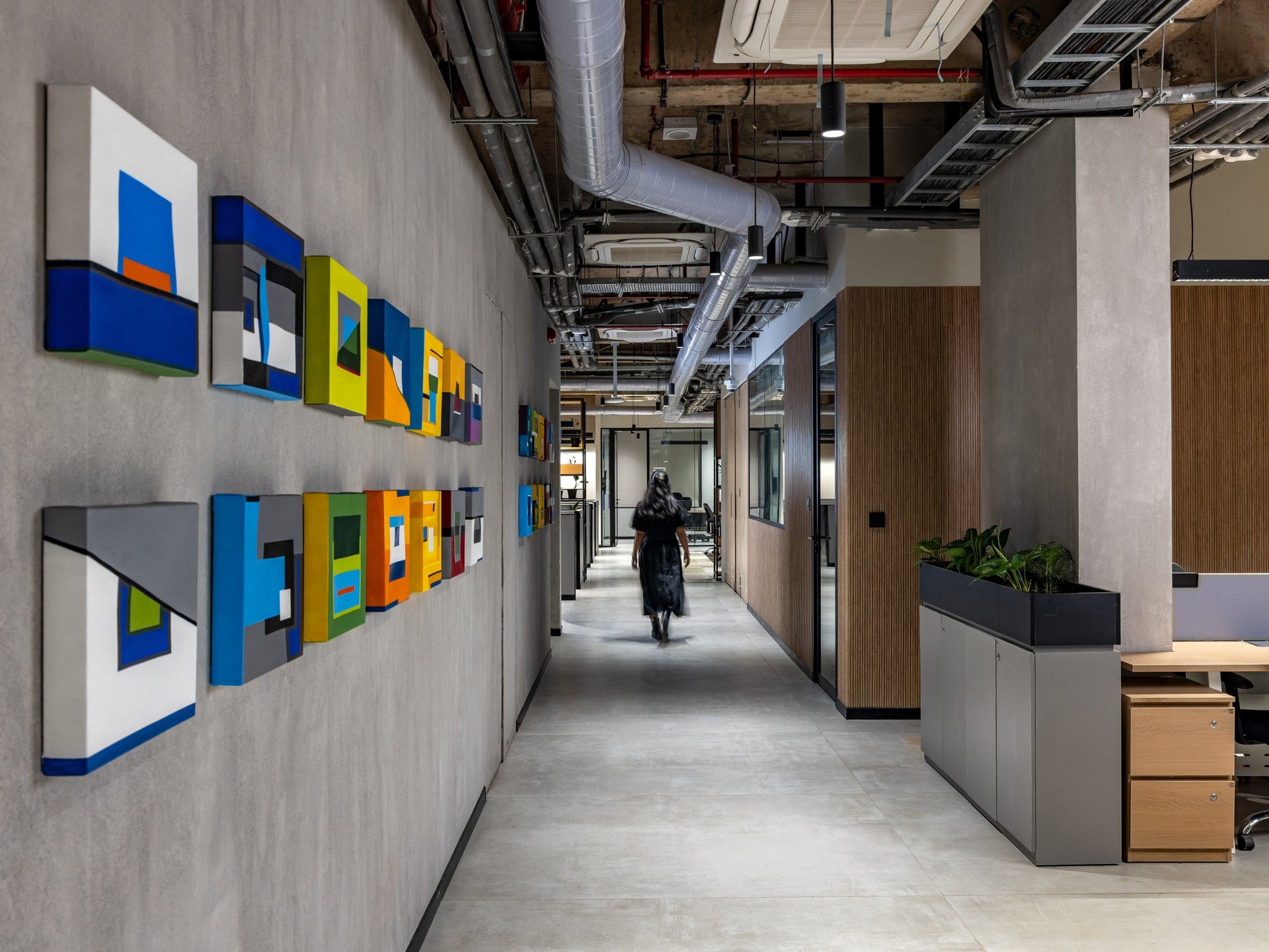
Along another stretch of the same circulation system, a wall of small abstract canvases in primary colour brings unexpected punctuation to the concrete surface. The grouping turns a functional corridor into a gallery moment, and the contrast with the exposed services overhead is precisely the kind of tension the project keeps returning to.
The Rooms for Quiet Work
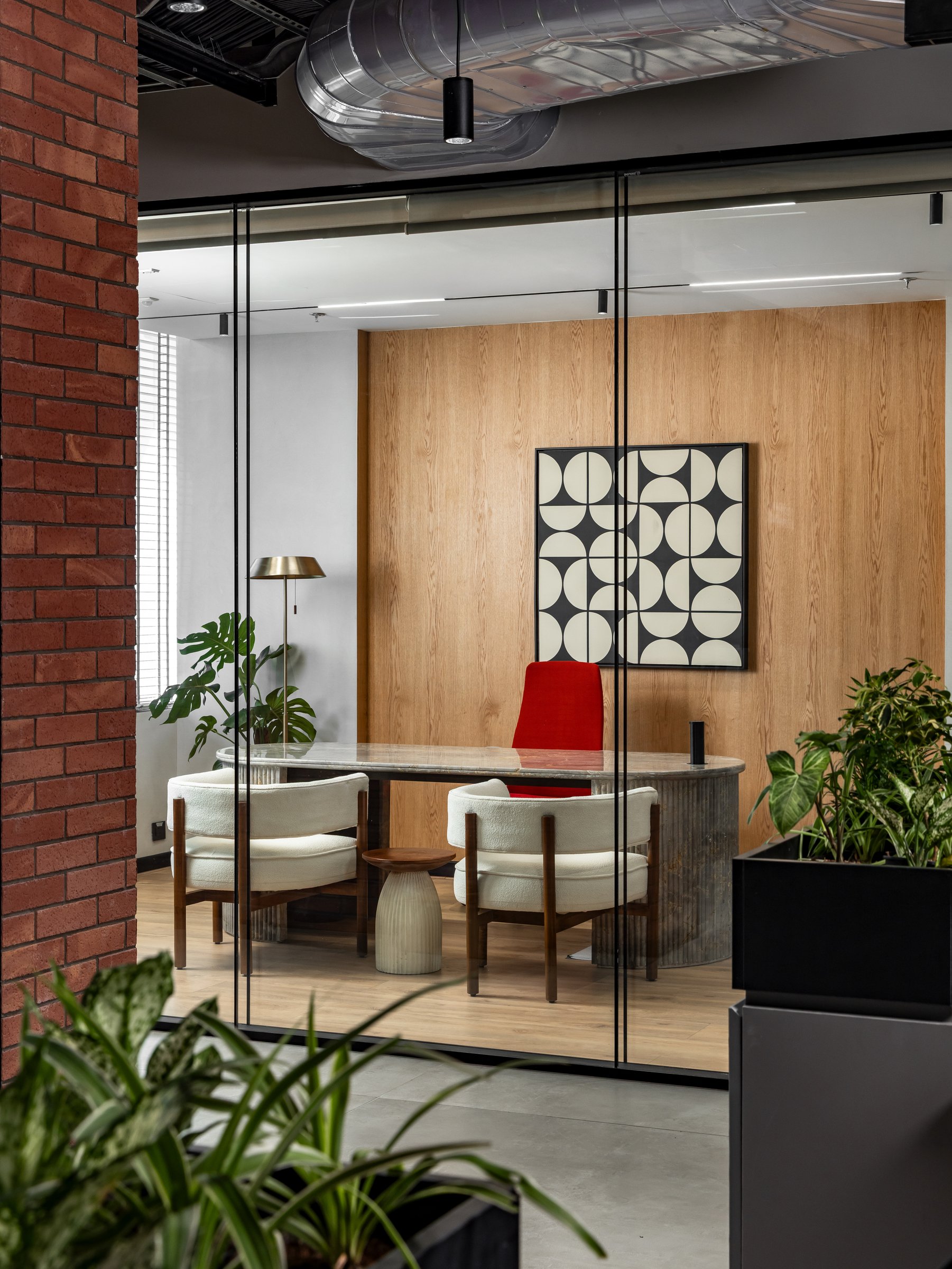
The leadership cabin is the project at its most composed. A curved fluted desk in stone meets a full panelled wall in warm oak, with a graphic black-and-white artwork that pulls the room into a midcentury register without quoting it directly.
The two boucle armchairs and the single red task chair behind the desk do most of the colour work, and the room knows when to stop. Brick reappears at the door jamb as a reminder that this cabin is part of the larger building, not a sealed executive sanctuary.
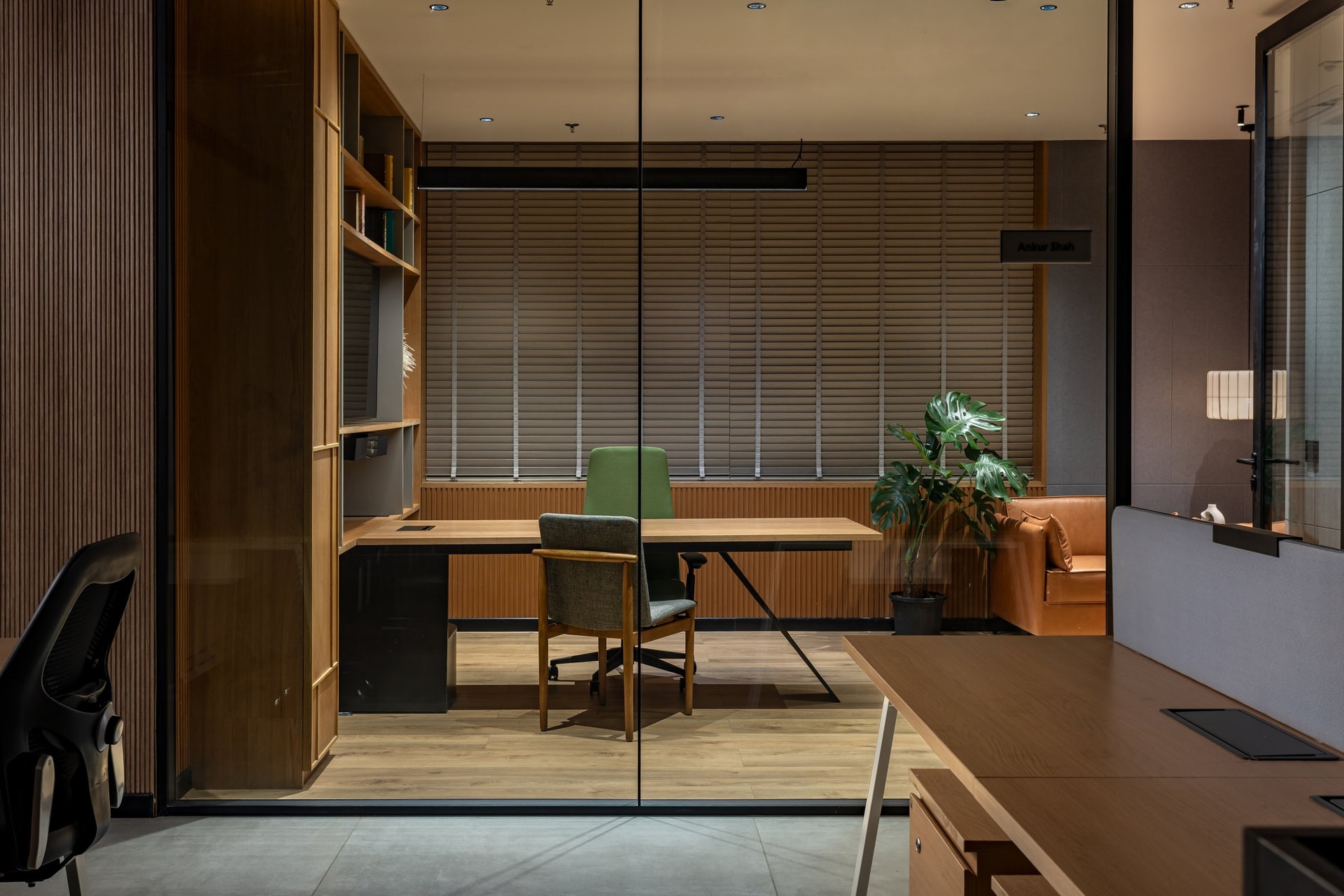
An adjacent cabin reads quieter still, organised around a long desk that runs into integrated joinery and a wall of slatted blinds that filter the daylight into horizontal bands. The palette stays in the register of oak, charcoal and grey upholstery, and the room is engineered for the kind of sustained attention that research leadership actually requires.
Breakout, Without the Cliche
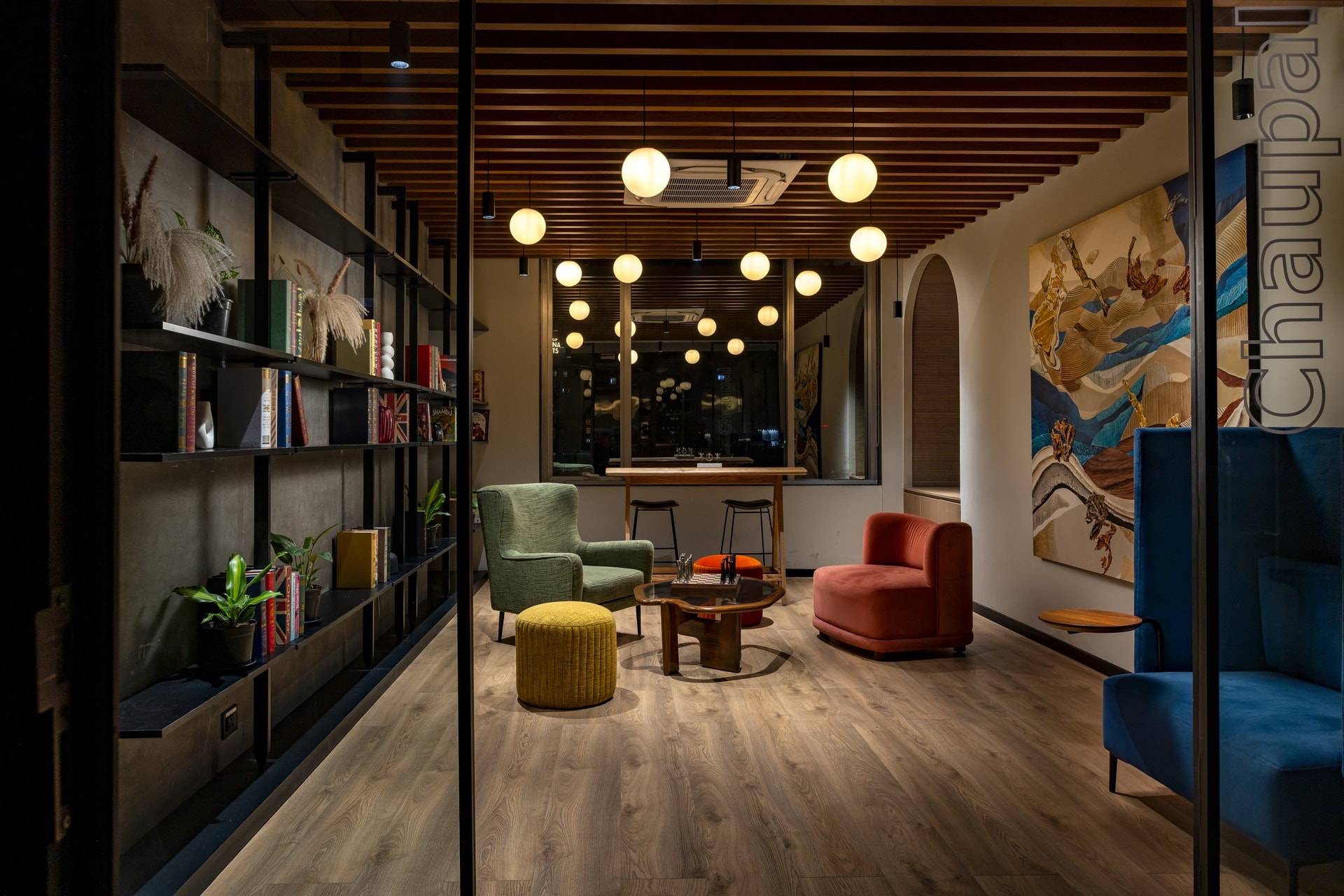
The breakout zone, marked Chaupal on the glass, is where the project allows itself the most expressive vocabulary. A slatted wooden ceiling and a constellation of glass globe pendants set the upper register, while seating in olive, rust and mustard with an indigo settee nearby gathers around a low table beneath a large painterly canvas.
The Cafeteria as Oasis
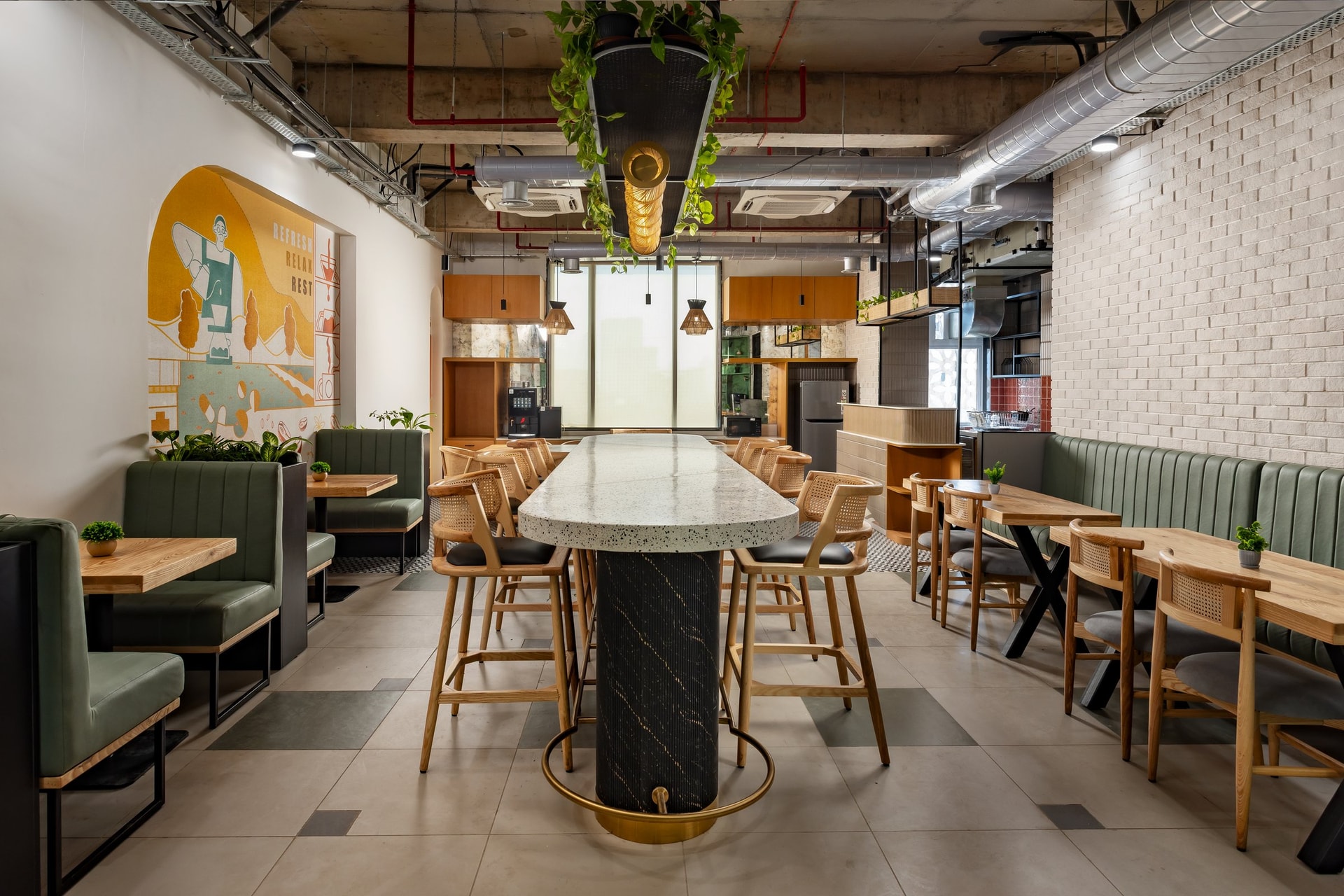
The cafeteria is the project’s most ambitious set piece. A long terrazzo-topped communal table on a dark fluted column anchors the room, flanked by olive-green banquettes on one side and a row of cane-back chairs at smaller tables on the other, with a bold illustrated mural at one end reading Refresh, Relax, Rest.
The architecture above is deliberately raw, with exposed services and a planted suspended frame at the centre, but the floor pattern and the warm joinery around the service counter keep the room hospitable. It works because it refuses to choose between industrial and domestic; it borrows from both.
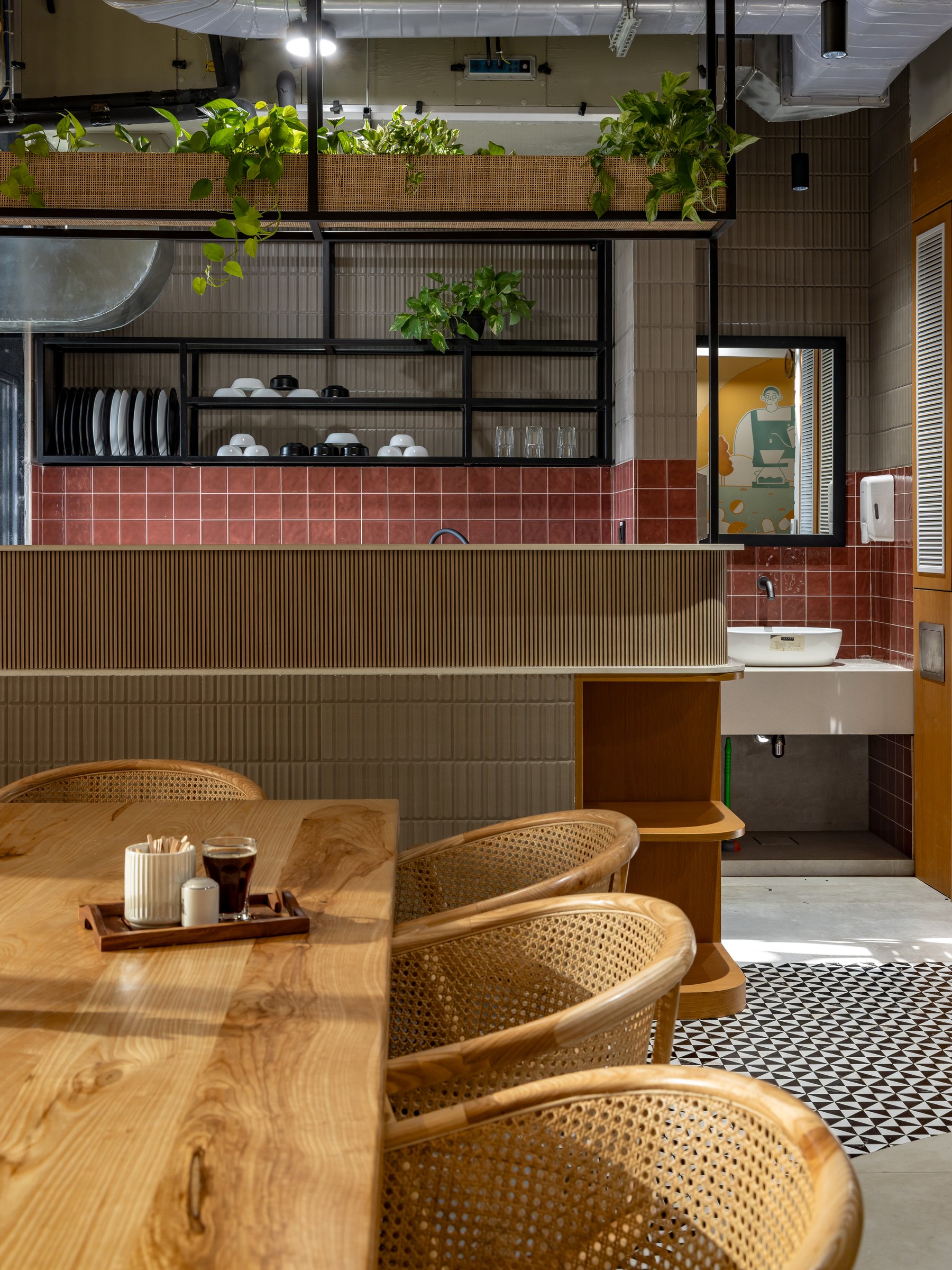
The service counter itself is detailed with the seriousness of a small cafe. Fluted wood meets a band of deep red square tiles, an open black shelving unit holds plates and cups within reach, and a planted ledge at the top brings green into the eye-line. The geometric floor tile near the wash counter is the kind of confident, slightly playful move that signals this is meant to be enjoyed.
The Spaces in Between
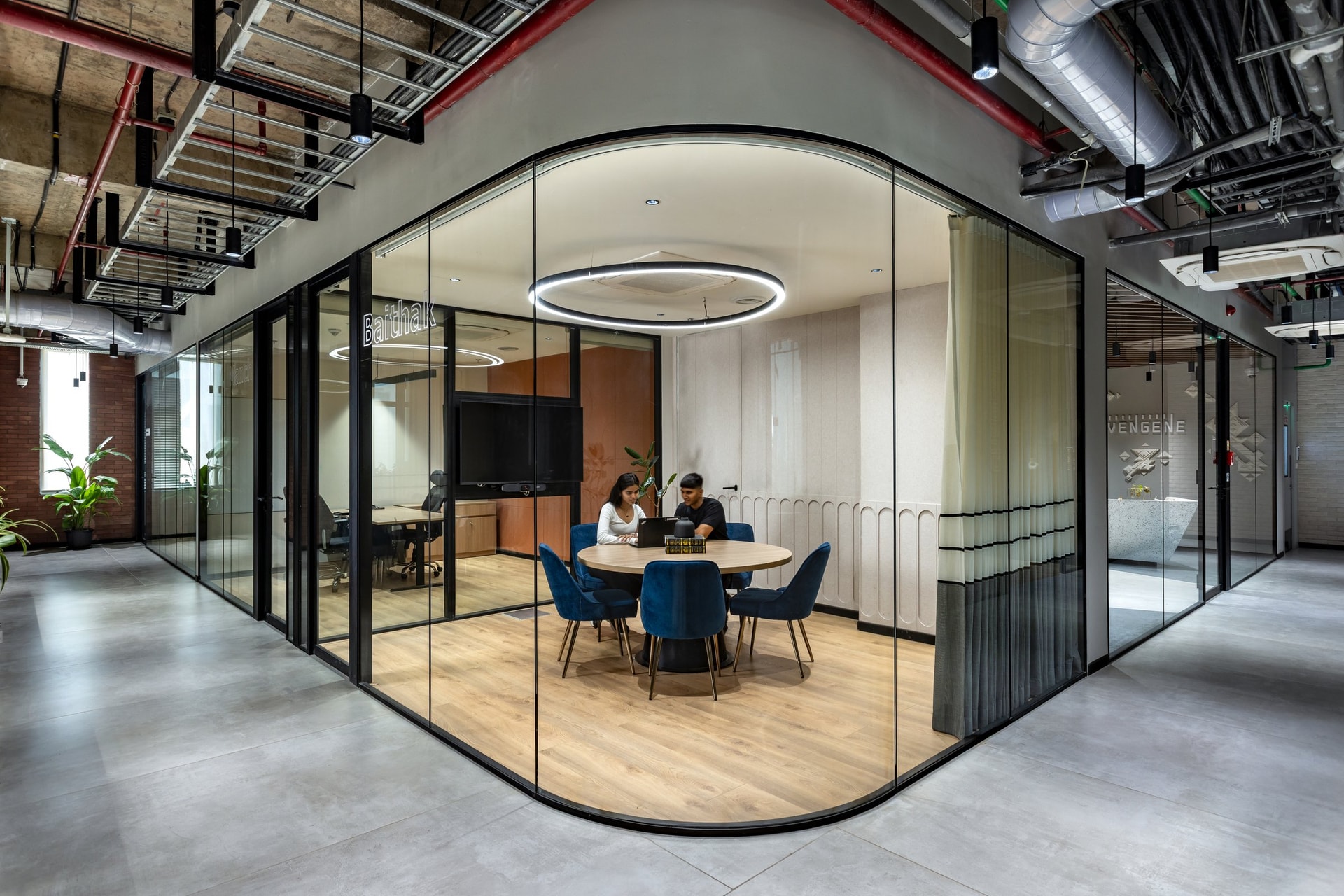
Among the more inventive moves on the floor is a curved-corner discussion room named Baithak, glazed on all sides and lit by a single circular pendant suspended over a round table. The soft rounding of the room’s plan reads as a deliberate counter-argument to the orthogonal grid of the workstations around it.
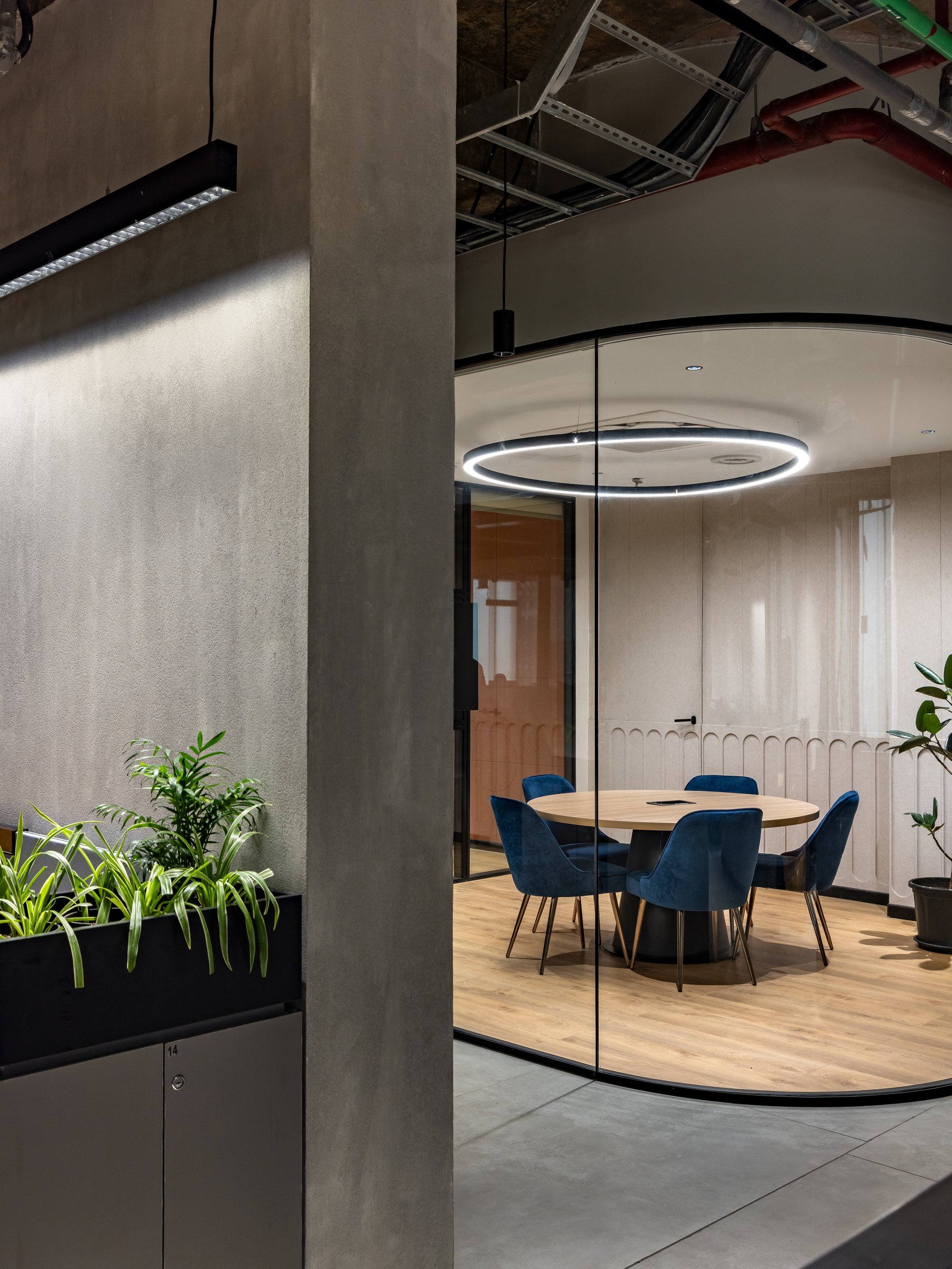
A second meeting room, glimpsed past a concrete column and a low planter, repeats the curved geometry with deeper blue velvet chairs and an arched fabric-panel wall. Together these rooms make a quiet case for the discussion space as something other than a square box with a screen, and they let the building’s circulation slow down around them.
What the project finally argues, across both halves of its plan, is that the workplace of an Indian research company need not borrow its language from either the laboratory or the imported tech-campus playbook. It can take the materials of its own context, brick, terrazzo, cane, fluted wood, planted edges, and assemble them into something that recognisably belongs to its city while still feeling generous to the people inside it.
That generosity is what distinguishes Beyond the Lab from a more conventional office fit-out. The design does not perform wellbeing as an idea, it simply gives the scientists who work here a building that takes their day as seriously as their research.