There is a particular kind of workplace that has grown rare in Indian commercial design, one that does not perform productivity through visual noise but quietly clears the room so the work itself can sit at the centre. The Accountant’s Annex on MG Road belongs to this category. It treats focus as an architectural condition, not an aspiration printed on a wall.
Designed by Bare Wall Studio for a chartered accountancy practice, the project occupies a long, narrow floor plate organised along a single central spine. The concept, which the studio calls Zensorial, draws from Zen philosophy without ever announcing it: openness, order, and a calibrated calm that lets the mind engage without distraction. The result is a workspace built on layers of light, texture, and transition rather than gesture.
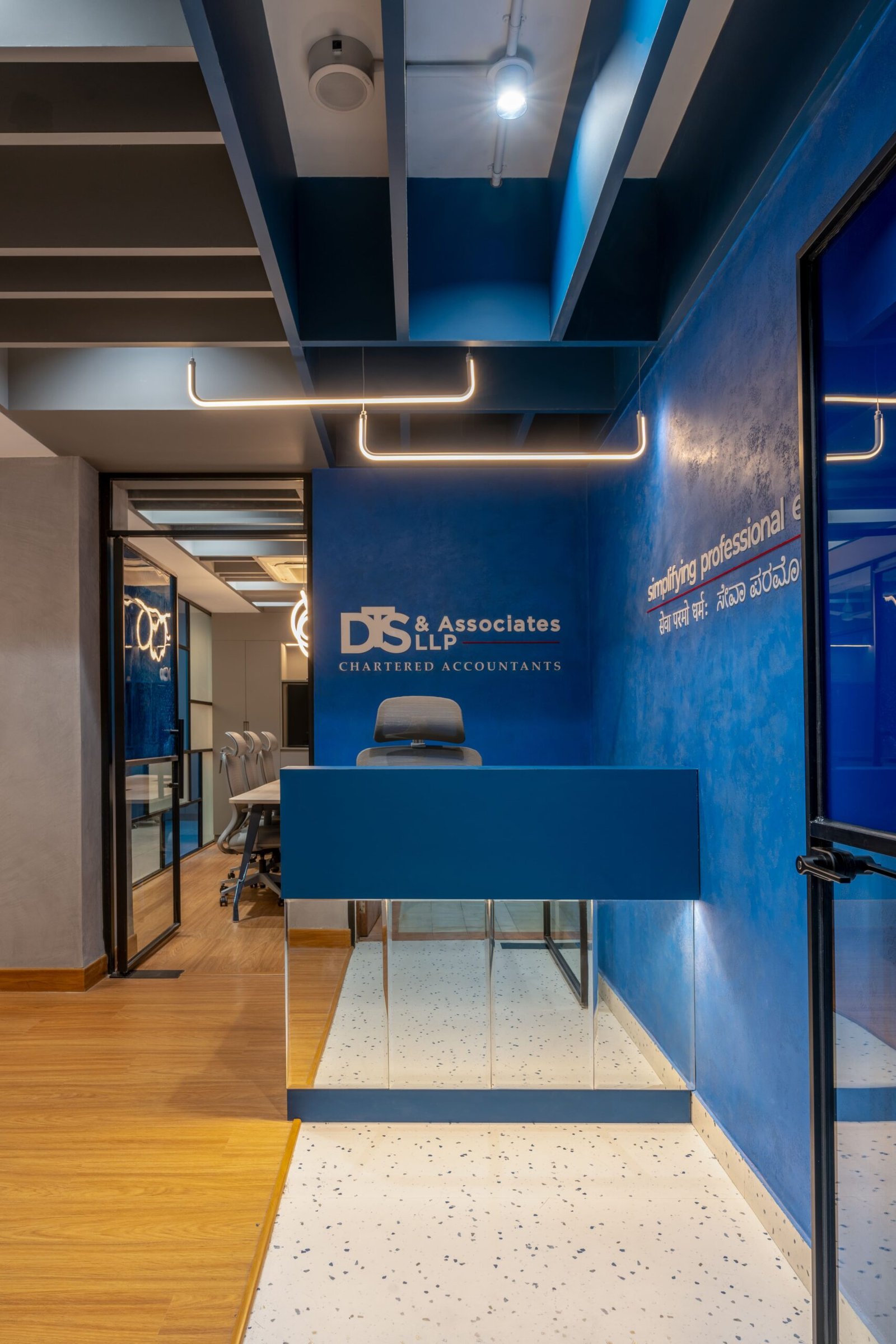
The entry resolves the project’s tone in a single move. A saturated indigo wall, finished in lime plaster with a soft cloudy depth, carries the firm’s identity in restrained typography and a Sanskrit line, while a terrazzo floor scattered with dark flecks meets the warm-wood threshold of the corridor beyond.
What makes the foyer work is its refusal to be ornamental. The reception desk reads as a low blue volume with a mirrored base that lifts it visually off the terrazzo, and a sculpted linear pendant traces a quiet loop overhead. The room states the firm’s character, professional, grounded, unhurried, before a visitor has taken three steps in.
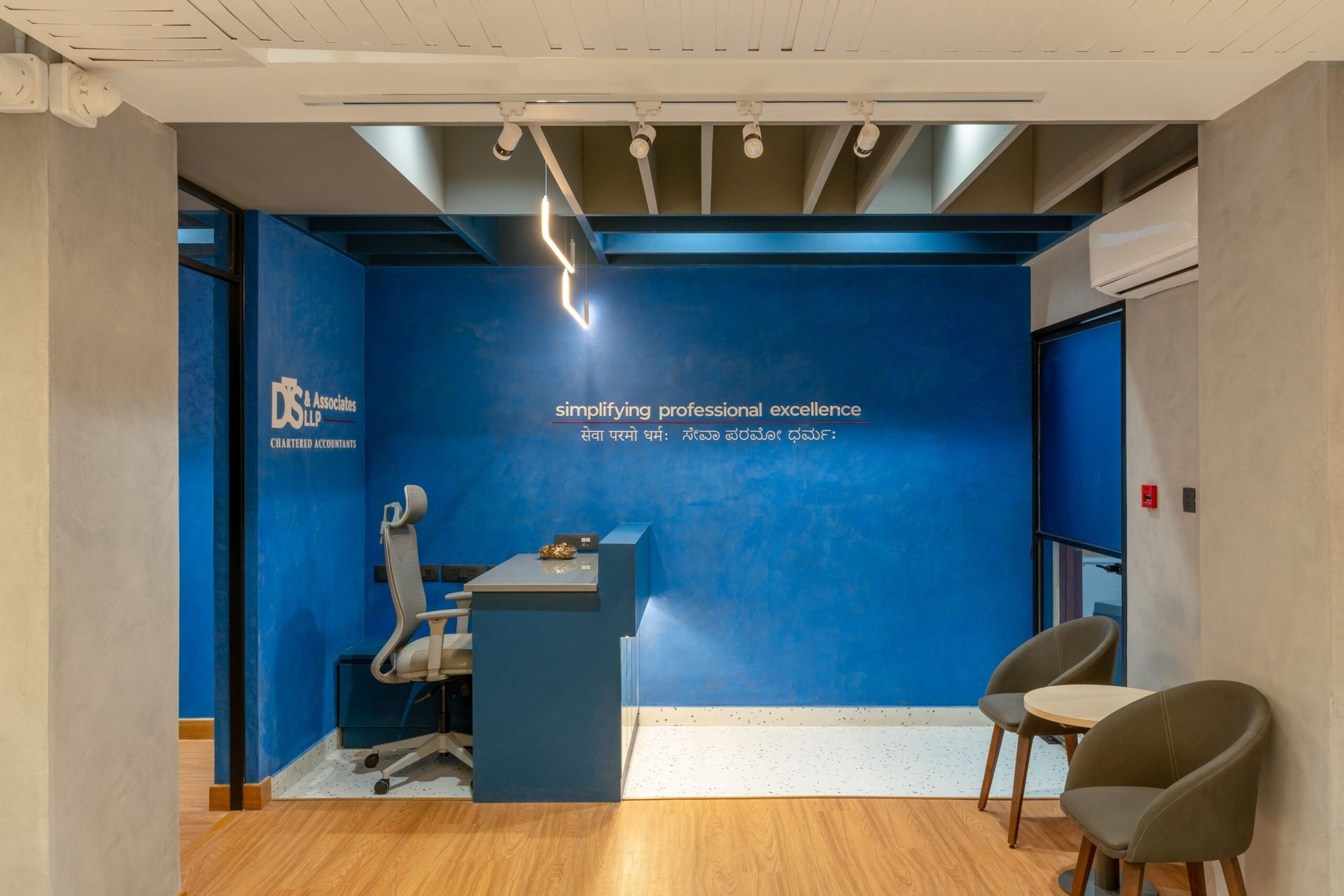
Seen straight on, the reception wall reveals the studio’s discipline with colour. The indigo does not shout; it absorbs light, holds the eye, and lets the small pair of olive-toned tub chairs across the wood-floored waiting zone do their understated work.
““The space is not defined by excess, but by what is essential: openness, order, and a sense of calm that allows the mind to engage without distraction.””
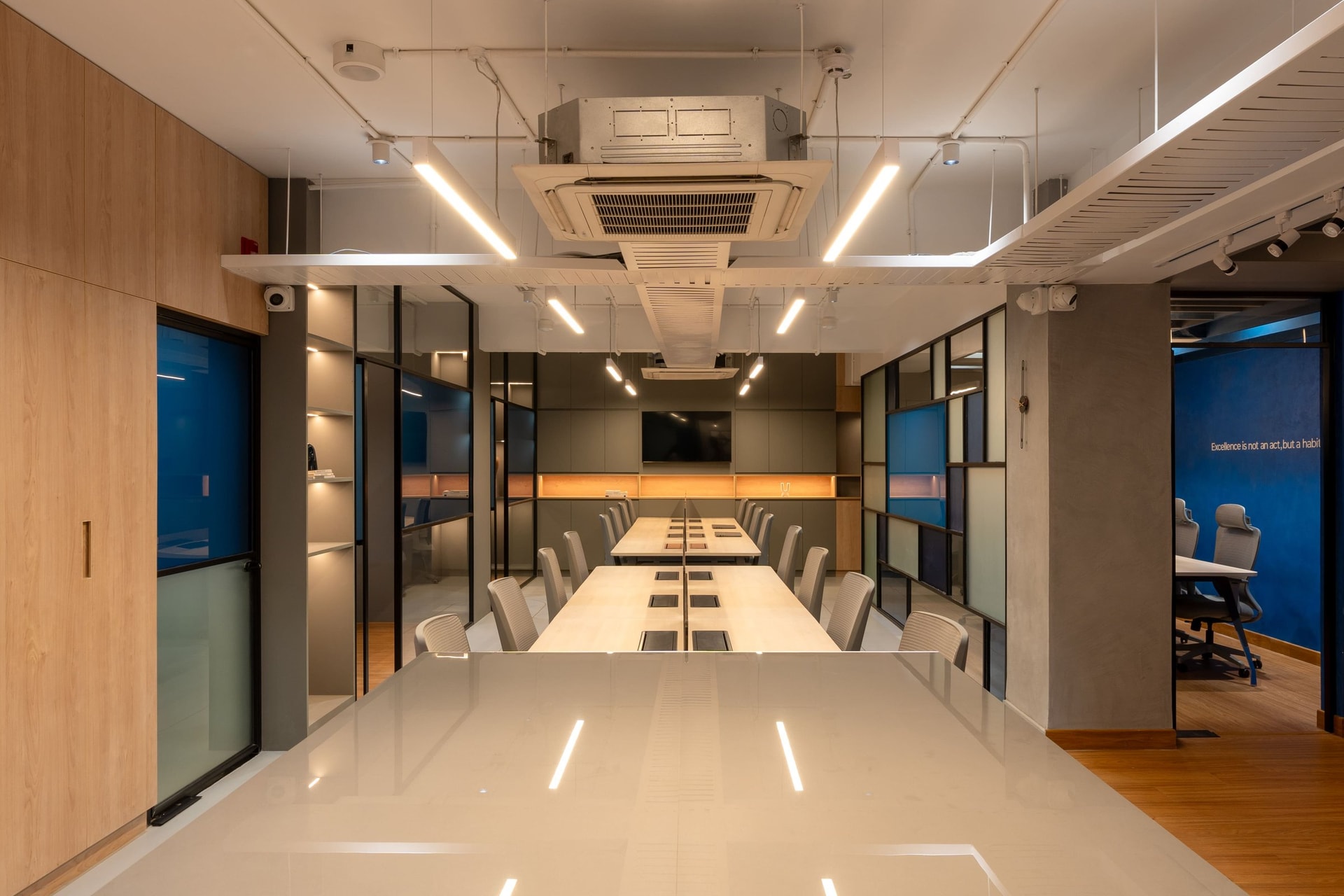
Moving past reception, the central spine opens into the project’s defining axis. Workstations line one flank while cabins sit along the other, framed by gridded glass partitions whose alternating panes of clear, frosted, and tinted glass act as a quiet rhythm device along the length of the floor.
This is where the planning logic becomes legible. The spine is not a corridor but the room’s organising principle, carrying daylight from the perimeter cabins inward and allowing every function to remain visually connected without being acoustically exposed.
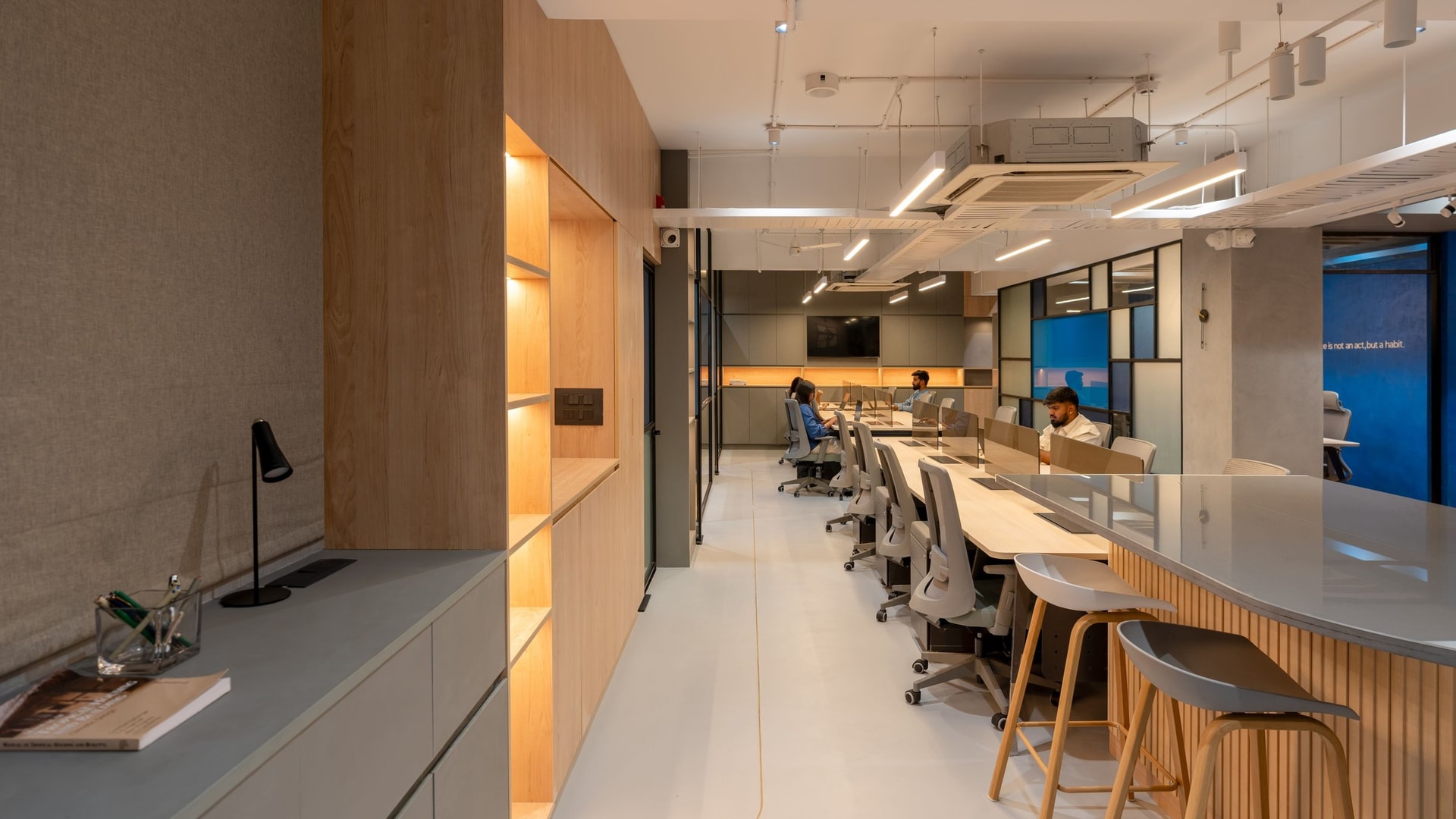
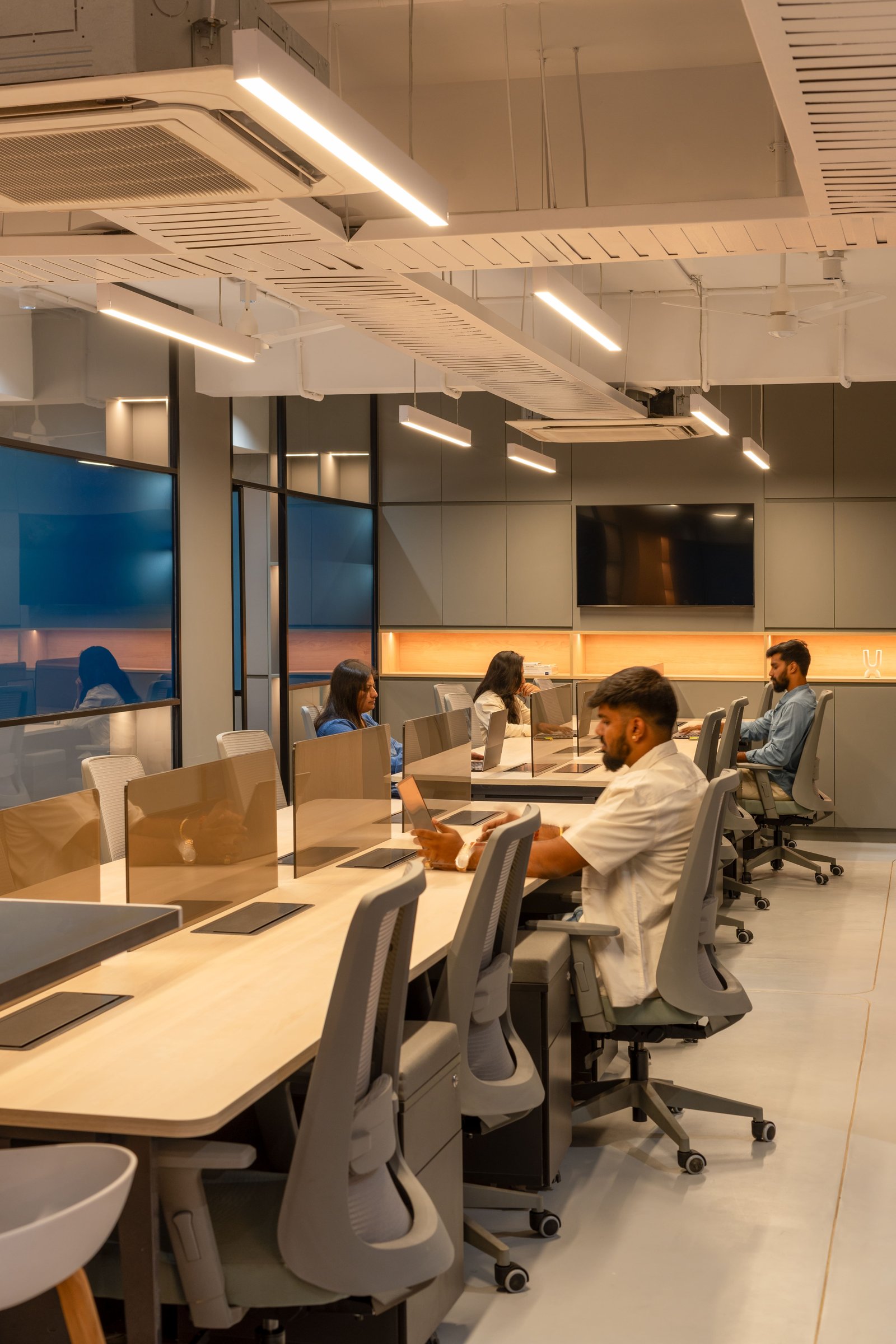
The open workstations themselves are handled with a similar economy. Pale ash desktops, low frosted screens between stations, and a back wall of grey cabinetry interrupted by a single horizontal band of warm cove light, nothing more is asked of the room than this.
Linear pendants align precisely with the planning grid above, and the exposed services, ducts, sprinklers, cassette units, are left visible rather than concealed behind a dropped ceiling. The decision keeps the volume generous and gives the disciplined surfaces below something honest to push against.
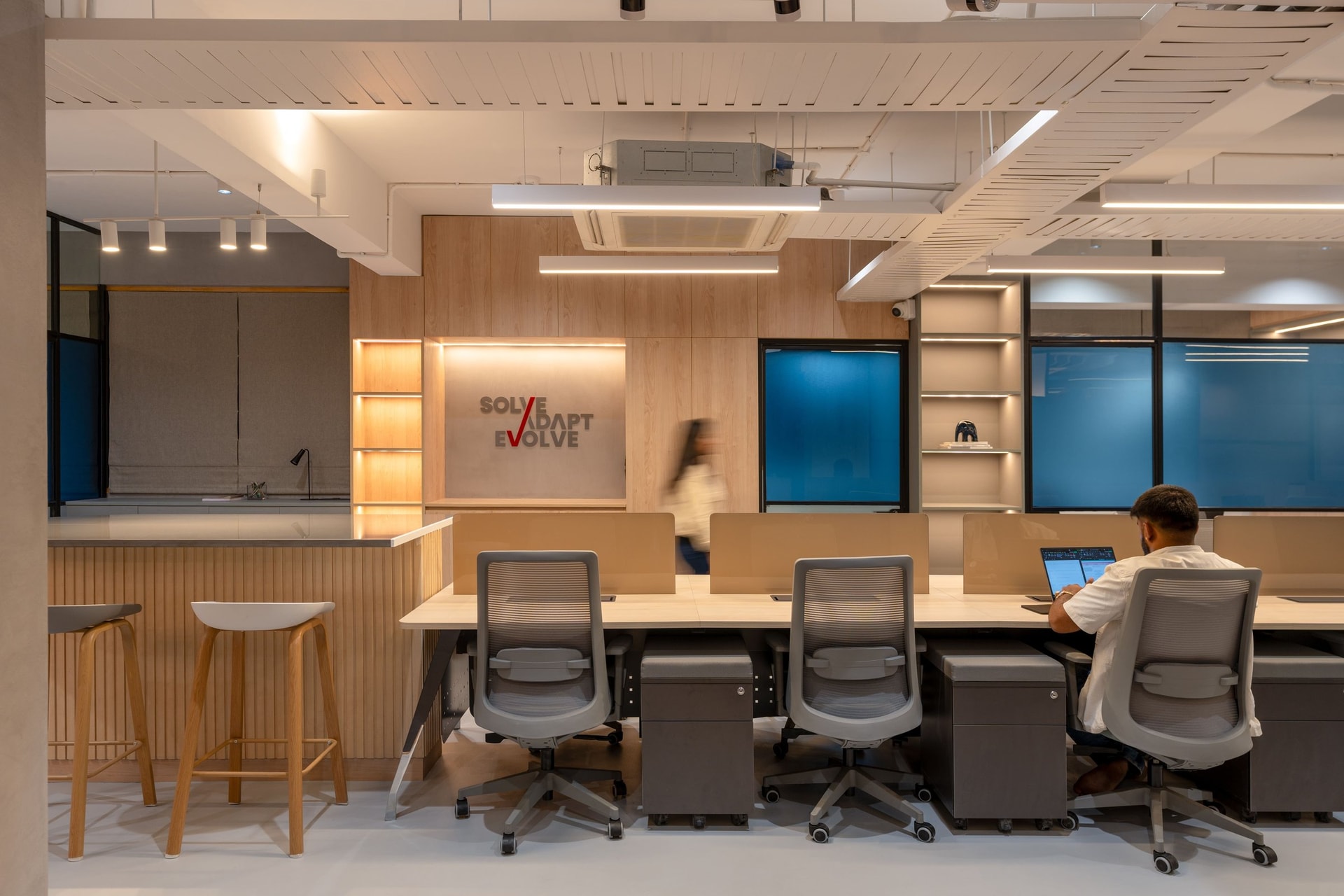
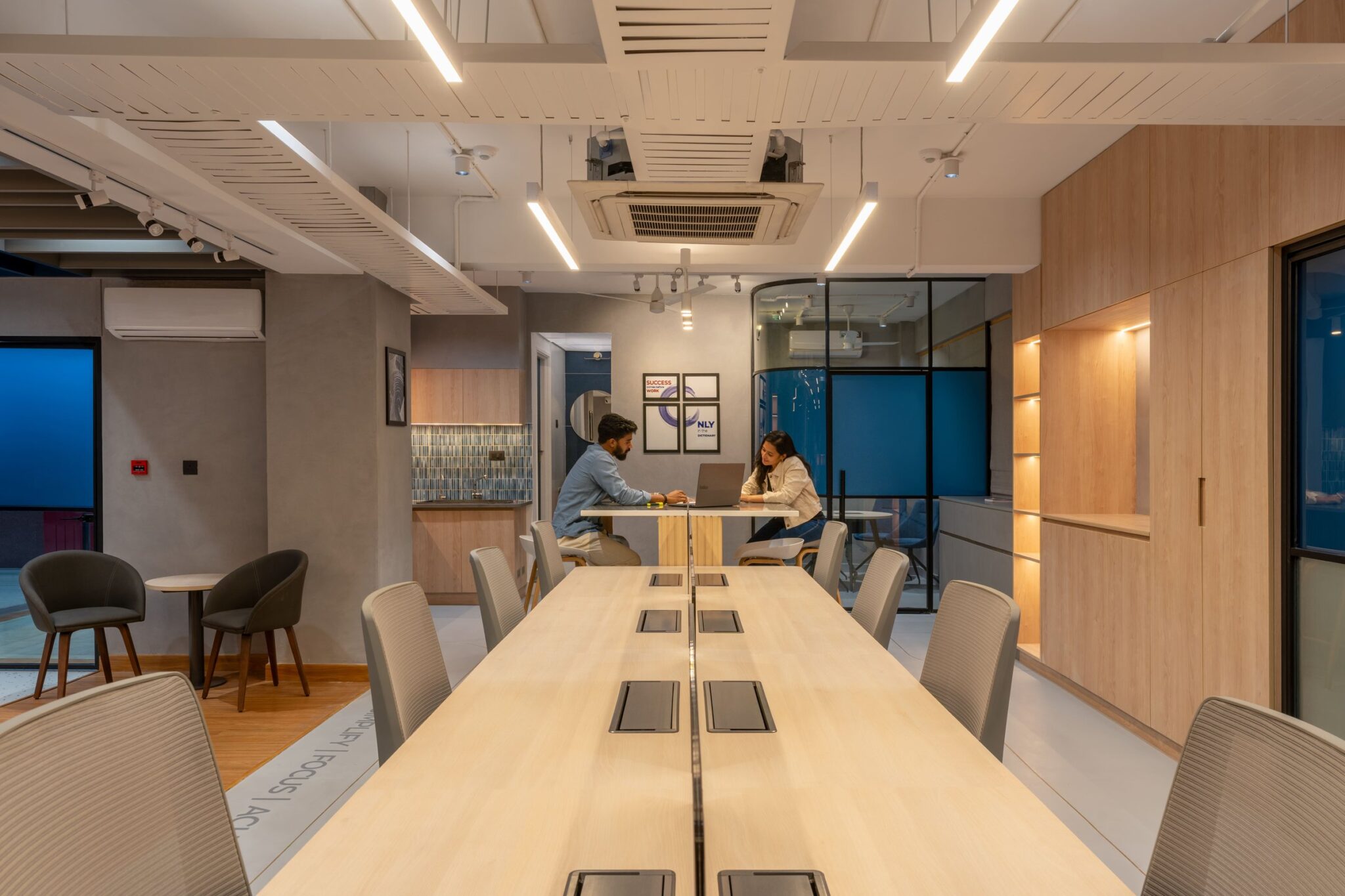
At the spine’s mid-point, a second cluster of workstations sits beneath a white slatted ceiling raft, the slatted ribs softening the industrial ceiling and concealing services in the same gesture. The wall behind carries the firm’s three-word ethos in quiet lettering, framed by a panelled wood backdrop and flanking lit niches.
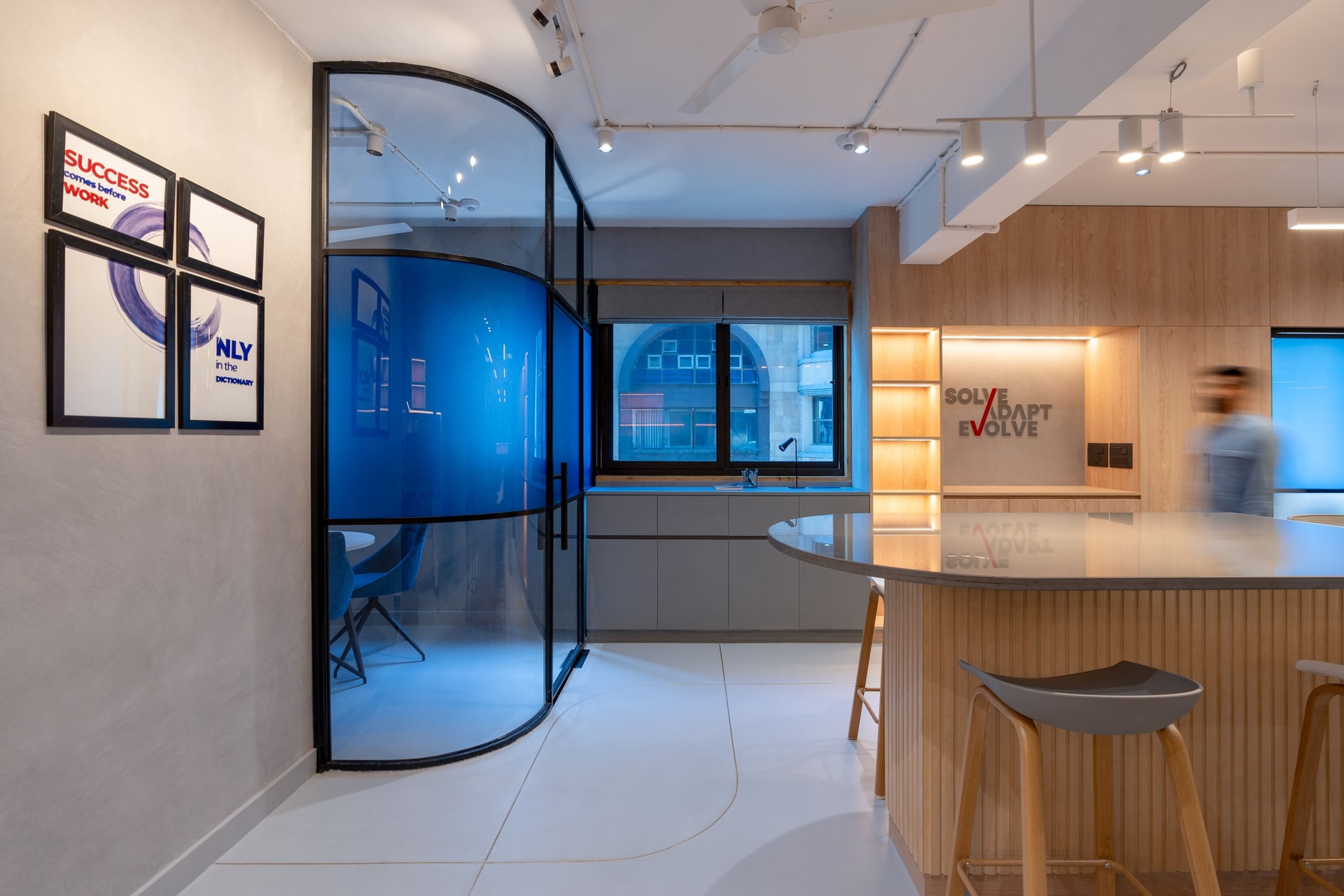
A curved blue-tinted glass pod marks one of the project’s more confident moments. Set against a pale plastered wall and the rounded edge of a pale-topped counter with a slatted wood base, it functions as an acoustically separated discussion room without rupturing the openness of the floor.
The blue here is not decorative. It is the same family of pigments that defines the foyer, the cabin walls, and the typographic accents, used now as transparency rather than surface, so the eye reads colour as architecture rather than finish.
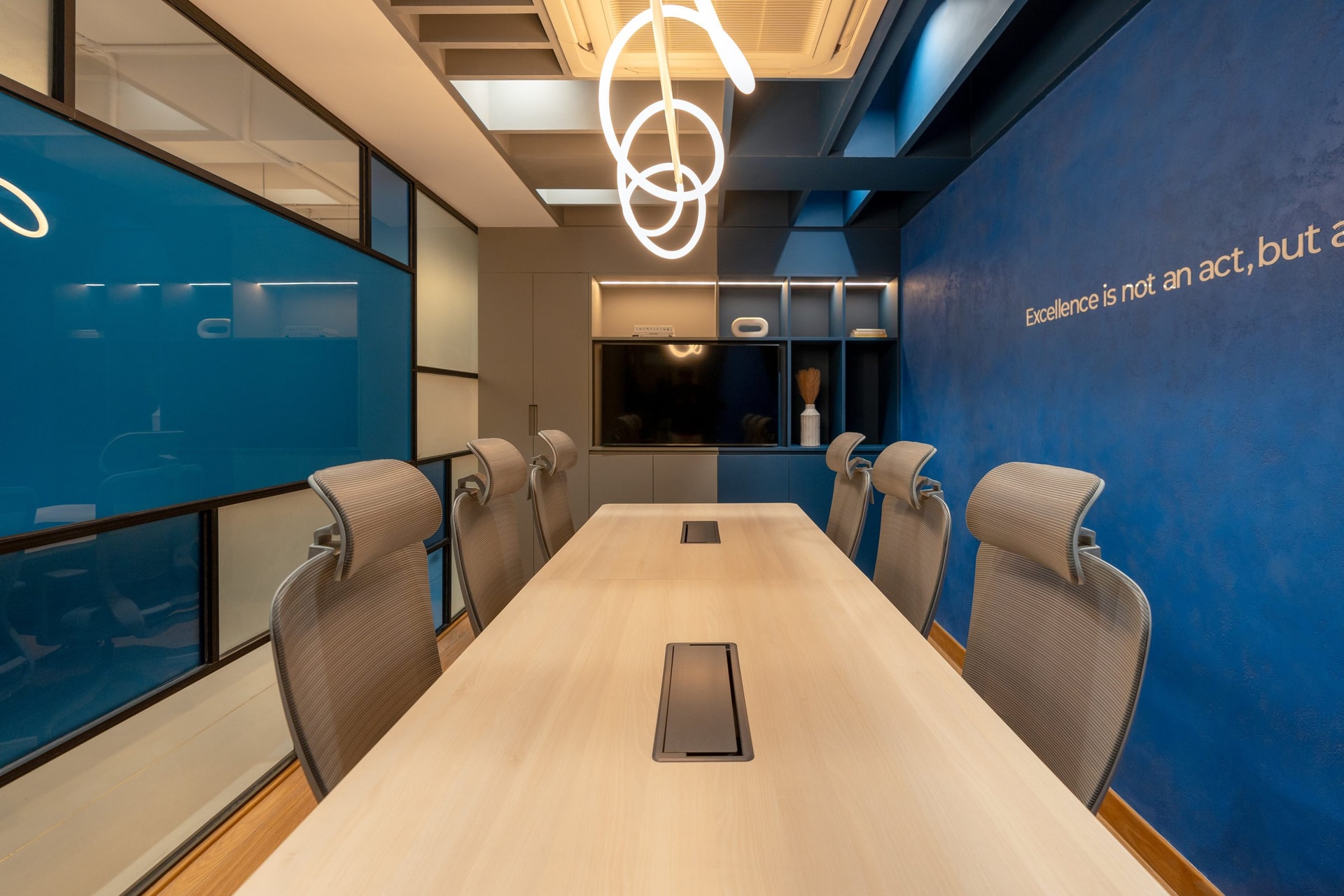
The conference room takes the project’s restraint to its most considered expression. A long pale-wood table with integrated cable boxes runs the length of the room, framed on one side by a gridded glass partition and on the other by a deep indigo wall carrying an inscribed quotation.
A sculptural ring pendant above the table introduces the room’s only flourish, a soft loop of light against the otherwise straight geometries of the joinery and partitions. The discipline of the rest of the space earns that one gesture the right to exist.
Toward the rear, the floor opens into a longer collaborative table set against a wall of warm-wood joinery with recessed display niches. Beyond it, the pantry counter and a small breakout cluster of upholstered chairs around a round café table extend the working zone into something more social.
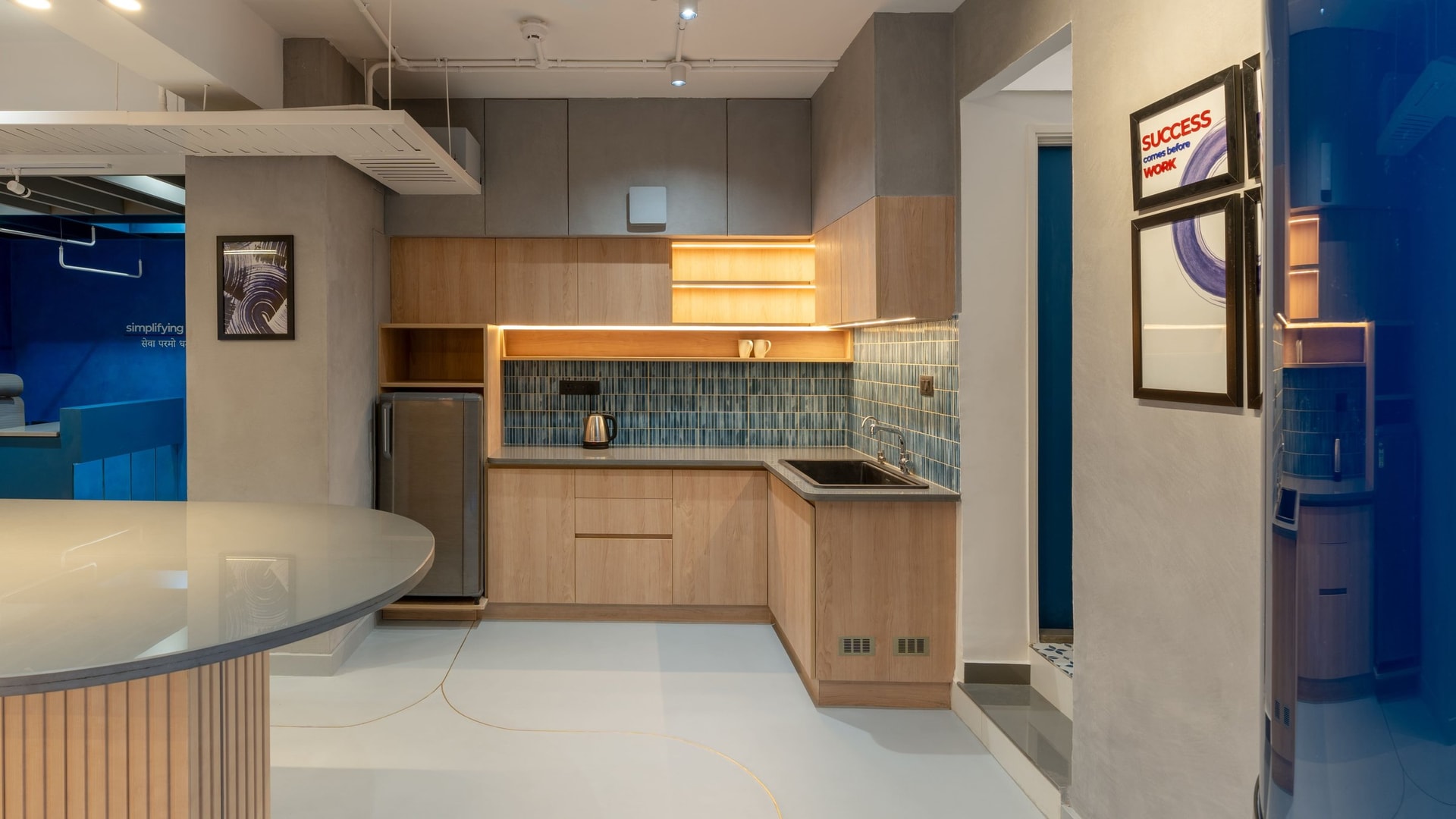
The pantry, glimpsed across the curved white-topped counter, is where the studio allows itself a moment of tactile pleasure. Vertically stacked tiles in mixed blue tones form a hand-glazed backsplash above light-wood cabinetry, with a recessed cove of warm light running beneath the upper units.
It is, by some margin, the warmest corner of the office, and deliberately so. A pantry in a professional services firm is where conversation actually happens, and the room rewards that with a more generous material register than the workstations would tolerate.
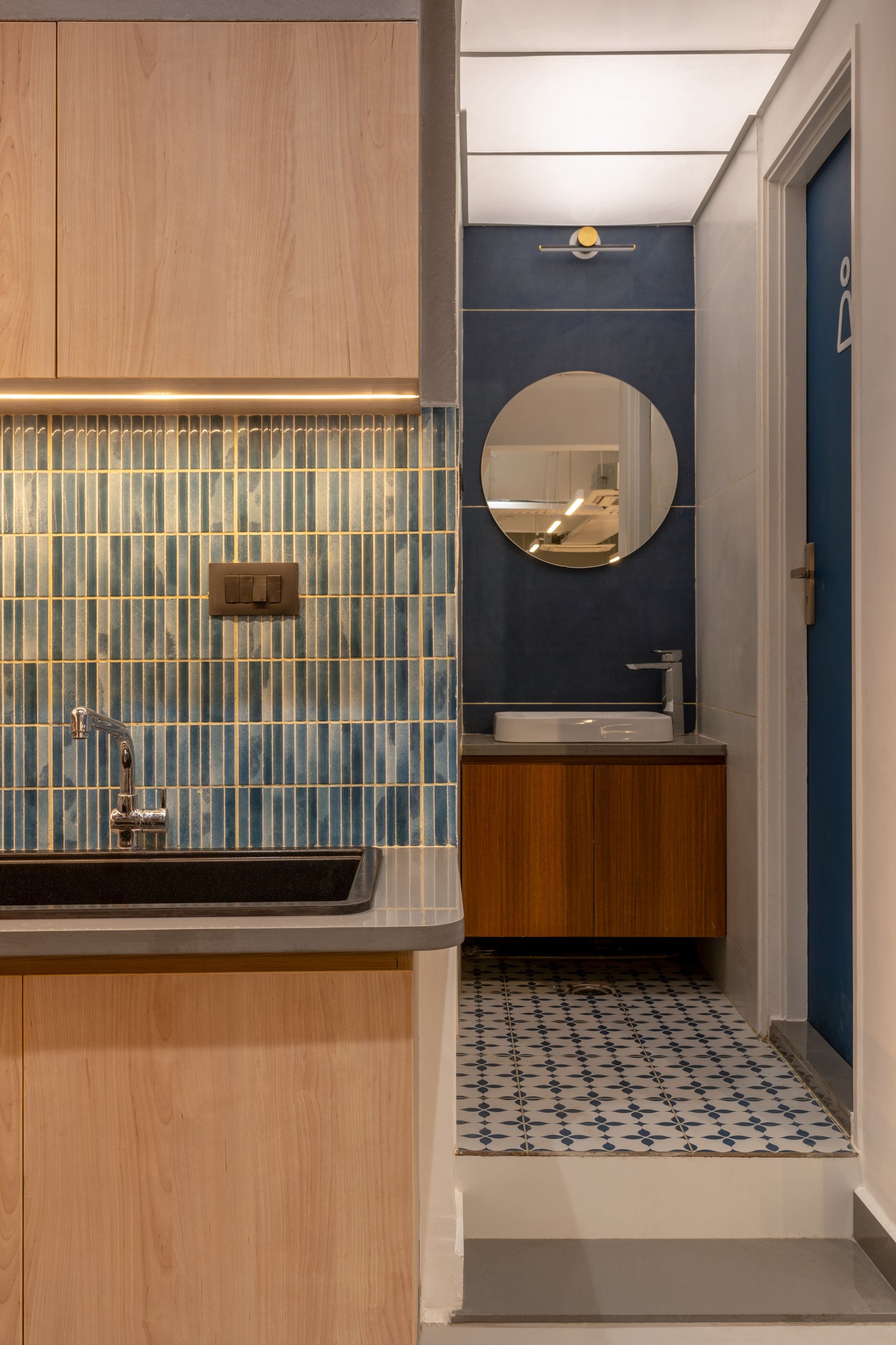
The same hand-glazed tile reappears in the washroom service area, this time paired with a deep indigo lime-plastered wall, a circular mirror, and a patterned encaustic floor with a small geometric motif. The transition is brief but unmistakably composed.
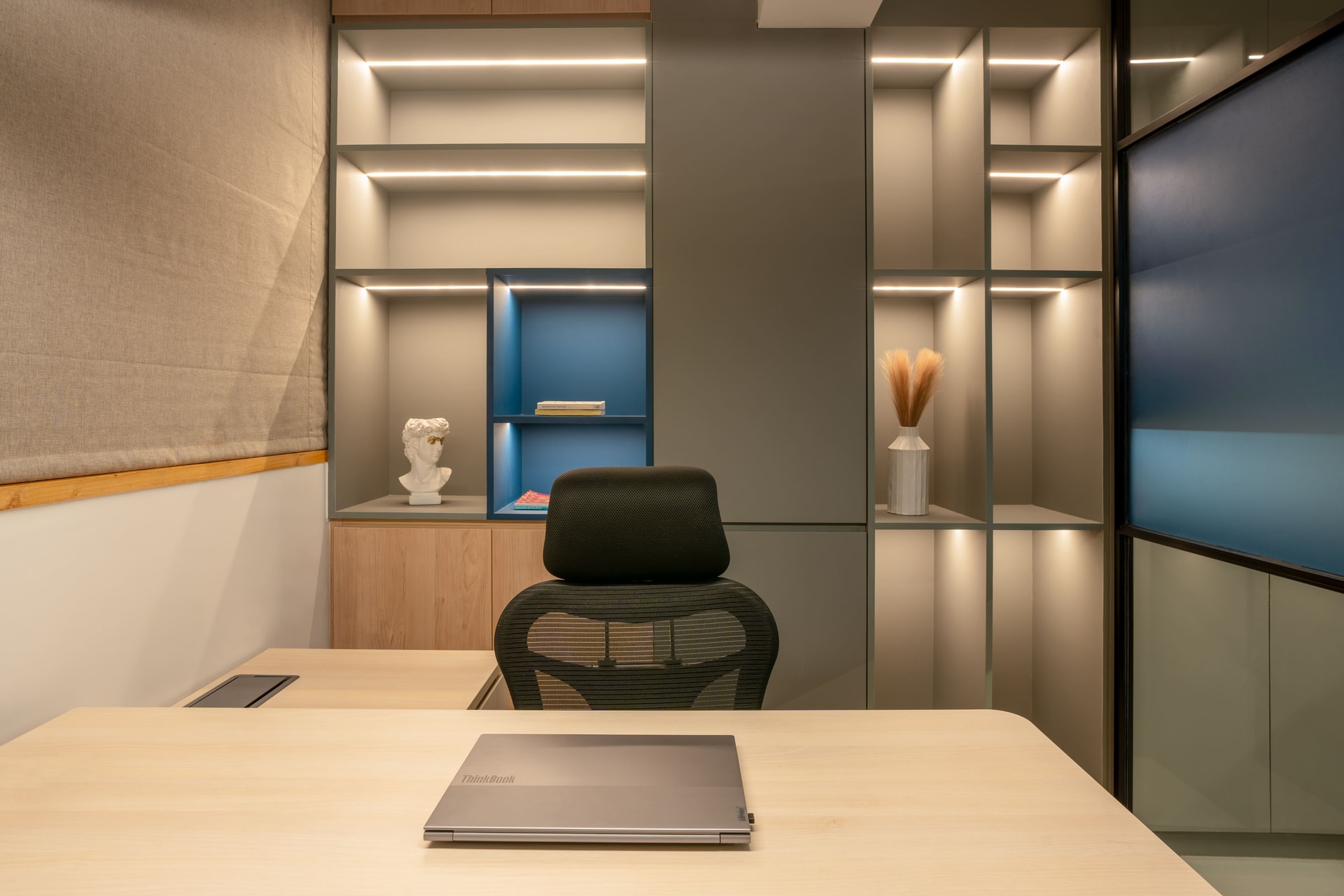
The principal cabin distils the studio’s grammar at a smaller scale. A wall of softly lit niches in muted grey, one of them painted indigo to frame a small bust and a stack of books, sits behind a pale-wood desk; a fabric roman blind in oatmeal linen handles the daylight without ceremony.
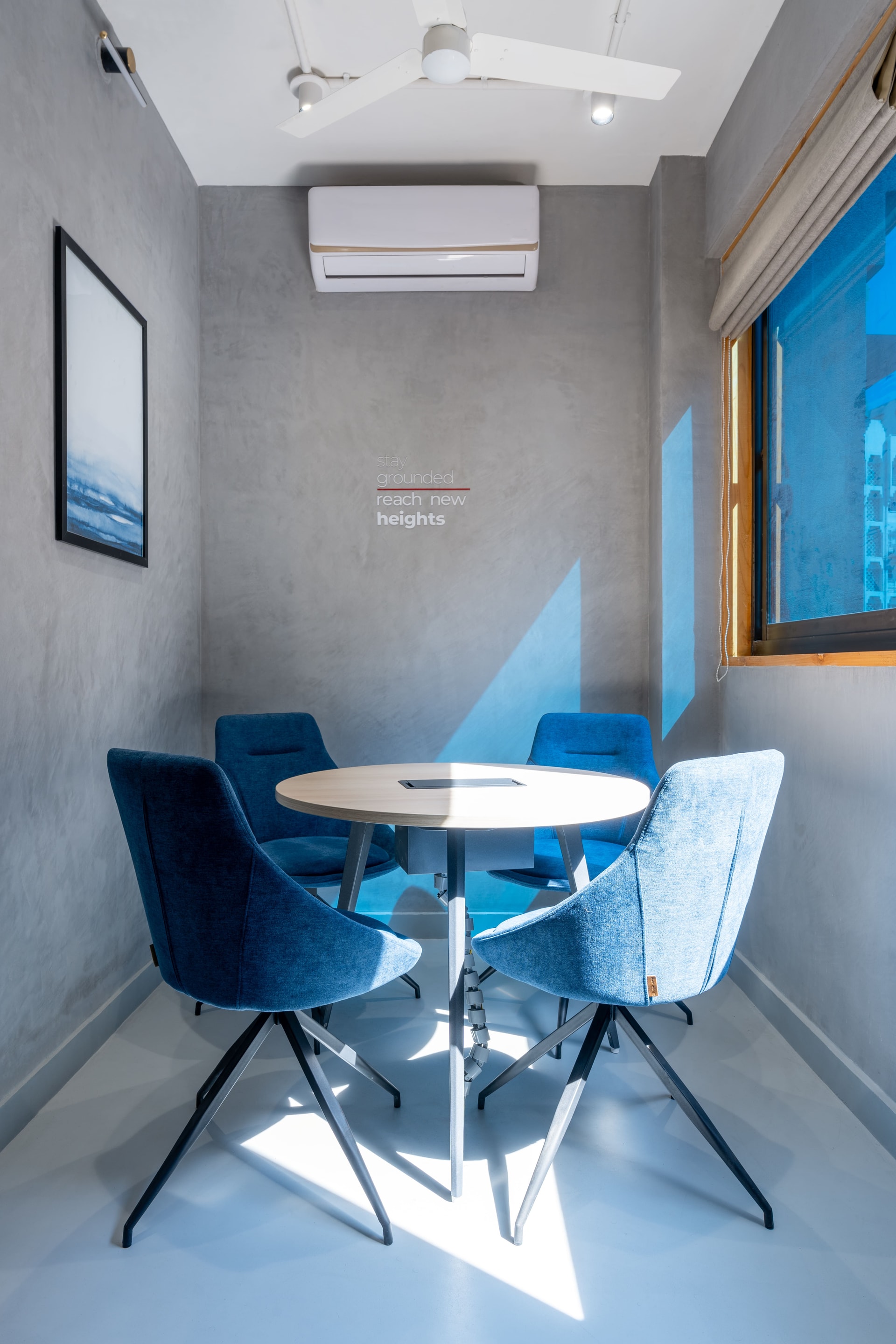
The smallest room in the office may be the most telling. A discussion nook holds a round wood table and four chairs in two shades of blue against grey lime-plastered walls, with a framed abstract on one side and the firm’s motto, stay grounded, reach new heights, lettered in small type on the other.
That a project of this discipline ends its tour in a four-chair room with a single line of text feels exactly right. The Accountant’s Annex is not interested in spectacle; it is interested in the conditions that make precise work possible, and in offering that condition consistently across every room.
For Bengaluru’s MG Road, a stretch defined by corporate interiors that often substitute volume for thought, the project reads as a quiet correction. It demonstrates that a chartered accountancy practice can be housed in a space whose material vocabulary, blues and greys softened by wood, lime plaster, terrazzo, hand-glazed tile, is as considered as any residential commission.
What lingers is the discipline. Every surface earns its place, every junction is resolved, and the Zen reference is not invoked through symbols but through the actual experience of moving through the floor. In refusing to perform, the Accountant’s Annex makes its strongest argument for what a workplace can be.