A commercial building on a 40 by 60 plot rarely gets the chance to be philosophical. The economics are too tight, the brief too literal, the footpath too crowded with neighbours competing for attention. What happens, then, when the clients are not speculators but designers, and the architects approach the structure not as a container for retail but as a question about how things hold together?
Along the dense commercial fabric of Domlur-Indiranagar in Bengaluru, Brick on Sticks announces itself almost evasively. Designed by Dot Bot Studio for a couple in their forties who have spent over a decade curating boutique furniture and art, the G+3 structure houses their luxury showroom Arkaa on the lower floors with rental commercial space above. The premise is unusual: a building whose conceptual starting point is not the façade or the plan, but joinery itself, the elemental principle of furniture-making translated into a tectonic argument.
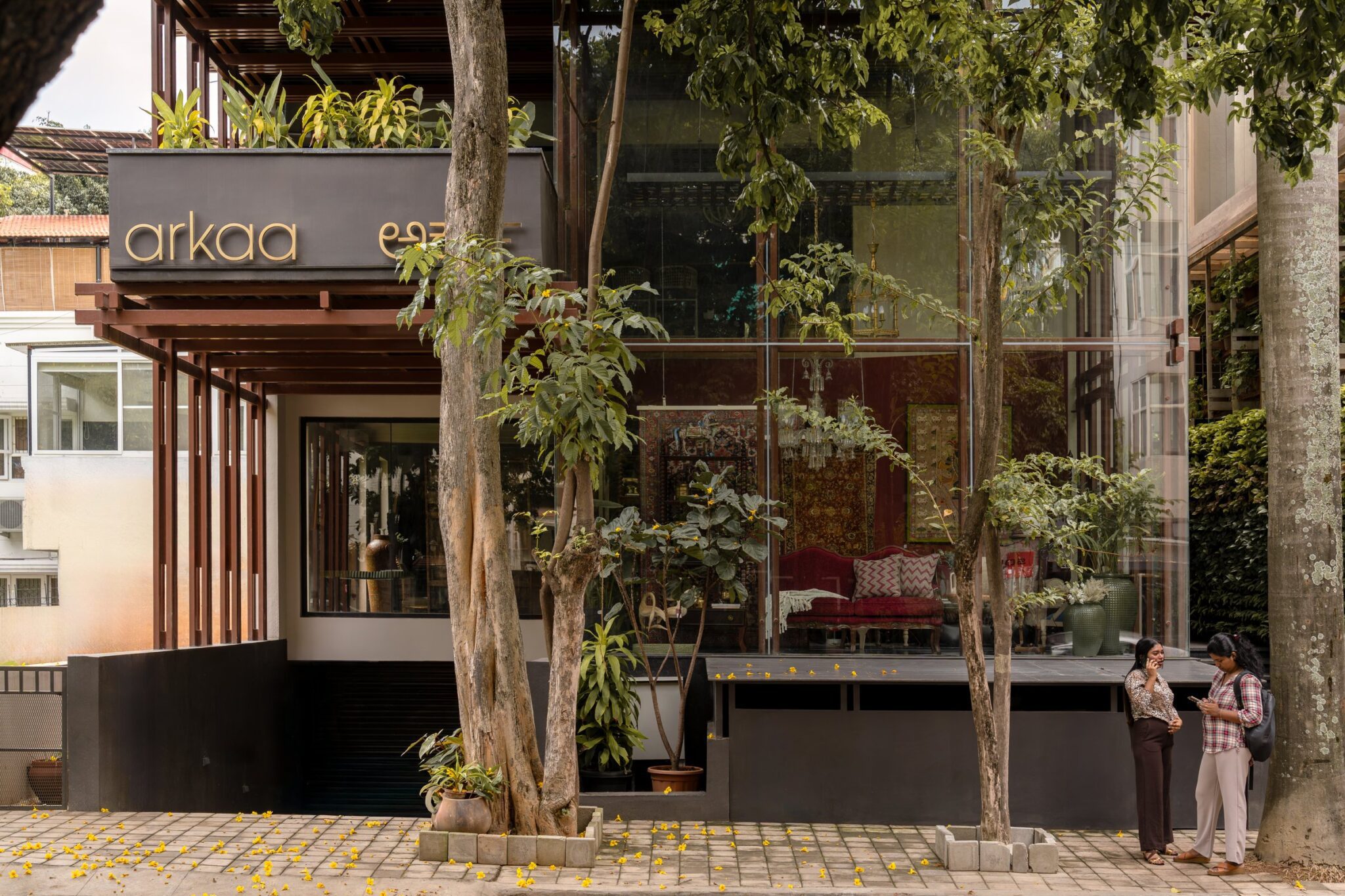
From the street, the building reads as a quiet civic gesture rather than a retail announcement. Two existing trees on the footpath, untouched by the construction, form a natural proscenium through which the architecture is glimpsed, their canopies softening the threshold between pavement and showroom. The Arkaa signage sits modestly on a dark fascia, behind which the double-height glazed volume reveals the showroom interior almost as a vignette: a red sofa, hanging rugs, a chandelier, all framed like a stage set viewed from the wings.
The ground-level approach is deliberately undramatic. There is no podium, no flourish, no attempt to sever the building from its street.
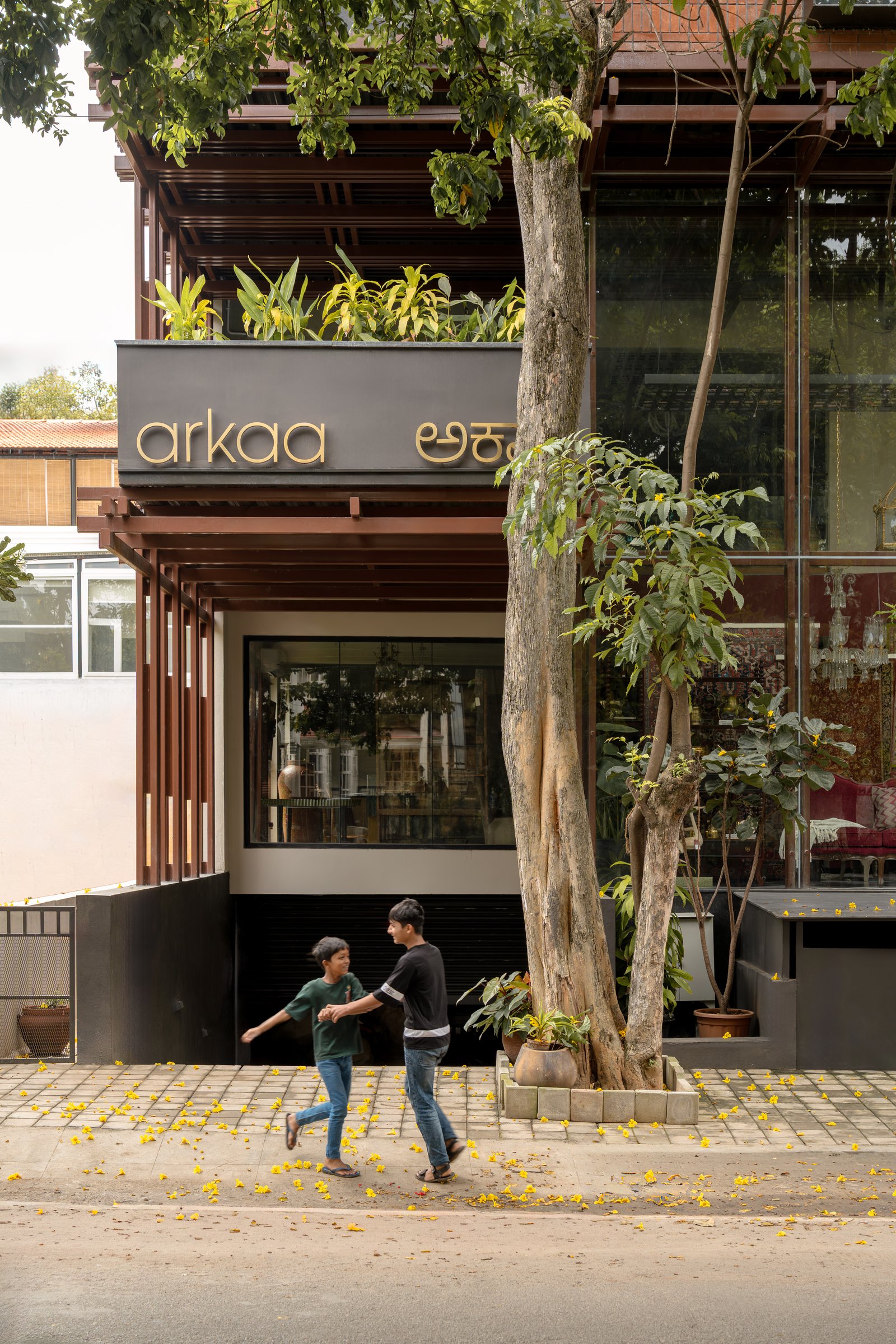
A vertical view of the same entry reveals how the slatted wooden canopy negotiates scale. The rhythm of the joinery-inspired columns is visible here, each member resolved as an assembly rather than a monolith, the bracketed connections reading as both structural and ornamental.
““From the beginning, the building had to feel intentional. Not decorative, not generic; every decision needed a reason.””
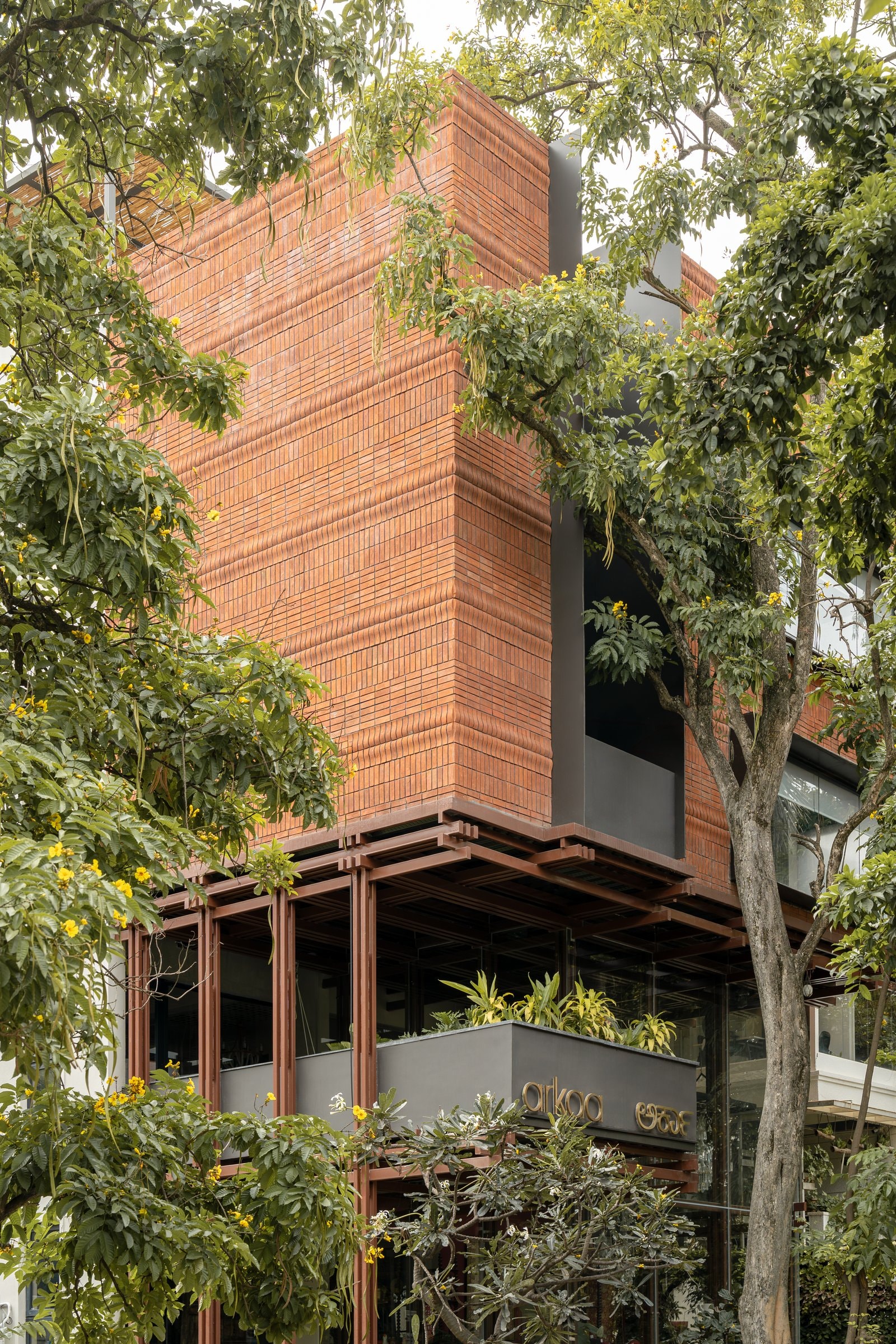
Step back, and the building’s full thesis comes into focus. A solid mass of red brick floats above a transparent base wrapped in a cage of slender steel columns, the column-and-bracket assemblies detailed with the visible logic of mortise-and-tenon. Brick on Sticks, the project’s name, is also its diagram: weight resting on articulation, mass legitimised by visible structure.
The upper floors are clad in a brick screen that reads as both wall and skin. Recessed openings register as deep shadows, while the surrounding trees press close enough to soften the geometry, blurring the line between architecture and canopy.
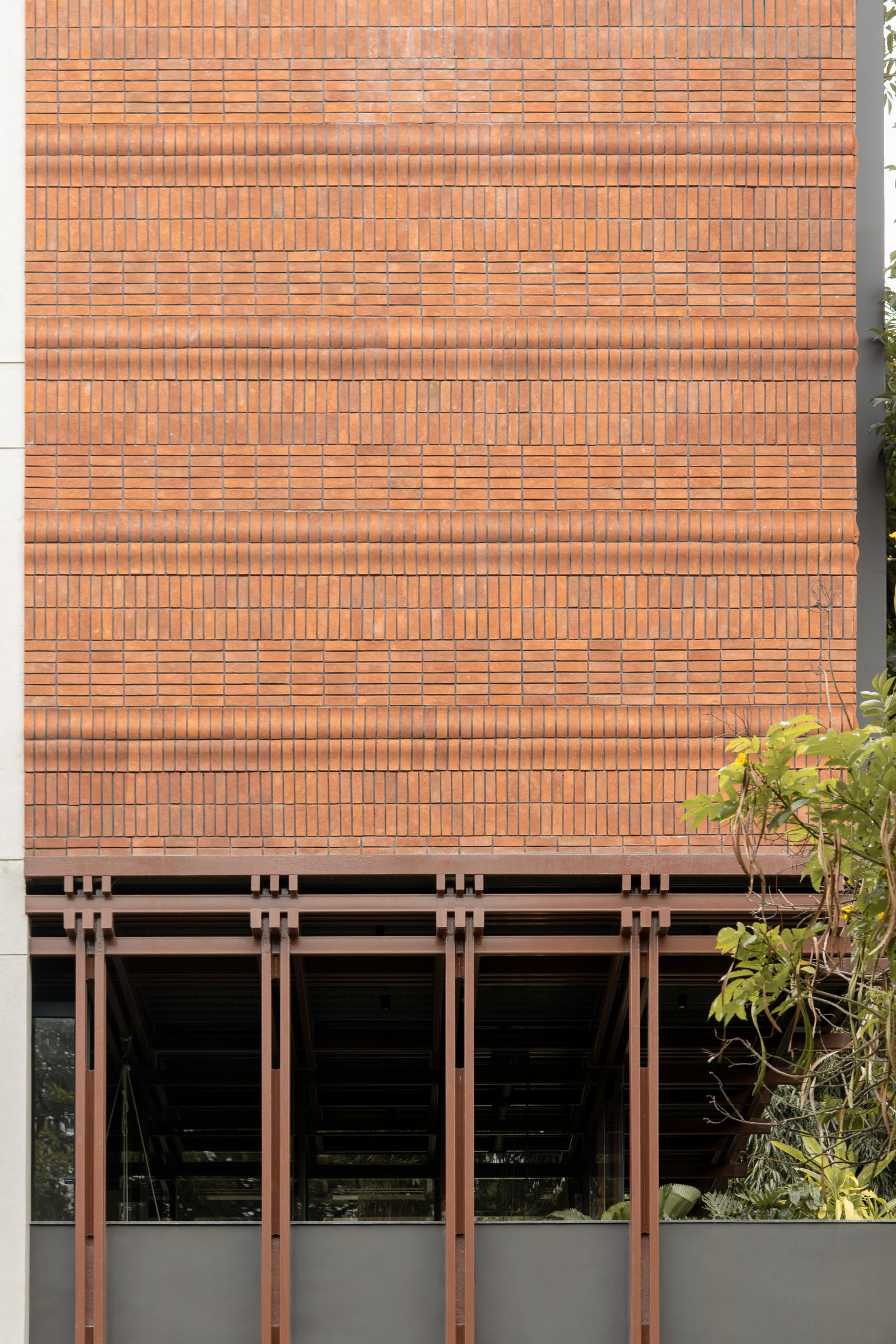
The brickwork itself is the building’s most patient gesture. Horizontal courses are interrupted at intervals by projecting vertical bricks, producing a corduroy texture that catches light differently through the day. Behind it, the steel column grid is visible at the lower edge, a deliberate exposure of the joinery logic that supports the apparent weight above.
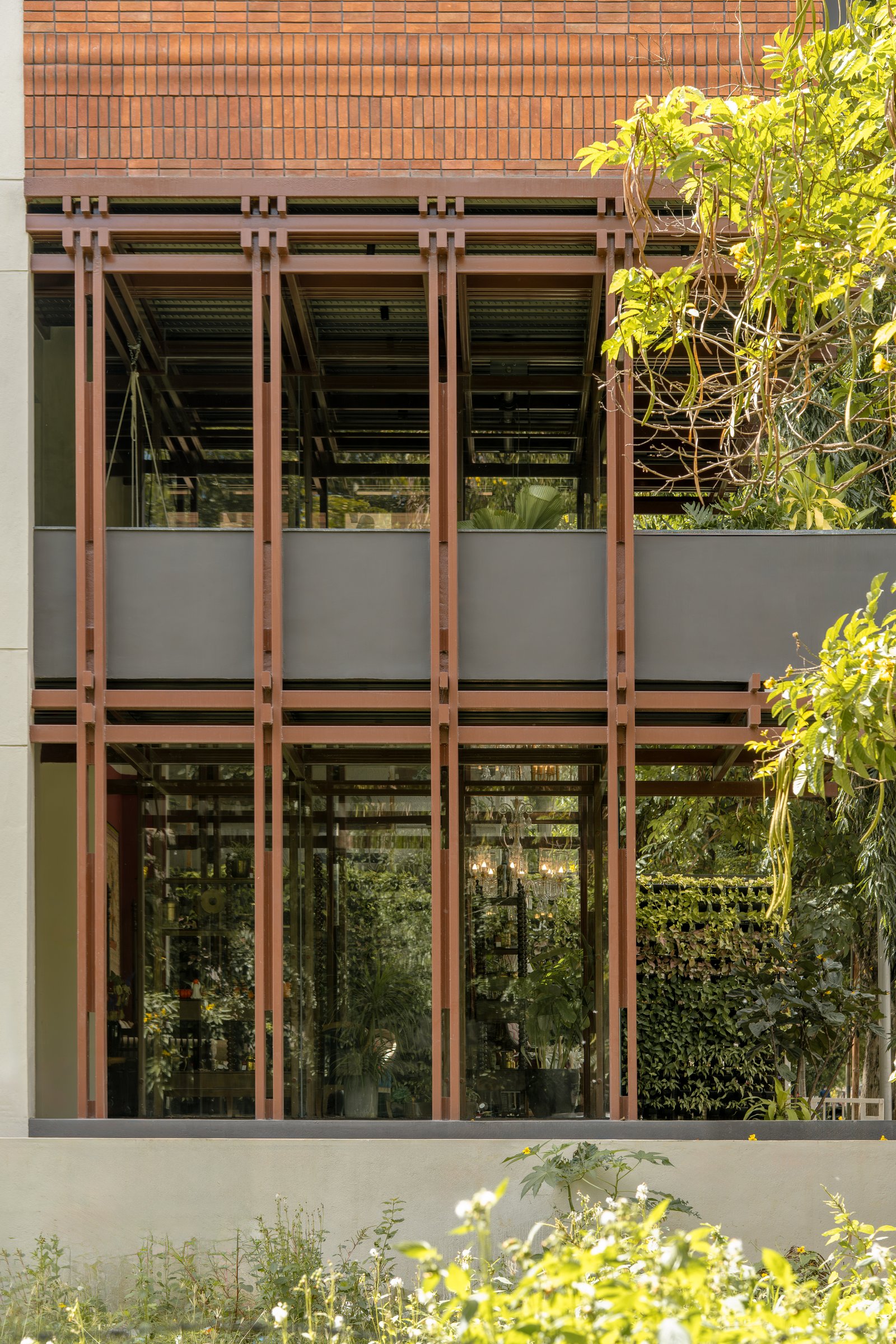
Closer in, the steel armature reveals its full grammar. Paired columns rise through a double-height void, each pair connected by short cross-pieces that resolve as a structural rhythm rather than a curtain wall. Through the glass, the showroom registers as a layered interior of plants, chandeliers, and curated objects, the architecture deliberately offering itself as a frame rather than a backdrop.
At the corner, the brick volume meets the sky with a sharply defined edge, the recessed glazing carved in as a clean horizontal slot. The detail rewards a long look: the brick is not laid as solid mass but as a screen that wraps an inner structure, the dark steel reveal acting as both shadow gap and structural acknowledgement.
Inside Arkaa: A Showroom That Behaves Like a Home
Within the ground-floor showroom, the design shifts register entirely. The architectural restraint of the exterior gives way to a deliberately layered interior, designed to display furniture in the way it might actually be lived with rather than as inventory on a sales floor.
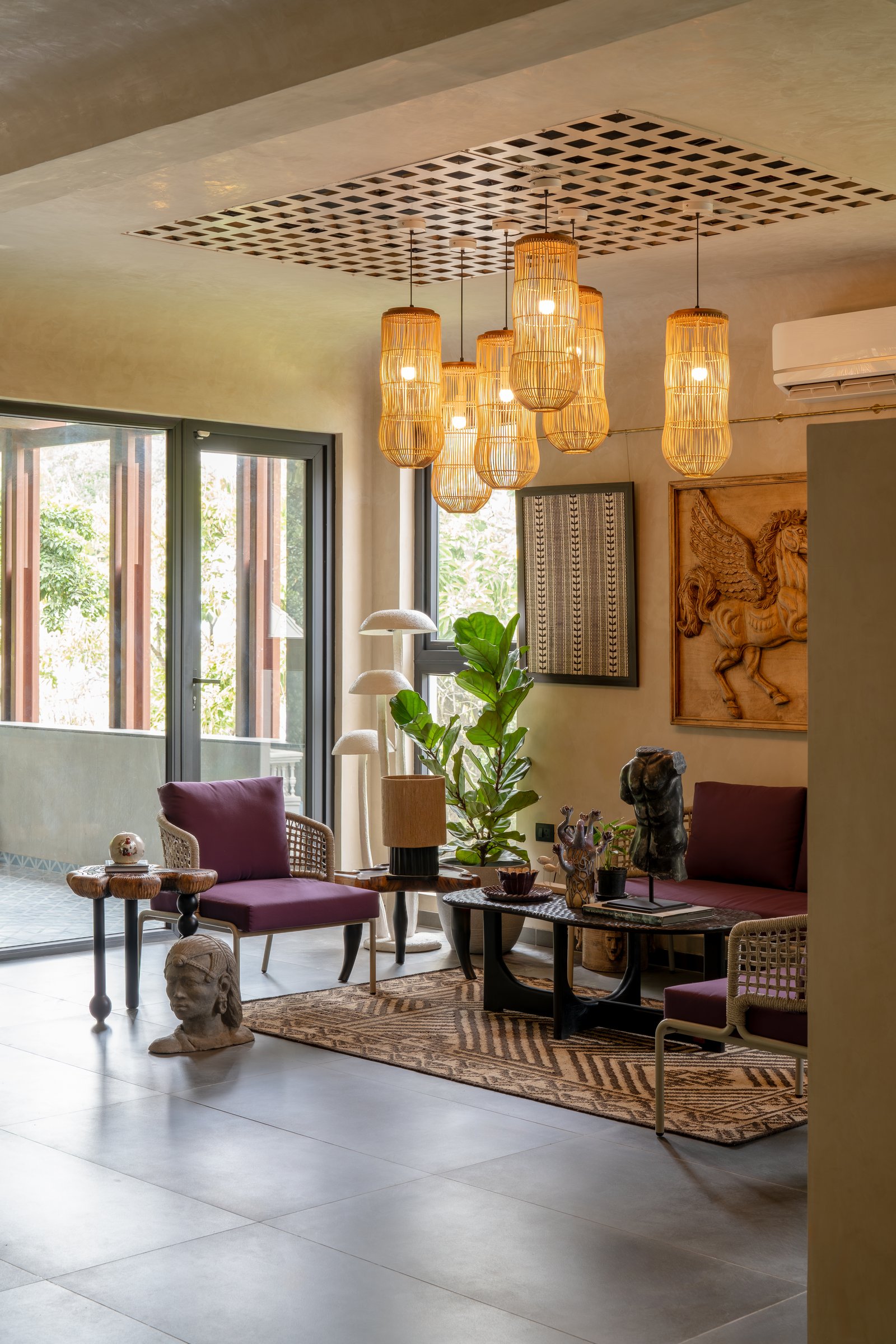
A seating vignette anchors the front of the showroom, with two upholstered chairs in deep aubergine flanking a low table beneath a cluster of cane pendants. A ceiling cut-out lined with a woven screen frames the pendants from above, while a relief panel of a winged horse provide the kind of curated counterpoint that signals this is not a retail floor but an interior in conversation with itself.
The plaster walls are finished in a warm, hand-applied beige that absorbs rather than reflects light. The patterned rug, the carved side tables, and the sculptural floor lamp all sit in a register that rewards slow looking.
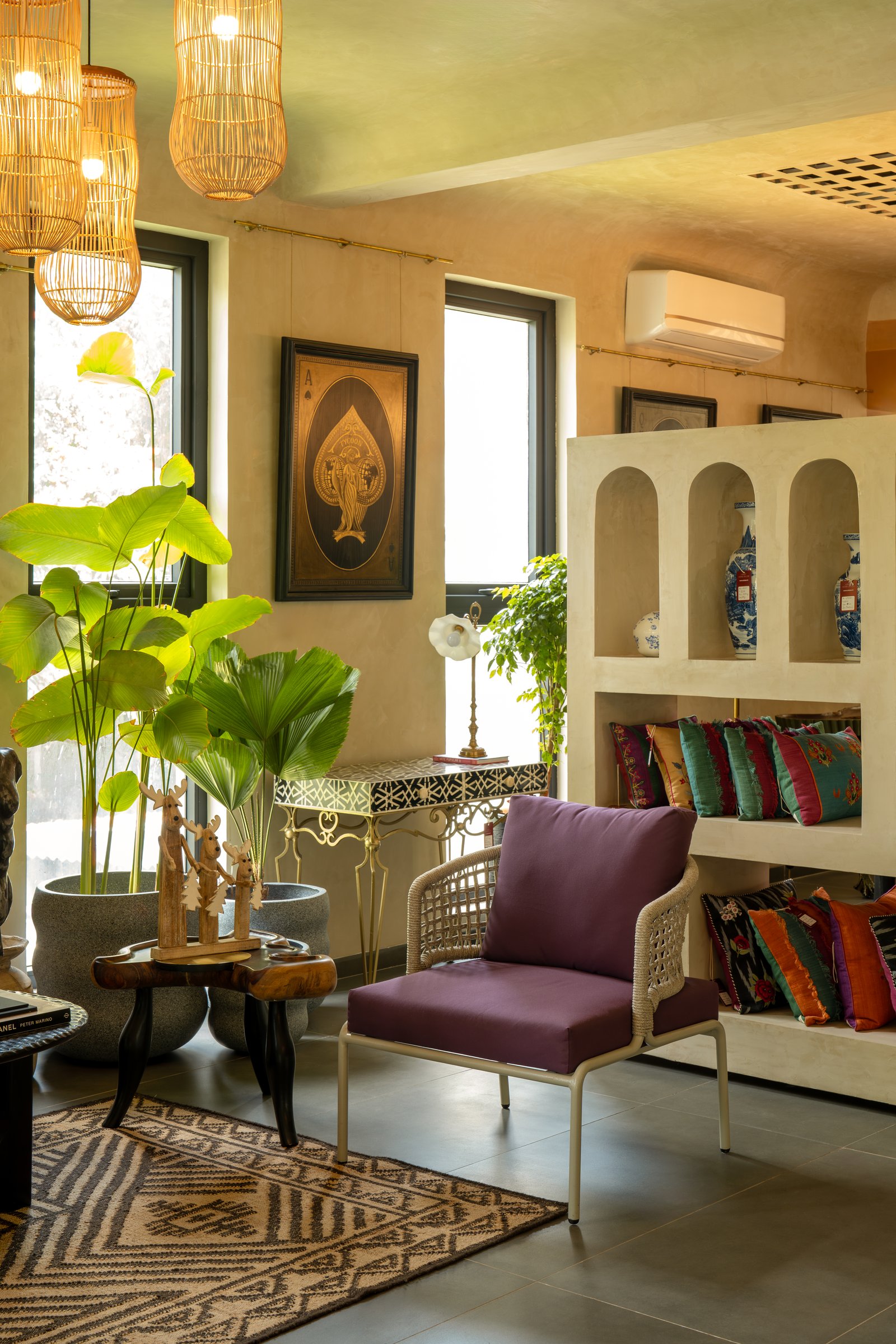
Further along, an arched niche unit functions as both display and partition, its three rounded recesses holding blue-and-white ceramics above open shelves stacked with embroidered cushions in jewel tones. A single aubergine chair sits against it, repeating the upholstery note from the adjacent vignette and quietly threading the room together.
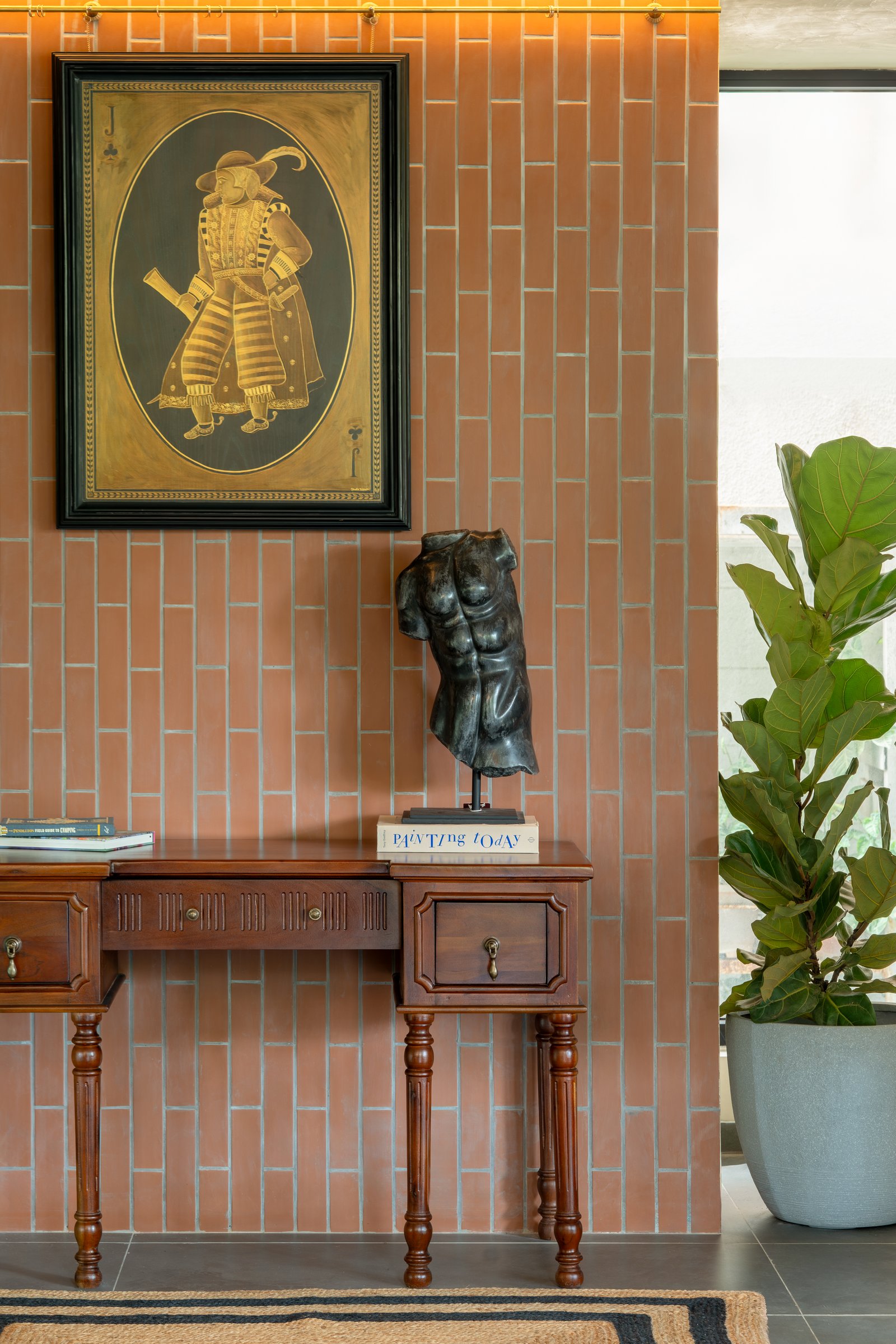
A detail wall demonstrates the project’s willingness to let materials carry meaning. Vertical terracotta tiles, laid in a narrow stack bond, become a textured backdrop for a turned-leg console, a gold-on-black painted panel, and a bronze torso. The brick that defines the building’s exterior reappears here as an interior surface, collapsing the distinction between façade and room.
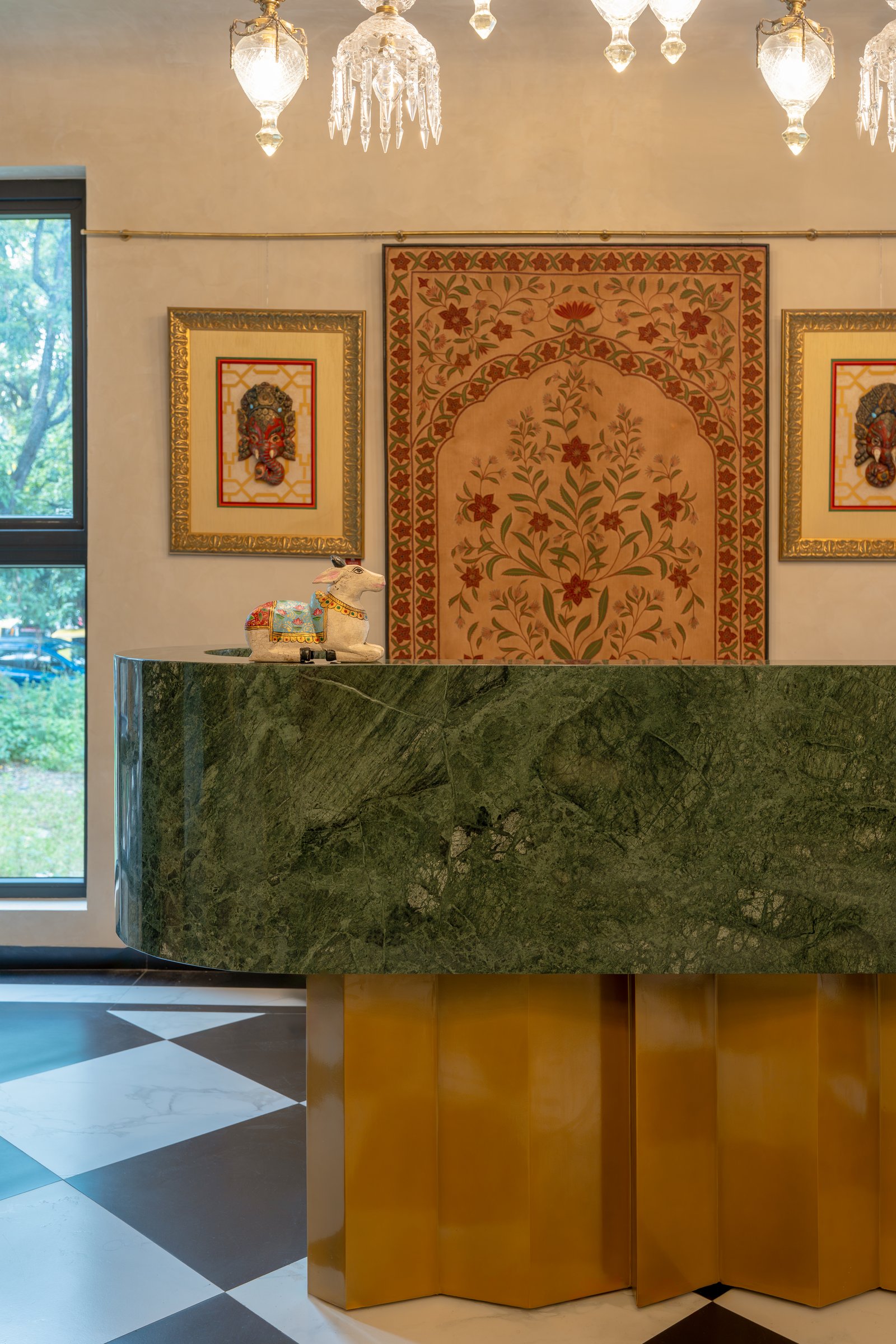
A reception counter occupies a particularly resolved corner of the showroom, its curved green stone top resting on a fluted brass base that reads almost as drapery. Above it, a Mughal-inspired textile in a gold frame anchors the wall, flanked by two smaller framed pieces, and a cluster of cut-glass pendants drops from the ceiling like a chandelier disassembled into components.
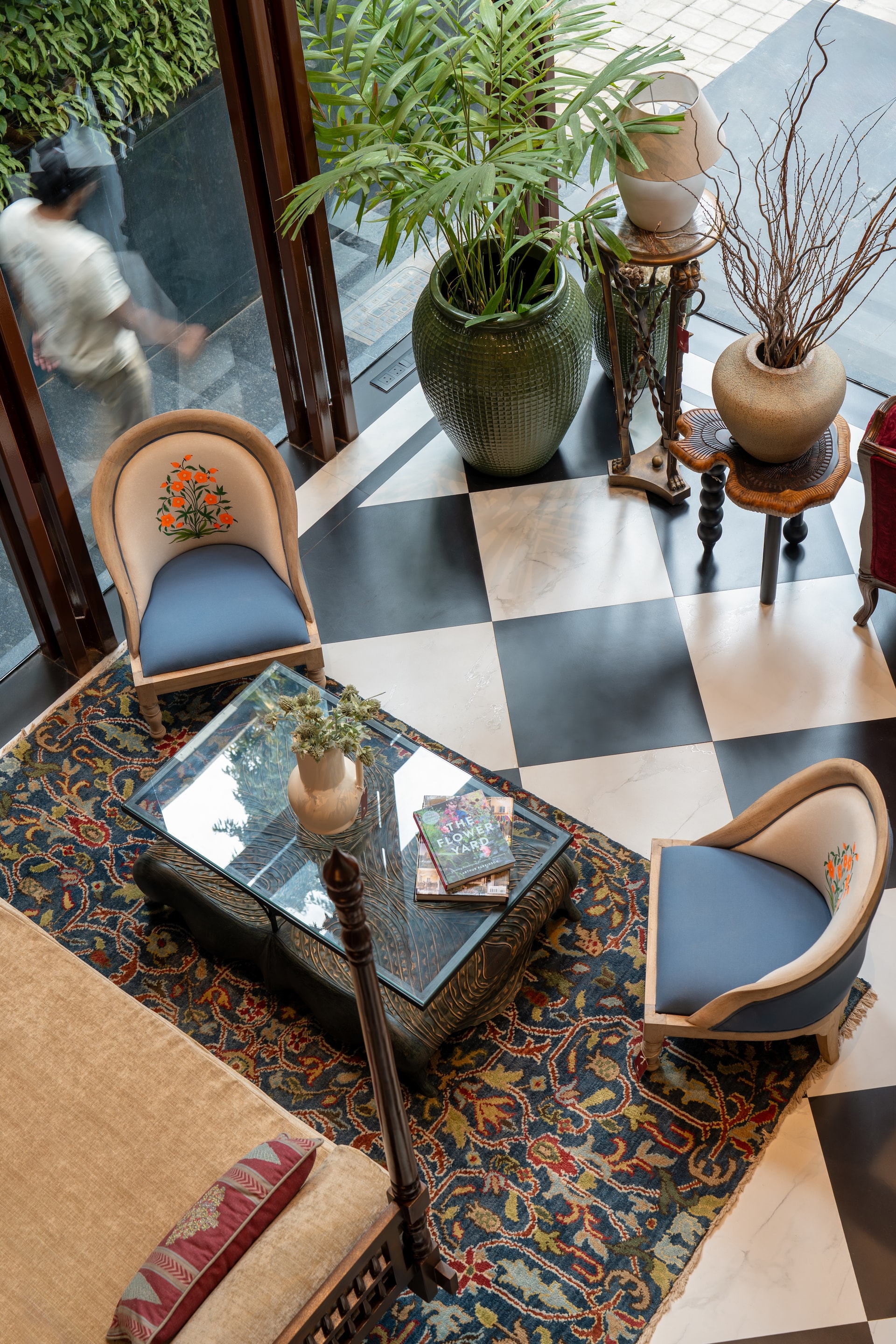
The black-and-white checkerboard floor signals a deliberate stylistic shift: a vignette of Indo-Portuguese and continental furniture arranged against the floor-to-ceiling glazing, a four-poster bed visible at one edge, a blue tub chair beside a hanging carpet, and a crystal chandelier suspended overhead. Sunlight pours through the steel-framed glazing and falls in geometric blocks across the tile, the daylight itself behaving like an exhibition piece.
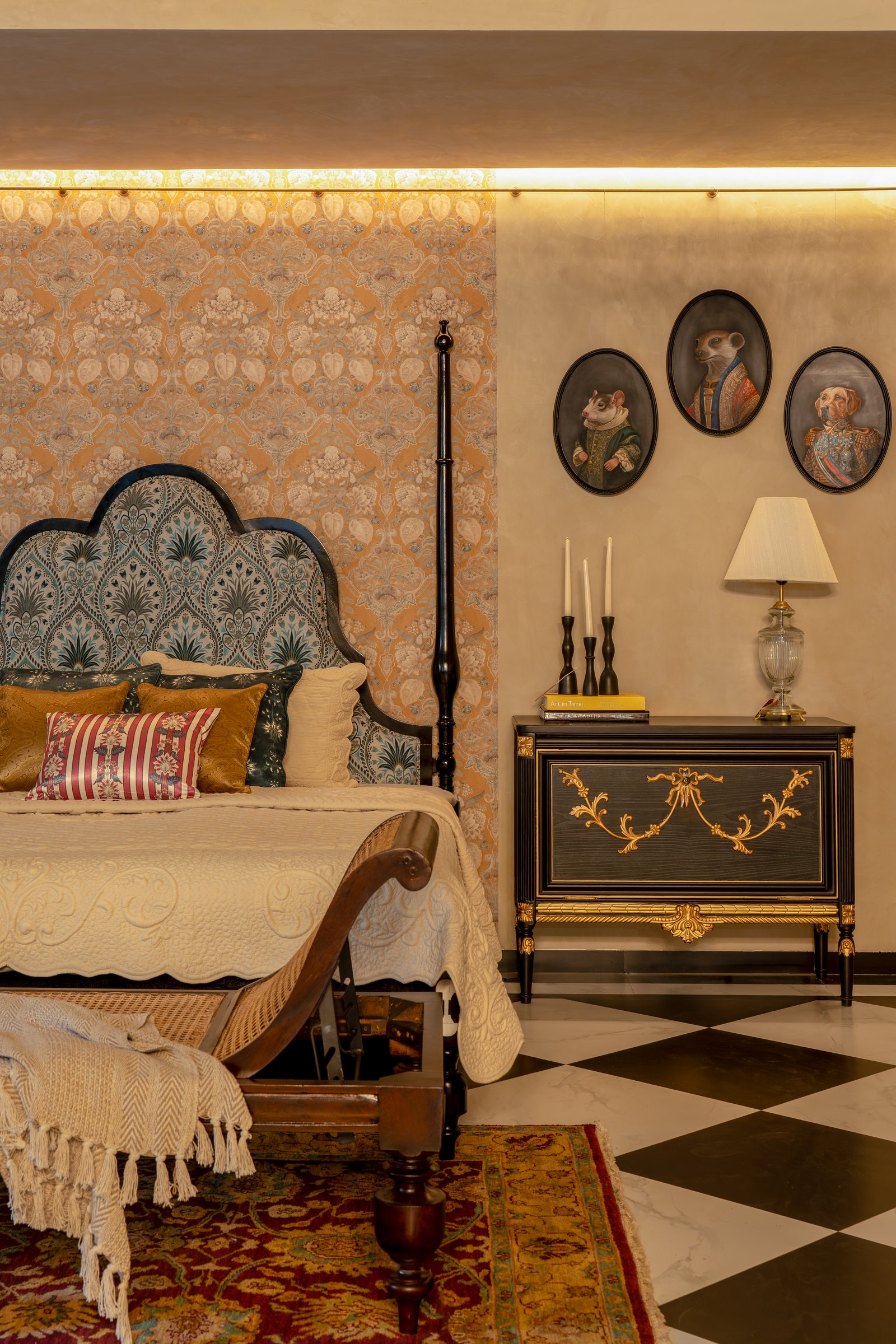
A bedroom vignette upstairs leans fully into ornament. A patterned wallpaper sits behind a scalloped, upholstered headboard with a slender black post, while a black-and-gold neoclassical chest of drawers occupies the adjacent wall beneath three oval portraits of animals dressed as aristocrats. The checkerboard floor returns, anchored by a faded red Persian rug, and the room is staged not as a bedroom for sale but as an essay on layering, period, and wit.
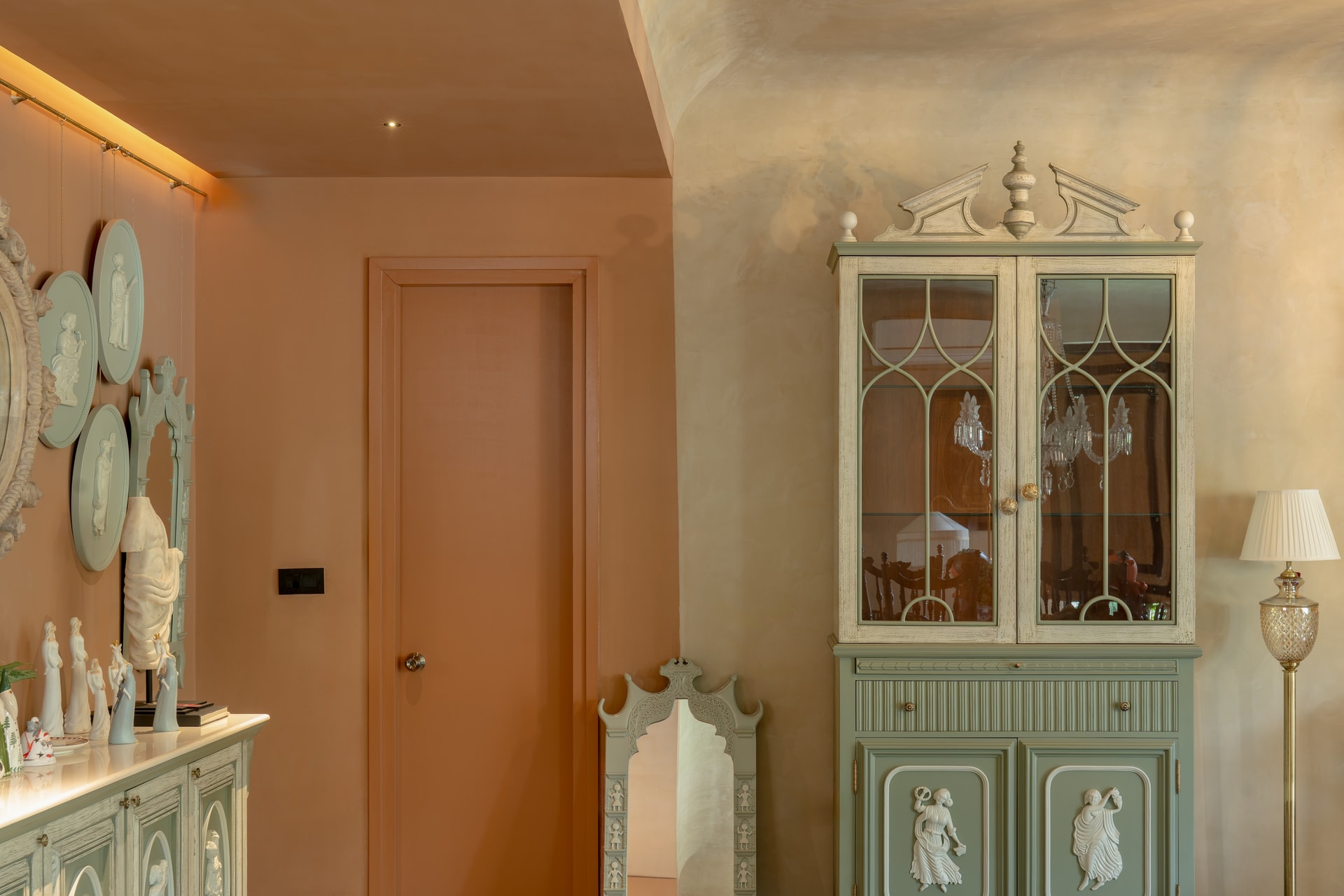
Elsewhere in the showroom, a softer palette emerges: a terracotta-pink wall holds a peach door, while a sage-green vitrine cabinet displays porcelain figures behind glazed astragal doors. The pairing of colour and case piece is unfashionable in the strictest sense, and that is precisely why it works; the room rewards taste built over decades rather than seasonal restraint.
What Brick on Sticks ultimately negotiates is a difficult balance between commercial pragmatism and architectural ambition. The clients needed a building that would earn its rent and house their life’s work; the architects responded by treating the structure itself as a piece of furniture, the brick as upholstery, the steel as joinery. The result is a Bengaluru commercial building that participates in the streetscape rather than dominating it, that holds its trees rather than felling them, and that argues, in restrained terms, for an architecture of reason.
In a city where speculative commercial fabric tends toward either the generic or the gestural, this is the quieter, harder thing: a building whose discipline is its design, whose ornament is its structure, and whose presence is calibrated to its place.