Retail interiors, at their most ambitious, do not merely house product; they argue for it. The premise is harder than it looks: the architecture must hold its own and then quietly step aside, leaving the garments to do the speaking. The Silver Store for Etasha by Asha Jain, tucked into the cultural grain of Kala Ghoda, is built on precisely this discipline.
Designed by DR&W, Design, Research and Workshop as the studio’s first retail commission, the 1,500-square-foot showroom translates the construction of Asha Jain’s metallic Banarasi textiles into spatial language. The brief was unusual: take a fabric in which silver threads crinkle through jewel-toned silks, and find its architectural equivalent. The studio’s answer was to wrap the shell in a single, restrained idea, a silver box painted in the industrial lacquer used on Mumbai’s street lampposts, and then let everything else negotiate around that decision.
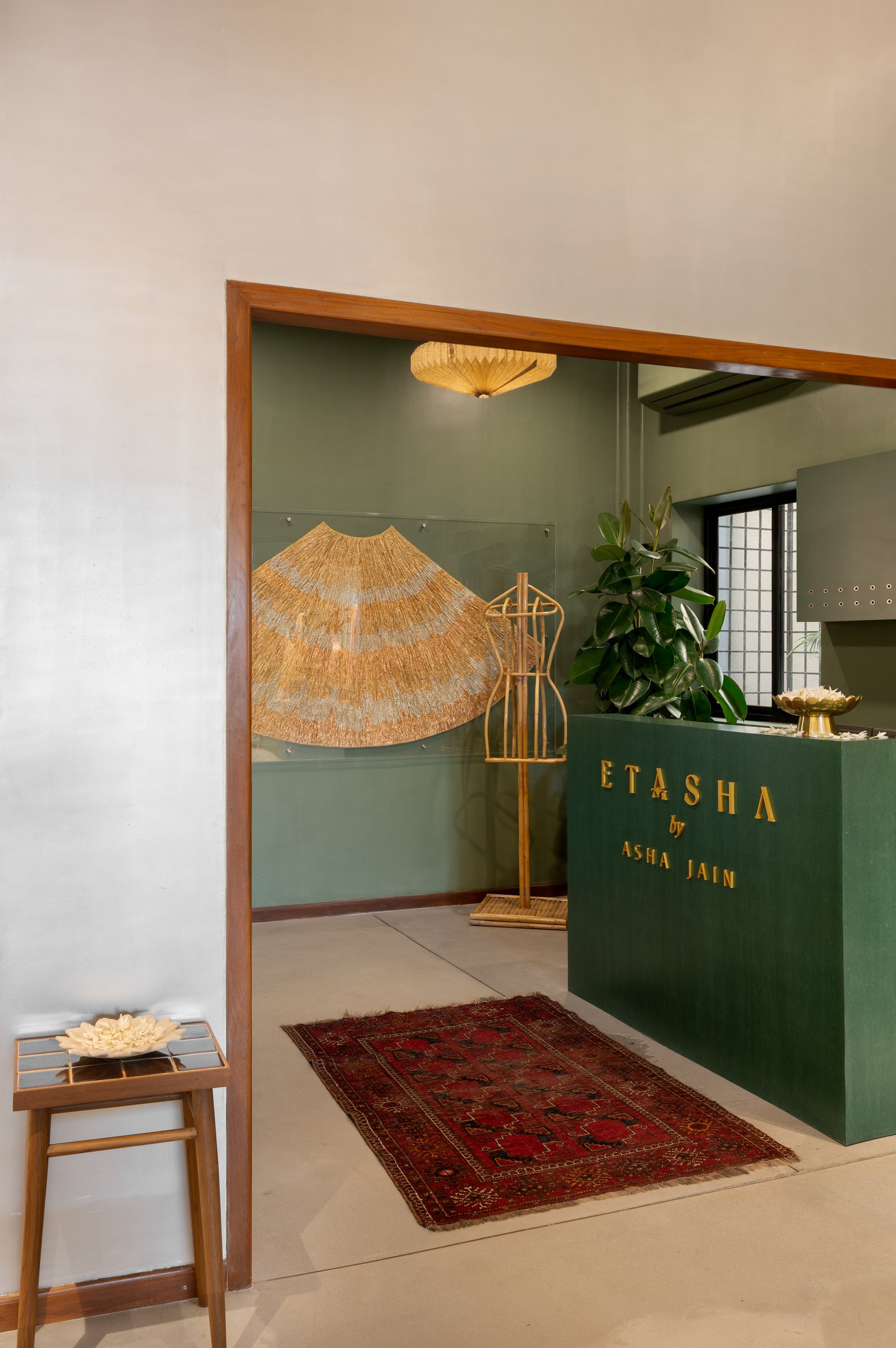
The arrival sequence is deliberately understated. A timber-framed threshold opens onto the deep emerald reception volume, where the Etasha wordmark sits in brass against a pigmented green wall and a paper-pleated ceiling pendant introduces the softer, handmade register that will run through the store.
The decisions read as gestures of restraint: a single antique rug, a sculptural mannequin in brass, a textile artwork mounted behind glass. Nothing competes with the green, and the green itself does not compete with what is coming next. The foyer functions as a tonal preamble, telling the visitor that this is a store where colour will be used architecturally, not decoratively.
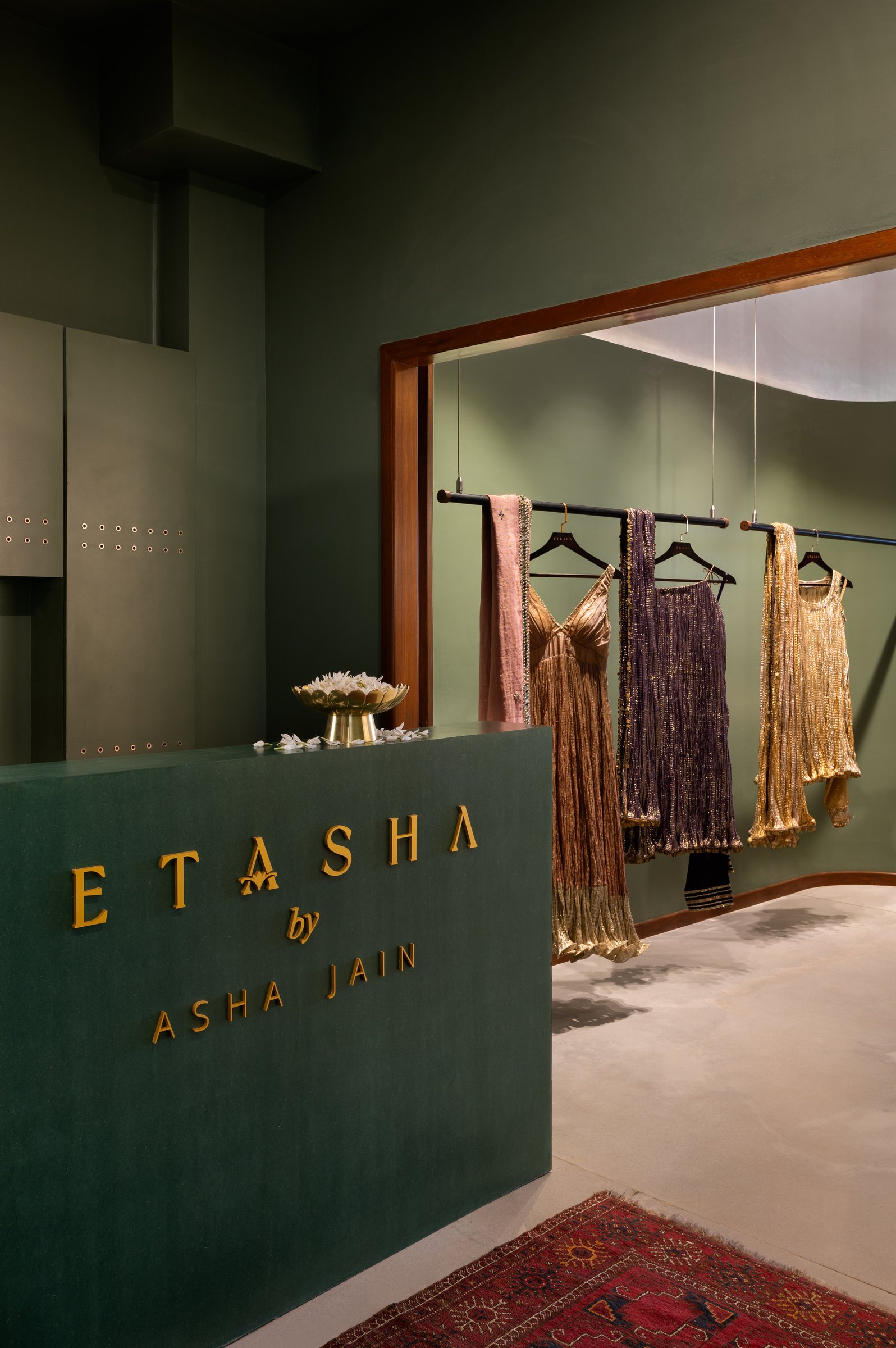
Up close, the reception desk reveals the studio’s material logic. The pigmented green putty is matte and slightly tactile, almost suede-like under light, and it carries the brass lettering without any of the gloss one might expect from luxury retail.
““By elevating a material associated with the everyday cityscape into the backdrop of a luxury retail environment, the project blurs distinctions between the ordinary and the opulent.””
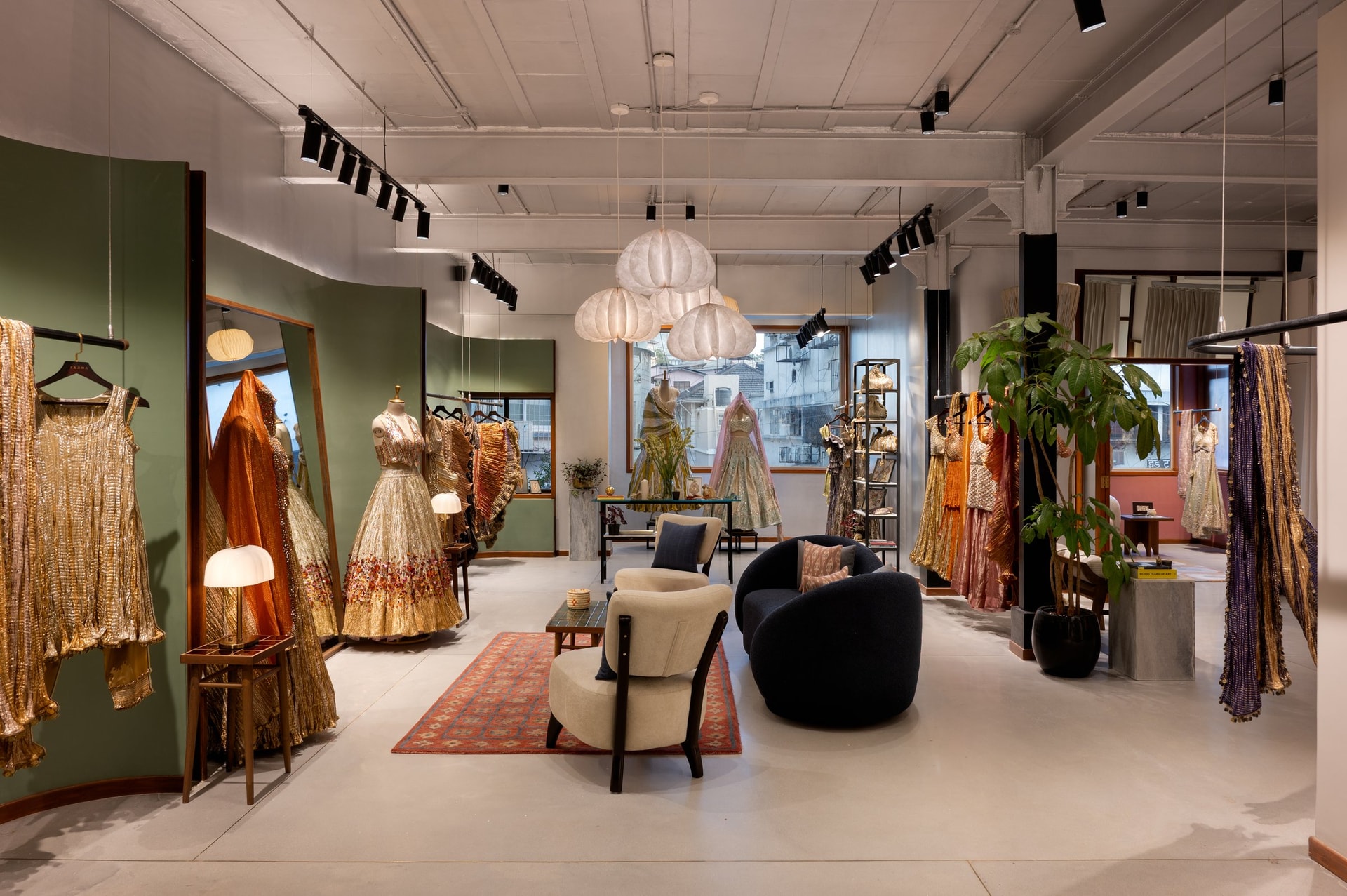
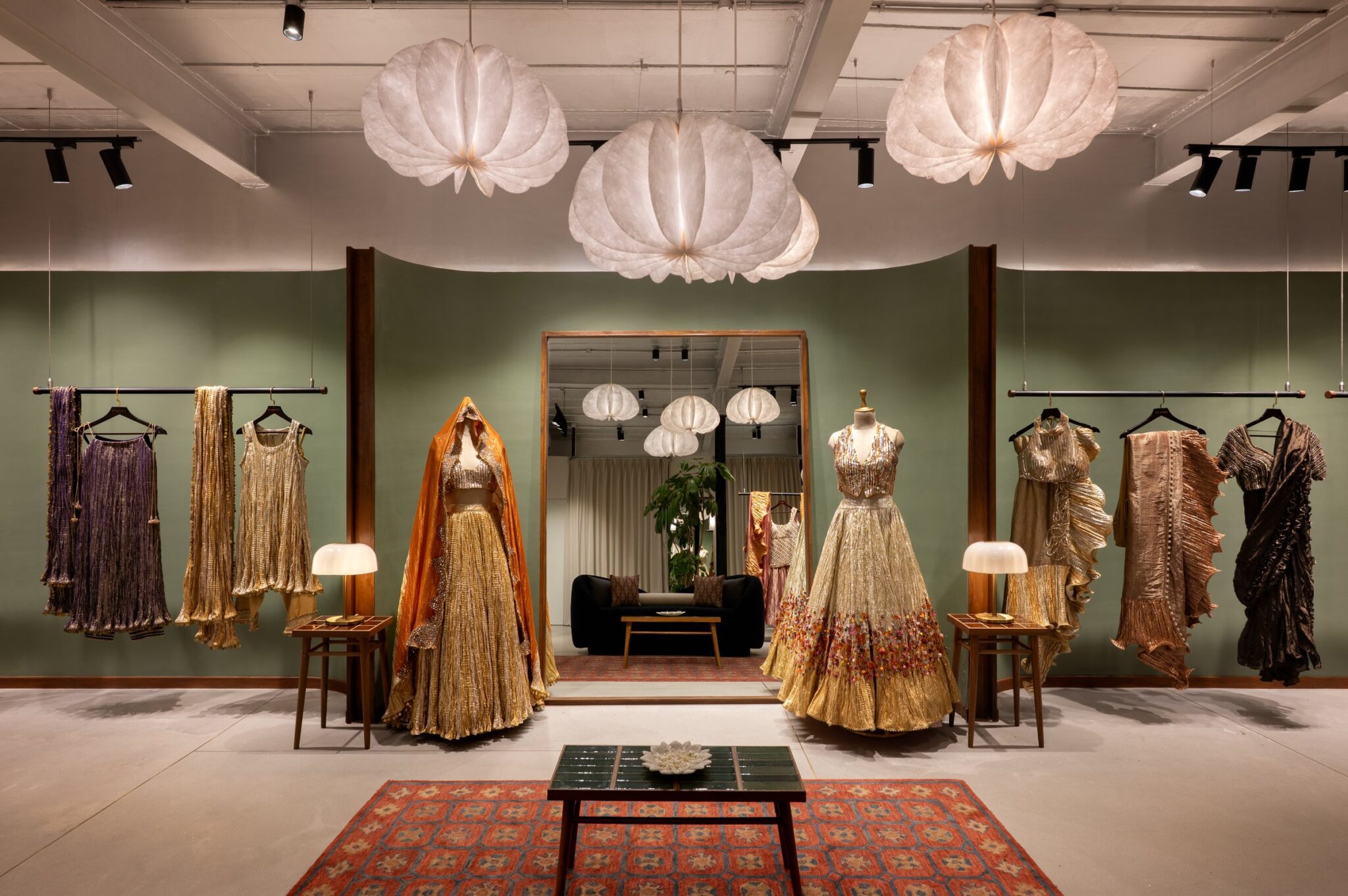
The main display hall : a sweeping curved wall in soft sage green that arcs through the room as a continuous backdrop. Against the industrial shell of exposed ceiling, track lighting and slim black columns, the green operates as both stage and counterpoint, its depth amplifying the reflective shimmer of the garments hung against it.
Furniture is deliberately recessive. A dark rounded sofa, a pair of upholstered chairs, a low table on an antique rug; the seating cluster is arranged not to dominate but to suggest pause, a place from which to look. Hanging above, a constellation of paper-shade pendants softens the warehouse-like ceiling without disguising it.
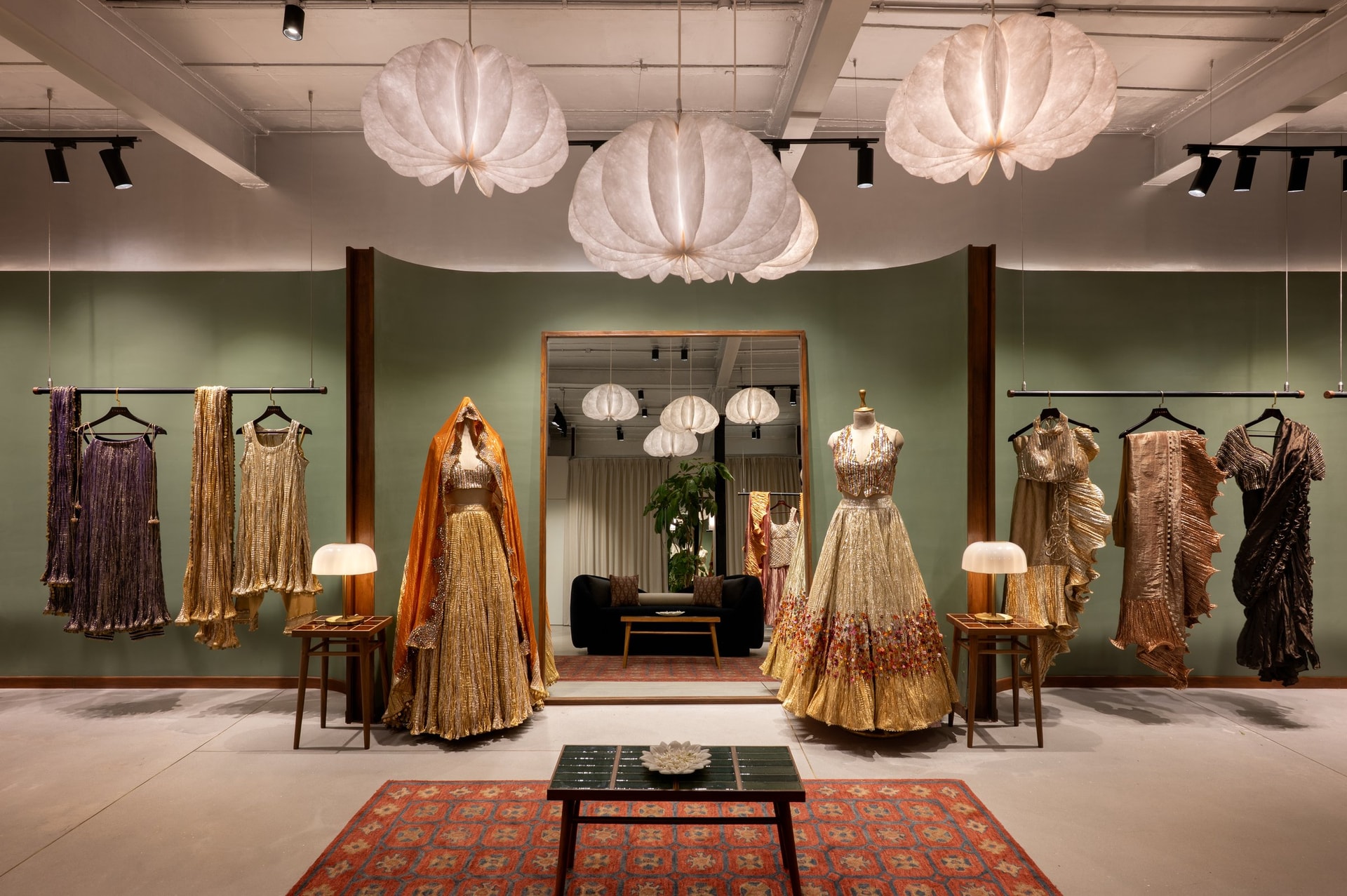
From the centre of the hall, the choreography becomes legible. The curved green wall frames a single tall mirror at its midpoint, mannequins flank it on either side, and the entire composition reads as a symmetrical altar to the textile itself.
It is here that the studio’s thesis crystallises. The metallic threads in Asha Jain’s fabrics are quiet until they meet a coloured ground; the architecture mimics this exactly, holding back in tone so the embroideries can release their light. The room is the loom, the garments are the warp.
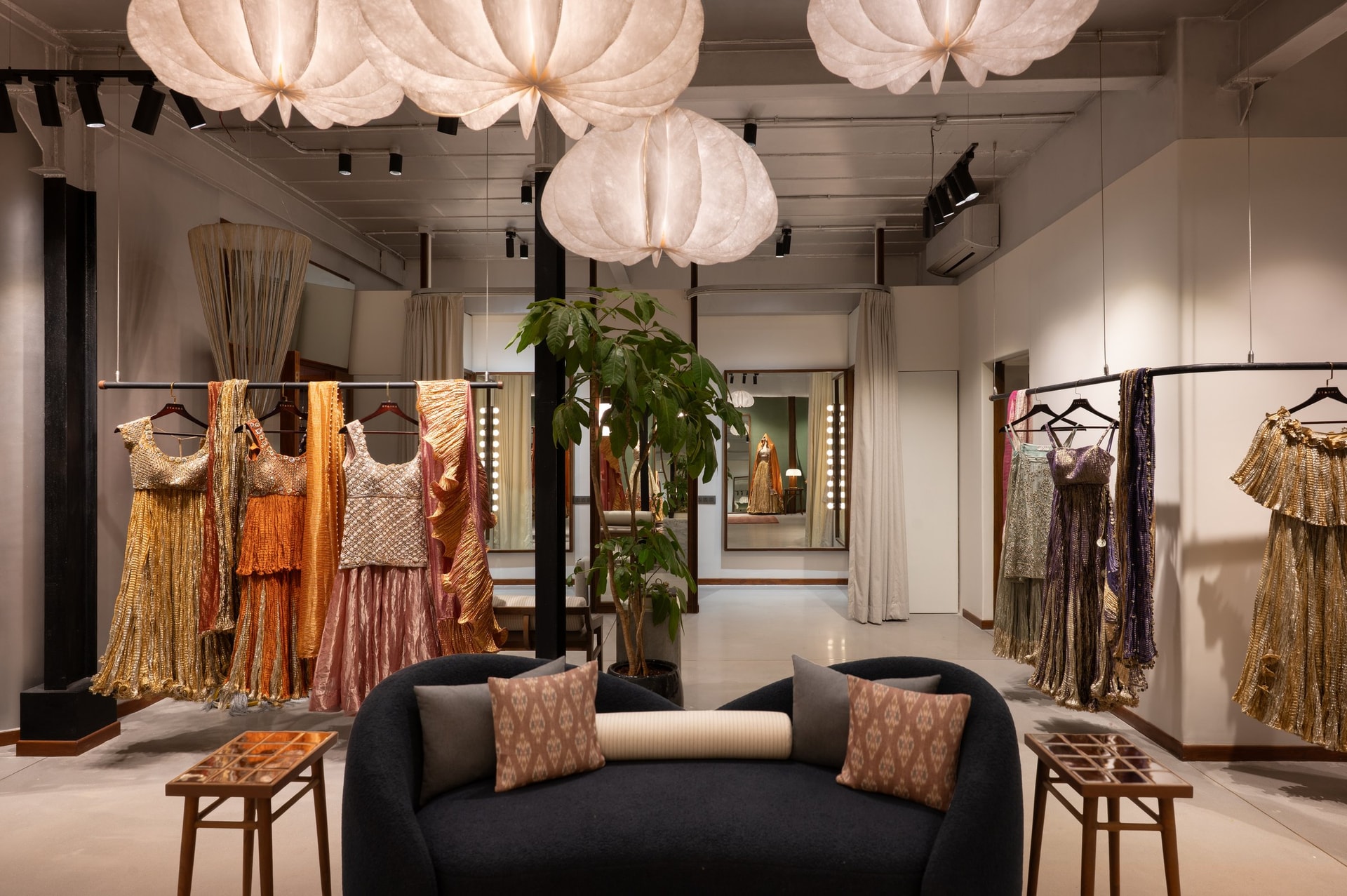
Look up, and the ceiling tells a parallel story. Clustered paper-pleated pendants in organic, bulbous forms hang at varying heights, their handmade surfaces catching light in much the same way the fabrics do, in folds and creases rather than flat planes.
A glass-topped console at the room’s centre holds the smaller registers of the collection, embroidered potlis, fragments of textile, an oversized vase of tuberose. The arrangement behaves more like a curated still life than a retail vignette, and it is here that the store’s relationship to craft, rather than commerce, comes most clearly into view.
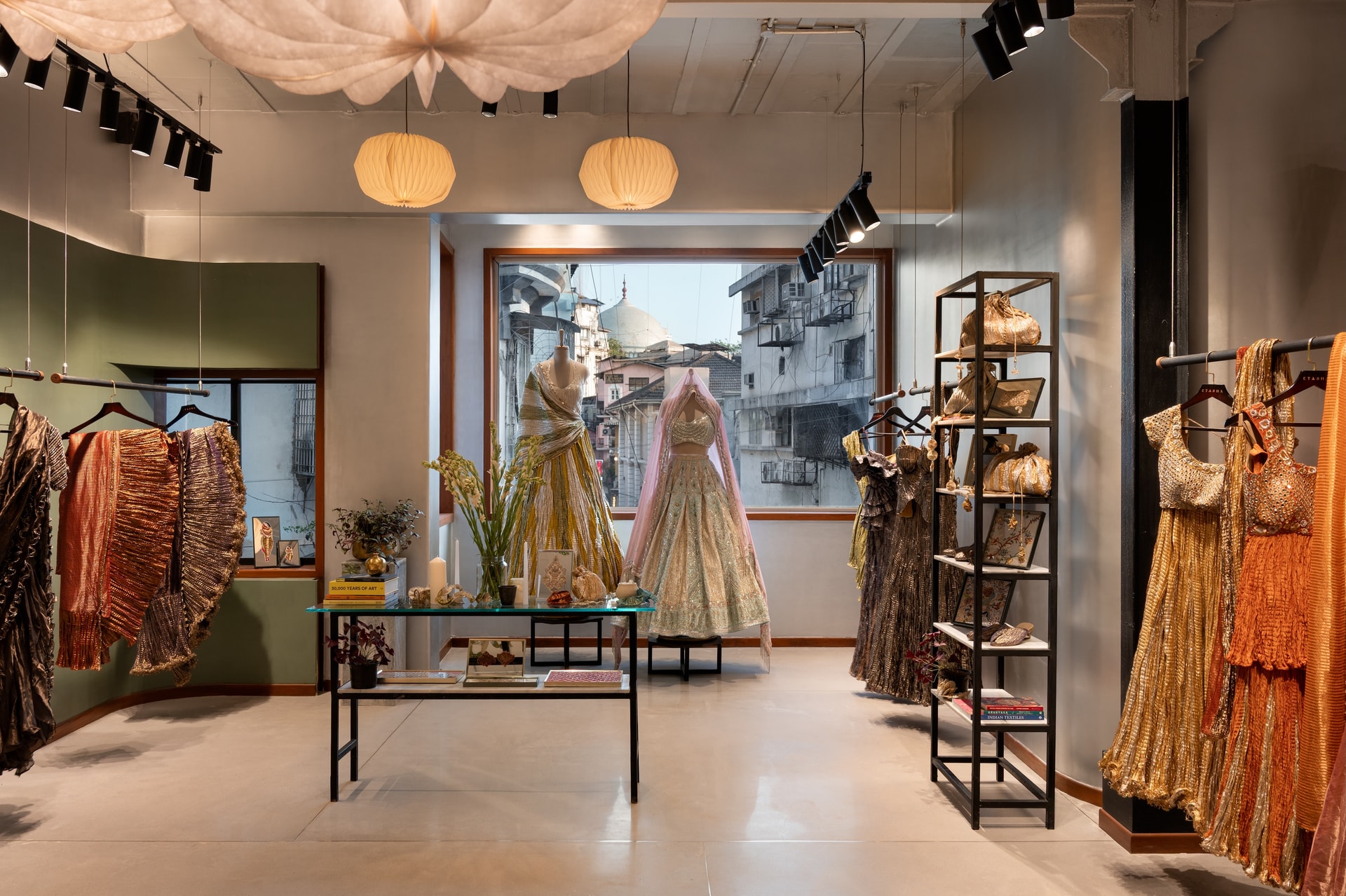
One of the room’s quieter rewards is the framed view through the window onto the dome of the Chhatrapati Shivaji Maharaj Vastu Sangrahalaya.
Detail vignettes around the curved wall demonstrate the design’s lower volume.
The wall’s gentle curve and the dark wooden skirting are doing more work than they appear to. The curve removes the room’s right-angled rigidity; the skirting grounds the green, preventing it from floating. These are the kind of decisions that distinguish a designed retail space from a styled one.
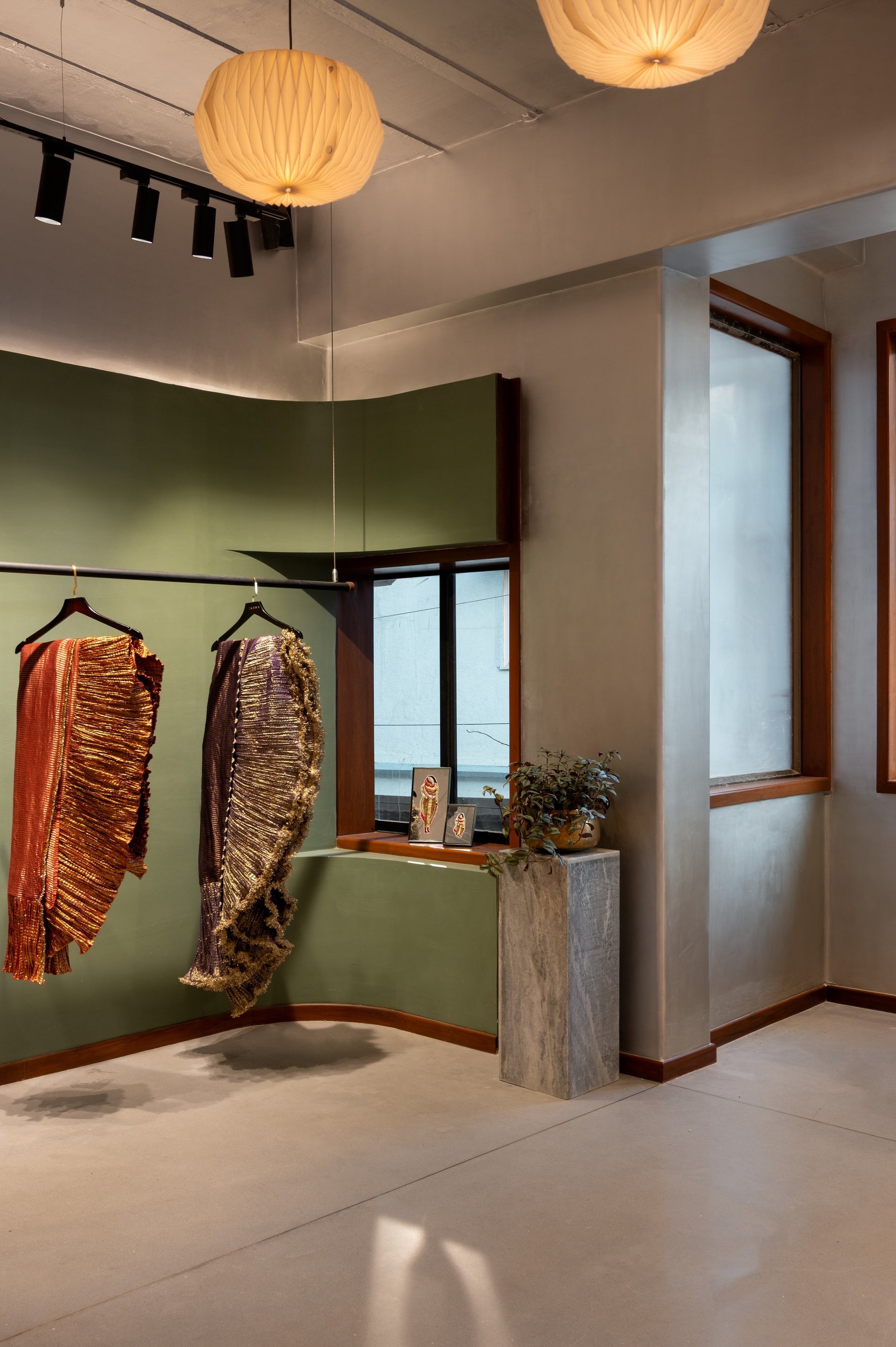
In a quieter pocket of the hall, the curved green wall meets a small window-side display where two textured garments hang against the pigmented surface. The corner reads almost domestically, a reminder that the store is sized for intimacy rather than spectacle.
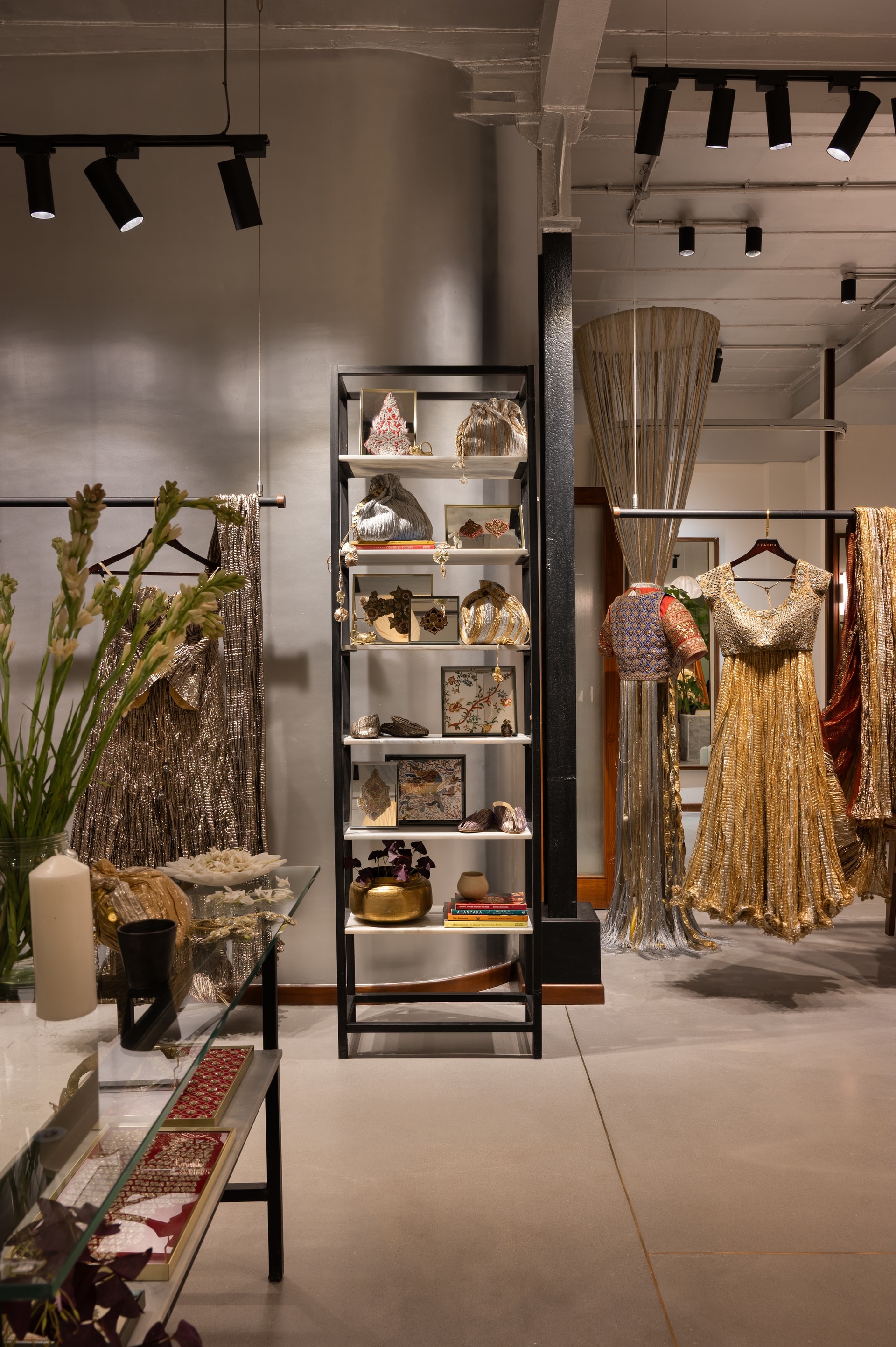
A tall black metal shelving unit, slender and almost industrial in profile, stages the collection’s accessories. The shelving’s restraint, all line and no mass, lets the objects accumulate visual weight against the silver-painted wall behind.
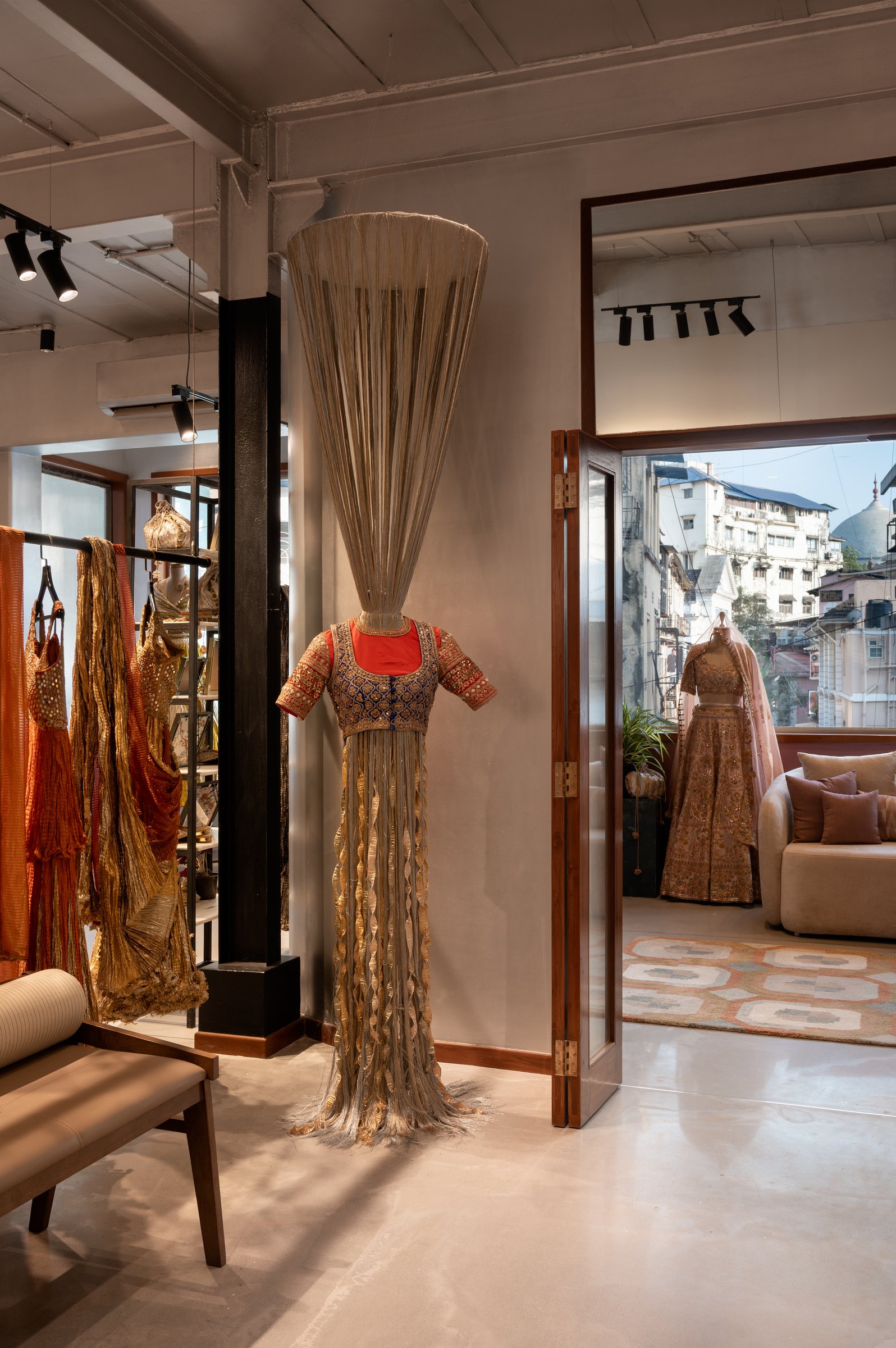
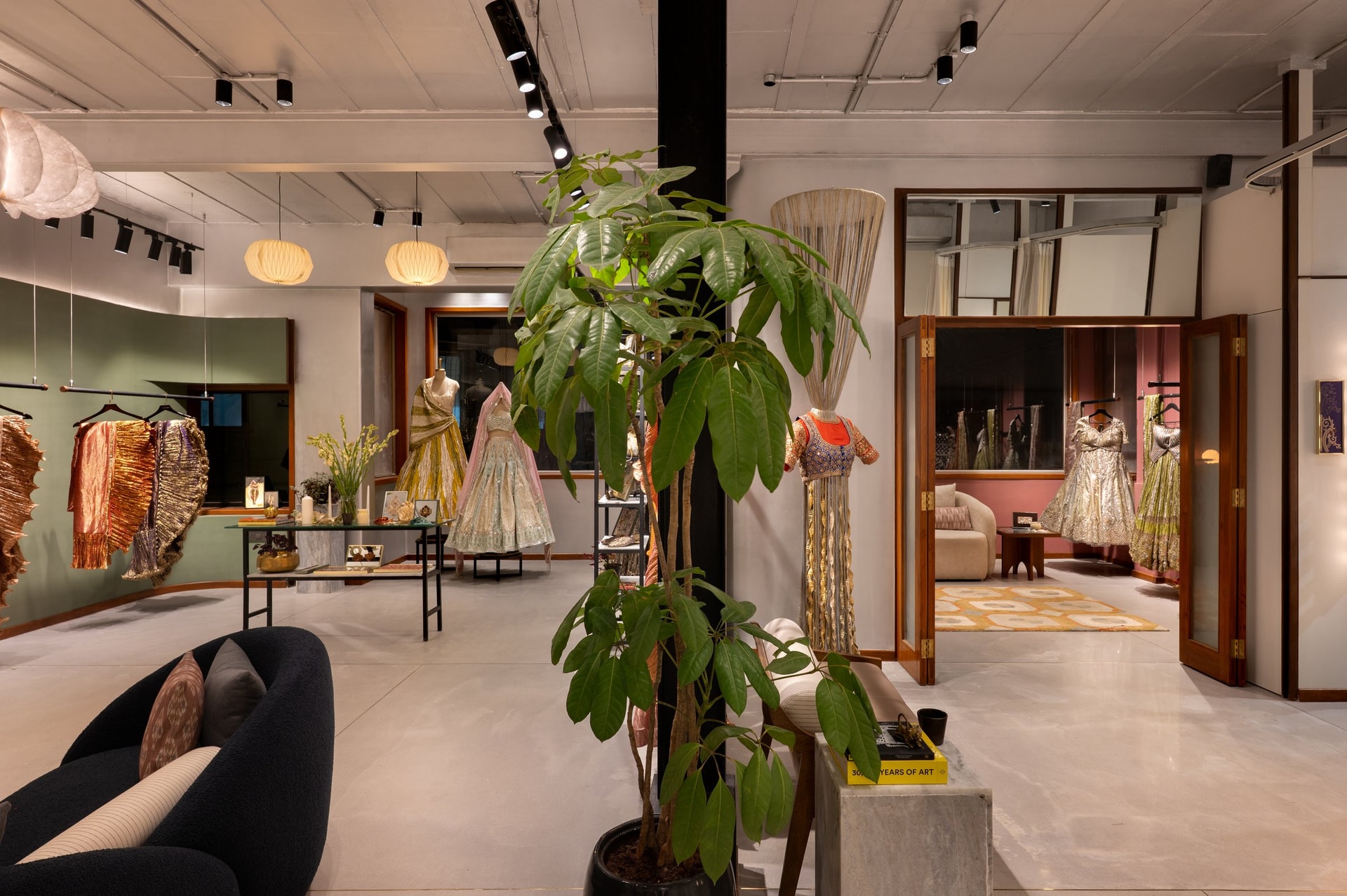
The transition between zones is handled with timber-framed glass doors that fold open to reveal the mauve-pink bridal lounge beyond. The choreography is deliberate: the main hall’s metallic-and-green palette gives way to something warmer, more enclosed, more ceremonial, and the threshold itself becomes part of the narrative.
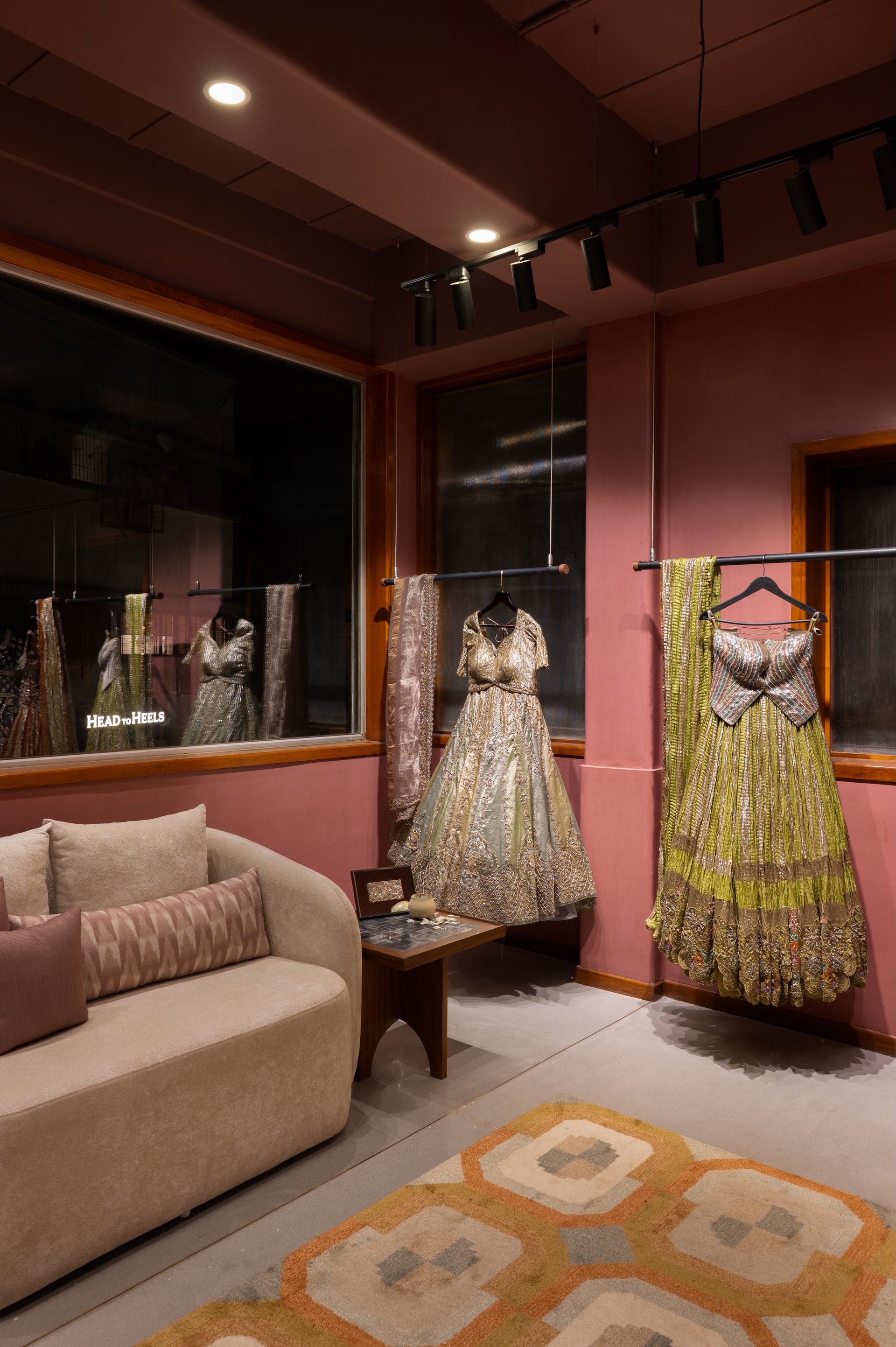
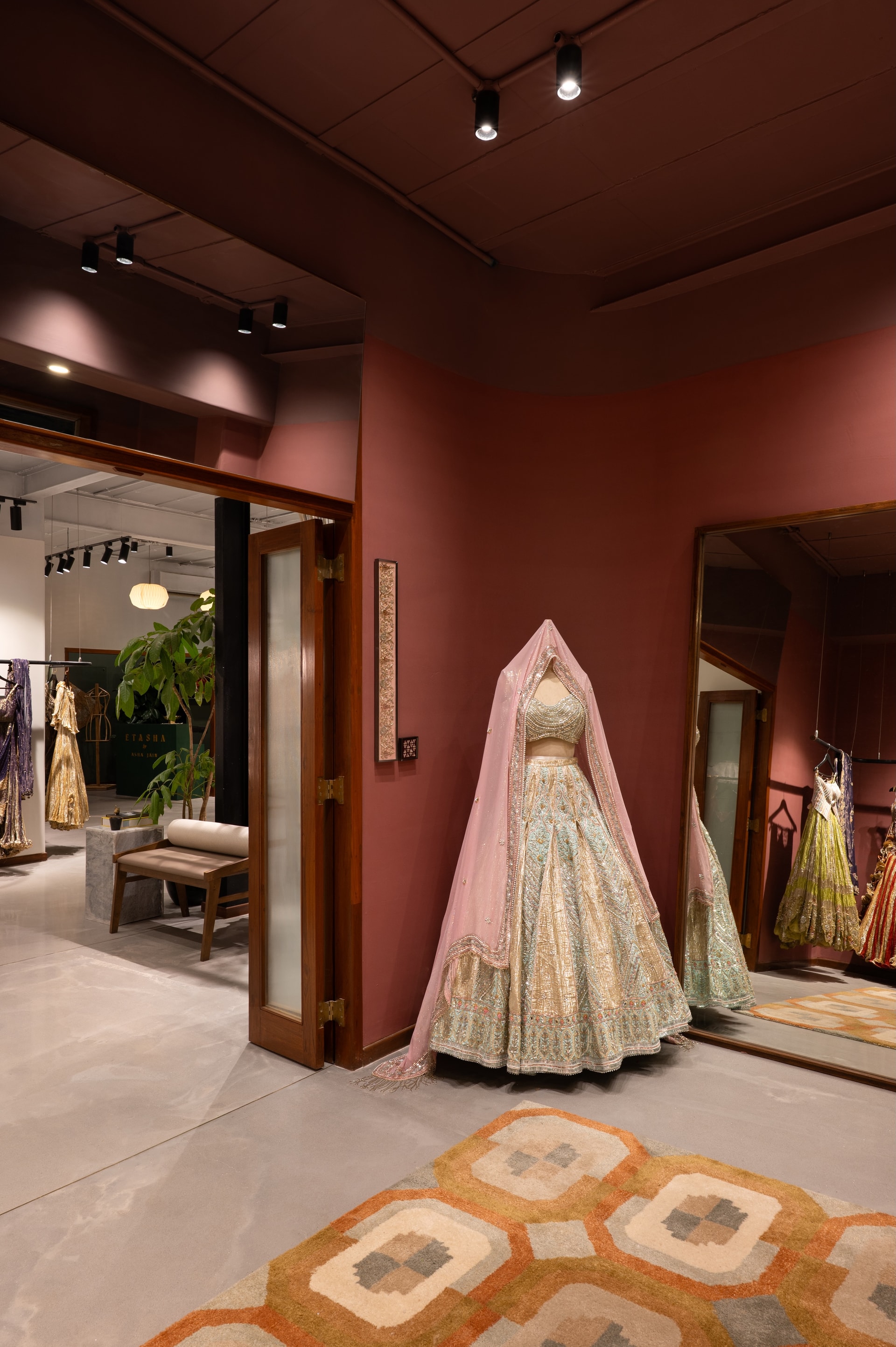
The bridal lounge departs entirely from the silver-and-green register of the main hall. Walls and ceiling are washed in a deep mauve-pink pigment that wraps the room into a cocoon, and the lighting drops to a warmer, lower key suited to consultation rather than display.
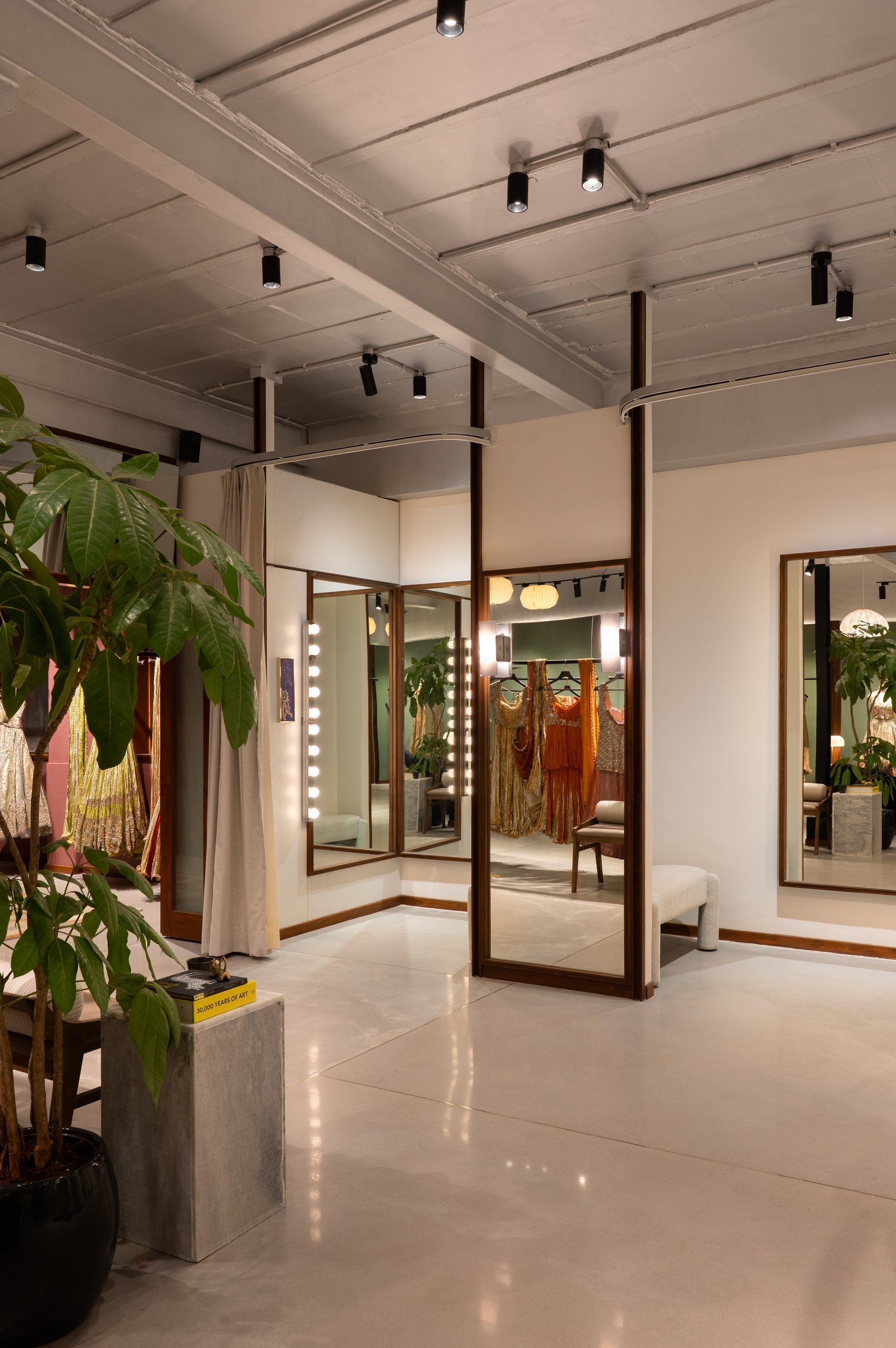
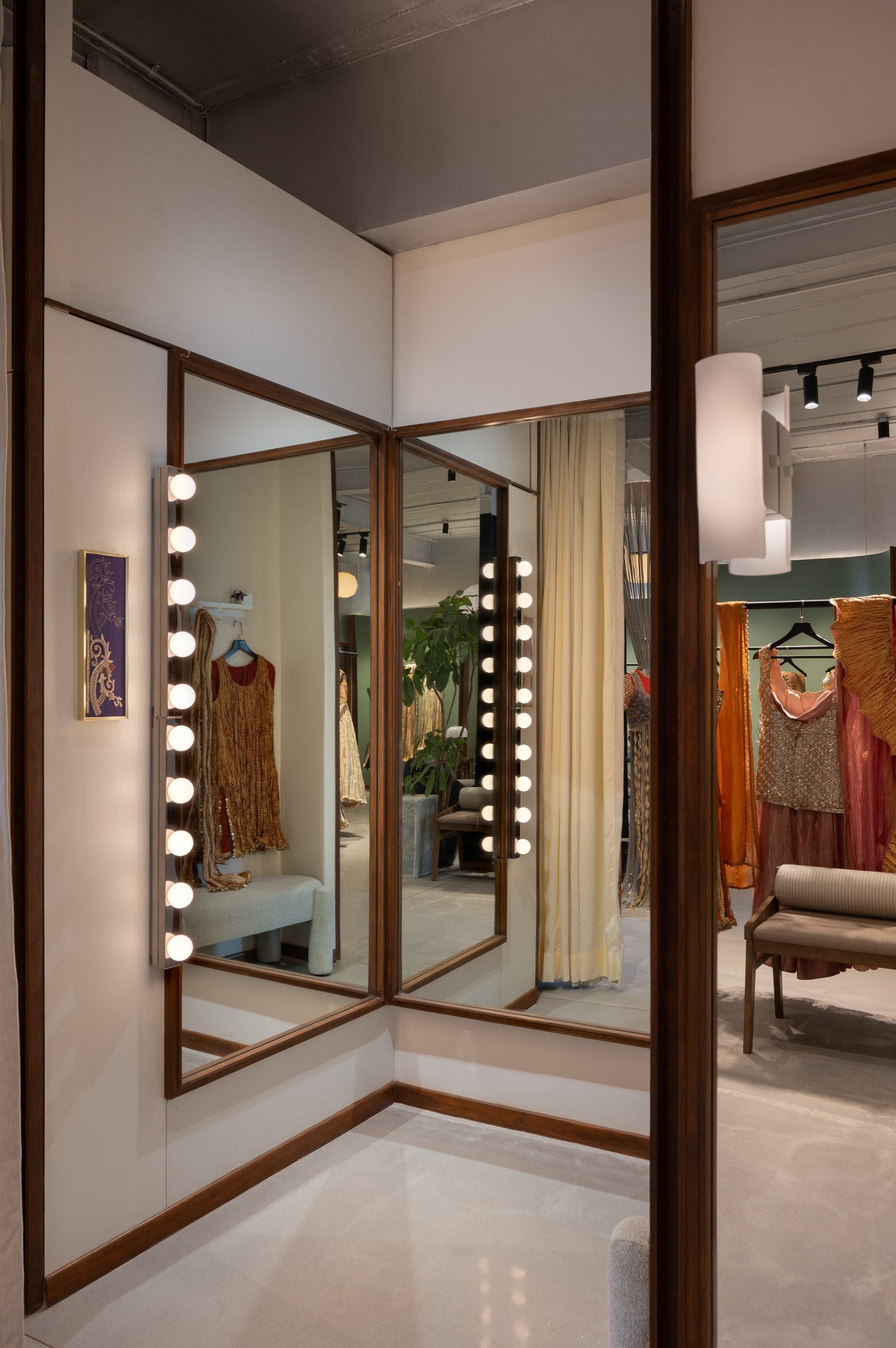
The trial room area extends the same restraint. Timber-framed mirrors with vanity-bulb edges sit within a soft, almost neutral envelope. After the chromatic intensity of the green hall and pink lounge, the trial zone reads as a deliberate exhale.
What the Silver Store argues, in the end, is that retail architecture in India is capable of more than imported luxury templates. The choice to use street-lamppost paint as the project’s defining material is not a stunt; it is a thesis about where opulence actually lives in a city like Mumbai, in the friction between the industrial and the ornate, the everyday and the ceremonial.
For DR&W’s first retail project, the Silver Store sets out a clear position: that the most generous thing an interior can do for a craft-led label is to step back, hold its tone, and let the textile finish the sentence. In a precinct like Kala Ghoda, where shop fronts compete loudly for attention, that restraint reads as a kind of confidence.