Clinical spaces, particularly small ones, are rarely designed as arguments. They are usually solved as problems: how to fit a consultation desk, a waiting bench, a storage wall, and a doctor’s chamber into a footprint that resists generosity. The more compelling clinics are those that begin with a different question, one about meaning rather than capacity, and allow the answer to organise everything else.
Meghdhara Ayurveda, the head office of an Ayurvedic practice in Jamnagar, takes this longer route. Designed by iRA Design Studio, the 350 sq. ft. interior is organised around three functional zones, reception and waiting, an associate chamber, and the principal doctor’s chamber, but its real organising principle is the translation of Ayurvedic philosophy into spatial form: the Panchamahabhuta, the Tridosha, and the presence of Lord Dhanvantari rendered as design rather than decoration.
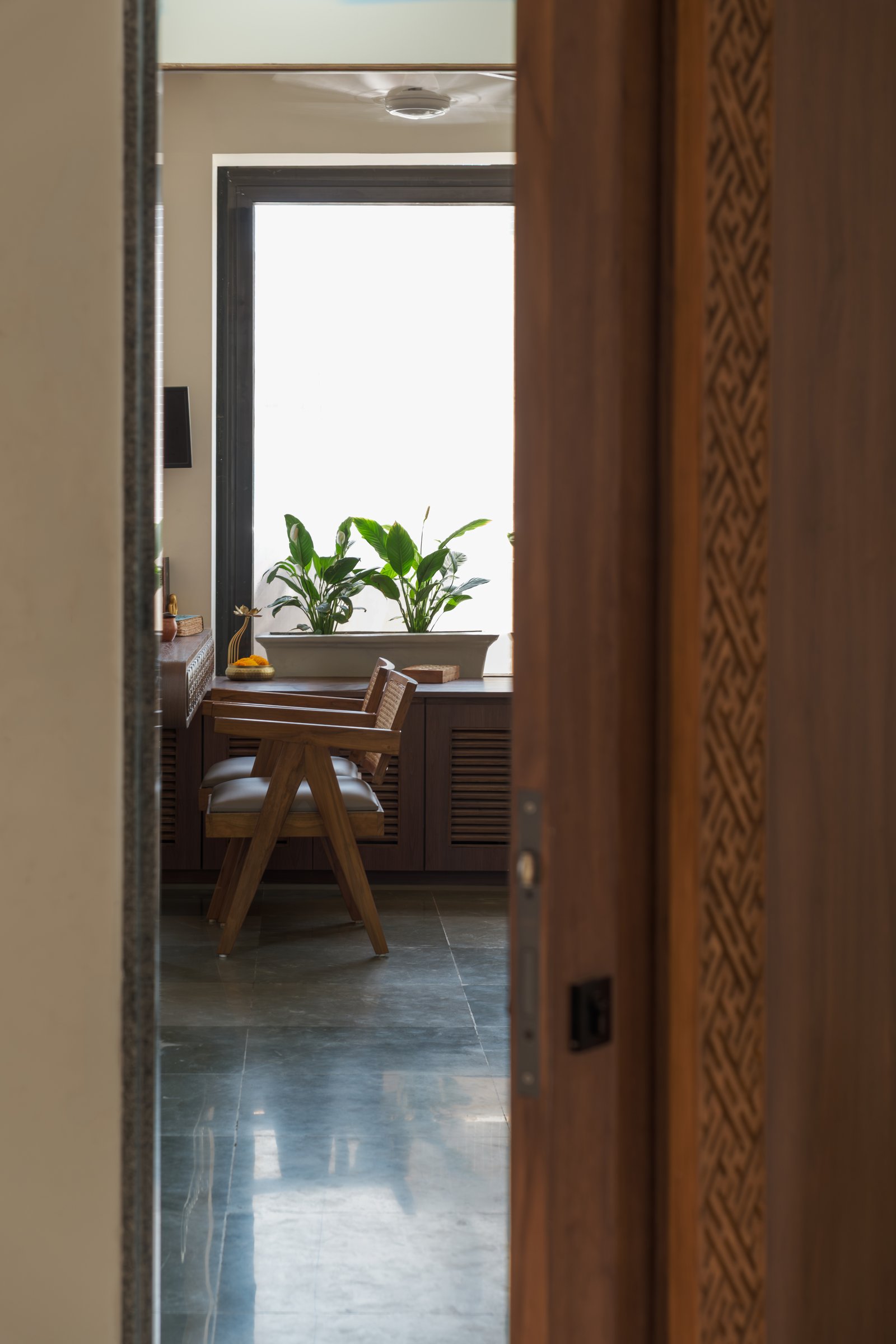
The first view of the clinic, framed through a carved jali-pattern door edge, sets the material register. Kota stone flooring runs in a soft green-grey checker, dark teakwood louvres line the low cabinetry, and a tall window at the end of the room holds a planter of broad-leafed greens against the daylight. The composition is grounded and quiet, and announces the clinic’s primary instinct: to feel like a place of pause and reflection.
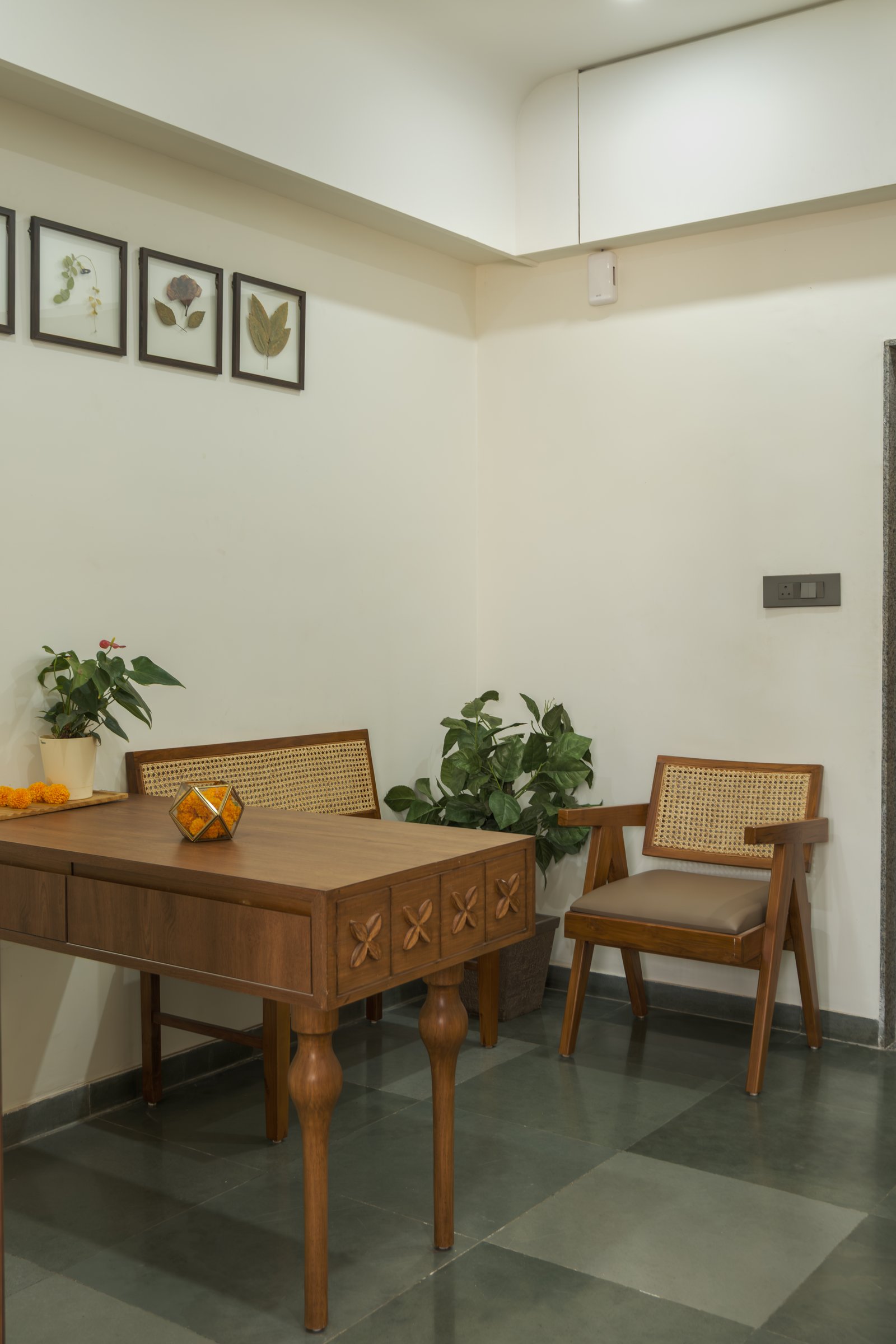
The reception and waiting area works at the scale of a single conversation. A bespoke teak desk with hand-crafted Cheel wood legs and carved floral motifs along its apron anchors the room, paired with a cane-backed armchair whose silhouette references Chandigarh’s institutional furniture language. Above, a row of framed pressed leaves runs along the wall, a quiet botanical reference that ties the room back to the practice it serves.
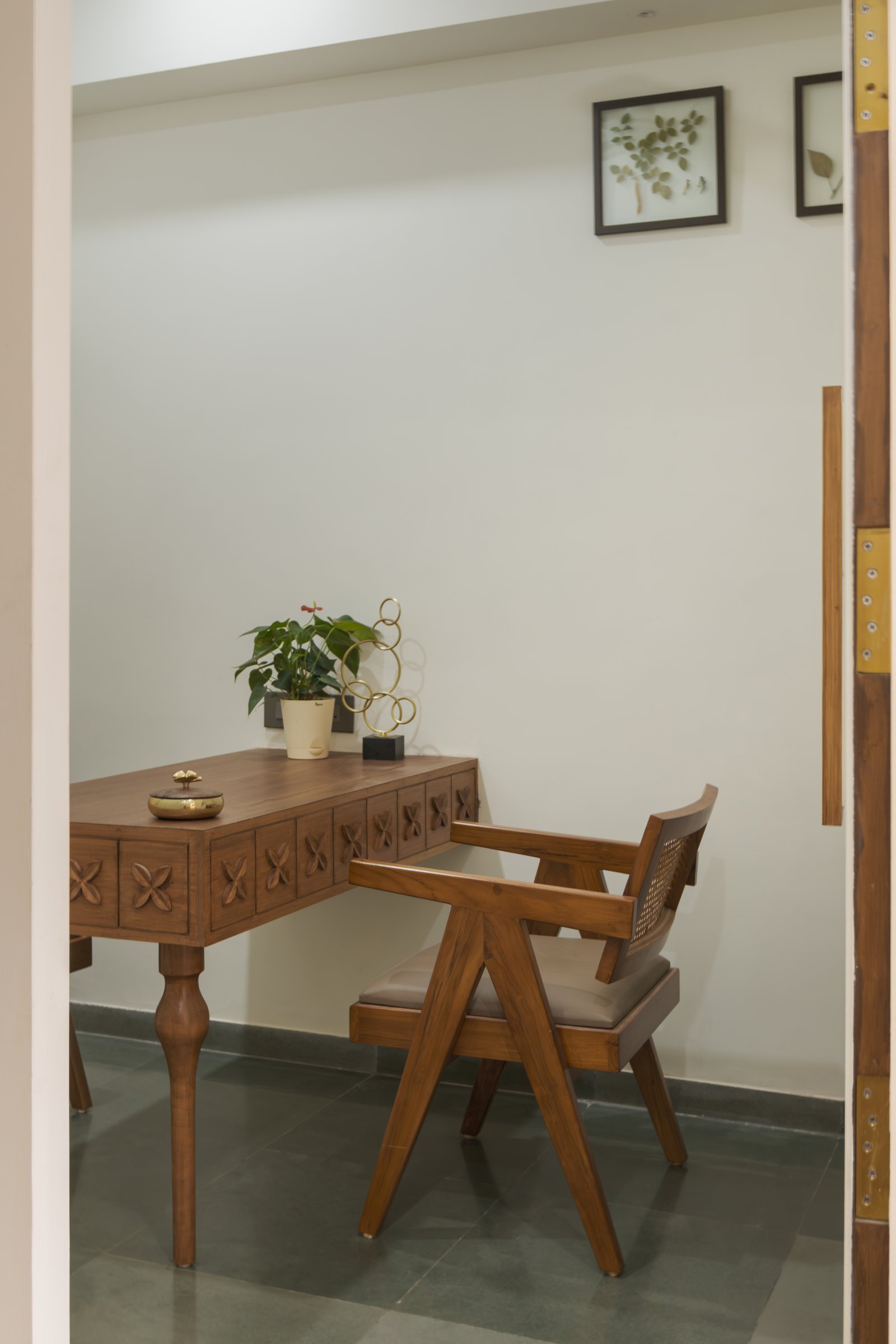
Seen from the adjoining threshold, the same chamber reveals its restraint. The pale walls are kept almost bare, with two small framed botanical studies sitting high on the wall and a sculptural brass-ring object and a small flowering plant marking the desk. In a 350 sq. ft. interior, the discipline of leaving wall surface unworked is what allows the carved furniture to register as craft rather than clutter.
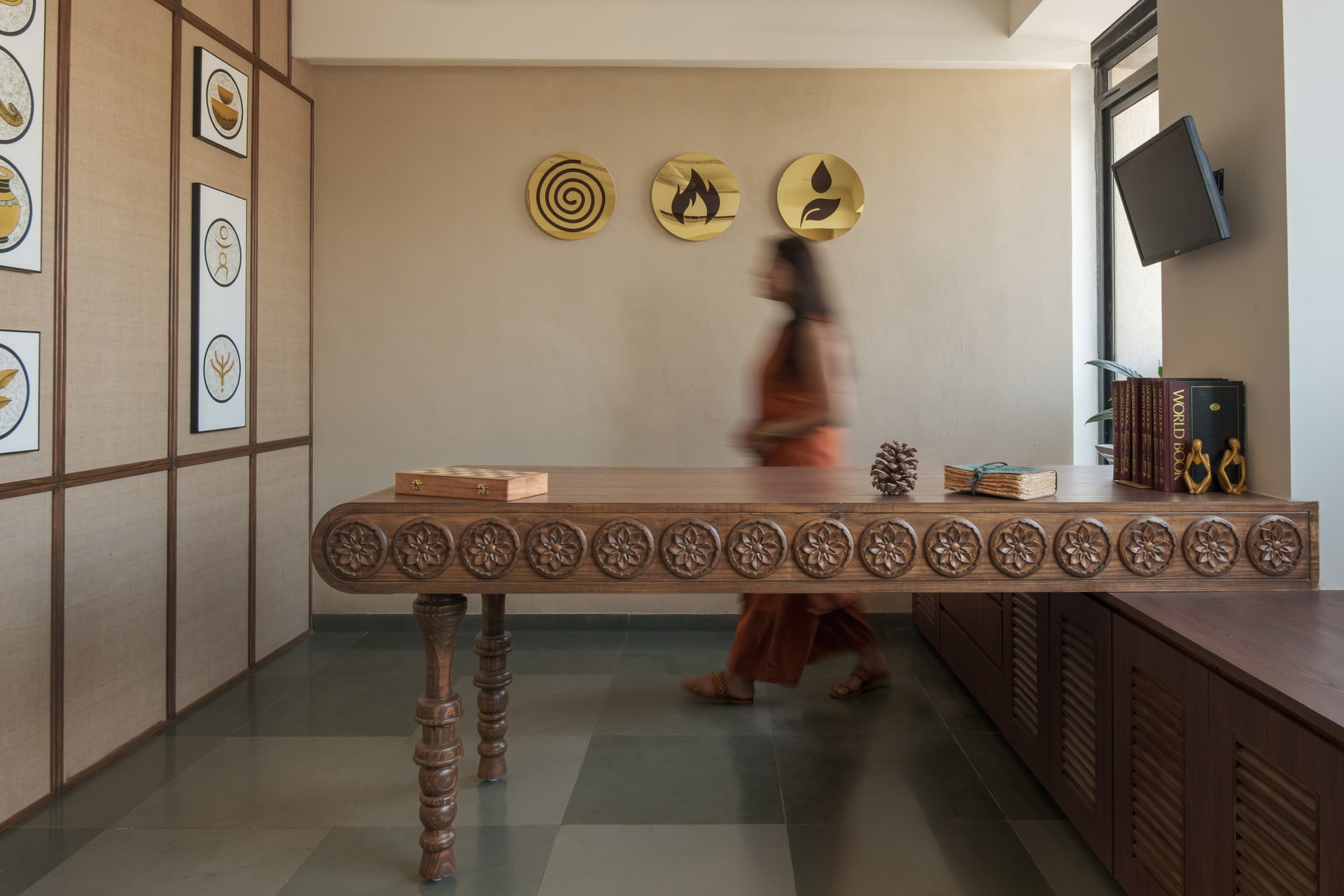
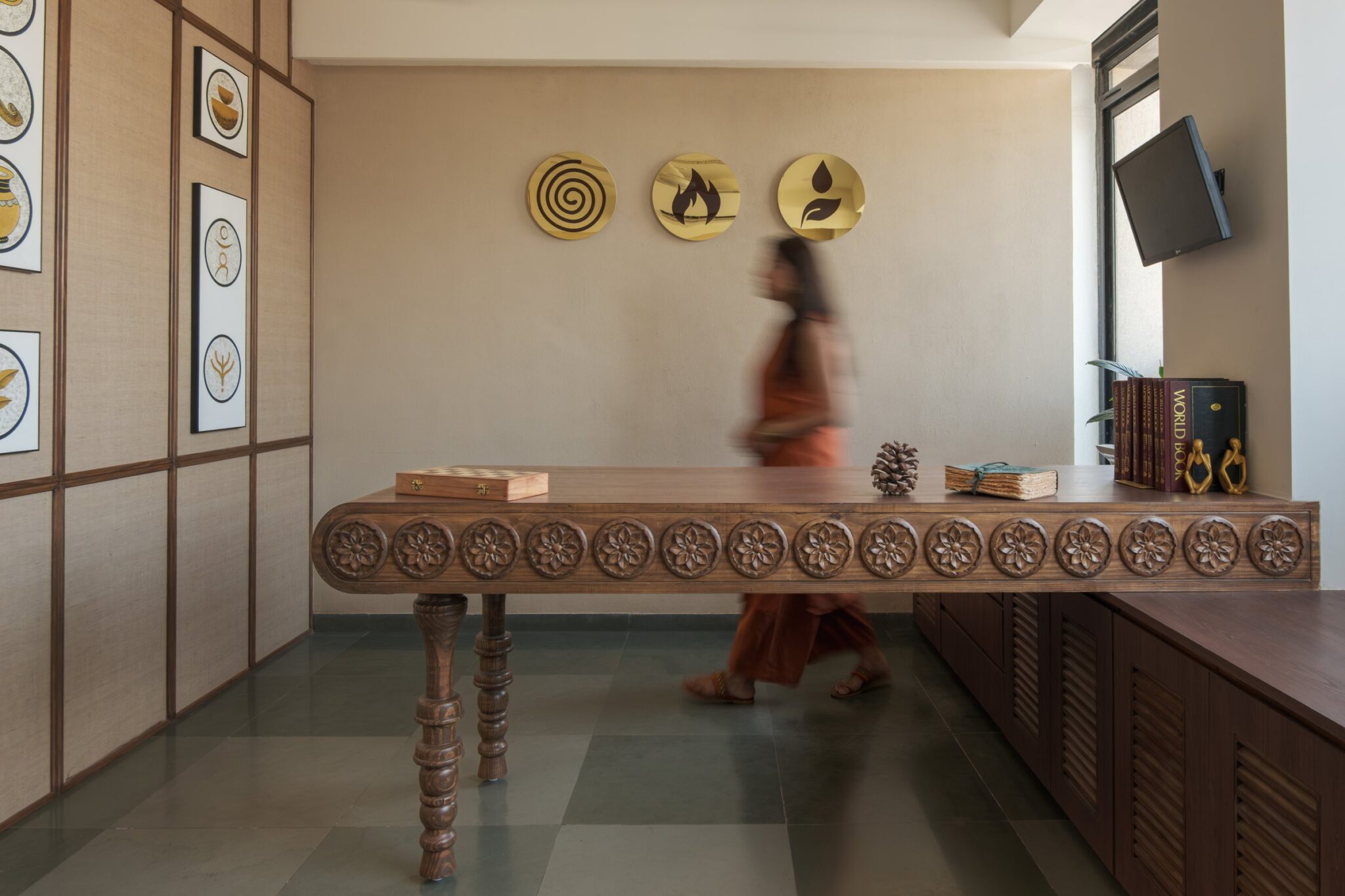
The principal doctor’s chamber carries the project’s central design move. A long teak table, its apron carved with a continuous band of rosettes, runs along one side of the room, and behind it three golden discs are mounted on the wall, each etched with a symbol for one of the Tridoshas, Vata, Pitta, and Kapha. The discs are small, but they carry the weight of an entire diagnostic tradition, and their placement turns a service wall into a quiet statement of purpose.
““The objective was clear: to translate the ancient equilibrium of Ayurveda into a physical environment.””
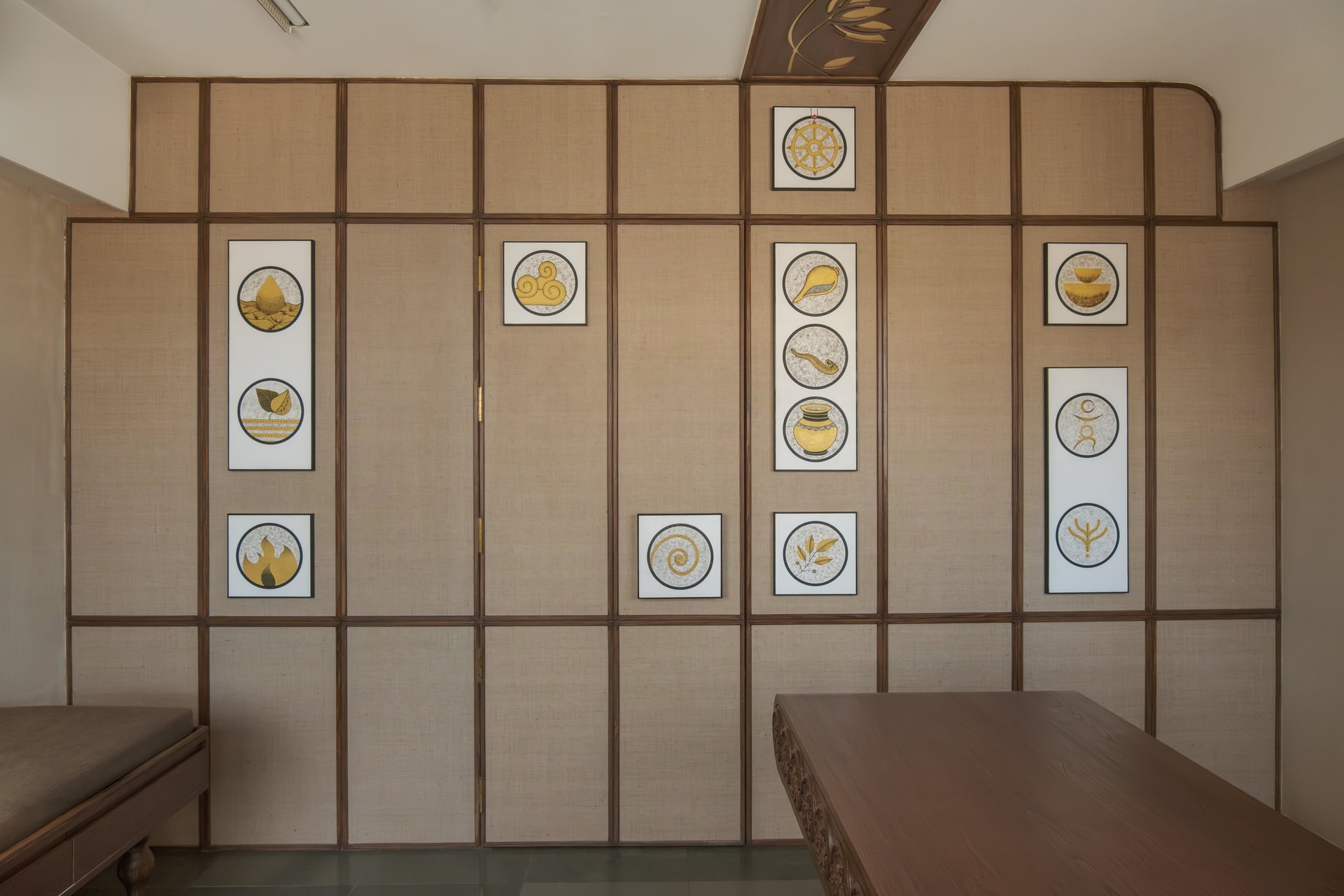
The narrative wall is the design’s most considered gesture. A grid of jute-clad panels framed in teak holds a series of small artworks depicting the Panchamahabhuta and the divine symbols associated with Lord Dhanvantari, the Amrita Kalash, Shankha, Chakra, and sacred herbs, rendered as gentle yellow-toned illustrations. Above the wall, a carved lotus and vine motif in gilded relief runs as a cornice, establishing the clinic’s design language in a single composed frame.
The wall also conceals the entry door to the principal doctor’s chamber, the handle and frame blended into the panel grid so the visual narrative remains uninterrupted. The detail rewards a second look: a hinged panel reveals itself only when opened, and the artwork continues across the threshold as though the door were never there. It is a small architectural moment that reframes passage as part of the larger educational sequence.
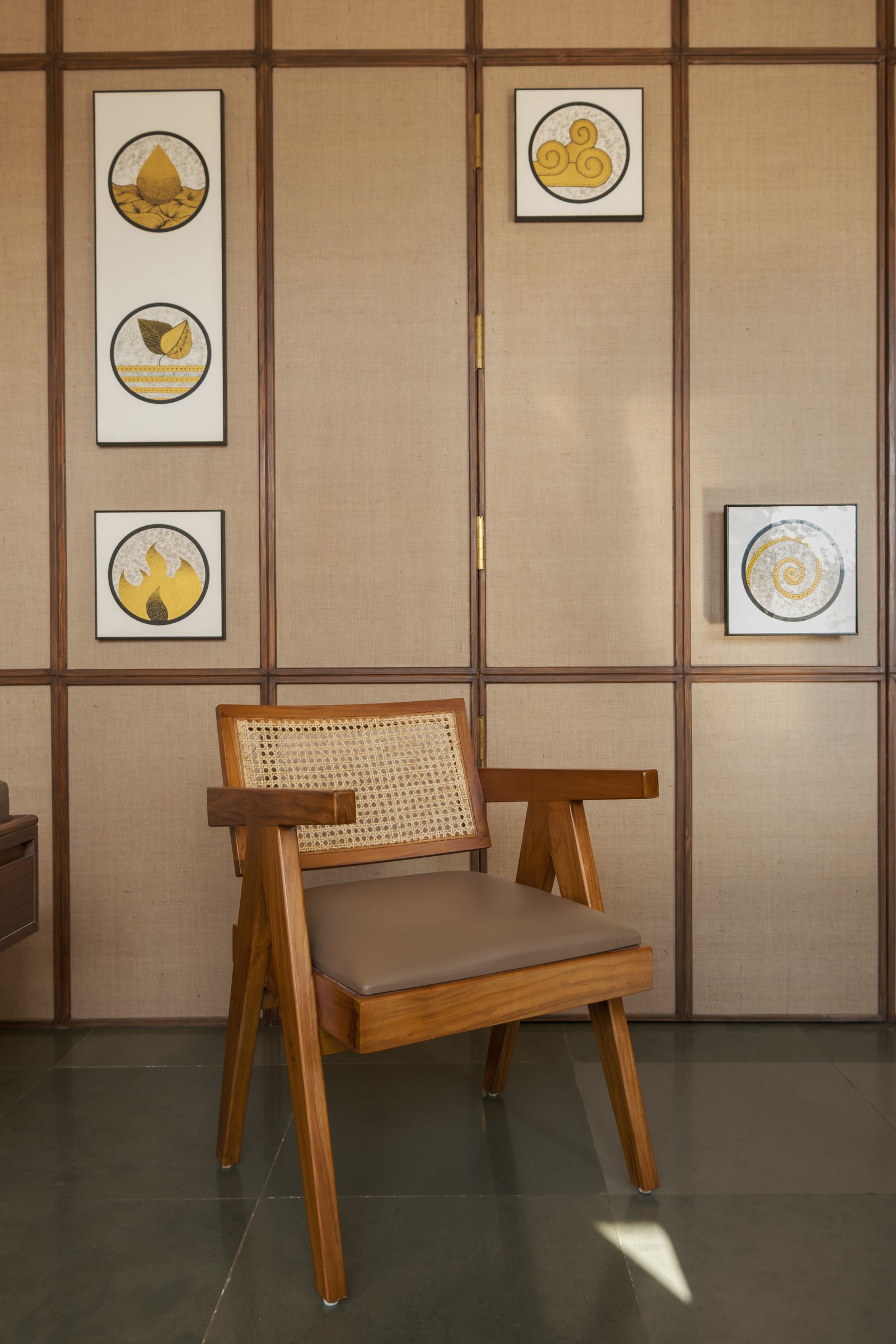
This is the clinic’s pattern in miniature: warm materials, restrained palette, meaning carried by what hangs on the wall rather than by the furniture itself.
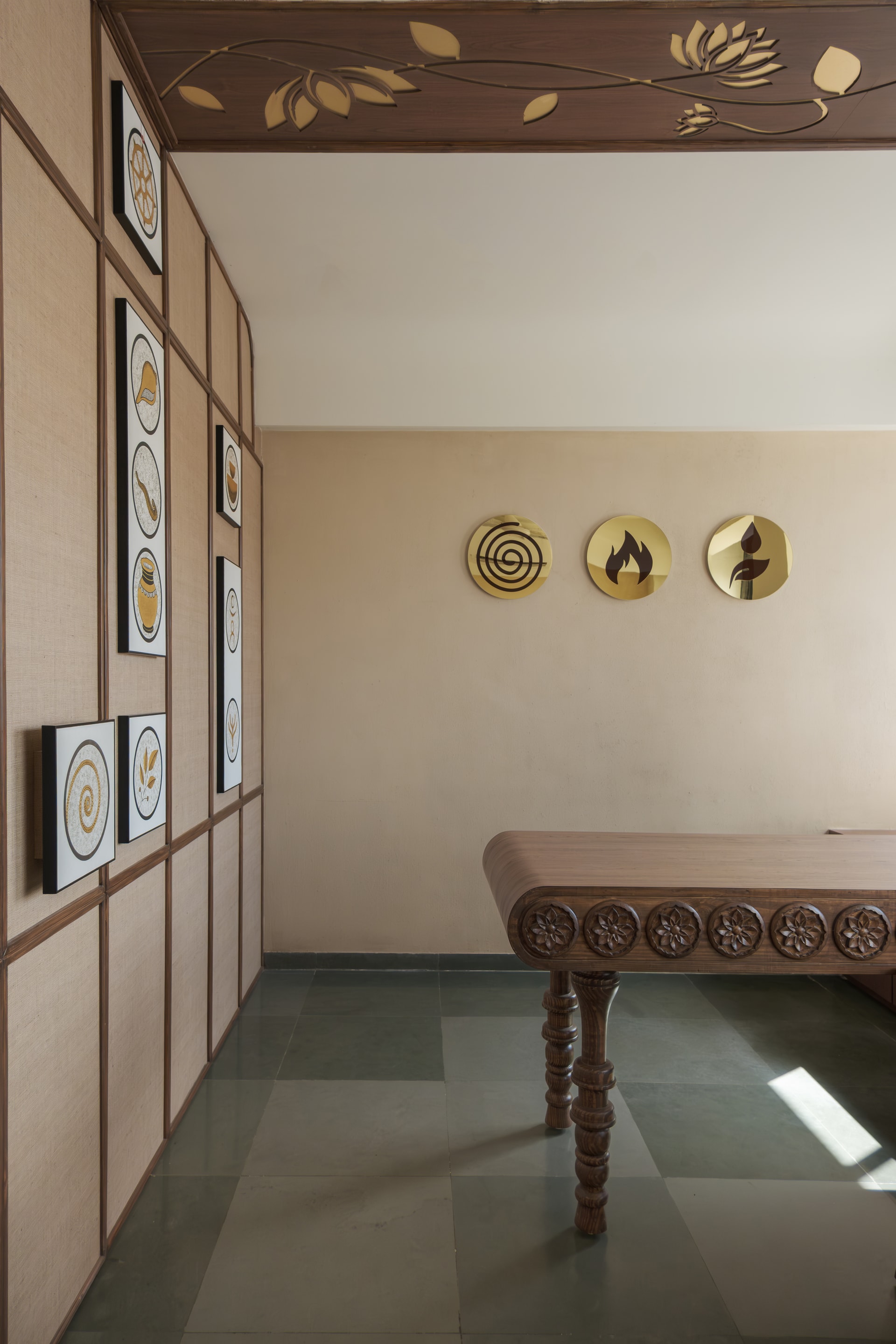
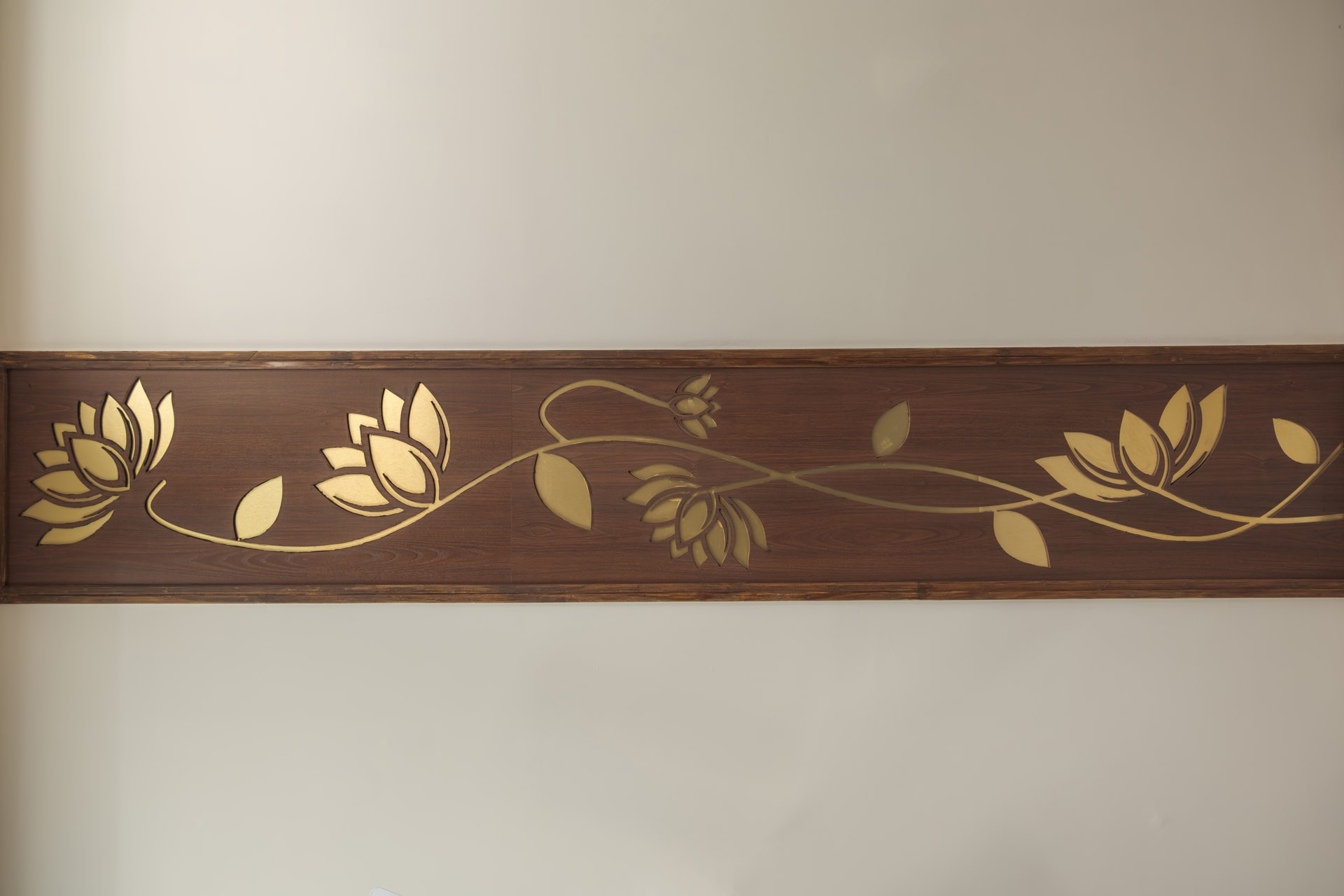
Above the consulting table, a long horizontal panel in dark teak holds a gilded inlay of lotuses and a trailing vine, a graphic reimagining of the divine symbols traditionally held by Lord Dhanvantari. The panel runs the full width of the wall and, in the designers’ framing, produces the effect of divine healing showering down upon the physician and patient. It is the kind of object that earns its prominence by carrying meaning the rest of the room only suggests.
Jamnagar holds a particular place in the contemporary Ayurvedic landscape as the seat of one of the science’s principal institutions, and a clinic of this scale carries a quiet responsibility to the tradition it represents. Meghdhara Ayurveda meets that responsibility without leaning on the visual shorthand of heritage; the teakwood and Kota stone are present, but they are paired with a contemporary spatial discipline and a graphic sensibility that frames tradition as a living and evolving practice.
The achievement of the project, in the end, is one of compression. Within 350 sq. ft., iRA has folded the Panchamahabhuta, the Tridosha, and the presence of Dhanvantari into an environment that explains itself without ever announcing the explanation, allowing the visitor to absorb the philosophy at the pace at which they would absorb a room.