A show flat is one of architecture’s more complex briefs. It must persuade without appearing persuasive, suggest a future life to people who have not yet imagined themselves within it, and withstand the demands of constant occupation while retaining the ease of a lived-in home. The temptation often lies in spectacle. The greater achievement is restraint.
Within a 1,600 sq. ft. apartment in Mumbai, Enforma Designs has chosen the latter approach. Conceived by principal designers Vini Thakker and Jash Shah, Park West was completed within an ambitious thirty-day timeline, yet carries little of the urgency such a schedule might imply. Rather than relying on overt visual gestures, the apartment unfolds through a carefully edited palette of natural materials, tonal warmth, and measured proportions. Each room establishes its own material identity, while a quiet continuity of texture and light binds the home into a cohesive whole.
The result is a show apartment that feels less like a marketing device than a believable residence. It invites attention through atmosphere rather than display, demonstrating how thoughtful detailing, layered materiality, and disciplined composition can create an interior that is both aspirational and convincingly liveable.
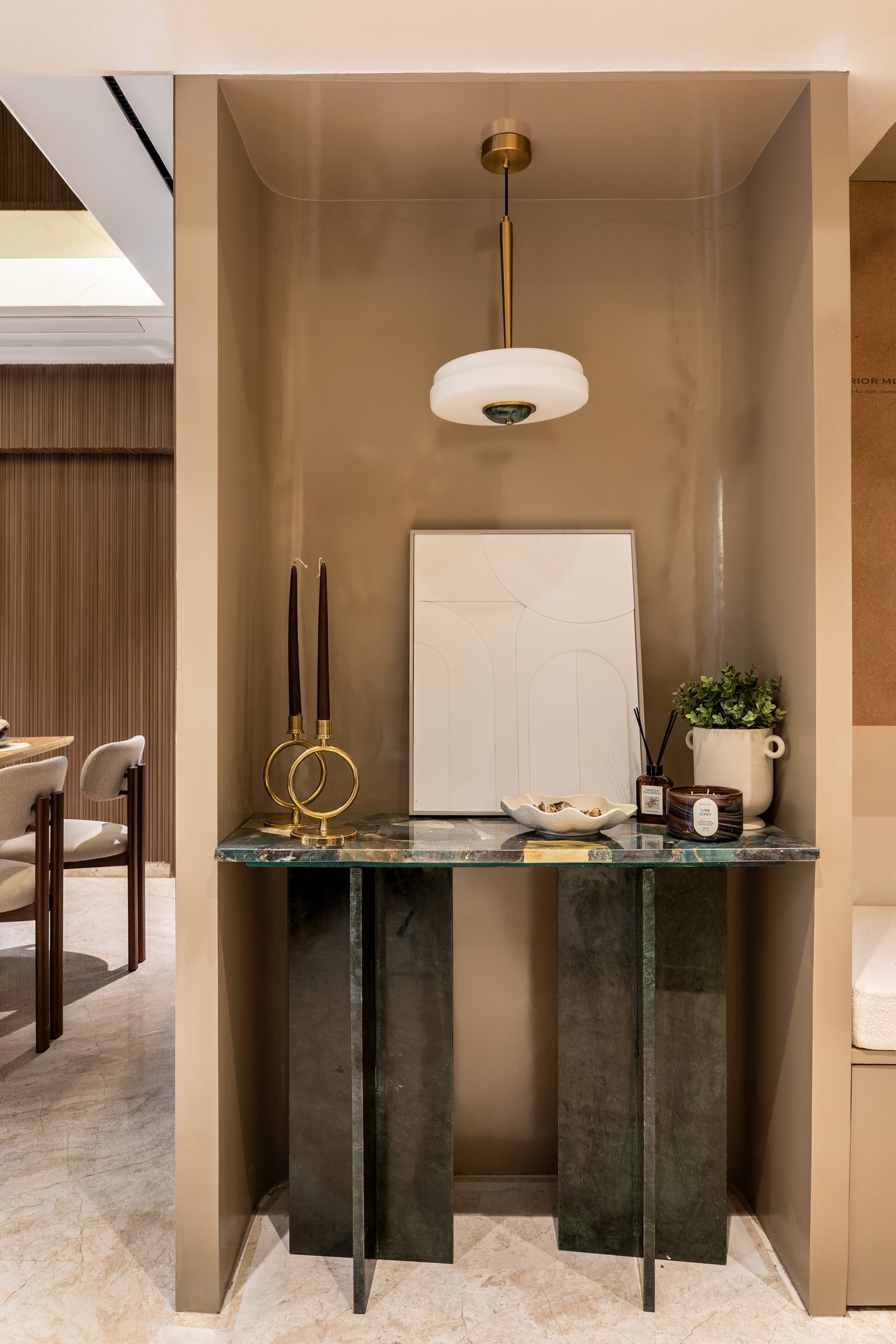
The entry sets the home’s tone before the larger volumes reveal themselves. A slim console in veined green marble, supported by sculptural slab bases in matching green marble, sits within a recessed taupe alcove that frames it almost like an interior portico. The opaline pendant above and the textured artwork behind establish the project’s design language in a single, composed frame: warm neutrals, considered weight, and a willingness to let one rich material carry the moment.
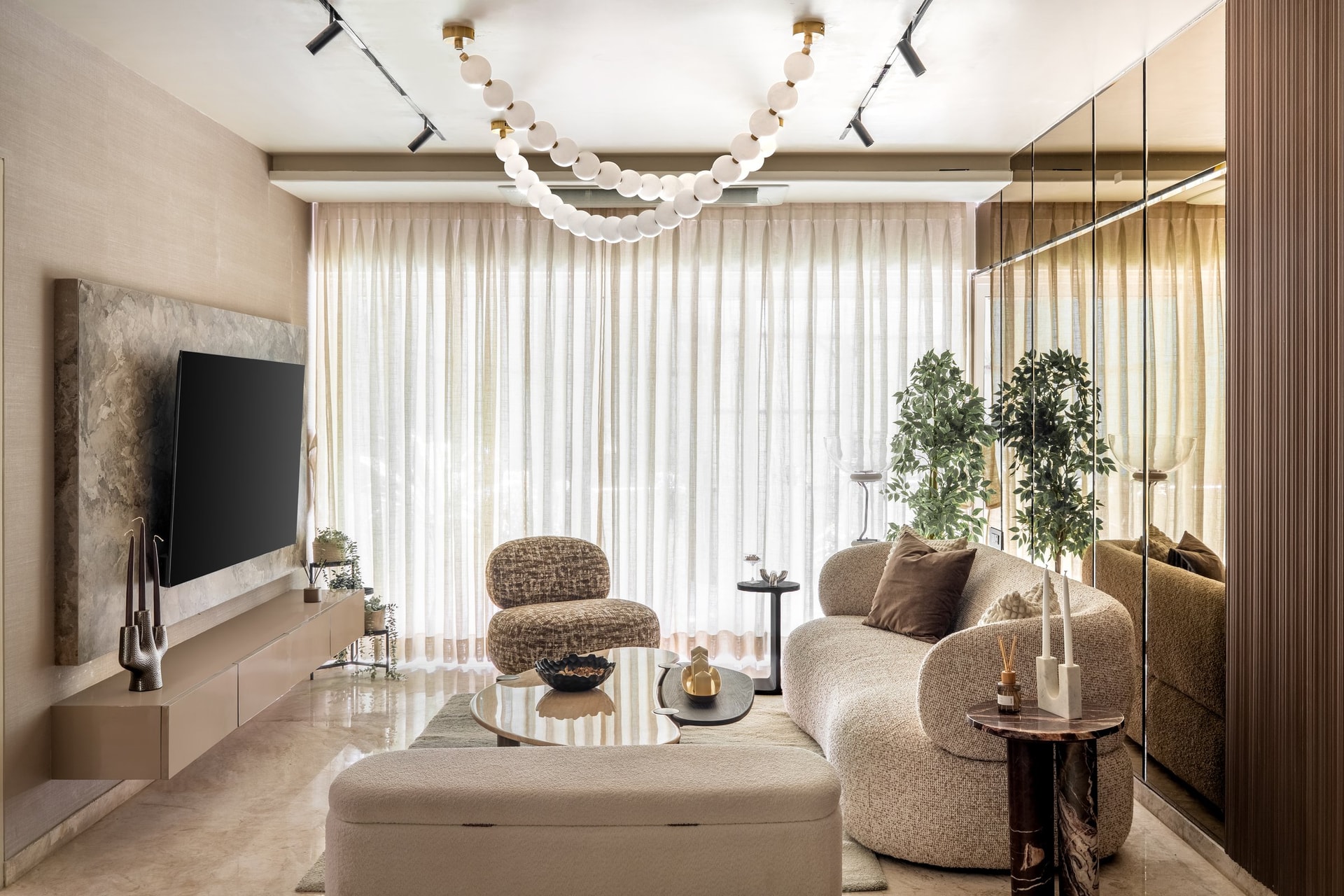
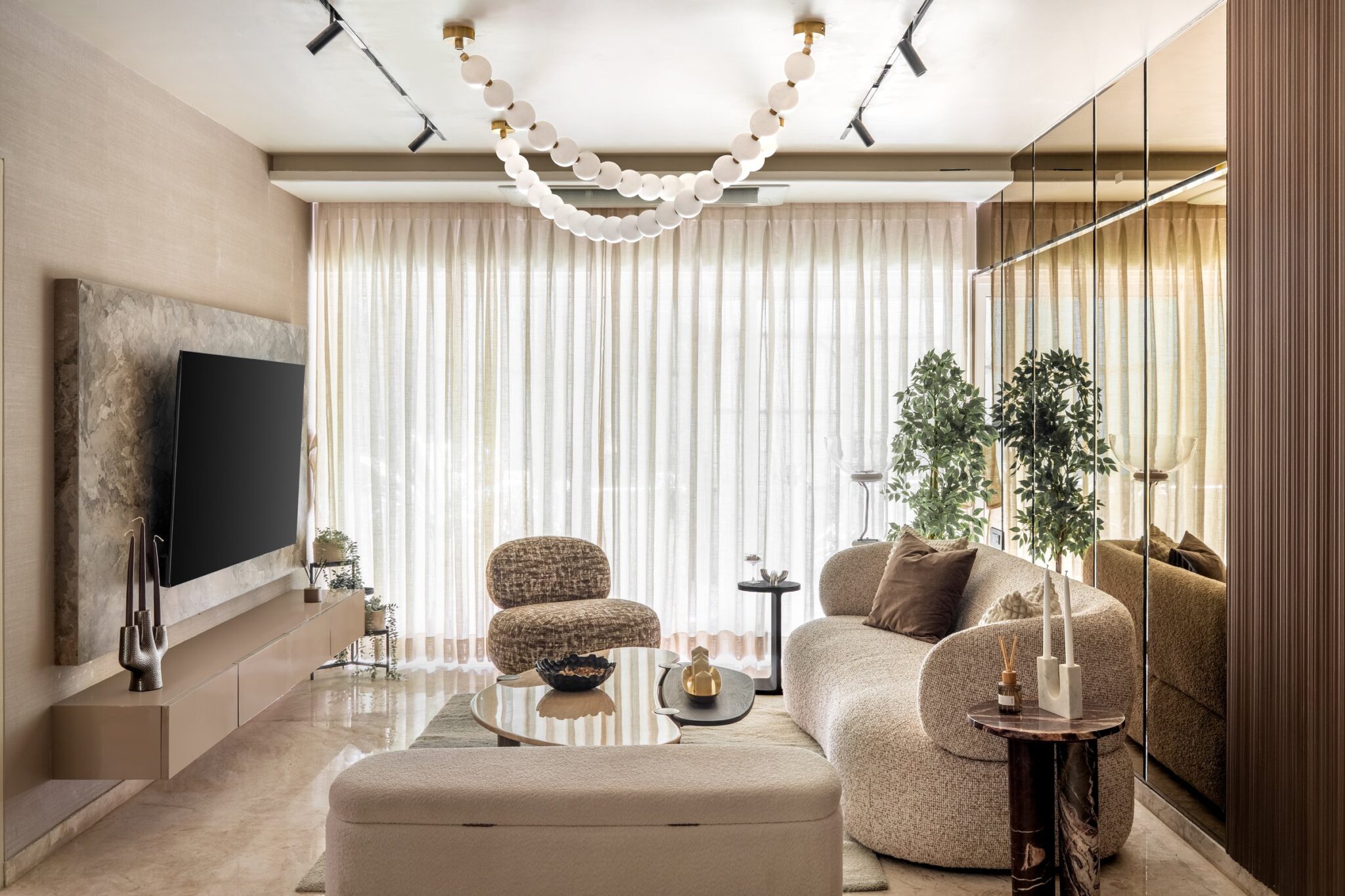
The living room opens immediately into the apartment’s most generous gesture, a sheer-curtained window wall that floods the space with diffused light. A curved cream-toned sofa traces the room’s softened geometry, while a single armchair in mottled chenille introduces a darker, woven counterpoint without disrupting the palette.
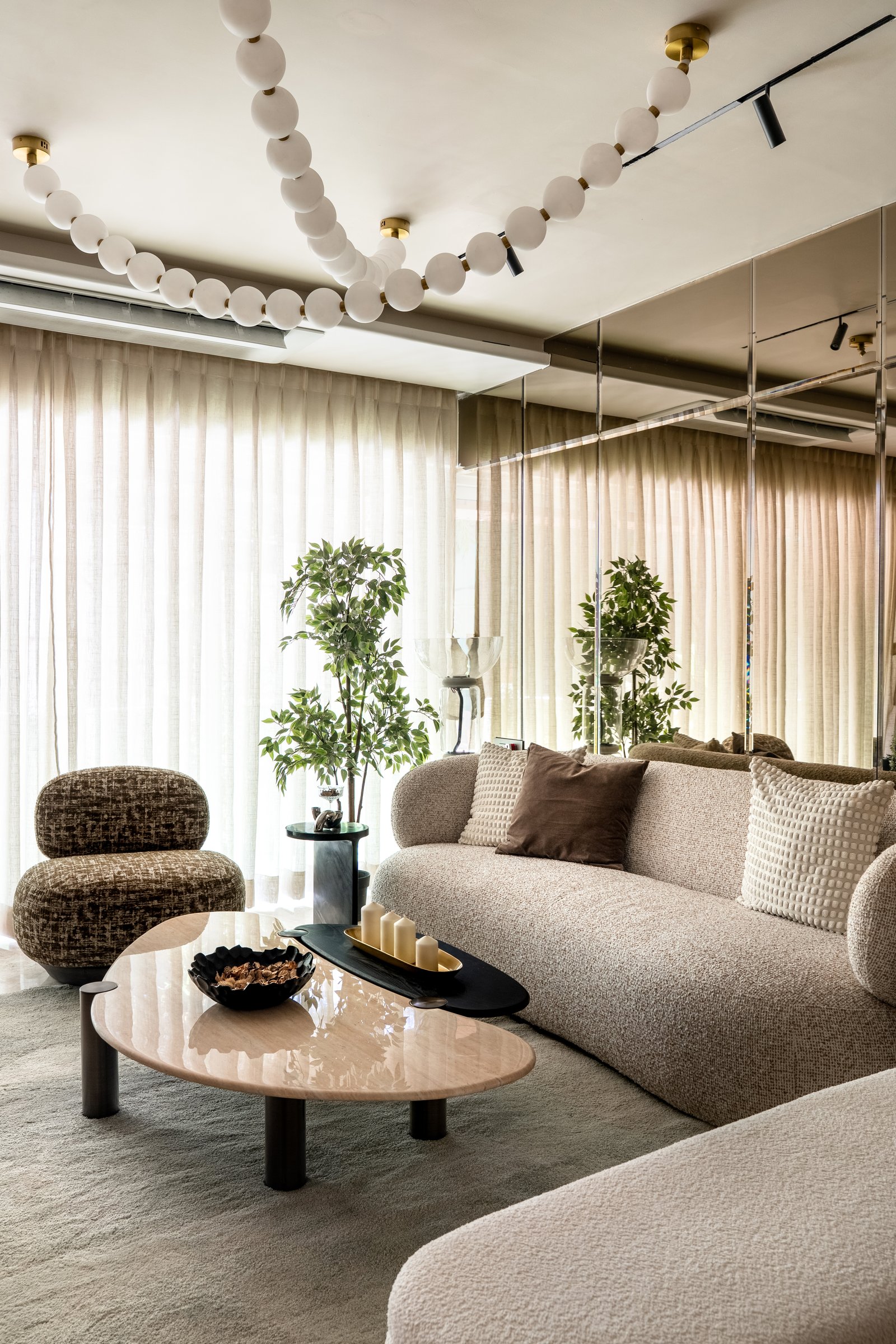
Above it all, a sculptural pendant of frosted orbs traces a long, looping arc across the ceiling, less a fixture than an architectural drawing in light. The mirrored wall on one side doubles the depth of an already compact room, and a travertine-topped coffee table on sturdy cylindrical legs anchors the seating arrangement without weighing it down. The room privileges continuity over hierarchy, allowing every surface to participate in the same hushed register.
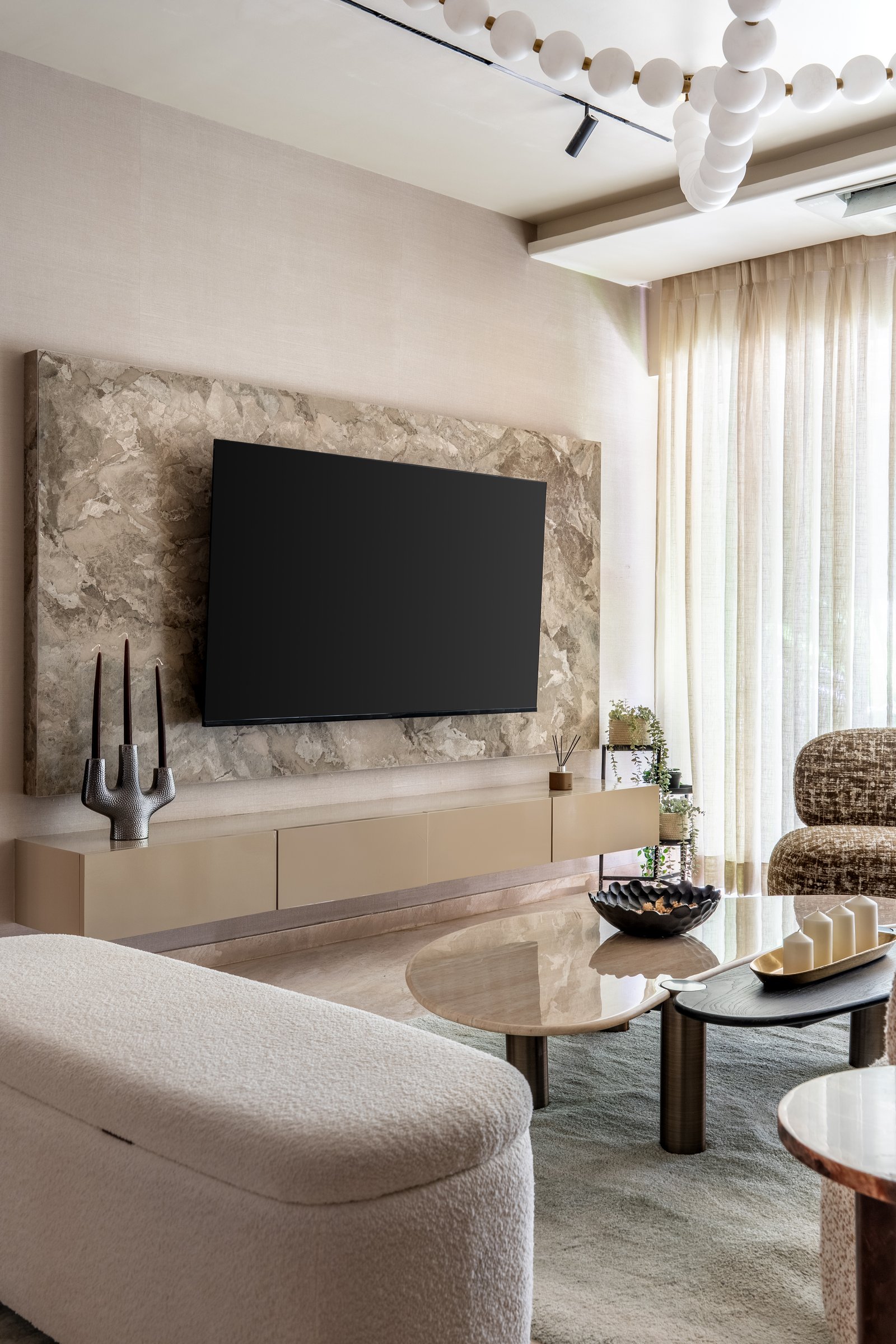
Opposite the seating, the media wall is finished in a large-format stone with sweeping grey and taupe veining, mounted on a slim wall-hung console in muted beige. The composition gives the television a sense of place rather than dominance, framing it within a panel that reads as artwork in its own right. The dialogue between the soft furnishings and the cool veined surface establishes a balance the rest of the home will continue to negotiate.
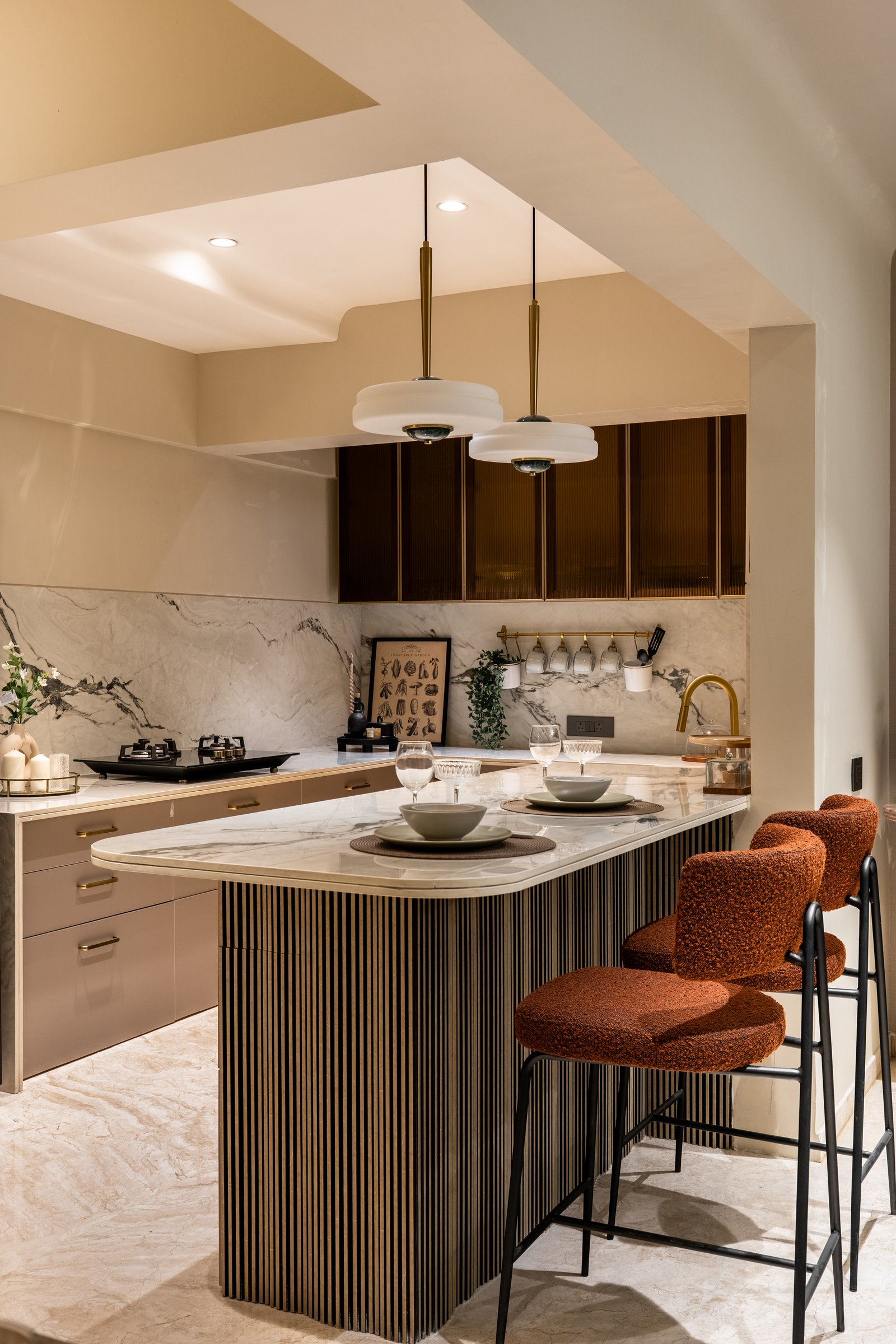
The kitchen takes a sharper, more graphic turn. Reeded vertical slats wrap the island base in a tactile, almost architectural rhythm, paired with handle-less cabinetry in a warm taupe lacquer and upper units fronted in fluted bronze glass. A pair of bouclé bar stools in burnt sienna introduces the home’s most decisive accent colour, sharpening what could have been a purely neutral palette into something more confident.
““From meticulously selected materials and fabrics to the finest design details, every element has been chosen to evoke a sense of understated luxury and timeless elegance.””
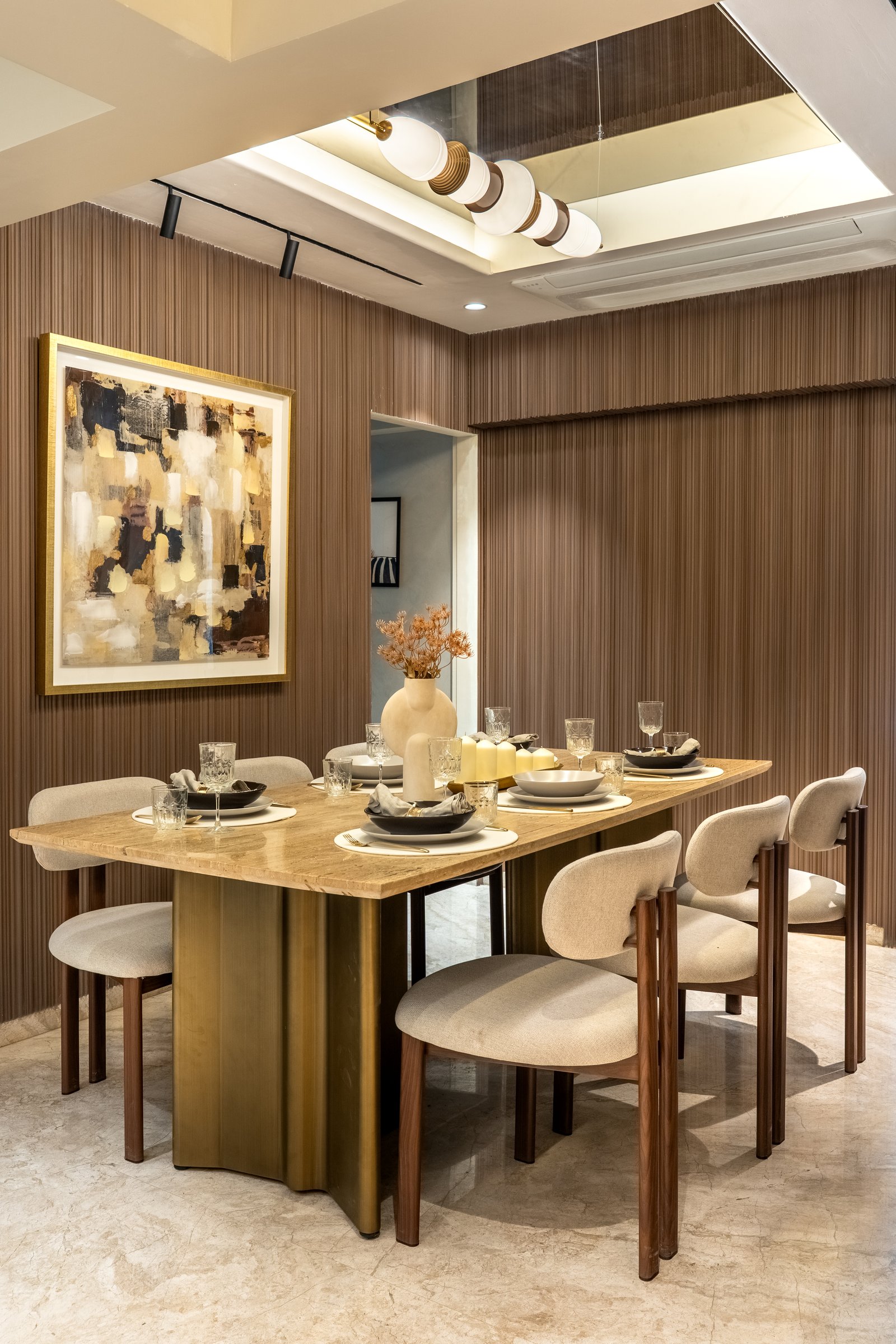
The dining room shifts the temperature again, this time into a deeper, more enveloping wood register. Floor-to-ceiling reeded panelling wraps the room in a vertical rhythm that lends scale to a modest footprint, while a travertine-topped table on a sculpted brushed-brass base anchors the composition. The framed abstract in ochre and charcoal echoes the room’s tonal logic without competing with it.
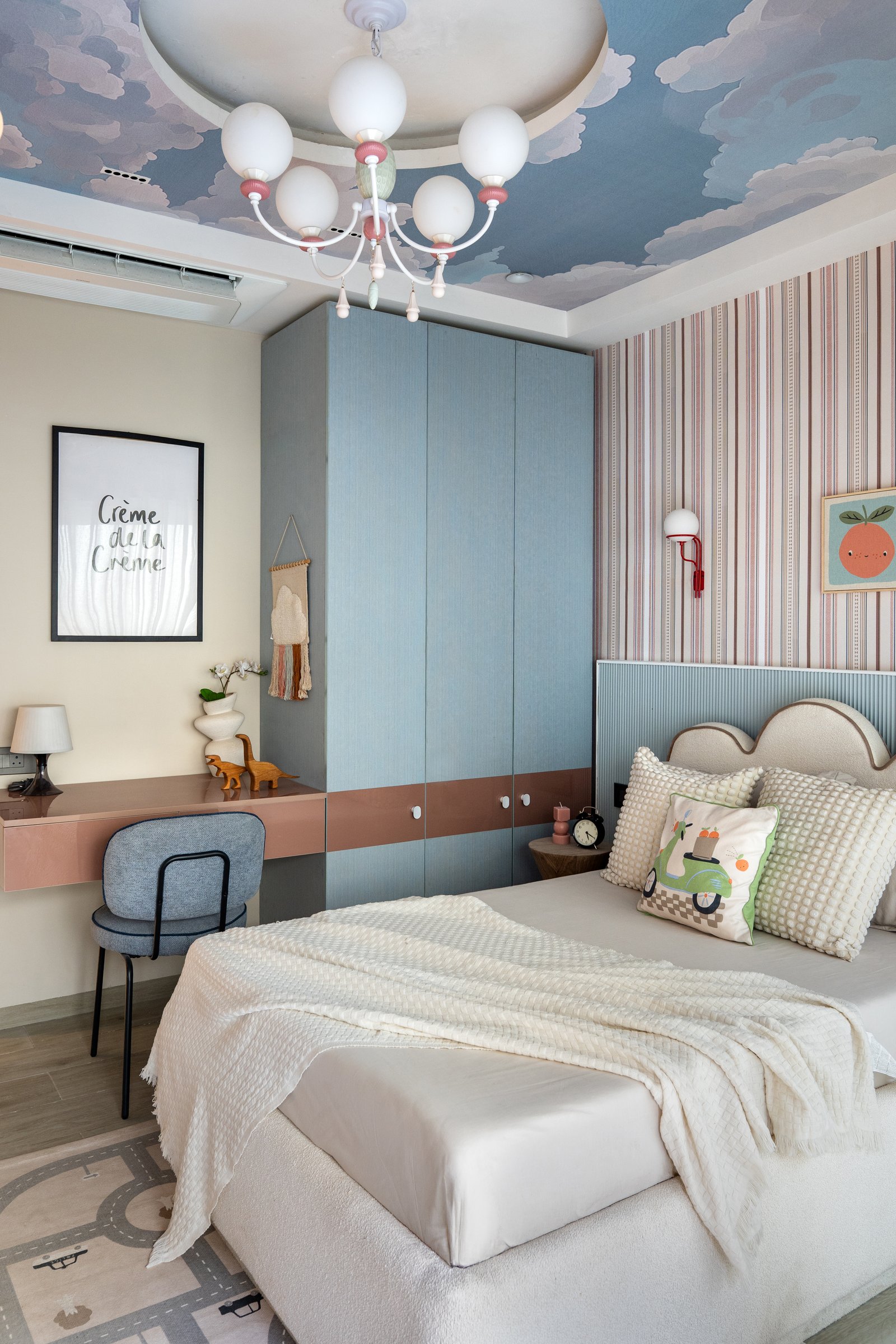
The children’s bedroom is the home’s most expressive room, and also one of its most disciplined. A painted cloudscape unfurls across the ceiling, while a striped wallcovering in dusty rose and cream meets a fluted blue dado below. A scalloped cream headboard, a blush-toned built-in desk, and a wardrobe in pale blue laminate set up a palette that reads as playful without ever tipping into theme.
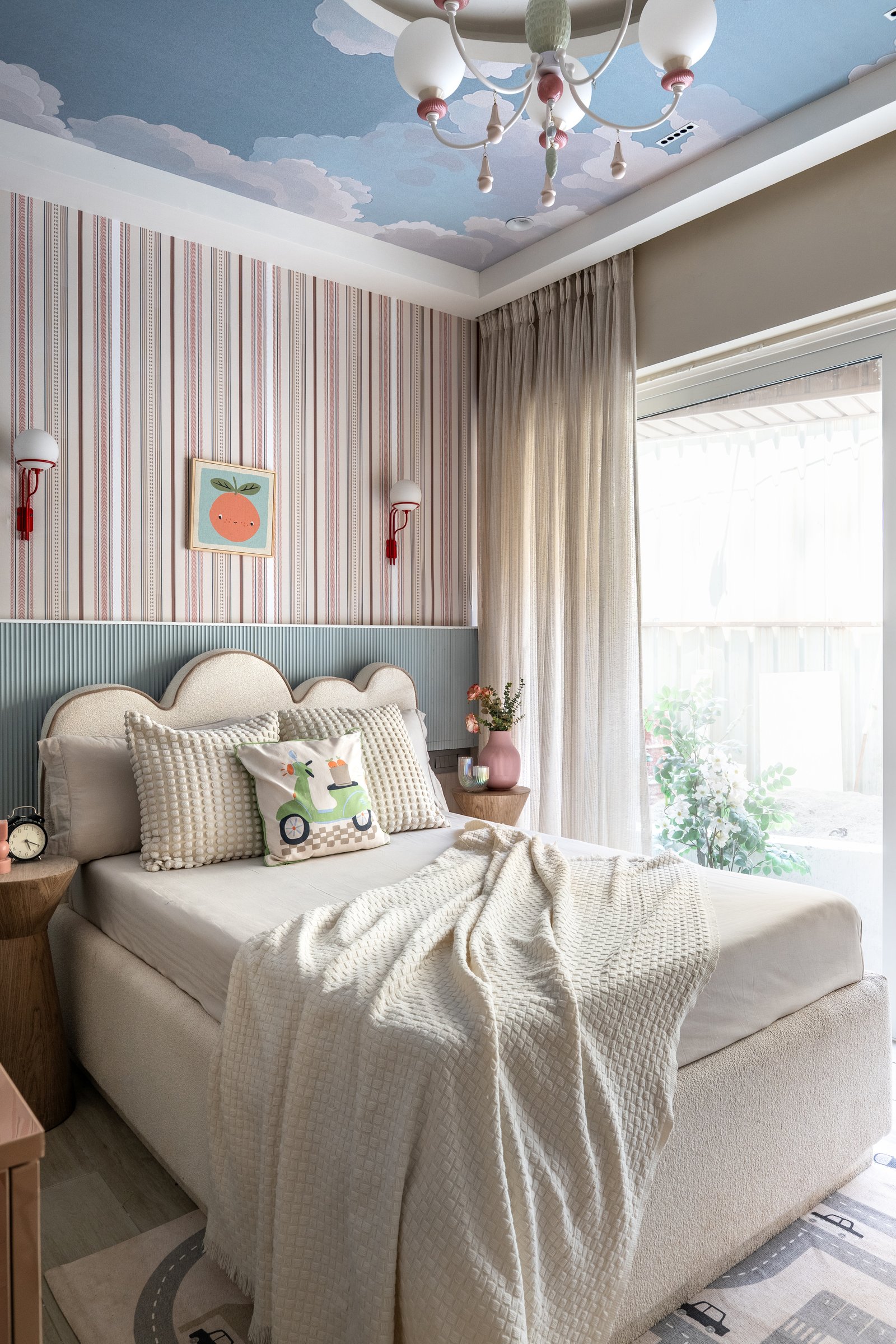
From the other vantage, the room reveals how carefully its decorative layers have been calibrated. The wall sconces in red and white sit like punctuation against the striped paper, and the pendant chandelier with its pastel-beaded arms echoes the dado’s pale blue below. The result is a room that does the difficult thing well: it speaks to a child without speaking down to them.
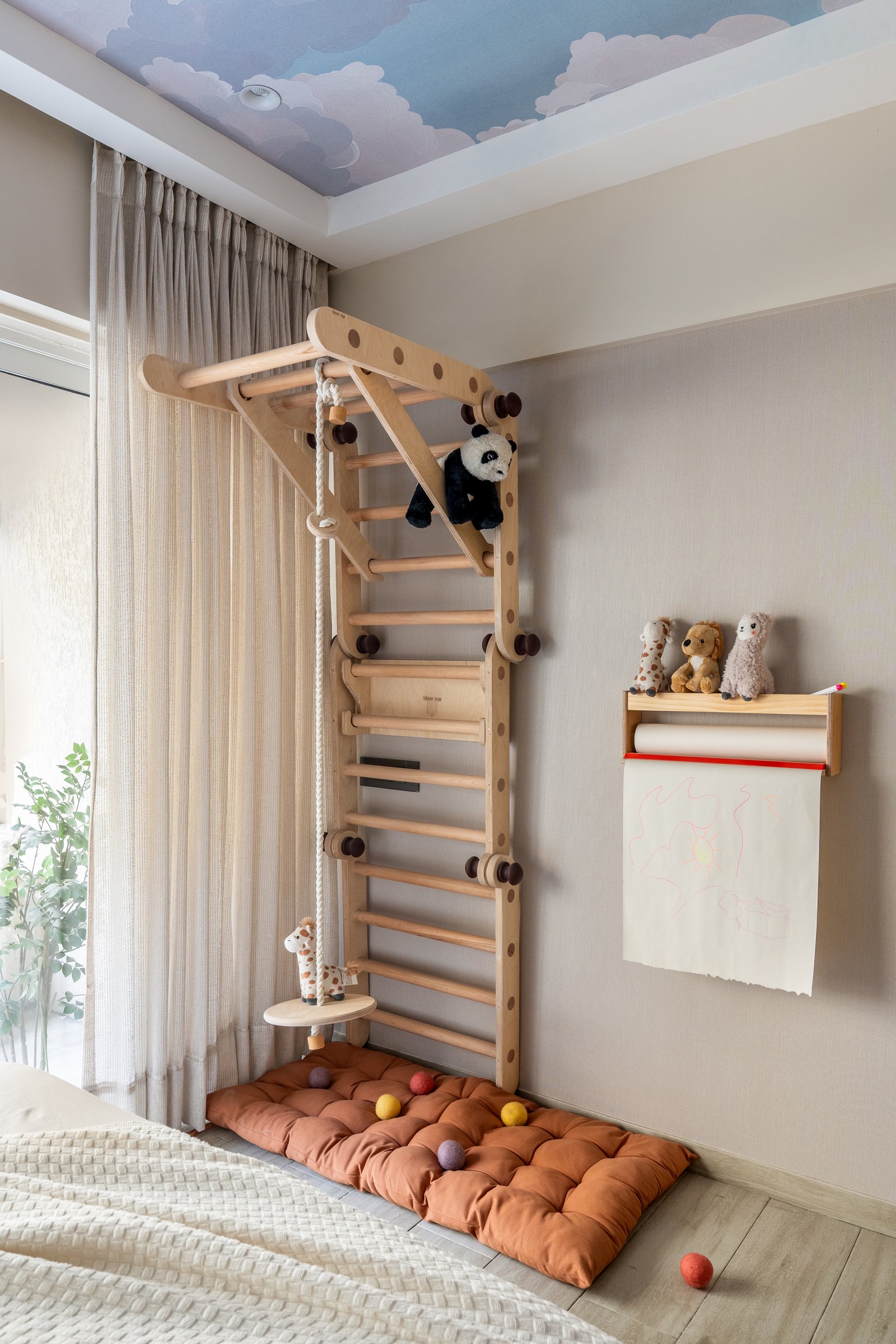
An indoor climbing frame in pale wood is set against the curtained window, with a small floor cushion in warm rust below. It is a generous gesture in a compact apartment, the kind of choice that turns a bedroom into something closer to a small world, and it folds the home’s broader interest in tactile, natural materials into a space designed for play.
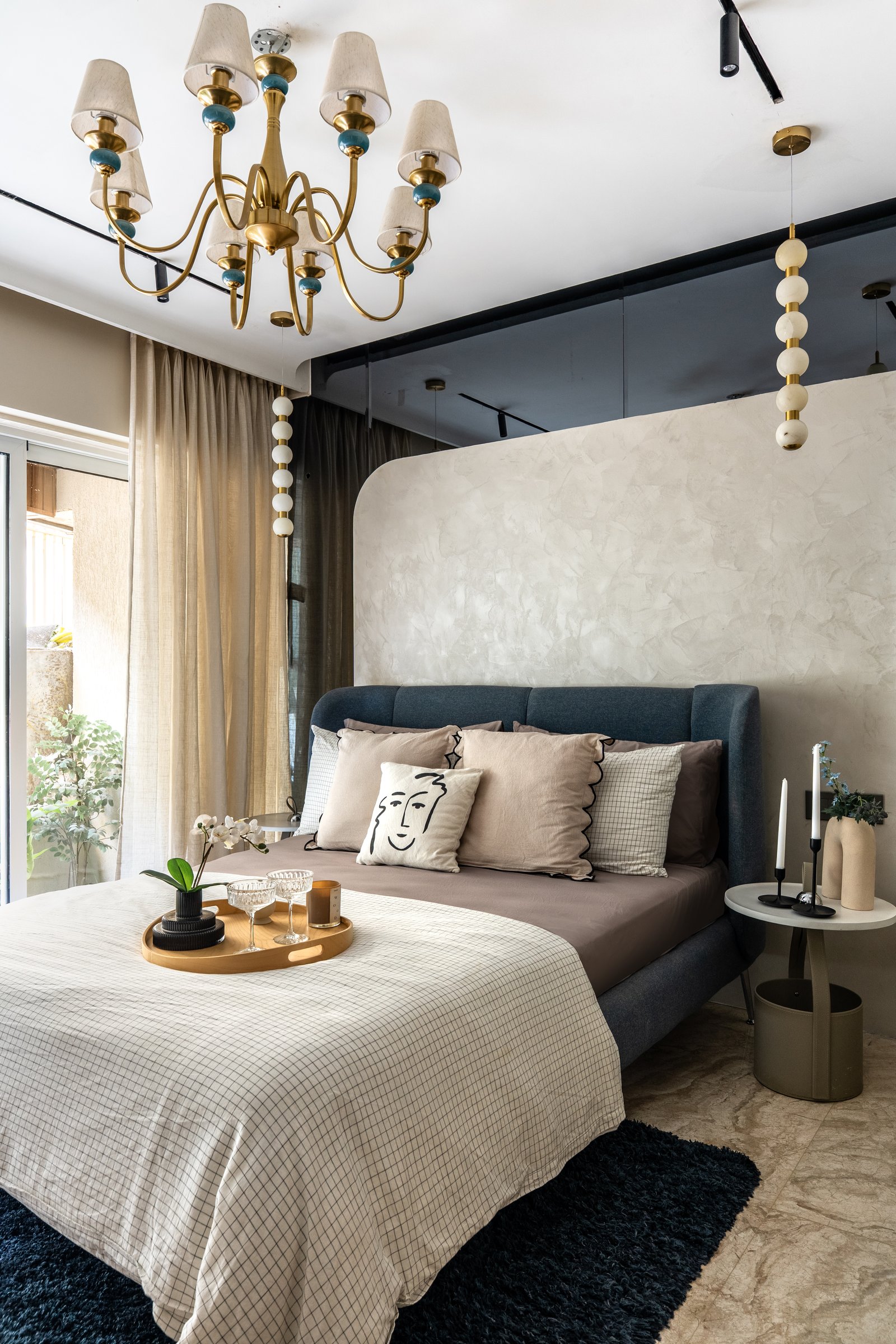
The principal bedroom moves into a cooler, more composed register. A curved textured-plaster wall in pale grey forms the headboard backdrop, against which a blue upholstered bed reads as the room’s quiet anchor. Suspended alabaster pendants on either side replace conventional bedside lamps, while a brass-and-cream chandelier overhead introduces a softer, more decorative gesture.
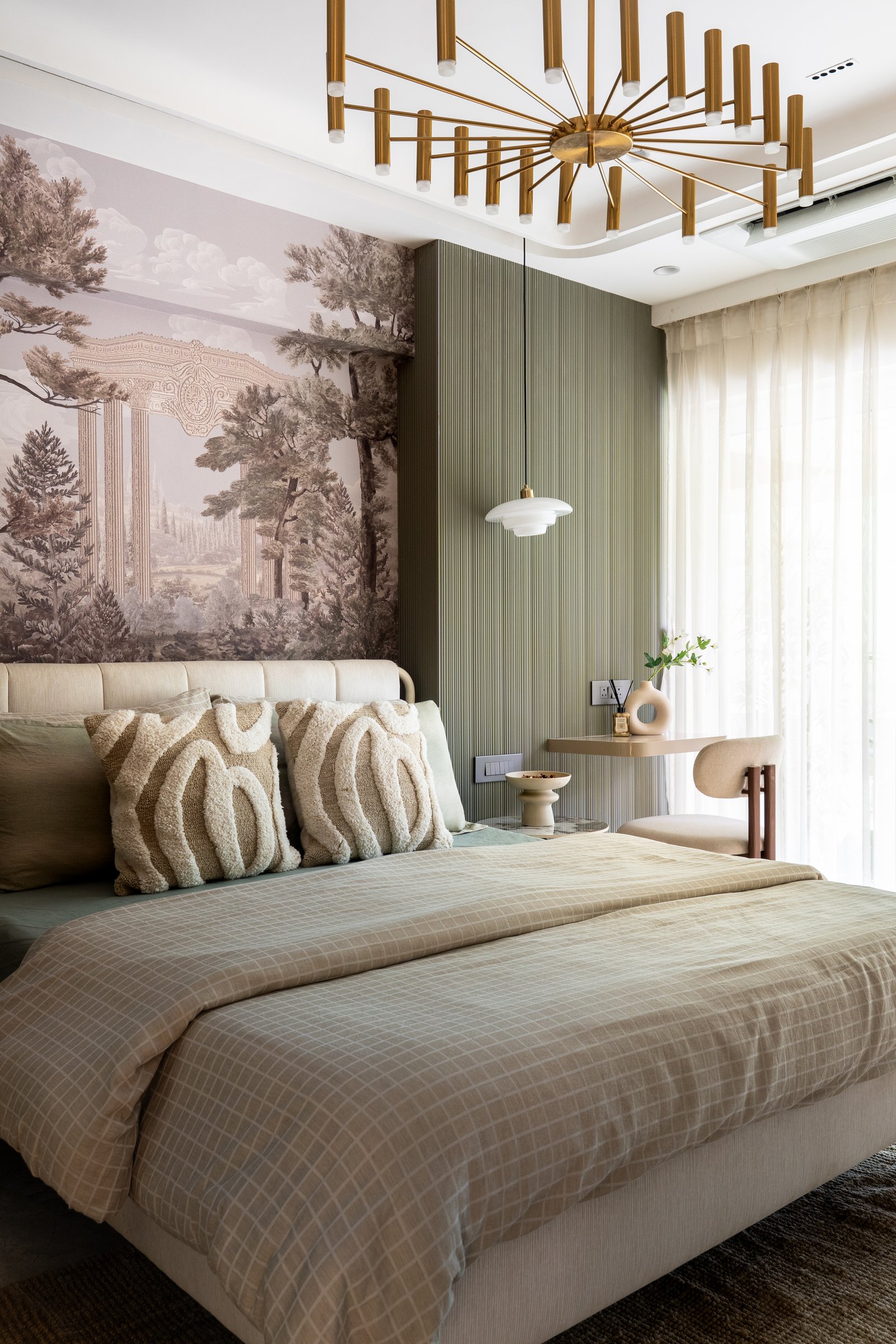
The guest bedroom takes its cue from a single hero gesture: a wallpapered mural in muted dusty pink tones depicting a classical landscape, set against an adjacent wall in fluted sage panelling. The bed sits low in a pale upholstered frame, dressed in beige checked linens that pick up the wall’s softer tones. A brass sputnik-style chandelier overhead, paired with a white pendant lamp suspended alongside, lends the room its notes of geometric formality.
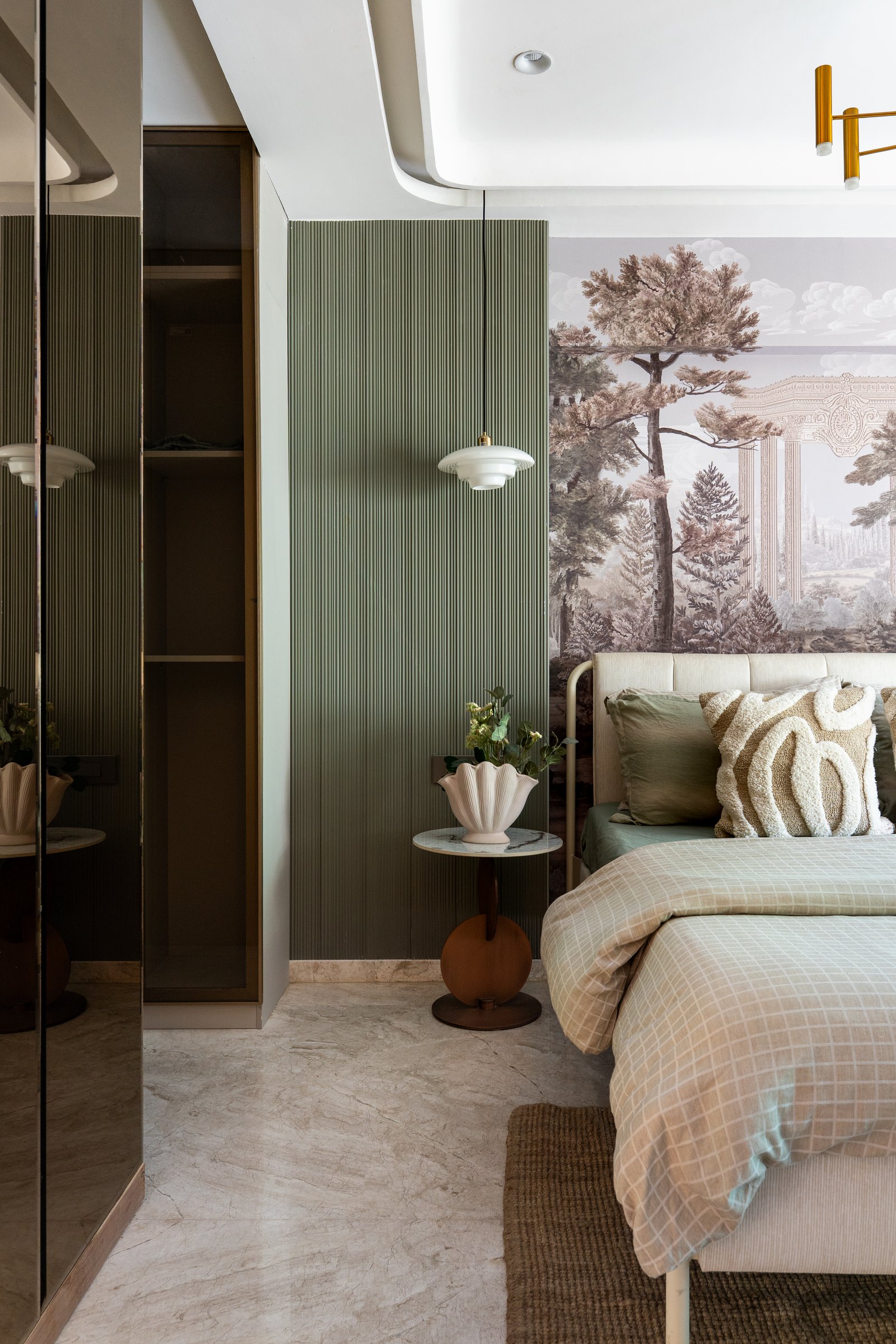
From a closer vantage, the room’s compositional logic becomes clearer. The fluted sage wall meets the mural in a vertical seam, while a small marble-topped side table on a sculptural wooden base holds a single shell-form vessel. The wardrobe in bronzed reeded glass on one side completes a room that balances pictorial drama with material restraint.
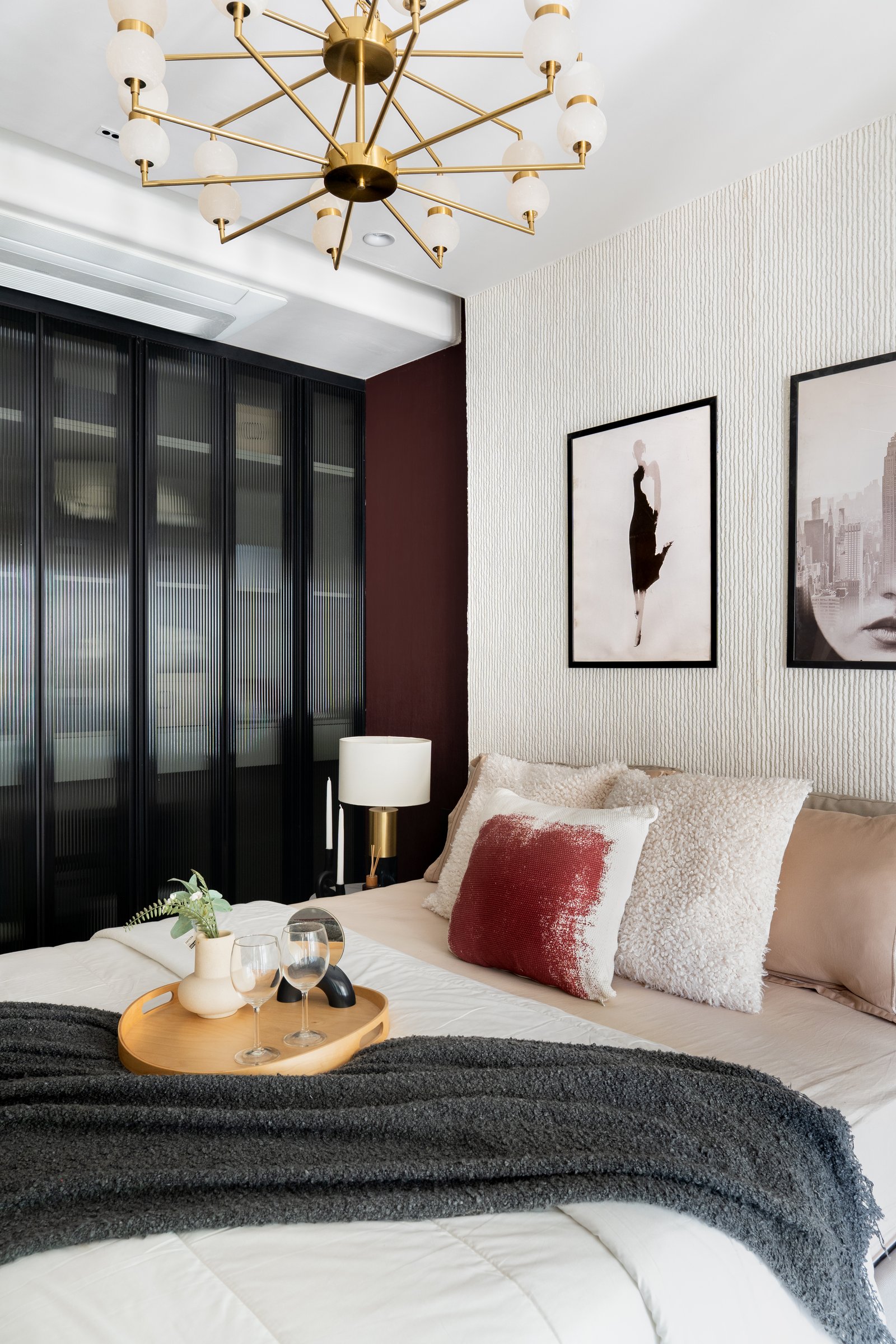
A secondary bedroom turns the temperature darker and more graphic. A textured cream wall with vertical relief sits against a deep oxblood accent wall, with two monochrome prints framed in slim black. A brass sputnik chandelier above and a fluted black-glass wardrobe complete a room that reads as confident and metropolitan without losing its warmth.
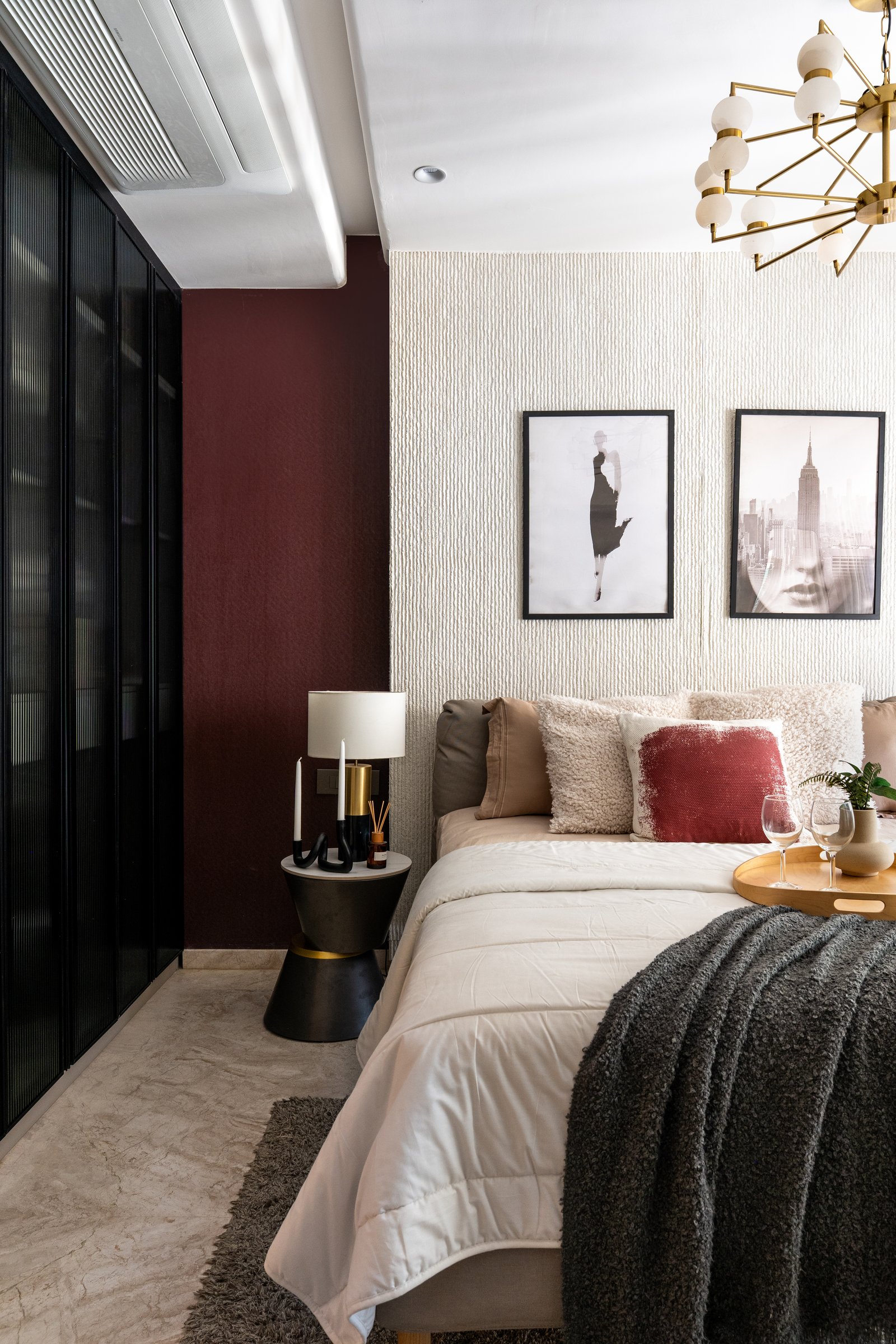
The wider view extends the same composition further. The oxblood wall meets the textured cream backdrop at a clean vertical edge, and a sculptural matte-black side table holds a brass-based lamp beside the bed.
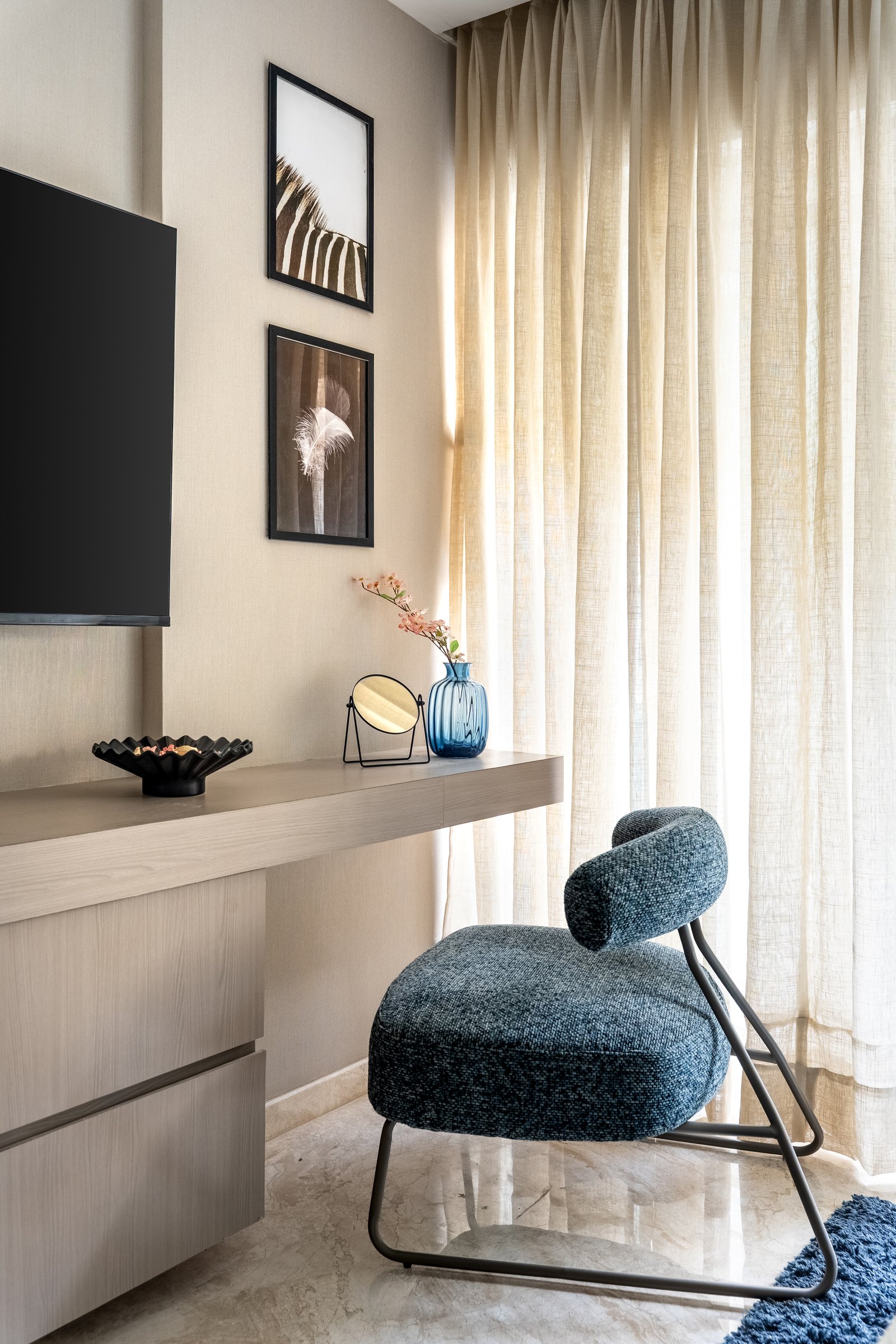
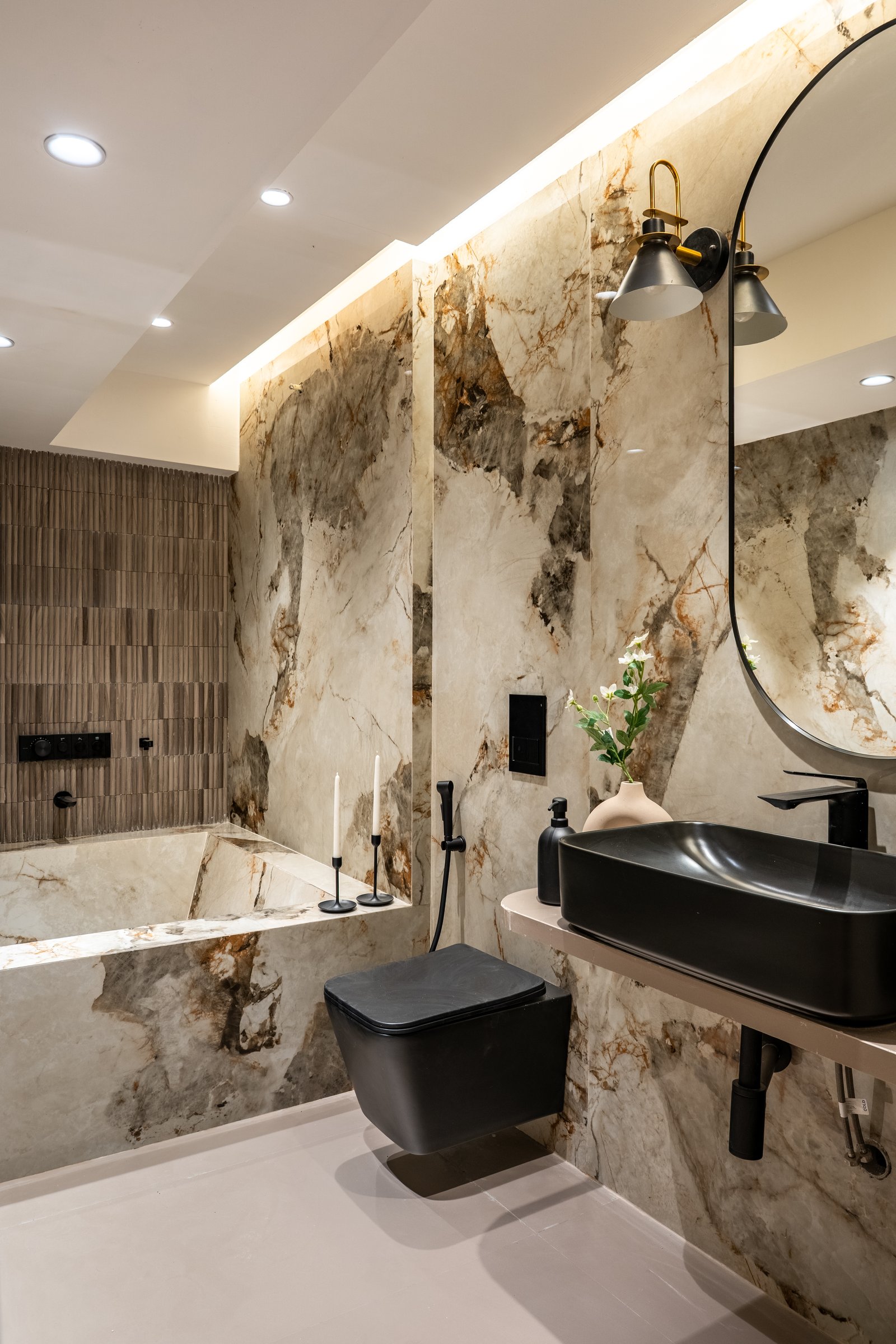
The principal bathroom commits fully to a single material idea. Dramatic veined stone in cream and amber wraps the walls and the sunken tub, while matte black fixtures, a vessel basin, and a slim oval mirror introduce a graphic counterweight. A column of vertically stacked tiles in warm terracotta tones lines the shower, lending the room a textural rhythm that prevents the stone from feeling monolithic.
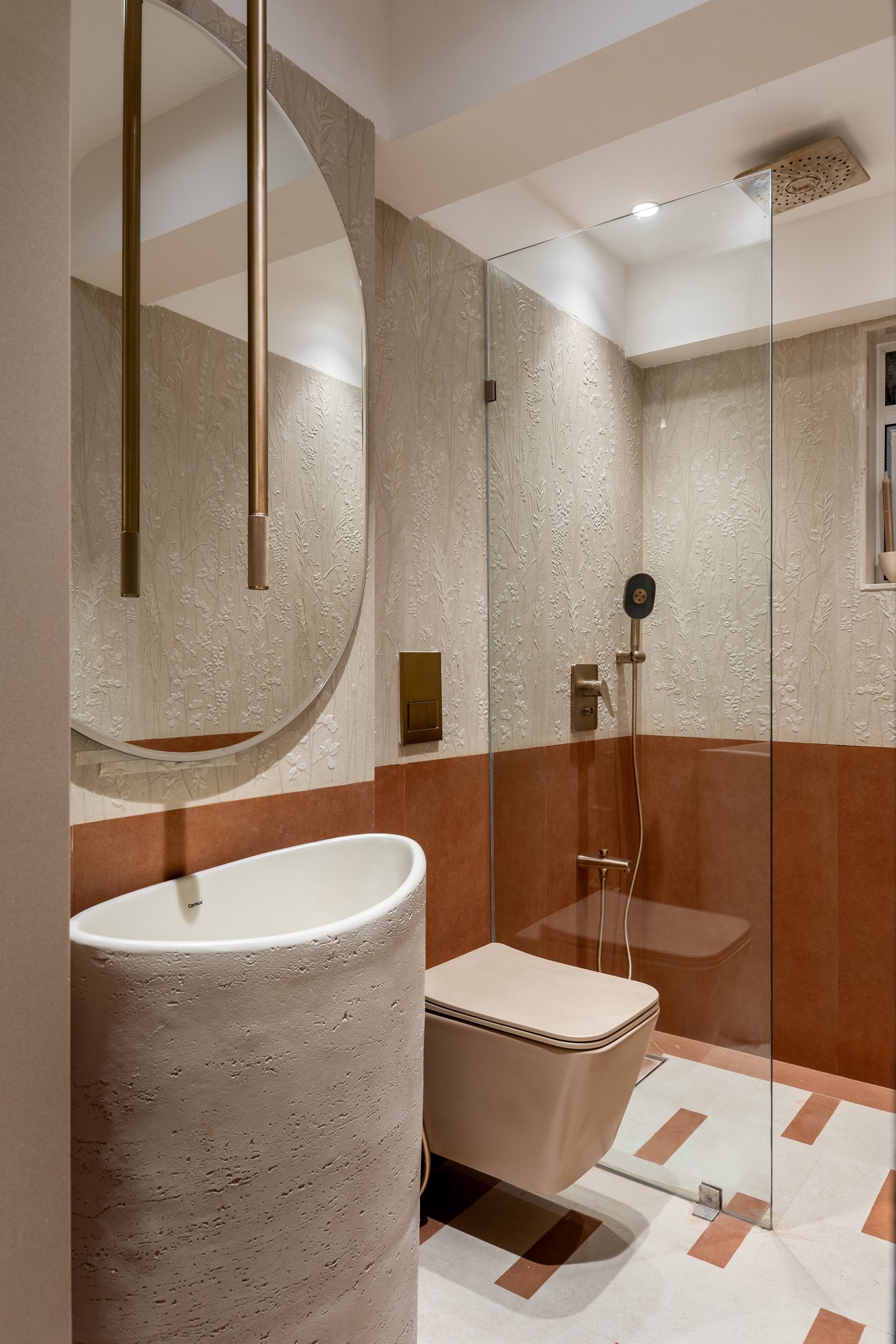
A second bathroom takes a softer, more crafted approach. A textured floral relief in pale plaster wraps the upper walls, meeting a band of warm terracotta tile below, while a pedestal basin in roughly finished stone introduces a more sculptural hand. The brass-toned fittings and oval mirror keep the room consistent with the apartment’s broader material logic, even as the register turns more tactile.
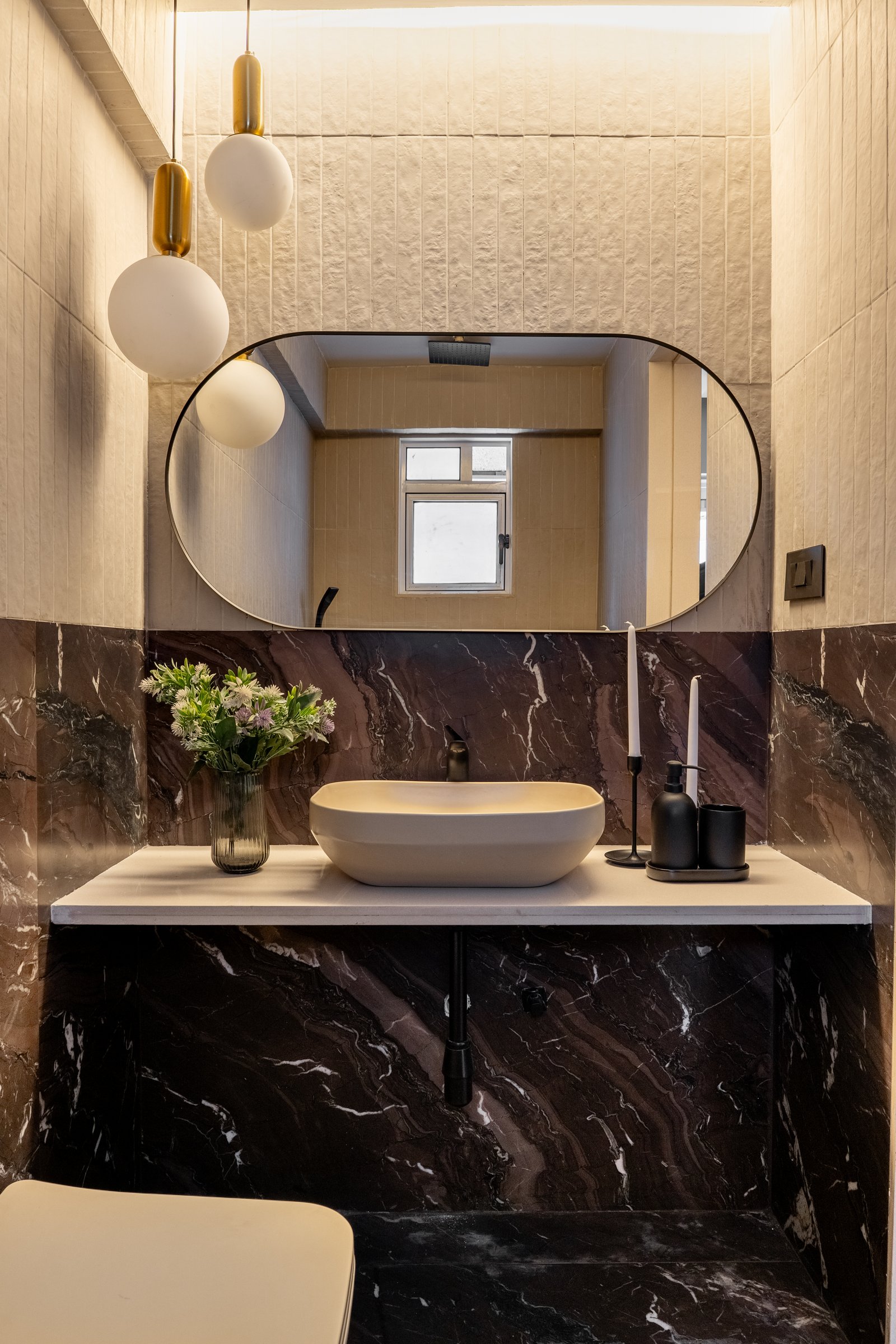
The third bathroom turns to a richer, more saturated palette. Deep oxblood-veined stone wraps the lower walls and floor, meeting a warm beige textured tile above, with a vessel basin in matte cream and pendant lights in opaline and brass. The composition lends a powder-room formality to what is structurally a utilitarian space, and it underscores the studio’s interest in giving every room its own material argument.
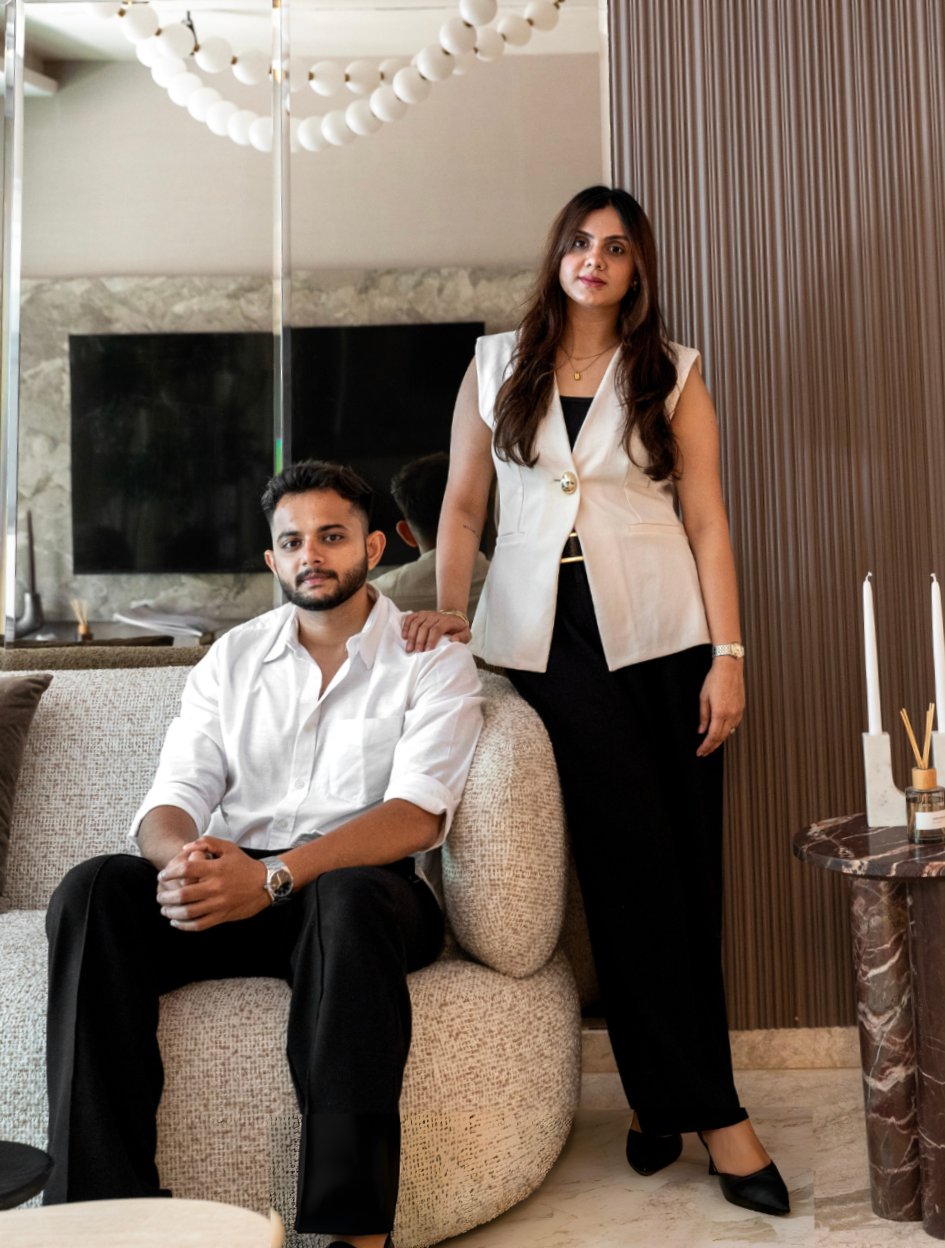
What Enforma Designs has achieved at Park West is a kind of considered persuasion. A show flat must work harder than a home, because it must convince before it can comfort, but this apartment manages to do both within thirty days of execution. The studio’s approach, grounded in restrained palettes, layered textures, and considered proportion, suggests a sensibility that places experience above effect.
Across a compact Mumbai footprint, the residence offers a measured argument for what aspirational living can look like when it is rendered with discipline rather than display. Each room carries its own register, but together they form a continuous design language, one that reads as both contemporary and quietly enduring.