A renovation is, at its most honest, an argument with the past. Tear down too much and the house forgets itself; preserve too cautiously and it remains stuck in time. The most considered renovations resolve this tension by treating memory as material, something to be sanded, re-jointed, and given fresh structural purpose without losing its grain.
Such is the proposition of Astitva Aasare, a twenty-year-old load-bearing residence in Marathalli, Bengaluru, reimagined by AD Studio 9 under principal designers Ar. Apoorva Lekha N and Ar. Gandhrav Krishna. Conceived for a family of four, a matriarch, her builder husband, and their two adult daughters, the project began not with a demolition plan but with a brief about emotional continuity. The clients wanted the house to breathe differently, to admit more light and air, while remaining unmistakably the home they had loved for two decades.
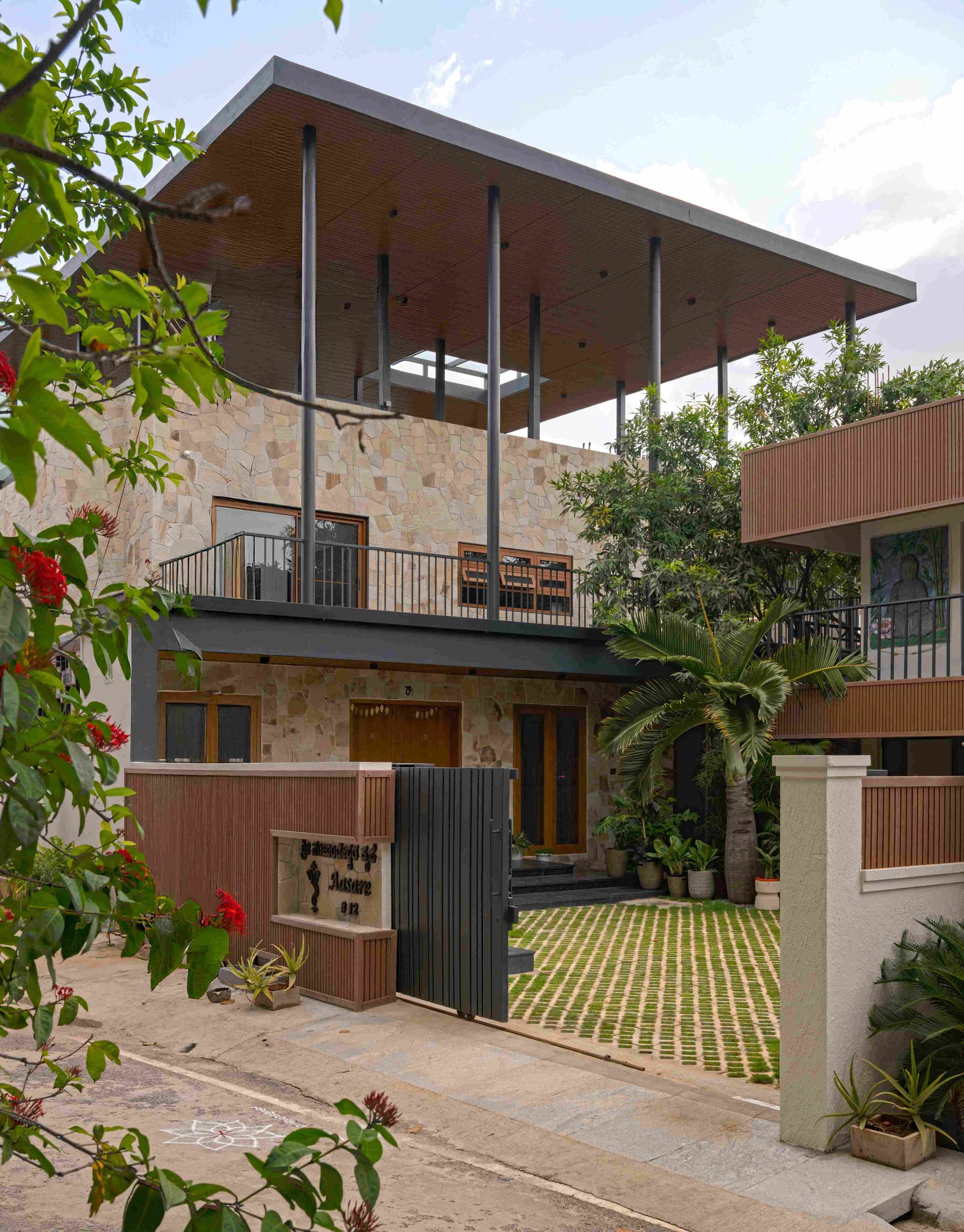
From the street, the renovated facade reveals the studio’s thesis in a single elevation. A deep cantilevered roof shelters a double-height verandah on the upper level, supported by slim steel columns that read as restraint rather than spectacle, while the ground floor anchors itself with random-cut sandstone cladding and a planted forecourt of grass-laid paver grids. The vocabulary is at once contemporary and rooted, a building that does not announce its renovation so much as quietly demonstrate it.
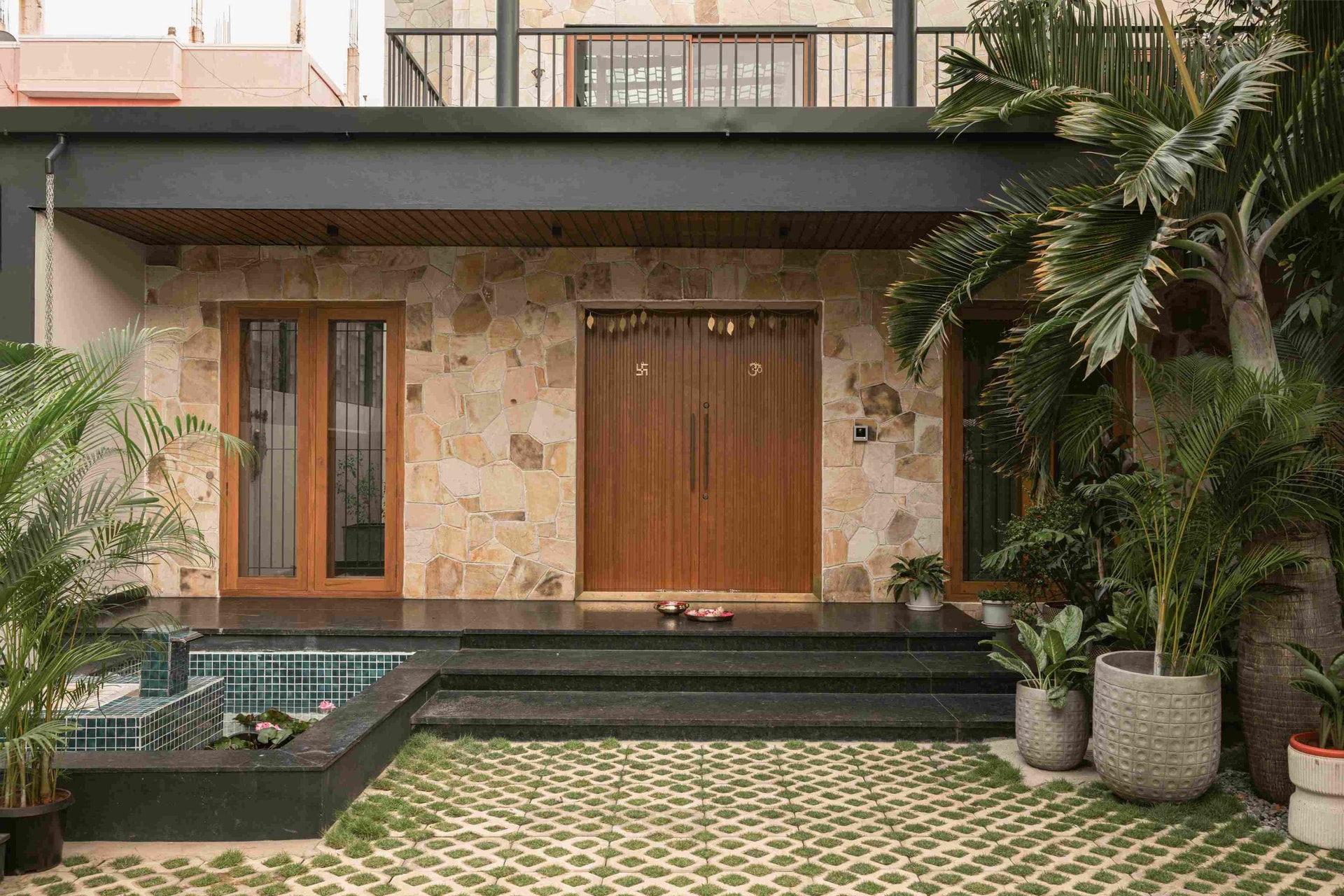
The entry sequence rewards a slower reading. A sandstone-clad portico frames the carved wooden front door, while a sunken lotus pond in deep green mosaic tile runs alongside the threshold, its surface reflecting fragments of palm. The grass-grid paving underfoot does what conventional flooring cannot: it allows the ground to remain ground, porous and breathing.
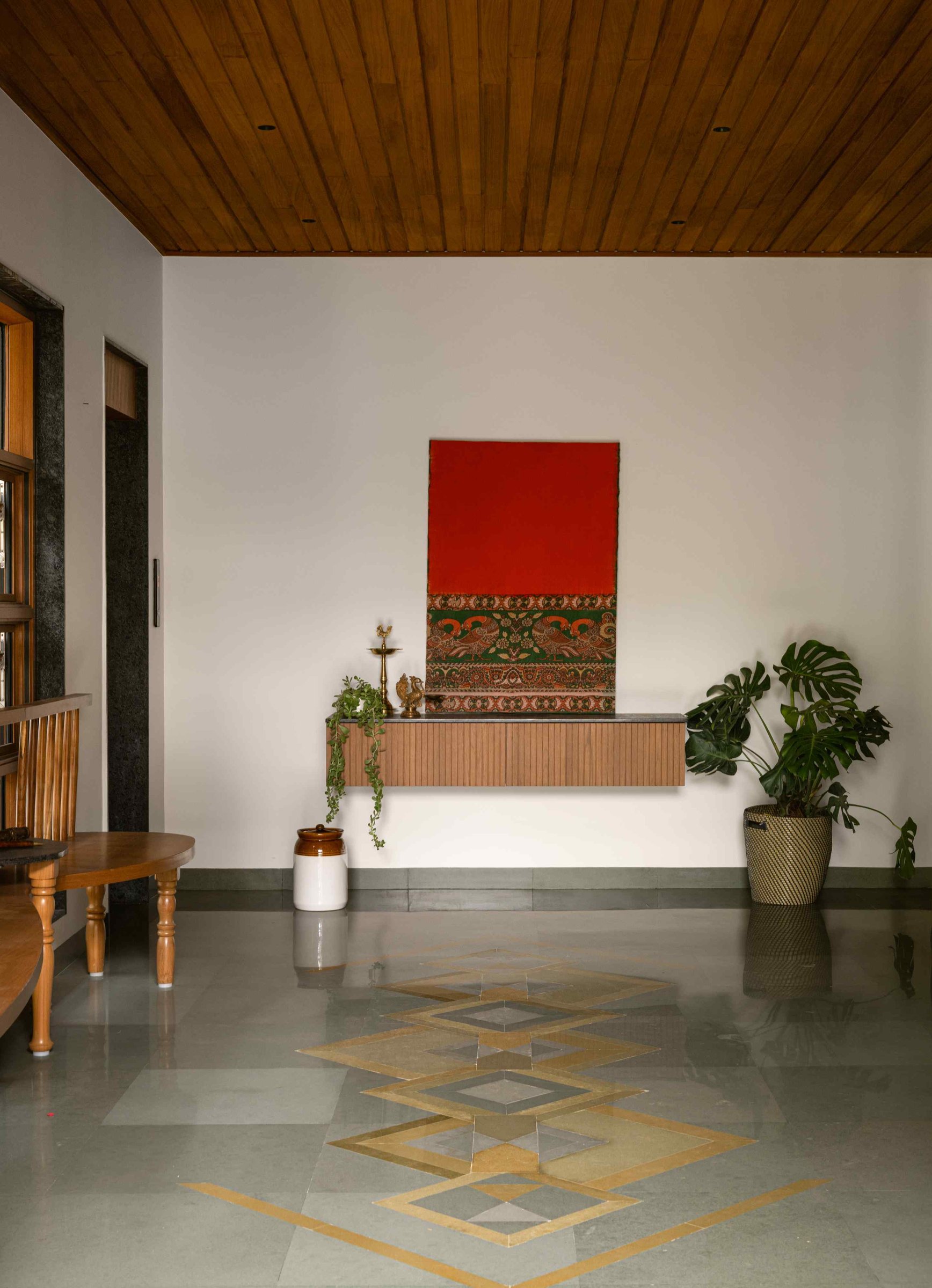
Crossing into the foyer, the home’s material grammar declares itself with confidence. A slatted wooden ceiling warms the volume above, while the polished kota floor below carries an inlaid brass-and-stone geometric motif that functions like a rangoli in permanence, a welcome drawn in stone. A floating fluted console holds a single textile-and-canvas artwork in oxidised red and forest green, the saree fragment beneath it locating the home culturally without resorting to overt signalling.
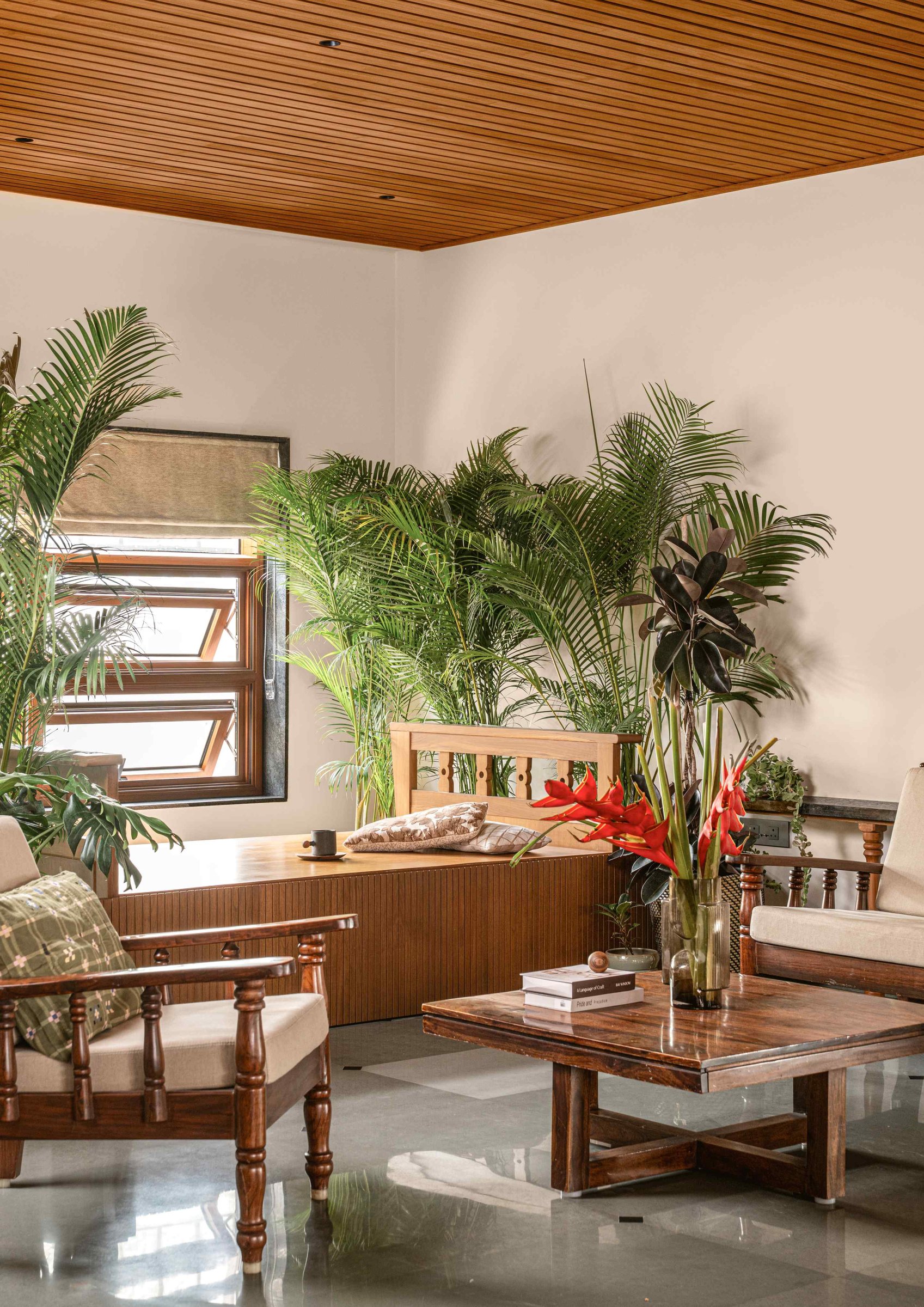
The living room opens off this threshold with what is, in effect, an indoor garden. A low daybed in honeyed wood is built into the corner beneath a casement window, framed on every side by tall areca palms, monstera, and a sculptural arrangement of heliconia that catches the eye exactly as intended. The slatted ceiling continues overhead, unifying the ground floor as a single tonal field.
The seating, a pair of armchairs in turned wood with cream upholstery around a low square coffee table, is deliberately modest in scale. The room understands that its most powerful gesture is the greenery itself, and the furniture defers to it without apology.
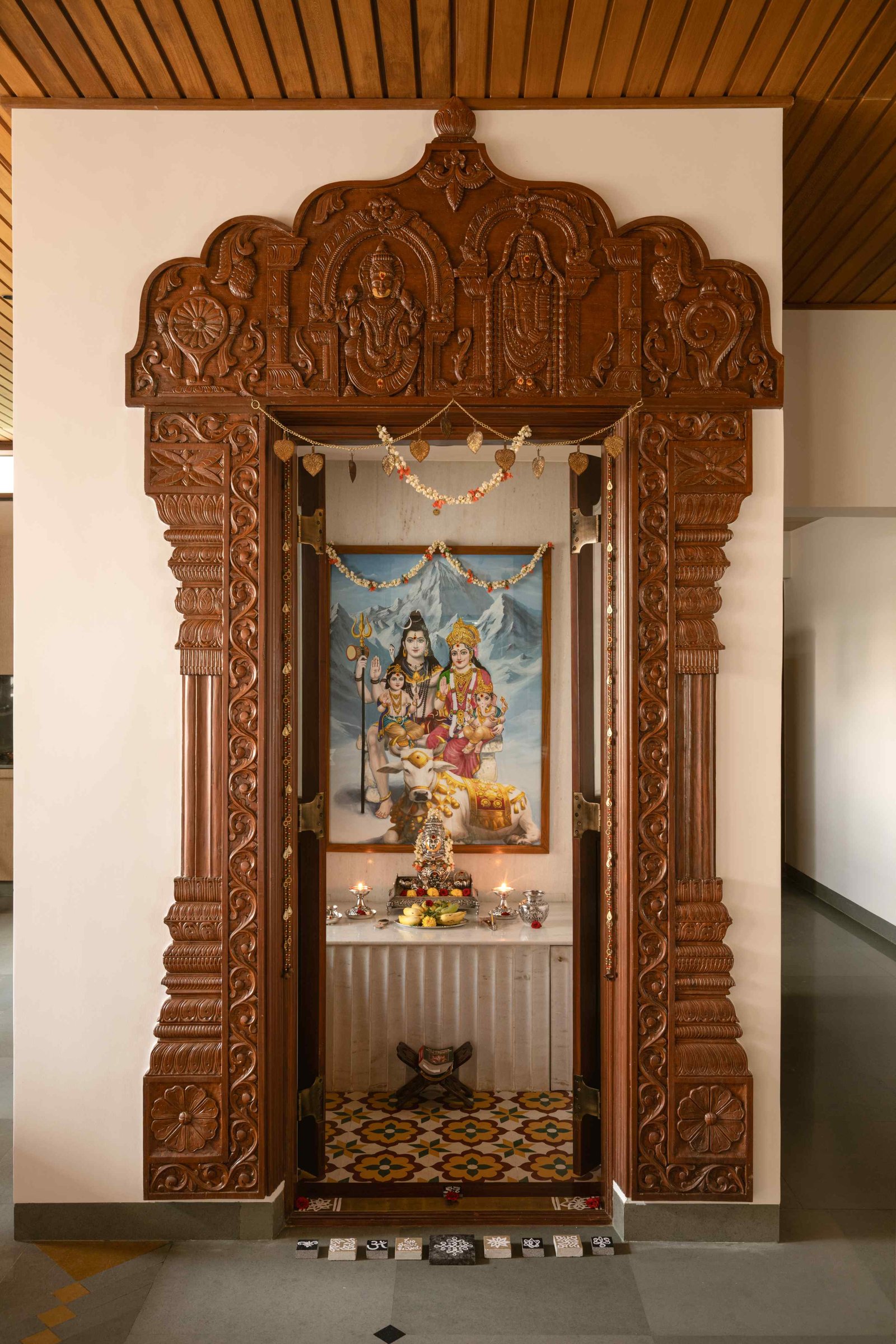
Adjacent to the social zone, the home’s pooja sits within an intricately carved wooden doorway that frames the deities like an architectural reliquary. The patterned cement-tile floor inside, geometric in ochre, green, and cream, separates the sacred enclosure from the polished kota outside without needing a physical door. It is a moment of unabashed tradition, held with the same seriousness as the contemporary detailing elsewhere.
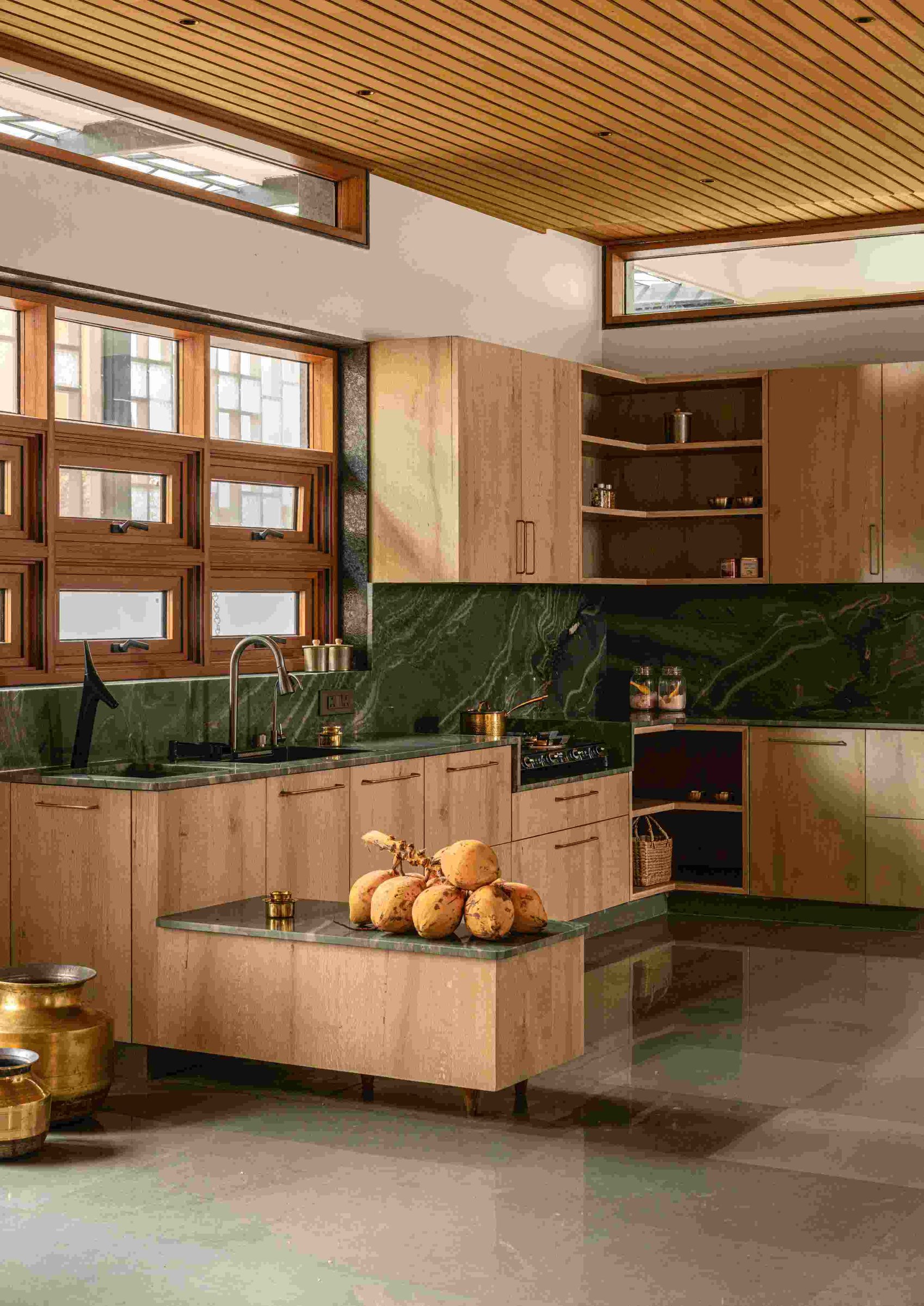
The kitchen reads as the home’s quiet showpiece. Pale oak cabinetry, flat-fronted with slim pulls, runs the length of two walls and wraps a small peninsula, while the counter and full-height backsplash in a deeply veined green stone introduce the only saturated colour in the room. A clerestory of timber-framed casement windows above the sink floods the work surface with daylight, the slatted wooden ceiling continuing overhead to hold the volume together.
““The brief emphasised simplicity, spatial functionality, and material honesty over ornamental indulgence.””
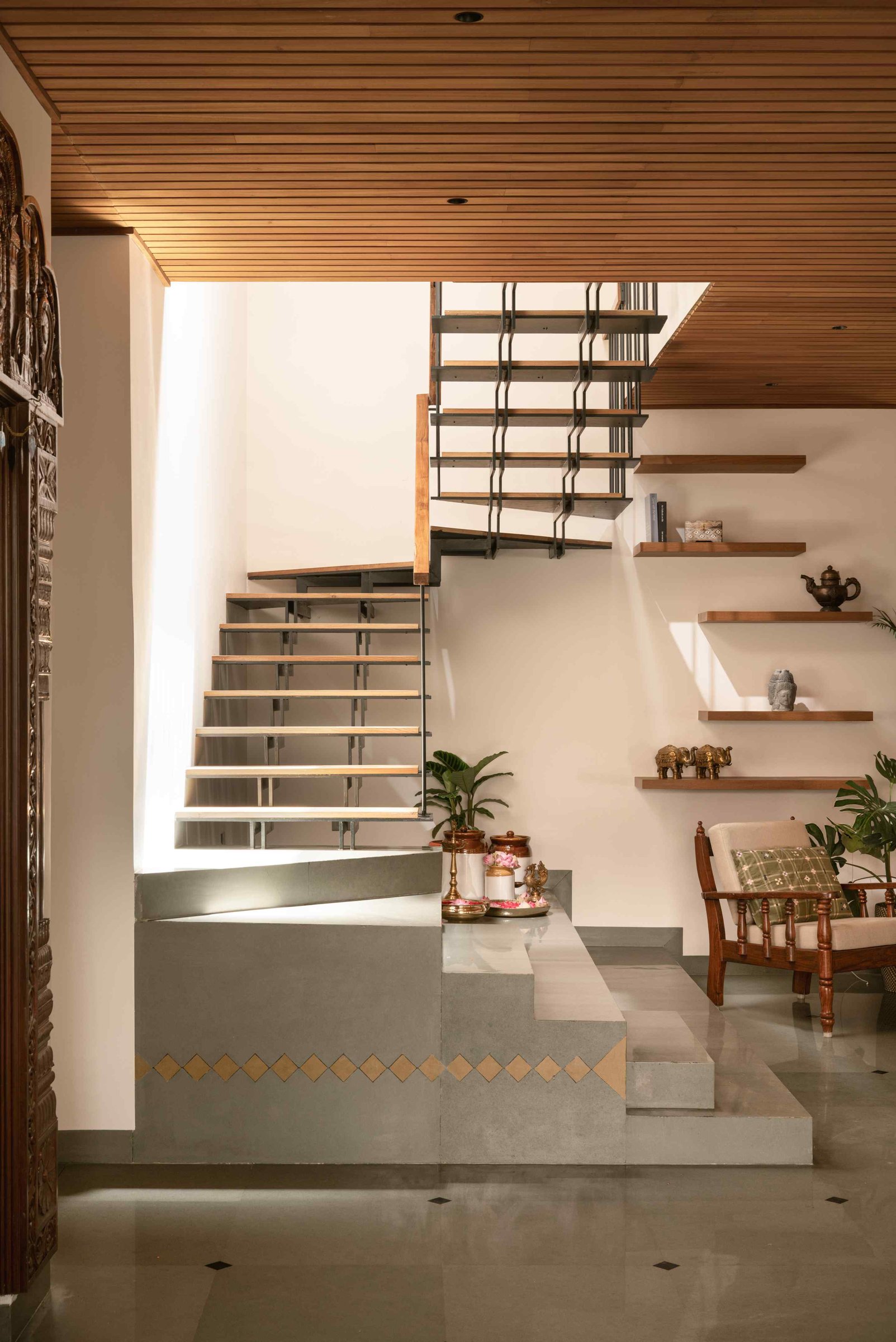
The staircase, reorganised as part of the renovation, is one of the project’s most architectural moments. Open metal stringers carry wooden treads in a folded geometry, and the wall beside it carries a sequence of cantilevered wooden shelves displaying brass figurines and ceramics, an ad-hoc gallery that records the family’s collected life. The plinth below, in pigmented concrete with a thin band of brass-and-stone inlay, references the foyer floor without repeating it.
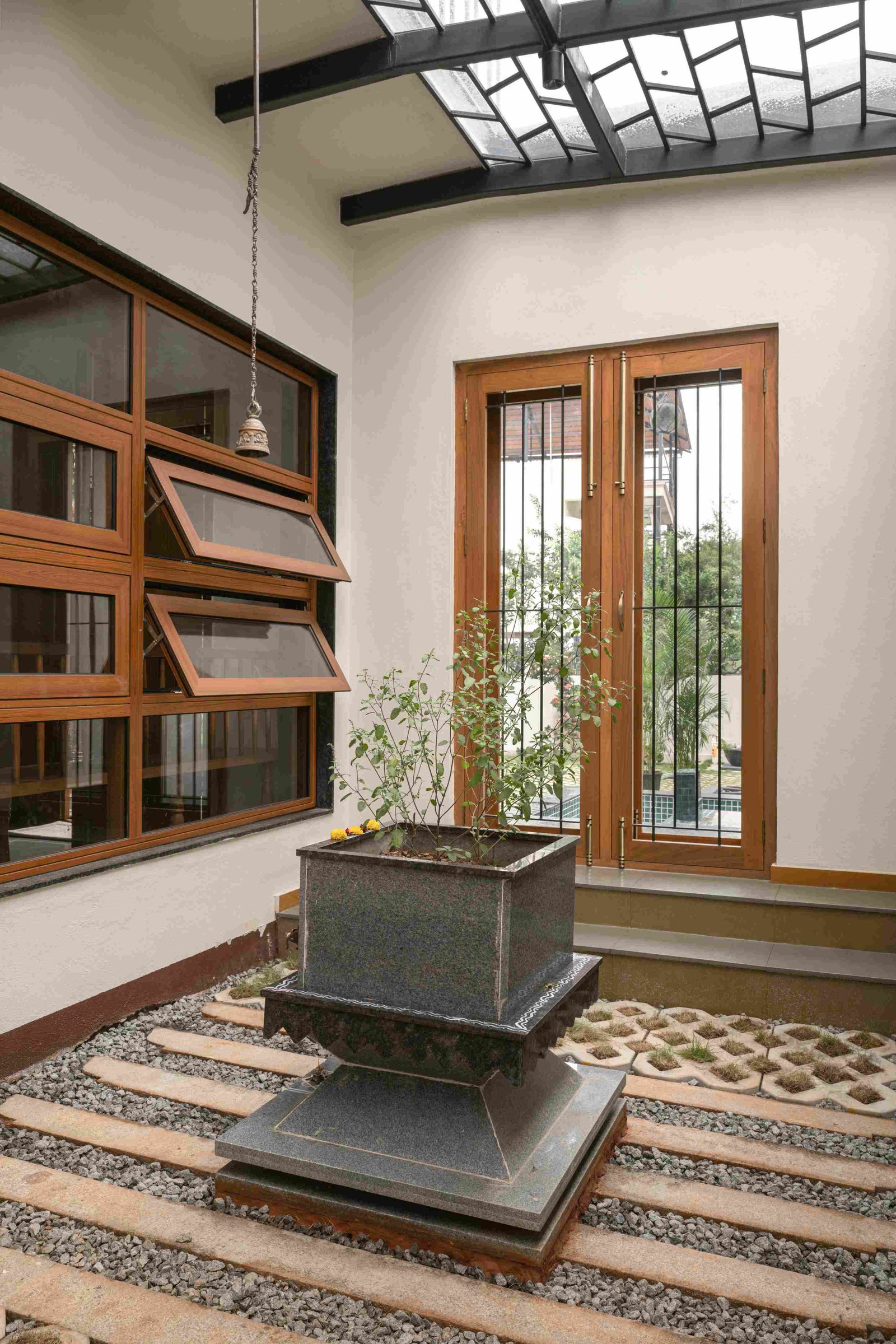
A small internal courtyard, framed by timber-mullioned awning windows and capped by a patterned steel skylight, brings light deep into the plan. A granite plinth at its centre holds a tulasi shrub, the household plant that anchors so many South Indian homes, here given the architectural dignity of a courtyard altar. The gravel-and-paver ground plane echoes the entry threshold, completing a quiet conversation between outside and inside.
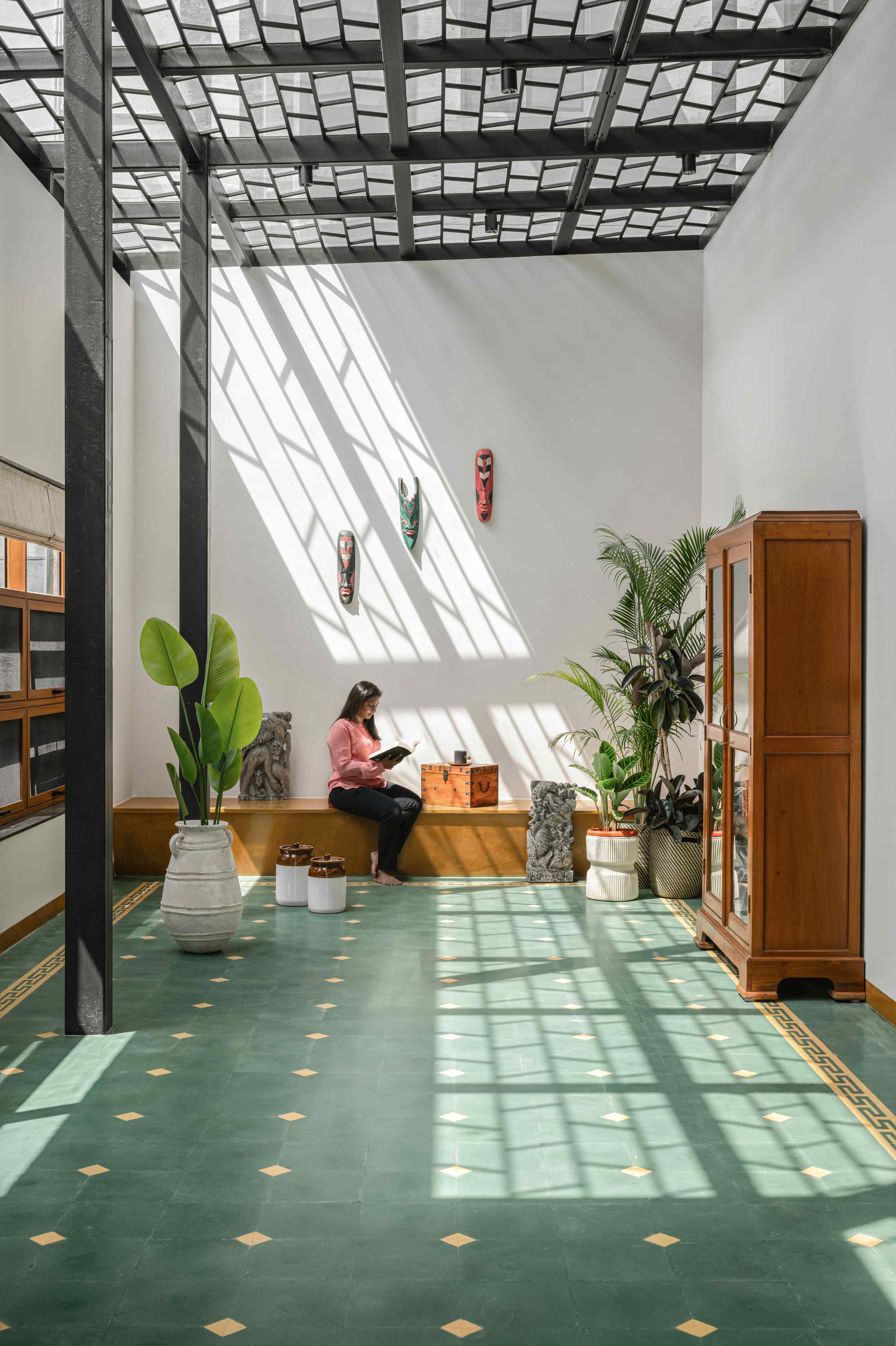
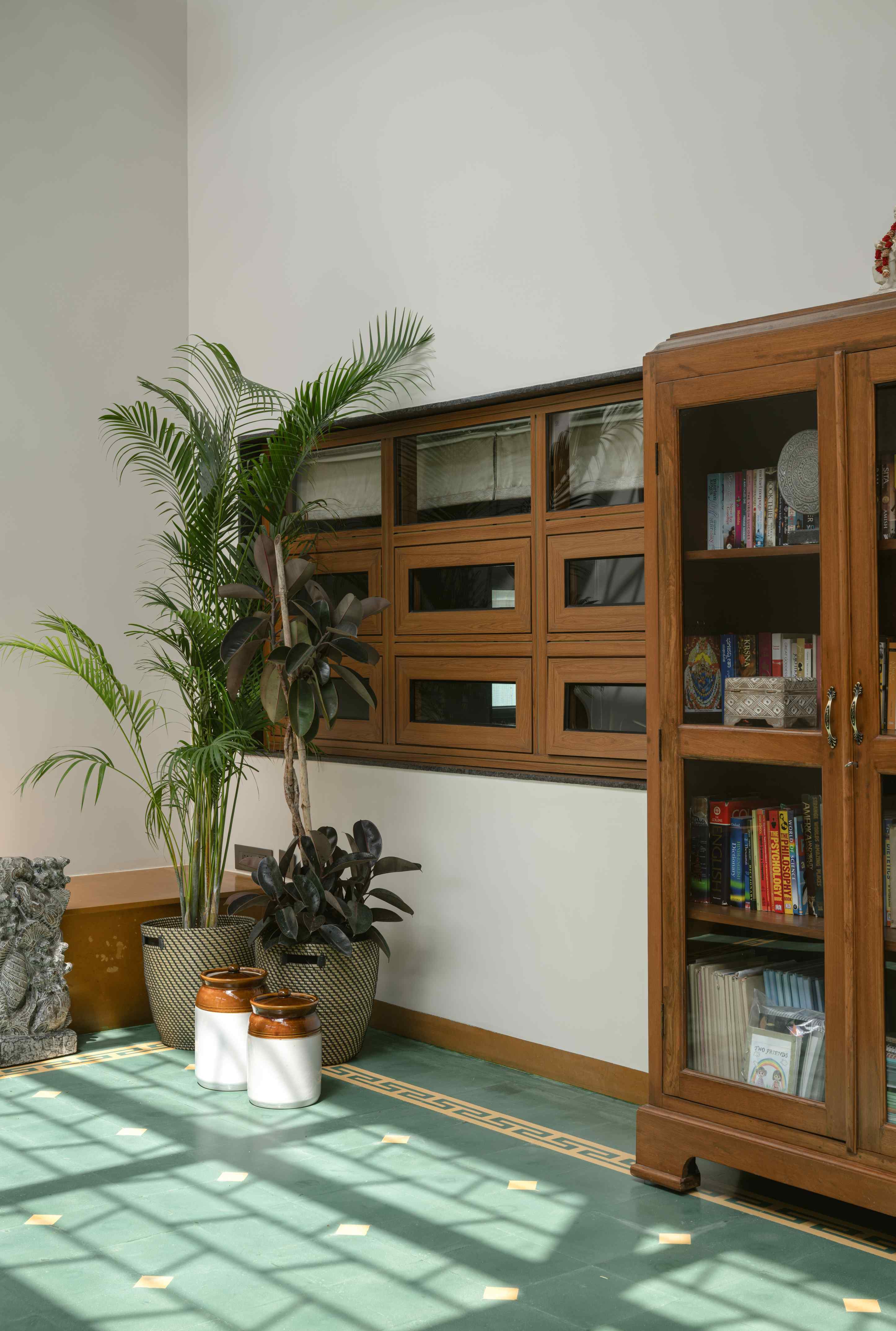
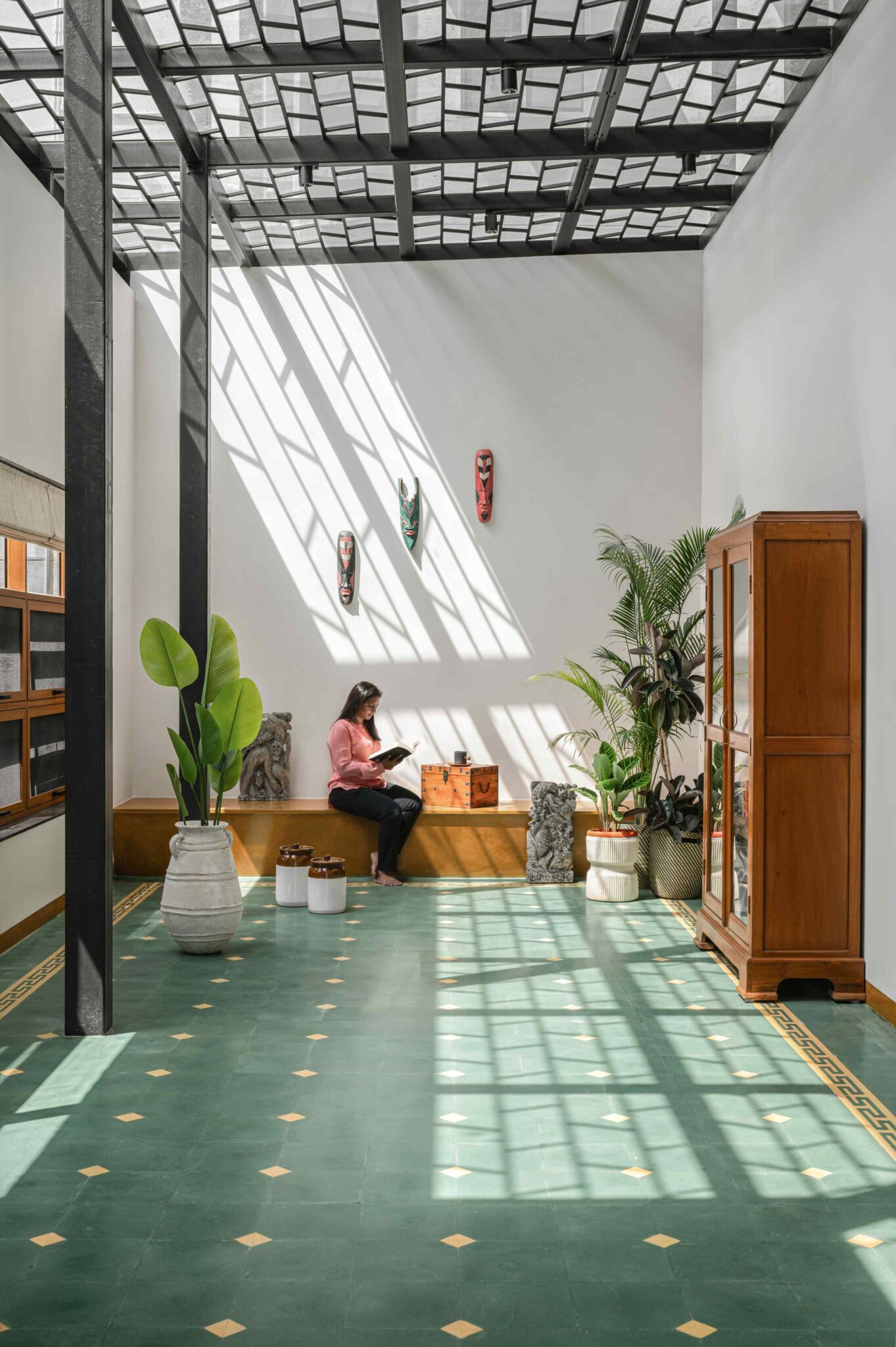
The most unexpected room in the home is the indoor garden court on the upper level, a double-height volume capped entirely by a glazed steel-truss roof. Green encaustic tiles with brass diamond inlays cover the floor, while three carved tribal masks hang on the wall above a built-in timber bench. The space is part conservatory, part reading room, part shrine to the family’s belief that a house should always have somewhere to simply sit and look up.
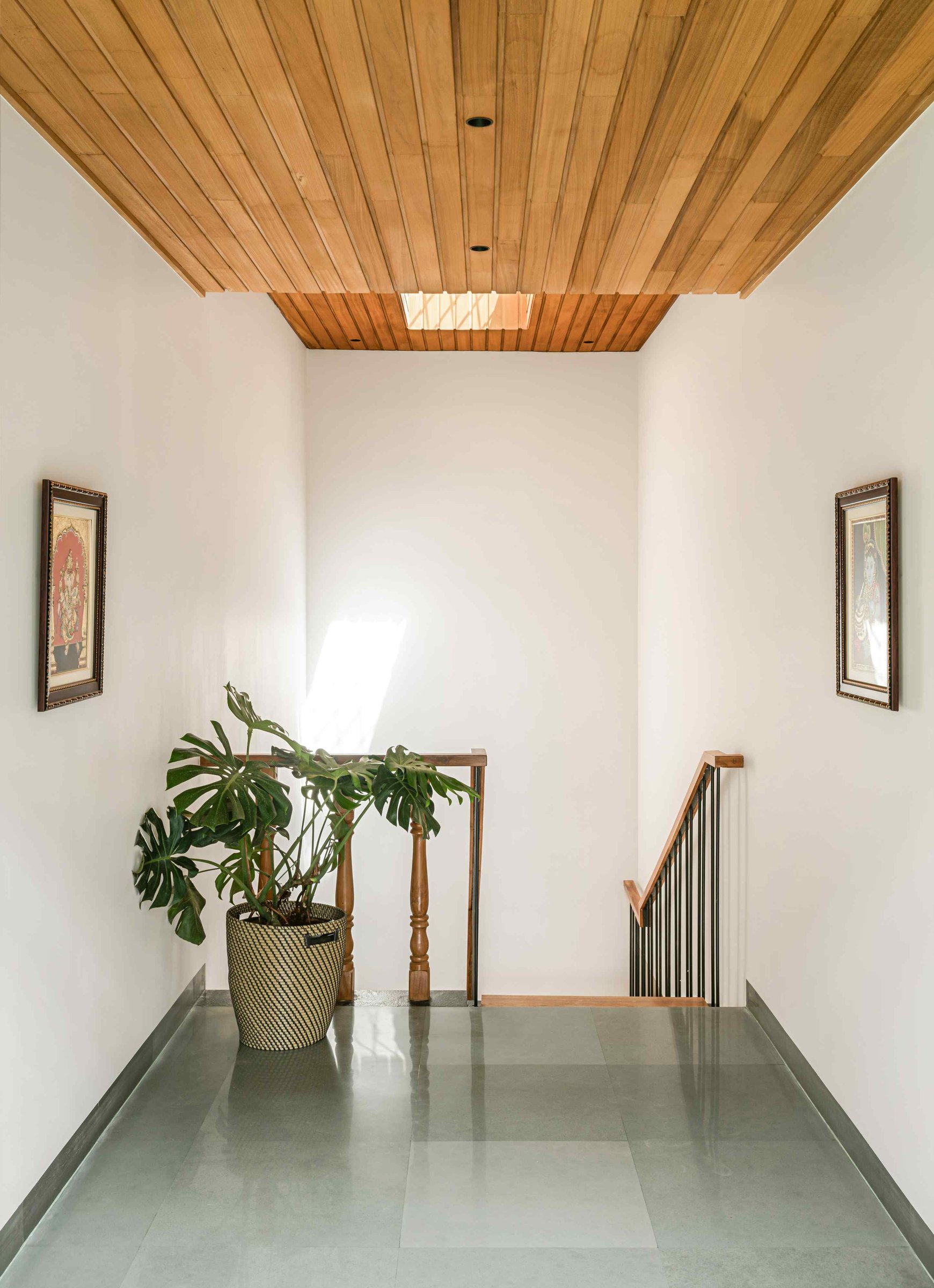
The upper landing, by contrast, is exercised in restraint. A slatted wooden ceiling holds a recessed skylight slot, and two small framed pichwai-style miniatures flank an otherwise unadorned white wall. A monstera in a woven basket rests against the timber-newelled railing. The room demonstrates that circulation space, when treated with the same care as a primary room, becomes part of the experience rather than a gap between it.
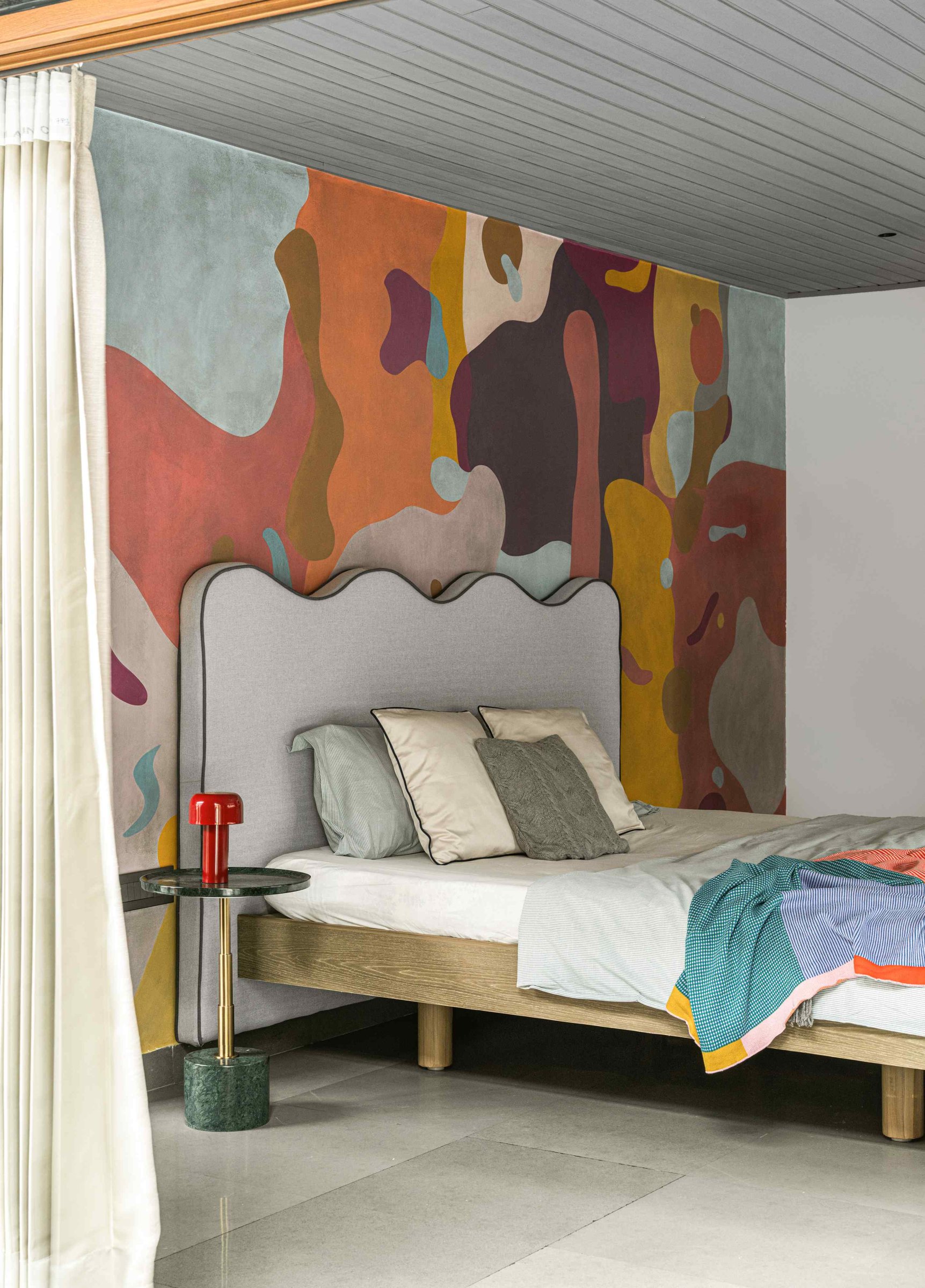
The first of the daughters’ bedrooms is the project’s boldest interior gesture. A floor-to-ceiling hand-painted mural in abstract organic forms, citrus, plum, slate, mustard, and rust folding into one another, wraps the headboard wall, while the upholstered headboard itself takes a softly scalloped silhouette in dove grey. A slim brass-and-green-marble side table holds a sculptural red lamp, and the bed in pale oak floats on cylindrical legs.
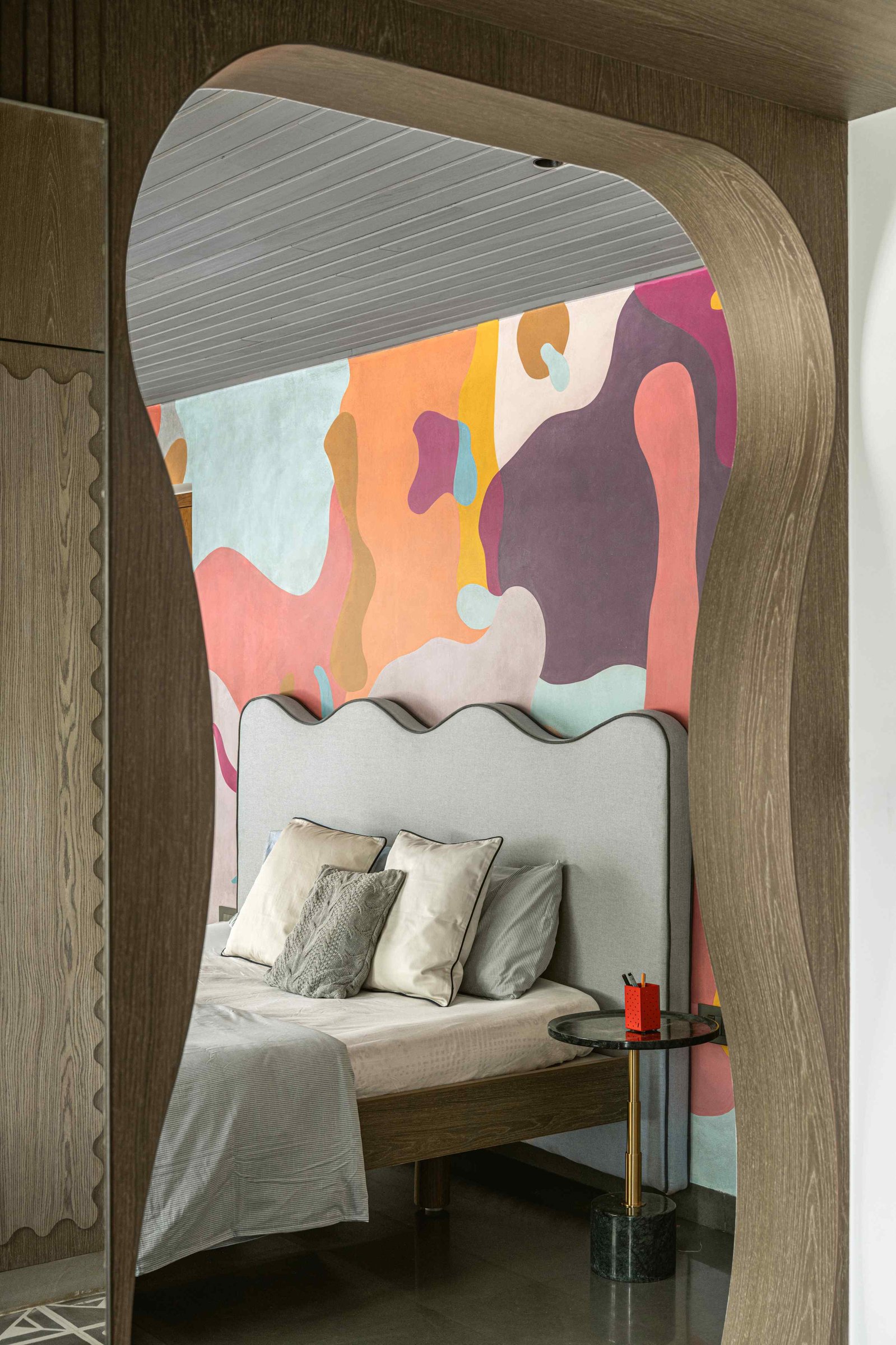
An organically curved wardrobe portal, carved from fumed oak in a sinuous wave, frames the view into this same room from the dressing area. The arch is a piece of millwork that thinks like sculpture, its silhouette echoing the mural’s biomorphic shapes and the headboard’s wavy crown. The repetition is not literal but tonal, the room speaking to itself in three different registers of the same language.
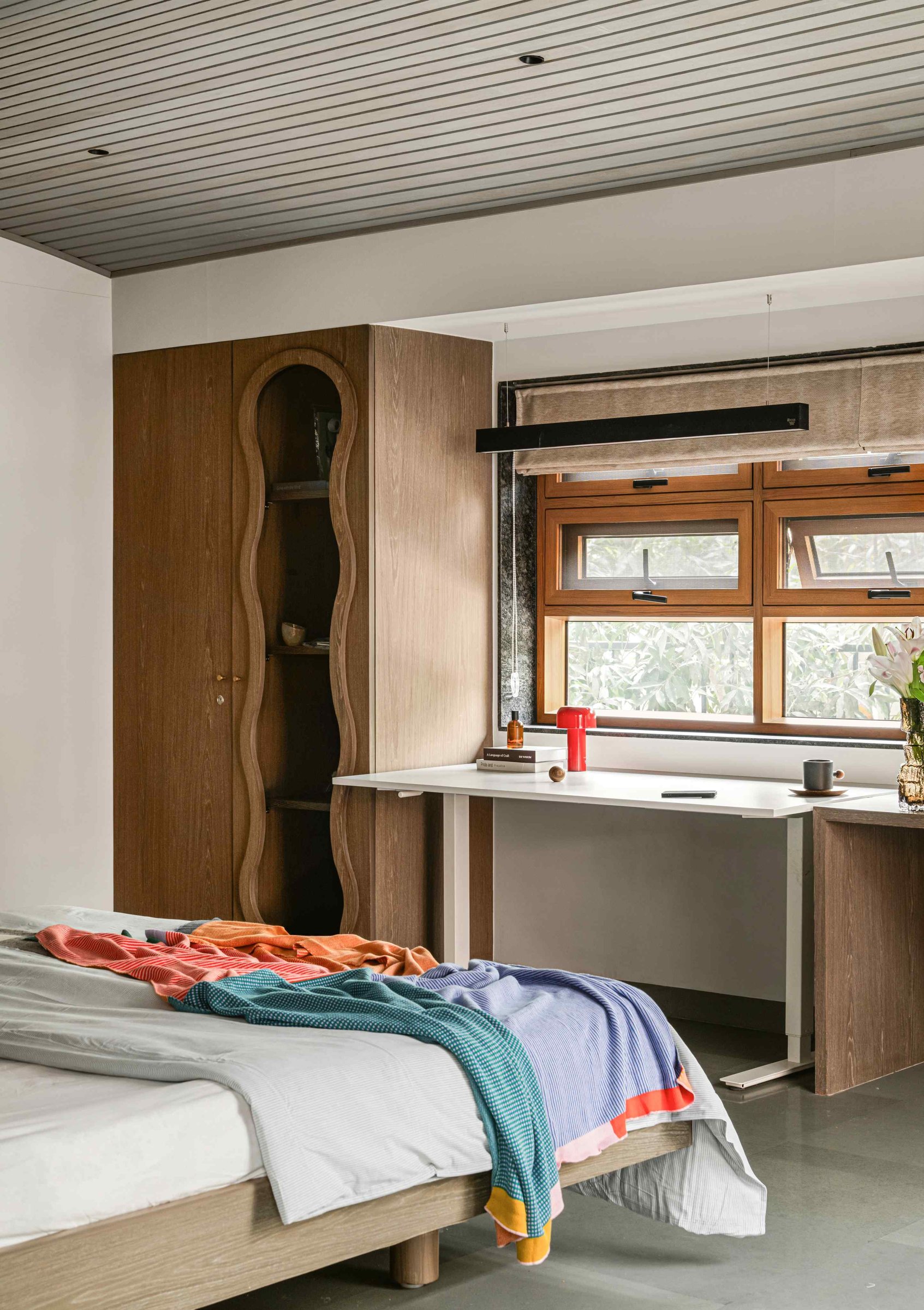
The room’s other half holds a wall-mounted desk in pale laminate against a timber-framed window set into a dark stone surround, with a slim black linear pendant overhead. A built-in oak wardrobe rises beside it, its door carved with the same wave motif as the arch, this time as a tall wave-edged arched opening revealing display shelves. The grey slatted ceiling lowers the visual weight of the volume, keeping the focus on the mural beyond.
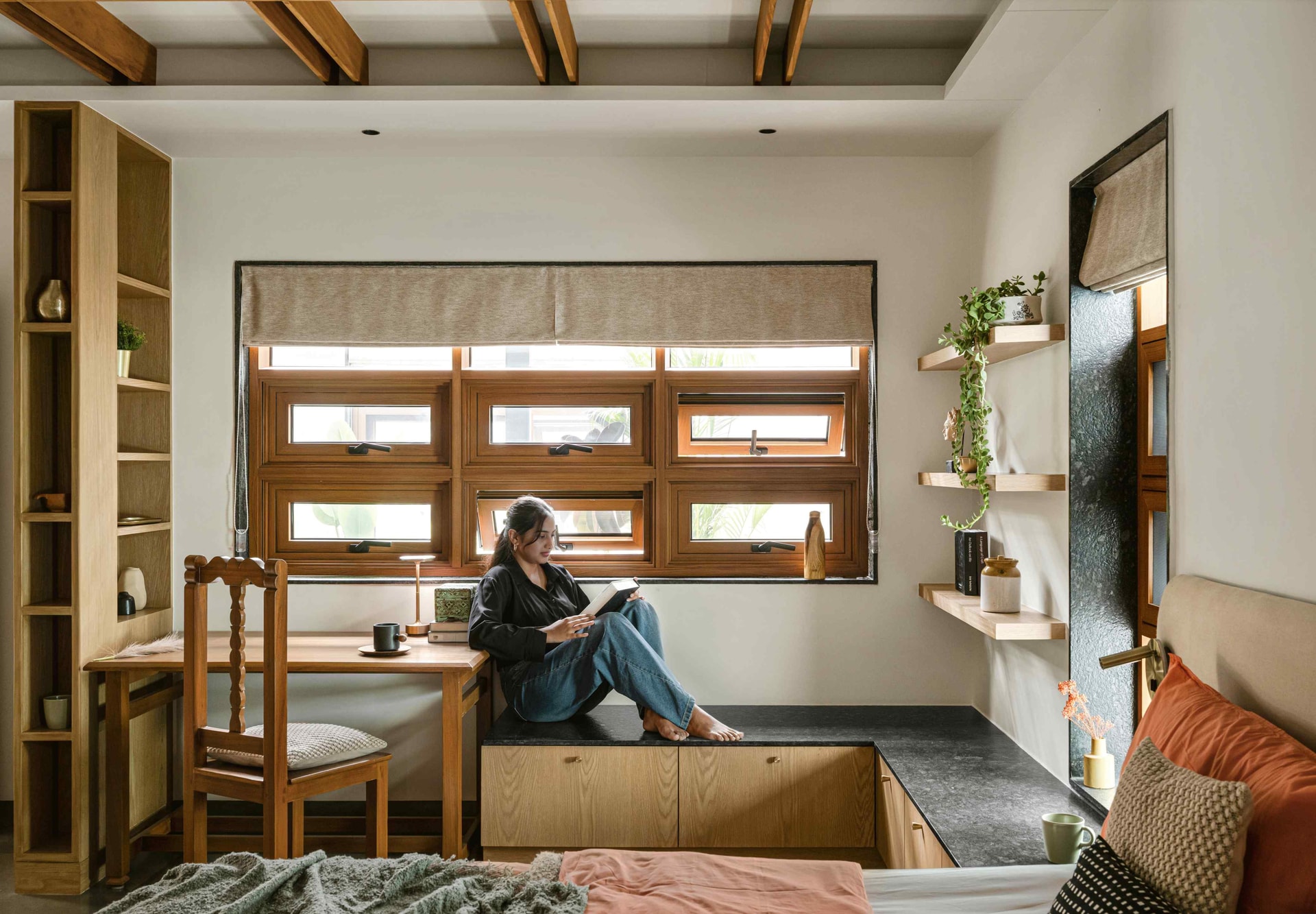
The second daughter’s bedroom takes a more contemplative tone. A long window seat in pale oak with a charcoal stone top runs beneath a bank of six awning casements, deep enough to read on, sit cross-legged on, or set a cup of tea upon while the morning light works its way across the floor. The exposed coffered timber ceiling above, with deep beams in honeyed teak, is the room’s most architecturally ambitious move and gives the space a workshop-like seriousness.
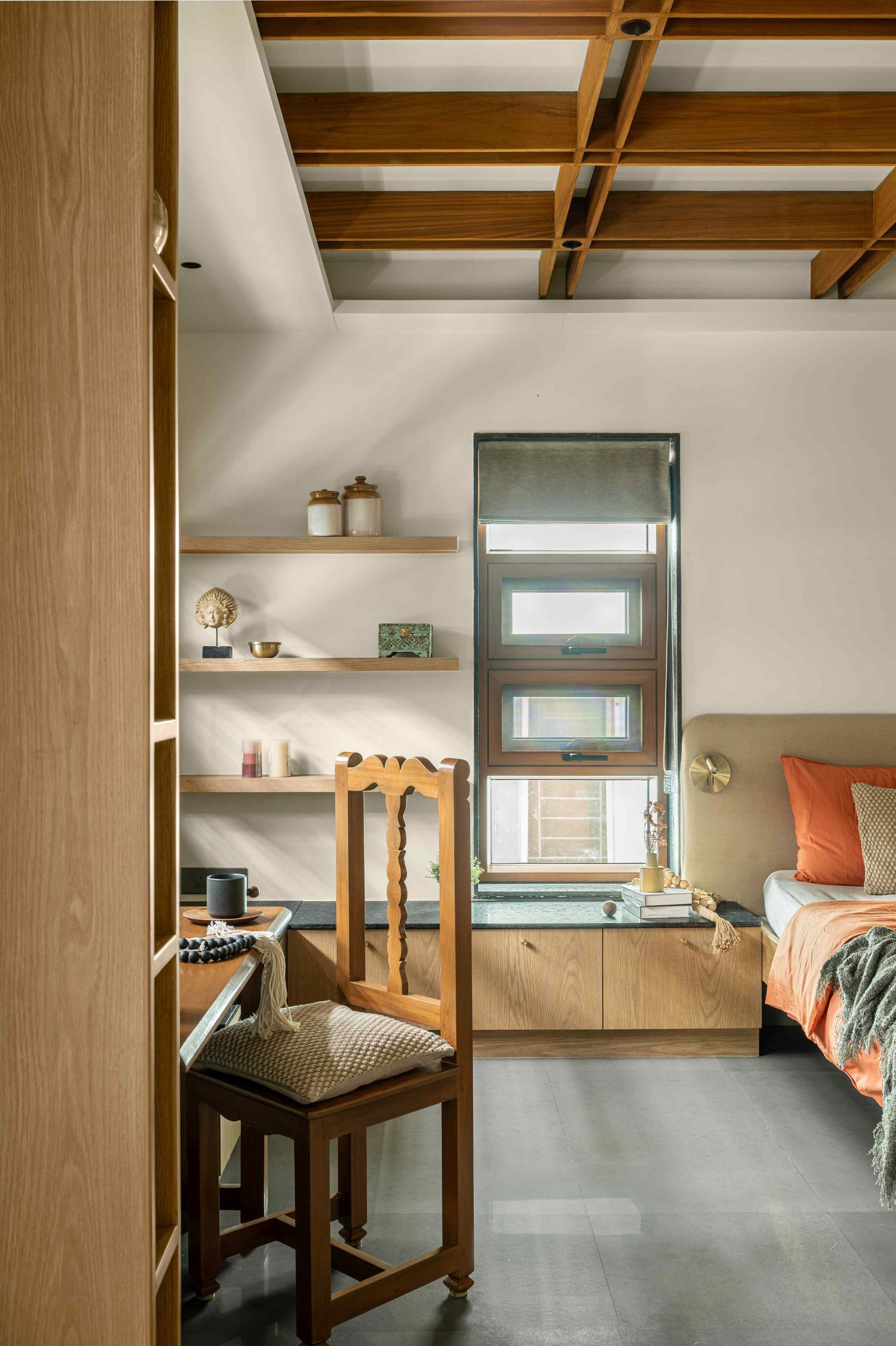
A built-in study nook tucks neatly into the same room, with a stone-topped desk and floating oak shelves holding the daughter’s small collection of brass objects, books, and ceramics. The turned-wood chair, clearly an inherited piece, is a deliberate counterpoint to the otherwise contemporary millwork, an old object given new daily purpose. The orange-and-sage palette of the bed linens picks up the warmth of the coffered ceiling, completing the room’s tonal logic.
The other bedroom takes its design cue from a single dramatic decision: hand-painted chinoiserie running across an entire wall of oak veneer wardrobes. Trailing branches, blossoms, and the occasional bird unfold across the timber-grain in soft pinks and sage greens, turning the storage wall into a botanical mural that ages, like all good wood, with grace. The rust-orange bed linens and patterned cement-tile floor inlay below ground the painted wardrobe in colour rather than letting it float.
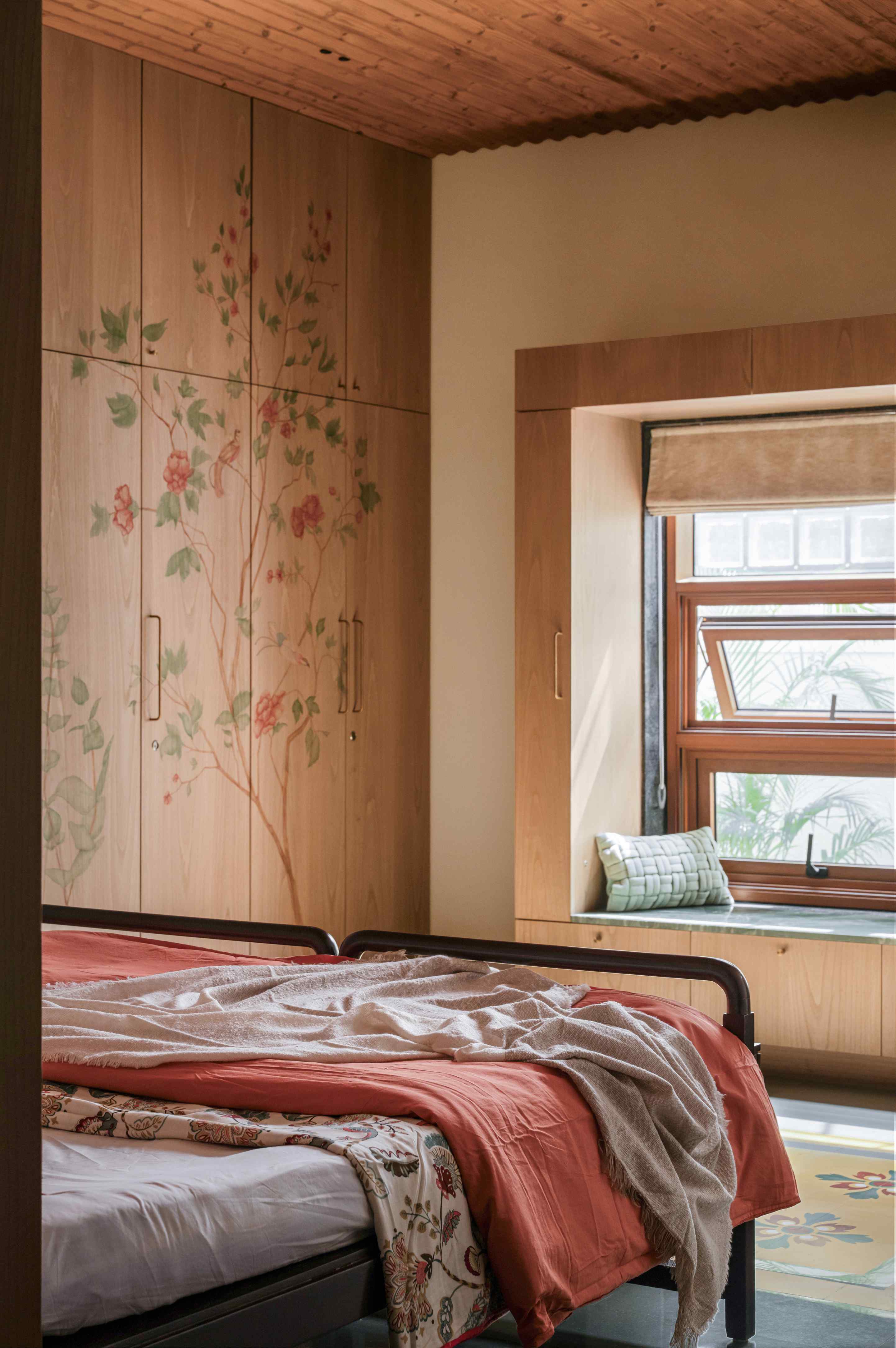
The same room, viewed from the bed, shows how the painted veneer continues around the corner and pauses cleanly at a casement window with a built-in seat. The tongue-and-groove timber ceiling here is treated more rustically than elsewhere in the home, a deliberate softening that lets the bedroom feel like a retreat rather than a continuation of the public floor below. A patterned floor inlay anchors the bed.
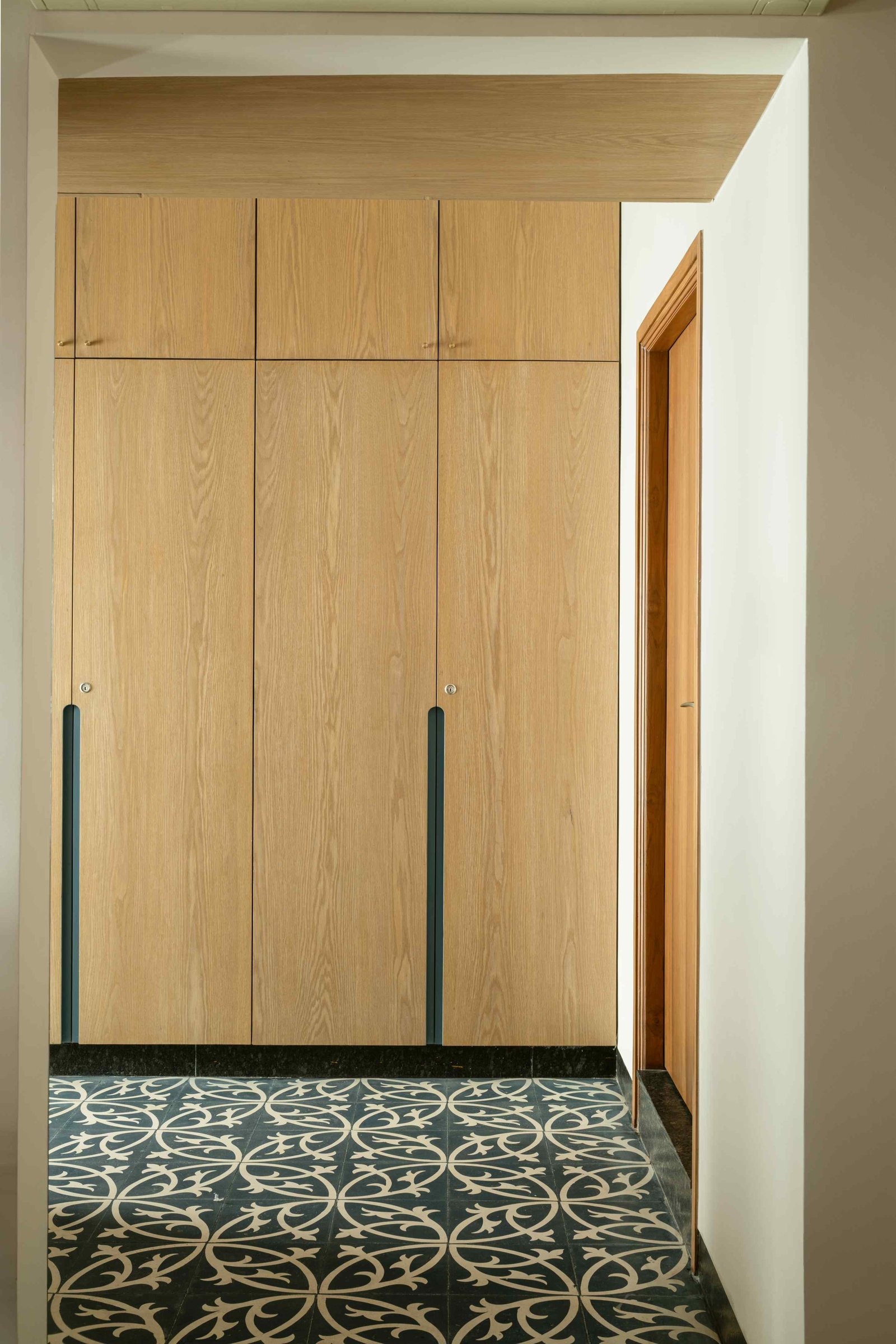
A dressing alcove off the bedroom holds a full-height pale-oak wardrobe with slim vertical handles in a muted teal, set above a floor of patterned cement tile in indigo and cream. The tile, a familiar South Indian motif rendered in a contemporary palette, demonstrates how the project handles tradition: not as quotation but as continuation. A neighbouring teak-framed door connects to the wider home.
What Astitva Aasare proposes, finally, is a particular model of the renovated Indian home, one where the load-bearing bones of the original are reorganised around courtyards, clerestories, and built-in greenery, but where the family’s accumulated objects, rituals, and aesthetic instincts are folded back in without irony. The carved pooja doorway, the chinoiserie wardrobes, the brass figurines on the staircase shelves: none of these are styling decisions. They are the residue of twenty years of living, given new architectural housing.
The project’s quiet achievement is that none of its individual moves feel decorative. The greenery improves airflow. The clerestories admit light. The biomorphic millwork in the daughters’ rooms responds to how the daughters actually live. A house has been made breathable without being made anonymous, and a family’s emotional memory has been preserved without being put behind glass.