A home, at its most considered, is less a collection of rooms than a sustained argument about how to live. Verde Residence makes that argument quietly, in the language of veined stone, fumed oak, and surfaces that ask to be touched before they ask to be photographed.
Designed by Plug Collective in Mumbai, the apartment was shaped for a family that wanted warmth without ornament and individuality without theatre. The plan moves from a compact foyer into an open living and dining volume, then folds inward to three bedrooms, each tuned to a different occupant and a different mood. The discipline of the project lies in how consistently its material vocabulary, green-veined stone, warm oak, off-white plaster, holds across spaces that otherwise refuse to repeat themselves.
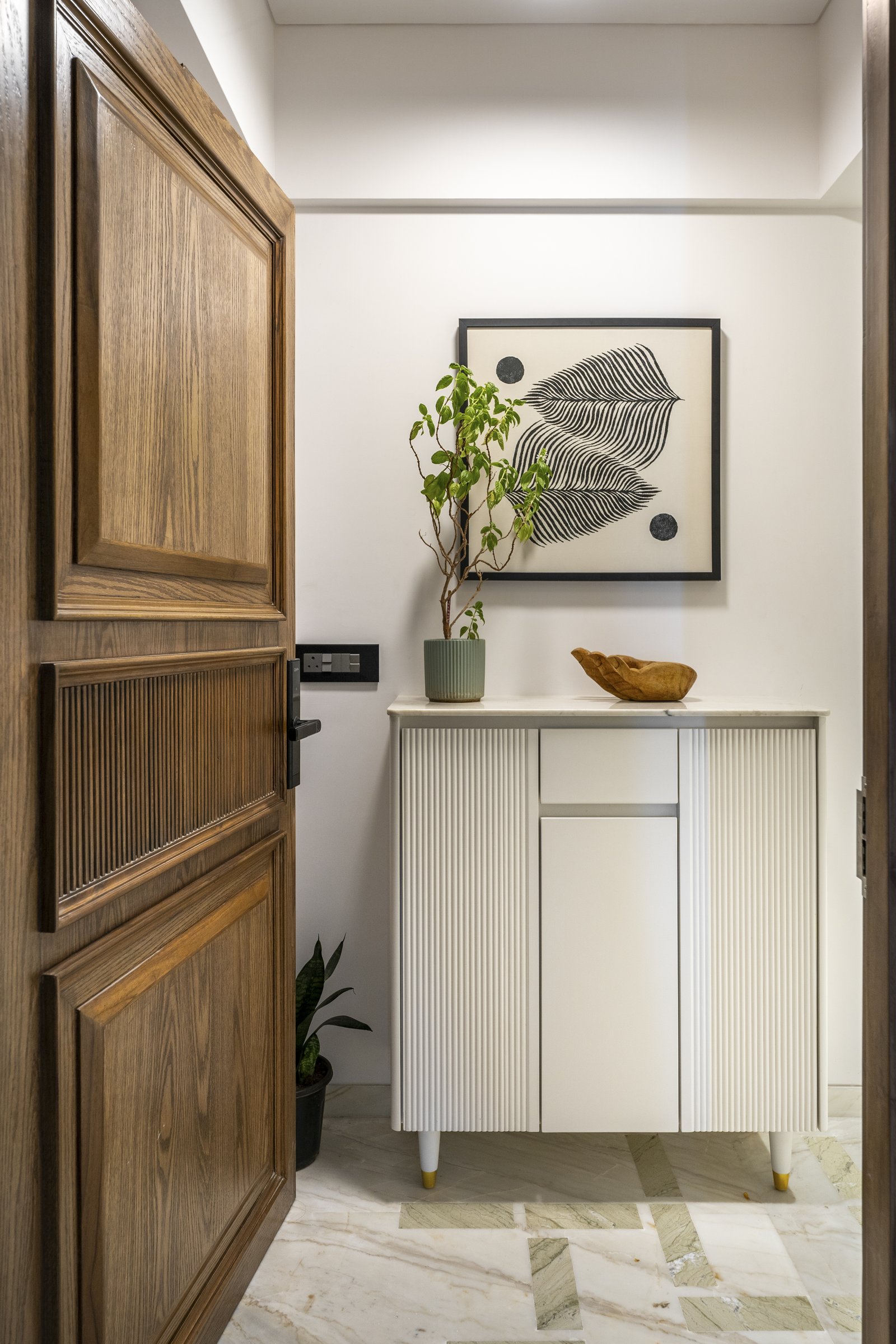
The foyer announces the project’s grammar before a single room is fully seen. A heavy panelled door in dark oak, its central panel detailed in fine reeding, opens onto a slim console in fluted ivory lacquer with brass-tipped tapered legs. Underfoot, a marble inlay weaves green-veined bands into a creamy field, the same green that will later return on the living room’s feature wall.
The living room opens with a deliberate softness. A modular sofa in pale ivory weave is set against a warm ivory plaster wall, its texture so subtle it reads first as light, then as surface. At the centre, sculptural coffee tables with plaster bases and dark glass tops anchor the composition, the gesture quiet but assured.
What anchors the room is the sculptural coffee table in raw, hand-finished plaster, its silhouette closer to a small monument than a piece of furniture. Paired with a wing-backed armchair in grey weave on a slim oak frame, the arrangement argues that comfort and sculpture are not opposing instincts but complementary ones.
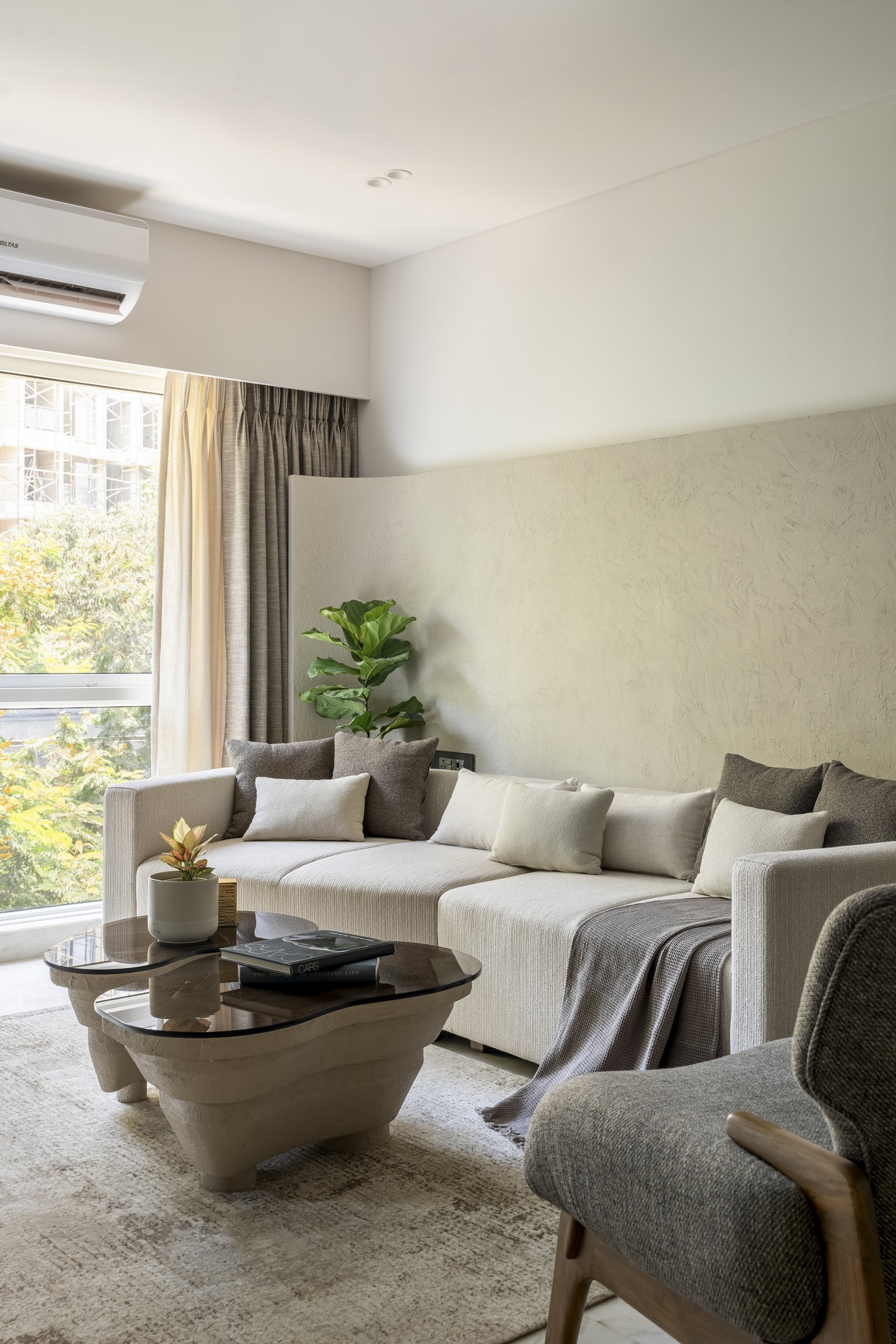
The plaster wall, hand-trowelled into a surface that catches light unevenly, behaves almost like a quiet painting behind the seating.
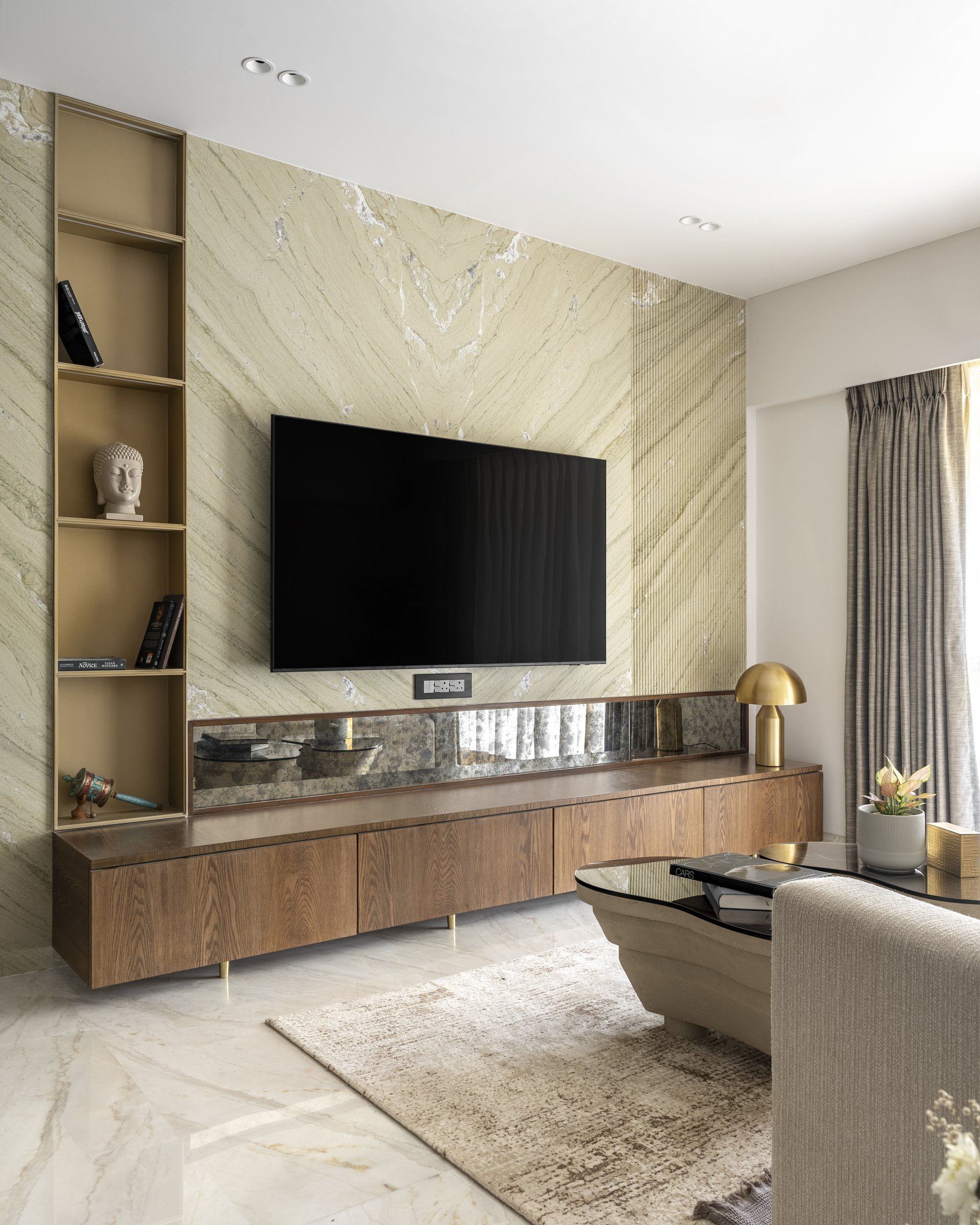
Opposite the seating, the media wall stages the project’s most overt material moment. A panel of cream quartzite with painterly veining, its movement closer to landscape painting than stone, frames the television and connects directly to the inlay underfoot in the foyer.
A long oak credenza floats below on slim brass feet, its surface broken by a band of antiqued mirror that catches the room in soft fragments. A slender open shelving column in muted ochre lacquer, holding a few books and a pale Buddha head, completes the wall without crowding it.
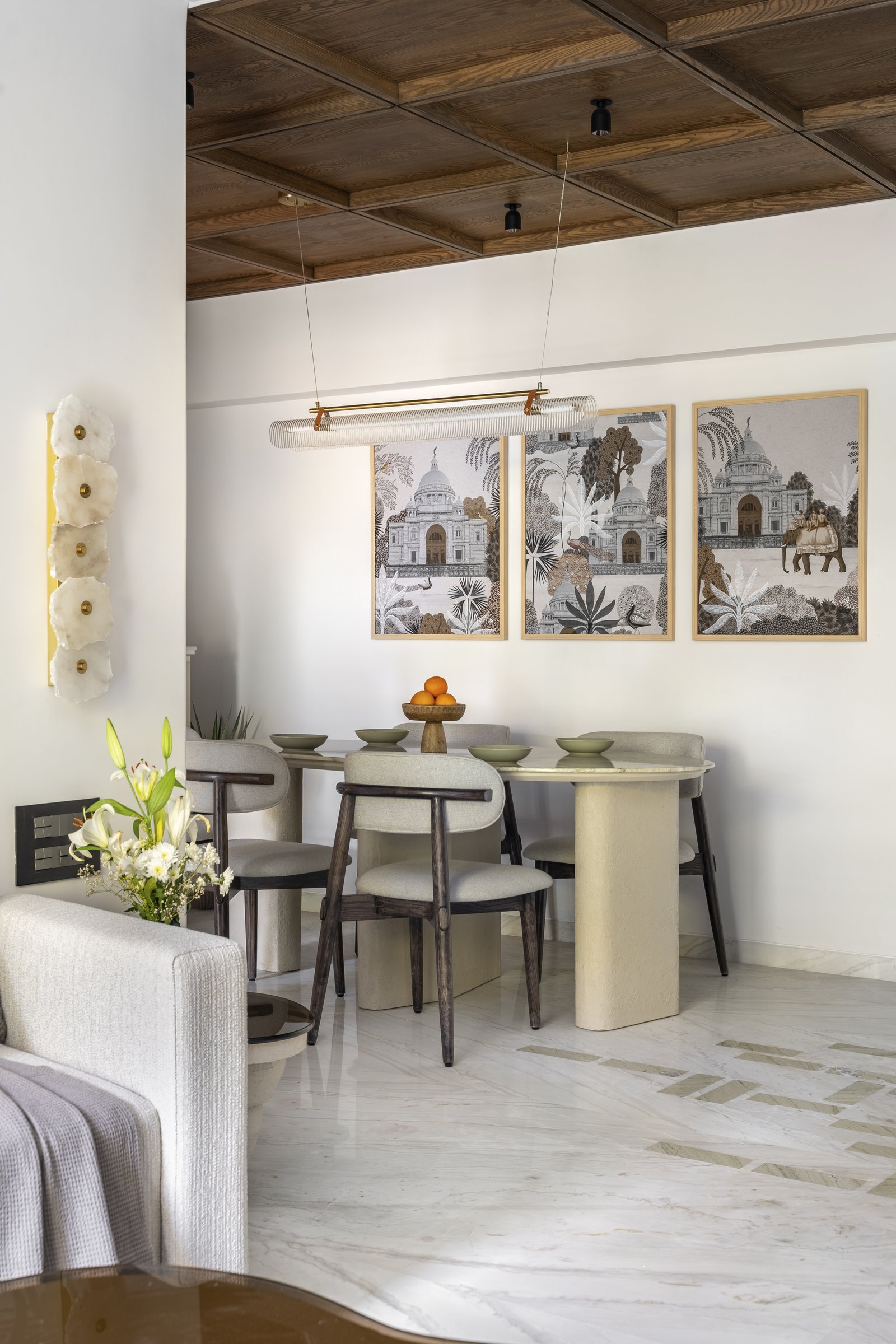
The dining area sits within the same volume but claims its own ceiling. A coffered grid of fumed oak overhead, deep enough to cast its own shadows, lowers the perceived height and gives the table a sense of room-within-a-room.
The dining table itself, with its sculpted plaster pedestals and pale stone top, is paired with chairs in soft ivory weave on dark wooden legs. A triptych of illustrated prints depicting domed pavilions and elephants brings a measured cultural reference to the wall, while an alabaster-and-brass sconce reads as both art object and light source.
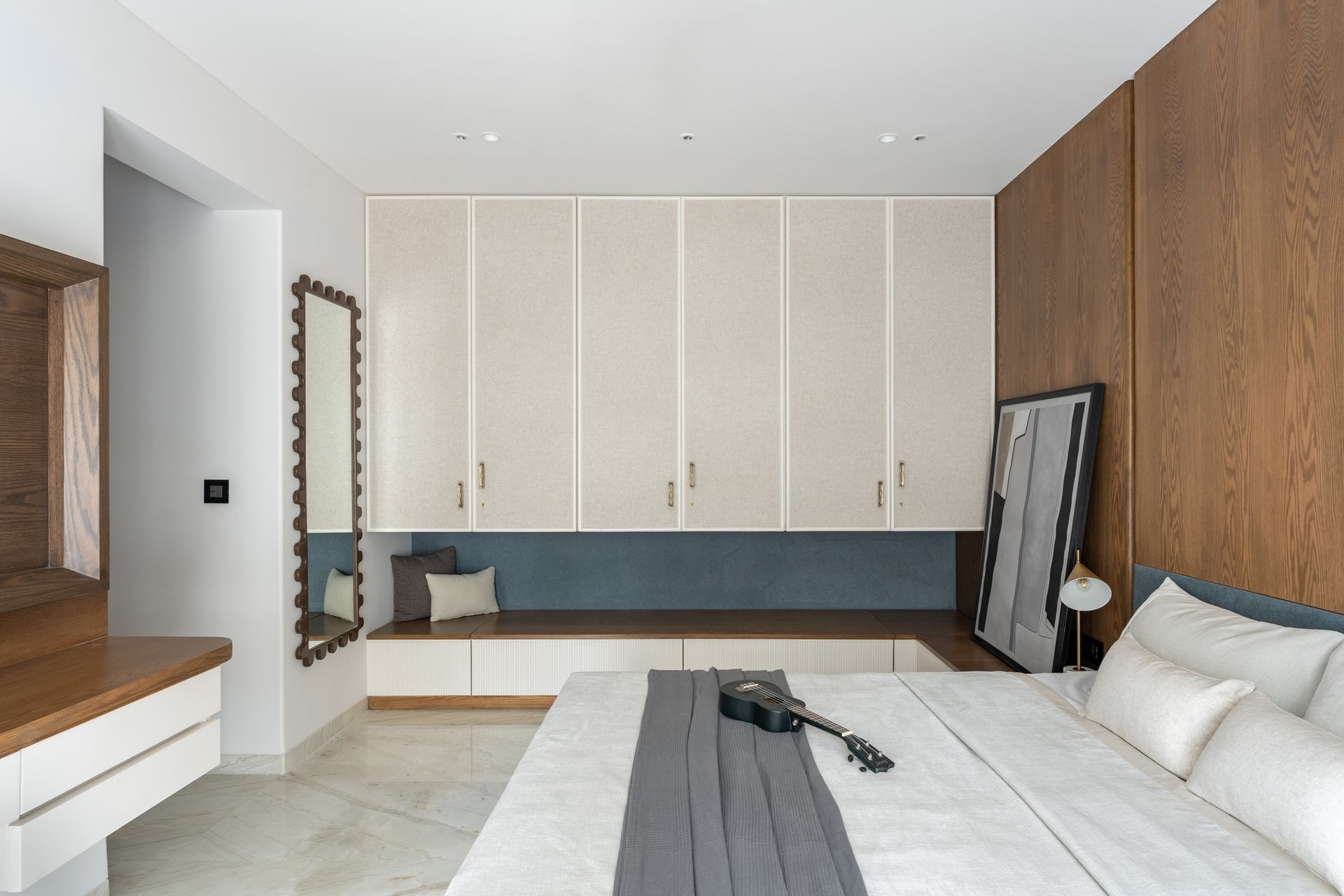
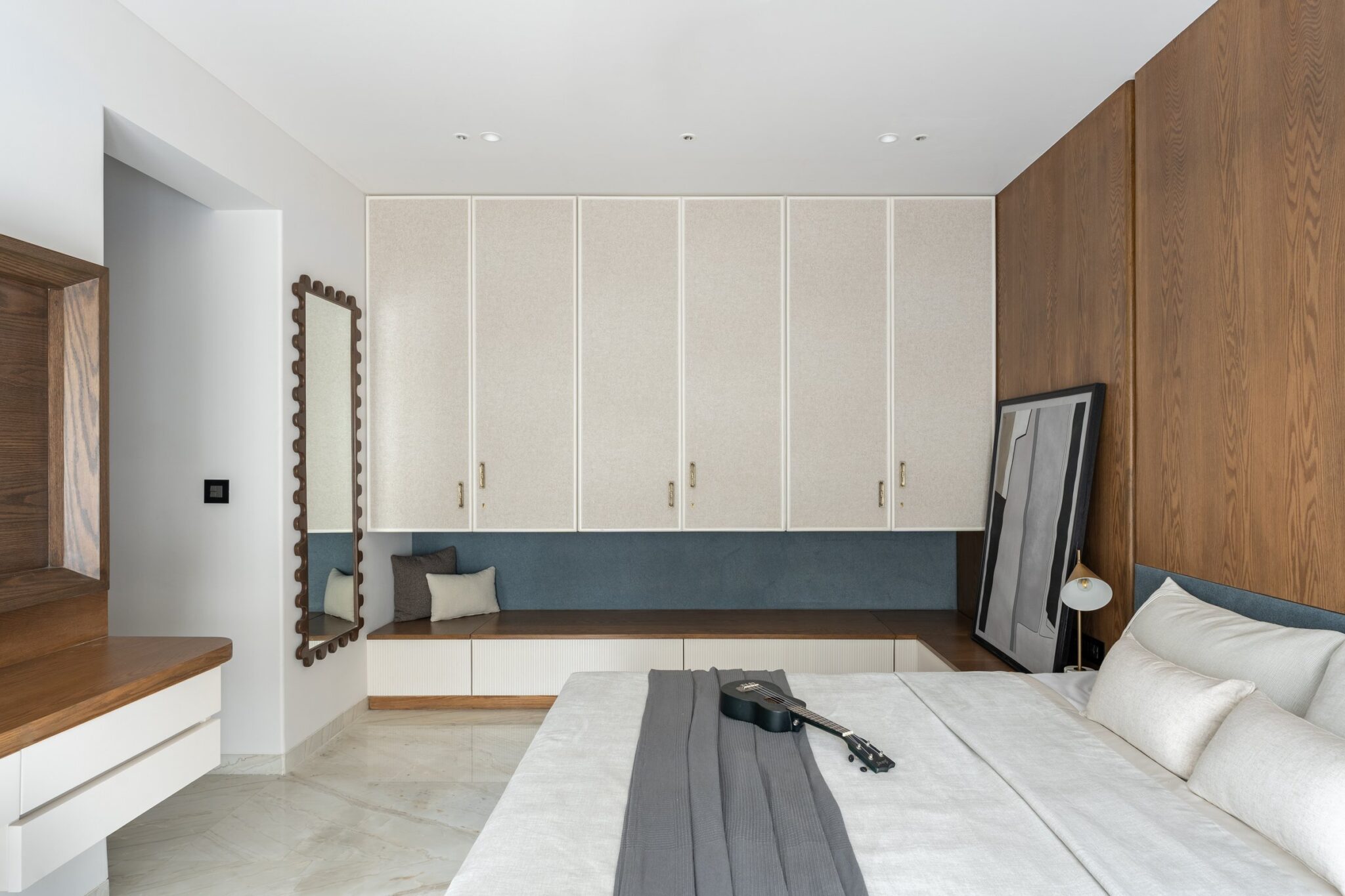
The first bedroom belongs unmistakably to a younger occupant, and the design respects that without resorting to thematic shorthand. A wall of upholstered fawn-toned wardrobes with slim brass pulls fills the longest run, broken at the base by a built-in bench with white drawers set against a teal upholstered wall panel.
A scalloped-edged full-length mirror in dark wood leans against the adjacent wall, its handcrafted frame the room’s single most expressive object. The composition allows for personality without demanding it.
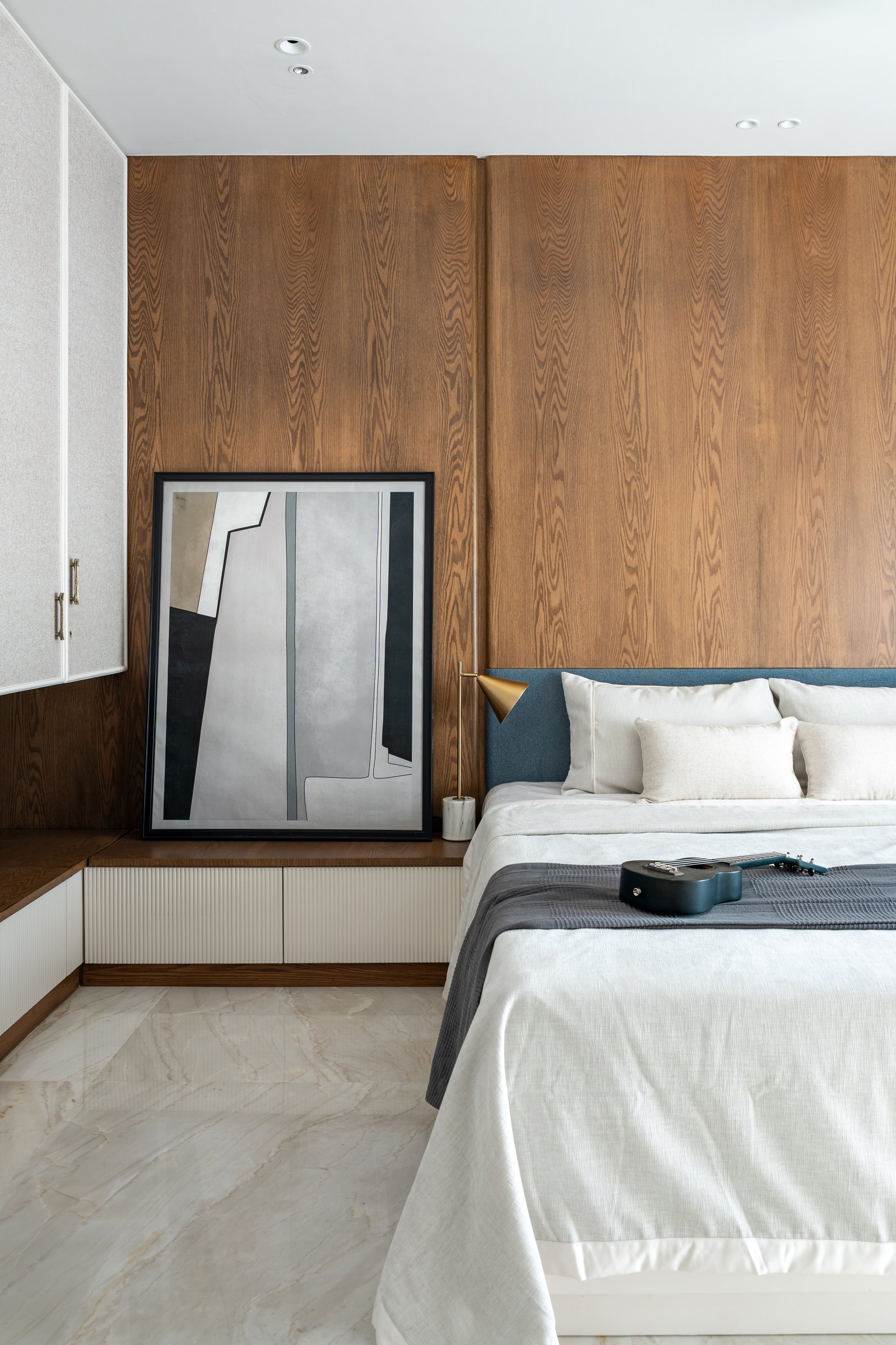
Turning toward the bed, the room’s central decision becomes clear: a full-height wall of warm-grained oak panels, set vertically, anchors the headboard side and absorbs sound and light alike. A teal upholstered headboard sits low against it, the colour drawn directly from the bench across the room.
A large abstract canvas in monochrome leans rather than hangs, propped on the low storage run, an unforced gesture that suggests the room is still being lived into.
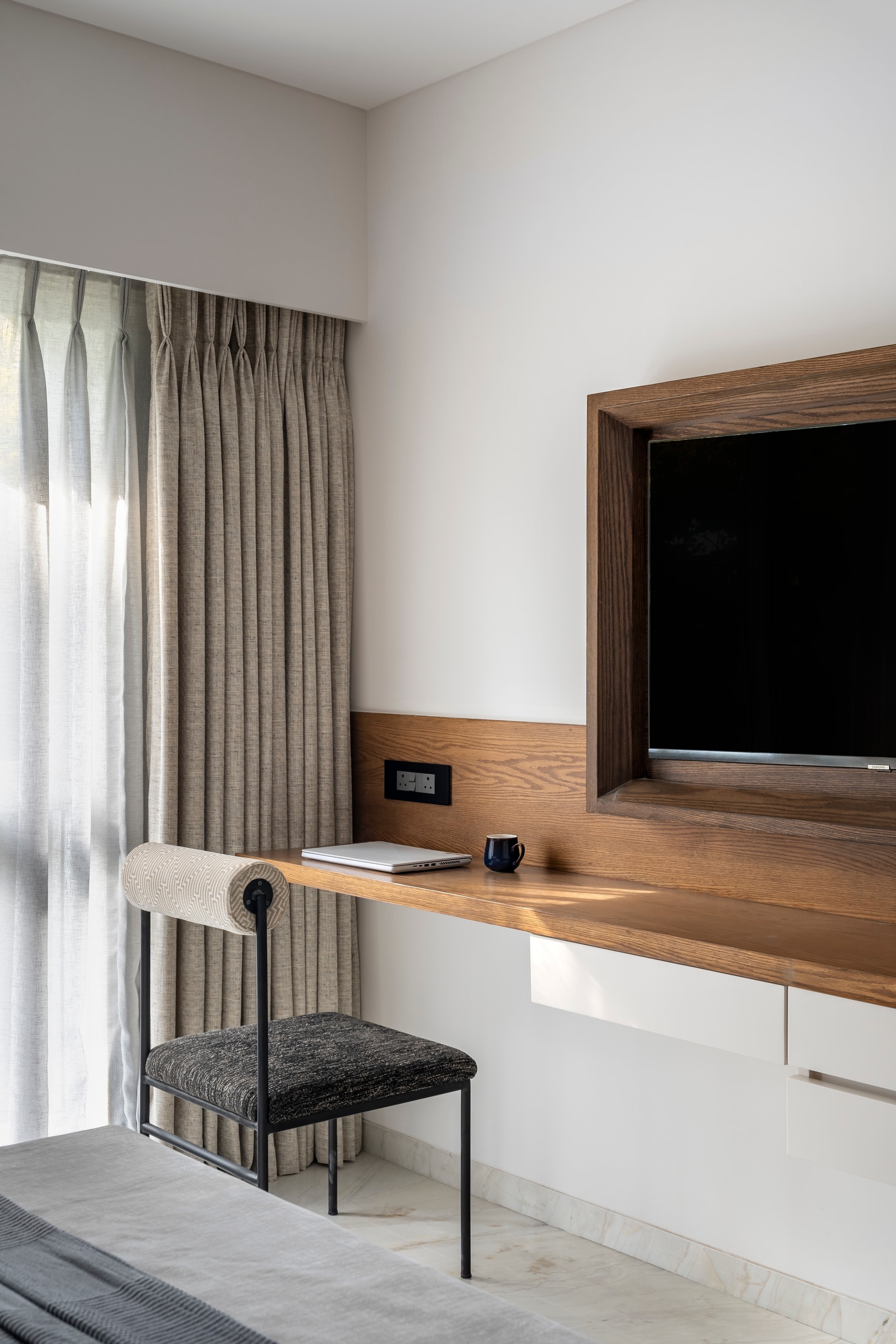
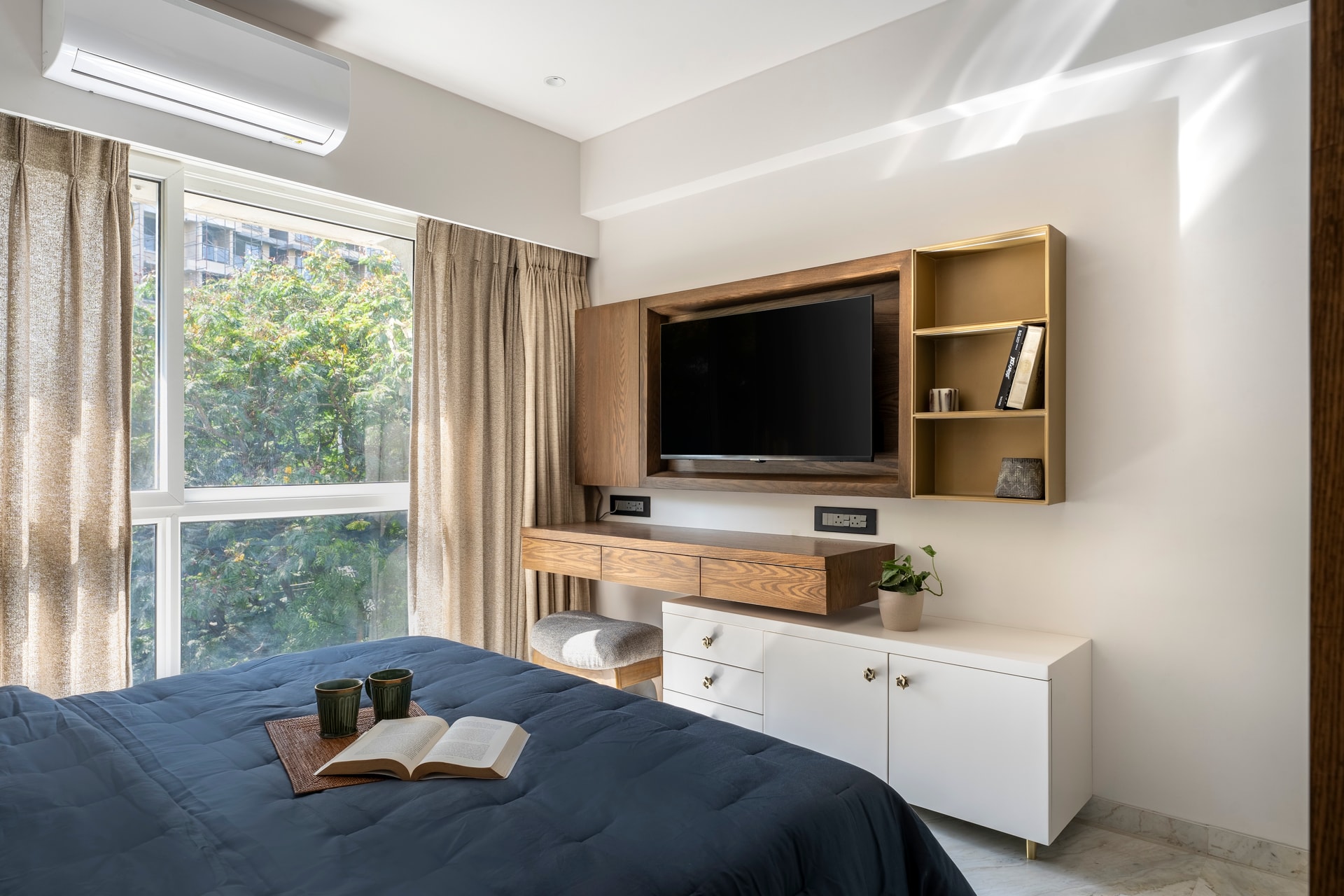
From the wider angle, the bedroom reads as quietly complete. The desk along one side, in the same fumed oak as the panelled wall, doubles as a writing surface and dressing table, its single chair upholstered in charcoal weave.
Floor-to-ceiling sheers temper the daylight without obscuring the green canopy beyond, and the result is a room that holds its inhabitant’s interests, music, drawing, study, without staging any of them.
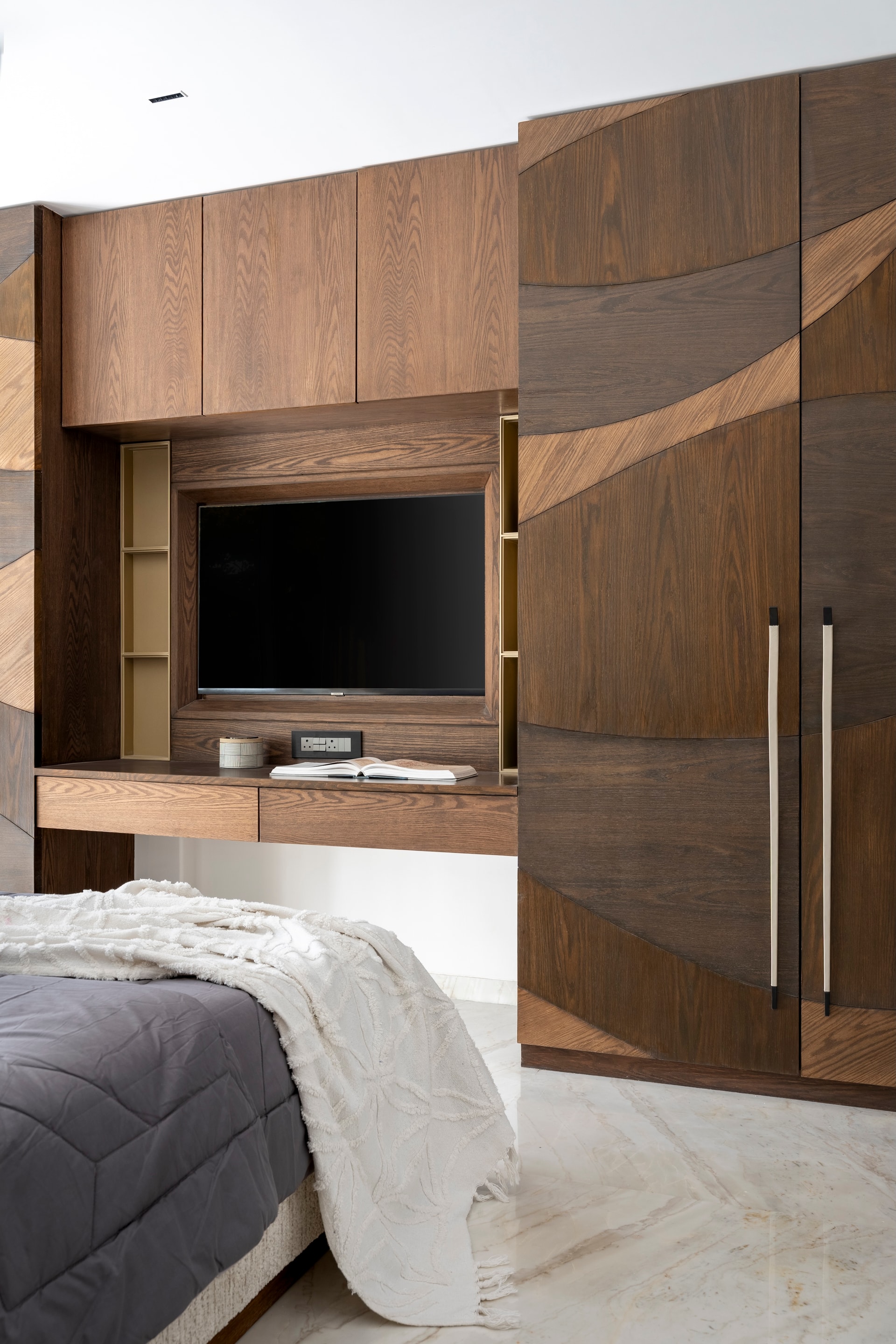
The second bedroom takes the wood vocabulary further and turns it sculptural. The wardrobe wall is a composition of two oak tones, the lighter wood inlaid into the darker in long, curved sweeps that read almost as topography.
A built-in writing desk, integrated into the same run, slides beneath a wall-mounted screen, and a small brass-lined open niche provides the only break in the geometry. The room makes a point of treating storage not as concealment but as the room’s defining surface.
The detail of the joinery rewards the close look. The curved inlays meet across the wardrobe doors with the precision of marquetry, while slim leather-and-metal handles run nearly the full height of each panel.
““We wanted every room in this home to feel as though it had been built around the person who would use it, not the other way around.””
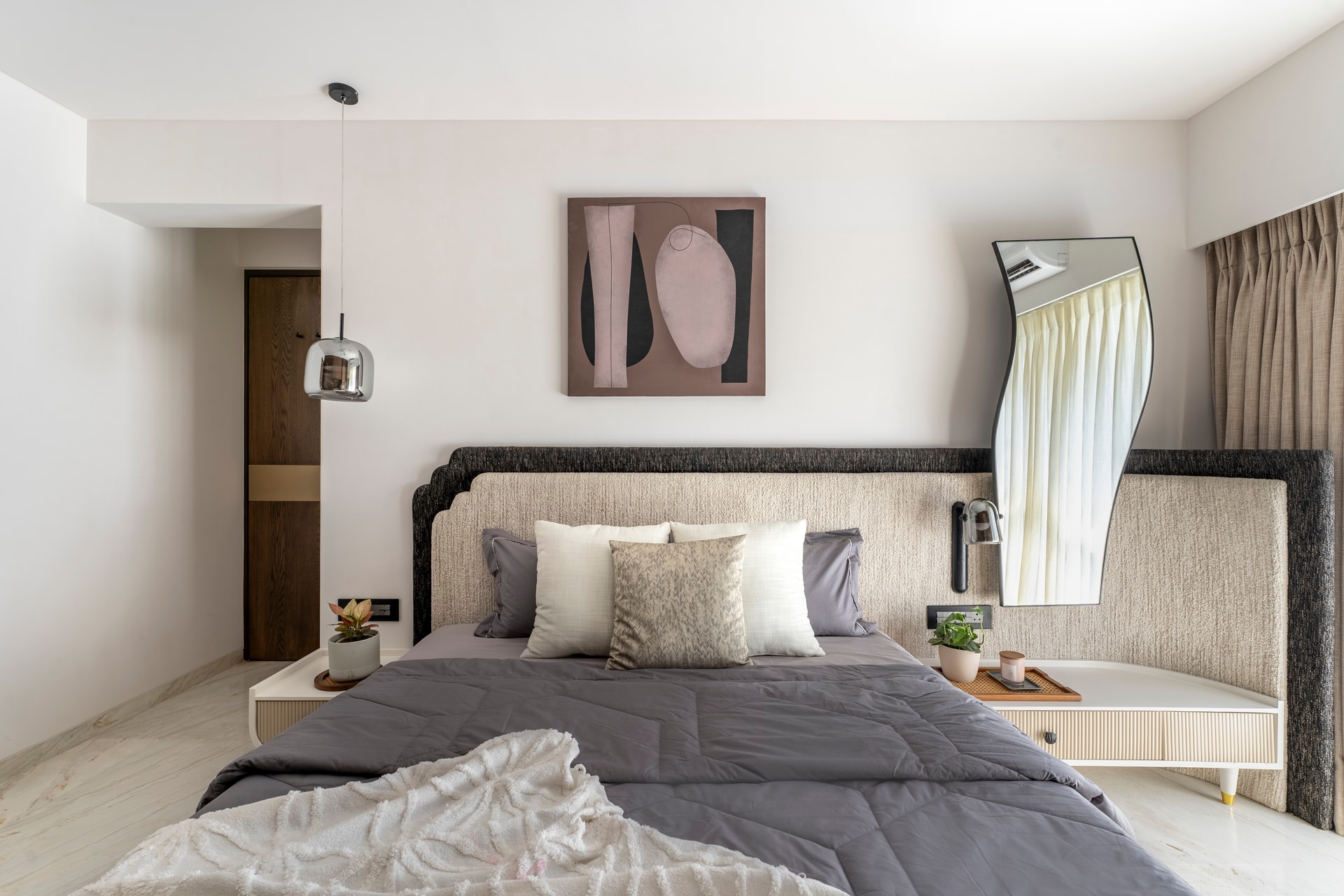
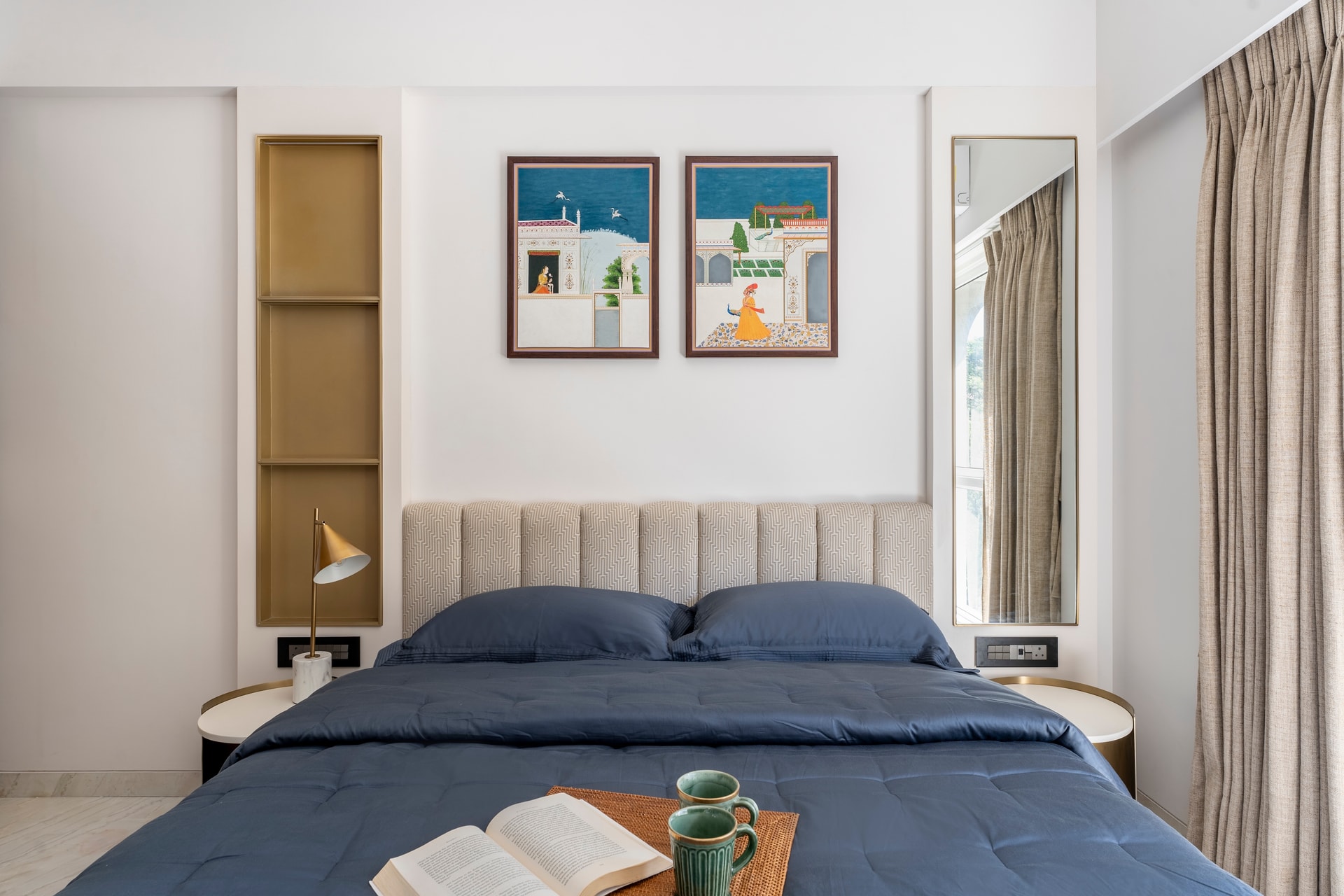
The third bedroom shifts register entirely. White walls, a channel-tufted upholstered headboard in a small geometric weave, and a pair of miniature paintings in the Pichwai tradition, framed in dark wood, give the room a more classical, almost gallery-like calm.
Brass-lined niches flank the bed on one side; a slim brass-framed mirror balances them on the other. A deep navy bedspread provides the colour anchor that the rest of the room is content to orbit.
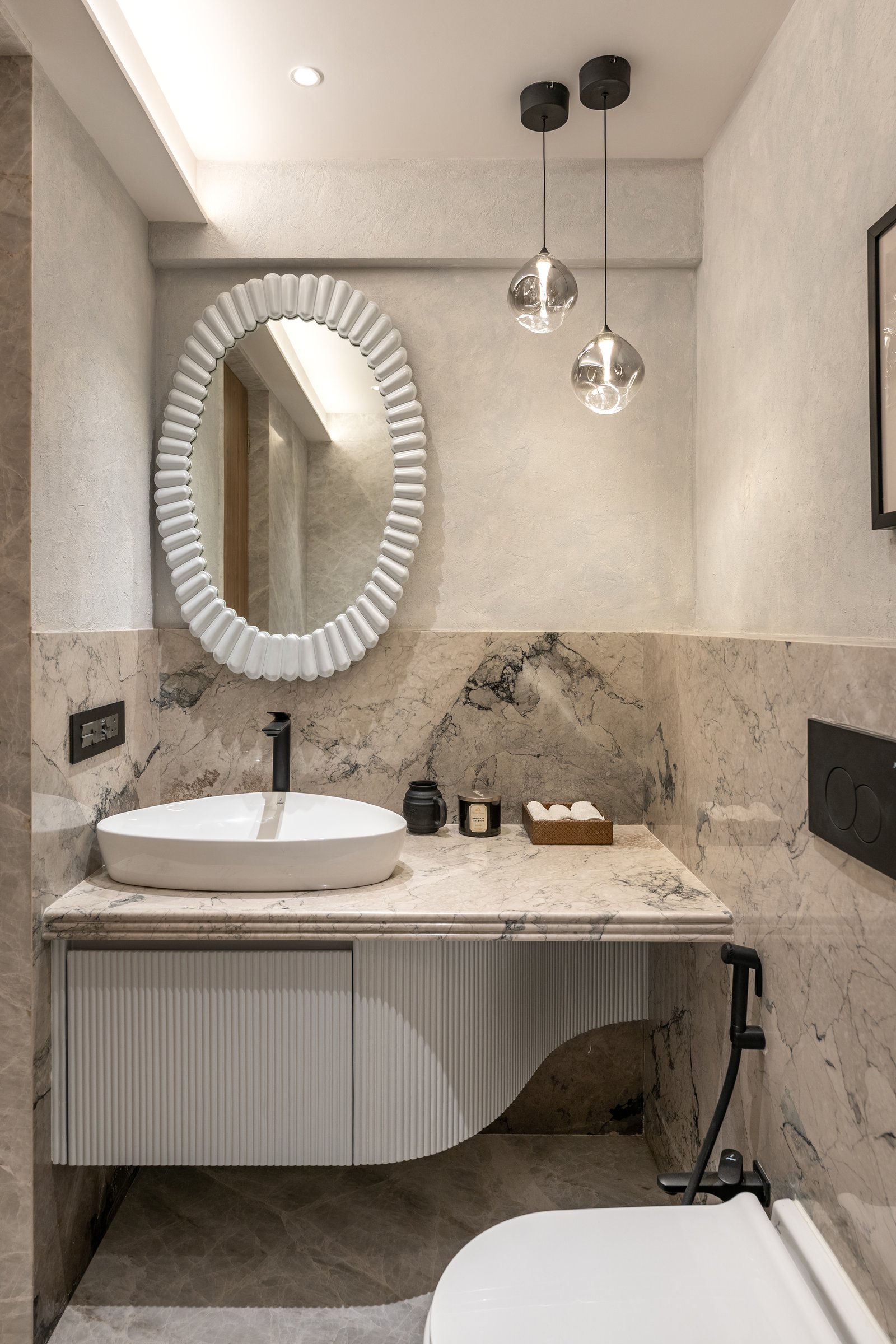
The powder room compresses the home’s confidence into a tight footprint. A scalloped oval mirror in white ceramic-like ribbing hangs above a counter in dramatically veined stone, its grey veining across a creamy ground far more expressive than the room’s scale would seem to permit.
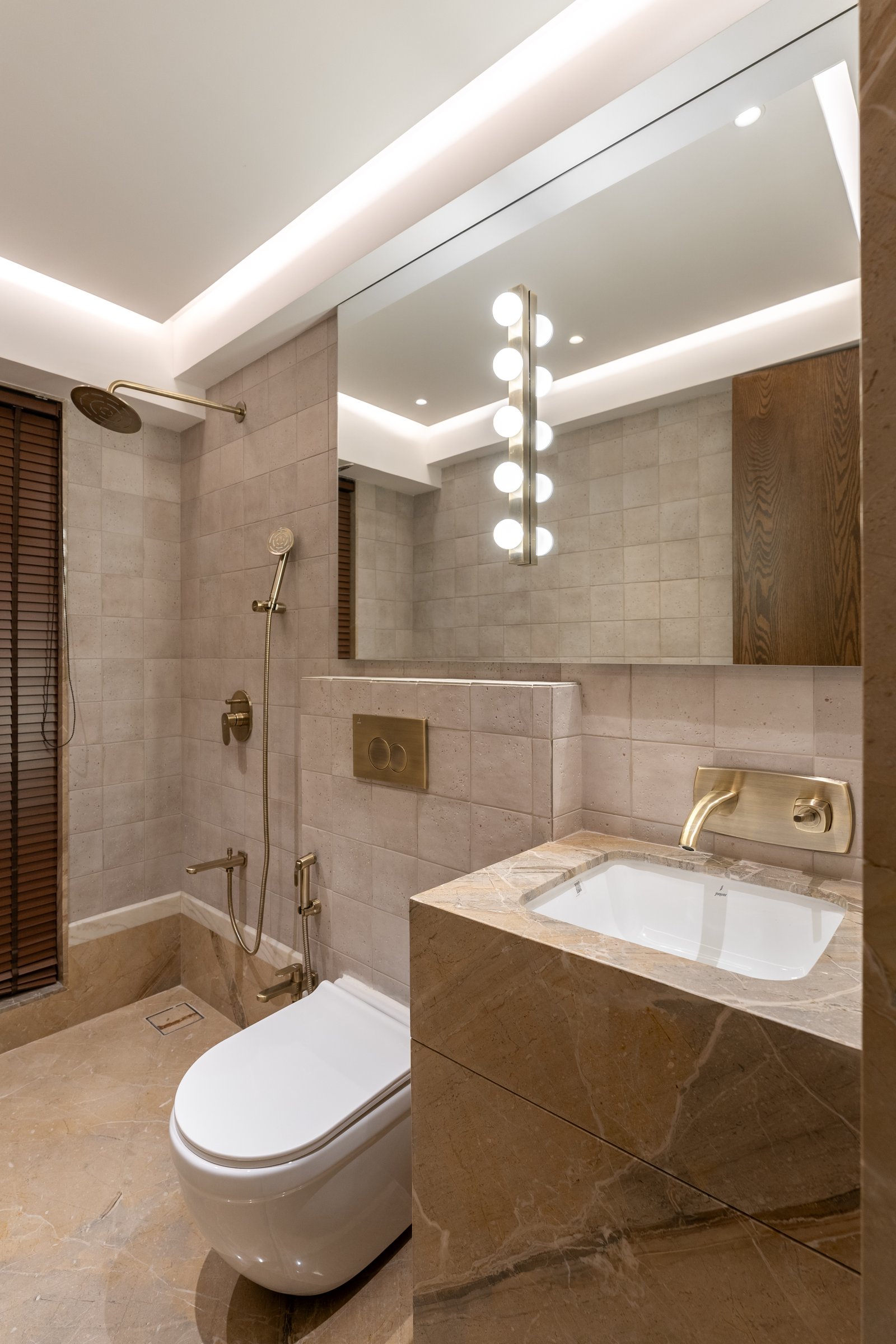
One of the bathrooms takes a warmer route, lined in honey-toned stone tiles with the soft variation of travertine, set against a contrasting brown marble vanity that grounds the room. Antique brass fittings, a wall-mounted shower arm, a tap, a large mirror flanked by vanity bulbs, run consistently across the room and lend it a cohesion that bathrooms in apartments often lack.
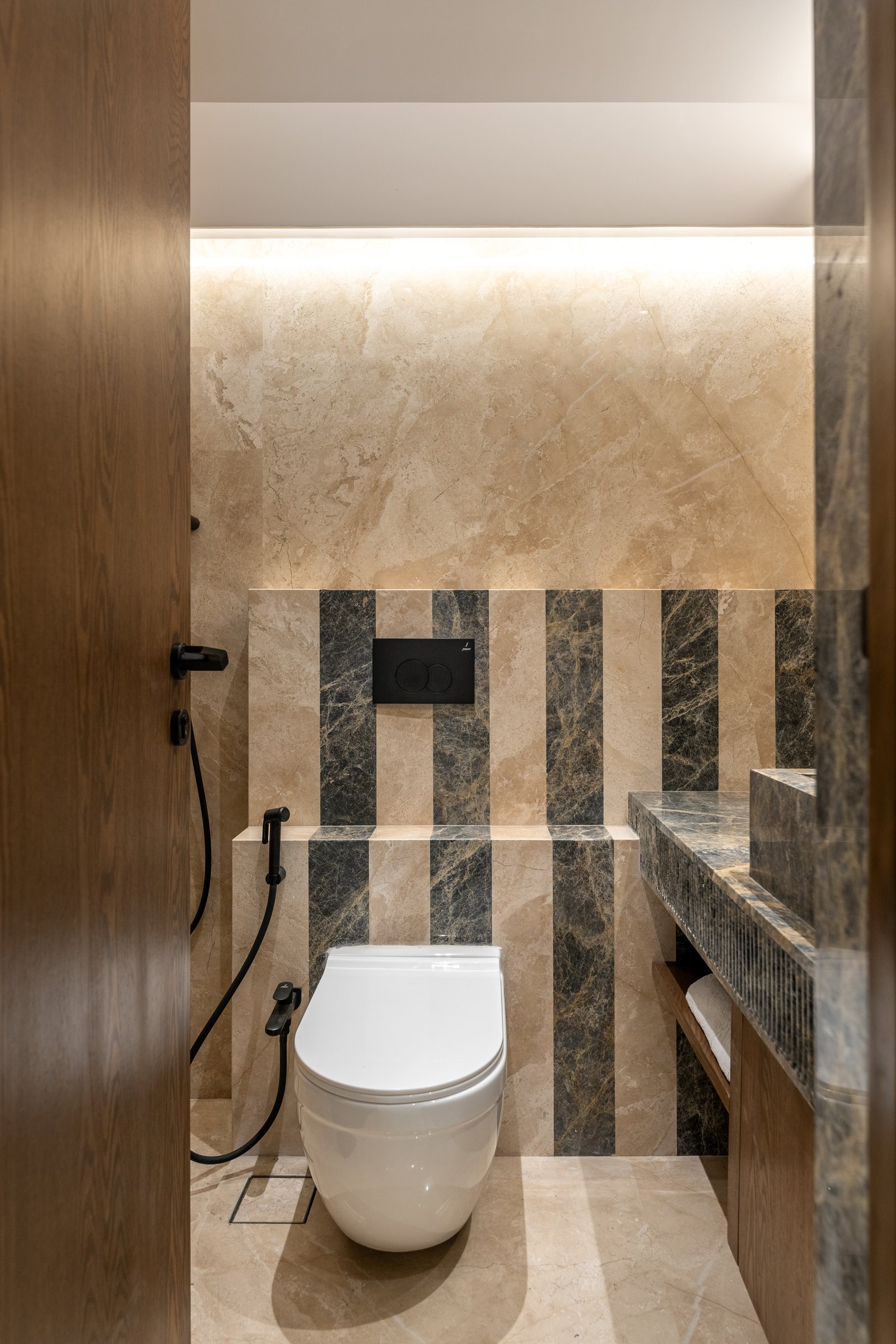
A second bathroom turns the temperature down and the drama up. Striped panels of dark green-grey marble and warm beige stone alternate in deliberate vertical bands behind the wall-hung WC, the pattern recalling the wider home’s interest in green stone but reinterpreting it as graphic rhythm.
What Verde Residence offers, finally, is a contemporary Mumbai apartment that is neither minimalist nor maximalist but composed. It belongs to a generation of Indian residential interiors that have moved past the easy shorthand of imported palettes and toward a more confident, locally inflected restraint, one in which stone, wood, and craft are deployed not to signal taste but to support life.
The achievement here is one of register. The studio holds a single material conversation across nearly twenty distinct moments without repetition or fatigue, and the home that results is one that should age slowly, intelligently, and with the kind of warmth that does not need to be explained.