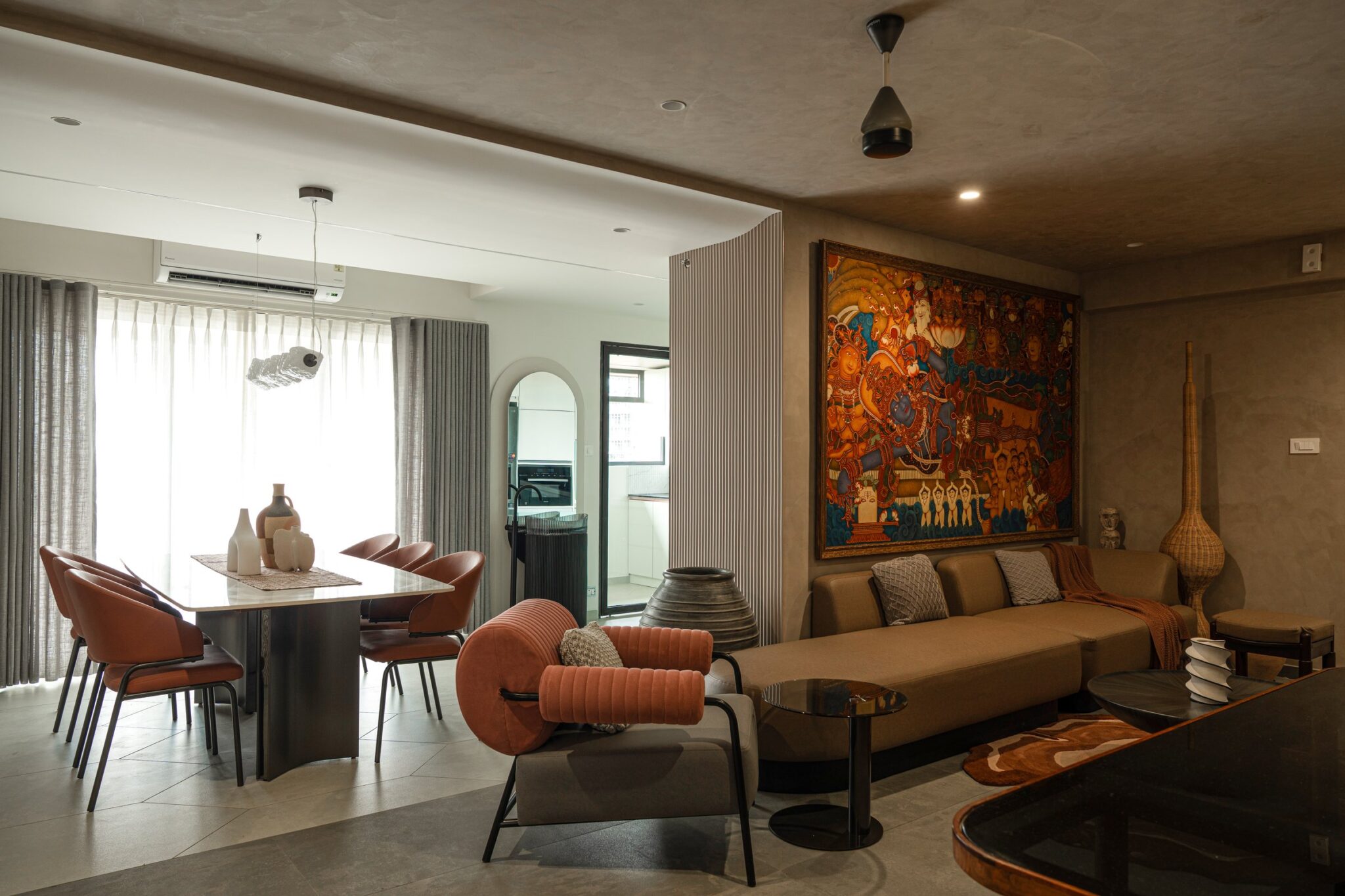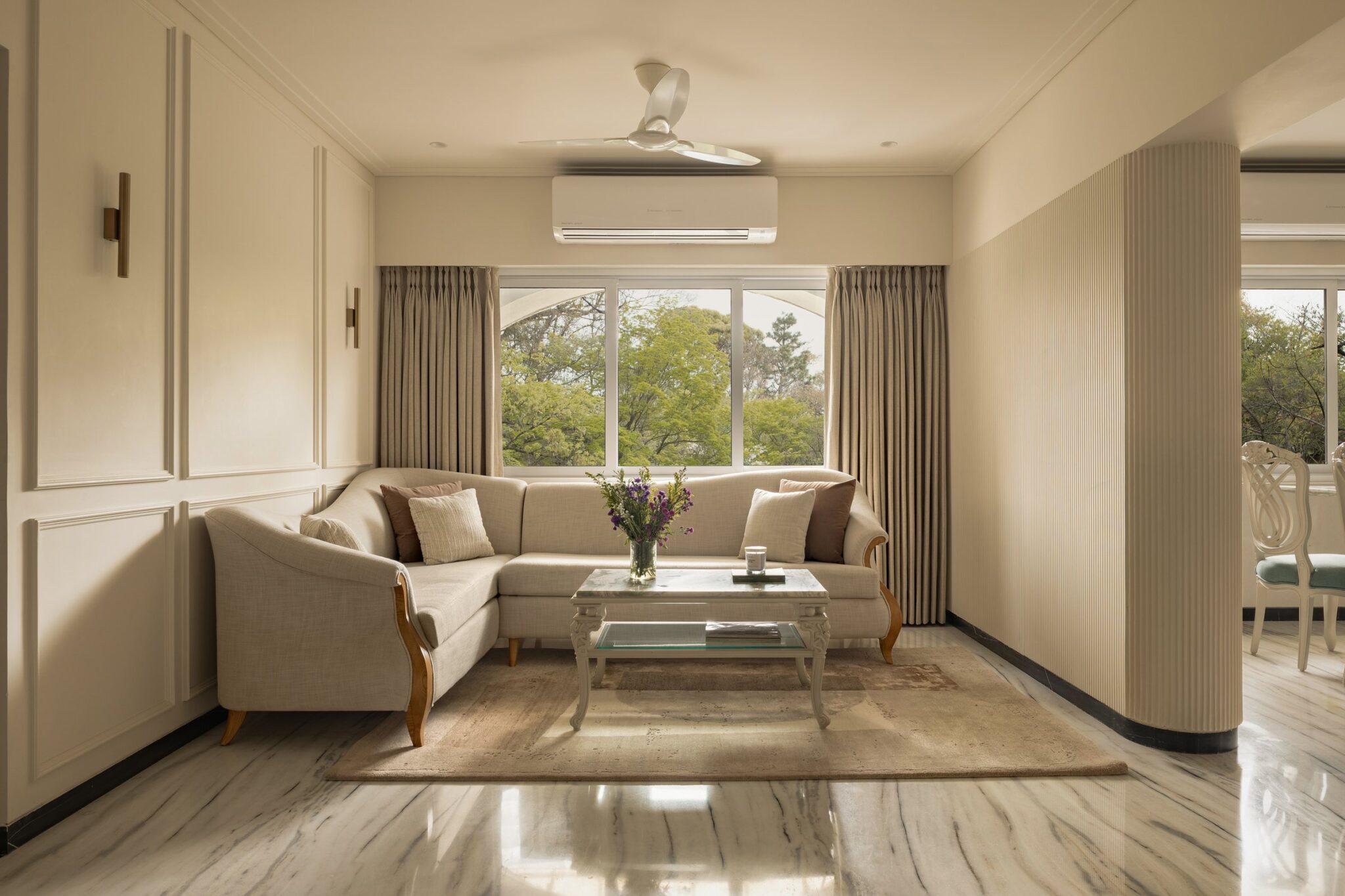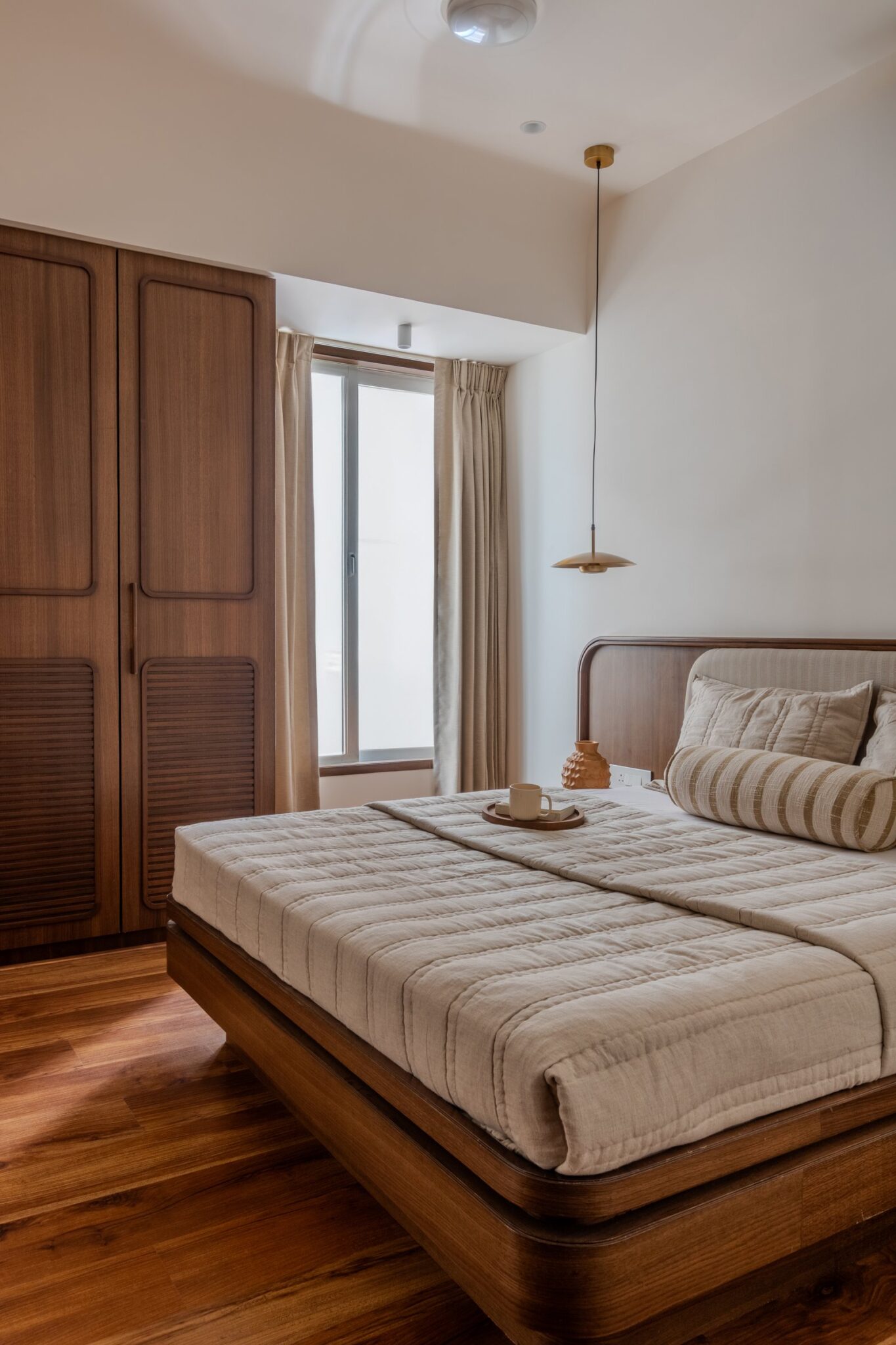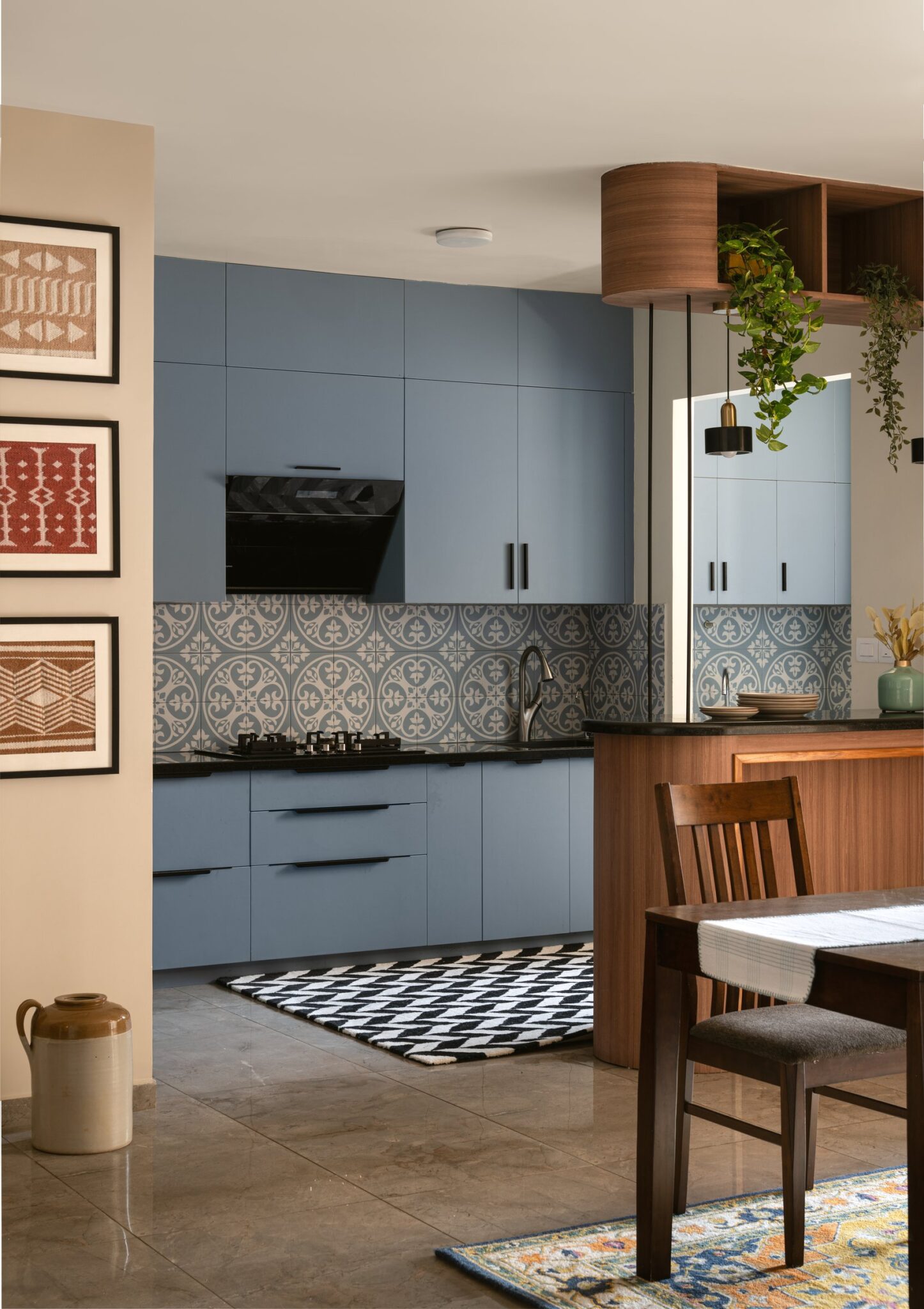
There is a quiet tyranny in the contemporary Indian apartment – a reflexive reach for beige, oak, and sunlit neutrals that feels safe precisely because it has been seen so many times before. The House of Blue Leaves resists that instinct with the calm of a project that has thought the question through. Here, colour is not arranged by temperature, and contrast is treated as conversation rather than collision.
Designed by By the Riverside, the studio led by Swati Seraan, this 1,800-square-foot Bangalore home was conceived for a busy modern couple who wanted a space that felt instinctive rather than composed. Muted blues, mauve undertones, and gentle greens sit beside warm beiges and softened blushes, and what could have read as indecision instead reads as a kind of unhurried confidence. The House of Blue Leaves is, finally, an apartment that argues for the pleasure of the unexpected when handled with restraint.
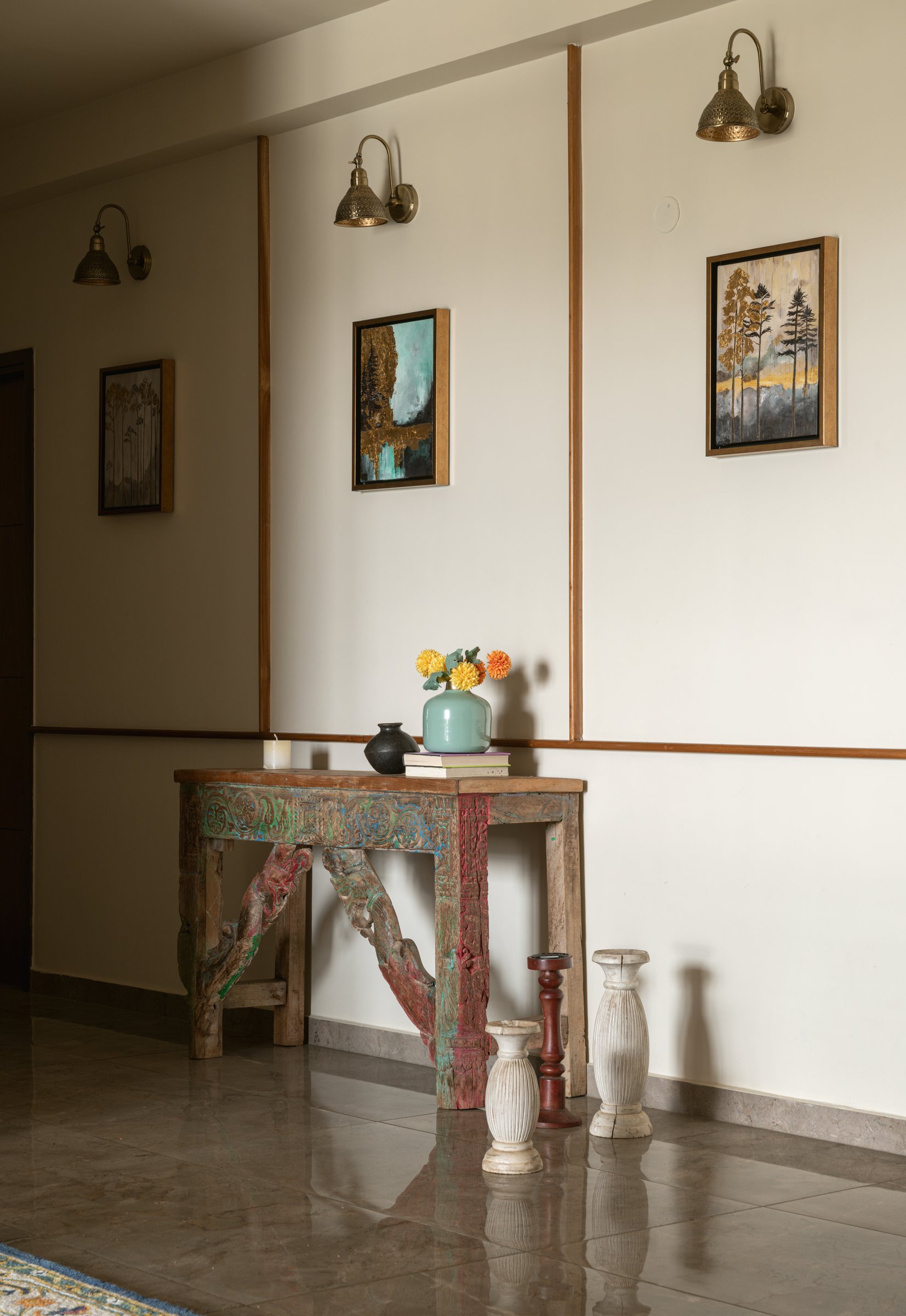
The arrival sets the home’s grammar before any room is fully entered. A reclaimed wooden console, its original blue and red pigments still surfacing through the grain, stands against cream-toned wall paneling edged in slim wooden trim. The hammered brass wall sconces and small framed landscapes do not attempt to match; they hold their own register, and the space gathers itself around their differences.
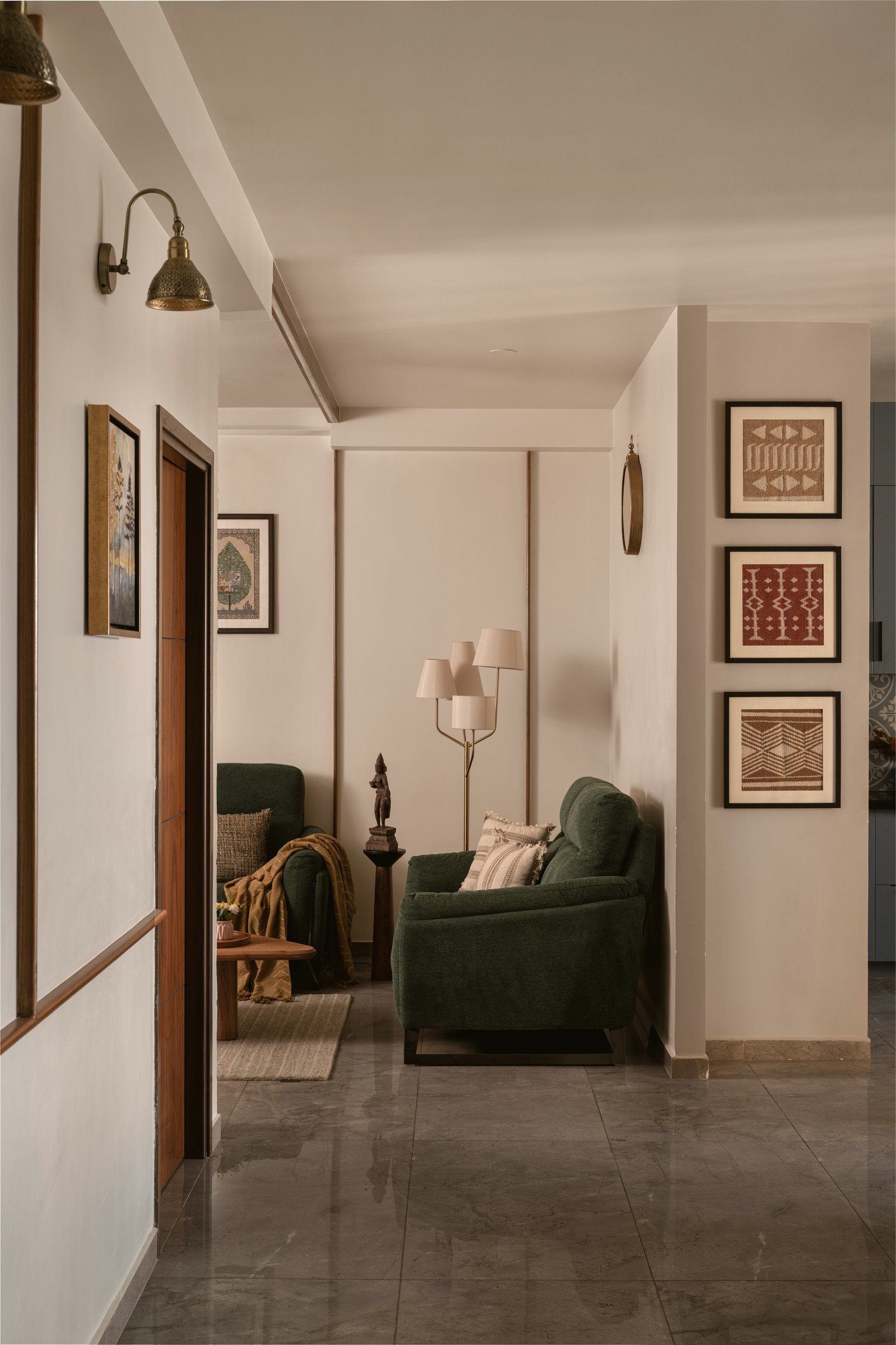
From the foyer, a glimpse opens into the living area, where a polished stone floor carries the light forward and a triptych of woven-textile artworks anchors the threshold wall. The corridor refuses the temptation to be merely transitional. It is curated, but lightly, the way a thoughtful host might set a table without explanation.
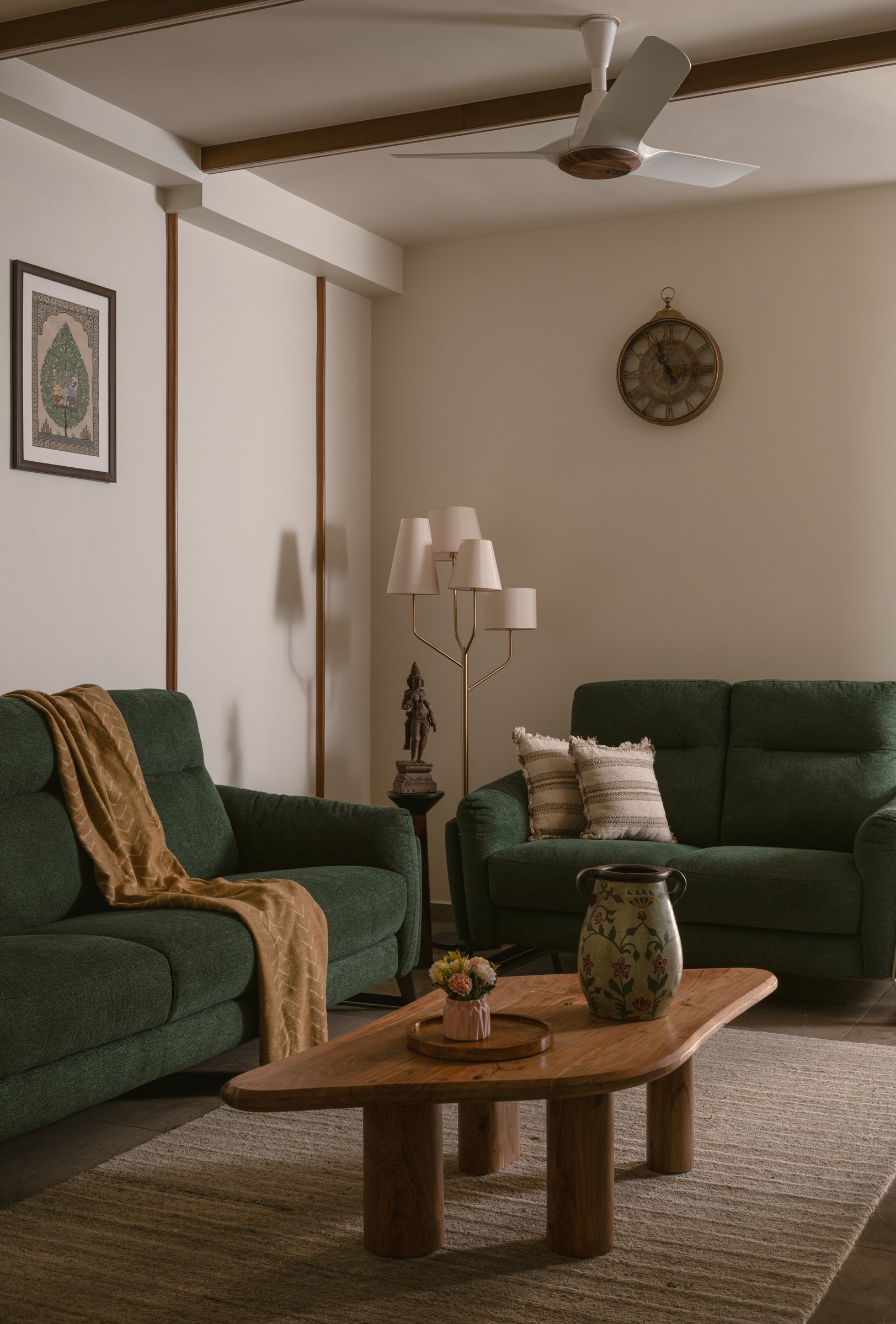
The living room is anchored by deep forest green sofas against soft cream walls, a colour decision that immediately distinguishes the home from its softer-toned peers. Two sofas in a muted green chenille face each other across an organic-edged wooden coffee table, and a brass-stemmed floor lamp with five staggered shades stands beside a small bronze figurine on its own pedestal. The room feels calm without being quiet.
““Cool and warm tones coexist without hierarchy, creating a composition that feels both composed and quietly unexpected.””
What gives the room its character is the relationship between the slim wooden ceiling beams overhead and the vertical wooden batten lines that run down the walls behind the seating. The geometry is subtle, almost incidental, but it organises everything beneath it. A small Pichwai-style framed work hangs at one side of the seating arrangement, less a focal point than a participant in a longer rhythm.
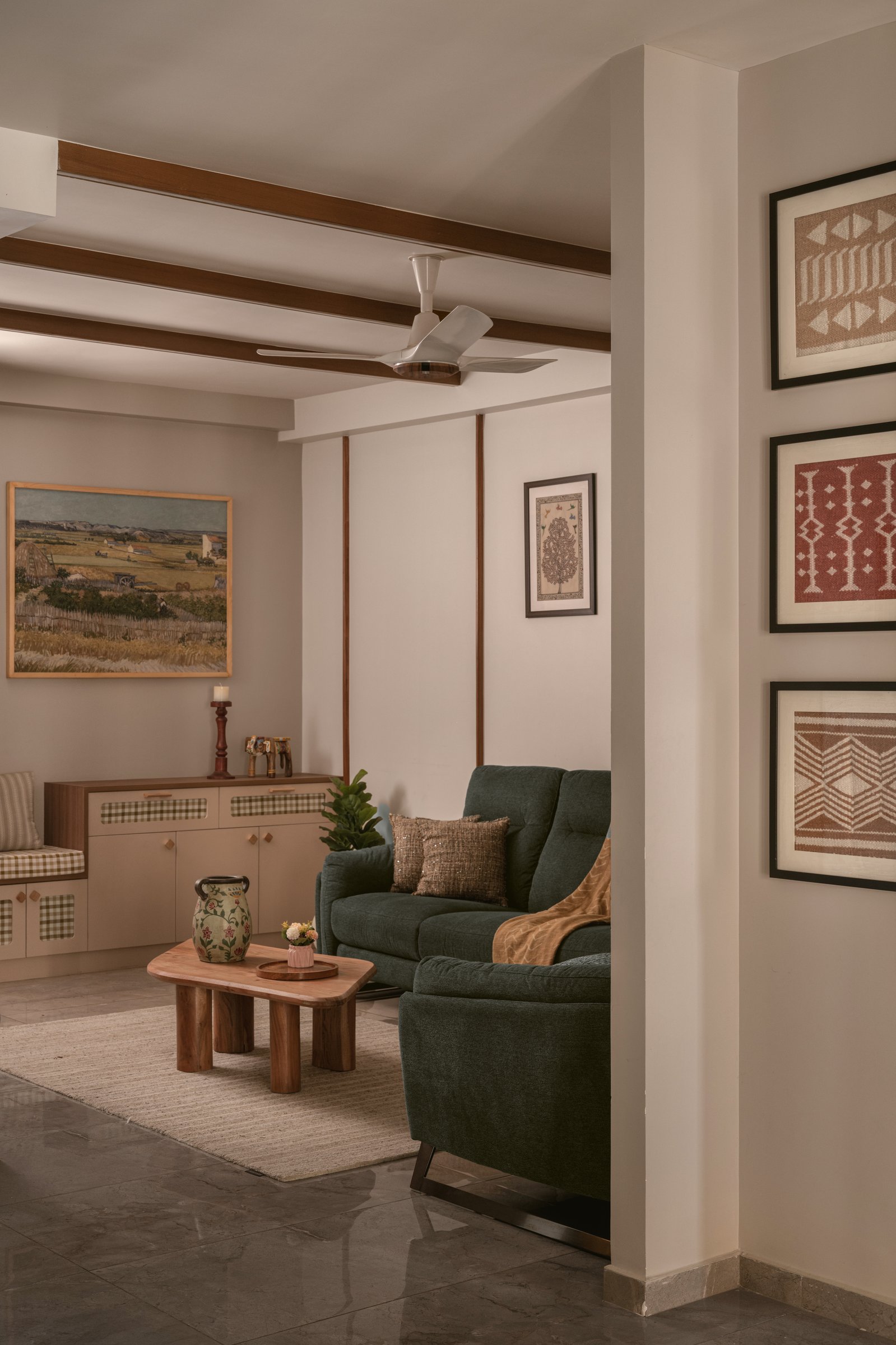
Turning further into the room, a low storage console in wood-toned with green gingham inset panels runs along one wall, finished with small wooden diamond pulls. A reproduction of a Van Gogh harvest landscape hangs on the adjacent wall, and to the right a tight gallery wall of three framed kilim-inspired graphics in earthen tones extends the room’s vocabulary into the adjacent passage. The composition holds beige, green, ochre, and a quiet rust without any one tone dominating.
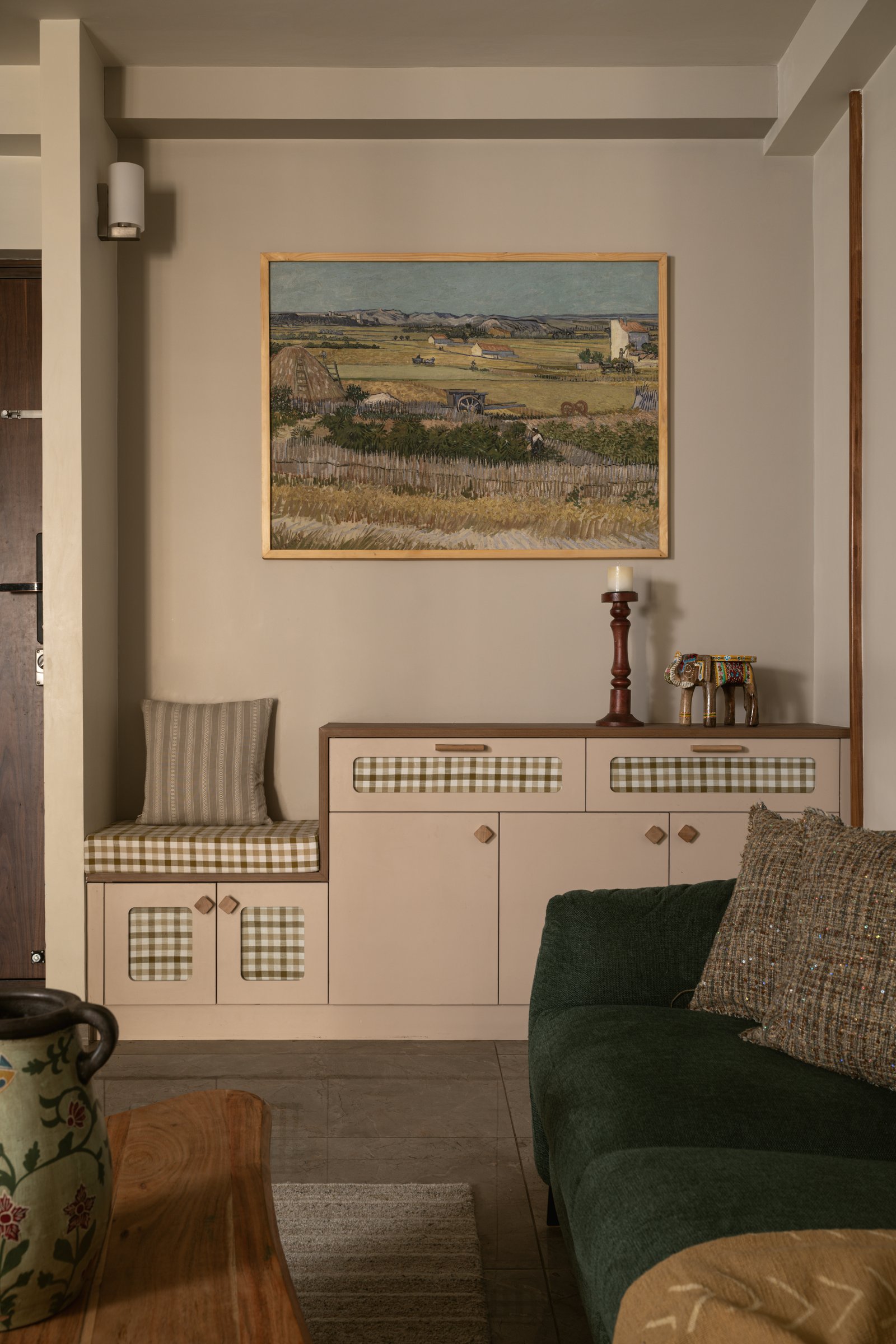
The same wall, seen closer, reveals a built-in bench seat slipped into the storage line, cushioned in the same gingham. It is a small editorial decision with significant spatial consequence. A modest apartment gains a place to pause, to read, to wait for someone, and the room admits another kind of use without expanding by an inch.
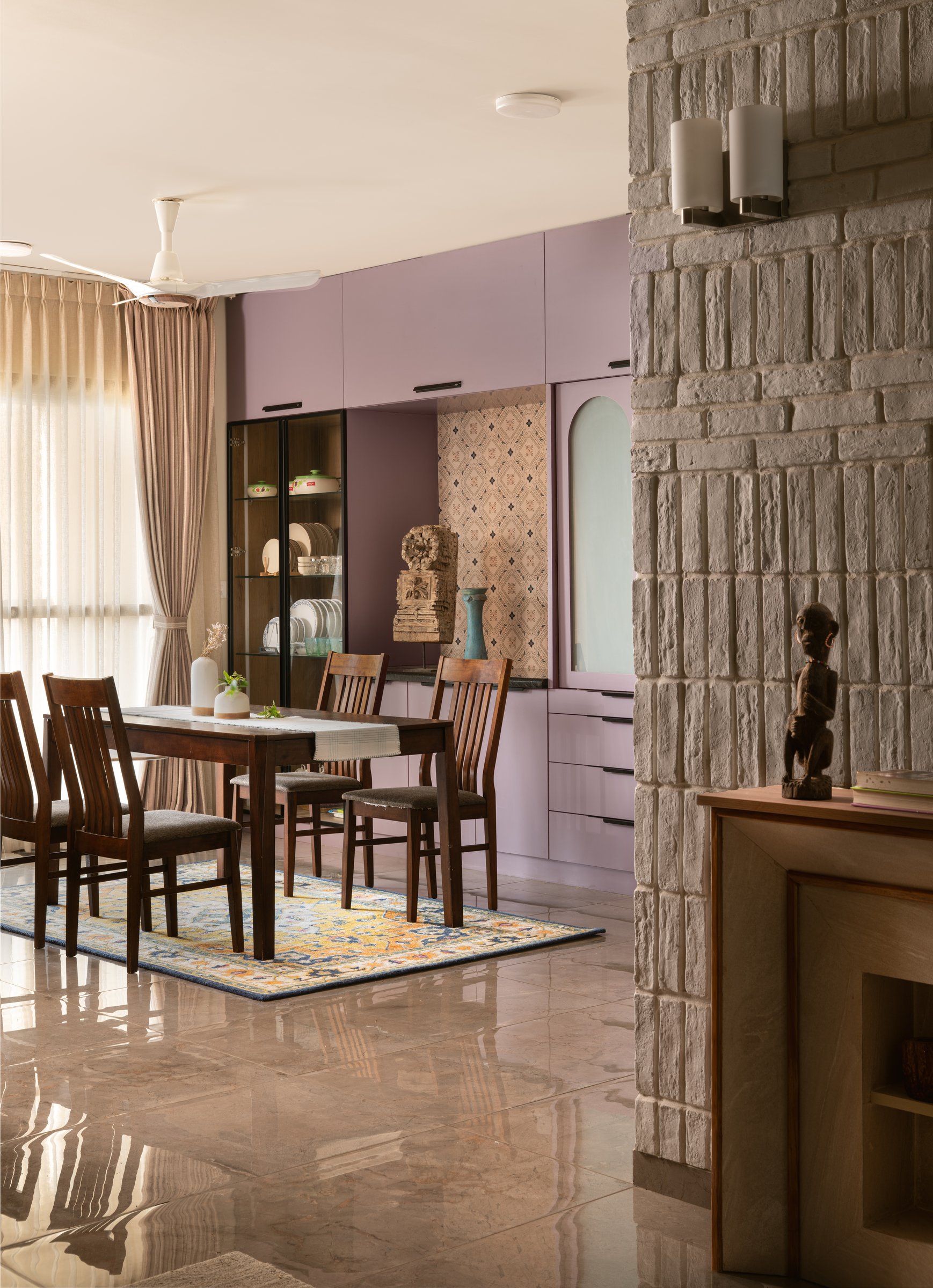
The dining area introduces the home’s most unexpected gesture: a tall storage and crockery wall in pale mauve, its glass-fronted cabinet revealing layered ceramics and a patterned tile inset that acts as a quiet centrepiece. To one side, a textured masonry wall in pale grey holds a small carved figurine on a low wood console, while a Persian-influenced rug in saffron and indigo grounds the dark wood dining table. The mauve is courageous; the room earns it by surrounding it with restraint.
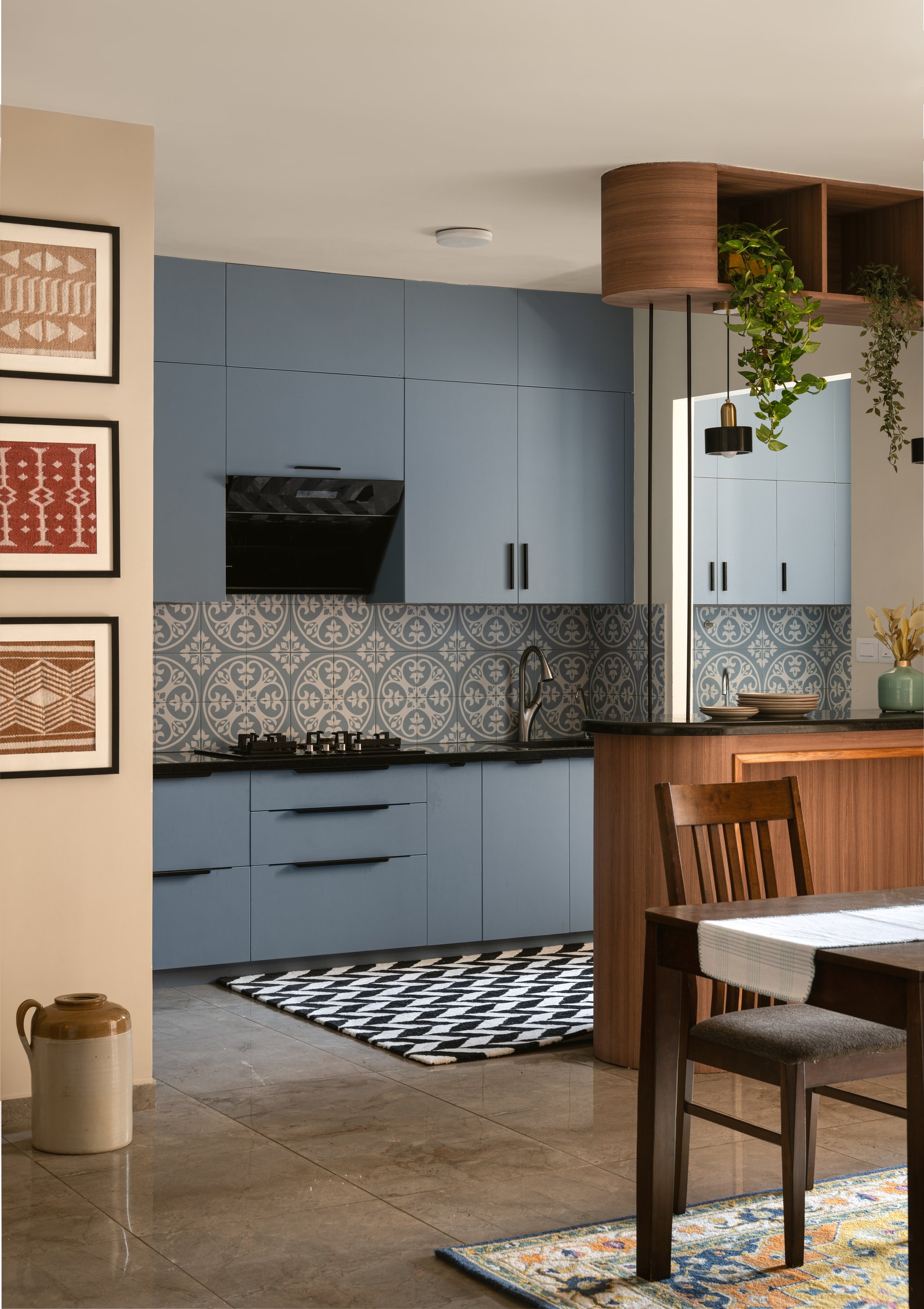
Beyond the dining table, the kitchen reveals itself in dusty blue, framed by a curved wooden breakfast counter that softens the architectural edge between the two zones. The patterned cement-tile backsplash, drawn in the same blue family, ties the cabinetry to the floor without insisting on it. The visible gallery of textile artworks on the partition wall keeps the dining area in conversation with the kitchen rather than walling it off.
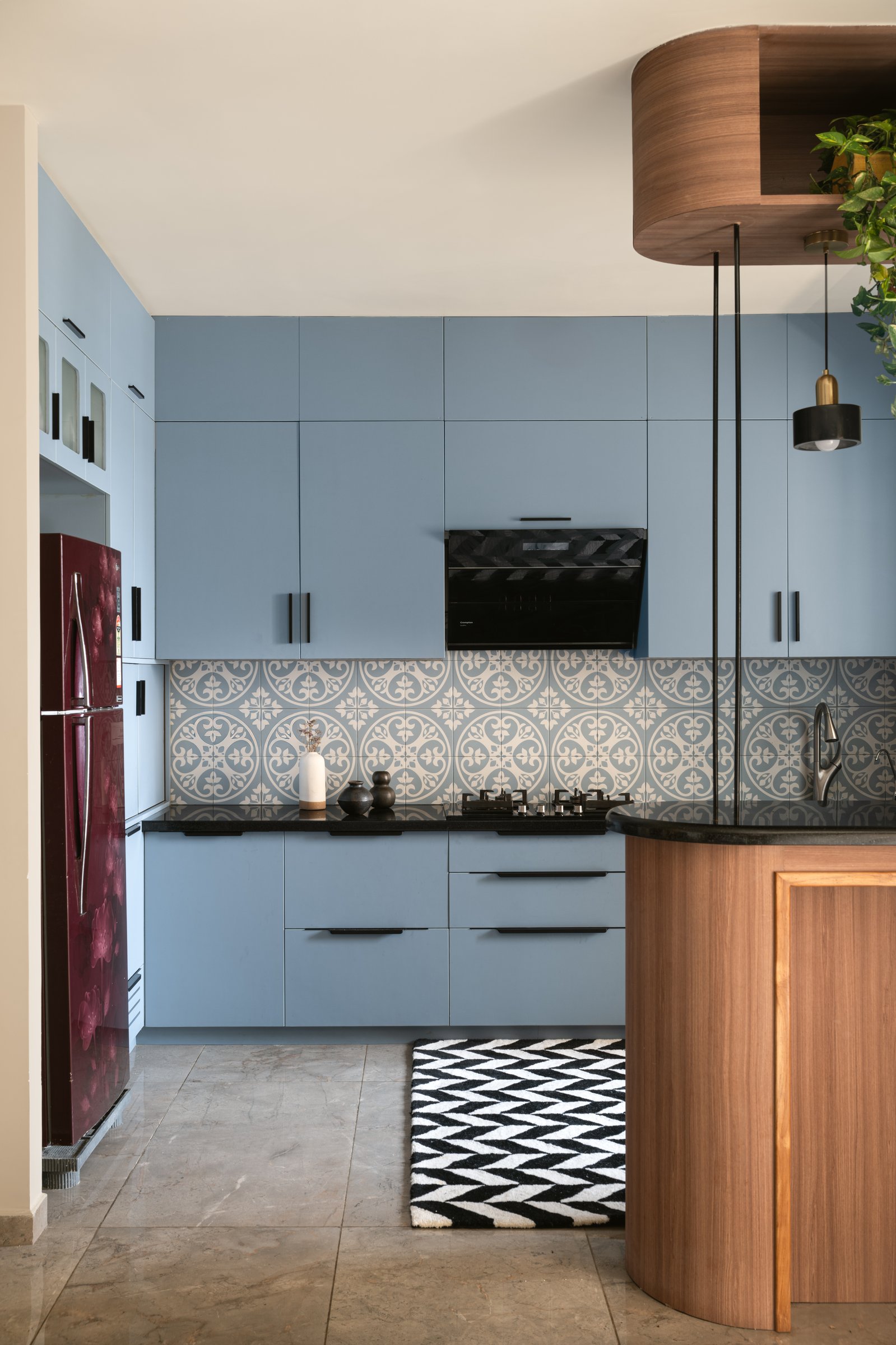
A closer view of the kitchen shows how carefully the curved wooden counter does its work, terminating the long run of blue cabinetry with a softened, almost furniture-like presence. A small black pendant suspended from a circular wooden housing introduces a darker punctuation, and a deep maroon refrigerator at the far end answers the mauve of the dining wall across the room. The kitchen feels designed for use, not display.
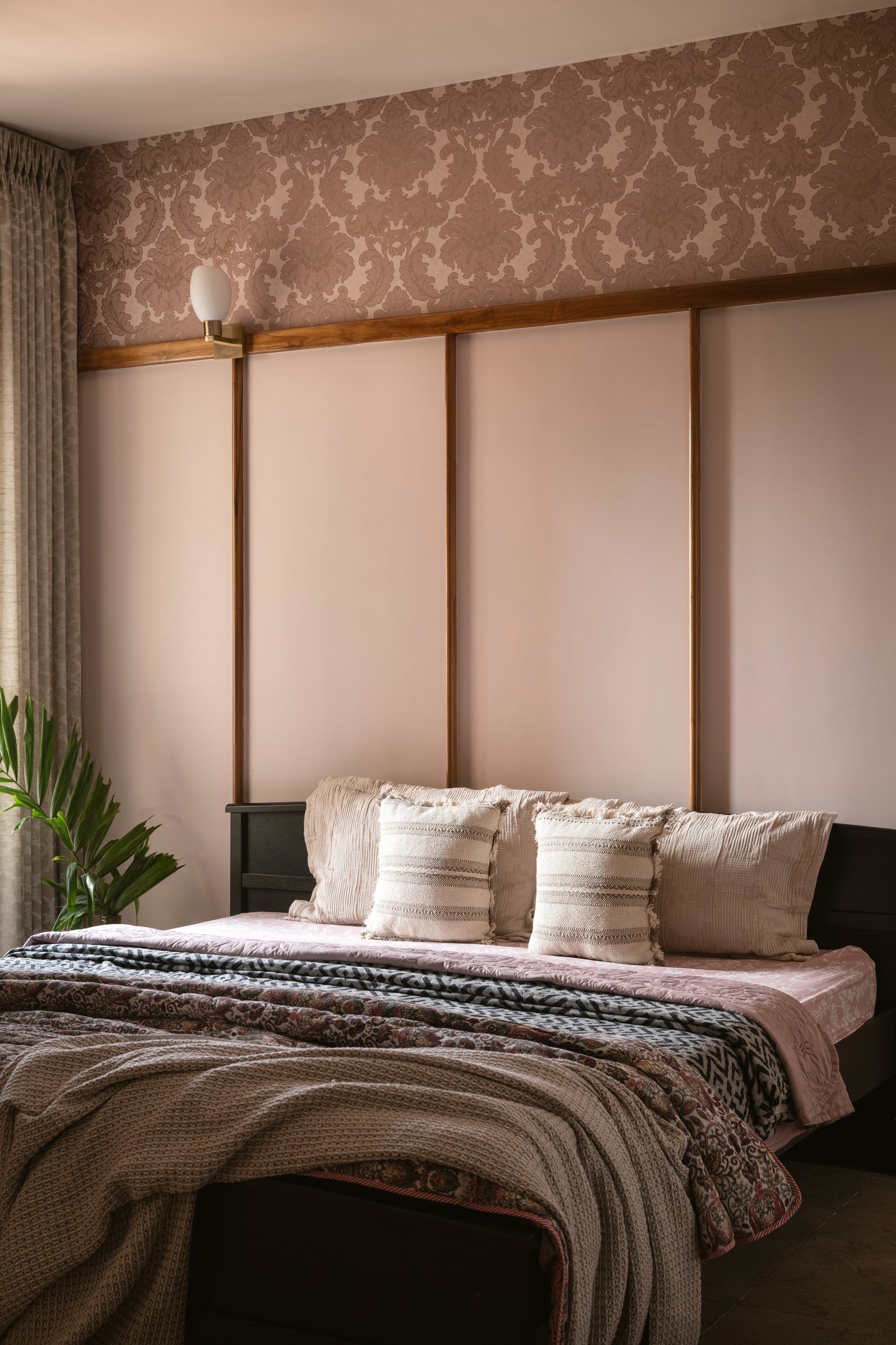
The master bedroom retreats into a different palette altogether. A blush-toned panelled wall, framed in slim wooden battens, sits beneath a damask-patterned wallpaper band that caps the room with quiet ornament. The bed is layered in cream cushions, paisley throws, and a knitted blanket in oatmeal, and a single brass-and-glass sconce introduces the room’s only metallic note.
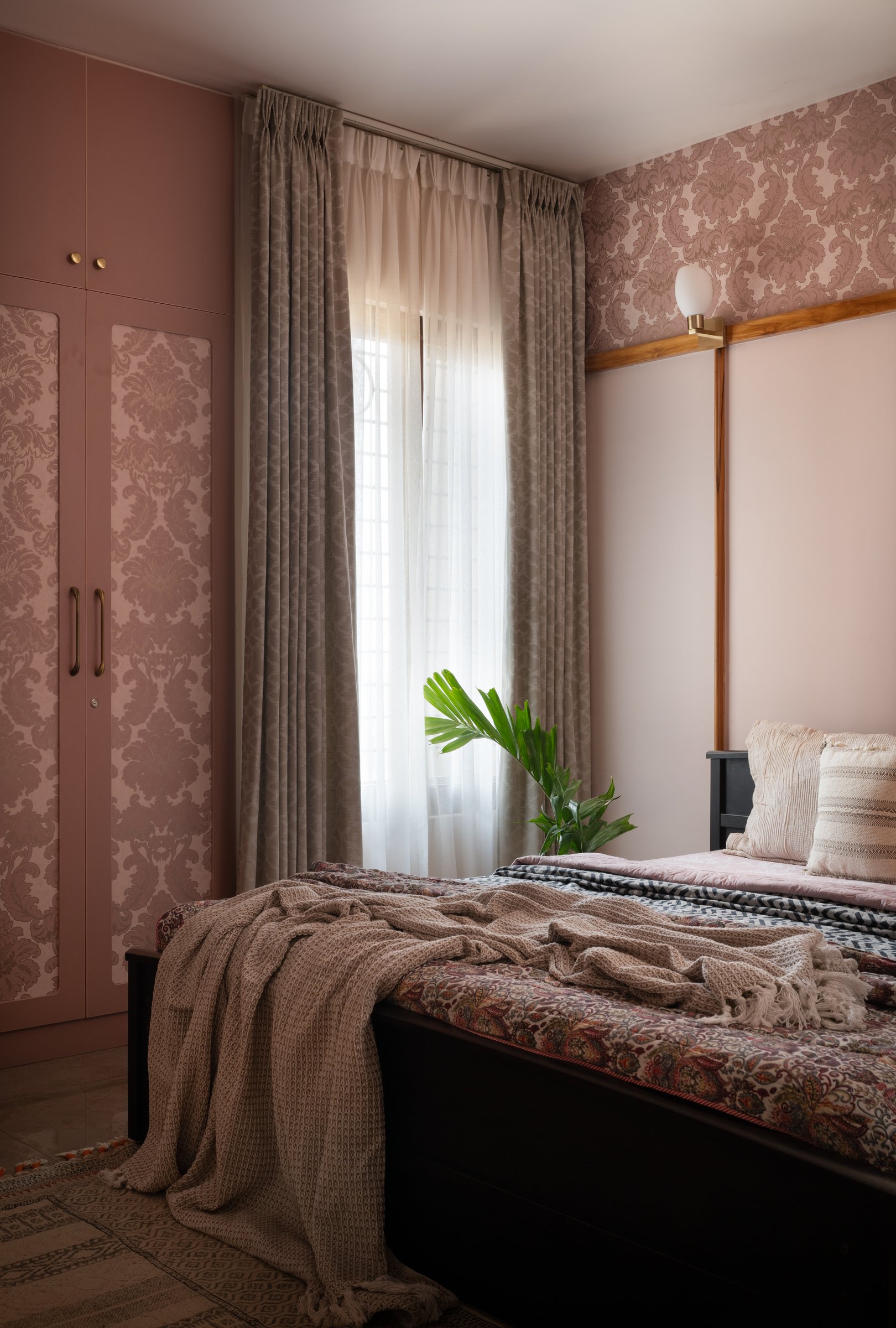
From another angle, the same room reveals a tall wardrobe finished in deeper rose, its central panels carrying the same damask motif as the wall. Sheer curtains filter the daylight into something gentler, and the room’s tonal range, from blush through dusty rose to warmer pinks, holds together without flattening. It is a bedroom designed to be slept in, not photographed, and that is precisely why it photographs well.
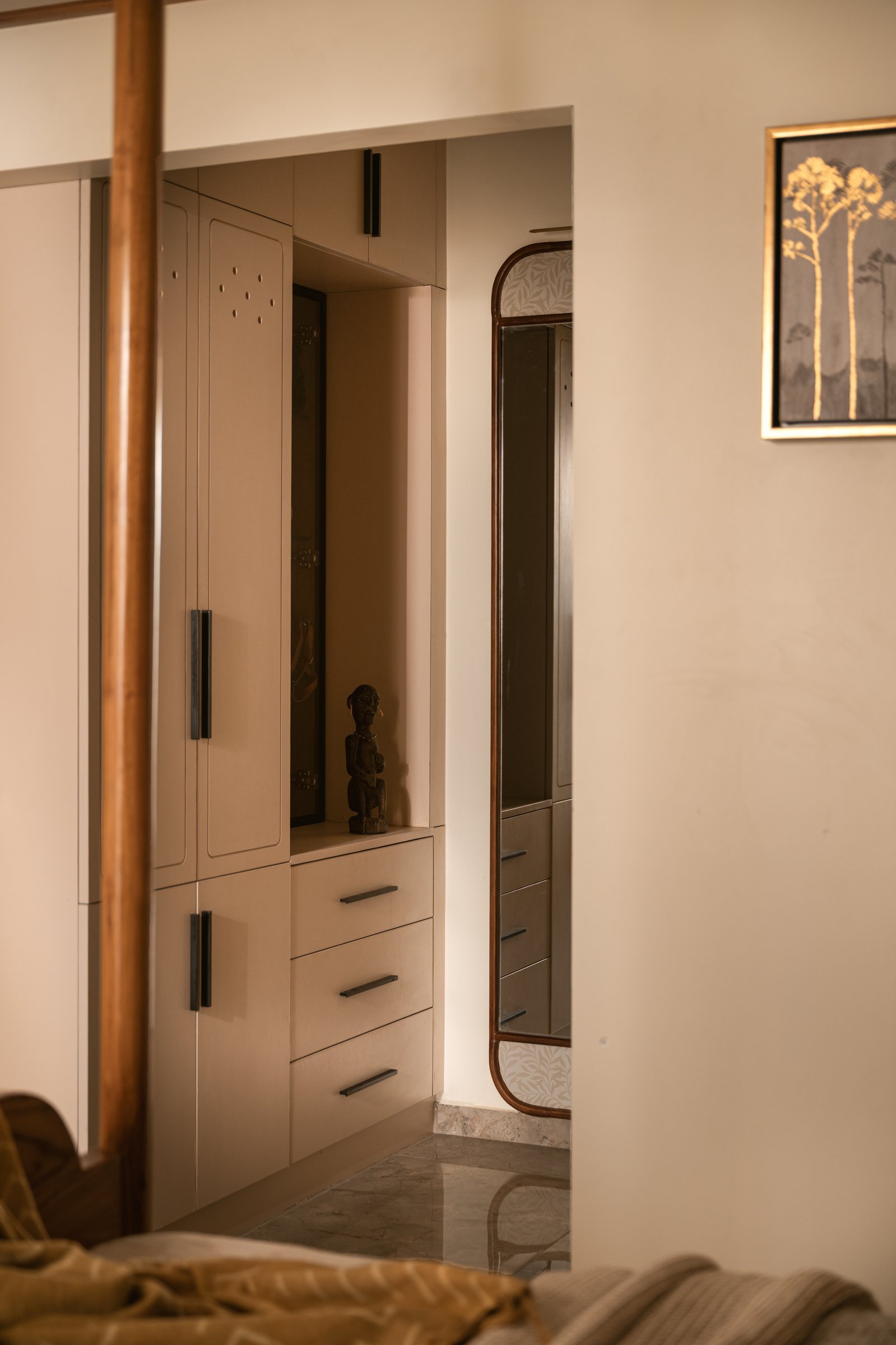
A small dressing alcove off the master bedroom continues the warm neutral language in a quieter register. Pale cabinetry frames a tall full-length mirror with rounded corners and a slim wooden frame, and a single carved figurine stands sentinel on an open shelf. The proportions are tight, the detailing unfussy, and the room reads as an extension of the bedroom rather than a separate function.
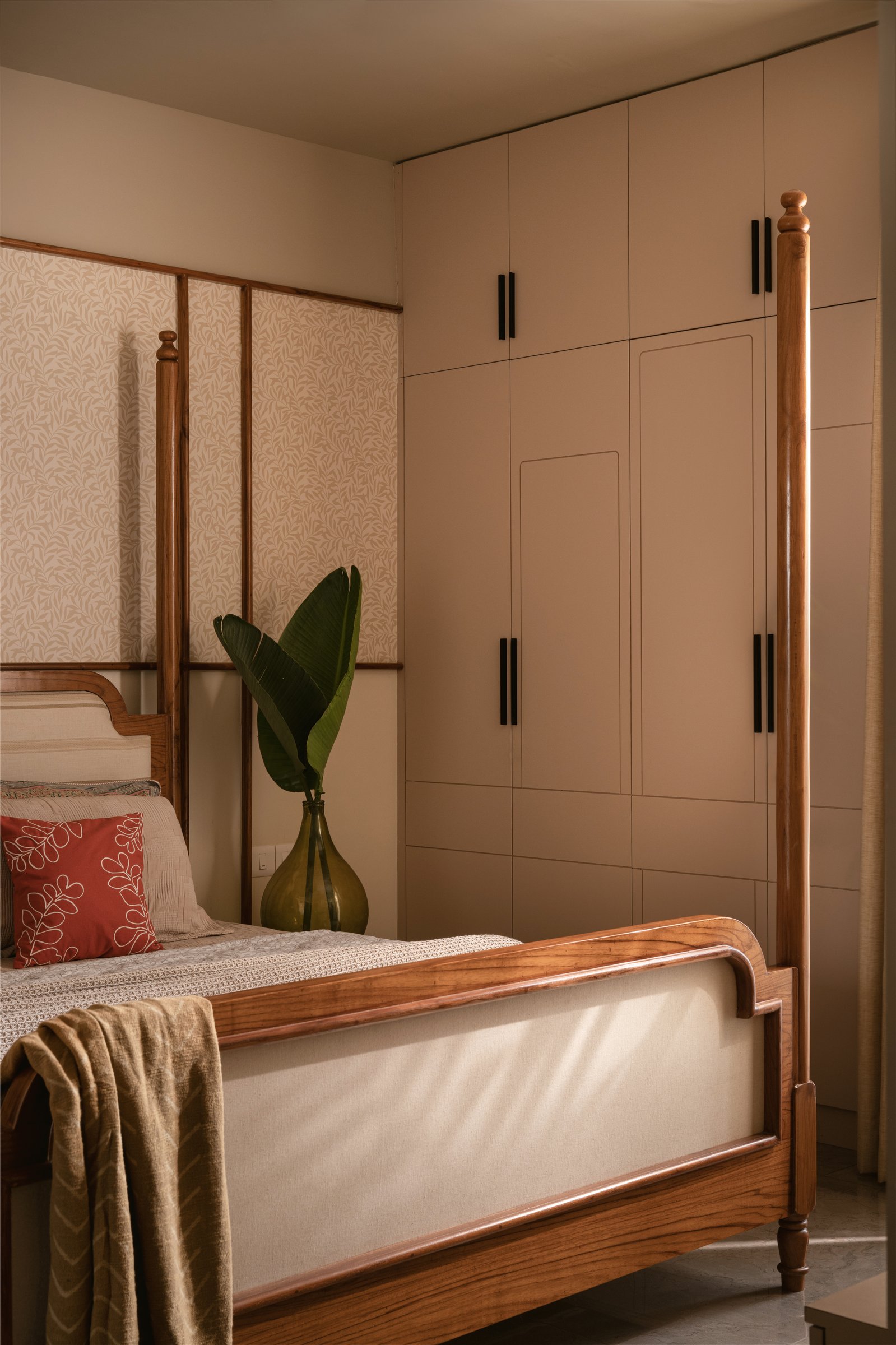
The second bedroom shifts into a warmer, more pastoral language. A four-poster bed in honey-toned teak, with an upholstered footboard in cream linen, stands against a wall papered in a subtle leaf-motif print framed by slim wooden battens. The wardrobe wall in pale blush keeps the room continuous with the home’s broader palette, while a green glass demijohn vase with banana-leaf foliage adds a single, well-placed note of green.
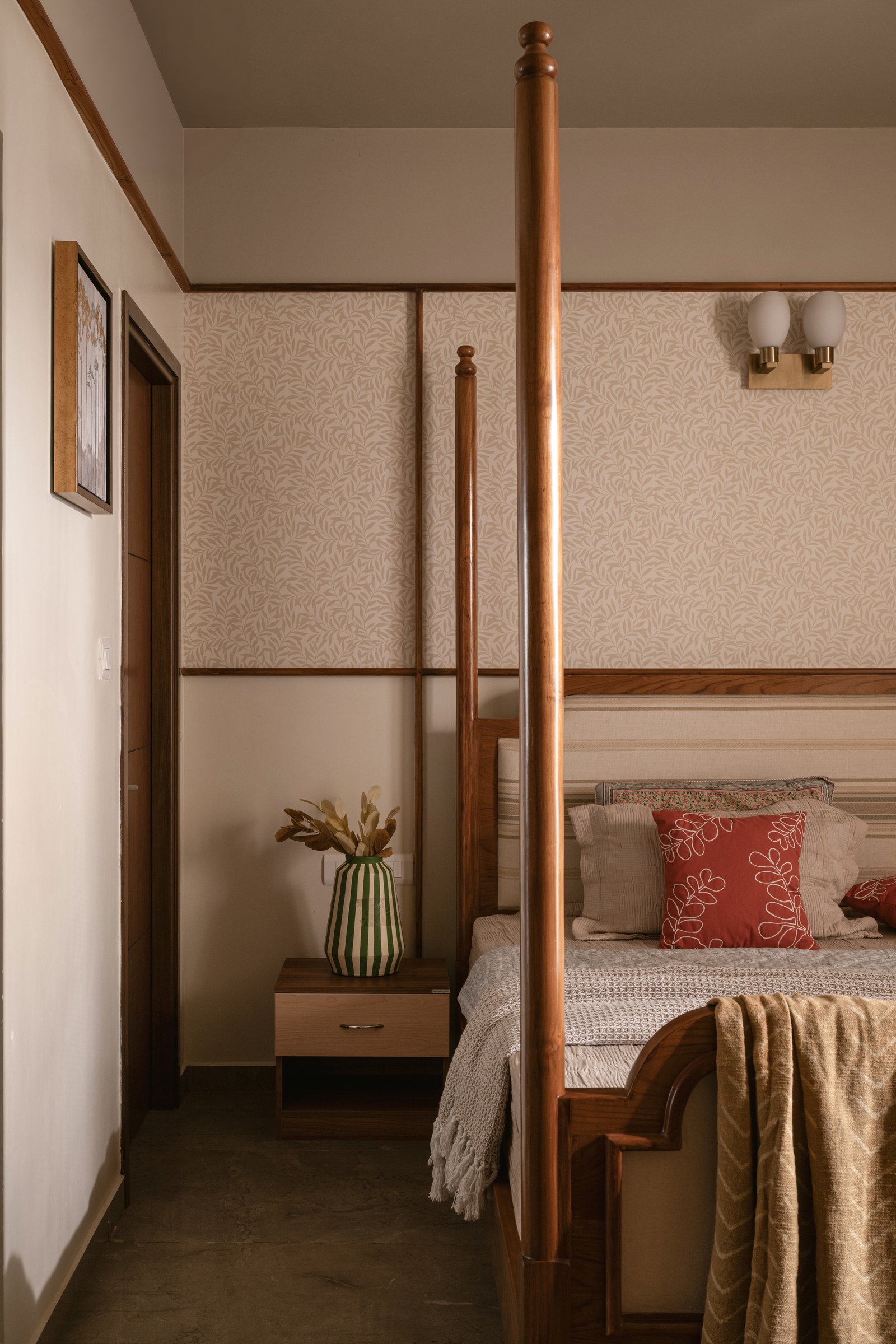
A second view of the same bedroom reveals the headboard wall in detail: a striped upholstered headboard set into a wooden frame, with a small green-and-cream striped vase on the bedside cabinet and a pair of brass sconces above. The leaf wallpaper, the wooden mouldings, and the warm bedding hold the room in a register that feels lived-in rather than styled. It is the kind of bedroom one reads in.
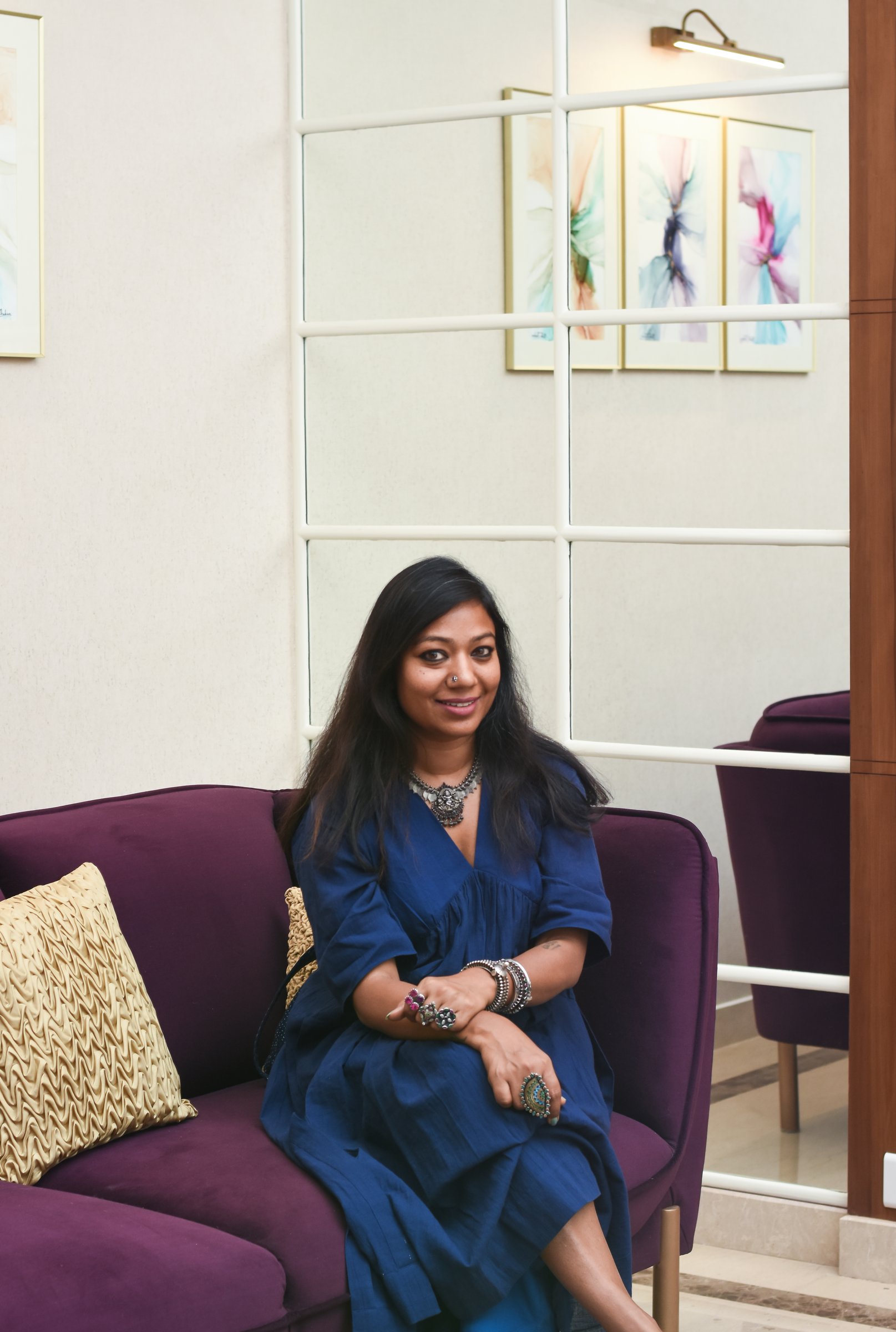
Within Bangalore’s current residential design conversation, often dominated by either tropical minimalism or heritage-revival warmth, this apartment occupies a less rehearsed position. It uses colour as architecture, treats wallpaper and pattern as structural rather than decorative, and finds its restraint not by editing the palette down but by giving each colour its proper distance from the next. Swati Seraan’s studio reads the brief of a working couple’s home as a question of pace, not of style.
What lingers about The House of Blue Leaves is not any single room but the discipline that holds the whole together. Cool and warm, restrained and expressive, structured and soft, the home keeps these pairs in active negotiation rather than resolving them into compromise. It is a project that trusts its own contradictions, and in doing so makes a quiet case for what an Indian apartment can look like when it is willing to be itself.