Apartments in Mumbai are rarely afforded the luxury of generosity, and the homes that succeed here are not those that pretend otherwise but those that work with the city’s spatial economy as a creative discipline. The Lucent Home, a 1,400-square-foot residence in the western suburbs, treats compactness not as a constraint to disguise but as an organising premise, building its argument around softened geometries, pale palettes, and a near-religious attention to how light moves through enclosed volumes.
Designed by MM Studio under the direction of Manvi Mehta, The Lucent Home was conceived for a family whose tastes leaned toward warmth without ornamentation, and whose daily life required the apartment to function as living, dining, working, and devotional space within a single uninterrupted plan. The studio’s response was to develop a vocabulary of curves, arches, and tonally adjacent surfaces that lets each zone breathe into the next while retaining its own emotional register.
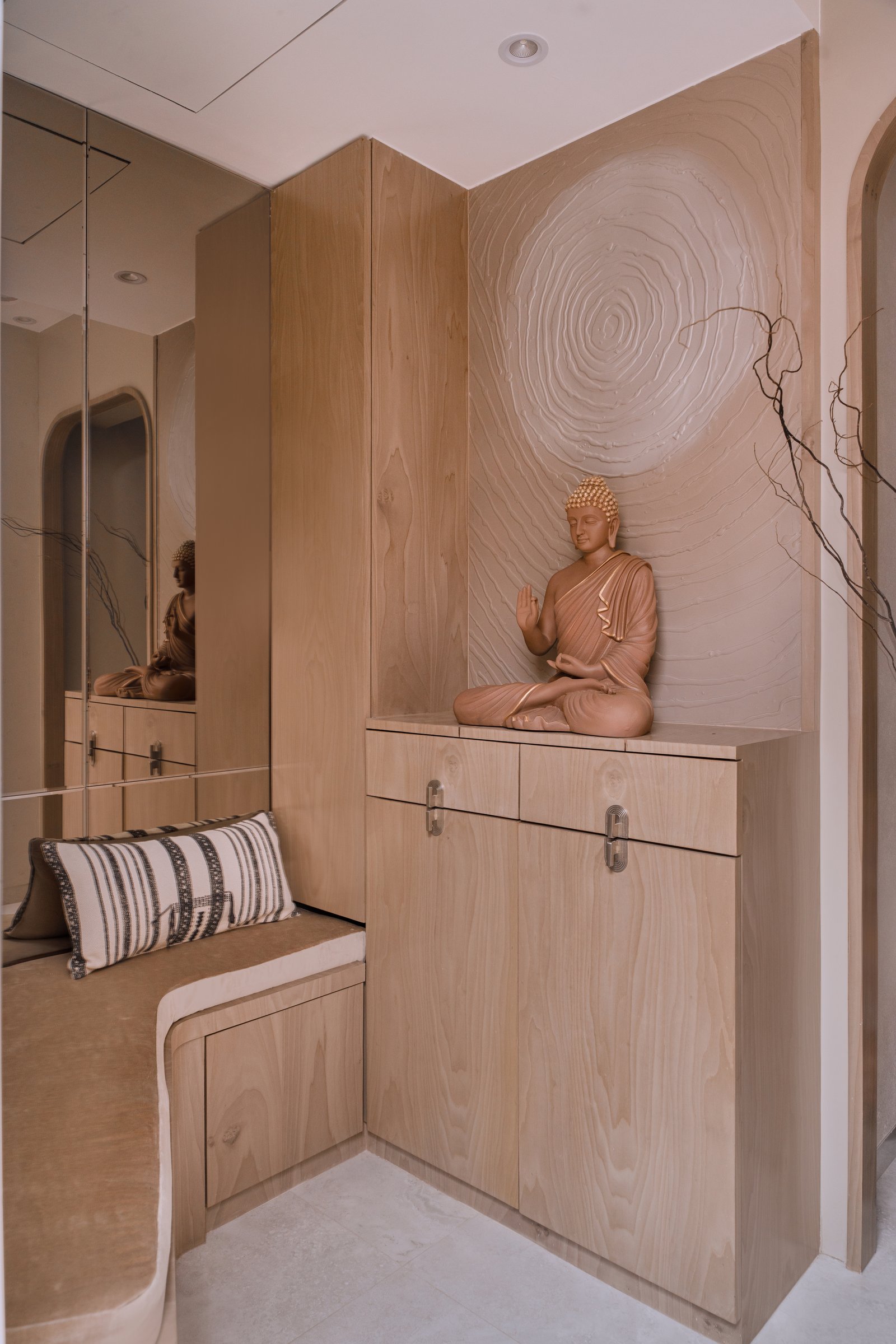
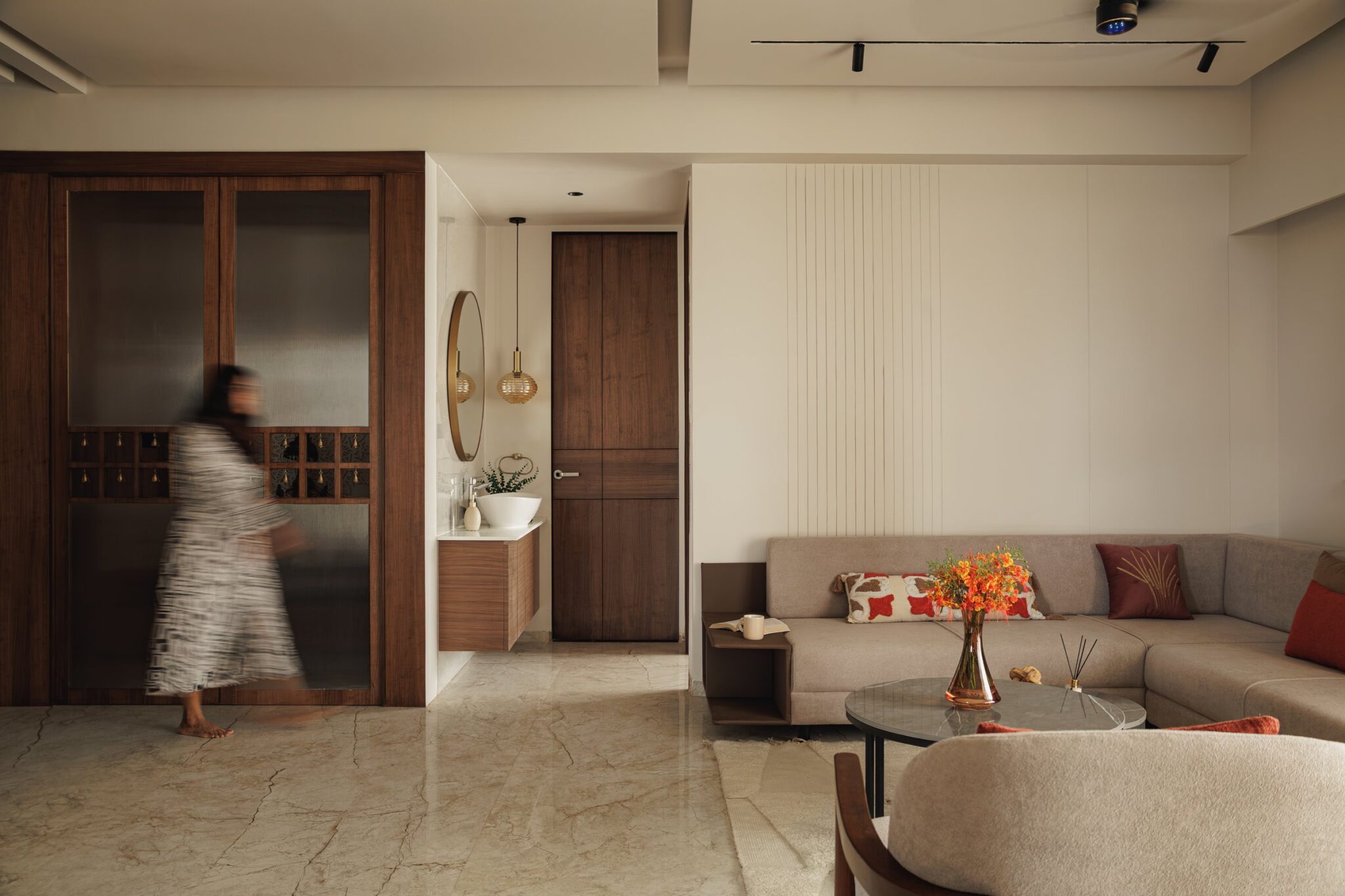
The foyer establishes the home’s grammar before the apartment fully reveals itself. A textured plaster panel, rippled in concentric rings behind a seated Buddha, sets a meditative tone that the rest of the home will quietly inherit; below, a pale wood shoe console with a built-in bench cushion folds storage into welcome without announcing either.
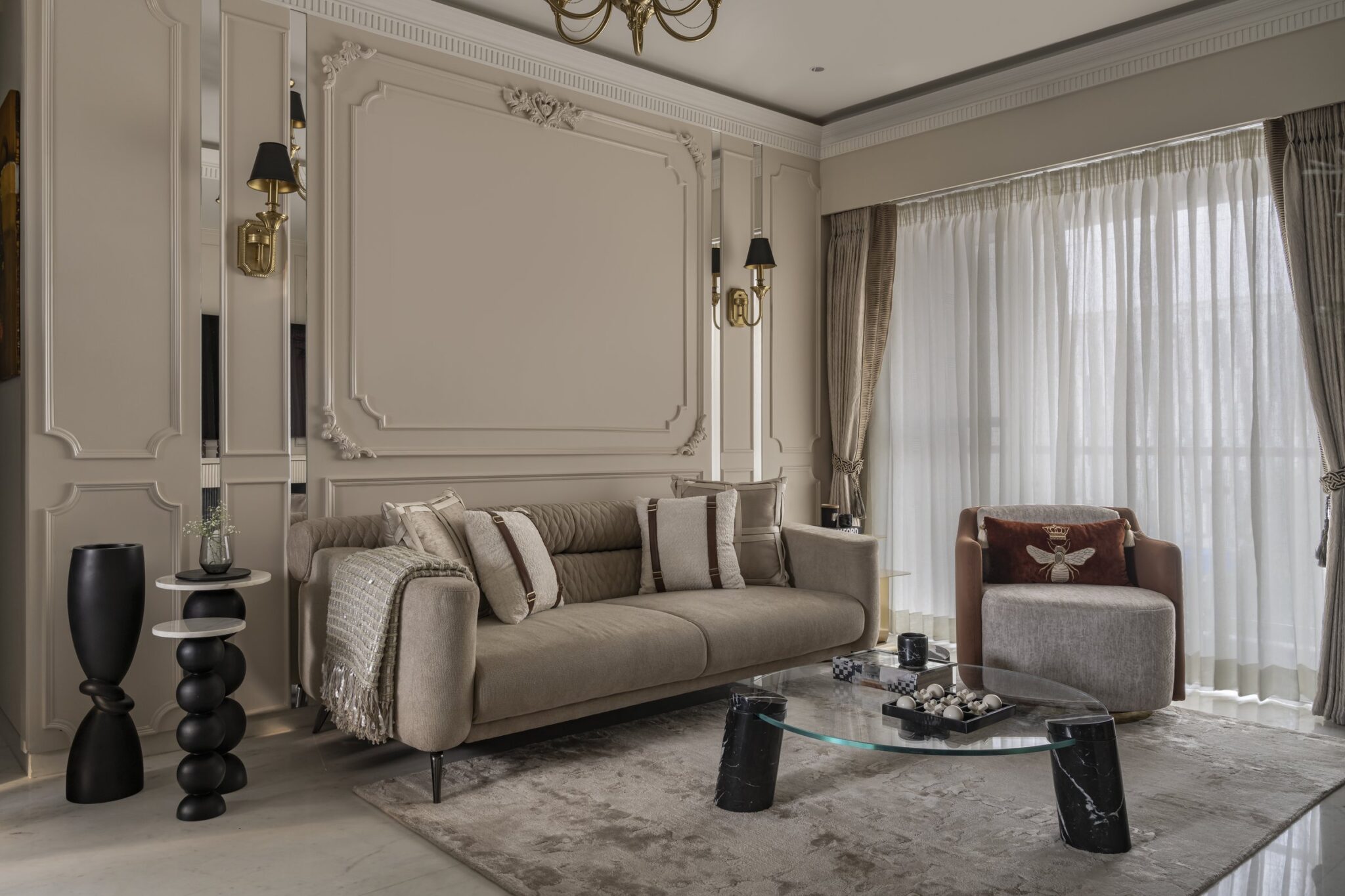
The living room is where the home’s restraint and its theatricality meet. A mauve-tan upholstered sofa anchors the space beside a wall finished in a vast concentric relief, while a round coffee table with green stone base introduces a cooler counterpoint to the otherwise honeyed palette.
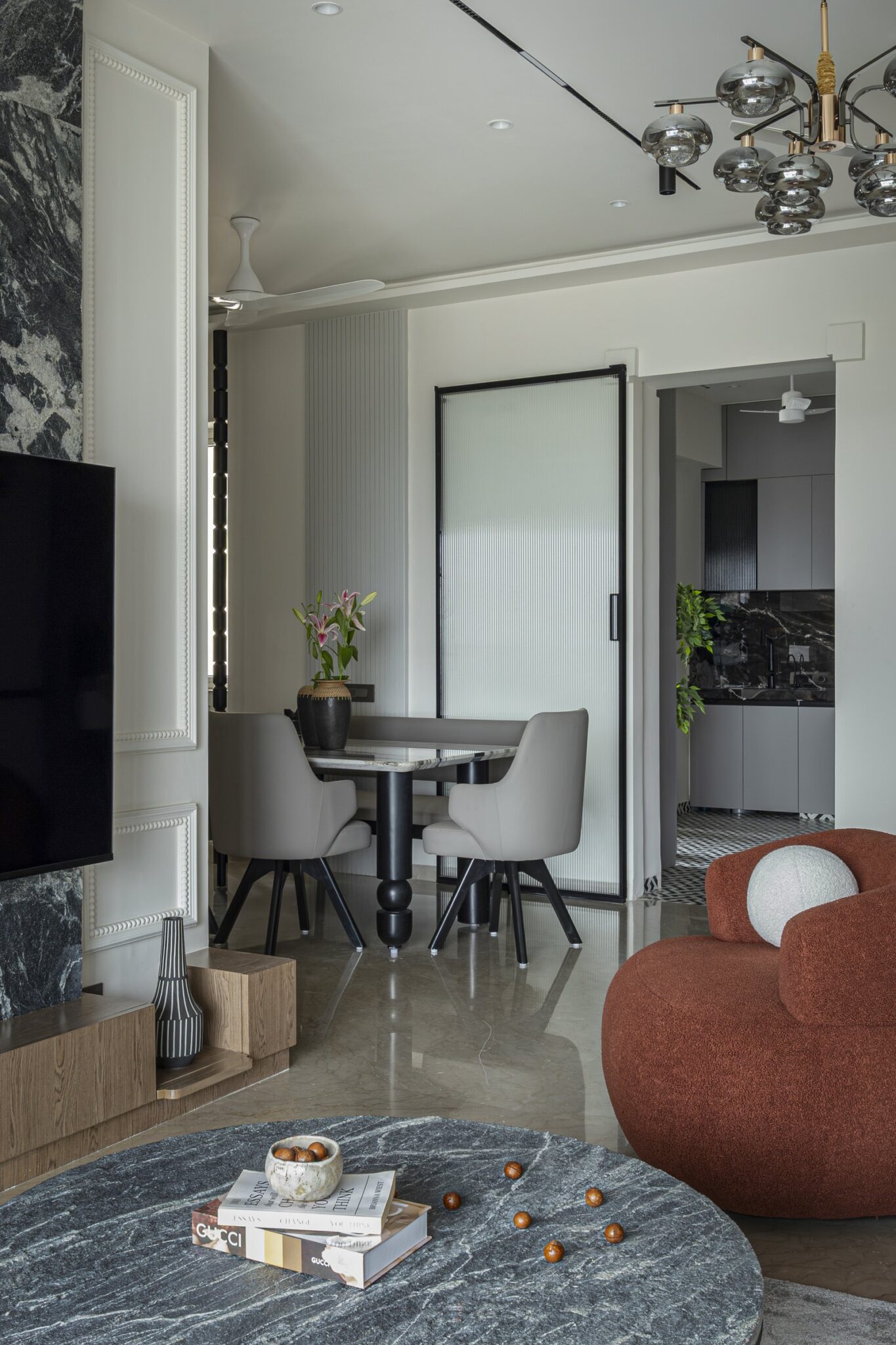
What distinguishes the room is the way every surface has been engineered to recede behind the textures. The wood panelling wraps the television wall in a continuous skin, the arched window frame is integrated into the joinery, and a slim built-in bookshelf threads between them without breaking the rhythm.
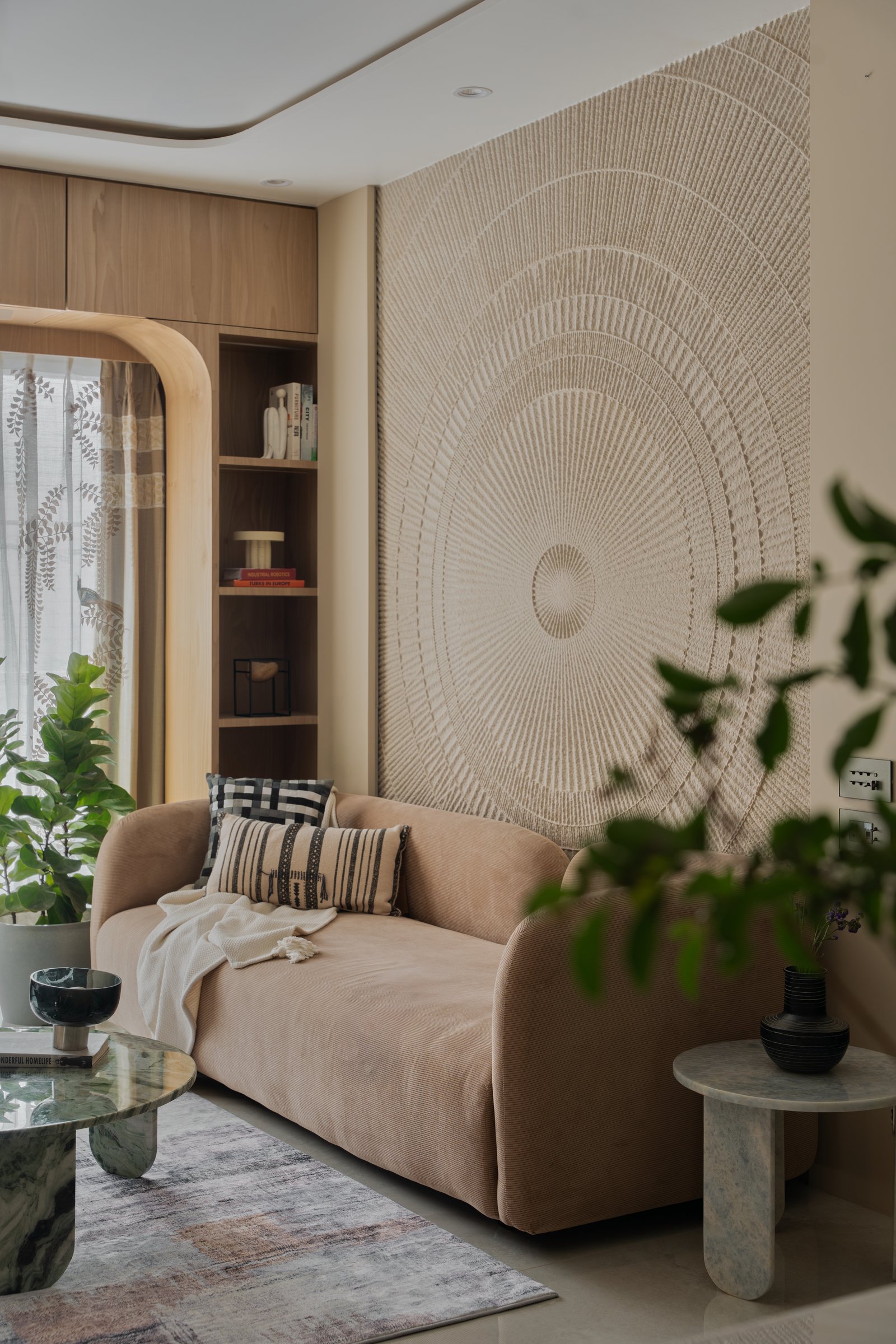
The concentric relief behind the sofa deserves its own attention. Hand-finished and radiating outward from a central point, it operates as both artwork and acoustic softener, lending the seating area a sense of focus that a more conventional gallery wall could not have achieved.
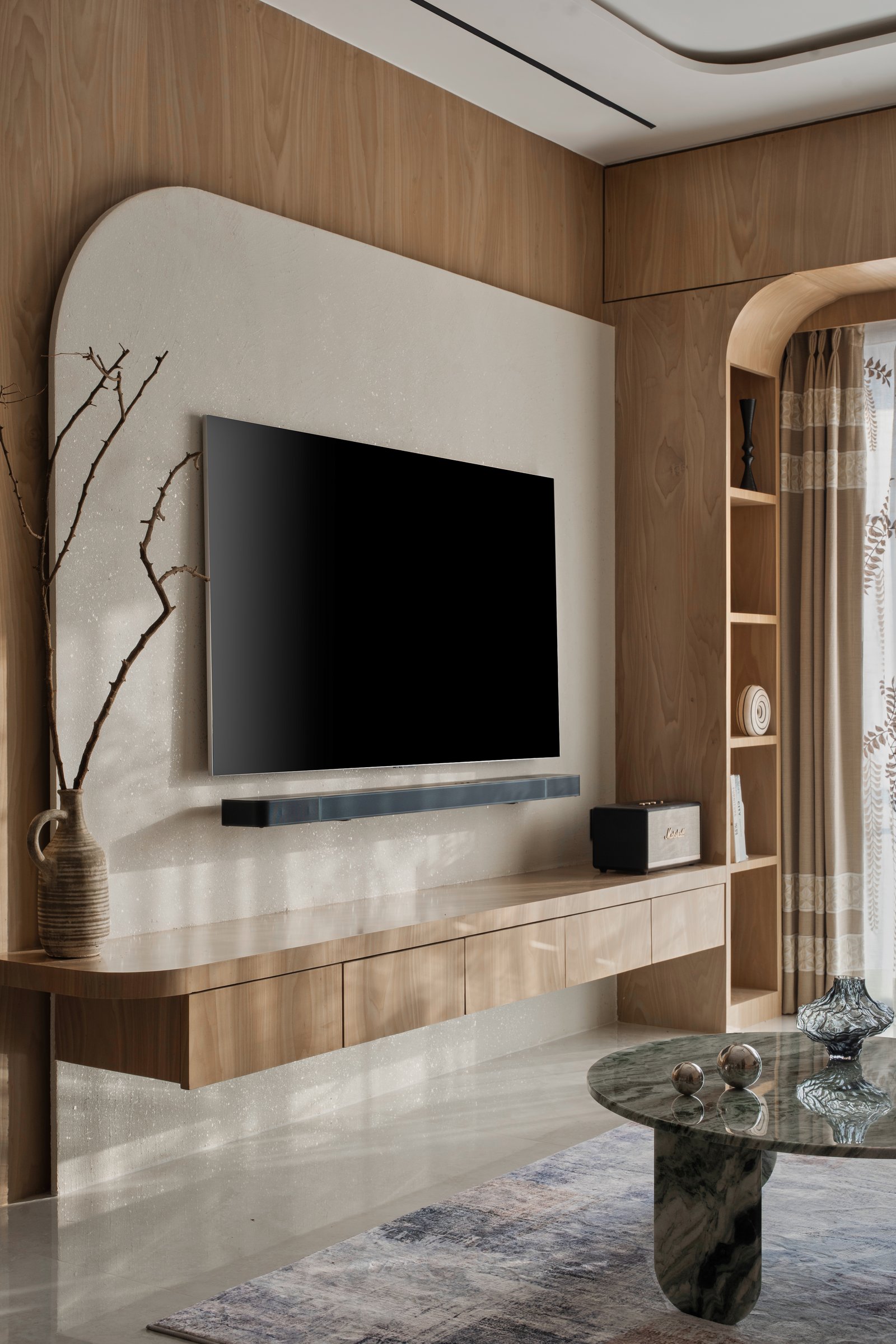
On the opposite side of the room, the television sits within an arched plaster niche flanked by an open shelving column, the whole composition floated above a wood-finished console with discreet drawers. The plaster’s faint shimmer catches the afternoon light, and the gesture of placing a slim branch in a stoneware vessel beside the screen is a quiet refusal of the entertainment wall’s usual dominance.
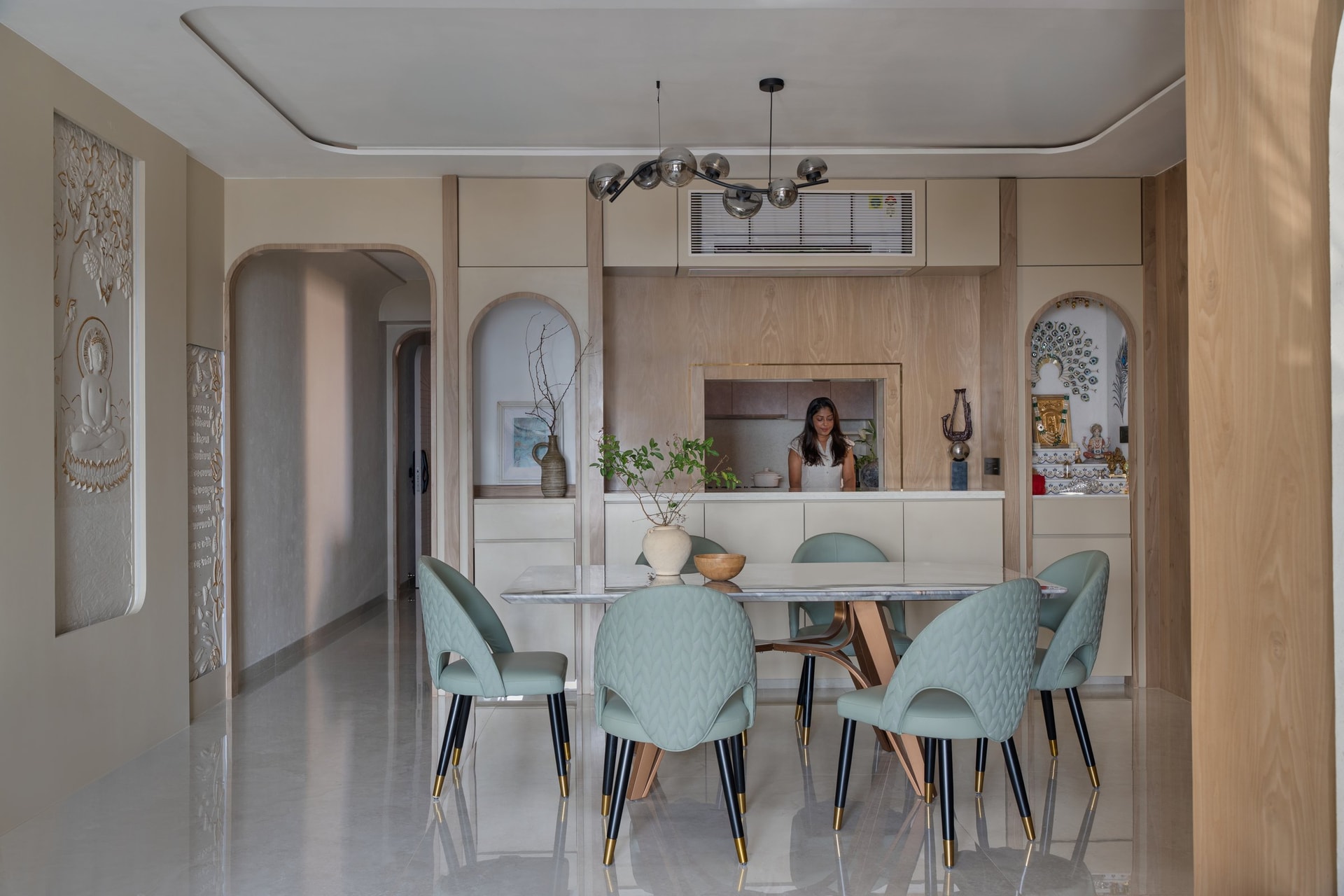
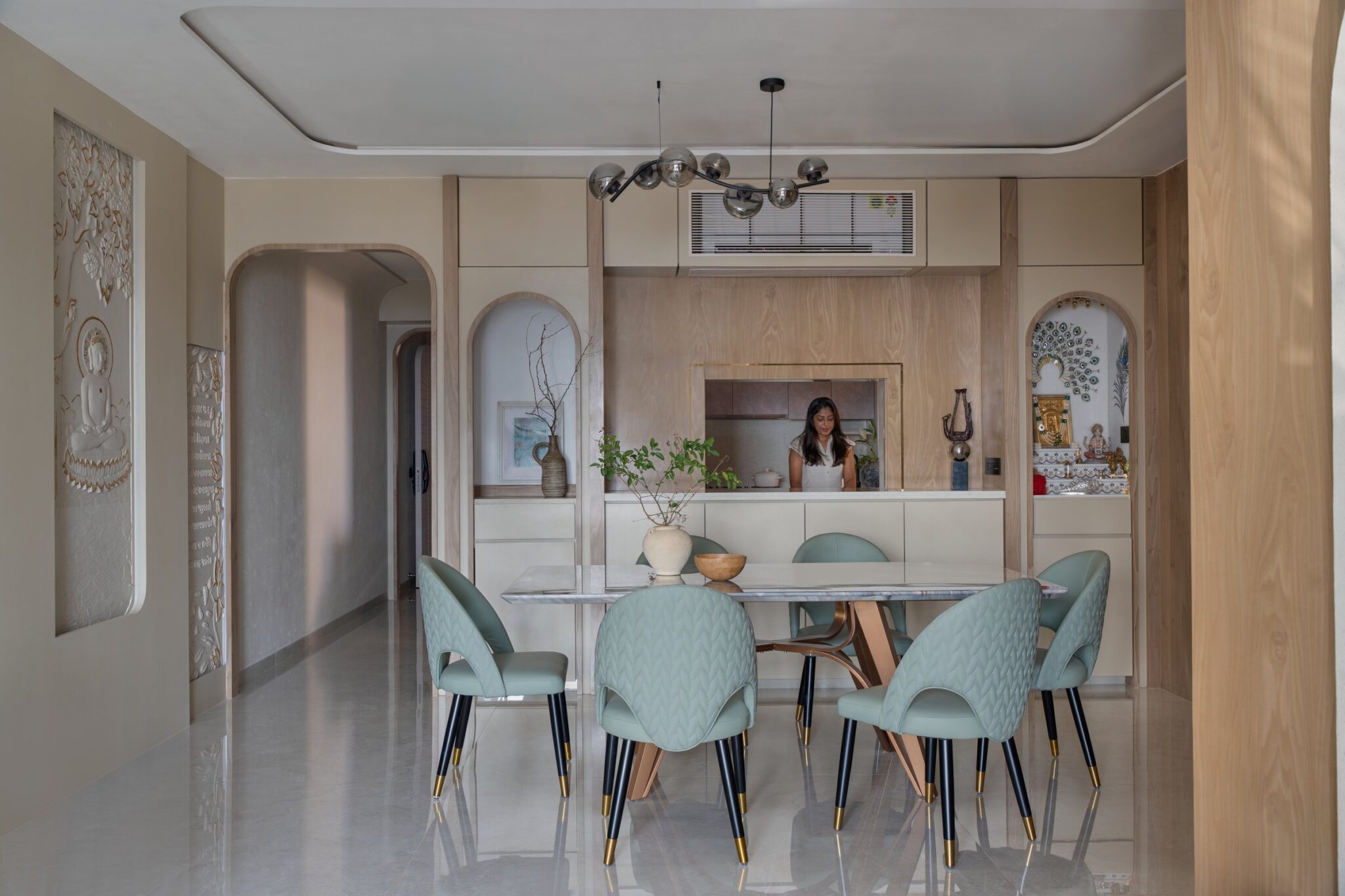
The dining area sits in open conversation with the kitchen pass-through, the two zones separated only by a serving counter that allows the cook to remain part of the household’s social geography. A veined marble tabletop on a sculptural wood-and-copper base anchors the space, surrounded by six sage green upholstered chairs with quilted backs and slim dark legs tipped in brass.
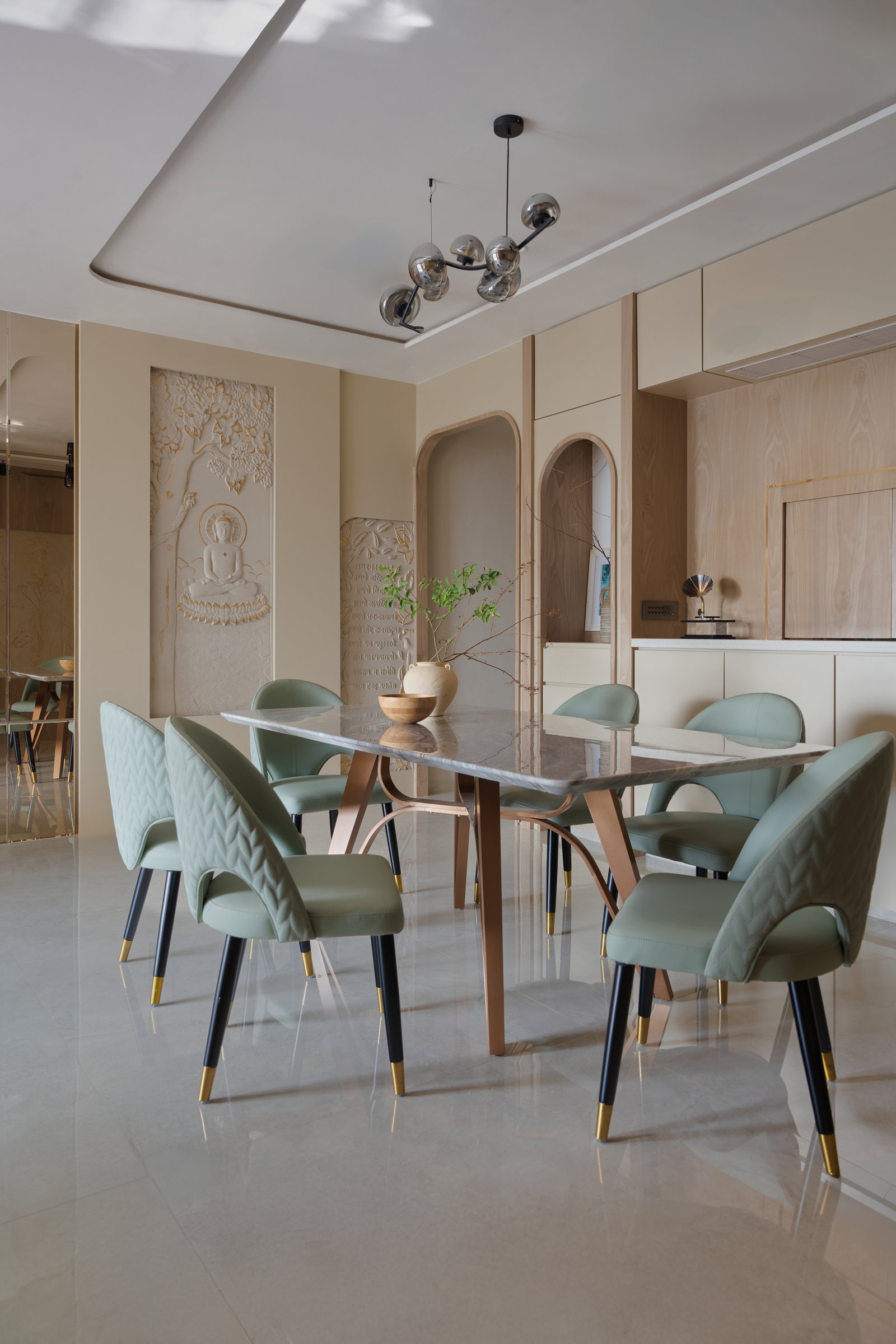
A sculptural Buddha relief panel sits alongside twin arched niches near the dining area, each element given equal architectural standing within the room’s quiet vocabulary.
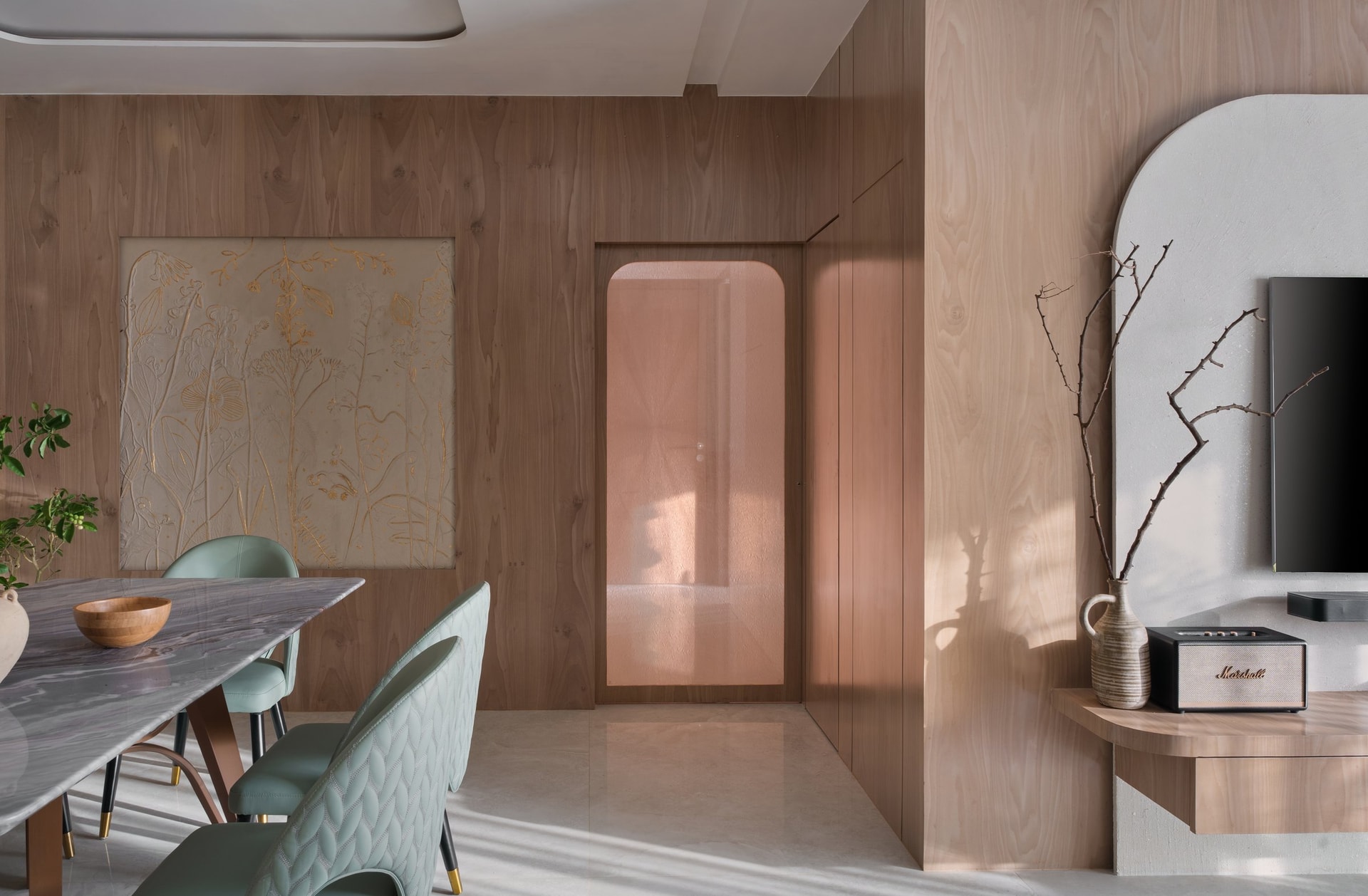
A second view of the dining zone reveals how thoroughly the wood-clad volume holds the room together. A framed botanical artwork in soft gold against a putty ground occupies the panelled wall, while a glazed door in a peach-tinted finish leads further into the apartment.
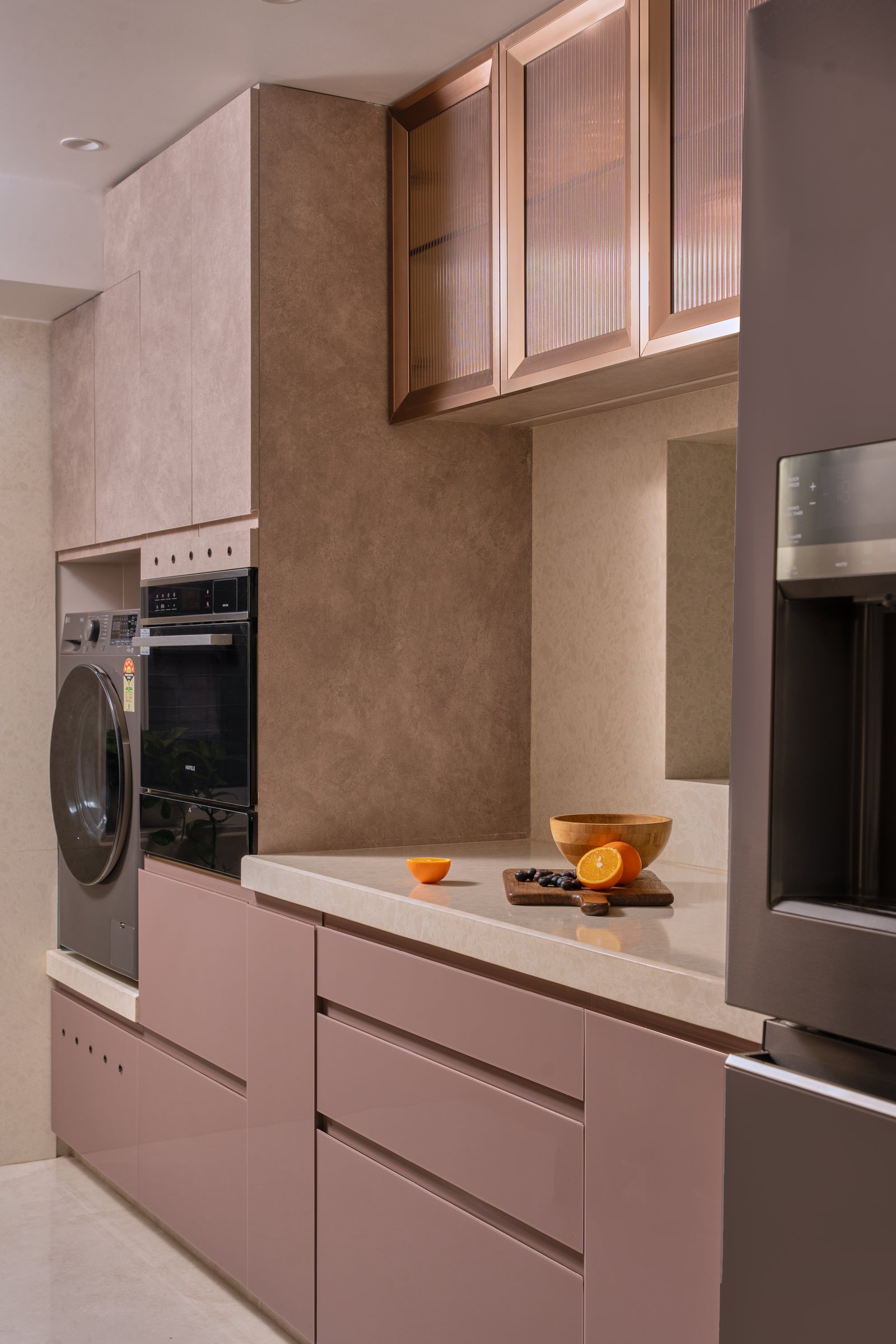
The kitchen itself is the home’s most surprising room: a galley wrapped in dusty rose cabinetry below and stone-finish uppers above, with fluted glass cabinet fronts in a warm metallic frame catching the light. The pass-through window connects it visually to the dining room without sacrificing the working privacy a Mumbai kitchen needs.
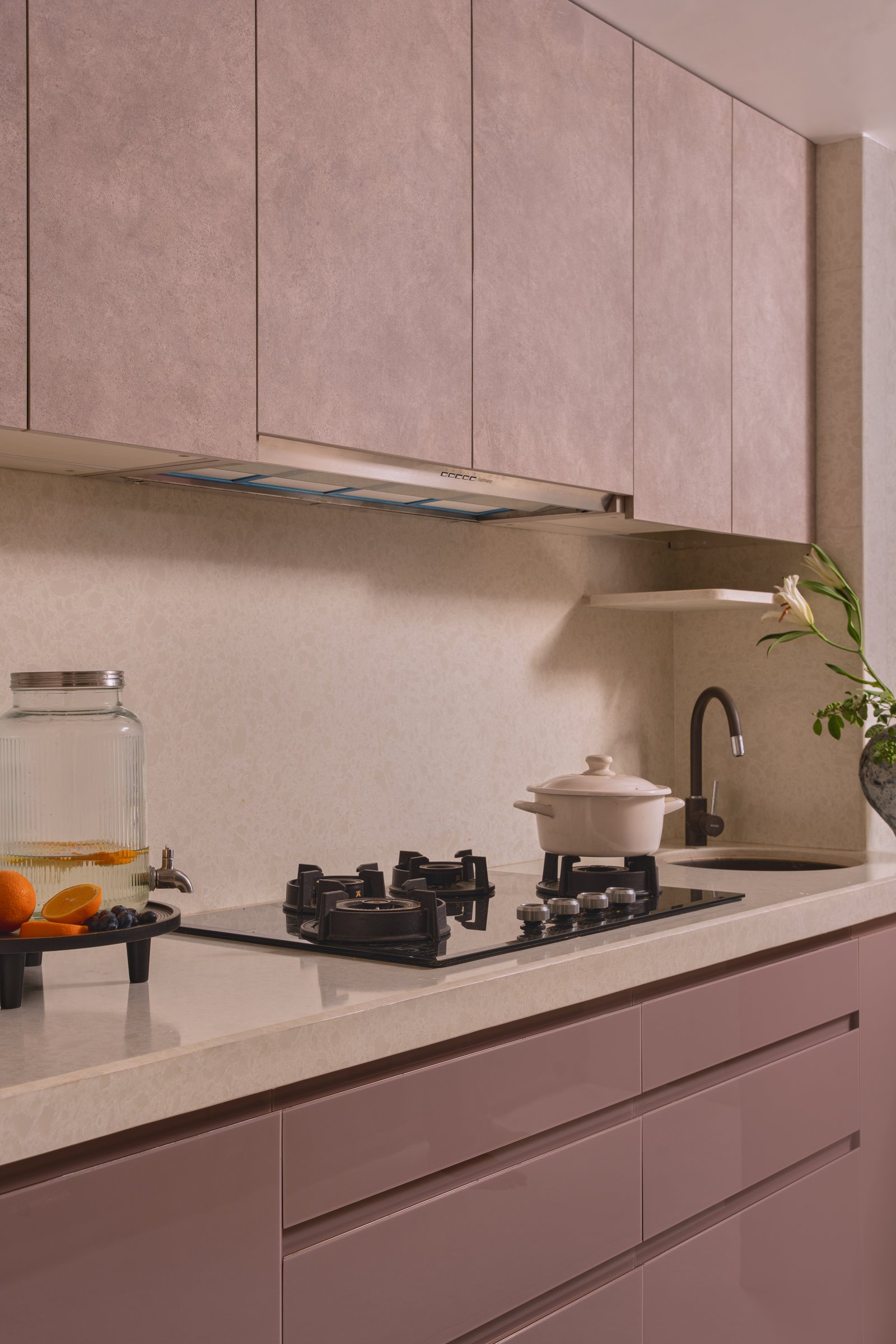
At the cooking counter, the pale stone worktop and matching backsplash keep the room visually weightless even as the lower cabinets commit fully to colour.
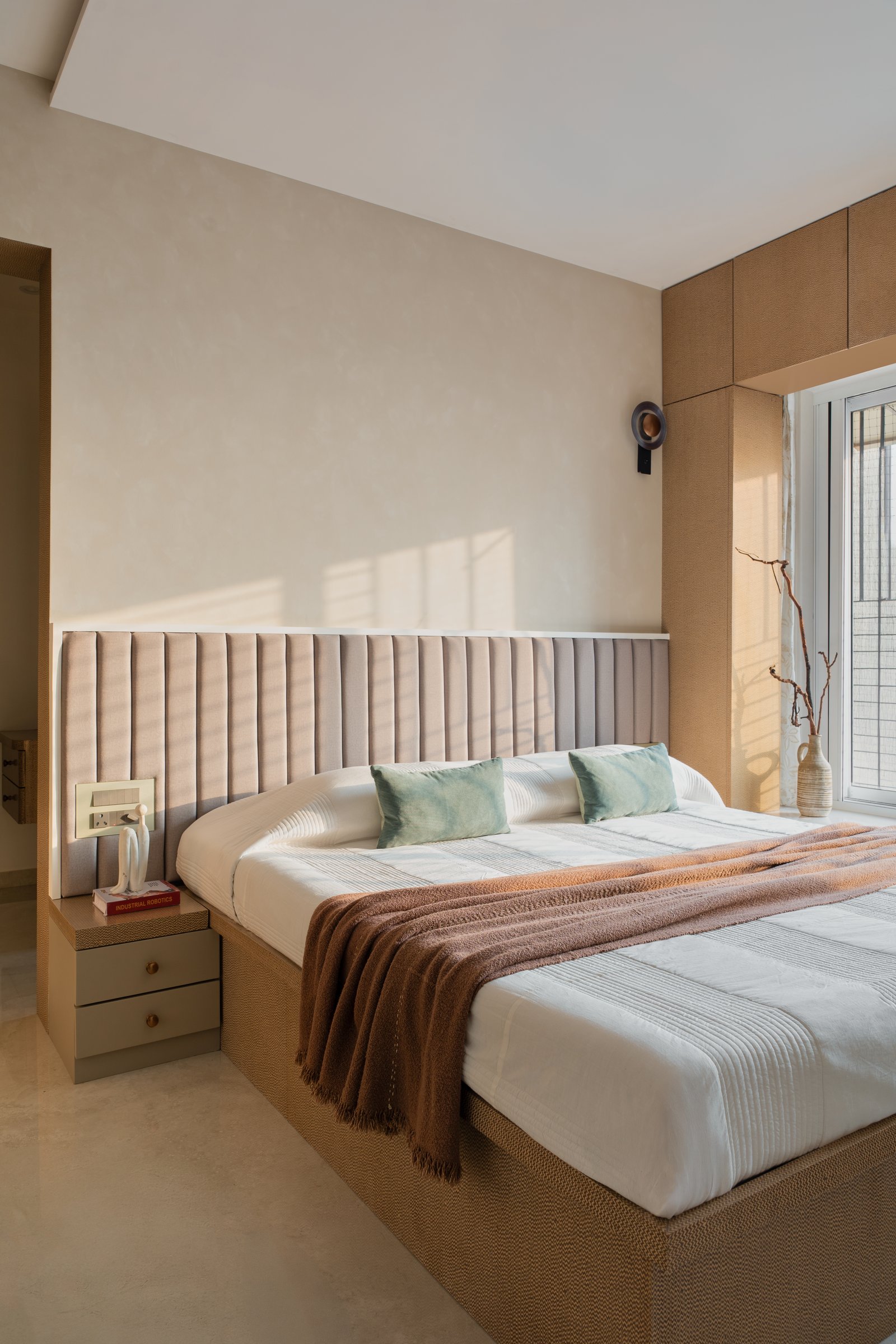
The master bedroom shifts the palette into deeper, more grounded tones. A channel-tufted upholstered headboard runs the length of the bed wall, set against a soft plaster finish that catches afternoon light in long warm bands.
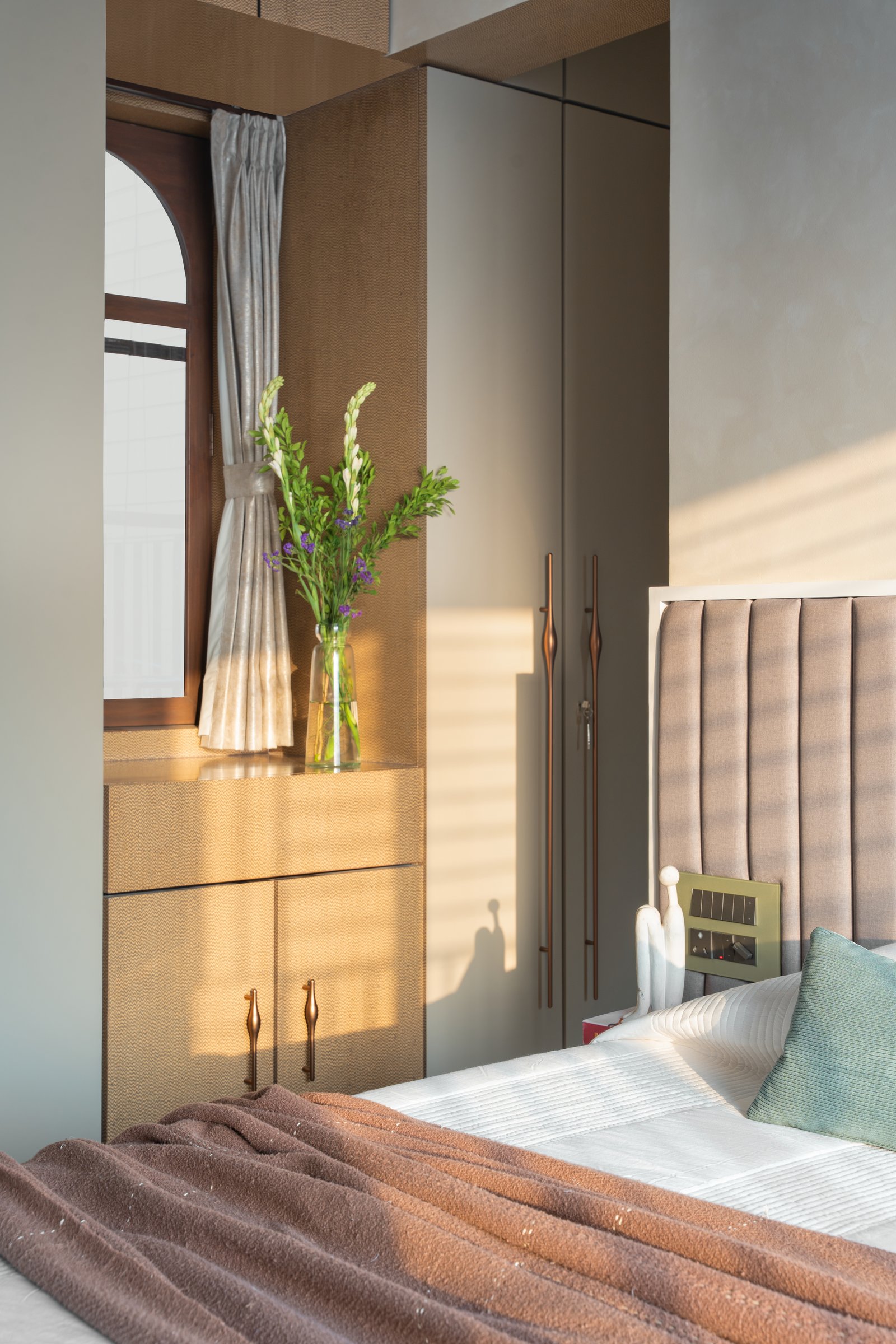
Beside the bed, a fabric-wrapped wardrobe with slim brass pulls handles the storage discreetly, while a slim window with an arched timber frame brings in a strip of garden light. The decision to clad the wardrobe in the same woven fabric as the bed base unifies the room into a single tactile envelope.
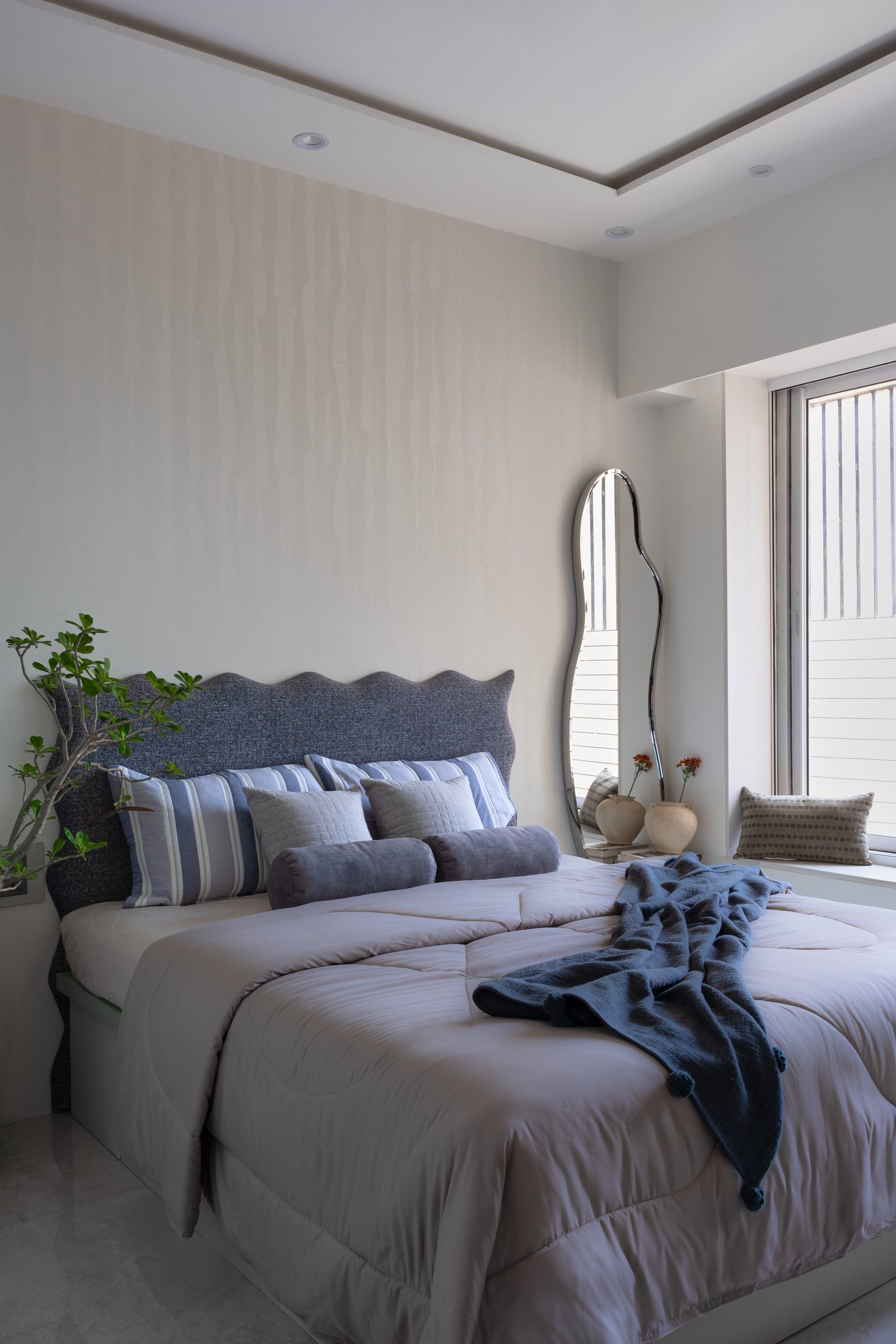
The second bedroom takes a quieter, cooler approach. A scalloped slate-blue headboard against a faintly textured wall introduces a wave-like rhythm, and a freeform mirror in a polished chrome frame leans into the window bay, doubling the available light.
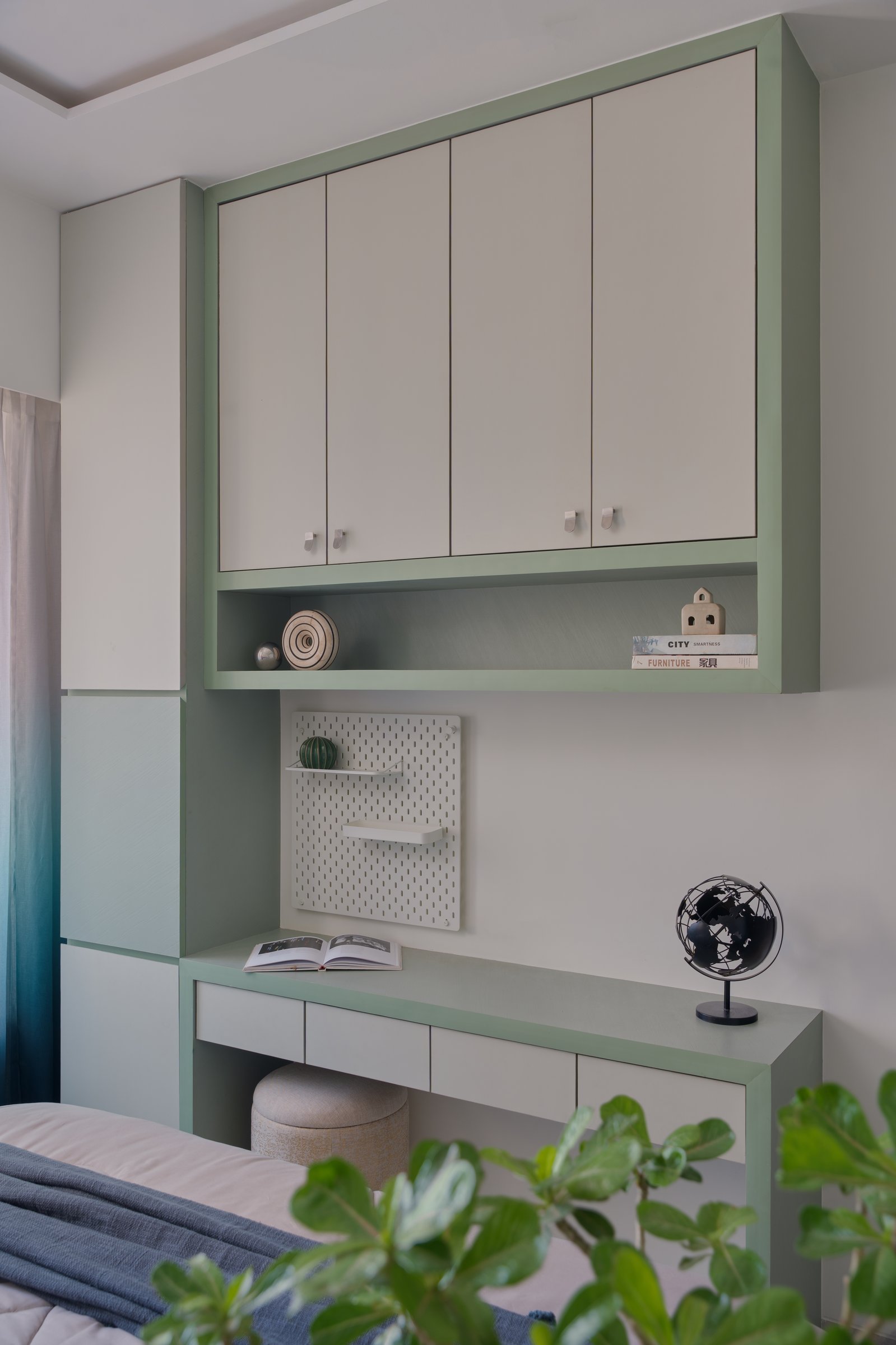
Within the same room, a sage-green framed study unit combines closed cabinetry, an open display ledge, and a slim writing desk with a pegboard above. The colour choice is the room’s signal that this is a space for a younger inhabitant, made without resorting to the visual clichés of a child’s bedroom.
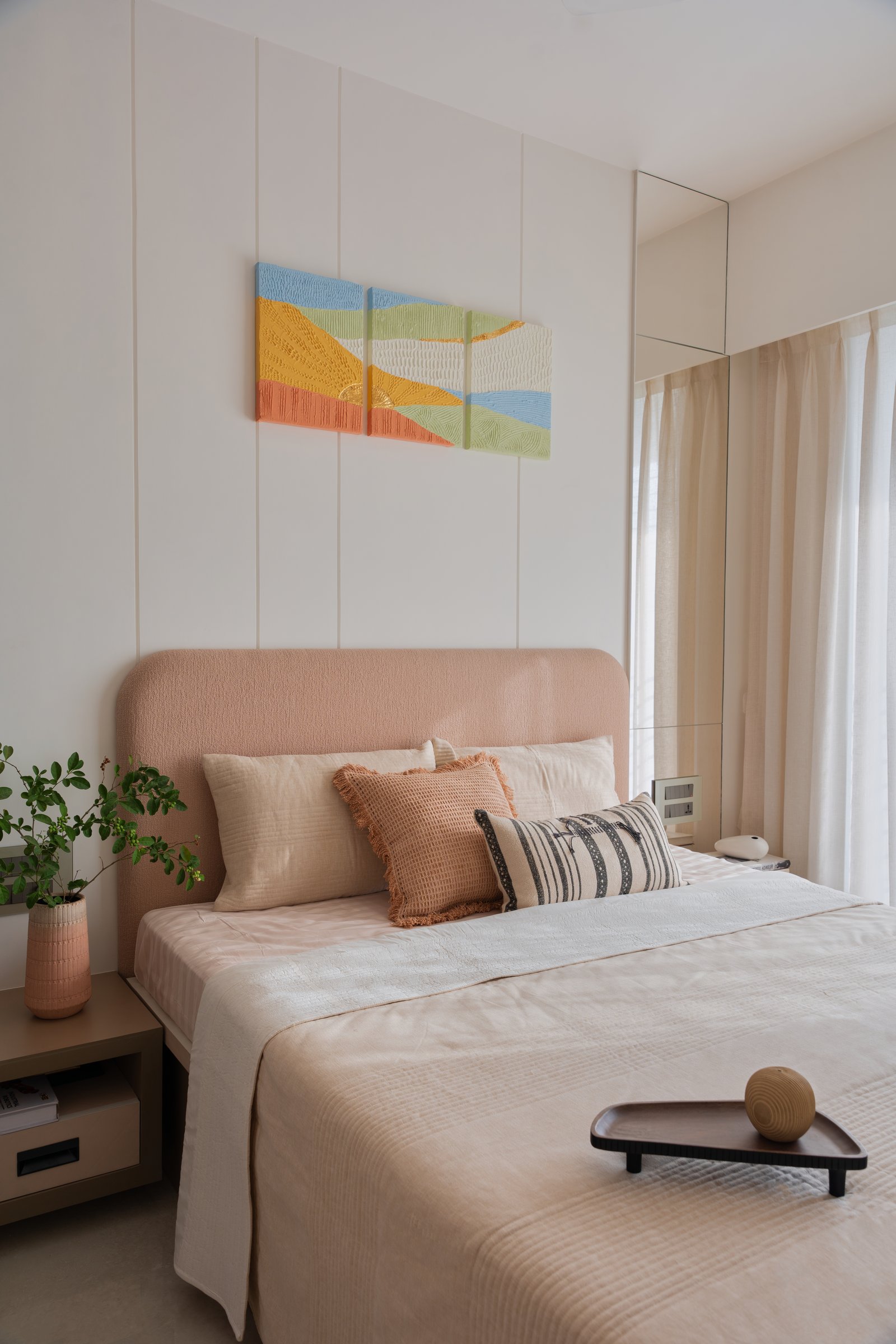
The guest bedroom is the most pared-back of the three, organised around a peach upholstered headboard and a triptych of textured artworks above. A floor-to-ceiling mirror panel beside the bed expands the room visually without adding objects to it.
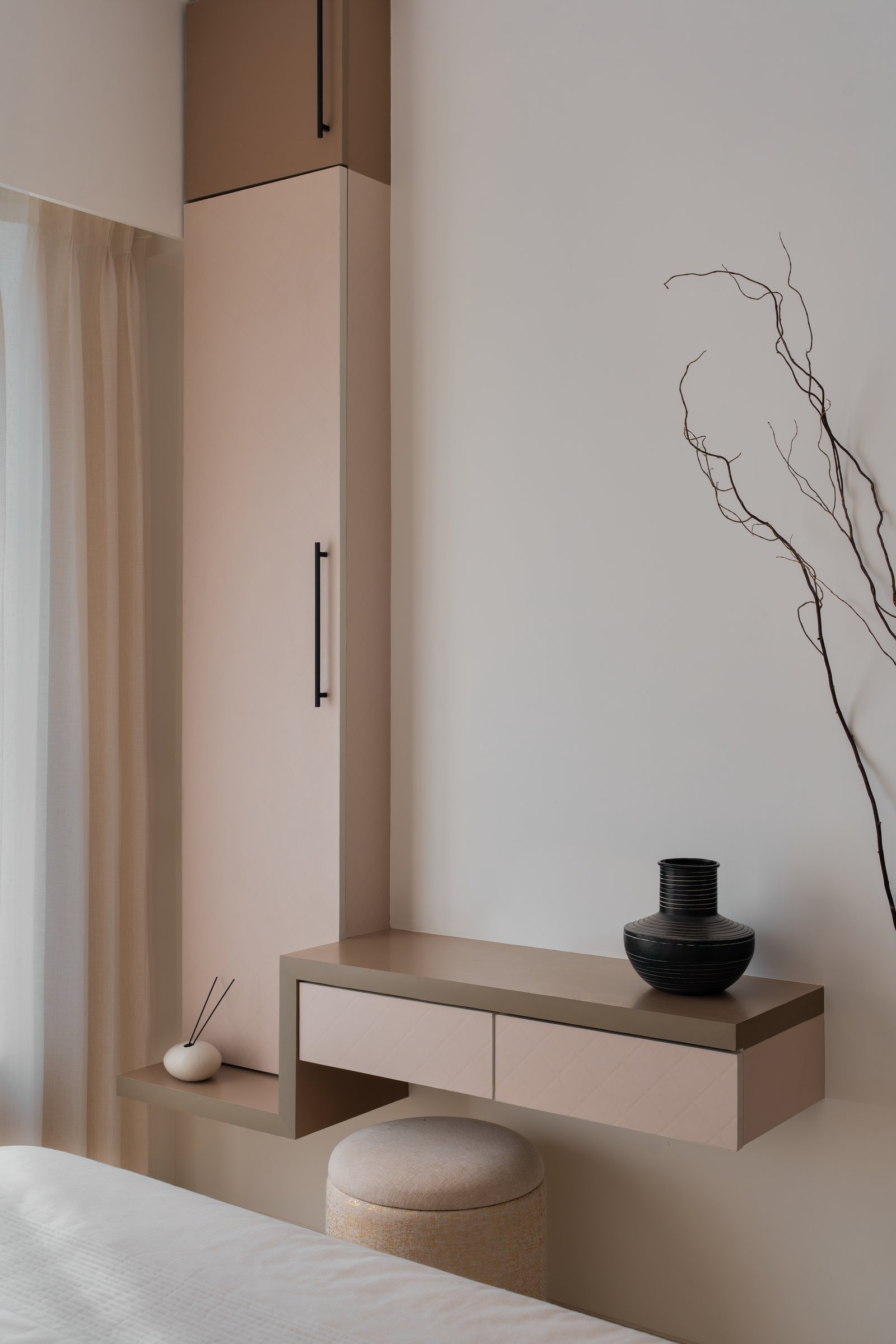
A floating console in muted taupe sits opposite the bed, paired with a tall slim wardrobe in the same finish. The dressing surface holds little more than a black ceramic vessel and a few twigs, an arrangement that lets the cabinetry’s proportions do the work.
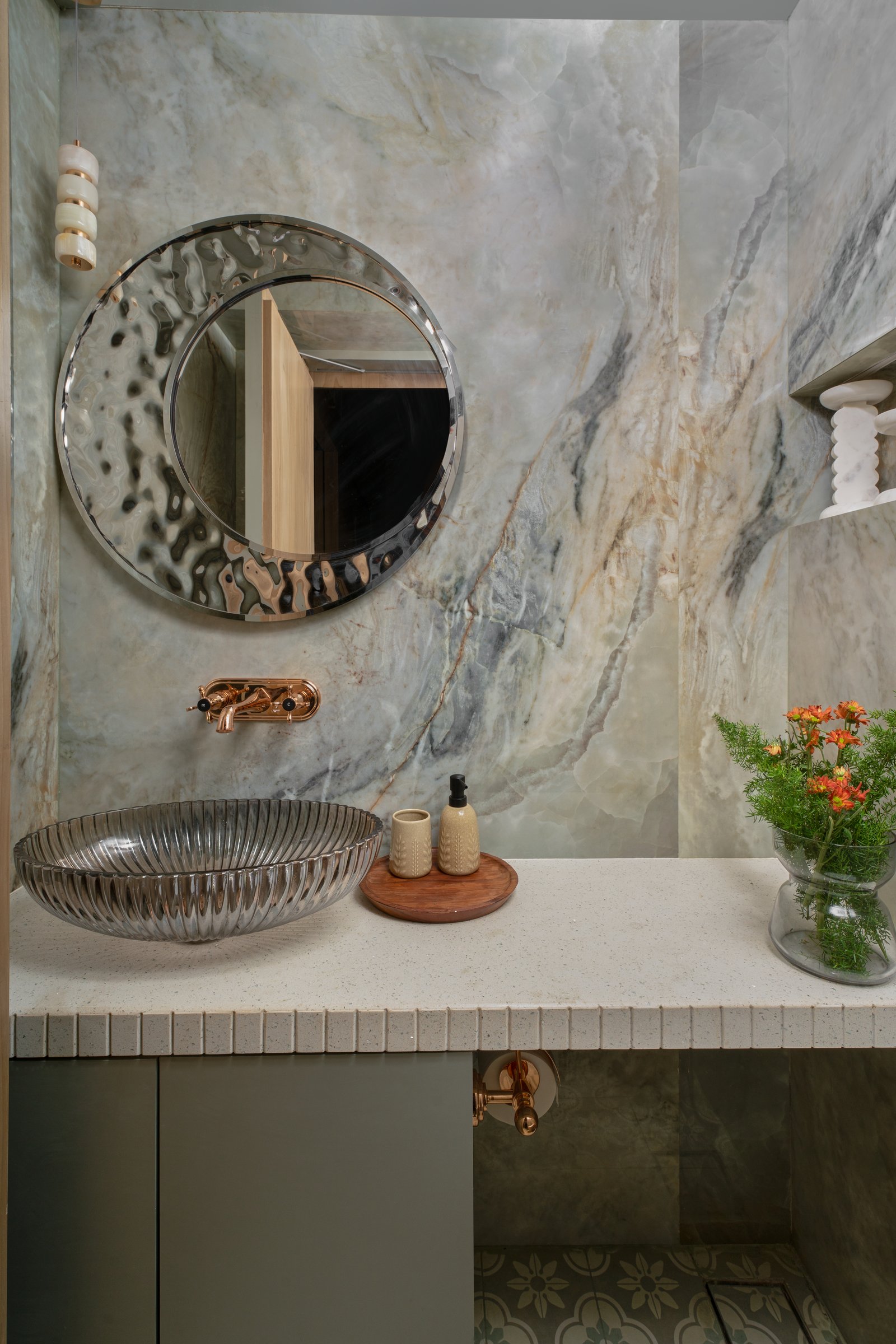
The powder bathroom is where the design permits itself genuine drama. Veined stone slabs wrap the walls in cool, painterly washes, met by a hammered-glass basin and a wall-mounted rose-gold tap that reads almost as jewellery.
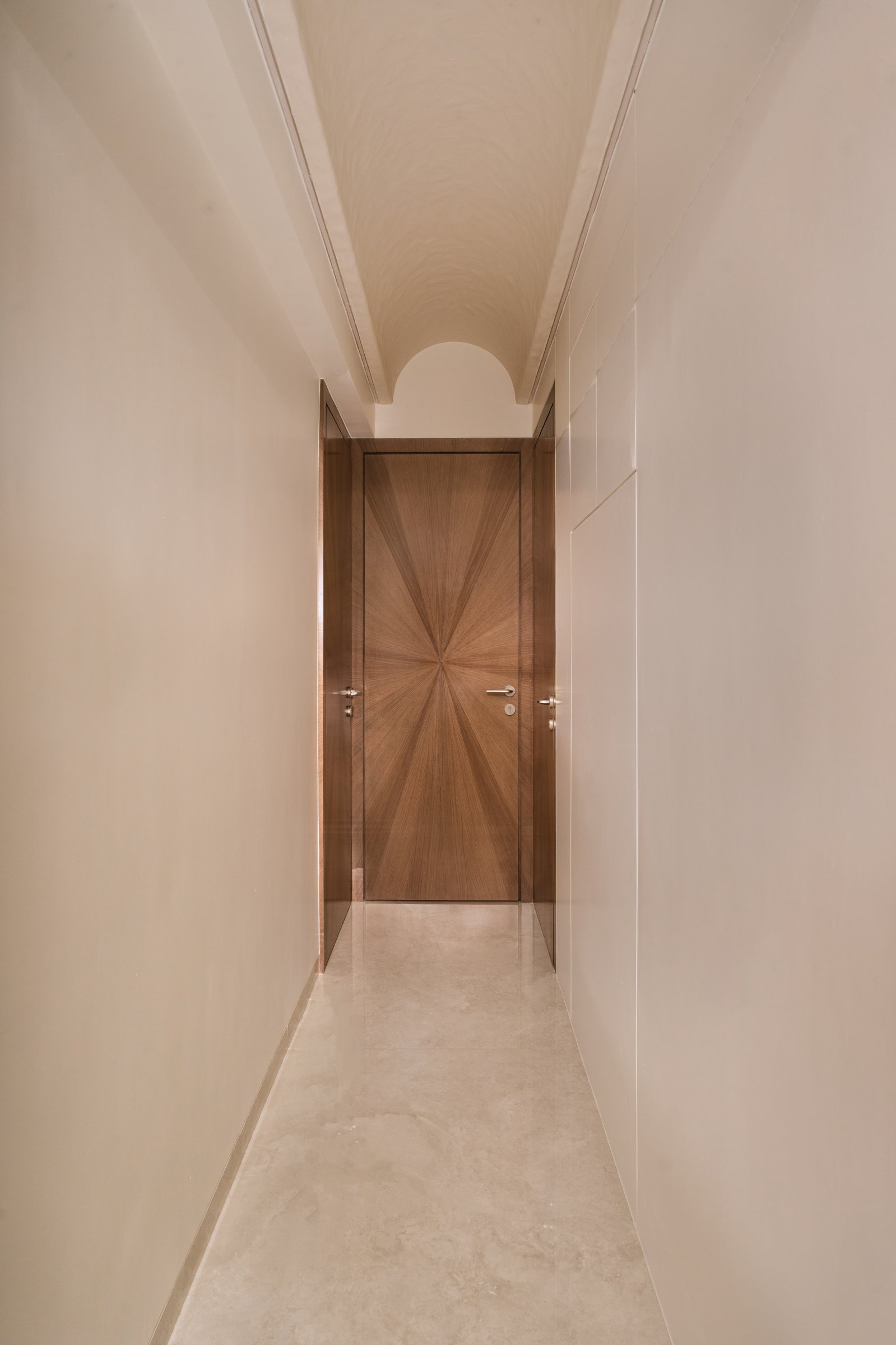
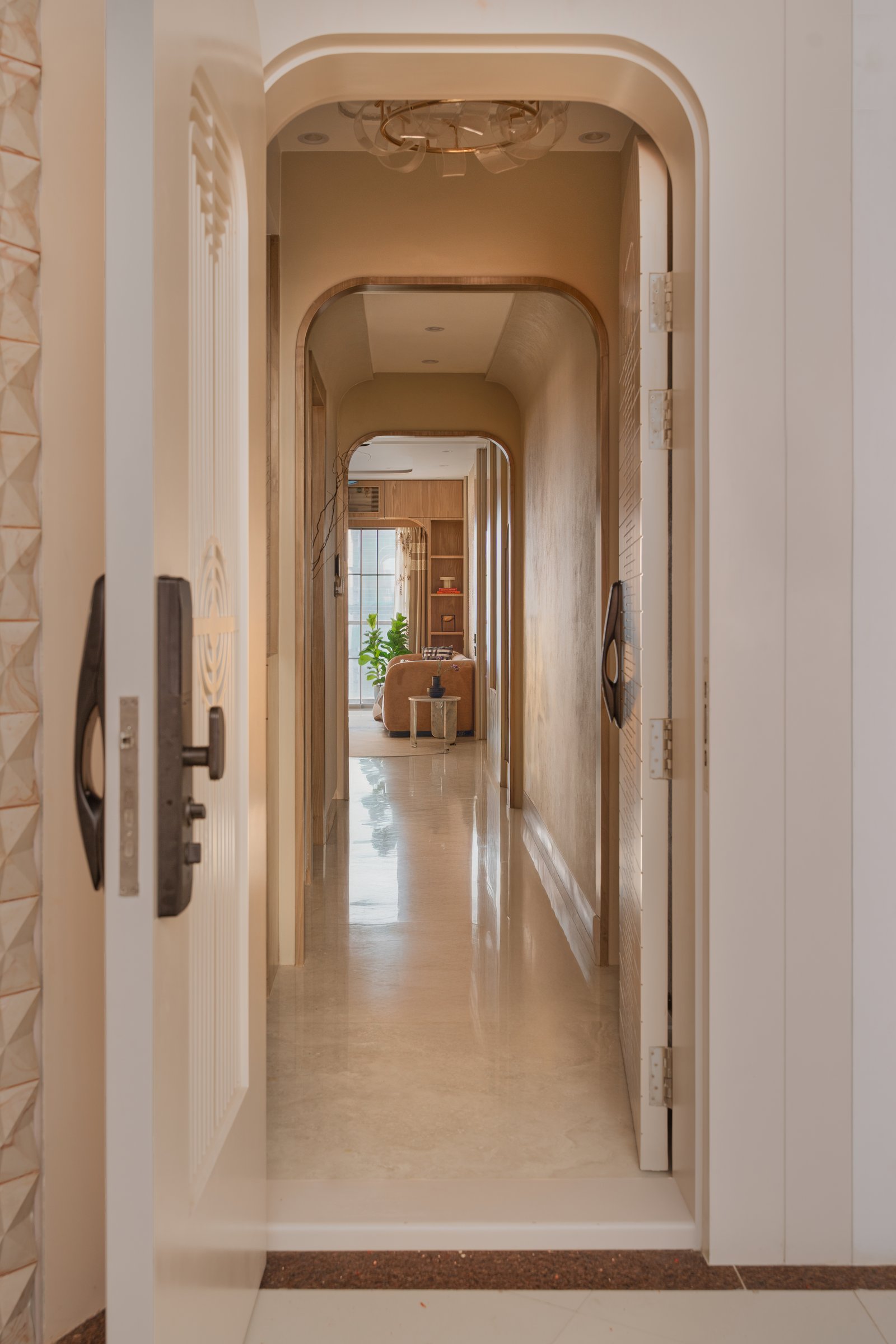
A final view of the internal passage shows a sunburst-veneer door at the corridor’s end, the wood’s radiating grain offering a quiet moment of geometry against the apartment’s otherwise unornamented walls. The arched ceiling vault above it is the last reminder that, in this home, even circulation is given an architectural gesture.
Within the current landscape of Mumbai’s apartment interiors, where compact plans are often resolved either through visual minimalism or through a hard pivot to maximalism, The Lucent Home occupies a more interesting middle position. It is committed to softness without slipping into preciousness, and it is unembarrassed about its devotional and cultural references while keeping them inside the design language rather than appended to it.
What MM Studio has produced here is a young practice’s case for a particular kind of restraint: one in which curves do the work that ornament might once have done, and in which colour is metered out room by room rather than imposed across a single palette. The result is a home that feels both calibrated and lived-in, and that suggests the studio has a clear and patient idea of what its work should feel like.