A home conceived by a furniture studio operates on a different logic. The walls do not come first and the objects do not follow; the two are imagined together, drawn at the same table, fabricated under the same roof. The result is a continuity that is difficult to manufacture in any other way.
This is the proposition behind Residence of Crafted Layers, a five-thousand-square-foot apartment in Noida designed by The Suite Life, a bespoke furniture brand that selectively undertakes full residential commissions. Led by designer Monika Goyal, the project was built for a family seeking a refined yet liveable home, and almost every panel, headboard, console, and partition was developed and manufactured in-house. What the studio describes as a furniture-first philosophy reads, in person, as a kind of compositional confidence: nothing in the home looks chosen, everything looks composed.
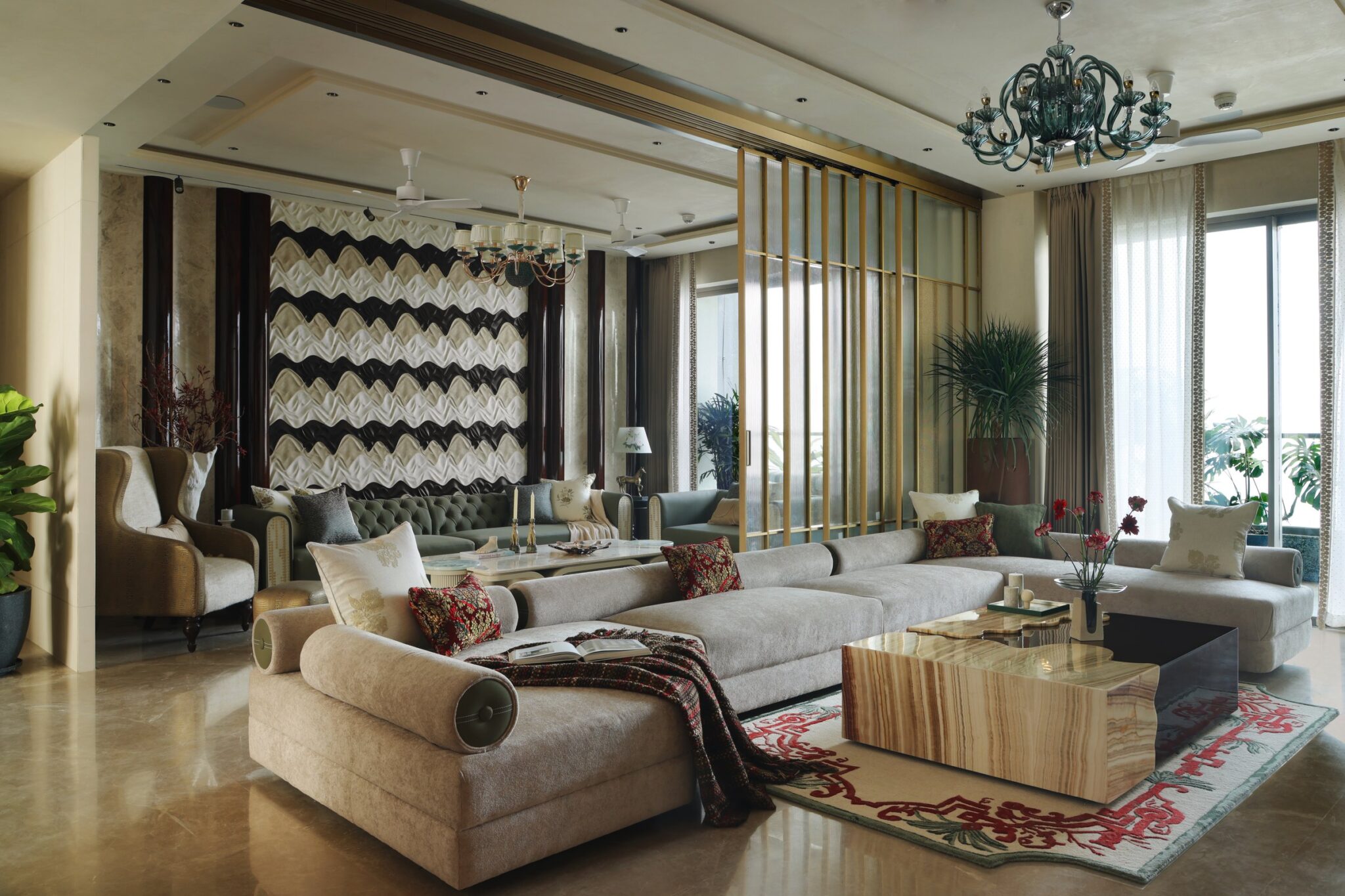
The living room makes the argument immediately. A sculptural feature wall in undulating black and ivory panels anchors the room behind a tufted sage-grey chesterfield, while an expansive cream sectional and a striated onyx coffee table establish the opposing edge of the conversation. The space is unmistakably formal, yet the sectional’s low, generous massing keeps the room from tipping into ceremony.
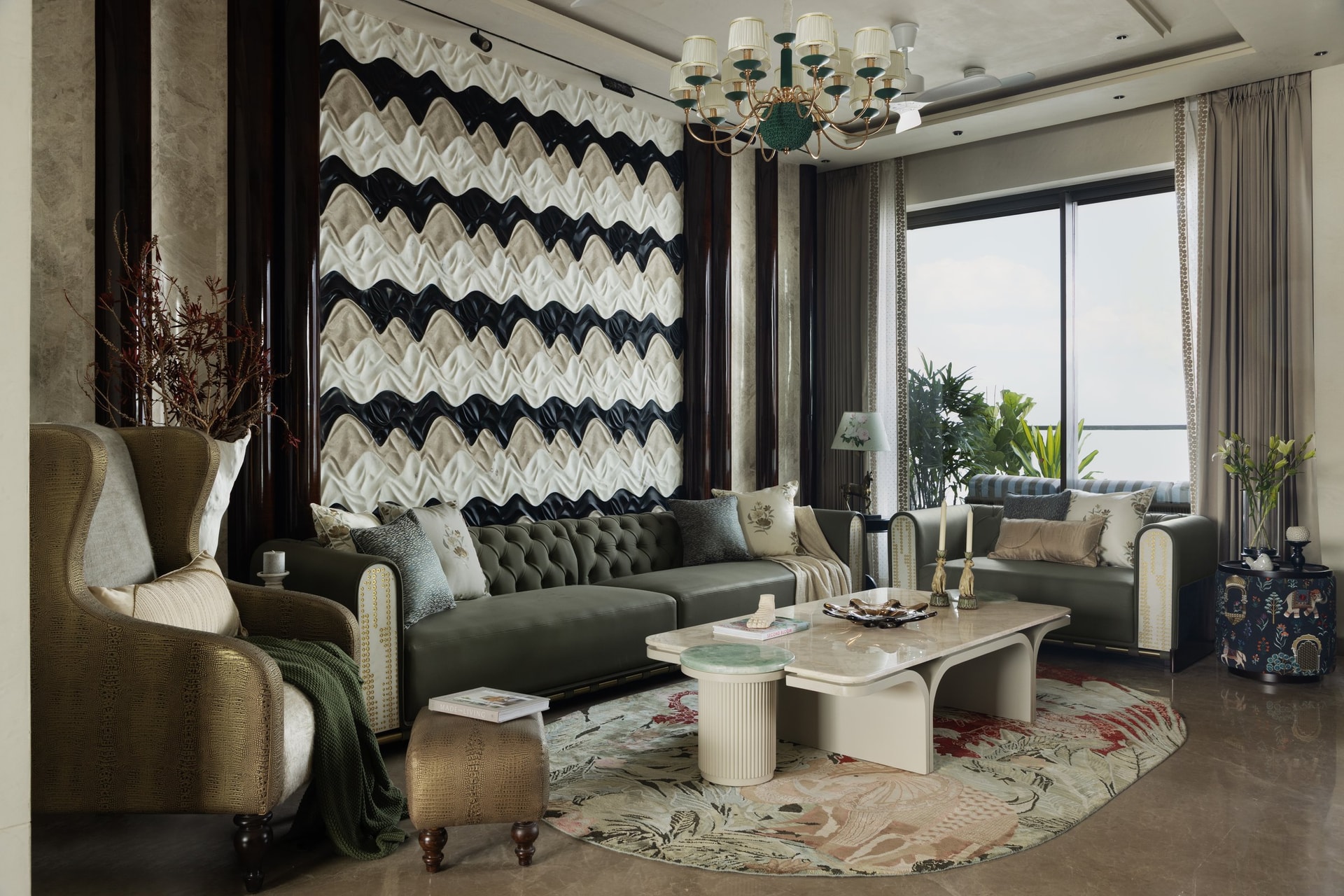
Seen from this angle, the wave-form panelling reveals itself as the room’s central piece of craft: a hand-detailed surface that behaves like sculpture rather than wallpaper. The chesterfield’s gilded stud detailing along its flanks and the textured wingback in bronze-olive crocodile-patterned upholstery extend the same conversation about ornament, treated here as structural rather than applied.
The living room is organised around two seating zones that face each other across a stone-and-cream coffee table. The dark fluted columns flanking the feature wall give the room its vertical lift, while the layered ceiling, with its inset trims and recessed lighting, holds the volume without flattening it.
““Furniture was not treated as an add-on. Each element was developed as part of an integrated system, ensuring continuity across spaces.””
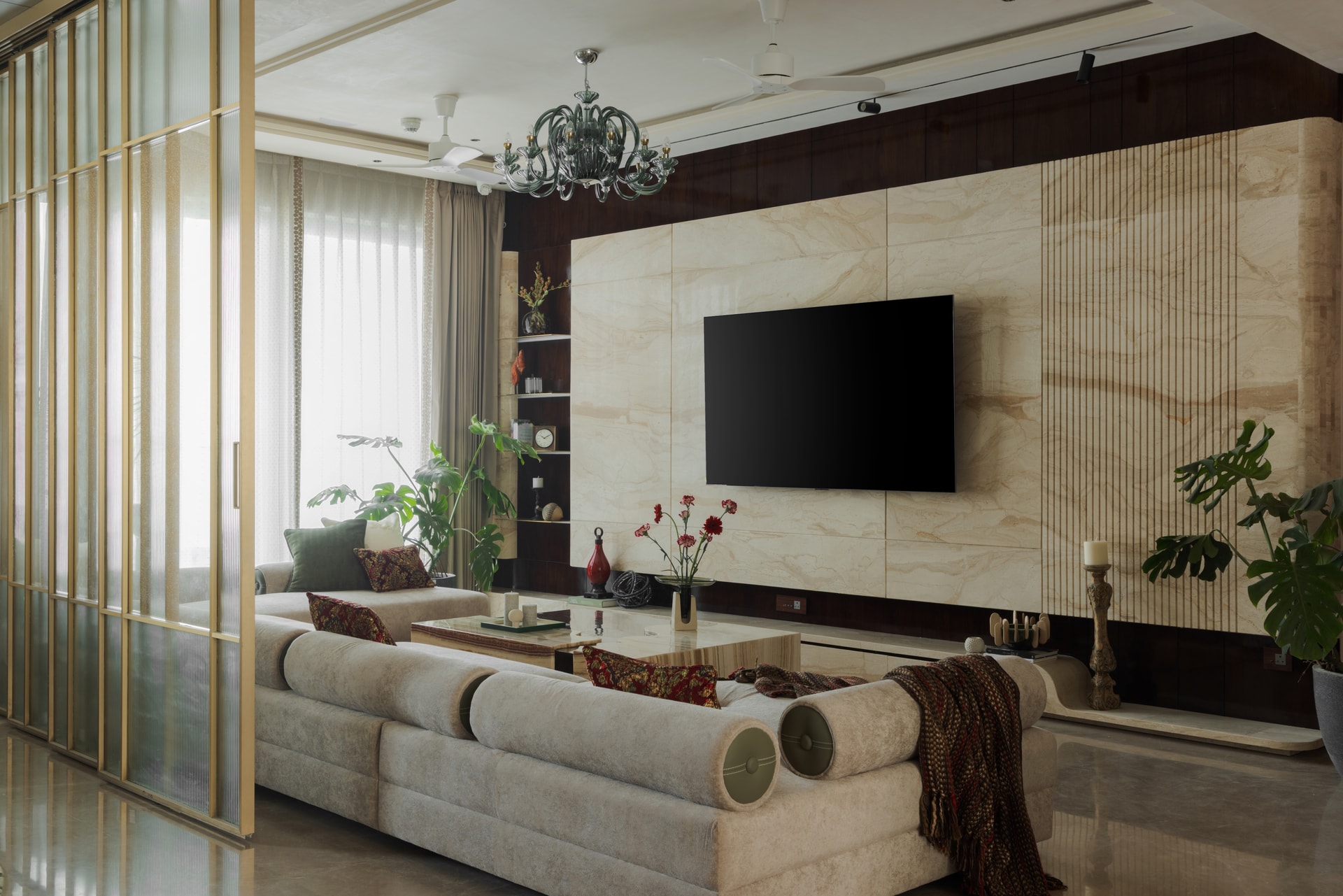
Turn the other way and the room shifts register entirely. A wide media wall in pale veined stone, framed by dark fluted panelling and slender reeded inserts, becomes the formal counterpoint to the wave wall behind. The brass-and-glass partition glimpsed at the edge separates this volume from the adjacent zone without closing it, a gesture that recurs throughout the home.
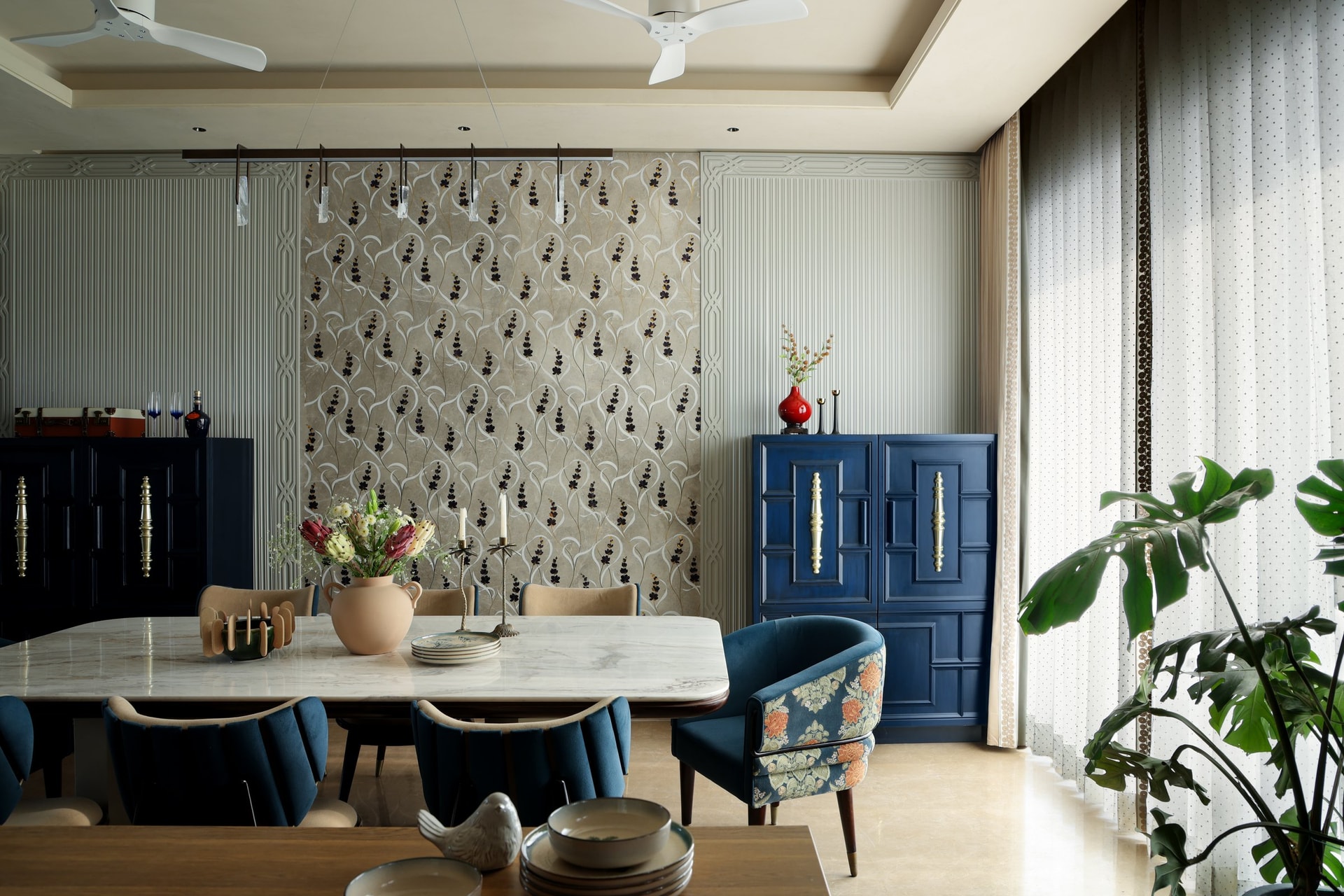
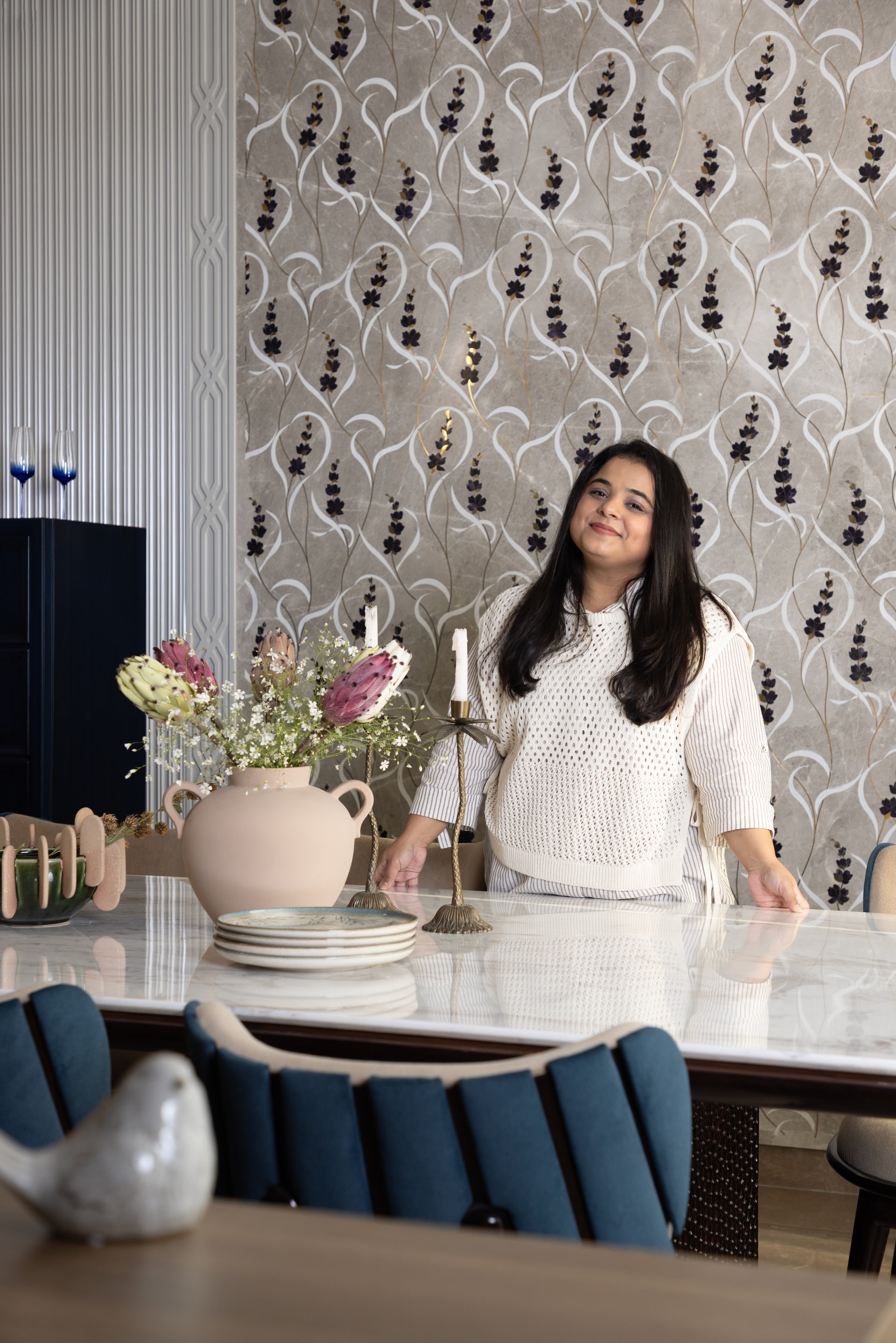
The dining room takes a different posture. Here, a patterned feature wall with trailing botanical motifs is set within a frame of ribbed cream panelling, and a deep cobalt cabinet with ornate ivory handles anchors one side of the marble-topped table. The chairs alternate between blue velvet and a printed floral upholstery, a layering that feels collected rather than coordinated.
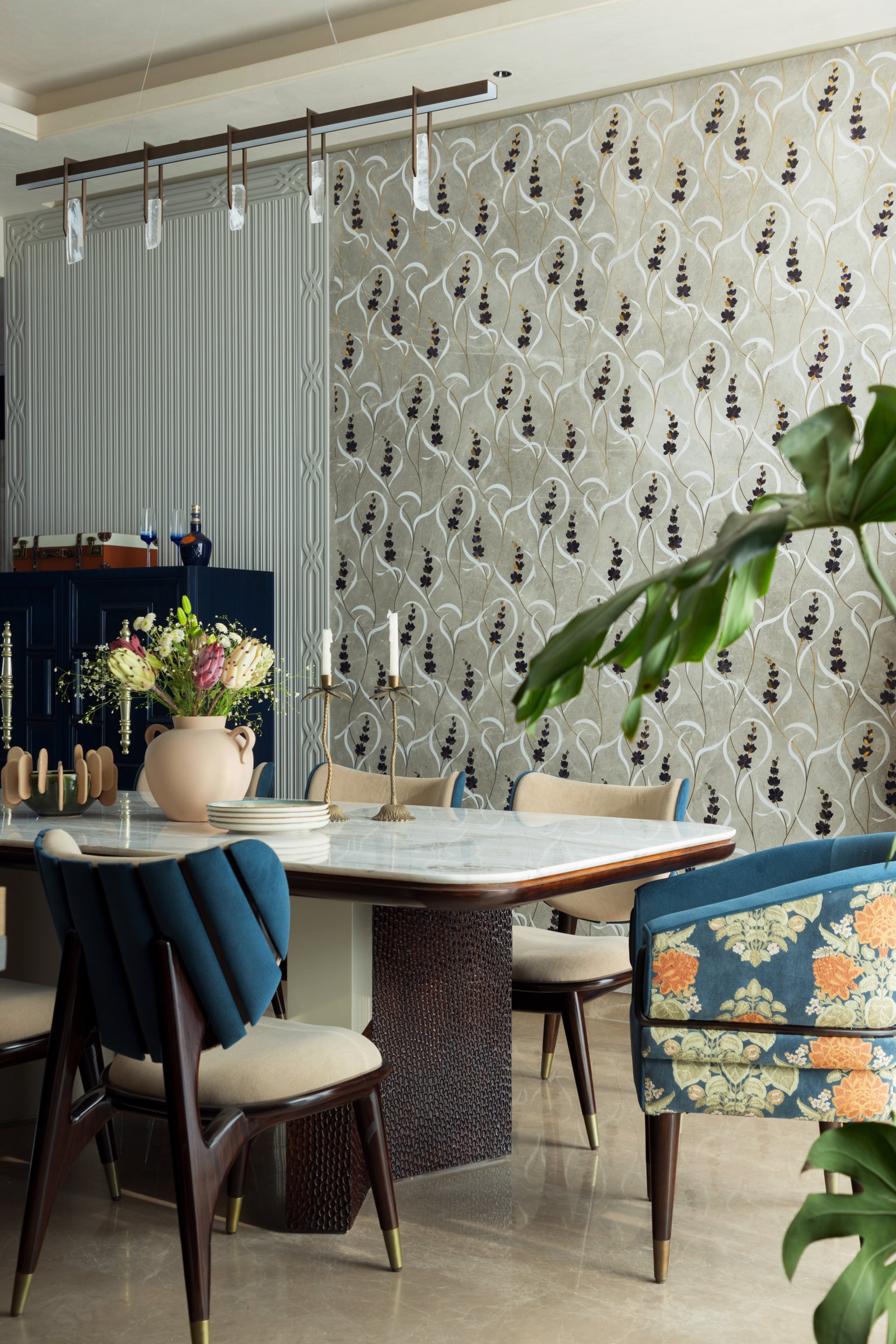
A closer read reveals how seriously the room takes its details. The dining table’s pedestal is finished in a dense, hand-textured surface that catches the light differently from every angle, and the suspended linear pendant carries small crystalline drops that gesture toward the wall’s pattern without mimicking it. The room is unafraid of decoration, and more importantly, unafraid of holding several decorative ideas at once.
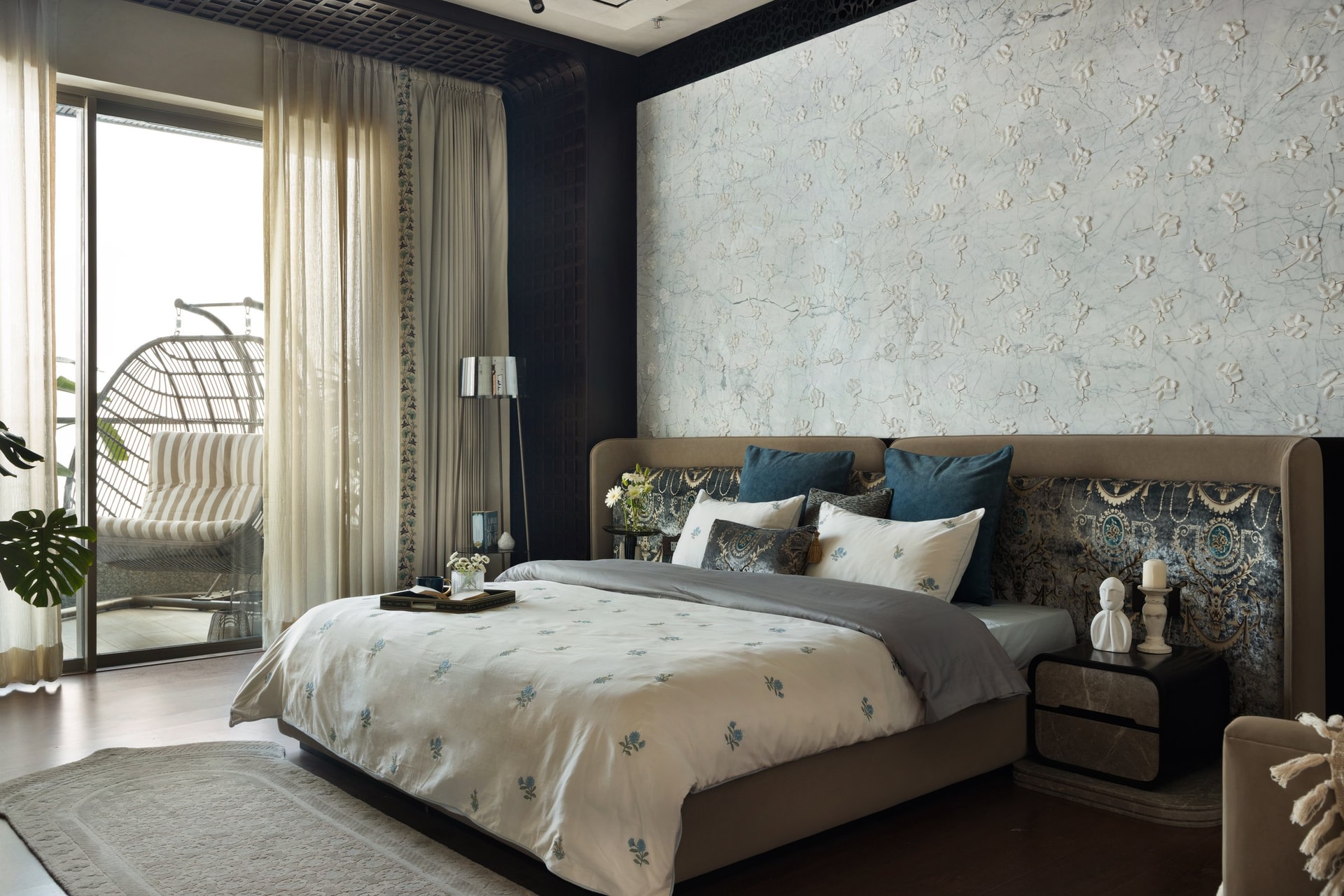
The master bedroom recalibrates the home’s volume into something quieter. A textured wall finish in pale grey-green, scattered with raised floral motifs, runs the full width behind the bed, while a tall lattice screen in dark wood frames the balcony beyond. The upholstered headboard, with its panel of antiqued damask print bordered in soft taupe, sits as the room’s compositional centre.
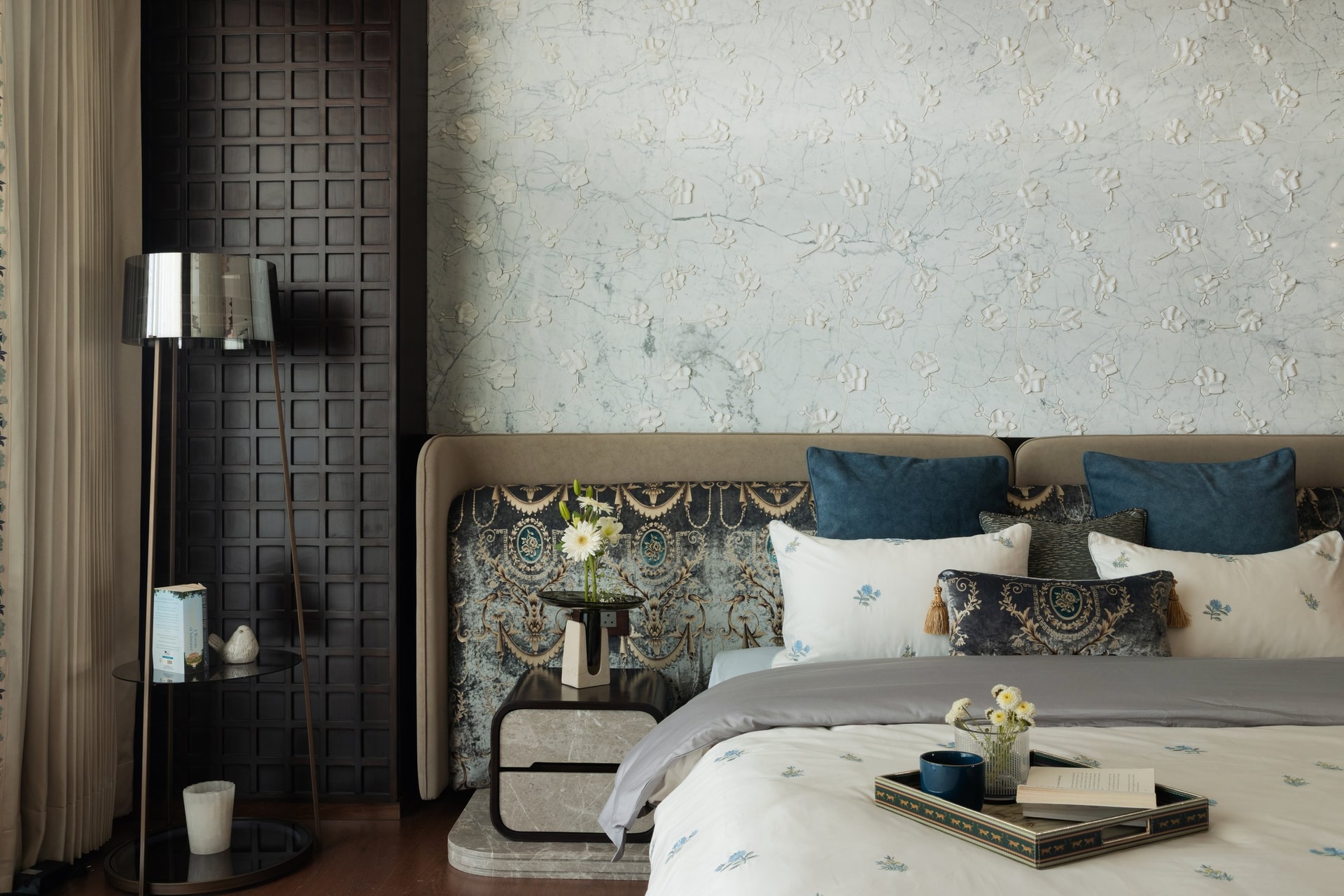
The headboard reveals itself as the project’s clearest statement of intent: upholstery, patterned fabric, and material detailing resolved as a single architectural element. The dark wood lattice beside it, lit softly from within the room, behaves less like a partition and more like a piece of millwork that happens to have depth.
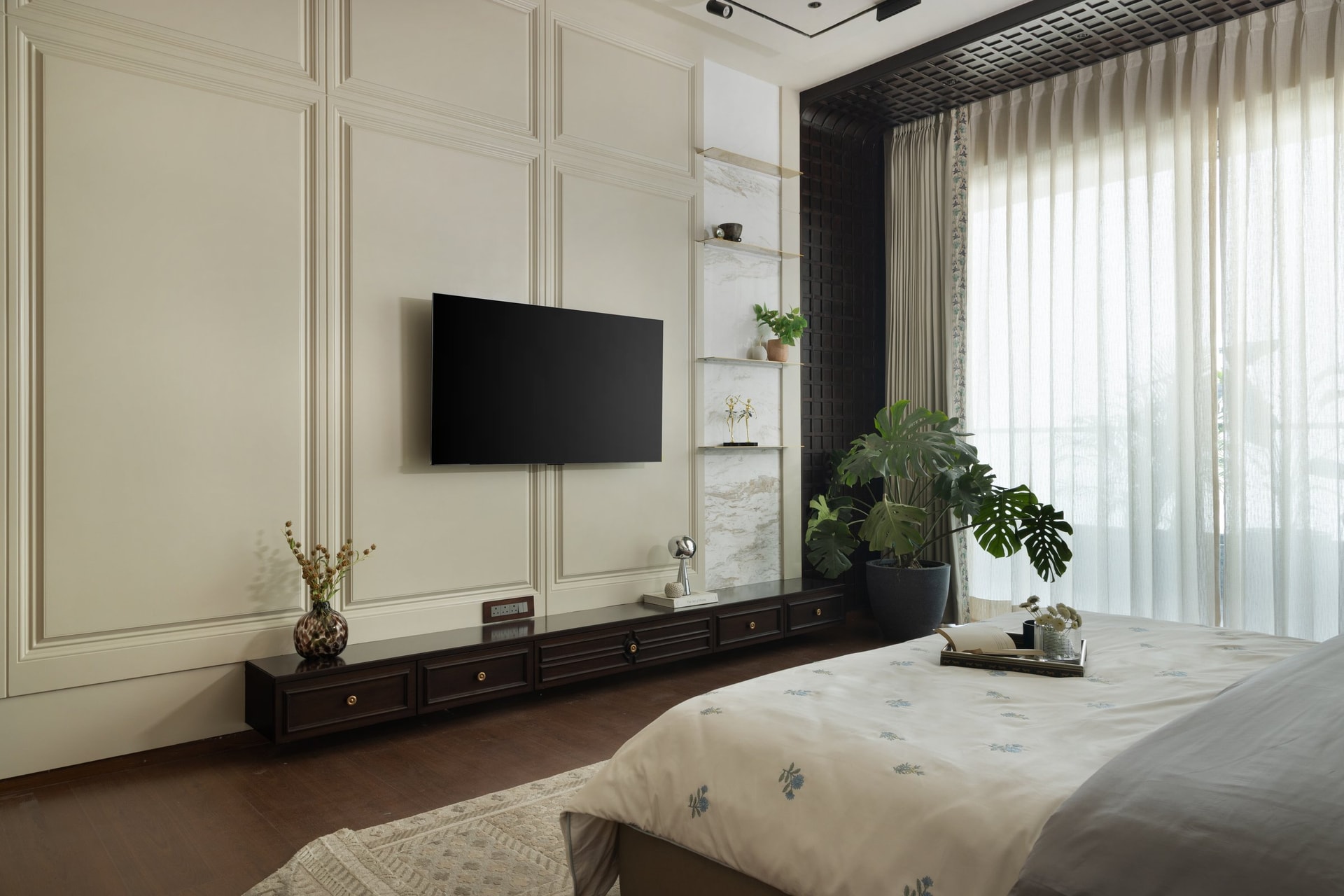
Opposite the bed, a panelled wall in warm ivory holds the television above a low, dark wood console with ribbed drawer fronts and small brass pulls. A slender niche of veined stone, bracketed with brass-edged shelves, sits between the panelling and the lattice screen. The room balances classical proportion with an unmistakably contemporary restraint.
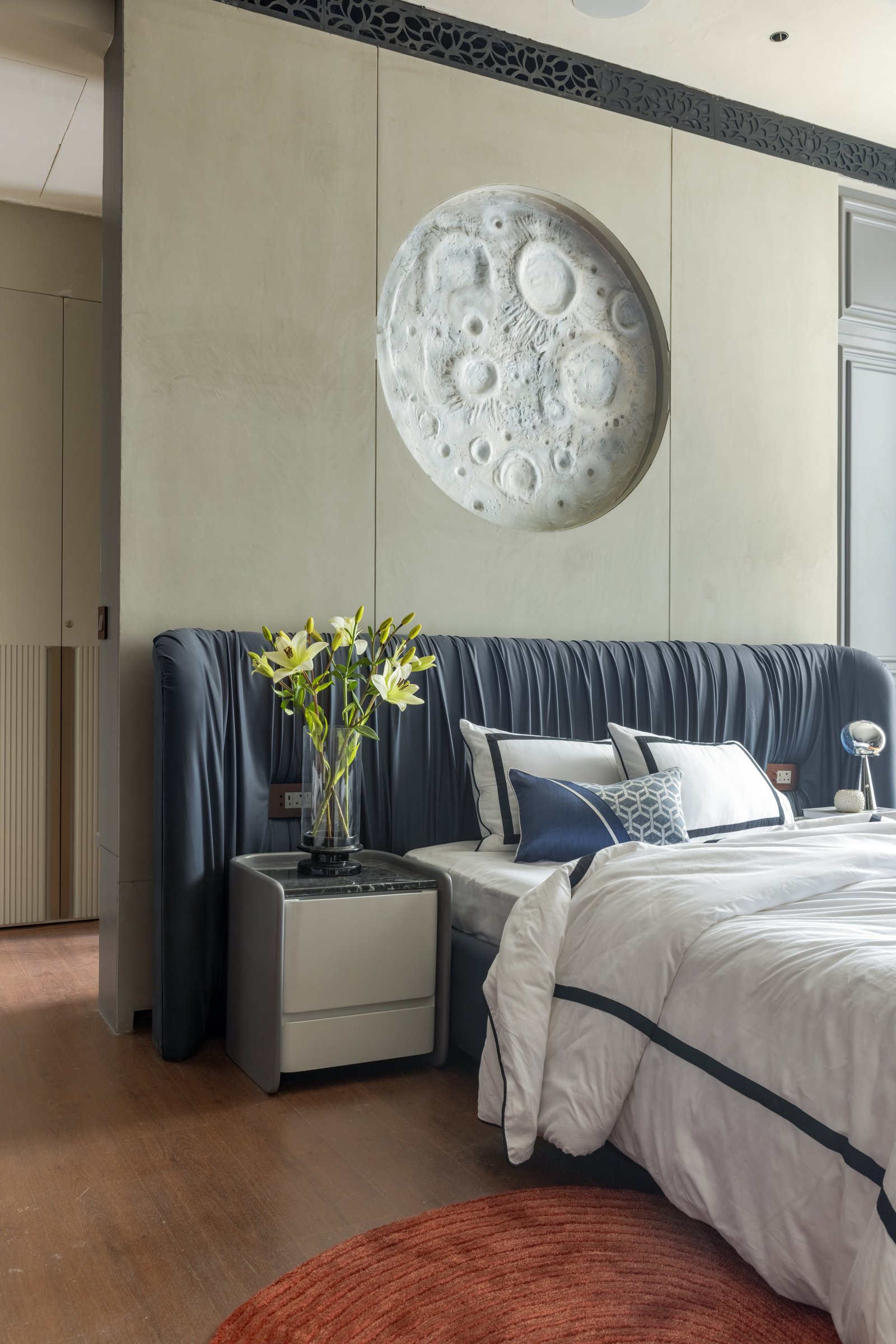
A second bedroom takes the home into a different register entirely. A deep navy headboard, gathered and draped along its full length, runs beneath a sculpted lunar relief mounted on a pale plaster wall. The bed linens in crisp white and dark navy keep the room disciplined, while the rounded nightstand in stone and lacquer brings a softer geometry to the corner.
What the project reveals about contemporary Indian residential design is the value of single-source authorship. When the furniture maker is also the interior designer, scale and proportion stop being approximations; the relationship between a sofa’s arm height and a wall’s panel rhythm becomes a decision rather than a coincidence. Noida, a city often associated with developer-led interiors, gains in this home an example of what fully bespoke fabrication can produce when given the whole canvas.
Residence of Crafted Layers does not insist on being remembered for any single gesture. Its case rests instead on the accumulation of decisions, the wave wall and the lattice screen and the cobalt cabinet and the lunar relief, each made to a standard that the next one is then obliged to meet. The home is, in the most literal sense, designed rather than assembled.