Radiance, in the architectural sense, is rarely a matter of brightness alone. It is a question of how a home receives light, how it holds it, and what it chooses to do with the silence between one room and the next. Dhyuthi, whose name translates to radiance, takes this question as its central premise.
Conceived by Nth Collective and led by Ar. Ananth Jayaraj, this four-bedroom residence in Palakkad spans 2,600 square feet and adopts what the studio describes as a contemporary tropical approach. The design rests on a quiet thesis: that openness, when paired with restraint, can produce something closer to grace than grandeur. Double-height volumes, courtyards, and a measured palette of wood, stone, and patterned tile do the work of carrying that argument through the home.
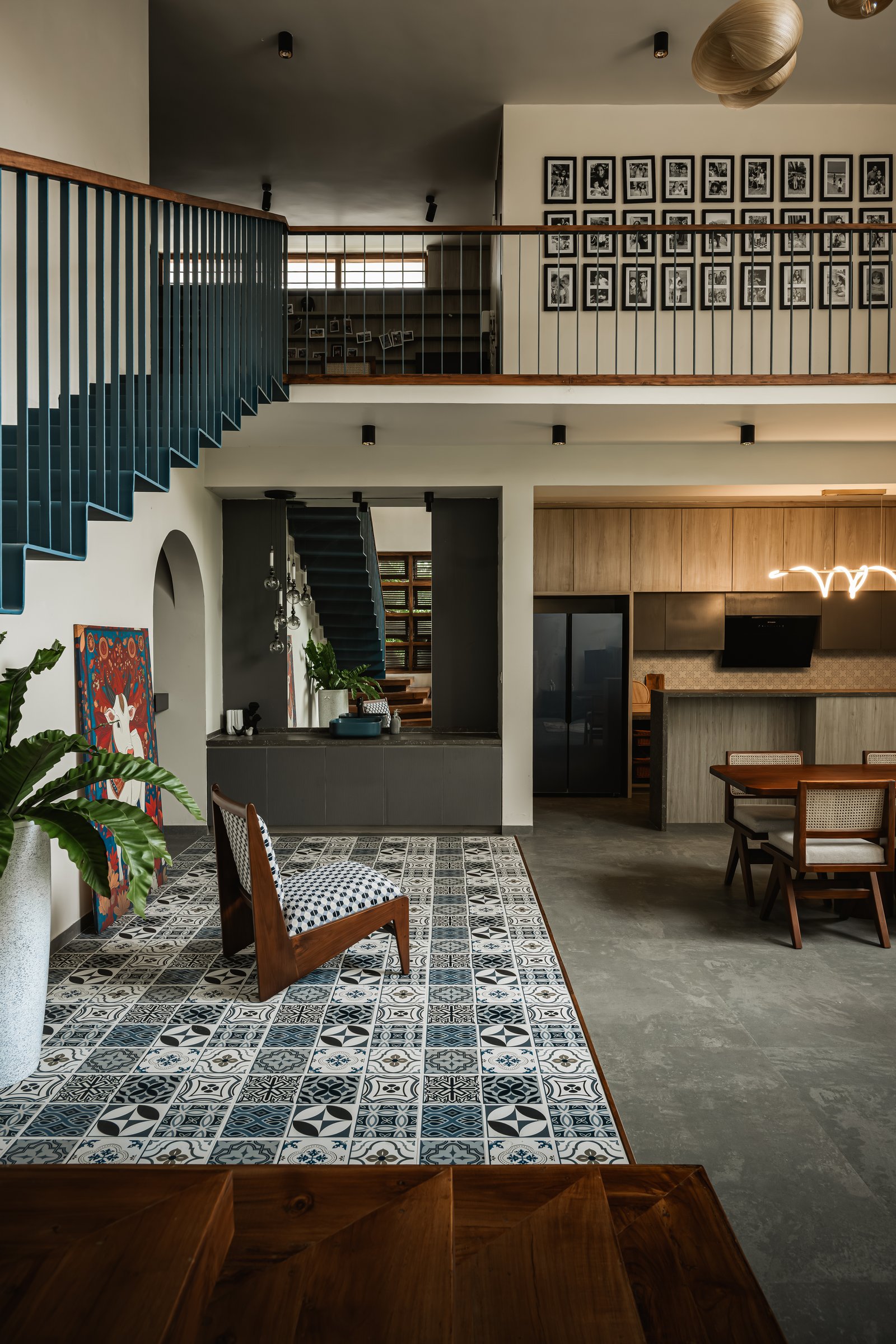
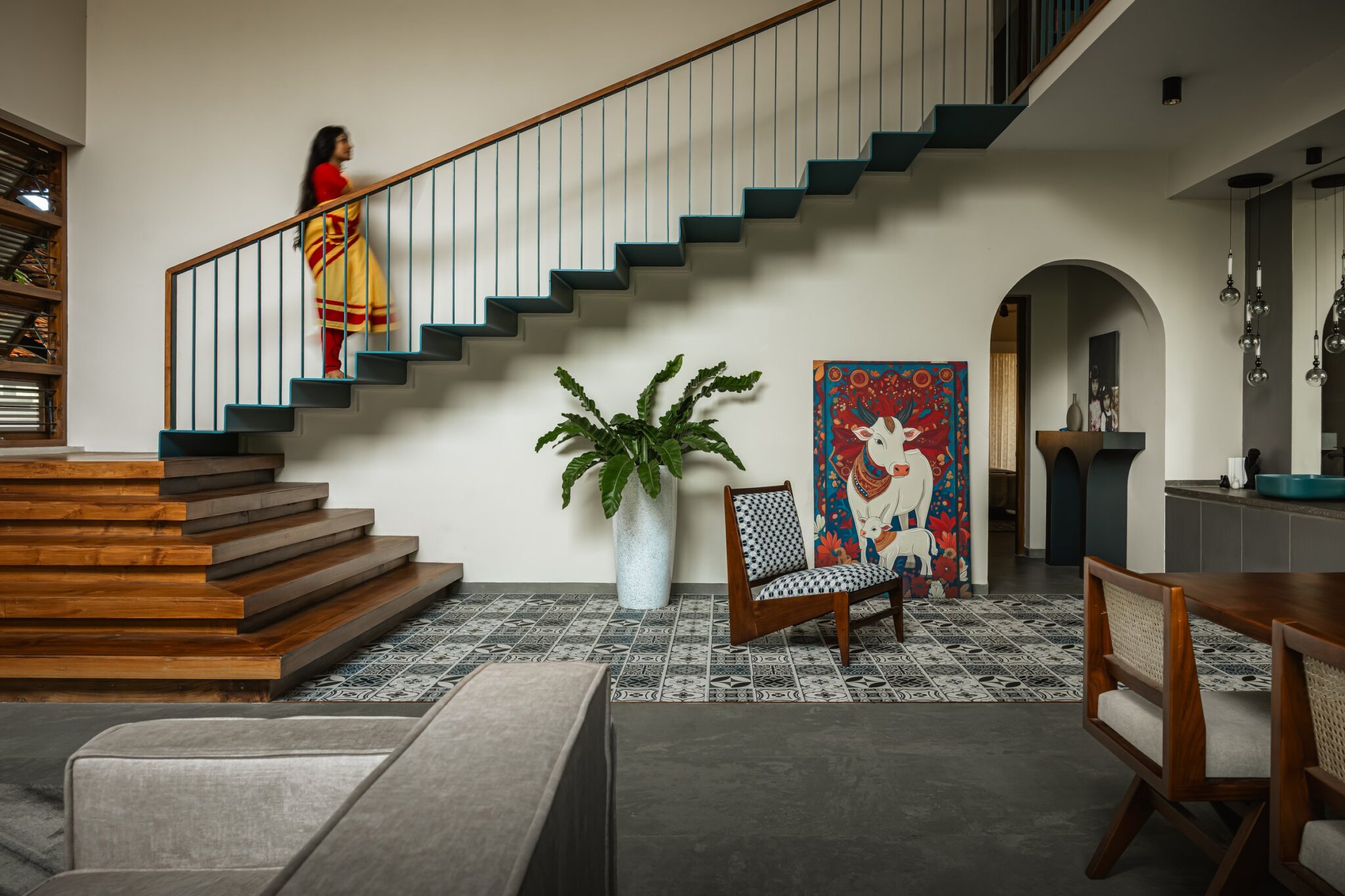
The double-height living volume is the project’s clearest statement of intent. A cantilevered staircase in deep teal-grey traces a diagonal across one side of the room while a mezzanine gallery, lined with framed family photographs, faces it from above; between them, the room breathes upward into a height it does not flaunt.
The patterned encaustic tile floor, rendered in muted indigos and graphite against cream, acts as a tethering device. It maps a zone of stillness for a low Chandigarh-style chair and grounds the otherwise vertical drama of the space.
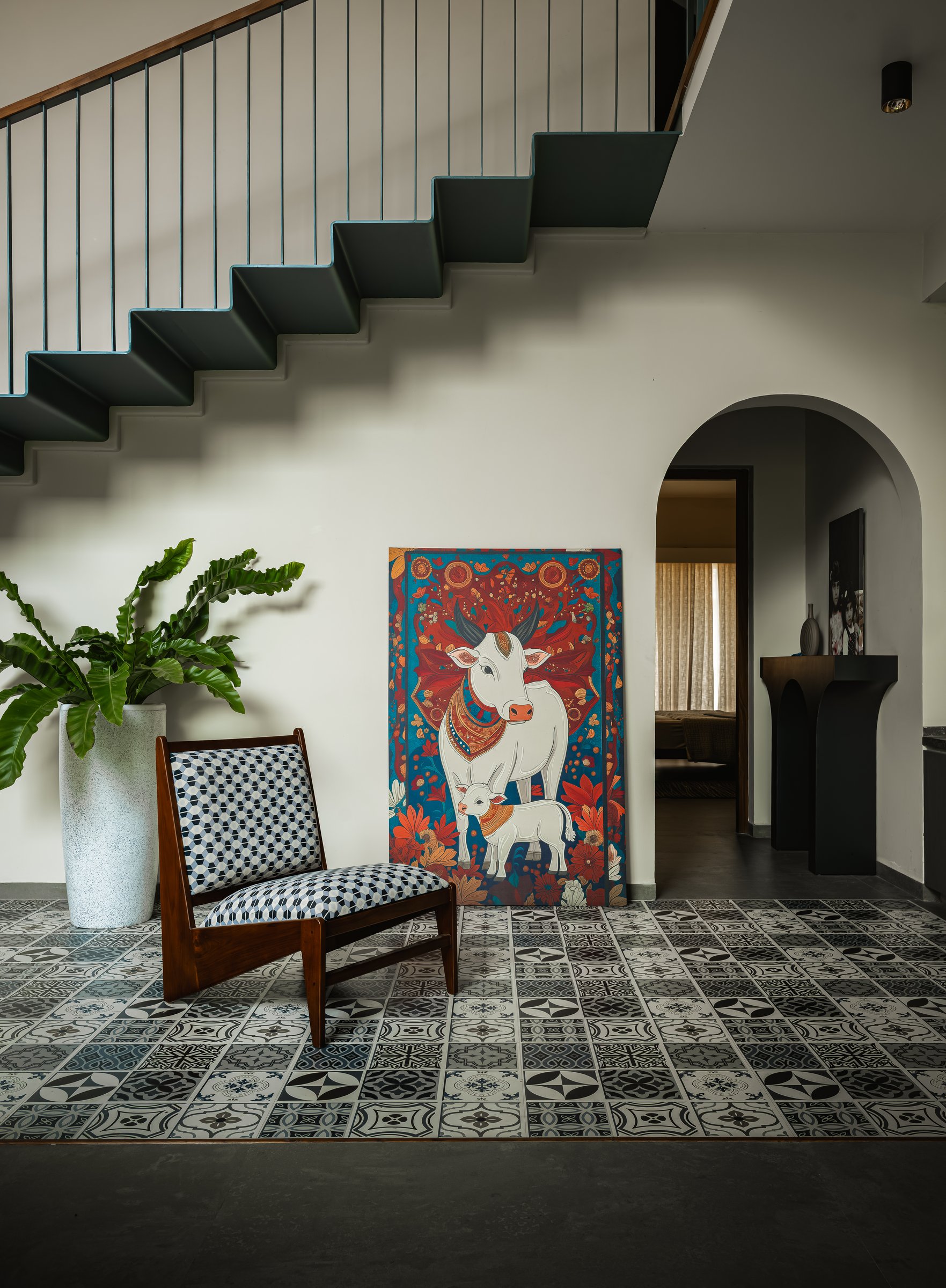
At the foyer, the staircase reads almost as sculpture. A vivid Pichwai-inspired canvas leans casually against the wall beneath the rising treads, while an arched opening to the adjacent zone introduces the home’s recurring vocabulary of softened geometry.
The decision to lean the artwork rather than hang it is telling. It signals a household that lives with its objects rather than enshrines them, and the small chair set beside it suggests this is a corner that gets used, not merely photographed.
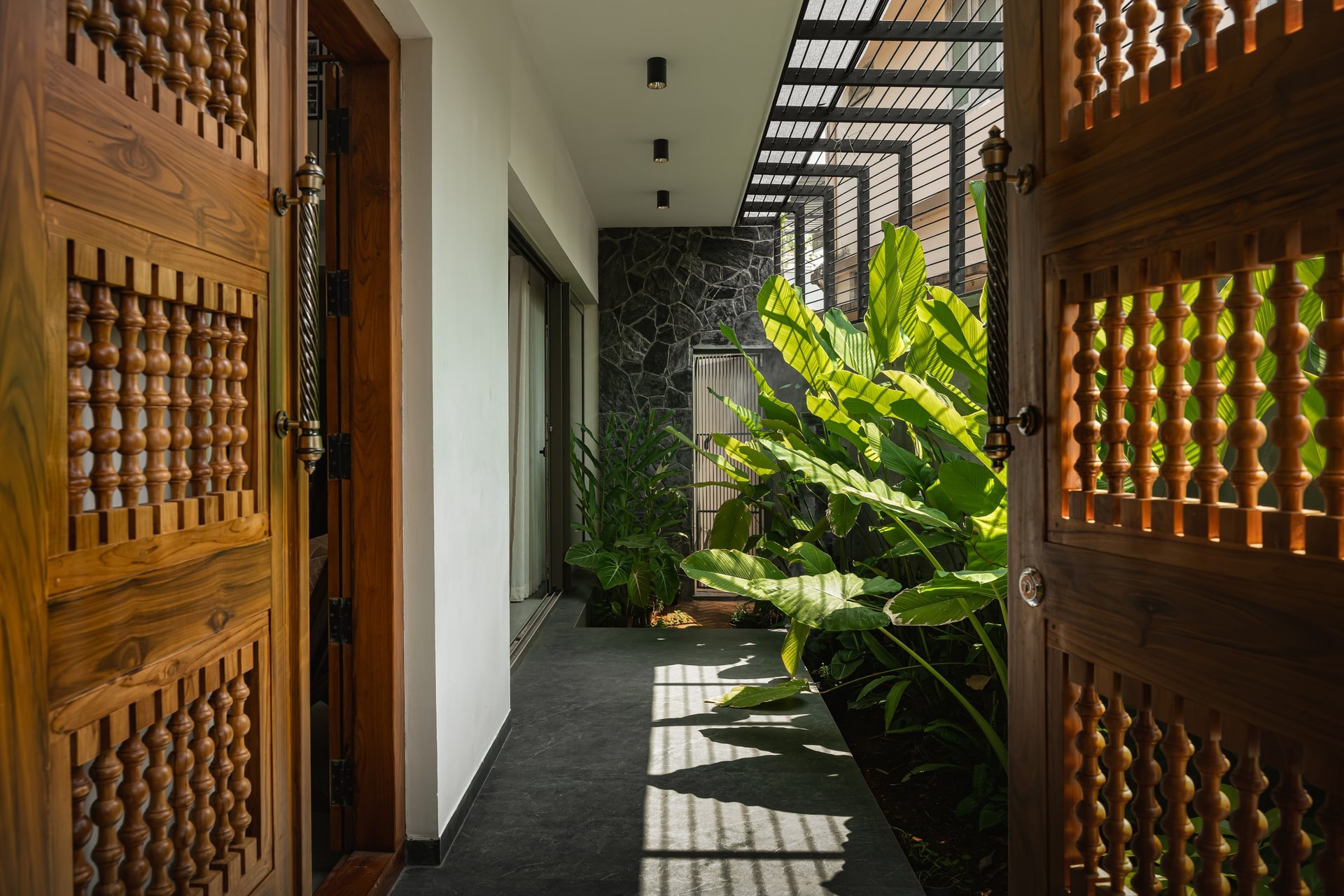
The entry sequence itself is a piece of tropical thinking. Carved spindled doors in honeyed wood open to a passage lined on one side by a planted strip of broad-leaved foliage, with a dark stone wall and a steel pergola overhead filtering the Kerala sun into striped patterns on the floor.
““Every space inside Dhyuthi is designed to feel connected, to light, to nature and to the people living within it.””
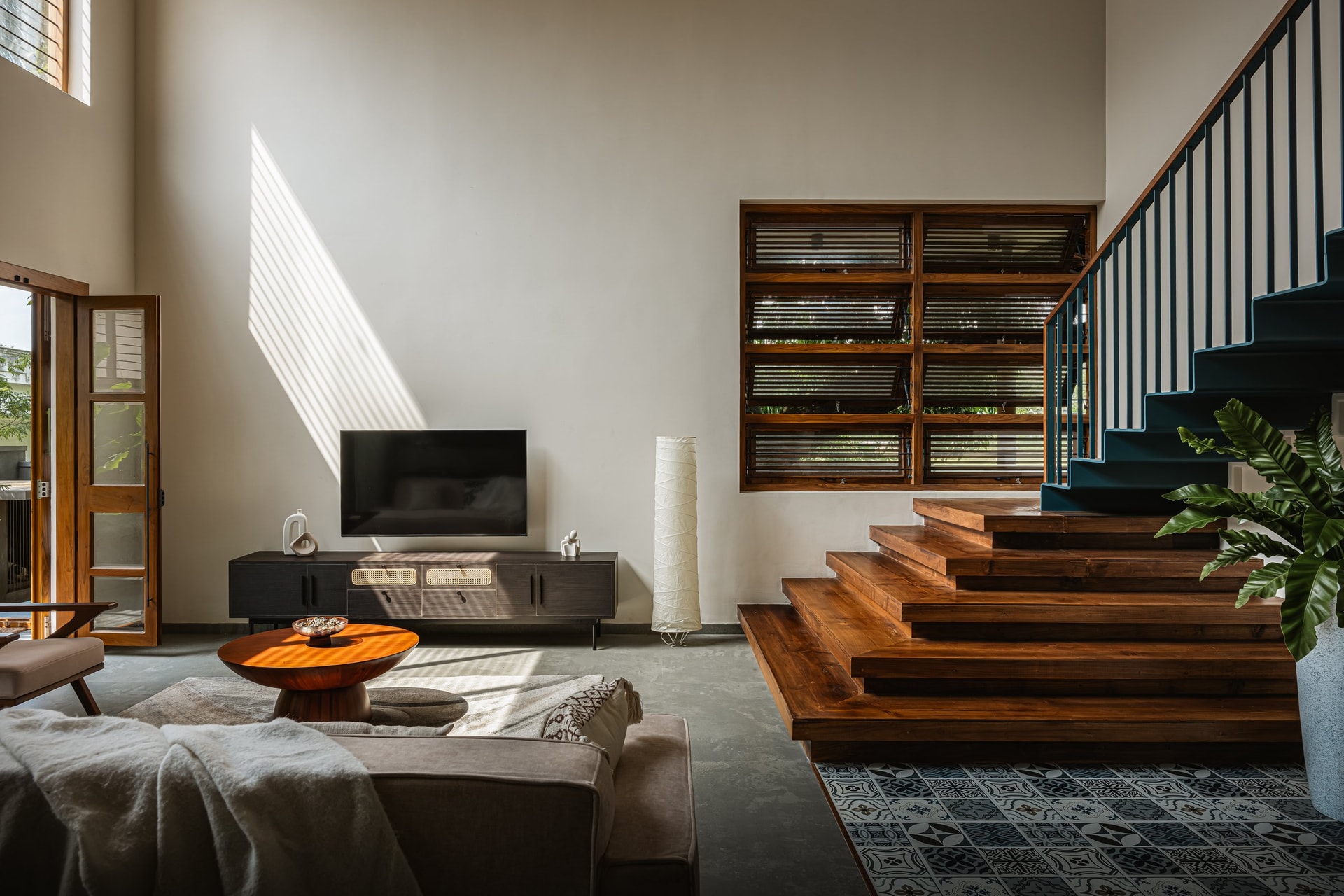
Back inside the living room, the volume reveals its second mood. A linen sofa sits low against the grey concrete-finished floor, and a slatted wooden window admits banded light onto the wall behind the television console, the geometry of which mirrors the staircase ascending alongside.
What makes this room work is its refusal to over-furnish. Two seating elements, a console, a paper-shade lamp, and the staircase itself do the entire job; the rest is left to light and proportion.
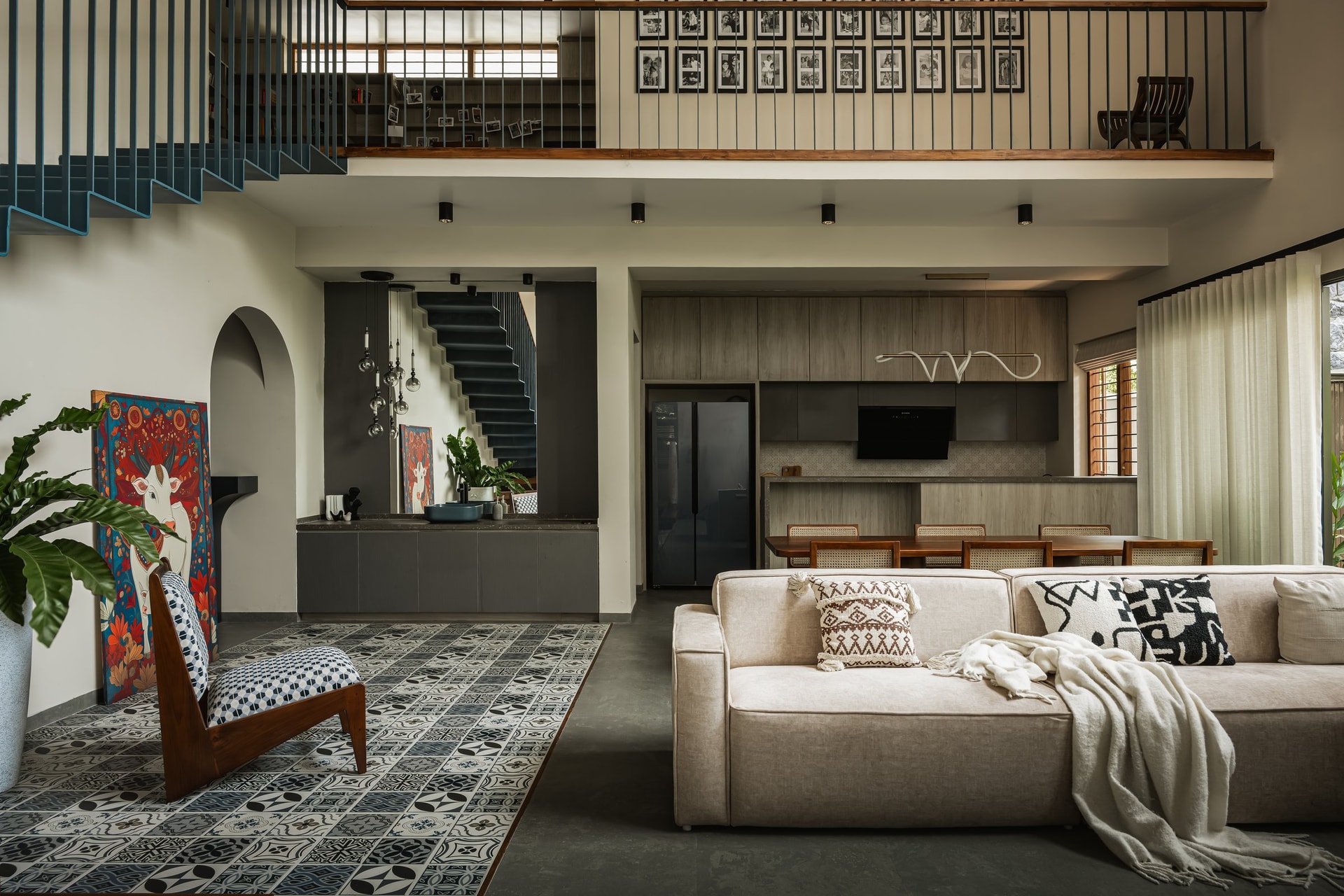
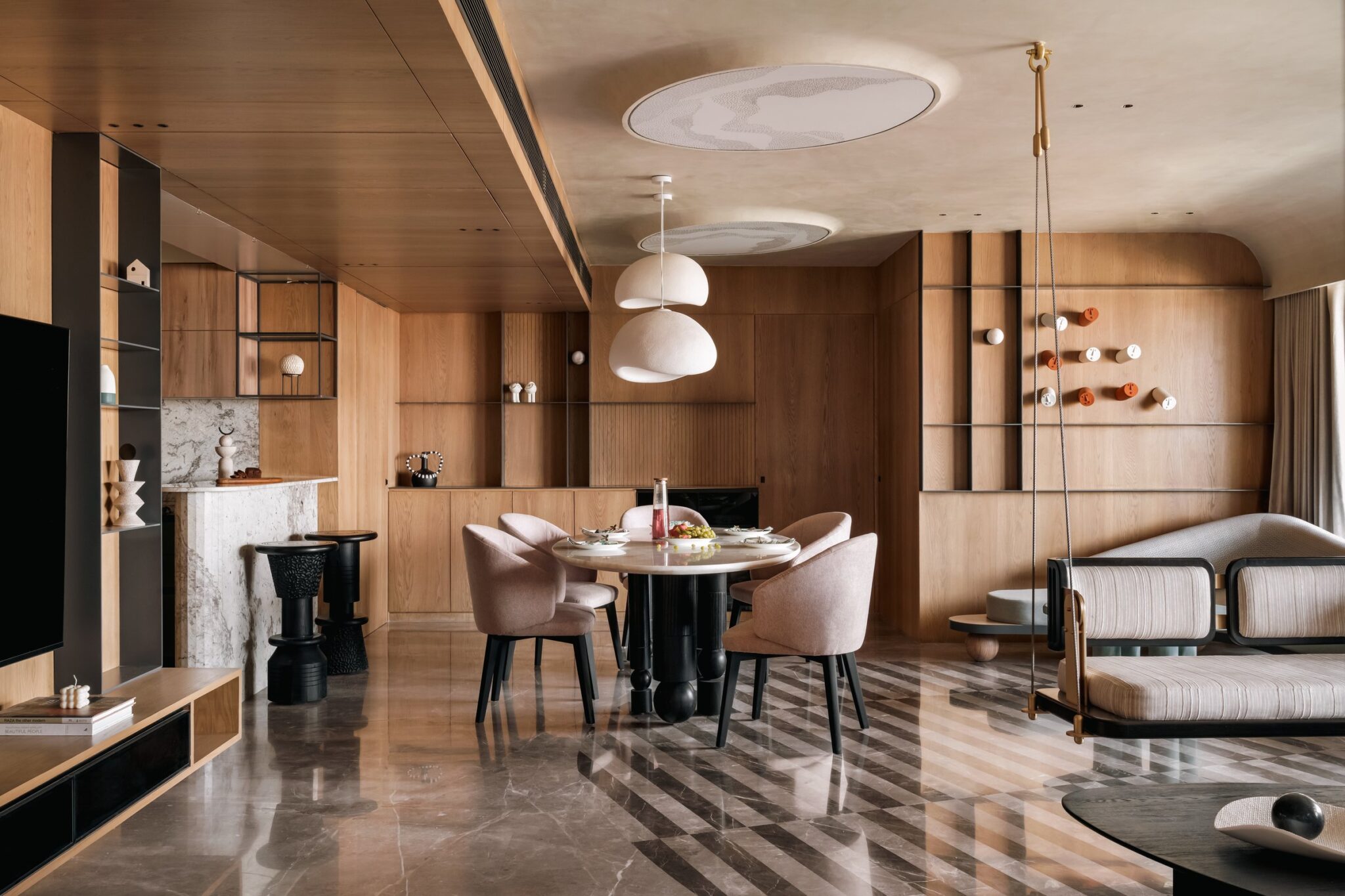
From a wider vantage, the social heart of the home reads as a single continuous gesture: living, dining, and kitchen unfold without partition, framed above by the mezzanine and its photo wall. The kitchen’s wood-toned cabinetry, the cane-backed dining chairs, and the patterned tile carpet all sit in conversation rather than competition.
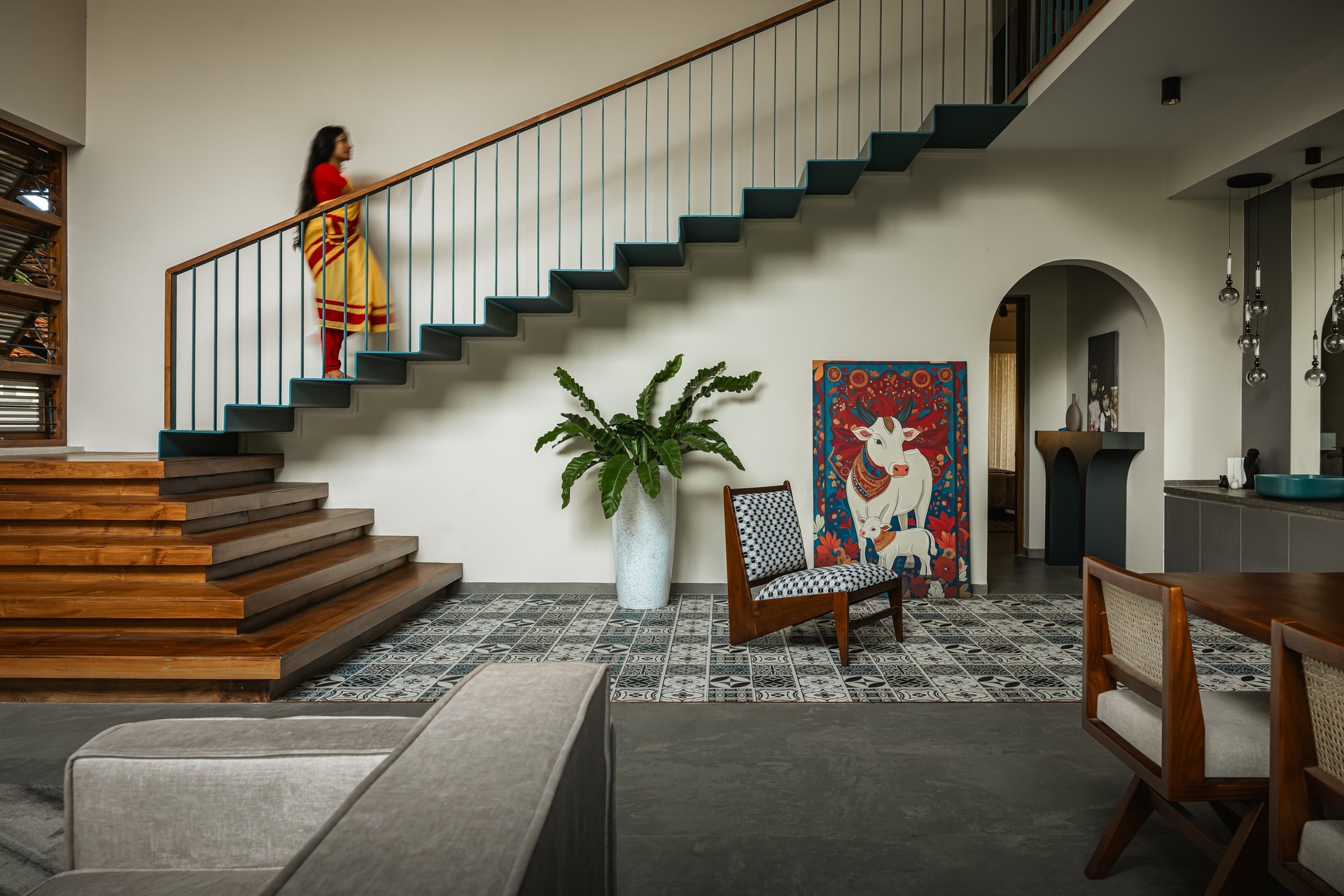
A figure ascending the staircase animates a scene that might otherwise read as still life. The treads are a hybrid of wood at the base and painted steel above, a transition the eye registers as both practical and poetic, ground giving way to flight.
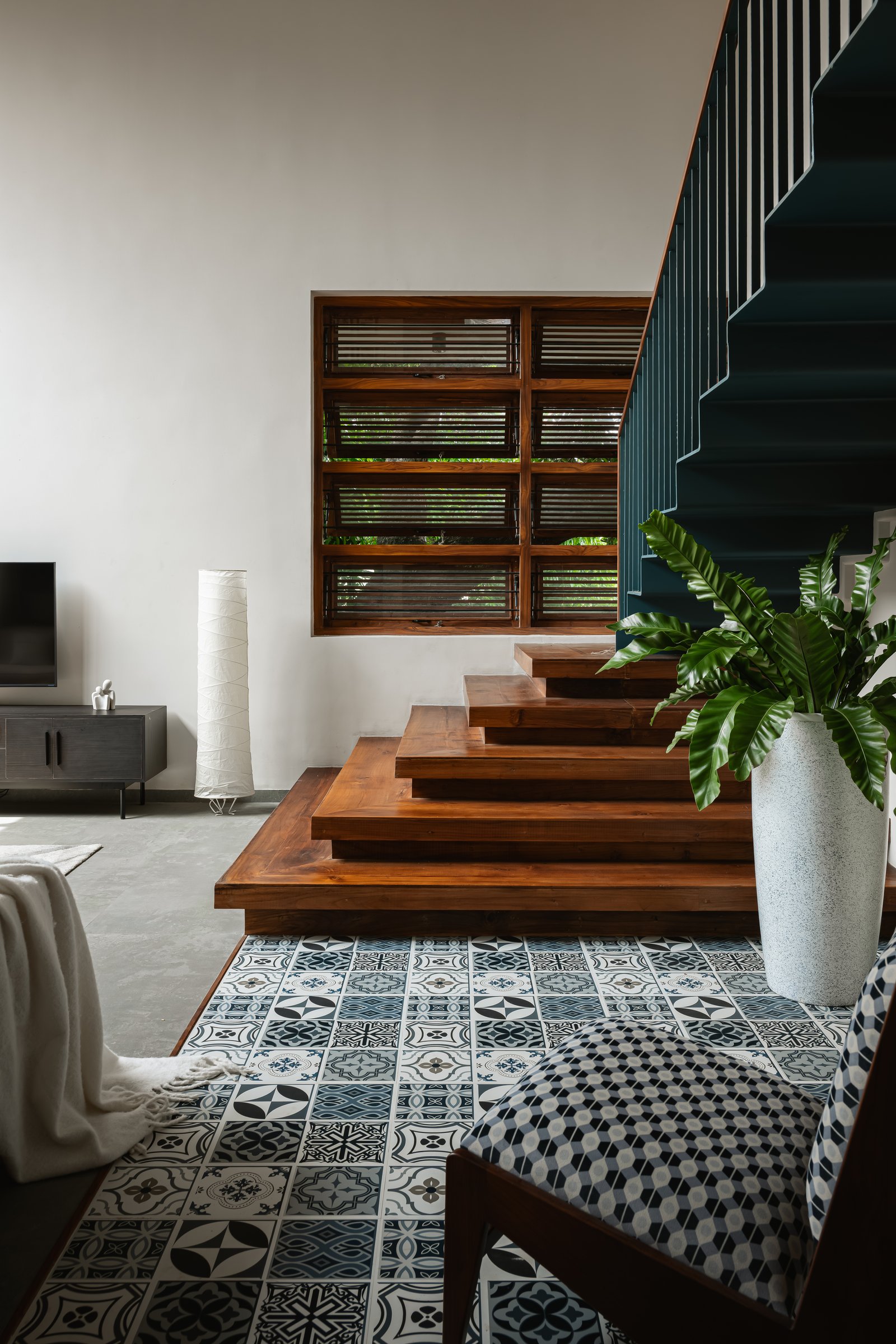
Seen from another angle, the lower flight of the staircase resolves into a small podium of stacked wooden steps that double as informal seating. The slatted window above frames greenery beyond, and the encaustic tile underfoot continues to do its quiet ordering work.
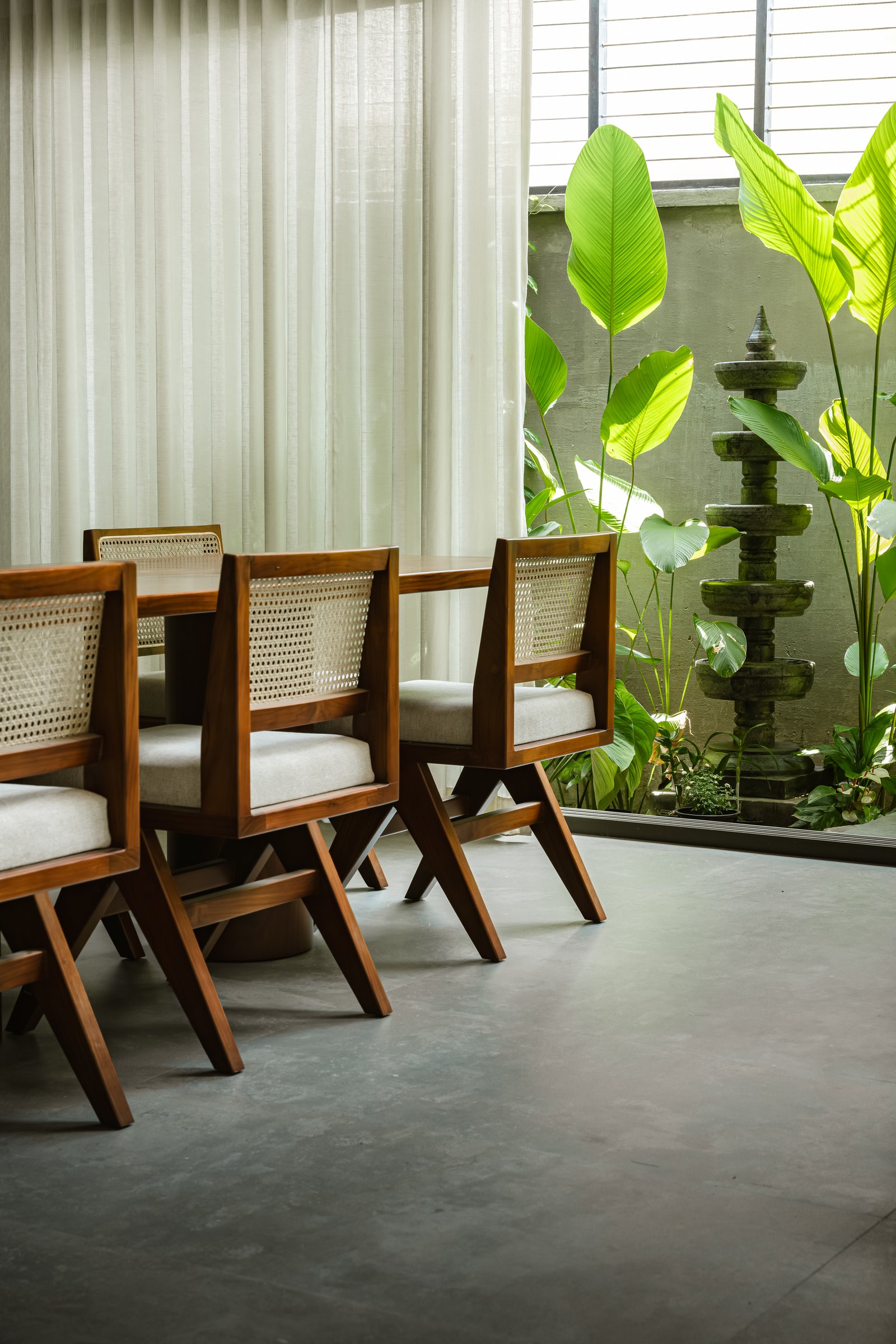
The dining area opens onto a planted court where a tiered stone fountain rises against broad green leaves. Cane-backed chairs in a familiar mid-century silhouette gather around a wooden table, sheer curtains soften the daylight, and the room derives its character almost entirely from what lies just beyond the glass.
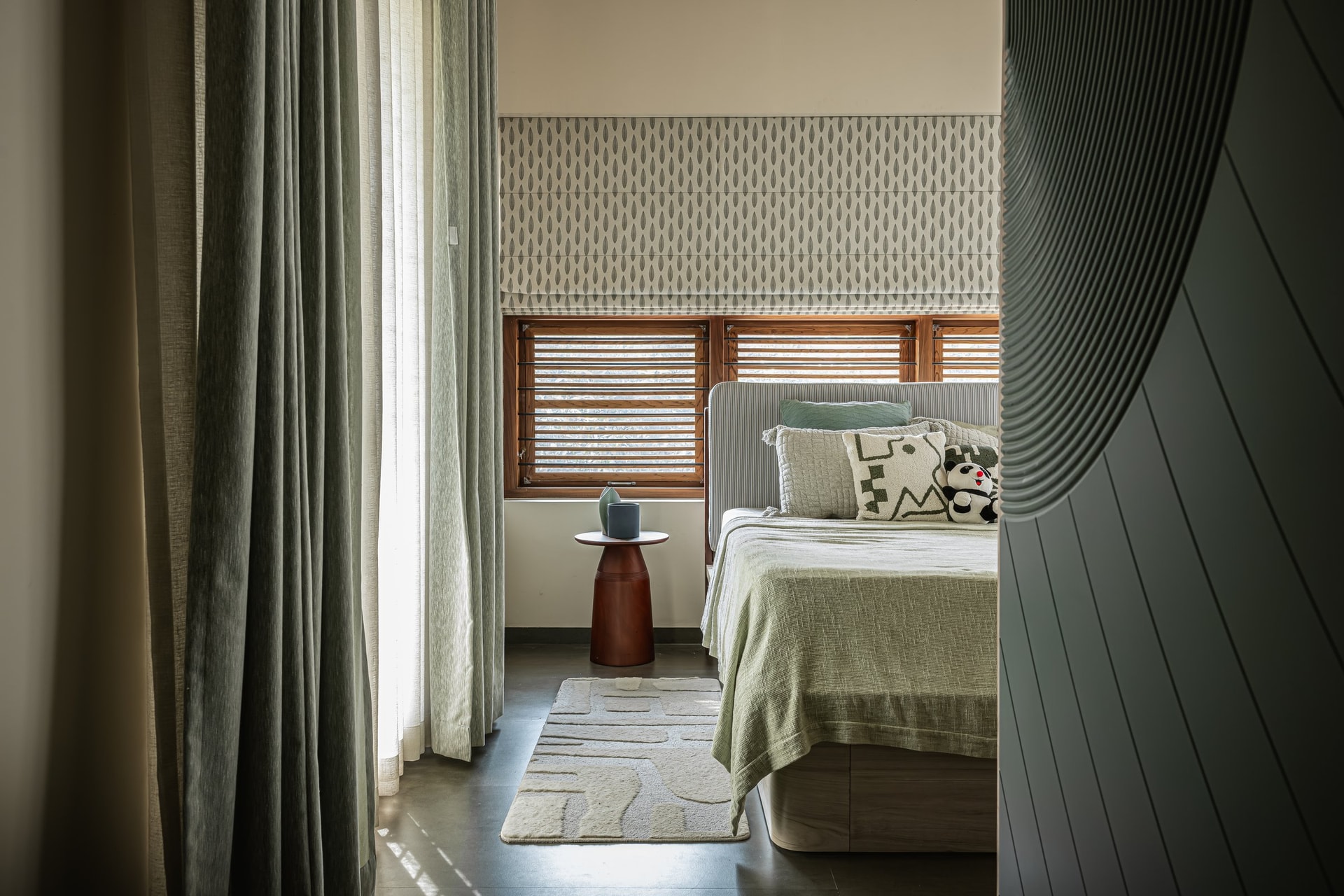
The master bedroom shifts the home’s register from communal to quiet. A patterned roman blind in muted sage sits above slatted wooden shutters, and the bed, dressed in soft green and oatmeal layers, is anchored by a small turned side table in deep red-brown.
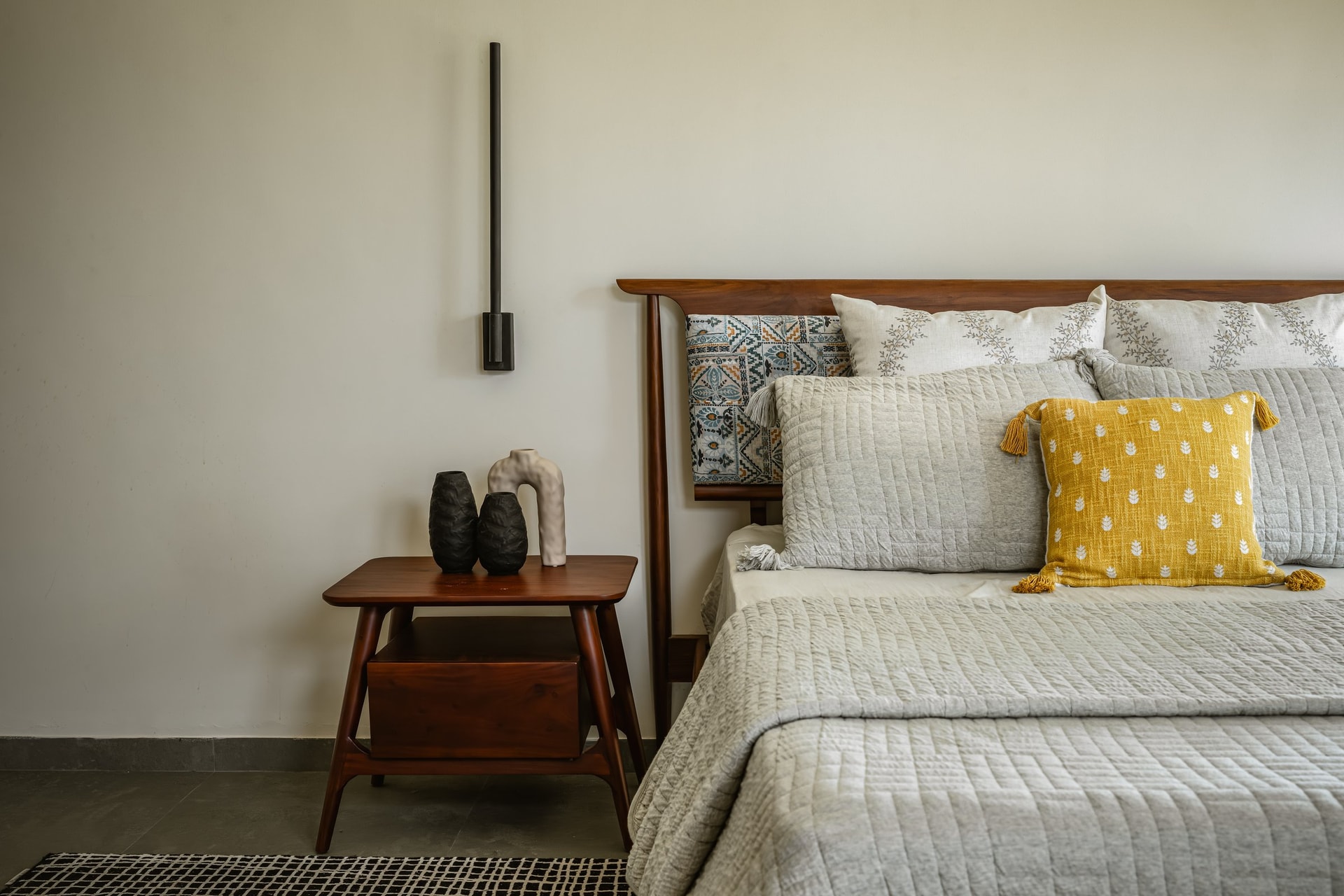
A closer view of the bed reveals the studio’s most unexpected detail: a panel of patterned ceramic tile inset into the wooden headboard. It is a small gesture, but it carries the encaustic language of the public rooms into the private zone, knitting the home together through a single recurring idiom.
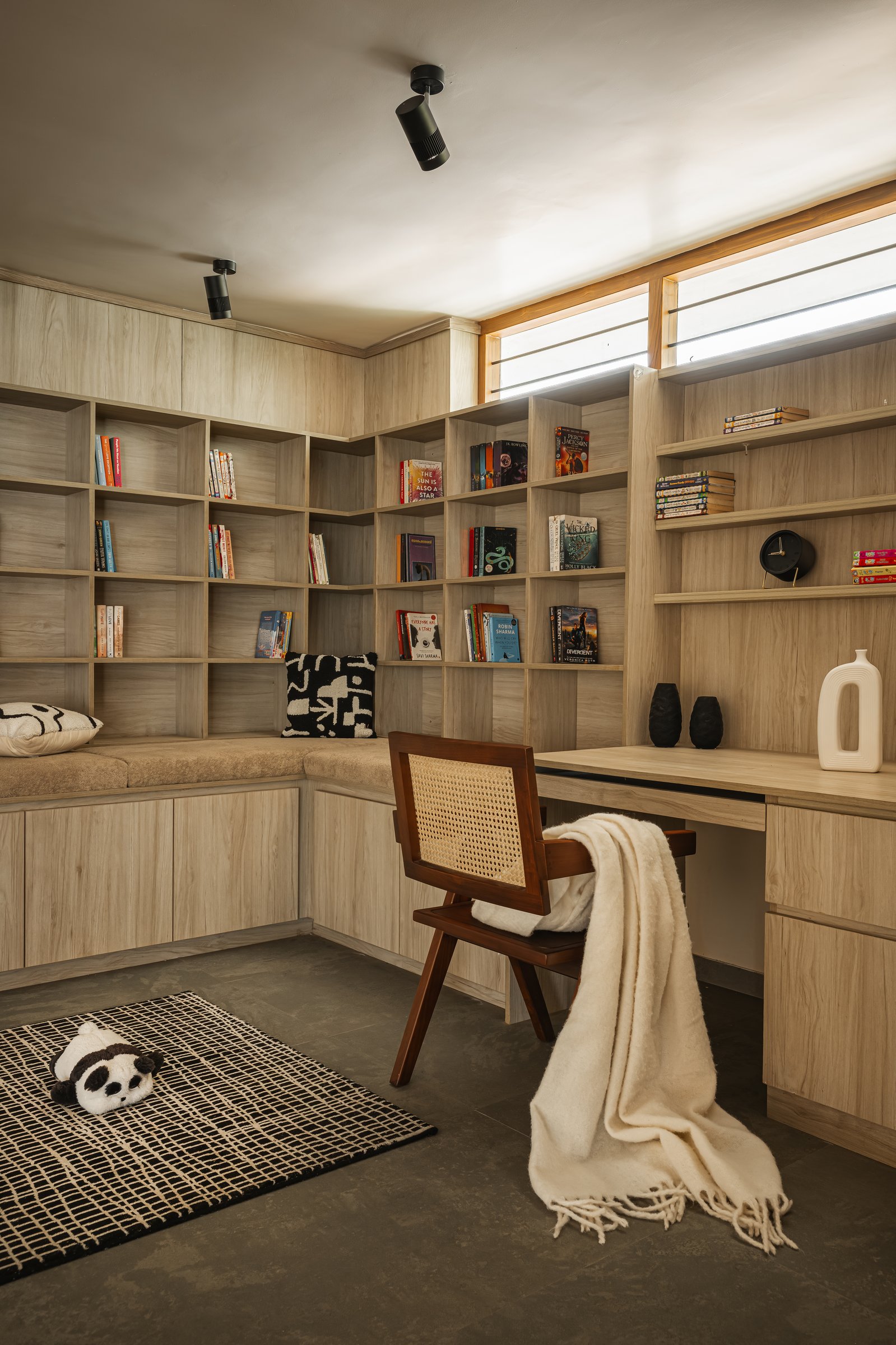
Tucked elsewhere on the plan, a study and library nook is rendered almost entirely in pale ash-toned joinery. A built-in window seat wraps one corner, open shelving rises to the ceiling, and a clerestory window admits a band of soft light across the desk surface.
The room is a study in monochromatic warmth. By holding the palette to a single tonal family, the design lets the books themselves provide the colour, and the result feels less like a designed room than a room a reader might have slowly assembled over years.
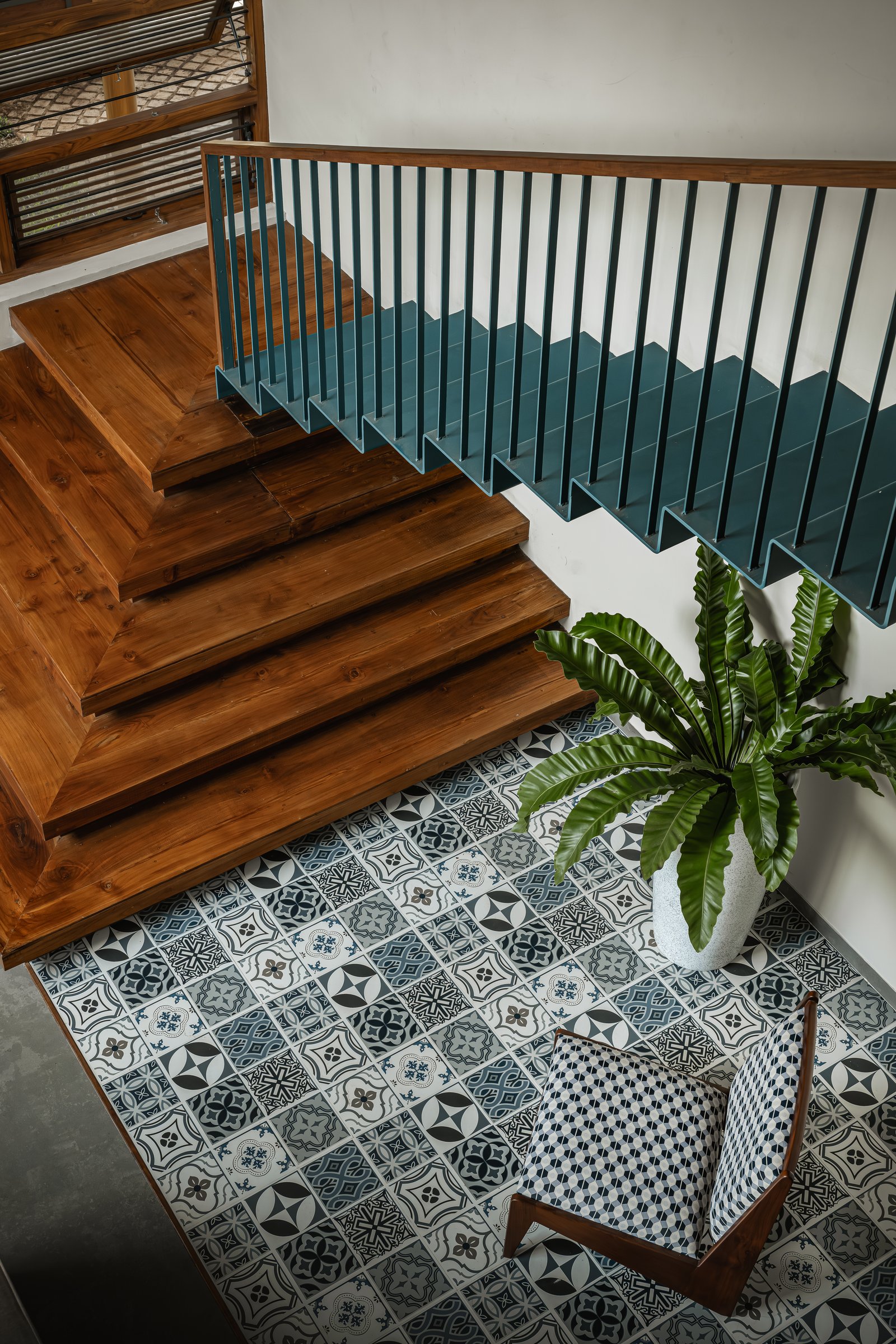
Seen from above, the staircase reveals its full geometry: a slim folded-metal underside in teal, wooden treads at the lower flight, and the encaustic tile expanse beneath that has functioned, throughout the home, as a kind of soft anchor for the architecture above it.
In a state whose vernacular architecture has long understood the value of filtered light, deep verandahs, and the courtyard as social organ, Dhyuthi reads as a thoughtful contemporary translation. It does not reach for traditional motifs as quotation; instead it absorbs their logic, the cross-breeze, the planted edge, the in-between space, and reworks them in a quieter, more pared-back idiom.
What lingers about this house is its sense of proportion, both spatial and emotional. Nth Collective has resisted the temptation to crowd the rooms with statements, and in doing so has produced a home in which radiance is not performed but practised, in the patient way a family settles into a place that already understands them.