There is a particular ambition that separates the decorated Indian home from the genuinely narrated one. Decoration accumulates; narrative selects, sequences, and commits. In Surat, a city whose wealth has historically expressed itself through textile and stone, a four-generation family asked Studio Rachana 369 to build something that could hold the full weight of Gujarati cultural memory within a contemporary apartment, not as museum display but as lived atmosphere. The result is RangRaas, an 8,000 sq ft thirteenth-floor residence that is, by any measure, one of the more ambitious domestic interiors to emerge from Gujarat in recent years.
Designed by Rachana and Ashish Chovatiya and completed in eleven months, the apartment is organised as two mirrored wings, one devoted to the narrative of Ram Darbar, the other to Krishna’s Vrindavan. The conceptual duality is not decorative overlay; it structures the entire spatial plan, from the paired entrance doors to the distinct colour palettes and craft vocabularies that distinguish each wing. Every room participates in a larger story, and every piece of furniture, joinery, and art has been conceived or commissioned specifically for its position within that story.
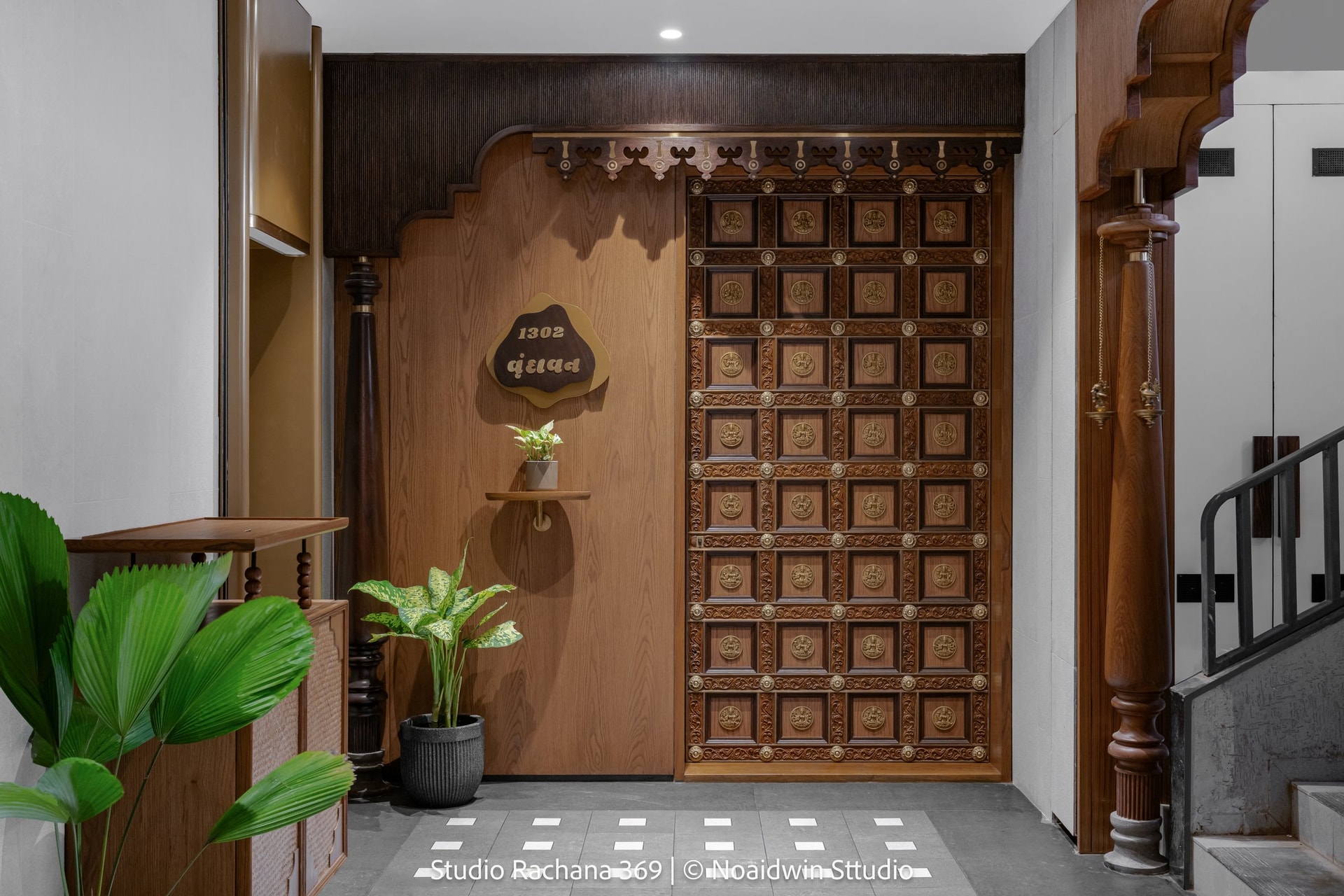
The entrance to Wing A announces the home’s intentions with absolute clarity. A carved teak door, its grid of medallioned panels recalling the heavy timber gates of Gujarati havelis, is flanked by turned wooden pillars on stone bases and framed by an arched timber cornice. The effect is threshold as ceremony, a transition from elevator lobby to another order of living entirely.
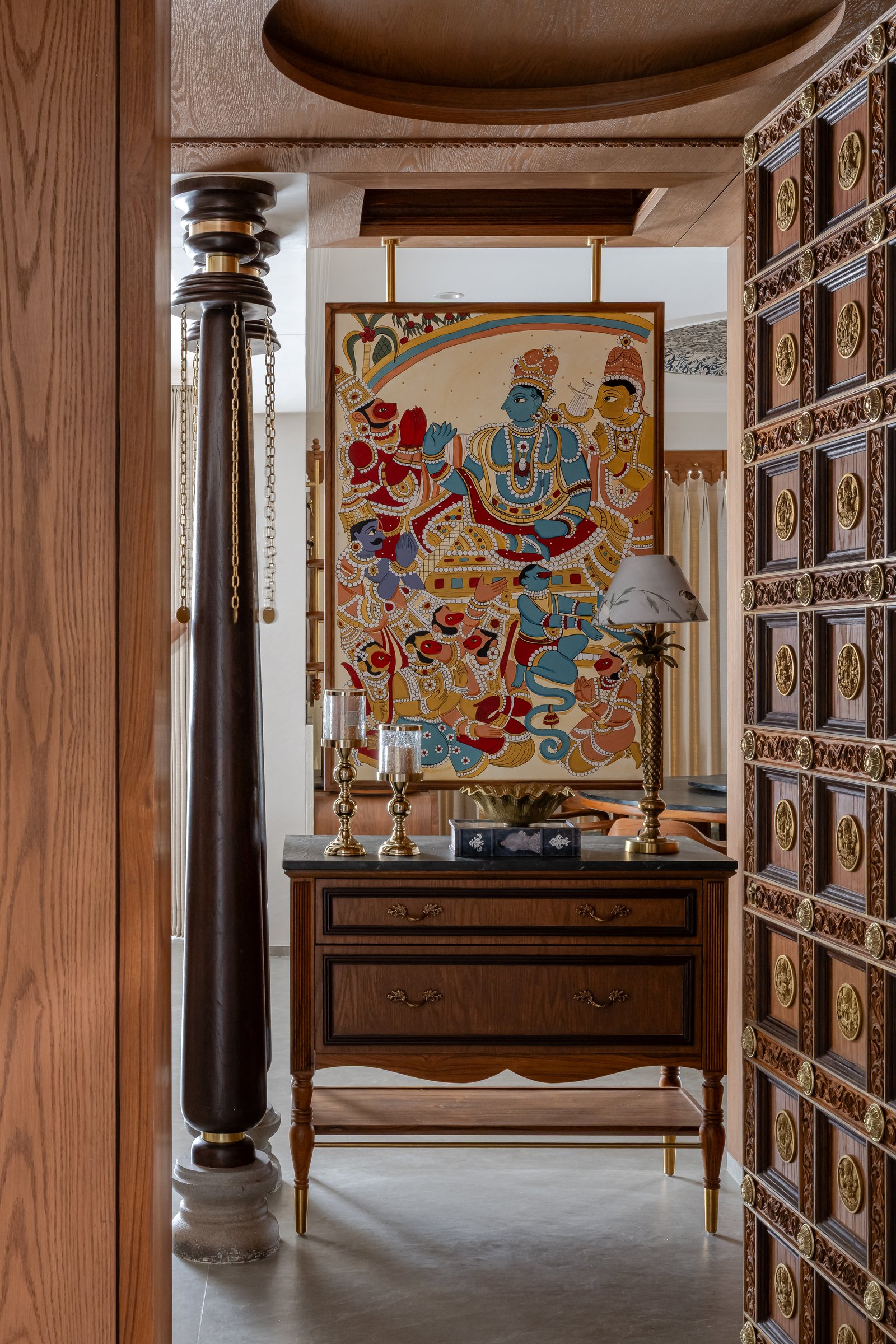
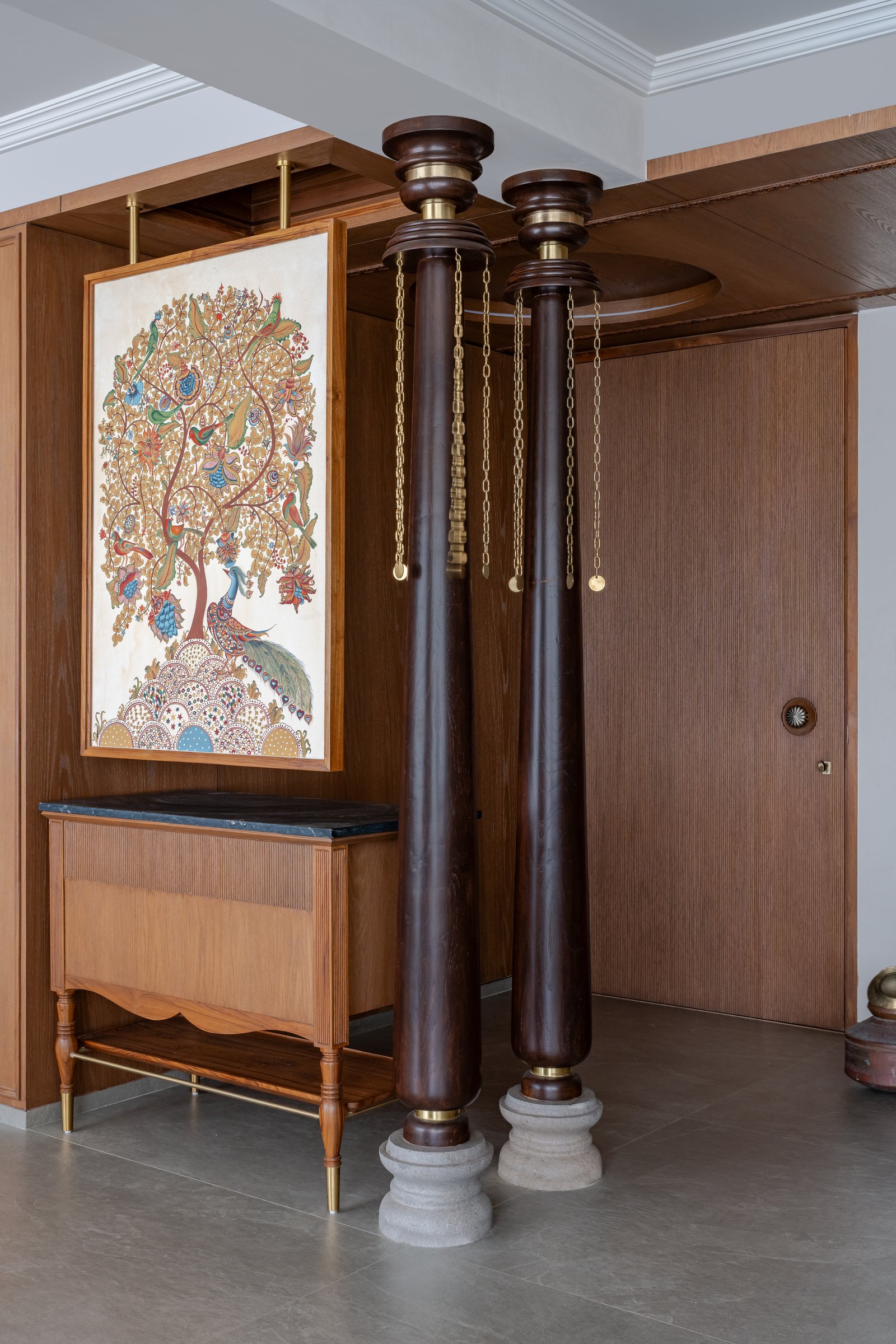
Stepping through, the foyer reveals a large Kalamkari-style painting and a console with a stone top, the carved teak columns continuing their vertical rhythm from floor to ceiling. What is striking is the restraint of the palette: warm timber, brass, and stone do all the work, and the painting provides the only burst of pigment.
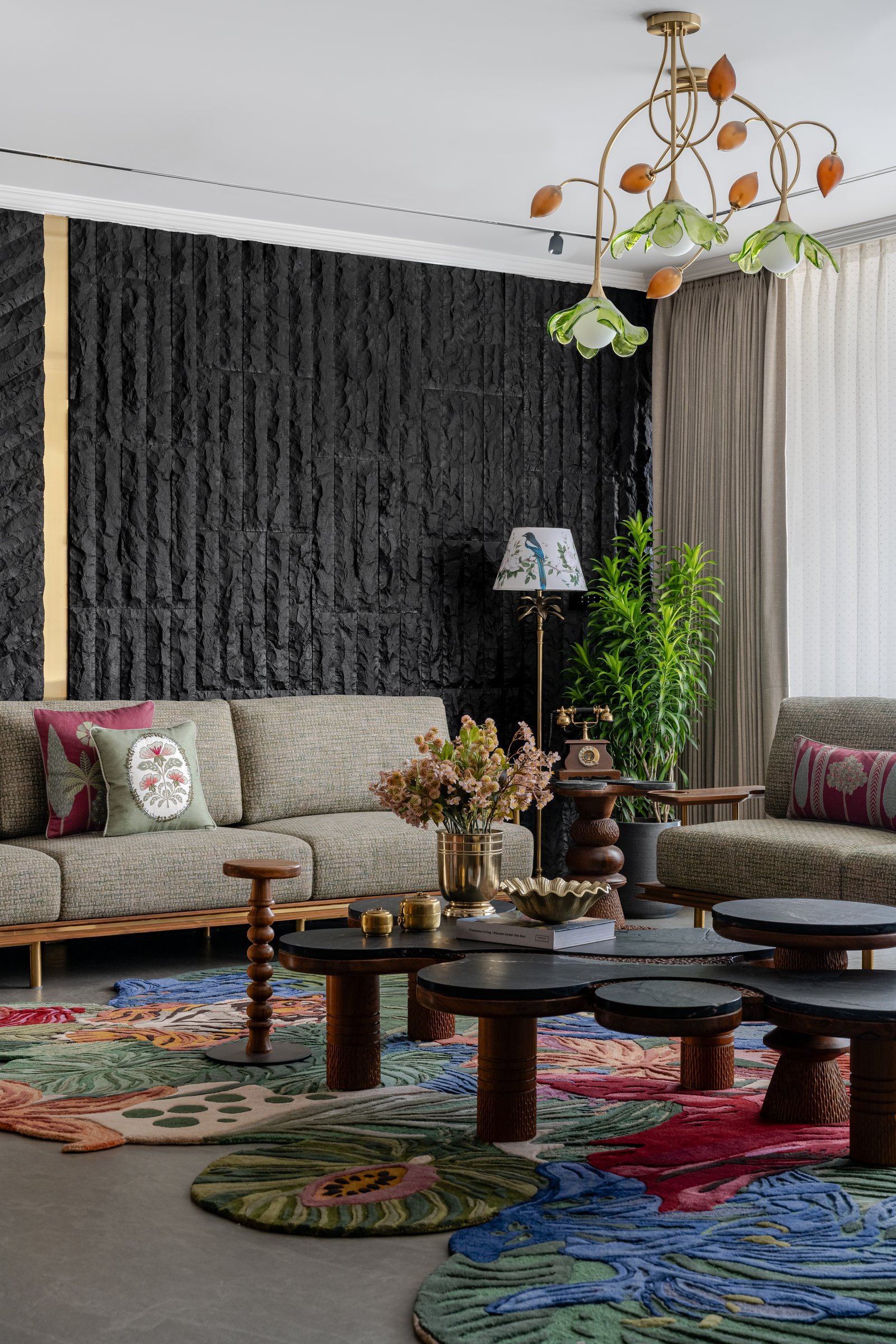
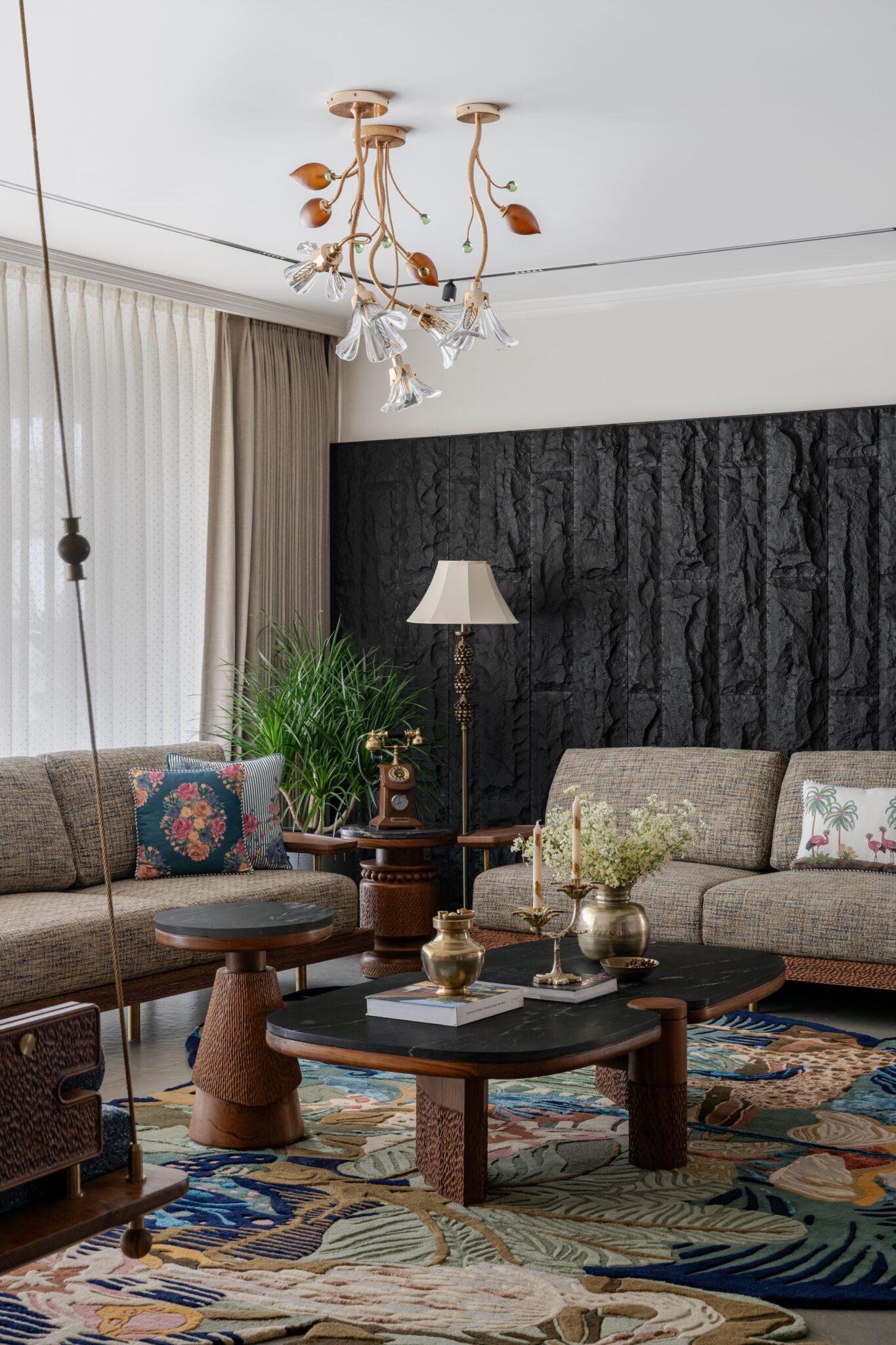
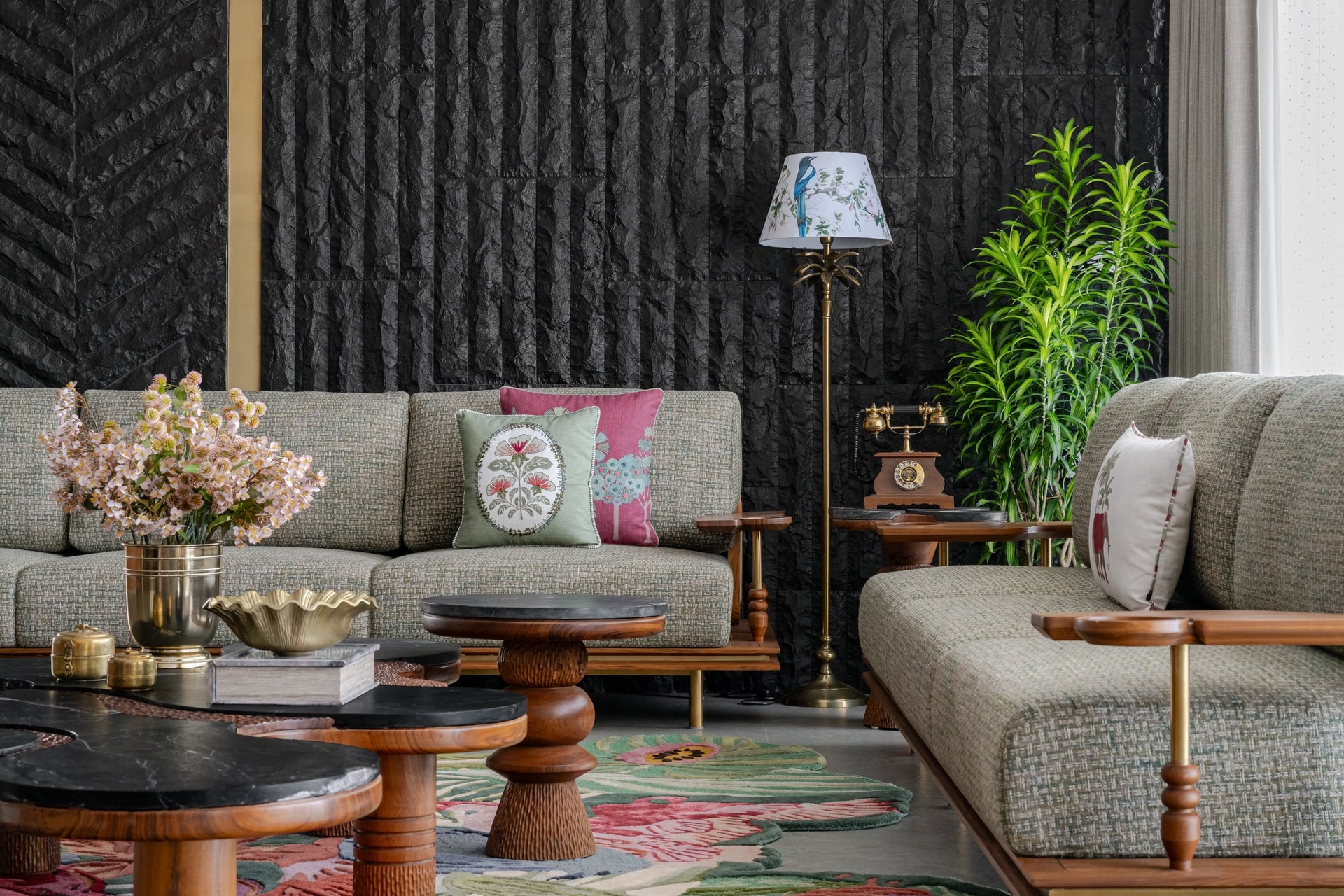
The living room in Wing A is where the project’s maximalist confidence becomes fully legible. A rough-hewn black stone wall occupies an entire surface, and against it, low-slung sofas in a muted weave hold their ground with quiet composure. A sculptural chandelier with petal-form glass shades floats overhead, and a set of clustered coffee tables in dark marble and turned timber anchor a hand-tufted rug whose botanical exuberance provides the room’s riot of colour.
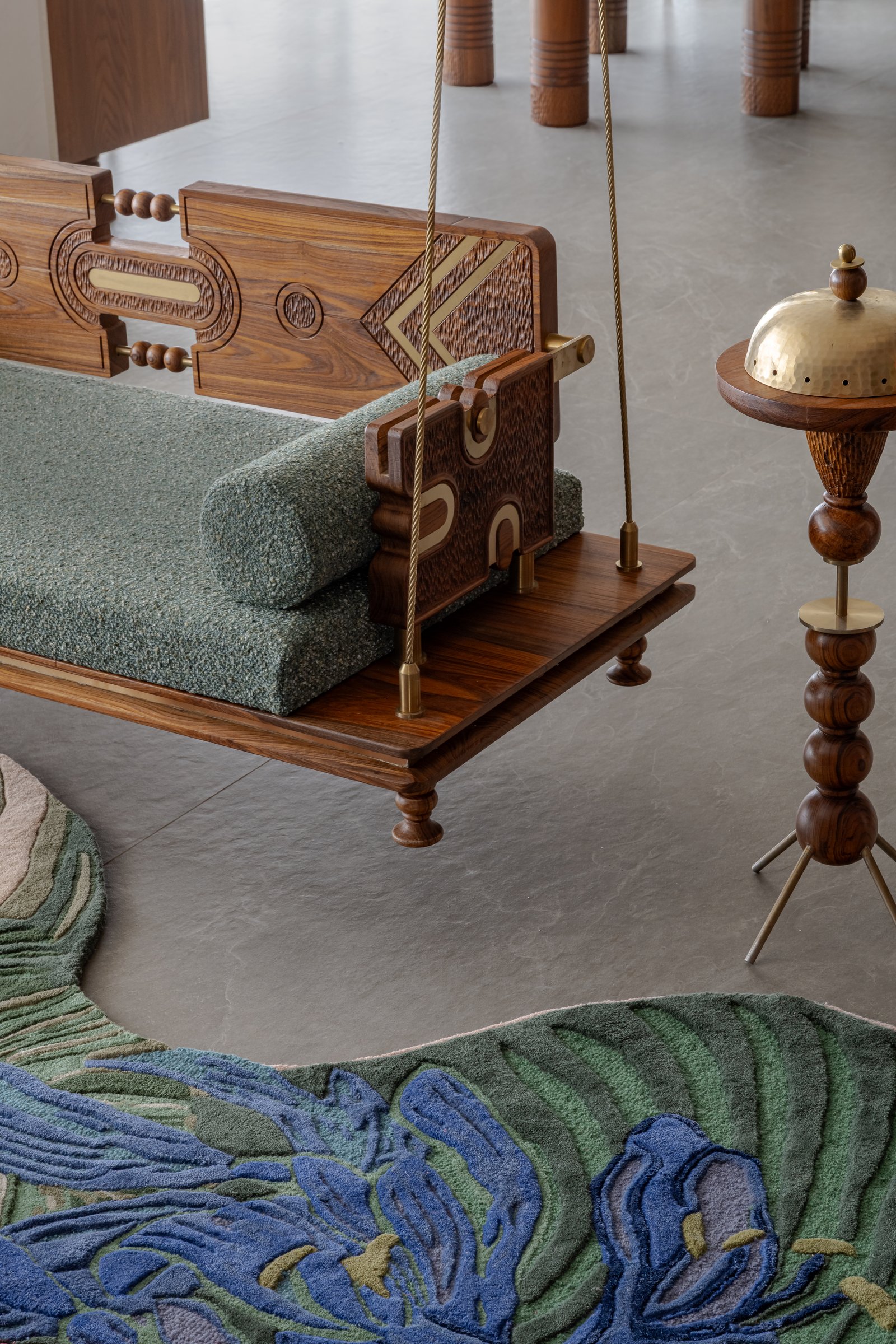
The carved timber jhula, or traditional swing, suspended from brass ceiling mounts beside the seating area, is the element that lifts this room from curated interior to cultural portrait. It is not a prop; it is the centre of Gujarati domestic life, repositioned at thirteen storeys above the city. A hammered brass incense stand beside it completes the vignette with knowing specificity.
““RangRaas is layered with nostalgia, mythology, and Gujarat’s craft. Even the outdoor deck carries duality, envisioned both as a village courtyard and a sky lounge above the city.””
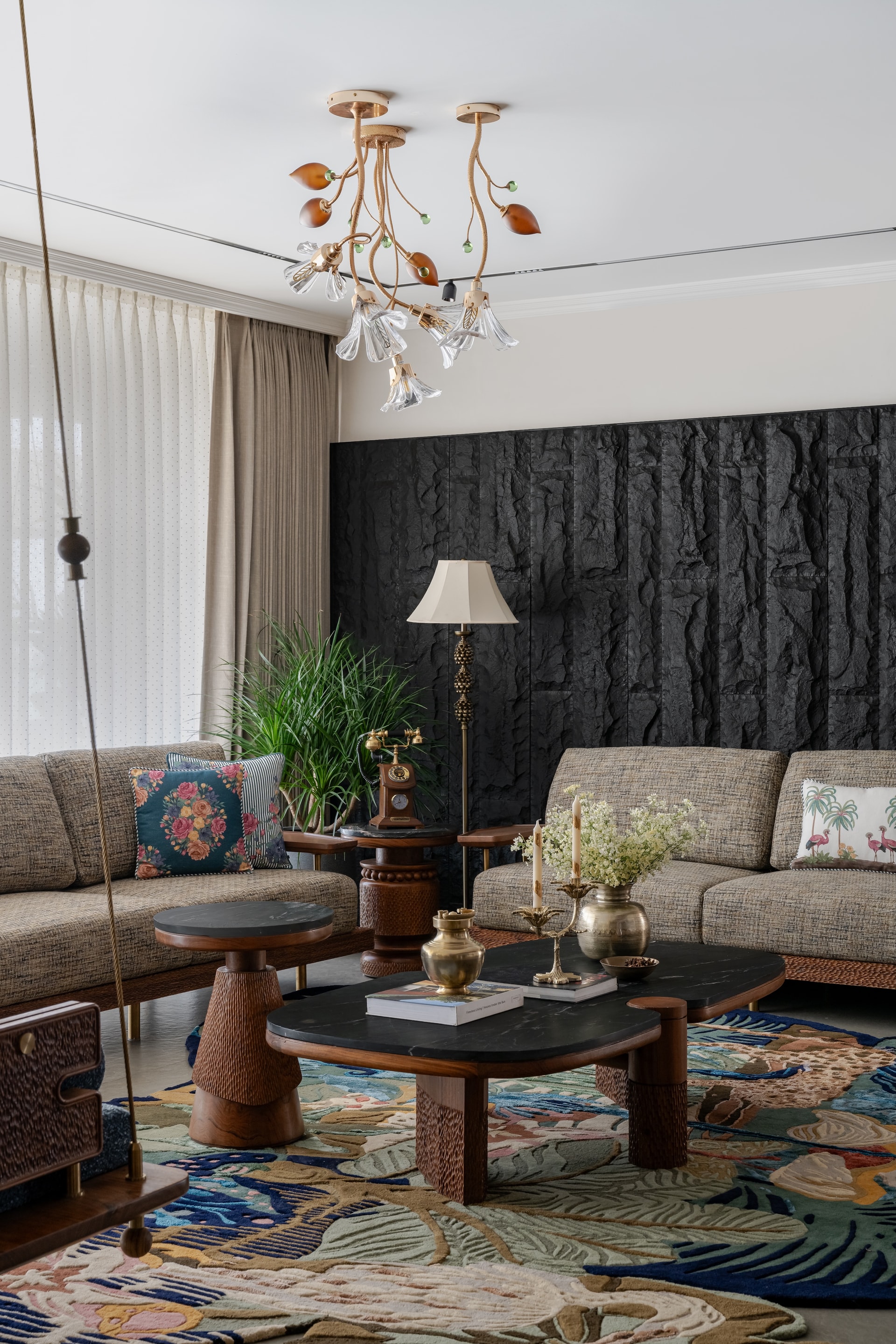
Wing B’s living room echoes the format but shifts the mood. A carved teak swing with indigo upholstery occupies the foreground, and through the open plan one reads the dining table, the glass-enclosed pooja room with its painted mural, and the passage beyond. The spatial depth here is remarkable, a single sightline that connects devotion, gathering, and repose.
The seating arrangement in this wing favours a warmer, slightly denser atmosphere. Floral and tropical cushions layer against the same rough-hewn stone wall, and a sculptural chandelier with glass and leaf-form elements catches light from the windows. The twin living rooms share a material DNA but never feel repetitive.
Between the living and dining zones, a sculptural wash basin console operates as a spatial marker. The organically shaped timber mirror above it, with its concentric wood-grain inlays, is among the most distinctive custom pieces in the home, functional object elevated to art.
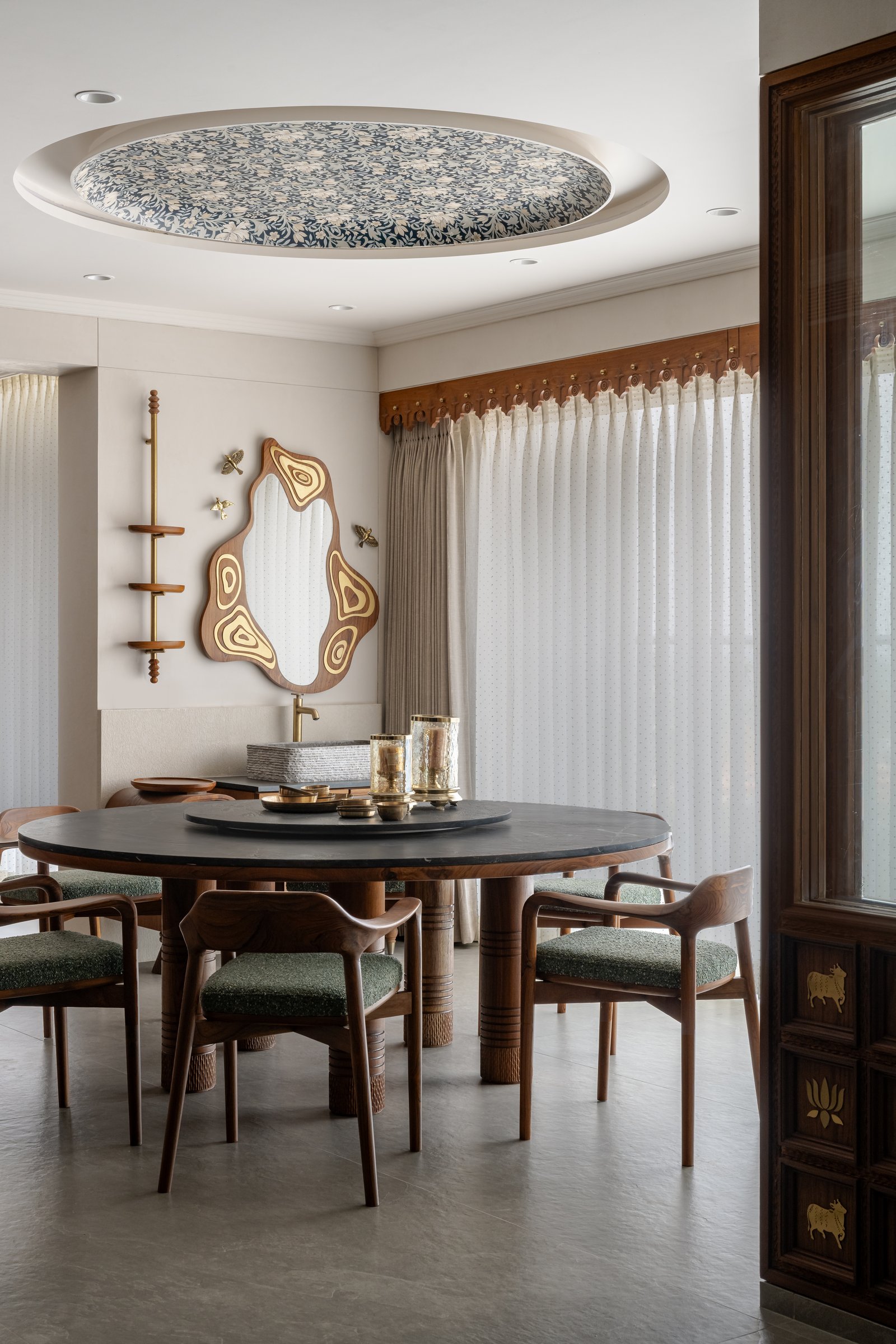
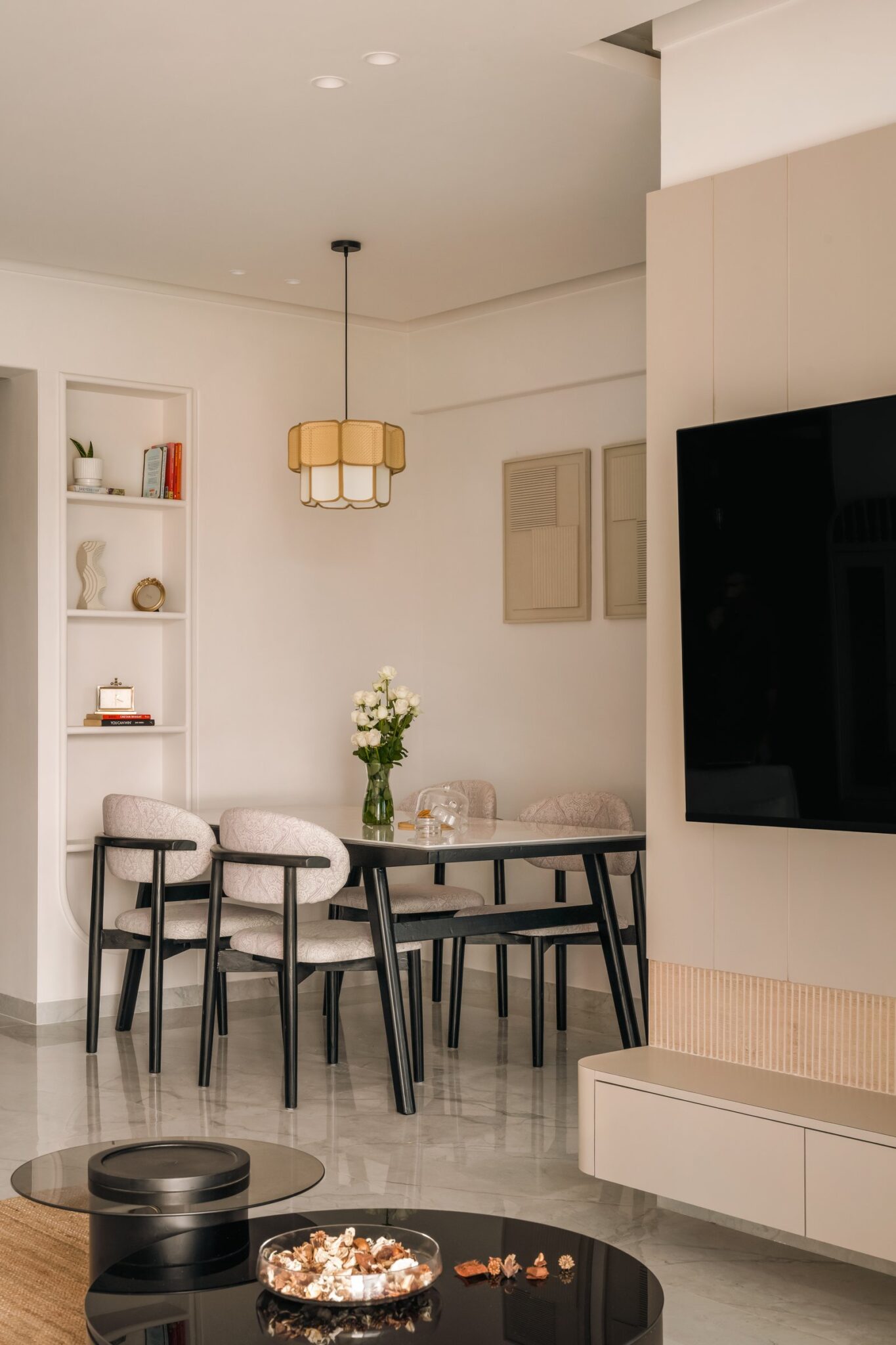
The dining area in Wing A sits beneath a recessed ceiling medallion finished in blue-and-white floral print, a gesture borrowed from the painted ceilings of traditional Gujarati interiors. A round table in dark stone, surrounded by timber chairs with woven seats, faces the glass-walled pooja room. The proximity is intentional: meals and prayer share the same axis.
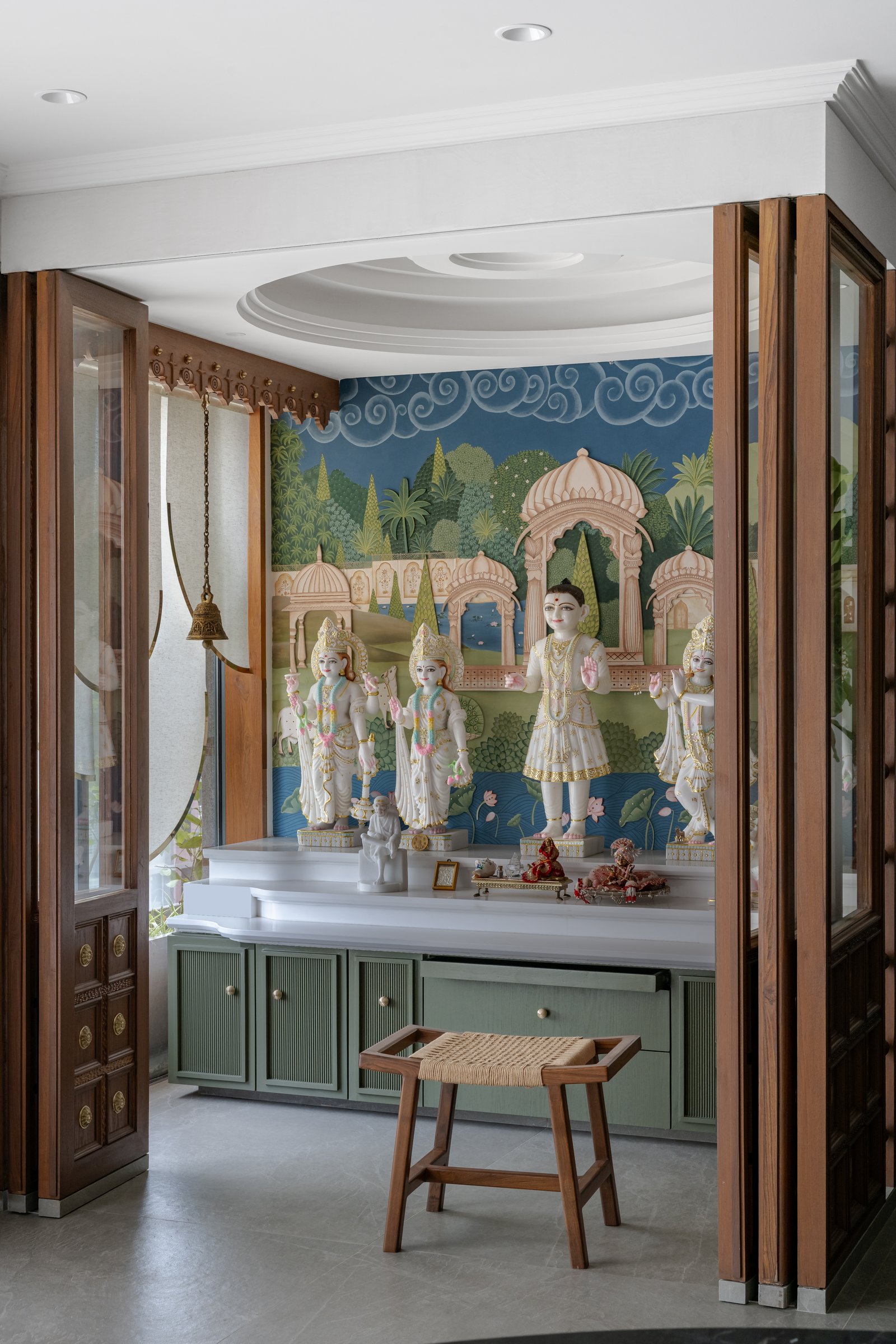
The pooja room in Wing A, visible through its carved timber bi-fold doors, is a complete environment. A hand-painted pichwai mural depicting temple architecture and lush gardens wraps the walls, while marble deities stand on a white plinth above sage-green cabinetry. The domed ceiling and brass bell complete the spatial grammar of a devotional chamber that feels both intimate and ceremonial.
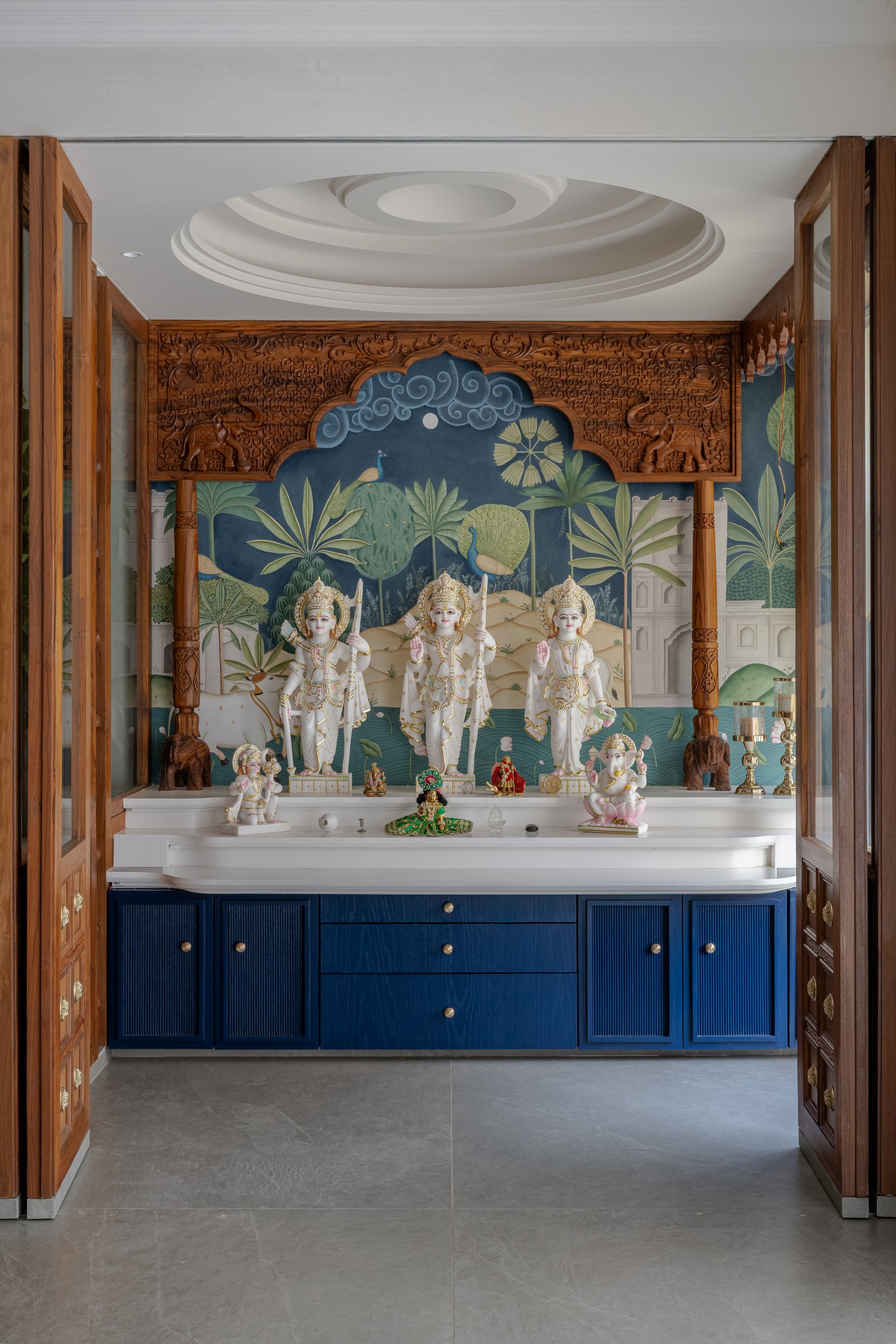
Wing B’s pooja room shifts the mythological register to Ram Darbar, with a bolder carved teak arch framing the mural and deities. The blue cabinetry below is a warmer, more saturated tone than its counterpart, and the carved column within the room deepens the sense of an interior temple transplanted into a high-rise apartment.
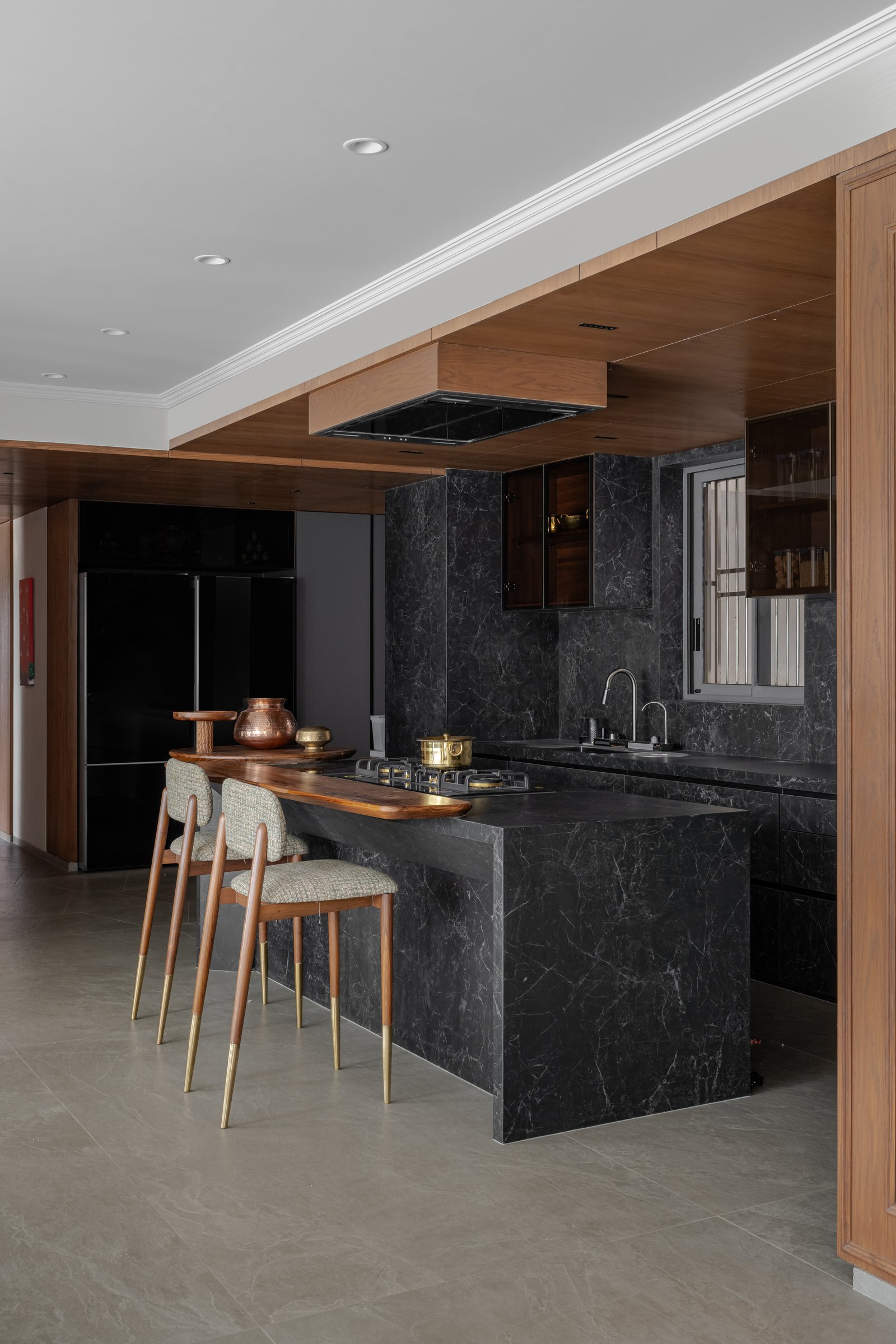
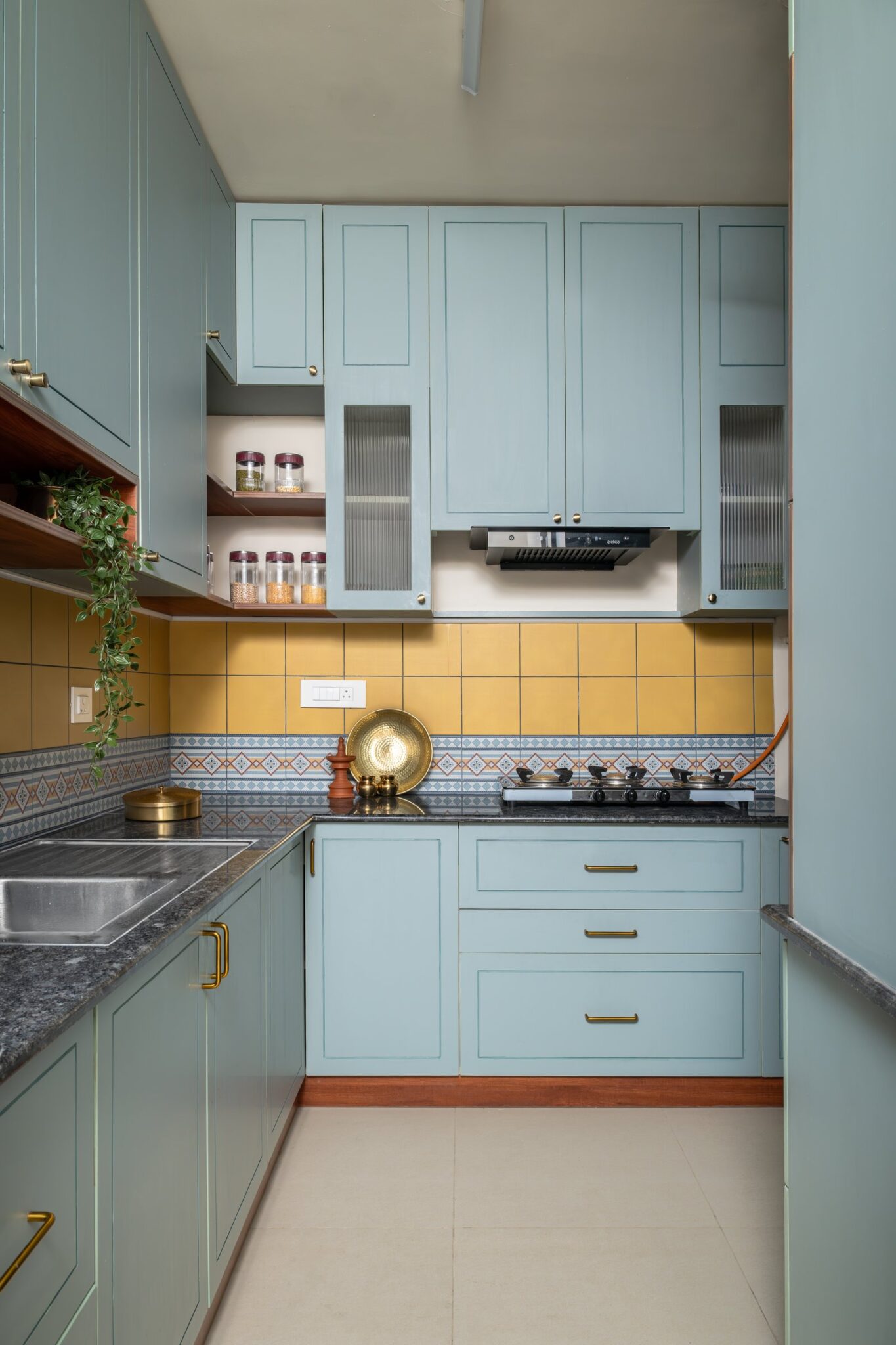
The kitchen, shared between the wings, is clad floor to ceiling in veined dark stone, its mass and darkness a deliberate counterpoint to the timber warmth elsewhere. A live-edge timber breakfast bar extends from the stone island, anchoring the zone for informal family meals. Copper vessels and brass cookware populate the countertops as though this kitchen is genuinely, actively used.
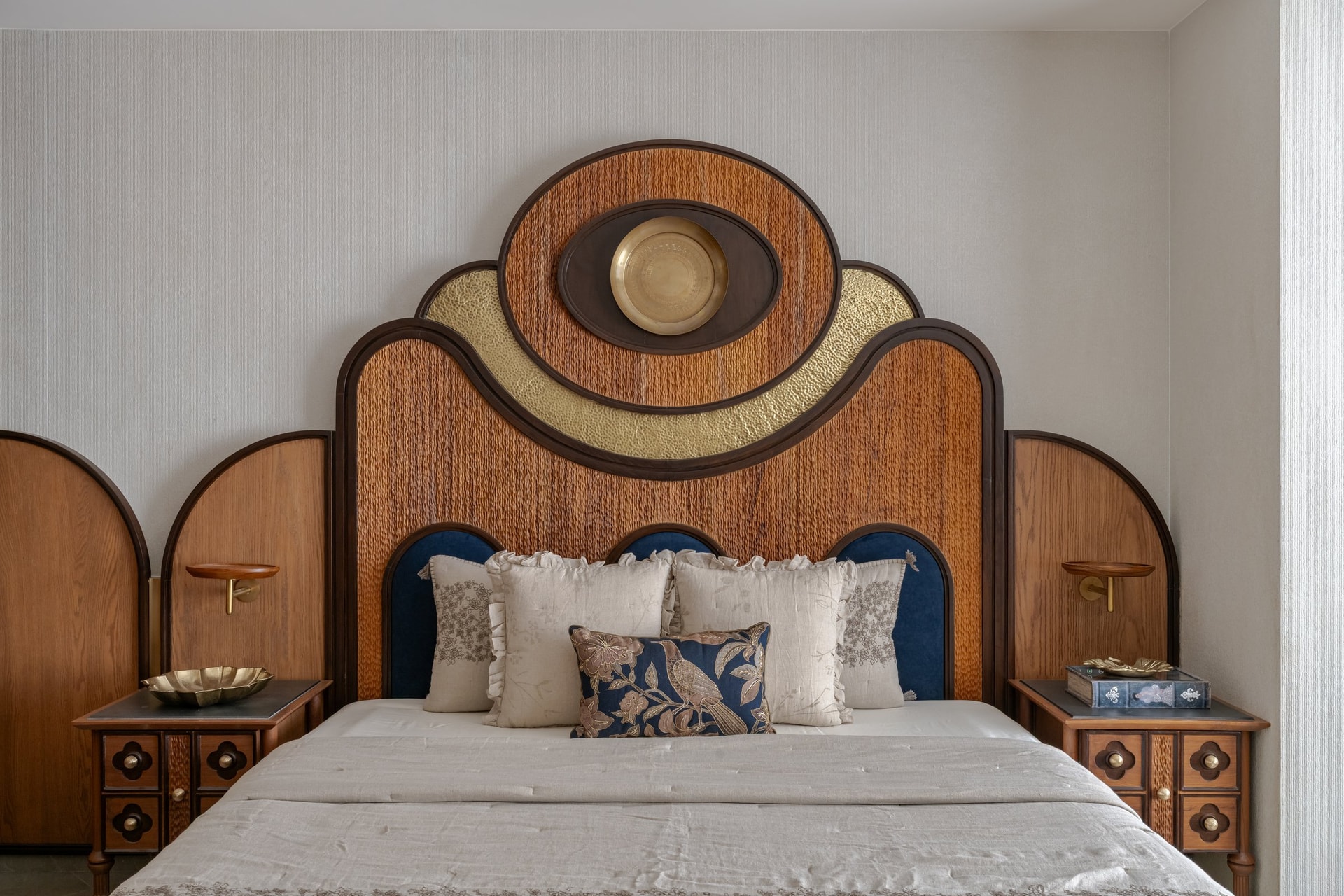
The master bedroom in Wing A centres on a monumental headboard wall: layered arches of carved timber and hammered gold leaf, crowned by a brass medallion, with deep blue velvet insets framing the pillows. It reads as a contemporary reinterpretation of temple shikhara geometry, scaled to the proportions of a bed rather than a sanctuary.
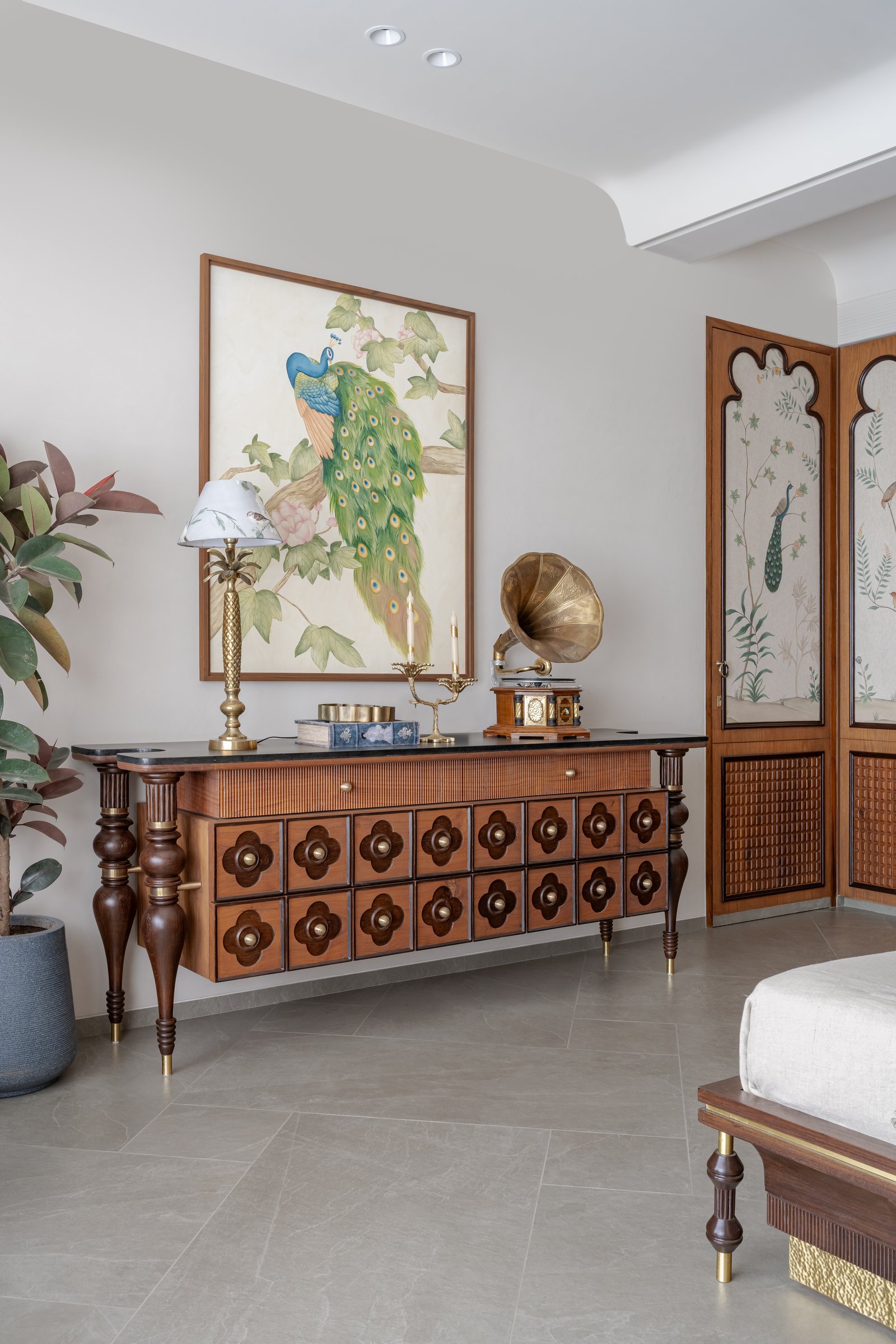
Across the room, a custom console with a grid of flower-motif drawer pulls sits below a large peacock painting, while a screen partition with painted chinoiserie panels provides a visual transition to the dressing area beyond. The furniture in this room has the density and intentionality of heirloom pieces, though everything here was designed new.
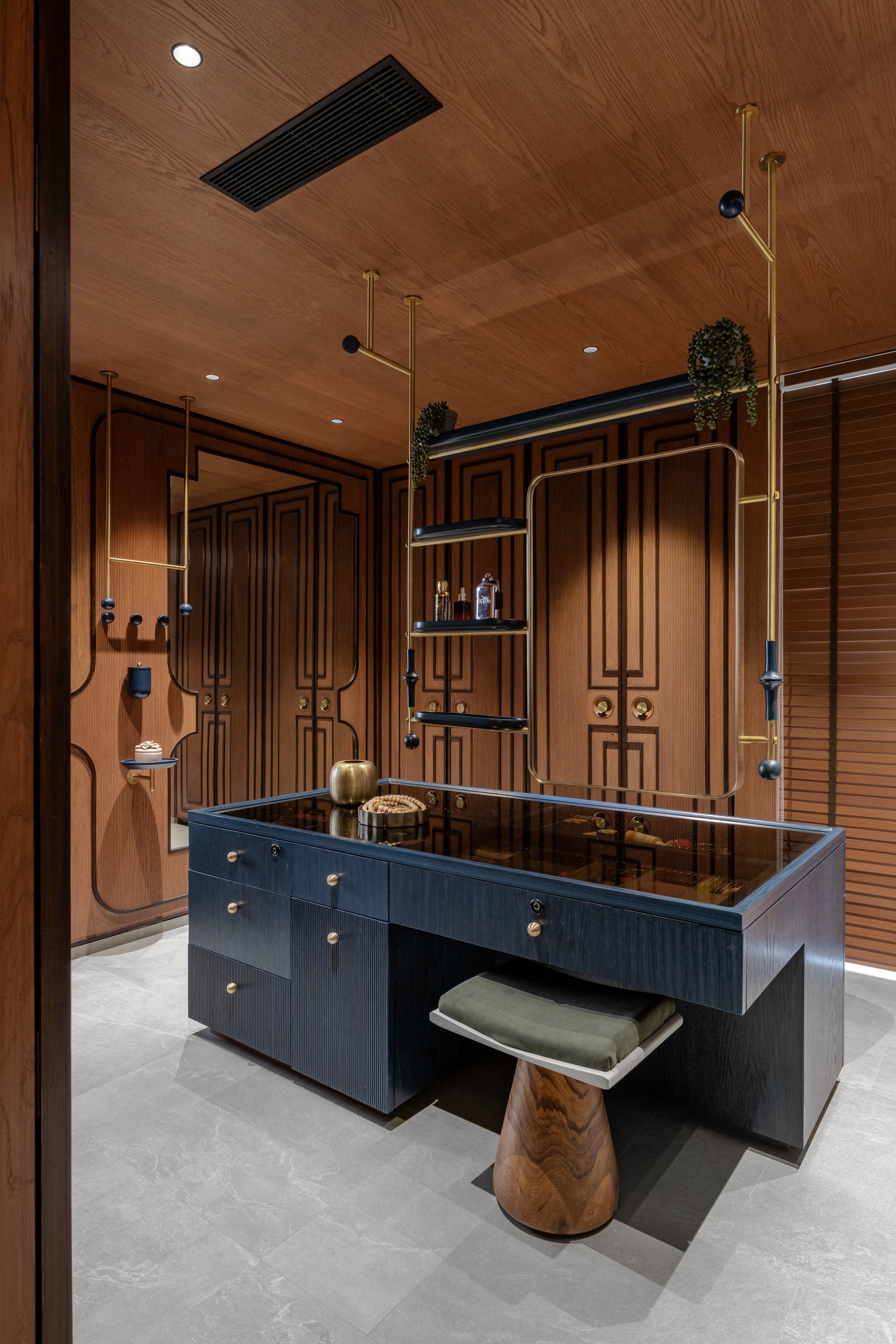
The master dressing room is an immersive volume: panelled walls with geometric joinery in timber and navy lacquer surround a central island vanity finished in deep blue with a glass top. Brass-mounted shelving floats from the ceiling, and the atmosphere is closer to a jewellery atelier than a domestic wardrobe.
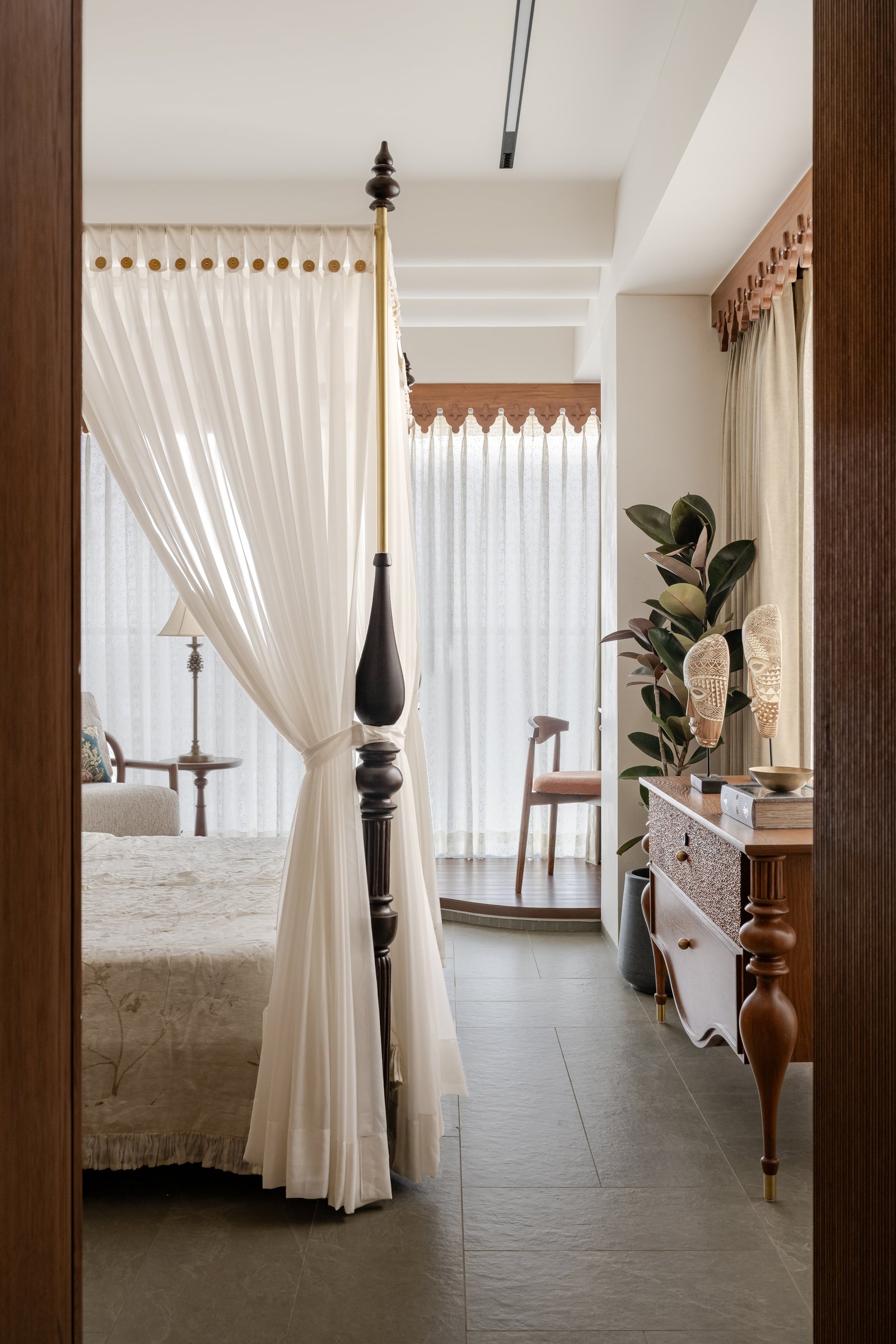
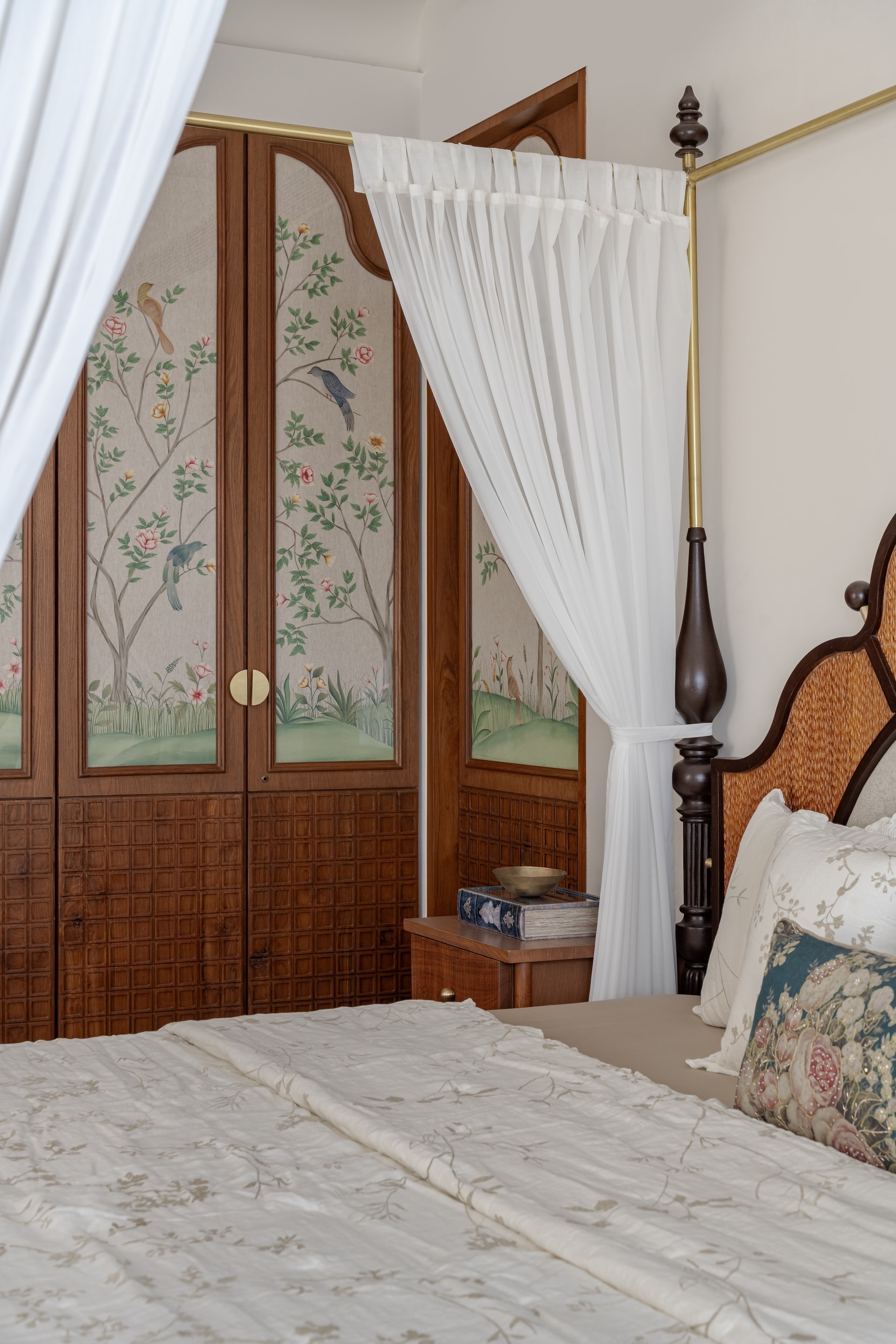
Wing B’s master bedroom introduces a four-poster bed with turned finials in dark timber with brass-toned shafts and flowing white curtains that drape to the floor, evoking the canopied beds of colonial-era Indian residences. The room balances this romanticism with a carved timber pelmet above the curtain track and a sideboard that mixes a terrazzo-style panel with turned wood legs.
The scalloped headboard in textured timber with a central linen-upholstered panel, paired with a brass-and-black teardrop wall sconce cradling a small white globe and a turned-leg bedside table, gives this room a distinctly softer profile than its counterpart. A glimpse of a hand-painted botanical panel on the adjacent door extends the garden imagery that recurs throughout the home.
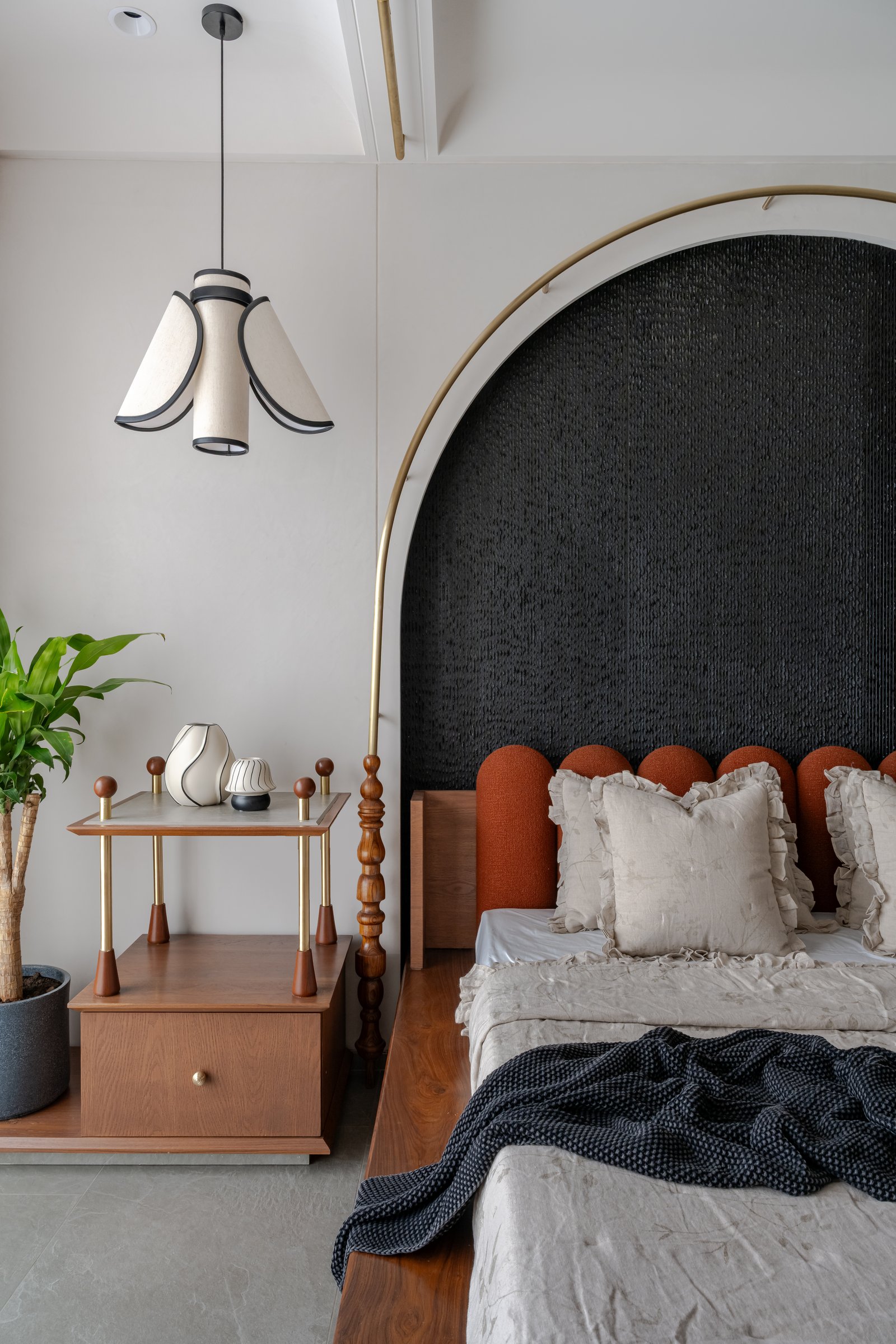
A younger bedroom, takes a bolder compositional stance. A large arched panel in dark woven texture, outlined in brass, dominates the headboard wall, while rounded terracotta-hued upholstered cushions provide a playful counterpoint. A pendant with petal-shaped fabric shades adds a note of levity overhead.
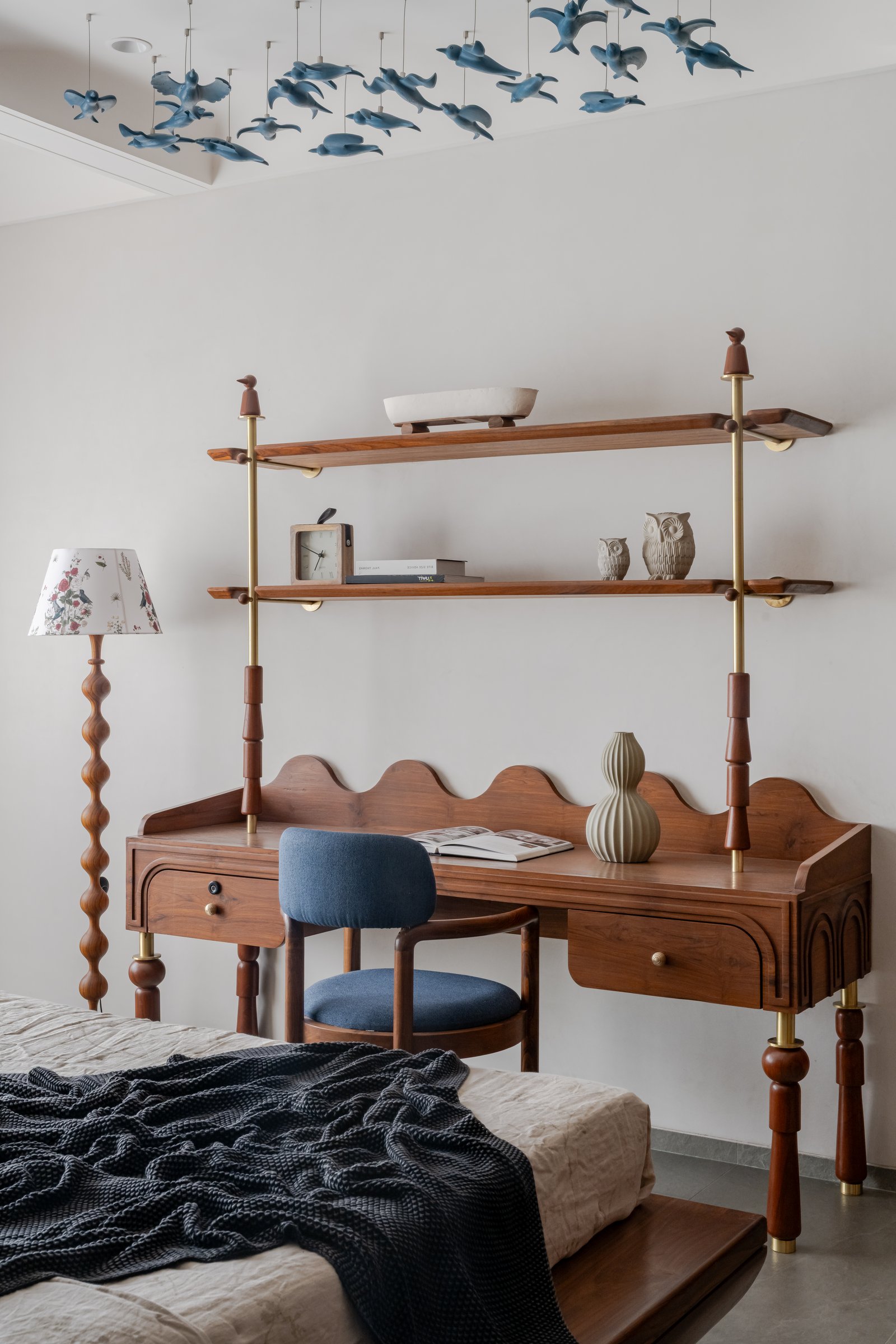
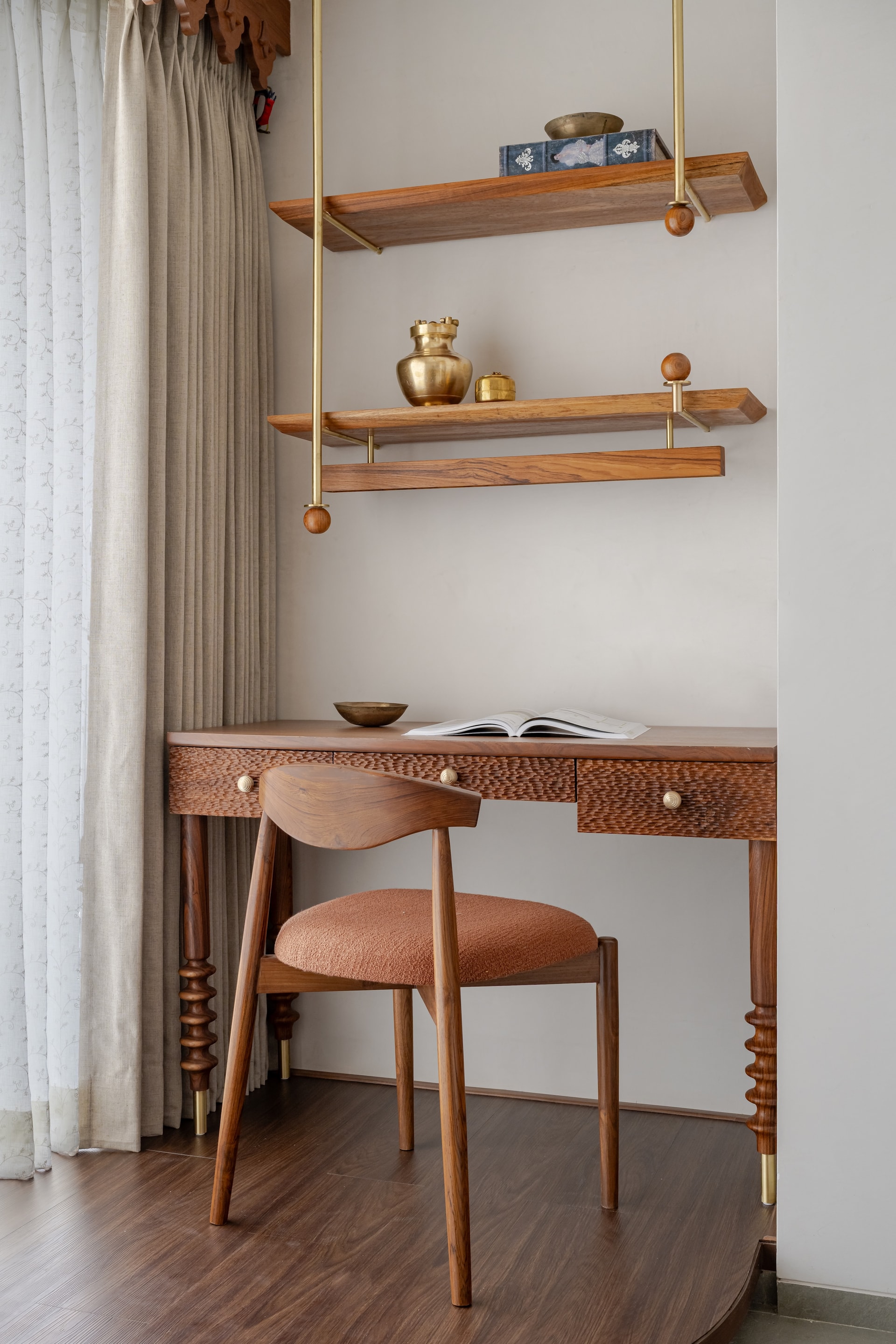
The study nook within this room is a standout detail: a scallop-edged timber desk with brass-mounted shelving, accompanied by a turned-leg floor lamp and a ceiling installation of suspended blue ceramic birds. The room manages to be youthful without being childish, the craft language continuous with the rest of the home.
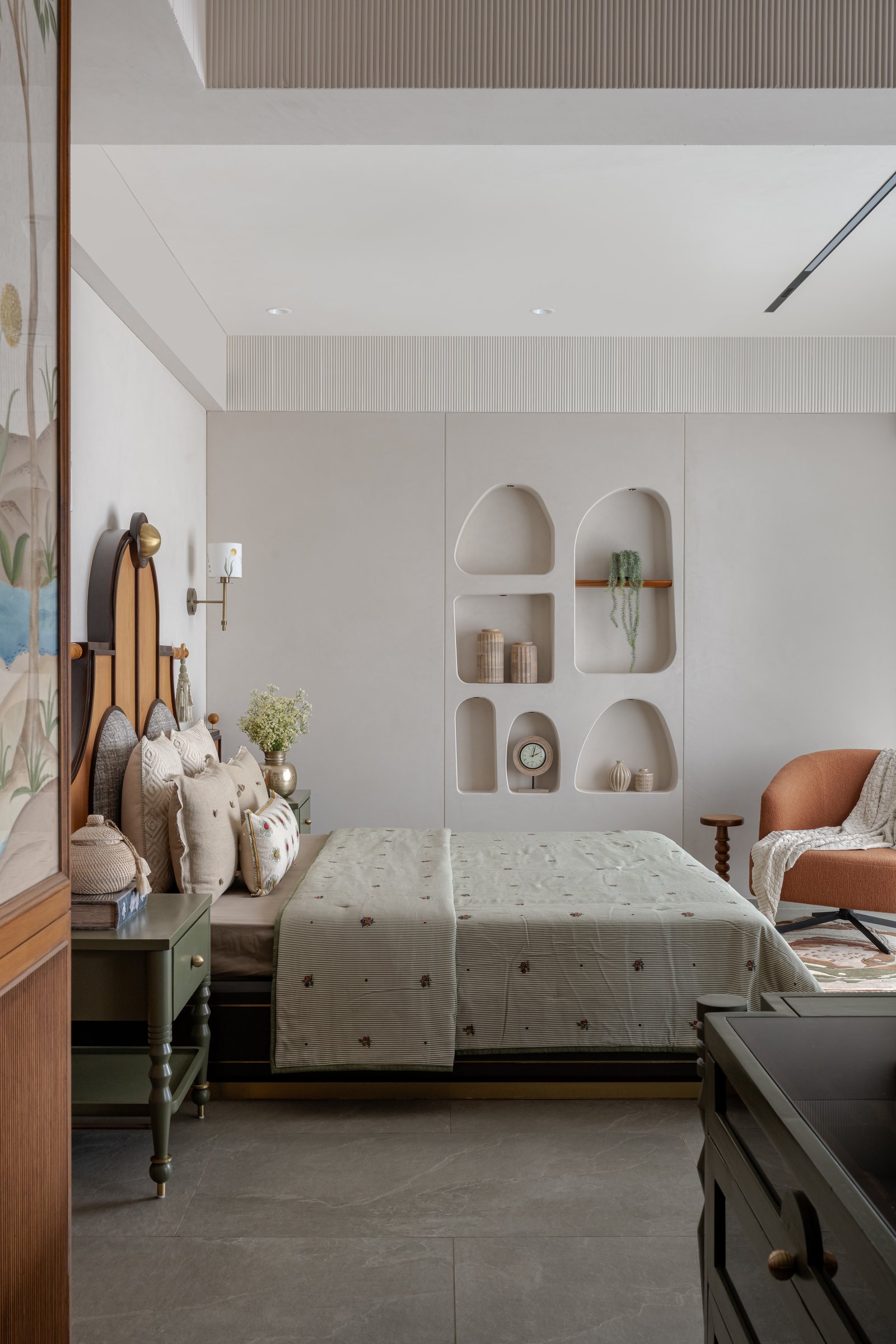
Another bedroom occupies a different tonal world entirely, one of soft greens, muted creams, and arched wall niches that borrow from Mediterranean and Rajasthani vocabularies simultaneously. A sage-green bedside table, a sliding door with a hand-painted pastoral panel, and an upholstered accent chair in burnt orange create a room that feels lighter and more contemporary than the common areas, yet still connected to the home’s craft sensibility.
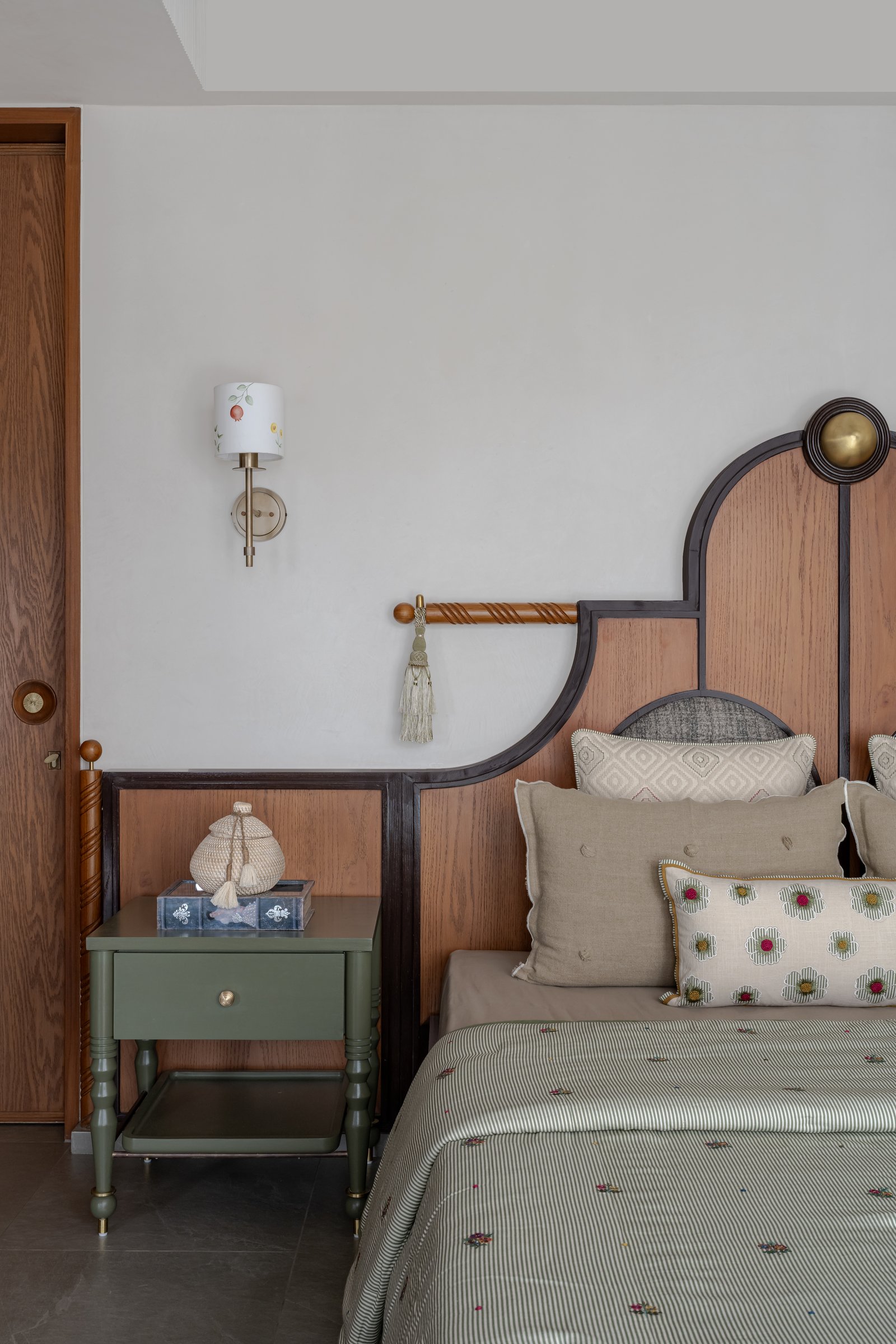
The bed in this room features a distinctive arched headboard with a brass finial and dark timber edging, flanked by olive-green bedside tables. The palette and proportions suggest a room designed for a younger woman who has absorbed the family’s aesthetic language but wears it with a softer touch.
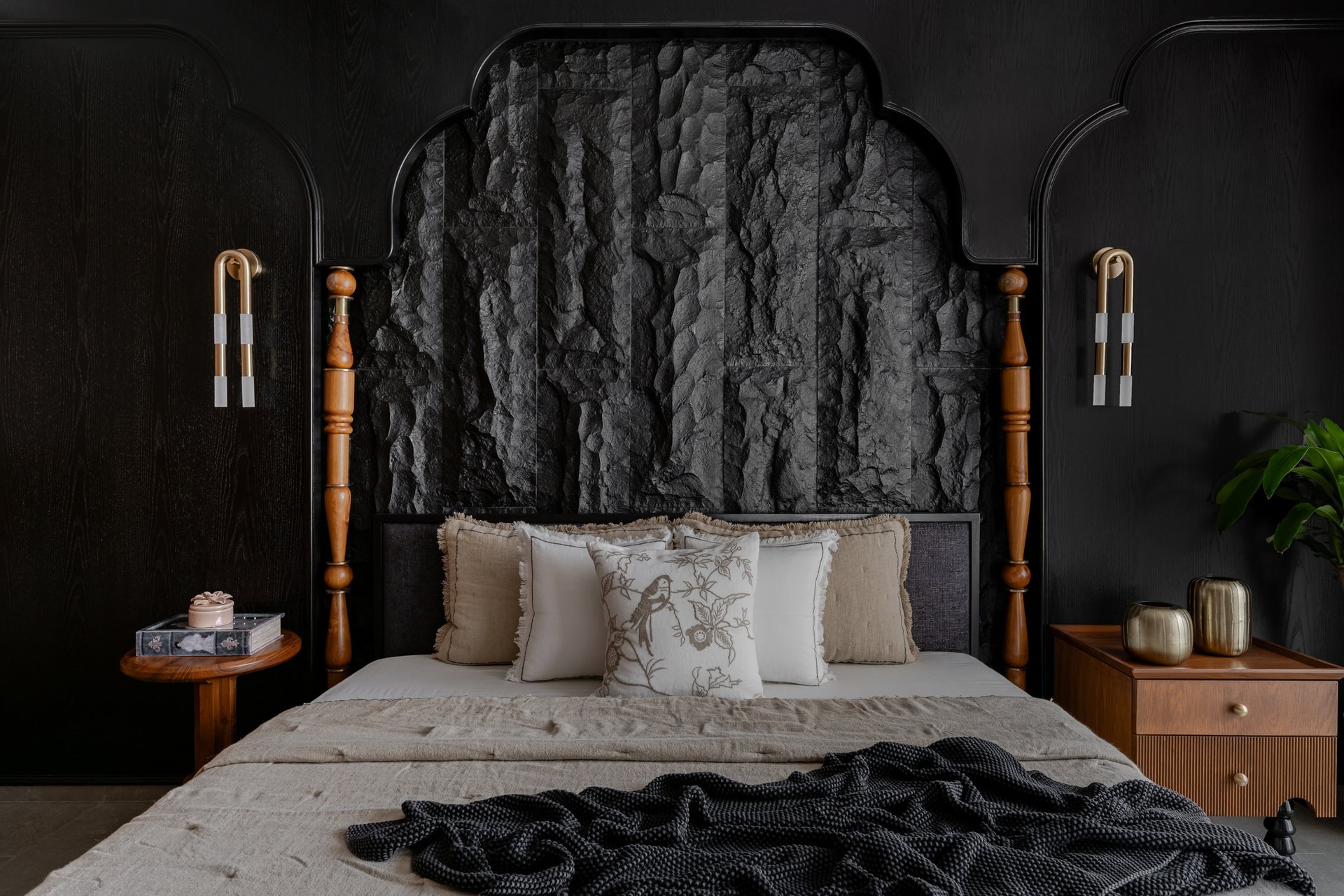
The grandparents’ bedroom takes the home’s most dramatic material decision: a fully black room. An arched frame in dark-stained timber, filled with the same rough-hewn stone used in the living rooms, rises behind the bed as a headboard wall of considerable visual force. Turned timber posts and brass-and-crystal sconces provide the only warmth against the encompassing darkness.
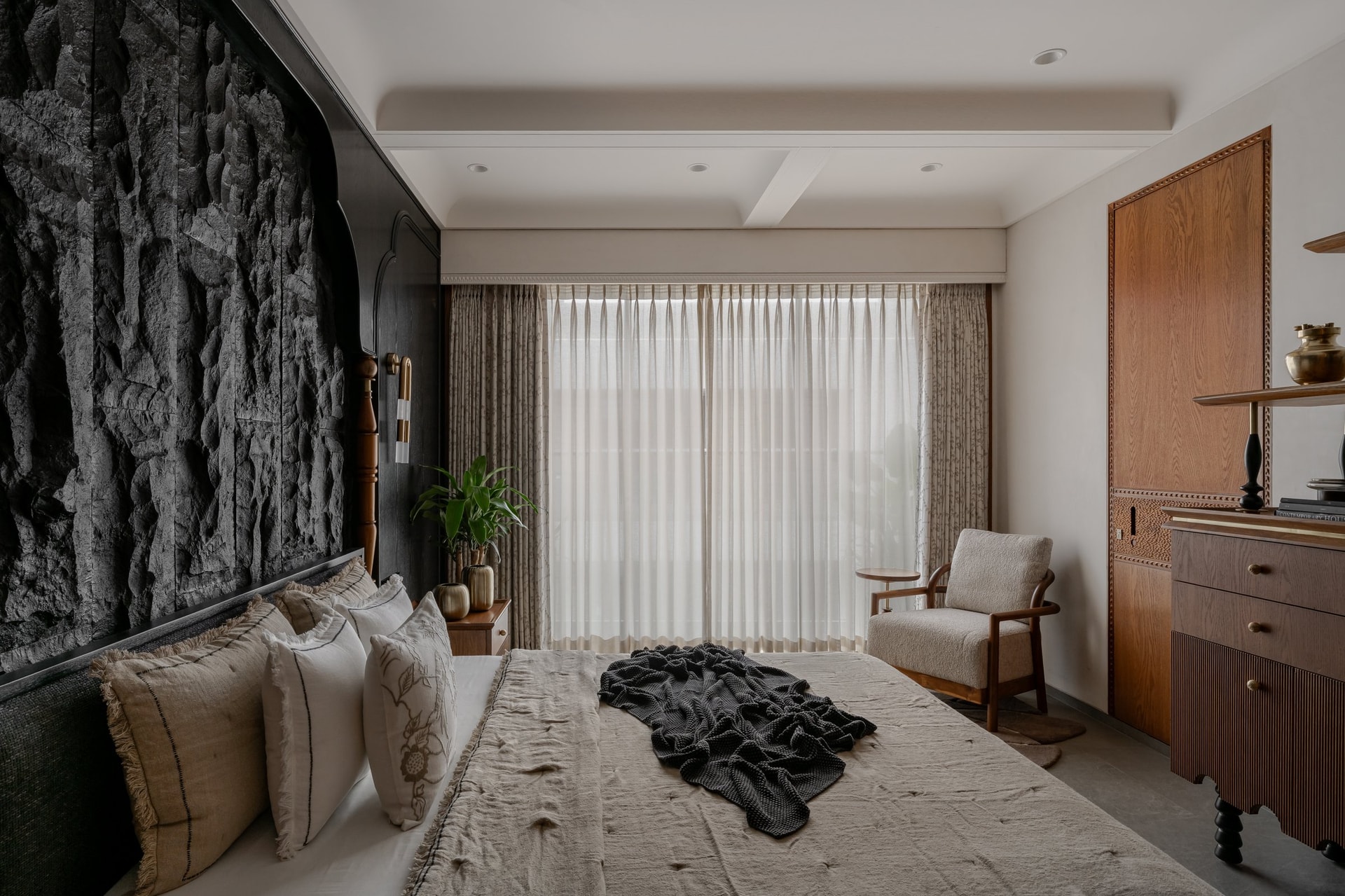
Seen from the foot of the bed, the room opens to generous natural light through sheer curtains, and a timber sideboard with reeded detailing along the adjacent wall provides grounding warmth. The darkness here is not oppressive; it reads as deliberate enclosure, a room that turns inward and values quietude.
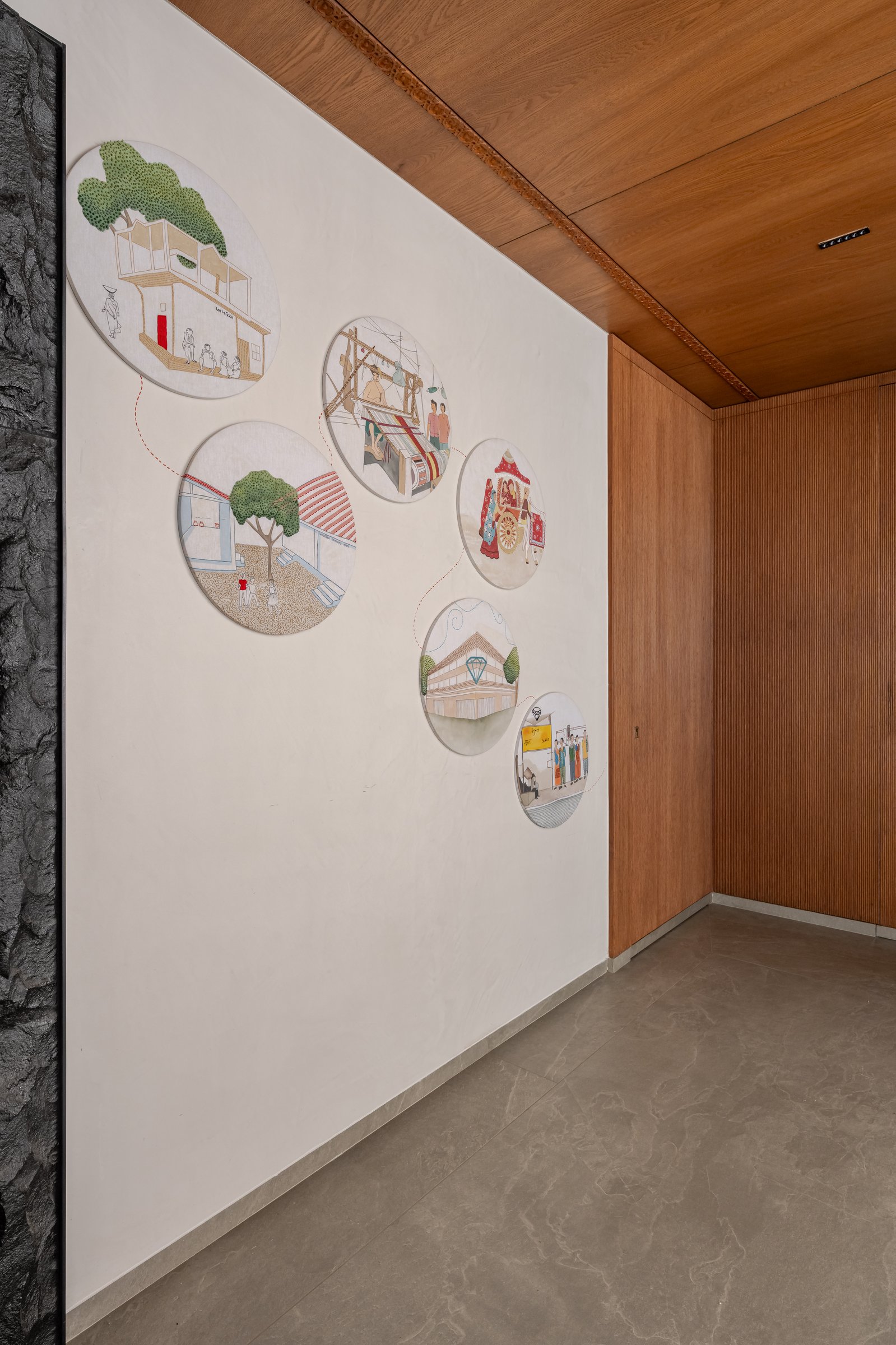
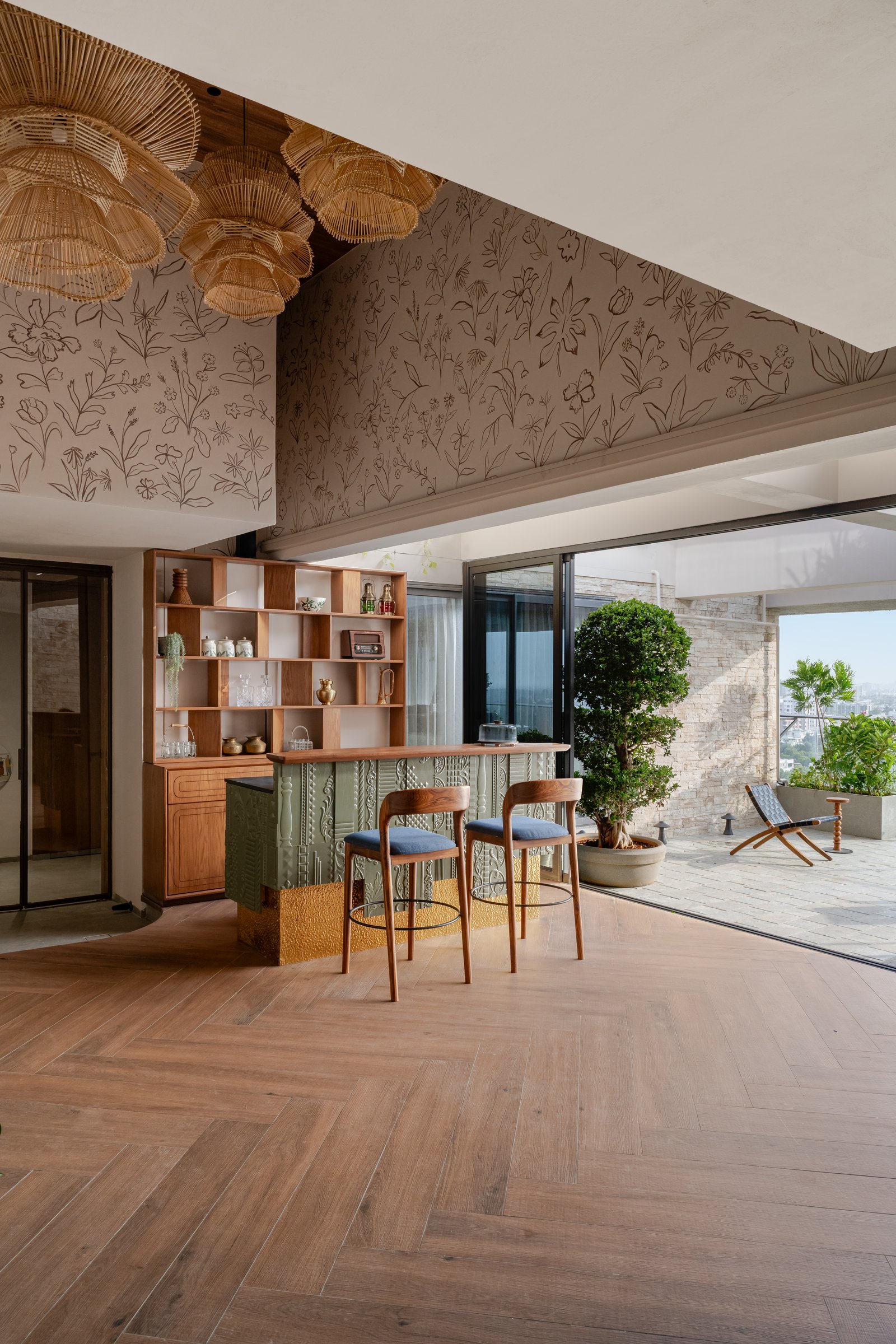
The outdoor deck, shared between the two wings, functions as both village courtyard and sky lounge. Herringbone timber flooring, a botanical-print ceiling, and a bar counter clad in embossed green panels with a hammered gold base open through full-height sliding doors to a stone-clad terrace with a sculpted topiary tree and a folding chair overlooking the city. The duality described by the designers is palpable here: ground and sky, tradition and panorama.
In a city where residential interiors often oscillate between imported luxury and nostalgic excess, RangRaas proposes a third path: a home in which every surface, every piece of joinery, every painting and textile is tied to a specific cultural reference, yet composed with the spatial clarity and custom-furniture ambition of contemporary practice. The project suggests that Indian maximalism, when underwritten by genuine craft knowledge and a coherent narrative framework, can produce interiors of real seriousness.
What distinguishes this apartment is not the quantity of its references but the conviction with which they are deployed. Rachana and Ashish Chovatiya have built a home that treats mythology, family history, and Gujarati material culture not as decoration but as architecture, a set of spatial and narrative principles that organise an 8,000 sq ft apartment into something that reads, room by room, as a single sustained argument about how tradition can inhabit the present tense.