A farmhouse is the rare brief that asks a designer to do less, not more. The land does the heavy lifting; the architecture is meant to step back, frame, and shelter. To over-design here is to compete with the countryside, and the countryside always wins.
The Rajeev Punjabi Farmhouse, conceived by Nashik-based Rathod Associates Pvt. Ltd. under principal architect Sumit Rathod, takes this argument seriously. Spread across 3,800 square feet on the outskirts of Nashik, the home pairs the rugged textures of rural Maharashtra with a disciplined, almost monastic palette of white walls, granite floors, and warm wood. The ceilings are held high, the distractions kept low, and what remains is a home that breathes.
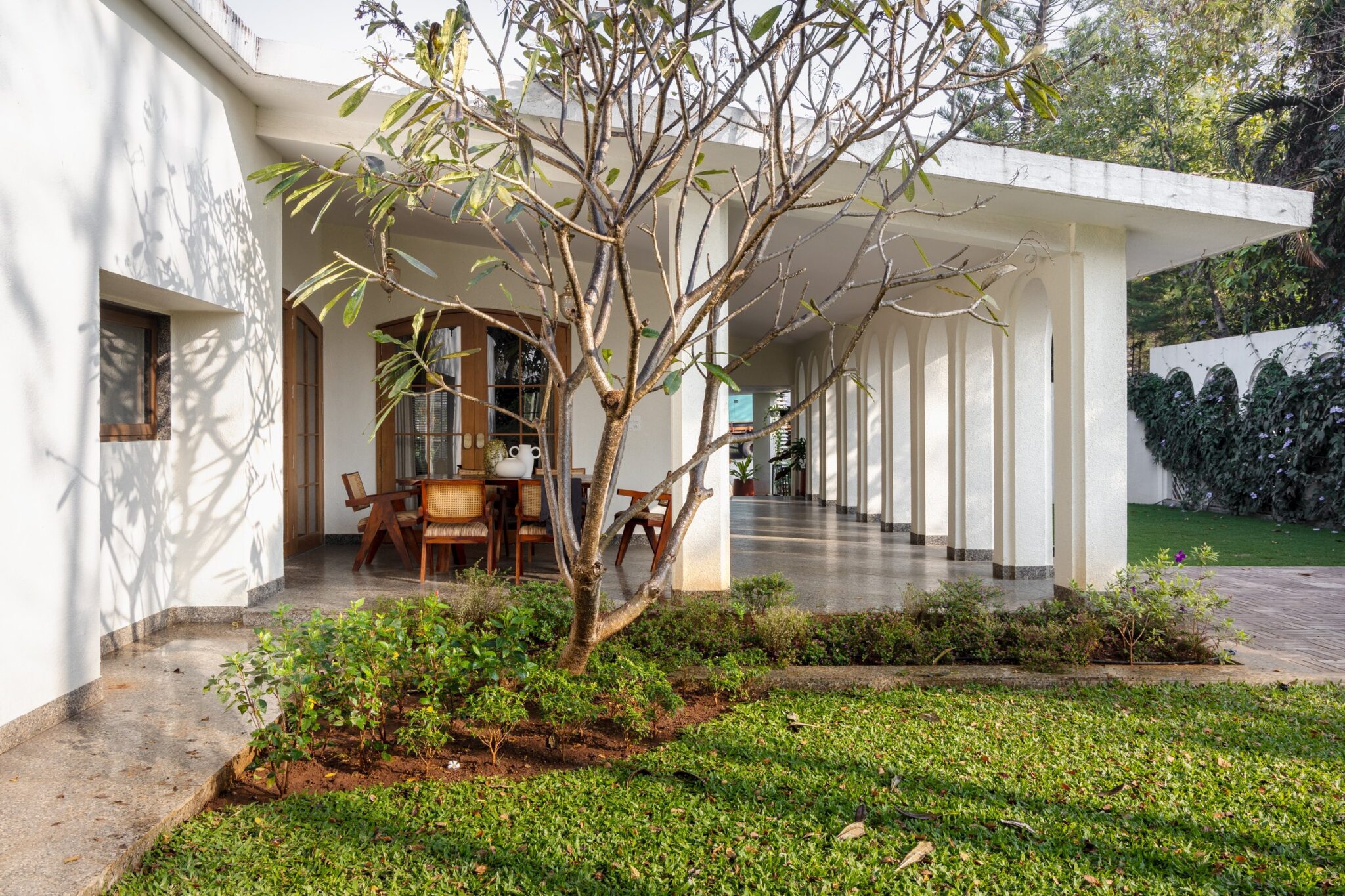
The exterior sets the tone before a single threshold is crossed. A low-slung white volume runs alongside a colonnaded verandah, its rhythm of slender pillars opening onto a lawn anchored by a mature frangipani. There is no announcement, no architectural posturing; the building is content to be a quiet ledge against the landscape.
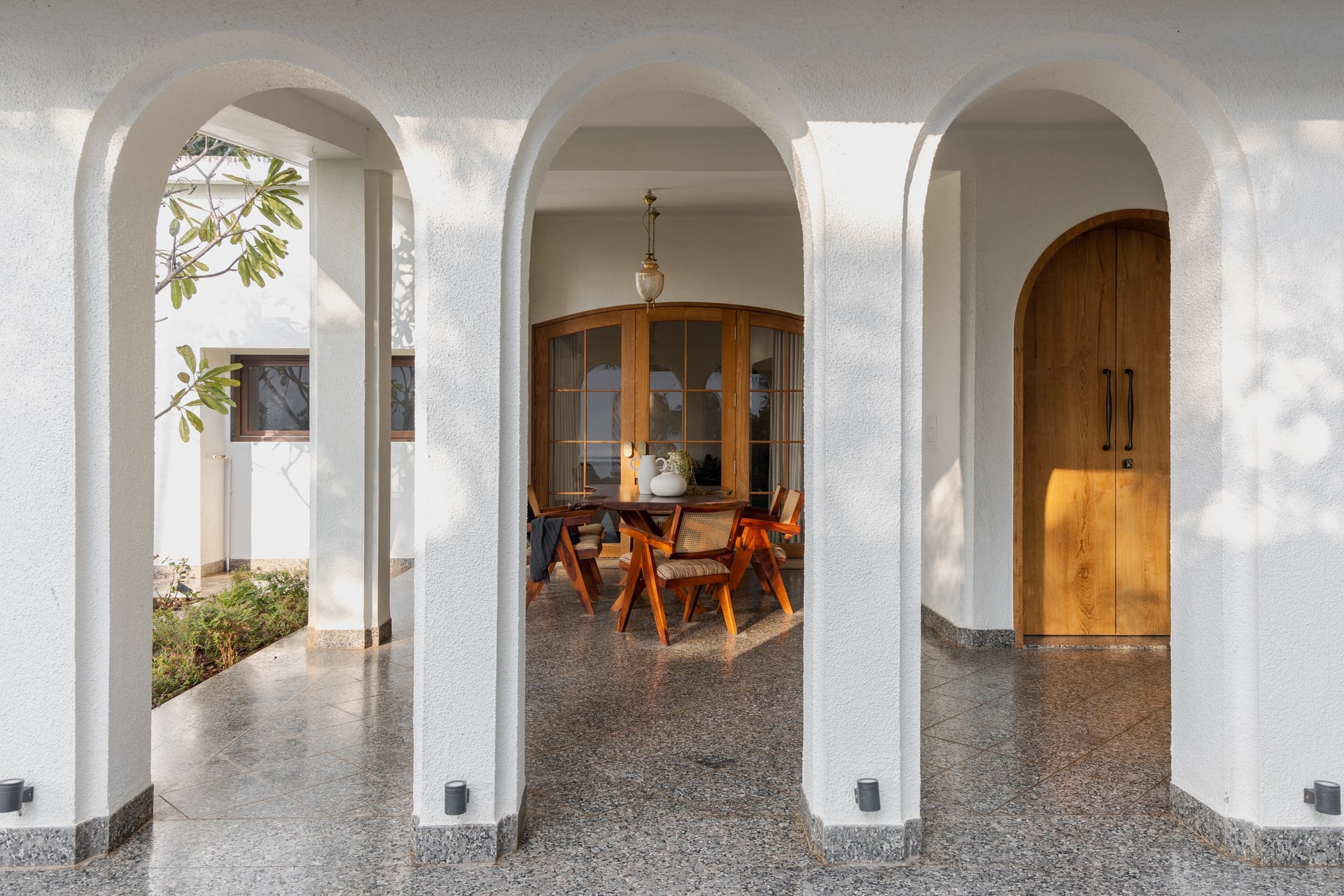
Three full-height arches mark the entry, framing the approach with a stillness that feels almost cloistered. Through the central arch, a glimpse of the dining table and its cane-and-wood chairs is offered like a held breath, while to the right an arched wooden door waits in its own bay. The triple-arch motif does the work of a portico without the weight of one.
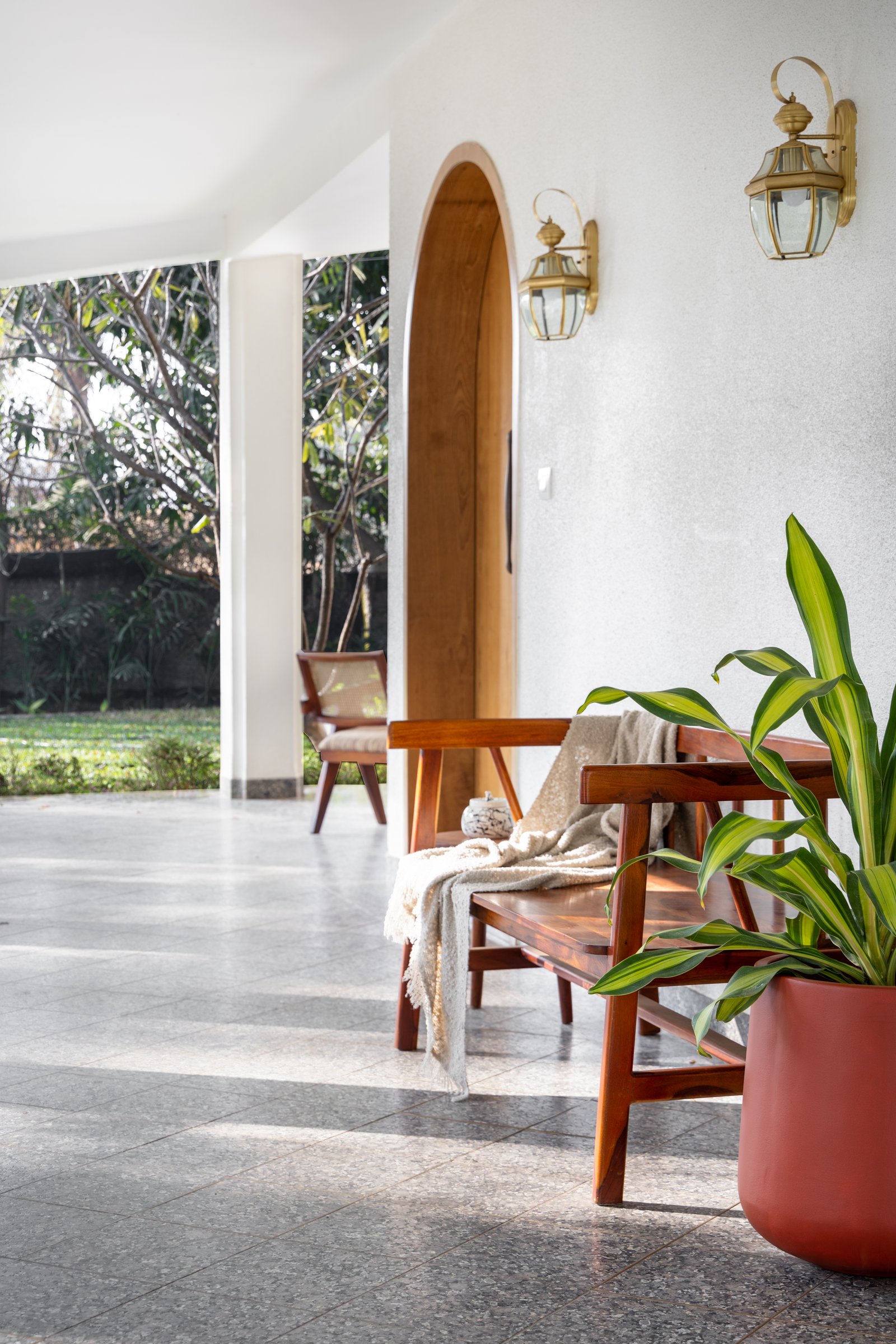
Within the verandah, the architecture continues its quiet logic. A wooden bench sits beneath a pair of brass lanterns, an arched wooden doorway opens to the interior, and a single planted dracaena holds the foreground. The room, if it can be called that, is really a threshold, and it is designed to be lingered in rather than passed through.
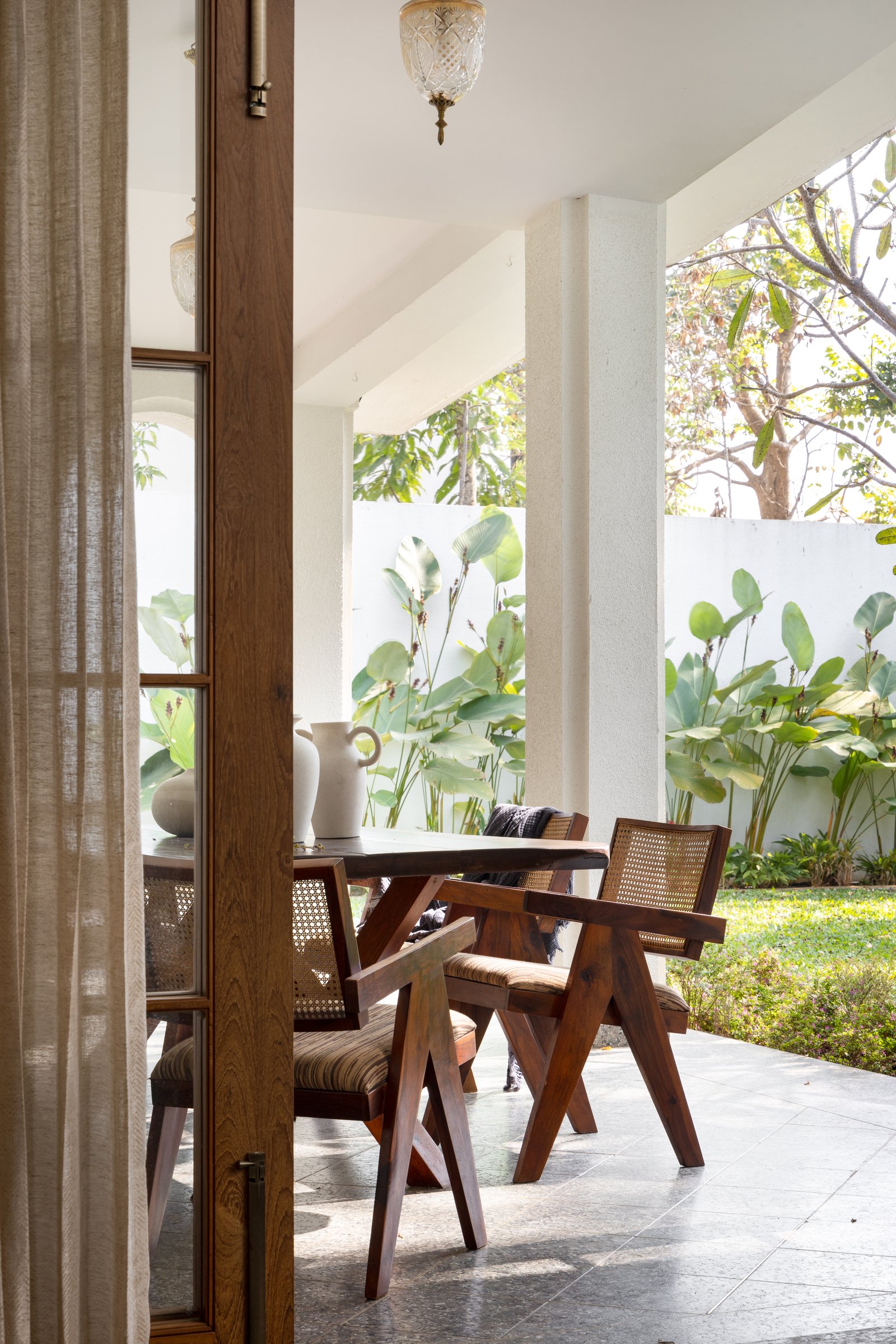
From the verandah, the boundary between inside and out softens further. A cane-and-wood chair pulled up to a live-edge table looks directly onto a band of broad-leafed planting against the boundary wall. The countryside is not a view here; it is the fourth wall of the room.
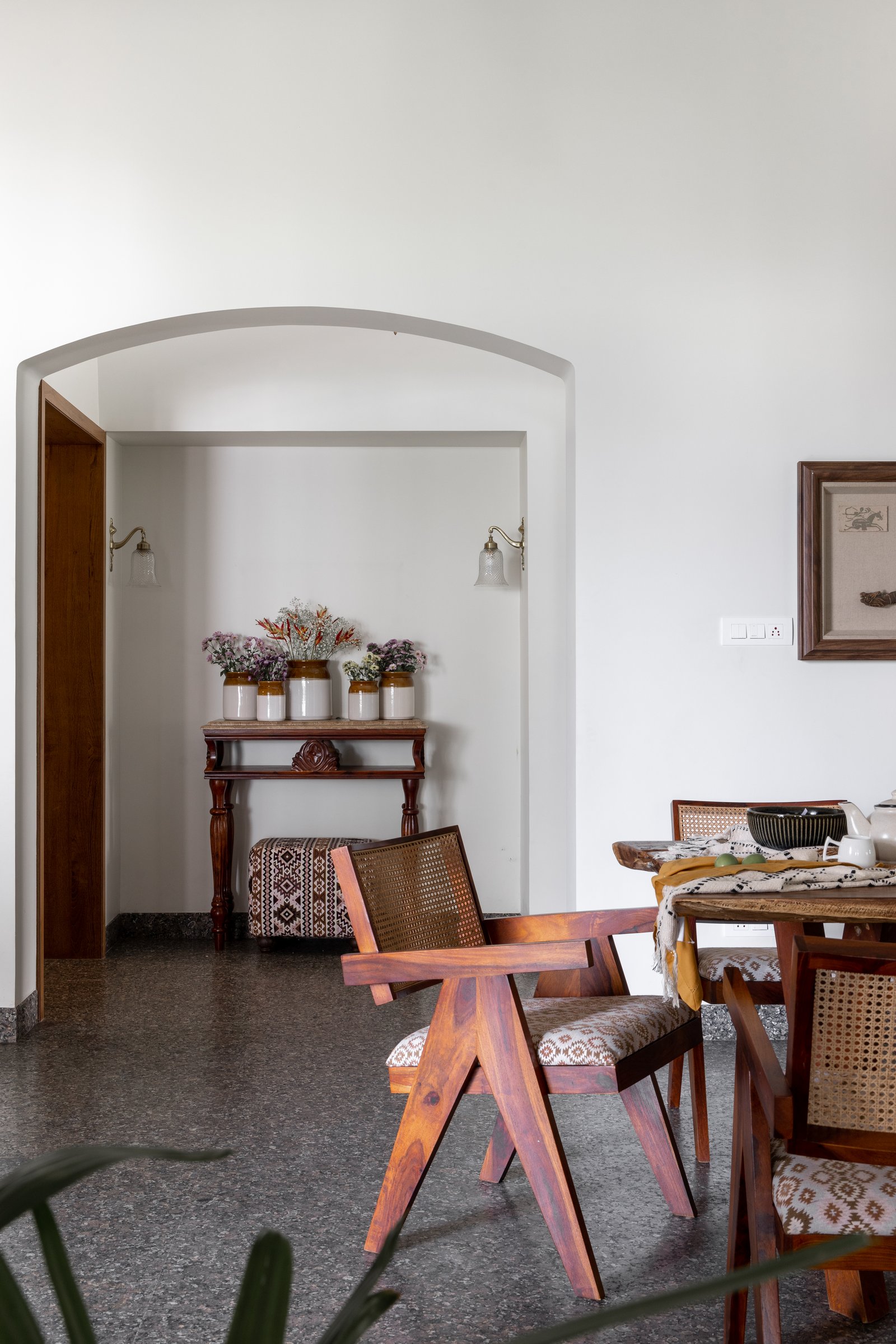
Step inside and the home reveals its central gesture: a soft, plastered arch that frames a quiet vignette of a carved console, a row of ceramic jars, and a small upholstered stool. The arch is not load-bearing in any structural sense, but it carries the whole emotional weight of the threshold between dining and the rest of the home.
In the foreground, a Chandigarh-language armchair in honey-toned sheesham with a caned back anchors the dining zone. The reference to mid-century institutional furniture is unmistakable, yet here it reads as domestic, almost rural, rebalanced by the cotton-block upholstery and the polished grey granite underfoot.
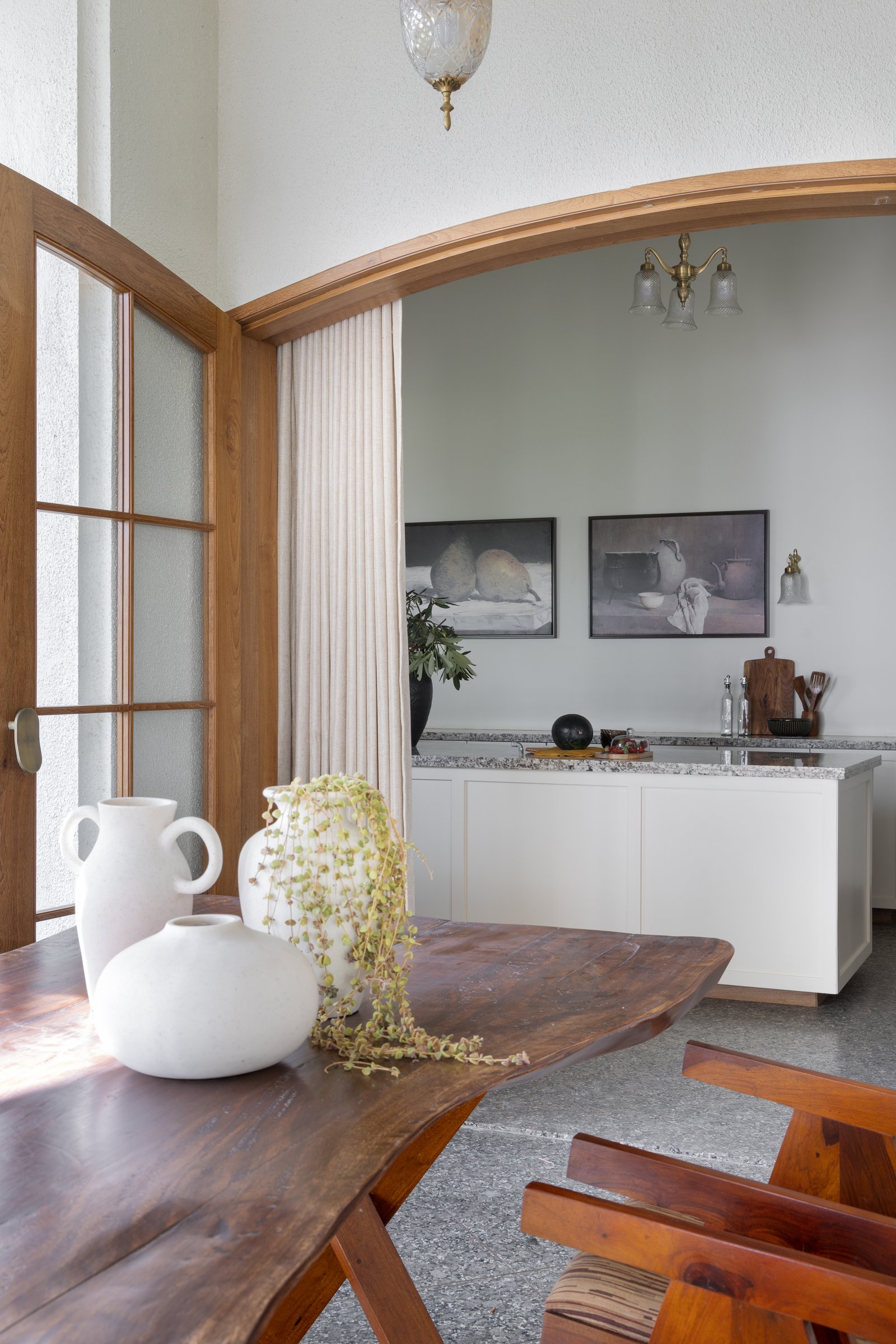
““We kept the ceilings high and the distractions low to let the view be the art.””
That single sentence from the studio explains nearly every decision in the home. Linen curtains pool to the floor, white ceramic vases cluster on the table, and a vintage glass pendant hangs at the doorway threshold; nothing competes, everything composes.
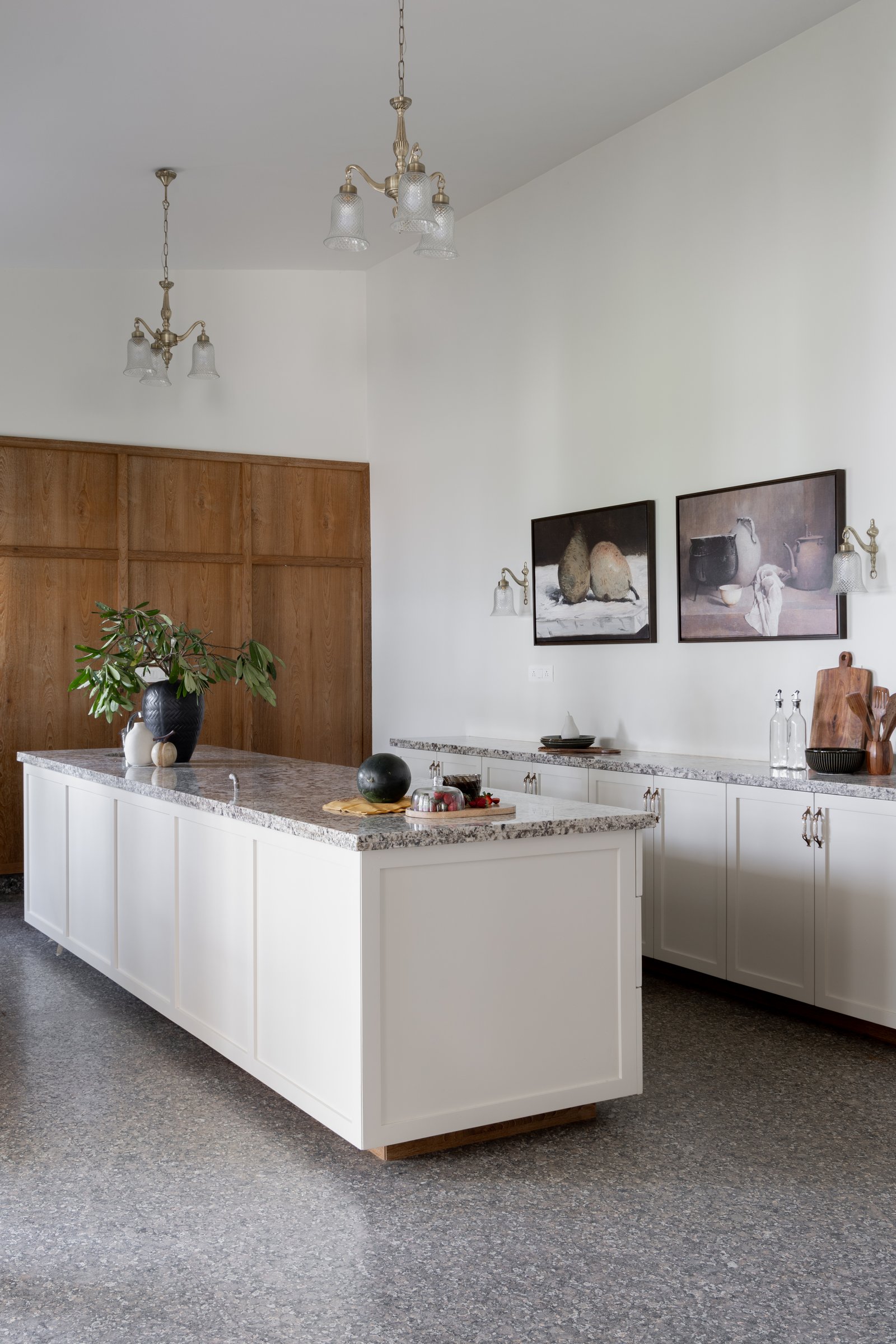
The kitchen extends this thinking into the room where most farmhouses tend to perform. A long island in white cabinetry, capped with a salt-and-pepper granite, runs parallel to a matching counter line. Above, two delicate brass-and-glass chandeliers hang at staggered heights against a double-height white wall, their old-world domesticity a deliberate counterpoint to the otherwise spare geometry.
Two framed still-life paintings, both in muted earth tones, are the only wall art the kitchen needs. They function less as decoration and more as a tonal cue: this is a room that values stillness over spectacle.
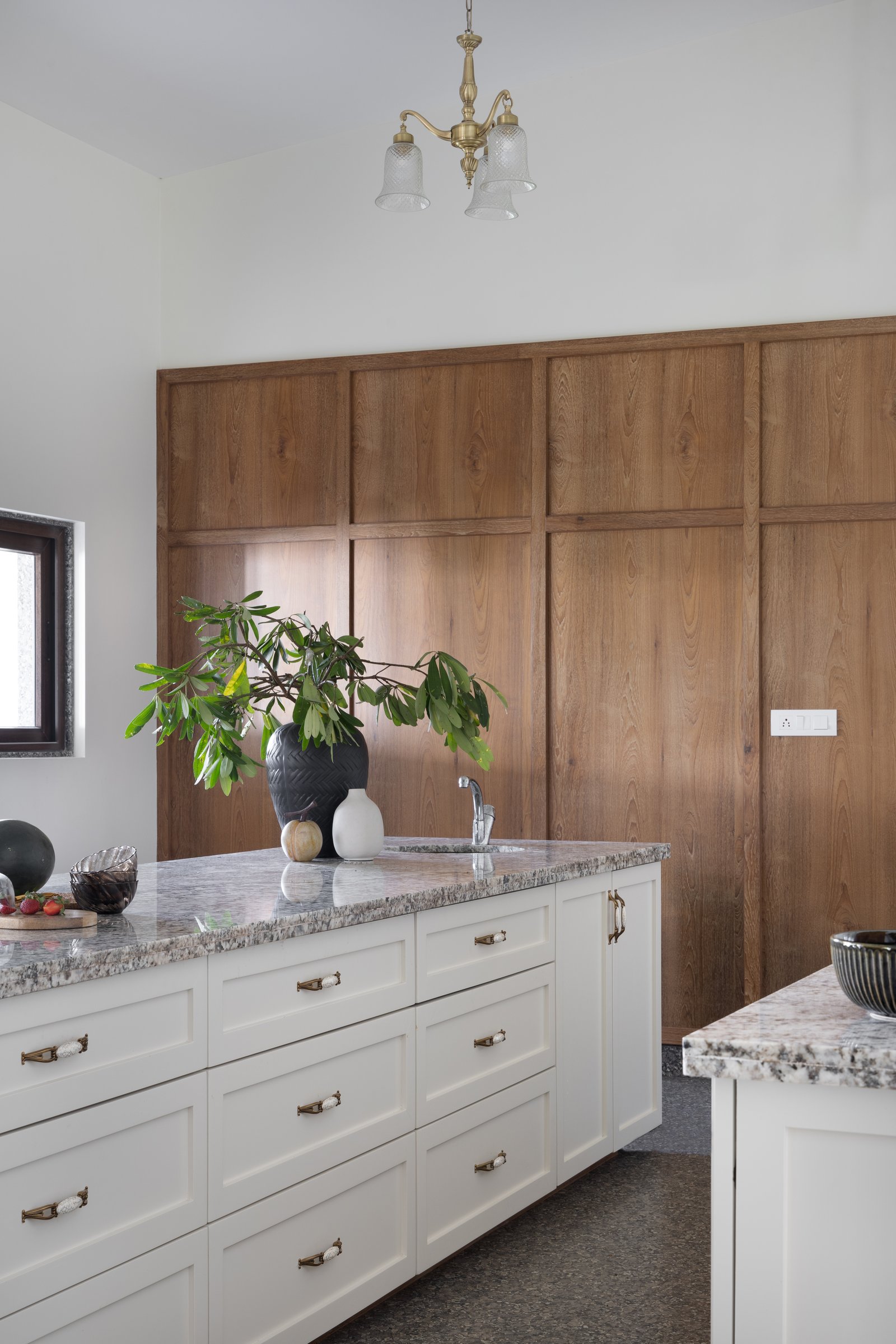
The kitchen’s quieter side is given over to a full-height wall of a grid of wooden panelling, its grain glowing softly under the chandelier. The panelling pulls the room’s centre of gravity toward warmth without ever crowding it, and the brass cup-pulls on the cream cabinetry reinforce the slightly classical undertone running through the project.
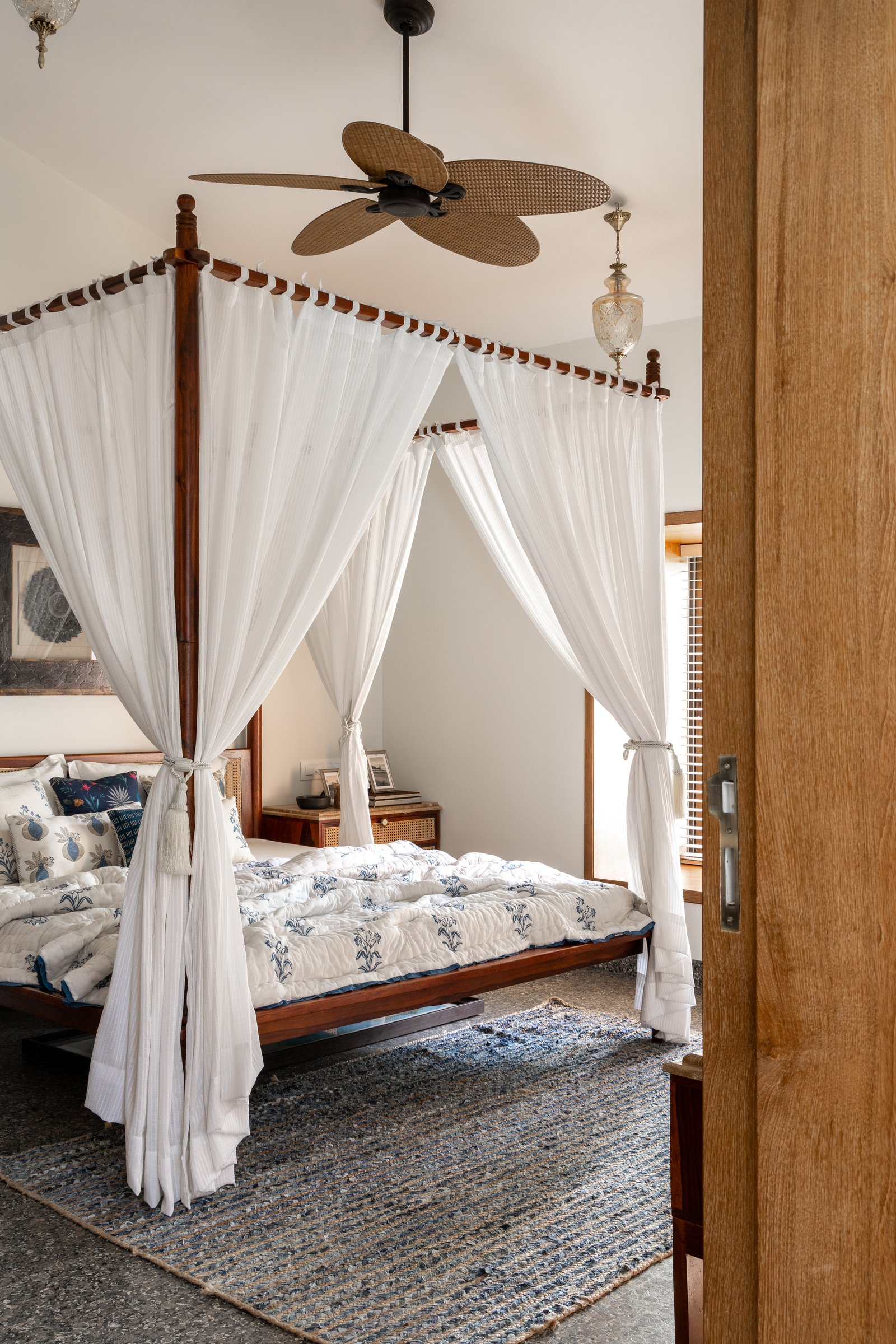
The master bedroom is the home’s most romantic gesture, and the only space where the discipline allows itself a small flourish. A four-poster wooden bed is draped with sheer white curtains tied back at each post, while a cane-fan ceiling fixture rotates overhead.
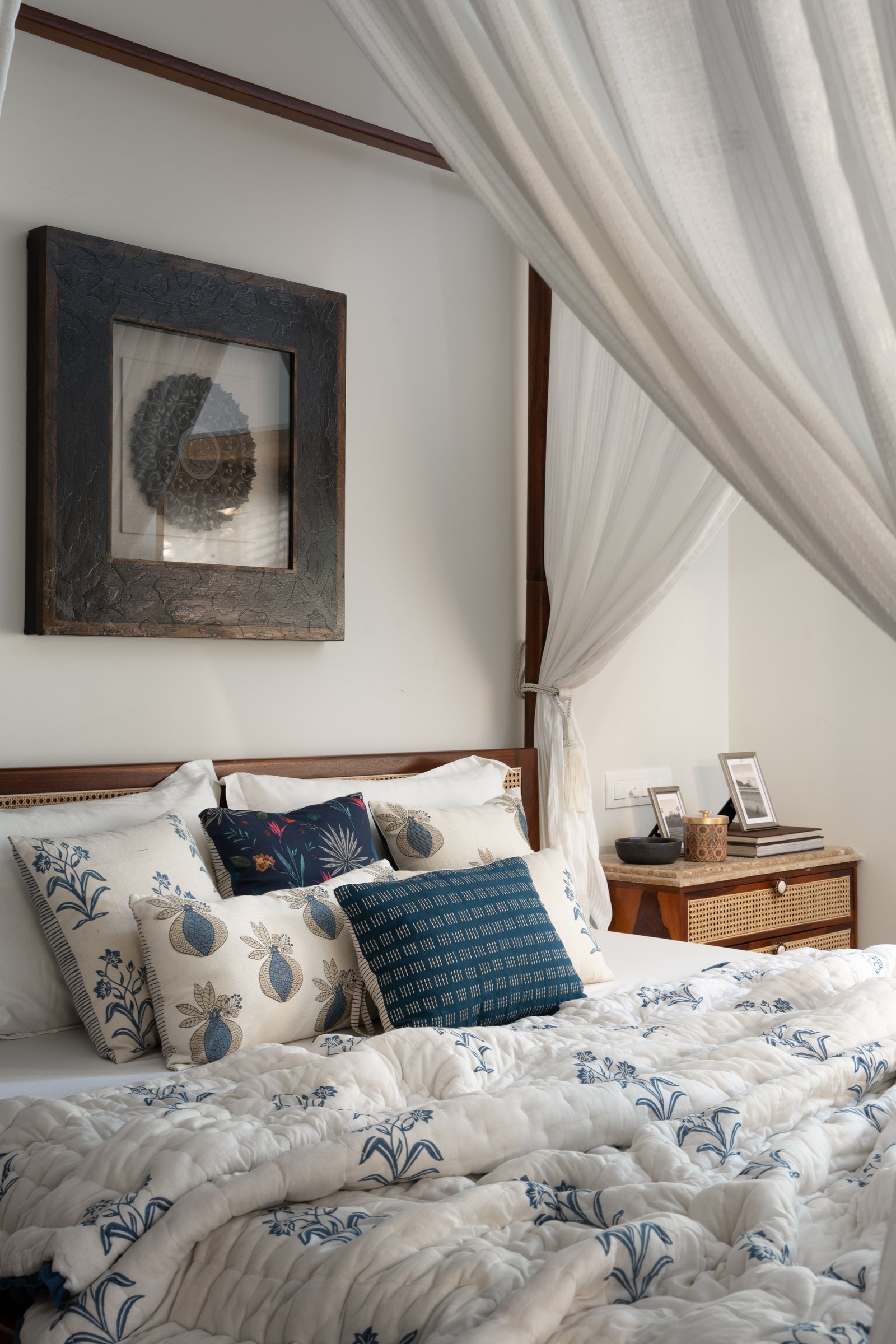
The bedscape itself, layered with pomegranate-motif and indigo cushions, draws directly from Indian block-print traditions without resorting to overt cultural signalling.
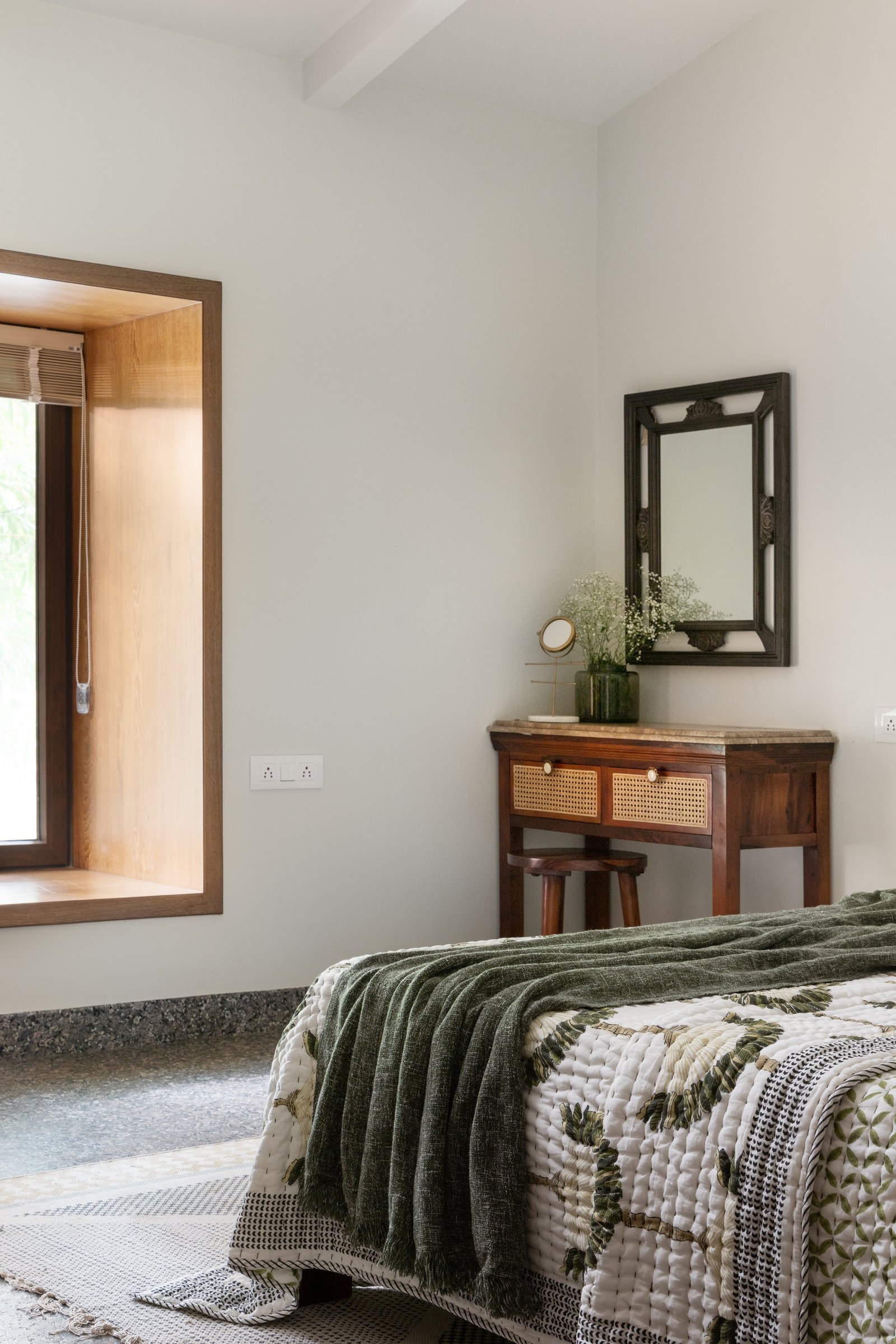
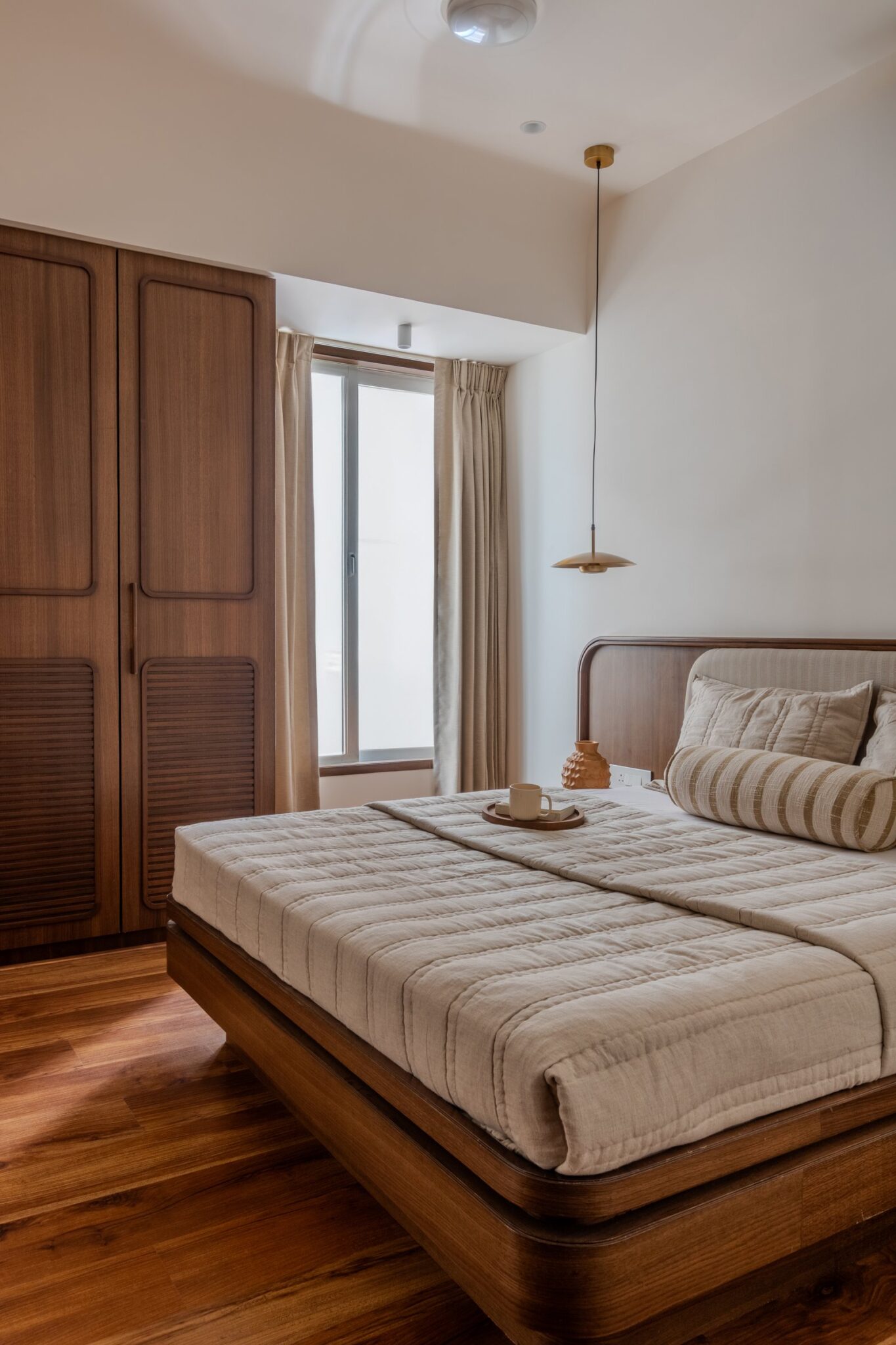
A second bedroom takes the same vocabulary in a calmer register. A caned writing console with a stone top sits below a carved dark-wood mirror, paired with a small three-legged stool. A deep wooden window reveal floods the floor with afternoon light, and an olive-and-cream quilted throw rests at the foot of the bed.
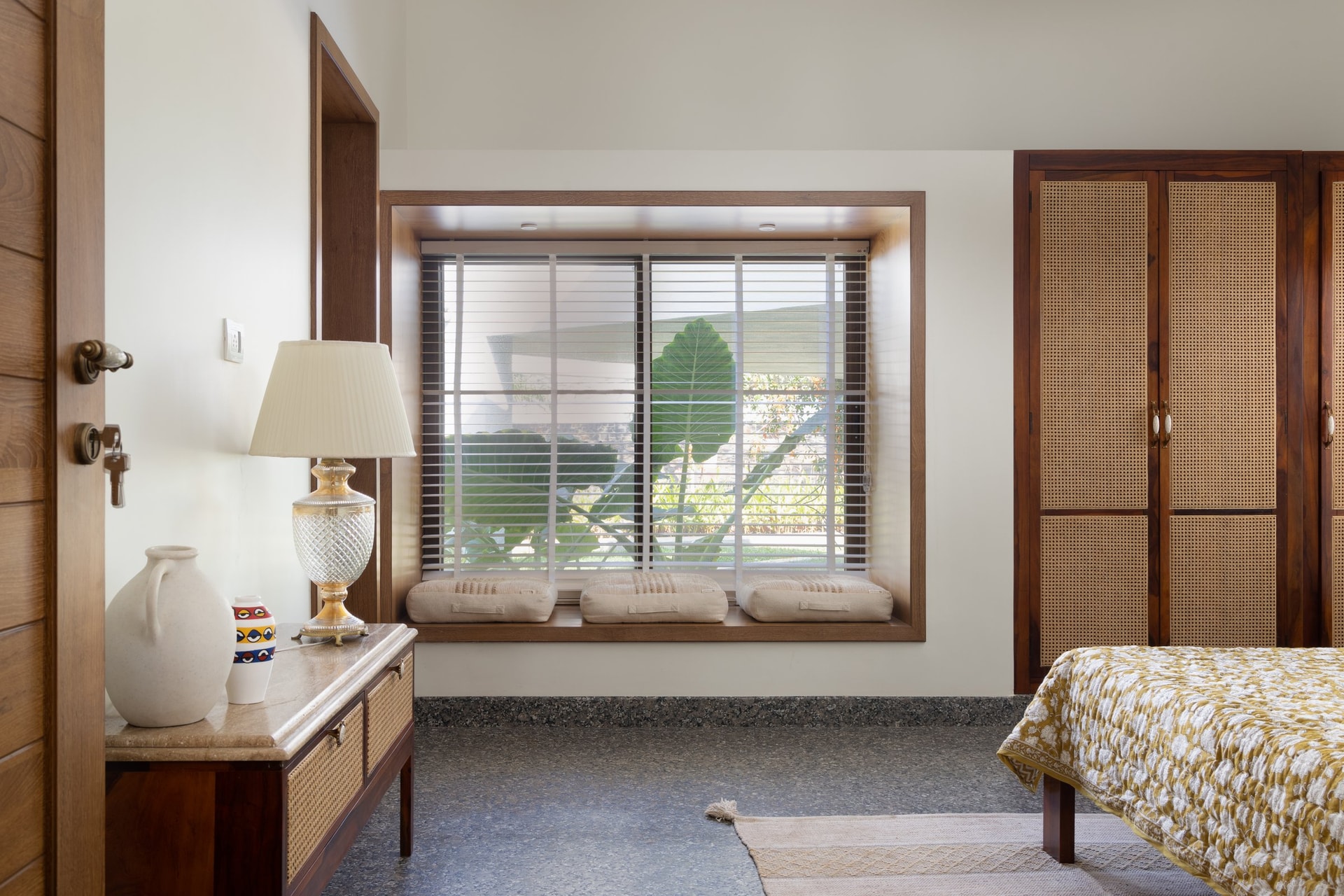
The third bedroom commits more fully to the verandah idea, treating the window itself as a piece of furniture. A deep wooden box-window holds three linen cushions in a row, looking onto the garden through slatted blinds. Opposite, a caned wardrobe in dark wood and a marble-topped console with a cut-glass lamp complete the room with the unhurried confidence of a guesthouse that knows its job.
What makes the Farmhouse worth attention is not any single material decision but the cumulative discipline of the project. In a moment when Indian farmhouse design often reaches for either heavy traditional ornament or imported minimalism, this home finds a third register: country-house quiet, materially Indian, with just enough classical detail to feel anchored rather than austere.
The result is a home that proposes a particular rhythm of living, one in which the architecture steps back so that light, foliage, and a few well-chosen objects can do the speaking. In this lies the distinction of the project, not in how much it contains, but in how much it knows to leave out.