There is a particular kind of discipline that, when applied to domestic architecture, produces not rigidity but a slow, encompassing comfort. It is the discipline of knowing precisely how one wants to live, and allowing that knowledge to shape every wall, every threshold, every material choice. In a climate where contemporary Indian houses often oscillate between maximalist display and imported minimalism, a home that draws its confidence from structure and intent alone is a quietly radical proposition.
House of Quiet Details, an 8,500 sq. ft. residence in Erode, Tamil Nadu, designed by Design Interactions 16, is exactly that kind of project. The client arrived with a brief of uncommon precision, one in which storage, circulation, and daily ritual had already been mapped out, and the designer’s task was to translate that clarity into spatial and material form without letting the result feel clinical.
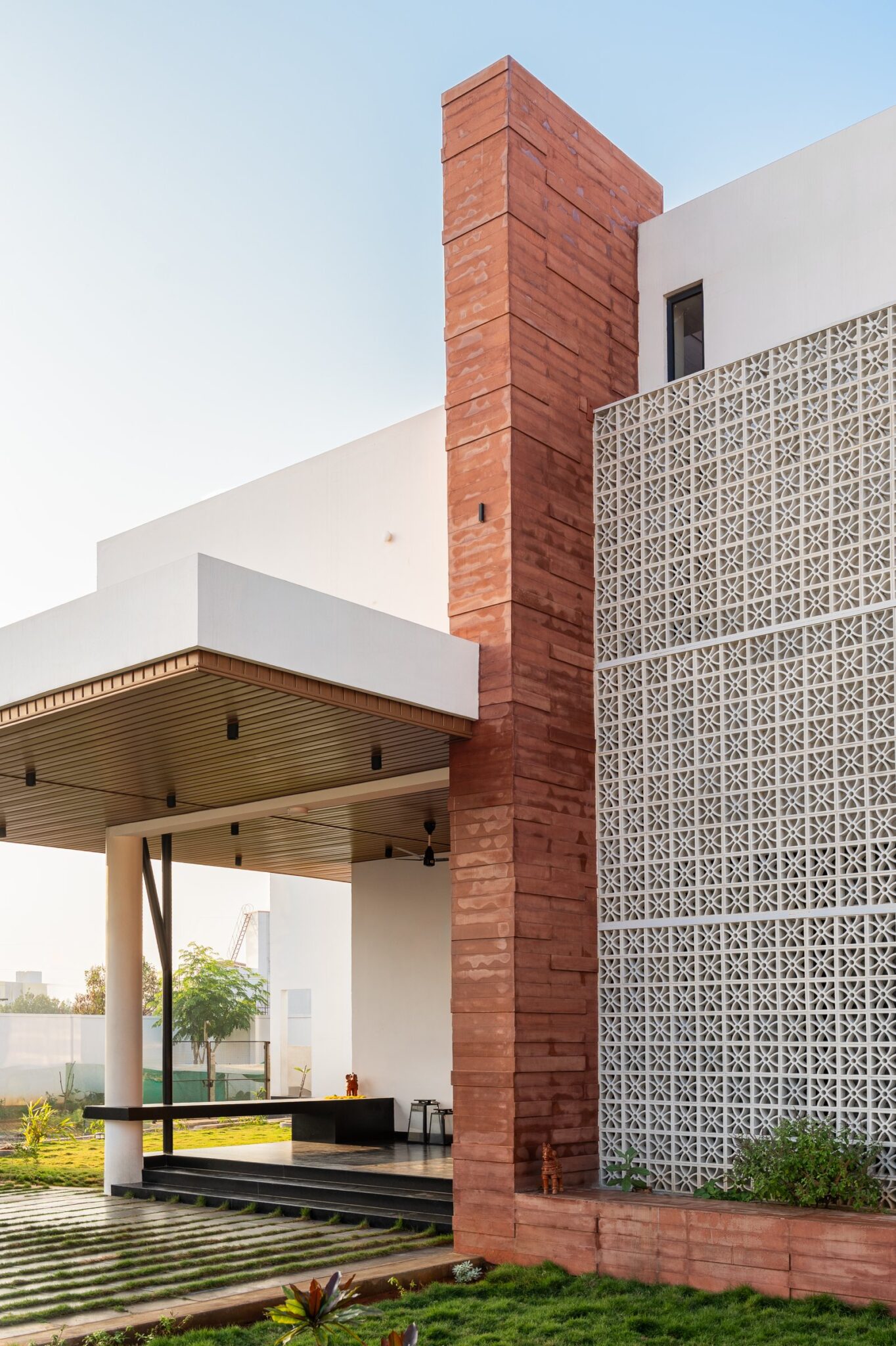
From the street, the house announces its material argument before the front door is ever reached. A red sandstone pier rises against white plastered volumes supported by slender columns and a full wall of perforated jaali screen, creating a layered facade that earns its depth through contrast and shadow rather than applied ornament. The deep overhang of the porch, lined with timber-finish battens on its soffit, signals a home that takes Erode’s climate seriously.
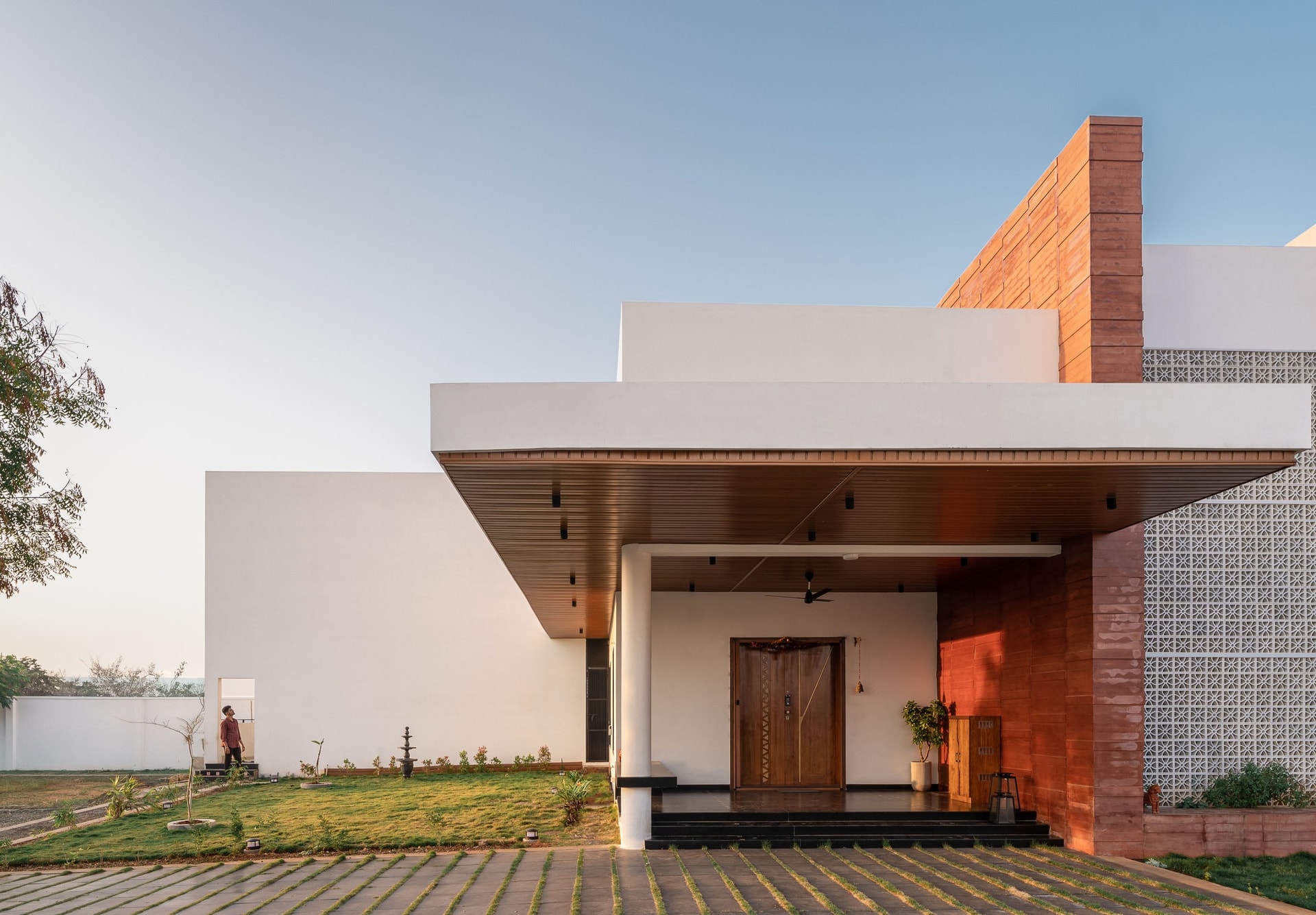
A wider view of the elevation reinforces the composition: staggered volumes, sandstone verticals, and the jaali field working together to break what could have been a monolithic mass into something rhythmic and permeable. The house reads as grounded, confident in its locality, owing nothing to borrowed formal gestures.
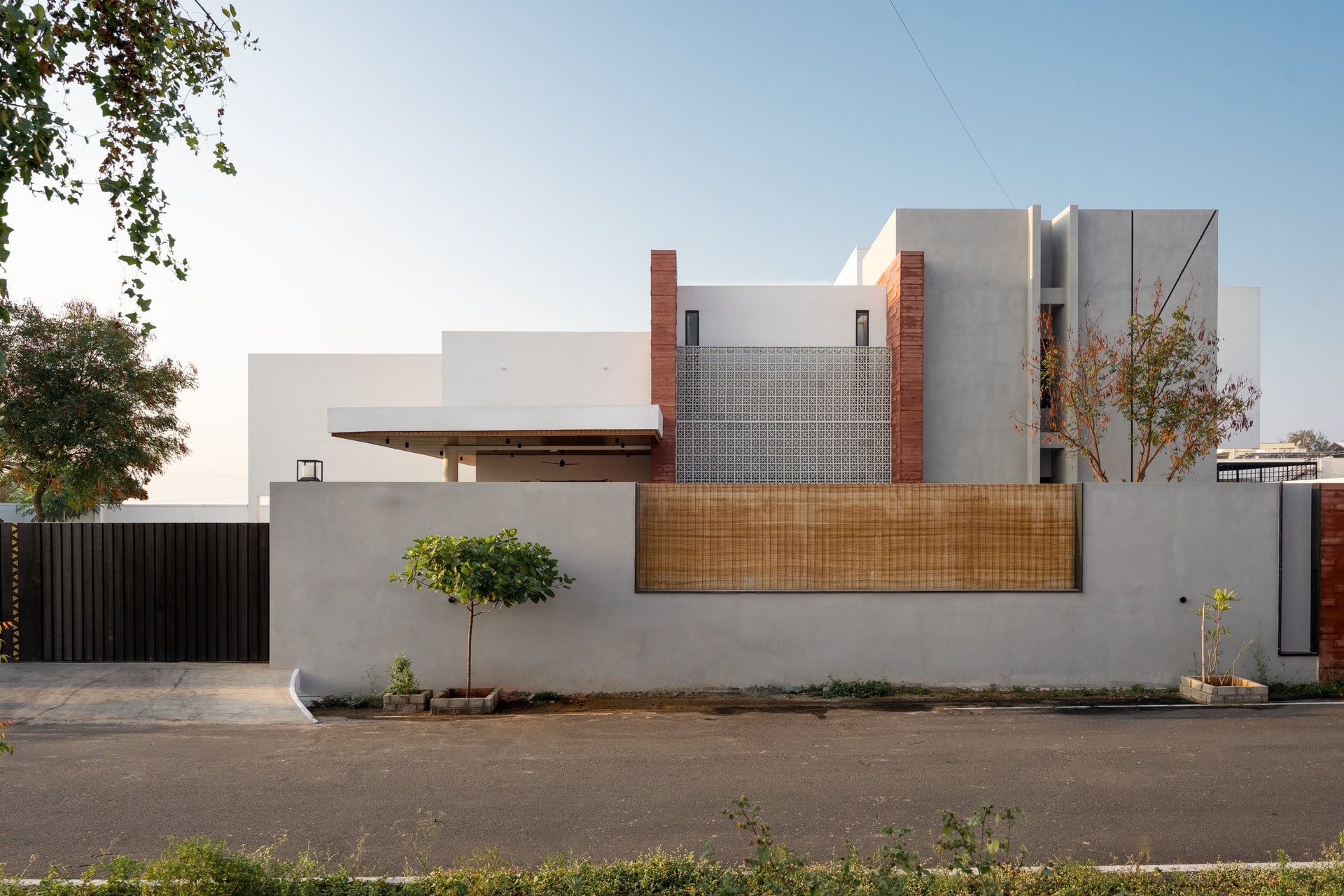
From the road, the street-facing facade reveals the interplay of grey rendered walls, red brick piers, and the patterned screen at a domestic scale, while a bamboo screen along the boundary wall adds warmth and texture.
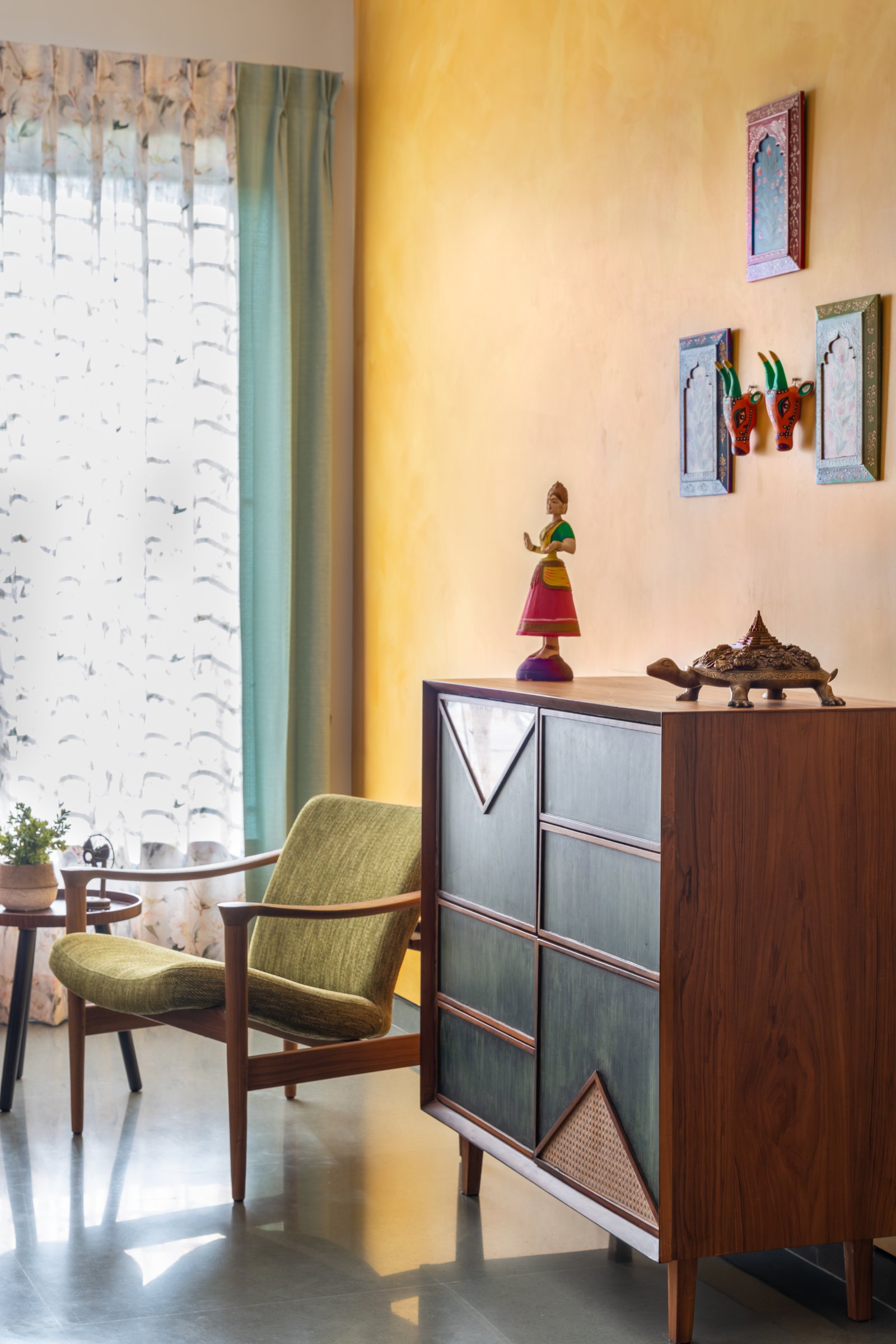
The foyer sets the home’s tonal register immediately. An ochre-washed wall, warm and slightly textured, frames a handcrafted wooden sideboard with patinated panel fronts and a cane-inlay detail. The palette here is deliberate: tradition is invoked through colour and craft, not through motif or pastiche, and the transition from the shaded verandah to this interior moment feels gradual rather than abrupt.
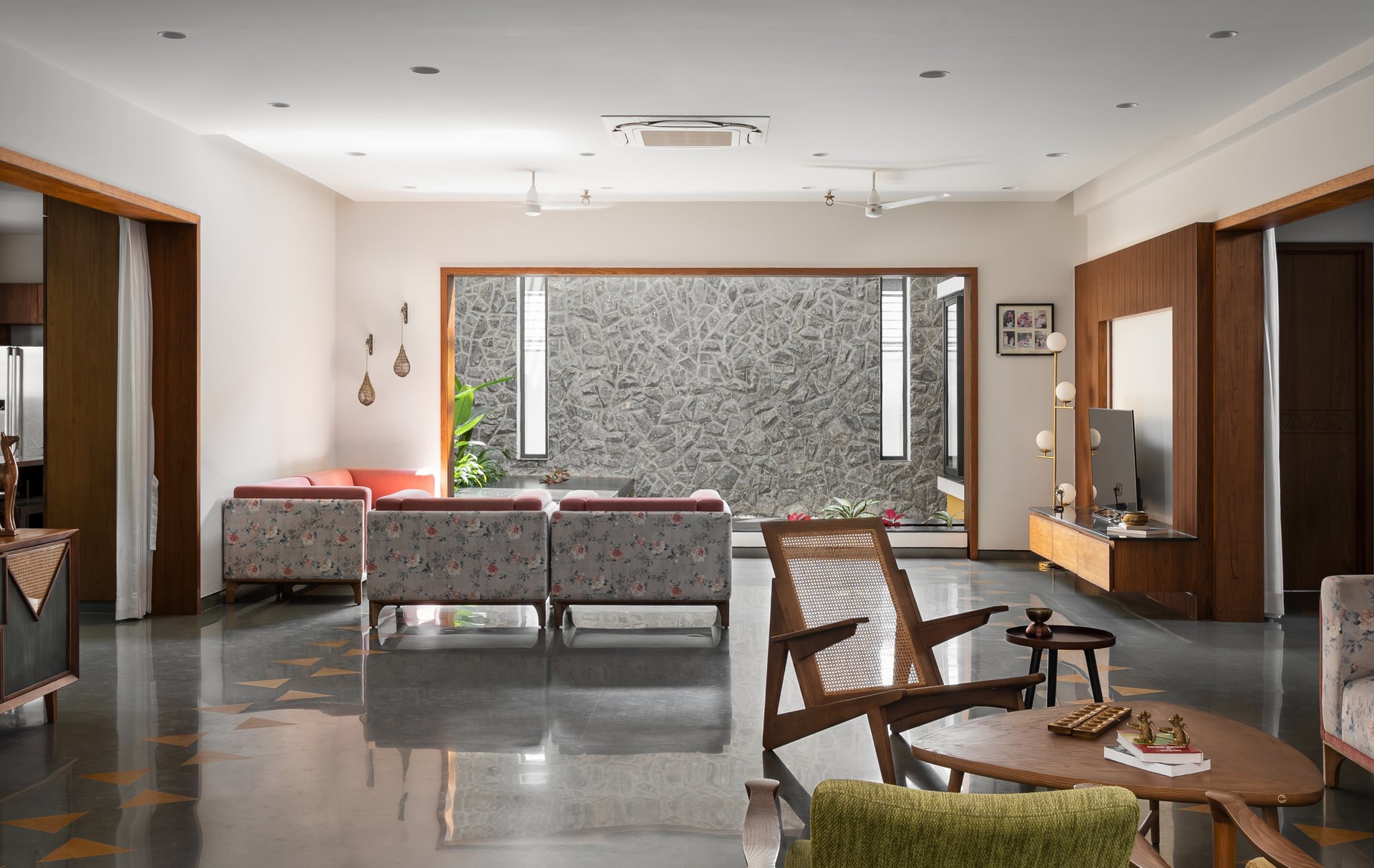
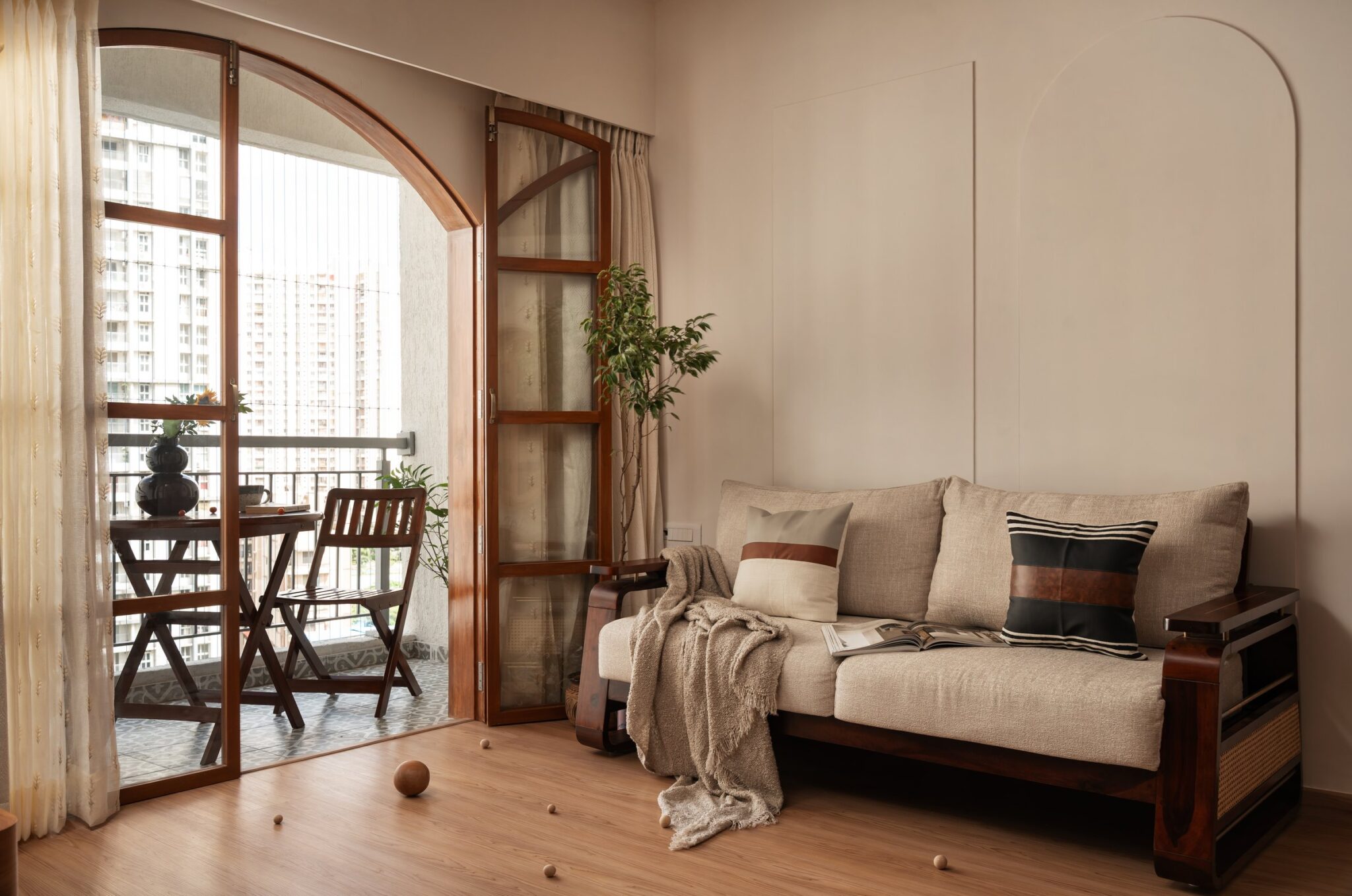
The living room opens as a generous, calm volume where Kota stone flooring, polished to a reflective finish, anchors the space with cool grey tones. Against the far wall, a large timber-framed opening looks directly into the courtyard, where a random rubble masonry wall in grey stone introduces a raw, textural counterpoint to the room’s restrained interiors.
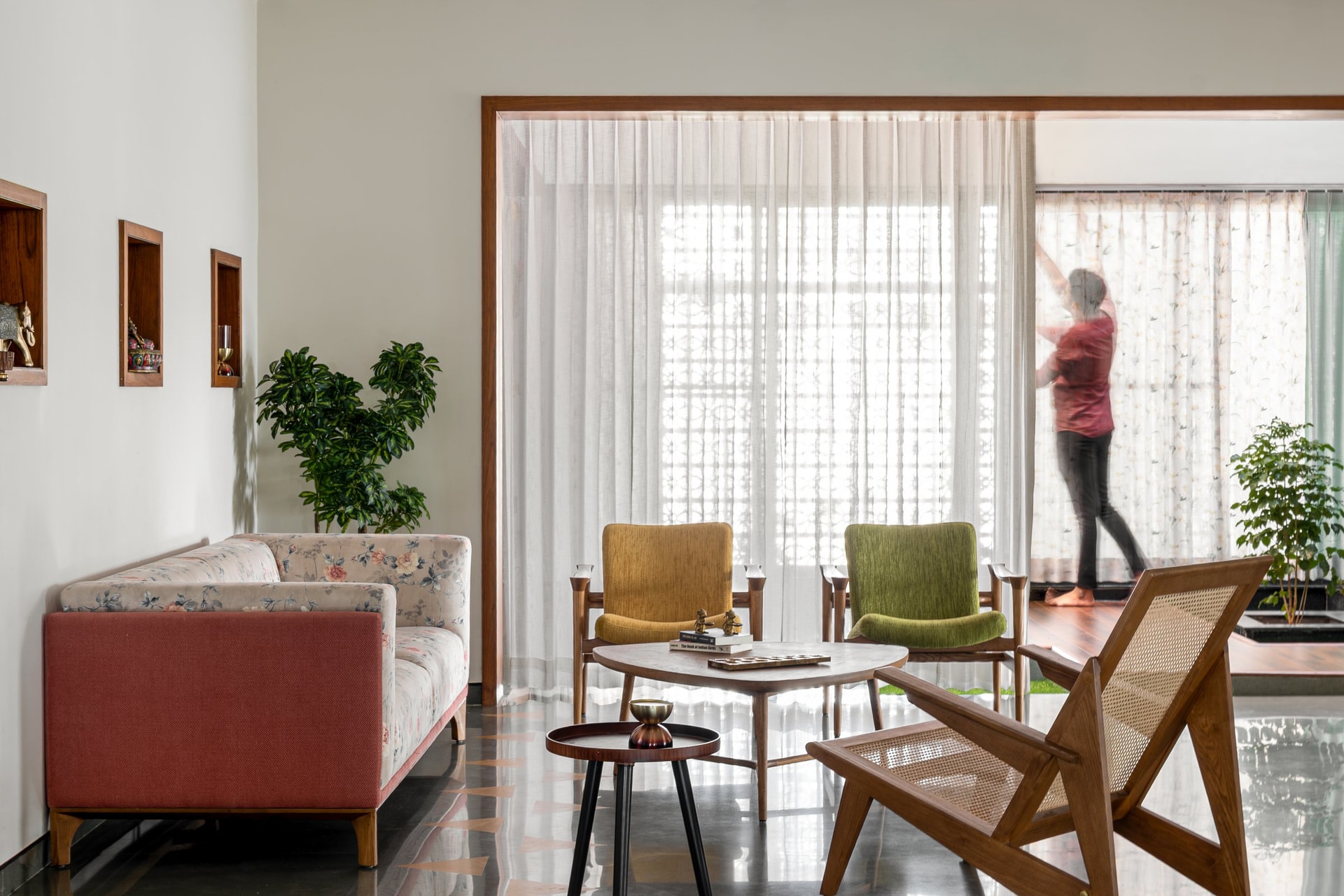
Recessed niches along one wall hold curated traditional objects, treated not as display but as quiet punctuation. The room’s character comes not from any single piece of furniture but from the way filtered light, entering through sheer curtains and the jaali screen beyond, creates shifting patterns across the dark polished floor’s geometric Jaisalmer stone inlays throughout the day.
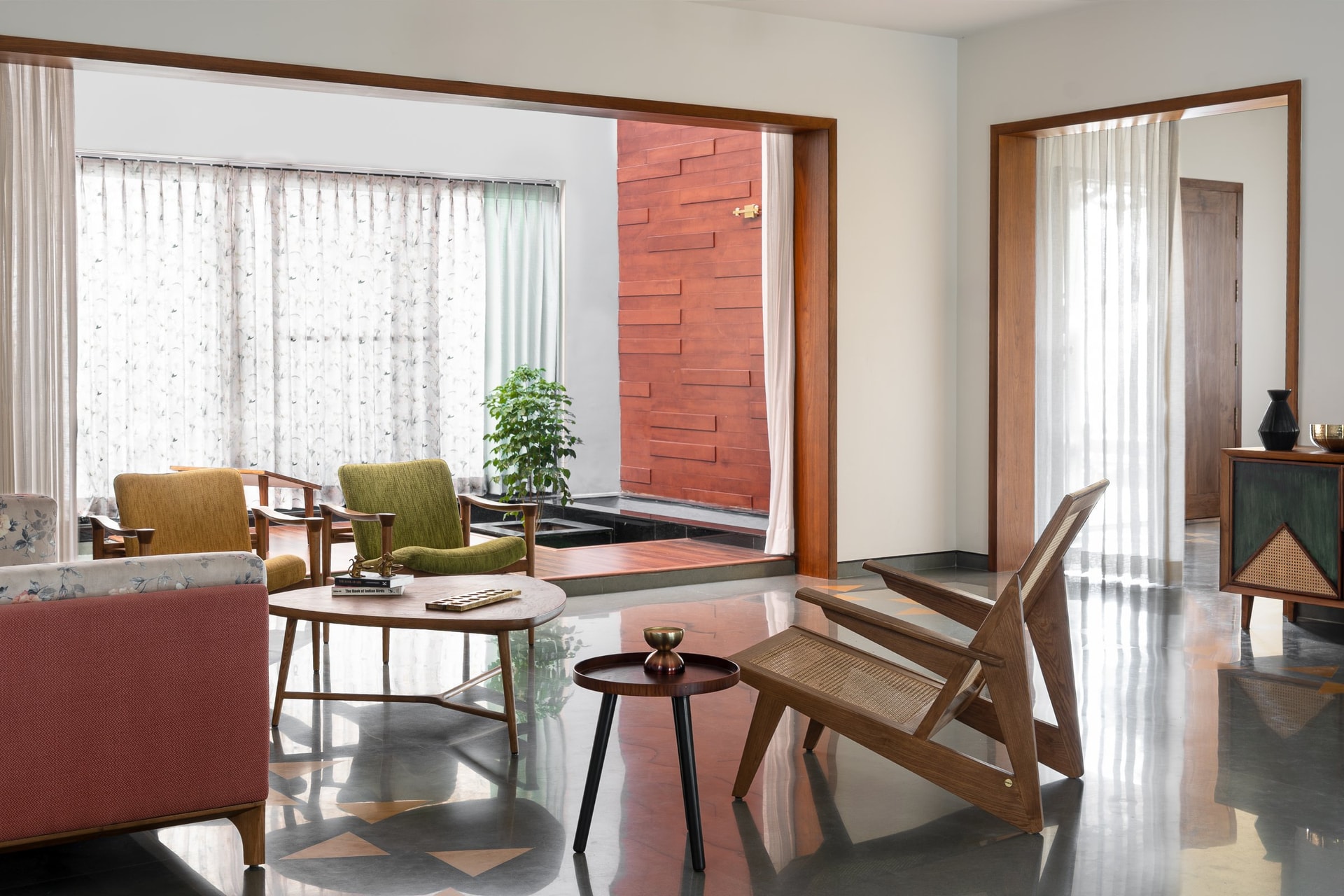
The sandstone wall of the courtyard, glimpsed through a wide wooden-framed opening, brings a warm terracotta glow into the room’s restrained palette. It is a view designed to change with the light, and it gives the living area a quality of constant, gentle animation.
““A quiet home where every detail is intentional, and every space is meant to be lived in.””
The pooja space is integrated into the living zone as a raised timber platform, open to the room rather than sequestered behind doors. This is perhaps the project’s most pointed design decision: spirituality treated as part of the domestic rhythm, not a separate event.
The courtyard itself is the home’s spatial and emotional centre. Yellow oxide walls meet the rubble masonry surface, a built-in black granite platform with an integrated planter defines its edge, and black stone pavers set in white pebble gravel underfoot ensure the space remains usable even in the monsoon. It is conceived for pause and conversation, not mere visual effect.
This is a lived-in space, occupied daily, warmed by sun and made comfortable by material choices that invite bare feet and unhurried time.
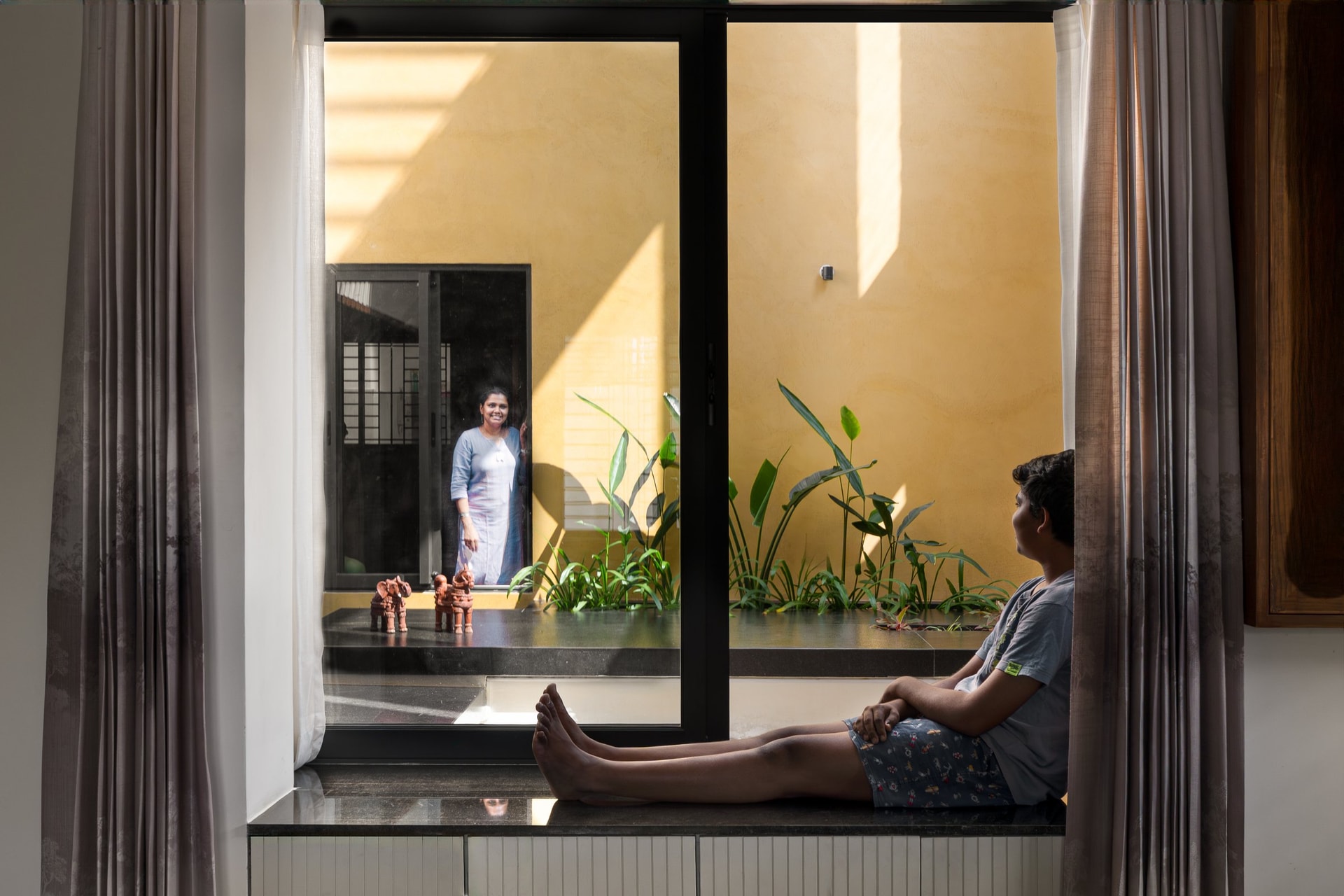
The master bedroom connects to the courtyard through a deep bay window, its black granite sill wide enough to sit in. From here, the yellow oxide wall and tropical planting are framed as a private vignette, separate from the more communal views the living room enjoys. The courtyard serves each room differently, and that multiplicity of connection is central to the plan’s success.
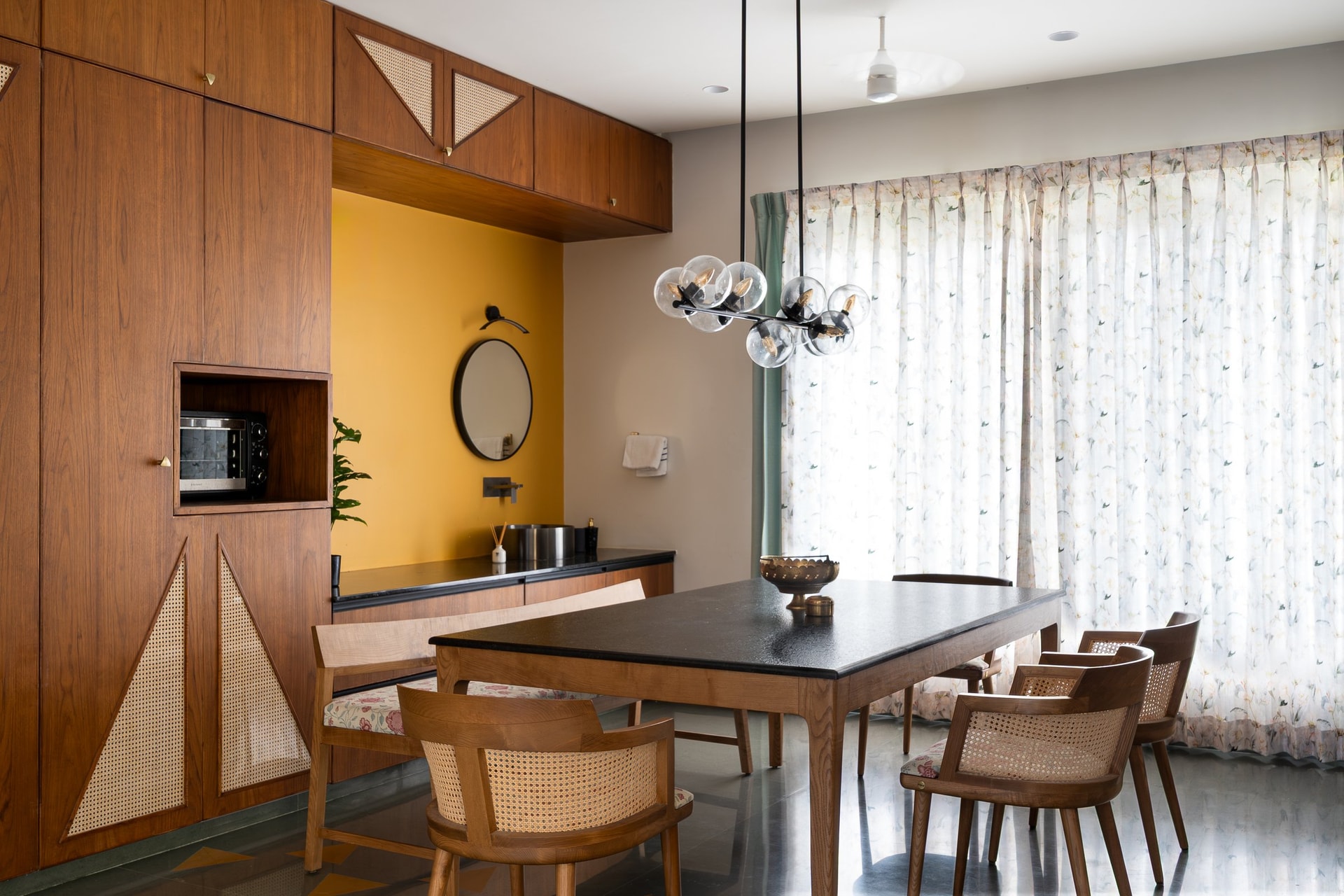
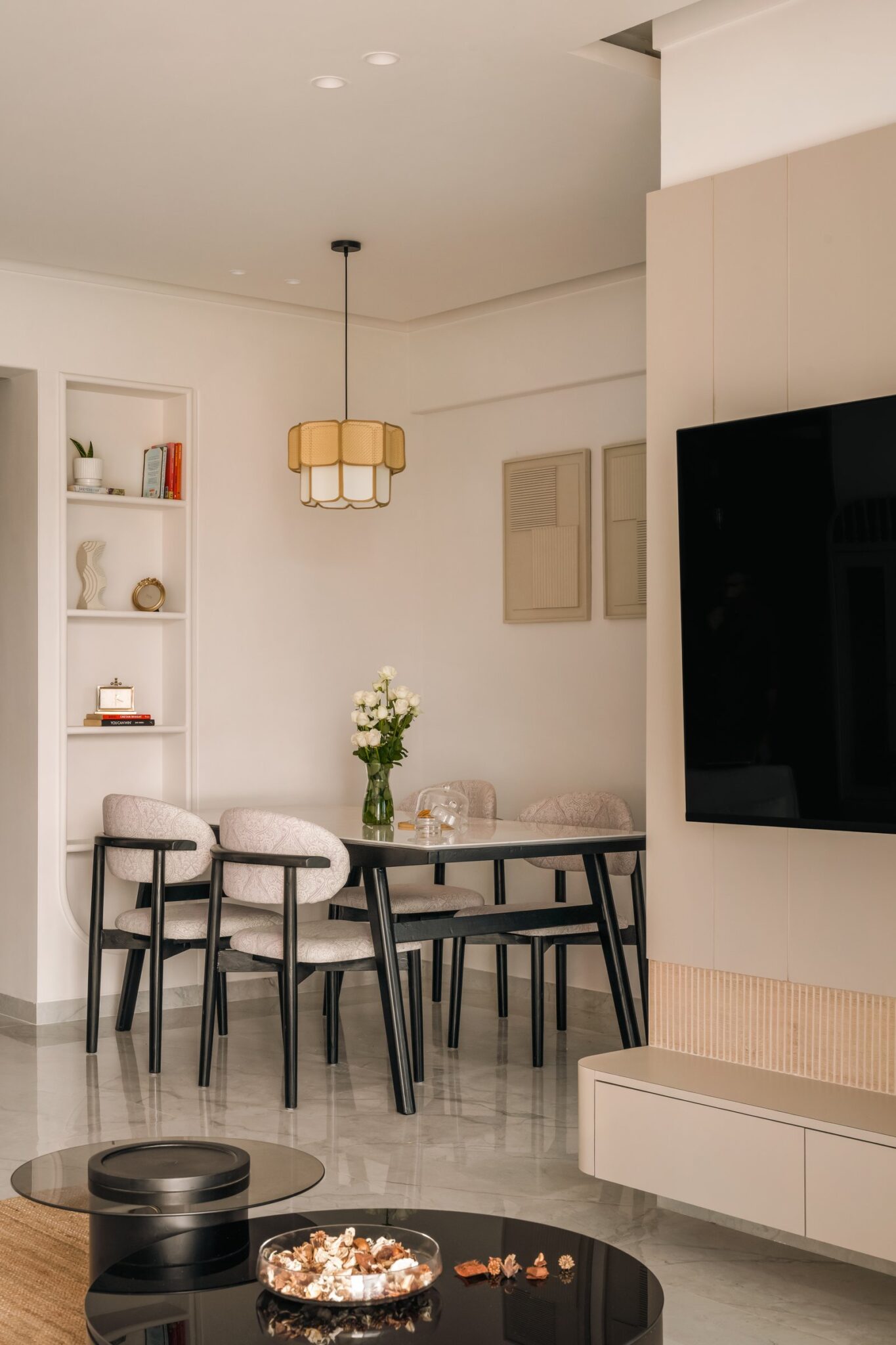
The dining area continues the home’s palette of warm timber and black granite, with cane-backed chairs gathered around a substantial table. A floor-to-ceiling joinery wall in wood and cane serves as both storage and spatial boundary, its triangular cane inlays echoing a motif that recurs throughout the house. The yellow accent wall behind a service alcove keeps the space bright and grounded.
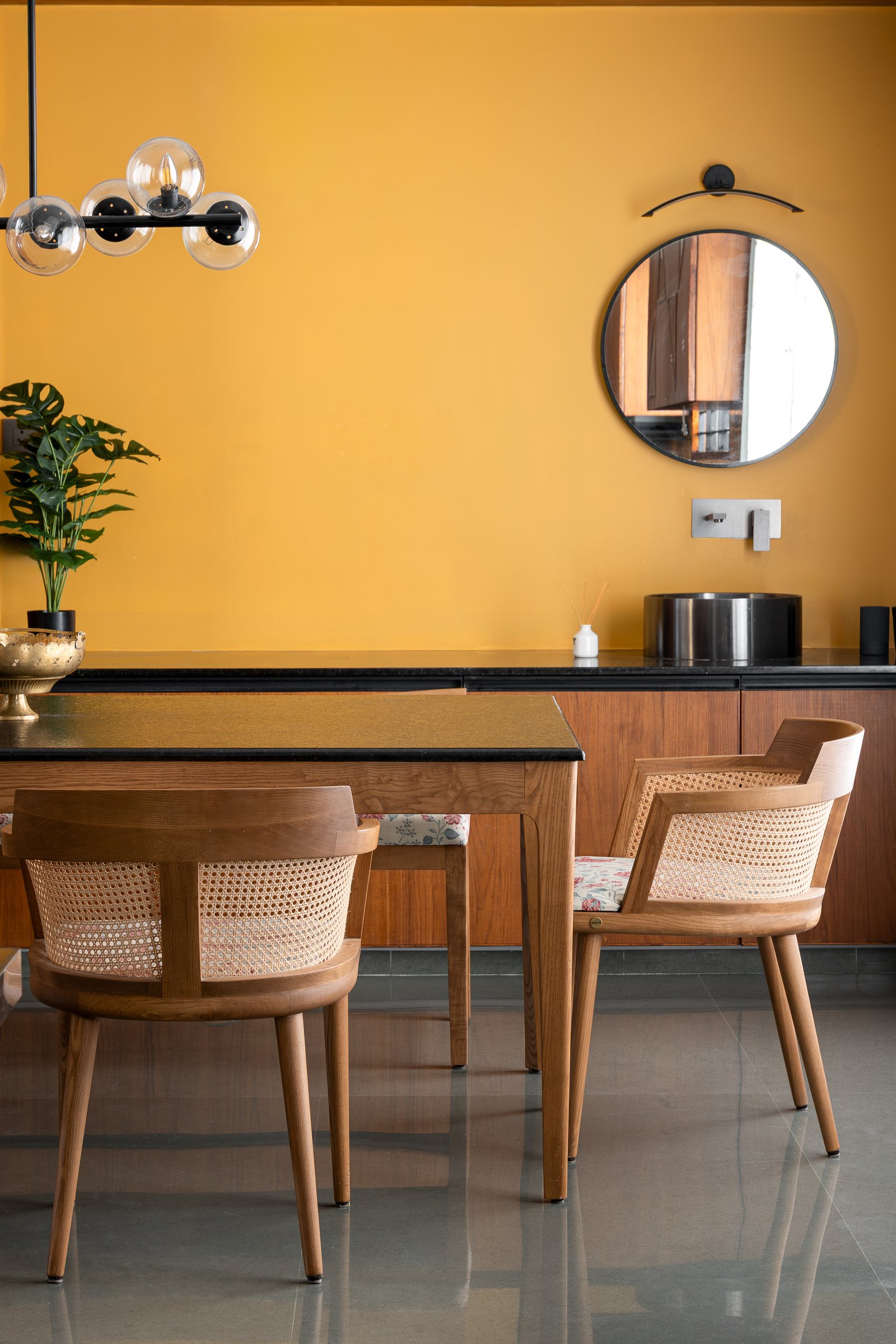
The dining zone’s proportions settle into a warm formality. The glass-globe chandelier provides a contemporary edge without disrupting the room’s material honesty, and the cane chairs catch the daylight in a way that makes the woven texture feel integral to the space rather than decorative.
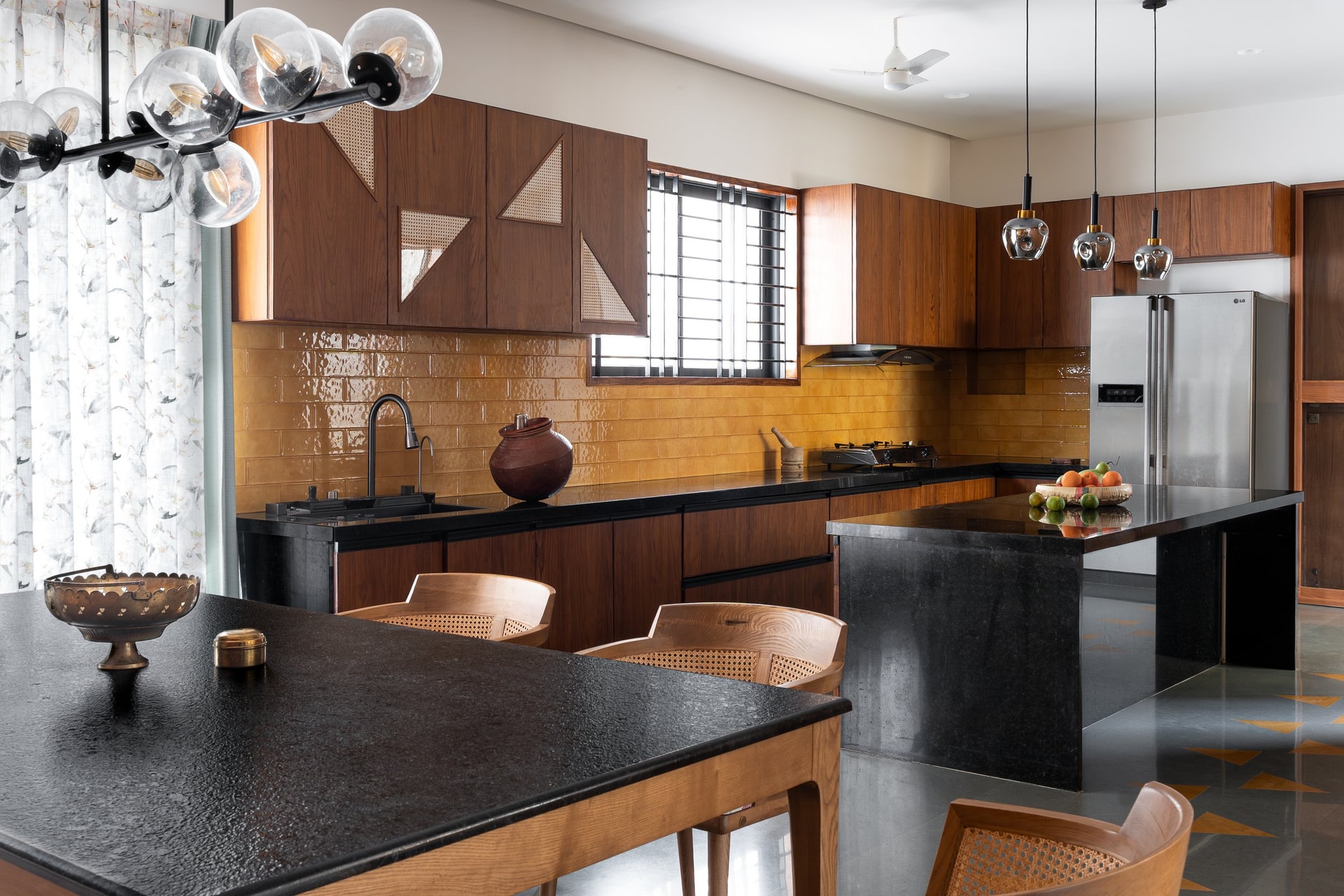
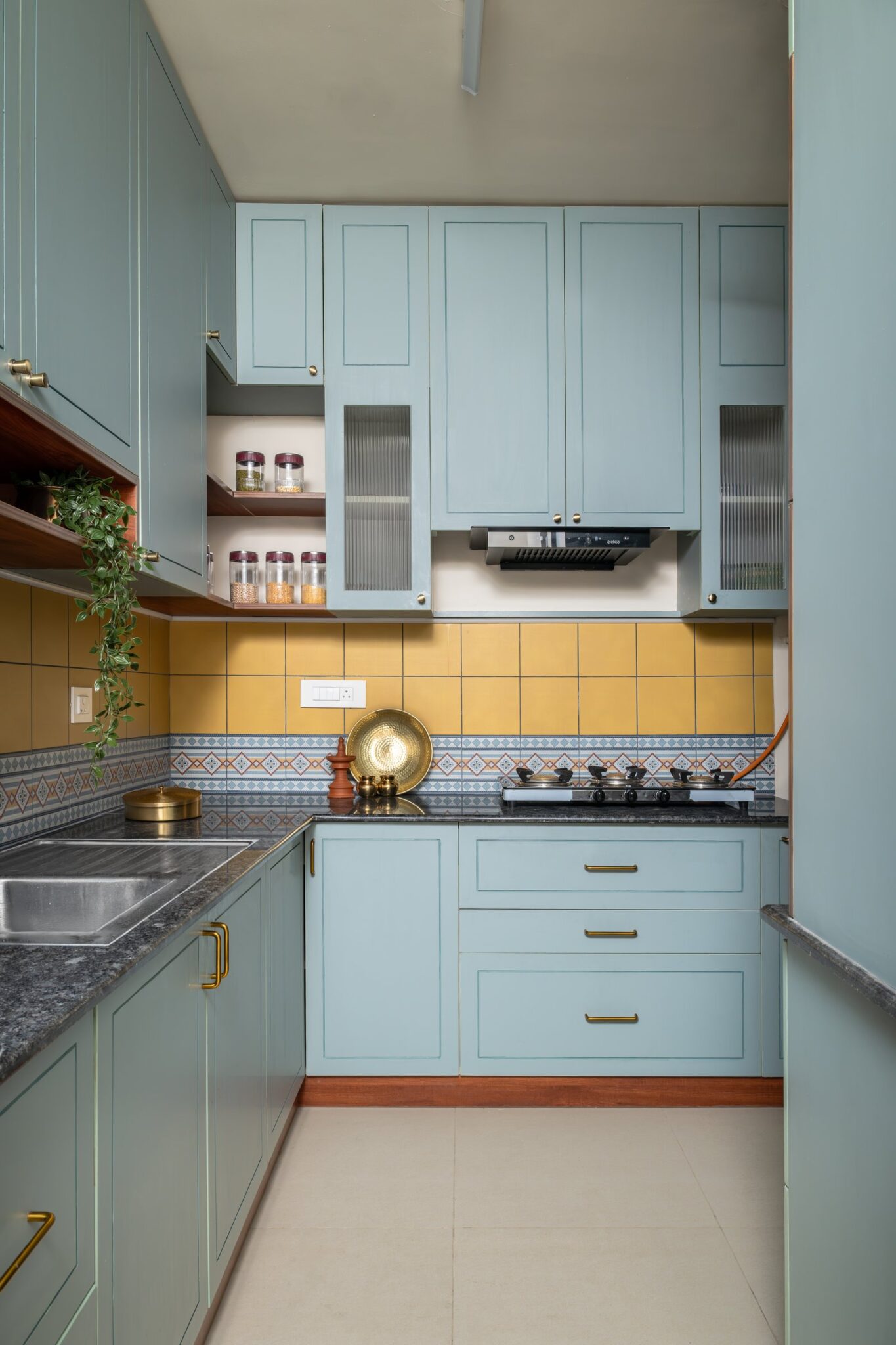
The kitchen is visible in its entirety from the dining table, the island unit bridging the two zones as both a work surface and a point of social connection. Warm-toned backsplash tiles and timber cabinetry establish a visual language that is cohesive with the rest of the house, while the black granite countertop provides a material anchor that runs from kitchen to dining to courtyard ledge, tying the home’s ground floor together through a single, recurring surface.
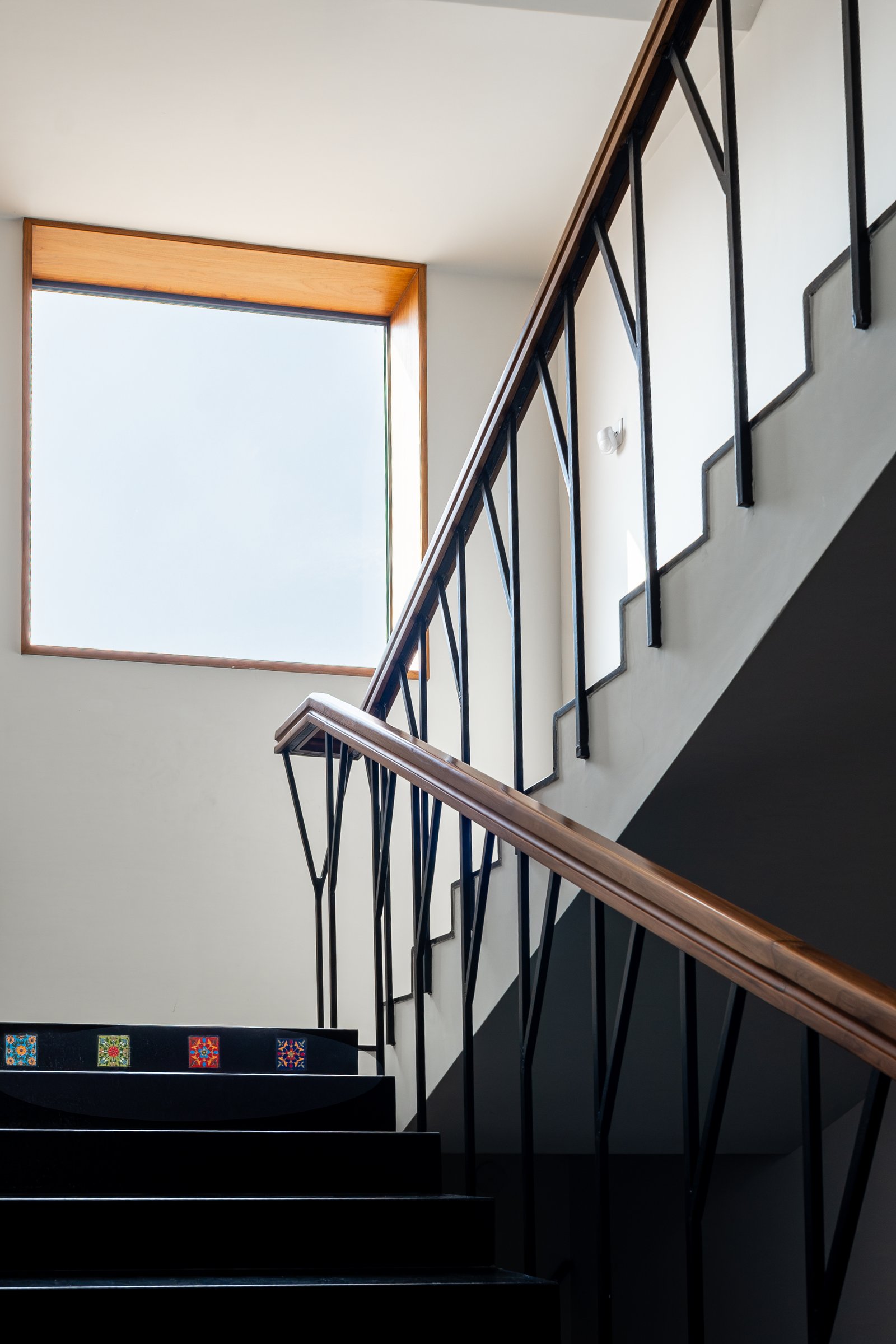
The staircase is where the home’s layered personalization becomes most legible. Black granite treads are inlaid with handmade tiles in vivid colour, and the railing’s metalwork is shaped into a “Y” form, a motif drawn from the couple’s initials. This gesture repeats quietly across the house, in the elevation, in gate details, in joinery, revealing itself slowly to those who look closely.
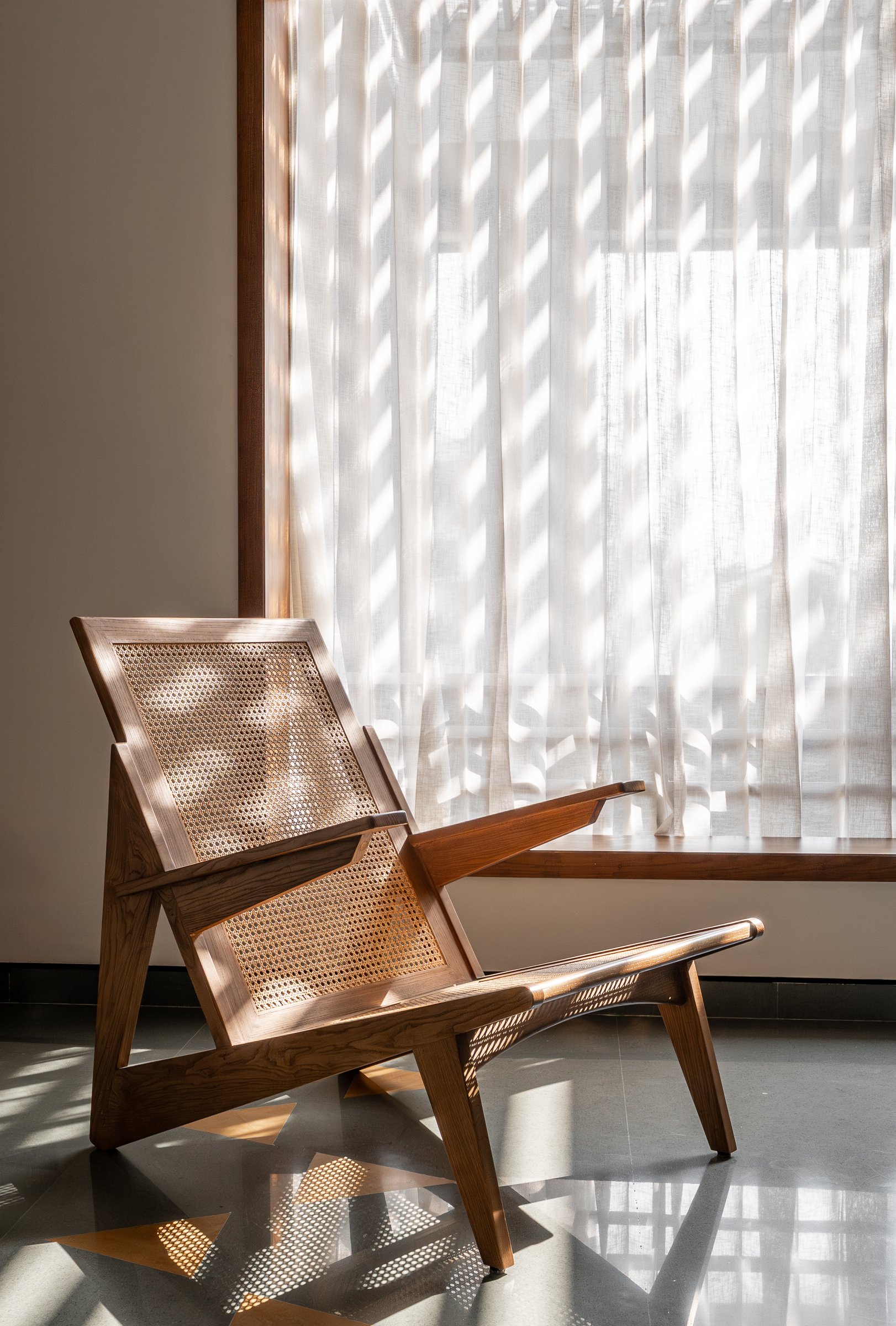
In Erode, as in many Tamil Nadu cities where rapid residential development often favours speed over specificity, House of Quiet Details offers a counterexample. It demonstrates that locally sourced materials, traditional spatial devices like the courtyard and the jaali, and a client brief rooted in personal clarity can produce a home that feels both contemporary and culturally continuous.
What distinguishes this project is not any single dramatic moment but the consistency of its intent. Every surface, every threshold, every recurring “Y” motif speaks to a household that knows how it wants to live and a designer who understood that the task was not to impose a vision but to give that knowledge a material and spatial form it could inhabit with comfort and pride.