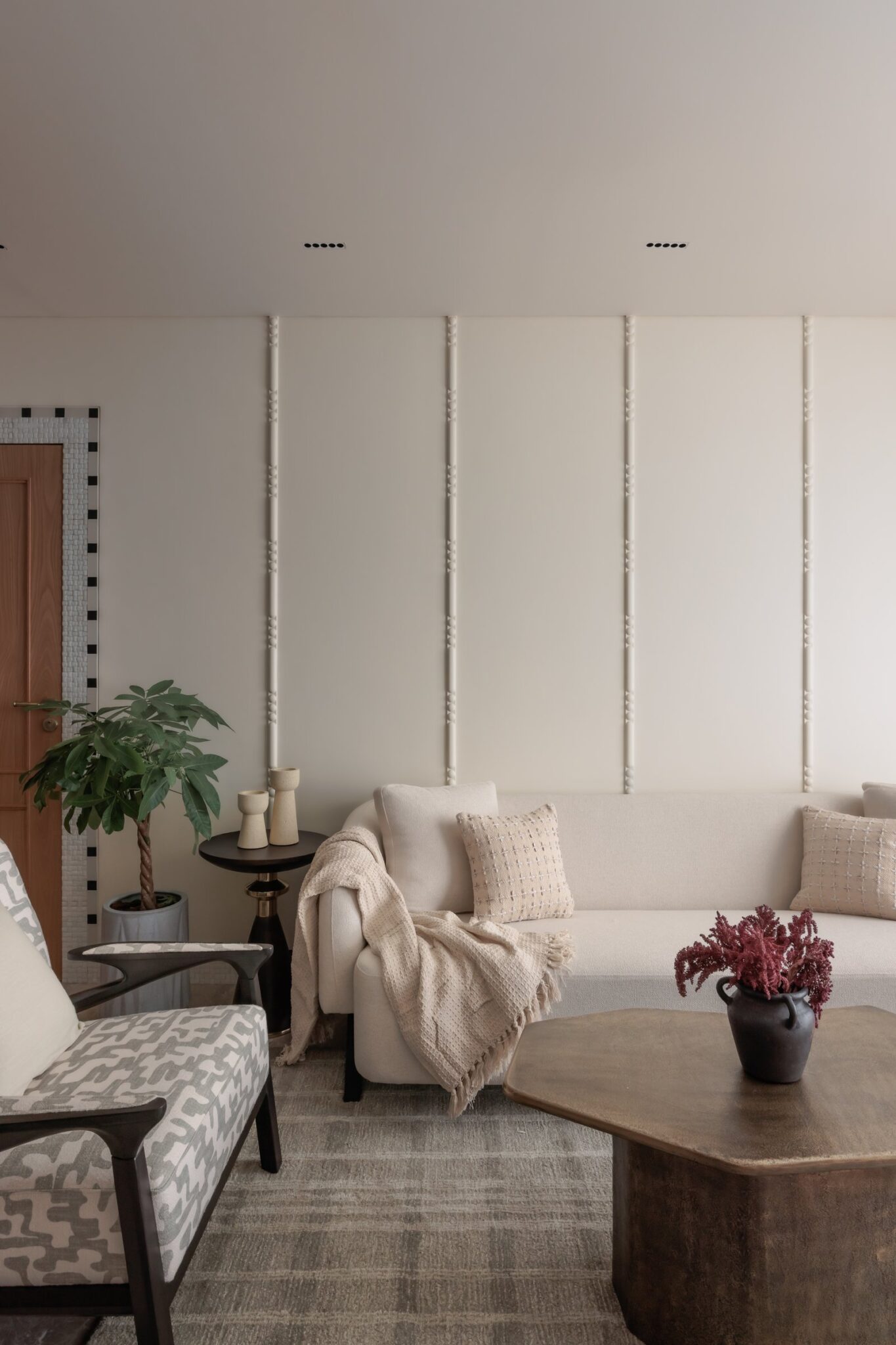
Calm is the most difficult atmosphere to design. It cannot be assembled from a checklist of muted tones or natural fibres; it has to be planned for, allowed for, given room to settle. Most homes that aspire to stillness end up performing it instead, mistaking restraint for absence and absence for serenity.
Sukoon, a 2,500-square-foot residence in Vadodara designed by Shape My Space under principal designer Kopal Trivedi, arrives at the question from the other direction. The home is Japandi in temperament, drawn from the shared minimalism of Japanese and Scandinavian sensibilities, but its grammar is rooted in the textures and proportions of Gujarat. The result is a residence that feels neither imported nor self-consciously regional; it simply feels lived in.
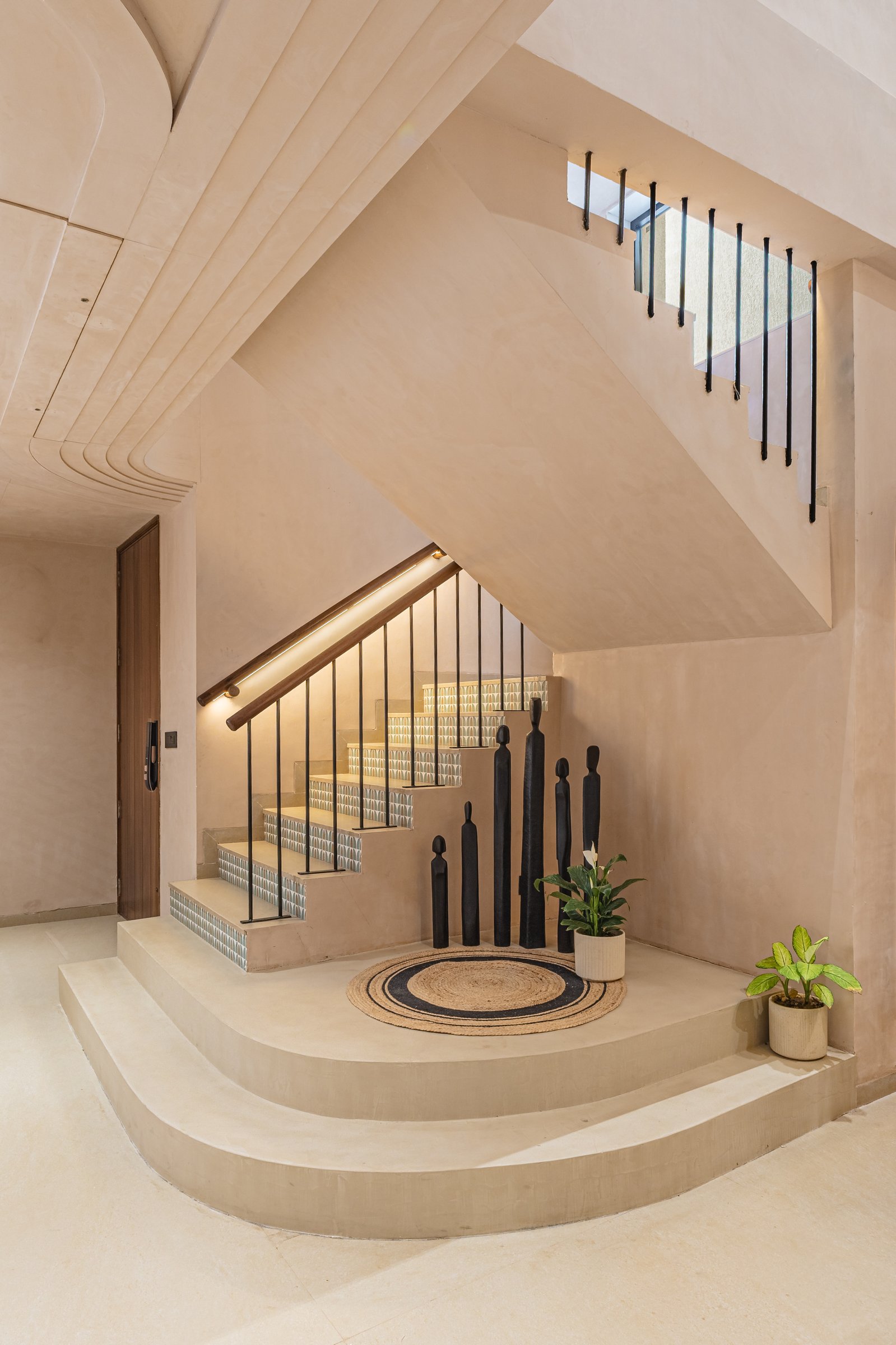
The arrival is staged with unusual care. A curved plinth of two stepped tiers sweeps outward from the base of the staircase, softening what would otherwise be a purely vertical gesture into something almost ceremonial. Patterned risers in muted cream and ochre introduce the home’s only pronounced graphic moment, held in check by the warm plaster surfaces around them.
The handrail of warm wood and the slim metal balusters above complete a vocabulary the rest of the home will quietly reiterate: rounded edges, restrained material count, a willingness to let one element carry the room.
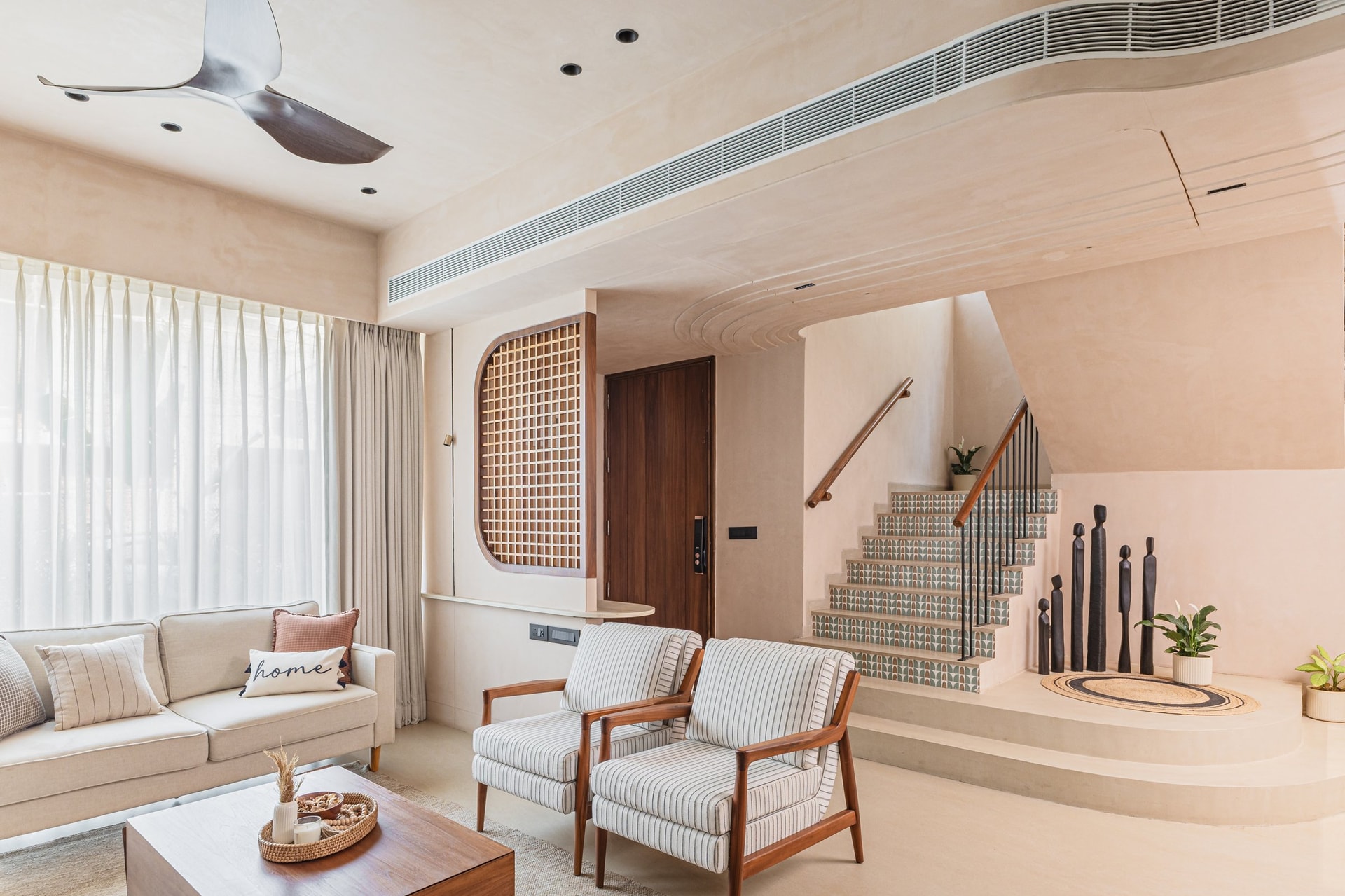
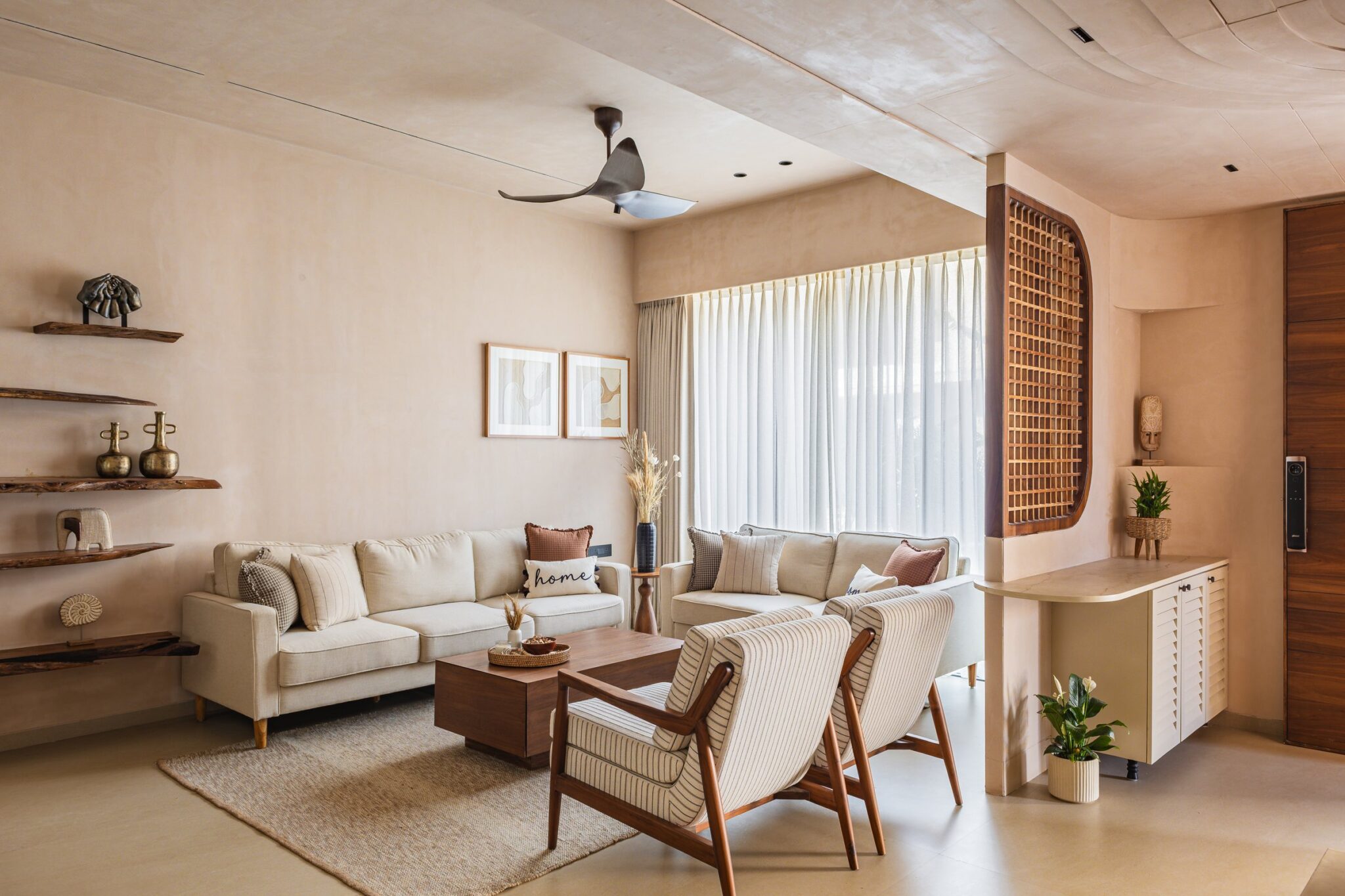
Stepping into the living room, the staircase reappears as a visible companion, its patterned risers framed by an arched timber jaali set into the plaster wall. The jaali is a deliberate cultural marker, the kind of detail that anchors the home’s Japandi ambitions to its Vadodara address without underlining the point.
““Sukoon is not just a home, but a feeling of quiet comfort and intentional living.””
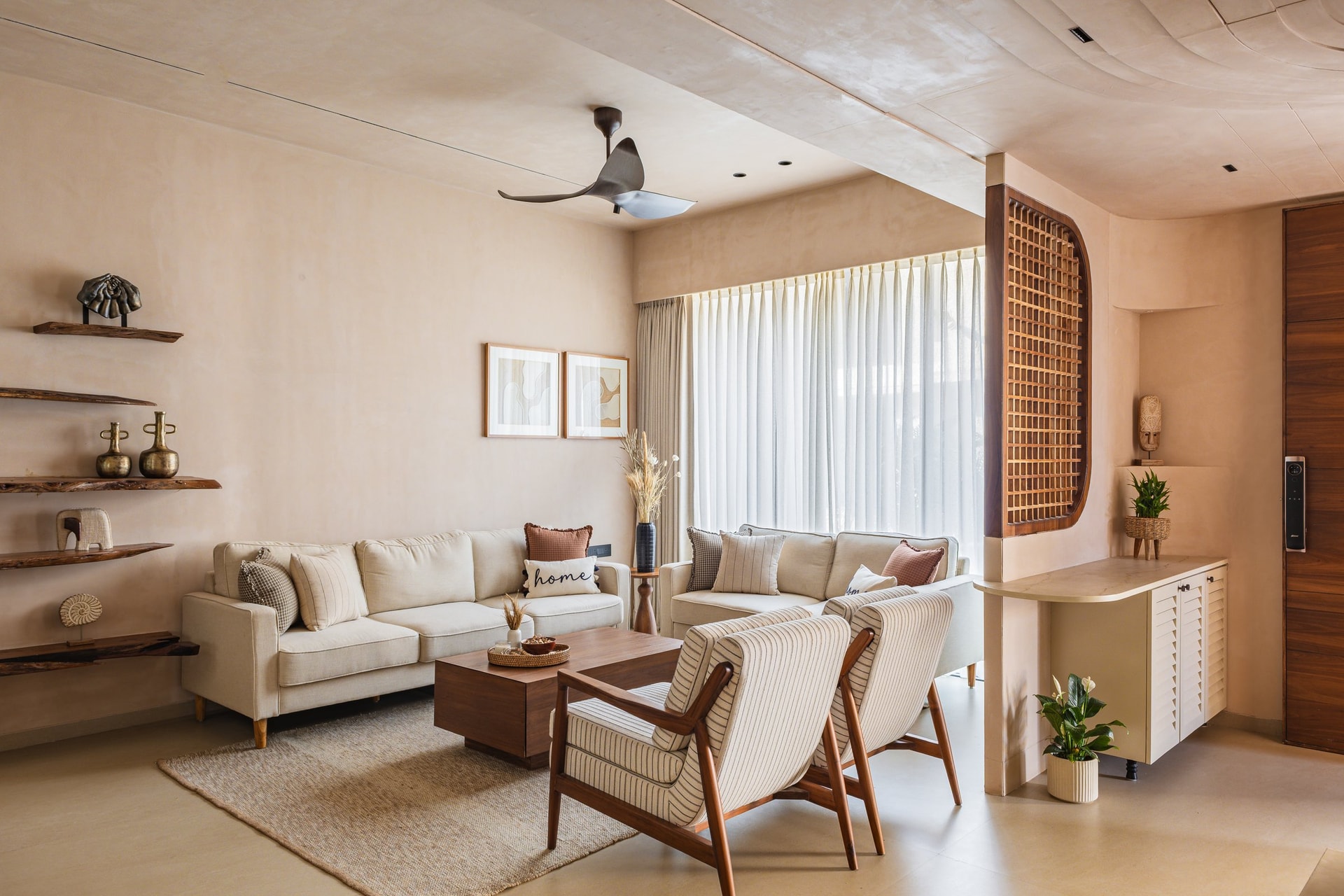
The seating arrangement is composed rather than coordinated. A pair of striped armchairs in honey-toned wood faces a longer sofa in undyed linen, with floating wooden shelves displaying small brass and ceramic objects on the opposite wall. The room earns its calm not by emptying out but by allowing each piece a measured distance from the next.
What makes the room work is the temperature of its surfaces. The plaster walls carry a faint blush undertone that shifts through the day, and the curved soffit overhead introduces a softness that flat ceilings rarely manage. Nothing in the space competes for attention, which is the precise condition under which attention finally relaxes.
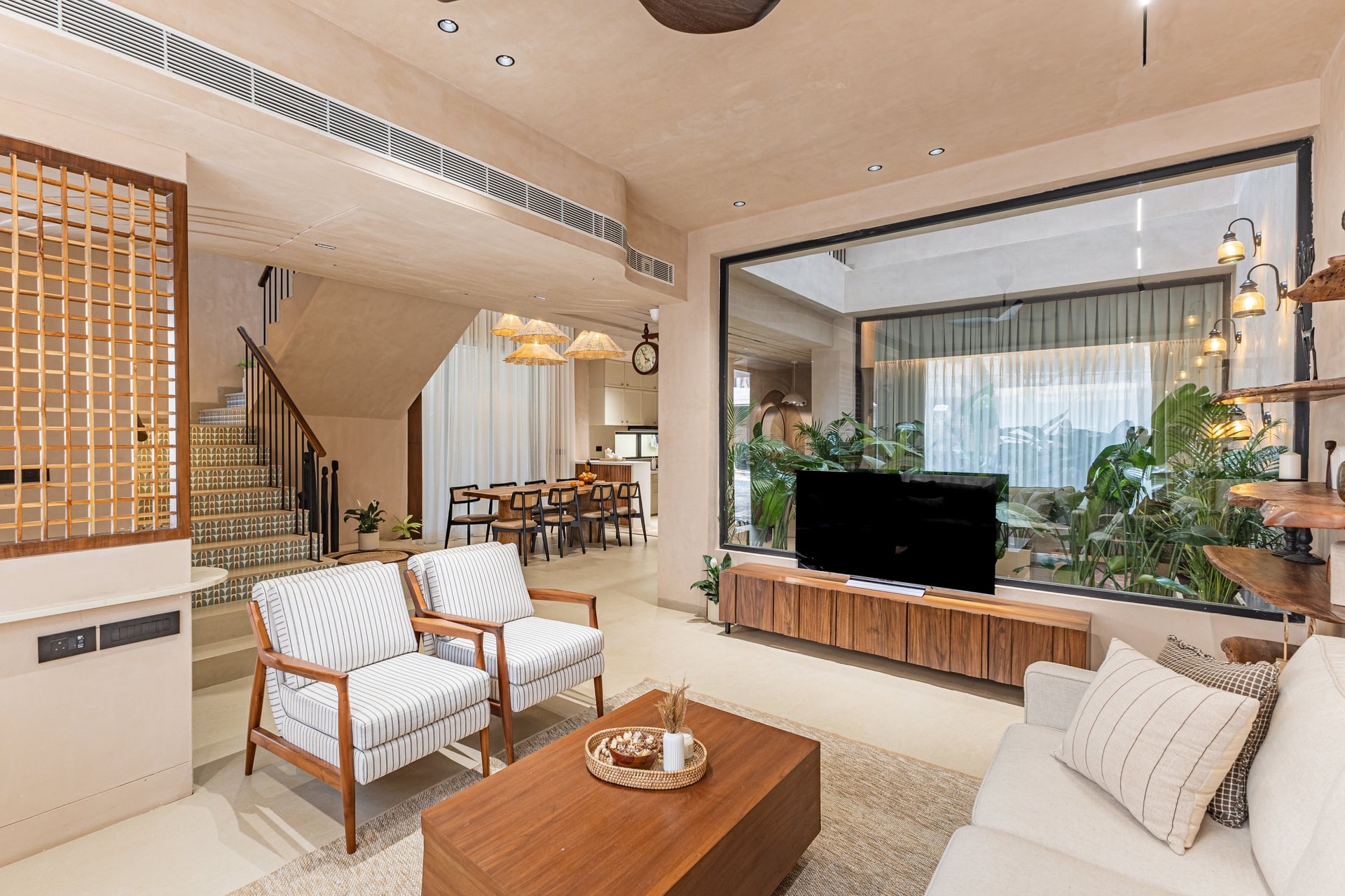
From a second vantage, the living room reveals its full breadth, opening through a large picture window onto a green pocket and continuing into the dining zone beyond. A wood-clad media console grounds the window wall, its warm timber tones echoing the jaali screen on the opposite side; between them, the room reads as a continuous frame rather than a cluster of zones.
The dining table is glimpsed in the distance, the woven pendants above it appearing here as a soft promise of where the home is going next. This is spatial choreography in its quietest form, one room handing the eye to the next without insisting on a transition.
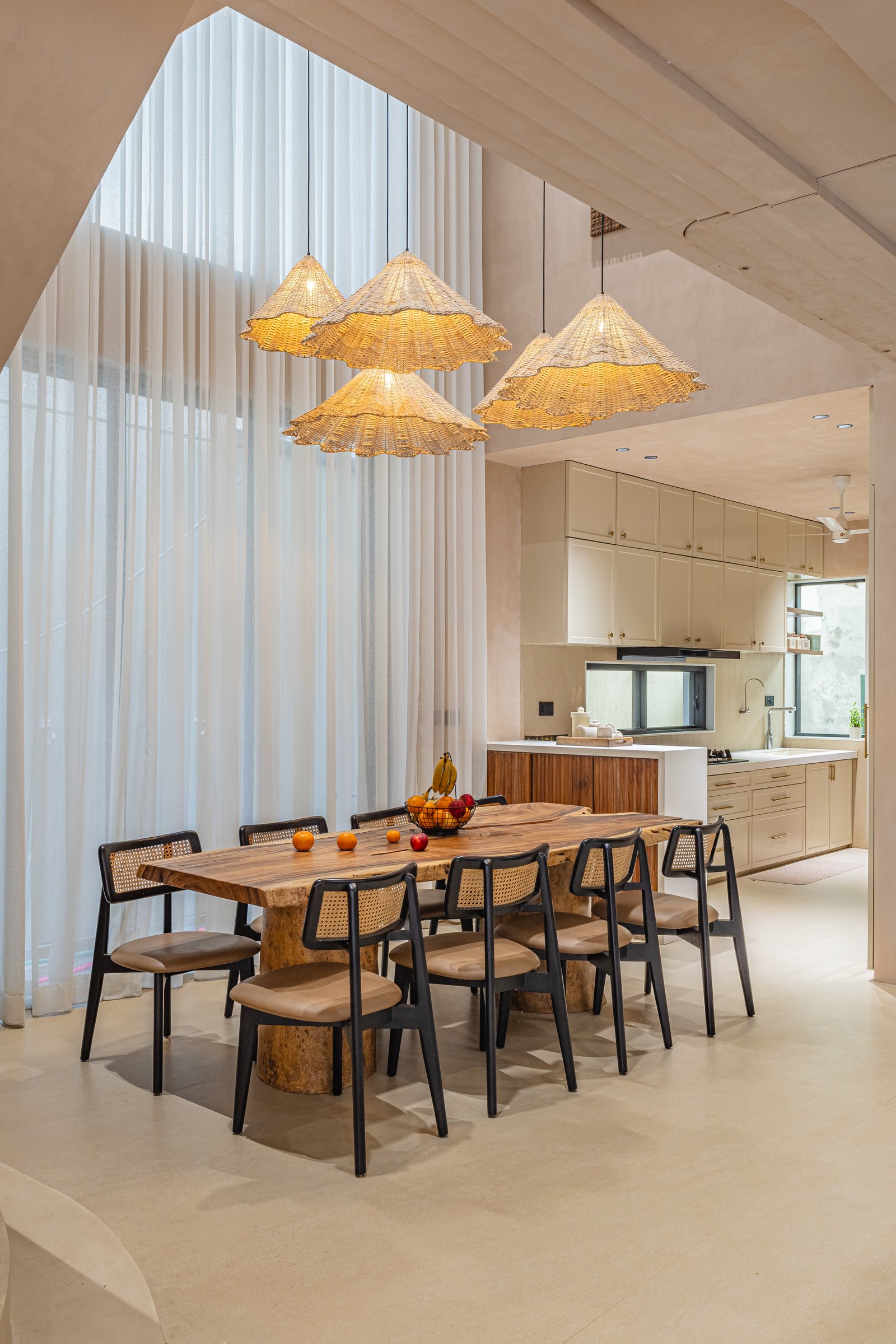
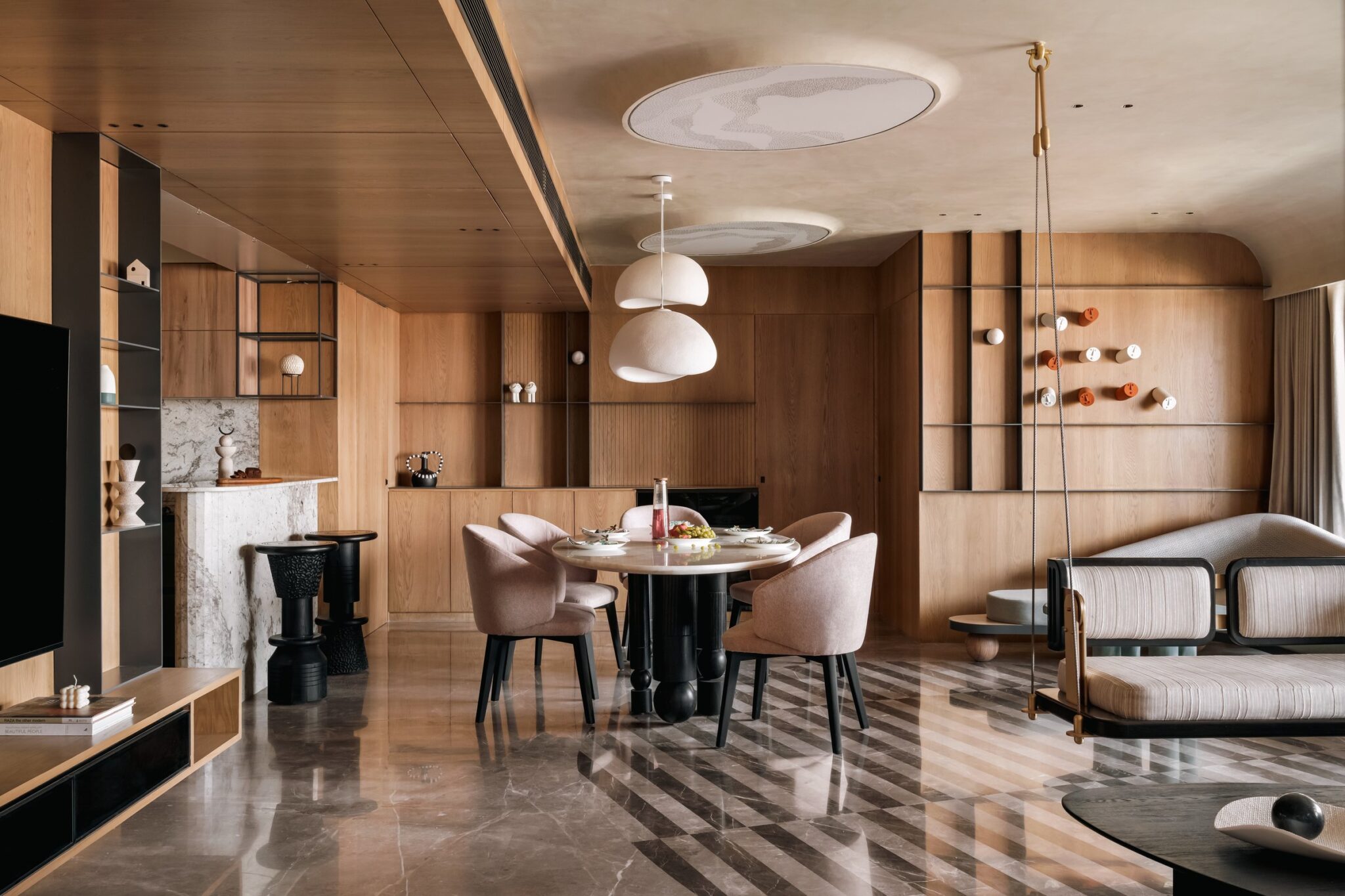
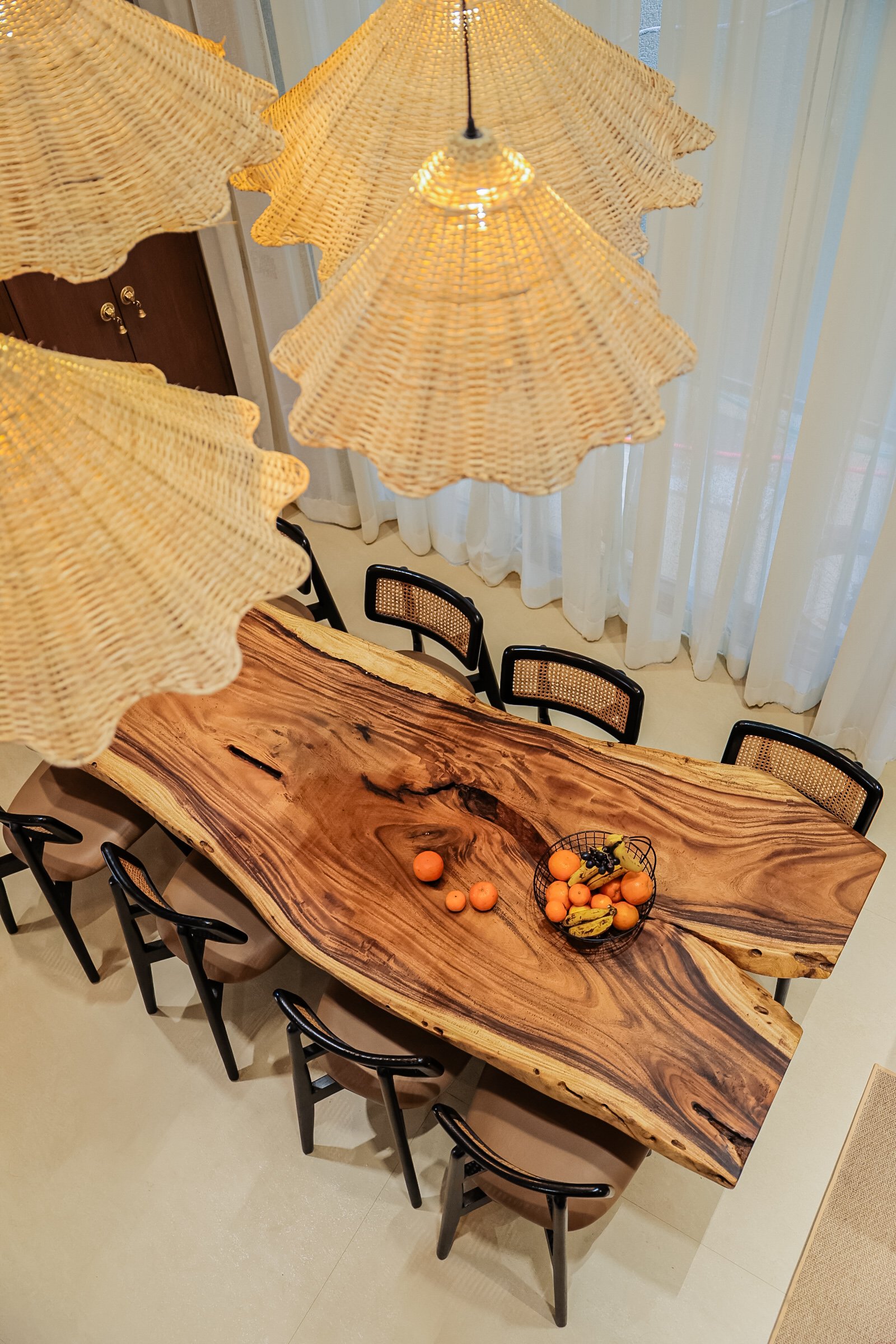
The dining area announces itself through verticality. A double-height curtain wall in sheer white fabric rises behind the table, drawing daylight down into the room and giving the cluster of woven pendants the height they need to feel sculptural rather than decorative. The pendants, hung at varied levels, behave less like fixtures and more like a single suspended composition.
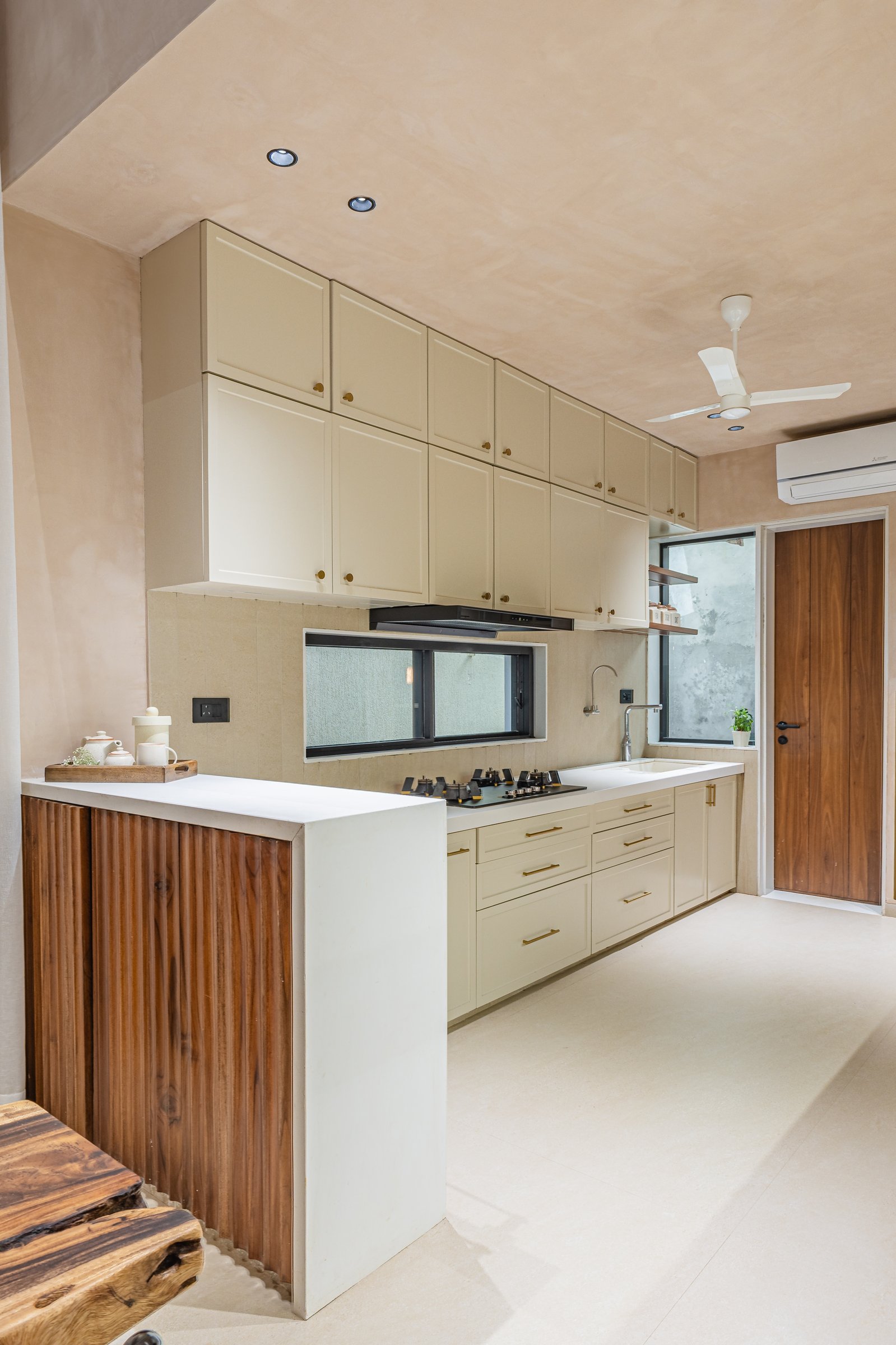
The kitchen takes the opposite tack: classical in structure, almost reticent in expression. Cream cabinetry with slim brass pulls runs along a single wall, broken by a horizontal window above the cooktop that pulls in light without compromising storage. A fluted wood base on the peninsula introduces a warm note.
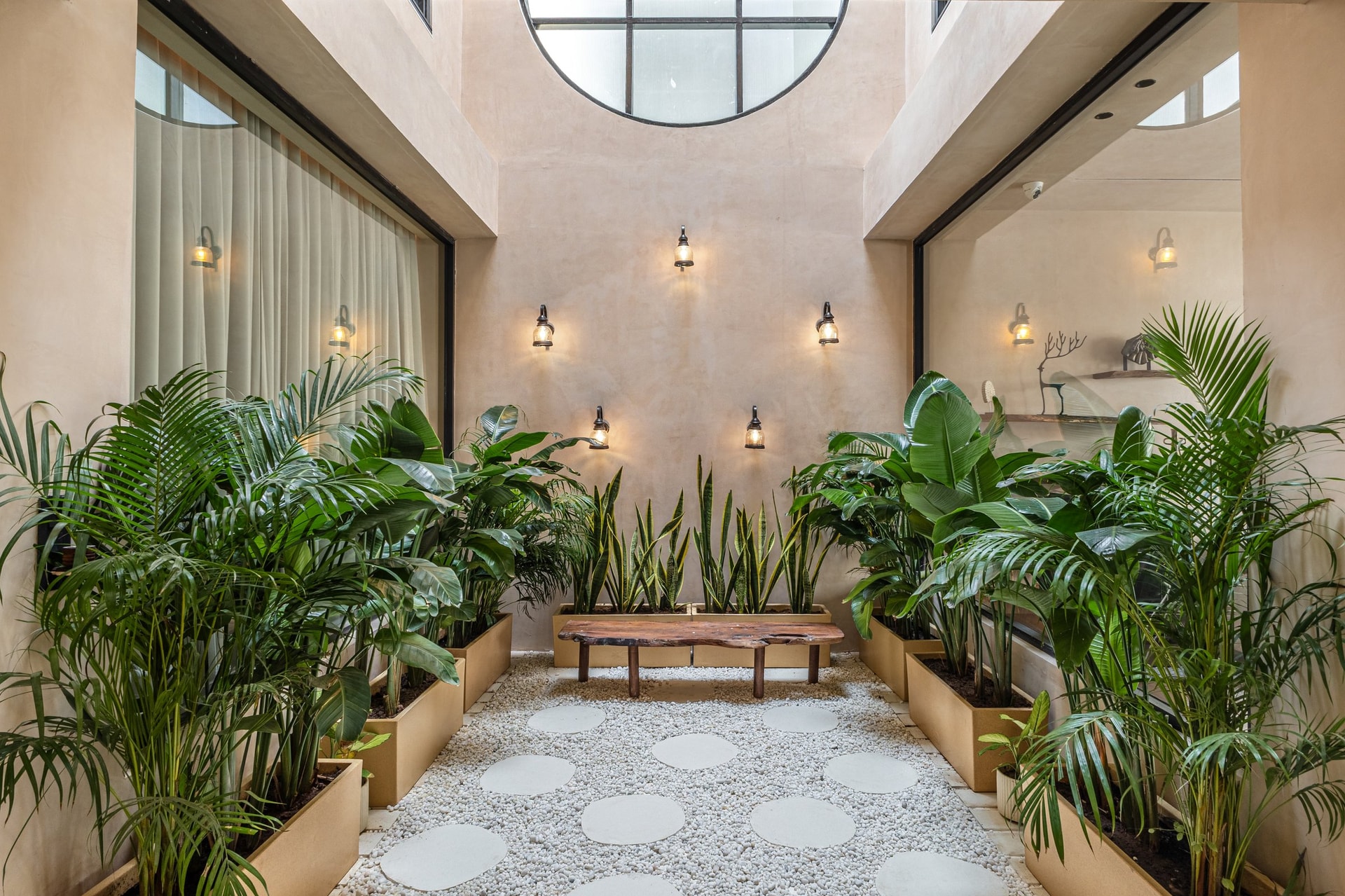
The courtyard is the project’s conceptual heart. Originally framed as a conventional square opening, it was reimagined as a circular skylight that pulls a perfect disc of sky into the centre of the home. Around it, dense plantings of palms and snake plants rise from raised planters, and a live-edge bench sits on a bed of white pebbles inlaid with round stepping stones.
The intervention does what good Japandi design is meant to do: it replaces a hard geometry with an organic one, and lets the resulting softness do the spatial work. Light here arrives in a curve, traces the walls through the day, and lends the courtyard a quality closer to meditation than display.
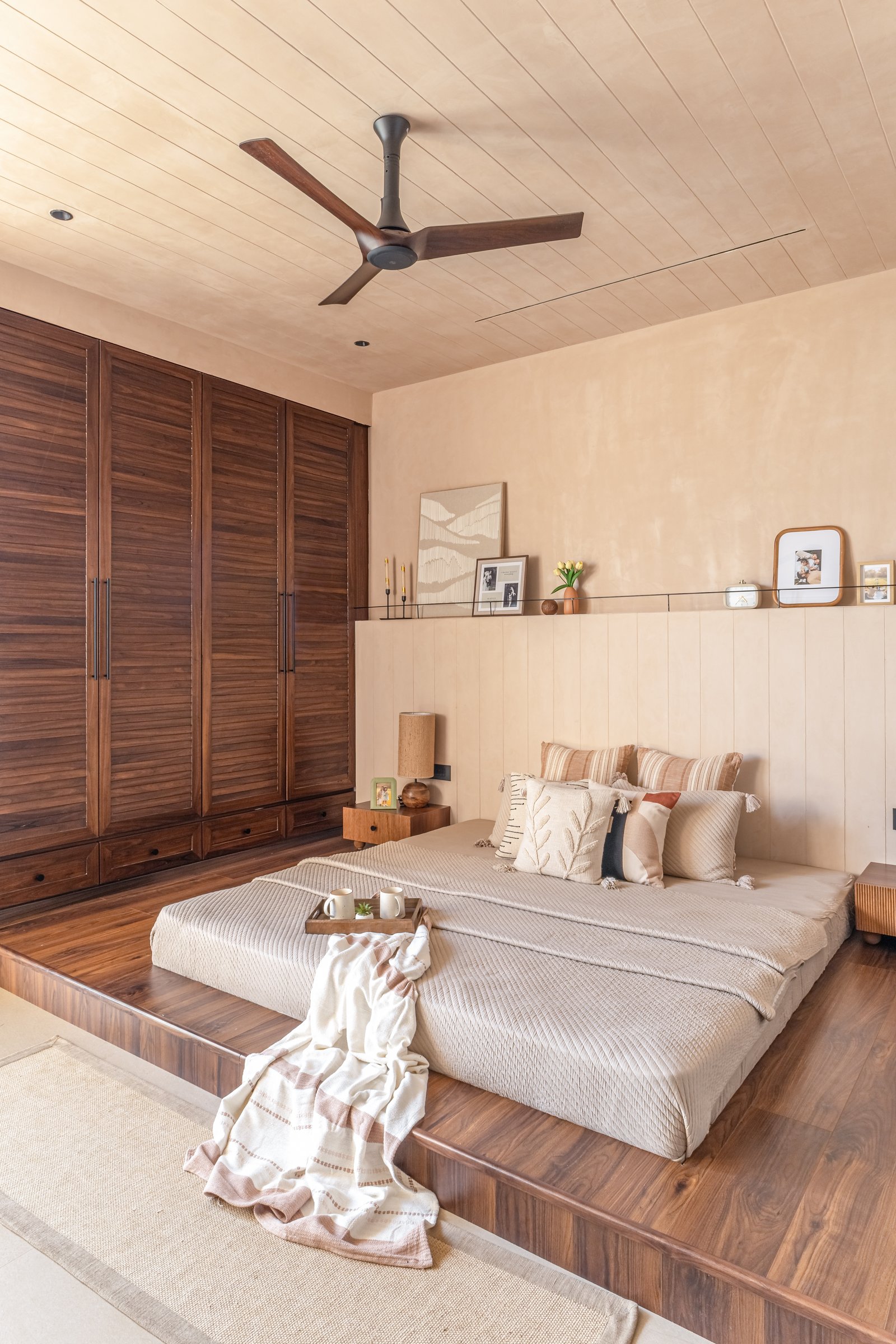
The master bedroom is where the home’s restraint becomes most fully realised. A platform bed in dark wood is set against a panelled headboard wall in a paler tone, with a slim shelf running its length to hold framed photographs and small ceramics. The wardrobes opposite, in louvred wood with a deeper grain, supply weight without visual noise.
The ceiling, clad in pale plank, lowers the apparent height of the room and gives the bed the feeling of a quiet enclosure. Sukoon finds its most literal translation here, in a room where everything is set just slightly lower, slower, softer than expected.
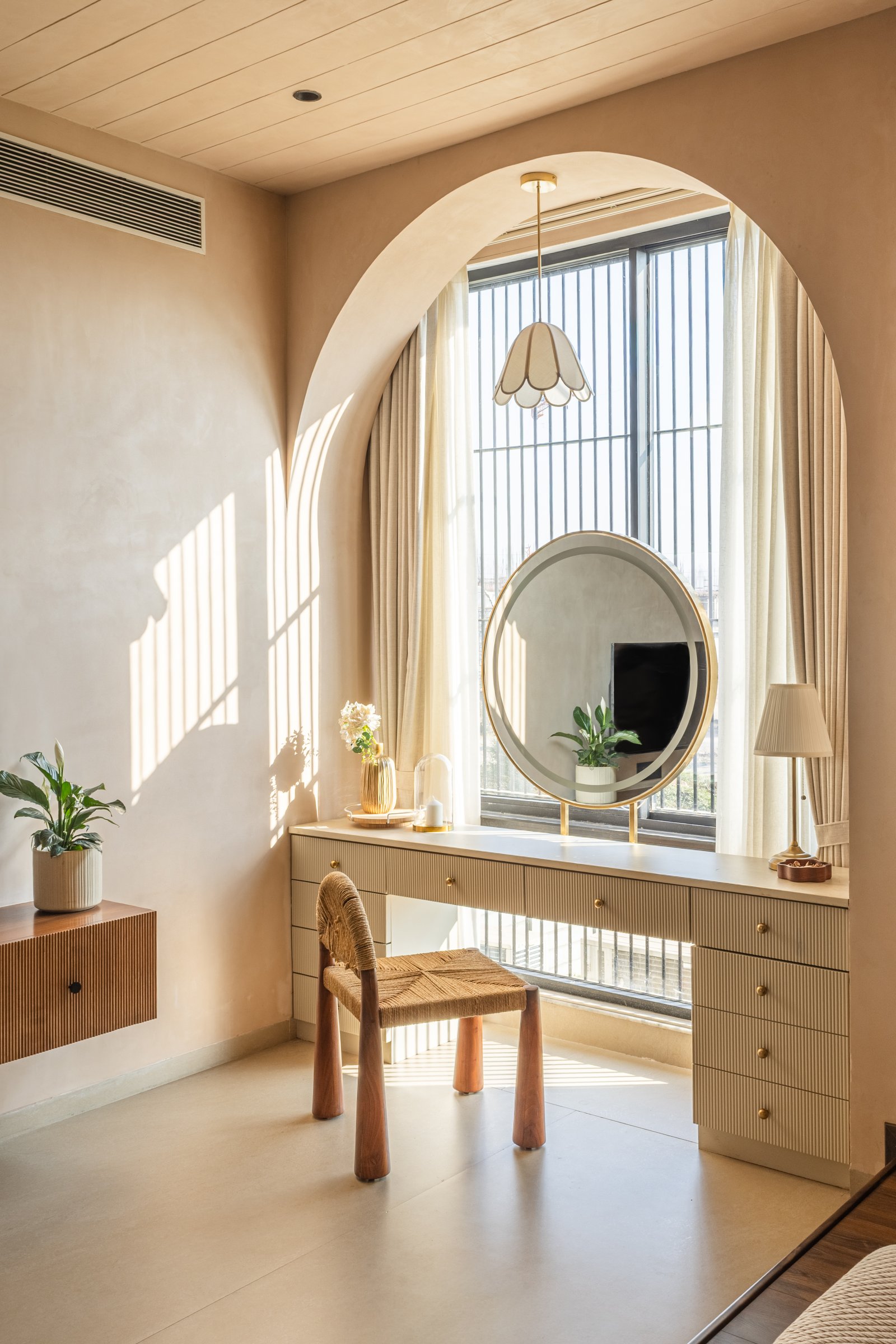
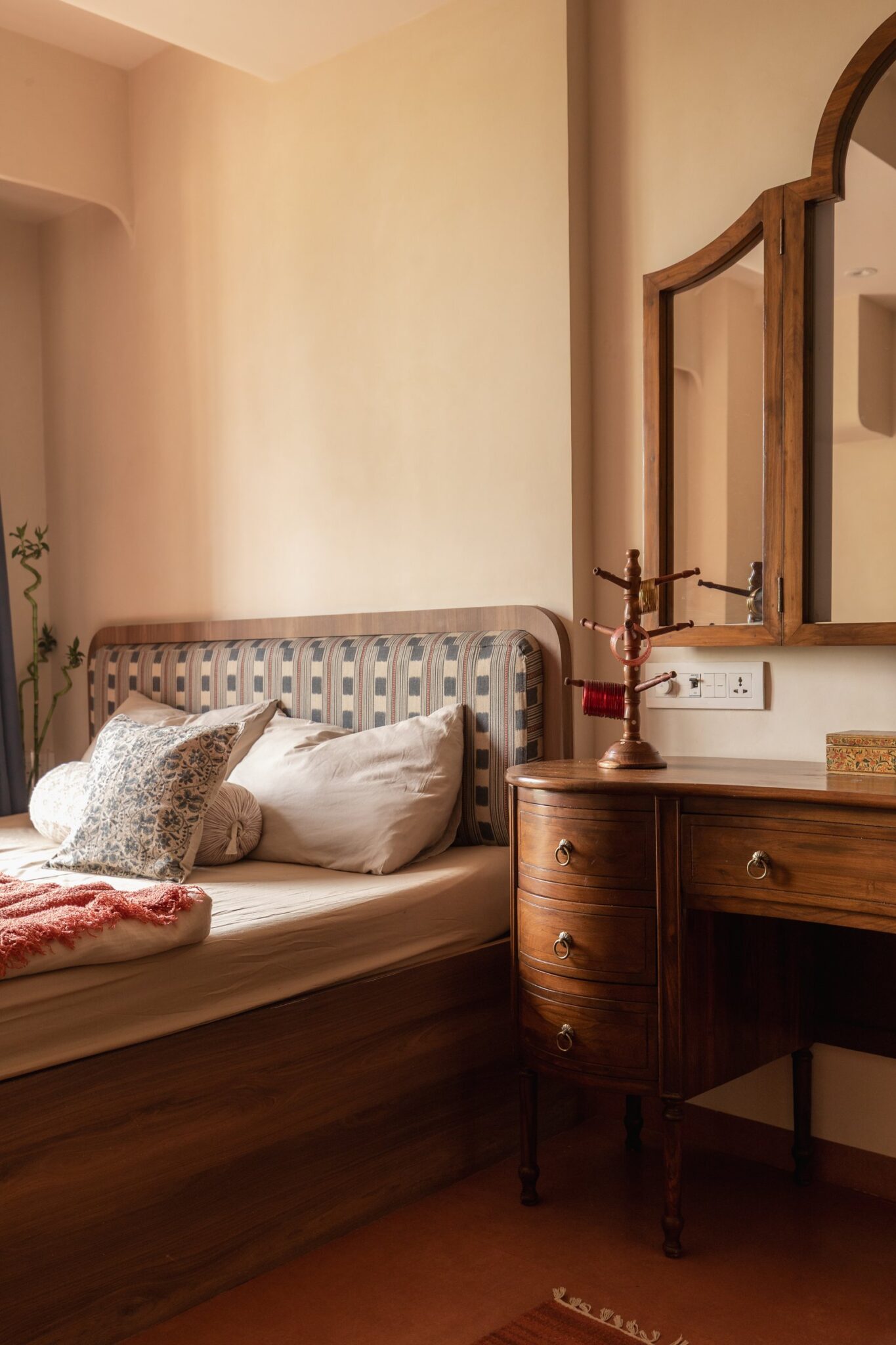
Within the master, a vanity alcove is carved into a tall arched recess, its ribbed cream drawers and a fluted floating console flanking a round brass-framed mirror. A rope-seated chair on turned wooden legs sits before it, and a scalloped pendant hangs just inside the arch. The composition is small but complete, the kind of corner that suggests how the room is actually used rather than merely how it photographs.
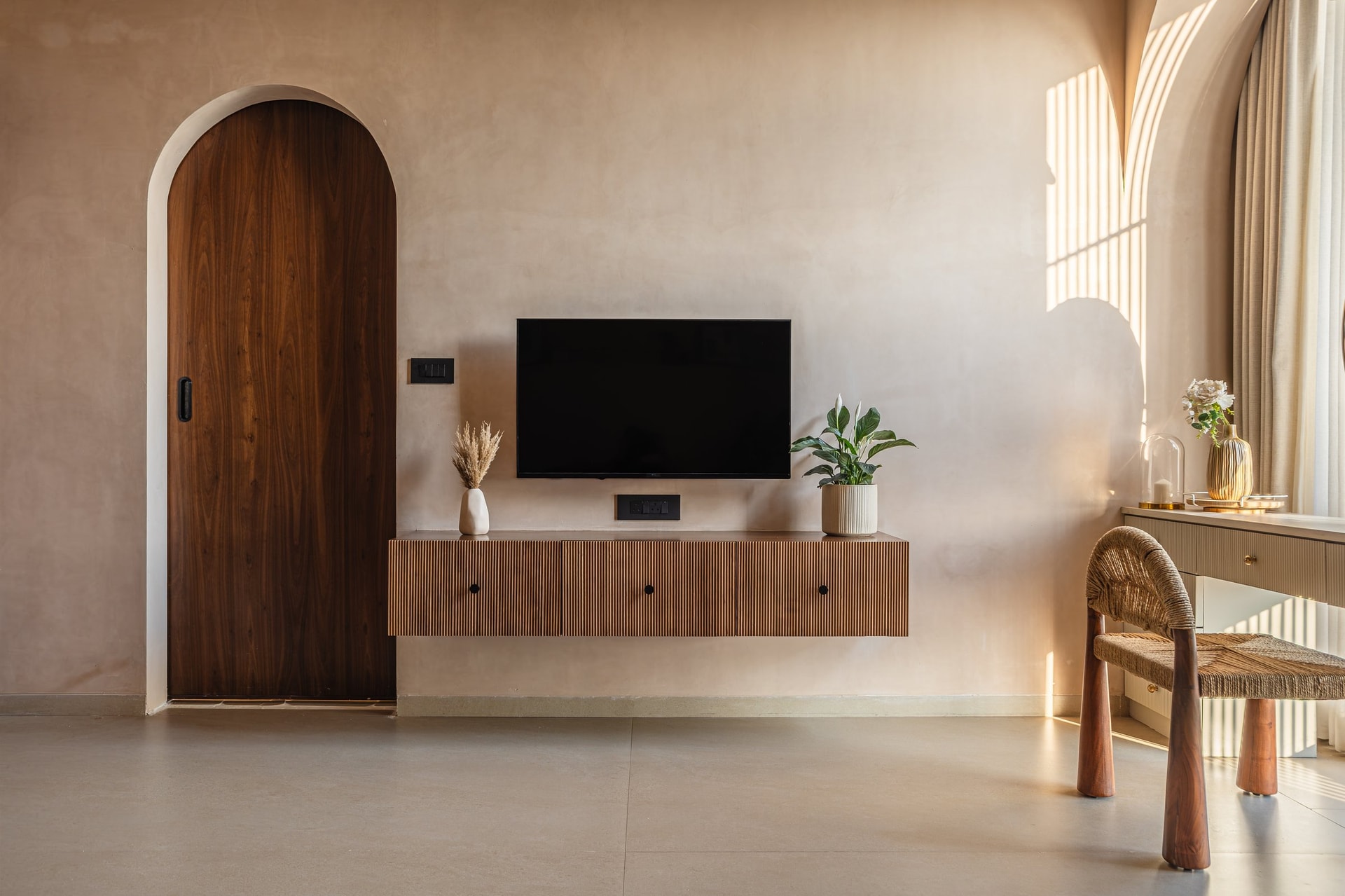
An adjacent wall of the master is anchored by an arched timber door beside a fluted wood console mounted under a wall-hung screen.
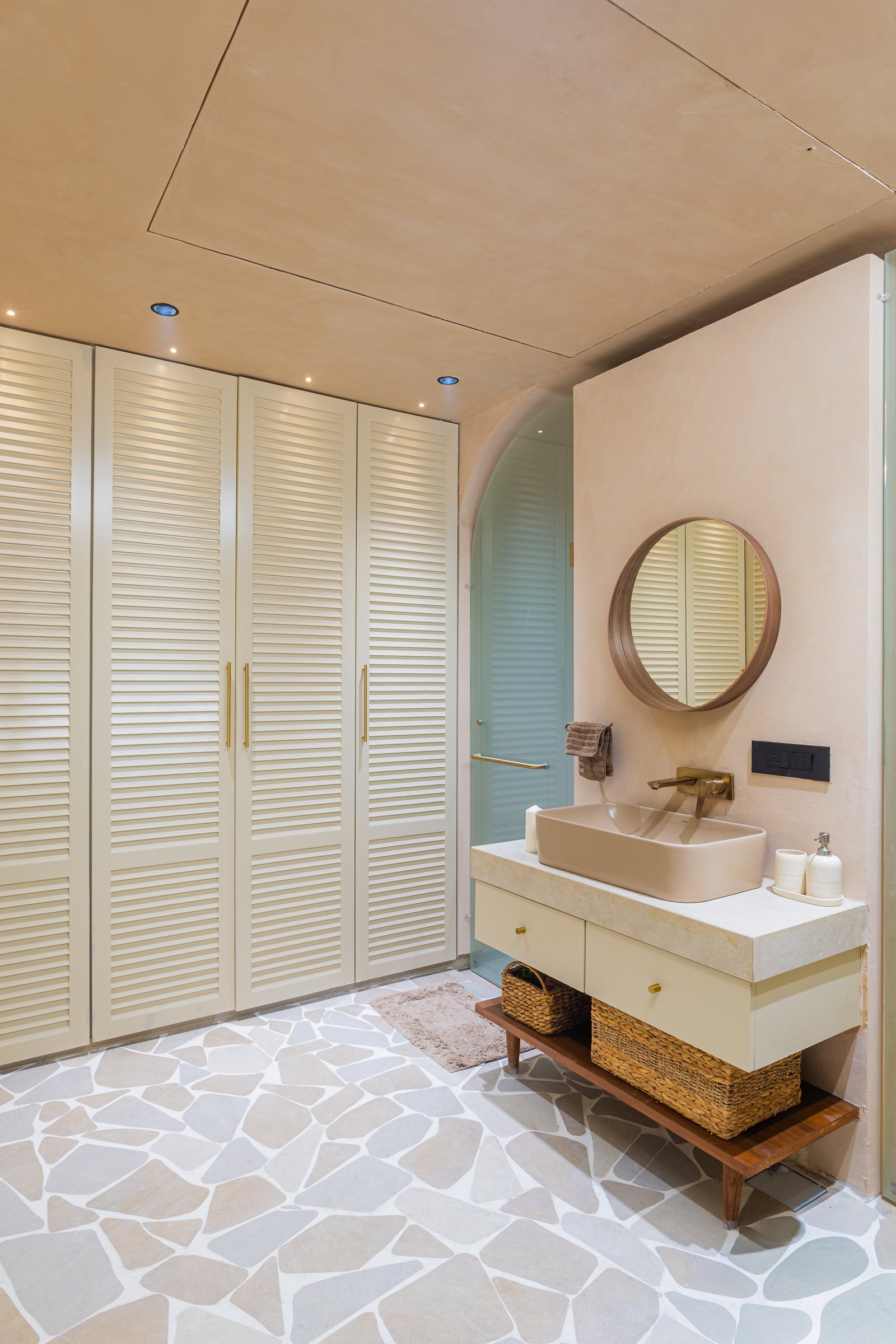
The master bath continues the language at a lower temperature. Louvred wardrobe doors in cream stand floor to ceiling along one wall, and a vanity with a pale stone counter and a rectangular vessel basin sits opposite, beneath a round wooden-framed mirror. Underfoot, an irregular tessellated stone floor introduces the only piece of pattern, soft enough to read as texture rather than ornament.
The parents’ bedroom takes a warmer, smaller register. A wood-clad headboard wall meets a plaster surface above it that holds a pair of framed textile artworks, and twin wall sconces in fabric shades give the room its evening tone. The bed itself is dressed in muted sage, the only saturated colour in an otherwise neutral home.
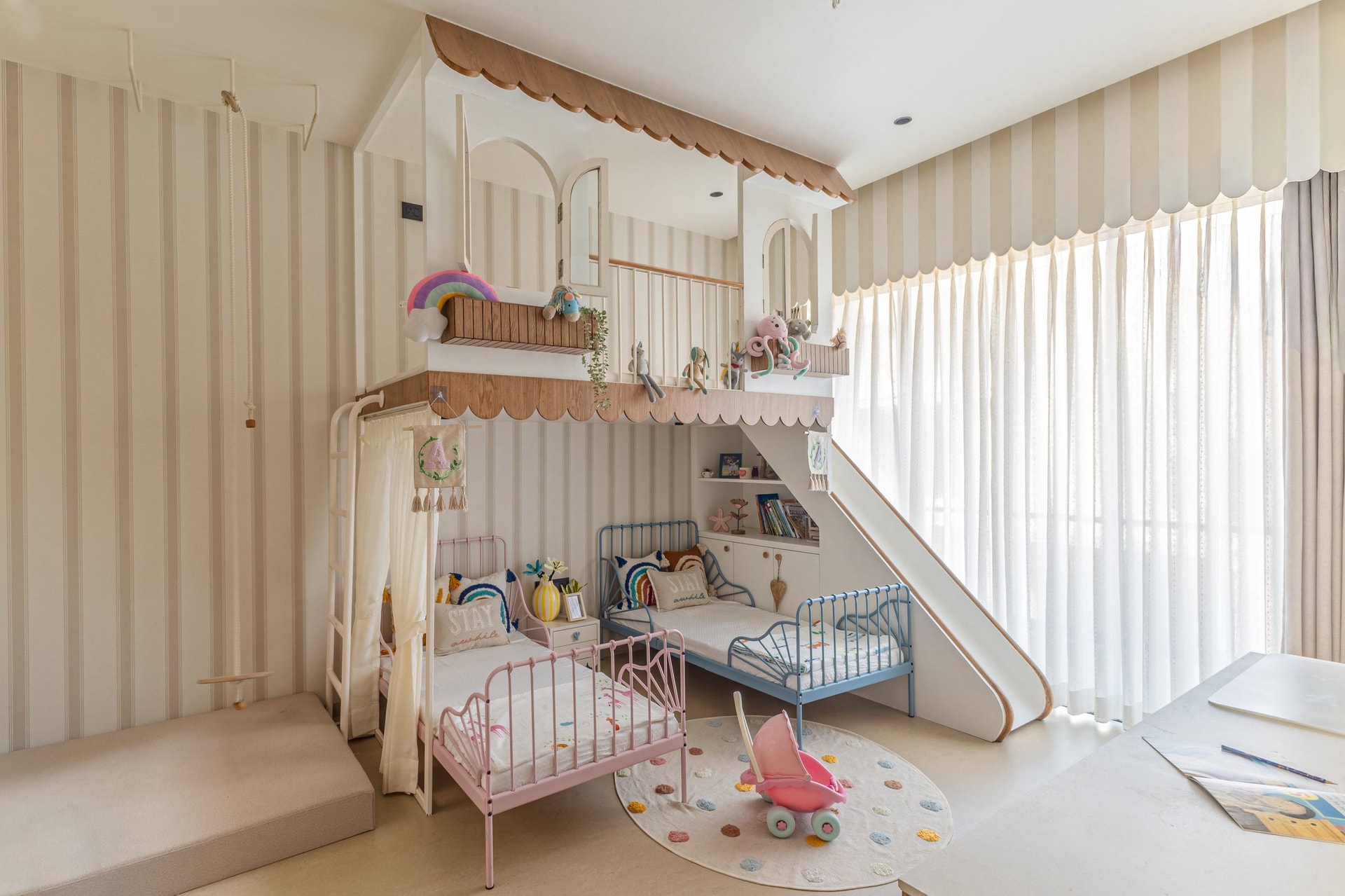
The children’s room is where the design philosophy loosens, but it does not abandon itself. A scalloped-edge loft above plays at being a treehouse, with arched openings and a soft pink curtain over the lower bed below; a slide descends to the floor in pale finish, and metal-framed beds in pink and blue sit beneath the loft. The striped wallpaper holds the whole composition in a register that reads as playful but not chaotic.
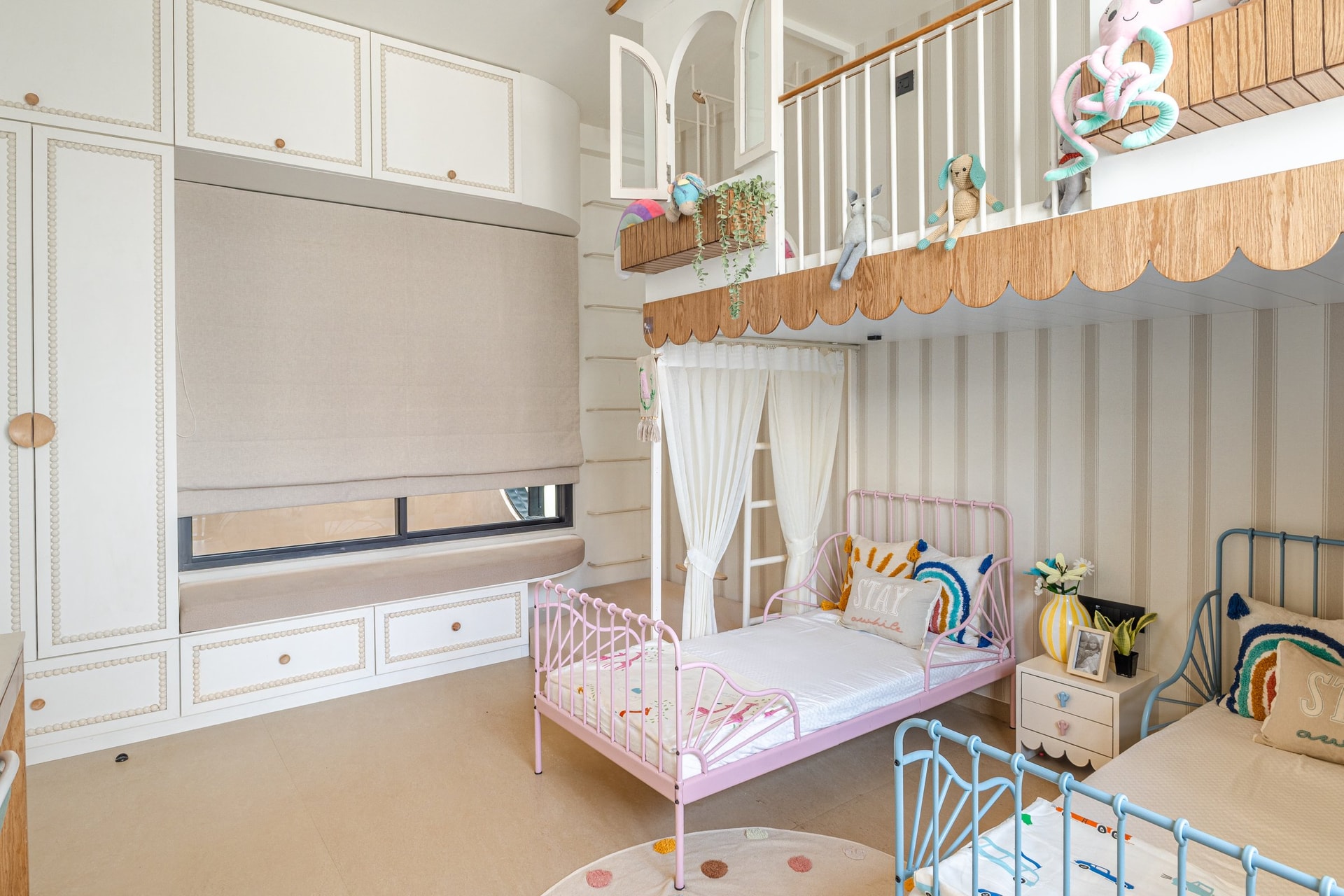
From another angle, the room reveals its built-in window seat with drawers below and a tall panelled wardrobe alongside, the kind of integrated storage that makes a children’s room actually function. The loft’s scalloped fascia in pale wood softens its geometry, and the ladder leading up to it doubles as a frame for hanging soft toys, making vertical use of every plane.
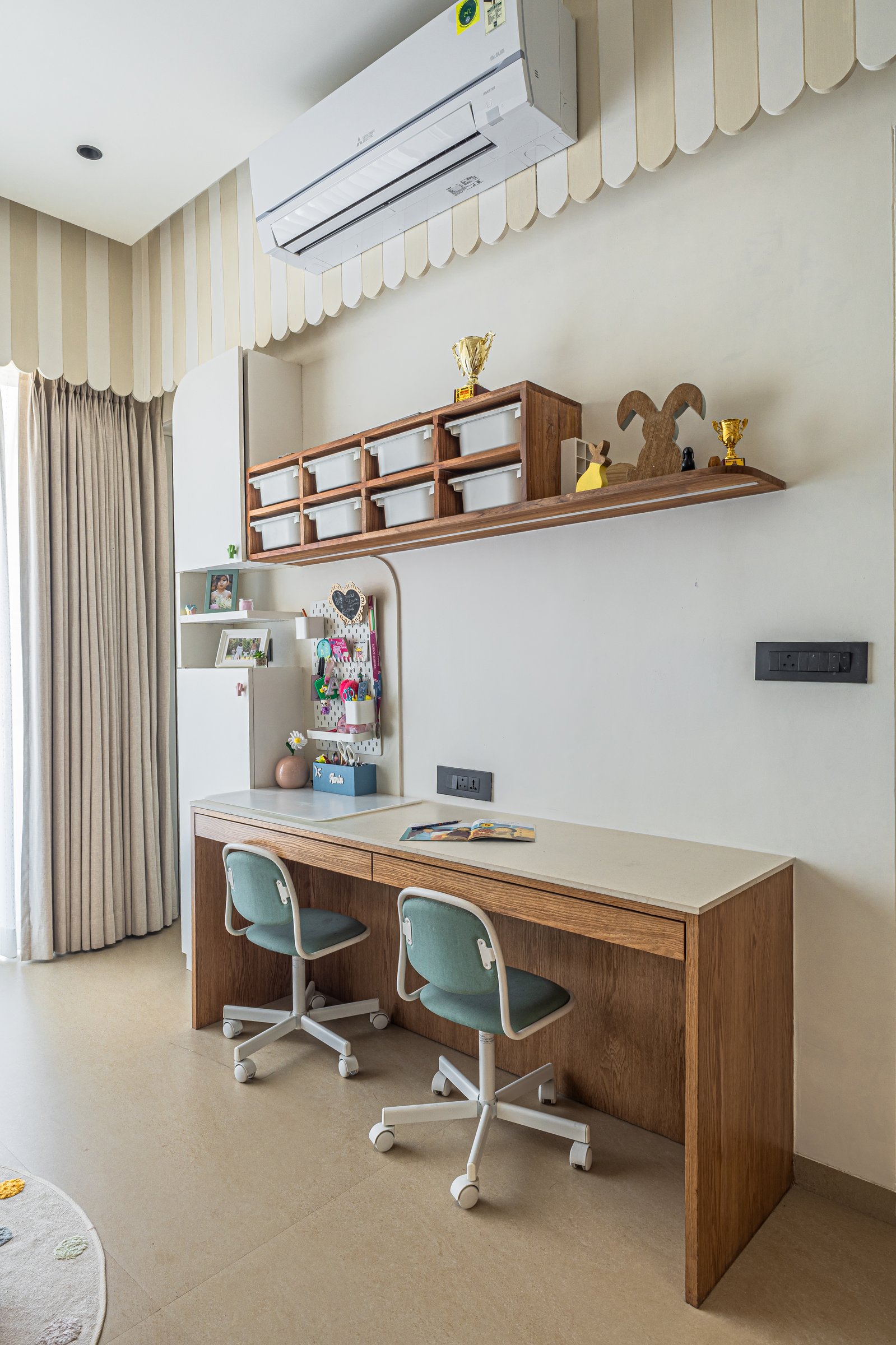
Tucked into the same room, a study counter in warm wood runs against a plain wall, with two swivel chairs in muted sage and a shelf of labelled storage bins above.
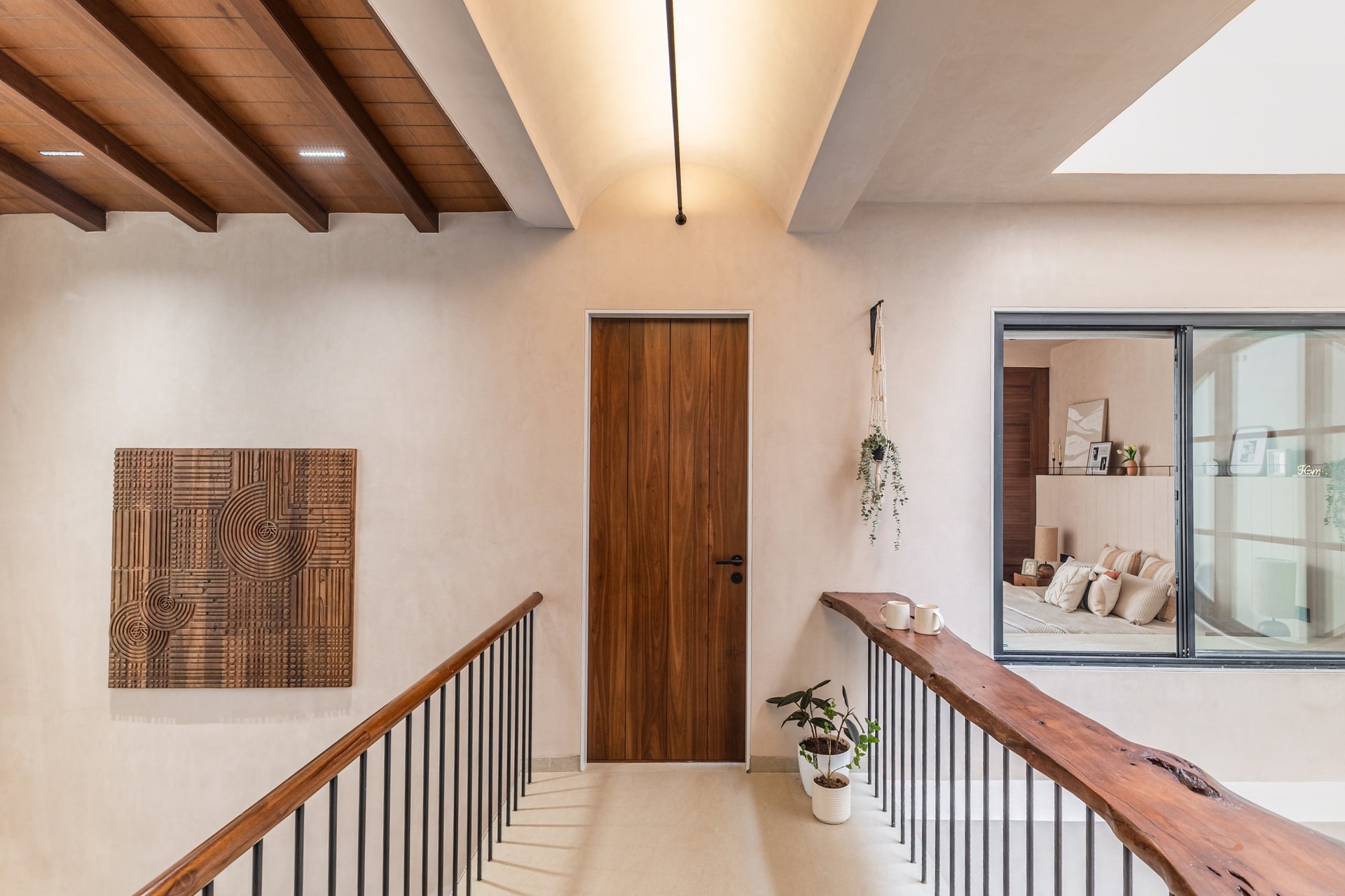
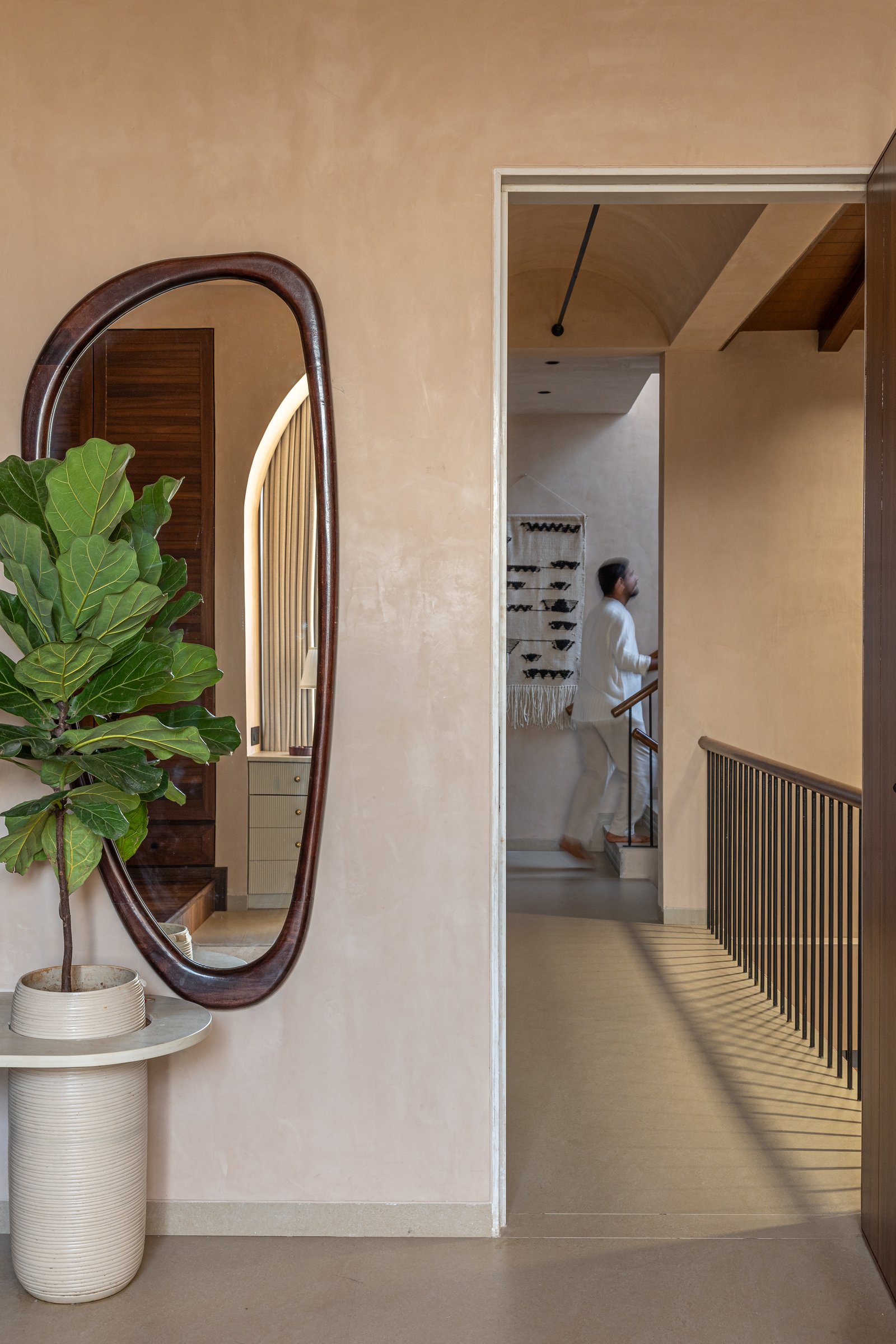
An upper passage links the bedrooms with a quiet authority all its own. Exposed wooden ceiling beams meet plaster walls and a curved vaulted ceiling above the timber door at the end, and an internal window opens a view back toward the master headboard wall. A live-edge handrail runs along the balustrade, the wood’s unfinished contour reading as a piece of sculpture as much as a piece of joinery.
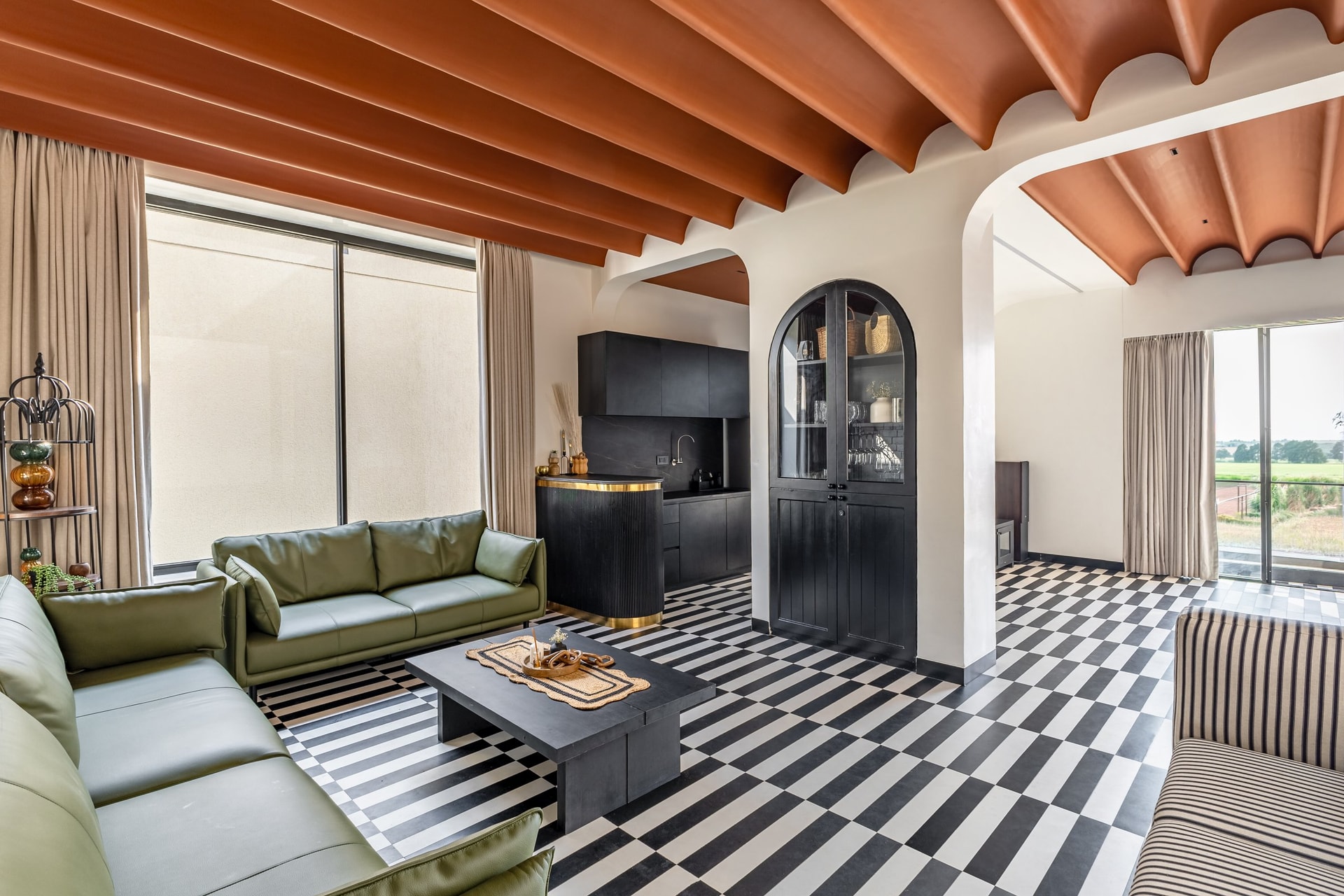
A separate entertainment volume offers the home’s clearest contrast. Here, an apricot-toned vaulted ceiling in scalloped sections meets a black-and-white checkerboard floor, with olive leather sofas, a black kitchenette, and an arched glass-fronted cabinet completing a register that is louder, more graphic, more theatrical.
Sukoon participates in a conversation that has become recognisable in recent Indian residential work: the search for a minimalism that does not feel borrowed, that earns its restraint through material warmth and proportion rather than through reduction alone. Vadodara, with its long traditions of craft and its newer appetite for contemporary form, is a useful setting for this kind of project.
What distinguishes Sukoon from its many Japandi-adjacent contemporaries is the precision of its planning. The circular courtyard, the curved plinth at the staircase, the double-height dining volume, and the arched alcoves through the master are not decorative gestures laid over a neutral plan; they are the plan, and the calm of the home is what they collectively produce.