A small apartment, well-edited, often outperforms a large one. Compression sharpens choices; every surface, every object, every silhouette has to earn its place, and the result, when it works, is a home that feels both calmer and more particular than its square footage should allow.
Apartment 902, a 750-square-foot residence in Mumbai designed by OneFive Design Studio for a young couple, takes that compression as its starting point. Principal designer Rachita Maheshwari has built the home around a single working idea: that modern living and inherited cultural sensibility need not be staged as opposites, and that a 2BHK in a Mumbai tower can hold both without strain. The brief asked for comfort, elegance, and rootedness; the response is an interior that argues for those qualities through restraint rather than display.
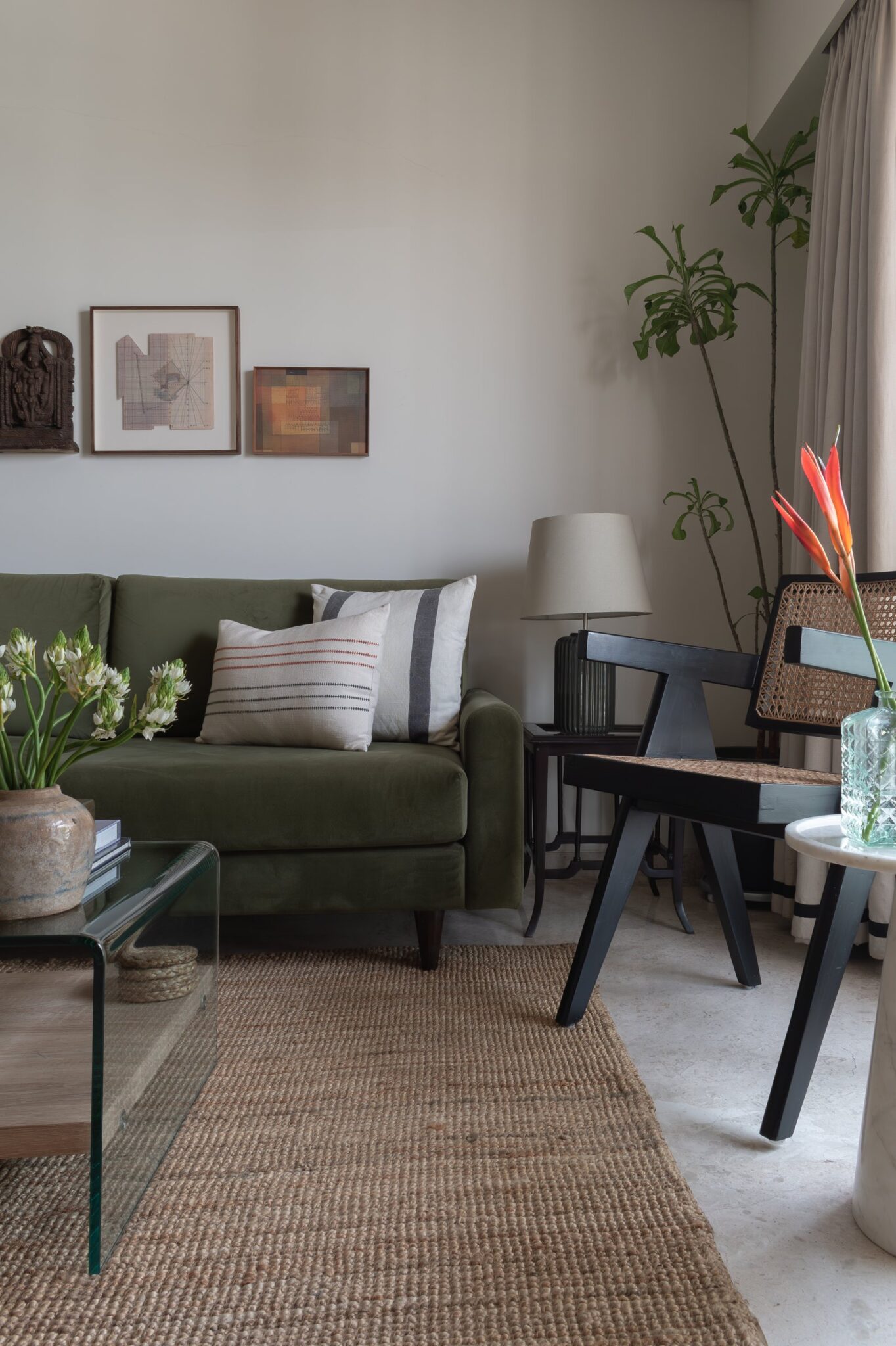
The living room sets the home’s tonal register in a single glance. A muted olive sofa in velvet anchors the seating, paired with a black lacquered Chandigarh-style chair whose caned back catches the afternoon light, while a jute rug grounds everything in honest texture. The composition is unhurried, almost careful, and that is precisely its quality.
Above the sofa, a small constellation of frames, a carved wooden devotional relief, an architectural drawing, a muted abstract, signals the home’s interest in personal history without insisting on it. A glass coffee table keeps the centre of the room visually weightless, an intelligent move in a compact plan where every solid mass would otherwise crowd the eye. The room does not chase a style; it chases coherence.
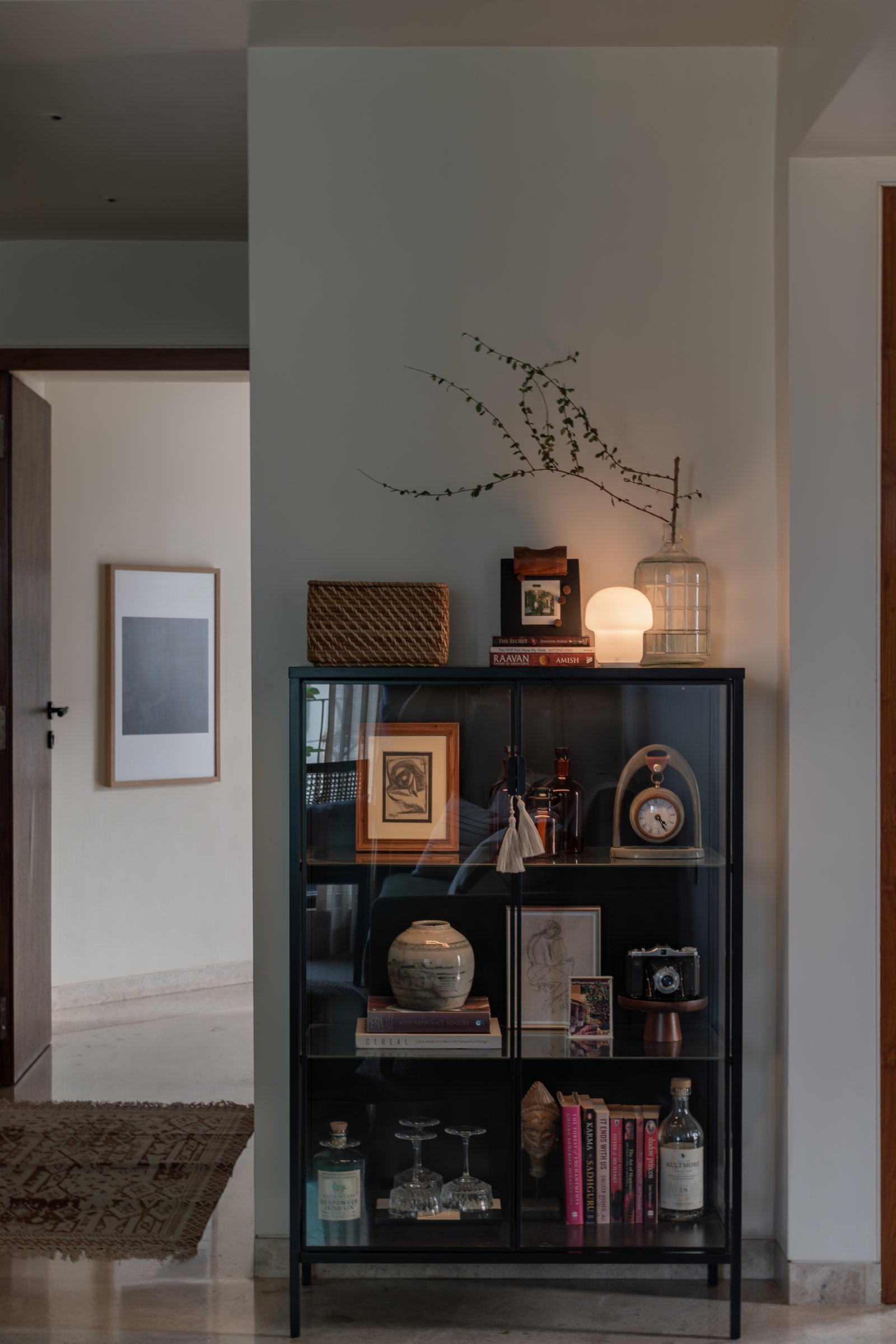
Just beyond the seating, a slim black-framed glass vitrine holds the home’s smaller archive: a vintage camera, a clay pot, a brass clock, a few well-chosen books. The cabinet is treated less as storage than as a quiet portrait of the people who live here, lit by a single mushroom lamp that turns the shelves into something closer to a still life at dusk.
““Every piece, from the carefully chosen artwork to the custom-designed furniture, tells a story of balance and harmony.””
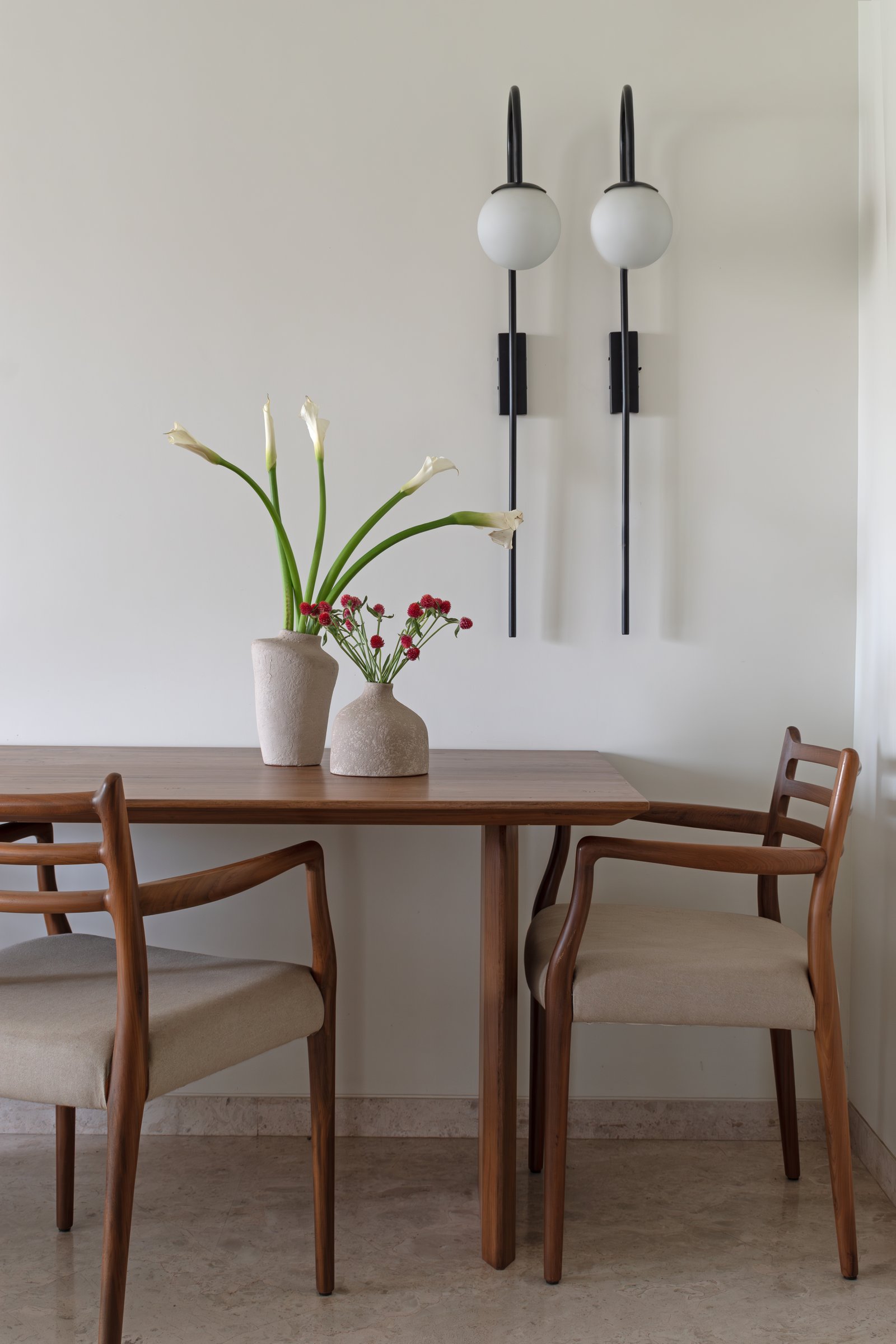
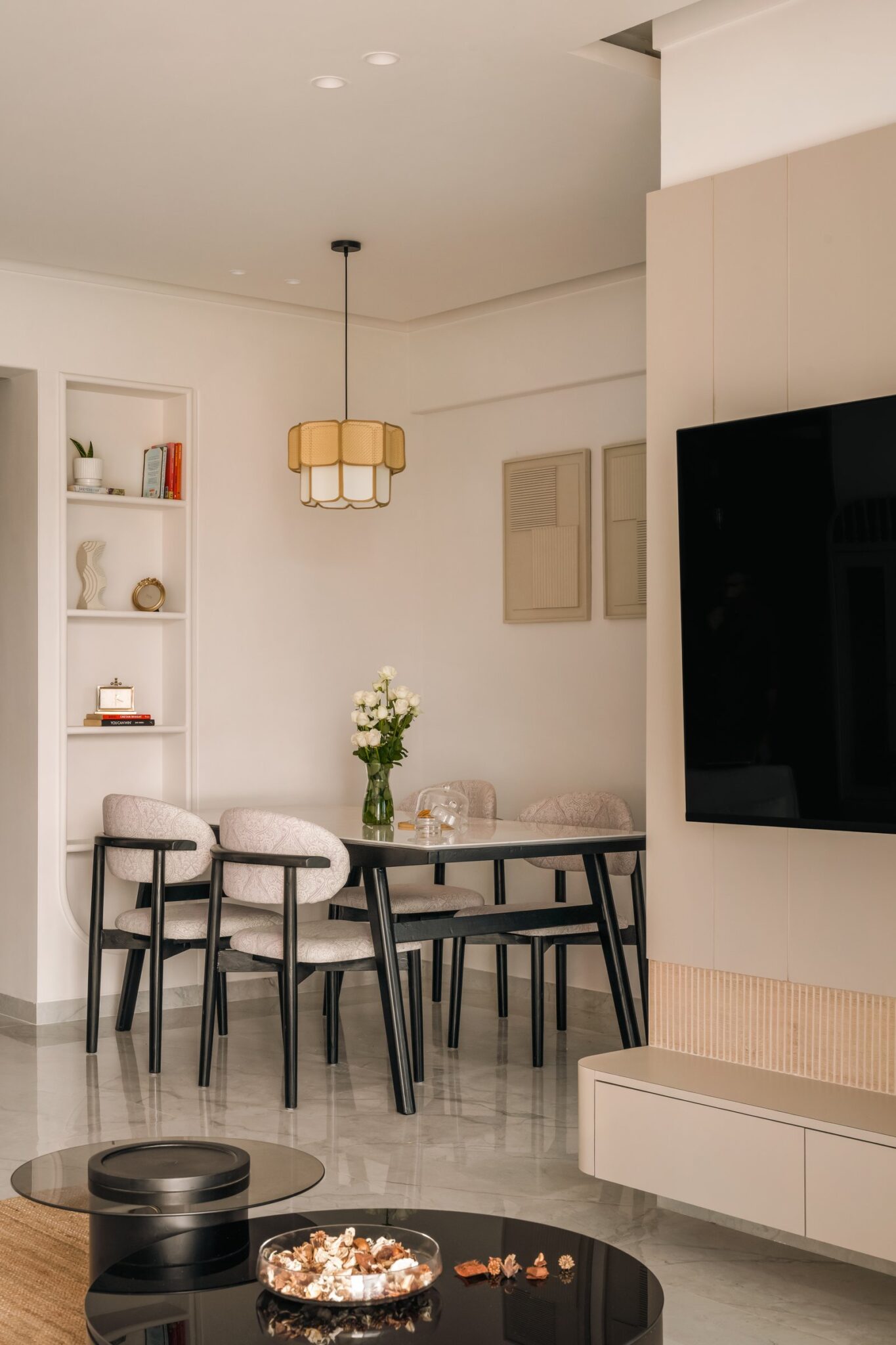
The dining corner is the home at its most distilled. A rich teak table flanked by sculpted wooden chairs in the Scandinavian-modern idiom sits against a plain wall, broken only by a pair of slim black sconces with opal globes that hang like exclamation marks above two textured stoneware vases.
What makes the vignette work is its refusal to overreach. The wall stays empty where another designer would have hung a canvas; the chairs are allowed their silhouette; the flowers, calla lilies and small red blooms, do the colour work alone. In a home of this size, an empty wall is not a missed opportunity but a deliberate breath.
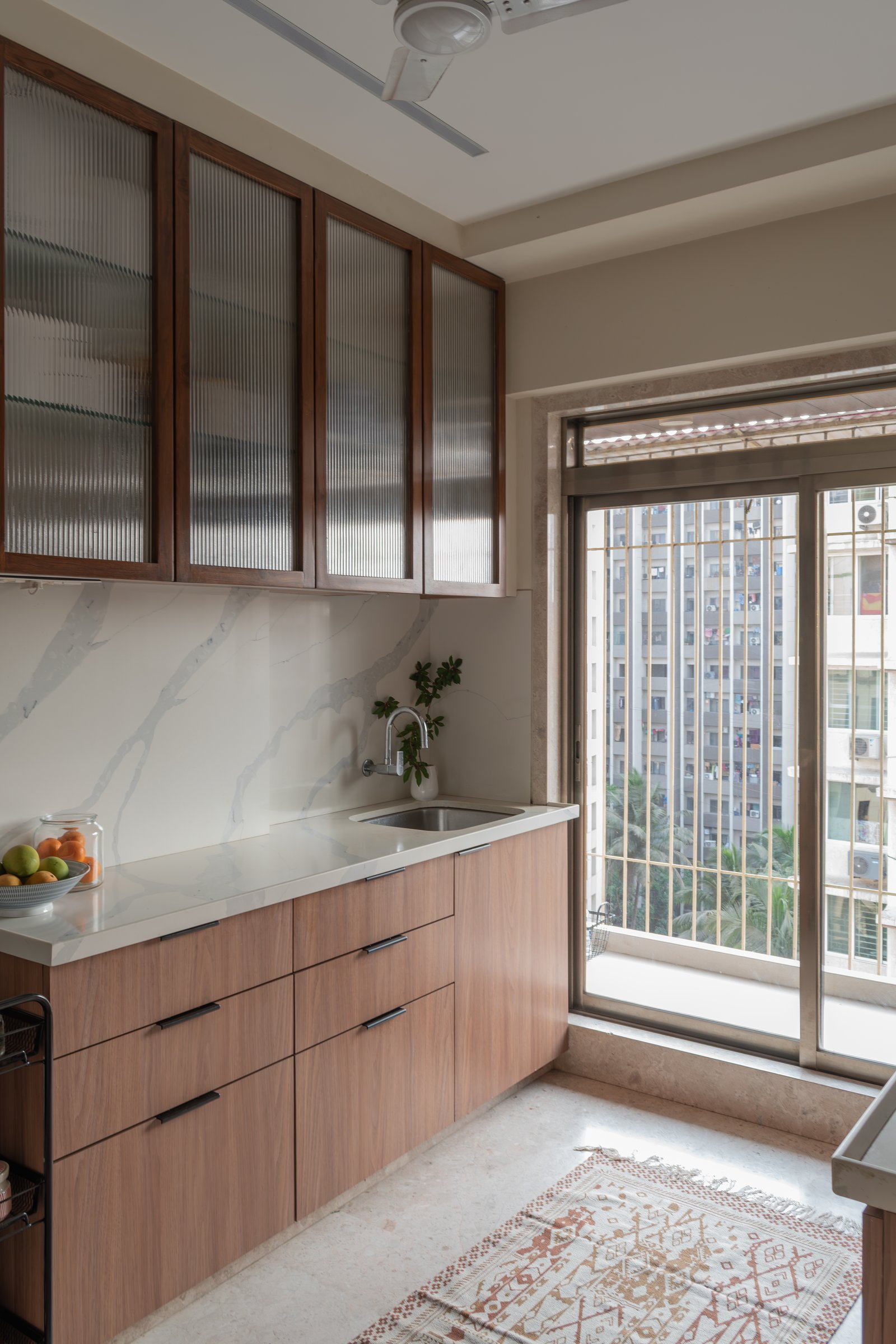
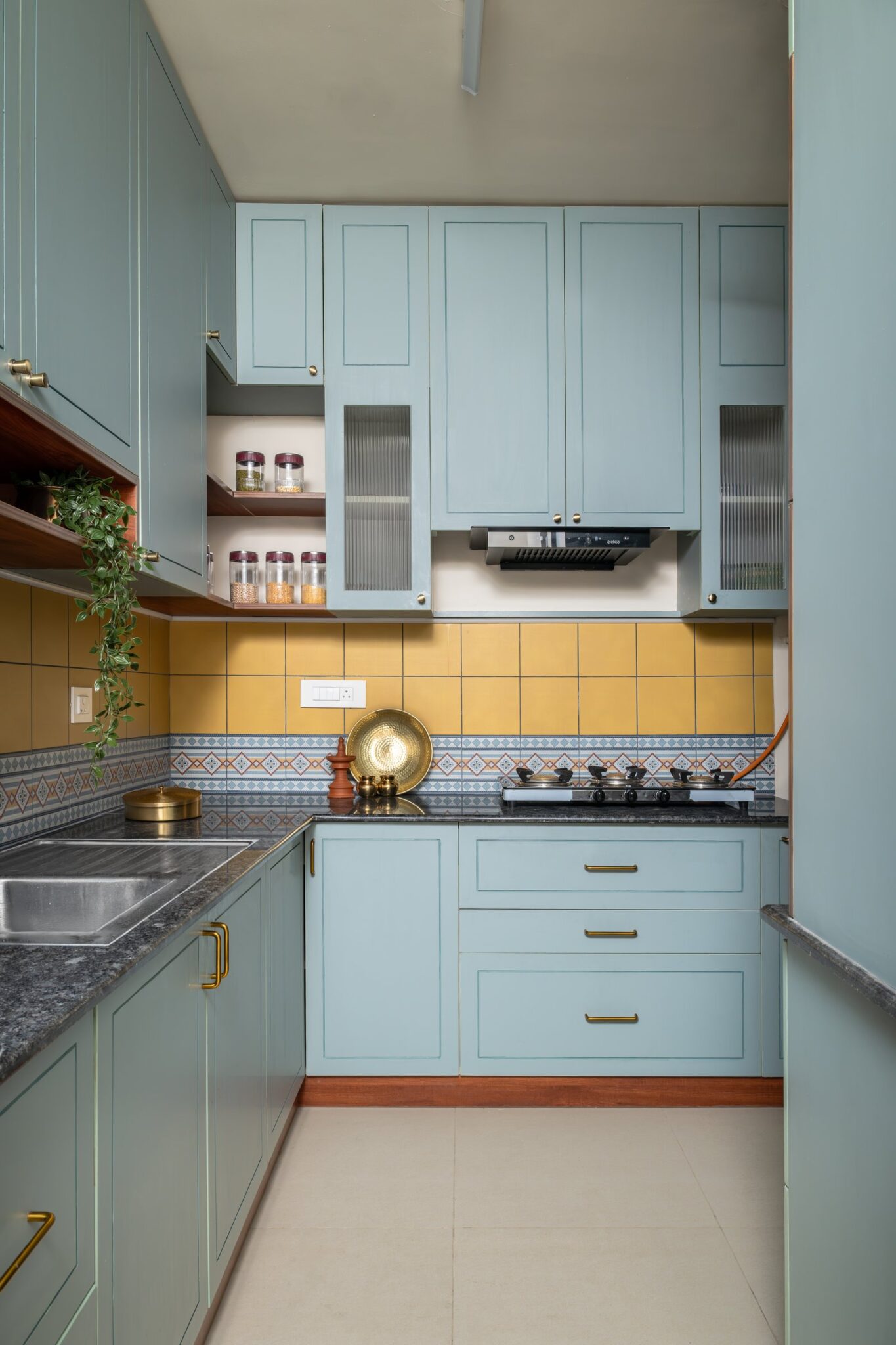
The kitchen continues the same logic in a more functional key. Wood-grained cabinetry in a warm mid-tone runs along the counter, topped by a marble-veined backsplash and crowned with reeded-glass upper units that filter what they hold rather than display it.
A sliding door opens onto a narrow utility balcony with a city view, and a small patterned dhurrie on the floor reintroduces craft into a space that could otherwise have read as purely utilitarian. It is a kitchen scaled to a couple, not a catalogue, and it is better for it.
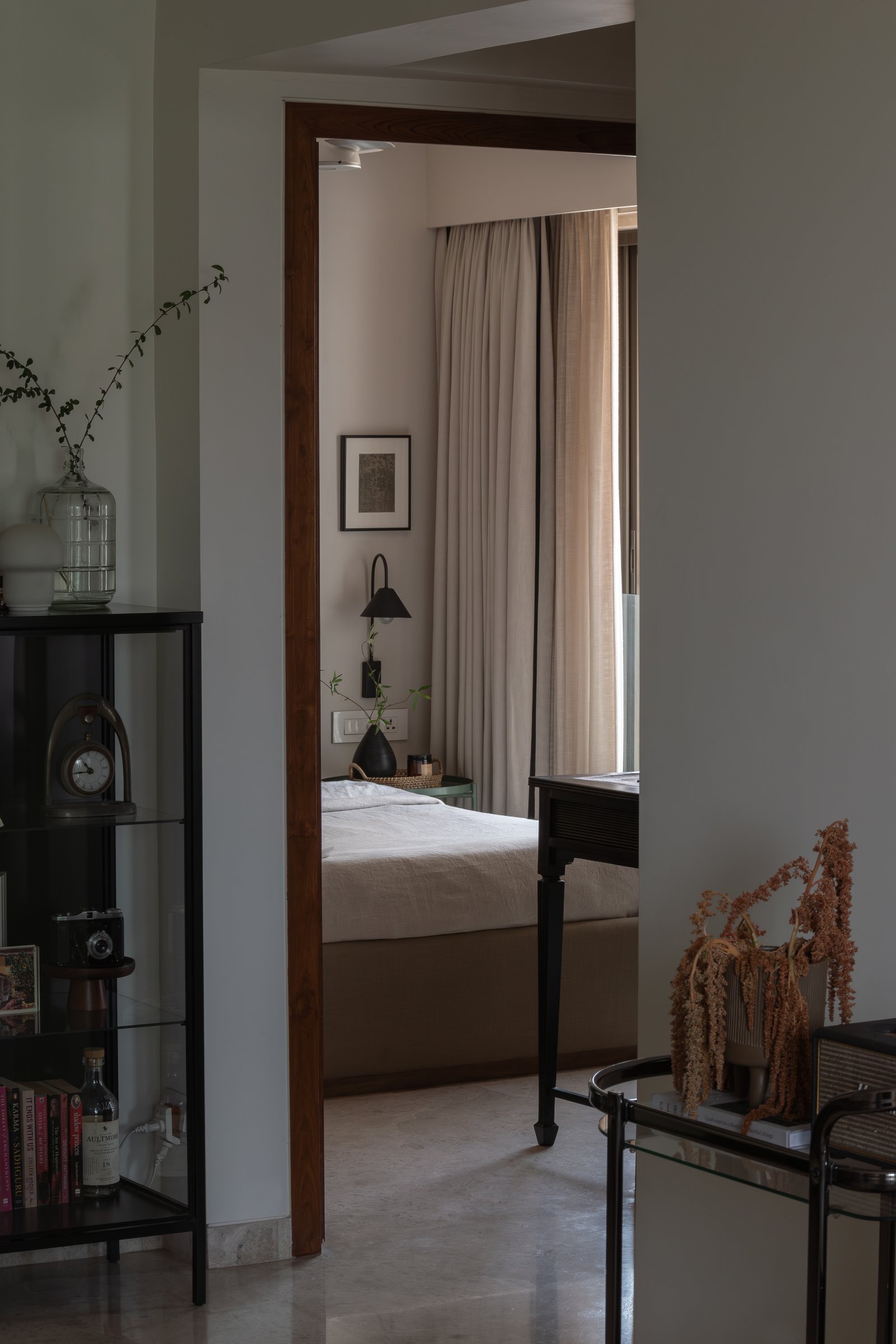
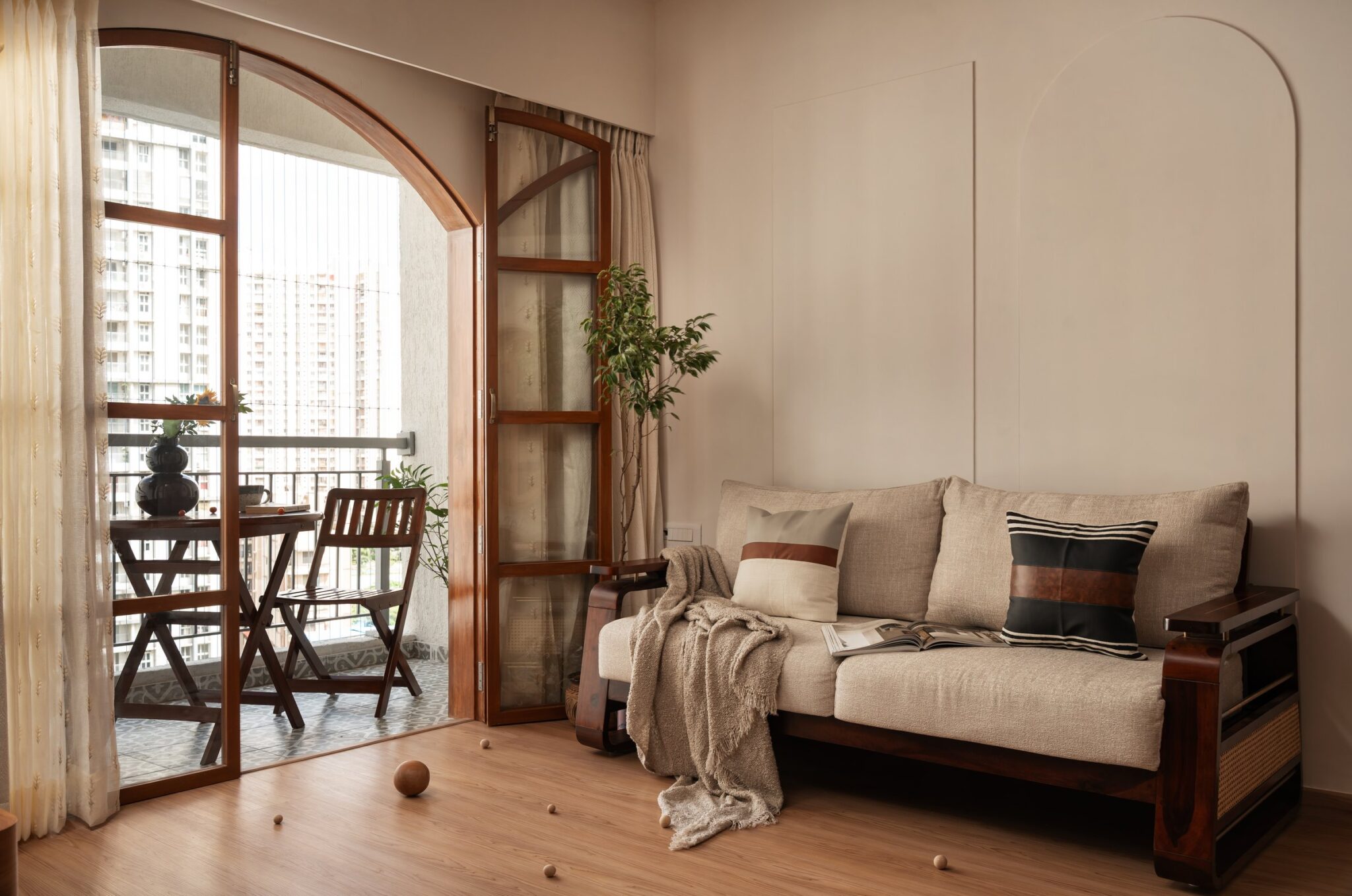
A glimpse from the living room into the master bedroom captures the home’s spatial choreography in miniature: a teak-framed doorway, a slice of bed, a curtain catching light, the black vitrine on one side and a bar trolley with dried amaranth on the other. The transitions in this apartment are not architectural events; they are gentle dimming of tone.
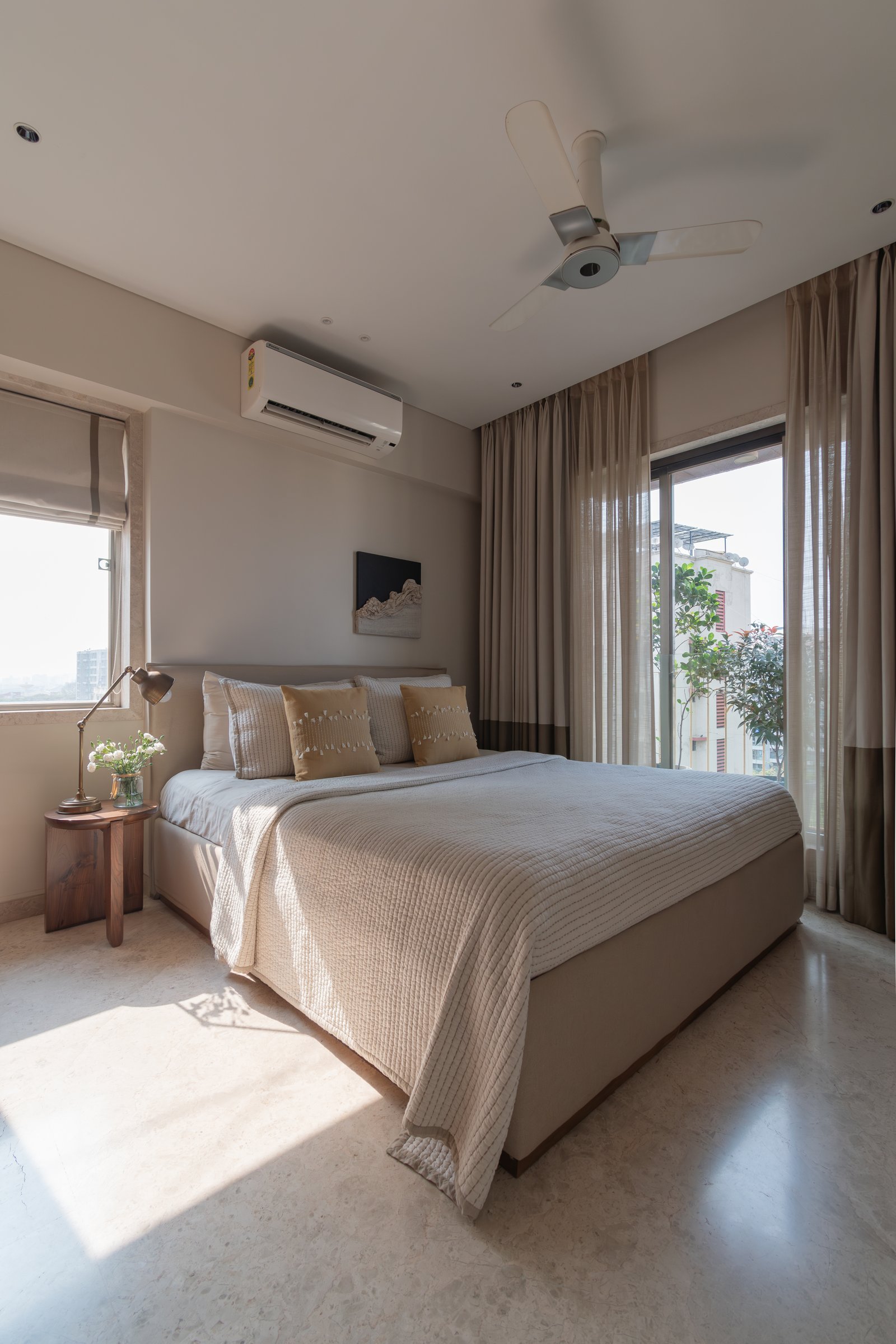
The master bedroom keeps the palette pared back to taupe, oat, and the occasional ochre cushion. A sand-toned upholstered bed sits between two windows, the curtains layered, sheer behind a heavier banded drape, so that Mumbai’s hard afternoon light arrives softened rather than blocked.
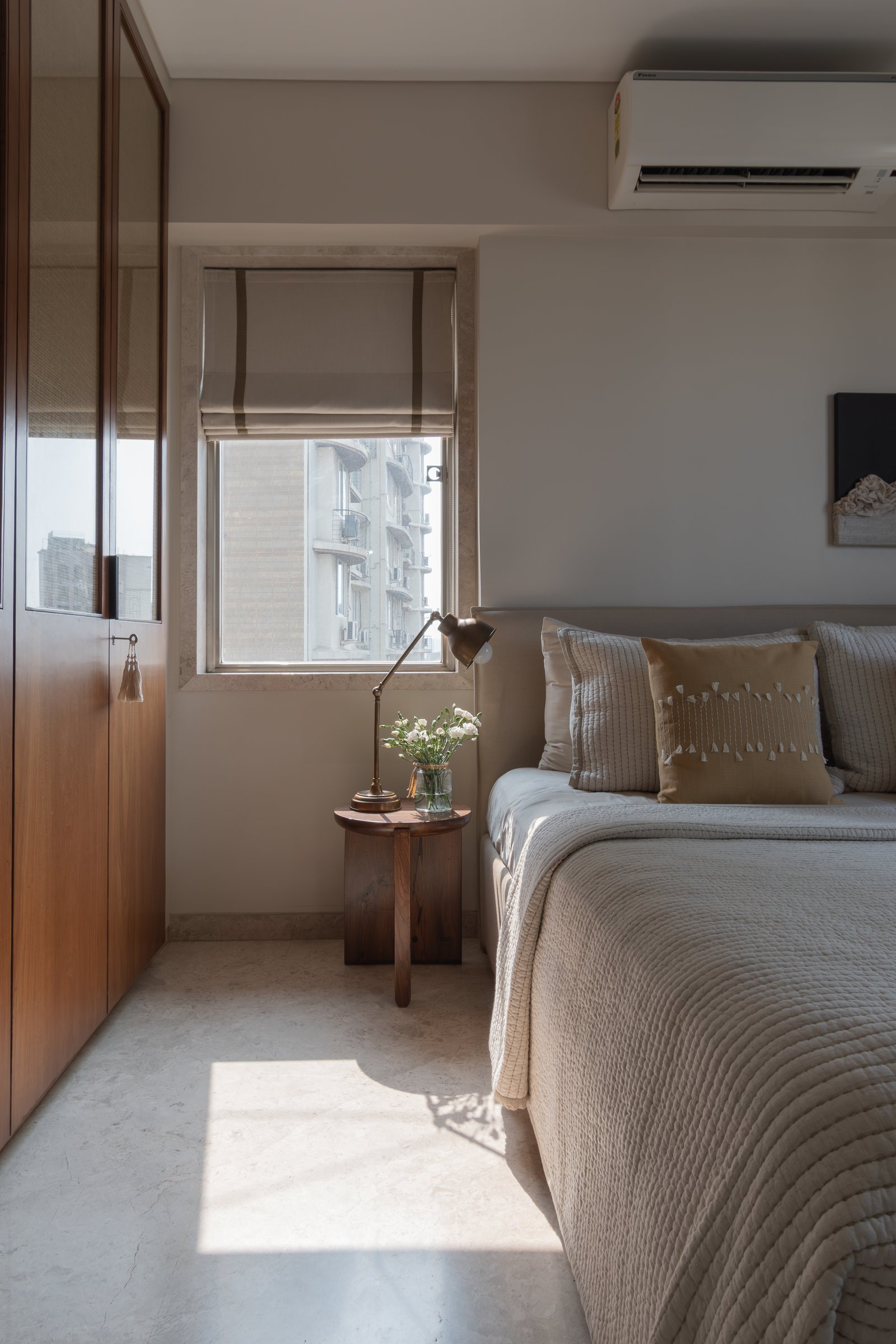
On the other side of the same bedroom, a small round wooden side table holds a brass task lamp and a glass of fresh blooms, while a wardrobe wall in honeyed wood with glass-fronted upper panels closes the room. The glass is the room’s single decorative gesture, and because nothing competes with it, it earns its place. The room feels like the work of people who have already learned what they do not need.
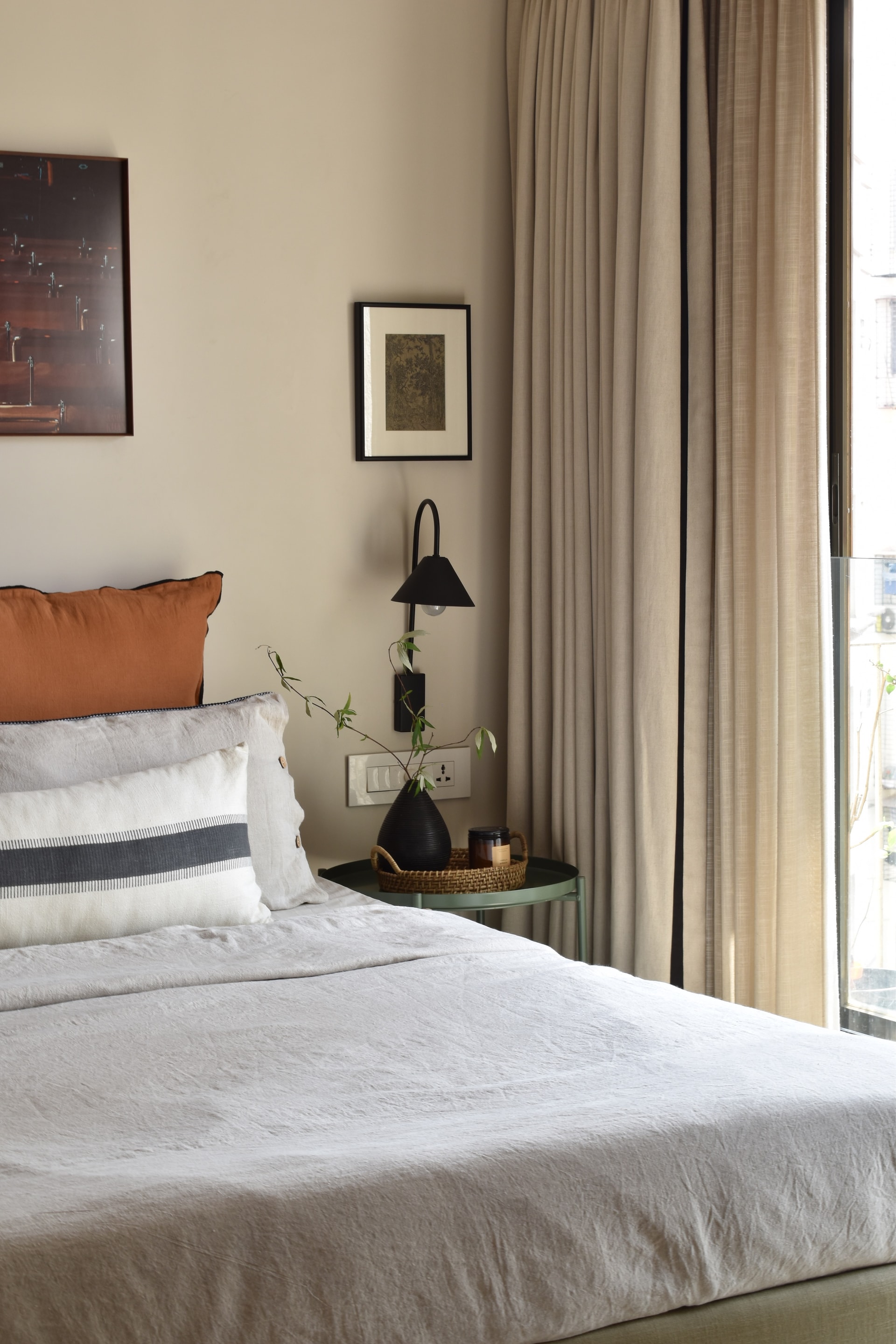
In the second bedroom, headboard wall reveals the smaller decisions that hold the room together: a striped bolster against a rust silk cushion, a black wall sconce in a graphic geometric form, a small framed work in muted gold tones. The mix is confident without being insistent, and the single rust pillow does the entire work of warmth that the rest of the room politely declines to perform.
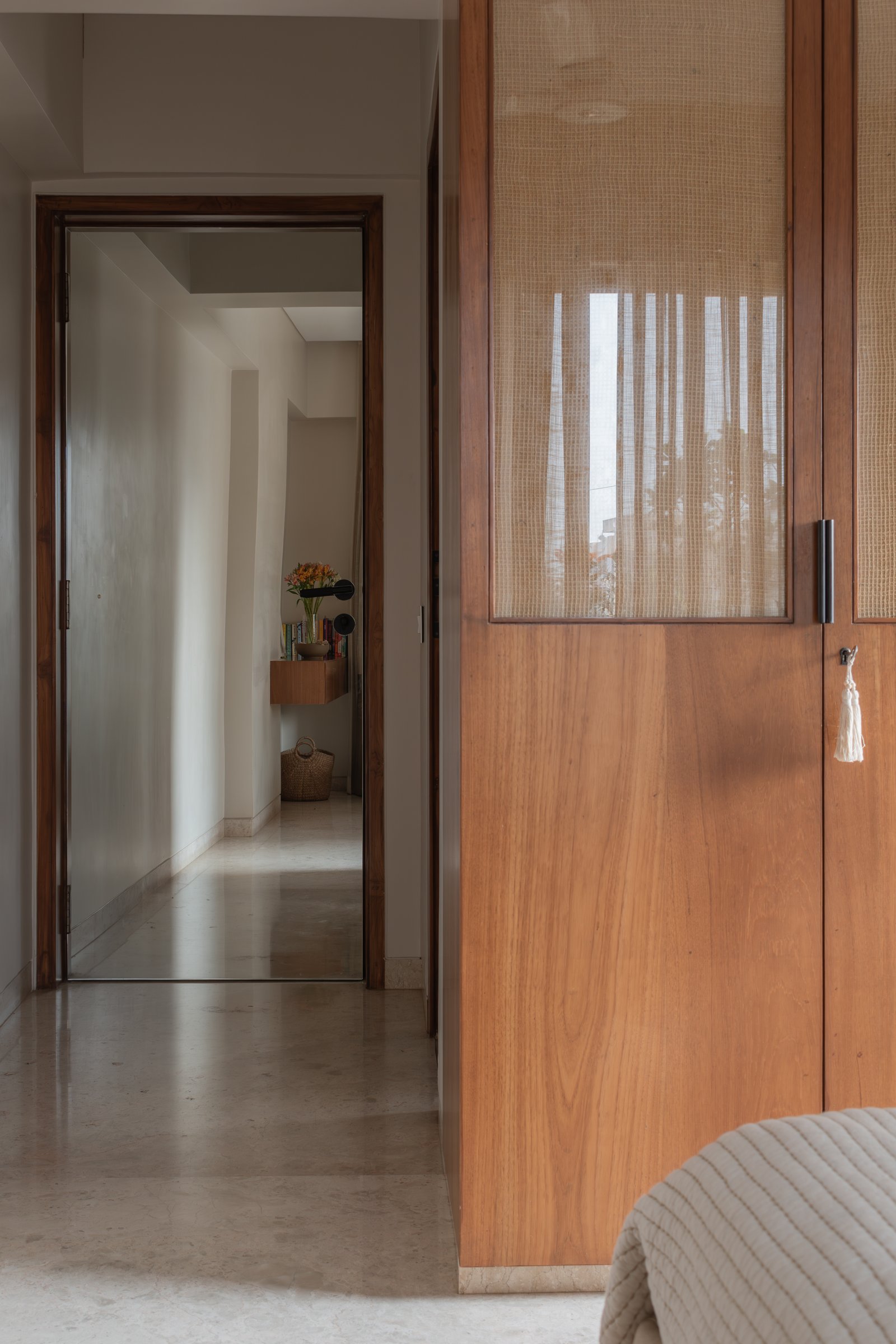
The passage between the two bedrooms reveals one of the home’s most considered details: a wardrobe in warm wood with woven cane upper panels that admit a soft, screened light, set against a polished stone floor that throws the corridor into reflection. A glimpse at the far end, of flowers on a small console, of a basket on the floor, suggests that even the in-between spaces have been given an eye.
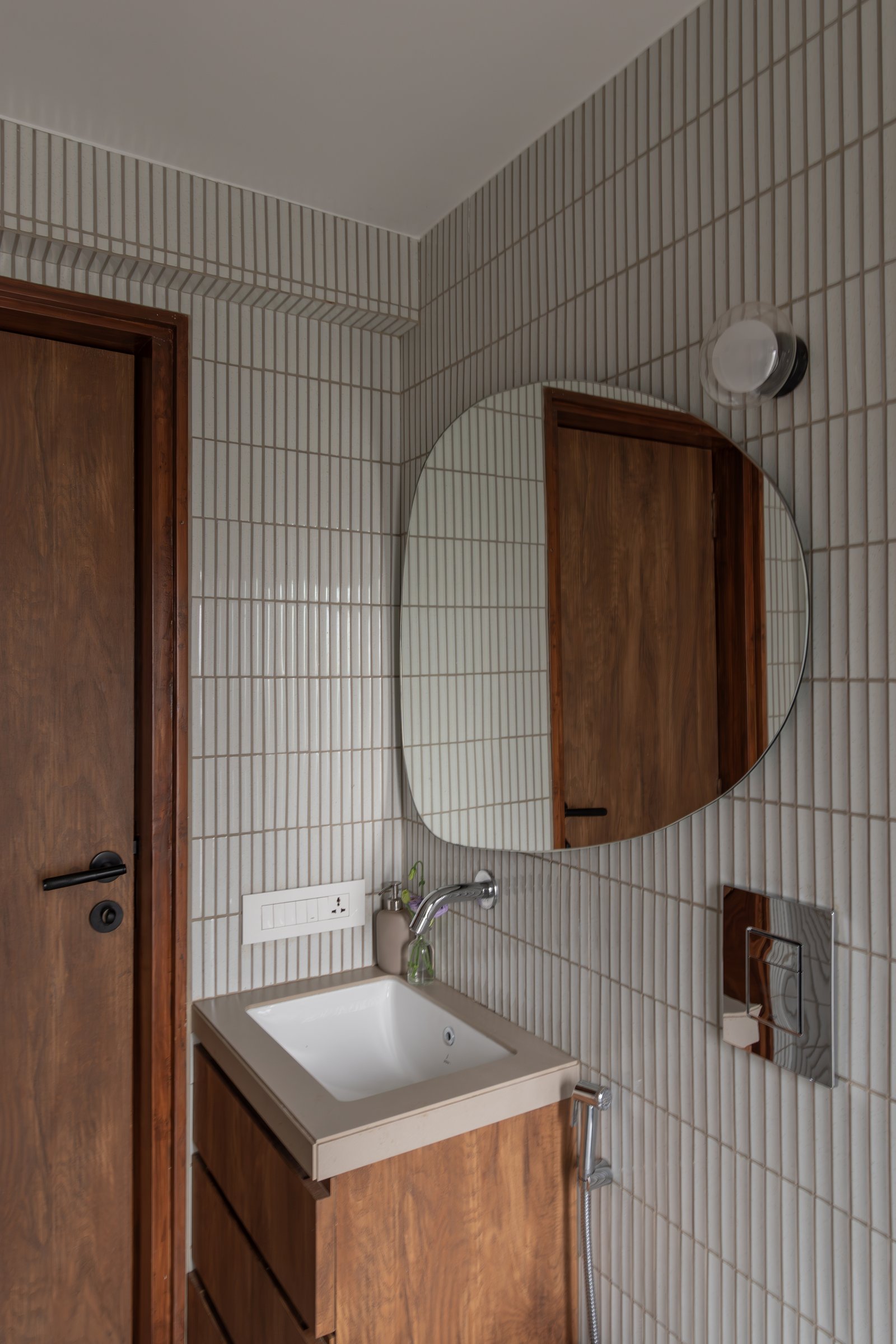
The bathroom is small and decisively styled. Stacked finger-tile in soft white runs floor to ceiling, the vertical grout lines elongating the room, while a wood-grained vanity and a wooden door in a richer tone weigh the composition down so that the tile does not float. A pebble-shaped mirror introduces the only curve in a room of straight lines, and it is enough.
What makes Apartment 902 worth attention is not any single design move but the accumulated discipline of its choices. In a market where compact Mumbai apartments are routinely asked to perform as much square footage as possible through mirrored walls, glossy cabinetry, and aggressive lighting, this home does the opposite: it accepts its size, slows the eye down, and trades visual volume for tactile depth. That is a confident position for a young studio to take.
The result is a home that reads as lived-in rather than installed, where modern furniture and quieter cultural references occupy the same rooms without one being asked to perform on behalf of the other. For a couple beginning a life in 750 square feet, the apartment proposes that elegance is largely a matter of editing, and that the things one chooses not to do are as visible, in the end, as the things one does.